
Human-in-the-Loop for AI Voice Agents: Safety Playbook



Implement human-in-the-loop for AI voice agents with practical approval rules, calibrated routing, reliable handoffs, and measurable QA checks.
Human-in-the-Loop for AI Voice Agents: Safety Playbook
An AI voice agent can give a perfectly fluent answer—and still take the wrong action. Human-in-the-Loop for AI Voice Agents means giving people defined authority to approve, interrupt, and review consequential decisions, rather than assuming that a convincing conversation is a safe one.
That distinction matters because support automation is moving beyond answering questions. An agent that retrieves a delivery update presents one level of risk; an agent that changes an address, promises compensation, or updates a customer record presents another. On a live call, the customer may hear a confident commitment before anyone notices that the underlying action was inappropriate.
The shift is already visible in 2026. Technoyard’s April 7, 2026 guide describes autonomous agents handling customer inquiries across chat, email, phone, and social media, including returns and troubleshooting. As of October 2026, Gleap’s support-automation article claims that nearly 40% of new deployments “flounder or even fail,” often because of governance and oversight gaps; treat that vendor-reported figure as a warning signal, not an independently established industry failure rate.
The practical lesson is stronger than any headline: more autonomy requires clearer boundaries, not merely better prompts. Nividous’s human-oversight guidance, available as of October 2026, emphasizes alignment with risk appetite, brand voice, and regulation. Anthropic’s containment guidance likewise explains that a tightly constrained environment can allow reduced per-action oversight—a useful distinction between controlled autonomy and unrestricted access.
What should human oversight for AI voice agents actually control?
Consider a caller requesting a refund after a failed delivery. A safe workflow might let the agent explain policy and gather details, but require approval before an exception changes the customer’s financial outcome. If the caller disputes the decision or asks for a person, escalation should be a designed path—not an improvised apology.
This playbook will show you how to:
- Set action boundaries: distinguish routine assistance from decisions requiring approval.
- Design escalation triggers: account for sensitive requests, disputed outcomes, and explicit requests for human help.
- Enable live intervention: define who can take control and what context they need.
- Audit and improve: review recordings, transcripts, tool actions, and outcomes before expanding autonomy.
As of October 2026, CallMissed supports live call monitoring with supervisor listen, whisper, and barge-in capabilities, alongside recordings, transcripts, and call scoring against custom QA rubrics.
The goal is not to put a human behind every sentence. It is to ensure that consequential decisions remain accountable, recoverable, and subject to meaningful human control.
How do you keep AI voice agents accountable? Set limits, require approval, and enable human takeover
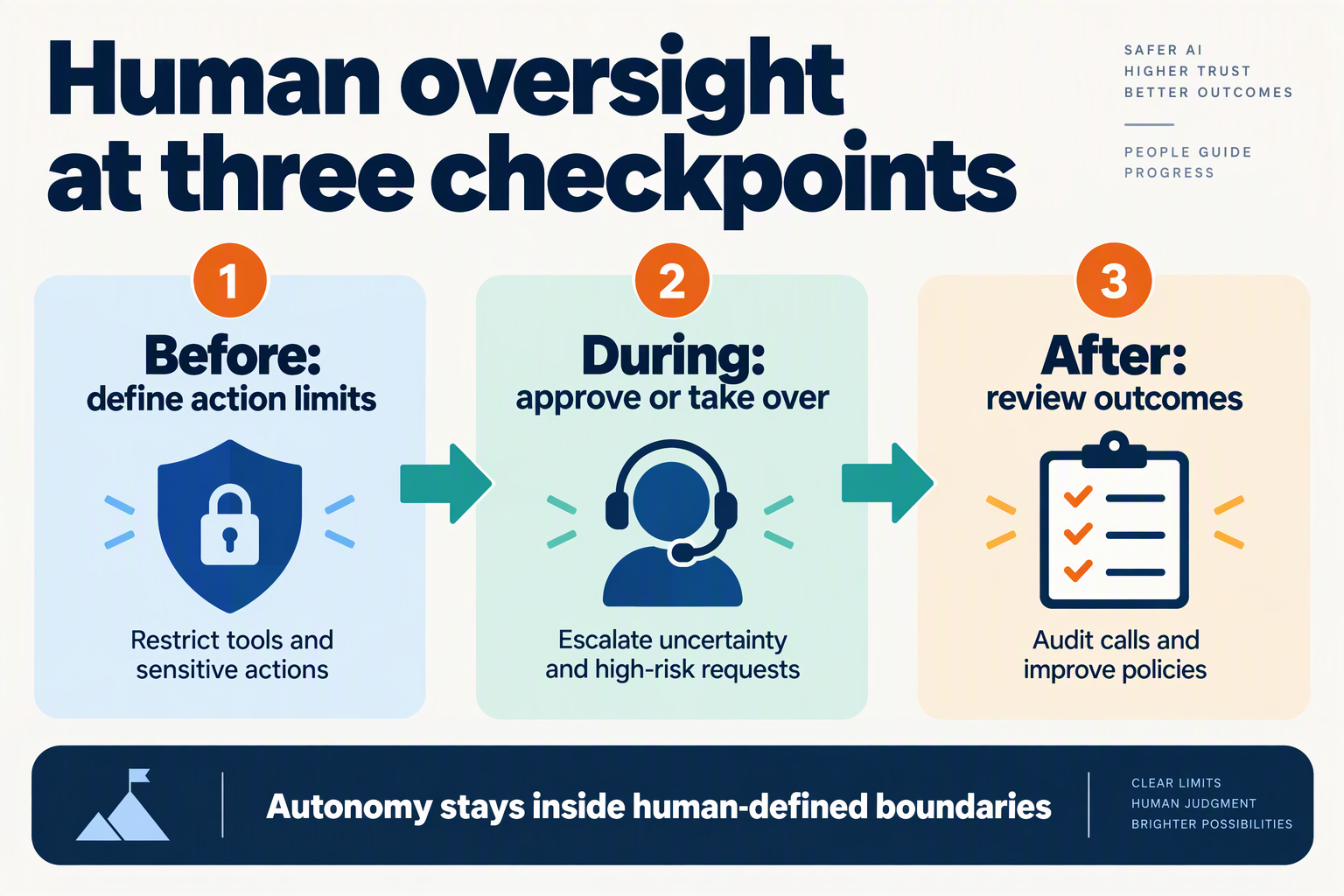
Keep AI voice agents accountable by enforcing action limits outside the model, requiring approval before consequential changes, and giving a named operator a reliable takeover path. Each action should have an owner, an authorization rule, and a record showing what actually happened—not just what the agent told the caller.
How do you set enforceable limits for an AI voice agent?
Start with the tools the agent can execute, rather than a prompt asking it to “be careful.” A support agent may need permission to retrieve an order, but that does not automatically justify permission to change its destination or issue compensation.
Create an action-permission register with three categories:
- Allowed: Read-only tasks and narrowly defined, reversible updates.
- Approval required: Financial commitments, identity-sensitive changes, or exceptions to policy.
- Blocked: Actions outside the agent’s role, including unrestricted data exports or administrative account changes.
Enforce these categories in the application or tool layer. Validate the caller’s authorization, permitted fields, transaction limits, and current account state before executing a request. A persuasive caller—or an instruction embedded in retrieved content—should not be able to override those checks.
As of October 2026, Anthropic’s containment guidance states, “A tight perimeter also means you can relax oversight.” Although the example concerns Claude Code rather than voice support, the design lesson transfers: reduce the agent’s reachable actions before reducing human supervision.
Where should approval checkpoints sit in a support workflow?
Place approval before the consequential action executes, not after the agent has promised an outcome. Approval should authorize a specific proposed action, not give the agent open-ended permission to resolve the case however it chooses.
Gleap’s support-automation guidance, available as of October 2026, recommends “Checkpoint approvals at key moments,” including large payments and data exports.
A practical approval sequence is:
- Prepare: Collect verified account details, the requested change, and the applicable policy.
- Pause: Explain that the request needs review, without presenting it as already approved.
- Review: Show the operator the proposed action, supporting evidence, and expected consequences.
- Execute: Apply only the approved change; recheck authorization if relevant details have changed.
- Confirm: Tell the caller what succeeded, failed, or remains pending.
For an illustrative refund workflow, approval for ₹500 should not authorize a later ₹2,000 refund or a different recipient. These amounts are design examples, not industry benchmarks. Bind approval to the customer, amount, destination, and action; expire it when those details change.
What makes human takeover meaningful rather than cosmetic?
A takeover button is insufficient if nobody owns the queue or the operator lacks context. Define staffing, response expectations, and a fallback when no authorized person is available.
The handover should include:
- Customer intent and verification status
- Actions completed, attempted, and awaiting approval
- Relevant policy evidence and unresolved questions
- Any commitments already communicated
As of October 2026, CallMissed’s no-code agent builder supports custom REST tools and versioning with publish and rollback. Teams can use those capabilities alongside application-level authorization controls; tool connectivity itself should never be mistaken for approval enforcement.
Finally, test takeover under failure conditions: an unavailable supervisor, a rejected tool request, or a disconnected call. Accountability means the workflow remains safe when intervention is delayed, with consequential actions paused and unfinished requests clearly recorded.
What is changing in autonomous customer support in 2026, and why does oversight matter?
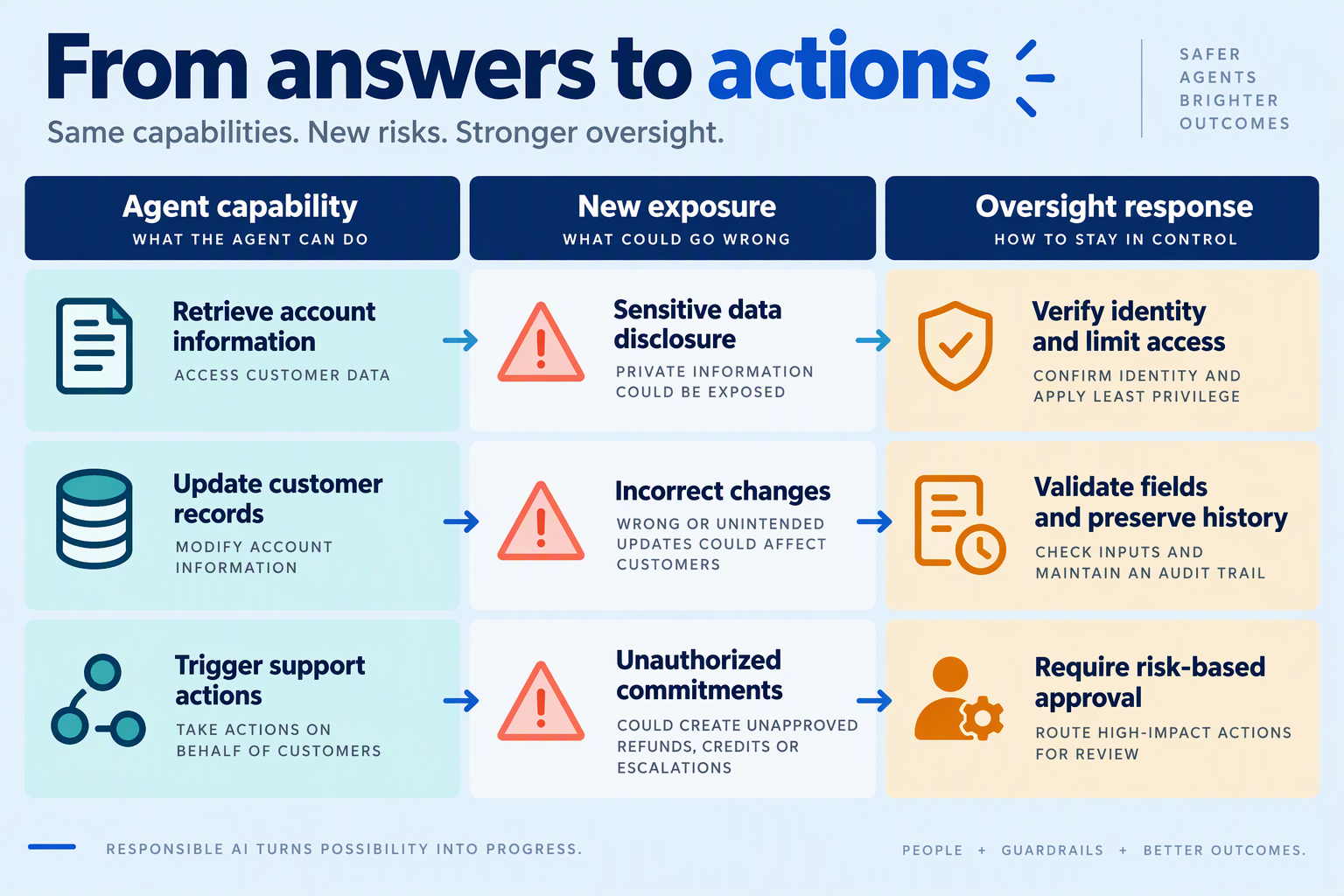
Autonomous customer support in 2026 is shifting from generating answers to executing connected workflows: retrieving account details, updating records, and coordinating next steps across channels. Oversight matters because an error can now persist in business systems and influence later interactions—not just appear in one conversation.
CloudNow Consulting’s guidance, available as of October 2026, describes customer-facing agents retrieving account information, updating customer records, processing requests, recommending next steps, and summarizing conversations. The operational change is significant: teams must evaluate what the agent changed, not merely whether its response sounded helpful.
What is changing in autonomous customer support workflows?
The table below maps capabilities described in the supplied 2026 industry guidance to practical oversight requirements. These are recommended controls, not claims that every platform implements them automatically.
| Workflow shift | 2026 source context | Oversight requirement | Evidence to retain |
|---|---|---|---|
| Answers become actions | CloudNow Consulting describes customer-record updates and request processing; available October 2026. | Separate read access from permission to change records. | Before-and-after values and action result. |
| Support spans channels | Technoyard’s April 7, 2026 guide covers chat, email, phone, and social media. | Preserve ownership when conversations move between channels. | Conversation history and assigned owner. |
| Outreach becomes proactive | AetherLink’s 2026 voice-agent guide describes renewal and warranty-expiry detection. | Check eligibility, permission, and contact timing before outreach. | Trigger, permission record, and contact outcome. |
| Agents pursue defined goals | AetherLink’s enterprise-autonomy guide describes action within constrained environments; available October 2026. | Define allowed tools and explicit stopping conditions. | Tool permissions and termination reason. |
| Governance enters workflow execution | Gleap’s 2026 support-automation guidance recommends checkpoints for large payments and data exports. | Route consequential actions to an authorized reviewer. | Reviewer decision and execution status. |
| Review extends beyond dialogue | Nividous’s oversight guidance emphasizes visibility into actions and decision paths; available October 2026. | Review operational outcomes alongside conversations. | Action sequence and supporting policy context. |
Why does cross-channel autonomy create new oversight problems?
A customer might begin with a chat about a replacement, call to change the delivery address, and later receive an order-status message. Each interaction can appear correct individually while the combined workflow contains conflicting instructions.
The oversight unit should be the customer case, not the individual message. Reviewers need to distinguish a proposed change from a completed change—and identify which system holds the authoritative record.
As of October 2026, CallMissed provides custom REST tools, integrations including Shopify and HubSpot, and a built-in CRM with per-record timelines. These capabilities illustrate why workflow-level oversight matters: connecting conversations to operational systems increases the importance of clear permissions and traceable changes.
How should teams measure readiness for greater autonomy?
Before expanding an agent’s scope, test whether the workflow can answer three questions:
- Did the intended action complete? A spoken confirmation is not evidence that an update succeeded.
- Was the action permitted? Technical access does not establish business authorization.
- Can a person reconstruct and correct the outcome? Recovery needs usable records, ownership, and a defined correction path.
Useful review categories include:
- Execution mismatches: the agent announces success after a failed tool action.
- State conflicts: separate channels hold incompatible customer instructions.
- Ownership gaps: an unresolved case has no accountable person or queue.
The central 2026 shift is therefore organizational as much as technical: autonomy connects more steps, so human oversight must follow the entire chain.
Which actions should run autonomously, wait for approval, or trigger takeover?
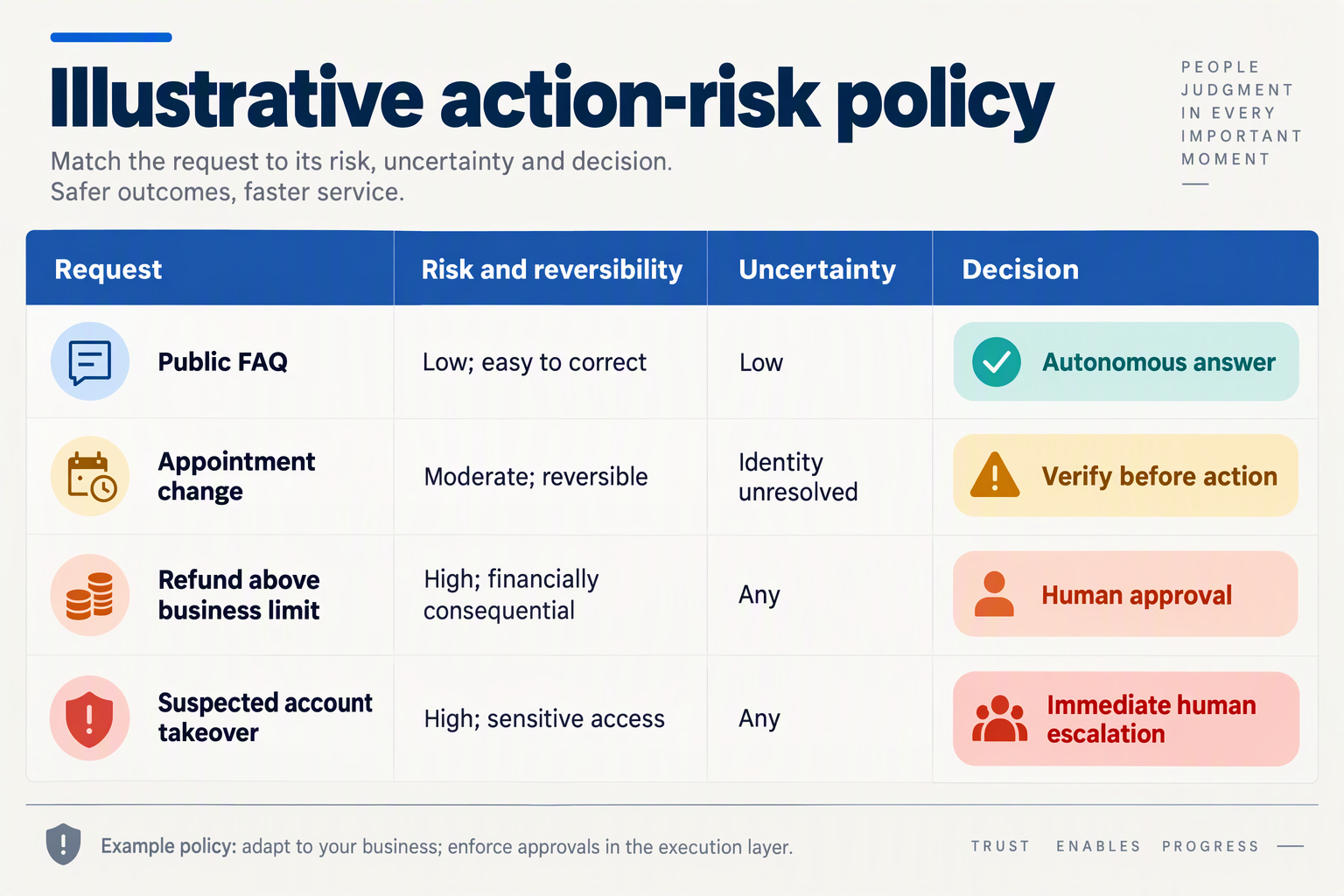
Let AI agents execute low-risk, reversible actions within verified permissions; require approval for consequential changes; trigger human takeover when consent, identity, safety, or the customer relationship is in doubt. Classify each action separately—not the entire call—because one conversation can move through all three oversight levels.
Which support actions belong in each oversight tier?
The following is a recommended operating policy for October 2026, not a claim about any platform’s default safeguards. Apply stricter controls where contracts, industry rules, or local law require them.
| Action | Oversight tier | Required boundary | If the boundary fails |
|---|---|---|---|
| Explain published policies or troubleshooting steps | Autonomous | Use approved, current knowledge; avoid unsupported promises | Stop guessing and escalate |
| Retrieve order status or appointment details | Autonomous | Verify the caller’s authorization before revealing personal information | Withhold details; route for identity checks |
| Add an internal call summary or proposed ticket category | Autonomous | Label generated content; preserve the original record and allow correction | Flag uncertainty for review |
| Change a delivery address or reschedule a booking | Approval | Confirm the exact change and obtain required authorization before writing | Leave the existing record unchanged |
| Issue exceptional refunds, credits, or contract changes | Approval | Named reviewer approves the amount, recipient, and terms | Keep the request pending; make no commitment |
| Handle suspected fraud, threats, identity disputes, or requests for a person | Human takeover | Stop consequential tool actions and route to an authorized human | Follow a defined callback or specialist route |
Approval and takeover solve different problems. Approval lets a human authorize a bounded action while the agent continues the workflow. Takeover transfers responsibility for the conversation because continuing autonomously is no longer appropriate.
How should teams decide whether an action needs approval?
Use three questions before granting a tool permission:
- What changes? Reading a delivery estimate differs from changing where a parcel will be delivered. Evaluate data exposure as well as record modification.
- Can the outcome be reversed? An editable internal note is easier to correct than a disclosed account detail or a binding financial promise.
- Who has authority? Customer confirmation establishes intent, but does not replace staff approval when an exception exceeds delegated authority.
Gleap’s support-automation guidance, available as of October 2026, recommends “checkpoint approvals at key moments,” including large payments and data exports. Translate that principle into explicit business rules rather than asking the model whether an action “seems risky.”
For example, a caller could confirm a new address while a separate policy still requires staff approval because the order has already shipped. Consent is necessary, but not always sufficient.
What must happen while an agent waits for approval?
An approval gate should block execution, not merely display a warning. Implement the boundary in the workflow or tool layer rather than relying only on prompt instructions.
- Show the reviewer: the proposed action, affected record, customer request, and relevant policy.
- Bind approval to the proposal: changed amounts, addresses, or terms require fresh approval.
- Fail closed: a timeout or unavailable reviewer leaves the action pending, not automatically approved.
Anthropic’s containment guidance, available as of October 2026, links reduced per-action oversight to a “tight perimeter.” The practical implication is that broader permissions demand stronger controls.
For live intervention, CallMissed supports supervisor listen, whisper, and barge-in capabilities as of October 2026. Those capabilities can support an escalation design; teams must still define takeover triggers, reviewer authority, and tool-level approval enforcement.
How do you calibrate a confidence-based routing system without trusting model self-confidence?
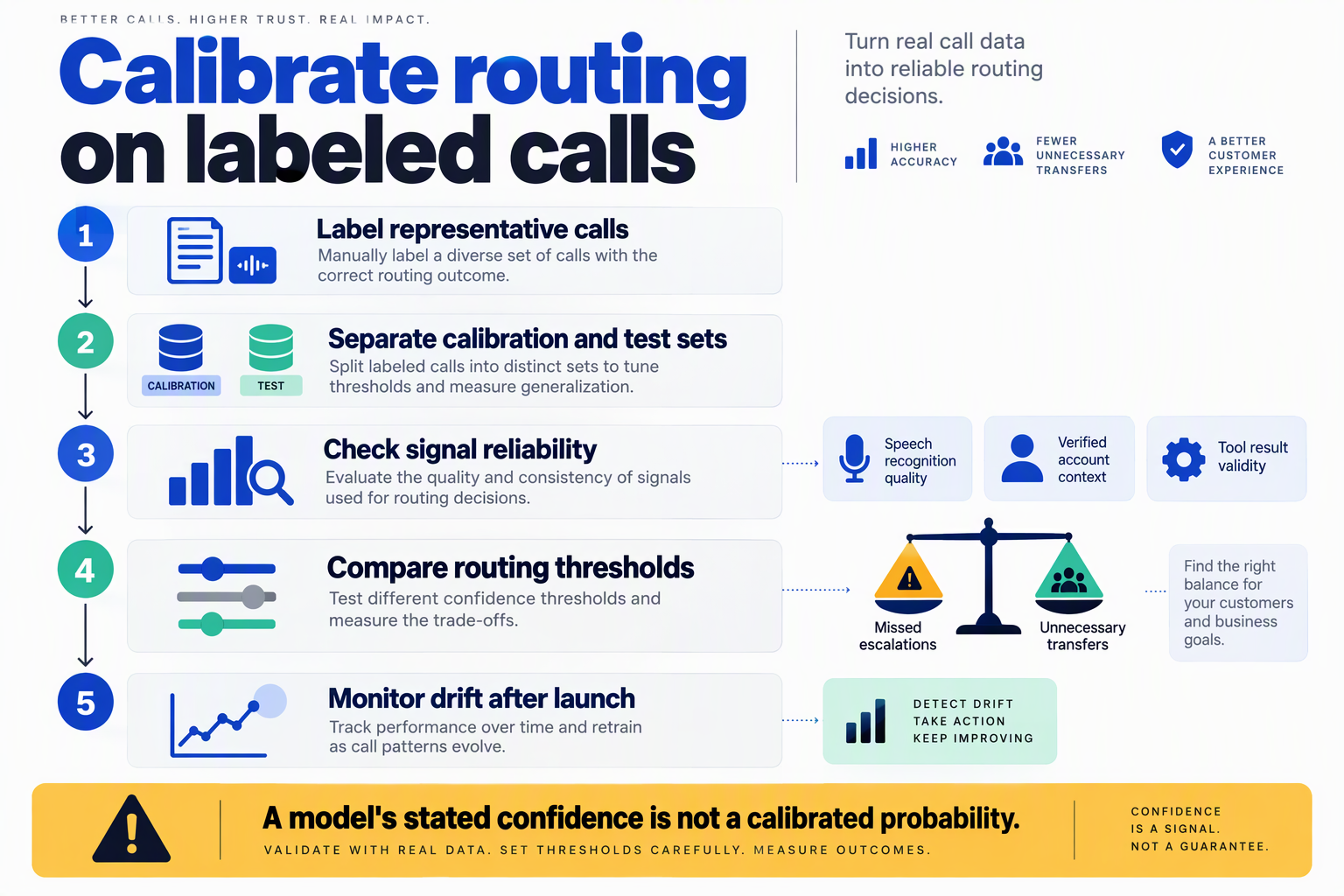
Calibrate confidence-based routing against independently reviewed outcomes, not an AI agent’s claim that it is “95% confident.” The routing score should estimate whether a specific proposed action meets your acceptance criteria, using observable evidence and validation data; mandatory approval rules must override that score.
What should a routing confidence score actually measure?
Separate answer correctness, action eligibility, and successful execution. An agent might accurately explain a refund policy while applying it to the wrong order, or choose an eligible action that fails because a tool returns an error.
Build the routing decision from evidence such as:
- Identity and permissions: Has the required verification succeeded, and is the requested action authorized?
- Knowledge support: Does an approved, current policy support the proposed answer?
- Tool results: Did the order lookup succeed, and do its fields support the next step?
- Speech uncertainty: Are names, amounts, addresses, or negations ambiguous in the transcript?
- Conversation consistency: Do the customer’s request, retrieved records, and proposed action agree?
These signals are inputs to evaluate—not proof of correctness. Agreement between two models, for example, can reflect a shared mistake.
As of October 2026, CloudNow Consulting describes customer-facing agents retrieving account information, updating records, and processing requests. That expanding action surface makes action-specific calibration more useful than one confidence score for an entire conversation.
How do you turn reviewed calls into calibrated thresholds?
Use a repeatable validation process:
- Define the label. Specify what counts as an acceptable action: correct account, supported policy, verified permissions, and no unauthorized commitment. Label consequential errors separately from harmless wording issues.
- Create representative examples. Include ordinary calls, disputed requests, noisy audio, code-switching, missing records, and tool failures. Have qualified reviewers adjudicate disagreements.
- Separate development and testing. Tune signals and thresholds on development data, then evaluate on held-out calls. Keep related conversations together to reduce leakage.
- Compare predictions with outcomes. Group proposed actions into score bands and measure the actual acceptable-action rate in each band. Use reliability plots and sample counts; sparse bands warrant caution.
- Choose thresholds by consequence. Evaluate error rates among automatically handled actions alongside the percentage routed to humans. A threshold that reduces workload but permits unacceptable financial errors is not operationally successful.
For an illustrative October 2026 test, suppose 200 held-out actions receive scores between 0.90 and 1.00, but reviewers accept only 170. The observed acceptance rate is 85%, not the score’s implied 90–100%; these hypothetical figures demonstrate overconfidence, not an industry benchmark.
How do you keep calibration reliable after deployment?
Begin with shadow routing: record the system’s proposed route while the existing review process remains authoritative. Inspect a random sample of automatically accepted actions as well as escalations; reviewing only escalated cases hides confident failures.
Monitor performance by language, request type, audio conditions, and tool dependency. Revalidate after changes to the model, prompts, knowledge base, or integrations, and report uncertainty rather than treating small samples as guarantees.
As of October 2026, CallMissed supports call scoring against custom QA rubrics, eval suites, and A/B experiments. Those capabilities can support evaluation, but teams still need independently defined labels and routing policies.
The governing principle is simple: confidence may prioritize review, but it cannot grant permission. High-risk actions remain subject to their approval requirements even when the routing score is high.
What happens when a supervisor is unavailable, a transfer fails, or the queue is overloaded?
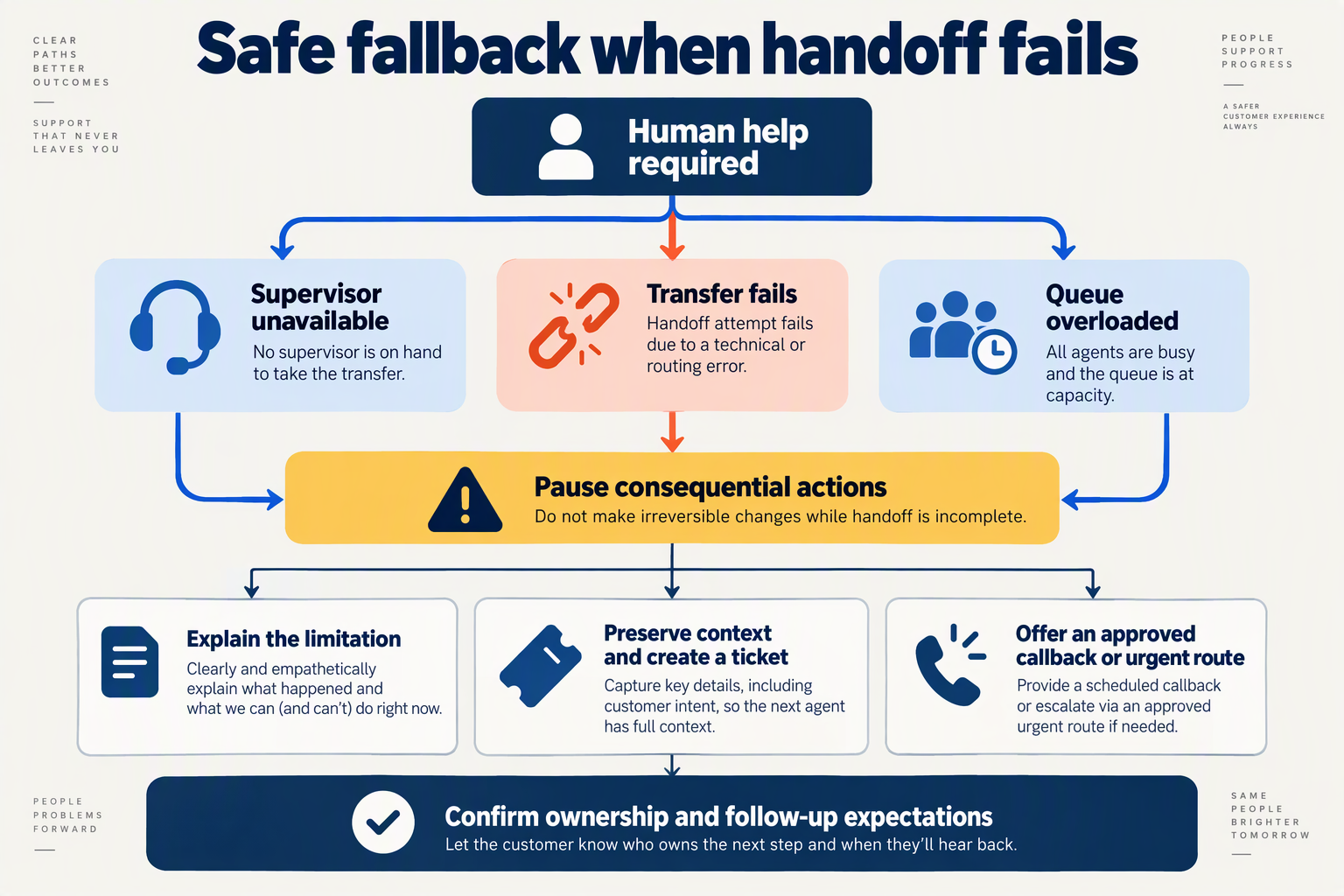
When a supervisor is unavailable, a transfer fails, or a queue becomes overloaded, the AI agent should reduce its authority—not expand it. The fallback should preserve the customer’s request, prevent unapproved actions, and provide an honest next step without claiming that a human has taken over.
Human oversight is only meaningful if the workflow remains safe when no human can respond immediately. A transfer attempt is not a completed handoff, and a ticket is not a resolved case.
What should an AI voice agent do when no supervisor is available?
Define a restricted fallback mode before deploying the agent. Routine assistance can continue, but any action that triggered mandatory approval must remain blocked until an authorized person reviews it.
For an October 2026 operating playbook, specify three categories:
- Continue: explain published policies, gather relevant details, or provide permitted status information.
- Defer: hold refund exceptions, disputed account changes, and other approval-dependent decisions.
- Redirect: offer an approved alternative contact route or a follow-up request, with the customer’s agreement.
The agent should say something concrete: “A supervisor isn’t available right now. I can record your request for review, but I can’t approve the exception.”
Do not promise a callback deadline unless staffing and scheduling support it. Nividous’s human-oversight guidance, available as of October 2026, emphasizes keeping automation aligned with risk appetite, brand voice, and regulation; temporary understaffing does not change those obligations.
How do you recover safely from a failed call transfer?
Treat handoff as a sequence of confirmed states: requested, connecting, accepted, or failed. Design the workflow so that only confirmed acceptance by the receiving person counts as a successful transfer.
Use a bounded recovery sequence:
- Check the outcome: distinguish a busy destination, no answer, technical failure, and caller disconnection.
- Explain the failure: tell the caller the connection did not complete, rather than leaving them in unexplained silence.
- Offer one approved alternative: another staffed queue, continued restricted assistance, or a follow-up request.
- Preserve context: retain the escalation reason, verification status, pending decision, and any action already attempted.
Retries need limits. Repeatedly sending someone to the same unavailable destination creates a loop, not oversight.
For example, if a refund tool times out before transfer, mark the outcome as unknown, not “failed.” Check the transaction status before retrying; otherwise, recovery could create a duplicate refund.
What should happen when the support queue is overloaded?
Use queue pressure to change routing and expectations, not approval requirements. Set thresholds using your own staffing capacity, oldest unresolved case, and response commitments—not an invented universal benchmark.
Prioritize cases by risk and urgency, while preserving aging rules so routine requests do not remain stranded indefinitely. Offer customers clear choices, and disclose estimated waits only when reliable queue data supports them.
As of October 2026, CallMissed provides support tickets, SLA policies, and a human-handoff queue in which switching the AI off hands the thread to a person. Those capabilities can support escalation operations, but teams still need to define ownership and what happens when that person is unavailable.
Test these failures deliberately: an absent supervisor, a dropped transfer, and an overloaded queue. A passing test means the request remains traceable, restricted actions stay blocked, and the customer knows what happens next.
How can CallMissed support live supervision, chat handoff, and post-call review?
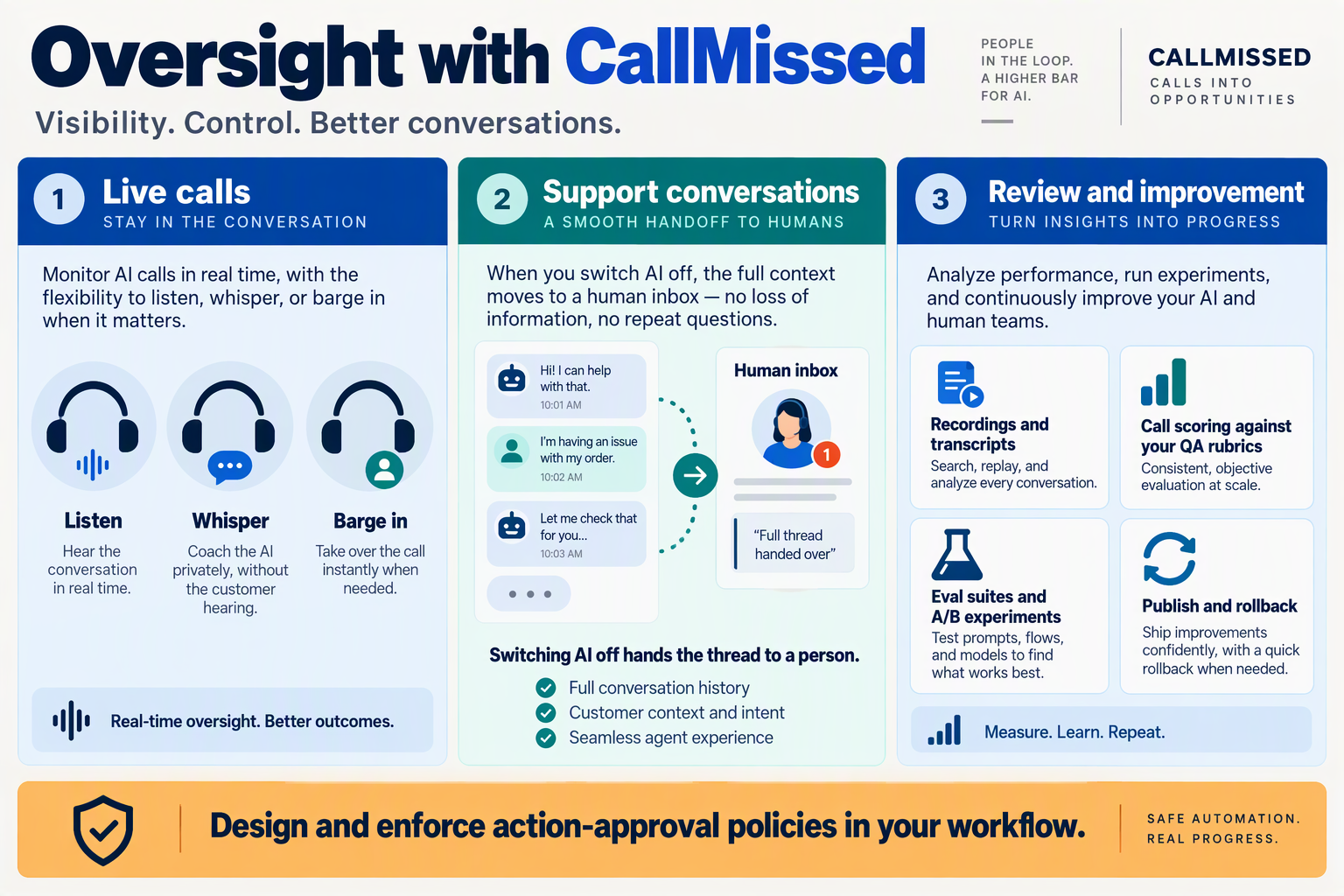
As of October 2026, CallMissed supports human oversight through live call monitoring with listen, whisper, and barge-in controls; a chat handoff queue; and post-call recordings, transcripts, AI notes, and custom QA scoring. These capabilities give supervisors practical intervention and review points, but teams still need to define who monitors conversations, when intervention is required, and who owns follow-up.
How should supervisors use live call monitoring?
As of October 2026, the platform’s listen, whisper, and barge-in capabilities support different levels of live supervision. The operational question is not simply whether someone can intervene—it is whether the right person is available when a conversation crosses a boundary.
Consider an AI agent handling an appointment cancellation. The customer mentions that the booking relates to an urgent medical concern. A sensible supervision procedure would distinguish routine scheduling assistance from a conversation requiring human judgment:
- Listen: Review whether the agent stays within scheduling responsibilities rather than offering medical guidance.
- Whisper: Use the available supervisory control when guidance can help correct the conversation.
- Barge in: Intervene directly when the customer needs a person or the agent makes an inappropriate commitment.
These are recommended operating procedures, not claims that sensitive-language detection or automatic intervention is built in. Assign monitoring responsibilities explicitly, including coverage during breaks and a fallback when the designated supervisor is unavailable.
Also distinguish agent routing from human escalation. As of October 2026, squads can hand a live call from one AI agent to another; that is useful for specialization, but it is not equivalent to handing control to a human supervisor.
What makes a chat handoff useful rather than frustrating?
As of October 2026, the omnichannel inbox includes a human-handoff queue: switching the AI off hands the thread to a person. Agent assist provides suggested replies and knowledge snippets, while support tickets and SLA policies support follow-through.
Treat that handoff as a transfer of responsibility, not merely a queue entry. Give the receiving employee a consistent checklist:
- Customer intent: What does the person want resolved?
- Previous commitments: What has the AI already promised?
- Unresolved issue: Which question or decision requires human attention?
- Next owner: Who will respond and manage the remaining work?
These checklist items are a recommended team practice, not a claim of an automatically generated handoff package. Test the workflow with an explicit “I want a person” request and confirm that staff can recognize and take ownership of the thread.
How can post-call review improve the next conversation?
As of October 2026, CallMissed provides recordings, transcripts, and AI call notes covering summaries, action items, dispositions, and follow-up, with notes pushed to the CRM. Call scoring against your own QA rubrics, metric alerts, eval suites, and A/B experiments provide additional review mechanisms.
Build the rubric around observable behavior: Did the agent make an unsupported promise? Did it recognize the need for escalation? Does the summary match the recording? Review the underlying conversation rather than treating an AI-generated note as definitive evidence.
Anthropic’s containment guidance, available as of October 2026, says a “tight perimeter” can allow reduced oversight. Apply that principle carefully: use review findings to improve prompts, knowledge, and workflow boundaries before expanding autonomy—not to assume that fluent calls no longer need supervision.
How do you measure oversight quality beyond containment and average handling time?
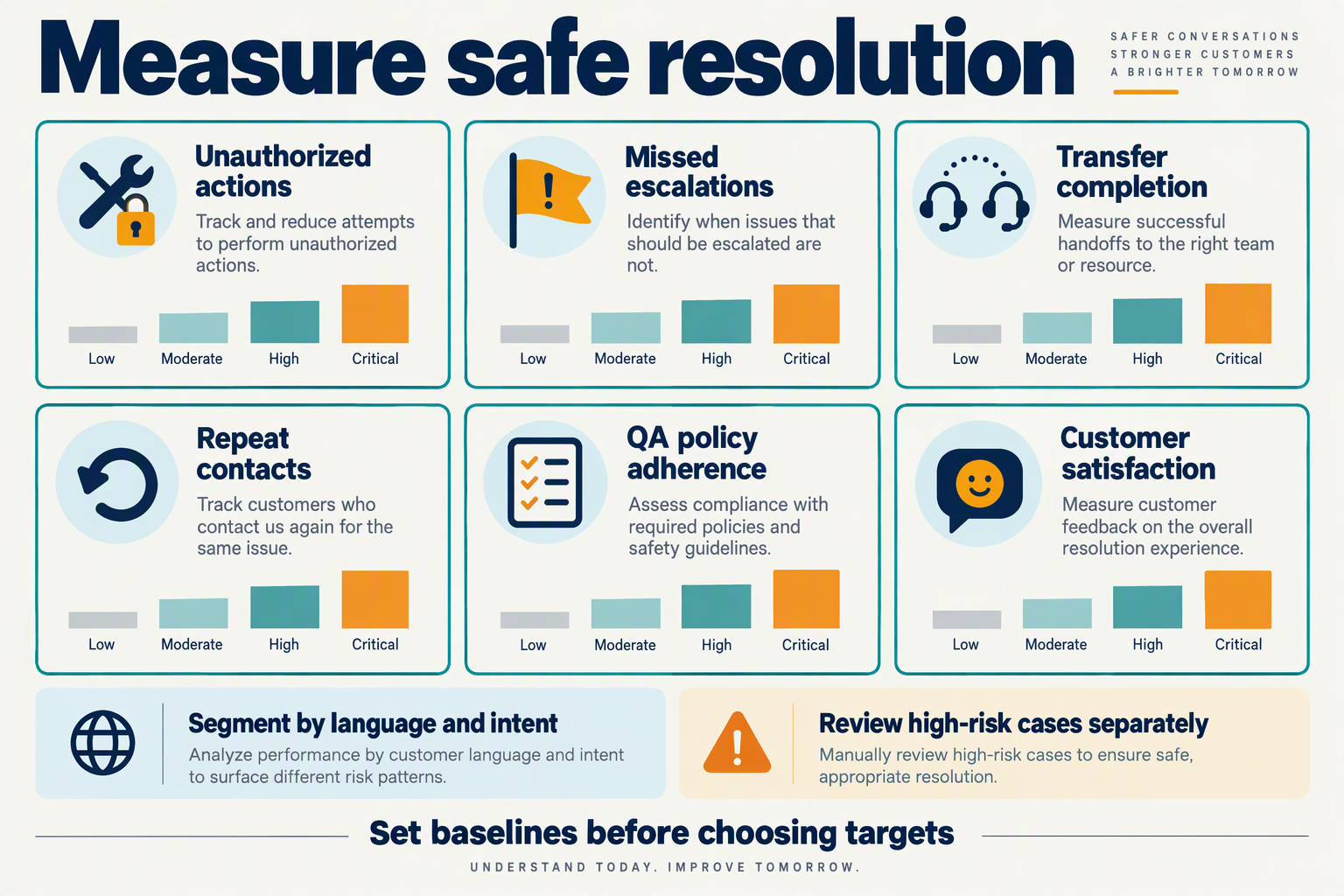
Measure oversight quality by whether humans detect consequential mistakes, intervene before harm, and confirm that the customer’s issue stays resolved. Containment and average handling time measure efficiency; they do not establish that an AI agent acted correctly or that human supervision worked.
A call can remain entirely automated because the agent resolved it—or because the customer could not reach a person. A shorter conversation can reflect efficient service—or a premature closure. Your scorecard must distinguish those outcomes.
Which metrics show whether human oversight actually works?
For an October 2026 oversight scorecard, track these measures alongside containment and handling time:
- Required-escalation recall: Of reviewed cases that genuinely required human involvement, what percentage reached a person? Count missed escalations, not just completed transfers.
- Escalation precision: Of cases sent to humans, what percentage actually needed their judgment? Low precision can overload supervisors and delay urgent interventions.
- Approval compliance: Of actions requiring authorization, what percentage had valid approval before execution? A retrospective sign-off should not count.
- Time to effective intervention: Measure from the triggering event to the moment a supervisor can meaningfully influence the outcome—not merely receive an alert.
- Durable resolution: Check whether the same issue reopened or prompted repeat contact within a defined follow-up window.
- Evidence completeness: Can a reviewer reconstruct the request, relevant policy, action taken, approval, and final outcome?
Nividous’s human-oversight guidance, available as of October 2026, identifies risk appetite, brand voice, and regulation as alignment priorities. Translate those priorities into separate rubric items rather than hiding them inside one average quality score.
How do you audit mistakes that never reached a supervisor?
Reviewing only escalated calls creates selection bias: you see the cases the agent recognized, but miss those it incorrectly treated as routine.
Use a three-part sampling plan:
- Random samples of automated resolutions to estimate everyday quality.
- Risk-targeted samples involving financial commitments, account changes, disputed decisions, or repeated customer requests.
- Intervention samples covering transfers, approvals, and supervisor takeovers to assess whether human involvement actually helped.
Have two reviewers independently score a subset, then reconcile disagreements. Record both the initial disagreement and the agreed decision; otherwise, an inconsistent rubric can make agent performance appear better or worse without any underlying change.
As of October 2026, CallMissed supports call recordings, transcripts, call scoring against custom QA rubrics, eval suites, and A/B experiments. Those capabilities provide material for an oversight programme; teams still need to define sampling rules and validate scoring against human judgment.
When should oversight results justify more autonomy?
Consider this illustrative October 2026 audit, not an industry benchmark: reviewers identify 40 calls requiring escalation, but only 30 reached a human. Required-escalation recall is 75%, even if overall containment looks impressive. Investigate the 10 missed cases before expanding permissions.
Compare results by workflow, language, and action risk. Strong performance on order-status questions does not establish readiness for refund exceptions.
Anthropic’s containment guidance, available as of October 2026, states that a “tight perimeter” can permit relaxed oversight. Apply that principle narrowly: expand autonomy within tested boundaries, rather than treating a good aggregate score as permission for unrestricted action.
The strongest oversight scorecard shows not just how often humans intervene, but whether they intervene when needed—and prevent the wrong outcome.
What should support leaders, security reviewers, and frontline supervisors challenge before launch?

Support leaders, security reviewers, and frontline supervisors should challenge whether the agent’s promises, permissions, and operating assumptions survive realistic failures—not just whether a demonstration sounds convincing. Before launch, each group should demand evidence that the workflow remains controllable when customers, tools, or staffing behave unexpectedly.
What should support leaders challenge about the customer outcome?
Ask: “What could this agent promise that our business cannot deliver?” A technically successful tool call can still produce a poor support outcome—for example, recording a refund request while telling the customer that the refund has already been approved.
CloudNow Consulting’s guidance, available as of October 2026, describes agents retrieving account information, updating customer records, processing requests, and summarizing conversations. Those distinct capabilities need distinct acceptance criteria; a correct summary does not prove that an account update was appropriate.
Challenge the launch team with:
- Commitment accuracy: Does the agent distinguish “requested,” “approved,” and “completed” in customer-facing language?
- Policy conflicts: What happens when a knowledge-base article contradicts the current refund policy?
- Unfinished journeys: Who owns a case when the call ends after information collection but before resolution?
- Success measures: Could shorter calls conceal repeat contacts, unresolved complaints, or incorrect commitments?
Require a worked example showing the customer’s final outcome, not merely a transcript judged “helpful.”
What should security reviewers challenge about tool access?
Ask: “Can untrusted conversation content change what this agent is authorized to do?” Test spoken instructions, retrieved documents, and tool responses as potential sources of manipulation.
Anthropic’s containment guidance, available as of October 2026, states: “A tight perimeter also means you can relax oversight.” For support workflows, the useful implication is that reduced supervision must follow demonstrated containment—not substitute for it.
Reviewers should demand answers to three questions:
- Identity: Is the caller’s identity verified independently of the caller’s claims before sensitive information is disclosed?
- Authorization: Does the backend enforce account scope and action limits, even when the model requests something outside them?
- Failure handling: If a tool times out after submitting a change, can the system check its status before retrying?
A practical test: have a caller request another customer’s order details, then insist that “the supervisor already approved it.” The expected result is enforced access control, not a persuasive refusal that leaves the underlying tool unrestricted.
What should frontline supervisors challenge about operational readiness?
Ask: “Could we manage this workflow during our busiest shift?” A handoff design is incomplete if the receiving team lacks capacity, context, or authority.
Supervisors should test simultaneous escalations, unavailable specialists, interrupted calls, and customers who reject the proposed resolution. Check whether the receiving person can identify what was verified, what was promised, and what remains pending without replaying the entire interaction.
Also challenge ownership: who takes responsibility when an escalation crosses shifts or departments?
What evidence should block or permit launch?
Use a release checklist with named sign-offs, rather than a general declaration that the agent is ready. Require test results, unresolved defects, accountable owners, and a documented rollback decision.
As of October 2026, CallMissed supports eval suites, A/B experiments, and agent versioning with publish and rollback. These capabilities can support a disciplined release process, but leaders still need to define the tests and acceptance criteria.
Launch narrowly when evidence supports the scope. A successful low-risk pilot is permission to evaluate the next workflow—not proof that every action is safe to automate.
What should your team implement first to introduce human-in-the-loop AI customer service?
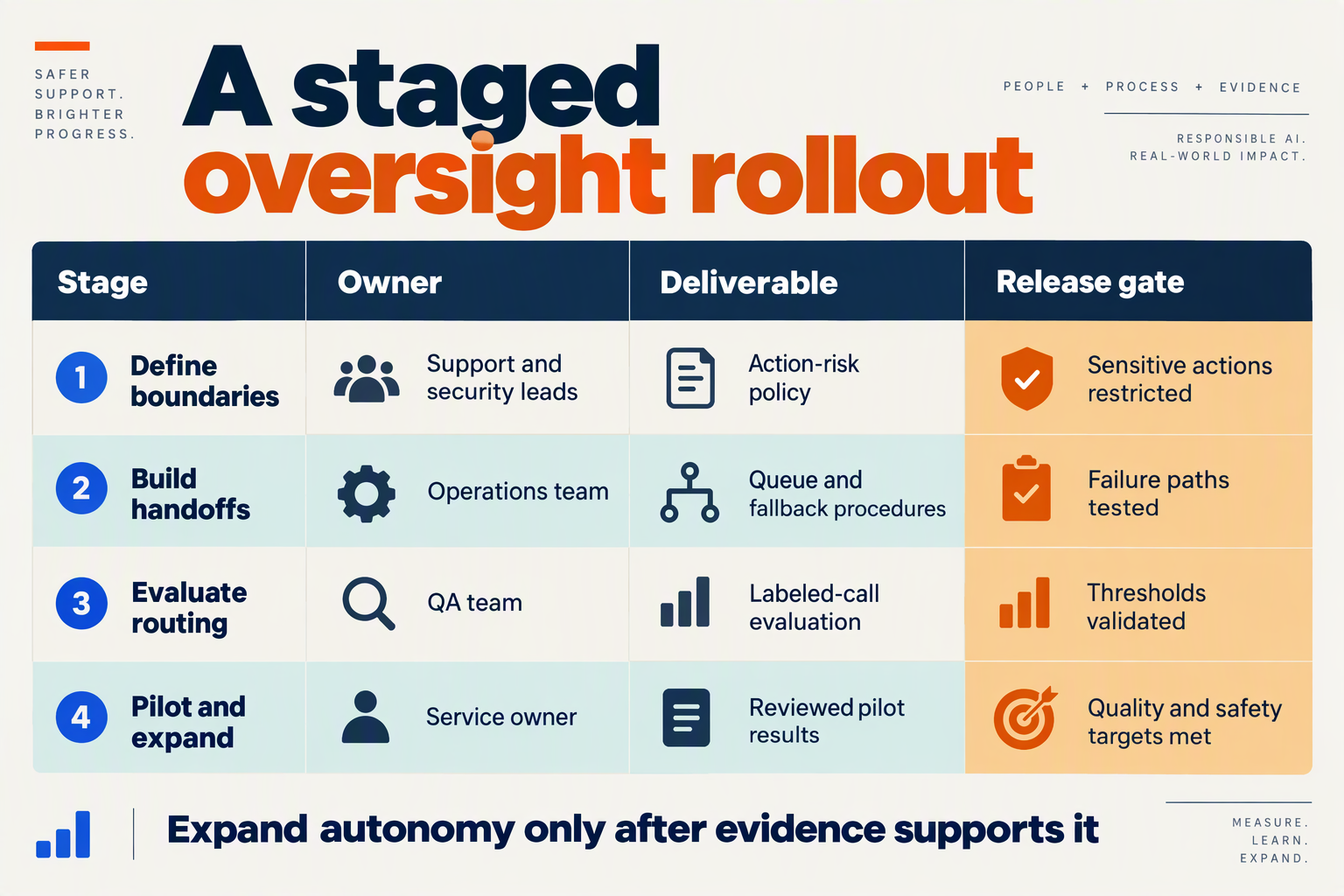
Start with one narrow support workflow, a named human owner, and an enforceable approval gate before giving an AI agent broader permissions. The first deliverable should be a tested operating procedure—not a fully autonomous rollout.
As of October 2026, CloudNow Consulting describes customer-facing AI agents that can retrieve account information, update customer records, process requests, and summarize conversations. Those capabilities need different permission levels: retrieving an order status should not automatically grant authority to change its delivery address.
What should a human-in-the-loop implementation checklist include?
Use this October 2026 implementation checklist to sequence your pilot. The acceptance checks below are recommended safeguards, not published industry benchmarks.
| Priority | Implement first | Accountable owner | Acceptance check |
|---|---|---|---|
| 1 | Select one bounded workflow, such as delivery-status enquiries | Support lead | Allowed actions and exclusions are documented |
| 2 | Restrict tool permissions; require approval for consequential changes | Engineering lead | An unapproved change is blocked outside the prompt |
| 3 | Create a staffed escalation queue with an unavailable-reviewer fallback | Operations lead | A test escalation reaches the assigned person |
| 4 | Prepare a concise handoff record with customer intent and pending action | Support lead | The reviewer can decide without restarting discovery |
| 5 | Test adversarial, ambiguous, and interrupted conversations | QA lead | Critical scenarios pass before customer exposure |
| 6 | Define release gates and a rollback procedure | Service owner | Staff can restore the previous approved configuration |
Implement permissions before polishing conversation quality. An awkward response is visible; an unauthorized account change may remain hidden until the customer complains. Enforce approval in the application or tool layer so that a persuasive caller cannot talk the agent around the restriction.
How should teams run the first pilot?
Follow a small, observable release sequence rather than switching an entire support queue at once:
- Replay representative cases. Include ordinary requests, disputed outcomes, failed tool calls, and customers who change their minds mid-conversation.
- Run in recommendation-only mode. Let the agent propose actions while staff execute them; compare its proposed decisions with policy.
- Enable limited execution. Permit only the actions that passed testing, while keeping exceptions behind approval.
- Expand after review. Add permissions only when evidence supports the change, not because the agent sounds confident.
Anthropic’s containment guidance, available as of October 2026, describes a “tight perimeter” that can support operation “without per-action approvals” in a constrained Claude Code environment. For customer service, the useful principle is bounded autonomy—not treating that coding example as proof that unrestricted customer-facing actions are safe.
As of October 2026, CallMissed provides eval suites, A/B experiments, and agent versioning with publish and rollback. These capabilities can support testing and controlled releases; teams still need to define approval rules and assign decision-making responsibility.
What evidence should determine whether the pilot expands?
Review outcomes alongside workload:
- Unauthorized-action rate: Did any action bypass its required approval?
- Handoff completeness: Did reviewers receive enough context to resolve the request?
- Customer outcome: Was the issue resolved without contradictory commitments?
- Reviewer burden: Did escalations arrive faster than staff could handle them?
Set thresholds before launch and inspect underlying cases, not just averages. If reviewers are overloaded, narrow the workflow or increase staffing before expanding autonomy. A safe pilot proves that the team can manage exceptions—not merely that the agent can complete routine calls.
Frequently Asked Questions
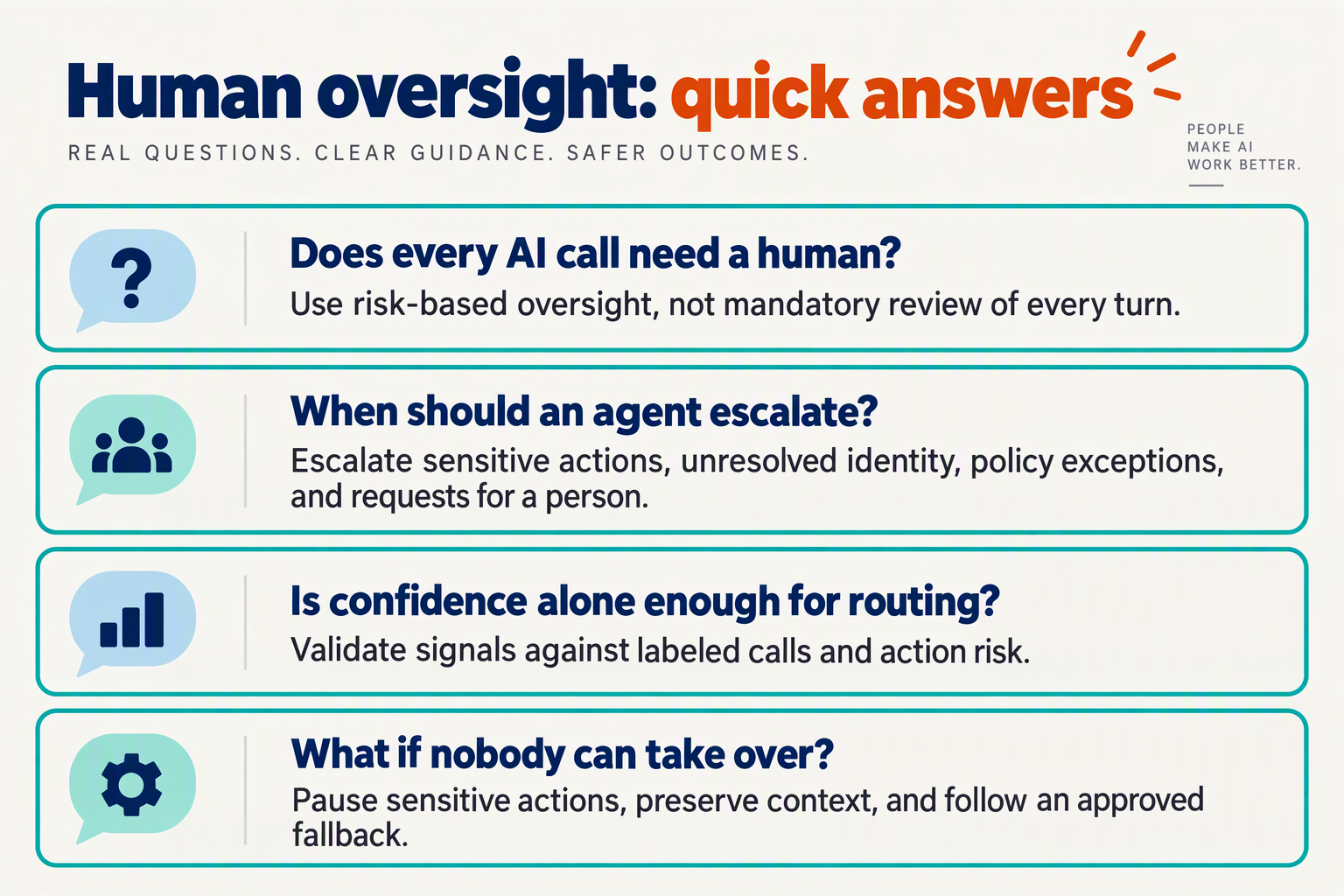
What does Human-in-the-Loop for AI Voice Agents mean in daily support operations?
Which AI voice agent actions should require human approval?
Can Human-in-the-Loop for AI Voice Agents work without monitoring every call?
How do you measure whether human oversight for AI voice agents is effective?
What privacy and compliance checks are needed for AI support calls?
How can teams implement Human-in-the-Loop for AI Voice Agents with CallMissed?
Conclusion
Human-in-the-Loop for AI Voice Agents means keeping consequential decisions under meaningful human control—not reviewing every sentence. As agents become more autonomous, the safest path is to expand their authority only when boundaries, escalation routes, and review processes are ready.
The shift is already underway: Technoyard’s April 7, 2026 guide describes autonomous agents handling customer inquiries across phone, chat, email, and social media, including returns and troubleshooting. But conversational fluency does not establish that an agent should change an address, promise compensation, or resolve a disputed outcome without approval.
Keep four principles at the center of your safety playbook:
- Define action boundaries before expanding autonomy. Separate routine assistance, such as retrieving delivery information, from actions that change financial outcomes or customer records. Make approval requirements explicit so a confident answer cannot become an unauthorized commitment.
- Build escalation into the workflow. Sensitive requests, disputed decisions, and explicit requests for a person should have predictable handoff paths. Specify who receives the escalation and what context they need to continue without making the customer repeat everything.
- Make live intervention practical. Assign responsibility for monitoring and establish when supervisors should intervene. Oversight is meaningful only when someone has both the authority and the ability to interrupt an inappropriate action.
- Review outcomes before widening permissions. Examine recordings, transcripts, tool actions, and QA results to identify recurring mistakes. Use those findings to adjust boundaries and escalation triggers—not simply to rewrite prompts.
The forward-looking question is whether governance will keep pace with agent capability. Nividous’s guidance, available as of October 2026, emphasizes alignment with risk appetite, brand voice, and regulation. Anthropic’s containment guidance, available as of October 2026, explains that tightly constrained environments can reduce the need for per-action approvals: controlled autonomy is different from unrestricted access.
Watch for that distinction as support workflows become more autonomous. The useful measure of progress is not how many decisions an agent makes alone, but whether consequential decisions remain accountable, recoverable, and open to intervention. A successful routine call should not automatically justify giving the same agent authority over exceptions.
For teams exploring this approach, CallMissed, the AI customer-communication platform, offers supervisor listen, whisper, and barge-in capabilities, plus recordings, transcripts, and call scoring against custom QA rubrics, as of October 2026. These capabilities provide practical tools for implementing oversight, while teams remain responsible for defining their operating rules.
Before granting your voice agent more autonomy, ask: Which decisions can it make independently, which require approval, and who can take control when the conversation goes wrong?
Related Reading
- Agentic AI Governance: India Voice Support Safety Guide
- Claude Opus 5.5 for Agents: A Voice Deployment Guide
- Enterprise Voice Agents: A CIO’s Guide to Safe Rollout
Sources
Discussion
Related Posts



Ready to automate customer conversations?
Launch AI voice agents and WhatsApp bots with CallMissed — one API, 22+ Indian languages.