
AI Productivity Tools Market: What Support Buyers Need



Understand the AI Productivity Tools Market forecast, compare support automation options, and evaluate costs, integrations, human handoff, and ROI.
AI Productivity Tools Market: What Support Buyers Need
A multibillion-dollar AI market cannot tell you whether a chatbot will resolve a refund—but support buyers need to know both. The AI productivity tools market matters because investment is expanding the automation choices available to customer-service teams, while making it harder to distinguish useful infrastructure from impressive demos.
According to SNS Insider’s September 16, 2026 announcement published through GlobeNewswire, the global AI productivity tools market was valued at $11.72 billion in 2025 and is projected to reach $69.22 billion by 2035, with a 19.50% compound annual growth rate during 2026–2035. That is a forecast for a broad technology category, not proof that any individual support product delivers savings.
For customer-support leaders evaluating purchases in October 2026, the question is therefore not “Should we buy AI?” It is: Which parts of our service workflow can AI improve reliably, and what will improvement actually cost? A tool that drafts excellent replies may still leave agents switching between systems, manually updating customer records, or rescuing conversations that automation cannot finish.
Consider a customer asking, “Where is my order?” A reply-writing assistant might produce a polished response. A connected support workflow could retrieve the order status, explain the next step, and route an exception to a person. The buying decision should distinguish those capabilities rather than treating every AI-branded product as equivalent.
That distinction is where the market forecast becomes practically useful: it signals a growing category worth evaluating, not a shortcut around due diligence. Buyers need to assess the operational chain:
- Resolution quality: Does the system answer accurately using approved business information?
- Workflow integration: Can it access the records and tools needed to complete the task?
- Human escalation: Can a person take over when judgment or an exception is required?
- Real economics: What happens to costs when conversations become longer, more complex, or require follow-up?
As of October 2026, CallMissed, the AI customer-communication platform, reflects this workflow-oriented approach through knowledge-base-backed agents, custom REST tools, a shared inbox, and a human-handoff queue.
This article translates the market’s growth story into a practical buying framework: how to separate assistants from automation, compare integration and channel requirements, test quality before deployment, and calculate costs beyond the headline subscription. The goal is not to choose the tool with the longest feature list. It is to identify a support system that helps your team complete customer requests—with clear accountability when automation reaches its limits, and evidence that improvements survive real-world usage.
What does market growth mean for support buyers? More choice, not guaranteed ROI
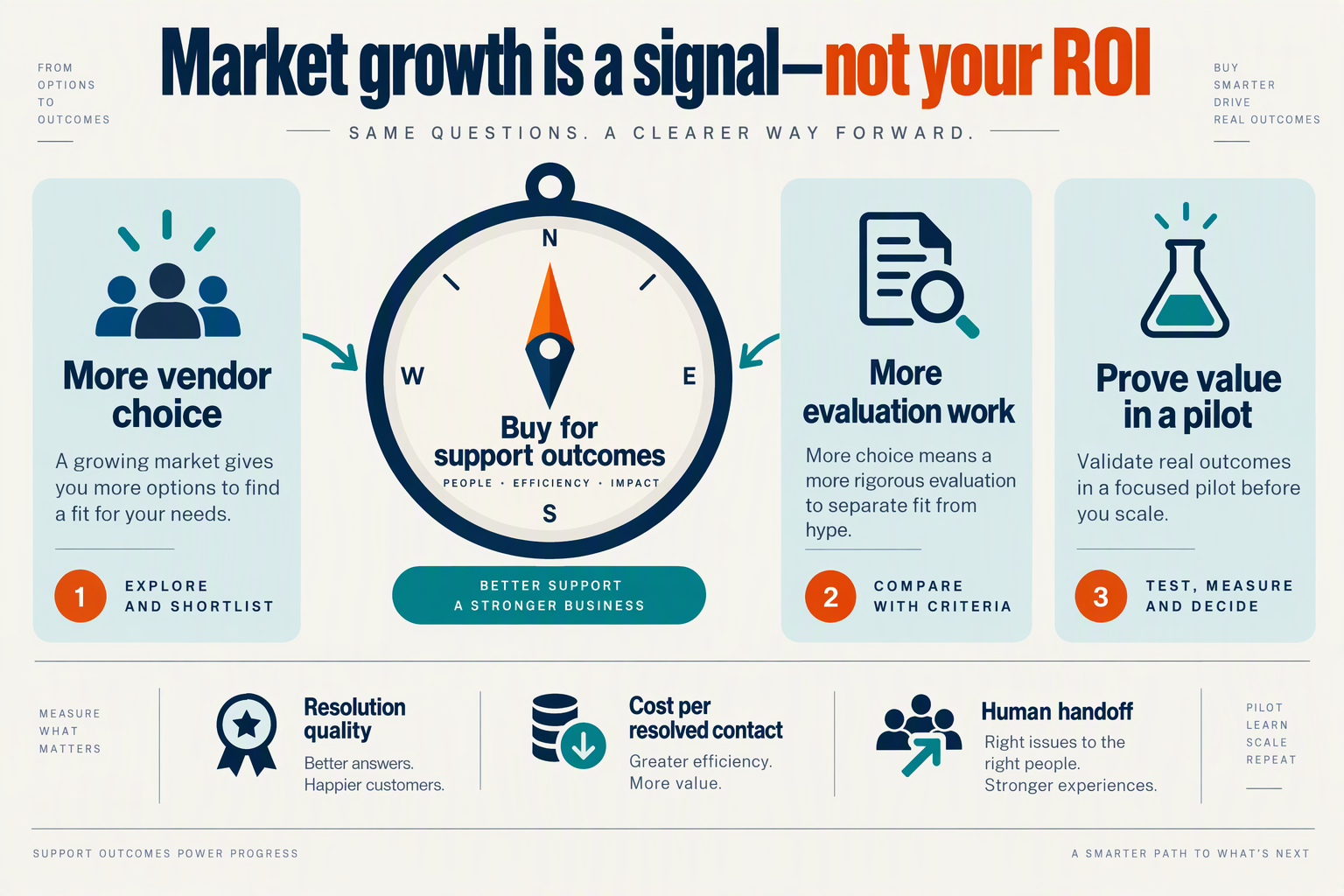
Growth in the AI productivity tools market gives support buyers more options to evaluate, but it does not guarantee lower costs or better customer outcomes. Treat the forecast as a reason to strengthen your buying process—not as evidence that an automation purchase will pay for itself.
What does a larger AI market actually tell support buyers?
The market’s expansion spans more than customer service. SNS Insider’s market coverage, available as of October 2026, identifies enterprise automation, cloud-based collaboration, AI-powered analytics, and code generation among the growth drivers. Spending across those categories cannot establish the return on investment for a support deployment.
The regional forecasts also suggest a broad purchasing landscape. As reported by Things Of Business in coverage available in October 2026, SNS Insider projects the U.S. AI productivity tools market to grow from $3.03 billion in 2025 to $17.59 billion by 2035. The same coverage reports SNS Insider’s forecast that Europe’s market will expand from $3.28 billion in 2025 to $17.92 billion by 2035.
For buyers, these projections support monitoring a growing technology category. They do not measure resolution accuracy, implementation effort, or customer satisfaction. Nor do regional spending totals establish whether a product fits an Indian business’s language, payment, or operating requirements.
How should buyers use the additional choice?
More choice is valuable when competing options can be tested against the same business requirement. Otherwise, buyers risk comparing attractive demonstrations that solve different problems.
Before requesting demos, define:
- The unit of work: A completed address change, for example—not merely a generated response.
- The acceptance condition: The correct record is updated and the customer receives confirmation.
- The failure boundary: Ambiguous identity or an unsupported request goes to a person.
- The evidence required: Test results, implementation requirements, and an itemised cost estimate.
This turns vendor evaluation into a comparison of outcomes rather than feature counts. It also exposes whether a proposed solution needs additional software or manual work to finish the task.
As of October 2026, CallMissed, the AI customer-communication platform, offers built-in CRM contacts, custom fields, and per-record timelines. For buyers considering connected support workflows, those capabilities belong in the evaluation—but their value still depends on how well they fit the team’s actual processes.
Why can time savings fail to produce positive ROI?
Saved minutes are not automatically saved money. They may create useful capacity without reducing payroll or other expenditure.
Consider this illustrative October 2026 buying scenario—not a vendor benchmark:
- A team handles 1,000 eligible requests monthly.
- Automation saves five agent minutes on 20% of those requests.
- That releases approximately 16.7 hours.
- At an assumed loaded labour cost of ₹600 per hour, the capacity value is roughly ₹10,000.
- If monthly software, usage, maintenance, and review costs total ₹12,000, the simplified net value is approximately –₹2,000.
The project might still improve response speed or absorb demand without hiring. However, those benefits need their own evidence; they should not be presented as realised cash savings.
The practical response to market growth is therefore a measurable, reversible pilot. Establish a baseline, test a bounded workflow, and expand only when verified outcomes—not market momentum—justify the investment.
How do productivity tools, workflow automation, and call center AI differ?
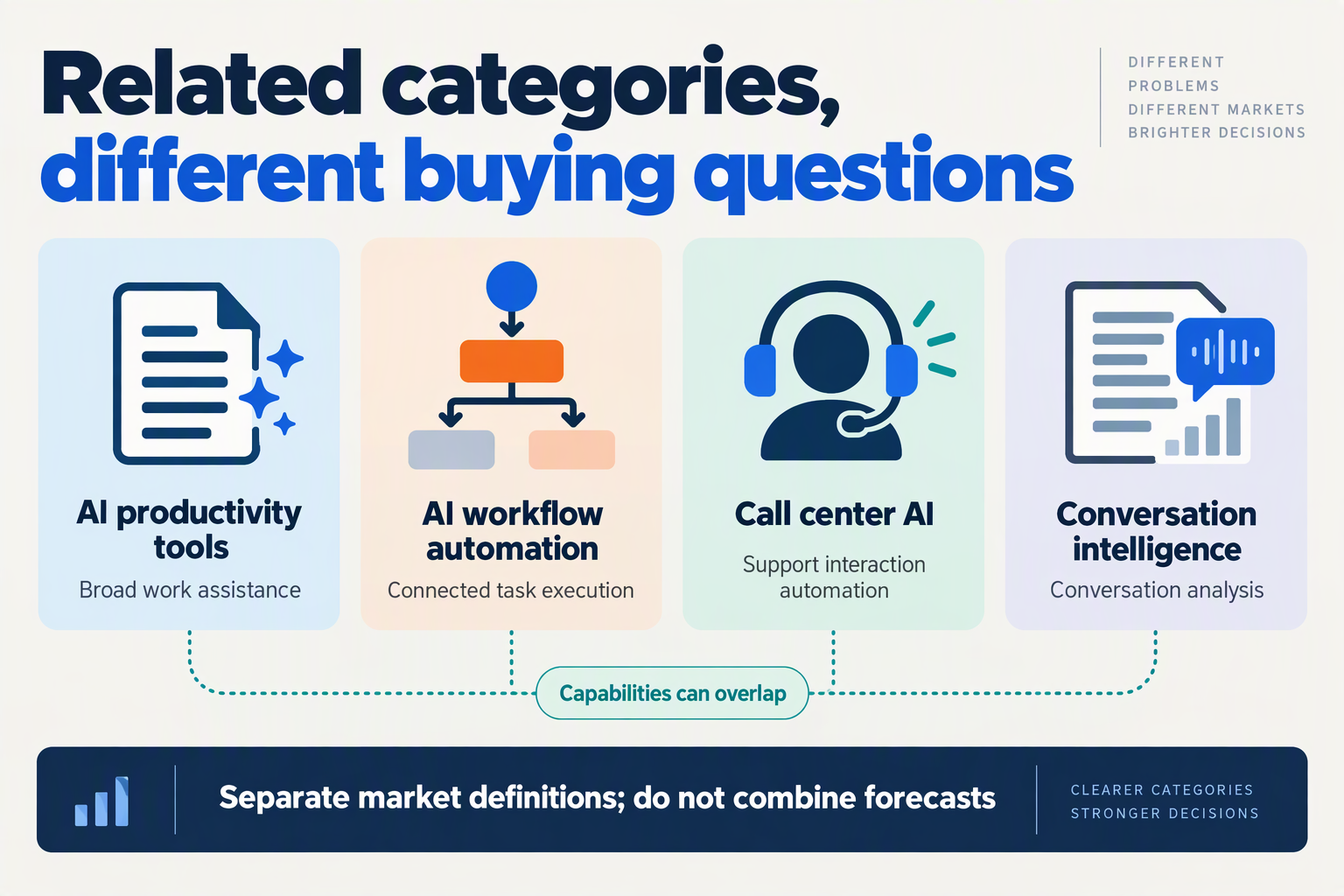
Productivity tools help people perform tasks; workflow automation coordinates actions across systems; call center AI supports or conducts customer conversations. These categories overlap, but buyers should distinguish them by who acts, what changes in business systems, and who handles exceptions—not by whether a vendor uses the word “agent.”
What do AI productivity tools actually automate?
AI productivity tools typically improve an individual task: drafting a response, summarizing a conversation, finding information, or suggesting the next action. The output may be useful without completing the customer’s request.
Consider a customer asking to reschedule a service appointment. A writing assistant can draft a clear confirmation, but unless something updates the scheduling system, the appointment has not changed.
For buyers, the important boundary is between content generation and operational execution:
- Input: Customer messages, documents, or conversation transcripts.
- Output: Suggested replies, summaries, recommendations, or extracted information.
- Accountability: Usually a person reviews the output and performs the consequential action.
These tools can be valuable where human judgment remains essential. Do not reject an assistant for lacking autonomy if your actual requirement is faster, better-supported human work.
How is workflow automation different from an AI assistant?
Workflow automation connects triggers, rules, and actions into a repeatable process. It might classify a request, retrieve a record, update a booking, create a ticket, and notify the customer—with approval gates where needed.
Workflow automation does not necessarily require a language model. Deterministic rules are often appropriate for eligibility checks or routing; AI can help interpret free-form language before those rules execute.
The trade-off is operational complexity. A generated response can be reviewed before sending, while an incorrect database update may require reversal. Buyers therefore need explicit permissions, validation, failure handling, and protection against duplicate actions.
As of October 2026, SPAC Feed’s reproduction of SNS Insider’s market announcement describes segmentation by tool type, revenue model, deployment model, industry vertical, offering, and region for the 2026–2035 forecast. That breadth reinforces why the AI productivity tools market should not be treated as one interchangeable software category.
What makes call center AI a separate buying category?
Call center AI applies intelligence to customer conversations and service operations. It includes agent assistance, transcription, quality assessment, and voice agents—not just autonomous phone answering.
Voice adds requirements that a drafting assistant does not face: speech recognition, turn-taking, interruptions, telephony connections, and live escalation. A system can understand a caller correctly yet still fail to execute the requested action.
As of October 2026, CallMissed, the AI customer-communication platform, combines inbound and outbound phone calls, custom REST tools, and live supervision that lets a supervisor listen, whisper, or barge in. These capabilities illustrate the intersection of conversation handling, workflow execution, and human oversight, rather than productivity assistance alone.
How can buyers test which category they need?
Use one appointment-rescheduling scenario across every demonstration:
- Ask for assistance: Can the product draft an accurate response?
- Ask for execution: Can it check availability and update the booking?
- Ask for conversation handling: Can it complete the same task during a phone call?
- Introduce an exception: What happens when no suitable slot exists?
Score each capability separately. A strong assistant, a reliable workflow engine, and a capable voice interface solve different problems; your purchase should match the gap in your service operation.
What does SNS Insider's September 2026 forecast actually say?
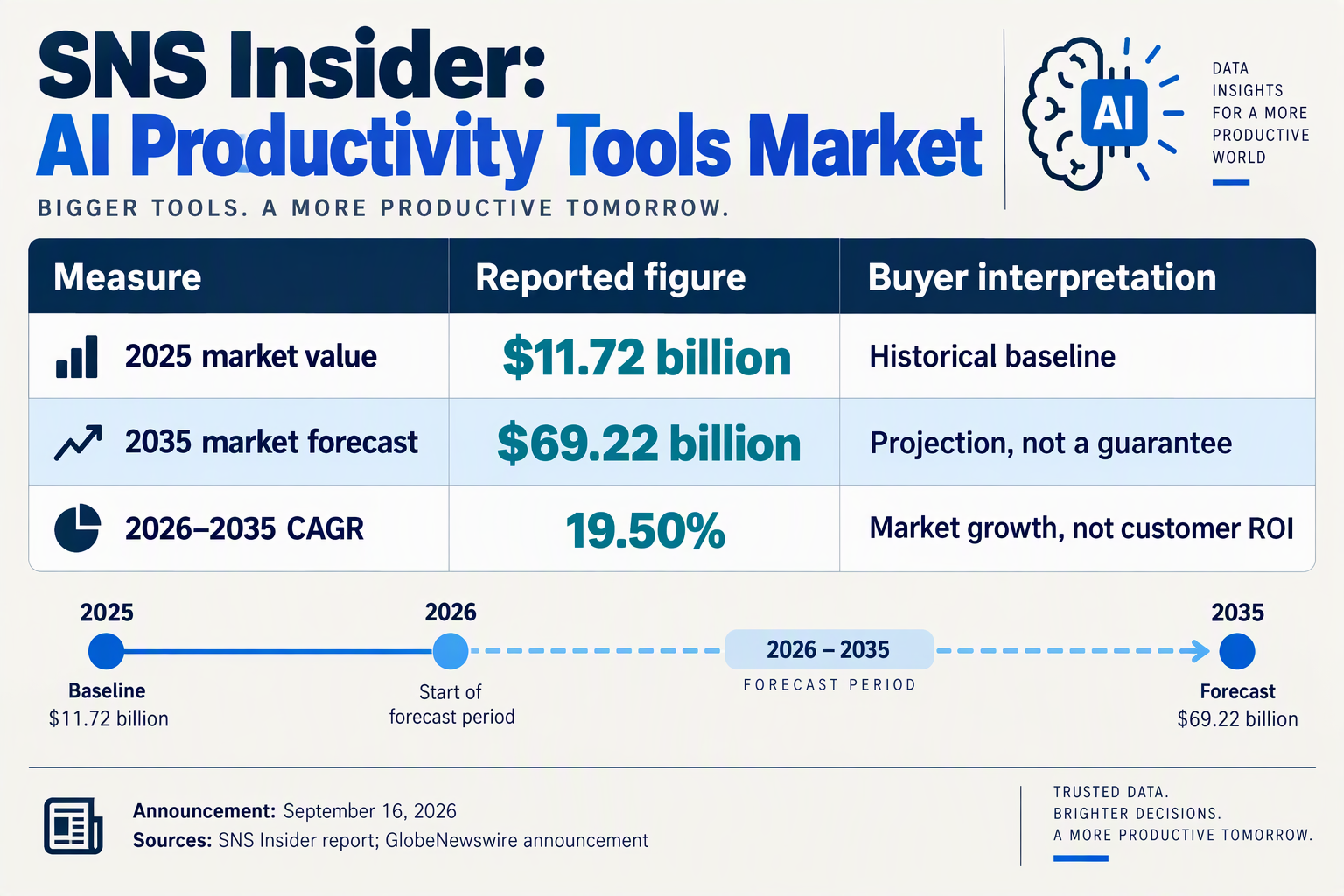
SNS Insider’s September 2026 forecast describes growth across the broad AI productivity tools market—not a forecast specifically for customer-support automation. Its headline figures establish the category’s projected scale, but do not establish support-resolution rates, implementation costs, or buyer returns.
What are the forecast’s headline numbers?
According to SNS Insider’s September 16, 2026 announcement published through GlobeNewswire, the global AI productivity tools market was valued at $11.72 billion in 2025 and is projected to reach $69.22 billion by 2035.
The following table separates baseline valuations from projections. Global figures come from that announcement; regional figures are reported by Things Of Business in its coverage of SNS Insider’s forecast, available as of October 2026.
| Measure | Baseline or period | Forecast | Interpretation |
|---|---|---|---|
| Global market value | $11.72 billion in 2025 | $69.22 billion in 2035 | Broad category expansion |
| Global annual growth | Forecast period: 2026–2035 | 19.50% CAGR | Compounded market growth, not buyer savings |
| U.S. market value | $3.03 billion in 2025 | $17.59 billion in 2035 | Substantial projected U.S. demand |
| European market value | $3.28 billion in 2025 | $17.92 billion in 2035 | Substantial projected European demand |
| Global absolute increase | Comparing 2025 with 2035 | $57.50 billion | Calculated from headline values |
| Global market multiple | Comparing 2025 with 2035 | Approximately 5.9× | Calculated expansion, not a separate forecast |
The final two rows are arithmetic derived from SNS Insider’s published endpoints, rather than additional findings from the research firm.
What does the 19.50% CAGR actually mean?
SNS Insider’s September 16, 2026 announcement states a 19.50% compound annual growth rate for 2026–2035. CAGR expresses an annualized growth trajectory across a forecast period; it does not mean the market will grow by exactly that percentage every year.
More importantly, market revenue and operational productivity are different measures:
- Market growth describes spending or revenue within the defined category.
- Support productivity concerns work completed relative to time and resources.
- Buyer ROI depends on benefits exceeding implementation and ongoing costs.
A rising market valuation could reflect wider adoption, additional paid capabilities, or increased spending. The supplied announcement does not quantify how much each factor contributes, so buyers should not interpret the CAGR as a predicted improvement in agent efficiency.
Which tools and regions does the forecast cover?
As of October 2026, SPAC Feed’s reproduction of the SNS Insider announcement describes segmentation by tool type, revenue model, deployment model, industry vertical, offering, and region. That breadth matters: customer-support automation is being considered within a larger technology landscape, not measured here as an isolated purchasing category.
Things Of Business, reporting SNS Insider’s forecast as of October 2026, names enterprise automation, cloud-based collaboration, AI-powered analytics, and code generation among the growth drivers. These are distinct applications; spending on coding assistants cannot automatically be treated as evidence of demand for support voice agents.
What should buyers verify before using this forecast?
Use the announcement to frame market direction, then check the research boundaries:
- Category definition: Which products and services count toward market revenue?
- Forecast methodology: What assumptions underpin adoption and spending estimates?
- Support relevance: Does the full report isolate customer-service use cases?
The supplied excerpts do not provide those methodological details. A large addressable market is useful context; evidence about your specific support workflow remains a separate requirement.
How should you calculate support automation costs and payback?
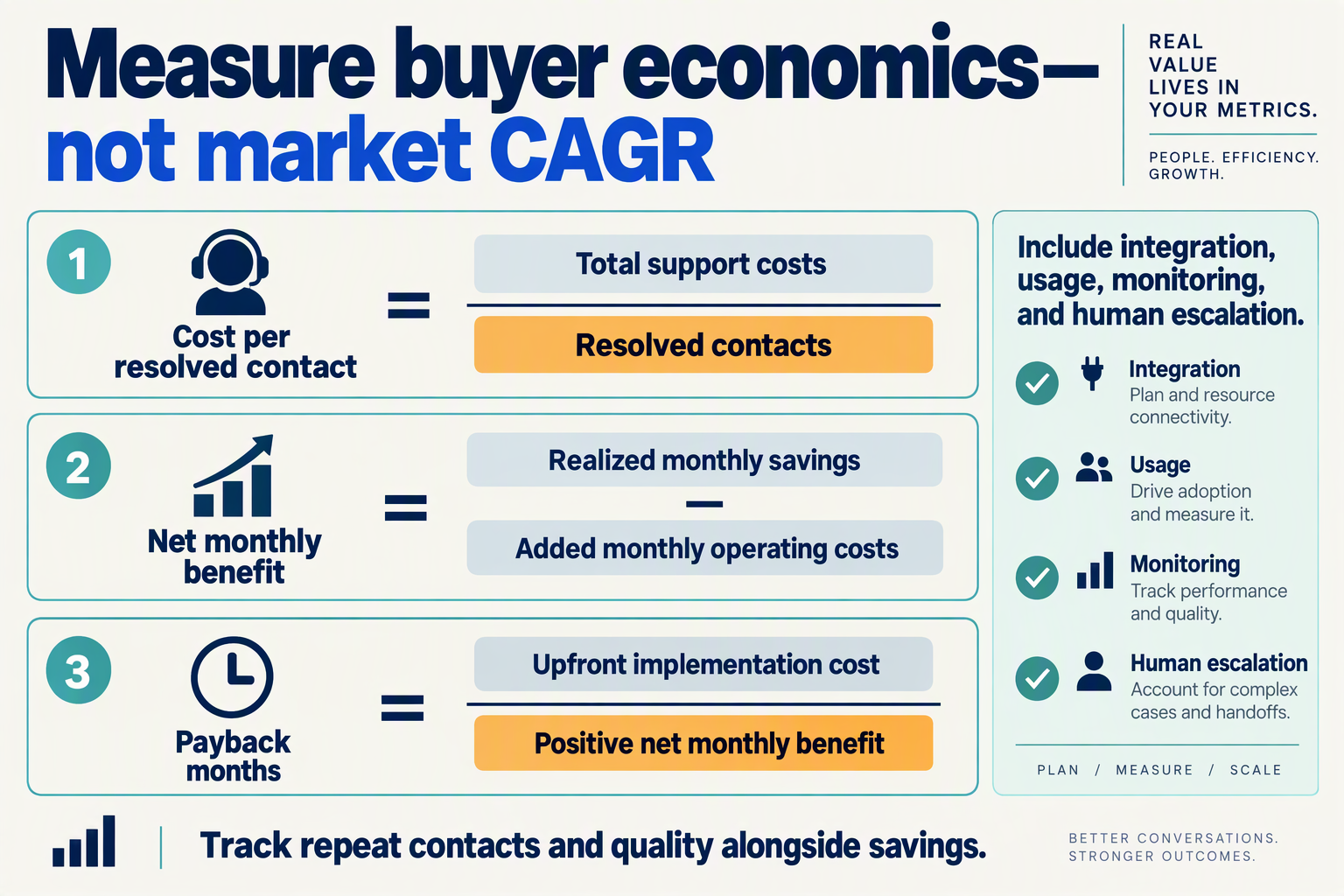
Calculate support automation costs using total cost per verified resolution, then estimate payback from the monthly savings you can actually capture. Include implementation, usage, human escalations, and ongoing maintenance—not just the subscription or advertised per-minute rate.
What belongs in the total cost of support automation?
Build two budgets: one-time deployment costs and recurring operating costs. Keep the existing support baseline comparable: use the same channels, request types, service hours, and quality requirements.
For an October 2026 procurement model, include:
- Deployment: workflow design, integrations, knowledge-base preparation, security review, testing, and staff training.
- Platform and usage: subscriptions, model inference, speech processing, messaging charges, phone carriage, and applicable taxes.
- Human involvement: escalated conversations, supervisor reviews, corrections, and follow-up work.
- Ongoing operations: knowledge updates, integration maintenance, quality checks, and incident handling.
Check how allowances, minimum charges, and bundled components affect the bill. Otherwise, you can accidentally count a bundled language model twice—or omit a separately billed channel charge.
According to CallMissed’s verified pricing, as of October 2026, its Standard voice-agent plan costs ₹4 per minute, including speech recognition, the language model, and voice, with a 30-second minimum per call; phone carriage is billed separately, and calls that never connect cost nothing. That structure illustrates why buyers should compare complete workflows rather than headline rates alone.
How do you calculate cost per resolved customer request?
Use this formula:
Cost per verified resolution = total recurring support cost ÷ customer requests genuinely resolved
Count a resolution only when the required task is completed and the request does not reopen within your chosen measurement window. A conversation that ends without escalation is not necessarily a successful resolution.
Track the full customer request across channels. If a chatbot answers a question but the customer subsequently calls an agent about the same issue, count the combined cost—not two independent successes.
Report both automation-only resolution cost and blended support resolution cost. The blended figure reveals whether inexpensive automated interactions are creating expensive downstream work.
What does a realistic payback calculation look like?
The following October 2026 planning example is hypothetical, not a vendor benchmark or a CallMissed quotation:
- Baseline: 10,000 monthly resolved requests at ₹80 each cost ₹800,000.
- After deployment: automation resolves 4,000 requests; humans resolve the remaining 6,000 at an assumed unchanged ₹80 each, costing ₹480,000.
- Automation operating budget: usage, channel charges, monitoring, and maintenance total ₹120,000 monthly.
- Net monthly savings: ₹800,000 − ₹480,000 − ₹120,000 = ₹200,000.
- Payback: a ₹600,000 implementation investment ÷ ₹200,000 monthly savings = three months after reaching steady-state performance.
The resulting blended cost is ₹60 per resolution, a 25% reduction from the illustrative baseline. Add rollout months separately; savings rarely begin at full scale on deployment day.
Which assumptions can make the savings disappear?
Distinguish cash savings from capacity released. Time saved only reduces expenditure when it changes overtime, outsourcing, hiring, or another real budget line; otherwise, it may improve service capacity without lowering payroll.
Stress-test longer conversations, more escalations, repeat contacts, and lower resolution rates. Also test whether the remaining human cases become harder and more expensive. Approve the investment against a conservative scenario—not just the most attractive pilot result.
Which integration, security, and escalation checks belong in vendor evaluation?
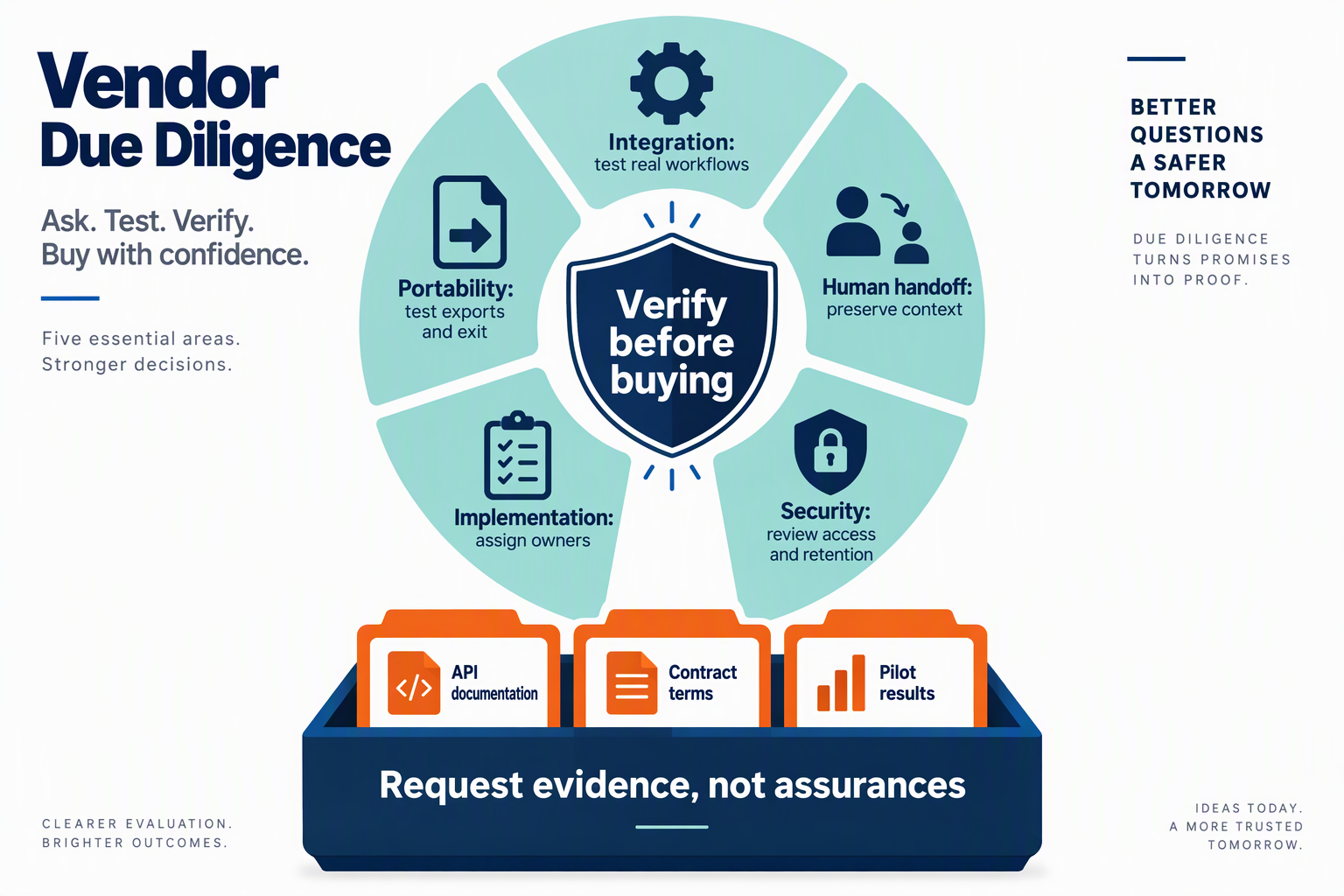
Evaluate integration depth, data controls, and human escalation as acceptance gates, not optional features. A vendor should demonstrate that automation can complete authorized work, protect customer information, and transfer unresolved cases without losing context.
SNS Insider’s AI productivity tools market announcement, published through GlobeNewswire on September 16, 2026, segments the market by deployment model, industry vertical, and offering, among other categories. For an October 2026 procurement decision, those distinctions matter: two products in the same growing market may have very different operational and security requirements.
How do you verify that an integration actually completes support work?
A connector logo proves little. Ask the vendor to demonstrate your actual workflow against a test account, including failed requests—not just successful lookups.
For an order-change request, establish whether the system can:
- Read the right record: Match the authenticated customer to the correct order without exposing another customer’s information.
- Execute an authorized action: Update an address only while the order remains eligible for changes.
- Confirm the result: Retrieve the updated record rather than treating a generated response as proof of success.
- Recover safely: Handle timeouts without submitting the same change twice.
Request documentation for authentication, permission scopes, API limits, webhook retries, and ownership of connector maintenance. Separate read access from write access: answering an order-status question should not automatically grant permission to issue refunds.
As of October 2026, CallMissed’s verified product capabilities include Shopify and HubSpot integrations, custom REST tools, and connections to MCP servers by URL. These are concrete integration options; buyers should still test the permissions, error handling, and end-to-end behavior required by their own workflows.
Which security evidence should a support automation vendor provide?
Ask for a data-flow map, not simply an assurance that the platform is secure. The map should identify where messages, recordings, transcripts, customer records, and model requests travel—and which organizations process them.
Your checklist should cover:
- Data handling: Retention periods, deletion procedures, backup treatment, and whether customer data is used for model training.
- Access controls: Staff permissions, credential storage, access revocation, and separation between customer accounts.
- Processing locations: Hosting region, subprocessors, and any cross-border transfers.
- Evidence: Contractual commitments, relevant independent assessments, and the scope and validity dates of any claimed certifications.
Test prompt injection too: place an instruction inside a retrieved document telling the agent to disclose unrelated customer information. The required outcome is that the instruction cannot override authorization boundaries. This is a proposed acceptance test, not a claim that any named vendor has passed it.
What should happen when automation needs a human?
Escalation should transfer responsibility and context, not merely display “contact support.”
Specify triggers such as failed identity verification, disputed charges, repeated tool errors, or an explicit request for a person. Then run three tests:
- Context transfer: The receiving agent gets the conversation, relevant records, actions attempted, and the reason for escalation.
- Ownership transfer: Automation stops taking conflicting actions once a person assumes control.
- Unavailable-agent handling: The customer receives an accurate next step when the queue is unstaffed, rather than a false promise of immediate help.
Record each result as pass, fail, or conditional, with an owner for unresolved gaps. Procurement should depend on demonstrated behavior—not a feature checkbox or a persuasive demo.
Which expert perspectives should inform your automation decision?

Your automation decision should combine market analysts’ perspective on investment trends with the judgment of support operators, integration engineers, risk specialists, and finance leaders. Each answers a different question: where the market is heading, whether the workflow works, what could go wrong, and whether the investment pays off.
What can market analysts tell you—and what can’t they?
Market analysts help buyers understand category expansion, not certify a particular product’s effectiveness. SNS Insider’s September 16, 2026 announcement through GlobeNewswire forecasts a 19.50% compound annual growth rate for the AI productivity tools market during 2026–2035. Treat that forecast as a reason to investigate the category, not as evidence that your support operation will achieve comparable gains.
As of October 2026, Things Of Business reports SNS Insider projections that the U.S. AI productivity tools market will grow from $3.03 billion in 2025 to $17.59 billion by 2035, while Europe will grow from $3.28 billion to $17.92 billion over the same period.
Those regional forecasts support a global buying perspective. They do not establish that a product handles your customers’ languages, operating hours, or service policies. Ask analysts about category definitions and forecast assumptions before using market growth to justify procurement.
Which support experts should validate the workflow?
Frontline agents and support-quality managers should determine what counts as a successful outcome. Their expertise is especially valuable when a technically correct answer still leaves the customer’s problem unresolved.
Give these reviewers representative conversations and ask:
- Was the policy applied correctly, including exceptions?
- Did the customer understand the next step, or merely receive an answer?
- Was escalation timely, with enough context for the receiving agent?
For example, an order-status response may be accurate but inadequate when the customer says the delivery contains medication needed that day. A support specialist can identify the urgency and escalation requirement that a generic accuracy score misses.
As of October 2026, CallMissed, the AI customer-communication platform, offers call scoring against buyers’ own QA rubrics, eval suites, and A/B experiments. These capabilities can support expert review; they do not replace the team’s responsibility to define acceptable service.
What should engineering and risk specialists challenge?
Integration engineers should examine failure paths, while security, privacy, and legal reviewers should examine authority and data exposure. Evaluate these perspectives together: a workflow that accesses customer records must also constrain what actions it can take.
Ask reviewers to test three situations:
- A dependency fails: The order-management system times out. Does the agent acknowledge uncertainty rather than invent a status?
- Identity is ambiguous: Two records share similar contact details. Does the workflow avoid exposing the wrong account?
- An action exceeds authority: A customer requests an exception refund. Does the system seek approval rather than treating a persuasive message as permission?
These are proposed evaluation scenarios, not findings from the market forecast.
How should finance turn expert feedback into a decision?
Finance should challenge the cost of a completed, acceptable outcome, including review and exception handling—not just the subscription or conversation price.
Use a shared decision rule: operational reviewers define success, engineers demonstrate reliability, risk reviewers approve boundaries, and finance checks the economics. If those perspectives disagree, narrow the deployment scope before expanding it. A defensible automation purchase rests on evidence from your workflow, not consensus around a growing market.
What should support buyers do next, and how should they measure success?
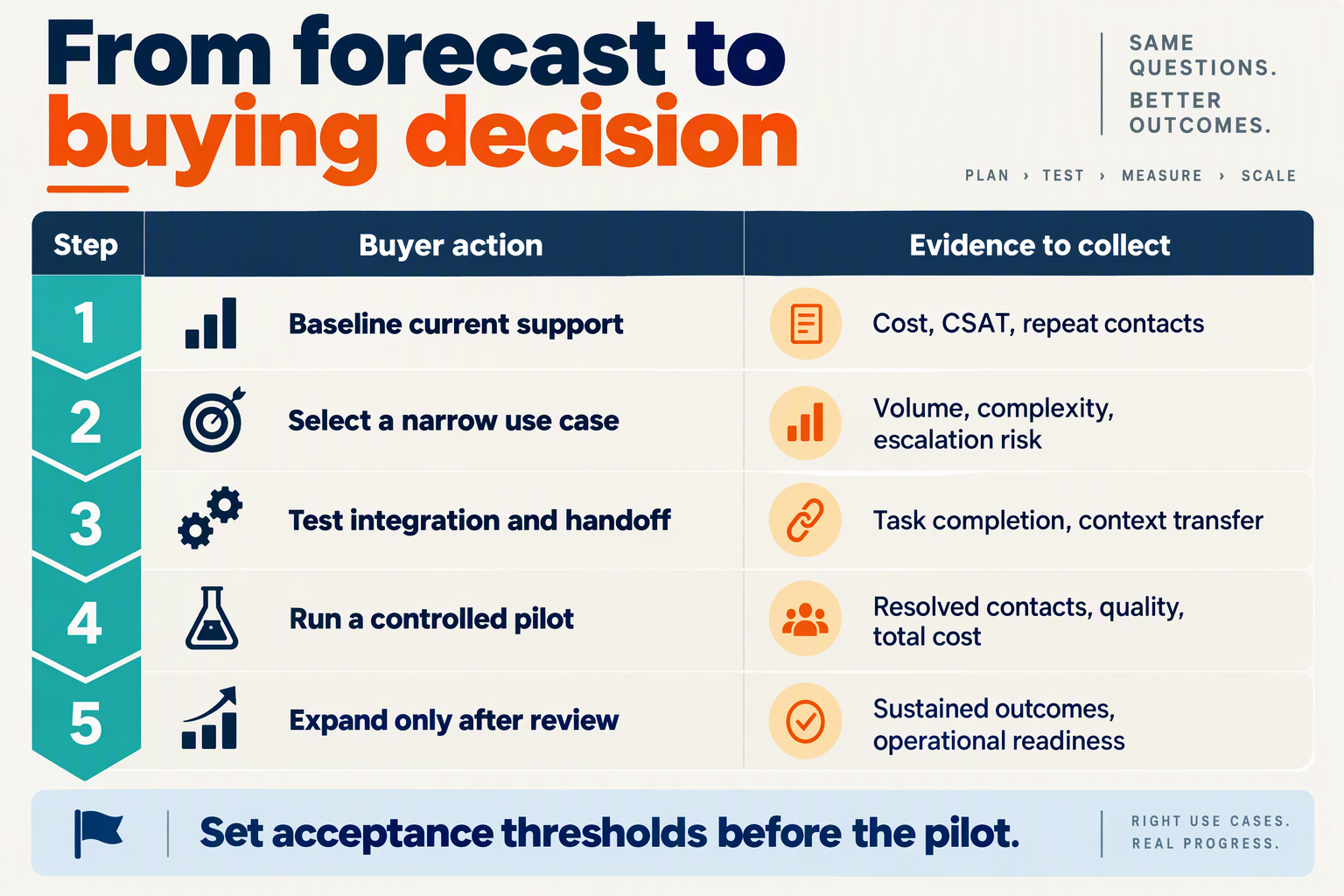
Support buyers should run a bounded pilot with pre-agreed success criteria, then expand only when verified resolutions improve without unacceptable quality, cost, or escalation trade-offs. Measure completed customer outcomes—not merely conversations handled or replies generated.
For an October 2026 buying decision, the next step is an evidence plan, not another feature comparison. SNS Insider’s September 16, 2026 announcement through GlobeNewswire projects 19.50% annual growth for the AI productivity tools market during 2026–2035; that forecast describes market expansion, not the performance target your support team should adopt.
What should a customer-support automation pilot measure?
Use the following scorecard as a recommended October 2026 pilot framework, not an industry benchmark. Agree on definitions, owners, and pass/fail thresholds before launch so that a promising demonstration cannot quietly become the standard for production approval.
| Priority | Buyer action | Success measure | Decision rule |
|---|---|---|---|
| Establish a baseline | Sample comparable human-handled cases | Resolution rate, handling time, CSAT | Compare equivalent intents and complexity |
| Verify completion | Audit outcomes against system records | Verified resolutions ÷ eligible cases | Count completed tasks, not confident replies |
| Check durability | Track repeat contacts for the same issue | Recontact rate within a defined window | Investigate apparent resolutions that reopen |
| Test escalation | Introduce exceptions and tool failures | Correct handoffs, transfer delay | Require escalation for predefined risk cases |
| Calculate economics | Include software, usage, setup, and human rescue | Total cost ÷ verified resolutions | Scale only when quality-adjusted costs justify it |
| Protect experience | Survey customers and review complaints | CSAT, complaint rate, response rate | Investigate deterioration before expansion |
Keep eligibility explicit. If automation handles only delivery-status questions, do not compare its results with a human queue dominated by disputed payments. Report both the eligible-case success rate and the share of total support demand those cases represent.
How do you avoid misleading automation metrics?
Containment is not resolution: a customer who leaves without reaching an agent may still have an unresolved problem. Pair containment with transaction evidence, transcript review, and repeat-contact tracking.
Consider this hypothetical October 2026 pilot—not a vendor benchmark:
- 1,000 eligible cases enter the automated workflow.
- 700 cases finish without a human transfer.
- Auditing verifies only 600 completed resolutions.
- ₹30,000 in total pilot costs produces a cost of ₹50 per verified resolution, rather than approximately ₹43 per contained conversation.
The denominator changes the buying decision. Also separate one-time implementation costs from recurring operating costs; otherwise, a small pilot can make steady-state economics look worse—or omitted setup work can make them look artificially attractive.
As of October 2026, CallMissed, the AI customer-communication platform, offers call scoring against buyers’ own QA rubrics, eval suites, A/B experiments, agent analytics, and metric alerts. These capabilities can support evaluation, but buyers must still define what constitutes an acceptable outcome.
When should buyers expand, pause, or stop?
Use a staged decision process:
- Expand when audited outcomes and costs meet agreed thresholds across representative cases.
- Pause when repeat contacts rise, handoffs lose context, or results vary sharply by language or intent.
- Stop and redesign when the system makes unauthorized commitments or cannot reliably escalate exceptions.
Assign an operations owner to review results and authorize changes. The strongest purchase case is not “AI handled more conversations”; it is “customers completed more requests at an acceptable cost, with accountable recovery when automation failed.”
Where could CallMissed fit in a support automation pilot?
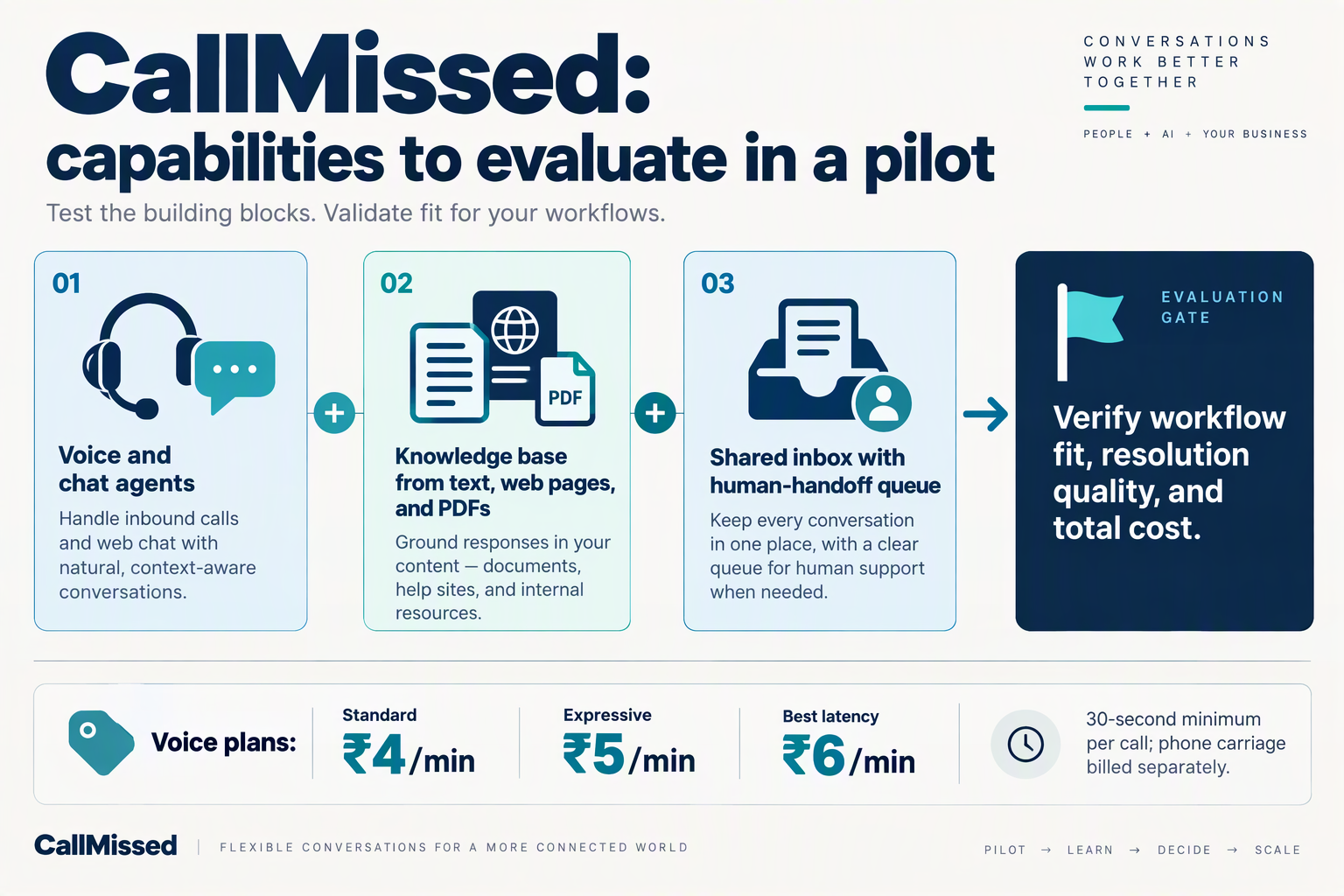
CallMissed could fit a support automation pilot where buyers need to test Indian-language voice support, connected business workflows, and supervised escalation together. As of October 2026, CallMissed’s verified product information lists speech recognition in 22 Indian languages plus English, live call monitoring, and integrations with Shopify, WooCommerce, and HubSpot—specific capabilities worth testing against your support workload.
Which support workflow should you pilot first?
Choose a bounded, reversible task, such as answering delivery questions or explaining a published cancellation policy. Avoid starting with discretionary refunds or account changes that require stronger authorization controls.
For example, a retailer could test whether a voice agent understands a Hinglish delivery query, retrieves the relevant order information through an integration or custom tool, and explains the next step accurately. Treat customer verification and permission to disclose order details as explicit workflow requirements—not assumptions about the platform.
Structure the pilot around three cases:
- Routine request: The customer provides sufficient information, and the order record is available.
- Missing information: The agent must ask a clarifying question rather than guess.
- Exception: The record conflicts with the customer’s account, requiring human judgment.
This tests whether automation completes a useful task, not merely whether the conversation sounds convincing.
How can supervisors inspect and improve the pilot?
As of October 2026, the platform supports call recordings, transcripts, AI call notes, and scoring against buyer-defined QA rubrics, according to CallMissed’s verified product information. Its live monitoring also lets supervisors listen, whisper, or barge in; eval suites and A/B experiments provide additional ways to test changes.
Translate those capabilities into a review process:
- Score factual accuracy: Did the response match the retrieved record and approved policy?
- Inspect language handling: Did code-mixed speech change the meaning of an address, date, or request?
- Review intervention: Did a supervisor need to correct the agent, and why?
- Compare versions: Change one prompt or workflow element at a time, then review comparable cases.
Speech recognition coverage is not the same as voice-output coverage: as of October 2026, natural text-to-speech voices cover 10 Indian languages plus English, with additional languages available through other voice models. Test recognition and spoken replies separately.
What would a small voice pilot cost?
As of October 2026, the published Standard voice-agent rate is ₹4 per minute, covering speech recognition, the language model, and the voice; phone carriage is billed separately. A hypothetical pilot comprising 100 connected calls averaging three minutes would therefore incur ₹1,200 in voice-agent usage, before carriage and other applicable charges.
Budget around the actual billing rules:
- Connected calls have a 30-second minimum.
- Calls that never connect cost nothing.
- A custom stack is billed component-by-component, by the second, without that minimum.
What should determine whether the pilot expands?
Expand only when the pilot demonstrates accurate task completion, manageable intervention, and acceptable cost per resolved request. The AI productivity-tools market’s expansion makes experimentation worthwhile, but the buying decision should rest on your own recordings, exception cases, and bills—not the market forecast or a polished demo.
Frequently Asked Questions
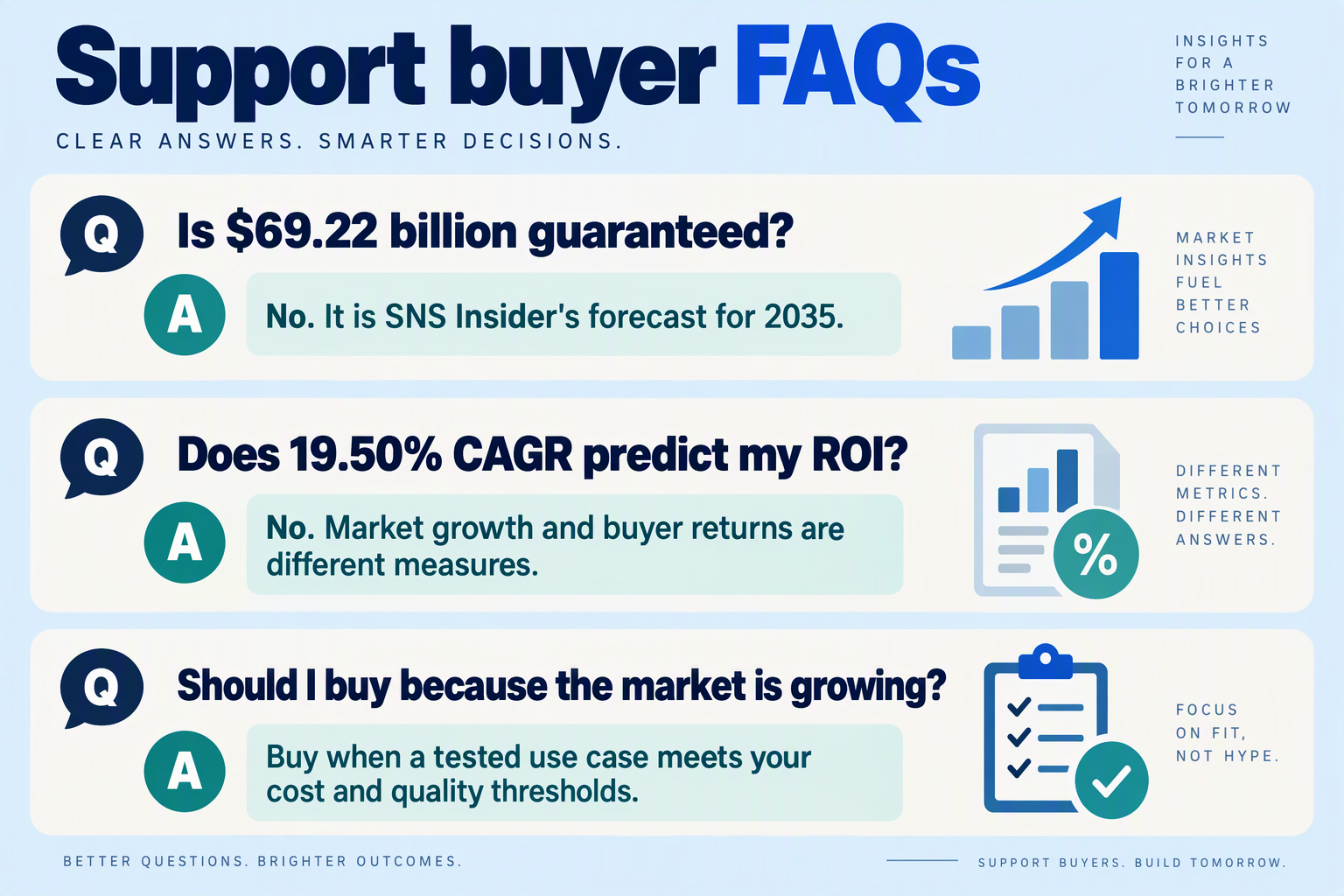
Is the AI productivity tools market forecast of $69.22 billion by 2035 certain?
Does the AI productivity tools market’s 19.50% CAGR mean my business will earn that ROI?
Should customer-support teams buy AI productivity tools now or wait?
What metrics should an AI customer-support automation pilot measure?
What costs should buyers include beyond an AI support subscription?
How can buyers reduce vendor lock-in before signing an AI support contract?
Conclusion
The AI productivity tools market offers support buyers more choices, but market growth is not evidence of better customer outcomes. The strongest buying decisions will connect automation to accurate answers, completed workflows, reliable human escalation, and costs that remain understandable under real-world demand.
According to SNS Insider’s September 16, 2026 announcement through GlobeNewswire, the market is projected to reach $69.22 billion by 2035, growing at 19.50% CAGR during 2026–2035. For support leaders evaluating tools in October 2026, that forecast signals an expanding category worth investigating—not a guarantee that any particular deployment will deliver savings.
Four takeaways should guide the next purchase:
- Buy for resolution, not polished replies. A convincing demonstration shows that an assistant can generate language; it does not establish that automation can complete a customer request. Use practical scenarios, such as an order-status enquiry or refund exception, to check whether the system retrieves approved information, explains the next step, and recognises its limits.
- Evaluate the whole workflow. Knowledge access, business-system integrations, customer records, and channel requirements belong in the same assessment. If agents still need to switch systems or manually update records after every interaction, an apparently capable tool may leave much of the operational work untouched.
- Make human escalation a requirement. Automation should support accountable service, not obscure who owns an unresolved request. Test what happens when an answer is uncertain or a customer needs judgment: a person must be able to take over rather than repeatedly rescue a stalled conversation.
- Calculate economics beyond the subscription. Compare costs against the work actually completed, including longer conversations, follow-up, and human intervention. A low headline price is not enough if difficult requests create additional effort; evaluate quality and spending together before expanding deployment.
What should customer-support buyers watch next?
As the market expands toward 2035, watch whether products become better at connecting answers to actions—not simply more fluent at conversation. The meaningful test will remain whether improvements survive real customer requests, integration constraints, and exceptions that demonstrations can overlook.
As of October 2026, CallMissed, the AI customer-communication platform, offers knowledge-base-backed agents, custom REST tools, a shared inbox, and a human-handoff queue. Readers can explore those capabilities as an example of the workflow-oriented approach discussed here, while applying the same quality, integration, and cost checks used for any purchase.
Start with one clearly defined support workflow, test it against realistic requests, and expand only when the evidence supports doing so. Before your next AI purchase, can you show how it will complete a customer’s request—not merely answer it?
Related Reading
- Agentic AI Reduced Productivity: What Support Must Track
- AI Productivity Tools for Business in 2026: Audit Guide
- Gemini 4 Argon: Customer Support and Receptionist Guide
Sources
Discussion
Related Posts

Ready to automate customer conversations?
Launch AI voice agents and WhatsApp bots with CallMissed — one API, 22+ Indian languages.