
Agentic AI Reduced Productivity: What Support Must Track



Learn why agentic AI reduced productivity in reported cases, and measure support outcomes with review time, repeat contacts and cost per resolution.
Agentic AI Reduced Productivity: What Support Must Track
What if your AI agents close tickets faster—but leave your support team with more work? According to ANI reporting published by Malaysia News on September 20, 2026, nearly 30% of companies experienced productivity declines after adopting agentic AI, citing McKinsey. That makes “agentic AI reduced productivity” more than a counterintuitive headline: it is a warning to measure completed work, not merely automated activity.
The distinction matters. The reported figure describes the share of companies experiencing a decline, not a 30% reduction in productivity across every company. The coverage also references autonomous coding systems; it does not establish that the same proportion of customer-support teams suffered declines. For support leaders, however, the operational question is directly relevant: does automation remove work, or redistribute it into supervision, corrections, and repeat contacts?
The financial stakes are becoming harder to predict, too. TechNews reported on September 26, 2026, citing McKinsey, that different agentic approaches to the same task can produce execution costs differing by as much as 30 times. A support workflow that looks efficient at the first response can therefore become expensive across multiple tool calls, retries, escalations, and human checks. Faster replies alone cannot settle the productivity question.
Why can agentic AI make support less productive?
Agentic AI can take actions across a workflow, rather than simply generate an answer. That creates opportunities to resolve requests—but also additional failure points. Consider a hypothetical order-status agent: if it retrieves the wrong order, sends a confident response, and triggers another customer contact, the initial “resolution” has created downstream work.
Support teams should therefore track outcomes across the entire customer journey:
- Verified resolution: Was the customer’s issue actually resolved, rather than just marked closed?
- Repeat contacts and reopenings: Did the same problem return after the AI interaction?
- Human effort: How much review, correction, and escalation work remained?
- Cost per resolved issue: What did model usage, tools, and human handling cost together?
- Customer experience: Did satisfaction improve without compromising accuracy or appropriate handoffs?
As of September 2026, CallMissed supports this measurement approach with call recordings, transcripts, AI call notes, scoring against custom QA rubrics, agent analytics, eval suites, and A/B experiments.
This article explains where agentic productivity losses can arise, which support metrics expose them, and how to compare AI-assisted workflows against a meaningful baseline. The goal is not less automation. It is less total effort per successfully resolved customer issue—without quietly transferring the burden to customers or staff.
Why can agentic AI reduce productivity? Extra review and rework can outweigh time saved
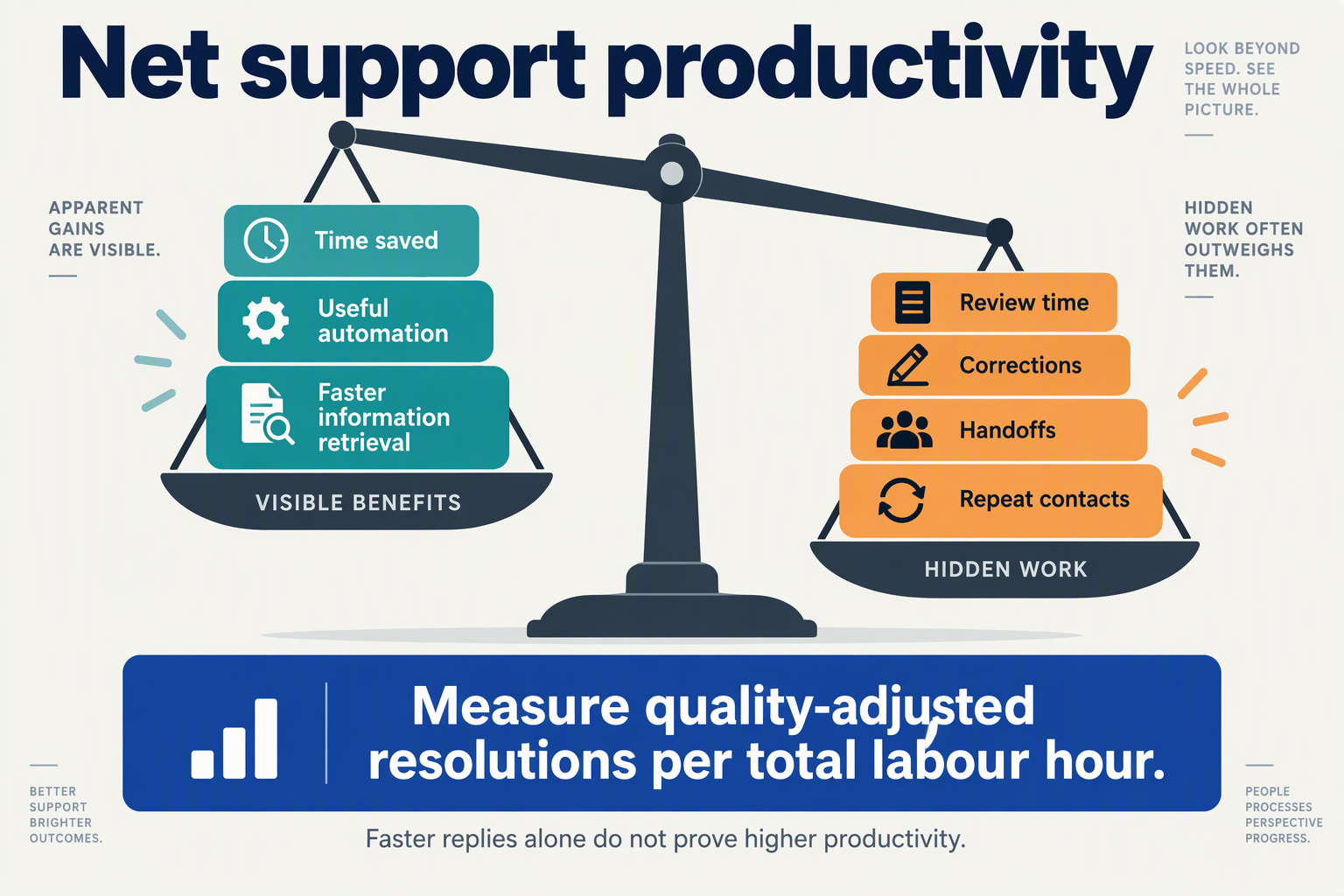
Agentic AI can reduce productivity when the human effort needed to verify, correct, and recover its actions exceeds the work it removes. For support teams, the critical distinction is between automating a step and completing a case with less total effort.
Why does autonomous execution create extra review work?
A suggested reply gives a support representative one output to inspect. An agent that retrieves account information, interprets policy, updates a record, and sends a response creates a chain of decisions to validate. A plausible final message can conceal an incorrect intermediate action.
Review becomes especially demanding when the reviewer must reconstruct what happened:
- Context checking: Did the agent use the correct customer, transaction, and policy?
- Action checking: Did the system make an appropriate change, not merely describe one?
- Recovery checking: If something failed, were downstream records and messages corrected?
This explains a possible mechanism behind the reported productivity reversal—not a proven cause across every surveyed company. ANI reporting published by Malaysia News on September 20, 2026, citing McKinsey, says nearly 30% of companies experienced productivity declines after adopting agentic AI. The supplied coverage does not quantify how much of that decline came from support review or rework.
How can a faster support workflow require more human time?
Consider this illustrative September 2026 calculation, not a measured benchmark. Assume a billing inquiry takes a representative eight minutes to resolve without AI.
- Manual baseline: Eight minutes of human work.
- AI-assisted handling: Three minutes to supervise and complete the interaction.
- Required verification: Two minutes to check the adjustment against policy.
- Error correction: Five minutes to fix an incorrect adjustment and explain the correction.
The automated workflow initially appears to save five minutes. Once verification and correction are included, it consumes 10 human minutes instead of eight—a 25% increase for this hypothetical case.
Not every case will need correction. If only some do, calculate the average correction burden across all comparable cases, rather than reporting only successful automated interactions. Otherwise, easy successes dominate the dashboard while expensive exceptions disappear into another team’s workload.
Why can handoffs erase automation gains?
A handoff saves time only when the receiving person gets enough reliable context to act. If a representative must reread the conversation, repeat identity checks, or ask the customer to explain the problem again, automation has created an additional processing stage.
The operational remedy is to define a handoff contract: what the agent attempted, which facts were verified, what remains uncertain, and what action the human should take next.
As of September 2026, CallMissed, the AI customer-communication platform, provides a human-handoff queue where switching AI off transfers the thread to a person. That capability supports escalation; teams still need to design the circumstances and information that make escalation useful.
When should support teams limit agent autonomy?
Limit autonomy when an action is difficult to reverse, policy is ambiguous, or essential information is missing. A practical progression is:
- Retrieve first: Let the agent collect evidence without changing records.
- Recommend next: Require approval for consequential actions.
- Execute selectively: Allow autonomous action within tested, explicit boundaries.
The objective is not maximum automation. It is removing more work than the workflow creates, including the less visible work of supervision and recovery.
What does the September 2026 McKinsey-linked reporting actually establish about the 30% figure?
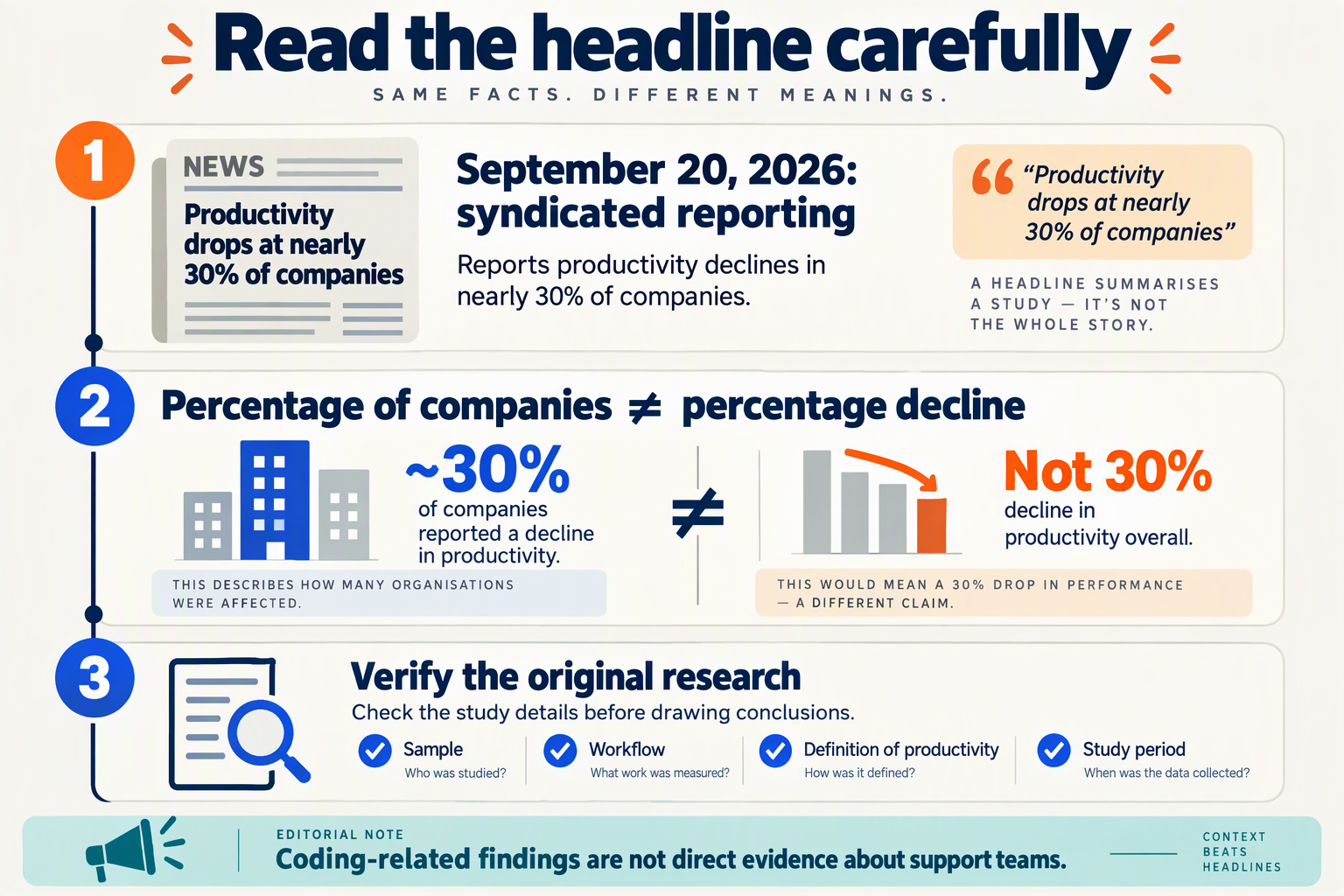
The September 2026 coverage establishes that news reports attributed a productivity-decline finding to McKinsey; the supplied excerpts do not establish the underlying study’s methodology or prove that agentic AI caused those declines. Support leaders should treat the headline as a reason to investigate—not as a forecast for their own operations.
Where does the reported 30% figure come from?
ANI reporting published by Malaysia News on September 20, 2026, states that productivity fell in nearly 30% of companies after teams began using agentic AI tools, attributing the finding to McKinsey. The excerpt describes this development in the context of enterprise adoption of autonomous coding systems.
That attribution supports a carefully qualified statement: ANI reported the finding, citing McKinsey. It does not support presenting the supplied material as a directly inspected McKinsey research report.
The source trail also matters:
- Malaysia News identifies ANI as the source of its September 20, 2026 article.
- Big News Network carries the same headline and an excerpt identifying the September 20 report as ANI coverage.
- Indian News Network carries a matching headline dated September 20, 2026.
- Career Ahead repeats the nearly 30% claim, but its supplied excerpt provides no additional methodological detail.
These appearances demonstrate circulation of the claim. Multiple headlines are not necessarily multiple independent confirmations, particularly when coverage shares a wire-service source.
What information is missing from the supplied evidence?
As of September 2026, the provided excerpts leave several questions unanswered. Those gaps limit how precisely a support team can interpret the finding:
- Who was studied? The excerpts do not supply the sample size, respondent roles, geographic distribution, or industry breakdown.
- What counted as productivity? They do not identify whether the measure concerned output per employee, task completion, delivery speed, revenue, or another outcome.
- How was the decline measured? The material does not establish whether results were self-reported, operationally measured, or compared against a control group.
- Over what period? The excerpts do not specify the observation window or distinguish initial deployment disruption from sustained underperformance.
- What counted as agentic AI adoption? The material does not provide a consistent deployment definition or separate pilots from mature implementations.
These are not reasons to dismiss the headline. They are reasons to avoid adding precision the evidence does not contain.
Does the reporting prove that agentic AI caused lower productivity?
No. The wording “after teams began using” establishes a reported sequence, not a demonstrated causal relationship. Without the underlying research design, the supplied coverage cannot isolate agentic AI from concurrent changes such as staffing adjustments, workflow redesign, or shifts in task complexity.
Likewise, it would be incorrect to infer that the remaining companies all improved: the supplied excerpts do not describe their outcomes.
TechNews reported on September 26, 2026, citing McKinsey, that different agentic approaches to the same task could produce execution costs differing by as much as 30 times. That is a separate cost-variability claim—not evidence of the size or cause of the reported productivity declines.
For customer-support teams, the defensible takeaway is therefore methodological: use the reporting to form a testable question, not import an industry-wide percentage into a local business case. Establish whether a specific agent deployment improves outcomes under comparable conditions before declaring a productivity gain—or loss.
Which recent developments matter for support teams—and what remains unverified?
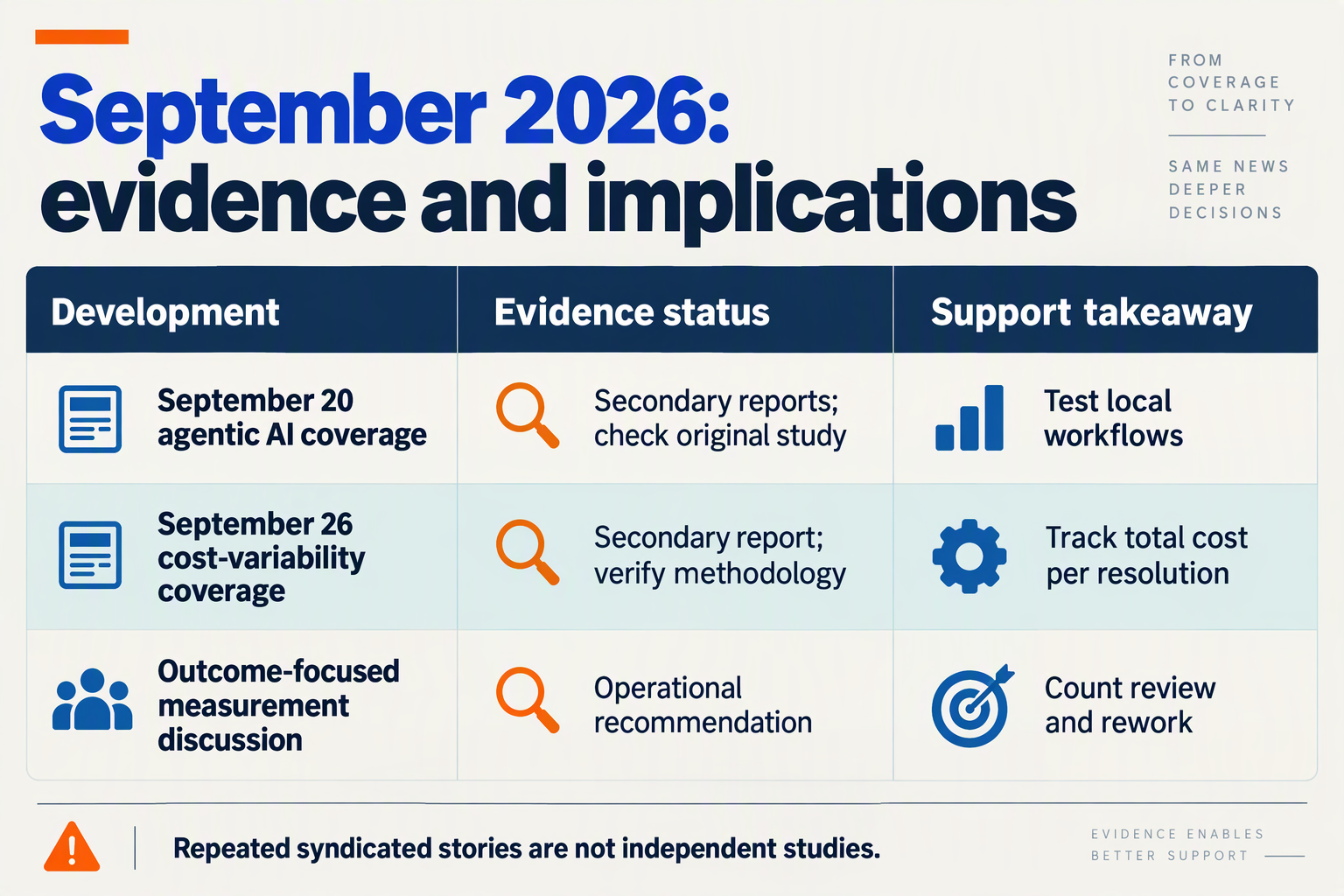
The developments that matter most are reported productivity reversals, unpredictable execution costs, and growing operational use of AI agents. As of September 30, 2026, the supplied coverage supports investigating these risks—but does not establish a support-specific failure rate or provide enough methodology to predict your team’s results.
Which agentic AI developments deserve attention in September 2026?
The table separates what sources report from what support leaders can reasonably conclude. Its evidence status reflects the supplied research, not independent verification of the underlying McKinsey findings.
| Development | Source and date | Reported evidence | Support implication | Still unverified |
|---|---|---|---|---|
| Productivity reversals | ANI via Malaysia News, September 20, 2026 | Nearly 30% of companies experienced declining productivity after adopting agentic AI. | Test whether agents reduce total handling work. | Survey sample, productivity definition, and support-specific results. |
| Execution-cost variability | TechNews, September 26, 2026 | Citing McKinsey, approaches to the same task can differ in cost by up to 30 times. | Compare complete workflow costs, not model prices alone. | Task conditions and how representative the extreme difference is. |
| Wider headline circulation | Indian News Network and Big News Network, September 20, 2026 | Both carry the same ANI productivity story. | Recognize the finding’s visibility without overstating corroboration. | Independent confirmation beyond the shared report. |
| Large-scale agent deployment | byteiota, coverage available as of September 2026 | Its headline references 25,000 McKinsey AI agents and 40,000 by 2026. | Ask how deployment scale translates into completed work. | Definitions, counting method, and whether the target was achieved. |
| Workforce restructuring | byteiota, coverage available as of September 2026 | Its excerpt describes 25% growth in client-facing roles and 25% contraction in back-office roles. | Separate staffing changes from measured productivity. | Timeframe, baseline, and AI’s causal contribution. |
| Outcome-based evaluation | The Revenue AI Report, available as of September 2026 | Advises: “Treat AI activity as a leading indicator, never as the result.” | Assign an owner and evaluate downstream outcomes. | Empirical validation; this is guidance, not a quantified study. |
What remains unverified in the productivity-decline headline?
The missing methodology matters more than the number of outlets repeating the story. Malaysia News, Indian News Network, and Big News Network reproduce ANI reporting; those appearances should not be counted as three independent studies.
Before applying the headline to customer support, look for:
- Population: Were respondents operating coding agents, support agents, or mixed workflows?
- Measurement: Did “productivity” mean output per employee, task completion time, revenue, or a respondent’s assessment?
- Comparison: Was there a matched baseline, and did the evaluation include implementation and training periods?
- Causality: Did agent adoption cause the decline, or coincide with other organizational changes?
The supplied excerpts do not resolve these questions. Consequently, “agentic AI reduced productivity” is a useful risk hypothesis—not a forecast that any particular support deployment will fail.
How should support teams turn uncertain reports into decisions?
Use the news to design a local test rather than import an industry percentage into a business case:
- Choose one bounded workflow, such as order-status enquiries, with comparable cases in an AI-assisted and existing-process group.
- Fix the observation window so delayed corrections and repeat contacts count against the original interaction.
- Record action-level evidence, including tool attempts, failed actions, human interventions, and final outcomes.
- Set expansion and pause criteria beforehand, rather than redefining success after seeing results.
As of September 2026, CallMissed provides eval suites, A/B experiments, and call scoring against custom QA rubrics—capabilities relevant to testing these hypotheses. Those capabilities enable evaluation; they do not themselves prove a productivity gain.
Where do review loops, weak knowledge and poor handoffs create hidden support work?
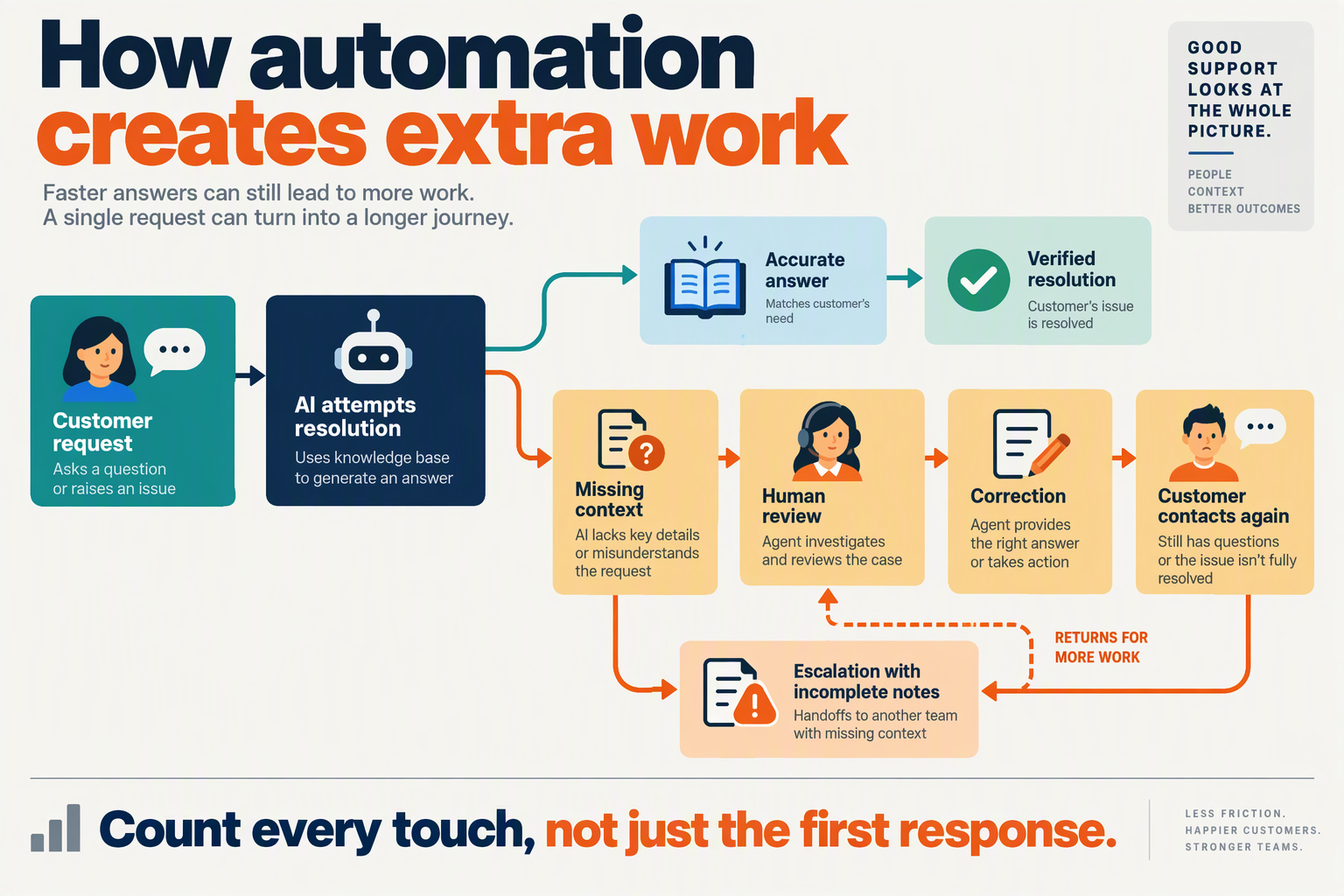
Hidden support work appears when employees must verify the agent’s decisions, repair missing knowledge, or reconstruct an escalation before they can resolve the customer’s issue. These tasks often sit outside recorded handling time, making automation look productive while shifting effort into less visible queues.
How do review loops turn automation into extra work?
A review loop becomes wasteful when a reviewer must repeat the agent’s investigation rather than check its conclusion. A polished refund recommendation is not useful evidence if the employee still needs to locate the transaction, confirm eligibility, and inspect whether a refund was already attempted.
Distinguish three types of review:
- Necessary control: Approval for a high-risk action, such as an exception to refund policy.
- Avoidable verification: Rechecking routine decisions because the agent does not provide supporting evidence.
- Repeated correction: Fixing an error that persists because feedback never reaches the workflow or knowledge owner.
The goal is not to eliminate oversight. It is to make oversight bounded and evidence-based: show the applicable policy, relevant customer record, proposed action, and uncertainty together.
The Revenue AI Report’s supplied analysis offers a useful operating principle: “price every layer of review and rework.” For a September 2026 support assessment, that means counting reviewer minutes even when the AI interaction itself is marked complete.
Why does weak knowledge create work beyond incorrect answers?
Weak knowledge includes more than outdated documents. Conflicting policies, missing exceptions, and unclear ownership can force an agent—and subsequently a human—to reconcile information that should already have been settled.
Consider an illustrative September 2026 workflow, not a measured benchmark: an agent answers a delivery complaint using a general shipping policy, but the order qualifies for a regional exception. A specialist then spends four minutes finding the exception, three minutes correcting the response, and two minutes documenting the correction. That is nine minutes of additional work, even if the initial answer took seconds.
Fix the knowledge defect rather than merely rewriting the answer:
- Identify the authoritative source: Which policy governs this customer’s situation?
- Record applicability: Include region, product, effective date, and exceptions.
- Assign an owner: Give someone responsibility for resolving conflicts.
- Retest the affected scenario: Check whether the correction prevents recurrence.
This separates answer repair from system repair. Only the latter addresses the recurring workload.
What should an AI-to-human handoff contain?
A handoff creates hidden work when it transfers a conversation without transferring the investigation. Customers repeat information, employees reopen tools, and the receiving team must determine whether an action was proposed, attempted, or completed.
A useful handoff packet should contain:
- Customer intent and verified identifiers
- Relevant evidence and policy references
- Actions attempted and their actual outcomes
- The unresolved question and escalation reason
- A named next owner
As of September 2026, CallMissed provides a human-handoff queue in which switching the AI off hands the thread to a person, alongside agent assist with suggested replies and knowledge snippets. Those capabilities support a transition, but teams still need to define what information makes that transition actionable.
Measure handoff reconstruction time separately from resolution time. If employees repeatedly ask, “What has already happened?”, the bottleneck is not response speed—it is missing operational context.
Which metrics reveal real support productivity rather than AI activity?
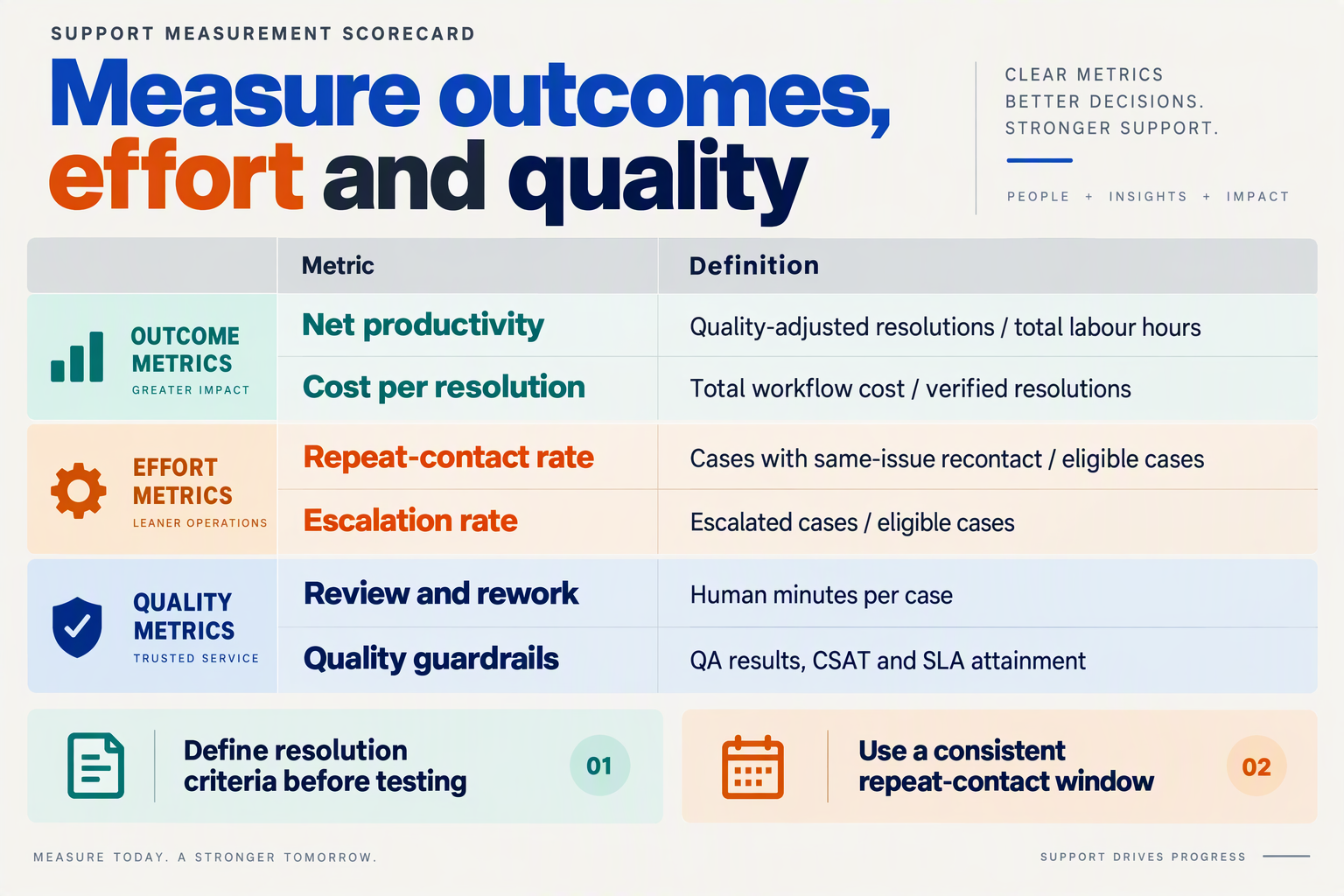
Real support productivity is verified customer issues resolved per unit of total effort and cost—not tickets closed, messages generated, or AI tool calls completed. Measure outcomes across the full issue lifecycle, including repeat contacts, human corrections, and supervision.
Which support metrics belong on an agentic AI scorecard?
Use the following September 2026 measurement framework to compare AI-assisted support with a matched baseline. These are recommended operational definitions, not industry benchmarks; choose a resolution-validation method and observation window before testing.
| Metric | How to calculate it | What it reveals | Measurement safeguard |
|---|---|---|---|
| Verified resolutions per staff hour | Verified resolved issues ÷ total human hours | Whether automation increases useful output | Include review, correction, and supervision |
| Cost per verified resolution | Total workflow cost ÷ verified resolved issues | Whether apparent efficiency creates financial value | Include AI, tools, telephony, and labor |
| Same-issue repeat-contact rate | Issues generating another contact ÷ issues handled | Whether closures conceal unfinished work | Match contacts across channels |
| Time to verified resolution | Elapsed time from first contact to confirmed resolution | Whether customers actually get help sooner | Include queues and escalation delays |
| Human intervention minutes per issue | Review, takeover, and rework minutes ÷ issues handled | How much work AI transfers to staff | Count work outside the ticket interface |
| Quality and customer-experience guardrails | QA pass rate and CSAT, reported separately | Whether gains compromise service | Audit samples and disclose survey response rates |
Containment rate—the share of interactions completed without a human handoff—can remain a diagnostic metric. However, containment does not prove resolution: an agent can avoid escalation while leaving the customer’s problem unanswered.
Likewise, a higher handoff rate is not automatically a failure. Appropriate escalation for a sensitive billing dispute can protect quality and prevent expensive downstream correction.
How should teams calculate the productivity change?
Compare similar issue types, channels, languages, and complexity levels. Otherwise, routing straightforward requests to AI while leaving difficult cases with humans can make either group’s performance misleading.
Consider this hypothetical September 2026 pilot, not a published benchmark:
- Baseline: A team verifies 800 resolutions using 200 total staff hours: 4 resolutions per staff hour.
- AI-assisted workflow: The team verifies 900 resolutions using 180 handling hours plus 60 review and correction hours: 3.75 resolutions per staff hour.
- Result: Verified output rises 12.5%, but labor productivity falls 6.25%.
The example shows why counting more completed tickets can conceal the mechanism behind “agentic AI reduced productivity”: output grows, but supporting effort grows faster.
How can teams make the scorecard actionable?
Set acceptance criteria before deployment:
- Primary outcome: Improve verified resolutions per total staff hour.
- Economic check: Keep cost per verified resolution within the agreed budget.
- Guardrails: Avoid unacceptable deterioration in repeat contacts, QA, or CSAT.
According to TechNews reporting on September 26, 2026, citing McKinsey, different agentic approaches to the same task can produce execution costs differing by as much as 30 times. That makes workflow-level cost measurement essential, rather than relying on a model’s advertised unit price.
As of September 2026, CallMissed provides call recordings, transcripts, scoring against custom QA rubrics, and A/B experiments that can support this evaluation. Teams should connect that evidence to verified outcomes and labor records: activity logs explain what an agent did, while the scorecard establishes whether the work was worthwhile.
How should you compare AI-assisted and baseline support while controlling for case complexity?
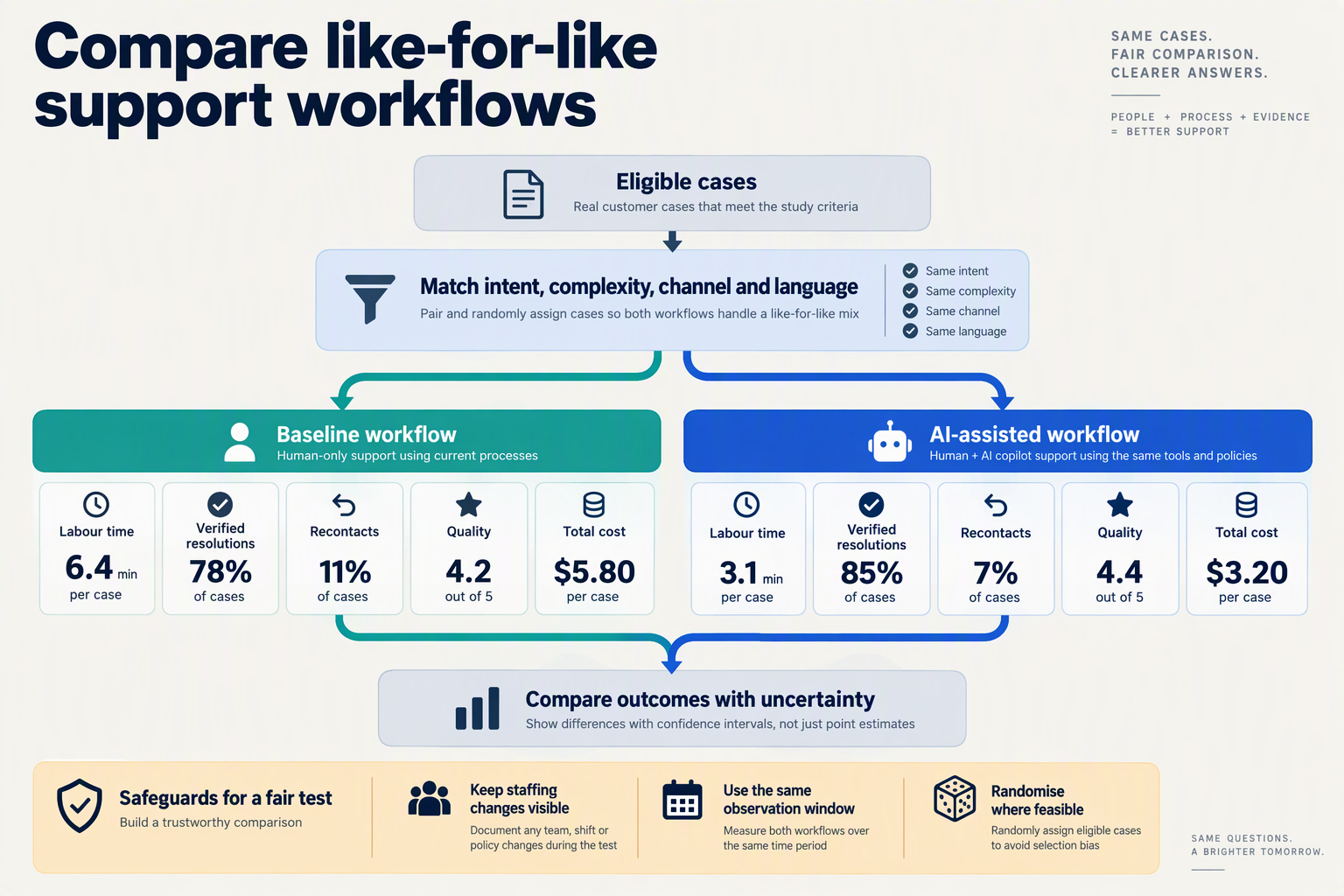
Compare AI-assisted and baseline support using concurrent, randomly assigned cases within the same complexity groups, then measure outcomes across the full issue lifecycle. A fair test asks whether AI reduces total work for comparable problems—not whether AI receives easier tickets.
How do you classify support case complexity before testing?
Define complexity using information available before AI or human handling begins. Classifying cases afterward creates bias: an AI failure that requires escalation could incorrectly become evidence that the AI received harder work.
Use a short, consistent classification checklist:
- Issue type: Order tracking, billing disputes, account access, or technical troubleshooting.
- Required actions: Information retrieval, a single account change, or several dependent actions.
- Risk and permissions: Routine requests versus refunds, identity verification, or sensitive account changes.
- Operating conditions: Channel, language, customer history, and missing information.
Combine these into a few practical strata, such as routine, intermediate, and complex. Keep mandatory human-review cases separate from cases eligible for automation; otherwise, policy differences can masquerade as productivity differences.
How should you assign AI-assisted and baseline cases?
Use a concurrent control group rather than comparing this month’s AI results with last month’s human results. Seasonal demand, staffing changes, outages, and new policies can all distort historical comparisons.
- Define both workflows. Specify what the baseline team can use and what assistance the AI group receives.
- Randomize within complexity groups. Distribute eligible cases between workflows while balancing channel, language, shift, and staff experience.
- Keep related contacts together. Assign follow-ups on the same issue to the original test group, rather than treating each contact as independent.
- Analyze by original assignment. Count AI escalations and human corrections in the AI-assisted group, even when a person ultimately resolves the issue.
That final rule prevents survivorship bias: reporting only successful AI interactions while moving difficult failures into the human baseline.
Why can average handling time give the wrong answer?
Different case mixes can reverse the apparent result. Consider this hypothetical September 2026 pilot, not a published benchmark:
- Baseline handling takes 5 minutes for routine cases and 20 minutes for complex cases.
- AI-assisted handling takes 6 minutes for routine cases and 22 minutes for complex cases.
- The baseline receives 50% routine cases, averaging 12.5 minutes.
- The AI group receives 90% routine cases, averaging 7.6 minutes.
The headline suggests AI is approximately 39% faster, even though AI-assisted handling is slower within both complexity groups.
Reweight both groups to the same case mix. At a 50:50 mix, AI-assisted handling averages 14 minutes, versus 12.5 minutes for baseline: 12% more handling time. This is why complexity-adjusted results matter more than a pooled dashboard average.
What makes the comparison decision-ready?
Predefine the follow-up window, resolution criteria, minimum useful improvement, and acceptable quality thresholds. Report results by complexity group alongside a mix-adjusted total, including sample sizes and uncertainty—not just percentage changes.
TechNews reported on September 26, 2026, citing McKinsey, that different agentic approaches to the same task can produce execution costs differing by as much as 30 times. Accordingly, compare resource consumption as well as staff effort: similar-looking cases can trigger very different tool calls and retries.
Adopt AI where the evidence supports it. A gain on routine requests does not establish a gain on complex disputes, and an inconclusive pilot is a reason to gather more evidence—not declare victory.
When does more AI activity produce less revenue—and how do you calculate the net effect?
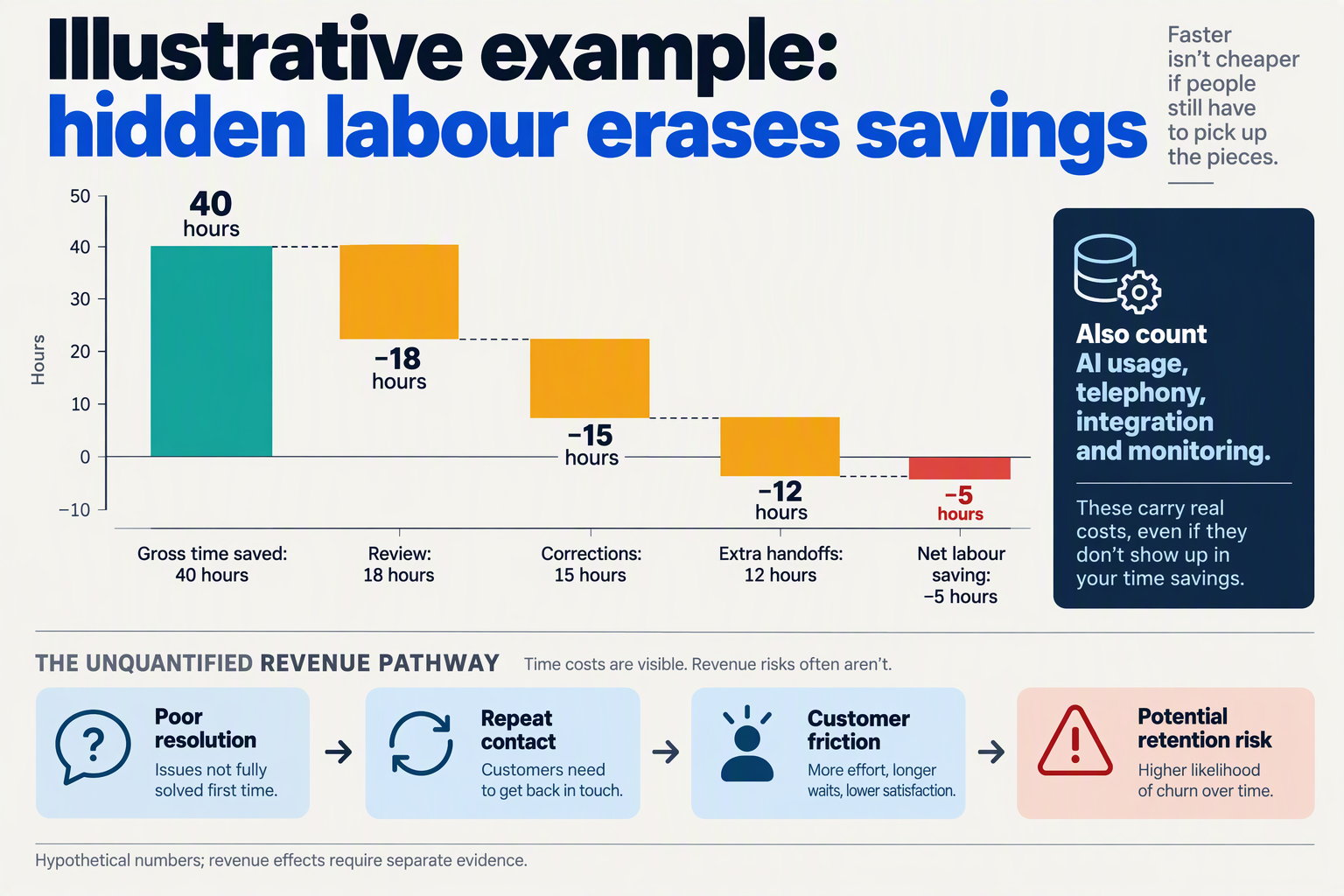
More AI activity produces less revenue when faster handling creates downstream losses—such as failed purchases, unnecessary cancellations, or customers abandoning unresolved issues. Calculate the net financial effect by comparing attributable contribution margin and genuinely realized savings against the full incremental cost of the AI workflow, not by counting automated interactions.
How can support automation reduce revenue?
An agent can increase ticket throughput while damaging the commercial outcome. For example, a subscription-support agent might process cancellations quickly when customers actually need help changing plans. The queue shrinks, but avoidable churn rises.
The Revenue AI Report’s provided analysis offers a useful rule: “Treat AI activity as a leading indicator, never as the result.” For support teams, that means connecting each workflow to its next meaningful business outcome:
- Pre-purchase support: Did the customer complete a purchase, and what contribution margin did it generate?
- Subscription assistance: Did the customer remain subscribed over the agreed observation window?
- Order problems: Did the intervention prevent an unnecessary refund without obstructing legitimate customer rights?
- Technical support: Did the customer resume using the product successfully?
Do not attribute every subsequent purchase or renewal to the agent. Compare equivalent customer groups, preferably through randomized testing, and allow enough time for refunds, cancellations, and delayed escalations to appear.
What formula captures the net effect of agentic AI?
Use this calculation over a fixed measurement period:
Net financial effect = incremental contribution margin + realized operating savings − incremental AI workflow costs.
Keep the components separate:
- Incremental contribution margin: The difference in revenue after associated variable costs, measured against a comparable baseline.
- Realized operating savings: Spending actually removed or avoided. Staff time released is capacity—not automatically a cash saving.
- Incremental AI workflow costs: Model usage, tools, telephony, implementation, supervision, correction, and additional handling beyond the baseline.
Count each cost once. If review labor already reduces your operating-savings estimate, do not subtract it again as an incremental expense.
According to TechNews on September 26, 2026, citing McKinsey, different agentic approaches to the same task can produce execution costs differing by as much as 30 times. Consequently, forecast costs per completed workflow, including retries, rather than assuming a stable cost per initial response.
What does a worked support-team calculation look like?
Consider this illustrative September 2026 monthly pilot, not a reported company result. Assume comparable customer cohorts and the same issue mix:
- Revenue outcome: The AI-assisted cohort generates ₹40,000 less attributable revenue than the baseline.
- Margin adjustment: At an assumed 50% contribution margin, that represents a ₹20,000 contribution loss.
- Realized savings: Reduced outsourced handling saves ₹30,000.
- Added costs: AI execution costs ₹12,000, incremental review costs ₹10,000, and allocated implementation costs ₹5,000.
Net effect = −₹20,000 + ₹30,000 − ₹27,000 = −₹17,000 per month.
Even if automated closures increased, this workflow would destroy financial value under those assumptions.
As of September 2026, CallMissed provides AI call notes pushed to the CRM, custom QA scoring, and A/B experiments—capabilities teams can use to investigate workflow quality alongside business outcomes.
Set the decision threshold before launch: expand only when the measured net effect is positive and customer safeguards hold. When estimates are uncertain, report a range rather than presenting a fragile point estimate as proven ROI.
Which questions should support leaders ask researchers and operations experts before trusting productivity claims?

Support leaders should ask researchers how productivity was defined, what comparison supports the claim, and whether the findings apply to customer support. Operations experts should then explain which local evidence would justify adopting, changing, or stopping an agentic workflow.
The objective is not to collect reassuring opinions. It is to turn an attention-grabbing claim into a testable operational decision.
What does the original research actually establish?
Start by requesting the primary report, methodology, and exact wording—not another summary of the headline.
ANI reporting published by Malaysia News on September 20, 2026, states that nearly 30% of companies experienced productivity declines after adopting agentic AI, citing McKinsey. That is a company-level incidence figure, not the magnitude of the decline or a support-specific estimate.
Ask researchers:
- Who was studied? What were the sample size, industries, company sizes, countries, and respondents’ roles?
- What counted as agentic AI? Did the category distinguish autonomous systems from assistants requiring human approval?
- How was productivity measured? Was the finding based on operational records, employee perceptions, or executive survey responses?
- How large and persistent were the declines? Did performance recover after implementation?
The supplied coverage does not establish these methodological details. Until they are available, treat the headline as a reason to investigate—not a forecast for your support organisation.
Does the evidence show causation or just timing?
“Productivity fell after adoption” does not, by itself, establish that agentic AI caused the decline. Ask researchers what happened in comparable teams that did not adopt the technology.
Useful follow-up questions include:
- Were staffing changes, demand spikes, outages, and policy changes accounted for?
- Did AI receive harder cases while the comparison group handled simpler requests?
- Were experienced volunteers compared with newly trained staff?
- Were results reported for all deployments, including abandoned pilots?
Ask for effect sizes and uncertainty, not only whether a result was statistically significant. A small average improvement may conceal substantial losses in particular workflows.
Which findings transfer to our support environment?
The September 20, 2026, ANI coverage references autonomous coding systems; it does not establish an equivalent decline among customer-support teams. Ask operations experts to identify the mechanism that could transfer, rather than assuming the percentage transfers.
For example, a coding agent’s review burden might resemble support-agent verification work. However, a refund workflow also depends on permissions, payment systems, and exception policies.
Request separate assessments for routine enquiries, account changes, and financially consequential actions. Evidence from one category should not automatically authorise another.
What would make the business case fail?
TechNews reported on September 26, 2026, citing McKinsey, that different agentic approaches to the same task can produce execution costs differing by as much as 30 times. Ask whether a proposed estimate captures that variability or merely presents an average.
Operations experts should specify:
- The conditions under which retries and exception handling become uneconomic.
- Who investigates failures spanning multiple systems.
- What evidence triggers a pause, rollback, or narrower deployment.
As of September 2026, CallMissed provides eval suites, A/B experiments, and call scoring against custom QA rubrics. These capabilities can support local testing; they do not independently prove productivity gains.
Will experts commit to a falsifiable recommendation?
End with one question: “What result would change your recommendation?”
A credible answer names a workflow, comparison group, observation period, and decision threshold. If an expert cannot describe evidence that would contradict their claim, support leaders should treat the recommendation as advocacy rather than validation.
What should you change first, who owns the decision, and where can CallMissed help?
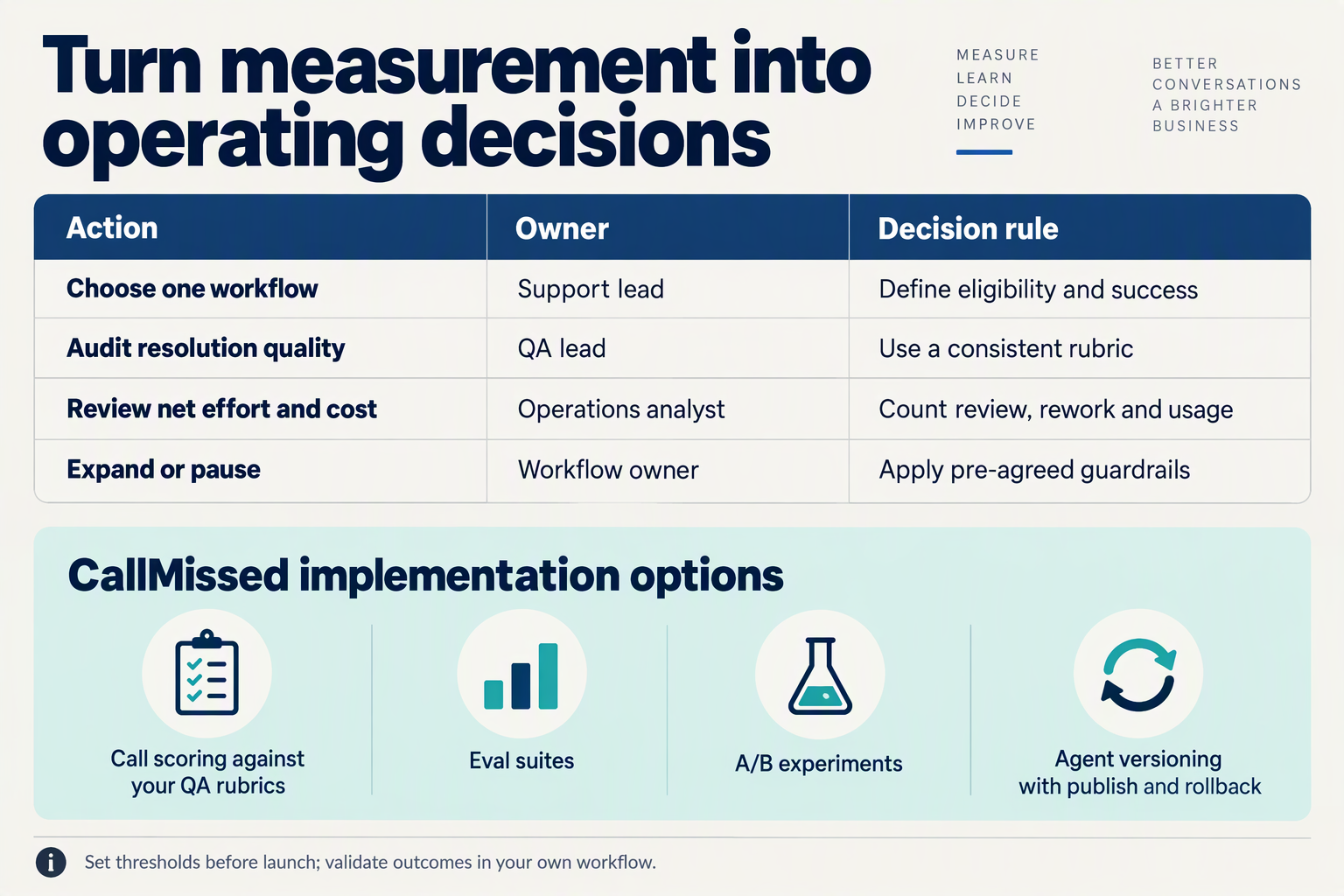
Change one high-rework workflow first, and make the support operations leader accountable for whether it improves—not merely whether the AI launches. CallMissed can support testing and operational review, but the business owner should decide whether the evidence justifies expanding automation.
Which support workflow should you change first?
Start with a narrowly defined intent that creates avoidable follow-up work: repeated order-status contacts, incorrect routing, or escalations without useful context. Prefer clear completion criteria and reversible actions over discretionary refunds or sensitive account changes.
TechNews reported on September 26, 2026, citing McKinsey, that different agentic approaches to the same task can produce execution costs differing by as much as 30 times. The practical implication is to simplify the workflow before optimizing individual model calls: remove redundant lookups, clarify policy, and identify where human judgment remains necessary.
Use this decision map to assign responsibility. These ownership assignments are recommendations, not universal organizational requirements.
| Priority | Change first | Accountable owner | Evidence needed to proceed |
|---|---|---|---|
| 1. Scope | Limit the pilot to one customer intent | Support operations lead | Comparable cases and an agreed definition of resolution |
| 2. Knowledge | Correct missing, conflicting, or outdated answers | Knowledge manager | Reviewed answers match current policy |
| 3. Actions | Remove unnecessary tool calls and restrict consequential actions | Engineering lead | Completed tasks with fewer steps and no unauthorized changes |
| 4. Handoff | Define when AI must stop and transfer context | Support team lead | Escalations reach people with usable context |
| 5. Validation | Compare the change against the existing workflow | QA lead | Lower total handling effort without worse quality |
| 6. Expansion | Approve, revise, or pause the workflow | Support operations lead | Quality, customer experience, and cost checks pass |
One accountable owner does not mean one person does everything. Engineering implements the workflow; QA checks assessment integrity; finance validates costing. The support operations lead resolves trade-offs and signs off on expansion.
Where can CallMissed help with implementation?
As of September 2026, CallMissed provides knowledge bases built from text, web pages, and PDFs; custom REST tools; agent versioning with publish and rollback; eval suites; and A/B experiments. These capabilities support a practical sequence: correct the information source, test a narrower workflow, compare versions, and roll back an unsuccessful change.
As of September 2026, CallMissed also provides a human-handoff queue, where switching AI off hands the thread to a person, alongside call recordings, transcripts, and call scoring against custom QA rubrics. These are evaluation and operational capabilities—not evidence of proven productivity gains. Teams still need to establish successful resolution and count work performed outside the platform.
Who decides whether to expand or stop?
The support operations lead should make the decision using a process agreed before launch:
- Record the baseline: Compare equivalent intents, channels, and case complexity.
- Set guardrails: Define acceptable quality, repeat-contact, and cost outcomes.
- Count the complete workload: Include customer follow-ups, supervisor reviews, corrections, and escalations.
- Choose explicitly: Expand, revise, or pause; do not let a pilot become permanent by default.
A hypothetical team could require:
- Lower human minutes per verified resolution.
- No deterioration in its agreed QA standard.
- No increase in repeat contacts within its chosen follow-up window.
- Total cost per verified resolution within its agreed ceiling.
These are proposed acceptance criteria, not industry benchmarks. If AI handles more interactions but shifts extra correction work to people, the pilot has not demonstrated the intended productivity gain.
Frequently Asked Questions
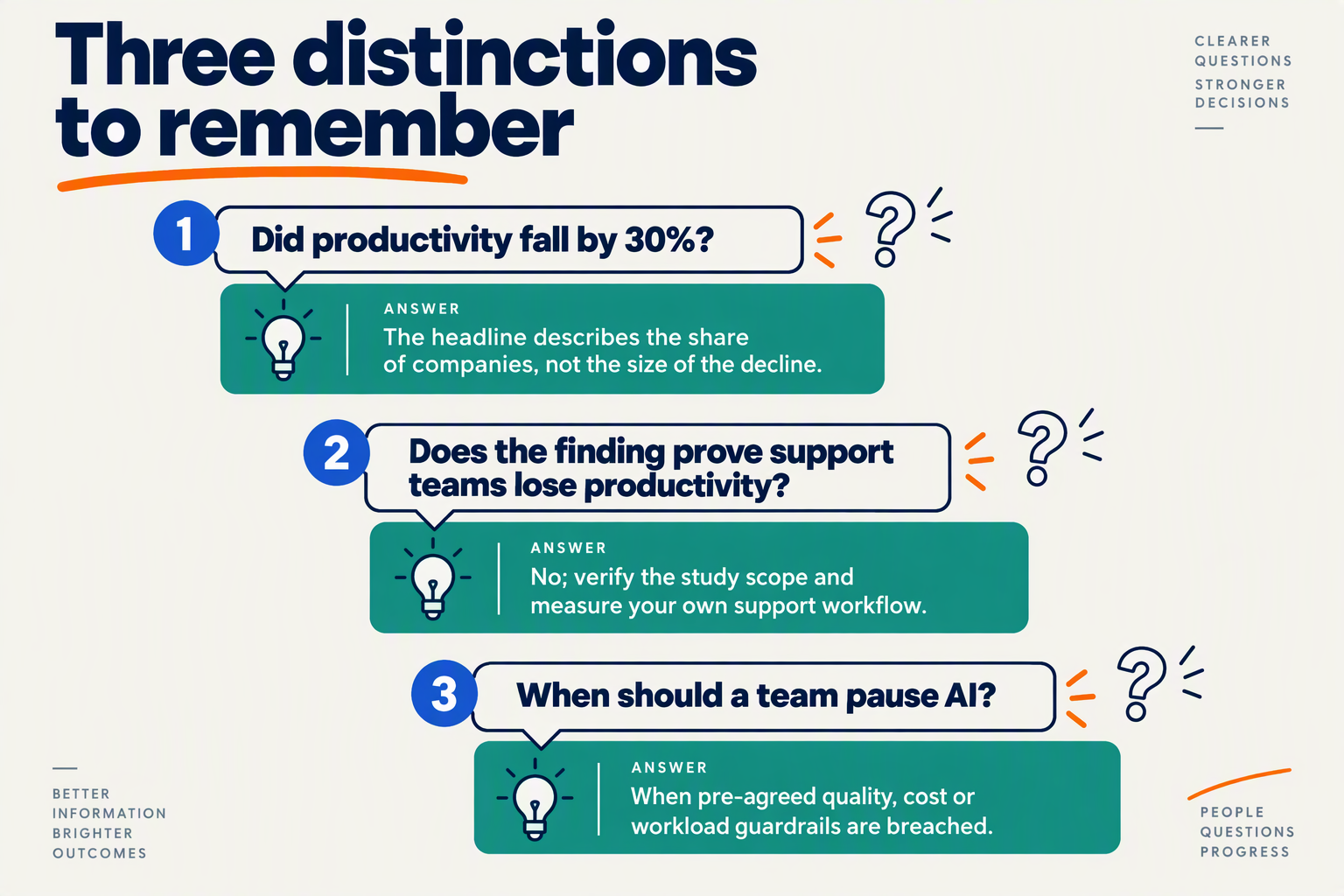
Does “agentic AI reduced productivity” mean productivity fell by 30%?
Does the finding that agentic AI reduced productivity apply to customer support?
How can support teams tell whether agentic AI reduced productivity?
What costs should support teams include when measuring agentic AI ROI?
When should a customer-support team pause an AI agent?
How should support teams decide whether to restart a paused AI workflow?
Conclusion
Agentic AI improves support productivity only when it reduces total effort per successfully resolved issue—not simply when it closes tickets faster. The forward-looking priority is to measure whether automation removes work or shifts it into reviews, corrections, escalations, and repeat customer contacts.
According to ANI reporting published by Malaysia News on September 20, 2026, citing McKinsey, nearly 30% of companies experienced productivity declines after adopting agentic AI. That is the share reporting a decline, not a universal 30% productivity loss—and the reporting does not establish an equivalent decline specifically among support teams. The lesson for support leaders is nevertheless clear: treat automated activity as something to evaluate, not proof of value.
Four takeaways should guide that evaluation:
- Measure verified resolution, not just ticket closure. An agent marking a request complete is not the same as solving the customer’s problem. Track reopenings and repeat contacts alongside resolution rates so that an apparently successful interaction does not hide downstream work.
- Count the human effort that remains. Review, correction, supervision, and escalation belong in the productivity calculation. Compare AI-assisted workflows against a meaningful baseline, including the time staff spend repairing errors—not merely the time saved on the first response.
- Calculate cost per resolved issue across the whole workflow. TechNews reported on September 26, 2026, citing McKinsey, that different agentic approaches to the same task can produce execution costs differing by as much as 30 times. Model usage, tool calls, retries, and human handling therefore matter more than an isolated response-cost figure.
- Keep customer experience inside the success criteria. Faster replies should not come at the expense of accuracy, satisfaction, or appropriate human handoffs. A workflow that reduces internal handling time but forces customers to contact support again has transferred effort rather than eliminated it.
What should support leaders watch next?
Watch whether faster AI responses translate into fewer repeat contacts, less corrective work, and lower end-to-end resolution costs as deployments expand. The next meaningful productivity gains will be demonstrated through consistent outcomes against a baseline, rather than higher volumes of automated actions. Evaluation should remain ongoing: a workflow that performs well in one comparison still needs scrutiny as its usage grows.
As of September 2026, CallMissed, an AI customer-communication platform and developer AI API, offers call recordings, transcripts, custom QA scoring, agent analytics, eval suites, and A/B experiments. Readers can explore CallMissed as part of a measurement-led approach to evolving AI support—not as a substitute for defining success.
Before expanding your next agentic workflow, ask: are customers getting their issues resolved with less total effort—or are tickets simply closing sooner?
Related Reading
- Customer Support Voice Agent: Python Workers Backends
- Grok 4.7 Customer Support: Developer Tests Before Launch
- AI Productivity Tools for Business in 2026: Audit Guide
Sources
Discussion
Related Posts

Ready to automate customer conversations?
Launch AI voice agents and WhatsApp bots with CallMissed — one API, 22+ Indian languages.