
Grok 4.7 Customer Support: Developer Tests Before Launch


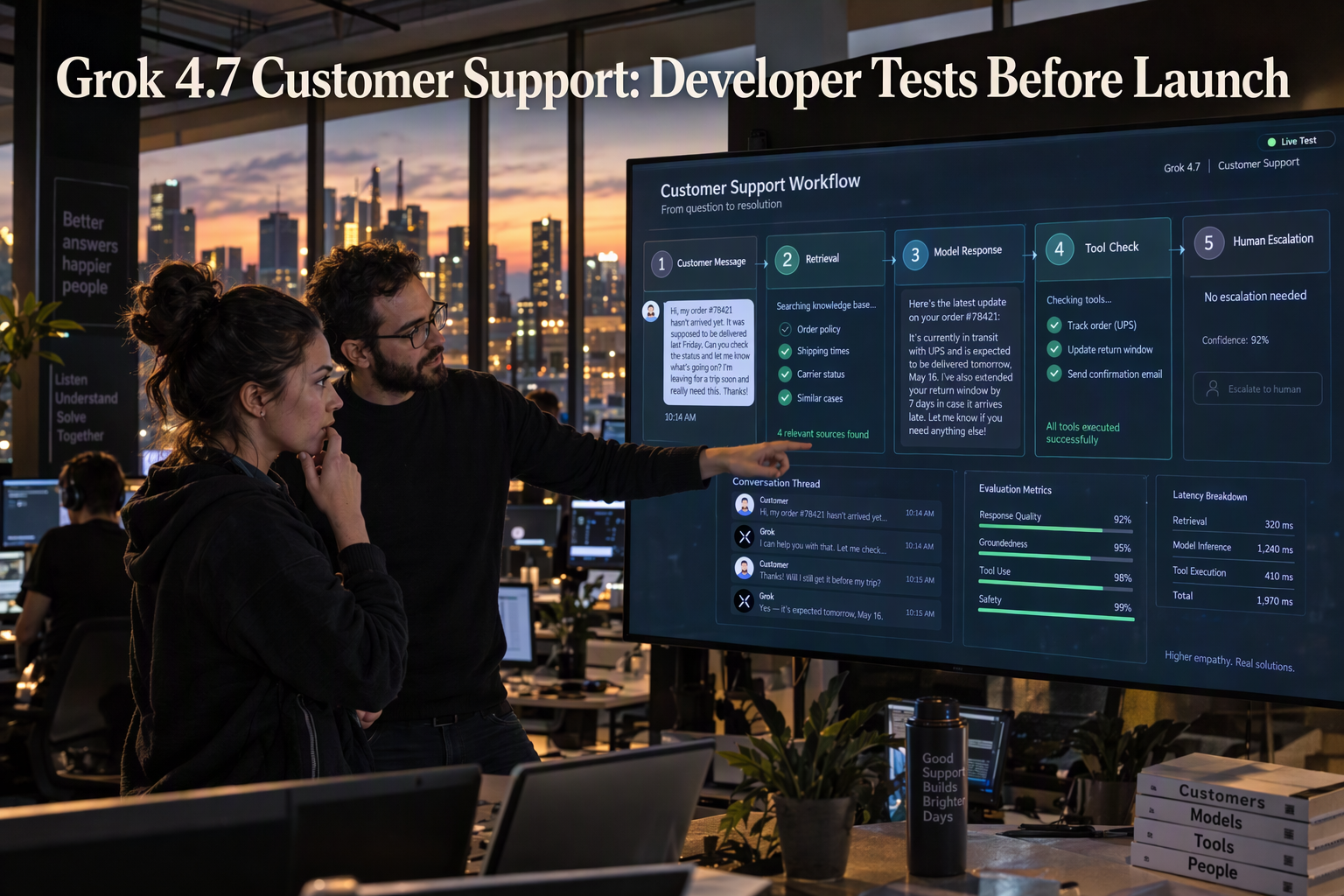
Learn how to evaluate Grok 4.7 for customer support with groundedness, tool safety, latency, cost, escalation tests, and a controlled rollout plan.
Grok 4.7 Customer Support: Developer Tests Before Launch
Could a 500,000-token context window make an AI better at customer support—or simply give it more room to get an answer wrong? That is the practical question behind Grok 4.7 customer support testing: whether a model reported to handle long tasks and text-and-image input can resolve real customer issues accurately, safely, and consistently.
The timing is hard to ignore. In September 2026, the Grok 4.7 discussion drew 361 points and 305 comments on Hacker News within 4.1 hours, according to the trend snapshot. Launch coverage from Data Phoenix reported a 500,000-token context window, while cho.sh reported pricing of $2 per million input tokens and $6 per million output tokens—the same rates as Grok 4.6. Those figures make Grok 4.7 worth evaluating, but they do not establish how it will perform in a support queue.
That distinction matters because coding and knowledge-work benchmarks are not customer-service guarantees. A support model must do more than produce a convincing answer: it needs to follow policy, retrieve the right account or product information, recognize when it lacks evidence, use tools correctly, protect sensitive data, and hand off complex or high-risk cases. A large context window may help with lengthy histories, but developers still need to test whether the model can find the relevant detail without being distracted by outdated or conflicting messages.
This article treats Grok 4.7 as a candidate to test—not an automatic upgrade. We’ll outline a practical pre-launch evaluation covering answer accuracy, groundedness, instruction following, tool calls, refusal behavior, multilingual conversations, latency, and cost. We’ll also look at regression tests: replaying real, anonymized support cases against the current model and Grok 4.7, then comparing outcomes rather than relying on a headline benchmark.
The broader developer trend is making model evaluation easier to operationalize: CallMissed, for example, offers one API key and balance across 138 models, while teams still need to validate each model for their own workflows. The useful question is not whether Grok 4.7 is impressive in general. It is whether it meets your support quality, safety, and operating-cost thresholds on the conversations your customers actually have.
Can Grok 4.7 work for customer support? Test it before shipping

Grok 4.7 could work for customer support, but the launch information does not establish that it is accurate, safe, or cost-effective on support conversations. Developers should test it against their existing model using real, anonymized tickets and predefined pass/fail criteria before routing customer traffic to it.
What does Grok 4.7’s reported performance tell support teams?
Grok 4.7’s early reported results are a reason to evaluate the model—not evidence that it will resolve support cases well. cho.sh reported a 46.3% score on CursorBench 4.0, compared with 40.4% for Grok 4.6; that benchmark concerns coding tasks, not customer-service quality. A model that performs well on extended technical work may still misunderstand a refund policy, mishandle an account-specific question, or confidently fill gaps in its knowledge.
For customer support, test behaviors that directly affect resolution and risk:
- Policy accuracy: Does the response apply the current return, billing, warranty, and escalation rules?
- Grounding: Can the model answer from approved help-center content and account data without inventing details?
- Tool use: Does it call the right system, pass valid parameters, and confirm an action only after the tool succeeds?
- Uncertainty and handoff: Does it ask a useful follow-up or route the conversation to a person when evidence is missing?
- Robustness: Does it handle typos, contradictory history, prompt-injection attempts, and requests for sensitive information appropriately?
How should developers run a pre-shipping test?
Use a paired evaluation: give the current production model and Grok 4.7 the same test conversations, the same reference materials, and the same tool definitions. Include ordinary cases as well as difficult examples, such as a customer whose earlier message conflicts with their latest request.
- Build a representative test set. Sample anonymized conversations across top contact reasons, languages, and escalation types. Include resolved cases and cases where the correct outcome is to ask for more information or hand off.
- Define expected outcomes before testing. For each case, record the acceptable answer, required tool action, policy constraints, and whether escalation is necessary.
- Score the whole interaction. Track resolution correctness, unsupported claims, policy violations, tool-call success, handoff quality, response time, and token usage.
- Review failures manually. Automated scoring can flag likely problems, but support and compliance reviewers should inspect high-impact errors such as unauthorized account changes or incorrect financial guidance.
- Set launch gates. Require Grok 4.7 to meet or exceed your current model on critical safety and accuracy measures, while staying within your latency and cost limits.
What should a safe rollout look like?
Start with offline replay, then a limited internal or shadow test in which Grok 4.7’s responses are evaluated without being sent to customers. If results are acceptable, expand gradually with human review and a documented rollback path. Re-run the test suite whenever prompts, tools, policies, or model versions change.
The September 2026 launch coverage describes Grok 4.7 as aimed at coding and long-running knowledge work, while Data Phoenix reported its availability through the API. That makes it accessible for developer evaluation, but the support decision should come from your own ticket outcomes—not launch positioning or coding scores. Companies comparing models can also use platforms such as CallMissed, whose developer API provides access to 138 models through one API key and balance, while still testing each model against their own support requirements.
What did xAI announce about Grok 4.7 and its API?

xAI announced Grok 4.7 as a model for coding and extended knowledge work, with API access, a reported 500,000-token context window, and text-and-image input. For customer-support developers, the announcement creates a candidate to evaluate—not evidence that Grok 4.7 is already reliable for live support.
What did xAI say Grok 4.7 was designed to do?
Launch coverage from Data Phoenix, published in September 2026, described Grok 4.7 as targeting coding and long-running knowledge tasks. Reporting by einkCN said xAI attributed its capabilities to a larger foundation model and longer reinforcement-learning training, with the model designed to persist through difficult tasks and check its own outputs more carefully.
Those are vendor-positioning claims, not a customer-service benchmark. A model that can work through a lengthy coding problem may still misunderstand a refund policy, overlook a crucial detail in a conversation, or confidently answer without evidence. For support teams, the practical question is whether those long-task and self-checking capabilities improve outcomes on their own ticket data.
What Grok 4.7 API details were reported?
Data Phoenix reported in September 2026 that Grok 4.7 was available through the xAI API, as well as Grok Build and Cursor. Launch coverage reported a 500,000-token context window and support for text and images; cxgn.cn also reported four reasoning-effort levels, from low to xhigh.
The context window may be useful when a support request depends on a long case history, product documentation, or images. But capacity is not the same as effective use: test whether the model can find the latest, relevant policy detail when the prompt also contains old messages, conflicting instructions, and unrelated information. Likewise, the available reporting does not establish specific API compatibility, rate limits, or support-workflow features, so confirm those details in xAI’s current API documentation before implementation.
How much did Grok 4.7 API usage cost?
According to cho.sh’s September 2026 launch coverage, Grok 4.7 pricing was $2 per million input tokens and $6 per million output tokens, the same listed rates as Grok 4.6. That means a request using 1 million input tokens and 100,000 output tokens would cost $2.60, before any other applicable charges.
cho.sh also reported that a variant offering twice the output speed costs twice as much. Treat that as a separate price-performance option to verify against the live API price list; it does not establish how quickly the standard model responds to support prompts. For a fair cost comparison, replay representative conversations and measure token use, successful resolutions, escalations, and retries—not just the per-token price.
What should developers verify before integrating the API?
Before routing customer conversations to Grok 4.7, confirm the current model identifier, request format, image-input requirements, reasoning controls, and operational limits in xAI’s API documentation. Then run the same anonymized support cases through Grok 4.7 and the model already in production.
Platforms such as CallMissed offer developers one API key and balance across 138 models, including 27 on a free tier; that can help teams compare options, but each model still needs workflow-specific validation. The announcement supplies a reason to test Grok 4.7. Only measured support results can establish whether it is ready to ship.
What Grok 4.7 specifications matter for support teams?
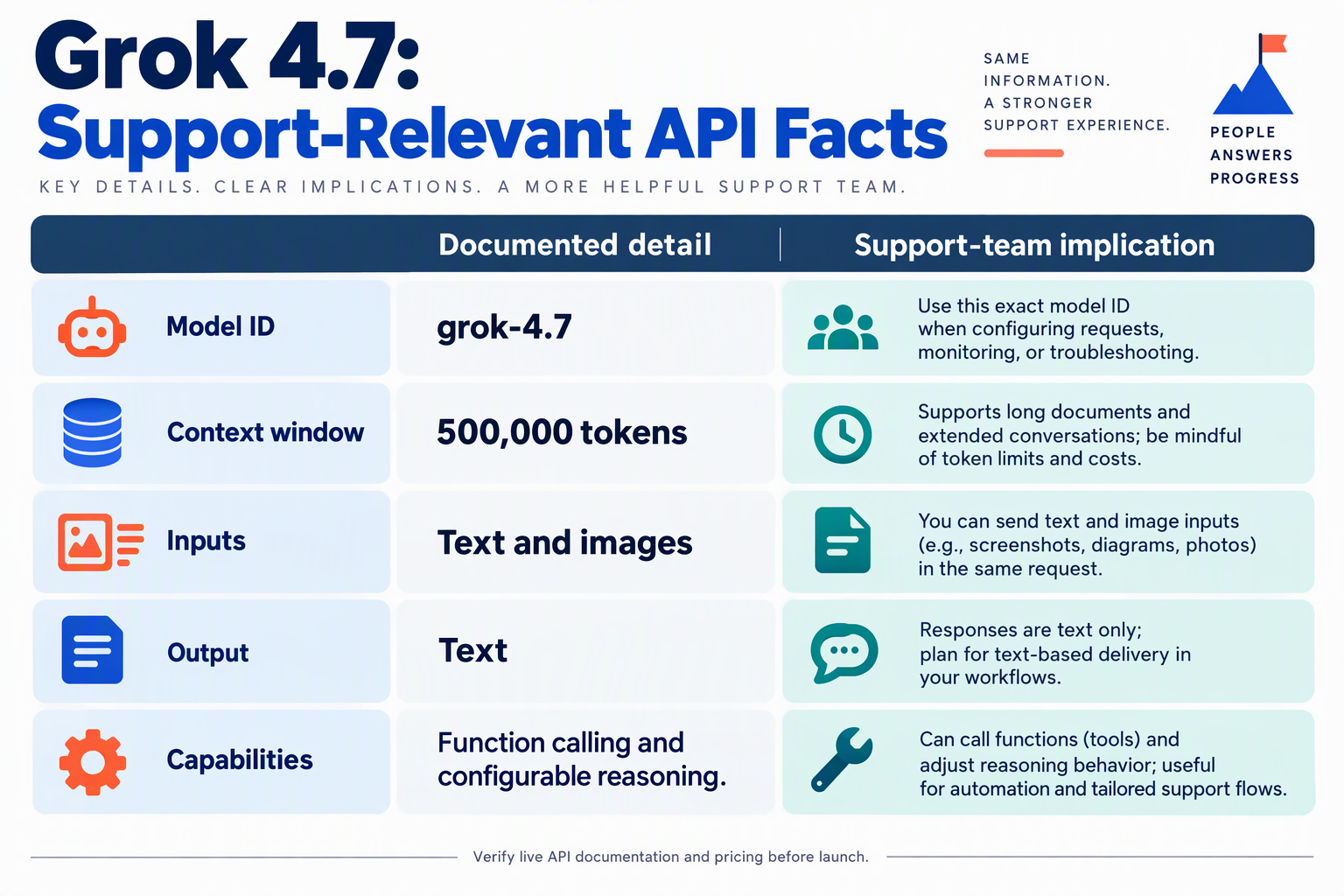
Grok 4.7’s reported specifications suggest several support tests, but they do not establish customer-support quality. As of September 2026, developers should validate the model’s context handling, multimodal input, reasoning controls, and token cost against their own support cases before shipping.
Which Grok 4.7 specifications should support teams evaluate?
Launch coverage describes Grok 4.7 as designed for coding and extended knowledge work. The table translates those reported capabilities into practical support checks; treat the figures as reported specifications, not guarantees of performance in your application.
| Specification | Reported detail | Why it matters in support | What to test |
|---|---|---|---|
| Context window | Data Phoenix reported a 500,000-token context window in September 2026. | A long window may accommodate ticket histories and policy documents, but does not ensure the model finds the current, relevant detail. | Include a long conversation with an outdated instruction and a newer correction; check which one the answer follows. |
| Input types | September 2026 launch coverage reported text and image input. | Customers may send screenshots of errors, receipts, or product issues alongside text. | Test screenshots with legible and ambiguous details; require the model to say when an image does not provide enough evidence. |
| Reasoning controls | CXGN reported four levels, from low to xhigh, in September 2026. | Different settings may change response quality, latency, and cost. | Compare settings on the same cases, recording policy accuracy, tool-call correctness, response time, and token usage. |
| API pricing | cho.sh reported $2 per million input tokens and $6 per million output tokens in September 2026, matching Grok 4.6 rates. | Token charges can add up across long histories and detailed replies. | At those rates, a hypothetical case using 10,000 input and 2,000 output tokens costs $0.032 in model tokens; estimate with your actual usage and traffic. |
| Faster variant | cho.sh reported a 2× output-speed variant at 2× the price in September 2026. | Faster generation may help time-sensitive conversations, but the premium needs to justify itself. | Compare end-to-end response times and per-resolution cost on urgent cases, not just generation speed. |
| Reported benchmark | cho.sh reported 46.3% on CursorBench 4.0, versus 40.4% for Grok 4.6, in September 2026. | A coding benchmark can signal capability on its task, but cannot predict support accuracy or policy compliance. | Use a support-specific evaluation set and score answers against approved resolutions, escalation rules, and tool outcomes. |
How should developers turn specifications into shipping criteria?
Use the specifications to define controlled experiments, not to choose a model by headline. Keep the prompt, tools, knowledge sources, and test conversations constant when comparing Grok 4.7 with the model currently in production.
A useful pre-launch checklist is:
- Grounding: Does the response cite or accurately use the approved policy and account data?
- Instruction following: Does it respect eligibility rules, current instructions, and required response formats?
- Tool use: Does it call the right system with valid arguments, and avoid claiming an action succeeded when it did not?
- Safety and escalation: Does it protect sensitive information and hand off uncertain or high-risk cases?
- Operations: What are the observed latency and cost per resolved case at each reasoning level?
Run anonymized real tickets alongside deliberately difficult cases, including conflicting history, missing information, image-based issues, and requests outside policy. Set pass thresholds before testing, then review failure examples—not only average scores. Platforms such as CallMissed offer one API key and balance across 138 models, which can help developers compare candidates; support-specific validation remains essential.
How should developers test Grok 4.7 customer support quality?

Test Grok 4.7 customer support quality with a paired, blinded evaluation: give it the same anonymized cases, policies, and tools as your current model, then compare factual accuracy, policy compliance, and escalation decisions. A long-context or coding result is not a substitute for evidence that the model handles your support workflows correctly.
Which customer support cases should developers test?
Build a test set from real, anonymized tickets and include routine requests as well as cases where a confident mistake could cause harm. Keep the expected answer and relevant policy or account evidence alongside each case, so reviewers can judge whether a response is correct and grounded—not merely fluent.
Include examples such as:
- Straightforward questions: product details, order status, and common troubleshooting.
- Ambiguous or incomplete requests: cases where the model should ask a clarifying question rather than guess.
- Conflicting context: a long conversation containing outdated information, corrections, or contradictory instructions.
- Policy-sensitive requests: refunds, cancellations, exceptions, and requests for private account data.
- Escalation cases: complaints or issues that need a human decision.
- Image-based cases: support requests that include a screenshot or product image, if your workflow accepts them.
CXGN reported on September 21, 2026, that Grok 4.7 supports text and image input and offers four reasoning settings, from low to xhigh. Test the settings you intend to deploy on the same cases: a different setting may change response quality, time, or cost, so don’t assume one result applies to all configurations.
How should developers score Grok 4.7 answers?
Use a written rubric and score each case on separate dimensions. A practical scorecard can include:
- Correctness: Is the answer supported by the approved source material?
- Groundedness: Does the response avoid inventing policy, product details, or account facts?
- Instruction following: Does it respect tone, format, and business rules?
- Tool use: Did it call the right tool with the right details, and avoid taking an action without required confirmation?
- Escalation: Did it hand off when the issue exceeded its authority or evidence?
- Privacy and safety: Did it avoid exposing sensitive information or complying with an unsafe request?
Set pass thresholds before running the comparison. For example, your team might require zero critical privacy or policy violations and a minimum score on routine cases; those are your acceptance criteria, not published Grok 4.7 support benchmarks. Review failures by severity, because an incorrect refund action should not count the same as an awkward greeting.
How can teams check consistency before launch?
Replay the test set more than once and compare outcomes across prompts, reasoning settings, and relevant conversation lengths. Record the exact model configuration, system instructions, knowledge sources, and tool responses so that a change in results can be traced to a specific change.
Then have support specialists review disputed cases without being told which model produced each answer. Track not just the average score, but also the types of failures and whether they cluster around particular policies, languages, or tools. Data Phoenix described Grok 4.7 as targeting long-running knowledge work; that makes long, realistic support histories worth testing, but it does not establish support accuracy.
Ship only when Grok 4.7 meets your pre-set quality and safety thresholds on the cases that matter to your business. Keep the same evaluation set for later model or prompt changes, so each update is measured against a stable baseline rather than a few memorable demos.
How do you test Grok 4.7 API tool calls without risking customer data?

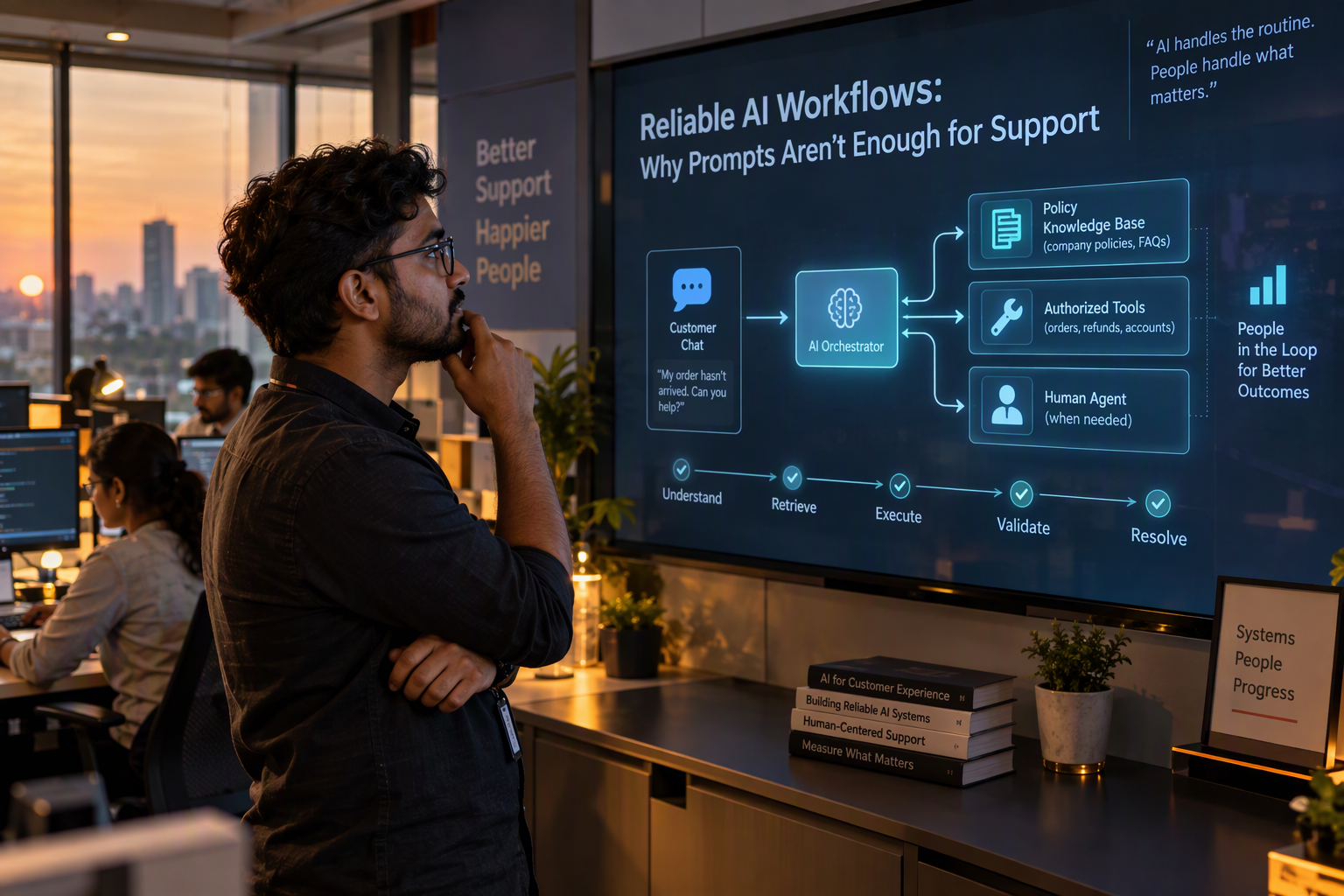
Test Grok 4.7 tool calls in a sandbox with synthetic or de-identified records, and make every consequential action pass through a permission-checking tool gateway. Do not give the model direct access to production customer databases, payment actions, or account changes during evaluation.
How do you create a safe test environment for Grok 4.7 tool calls?
Start with tools that return fake data and cannot alter real accounts. For example, a mock lookup_order tool can return a fabricated order status, while a mock issue_refund tool records the request without initiating a payment. This lets you inspect whether Grok 4.7 chooses the right tool and supplies valid arguments without exposing customer information.
Keep test inputs realistic but non-sensitive:
- Replace names, email addresses, phone numbers, and account IDs with synthetic values.
- Include stale, contradictory, and irrelevant messages to check whether the model selects the right evidence.
- Label test data clearly and prevent sandbox credentials from reaching production systems.
- Restrict each tool to the minimum data and actions needed for the test.
As of September 2026, Data Phoenix reported that Grok 4.7 supports a 500,000-token context window. A long context can contain more conversation history, but it does not establish that the model will ignore malicious instructions or avoid exposing sensitive details. Test both risks explicitly.
Which tool-call failures should developers test?
Evaluate the whole path—from the model’s proposed call to your application’s decision to execute it. Include cases where the model should not call a tool, such as a customer asking for another person’s account details, and cases where it should ask a clarifying question rather than guessing an order ID.
A practical test suite should cover:
- Authorization: Does the gateway reject requests for records the simulated customer cannot access?
- Argument validation: Are missing, malformed, or unexpected fields blocked before execution?
- Prompt injection: Does the system resist instructions embedded in a pasted email or document that ask it to reveal data or bypass policy?
- Action safety: Are refunds, cancellations, and account changes held for explicit policy checks or human approval?
- Failure handling: If a tool times out or returns an error, does the model avoid inventing a successful result?
Log the model’s proposed tool call, the gateway’s validation result, and the mock tool’s response. Redact sensitive values even in test logs, set retention limits, and treat traces as potentially sensitive: logs can create a second route for data exposure.
How do you decide whether Grok 4.7 is safe to ship?
Define pass/fail gates before running the tests. For example, require zero unauthorized record access, no execution of unapproved actions, and a clear escalation when identity or policy is uncertain. Replay the same cases against your current model and compare tool selection, argument accuracy, policy compliance, and escalation rates.
As of September 2026, cho.sh reported a 46.3% CursorBench 4.0 score for Grok 4.7. That coding benchmark is not a measure of customer-data protection or support tool-call safety, so it should not replace your own tests.
For teams evaluating multiple providers, CallMissed’s developer AI API lists xAI among its model makers and supports function calling, usage records, and request logs. Confirm model availability and endpoint compatibility before building a test around a particular model; provider-level capabilities do not guarantee that every model supports the same tool behavior.
Which metrics reveal whether Grok 4.7 is ready for support traffic?
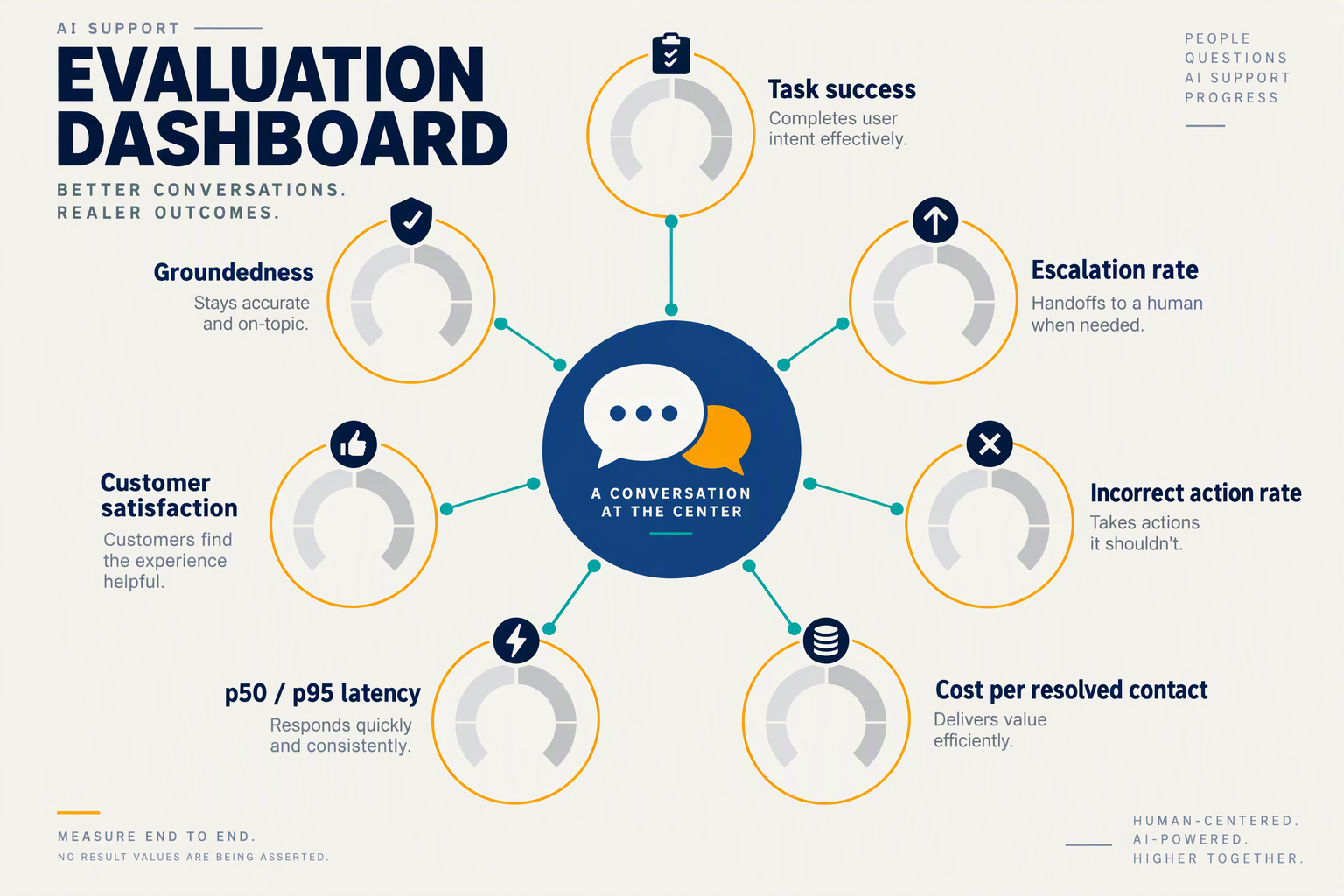
Measure Grok 4.7 against your current support model on resolution quality, policy and tool compliance, escalation, latency, and cost per successful resolution. A model is ready only if it meets your team’s predefined quality and safety gates on representative conversations—not merely because it performs well on unrelated benchmarks.
Which support-quality metrics should developers track?
Use a held-out set of anonymized tickets that reflects your real mix of customer intents, languages, edge cases, and conversation lengths. Score each model on the same cases, using human review for consequential outcomes and automated checks only where the expected result is unambiguous.
Track these metrics:
- Correct resolution rate: the share of cases where the response answers the customer’s issue accurately and completely, judged against a reference answer or reviewer rubric.
- Groundedness and policy compliance: the share of responses supported by approved knowledge and consistent with current policies. Record unsupported claims and policy violations separately; a fluent response can still be wrong.
- Tool-call success: the share of cases where the model selects the right tool, supplies valid arguments, and correctly reflects the tool result. Include failure cases such as missing data, timeouts, and permission errors.
- Appropriate escalation: measure both missed escalations on sensitive or unresolved cases and unnecessary handoffs on straightforward ones. Report each rate separately so one does not conceal the other.
- Regression rate: compare Grok 4.7 with the incumbent model case by case. Flag cases where the new model turns a previously correct, safe response into an incorrect or unsafe one.
Set pass thresholds before the test, based on the risk of each support workflow. For example, a billing-policy answer and a low-risk product question may need different review gates; the acceptable error rate should be a deliberate business decision, not a number inferred from a general benchmark.
How should teams measure speed and operating cost?
Measure end-to-end latency, not just model response time: include retrieval, tool execution, retries, and the wait until a customer receives a useful answer. Report median and high-percentile latency separately, and test during realistic concurrency. For multi-turn support, measure time to resolution as well as time to first response.
Cost should be evaluated per successfully resolved conversation, not just per token. Include input and output tokens, repeated turns, tool calls, and any fallback model usage. As of September 2026, cho.sh reports Grok 4.7 pricing at $2 per million input tokens and $6 per million output tokens, the same rates as Grok 4.6. That is a useful estimate for model-token cost, but your workload’s token volume and resolution rate determine the actual unit economics.
What makes a useful release gate?
Run a regression suite, then a limited, monitored rollout only after the model passes your quality and safety criteria. Review results by intent, language, and case complexity: an overall average can mask failures in a small but high-risk category. Keep rollback available, and compare customer outcomes—not just model scores—during the rollout.
The reported 46.3% CursorBench 4.0 score for Grok 4.7, versus 40.4% for Grok 4.6, comes from cho.sh and concerns coding-task performance; it does not establish support readiness. Data Phoenix reported a 500,000-token context window, but developers should test whether longer histories improve resolution without increasing cost or allowing outdated details to mislead the model.
What do official claims and available evidence actually establish?

Grok 4.7’s available evidence supports evaluating it for long-running knowledge and coding tasks, but it does not establish that it is ready for customer support. The key distinction is between xAI’s stated design goals, reported benchmark results, and support outcomes that have not yet been shown in the available sources.
What does xAI say Grok 4.7 is designed to do?
xAI’s launch claims, as summarized by einkCN in September 2026, describe Grok 4.7 as using a larger base model and longer reinforcement-learning training to handle complex tasks for longer and check its own outputs more carefully. Those are claims about the model’s intended capabilities; they are not, by themselves, independent evidence of accuracy or reliability in a deployed support workflow.
The same launch coverage describes the model as optimized for coding and knowledge work. Data Phoenix reported in September 2026 that Grok 4.7 has a 500,000-token context window and accepts text and image input. A long context could help a model consider extensive case histories or product documentation, but context capacity alone does not show that it will identify the right evidence or disregard outdated instructions.
For support teams, treat these points as testable hypotheses:
- Does the model retain the relevant policy detail across a long conversation?
- Does it distinguish current information from conflicting or obsolete messages?
- Can it recognize when the supplied context does not answer the customer’s question?
What do the reported benchmarks establish?
The clearest available numbers relate to coding tasks, not customer service. cho.sh reported in September 2026 that Grok 4.7 scored 46.3% on CursorBench 4.0, compared with 40.4% for Grok 4.6 and 41.7% for GPT-5.6 Sol Max; the same report listed Fable 5.1 Max at 51.8%.
cho.sh also reported in September 2026 that Grok 4.7 scored 38.0% on Terminal-Bench 4.0, up from 20.3% for Grok 4.6. These results support the view that the model may have improved on certain coding and terminal-use evaluations. They do not measure whether it follows a refund policy, retrieves the correct customer record, or escalates a sensitive complaint appropriately.
The evidence therefore has a clear boundary: benchmark scores describe performance on their specific tasks and scoring methods. They should not be presented as general proof of support quality.
What remains unproven for customer support?
The available launch coverage does not establish Grok 4.7’s performance on customer-support evaluations, including policy compliance, factual grounding in a company knowledge base, safe handling of personal data, or successful tool use in a support system. Nor do the cited reports provide support-specific latency or resolution-rate results.
Developers should separate reported facts from deployment decisions. For example, the 500,000-token context window is a reported product capability; whether it improves resolution quality on your ticket histories is an empirical question. Similarly, self-checking is part of the reported design rationale, not a substitute for measuring unsupported answers or policy errors.
A useful evidence standard before shipping is to compare Grok 4.7 with the current production model on the same anonymized cases, using the same tools and instructions. Record both successful resolutions and failure types, then decide from your own results—not from coding benchmarks alone—whether the model meets the support workflow’s requirements.
What should a safe Grok 4.7 rollout look like?
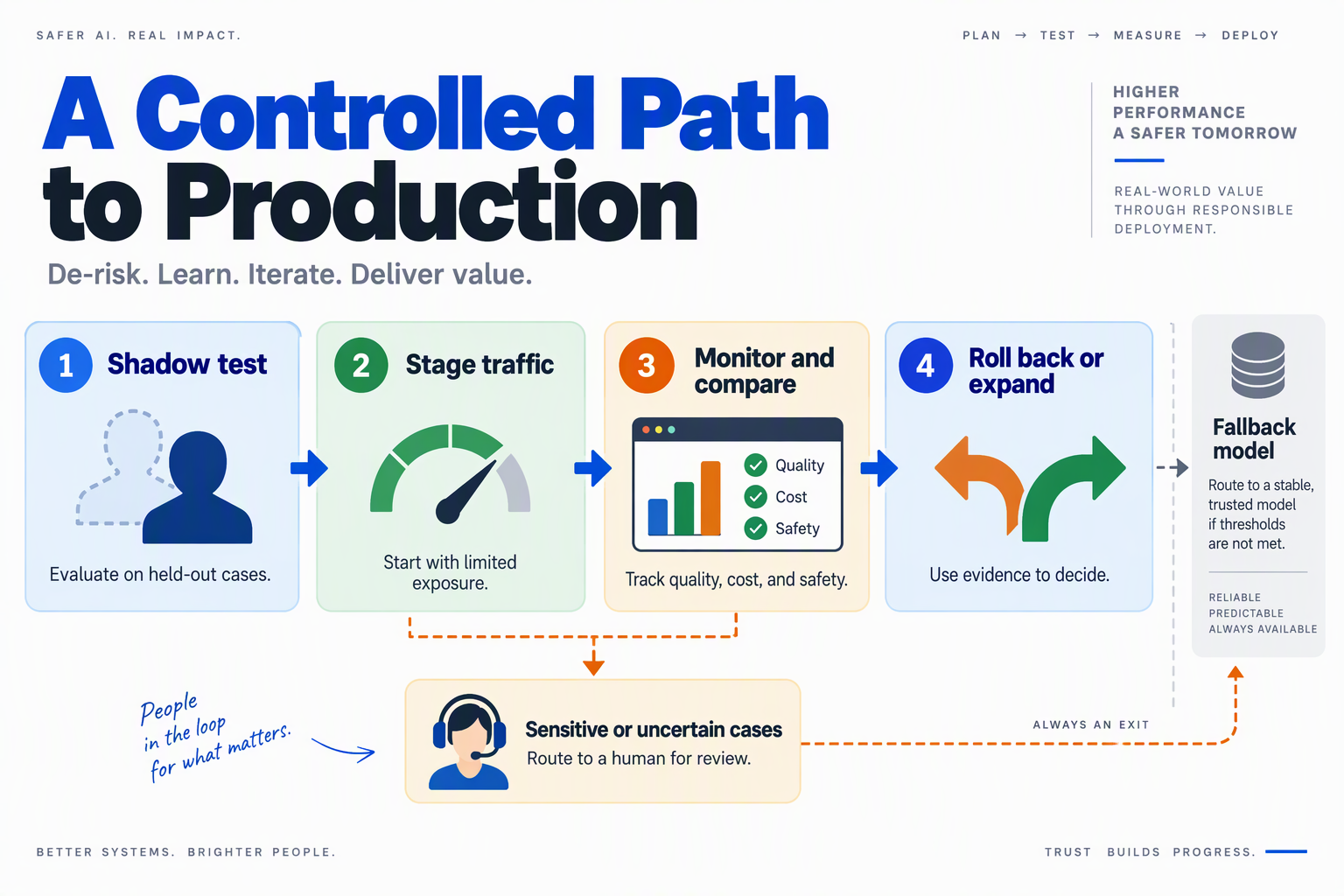
A safe Grok 4.7 rollout should move through offline evaluation, isolated tool tests, shadow traffic, and a small reversible production pilot—not jump directly to full automation. Treat every pass threshold below as a team-defined release gate, not a performance claim about Grok 4.7.
What should developers test before exposing Grok 4.7 to customers?
Use a staged rollout with explicit owners, measurable checks, and a rollback decision at each step. The table’s thresholds are examples to adapt to your support risk and existing-model baseline.
| Stage | What to test | Example release gate | Action if it fails |
|---|---|---|---|
| 1. Offline replay | Run a fixed, anonymized set of past tickets covering routine questions, policy exceptions, ambiguous requests, and outdated account details. | Meet your agreed accuracy and policy-compliance targets; compare results with the current model on the same cases. | Refine prompts or retrieval; do not advance until critical regressions are understood. |
| 2. Safety and privacy | Test requests for another customer’s data, unsupported refunds, credential disclosure, and attempts to override system instructions. | Zero critical violations in the test set; log lesser errors by category and severity. | Block deployment for any critical failure; add controls and repeat the full test. |
| 3. Tool isolation | Test read and write actions separately, including missing fields, duplicate requests, and incorrect tool arguments. | No irreversible action without the required checks and authorization; verify every action against system records. | Keep write tools disabled or require human approval while correcting the workflow. |
| 4. Shadow traffic | Send a sample of live conversations to Grok 4.7 without showing its answers to customers or allowing it to change records. | Compare answer quality, escalation decisions, latency, and token cost with the production baseline. | Continue shadowing or stop; investigate outliers before customer exposure. |
| 5. Limited pilot | Route a small, defined slice of eligible conversations to the model, with human review and a clear escalation path. | Stay within pre-set quality, cost, and response-time limits for the pilot period. | Pause routing at a predefined trigger and return to the previous workflow. |
| 6. Expansion | Increase traffic gradually while sampling conversations and tracking failure categories. | Each increase meets the same gates; no unresolved critical incident. | Hold or roll back rather than treating higher volume as proof of safety. |
How should teams set rollout gates and rollback triggers?
Define the gates before looking at comparative results. For example, specify which policy errors count as critical, how many reviewed conversations are needed per risk category, and what change from the current model is acceptable. A single average score can conceal failures in refunds, account access, or vulnerable-customer cases, so report results by task and risk level.
Keep the model’s role narrow during the pilot. Start with low-risk informational replies, route uncertain or sensitive cases to a person, and require approval for consequential account changes. Record the model version, prompt, retrieved sources, tool inputs, and final outcome so a failure can be reproduced. Set rollback triggers in advance—for instance, any confirmed critical policy breach or a sustained breach of your service’s cost or latency limit.
As of September 2026, Data Phoenix reported a 500,000-token context window for Grok 4.7, while cho.sh reported pricing of $2 per million input tokens and $6 per million output tokens. Those reported specifications can inform test design and budget estimates, but they do not demonstrate support accuracy or predict your real bill; measure both on your own conversation mix.
For teams building model evaluations, CallMissed offers one API key and balance across 138 models as of September 2026. That can support a broader comparison strategy, while Grok 4.7 availability should be verified separately and each candidate should still pass the same support-specific gates.
Frequently Asked Questions
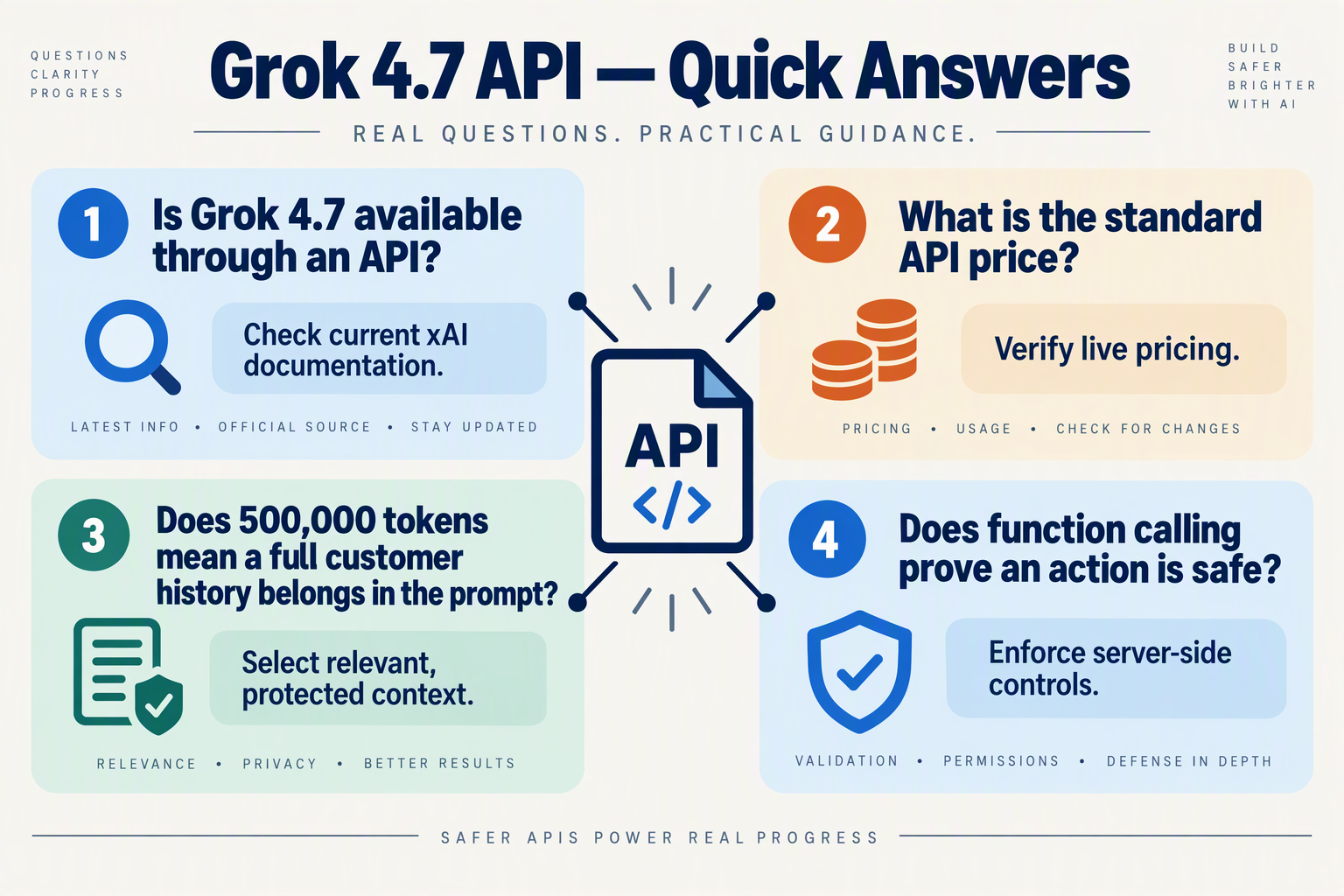
How much does the Grok 4.7 API cost per million tokens?
What is Grok 4.7’s context window, and does it help with customer support?
How do I integrate the Grok 4.7 API into an existing customer-support app?
Is Grok 4.7 suitable for AI customer support?
How can I estimate Grok 4.7 API costs for a support chatbot?
Should developers access Grok 4.7 through a multi-model API gateway?
Conclusion
Grok 4.7 is worth testing for customer support, but its reported benchmarks and long context window are not proof that it will meet your customers’ needs. Before shipping, compare it with your current model on real, anonymized conversations and judge results against clear quality, safety, latency, and cost thresholds.
- Treat launch metrics as a starting point: cho.sh reported a 46.3% CursorBench 4.0 score for Grok 4.7 in September 2026, while Data Phoenix reported a 500,000-token context window. Neither establishes support accuracy or policy compliance.
- Test the whole support workflow: Check whether the model finds relevant details in long histories, follows instructions, uses tools correctly, protects sensitive information, and hands off cases it cannot resolve.
- Measure outcomes, not impressions: Replay representative tickets against your current model and compare groundedness, refusal behavior, multilingual responses, latency, and cost.
- Keep the evaluation repeatable: Use regression tests so future model or prompt changes can be checked against the same cases.
As model options expand, platforms such as CallMissed offer one API key and balance across 138 models, giving developers a way to explore different models while validating each for their own workflows.
Looking ahead, watch for support-specific evidence—not just coding or knowledge-work results—and for how performance holds up in your production-like tests. Which conversations would Grok 4.7 need to handle reliably before you would trust it with a customer?
Related Reading
- AI Agent Human Oversight Rules for Customer Support
- AI Customer Support for Ecommerce: 2026 Automation Playbook
- AI Voice Agent Customer Service 2026: CallMissed Support Operations Guide
Sources
Discussion
Related Posts

Ready to automate customer conversations?
Launch AI voice agents and WhatsApp bots with CallMissed — one API, 22+ Indian languages.