
AI Agent Human Oversight Rules for Customer Support



Learn practical AI agent human oversight rules for customer support, including approval gates, data boundaries, escalation workflows and audit trails.
AI Agent Human Oversight Rules for Customer Support
What should happen when a customer-support AI can issue a refund, change an account, or disclose sensitive information without asking a person first? Recent reporting on Israel’s Bar Association offers a timely warning: as AI agents take on consequential work, supervision, confidentiality, and verification cannot be afterthoughts. Those principles are a useful starting point for AI Agent Human Oversight Rules for Customer Support—but the reported guidance concerns lawyers, not support teams.
Calcalist reported in September 2026 that lawyers using AI agents should closely supervise autonomous systems, protect confidential client information, and verify AI-generated legal work before relying on it. The available reporting provides only those broad principles; it does not establish rules for customer-service operations. This article is not legal advice. The practical lesson is narrower: organizations should decide in advance which support tasks an agent may complete independently, which require approval, and which must stay with a human.
That distinction matters because a support agent’s risk depends less on whether it sounds convincing than on what it can do and what information it can access. Answering a public question about store hours is different from changing billing details, promising compensation, or handling identity documents. A single “human in the loop” rule is too blunt: review every reply and teams lose the speed automation is meant to provide; review nothing and small errors can become customer, privacy, or financial incidents.
This guide turns the supervision principle into an operating policy. You’ll learn how to set risk tiers and approval gates; define data boundaries for personal, account, and confidential information; and create an audit trail that records what the agent saw, recommended, changed, and escalated. It also lays out a practical review workflow: test an agent’s permissions, route uncertain or high-impact requests to a human, record decisions, and use recurring reviews to adjust thresholds. The goal is not to approve every sentence. It is to place human judgment at the points where the consequences justify it.
Platforms such as CallMissed reflect this operational direction: as of September 2026, its AI voice-agent offering includes call recordings, transcripts, AI call notes, call scoring against a team’s own QA rubrics, and live monitoring where a supervisor can listen, whisper, or join a call. Those controls do not replace a company’s policy; they illustrate why oversight needs to be designed into the workflow.
How should support teams supervise AI agents? Use risk-based approval gates

A support team should approve AI actions according to their potential impact, not review every message equally. Let agents handle low-consequence tasks within defined boundaries, require human approval before consequential changes, and reserve sensitive or exceptional decisions for people.
Which support actions should require human approval?
Calcalist’s September 2026 reporting on Israel’s Bar Association offers a timely signal: the reported principles for lawyers include close supervision of autonomous systems, protecting confidential information, and verifying AI-generated work. Those principles are not customer-support rules, and the available reporting does not establish detailed requirements for support teams. The practical transfer is to set explicit limits on what an agent may do before deployment. This is operational guidance, not legal advice.
A useful policy separates actions by consequence:
- Low risk — act independently: Answer public questions, explain published policies, or help a customer find information, provided the agent uses approved sources and does not expose account-specific data.
- Moderate risk — prepare, then confirm: Draft a response about a disputed charge, recommend a goodwill credit within a defined limit, or propose an account change. A human checks the facts and approves before the action is taken.
- High risk — require approval or hand off: Issue a substantial refund, change ownership or security settings, make an exception to policy, or handle a request involving sensitive identity or financial information.
- Prohibited — human-only: Actions the organization will not delegate, such as decisions requiring individual judgment or access to data the agent should not see.
The exact thresholds should reflect the business’s policies, customer commitments, and potential harm—not a generic “AI confidence” score. A confident answer can still be wrong; uncertainty can help trigger review, but consequence should determine whether approval is mandatory.
How can teams make approval gates operational?
Translate each risk tier into a permission and a workflow. For example, an agent may draft a refund recommendation but lack permission to submit the refund. A human reviewer sees the customer request, relevant policy, proposed action, and supporting account facts, then approves, edits, or rejects it. The system should not treat silence or a timeout as approval.
A practical rollout can follow four steps:
- List actions and data: Identify what the agent can read, recommend, and change. Assess each action by financial impact, privacy exposure, reversibility, and customer consequences.
- Set gates: Specify which actions are autonomous, which need approval, and which must be handed to a person. Define monetary limits and exceptions in plain language.
- Test failure cases: Try ambiguous requests, conflicting account records, prompt-injection attempts, and requests to disclose another person’s information. Confirm that the agent pauses or escalates rather than improvising.
- Review decisions: Sample approvals, overrides, and escalations. If reviewers repeatedly correct a class of actions, tighten its permissions or improve the policy and approved information before expanding autonomy.
What should happen when a request changes risk level?
Approval should attach to the specific action, not merely the conversation. A chat that starts with a routine product question may become high risk when the customer asks to change a billing account. The agent should reclassify the request, stop before the consequential step, and route the case with enough context for a reviewer to decide. This keeps routine support moving while placing human judgment where the consequences warrant it.
What does the Israel Bar Association news signal—and what does it not establish?

The Israel Bar Association story is a signal that professional use of autonomous AI requires supervision, confidentiality safeguards, and verification—not evidence that the same rules govern customer-support teams. In September 2026, Calcalist reported those three principles for lawyers using AI agents; the available reporting does not establish a customer-service standard or provide enough detail to treat the story as a ready-made support policy.
What does the reported guidance signal for support teams?
The transferable lesson is about how responsibility follows delegation. A lawyer’s work and a support agent’s work are not interchangeable, but both raise practical questions when an AI system can act on information or produce work that someone may rely on. For support operations, that means defining what an agent is allowed to do, what information it may use, and how people check consequential outputs.
That is a useful prompt for an operational review—not a reason to copy legal rules into a service workflow. For example, a team could ask whether an agent may answer a general product question using approved information, but should pause before changing account ownership or making a commitment outside policy. The important distinction is the consequence of the action, not whether the AI’s reply sounds confident.
The reporting also connects confidentiality and verification. A support team can translate those ideas into concrete questions:
- Which customer records and documents can the agent access for this task?
- Can the agent send, change, or disclose information, or only recommend an action?
- What evidence must a human check before approving an exception or high-impact decision?
These are design choices for the organization. The available Calcalist account does not specify answers for customer-support systems.
What does the news not establish?
It does not show that the Israel Bar Association’s reported guidance applies to customer-support teams, creates a global rule for AI agents, or sets a particular approval threshold. Nor does the reporting available here provide the full text of the guidance, detailed enforcement provisions, or a technical checklist for implementing supervision.
That boundary matters. Treating a profession-specific report as a universal regulation risks overstating what is known; ignoring it because it concerns lawyers misses the broader operational question it raises. The careful reading is narrower: Calcalist reported that lawyers should supervise autonomous systems closely, protect confidential client information, and verify AI-generated legal work before relying on it. Those principles invite organizations in other fields to examine their own duties and risks, but do not answer those questions for them.
How can teams turn the signal into a practical review?
Use the news as a policy stress test, not as legal advice. A support team can take one agent workflow and document:
- The permitted action: what the agent can do independently, and what it can only propose.
- The information boundary: which records or knowledge sources the agent can access, and which should remain unavailable.
- The human check: which outcomes need review, who approves them, and what record shows the decision.
Then test the workflow with ordinary requests and edge cases—such as conflicting account details or a request that falls outside the written policy. Record where the agent lacked information, made an uncertain recommendation, or reached a decision that deserved human review. This turns broad principles into evidence a team can use to refine its controls, while keeping the distinction clear: the reported legal guidance is a timely reference point, not a customer-support rulebook.
Which recent guidance and risk frameworks help frame AI supervision?
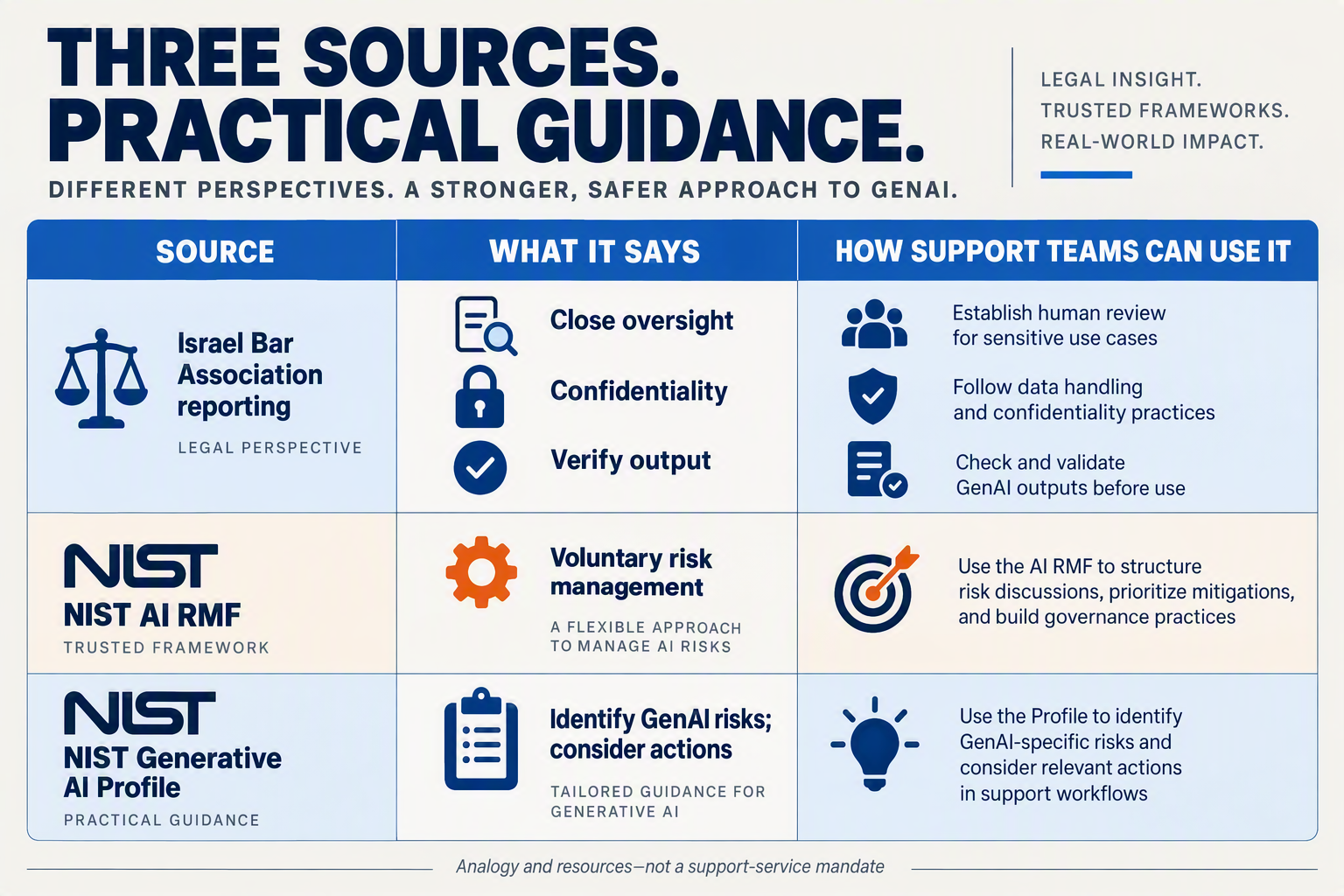
Recent guidance and risk frameworks are useful as design references, not as one universal rulebook for customer-support AI. Calcalist reported in September 2026 that Israel’s Bar Association expects lawyers to closely supervise autonomous systems, protect confidential client information, and verify AI-generated legal work; that reporting concerns lawyers, and the available details do not establish requirements for support teams.
Which frameworks translate into practical supervision controls?
The useful question is not whether a framework applies directly to a support chatbot. It is whether it helps a team define permissions, review points, data access, and evidence of what happened. The frameworks below offer different pieces of that operating model:
| Guidance or framework | What it contributes | Customer-support application | Important limit |
|---|---|---|---|
| Israel Bar Association guidance, as reported by Calcalist (September 2026) | Three reported principles: close supervision, confidentiality, and verification of AI-generated work | Use these as prompts for approval gates, restricted data access, and checks before consequential actions | The reported guidance concerns lawyers; it is not a support-team rulebook, and available reporting gives limited detail |
| NIST AI Risk Management Framework (AI RMF 1.0, 2023) | Organizes risk work around Govern, Map, Measure, and Manage | Assign an owner, document the agent’s intended tasks and impact, test risks, then monitor and adjust controls | It is a voluntary risk-management framework, not a prescribed approval matrix |
| NIST Generative AI Profile (2024) | Applies the AI RMF approach to risks associated with generative AI | Include plausible failure cases in testing, such as an incorrect refund promise or an answer that exposes information across accounts | It supports risk identification and management; teams still need to set their own thresholds |
| EU AI Act (Regulation (EU) 2024/1689) | Includes human-oversight requirements for AI systems classified as high-risk | Check the system’s intended use and classification before deciding what legal obligations apply; use oversight principles to inform controls | Not every customer-support chatbot is automatically high-risk; classification and applicable obligations matter |
| ISO/IEC 42001:2023 | Sets out requirements for an organizational AI management system | Connect agent approval, responsibility, documentation, and recurring review to broader company processes | Certification or use of the standard does not, by itself, prove a particular agent is safe or compliant |
How should a team turn these references into policy?
Treat each framework as a lens, then write a support-specific rule. For example, an agent might answer public product questions without review, draft a refund recommendation for an employee to approve, and be blocked from changing payment details unless an authorized person confirms the request. The precise thresholds should reflect the organization’s products, customer data, and consequences of error—not a borrowed legal example.
A practical policy can connect the frameworks to three records:
- Permission record: which tools, accounts, and data the agent can access.
- Approval record: which actions require confirmation, who can approve them, and what happens when approval is unavailable.
- Audit record: what information informed the action, what the agent proposed or changed, and whether a person reviewed or overruled it.
These frameworks do not replace legal advice or an organization’s own risk assessment. Their value is that they help make supervision testable: define the boundary, exercise it with realistic scenarios, and preserve evidence for review.
Which actions need human approval, and what should reviewers verify?
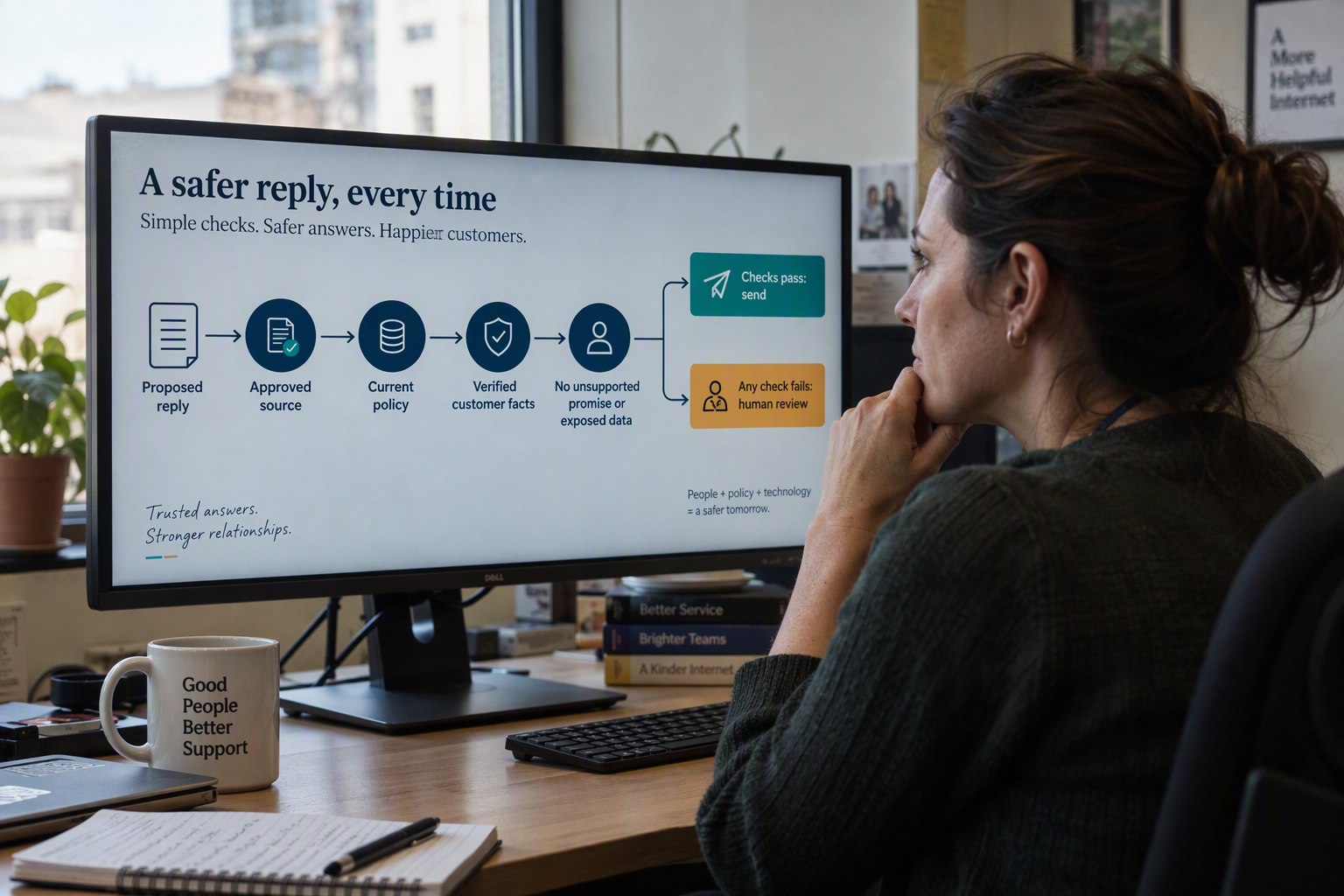
Human approval should be required before an AI agent makes a consequential, hard-to-reverse, or privacy-sensitive change; routine, reversible tasks can proceed within defined limits. Reviewers should verify the customer’s authority, the evidence behind the recommendation, the exact action proposed, and its likely consequences.
Which customer-support actions should require approval?
A useful threshold is whether an error could move money, change access, expose sensitive information, or create a commitment the business may have to honor. For example, a team might allow an agent to explain a return policy or locate an order, but require approval before it issues an exception refund, changes account ownership, or discloses information from a protected record. These are policy examples, not universal legal requirements.
Set approval gates around actions such as:
- Financial decisions: refunds above a team-defined limit, credits outside policy, disputed charges, or fee waivers.
- Account and access changes: changing ownership, payment details, authentication settings, or permissions.
- Sensitive disclosures: sharing personal, financial, health, or confidential account information, especially when identity or authorization is uncertain.
- Exceptions and commitments: overriding policy, promising compensation, changing contractual terms, or making a statement that could be treated as an official commitment.
- High-impact or unclear cases: complaints involving safety, suspected fraud, legal threats, vulnerable customers, or conflicting records.
The approval gate should attach to the action, not just the conversation. An agent can draft a response or prepare a proposed change, while a person authorizes the consequential step. Make limits specific—for instance, which refund amount needs approval and which evidence is sufficient—so the agent cannot interpret a vague instruction such as “use discretion” as unlimited authority.
What should a reviewer verify before approving an AI action?
A reviewer should be able to answer four questions: Is this the right customer? Is the customer authorized to request it? Is the proposed action supported by reliable information? Is it within policy and proportionate to the issue? If any answer is unclear, pause the action and ask for more information or take over the case.
Use a consistent checklist:
- Identity and authority: Confirm the account and whether the requester may make this change. Do not treat a confident tone or a matching name as proof.
- Evidence: Check the relevant order, account record, policy, or conversation history. Distinguish verified facts from the agent’s inference, and look for missing or contradictory information.
- Scope and impact: Confirm the exact amount, field, access level, recipient, or commitment being changed. Consider whether the action can be reversed and who else it affects.
- Data handling: Ensure the response reveals only information the requester is entitled to receive. Avoid copying sensitive details into an approval note unless they are necessary.
- Customer communication: Check that the explanation is accurate, clear, and does not promise more than the approved action.
How should teams make approval decisions repeatable?
Give reviewers a short decision path: approve, edit and approve, request more evidence, or escalate to a specialist. Record who approved the action, what evidence they reviewed, what changed, and why an exception was granted. That record helps teams investigate disputes and identify where an agent’s permissions or instructions need adjustment.
The trigger for this workflow is a useful reminder from another profession, not a customer-support rule. Calcalist reported in September 2026 that Israel’s Bar Association expects lawyers using AI agents to closely supervise autonomous systems, protect confidential client information, and verify AI-generated legal work before relying on it. The available reporting gives those broad principles but does not establish requirements for support teams. The practical adaptation is to define approval thresholds in advance, then verify each consequential action before it takes effect.
How should teams set data boundaries and escalate sensitive cases?

Support teams should set data boundaries by classification and purpose, then escalate whenever the agent lacks enough authority or confidence to act safely. The key is to limit what an agent can see and do—not simply ask it to be careful.
What data should a customer-support AI agent be allowed to access?
Give an agent access only to information needed for its assigned task, and divide that information into practical tiers:
- Public information: store hours, product descriptions, and published policies. Agents can usually answer these questions without accessing customer records.
- Routine account information: order status or subscription details. Allow access only after the customer is authenticated and only for the relevant account.
- Sensitive information or actions: identity documents, payment details, account recovery, or confidential internal notes. Restrict access by default; require a defined business need and, where appropriate, human involvement.
Apply least privilege to tools as well as data. An agent that can explain a refund policy does not necessarily need permission to issue a refund. An agent handling an order-status question should not be able to retrieve unrelated customer records.
Minimize exposure at the prompt and tool level: return only the fields needed to answer, mask identifiers where possible, and exclude credentials and full payment details. Set retention and access rules for conversation records according to the organization’s policies. These are operational safeguards, not a substitute for legal or privacy advice.
When should an AI support agent escalate a sensitive case?
Escalate before the agent takes an action when the request could materially affect a customer’s money, access, privacy, or safety. Useful triggers include:
- Identity uncertainty: authentication fails, account ownership is disputed, or a request involves another person’s data.
- High-impact changes: changing payment or account-recovery details, closing an account, or making an exception to a refund policy.
- Sensitive disclosures: requests involving identity documents, health or financial information, or confidential communications.
- Unusual or ambiguous cases: suspected fraud, threats, a vulnerable customer, or a request that falls outside the agent’s approved policy.
Escalation should pause the consequential action, not merely add a note after it. The handoff should give the human a concise summary, the relevant customer-provided facts, and the reason for escalation—without copying unrelated sensitive data. The agent should avoid promising an outcome while the case is under review.
How can teams make data boundaries enforceable?
Use a short decision workflow and test it with realistic cases:
- Identify the task and data needed. If the agent cannot justify access to a field, do not expose it.
- Check identity and permissions. Confirm the customer is authorized and the agent’s tools permit the requested action.
- Apply the approval threshold. Allow low-impact, policy-based answers; require human approval for consequential changes; route sensitive or exceptional cases to a person.
- Record the handoff. Capture the trigger, the information shared, the proposed action, and the human decision so teams can review whether the boundary worked.
Calcalist reported in September 2026 on guidance for lawyers that concerns legal practice, not customer-support operations. Its relevance here is a prompt to make confidentiality and verification concrete: teams should define what an agent may access, what it may change, and when a person must take over. Use test cases such as a routine order lookup, a disputed account, and a request to change payment details; revise permissions when the agent crosses a boundary or escalates too late.
What do professional guidance and NIST recommend teams keep in perspective?

Professional guidance and NIST point toward the same operating principle: assign responsibility, protect information, and verify consequential outputs. The reported Israeli Bar Association guidance concerns lawyers—not customer-support teams—so it is a signal for careful delegation, not a support-sector rulebook.
What did the Israeli Bar Association reportedly tell lawyers?
Calcalist reported in September 2026 that lawyers using AI agents should closely supervise autonomous systems, protect confidential client information, and verify AI-generated legal work before relying on it. The available reporting establishes those broad principles but does not provide a detailed customer-support policy or show that the guidance applies to support operations.
The useful transfer is operational, not legal: an organization remains responsible for deciding what an agent can do, what information it can access, and when a person must check its work. That matters when an agent moves beyond answering questions and can change an account, make a commitment, or expose sensitive data. This section is practical guidance, not legal advice.
What does NIST recommend teams keep in perspective?
NIST’s AI Risk Management Framework (AI RMF 1.0) organizes risk management around four functions: Govern, Map, Measure, and Manage. NIST describes the framework as voluntary; it is not a customer-support regulation or a prescribed list of approval gates.
Applied to support agents, the functions offer a useful way to structure decisions:
- Govern: Name the people accountable for the agent, its permissions, escalation rules, and ongoing review.
- Map: Document the agent’s intended tasks, users, data access, and potential effects on customers.
- Measure: Test whether it follows boundaries, produces reliable answers, and escalates cases that exceed its authority.
- Manage: Reduce identified risks through restricted permissions, human review, updates, or suspension when needed.
NIST’s Generative AI Profile, published in July 2024, further contextualizes the AI RMF for generative AI risks. Neither framework should be presented as requiring one universal “human in the loop” design. A team still needs to set controls based on its use case and the consequences of an error.
How can support teams turn these principles into an operating policy?
Use professional guidance as a prompt to make responsibility visible, then translate the NIST functions into a repeatable review cycle:
- Define the allowed action. List what the agent may answer, recommend, or change. Separate routine information from actions with financial, privacy, or account consequences.
- Set data boundaries. Specify which customer details the agent may retrieve for each task, and prevent unrelated or confidential information from entering its context.
- Choose the verification point. Require a person to approve high-impact actions or review uncertain cases before completion; let low-risk tasks proceed only within tested limits.
- Record decisions and outcomes. Keep enough context to reconstruct what information the agent used, what it proposed or changed, and whether a person approved or intervened.
- Review performance and revise. Use sampled conversations, escalations, and errors to test whether the boundaries work in practice, and adjust permissions when they do not.
The key trade-off is proportionate oversight: reviewing every routine reply can slow service, while allowing consequential actions without checks can magnify mistakes. CallMissed’s AI voice-agent offering includes call recordings, transcripts, AI call notes, QA scoring against a team’s own rubric, and live supervisor monitoring as of September 2026—examples of capabilities that can support review, not substitutes for an organization’s policy or accountability.
What should your team do at each stage of AI-agent deployment?
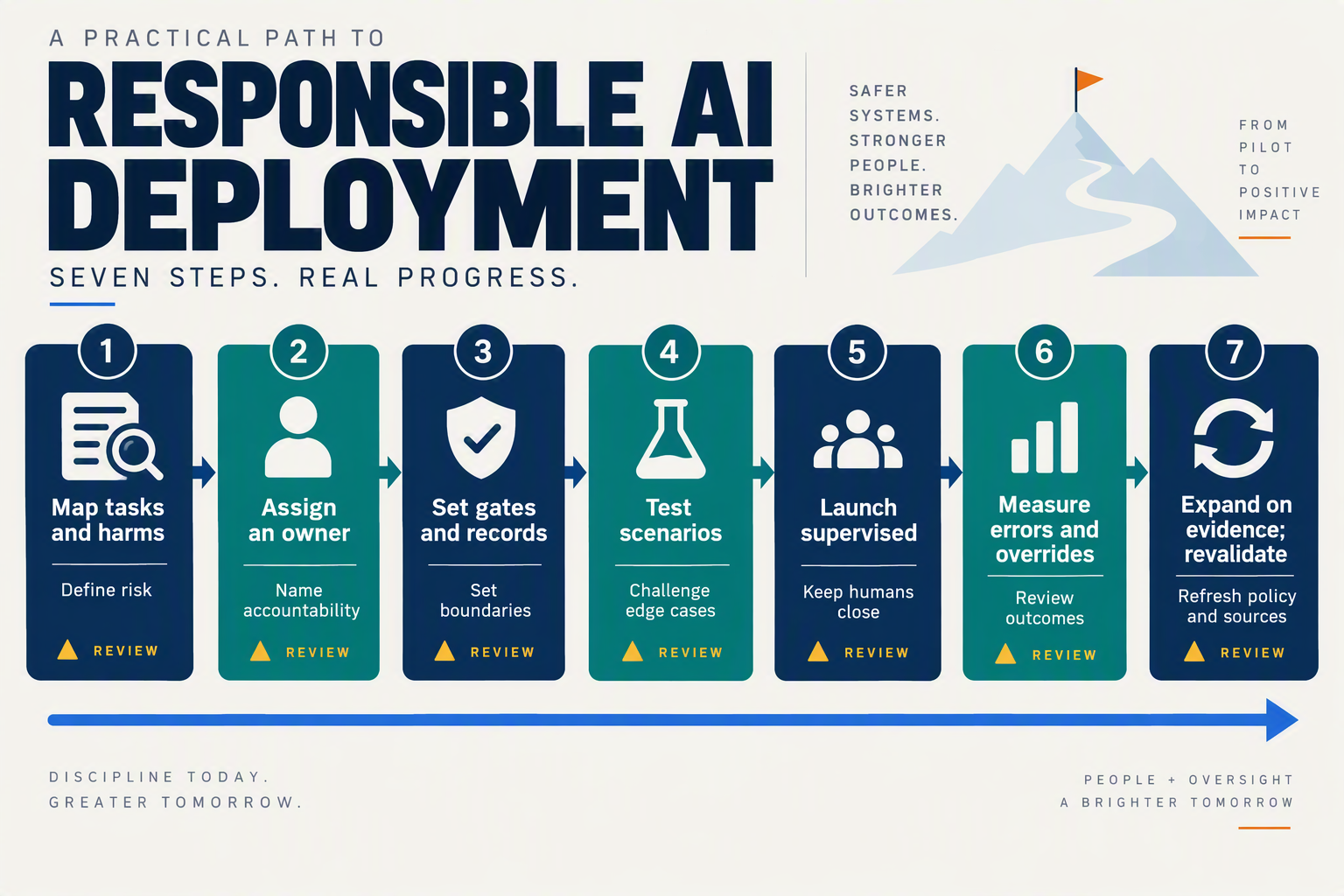
A support team should move an AI agent through scope definition, data controls, testing, controlled release, live supervision, and periodic review. At each stage, set what the agent can access or change, when a person must approve, and what evidence is retained.
What should the team decide before building the agent?
Start with real support tasks, not a general instruction to “resolve customer issues.” For each task, record the likely consequence of an error, the data required, and whether the action can be reversed. A public-hours question may be suitable for autonomous handling; a refund, account change, or disclosure of sensitive information may need approval or a human-only route.
Calcalist reported in September 2026 that Israel’s Bar Association guidance for lawyers emphasizes close supervision of autonomous systems, confidentiality, and verification of AI-generated legal work. That reporting concerns legal practice, not customer support, and describes only broad principles. For support teams, the practical takeaway is to define supervision around the consequences of delegation—not to treat legal guidance as a ready-made service policy.
What should happen at each deployment stage?
| Stage | Team action | Agent authority | Gate and audit evidence |
|---|---|---|---|
| 1. Define scope | List permitted tasks, prohibited decisions, escalation triggers, and an accountable owner. | Answer approved, low-impact questions; no consequential changes. | Written task and risk register; named policy owner. |
| 2. Set data boundaries | Map which customer fields and knowledge sources each task needs; exclude unnecessary or restricted information. | Retrieve only approved sources and fields; do not expose confidential data in replies. | Access test, source list, and documented handling rules. |
| 3. Test before launch | Run representative, ambiguous, and adversarial cases, including identity and sensitive-data scenarios. | Work in a test environment; no live customer changes. | Review outputs, tool calls, refusals, and escalations; fix failures before release. |
| 4. Launch with limits | Begin with a narrow task set and explicit transaction or compensation limits chosen by the business. | Act only inside those limits; pause for approval outside them. | Human approval record for exceptions; compare outcomes with expected behavior. |
| 5. Supervise live work | Route uncertainty, complaints, sensitive requests, and high-impact actions to trained staff. | Handle approved routine requests; stop rather than guess when a gate is reached. | Preserve the customer request, relevant context, agent response, action, and reviewer decision. |
| 6. Review and change | Sample completed interactions, investigate incidents, and reassess permissions when workflows change. | Keep existing permissions until changes pass review. | Dated review notes, incident findings, and version/change history. |
How should approval gates work in practice?
Make the gate explicit in the workflow. For example, an agent can explain a refund policy, but should send a refund request above the company’s chosen limit to an authorized reviewer before submitting it. The threshold should reflect the organization’s risk tolerance and legal or contractual obligations; there is no universal dollar amount that fits every support operation.
A useful review record answers five questions: What did the customer ask? What information did the agent use? What did it recommend or do? Who approved or changed the decision? What happened next? Keep records proportionate to the risk, restrict access, and define retention under the organization’s privacy requirements.
When should a team tighten or loosen controls?
Review controls after a material incident, a change in connected tools or data, or evidence that the agent is repeatedly escalating—or mishandling—the same request type. Widen autonomy only for tasks with clear boundaries and reviewed outcomes; narrow it when the agent encounters new edge cases. This staged approach turns human oversight into a repeatable operating process rather than a blanket requirement to approve every message.
Frequently Asked Questions

What do AI agent supervision rules mean for customer support?
When should a human approve an AI agent’s customer-support action?
How should AI agent supervision rules limit access to customer data?
What should an audit trail record for an AI support agent?
Which customer-support requests should an AI agent escalate to a human?
How can teams monitor AI support agents and review their decisions?
Conclusion
Customer-support AI should earn autonomy through clear boundaries: automate low-risk tasks, add approval gates for consequential actions, and keep sensitive or exceptional decisions with people. The goal is not to review every sentence, but to put human judgment where the consequences warrant it.
Calcalist reported in September 2026 that Israel’s Bar Association expects lawyers to closely supervise AI agents, protect confidential information, and verify AI-generated legal work. That reporting concerns legal practice, not customer-support rules; it offers a useful signal, not legal advice or a ready-made support policy.
- Set risk-based permissions: let agents handle routine questions independently, but require approval before meaningful account or financial changes.
- Define data boundaries: limit what customer information an agent can access and use.
- Make decisions reviewable: record what the agent handled, what it changed, and when it escalated.
- Improve the workflow over time: test permissions and review outcomes to refine approval thresholds.
As agents gain authority, watch for clearer expectations around supervision and verification—and make sure operational controls keep pace. CallMissed offers voice-agent call recordings, transcripts, AI call notes, QA scoring, and live supervisor monitoring; explore CallMissed to see how AI communication infrastructure is evolving. Which support actions should your AI handle alone, and where should a person always decide?
Related Reading
- AI Agent Governance in Customer Service: Human Oversight
- AI Voice Agent Customer Service 2026: CallMissed Support Operations Guide
- July 2026 AI Agent Updates: Gemini for Support Teams
Sources
Discussion
Related Posts


Ready to automate customer conversations?
Launch AI voice agents and WhatsApp bots with CallMissed — one API, 22+ Indian languages.