
ChatGPT Cross-Site Data Collection: Support Privacy



Understand the ChatGPT cross-site data collection claim, what OpenAI says about ads, and the privacy questions support teams should ask vendors.
ChatGPT Cross-Site Data Collection: Support Privacy
Could an identifier connect what you do in ChatGPT with activity on other websites? That question is driving a fast-moving debate about ChatGPT cross-site data collection—and it matters to anyone who uses AI in customer support, where conversations can contain personal details, account information, or sensitive business context.
A Hacker News post titled “ChatGPT now knows what you do on other websites via ad collector” has also prompted discussion on Reddit and Lobsters. But a viral claim is a reason to investigate, not proof that every suggested tracking mechanism works as described. A Daily.dev summary says an investigation reproduced a mechanism on a phone and traced an identifier from a signed JWT issued by ChatGPT’s backend through a cross-site flow. Other summaries mention a possible __obi cookie and links between ad-site activity and ChatGPT. These are secondary-source accounts: the underlying technical report and reproducible evidence were not available in the research for this article. The mechanism, scope, and account linkage therefore need independent verification.
For support teams, the key is to separate three different data paths. First, what a customer or employee deliberately submits to ChatGPT. Second, identifiers or events that may reportedly be shared across third-party websites. Third, what support personnel—or other authorized staff—can access in conversations and records. These paths raise related privacy concerns, but evidence about one does not establish what happens in the others.
That distinction is especially important when evaluating AI vendors. A company’s published ad and privacy commitments should be read alongside concrete answers about who can access conversation data, what access is logged, how long data is retained, and whether customer information is separated from advertising or other uses. Support platforms such as CallMissed, an AI customer-communication platform hosted in India, are part of the wider shift toward AI in customer interactions; adopting any such tool makes clear vendor answers essential.
This article will unpack what the cross-site allegation does—and does not—show, distinguish it from the separate question of staff access to conversations, and outline practical questions businesses should ask about access controls, retention, and data separation. The aim is not to turn an unverified technical account into a verdict, but to give support leaders a careful framework for assessing privacy risk while the evidence is examined.
What does the claim mean? It alleges ad-data linkage, not support-agent access

The claim is that an identifier may connect activity associated with ChatGPT to events on other websites in an advertising-related flow. That allegation concerns possible data linkage; by itself, it does not show that support agents can read ChatGPT conversations or that conversation content was shared with advertisers.
What does the reported mechanism actually allege?
A Hacker News post titled “ChatGPT now knows what you do on other websites via ad collector” has prompted discussion on Reddit and Lobsters. The headline makes a broad claim, but the technical summaries available here describe a narrower, still-unverified possibility.
Daily.dev says an investigation reproduced a mechanism on a phone and traced an identifier from a signed JSON Web Token (JWT) issued by ChatGPT’s backend through a cross-site flow. Other search-result summaries mention a possible __obi cookie and links between ad-site activity and ChatGPT. These details are secondary-source accounts: the underlying technical report, test conditions, and reproducible evidence were not available in the research reviewed for this article.
If an identifier does travel between sites, it could potentially help associate events with a browser or account, depending on how it is created, shared, and used. But the summaries alone do not establish:
- Whether the identifier is present for all users, or only under particular conditions.
- What information the alleged flow carries, or which parties receive it.
- Whether the identifier can reliably be tied to a named ChatGPT account.
- Whether the reported cookie is involved in the same mechanism.
Those are important distinctions: a browser-level signal, an advertising event, and a conversation transcript are different kinds of data. A report about one does not prove collection or disclosure of the others.
Does cross-site tracking mean support staff can see chats?
No. Cross-site linkage and human access to conversations are separate privacy questions. A technical signal potentially used to connect website activity does not establish that OpenAI support personnel, a business’s support team, or an AI vendor’s staff can access chat contents.
To assess staff access, businesses need evidence about the controls governing conversation data—for example, which roles can view it, whether access is logged, and how long records are retained. To assess advertising-related collection, they need to understand what identifiers or events are collected, shared, and used. One set of answers cannot substitute for the other.
How should OpenAI’s published commitments be compared with the allegation?
Read OpenAI’s published advertising and privacy statements alongside the technical claim, but do not treat either as a complete answer to the other. A policy describes stated practices and commitments; a technical investigation, if independently reproducible, can provide evidence about observed behavior under particular conditions. Neither should be stretched beyond what it actually establishes.
The material available for this section does not reproduce the relevant policy wording or the underlying technical report, so it cannot verify whether the alleged flow conflicts with a specific OpenAI commitment. For a business review, record the exact policy language and ask the vendor to clarify how it applies to identifiers, advertising events, conversation content, and staff access. Until the mechanism and scope are independently established, the defensible conclusion is limited: the claim raises a question about possible ad-data linkage, not proof of support-agent access to ChatGPT conversations.
What are the three data paths readers should keep separate?
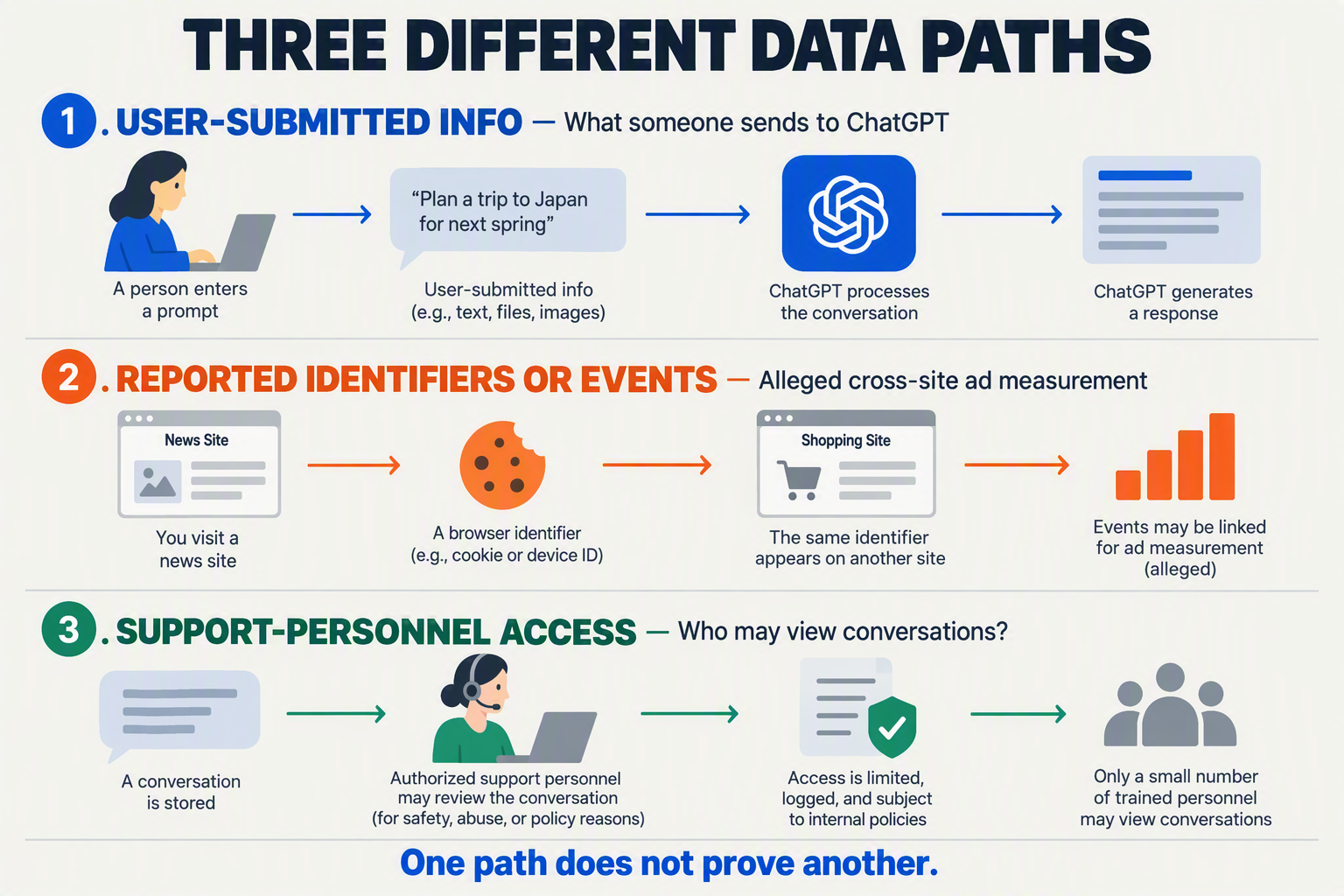
The three data paths are (1) information a person submits to ChatGPT, (2) identifiers or events reportedly exchanged across third-party websites, and (3) access that support staff may have to conversation records. They raise different privacy questions: evidence about one path does not establish what happens in the other two.
What information does a person submit to ChatGPT?
The first path is conversation content: prompts, uploaded material, and other information a person chooses to provide to ChatGPT. For a support team, the practical question is what staff or customers might enter—for example, account details, order information, or internal business context—and how the relevant service handles that content.
This is separate from whether an identifier may appear in an advertising-related flow. A report about cross-site identifiers does not, on its own, show that ChatGPT conversation text was shared with an advertiser. To assess content handling, businesses should check the applicable privacy terms and ask vendors directly:
- What conversation content is retained, and for how long?
- Who can access it, and for what purposes?
- Can the customer control retention or deletion?
- Is conversation content separated from advertising or other uses?
What might be shared across third-party websites?
The second path is the allegation prompting discussion. A Hacker News post titled “ChatGPT now knows what you do on other websites via ad collector” appeared alongside discussion on Reddit and Lobsters. Daily.dev summarizes an investigation that reportedly reproduced a mechanism on a phone and traced an identifier from a signed JWT issued by ChatGPT’s backend through a cross-site flow. Other summaries mention a possible __obi cookie and links between ad-site activity and ChatGPT.
Those are secondary-source summaries, not independently verified findings in the research available for this article. The underlying technical report and reproducible evidence were not retrieved. So the mechanism, the cookie’s behavior, what information might be associated with an identifier, and whether any association links activity to a particular account all remain questions to verify—not established conclusions.
Even if an identifier or event is observed, that alone does not establish that conversation content was involved. Nor does it show which parties received what data, how long it was retained, or whether a user can be identified. Those are distinct technical and policy questions.
What can support personnel access?
The third path concerns internal access to conversations and records: whether support agents, administrators, contractors, or other authorized personnel can view them, and under what controls. This is not the same as cross-site tracking. A claim about an advertising identifier does not prove that support staff can read ChatGPT conversations; likewise, an access policy does not resolve what happens in a third-party web flow.
Businesses evaluating AI for support should ask for specifics on role-based permissions, access logs, review procedures, retention periods, and separation between customer-service data and advertising or analytics. OpenAI’s published ad and privacy commitments should be considered alongside technical evidence and answers to those operational questions. A broad statement about advertising does not, by itself, answer who can access support records or how those records are protected.
Keeping these paths separate makes the debate more useful: verify the cross-site report on its own merits, evaluate submitted content under the applicable privacy terms, and assess staff access through concrete controls.
What has been reported, stated, and left unresolved?
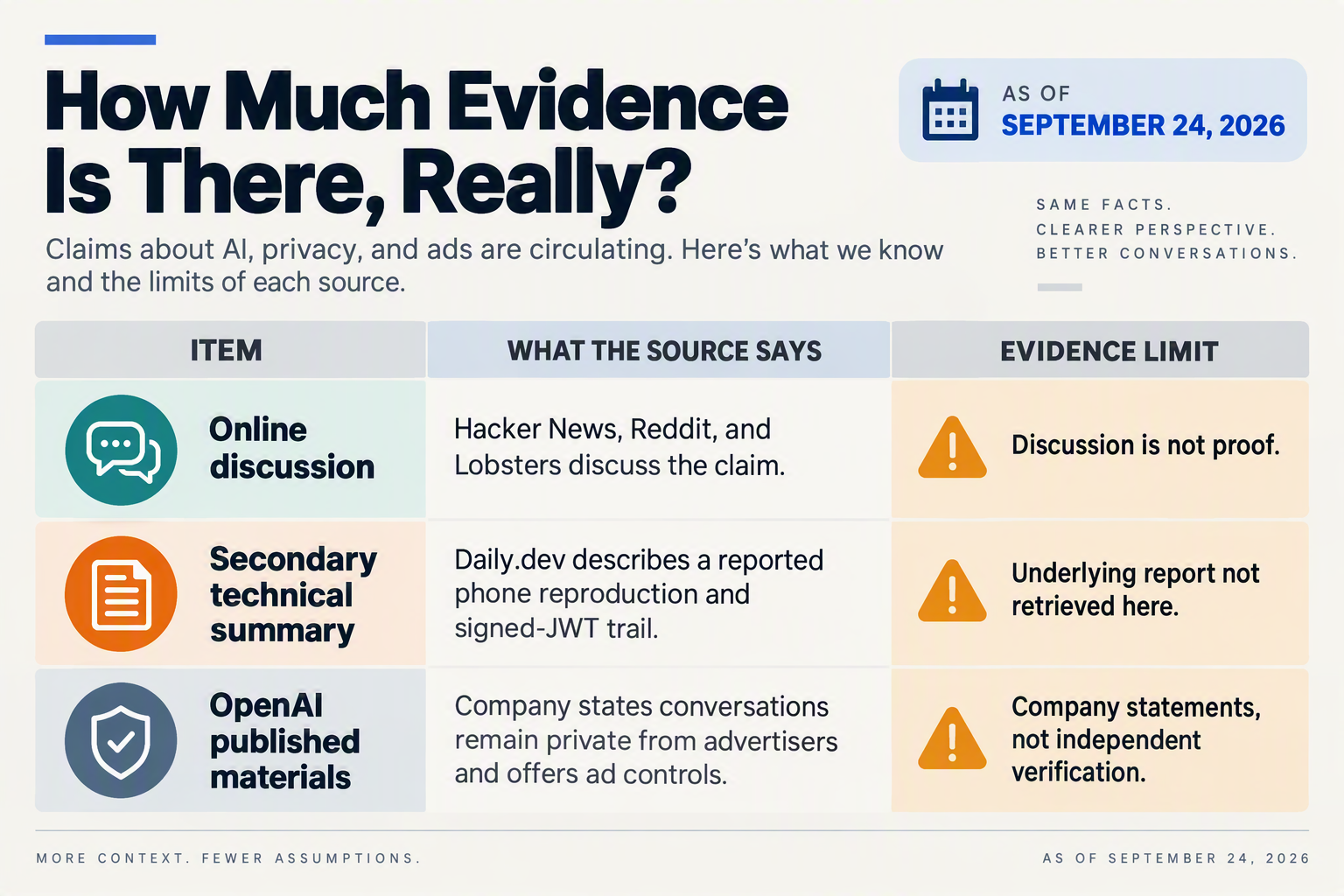
The evidence available here confirms that a cross-site data-collection allegation is being discussed, but it does not independently verify how the reported mechanism works or what data it links. The technical details come from secondary summaries; the underlying report and a first-party OpenAI statement about the specific allegation were not available in the research reviewed for this section.
What does the available evidence establish—and what remains unverified?
The Hacker News post titled “ChatGPT now knows what you do on other websites via ad collector” is also being discussed on Reddit and Lobsters, according to the supplied search results. That establishes that the claim is circulating—not that every technical conclusion in it has been reproduced or confirmed.
| Topic | What the supplied sources say | What this establishes | What remains unresolved |
|---|---|---|---|
| Public discussion | Hacker News lists the post; related discussions appear on Reddit and Lobsters. | The allegation has drawn attention across multiple forums. | Forum discussion is not independent technical verification. |
| Reported test | Daily.dev says an investigation reproduced a mechanism on a phone. | A secondary summary describes a claimed reproduction. | The original report, test steps, device details, and reproducible evidence were not retrieved. |
| Identifier and token | Daily.dev says an identifier was traced from a signed JWT issued by ChatGPT’s backend through a cross-site flow. | The summary alleges a path involving an identifier and a token. | The token’s contents, the identifier’s meaning, and whether the path reliably links activity to an account are not established here. |
| Possible cookie | Other summaries mention a possible __obi cookie and links between ad-site activity and ChatGPT. | The cookie name is part of the reported allegation. | Its behavior, purpose, scope, and connection to the alleged flow require primary evidence. |
| Data involved | The claim describes possible ad-related data linkage across websites. | The allegation concerns identifiers or events, not necessarily conversation text. | Whether conversation content is involved—or whether any support employee can access it—cannot be inferred from the allegation. |
| OpenAI’s position | The research context points to OpenAI’s published ad and privacy commitments but does not include their text. | A fair comparison should consult OpenAI’s first-party policies and statements. | The specific commitments, their scope, and whether they address this reported mechanism cannot be summarized from the material provided. |
A signed JWT is not, by itself, proof of cross-site tracking: the key questions are what information it contains, where it is sent, and whether it can be associated with a person or account. Likewise, a cookie name appearing in a secondary account does not establish that the cookie is present for all users or that it exposes conversation content.
For support teams, keep the three data paths separate:
- Submitted information: what a user types or uploads to ChatGPT.
- Reported cross-site signals: identifiers or events that may be exchanged in an advertising-related flow.
- Staff access: what authorized support personnel can view in conversations, logs, or customer records.
These are different privacy questions. Evidence for a possible identifier flow would not, without more, demonstrate that support agents can read ChatGPT conversations or that conversation contents were shared with advertisers.
Before drawing conclusions about OpenAI’s published commitments, check the relevant first-party policy or statement and compare its wording with the technical evidence. For any AI support vendor, ask directly: What data is collected? Who can access conversations? Are access events logged? How long is data retained? Is customer conversation data separated from advertising and other uses? Clear answers to those questions are more useful than treating a viral headline as a complete account.
What does the ad-collector report show—and what remains unverified?

The available material shows that a cross-site tracking allegation is circulating, but it does not independently verify how the reported mechanism works or how widely it operates. The central technical details come from secondary summaries, not a retrieved technical report or reproducible evidence.
What does the reported mechanism claim?
A Hacker News post titled “ChatGPT now knows what you do on other websites via ad collector” has also drawn discussion on Reddit and Lobsters, according to the supplied search results. The headlines identify a live concern; they do not establish that the claim is true.
A Daily.dev summary says an investigation reproduced a mechanism on a phone and traced an identifier from a signed JWT issued by ChatGPT’s backend through a cross-site flow. Other search-result summaries refer to a possible __obi cookie and a connection between ad-site activity and ChatGPT. These descriptions are reported allegations, not findings independently confirmed by the material available for this section.
In particular, the summaries do not establish:
- What information, if any, the identifier contains or represents.
- Whether the possible
__obicookie is present, what it does, or under what conditions it operates. - Which websites, users, devices, or regions might be in scope.
- Whether the identifier can be linked to a specific ChatGPT account or conversation.
- Whether conversation content is involved at all.
A signed token or cookie, if one is involved, would not by itself prove that conversation text was sent to an advertiser. Establishing that would require examining the underlying data flow and evidence of what is transmitted, received, and associated.
What remains unverified about ads and privacy commitments?
The supplied results do not include OpenAI’s relevant primary-source ad disclosures or privacy policy language. That means this material cannot confirm how OpenAI describes ad targeting, what data it says is used or excluded, or how those statements relate to the reported mechanism. Those commitments should be checked directly against current OpenAI documentation and compared with technical evidence—not inferred from headlines or secondary summaries.
For a reliable assessment, investigators would need a reproducible account of the test conditions, the requests and responses observed, the token or cookie’s role, and whether the behavior persists across accounts, browsers, or devices. They would also need to distinguish data collection from data linkage: observing an identifier cross a site boundary does not automatically prove that a person’s identity, ChatGPT account, or private conversation can be inferred.
What does this mean for support teams?
The allegation does not answer whether support personnel can access conversations. That is a separate vendor-governance question, and businesses should ask vendors for specific, documented answers:
- Which employees or contractors can access conversation content, and for what purposes?
- Are access events logged and reviewable?
- How long are prompts, transcripts, identifiers, and related records retained?
- Are customer conversations separated from advertising, analytics, or model-improvement uses?
- Can the vendor explain its policies alongside the data flows observed in an independent test?
These questions apply across AI support platforms, including CallMissed, an AI customer-communication platform hosted in India; the hosting location alone does not establish access, retention, or advertising practices. The practical takeaway is to treat the ad-collector claim as a reason to request evidence and scrutinize vendor disclosures—not as proof that support conversations have been exposed.
Does ChatGPT share your data with advertisers, according to OpenAI?
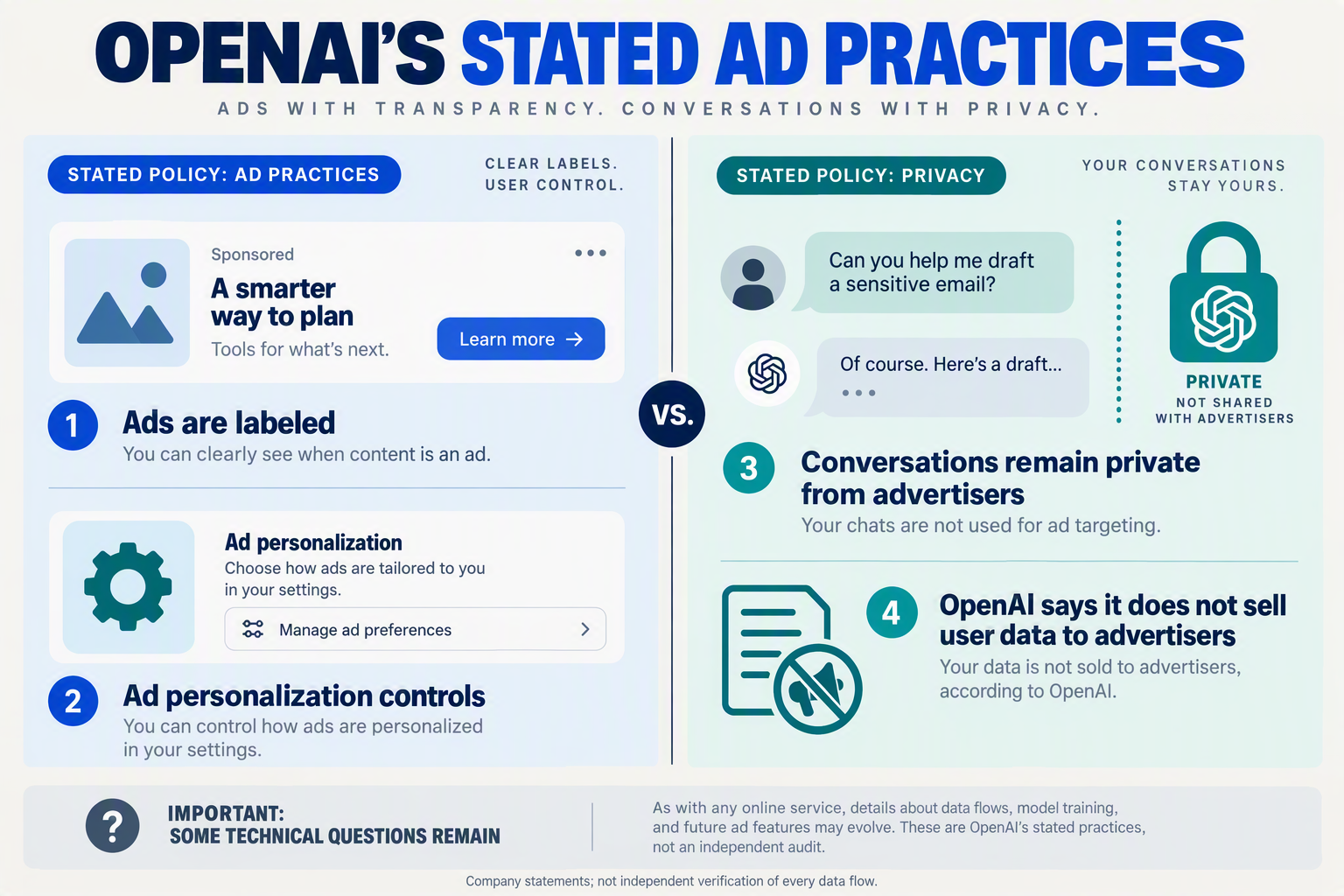
OpenAI’s published commitments cannot be confirmed from the material available for this article: the supplied results do not include an official OpenAI ad or privacy policy. They also do not establish that advertisers receive ChatGPT conversation content. The cross-site allegation should therefore be treated as a claim to investigate—not as proof that OpenAI shares chats with advertisers or that support staff can access them.
What does the reported cross-site flow prove?
A Hacker News post titled “ChatGPT now knows what you do on other websites via ad collector” has prompted related discussion on Reddit and Lobsters. The discussion reflects concern, but posts and reactions are not independent verification of how a tracking mechanism works.
Daily.dev summarizes an investigation that reportedly reproduced a mechanism on a phone and traced an identifier from a signed JWT issued by ChatGPT’s backend through a cross-site flow. Other summaries refer to a possible __obi cookie and links between ad-site activity and ChatGPT. These are secondary-source accounts: the underlying technical report and reproducible evidence were not available in the research for this article.
Even if an identifier is passed between services, that alone does not show what information it represents, whether it is tied to a particular account, whether it is used for ad targeting, or whether conversation text is disclosed. Those are separate questions requiring evidence about the data collected, its recipients, and its purpose.
What should businesses verify in OpenAI’s ad and privacy terms?
A responsible answer requires current, official OpenAI documentation—not inference from a viral post or a discussion thread. Before using ChatGPT for support workflows, businesses should locate the relevant terms for their product and account type, then check whether they explain:
- What advertisers receive: conversation content, identifiers, ad interactions, or only aggregated reporting.
- Whether data is used for targeting: including whether activity across websites or services can be associated with an account.
- What controls apply: whether users or organizations can opt out of particular data uses, and whether those controls differ by plan or region.
- How long information is retained: including logs, identifiers, and data shared with service providers.
- Who can access chats: such as authorized staff, contractors, or service providers, and what safeguards or audit logs govern that access.
A commitment about not selling personal data, if present in a policy, would not by itself answer every question about collection, processing, or sharing with vendors. Businesses should read the exact wording and scope rather than treating broad privacy language as proof that no data flows occur.
Does an ad-tracking allegation establish support-agent access?
No. Cross-site identifiers, submitted conversation content, and staff access are distinct data paths. Evidence that may indicate an identifier moves through an advertising-related flow does not show that a human support agent can read a conversation. Conversely, a platform’s statement about advertising would not, by itself, explain internal access permissions or retention.
For any AI vendor, ask for written answers on access controls, retention periods, deletion, and separation of customer conversations from advertising or other uses. Until primary technical evidence and applicable OpenAI policy language are reviewed, the careful conclusion is limited: the reported mechanism raises questions, but its scope—and what it means for support-agent privacy—remains unverified.
What do official statements and reporting establish about support-agent access?

The available reporting does not establish whether support agents can access ChatGPT conversations. It describes a reported cross-site identifier flow, while the research provided here contains no direct OpenAI statement or policy text specifying support-staff access, access logging, or retention.
What does the cross-site reporting establish?
The Hacker News post titled “ChatGPT now knows what you do on other websites via ad collector” is also being discussed on Reddit and Lobsters. Those discussions show that the claim is attracting attention; they do not independently verify how the alleged mechanism works.
A Daily.dev summary says an investigation reproduced a mechanism on a phone and traced an identifier from a signed JWT issued by ChatGPT’s backend through a cross-site flow. Other summaries refer to a possible __obi cookie and a connection between ad-site activity and ChatGPT. These are secondary-source accounts: the underlying technical report and reproducible evidence were not available in the research for this article. The cookie’s behavior, the flow’s scope, and whether it links activity to a particular account therefore remain unverified here.
Even if the reported identifier flow were confirmed, that alone would not show that support agents can read ChatGPT conversations. Nor would it establish that conversation content was shared with advertisers. Those are separate claims requiring separate evidence.
What can be said about official statements?
The materials supplied for this section do not include OpenAI’s published advertising or privacy commitments, so they are not enough to quote or assess what OpenAI officially promises about ads, conversation data, or internal access. A careful comparison must start with the actual policy language, not summaries of a technical allegation or discussion-board reactions.
For support teams, the relevant questions are specific:
- Who can access conversations? Ask whether access is limited by role, purpose, and need, and whether administrators or support personnel have broader access.
- Is access logged and reviewable? Ask what the audit trail records, who can inspect it, and how suspected misuse is handled.
- How long is data retained? Ask about conversations, associated identifiers, logs, and backups—and whether deletion applies to each.
- Are data uses separated? Ask whether support conversations, product analytics, advertising-related data, and model-improvement uses are governed separately.
These questions distinguish the three data paths at issue: information a user submits, identifiers or events reportedly exchanged across websites, and staff access to conversation records. A finding about one path cannot answer the other two.
What should businesses conclude?
For now, the sound conclusion is uncertainty, not proof of staff access. The supplied reporting raises a question about possible cross-site linkage, but does not settle that mechanism or demonstrate what support personnel can see. Businesses evaluating any AI provider should seek current, written answers on access controls, retention, and data separation, then compare those answers with published privacy and advertising commitments.
CallMissed, an AI customer-communication platform hosted in India, is one example of the broader range of AI tools businesses may assess. Its hosting location is a concrete vendor fact, but it does not by itself answer questions about staff permissions or retention; those require explicit, product-specific disclosures.
What should users and support teams do next?
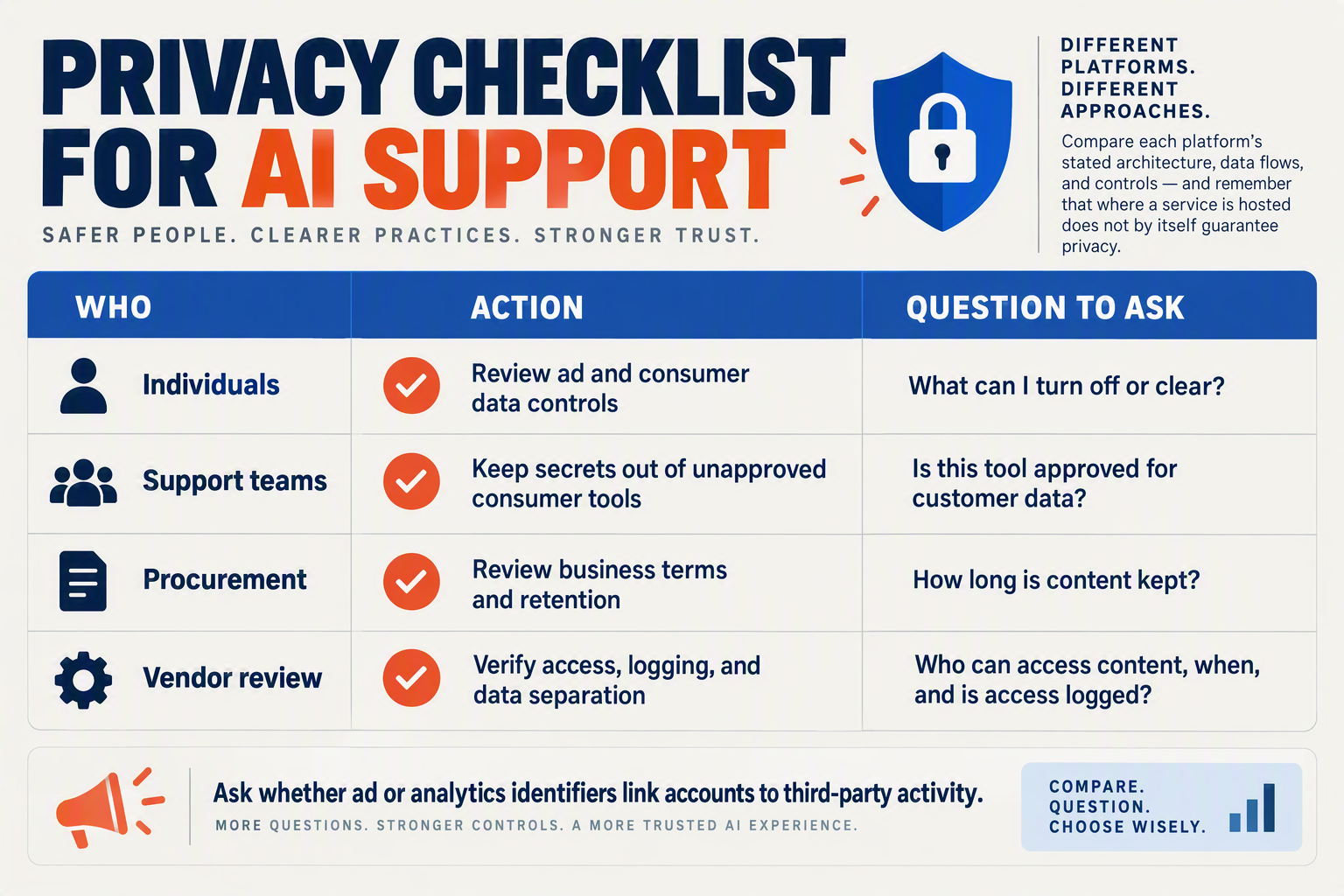
Users should limit sensitive information shared with any AI service, while support teams should assess the reported cross-site mechanism separately from staff access to conversations. Treat the Hacker News, Reddit and Lobsters discussion as a prompt for investigation, not confirmation: Daily.dev’s summary describes a phone reproduction and a signed JWT, but the underlying technical report and reproducible evidence were not available in the research for this article.
What practical steps can users and support teams take?
| Priority | What users can do | What support teams should do | Evidence to request |
|---|---|---|---|
| Minimize data | Avoid entering passwords, payment details or unnecessary identifiers into AI chats. Redact personal details before sharing. | Set rules for what agents may paste into AI tools; use synthetic or redacted examples for testing. | Written terms specifying whether prompts are used for advertising, model improvement or other purposes. |
| Check the claim | Review current account and privacy settings. Do not treat a cookie name or online post as proof of account-level tracking. | Ask security staff to assess the technical report, including whether the alleged identifier is present and what it can link. | Primary research, reproducible steps, affected platforms and dates, plus an explanation of any __obi cookie or JWT behavior. |
| Limit staff access | Use individual accounts and avoid shared logins where possible. | Apply least-privilege access: give each role only the conversation data it needs, and review access when roles change. | Role and permission documentation, access logs, and procedures for investigating unusual access. |
| Set retention rules | Use available controls to delete or export personal data, and check what the provider says about retained copies. | Define retention periods for conversations, transcripts, recordings and logs; document deletion workflows and exceptions. | Retention schedules, deletion timelines, backup handling and a contact for privacy requests. |
| Separate data paths | Keep personal browsing and work accounts distinct where practical, without assuming this alone prevents tracking. | Map customer-submitted content, cross-site identifiers and internal staff access as separate data flows. | A data-flow diagram showing collection, recipients, purposes, storage locations and whether advertising systems receive conversation data. |
| Prepare for incidents | Report unexpected account activity through the provider’s official support channel. | Assign owners for vendor review and incident response; reassess controls if new evidence changes the risk assessment. | Breach-notification terms, escalation contacts and a dated record of the vendor’s answers. |
What should teams ask vendors about privacy?
These steps address three distinct questions: what a user submits, what identifiers may travel between sites, and who inside an organization can read support conversations. Evidence for one path should not be treated as evidence for another. Proof that an identifier is transmitted would not, by itself, establish that conversation text is shared with advertisers or visible to support personnel.
Ask vendors for clear, written answers rather than relying on broad assurances such as “private” or “secure.” Record the response, the date reviewed, the products covered and any unanswered questions. Revisit the assessment if the service changes its advertising practices or publishes new technical documentation.
CallMissed, an AI customer-communication platform hosted in India, is one example of the broader shift toward AI in customer interactions. As of September 2026, that hosting fact alone should not be read as a guarantee about retention, access controls or advertising-related data separation; support teams should ask those questions directly of every vendor they evaluate.
Frequently Asked Questions
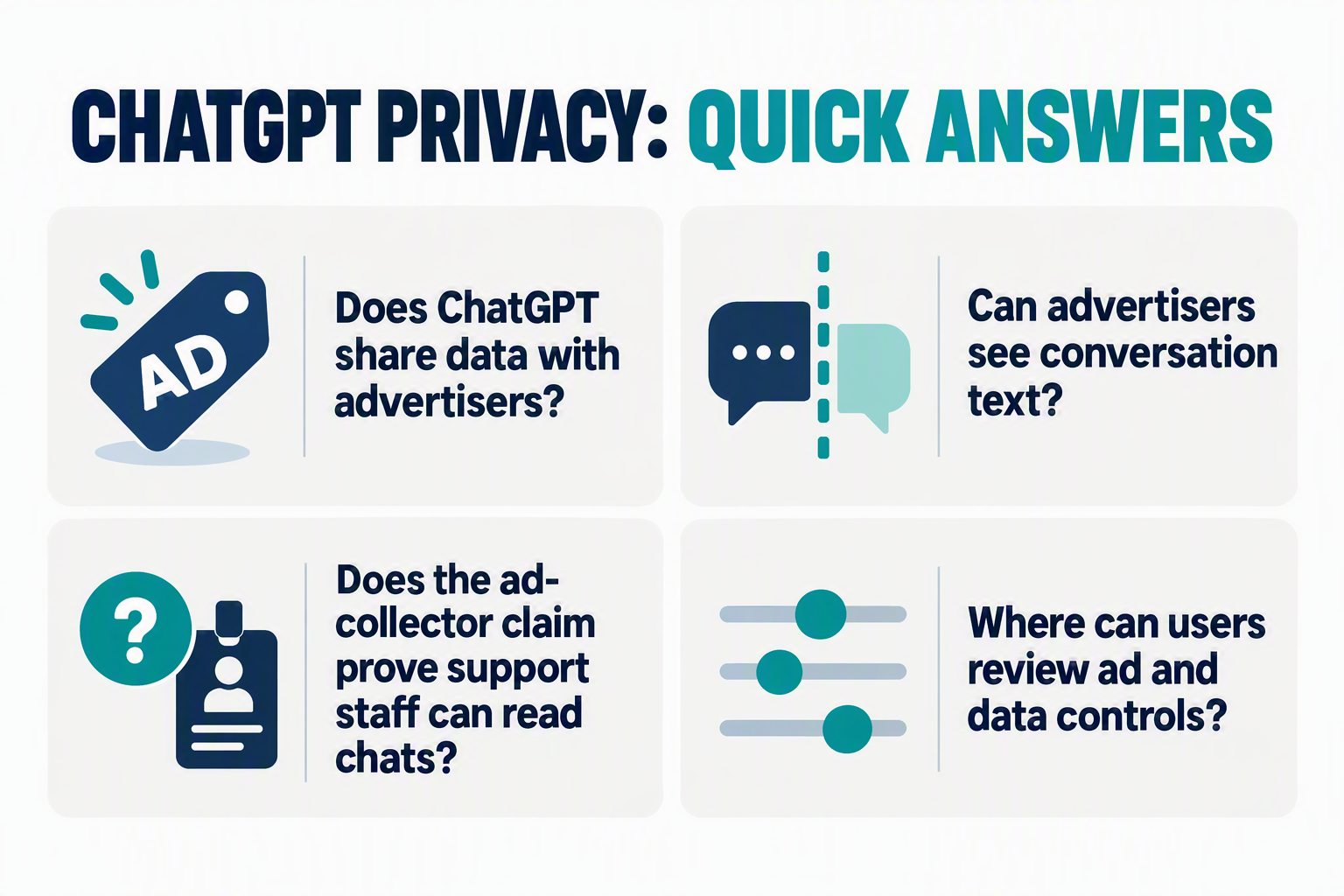
Does ChatGPT share my data with advertisers?
What does the ChatGPT cross-site data collection claim actually allege?
__obi cookie. These are secondary accounts; the underlying technical report and reproducible evidence were not available in the research for this article.Can OpenAI employees or support staff read my ChatGPT conversations?
Can my company’s support agents see what I asked ChatGPT?
How can I reduce risks from ChatGPT cross-site data collection?
What privacy controls should a business ask an AI support vendor about?
Conclusion
The cross-site data-collection claim deserves scrutiny, but the available summaries do not prove how the reported mechanism works—or that ChatGPT conversations are accessible to support agents. For support teams, the practical takeaway is to distinguish the data paths and ask vendors clear questions before drawing conclusions:
- Submitted information: What customers or employees intentionally share with an AI service may raise different risks from browsing identifiers.
- Reported cross-site linkage: Daily.dev describes a phone-based reproduction involving a signed JWT, while other summaries mention a possible
__obicookie. The underlying technical report and reproducible evidence were not available for independent verification here. - Staff access: An allegation about advertising-related data linkage does not, by itself, show that support personnel can read conversations or that conversation content goes to advertisers.
- Vendor safeguards: Ask who can access conversation records, whether access is logged, how long data is retained, and whether customer information is separated from advertising and other uses.
Next, watch for independently reproducible technical findings and clear, specific vendor disclosures—not just viral interpretations. AI communication platforms such as CallMissed, hosted in India and offering voice and chat agents with speech recognition in 22 Indian languages, are part of this changing landscape. To explore how AI communication is evolving, visit CallMissed. What evidence and safeguards would your team need before trusting an AI tool with a support conversation?
Related Reading
- July 2026 AI Agent Updates: Gemini for Support Teams
- AI Agents from Pilot to Production: Support Playbook
- How to Write Prompts for AI Agents: Support Guide 2026
Sources
Discussion
Related Posts


Ready to automate customer conversations?
Launch AI voice agents and WhatsApp bots with CallMissed — one API, 22+ Indian languages.