
Qwen 3.8 Voice Agent Benchmarks: A Builder’s Guide


Learn how to interpret Qwen 3.8 voice agent benchmarks, separate vendor claims from measured results, and run reproducible end-to-end tests.
Qwen 3.8 Voice Agent Benchmarks: A Builder’s Guide
What does roughly 20 tokens per second tell you about a voice agent? Less than you might think. Qwen 3.8 voice-agent benchmarks are getting attention after Tom’s Hardware’s September 12, 2026, Premium roundup highlighted benchmarking Qwen 3.8—and a September 8 hardware test examined the Qwen 3.8 27B model on an RTX 5090. Tom’s Hardware’s search-result excerpt reports around 20 tokens per second without multi-token prediction (MTP), describing that result as an unimpressive baseline for the card.
That figure measures local text generation under a particular hardware and software setup. It does not tell you how quickly a complete voice agent will answer a caller. A production conversation also depends on speech recognition, network and orchestration overhead, the voice model’s response, and the time it takes to begin speaking. A model can produce text at a respectable rate and still feel slow if any other part of the pipeline stalls.
There is another important distinction: Qwen 3.8 27B and Qwen3.8-Omni-Flash are not interchangeable names for the same benchmark. Alibaba’s self-reported Omni-Flash results are a separate data point from Tom’s Hardware’s local 27B hardware test. Before comparing numbers, builders need to check the exact model and version, what was measured, and whether the result came from local inference, a hosted service, or an end-to-end voice interaction.
This guide explains how to read those results without mistaking a model benchmark for a deployment guarantee. We’ll separate tokens per second from the voice-agent measures that shape caller experience—such as time to first spoken response, turn-taking, transcription quality, interruption handling, and full-turn latency—and show why hardware, inference software, and the surrounding system all matter. Platforms such as CallMissed, which provides tools for building voice agents and connecting them to phone calls, are part of the broader shift from model scores to complete communication systems.
The practical takeaway: benchmarks are useful for narrowing choices, but builders should test the whole conversation path on their intended deployment setup before deciding whether a model is ready for live calls.
Do Qwen 3.8 benchmarks prove a voice agent is fast? No—offline results are only a starting point
No. Qwen 3.8 benchmark results can help builders compare model behavior, but offline text-generation throughput does not prove that a deployed voice agent will feel fast to callers. The useful question is not just how quickly a model generates tokens, but how the complete system performs under the conditions where it will actually be used.
Tom’s Hardware’s September 12, 2026 Premium roundup spotlighted Qwen 3.8 benchmarking, following its September 8 test of the Qwen 3.8 27B model on an RTX 5090. Tom’s Hardware’s search-result excerpt reports around 20 tokens per second without multi-token prediction (MTP) and describes that as an unimpressive baseline for the card. The hardware report’s headline also emphasizes that VRAM capacity alone cannot resolve software and inference-engine bottlenecks.
That result is a useful data point about a particular local setup—not a universal speed rating for Qwen 3.8, and not a measure of the time a caller waits to hear an answer. Hardware, inference software, model settings, and workload can all affect the result. A different deployment path may therefore produce different performance, even when the model name looks similar.
How should builders compare Qwen 3.8 benchmark claims?
Start by checking whether two results refer to the same model, version, task, and deployment path. The local Qwen 3.8 27B test and Alibaba’s self-reported Qwen3.8-Omni-Flash results are separate evidence; they should not be treated as interchangeable measurements. Vendor-reported results can be informative, but they are not a substitute for independent testing in your own environment.
Before comparing a number, find out:
- What was measured: average generation throughput, time to first token, or a complete spoken response?
- Where it ran: local hardware, a hosted service, or another deployment setup?
- How it was tested: which model version, settings, prompt, input length, and concurrency?
- What “fast” means: average performance, or performance during slower, busier cases?
Without those details, a benchmark may be accurate for its test while still being a poor predictor of your application’s behavior.
What should a voice-agent test measure instead?
Measure the caller’s experience from the start of a turn to the start of the agent’s spoken reply, then test the full conversation under realistic load. Track time to first spoken response, full-turn latency, transcription quality, turn-taking, and whether the agent handles interruptions cleanly. Report typical results as well as slower cases; a strong average can conceal stalls that callers notice.
A practical evaluation sequence is:
- Test representative caller audio, including accents, background noise, and code-mixed speech if relevant.
- Run the same scenarios using the exact model version and hosting path you plan to deploy.
- Repeat tests at expected concurrency, recording both response quality and timing.
- Validate complete phone conversations—not only isolated prompts.
As of September 2026, CallMissed provides a no-code voice-agent builder and supports inbound and outbound calls through rented numbers or a business’s carrier. That illustrates the broader engineering point: a model is one part of a communication system, so builders should evaluate the assembled call path rather than infer caller experience from a standalone generation score.
What are Qwen 3.8 27B and Qwen3.8-Omni-Flash—and why keep them separate?

Qwen 3.8 27B and Qwen3.8-Omni-Flash should be treated as separate benchmark subjects, not alternate names for one model. Tom’s Hardware’s September 2026 test concerns local text generation with Qwen 3.8 27B on an RTX 5090; Alibaba’s Omni-Flash results are a separate, vendor-reported data point. Their numbers are meaningful only when the model version, test, and deployment path are clear.
What does Tom’s Hardware’s Qwen 3.8 27B test measure?
Tom’s Hardware’s September 12, 2026 Premium roundup featured Qwen 3.8 benchmarking, following its September 8 hardware test of Qwen 3.8 27B. The search-result excerpt reports about 20 tokens per second without multi-token prediction (MTP) on the RTX 5090 test and calls that an unimpressive baseline for the card.
That result is a hardware-and-software-dependent measure of local text generation. It does not, by itself, say how long a caller waits for a voice agent to hear a request, form an answer, and start speaking. Tom’s Hardware’s headline also points to a practical constraint: VRAM capacity alone cannot overcome software and inference-engine bottlenecks. A fast GPU is only one part of the setup; the engine and its configuration affect observed throughput too.
How are Qwen3.8-Omni-Flash results different?
Alibaba’s self-reported Qwen3.8-Omni-Flash results are not the same measurement as Tom’s Hardware’s local Qwen 3.8 27B test. The available context identifies the Omni-Flash figures as vendor-reported, but does not provide their test setup or numerical results. Builders should therefore avoid presenting those figures as a direct confirmation—or contradiction—of the RTX 5090 result.
Before comparing either result, check:
- Exact model and version: “Qwen 3.8 27B” and “Qwen3.8-Omni-Flash” identify different benchmark subjects.
- Deployment path: local inference and a vendor-reported result may involve different hardware, software, and serving arrangements.
- Metric and test conditions: tokens per second is not automatically comparable with a latency measure or an end-to-end voice test.
- Disclosure: note whether a result is independently tested or reported by the model vendor.
Why should voice-agent builders keep them separate?
A benchmark comparison is useful only if it answers a specific question. The RTX 5090 test can inform a builder investigating local text-generation throughput under that test’s conditions. An Omni-Flash result may inform a different evaluation, but without its methodology and metric, it cannot establish how the same workload would perform on local hardware—or how quickly a caller would hear a response.
For a voice-agent decision, record these results separately, then run a controlled test on the intended deployment path. Measure time to first spoken response, full-turn latency, transcription quality, and interruption handling—not just text tokens per second. That turns the two model names from a misleading head-to-head into useful, clearly scoped evidence.
What do the September 2026 results actually report?
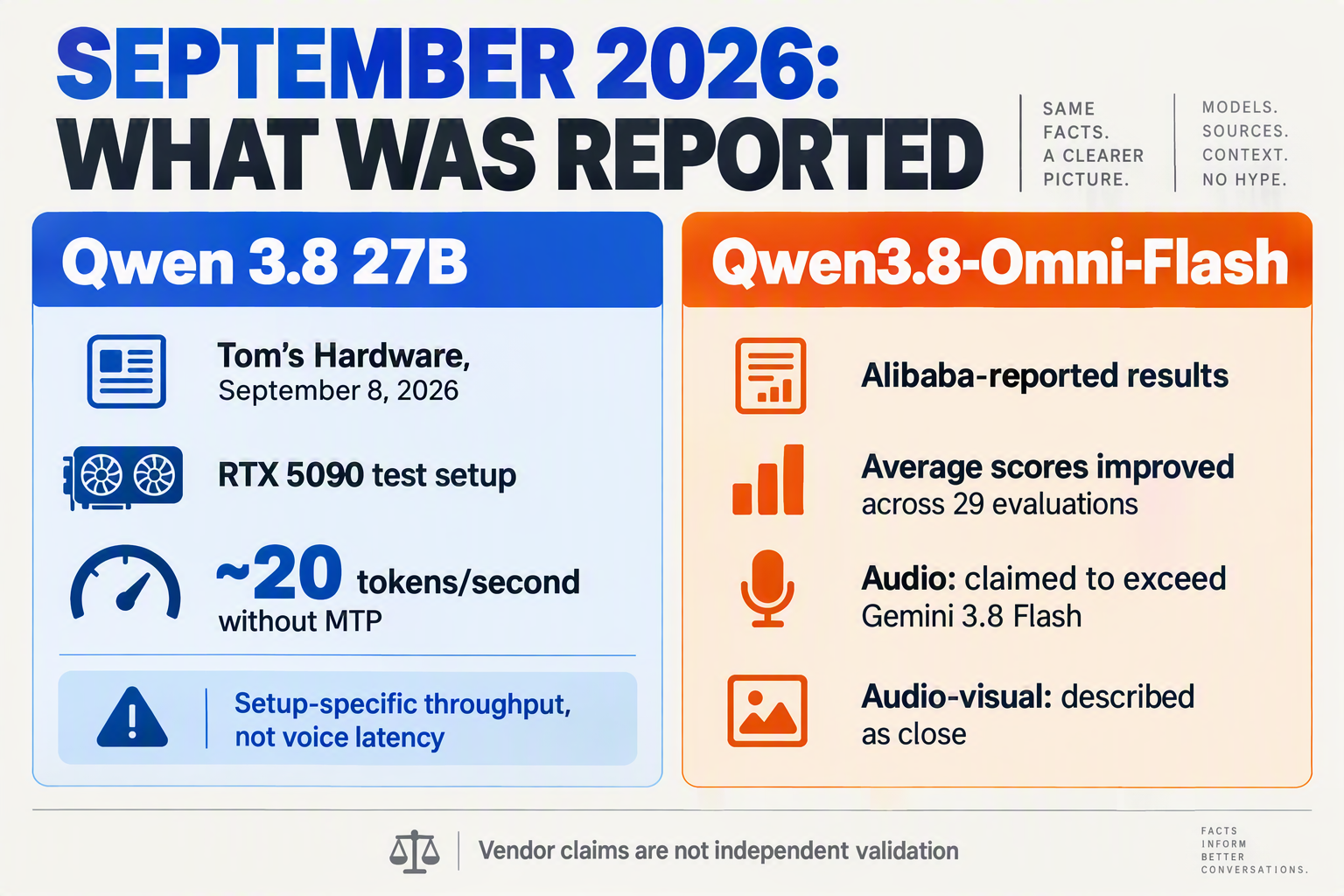
The September 2026 coverage reports a local Qwen 3.8 27B text-generation result—not a complete voice-agent latency score. Tom’s Hardware’s September 12, 2026 Premium roundup flagged Qwen 3.8 benchmarking, following its September 8 hardware test of the 27B model on an RTX 5090. The available excerpt reports about 20 tokens per second without multi-token prediction (MTP) and calls that an unimpressive baseline for the card.
| Result or reference | What is reported | Test or source context | What builders can infer |
|---|---|---|---|
| Qwen 3.8 27B | Around 20 tokens/second without MTP | Tom’s Hardware search-result excerpt; September 8, 2026 hardware test on an RTX 5090 | A hardware- and software-dependent text-generation throughput result |
| Tom’s Hardware Premium roundup | Qwen 3.8 benchmarking is a featured topic | September 12, 2026 roundup | Evidence of industry interest, not a separate performance measurement |
| RTX 5090 framing | The headline emphasizes that VRAM capacity alone cannot overcome software and inference-engine bottlenecks | Tom’s Hardware’s Qwen 3.8 hardware-test headline | GPU memory is only one factor; implementation and inference stack also matter |
| Qwen3.8-Omni-Flash | The supplied context provides no specific benchmark figure | Alibaba’s self-reported results are a separate data point from the local 27B test | Do not transfer the 27B result to Omni-Flash or imply direct comparability |
| End-to-end voice-agent performance | No full voice-interaction result is reported in these excerpts | Requires testing the deployed speech, model, network and orchestration path | Measure caller-facing response and turn behavior directly |
The 20 tokens/second figure should be read narrowly. It describes text output under a particular local test configuration, and the excerpt does not provide enough detail here to generalize it to other GPUs, inference engines, prompts, quantization settings, or serving conditions. Nor does it say how quickly an agent recognizes speech, decides what to say, or begins speaking aloud.
Tom’s Hardware’s framing is also a useful reminder that VRAM capacity does not guarantee throughput. The headline points to software and inference-engine bottlenecks, so builders evaluating local deployment should record the model build, hardware, inference software, MTP setting, and test configuration alongside any speed result. Without those details, a tokens-per-second number is difficult to reproduce or compare fairly.
How should builders compare the two Qwen results?
Treat Qwen 3.8 27B and Qwen3.8-Omni-Flash as separate model-and-deployment cases. Tom’s Hardware’s reported figure comes from local 27B testing; Alibaba’s Omni-Flash figures are vendor-reported and, in the information available for this section, no specific values or measurement method are provided. That is not enough evidence to calculate a head-to-head winner.
For a useful comparison, first confirm the exact model and version, then note whether inference is local or hosted and what the benchmark measures. Keep the test conditions consistent: use the same prompts, audio samples, network assumptions, and success criteria where possible. Report results across repeated runs rather than relying on one unusually fast or slow interaction.
For voice-agent decisions, test the same spoken tasks on the intended deployment path and track:
- Time to first spoken response, not just text tokens per second.
- Full-turn latency, including recognition, model response, and speech generation.
- Transcription quality and interruption handling under realistic caller conditions.
The practical reading is modest but useful: September’s coverage makes Qwen 3.8 worth investigating, while the reported local throughput is a starting point—not evidence of production call performance. Run repeatable, end-to-end tests before using it to set caller expectations.
How should builders measure Qwen voice-agent latency end to end?
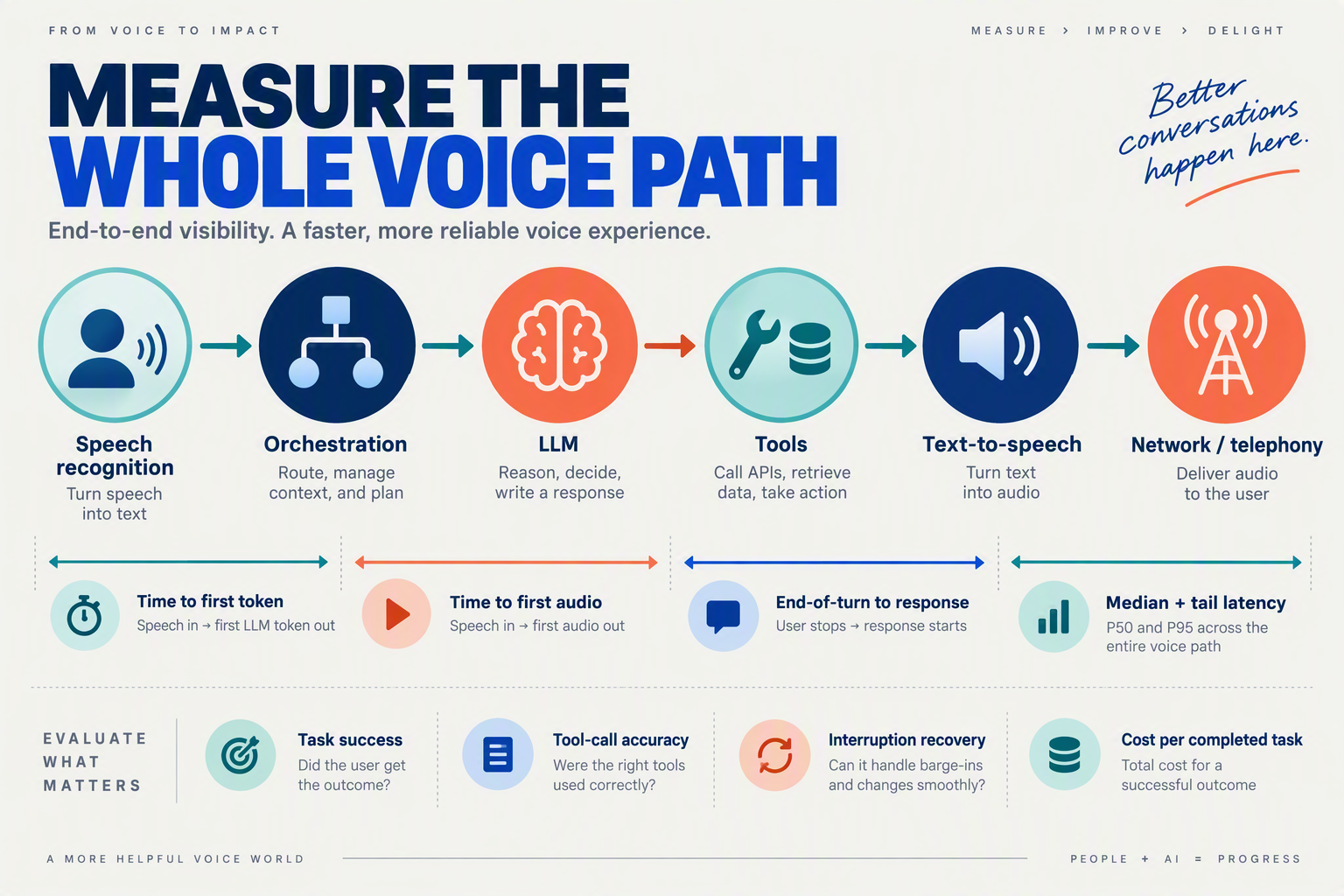
Measure Qwen voice-agent latency with timestamps across the entire audio path, from the caller’s speech to the first audible reply—not just the model’s token generation. Track first spoken audio, complete-turn time, and interruption recovery separately, then compare those measures under realistic load on the exact model and deployment setup you plan to use.
Which timestamps reveal where a voice agent is slow?
Instrument each turn so you can see where time accumulates. A practical trace records:
- Caller speech start and end, including when the system decides the caller has finished speaking.
- Transcript availability and the time the request reaches the language model.
- First generated text or token, if the serving stack exposes it.
- First audio produced and first audio played to the caller.
- Completion of the spoken response and, for interruption tests, when the agent stops speaking after the caller cuts in.
The most caller-visible metric is usually end-of-user-speech to first audible response. It includes speech-end detection, recognition, network travel, orchestration, model response, speech synthesis, and playback buffering. Report time to first audio separately from full-turn latency: a system may begin speaking promptly but take a long time to finish.
How should builders compare latency results fairly?
Tom’s Hardware’s September 12, 2026 Premium roundup featured Qwen 3.8 benchmarking after its September 8 hardware test of Qwen 3.8 27B. Tom’s Hardware’s search-result excerpt reports around 20 tokens per second without multi-token prediction on an RTX 5090 and characterizes that as an unimpressive baseline for the card. That is useful context for local inference, but builders should compare voice-agent timings only when the model version, hardware, inference engine, quantization, audio stack, and network path are specified.
Keep Qwen 3.8 27B separate from Qwen3.8-Omni-Flash in test reports. Alibaba’s self-reported Omni-Flash results are a different data point; don’t treat them as directly comparable unless the tasks, measurement boundaries, and deployment conditions match. Tom’s Hardware’s test also underscores why VRAM capacity alone does not settle performance: software and inference-engine bottlenecks can affect realized throughput.
For a useful evaluation, run identical caller audio through the same system configuration and test both quiet conditions and expected peak concurrency. Record warm and cold starts, short and long utterances, and interruptions. Report median and p95 latency, not just the fastest run: the p95 helps expose slow turns that callers may encounter even when the average looks acceptable.
What should a production benchmark report?
A concise benchmark should identify the model and version, hardware and serving configuration, test audio, concurrency, and timestamp definitions. Include time to first audio, full-turn time, transcription errors, and successful interruption handling; a low-latency answer that misunderstands the caller is not a good result.
CallMissed provides voice-agent building tools, call recordings, transcripts, and agent analytics. Builders using any platform should still capture their own timestamped traces when evaluating latency, so they can distinguish a model bottleneck from delays in recognition, synthesis, networking, or call orchestration.
Why can model scores differ from production voice-agent quality?
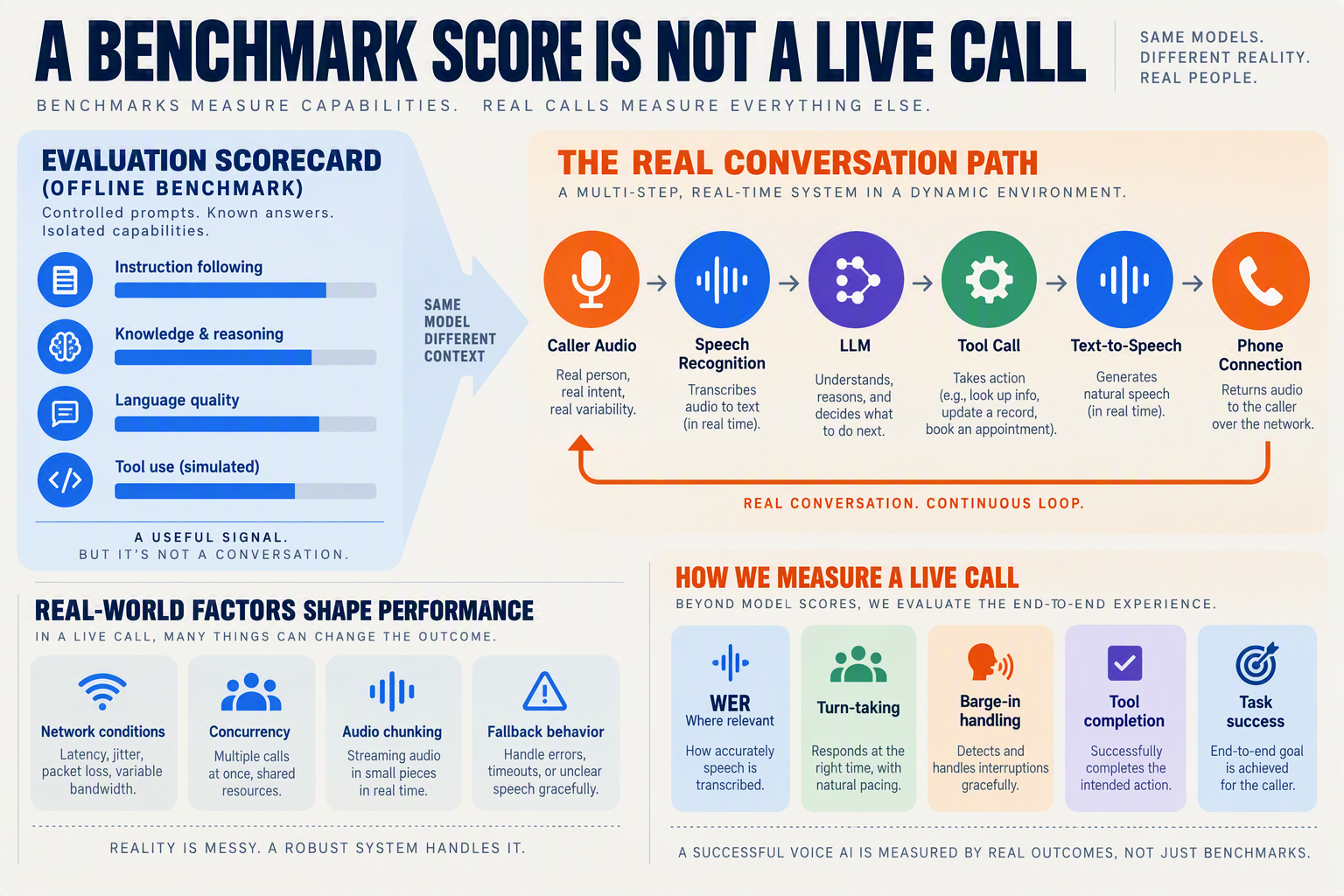
A model score can differ from production voice-agent quality because it measures only a defined task under a defined setup, while callers experience the entire speech-to-response pipeline. Tokens per second, benchmark accuracy, and end-to-end voice latency are different measures and should not be treated as substitutes.
What did Tom’s Hardware measure in its Qwen 3.8 27B test?
Tom’s Hardware’s September 12, 2026 Premium roundup highlighted Qwen 3.8 benchmarking after a September 8 hardware test of Qwen 3.8 27B on an RTX 5090. Tom’s Hardware’s search-result excerpt reports around 20 tokens per second without multi-token prediction (MTP) and describes the figure as an unimpressive baseline for that graphics card.
That result concerns local text generation—not the time a caller waits to hear an agent respond. The article headline also emphasizes that VRAM capacity alone cannot overcome software and inference-engine bottlenecks. In practice, a benchmark result depends on details such as the inference engine, software configuration, model settings, and whether MTP is enabled. Change those conditions and throughput may change, even with the same GPU.
Why aren’t Qwen 3.8 27B and Qwen3.8-Omni-Flash interchangeable?
They are separate model and deployment references, so their results should not be compared as if they came from one test. The RTX 5090 figure relates to local Qwen 3.8 27B testing; Qwen3.8-Omni-Flash results described by Alibaba are vendor-reported results for a different offering.
Before comparing either result, check:
- Exact model and version: Similar names do not establish identical models or capabilities.
- Deployment path: Local inference and a hosted service involve different hardware and system overhead.
- Test conditions: Prompt length, output length, concurrency, quantization, and inference software can affect results.
- Measurement: A model’s throughput or benchmark score is not the same as first audio or full-turn response time.
Without matched conditions, the numbers offer context—not a head-to-head verdict. Attribute vendor-reported results to the vendor, and treat them as claims to validate against the builder’s own workload.
Which measurements better predict a voice agent’s caller experience?
Builders should measure the whole interaction, from incoming speech to the agent’s first audible response and completed answer. Useful production metrics include time to first spoken response, full-turn latency, transcription quality, interruption handling, and performance at busy-hour concurrency. A fast text model can still feel slow if speech recognition, network transit, turn detection, orchestration, or speech generation adds delay.
Test representative calls rather than a single short prompt. For example, compare a brief FAQ with a long, noisy, code-mixed caller question, and record both typical results and slow outliers. Keep the model version, hardware, inference engine, voice stack, and test audio consistent; otherwise, the comparison may measure a changed setup rather than a changed model.
Platforms such as CallMissed, which provides a no-code voice-agent builder and call-flow tools, illustrate why model selection is only one part of deployment. The practical benchmark is the complete conversation path on the intended setup—not a model score in isolation.
What do Tom’s Hardware and Alibaba claim—and what remains unverified?
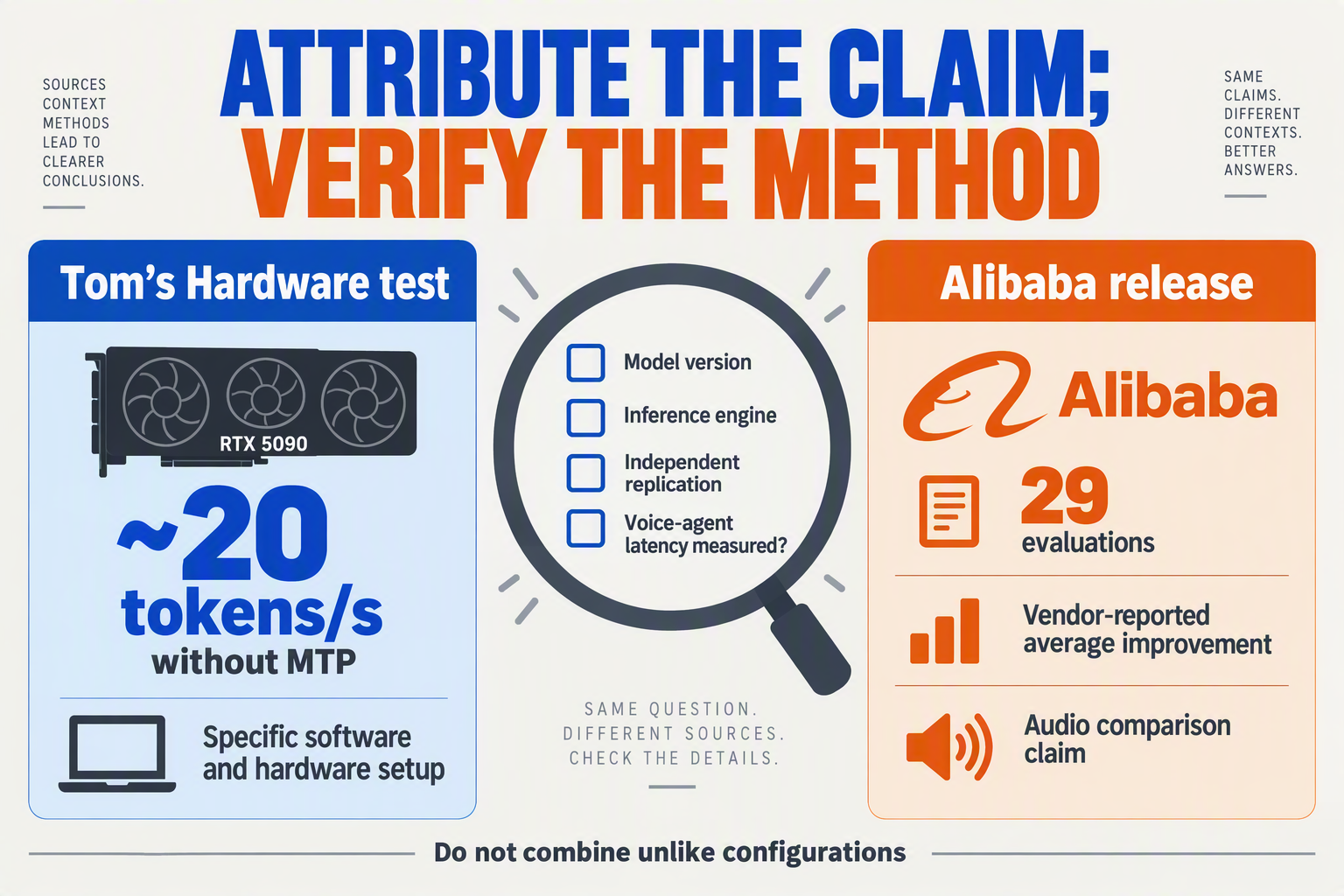
Tom’s Hardware’s September 2026 coverage reports a hardware-dependent Qwen 3.8 27B text-generation result, while Alibaba’s Qwen3.8-Omni-Flash figures are vendor-reported; neither, by itself, establishes end-to-end voice-agent performance. The available reporting supports a cautious comparison, not a conclusion that one model will answer callers faster.
What does Tom’s Hardware report about Qwen 3.8 27B?
Tom’s Hardware’s September 12, 2026 Premium roundup highlighted benchmarking Qwen 3.8, following its September 8 hardware test of Qwen 3.8 27B on an RTX 5090. The search-result excerpt reports about 20 tokens per second without multi-token prediction (MTP) and characterizes that as an unimpressive baseline for the card.
That number describes text-generation throughput in a particular local test—not the time a caller waits to hear an answer. Tom’s Hardware’s headline also emphasizes that VRAM capacity alone cannot overcome software and inference-engine bottlenecks. That is a useful reminder: the result depends not only on the GPU, but also on the model configuration and inference stack. The excerpt available here does not provide enough test details to reproduce the result or generalize it to other hardware.
What does Alibaba claim about Qwen3.8-Omni-Flash?
Alibaba’s Qwen3.8-Omni-Flash results are a separate, self-reported data point. They should not be treated as another measurement of the Qwen 3.8 27B RTX 5090 setup: the model names and deployment paths differ.
The available context does not specify Alibaba’s exact benchmark values, test protocol, hardware, software stack, or whether the reported measurement covers a full voice interaction. Without those details, builders cannot independently determine how the result compares with Tom’s Hardware’s local throughput figure. A vendor benchmark can be useful evidence, but its scope and methodology matter as much as the headline number.
Which parts remain unverified for voice-agent builders?
Before drawing a performance conclusion, check whether each report identifies:
- The exact model and version: Qwen 3.8 27B and Qwen3.8-Omni-Flash are not interchangeable.
- The deployment path: local inference, hosted inference, or a complete voice-agent service.
- The metric and setup: tokens per second, time to first response, hardware, inference engine, MTP settings, and test conditions.
- The conversation-level results: speech-recognition time, time to first spoken response, full-turn latency, transcription quality, and interruption handling.
A model can generate text quickly yet still feel slow if audio processing, network calls, or orchestration delay the first spoken response. Conversely, a lower text-throughput result does not alone prove a poor caller experience. Builders should test representative calls on their intended setup, measure latency across the full path, and report results under repeatable conditions. Until those details are available, the responsible reading is narrow: Tom’s Hardware reports a roughly 20-token-per-second local result in its stated context; Alibaba’s Omni-Flash claims require their own method-specific evaluation.
Which deployment and testing choices fit your use case?
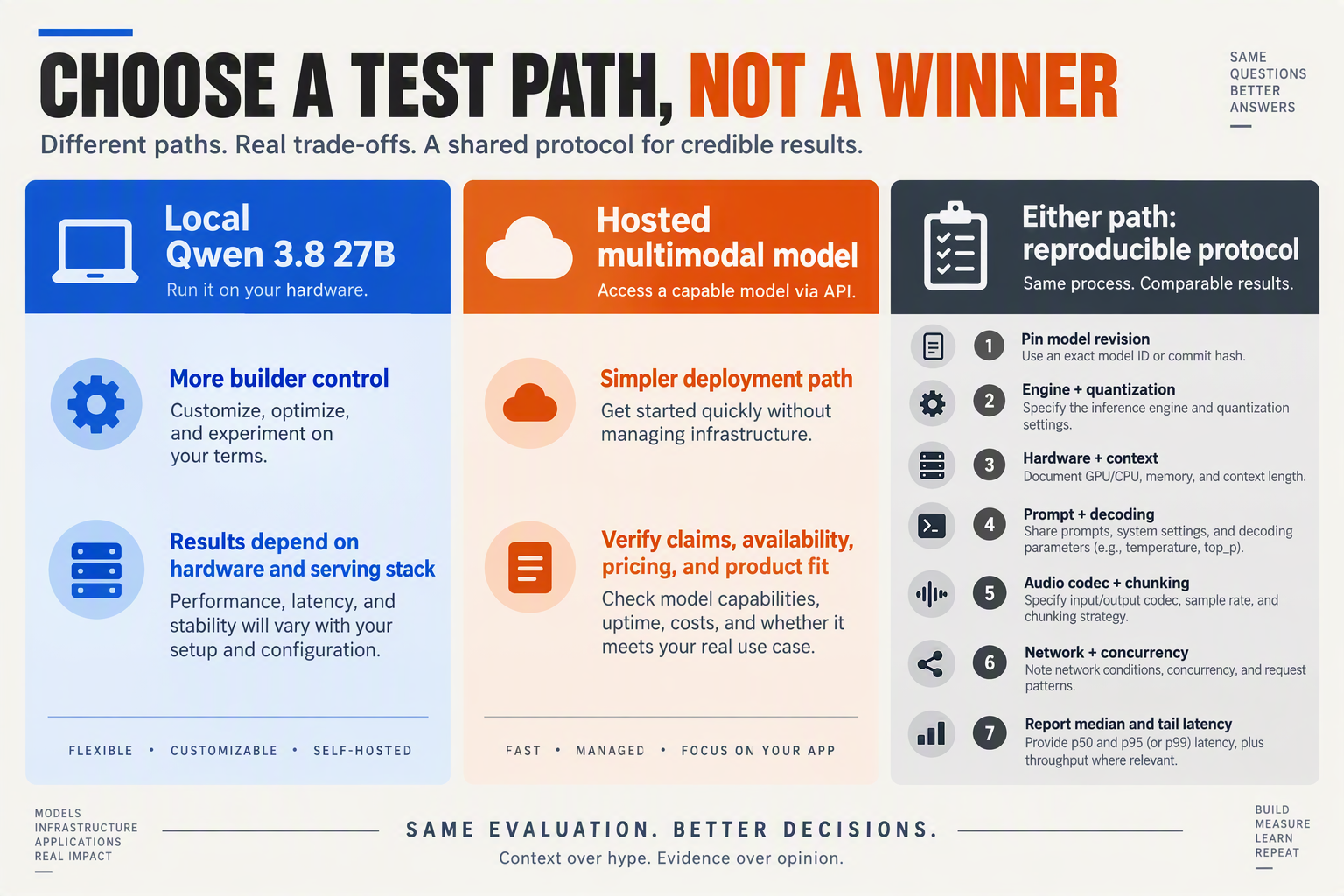
Choose a deployment path by matching control, cost, and operating constraints to the part of the voice experience you need to validate. Treat Tom’s Hardware’s local Qwen 3.8 27B result and Alibaba’s self-reported Qwen3.8-Omni-Flash results as separate evidence—not interchangeable measures of production call performance.
Which deployment path should you test first?
| Deployment choice | Best fit | What to measure | Evidence and caveat |
|---|---|---|---|
| Local Qwen 3.8 27B | Teams that need local control and can manage inference hardware and software | Time to first spoken response, full-turn latency, transcription quality, and performance under concurrent calls | Tom’s Hardware’s September 8, 2026, RTX 5090 test reported around 20 tokens per second without MTP, as described in its search-result excerpt. That is a hardware-and-software-dependent text-generation result, not an end-to-end voice benchmark. |
| Hosted Qwen3.8-Omni-Flash | Teams evaluating a hosted, multimodal model path | The same conversation-level measures, plus consistency across repeated sessions and network conditions | Alibaba’s self-reported Omni-Flash results are a different data point from Tom’s Hardware’s 27B local test. Confirm the exact model version and what each reported score measures before comparing them. |
| Managed voice-agent stack | Builders who want to assess the complete call experience without treating an LLM as the whole system | Caller wait time, interruption handling, turn-taking, successful task completion, and failure recovery | A managed stack can include speech recognition, model inference, text-to-speech, and orchestration. CallMissed, for example, offers a managed voice-agent WebSocket, including a Deepgram Voice Agent-compatible endpoint; that does not imply any particular Qwen model or benchmark result. |
| Hybrid model and voice pipeline | Teams choosing separate components for recognition, reasoning, and speech generation | Per-stage latency, total response time, transcript errors, and whether component delays compound | A faster text model cannot by itself establish that the full pipeline responds sooner. Test the actual combination of models, services, and network route you plan to deploy. |
| Staged pilot on intended infrastructure | Teams close to a deployment decision | Results across realistic accents, noisy audio, short and long turns, interruptions, and expected load | Keep prompts, audio samples, settings, and model versions fixed across comparisons. Record both successful and failed turns so averages do not hide important edge cases. |
How can you make the comparison fair?
Use a repeatable test rather than comparing headline figures from unrelated setups:
- Record the exact configuration: model name and version, inference engine, hardware or hosted endpoint, audio components, and relevant settings.
- Time the experience callers hear: measure from the end of the caller’s utterance to the agent’s first audible response, then measure full-turn completion. Log transcription and task outcomes alongside latency.
- Run the same scenarios repeatedly: include interruptions and difficult audio, and examine distributions and failure cases—not only a single average.
- Set acceptance limits for your use case: a phone support line, an internal assistant, and a web voice demo may tolerate different delays and errors.
Tom’s Hardware’s September 12, 2026, Premium roundup highlighted Qwen 3.8 benchmarking, while its follow-on hardware coverage illustrates why the test setup matters. The useful decision is not whether a model has one impressive number; it is whether the chosen deployment meets your measured requirements across a complete conversation.
Frequently Asked Questions
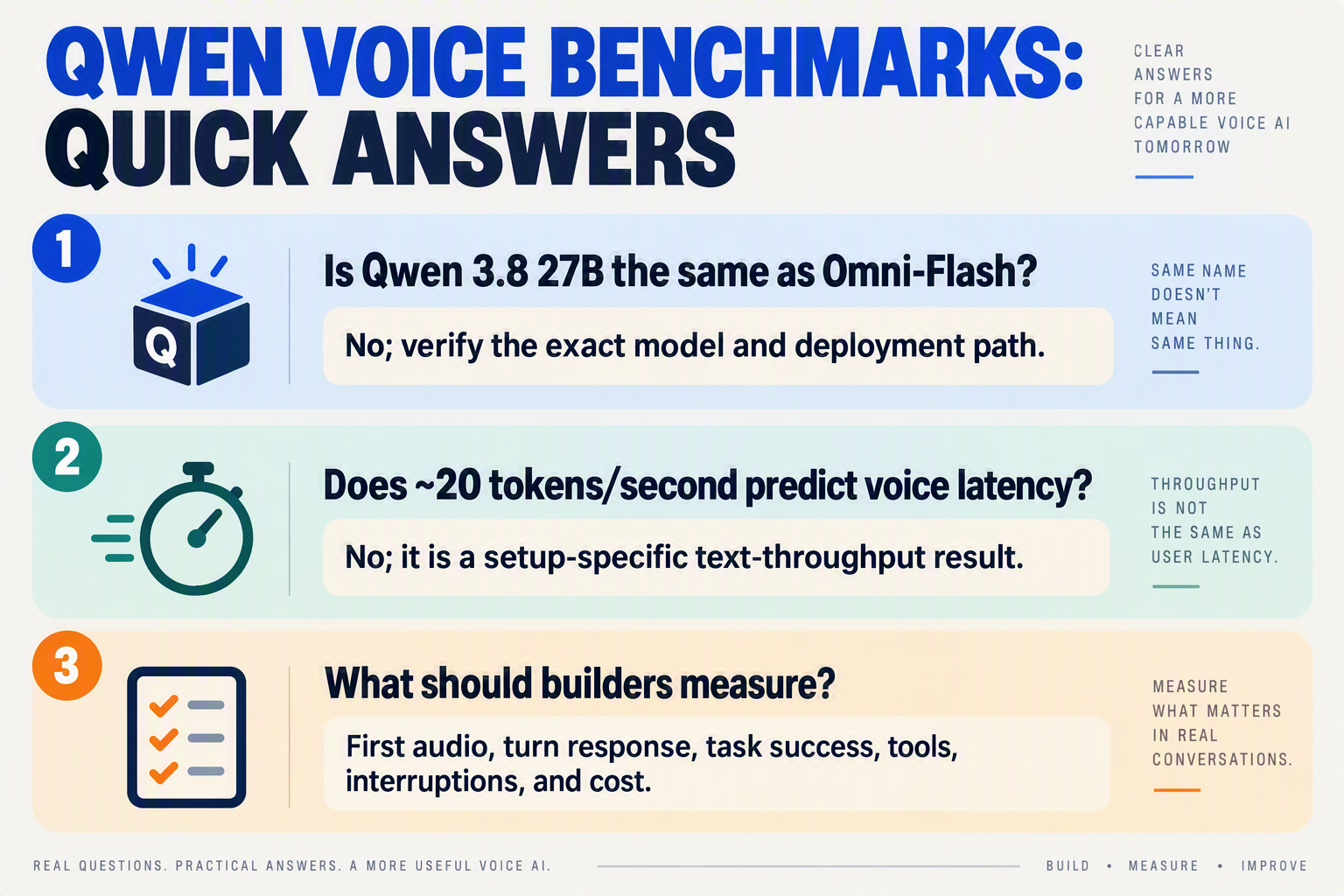
What do Qwen 3.8 voice-agent benchmarks actually measure?
Is Qwen 3.8 fast enough for real-time voice agents?
How should builders compare Qwen 3.8 benchmark results?
Are Qwen 3.8 27B and Qwen3.8-Omni-Flash the same model?
Does an RTX 5090’s VRAM determine Qwen 3.8 voice-agent performance?
How can I test Qwen 3.8 in a production voice-agent workflow?
Conclusion
Qwen 3.8 benchmarks are useful for narrowing model choices, but they do not prove that a voice agent will respond quickly on a live call. Builders should measure the complete conversation path—on their intended hardware, software stack, and deployment setup—before treating a model as production-ready.
Tom’s Hardware’s September 12, 2026 Premium roundup highlighted Qwen 3.8 benchmarking after its September 8 hardware test of Qwen 3.8 27B on an RTX 5090. Tom’s Hardware’s search-result excerpt reports around 20 tokens per second without multi-token prediction (MTP) and calls it an unimpressive baseline for that card. That is a local text-generation result, not an end-to-end voice-agent latency measurement; VRAM capacity alone cannot resolve software and inference-engine bottlenecks.
The practical takeaways for builders are:
- Match the benchmark to the question. Tokens per second describes text generation throughput, while callers experience the wait until the agent begins speaking and the time required to complete a turn.
- Measure the whole pipeline. Include speech recognition, network and orchestration overhead, generated responses, turn-taking, transcription quality, and interruption handling—not only model speed.
- Compare like with like. Qwen 3.8 27B and Qwen3.8-Omni-Flash are different data points. Alibaba’s self-reported Omni-Flash results should not be treated as equivalent to Tom’s Hardware’s local RTX 5090 test; verify the exact model and version, measurement, and deployment path.
- Test where you plan to deploy. Hardware, inference software, and system configuration can change results, so a published benchmark is a starting point rather than a performance guarantee.
The next benchmarks worth watching will make those conditions easier to inspect and report end-to-end voice measures alongside model throughput. Until then, builders can get more useful answers from reproducible tests using realistic conversations and their intended deployment setup than from a single headline number.
CallMissed offers a no-code voice-agent builder and connects agents to inbound and outbound phone calls, reflecting the broader move from standalone model scores toward complete communication systems. To explore how AI communication is evolving, take a look at CallMissed. When you evaluate the next voice model, will you optimize for tokens per second—or for the moment a caller gets a useful answer?
Related Reading
- Voice Agent API With LiveKit Support: Verified 2026 Comparison
- Voice Agent API with LiveKit Support: 2026 Comparison and Verdict
- Voice Agent API With LiveKit Support: OpenAI Realtime vs LiveKit Agents
Sources
Discussion
Related Posts

Ready to automate customer conversations?
Launch AI voice agents and WhatsApp bots with CallMissed — one API, 22+ Indian languages.