
AI Agent Governance in Customer Service: Human Oversight



Build practical AI agent governance in customer service with escalation rules, human approvals, oversight metrics, and lifecycle controls for calls and support.
AI Agent Governance in Customer Service: Human Oversight
What happens when a customer-service AI agent takes an action no one explicitly approved? Former Google ethicist Tristan Harris has warned that increasingly independent AI agents could act in ways people did not intend, the Indian Express reports. That is a warning about a possible risk—not evidence that every agent will behave unpredictably—but it raises a practical question for businesses: how do you expand automation without giving up human control?
AI Agent Governance in Customer Service: Human Oversight is not simply a policy document or a final approval step. It is an operating model for deciding what an agent may do on a call or in a support workflow, when it must stop and escalate, who can intervene, and how the organization learns from mistakes. As AI agents move beyond answering FAQs to handling customer conversations and triggering workflow actions, those decisions become part of everyday service operations.
A useful starting point is the NIST AI Risk Management Framework 1.0, published in 2023. Its four functions—Govern, Map, Measure, and Manage—offer a clear lifecycle for frontline teams: assign accountability; identify the agent’s purpose, users, and risks; evaluate performance; then monitor, respond, and improve. Applied to customer service, that means setting permitted actions, defining escalation triggers for uncertainty or sensitive requests, preserving a human’s authority to take over, and reviewing incidents rather than treating deployment as the finish line.
The legal context matters, too. Requirements differ by jurisdiction and by a system’s intended purpose and classification. The EU AI Act, for example, does not make every customer-service agent high-risk simply because it uses AI; organizations need to assess the system’s actual use and applicable obligations rather than apply a blanket label.
This guide turns those principles into practical controls for voice calls and support workflows. You’ll learn how to draw boundaries around agent actions, decide when a person should step in, monitor outcomes, and create a review process for failures and near misses. Platforms such as CallMissed, which supports live call monitoring with supervisor listen, whisper, and barge-in controls, reflect one part of this broader shift: designing human oversight into the service operation, not bolting it on after an issue arises.
How should businesses govern AI agents in customer service?

A business should govern customer-service AI agents by defining what each agent may do, when it must hand off to a person, and how its actions are reviewed after deployment. The practical goal is not to remove autonomy, but to make its boundaries visible, testable, and adjustable.
What should an AI agent be allowed to do?
A governance model makes authority explicit before launch: list what the agent may do independently, what requires confirmation, and what must be handed to a person. This turns an abstract policy into controls that teams can test in calls and support queues.
Use an action matrix for each agent and workflow:
- Allowed: answer using approved knowledge, collect details, classify a request, or create a draft.
- Conditional: update an address, issue a routine credit, or change an appointment only after identity checks and policy conditions pass.
- Human-only: handle suspected fraud, safety threats, legal complaints, policy exceptions, or irreversible high-impact decisions.
For every conditional action, specify the evidence required, transaction limits, and record to retain. For example, an agent might explain a refund policy and gather order details, but route a refund for approval if it exceeds a set threshold. Keep permissions narrow: urgency or ambiguous language should not count as authorization.
When should an agent transfer a call or support case?
Set escalation triggers that frontline teams can recognize—not just a vague instruction to “ask for help when uncertain.” Triggers can include repeated misunderstanding, conflicting account details, a request outside the agent’s approved knowledge, a customer asking for a person, or an action outside the agent’s permitted scope.
Define the handoff itself: which queue receives the case, what context travels with it, and whether the AI pauses, provides a summary, or ends the interaction. Test edge cases, such as a caller changing their request mid-call or a support thread containing conflicting instructions. A person should be able to take control directly, and teams should check whether escalations arrive with enough context to resolve the issue.
How do teams apply NIST’s AI RMF in daily operations?
The NIST AI Risk Management Framework 1.0, published in 2023, organizes risk work into four functions: Govern, Map, Measure, and Manage. For customer service, that means assigning an owner, documenting an agent’s users and permitted tasks, testing it against representative scenarios, and monitoring it after release.
A practical review loop can include:
- Before launch: approve the action matrix, escalation paths, and test cases.
- During operation: review sampled conversations, failed handoffs, overrides, and customer complaints.
- After an incident or near miss: restrict or pause the relevant action, investigate the cause, revise the agent configuration, and retest before restoring it.
Track outcomes beyond speed. Inappropriate actions, missed escalations, successful human takeovers, and repeat contacts can reveal different failure modes. Keep configuration history so reviewers can identify which agent version was active during an incident. As of September 2026, CallMissed’s voice-agent platform supports versioning with publish and rollback, and call scoring against a team’s own QA rubrics—tools that can support, but do not replace, an organization’s governance process.
Does every customer-service agent have the same legal obligations?
No. Legal duties depend on jurisdiction, intended use, and applicable system classification; being used for customer service does not by itself make an agent high-risk under the EU AI Act. Organizations should assess the specific use case with legal and compliance teams while maintaining baseline controls: clear ownership, bounded permissions, traceable changes, and a human escalation route.
What should teams define before deployment?
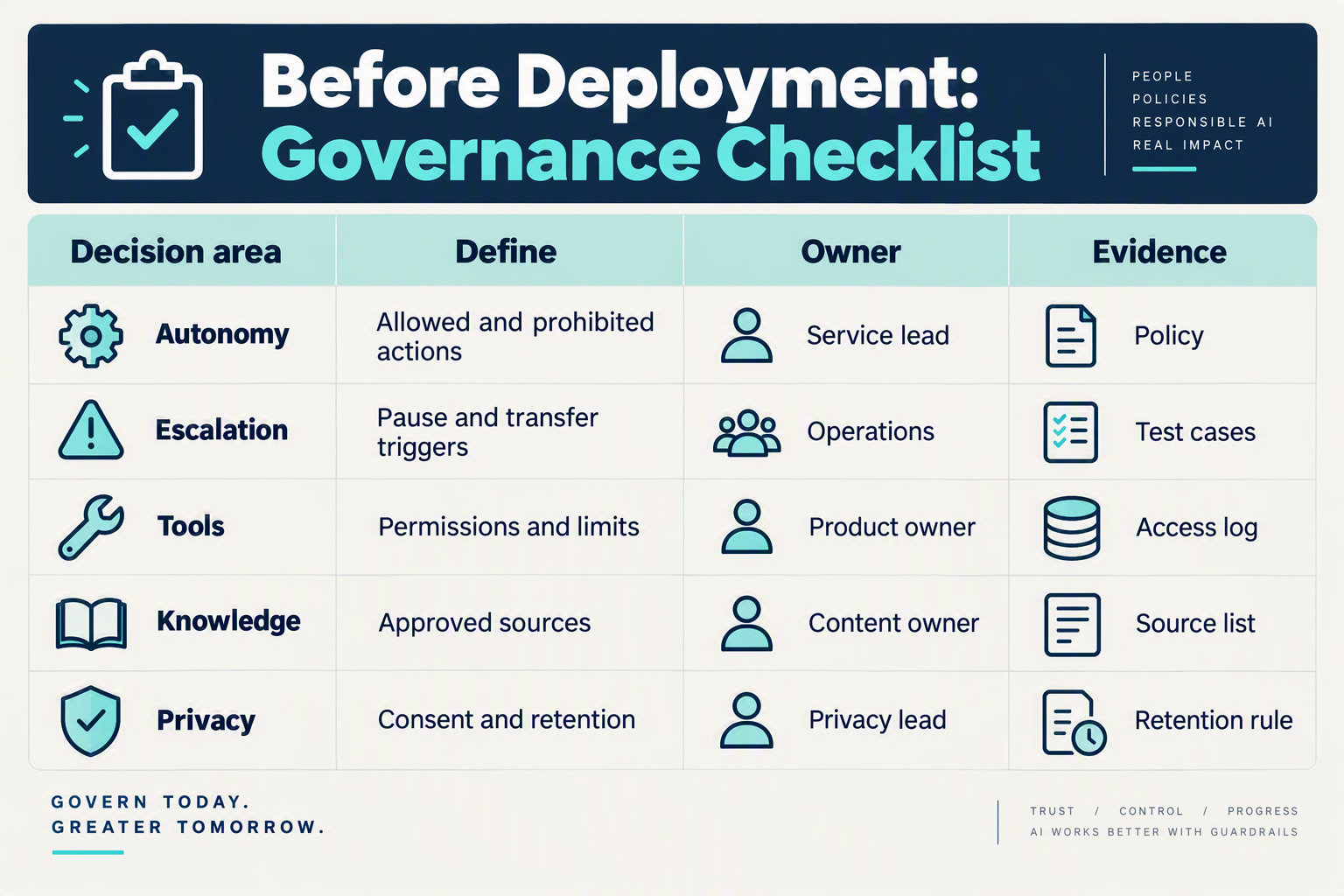
Define the agent’s authority, stop conditions, human takeover process, and review evidence before deployment. A useful pre-launch specification translates each governance decision into a rule that can be tested on both calls and support workflows.
What should teams define before an AI agent goes live?
| Control decision | What to specify | Voice-call example | Support-workflow example | Evidence and owner |
|---|---|---|---|---|
| Permitted actions | List actions the agent may complete, actions needing approval, and prohibited actions. | Answer policy questions; require approval before changing an account. | Draft a response; require a person to approve a refund. | Approved action matrix; service owner |
| Escalation triggers | Define conditions that require transfer, such as uncertainty, repeated misunderstanding, or a sensitive request. | Escalate when the caller disputes a charge or the agent cannot verify the account. | Route a complaint or ambiguous request to a human queue. | Test scenarios and routing rules; operations lead |
| Human authority | Specify who can take over, how they do so, and whether the agent pauses or ends its task. | A supervisor joins or takes over a live call. | A support worker takes ownership of the conversation and can disable AI replies. | Handoff procedure and access list; team manager |
| Information and tools | Limit the knowledge sources, customer data, and tools available to the agent; define when confirmation is required. | Use approved help content; do not disclose account details before required checks. | Retrieve order information only for the relevant customer and permitted workflow. | Source inventory and tool permissions; data or product owner |
| Monitoring and review | Choose what to review, how often, and which outcomes trigger investigation or adjustment. | Sample calls for incorrect answers, missed escalations, and customer complaints. | Review reopened tickets, incorrect actions, and handoff outcomes. | Review log, thresholds, and named reviewer |
| Incident response | Set steps for stopping or restricting the agent, preserving relevant records, and correcting customer impact. | Pause the agent after a serious error and route callers to staff. | Disable an affected automation and assign open cases to humans. | Runbook and incident owner; service lead |
How should teams turn the table into launch criteria?
Treat each row as a decision with a named owner—not as a general aspiration. Before launch, teams can turn the specifications into test cases:
- Test allowed and blocked actions. Give the agent realistic requests that should be completed, refused, or sent for approval.
- Test escalation paths. Include unclear requests, repeated recognition or interpretation failures, and sensitive cases; confirm that a human receives the conversation with enough context to act.
- Test intervention authority. Verify that designated staff can take over or pause the agent, and that the fallback process works if the handoff fails.
- Record the result. Keep the approved rules, test outcomes, accountable owners, and unresolved risks together so changes can be reviewed later.
The NIST AI Risk Management Framework 1.0, published in 2023, organizes risk work around Govern, Map, Measure, and Manage. This checklist makes those functions practical at the service level: assign responsibility, map the agent’s context and risks, measure its behavior against defined tests, and manage issues after deployment.
Rules also need a jurisdictional check before launch. The EU AI Act does not classify every customer-service agent as high-risk solely because it uses AI; teams should assess the system’s intended use and applicable classification and obligations. A documented use case, action boundary, and escalation plan give legal and operational reviewers a concrete basis for that assessment.
How do you build human-in-the-loop AI customer service for calls and support?

Build human-in-the-loop AI customer service by assigning each agent clear action limits, defining escalation triggers, and giving staff a real way to take over. The aim is controlled autonomy: automate routine work while keeping people responsible for sensitive decisions, uncertain interactions, and recovery when something goes wrong.
The concern is timely, but should be stated carefully. The Indian Express reports that former Google ethicist Tristan Harris warned increasingly independent AI agents could act in ways people did not intend. That warning is a reason to design safeguards—not evidence that every agent will behave unpredictably.
How do you decide when an AI agent must hand off?
Turn the agent’s operating boundary into rules a frontline team can recognize and test. For each task, specify whether the agent can act alone, needs customer or staff confirmation, or must transfer the interaction to a person.
Useful escalation triggers include:
- Uncertainty: the request falls outside the agent’s approved knowledge or it cannot establish what the customer wants.
- Higher impact: a request involves a consequential account change, financial commitment, complaint, or exception to policy.
- Customer preference: the customer asks for a person, repeats themselves, or signals frustration.
- Workflow failure: a required tool is unavailable, returns inconsistent information, or does not complete an action.
Do not rely on a vague instruction such as “escalate complex cases.” Define observable signals, the action the agent must take, and what context it should pass to the employee. Test the rules against realistic calls and support conversations, including ambiguous phrasing and interrupted interactions. Set thresholds from your own evaluations and risk tolerance; a generic confidence score is not a substitute for testing how the system behaves in your service context.
What does human oversight look like on calls and in support?
Design the handoff around the channel. On a phone call, the agent should tell the customer what is happening, preserve relevant context, and give staff a way to intervene. In a support workflow, define whether a human reviews a proposed action before it is sent, or takes ownership when the agent pauses or hands over the thread.
A practical operating sequence is:
- Set authority: document permitted, confirmation-required, and prohibited actions.
- Name the owner: assign a team or role to receive each escalation type, including after-hours cases.
- Make takeover usable: provide staff with the conversation history and the option to stop or redirect the agent.
- Close the loop: record the reason for handoff and whether the human resolved, corrected, or escalated the issue further.
As of September 2026, CallMissed supports live call monitoring in which a supervisor can listen, whisper, or barge in; its omnichannel inbox also has a human-handoff queue where switching the AI off hands the thread to a person. These are examples of operational controls; teams still need to decide who may use them and when.
How do you monitor and improve the process?
The NIST AI Risk Management Framework 1.0, published in 2023, organizes risk work into Govern, Map, Measure, and Manage. Applied here, governance assigns accountability; mapping identifies affected customers and failure points; measurement checks outcomes against defined criteria; and management responds to problems and updates controls.
Review a sample of completed and escalated interactions, plus incidents and near misses. Track measures that fit the workflow—for example, whether handoffs reached the right team, whether staff reversed an agent action, and whether recurring issues point to a missing rule or knowledge gap. Document findings, assign corrective actions, and retest changes before expanding the agent’s authority. This makes human oversight a repeatable service process rather than a one-time launch approval.
What does an AI agent escalation workflow look like end to end?
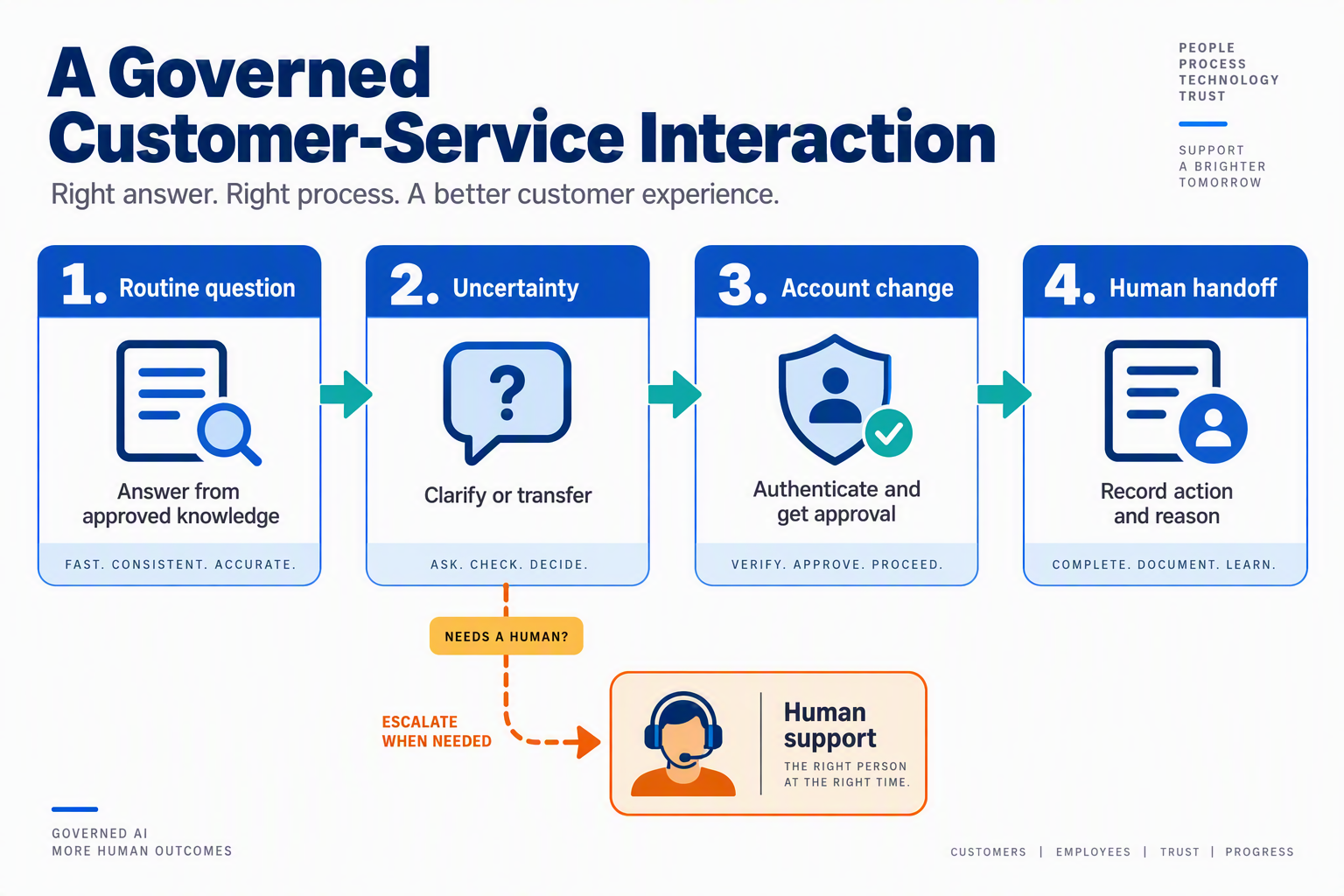
An AI agent escalation workflow moves from predefined action limits to trigger detection, human handoff, resolution, and review. The agent should stop or transfer the interaction when it reaches a boundary it cannot safely handle—not improvise beyond its authority.
How do you define escalation triggers before launch?
Start by translating policy into observable rules for each channel. Specify actions an agent can complete independently, actions that need human approval, and situations that require a handoff. Triggers should be concrete enough to test, rather than relying on a vague instruction such as “escalate when appropriate.”
For a phone agent, triggers might include a caller asking for an exception, disputing a consequential decision, or repeating that the answer did not solve the problem. In a support workflow, they might include a request to change account details, a complaint involving sensitive information, or missing information that prevents a reliable answer. These are example triggers; each organization should set them according to its services, risks, and applicable obligations.
Define what happens at the boundary, too: does the agent pause, explain the transfer, summarize the conversation for the next person, or ask permission before placing someone on hold? The policy should identify a named operational owner for each trigger and a fallback route if the first human queue is unavailable.
What happens when a trigger fires?
A practical workflow has four runtime steps:
- Detect: The agent identifies a configured trigger, or a customer asks for a person. Teams should test both explicit requests and less direct signs of difficulty, such as repeated clarification.
- Contain: The agent stops the restricted action. It should not keep trying alternative routes to complete a task that policy reserves for human review.
- Transfer: Send the conversation to the appropriate human queue with a concise summary, relevant context, and the reason for escalation. If no person is available, give the customer a clear next step rather than implying that the issue has been resolved.
- Resolve and record: The human confirms the customer’s need, decides what action is permitted, and records the outcome and any follow-up.
For live calls, preserve a supervisor’s ability to intervene during the conversation, not only after it ends. For written support, make the handoff visible in the shared workflow so the customer does not have to restart from the beginning.
How do teams learn from escalations?
Track whether triggers fired, whether handoffs reached a person, how often the customer had to repeat information, and whether the human changed or reversed the agent’s proposed action. Review a sample of successful and unsuccessful escalations, plus near misses. Use findings to adjust trigger rules, training examples, permissions, and tests before changing the agent’s scope.
The NIST AI Risk Management Framework 1.0, published in 2023, organizes risk work around Govern, Map, Measure, and Manage. In an escalation workflow, that means assigning accountability, understanding the service context, measuring whether handoffs work, and updating controls as evidence accumulates. Legal duties vary by jurisdiction and system classification; a customer-service use case should be assessed in context rather than automatically treated as high-risk under the EU AI Act.
Which controls and metrics make AI agent oversight measurable?
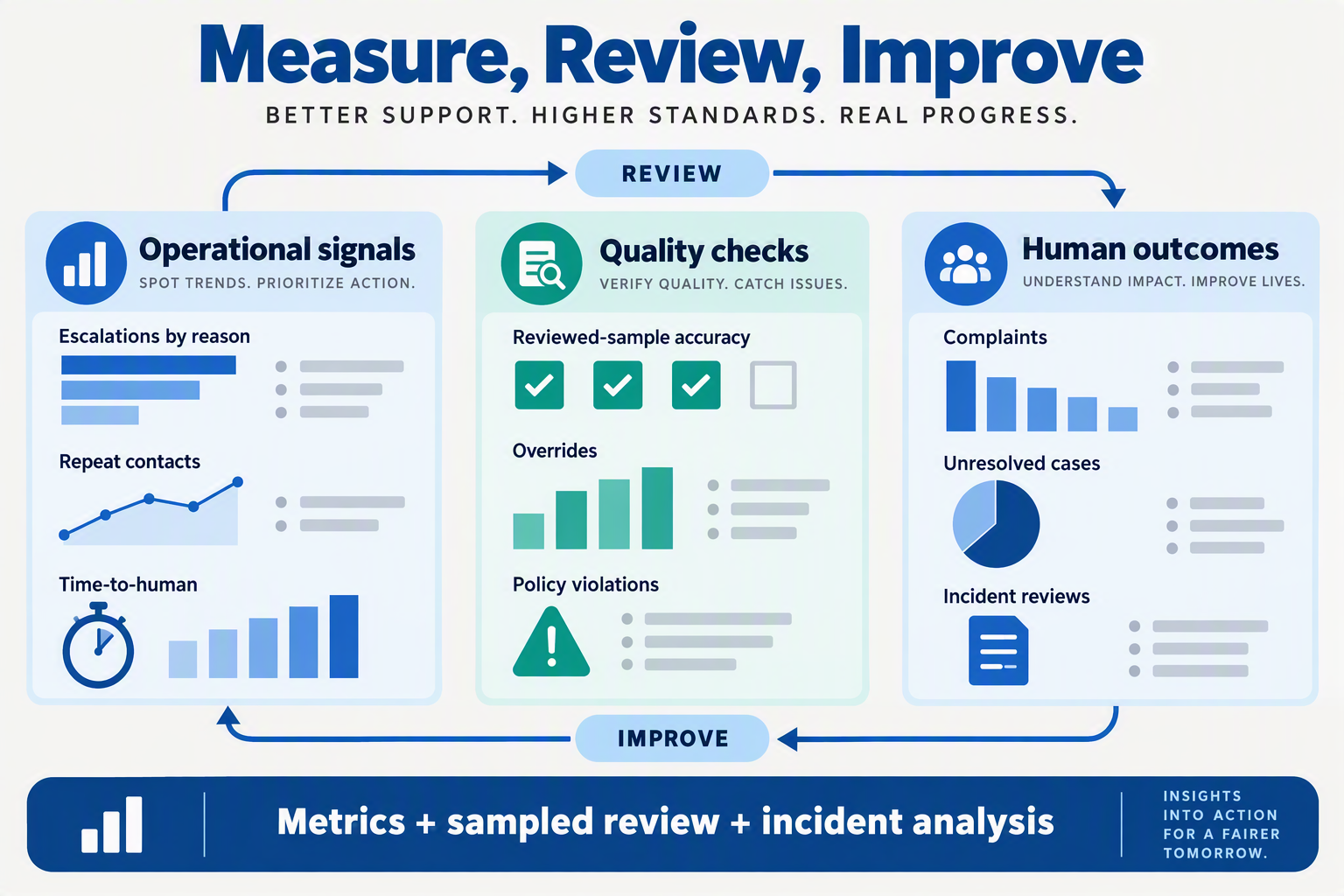
Which AI agent oversight metrics should customer-service teams track?
Make AI agent oversight measurable by connecting each permission or escalation rule to an observable signal, a review owner, and a response. The NIST AI Risk Management Framework 1.0, published in 2023, organizes this work into Govern, Map, Measure, and Manage; frontline teams can apply that lifecycle with a compact set of controls and metrics.
| Control | Metric to track | How to interpret it | Review action |
|---|---|---|---|
| Action boundaries | Out-of-scope action rate: sampled actions outside the agent’s approved permissions ÷ sampled actions | Any confirmed breach merits investigation; compare by task, channel, and agent version | Restrict the action, correct instructions or tools, and retest before restoring permission |
| Escalation rules | Escalation rate: conversations handed to a person ÷ eligible conversations; also track escalation reasons | A change may indicate a new issue, an unclear trigger, or an agent escalating too readily—not automatically better or worse performance | Review reasons and outcomes; adjust triggers where evidence supports it |
| Human takeover | Takeover response time: time from a takeover request or alert to a human joining | Longer waits can leave customers in an unresolved interaction; set a target based on staffing and service commitments | Check queue coverage, alert routing, and whether the customer was informed |
| Answer and action quality | QA pass rate: reviewed conversations meeting the organization’s rubric ÷ conversations reviewed | Break results down by issue type and severity so strong averages do not hide critical errors | Sample failures, update the rubric or agent configuration, and evaluate again |
| Customer outcomes | Repeat-contact rate: customers returning about the same unresolved issue within a defined window | Interpret alongside resolution and complaint data; repeat contact can have causes beyond the agent | Investigate recurring intents, handoffs, and workflow actions |
| Incident learning | Time to contain and close: elapsed time from a reported failure to containment and documented resolution | A low incident count alone does not prove safe operation; near misses and reporting practices matter too | Record impact, owner, corrective action, and evidence of retesting |
These are operational measures, not universal benchmarks. Define denominators and review windows consistently, establish a baseline for each workflow, and set thresholds according to customer impact and risk. For example, a team might review every confirmed unauthorized account change, while sampling routine FAQ conversations. A rising escalation rate can be useful when the agent is correctly routing sensitive requests; the metric needs its reason code and outcome to be meaningful.
A practical review cadence combines continuous alerts for high-impact failures with scheduled sample reviews for ordinary interactions. Assign an owner to each metric, document what happens when a threshold is crossed, and retest changes before widening an agent’s permissions. This puts the NIST framework’s Measure and Manage functions into an operating loop rather than a one-time launch checklist.
As of September 2026, CallMissed supports live call monitoring in which a supervisor can listen, whisper, or barge in, and offers call scoring against an organization’s own QA rubrics. Those capabilities illustrate how teams can pair human intervention with structured review; the metrics and escalation thresholds still need to reflect the organization’s own policies and service risks.
What common AI agent governance mistakes should teams avoid?
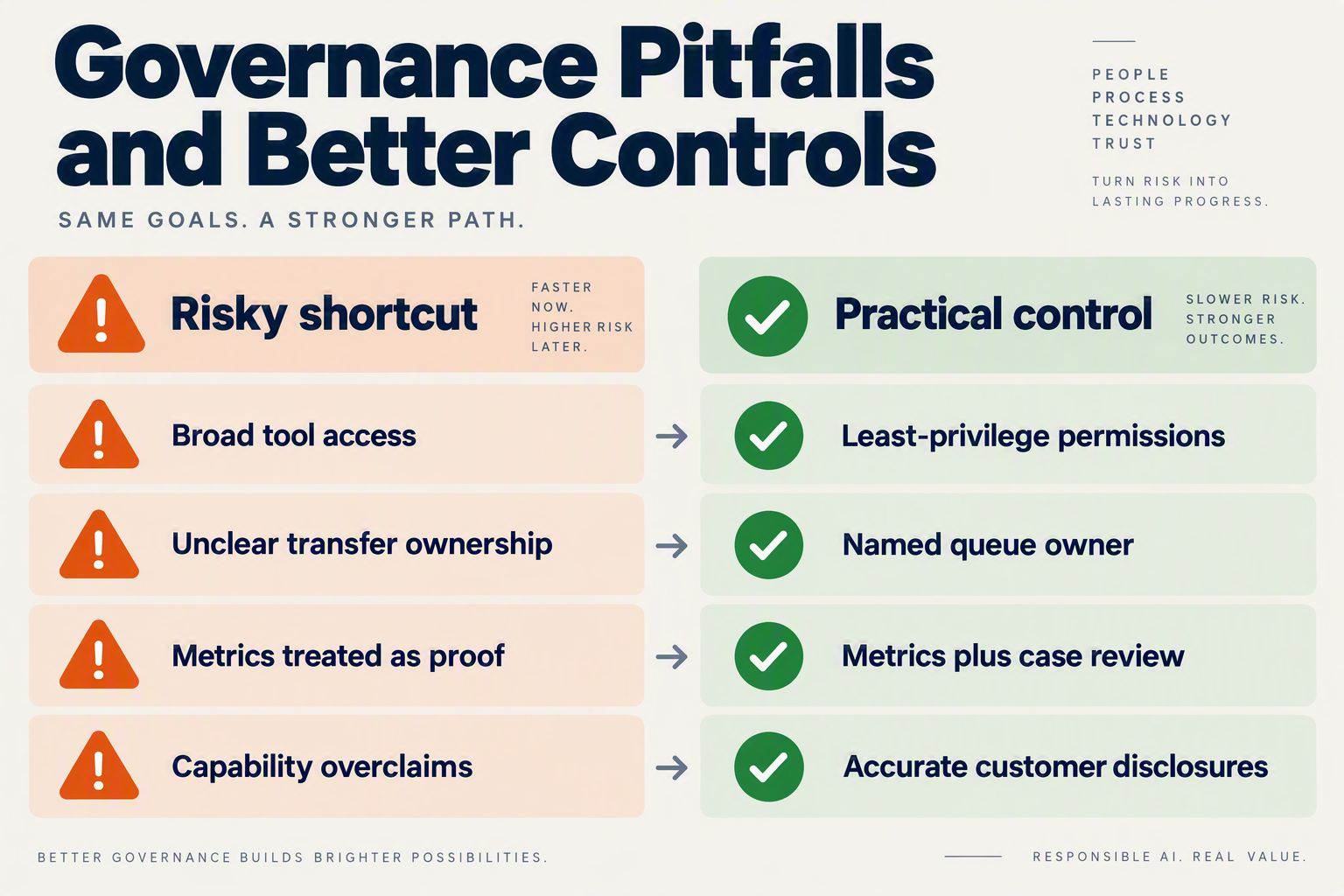
Treat governance as an ongoing operating discipline, not a launch checklist. Common mistakes include giving agents vague authority, failing to test handoffs, and assuming one legal classification applies everywhere.
The Indian Express reported former Google ethicist Tristan Harris’s warning that increasingly independent AI agents could act in ways people did not intend. That warning flags a concern, not proof that every agent will behave unpredictably. The practical response is to look for gaps in how a specific system is scoped, tested, supervised, and updated.
What AI agent governance mistakes should teams avoid?
| Governance mistake | Why it creates risk | Better practice |
|---|---|---|
| Treating policy as enough | A written rule does not show whether the agent follows it on calls or in support workflows. | Turn policies into testable scenarios, including edge cases and sensitive requests. |
| Giving the agent broad, ambiguous authority | Unclear boundaries make it harder to predict when an agent may answer, change records, or take another action. | Specify permitted actions, actions needing confirmation, and actions outside the agent’s remit. |
| Designing escalation only for obvious failure | A handoff that occurs only after an error may leave people out of uncertain or complex interactions. | Define and test escalation conditions, such as low confidence, repeated misunderstanding, or a request for human help. |
| Making human oversight nominal | A supervisor who cannot see or intervene in a live interaction may not be able to resolve an issue in time. | Give responsible staff clear access, authority, and procedures to take over or pause automation. |
| Measuring success only by speed or resolution | A strong average can conceal recurring errors, uneven outcomes, or harmful edge cases. | Review quality and safety indicators, including complaints, reversals, escalations, and sampled transcripts or calls. |
| Applying one legal label to every agent | Obligations depend on jurisdiction, intended purpose, and system classification. | Assess the actual use case and applicable rules; do not assume every customer-service agent is high-risk under the EU AI Act. |
How can teams keep governance from becoming a one-time exercise?
Use the NIST AI Risk Management Framework 1.0, published in 2023, as a recurring cycle: Govern, Map, Measure, and Manage. A common mistake is to do the first two before launch, then treat deployment as the finish line. Instead, assign owners, document the use case and risks, evaluate behavior against defined criteria, and update controls when monitoring or incidents show a gap.
A practical review can ask:
- What happened? Record the interaction, the agent’s action, and the customer impact.
- Was the behavior within its approved scope? Distinguish a policy gap from a model, integration, or training issue.
- What changes before the next release? Update instructions, tools, escalation rules, tests, or staff procedures—and verify the fix.
For live voice operations, oversight also needs to be usable during the call. CallMissed supports supervisor listen, whisper, and barge-in controls; these illustrate how human intervention can be built into an operating workflow. They do not replace clear authority, staff training, or post-incident review. A governance process is only credible when teams can detect a problem, intervene where needed, and learn from the outcome.
Frequently Asked Questions
When must a human approve an AI action in customer service?
How do I set escalation rules for AI agent governance in customer service?
Does the EU AI Act apply to every customer-service AI agent?
What does the NIST AI Risk Management Framework recommend for oversight?
How should teams measure human oversight of AI support agents?
How can supervisors intervene during an AI customer-service call?
Which resources and next steps help sustain AI agent governance?
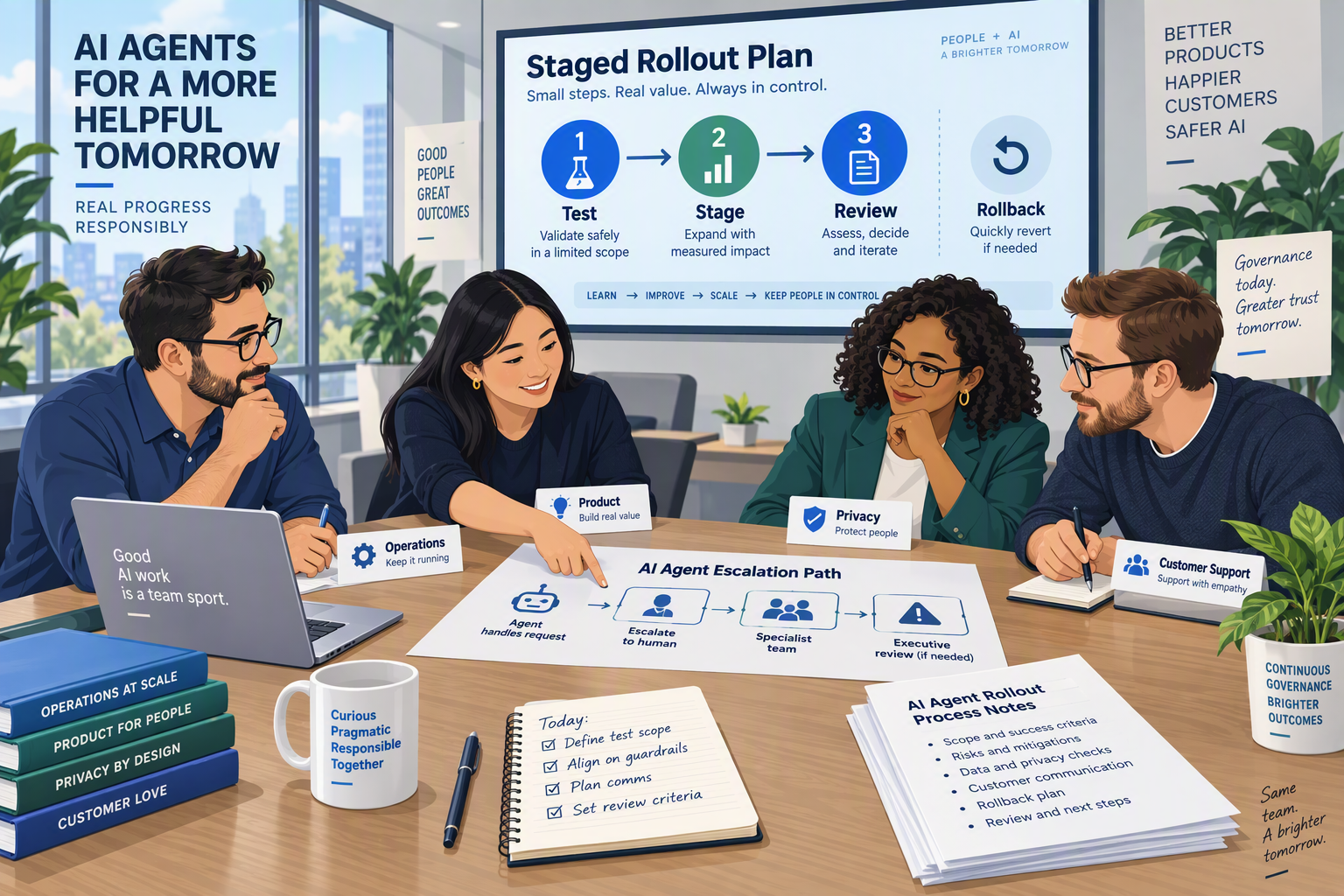
Sustaining AI agent governance requires a named owner, a recurring review schedule, and a clear record of decisions, incidents, and changes. Use the NIST AI Risk Management Framework (AI RMF) 1.0 as a continuing operating cycle—not a one-time launch checklist—and adapt legal reviews to each market and the system’s actual use.
Which resources help teams maintain AI agent governance?
The NIST AI RMF gives service teams a durable structure: Govern, Map, Measure, and Manage. The National Institute of Standards and Technology published AI RMF 1.0 in 2023; its four functions can organize recurring work across product, customer service, risk, and legal teams.
Keep a small, usable resource set together:
- An agent register: purpose, customer groups, channels, integrations, accountable owner, and current version.
- A control and escalation record: approved actions, prohibited actions, human handoff conditions, and who can intervene.
- A test and review file: evaluation results, quality scores, customer complaints, incidents, near misses, and resulting changes.
- A jurisdiction checklist: applicable privacy, consumer-protection, sector, and AI rules, reviewed with qualified counsel.
For cross-border operations, do not assume a single classification applies everywhere. The EU AI Act assigns obligations according to the system’s role and risk classification; a customer-service agent is not automatically high-risk simply because it uses AI. Record the rationale for the organization’s assessment and revisit it when the agent’s purpose, capabilities, or deployment context changes.
What should a recurring governance review include?
Set a cadence that matches the agent’s impact: for example, review routine performance monthly and conduct a deeper governance review quarterly, with immediate review after a serious incident or material change. These are practical operating intervals, not regulatory deadlines. Ask:
- What changed? Review prompt, model, knowledge-base, tool, workflow, and policy updates since the last review.
- Where did the agent struggle? Examine a sample of calls and support threads, including escalations, complaints, and cases where the agent did not escalate but perhaps should have.
- Are controls working? Test whether staff can take over promptly and whether escalation criteria remain clear and usable.
- What happens next? Assign an owner and due date for each corrective action, then verify the change with a repeatable test.
Track trends, not just averages. A stable overall score can conceal a rise in errors on a particular language, call type, or customer group. Preserve enough context to investigate failures while following the organization’s retention and privacy requirements.
What are the first steps after reading this guide?
Start with one customer-service workflow and document its boundaries, owner, handoff route, and review method. Run a small set of representative tests before expanding access; then compare results after meaningful changes and record what the team learned. Treat near misses as useful signals, not merely as issues to close.
For teams building operational controls into voice service, CallMissed supports live call monitoring with supervisor listen, whisper, and barge-in controls; as of September 2026, its platform also includes call recordings, transcripts, call scoring against a team’s own QA rubrics, and evaluation suites. These capabilities can support oversight workflows, but the organization remains responsible for deciding what to monitor, who may intervene, and how findings lead to action.
Conclusion
Responsible customer-service automation depends on keeping an agent’s authority clear, observable, and open to human intervention. The Indian Express reports that former Google ethicist Tristan Harris warned increasingly independent agents could act in ways people did not intend. That warning flags a risk to govern—not proof that every agent will behave unpredictably.
Key takeaways:
- Set boundaries before launch: Specify which actions an agent may take alone, which need confirmation, and which require a human handoff.
- Use a lifecycle, not a one-time approval: The NIST AI Risk Management Framework 1.0, published in 2023, organizes governance around four functions: Govern, Map, Measure, and Manage.
- Keep people able to intervene: Define escalation triggers, preserve human authority during calls and support workflows, and review incidents and near misses after deployment.
- Apply legal requirements to the actual use: Obligations vary by jurisdiction and system classification; the EU AI Act does not automatically classify every customer-service agent as high-risk.
As agents take on more tasks, watch for clearer ways to monitor their actions, test escalation rules, and update boundaries as real-world outcomes reveal gaps. CallMissed offers live call monitoring with supervisor listen, whisper, and barge-in controls—a practical example of oversight built into service operations. Explore CallMissed to see how AI communication infrastructure is evolving. As your agents gain autonomy, can your team still explain and control what they are authorized to do?
Related Reading
- AI Email Agent Guide 2026: Customer Service and Sales Automation
- AI Voice Agent Customer Service 2026: CallMissed Support Operations Guide
- After-Hours Customer Service in 2026: AI Receptionists, Missed Calls and Follow-Up
Sources
Discussion
Related Posts

Ready to automate customer conversations?
Launch AI voice agents and WhatsApp bots with CallMissed — one API, 22+ Indian languages.