
Gemini 3.8 Text-to-Speech: What Changes for AI Agents?



Explore Gemini 3.8 text-to-speech for AI voice agents: compare model options, assess latency and costs, and plan a reliable multilingual pilot.
Gemini 3.8 Text-to-Speech: What Changes for AI Agents?
What if your AI agent could sound reassuring during a billing dispute and energetic during a product demo—without switching to a different preset voice? Gemini 3.8 text-to-speech points toward more controllable speech generation, but the real question is whether expressive audio translates into better live conversations.
Google’s announcement introduces Gemini 3.8 Flash TTS and Gemini 3.8 Flash-Lite TTS, describing a shift “from static presets into a dynamic creative studio.” In the announcement supplied for this October 2026 article, Google positions the models around richer, more expressive audio. For developers building AI voice agents, that raises a practical possibility: controlling how an answer sounds, not just what it says.
The attention is already substantial. The supplied Hacker News trend snapshot for October 2026 records 241 points and 118 comments within 8.5 hours for “Gemini 3.8 text-to-speech.” That is a signal of developer interest, not evidence of production readiness—and the distinction matters when an agent is answering customers rather than narrating a prepared script.
What could Gemini 3.8 text-to-speech change for AI agents?
A voice agent needs more than an attractive voice. It must turn a generated response into understandable speech quickly enough to keep a conversation moving, pronounce important details correctly, and handle interruptions without becoming confusing.
Consider an appointment-booking agent. A warmer delivery could make an opening greeting more approachable, but reading the wrong date beautifully still produces a failed interaction. Likewise, expressive pauses might improve comprehension in a narrated explanation while feeling frustrating during a time-sensitive customer call.
The opportunity is therefore better control with measurable conversational benefits, rather than expressiveness for its own sake. Teams evaluating a new speech model should ask:
- Responsiveness: How soon does usable audio arrive, and can playback stop when the caller interrupts?
- Consistency: Does delivery remain appropriate across short replies, long explanations, and repeated calls?
- Accuracy: Are names, prices, dates, and multilingual phrases spoken clearly?
- Deployment fit: What do integration requirements, usage costs, and voice-consent safeguards mean for the application?
As of October 2026, CallMissed supports custom voice-agent stacks billed by component, giving teams a way to evaluate speech choices within a broader communication workflow.
This article examines what Google’s reported speech-generation changes could mean for AI agents, which capabilities deserve testing, and where announcement claims stop short of operational evidence. The goal is to separate a compelling voice demo from a dependable customer conversation—and identify what developers should measure before changing their stack.
A new TTS model could improve AI voice-agent delivery—not solve the entire conversation
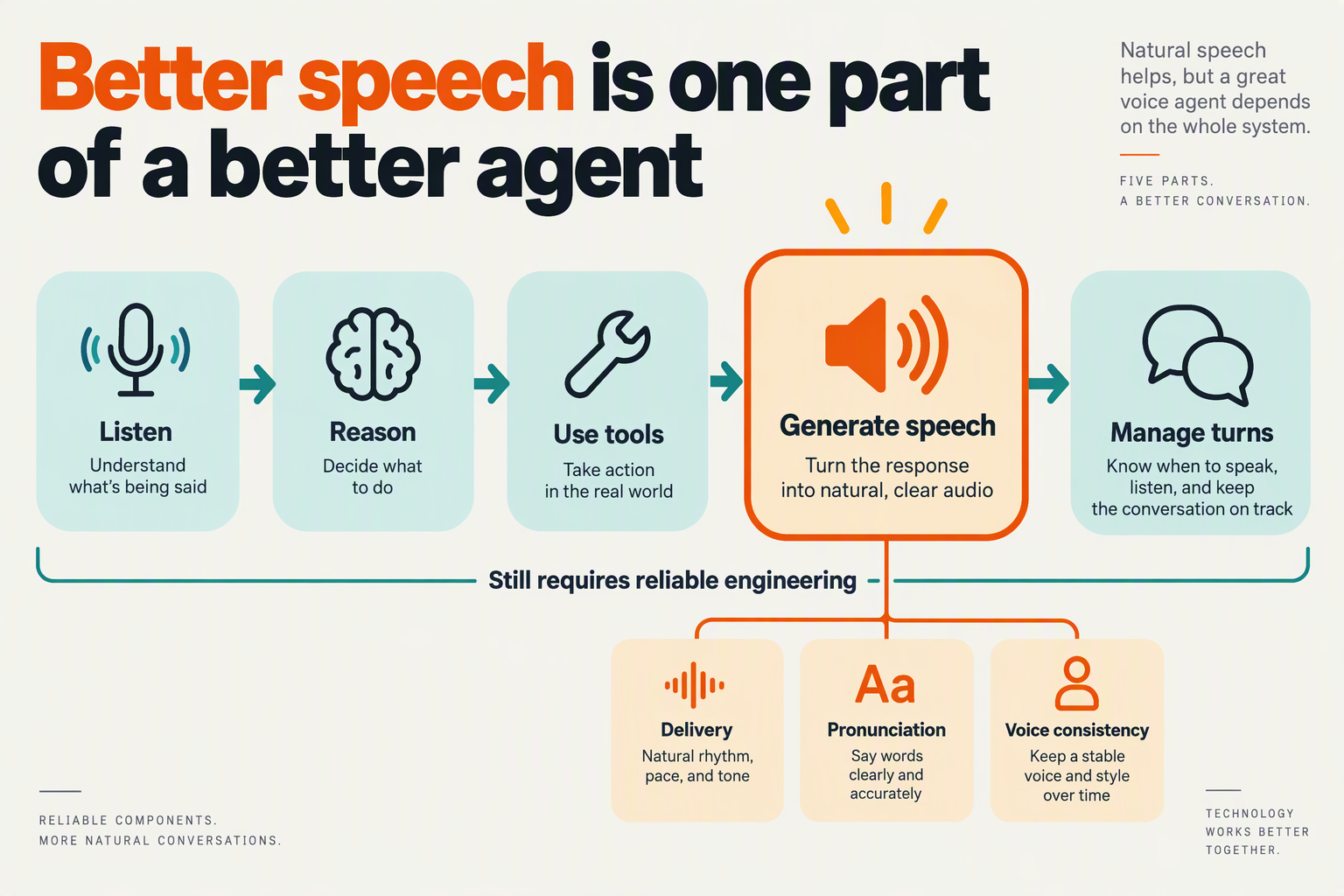
A new text-to-speech model can improve how an AI voice agent delivers an answer, but it cannot independently fix misunderstanding, incorrect reasoning, or failed business actions. The useful distinction is between speech generation quality and end-to-end conversation quality: customers experience both, even when developers evaluate them separately.
Where does text-to-speech fit in an AI voice-agent stack?
In a typical modular voice-agent architecture, text-to-speech is the final generation stage—not the entire intelligence layer. A customer’s request passes through several connected systems:
- Speech recognition converts the caller’s audio into text.
- Conversation orchestration combines that text with previous turns, business instructions, and relevant knowledge.
- Reasoning and tools determine the response and, where authorized, perform actions such as checking an order.
- Text-to-speech turns the response into audible speech.
- Playback and interruption handling govern what the customer actually hears and when.
Some architectures combine these functions, but the responsibilities remain distinct. Better speech synthesis cannot repair an incorrect order lookup, and a well-designed knowledge base cannot compensate for audio that reads a reference number unintelligibly.
Google’s announcement supplied for this October 2026 article names two models: Gemini 3.8 Flash TTS and Gemini 3.8 Flash-Lite TTS. That establishes a speech-generation development; the supplied announcement excerpt does not establish performance across every stage of a live voice-agent system.
What would better delivery change in a real customer call?
Consider a delivery-support agent that has correctly retrieved an updated arrival window. Its response is: “Your package is expected between 2 p.m. and 4 p.m. tomorrow. You don’t need to place another order.”
Delivery matters because the two sentences serve different purposes. The first communicates operational information; the second reduces uncertainty. A useful speech model could make the time window easy to distinguish and deliver the reassurance without sounding dismissive.
However, three different failures require three different fixes:
- Wrong arrival window: Repair the data retrieval or reasoning—not the voice.
- Correct window, unclear pronunciation: Improve speech rendering or text preparation.
- Caller interrupts to change the address: Handle the interruption and evaluate whether an address change is permitted.
This is where expressive TTS becomes operationally interesting: not as decoration, but as a way to make correct information easier to understand. The trade-off is that extra pauses or dramatic emphasis can also lengthen an otherwise simple exchange.
How should teams separate model claims from conversation outcomes?
The supplied October 2026 PressNews summary describes Gemini 3.8 TTS as supporting voice identities and line-by-line control for richer, more expressive audio. That suggests greater control over delivery; it does not, by itself, demonstrate improved task completion.
Evaluate the same response text with the existing and proposed speech models before changing other components. Then test the complete agent separately. This helps distinguish a genuine delivery improvement from changes caused by different prompts, tools, or recognition errors.
Language coverage also needs that separation. As of October 2026, CallMissed’s verified product information lists speech recognition in 22 Indian languages plus English, while natural text-to-speech covers 10 Indian languages plus English. Input understanding and spoken output are separate capabilities, even within one platform.
The practical takeaway: treat a new TTS model as a targeted upgrade, then prove its value in the full conversation.
What is reported about Gemini 3.8 text-to-speech, and what still needs verification?
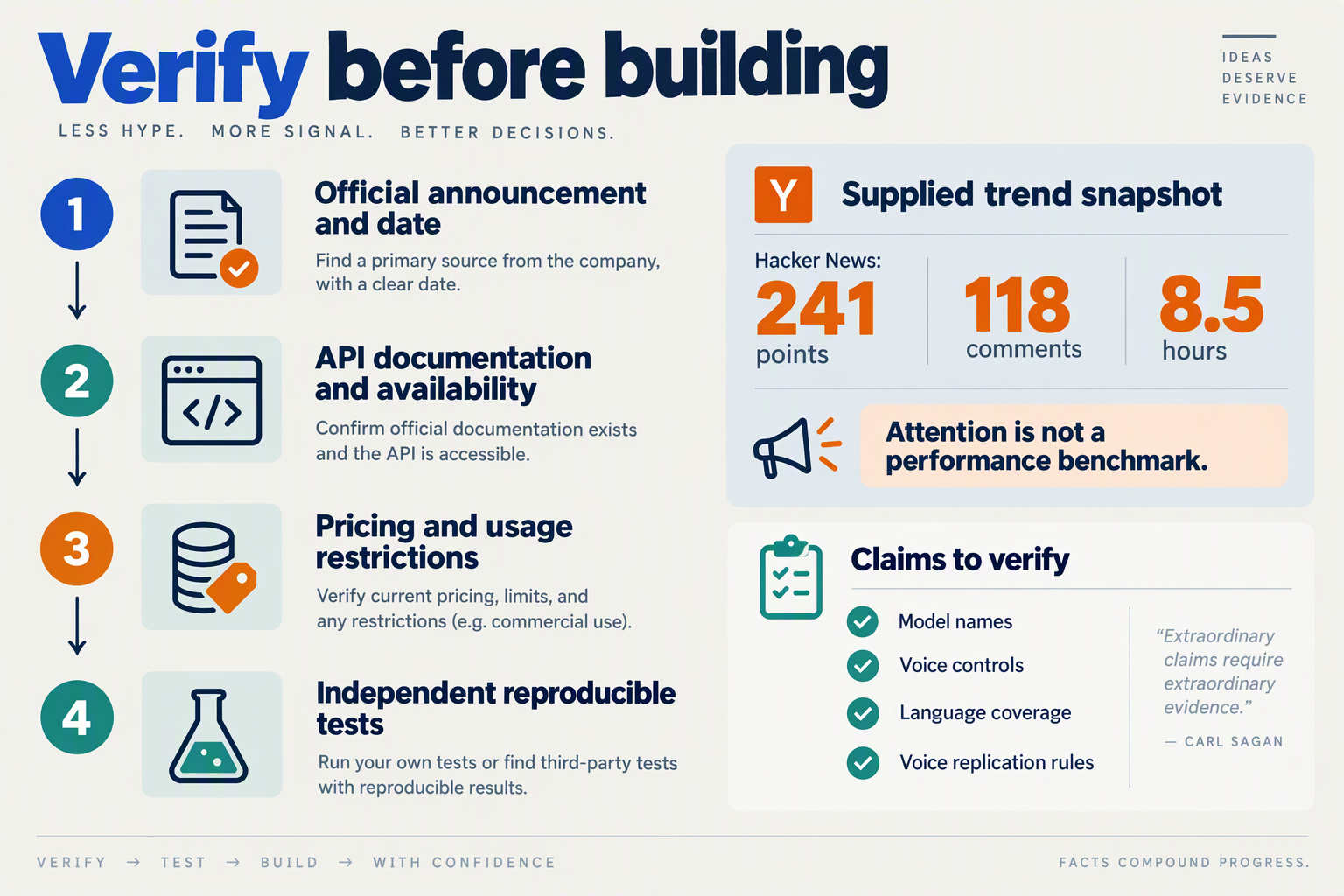
The supplied Google announcement names Gemini 3.8 Flash TTS and Gemini 3.8 Flash-Lite TTS and describes richer, more expressive speech generation. As of October 2026, the excerpts do not establish production latency, pricing, language-by-language quality, or the precise conditions for custom voice creation.
The distinction is between what the announcement says, what secondary publishers report, and what developers can verify in documentation and tests. Those are different levels of evidence—not interchangeable descriptions of a production-ready service.
What does Google’s announcement actually establish?
Google’s supplied October 2026 announcement explicitly introduces two text-to-speech models: Gemini 3.8 Flash TTS and Gemini 3.8 Flash-Lite TTS. Google describes the intended outcome as “richer, more expressive audio,” establishing the product direction without quantifying how consistently either model delivers it.
The available excerpt supports the existence of an announcement and its broad positioning. It does not provide enough detail to compare the two models’ performance or deployment requirements.
In particular, developers should not infer that “Flash-Lite” automatically means a particular price reduction or response-time advantage. Model names are not benchmarks; those differences require published specifications or measured results.
Which reported capabilities still need primary-source confirmation?
Several secondary sources add concrete claims beyond the supplied Google excerpt:
- Language coverage: Shorty News reports support for more than 100 languages in the material supplied for this October 2026 article. The excerpt does not provide a language list, regional availability, or quality measurements.
- Voice inventory: Remio reports more than 2,000 voices in the supplied October 2026 context. That figure needs clarification: it could describe selectable voices, generated identities, or another catalogue structure.
- Voice replication: Remio reports replication from a 30-second recording and identifies a September 23 release. The supplied primary-source excerpt does not confirm the recording requirements, consent checks, access restrictions, or release date.
- Delivery controls: PressNews describes custom voice identities and line-by-line control. WaveSpeedAI advertises configurable voice and delivery-style controls through a REST inference API, but a third-party listing does not establish Google’s native API contract.
These reports are useful leads. However, repeated coverage is not necessarily independent corroboration: several articles may summarize the same announcement without testing the product.
What should developers verify before planning an integration?
An evaluation should resolve three questions in order:
- Can your team actually access the model?
Confirm official model identifiers, preview or general-availability status, supported regions, quotas, and commercial-use terms. A provider listing alone does not establish equivalent access through Google’s own services.
- What does the API deliver?
Check supported audio formats, streaming behavior, output limits, speaker controls, and how instructions affect pronunciation. Generating a finished audio file and delivering incremental audio for a live call are different integration requirements.
- What protections govern voice identity?
If replication is available, inspect consent requirements, identity verification, permitted uses, and abuse-reporting mechanisms. A short recording requirement says nothing by itself about authorization to reproduce someone’s voice.
For AI voice-agent teams, the practical takeaway is evaluate the documented interface, not the headline feature count. Broad language coverage cannot establish reliable pronunciation of a particular customer’s name, and expressive samples cannot establish dependable behavior across thousands of conversational turns. Keep those claims provisional until official documentation and reproducible tests support them.
How should you compare Gemini 3.8 Flash TTS and Flash-Lite TTS?
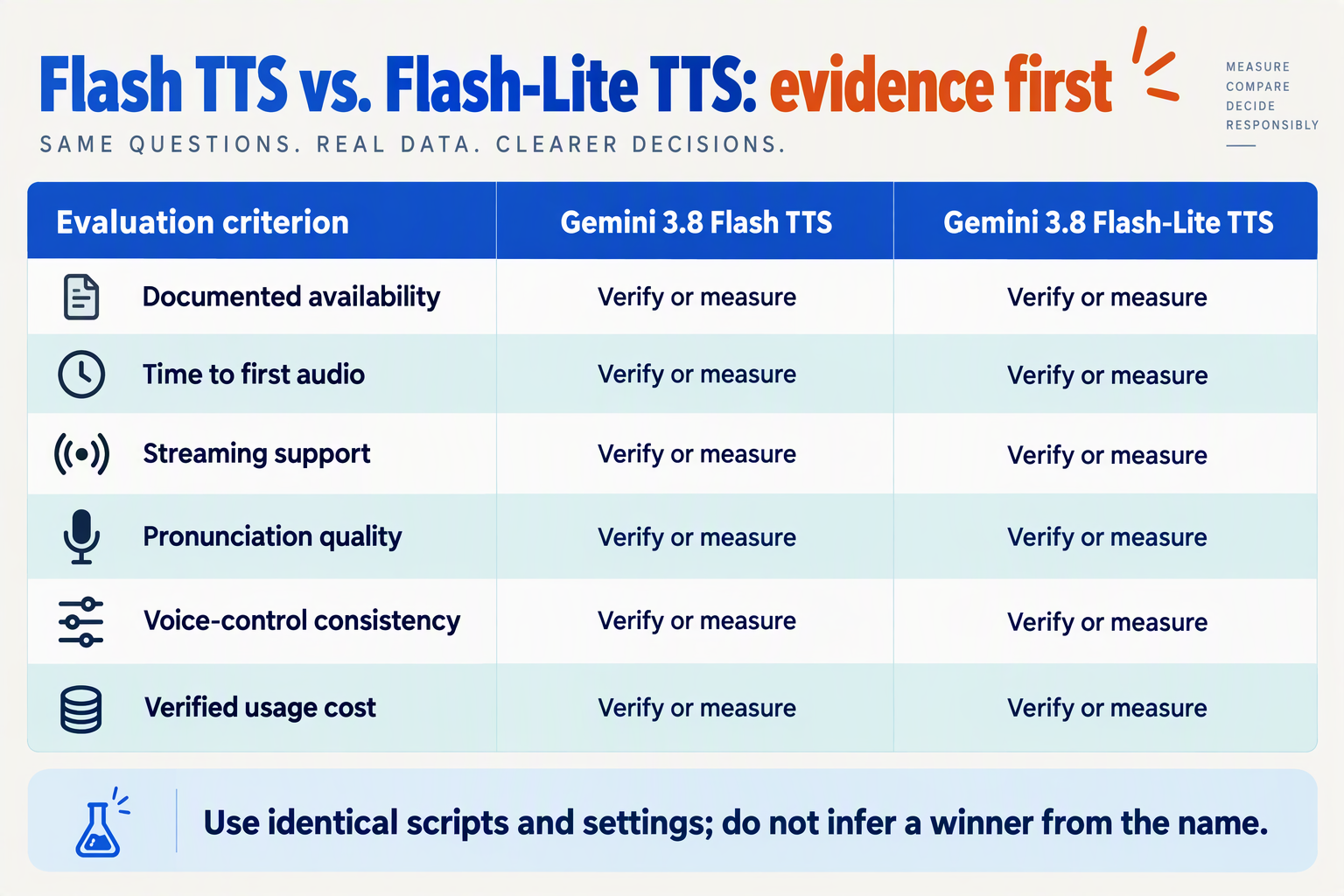
Compare Gemini 3.8 Flash TTS and Gemini 3.8 Flash-Lite TTS using matched voice-agent tests, not assumptions about their names. As of October 2026, the supplied Google announcement establishes two expressive speech models, but the available excerpts do not establish a numerical difference in pricing, latency, or speech quality.
What specifications are confirmed for Flash TTS and Flash-Lite TTS?
Google’s announcement, supplied for this October 2026 comparison, describes both models as enabling “richer, more expressive audio.” That supports evaluating delivery control; it does not establish that Flash is more natural or that Flash-Lite is cheaper.
The table separates reported capabilities from evidence still needed for a production decision.
| Comparison area | Gemini 3.8 Flash TTS | Gemini 3.8 Flash-Lite TTS | What to verify |
|---|---|---|---|
| Expressive delivery | Included in Google’s expressive-audio announcement | Included in the same announcement | Whether tone instructions work consistently |
| Voice and style controls | Model-specific details absent from supplied Google excerpt | WaveSpeedAI describes configurable voice and delivery-style controls | Equivalent controls through your chosen endpoint |
| Language coverage | Shorty News reports over 100 languages across the launch | Same launch-level report; individual coverage unclear | Exact supported languages and regional pronunciation |
| First-audio latency | No benchmark supplied | No benchmark supplied | Median and p95 time to playable audio |
| Pricing | No verified rate supplied | No verified rate supplied | Billing units, failed requests, and regeneration costs |
| Streaming and interruption | Behavior not established in supplied excerpts | Behavior not established in supplied excerpts | Incremental playback and cancellation handling |
Shorty News reports support for over 100 languages in its Gemini 3.8 TTS launch coverage supplied for October 2026. Treat that as a secondary-source claim until model-specific documentation confirms coverage; language count alone does not demonstrate quality in code-mixed customer conversations.
How do you run a fair voice-agent comparison?
Use the same scripts, equivalent voice settings, audio format, and deployment region wherever both endpoints permit them. Otherwise, a configuration difference can look like a model advantage.
- Create a representative test set. Include brief confirmations, billing explanations, names, currencies, dates, and the languages customers actually use.
- Run repeated trials. Alternate model requests across comparable periods rather than testing one model during quiet hours and another during peak traffic.
- Score audio without model labels. Ask reviewers to assess intelligibility, tone appropriateness, pronunciation, and unnecessary pauses.
For a proposed 100-utterance pilot, allocate 40 short replies, 30 detailed explanations, 20 pronunciation-sensitive statements, and 10 interruption scenarios. Those numbers are an illustrative test design—not a Google benchmark.
Record both time to first playable audio and total generation time. A model that finishes a long response quickly may still introduce an awkward delay before the caller hears anything; report p95 alongside the median to expose slow-tail behavior.
Which model should you choose for customer calls?
Choose the model that satisfies your conversational requirements at the lowest measured cost per successful interaction, rather than selecting Flash-Lite on an unverified price assumption.
Track:
- Correction burden: How often must important details be repeated?
- Delivery reliability: Does a reassuring instruction remain appropriate across different scripts?
- Operational cost: What do retries, regenerated speech, and longer spoken responses add?
If both models meet your thresholds, cost can decide. If one consistently pronounces account details more clearly or starts speaking sooner, that operational advantage may justify a higher verified price. The supplied October 2026 evidence supports testing both models—not declaring a winner.
How does text-to-speech differ from a live speech-to-speech agent?
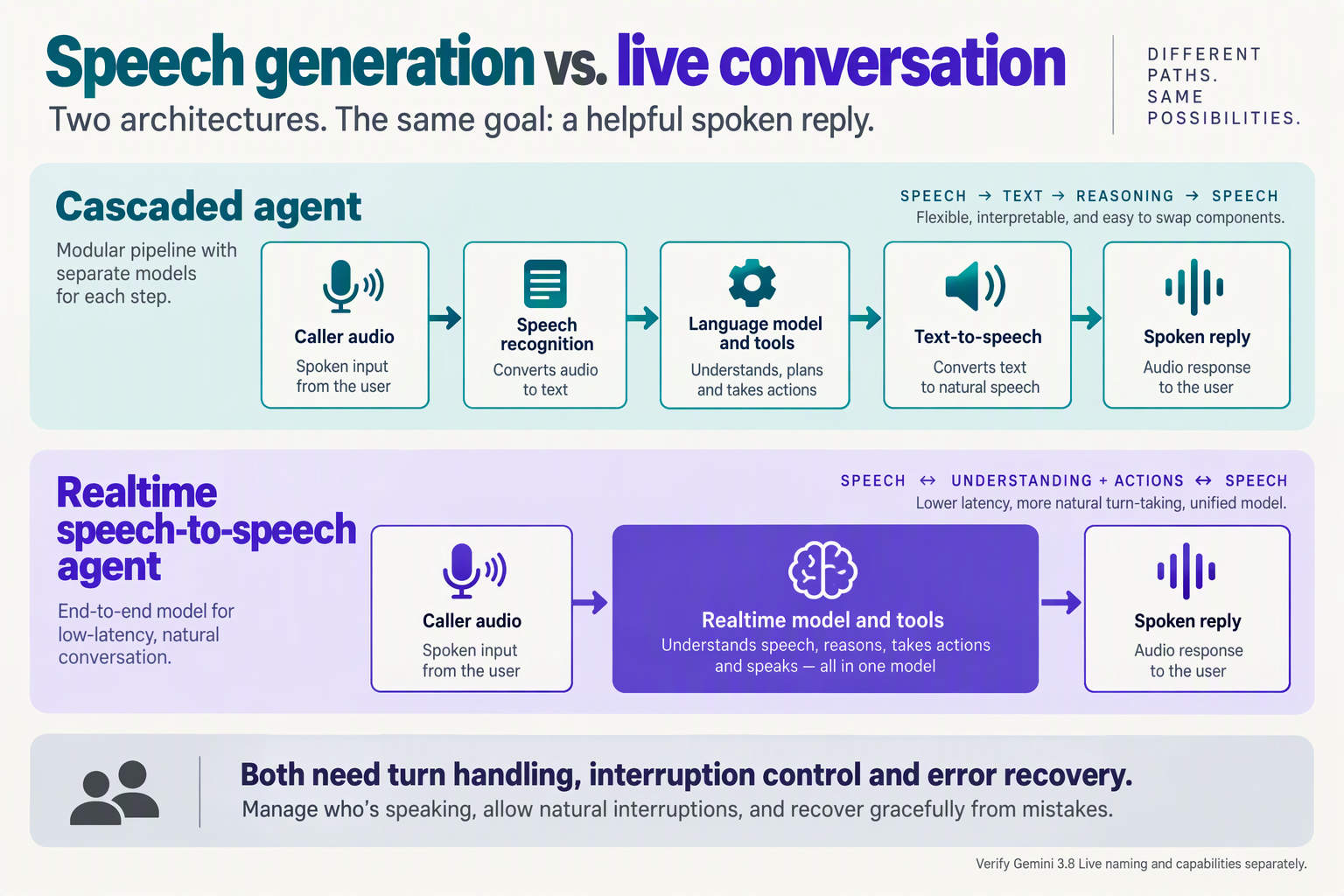
Text-to-speech (TTS) turns written text into spoken audio; a live speech-to-speech agent accepts spoken input and manages a conversation that produces spoken replies. TTS is an output component, while a voice agent also needs listening, turn-taking, reasoning, tool access, and conversation state.
That distinction is central to evaluating Gemini 3.8 text-to-speech. In the announcement supplied for this October 2026 article, Google names two speech-generation models—Gemini 3.8 Flash TTS and Gemini 3.8 Flash-Lite TTS. Their introduction does not, by itself, establish the capabilities of a complete live agent.
How does a text-to-speech voice-agent pipeline work?
A conventional cascaded voice agent connects separate components. The application coordinates those components so that a caller experiences one conversation:
- Speech recognition converts incoming audio into a transcript.
- A language model interprets the request, consults conversation history, and decides whether to use tools.
- Business tools retrieve information or perform permitted actions.
- Text-to-speech converts the resulting answer into audio.
These stages can overlap through streaming; the system does not necessarily wait for an entire response before beginning playback. However, streaming speech generation alone does not solve when to answer, when to remain silent, or what to do when someone interrupts.
The advantage of this architecture is component-level control. Developers can inspect transcripts, validate tool results, and change the speech generator without necessarily replacing the reasoning layer. The trade-off is coordinating multiple components and preserving conversational cues that a plain transcript may omit.
Is speech-to-speech the same as a native audio model?
No. Speech-to-speech describes the interaction; native audio describes a model architecture. A live speech-to-speech application can use the cascaded pipeline above or a model that directly processes and generates audio.
A native audio model may retain information beyond the words, such as delivery and vocal emphasis, depending on its capabilities. But “native” does not automatically mean reliable tool use, effective interruption handling, or lower end-to-end latency. Those remain implementation and evaluation questions.
For an October 2026 assessment, Google’s supplied announcement establishes Gemini 3.8 Flash TTS and Flash-Lite TTS as text-to-speech offerings. It does not provide evidence here that either model replaces the listening and reasoning stages of a live agent.
What happens when a caller changes their mind mid-sentence?
Consider a caller saying, “Send the invoice to accounts—actually, use my personal email.”
A TTS model can speak a confirmation, but the surrounding agent must first resolve the correction. That requires more than generating natural audio:
- Turn detection: Decide whether the caller has finished speaking.
- Interruption handling: Stop queued playback when the caller resumes.
- State management: Replace the earlier email choice rather than retaining both.
- Action control: Avoid sending the invoice before the correction is resolved.
This is where the distinction becomes operational: speech generation produces the reply; conversation orchestration determines whether that reply—and any associated action—is appropriate.
As of October 2026, CallMissed provides real-time voice sessions through an API and SDK, plus a managed voice-agent WebSocket with a Deepgram Voice Agent-compatible endpoint. These are integration capabilities for live conversations, distinct from selecting a TTS model.
When evaluating a new voice, test the complete conversational loop, not just an isolated audio sample. Better delivery matters only when the agent hears the correction, updates its state, and responds correctly.
How would you integrate a new TTS model into a production voice agent?
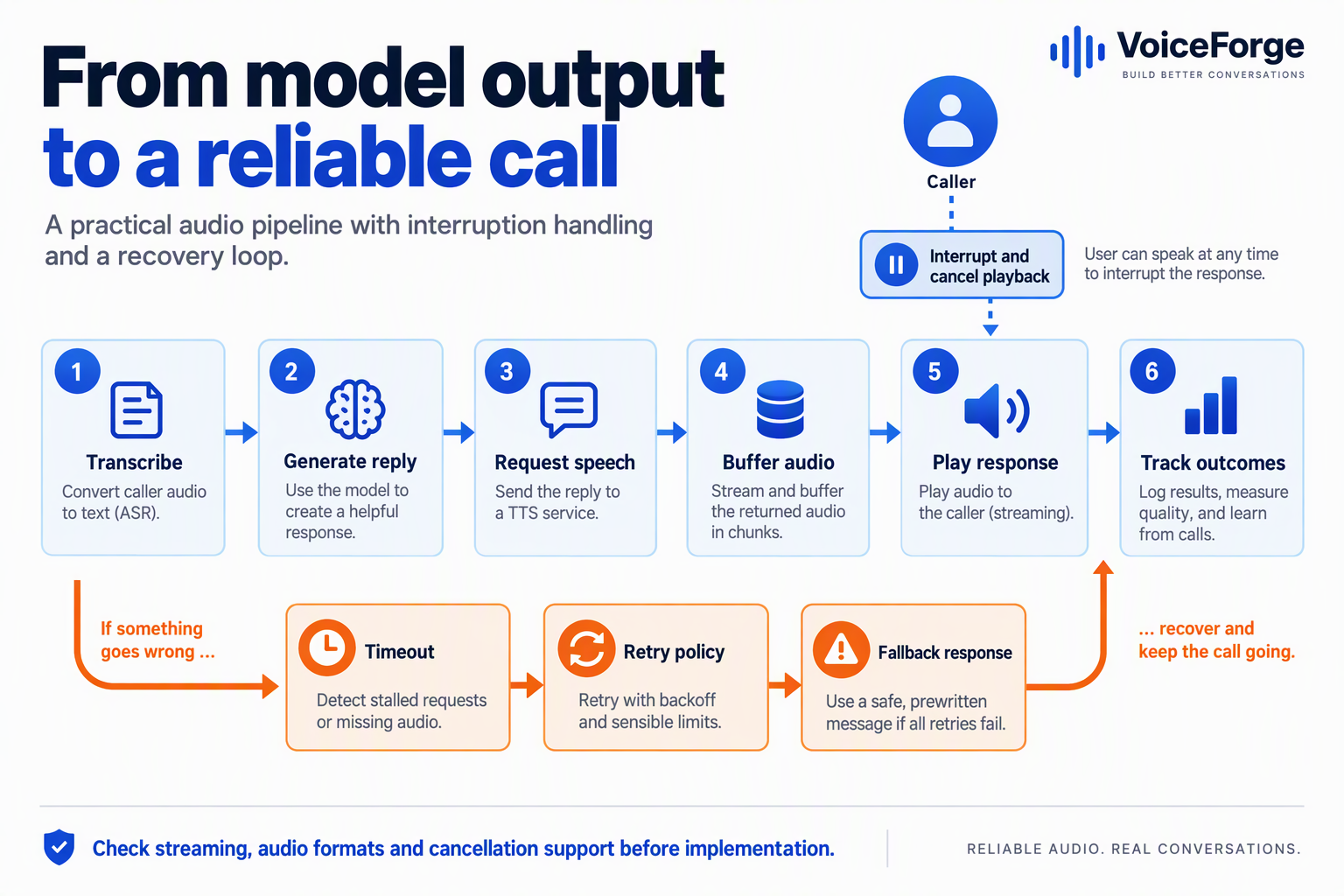
Integrate a new TTS model as a replaceable speech-generation component, not a rewrite of your entire voice agent. Keep conversation logic, tool execution, and call handling separate, then validate the model’s audio interface, interruption behavior, and failure recovery before routing live customer traffic to it.
Where should the TTS model sit in the architecture?
A modular pipeline is: speech recognition → conversational model and tools → approved response text → TTS adapter → audio playback. The adapter isolates provider-specific authentication, request fields, output formats, and error handling.
In the Google announcement supplied for this October 2026 article, Gemini 3.8 Flash TTS and Gemini 3.8 Flash-Lite TTS are positioned as moving voice generation “from static presets into a dynamic creative studio.” That describes creative control; it does not establish the streaming behavior or telephony compatibility needed for your application.
Before implementation, check the provider’s current documentation for:
- Audio delivery: streamed chunks or a complete audio response.
- Output compatibility: codec, sample rate, channel count, and required conversion.
- Request controls: supported voice settings, delivery instructions, text limits, and cancellation.
- Operational constraints: authentication, quotas, regional availability, pricing, and data handling.
If incremental audio is unavailable, sentence-level requests may reduce waiting compared with synthesizing an entire answer, but can introduce inconsistent pacing between segments. Test that trade-off rather than assuming chunking solves responsiveness.
How do you prevent speech from getting ahead of the conversation?
Use a turn-aware playback queue. Assign each response a turn identifier, and discard audio belonging to an obsolete turn when the caller interrupts or the agent changes its answer.
For an appointment agent, do not synthesize “Your booking is confirmed” while the calendar tool is still processing. First obtain the booking result, then generate the confirmation. TTS should speak verified application state—not anticipate success.
A practical sequence is:
- Finalize a speakable segment: preserve names, amounts, dates, and negations.
- Send text and bounded delivery instructions: keep customer input separate from application-controlled voice settings.
- Normalize and queue audio: convert only as needed for the playback transport.
- Handle interruption: stop playback, clear queued segments, and cancel generation where supported.
- Record what was played: distinguish generated text from speech the caller actually heard.
That final distinction matters when reviewing disputes: a complete transcript of intended speech can misrepresent a response interrupted halfway through.
What should you measure before a production rollout?
Instrument the integration boundary, not just the model request. Track time to first playable audio, playback underruns, synthesis errors, interruption-stop time, and cost per completed conversation.
Use representative test calls, then move through offline evaluation, internal calls, and a limited live rollout. As an illustrative rollout policy, start with 5% of eligible traffic and expand only when predefined thresholds hold; that percentage is a deployment choice, not a published Gemini benchmark.
Retain the previous TTS integration for rollback. On failure, avoid blindly replaying a full response if part has already been spoken.
As of October 2026, CallMissed’s verified product fact sheet lists custom voice-agent stacks billed by component, alongside eval suites and A/B experiments. Those capabilities are relevant to controlled speech-model evaluation, but do not establish that Gemini 3.8 TTS is available through CallMissed.
The production milestone is not “the API returned audio.” It is the correct response reached the caller, interruptions worked, and failures remained recoverable.
How can you test prompt-based voice design, latency and multilingual quality?
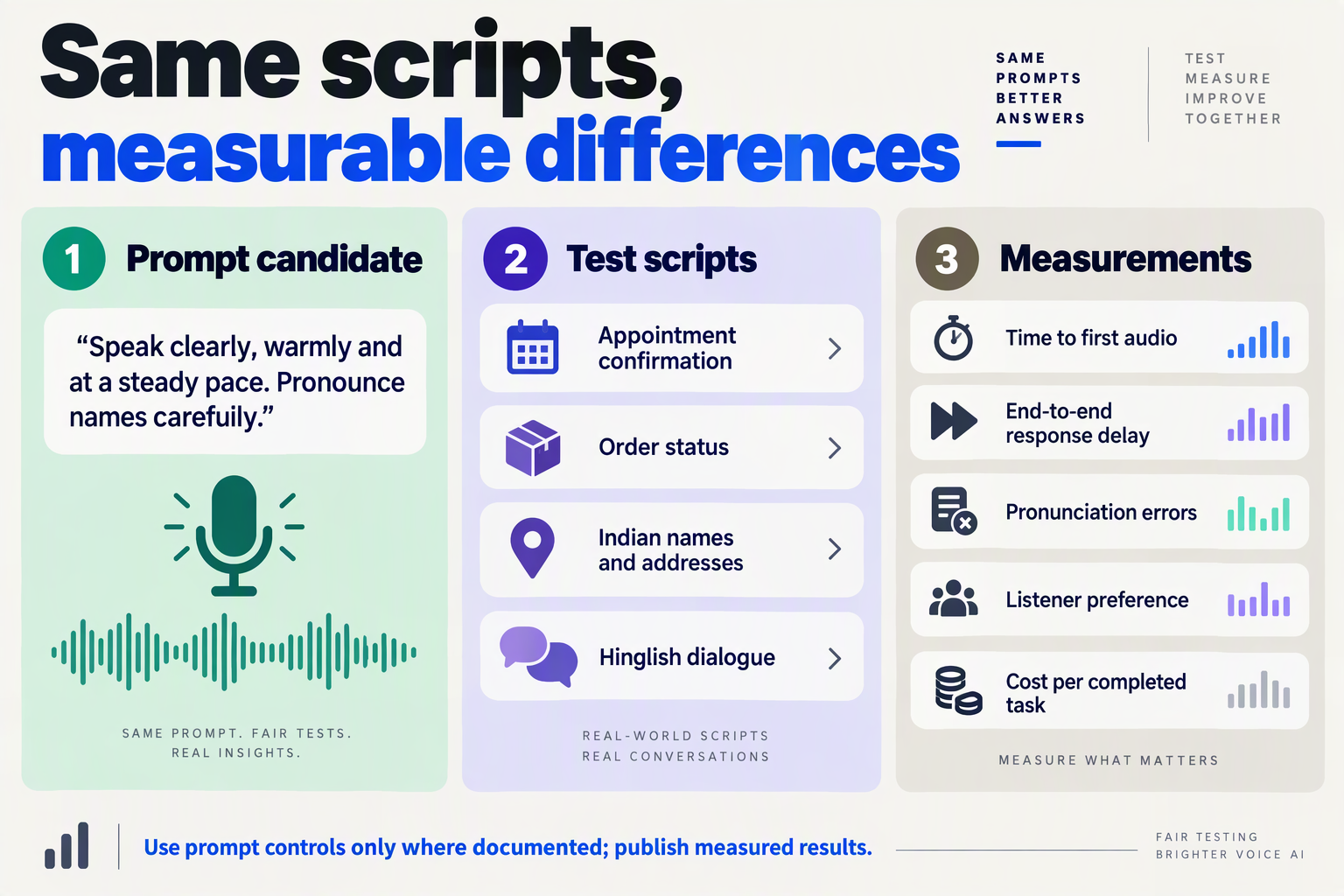
Test prompt-based voice design, latency and multilingual quality with a repeatable evaluation set, blinded listening and instrumented live calls—not a handful of polished demos. Compare the candidate model against your existing speech stack using identical scripts, network conditions and scoring rules.
Google’s announcement supplied for October 2026 names Gemini 3.8 Flash TTS and Gemini 3.8 Flash-Lite TTS, but the supplied context provides no measured conversational-latency benchmarks. Treat responsiveness as something to establish experimentally, not infer from either model’s name.
How do you test whether voice-design prompts work reliably?
Separate delivery instructions from spoken content, then vary one instruction at a time. This reveals whether a prompt produces predictable changes or merely a pleasing result once.
- Create a fixed script set. Include greetings, billing explanations, appointment confirmations, refusals and recovery after a misunderstanding.
- Define observable delivery goals. Replace “sound professional” with “use a calm tone, moderate pace and a brief pause before the next action.”
- Generate repeated samples. As a proposed starting design—not a published benchmark—test 20 scripts with three delivery prompts and three repetitions each: 180 clips per model.
- Blind the evaluation. Hide model names and randomize playback order so listeners judge the audio rather than the brand.
Score instruction adherence, intelligibility, appropriateness and consistency separately. A voice can sound natural while ignoring the requested pace or making a sensitive response overly cheerful.
Include prompts with competing requirements: “Be reassuring, but read the cancellation deadline precisely.” Check that expressive delivery never changes an amount, omits a condition or speaks the delivery instructions aloud.
How should you measure latency in a live voice agent?
Measure the full conversation pipeline alongside speech-generation timing. A fast TTS response cannot compensate for slow endpoint detection, transcription or language-model generation.
Record these timestamps:
- Caller stops speaking: the acoustic end of the caller’s turn.
- Turn closes: the system decides the caller has finished.
- Text reaches TTS: the speech request begins.
- First playable audio arrives: usable audio becomes available.
- Playback begins: the caller actually hears the response.
Report median and p95 latency, separating cold starts from warm requests and short replies from longer explanations. Run tests through the intended phone or browser channel rather than relying solely on server-side measurements.
Also measure interruption stop time: how long playback continues after a caller starts speaking. Test whether the resumed response reflects the interruption; stopping audio without updating conversational state is only half the job.
How do you evaluate multilingual and code-mixed speech?
Use native-speaking reviewers and realistic business utterances. Back-transcribing synthesized speech can flag possible errors, but it cannot establish that pronunciation, accent or delivery sounds appropriate.
Build language-specific checks for:
- Critical entities: names, currencies, dates, addresses and reference numbers.
- Code-switching: regional-language sentences containing English product names.
- Meaning preservation: negation, deadlines and conditions.
- Delivery transfer: whether “calm” or “energetic” remains appropriate across languages.
According to CallMissed’s verified fact sheet, as of October 2026, CallMissed supports speech recognition in 22 Indian languages plus English, while natural text-to-speech voices cover 10 Indian languages plus English. Those distinct coverage figures illustrate why recognition support must never substitute for output-language testing.
Set acceptance criteria before reviewing results. Prioritize critical-detail accuracy and successful task completion over expressiveness, and retain a rollback path when a new voice improves listening scores but weakens live-call performance.
What could more expressive speech mean for enterprise voice agents and customer trust?

More expressive speech could make enterprise AI voice agents easier to understand and more considerate during difficult conversations. But customer trust depends on calibrated delivery: the voice should communicate uncertainty, limits, and next steps—not make an unreliable answer sound convincing.
Can an expressive AI voice improve customer confidence?
Google’s announcement, supplied for this October 2026 article, introduces Gemini 3.8 Flash TTS and Gemini 3.8 Flash-Lite TTS as two models for richer, more expressive audio. That creates an opportunity to design delivery around the customer’s situation, rather than applying the same upbeat tone to every interaction.
Consider a customer reporting a duplicate payment. An enthusiastic “Great, I can help!” may sound dismissive. A restrained “I can check the payment records with you” better matches the situation without implying that a refund has already been approved.
The useful distinction is between acknowledging emotion and claiming to experience it. An agent can recognize frustration and explain the next step without pretending to have human feelings or a personal relationship with the caller.
Expressiveness should support three practical outcomes:
- Comprehension: Make conditions, amounts, and required actions easier to follow.
- Appropriate reassurance: Explain what the business can do without promising an unverified outcome.
- Customer agency: Leave room for questions, disagreement, and a request for human assistance.
These are potential benefits to test, not demonstrated outcomes from the supplied model announcement.
Could a more human-sounding agent undermine trust?
Yes—if customers mistake vocal confidence for factual certainty or human authority. A polished voice can make “Your refund should arrive tomorrow” sound definitive even when the underlying system has only an estimated processing date.
Enterprises should therefore connect speech style to verified workflow state. A confirmed booking can receive a clear, positive acknowledgment; an unresolved eligibility check should use neutral delivery and explicit uncertainty.
PressNews’ coverage, supplied for October 2026, describes Gemini 3.8 speech generation as supporting voice identities and “line-by-line” scenario control. For enterprise teams, the implication is not unlimited dramatic range: it is the need for approved boundaries around how sensitive statements are delivered.
Useful safeguards include:
- Identify the agent as AI, rather than relying on callers to infer that from the voice.
- Preserve qualifications, such as “estimated,” “pending approval,” and “subject to verification.”
- Avoid emotional pressure, including urgency or exaggerated enthusiasm intended to discourage cancellation.
- Offer human escalation when the customer disputes an outcome or the agent cannot verify an answer.
How should enterprises measure whether expressive speech earns trust?
Evaluate the customer’s understanding, not just whether the voice sounds pleasant. In a controlled comparison, keep the response content constant and change delivery, then assess whether callers correctly understood the commitment, uncertainty, and next action.
A useful scorecard combines task completion, clarification requests, escalation requests, and customer feedback with a review of misleading reassurance. Segment results by language and call type: delivery that works for a sales inquiry may be inappropriate for debt collection or a service complaint.
As of October 2026, CallMissed supports call scoring against businesses’ own QA rubrics, eval suites, and A/B experiments. Those capabilities can help teams assess expressive delivery against defined conversational standards, rather than treating a compelling voice demo as proof of customer trust.
The enterprise goal is not to make every agent sound more human. It is to make every interaction clearer, appropriately reassuring, and accountable.
What should speech engineers and customer-support leaders be asked before deployment?

Ask speech engineers for evidence that the voice pipeline survives real call conditions, and ask customer-support leaders for explicit boundaries on what the agent may say, do, and escalate. Before deployment, both teams should agree on acceptance criteria, incident ownership, and a tested rollback procedure—not simply approve a convincing demo.
What evidence should speech engineers provide before launch?
Google’s announcement, supplied for this October 2026 article, names Gemini 3.8 Flash TTS and Gemini 3.8 Flash-Lite TTS as new speech-generation models. That announcement establishes the products being discussed; it does not establish their suitability for your support queue.
Request a reproducible evaluation package, with model identifiers, configuration, test scripts, and dated results. Ask:
- “What happens when synthesis fails halfway through a response?” Demonstrate timeout handling, partial playback, retries, and recovery without repeating a sensitive statement or implying an action succeeded.
- “Can we reproduce a customer complaint?” Record the text submitted for synthesis, relevant delivery settings, model version, and playback events, subject to privacy controls.
- “Which changes require requalification?” Define whether a model update, prompt edit, pronunciation rule, or voice-setting change triggers another evaluation.
- “What does the fallback preserve?” A replacement voice should preserve meaning and transaction state, even if its delivery differs.
Use a concrete failure drill: an agent says, “Your refund has been…” and audio stops. The system should verify the transaction state before completing or repeating the claim. Speech recovery must not become transaction invention.
What decisions should customer-support leaders make?
Support leaders should define acceptable behavior by customer situation, rather than approve a voice as universally “friendly.” A delivery style appropriate for a sales inquiry may be unsuitable for bereavement, suspected fraud, or financial hardship.
Ask support owners to resolve three questions:
- Which conversations require a person? Specify escalation triggers, including disputed charges, repeated misunderstanding, distress, and requests for a human.
- Which statements need controlled wording? Identify refund commitments, eligibility decisions, legal notices, and identity-verification instructions that must not be embellished.
- What counts as a successful outcome? Pair resolution measures with complaint review and repeat-contact analysis; shorter calls alone can conceal customers giving up.
A useful approval exercise is a billing dispute where the agent sounds sympathetic but cannot authorize a refund. Support leaders should confirm that the script distinguishes acknowledgment from commitment—and makes the next step clear.
Who owns consent, monitoring, and the deployment decision?
Assign named owners for voice-use permissions, recording disclosures, retention, and access to customer audio. Do not assume ordinary call-recording consent also authorizes creating or replicating a person’s voice.
Require a signed deployment checklist covering engineering reliability, support policy, privacy review, and operational readiness. Each approval should identify unresolved risks and the conditions that would pause the rollout.
As of October 2026, CallMissed’s verified product fact sheet lists call scoring against custom QA rubrics, eval suites, A/B experiments, and supervisor listen, whisper, or barge-in capabilities. These are relevant evaluation and oversight tools, not proof that any particular TTS model is ready.
The final question should be direct: “Who can stop this deployment, and what evidence will make them do it?” A clear answer turns speech-model experimentation into accountable customer-service operations.
What should you pilot now, and where can CallMissed fit?
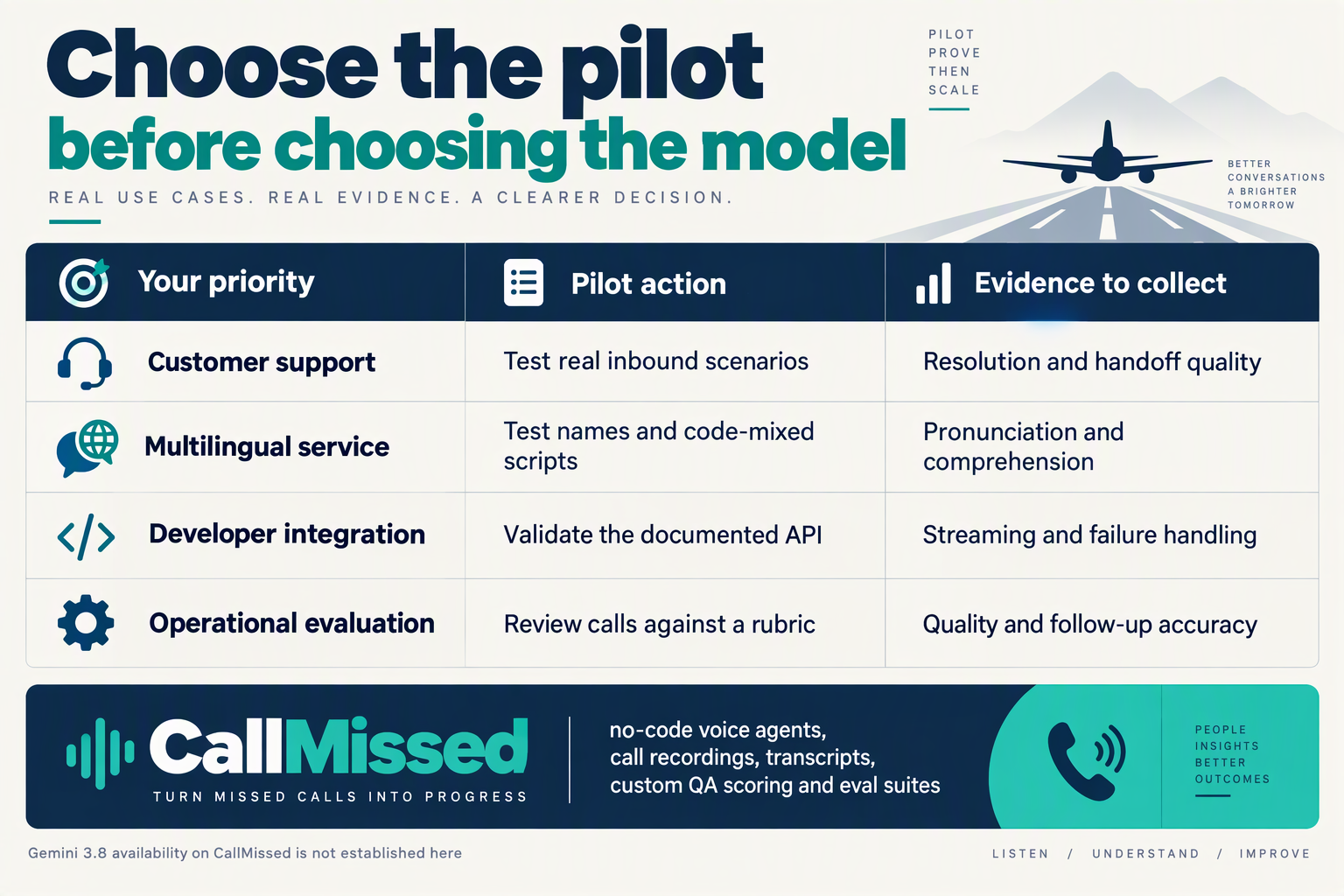
Pilot one bounded customer workflow with a baseline voice and a candidate TTS model, rather than replacing your entire voice stack. CallMissed can support the surrounding agent workflow and evaluation, but the supplied product facts do not confirm availability of Gemini 3.8 Flash TTS or Gemini 3.8 Flash-Lite TTS through its platform.
Which AI voice-agent pilots should you run first?
Start with a task where successful completion is observable: confirming an appointment, explaining an order status, or answering a narrowly scoped billing question. Avoid making emotionally sensitive disputes your first live experiment; those conversations introduce too many variables to isolate speech delivery.
Google’s announcement supplied for this October 2026 article names two models: Gemini 3.8 Flash TTS and Gemini 3.8 Flash-Lite TTS. Treat them as separate candidates, not interchangeable options: the supplied context does not establish comparative live-call latency, reliability, or cost.
The following is a proposed pilot plan, not a published benchmark. Platform capabilities referenced below come from the CallMissed fact sheet, as of October 2026.
| Pilot step | Test setup | Measure | Deployment gate |
|---|---|---|---|
| Establish a baseline | Run the current voice on 30 fixed scenarios | Completion rate and correction requests | Baseline results recorded |
| Compare delivery | Render identical responses with each available candidate | Blind listener preference and comprehension | No comprehension regression |
| Check critical details | Include dates, amounts, names, and booking references | Incorrect or ambiguous readings | No critical errors in the test set |
| Test interruptions | Interrupt greetings and longer explanations | Playback-stop delay and recovery quality | Meets your existing service target |
| Evaluate regional speech | Test target-language and code-mixed examples | Native-speaker ratings and task success | Passes each intended language |
| Run a limited live trial | Release to a small, consented test cohort | Completion, escalation, and cost per resolved task | Expand only after review |
The 30-scenario starting point is a practical recommendation, not enough evidence to establish production reliability. Add cases when failures cluster around particular names, sentence lengths, languages, or caller behaviours.
How do you keep the comparison fair?
Change the speech layer first, while keeping the prompt, knowledge base, tools, and task constant. Otherwise, a better answer could be mistaken for a better voice.
- Freeze the response content: Use identical text for offline listening tests.
- Separate listening from interaction: A narration preference test cannot establish live conversational performance.
- Predefine failure rules: Decide what triggers escalation, suspension, or rollback before admitting live traffic.
Keep critical errors separate from average scores. A voice that wins most preference votes but misreads payment amounts should not pass a billing pilot.
Where can CallMissed support the pilot?
As of October 2026, CallMissed’s verified capabilities include agent versioning with publish and rollback, eval suites, A/B experiments, call recordings, transcripts, and scoring against custom QA rubrics. These provide useful building blocks for comparing agent configurations and investigating failures; they do not establish that a particular external TTS model is integrated.
For budgeting, the CallMissed fact sheet lists flat-rate voice-agent plans at ₹4, ₹5, and ₹6 per minute as of October 2026, covering speech recognition, the language model, and voice, with phone carriage billed separately. Custom stacks instead charge each component by the second with no minimum.
- Use a managed configuration when repeatable workflow testing is the priority.
- Explore a custom stack when isolating speech components matters, after confirming model compatibility.
The decision to expand should follow demonstrated task success—not enthusiasm for the announcement or a compelling audio sample.
Frequently Asked Questions
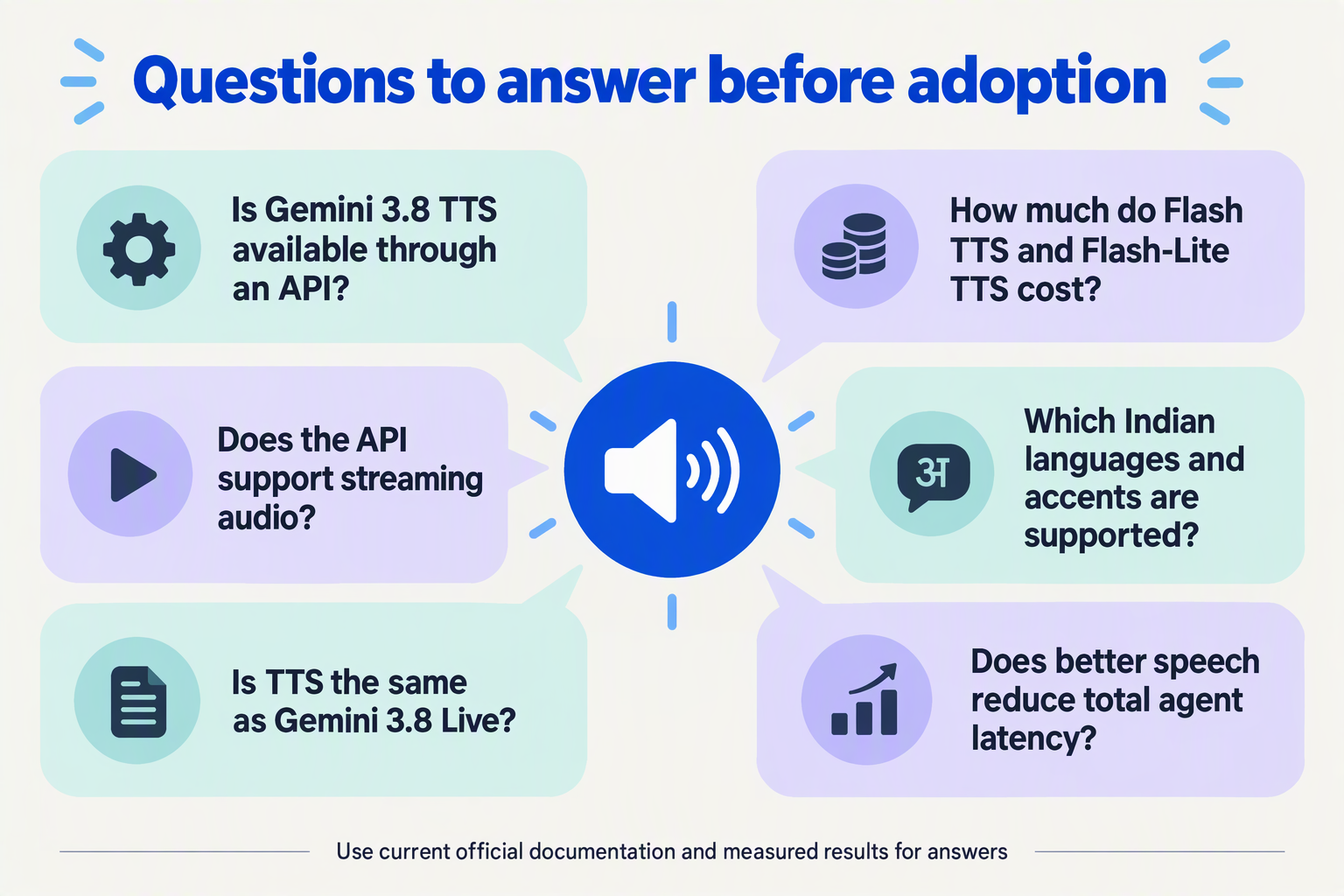
What is Gemini 3.8 text-to-speech, and what does it change for AI voice agents?
What is the difference between Gemini 3.8 Flash TTS and Flash-Lite TTS?
Is Gemini 3.8 text-to-speech suitable for real-time AI phone agents?
Does Gemini 3.8 TTS support Indian languages and multilingual customer calls?
Can Gemini 3.8 TTS clone a voice, and what consent is needed?
How much does Gemini 3.8 TTS cost, and can I use it through CallMissed?
Conclusion
Gemini 3.8 text-to-speech could give AI agents greater control over delivery, but expressive speech is valuable only when it improves the conversation. The practical test is not whether an agent sounds impressive in a demo; it is whether customers can understand, interrupt, and complete tasks with it reliably.
Google’s announcement supplied for this October 2026 article describes Gemini 3.8 Flash TTS and Gemini 3.8 Flash-Lite TTS as moving voice generation “from static presets into a dynamic creative studio.” That direction is promising, but creative control and operational readiness remain different questions. A reassuring billing response still needs accurate amounts, just as an energetic product explanation still needs clear pronunciation and appropriate pacing.
Four takeaways should guide evaluation:
- Treat expressiveness as a means, not the outcome. Warmer greetings and more deliberate explanations could improve customer interactions. However, the right delivery depends on context: a pause that helps someone understand a complex answer may frustrate someone trying to confirm an appointment quickly.
- Measure conversational responsiveness, not just audio quality. Teams should evaluate how soon usable speech arrives and whether playback stops when callers interrupt. A polished recording does not establish that a model can support the back-and-forth demands of a live voice agent.
- Keep accuracy and consistency central. Names, prices, dates, and multilingual phrases must remain understandable across short responses, longer explanations, and repeated calls. Reading the wrong appointment date beautifully is still a failed interaction, regardless of how natural the voice sounds.
- Assess the complete deployment trade-off. Integration requirements, usage costs, and voice-consent safeguards belong alongside listening tests. Changing the speech component should produce measurable conversational benefits, rather than simply adding another attractive voice option to the stack.
The supplied Hacker News trend snapshot for October 2026 records 241 points and 118 comments within 8.5 hours for “Gemini 3.8 text-to-speech.” That attention establishes developer interest—not evidence that either model is ready for every production workflow.
What should developers watch for next?
Watch for operational evidence that expressive control can coexist with responsive playback, reliable pronunciation, and consistent delivery. The next meaningful milestone is not a more dramatic demo, but repeatable results on the conversations an agent actually handles.
As of October 2026, CallMissed supports custom voice-agent stacks billed by component, making the platform worth exploring when evaluating speech choices within a broader communication workflow. That approach keeps the focus on the whole interaction rather than one model’s presentation.
Before changing your stack, ask: Will this voice help customers finish their task more clearly and reliably—or merely make the same conversation sound better?
Related Reading
- Gemini 4 Argon vs GPT-6.1 Sol: Coding & Agents (2026)
- How to Stream Speech to Text in Production: Guide
- Best Speech-to-Text API for Indian Languages: 2026
Sources
Discussion
Related Posts



Ready to automate customer conversations?
Launch AI voice agents and WhatsApp bots with CallMissed — one API, 22+ Indian languages.