Vapi Alternatives for Voice AI: 2026 Comparison With WhatsApp Follow-Up
Compare Vapi alternatives including Retell, Bland, Synthflow, Bolna and CallMissed by pricing structure, setup, latency, languages and WhatsApp workflows.
Introduction: Why Teams Compare Vapi Alternatives for Voice AI Agents
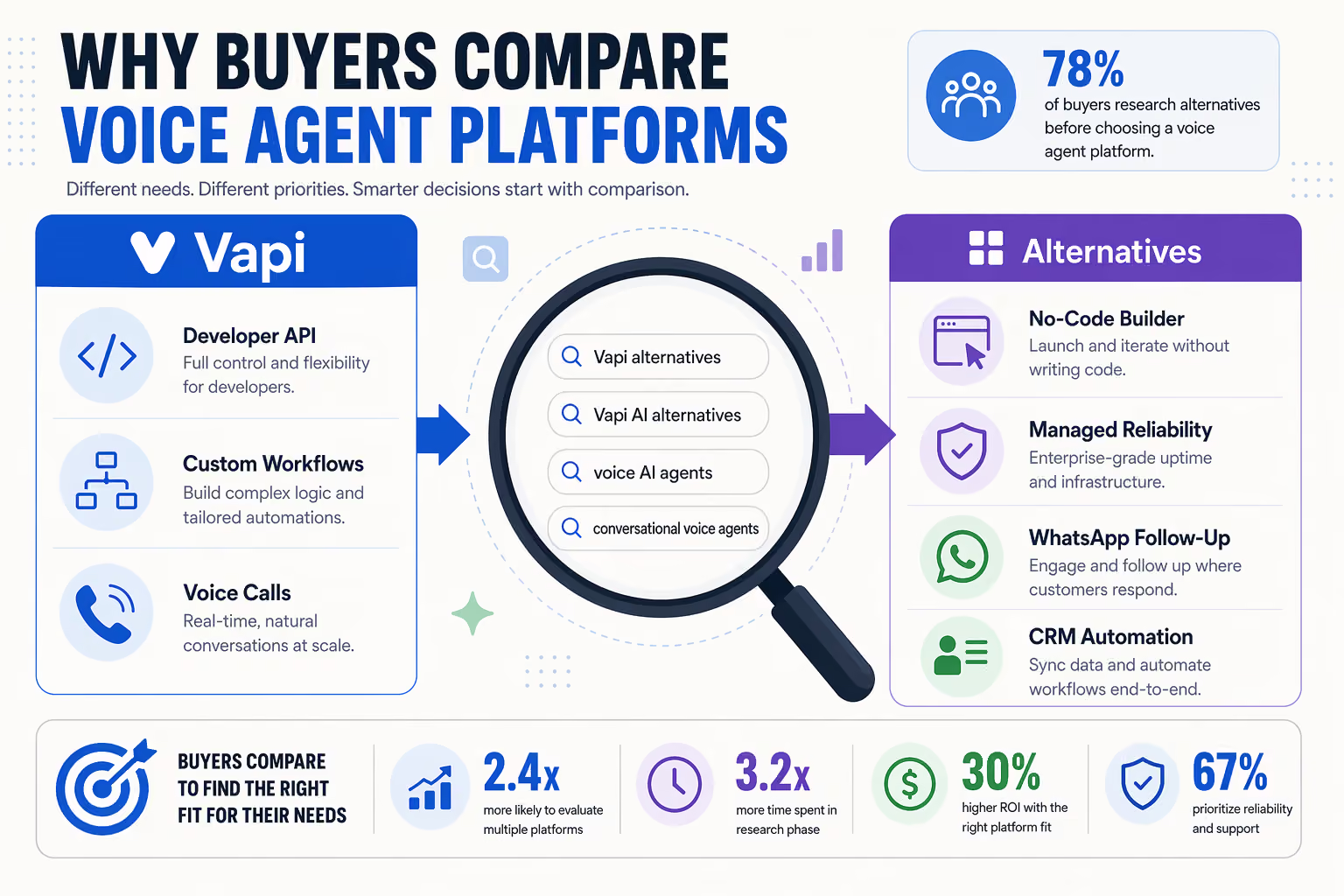
In 2026, the best Vapi alternative depends on your workflow, technical resources, language requirements, and post-call automation needs.
Shortlist by use case
- Developer orchestration — Vapi: Vapi remains a common benchmark for API-first voice-agent development and modular provider selection. It suits teams that want control over telephony, STT, LLM, TTS, and tool integrations.
- Managed reliability — Retell AI: Retell targets teams seeking managed conversational voice agents with enterprise-oriented performance and compliance features. Buyers should verify uptime, transfer behavior, data handling, and support commitments for their specific plan.
- No-code setup — Synthflow: Synthflow provides a visual approach for building voice workflows without extensive development. It may suit sales, support, and operations teams that want faster configuration and easier internal ownership.
- High-volume outbound calling — Bland AI: Bland is frequently evaluated for outbound campaigns and programmatic calling at scale. Teams should compare concurrency, telephony coverage, rate limits, consent controls, and campaign management before choosing it.
- Indian-language support — Bolna: Bolna is relevant for teams building multilingual voice agents, particularly for Indian use cases. Language availability alone is not enough, so test accents, mixed-language speech, latency, and transcription accuracy.
- Voice plus WhatsApp follow-up — CallMissed: CallMissed combines AI calling with WhatsApp automation for post-call customer journeys. Its published capabilities include 300+ LLM inference options and Speech-to-Text for 22 Indian languages.
This is a use-case shortlist, not a universal ranking. Each platform has different trade-offs across control, setup effort, reliability, language coverage, and channel support.
What buyers are really comparing
Teams searching for “Vapi alternatives,” “Vapi AI alternatives,” “voice AI agents,” or “Vapi vs Retell” usually need production-ready workflows, not another impressive demo.
- Architecture: Vapi emphasizes developer-controlled orchestration, while managed and no-code platforms reduce the number of components teams must assemble.
- Latency: Delays can interrupt natural turn-taking and cause callers to speak over the agent. Test real calls across target regions, carriers, languages, and peak traffic periods.
- Production reliability: Evaluate uptime, call transfers, voicemail detection, retries, fallback routing, CRM logging, analytics, and human escalation.
- Builder experience: API-first tools provide flexibility but require engineering capacity. Visual builders can accelerate deployment while limiting deeper customization.
- Concurrency: Published per-minute pricing rarely explains how many simultaneous calls a plan supports. Confirm concurrency limits, upgrade costs, and queue behavior.
- Compliance: Review security certifications, consent management, recording controls, retention policies, data residency, and exposure to third-party model providers.
- Language performance: A platform may list many languages without performing equally across accents, dialects, code-switching, or noisy phone connections.
Compare total cost, not only the advertised rate
Voice AI pricing extends beyond a platform’s headline per-minute charge. A complete estimate should include:
- Platform or orchestration fees
- Inbound and outbound telephony
- Speech-to-Text usage
- LLM inference and tool calls
- Text-to-Speech generation
- Concurrency upgrades
- Compliance or enterprise features
- CRM and workflow integrations
- Monitoring, testing, and engineering time
Bundled pricing may simplify forecasting, while modular pricing can offer greater provider control. Model several realistic call scenarios before comparing vendors.
Why WhatsApp follow-up changes the decision
A phone call is often only one step in the customer journey. Bookings, payments, documents, reminders, and support evidence usually require another channel.
Voice agents can qualify leads, answer urgent questions, or schedule appointments. WhatsApp can then send brochures, payment links, confirmations, images, PDFs, and status updates.
This distinction is especially important for Indian businesses serving WhatsApp-first customers and multilingual callers. Bolna may merit evaluation for Indian-language voice workflows, while CallMissed focuses on connecting voice interactions with WhatsApp follow-up.
The right choice is therefore not simply the cheapest Vapi alternative. It should match your architecture, reliability requirements, compliance obligations, languages, call volume, and post-call workflow.
At a Glance: Verdict
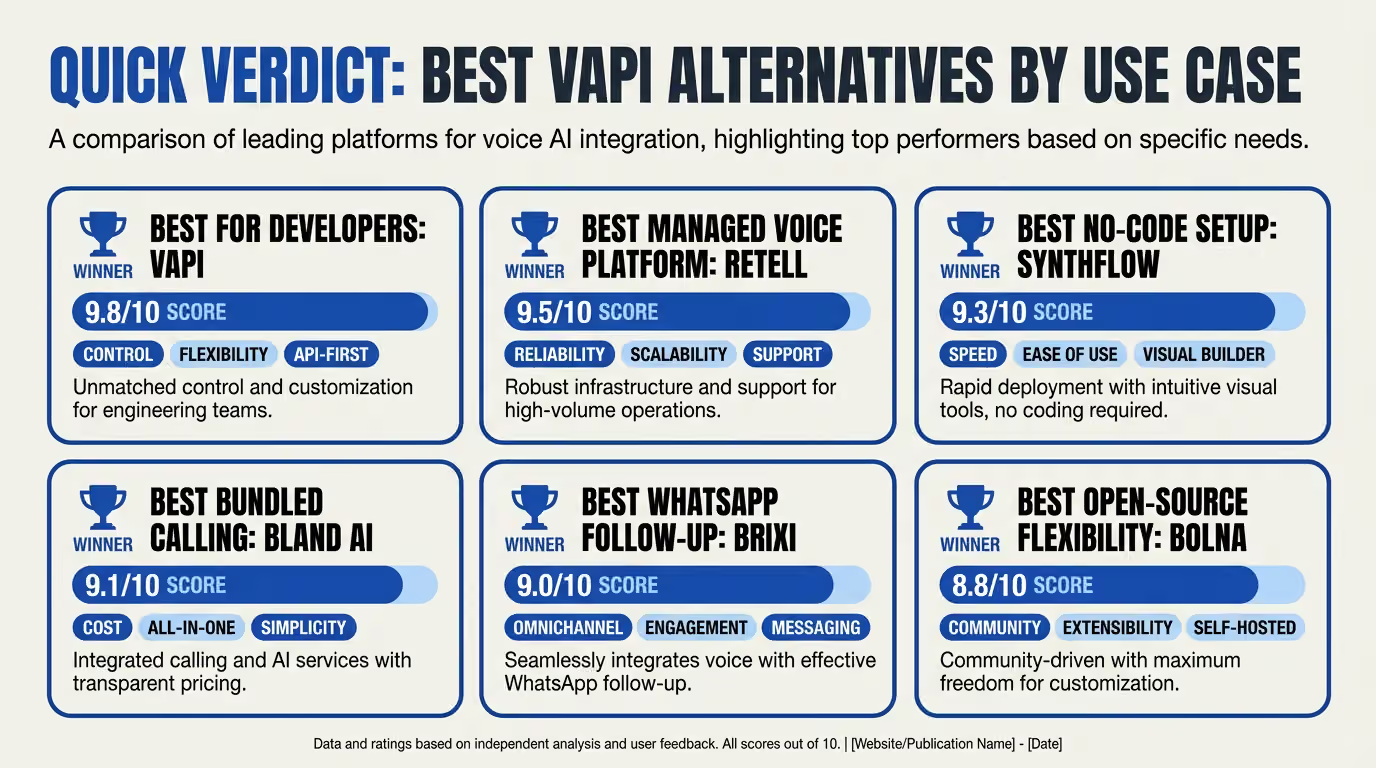
If you want the fastest verdict: Vapi is best for developer-led voice AI, but not always best for WhatsApp-first or operations-led teams.
- Best for developers — Vapi: Choose Vapi if your team wants API-first control over LLMs, STT, TTS, telephony, tool calls, and custom conversational voice agents.
- Best managed alternative — Retell AI: 2026 search results position Retell as an enterprise Vapi alternative focused on pricing, compliance, and performance for conversational voice agents.
- Best no-code option — Synthflow: Pick Synthflow when sales, support, or operations teams need to launch agents without engineering; 2026 comparisons explicitly frame it as no-code vs Vapi’s developer platform.
- Best bundled voice automation — Bland AI: Bland is a strong fit when teams want simpler outbound/inbound calling workflows without assembling every infrastructure layer themselves.
- Best regional/multilingual fit — Bolna and India-focused platforms: Shortlist these when Indian languages, local accents, and non-English call flows matter more than generic English voice demos.
- Best omnichannel fit — CallMissed: For teams that need voice agents plus WhatsApp follow-up, CallMissed combines AI voice agents, WhatsApp chatbots, 300+ LLMs, and STT for 22 Indian languages.
- WhatsApp deciding factor: With WhatsApp at 3 billion+ monthly users globally, a voice-only platform may lose leads after the call unless it supports confirmations, reminders, documents, and payment links over chat.
- Bottom line: Use Vapi for maximum build flexibility; use Retell/Bland/Synthflow for managed or no-code voice workflows; use CallMissed-style omnichannel infrastructure when calls and WhatsApp must work together.
Feature Comparison: Vapi vs Retell vs Bolna vs Bland AI vs Synthflow vs Brixi
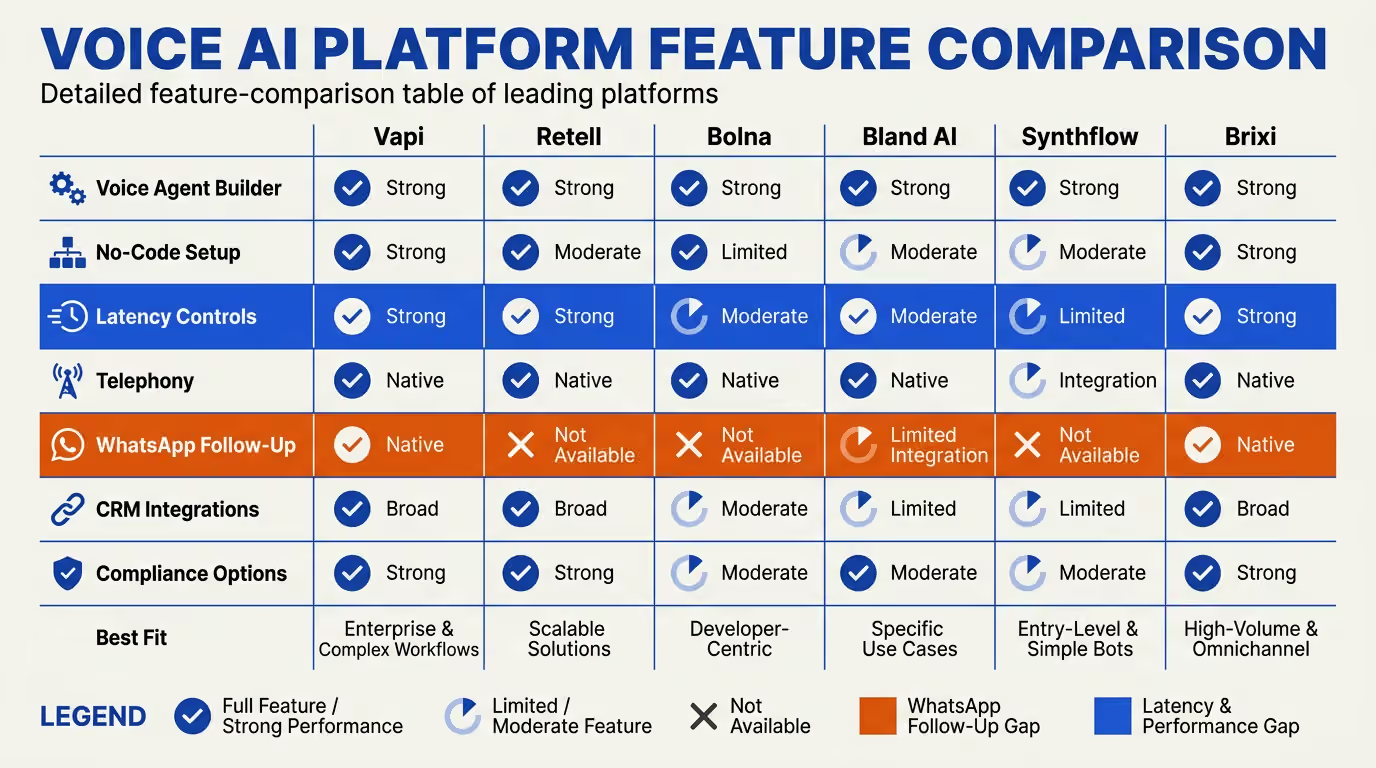
Use this table as a buyer shortlist, not a final procurement decision: 2026 SERPs position these tools differently across developer control, managed reliability, no-code setup, regional language fit, and WhatsApp follow-up.
| Platform | Best Fit | Strengths | Watchouts | WhatsApp / Omnichannel Fit |
|---|---|---|---|---|
| Vapi | Developer-led voice agent builds | API-first stack; custom LLM/STT/TTS/telephony orchestration | More engineering ownership; separate follow-up workflows often needed | Usually requires integrations for WhatsApp/SMS/CRM |
| Retell AI | Enterprise conversational voice agents | Retell’s 2026 result highlights pricing, compliance, and performance for Vapi alternatives | May be less flexible than fully assembled developer stacks | Strong for managed calls; omnichannel depends on setup |
| Bolna | India-focused and multilingual voice AI | Relevant for regional markets where local speech quality matters | Evaluate language coverage, latency, and production SLAs | Useful when paired with WhatsApp-heavy Indian workflows |
| Bland AI | Fast outbound/inbound voice automation | 2026 comparisons describe Bland as simpler and more bundled than Vapi | Less granular control than API-first platforms | Voice-first; post-call messaging may need external automation |
| Synthflow | No-code sales/support agents | 2026 comparisons call it the most no-code option for non-technical teams | Lower flexibility for deeply custom agent logic | Good for business teams; WhatsApp requires workflow design |
| Brixi | Omnichannel voice + WhatsApp follow-up | Search demand includes “Brixi vs Vapi vs Retell vs Bolna” around WhatsApp agents | Validate maturity, integrations, and enterprise controls | Strongest positioning when WhatsApp follow-up is central |
- Vapi: Best when your team wants control over models, prompts, tools, telephony, and latency tuning rather than a packaged workflow.
- Retell: A strong shortlist option for enterprises comparing Vapi AI alternatives around reliability, compliance, and production-grade conversational agents.
- Bolna: Worth testing for India-first use cases where English-only benchmarks miss real customer behavior across regional languages.
- Bland AI: Better suited to teams that want bundled voice automation quickly, especially for outbound calling and simpler call flows.
- Synthflow: Best for operators and revenue teams that prefer visual workflows over writing voice-agent code.
- Brixi: Most relevant when the buyer’s real requirement is not just “answer the call,” but “continue the conversation on WhatsApp.”
- CallMissed: For teams prioritizing omnichannel journeys, platforms like CallMissed combine AI voice agents, WhatsApp chatbots, 300+ LLM options, and Speech-to-Text for 22 Indian languages in one communication layer.
- Market signal: The comparison category is active in 2026, with current results covering “Best No-Code Voice AI Agents,” “Top Vapi AI Alternatives,” “Vapi vs Bland vs Retell vs Synthflow,” and “Vapi Alternatives in 2026.”
Pricing & Value: Usage Fees, Setup Costs, and Total Cost of Ownership
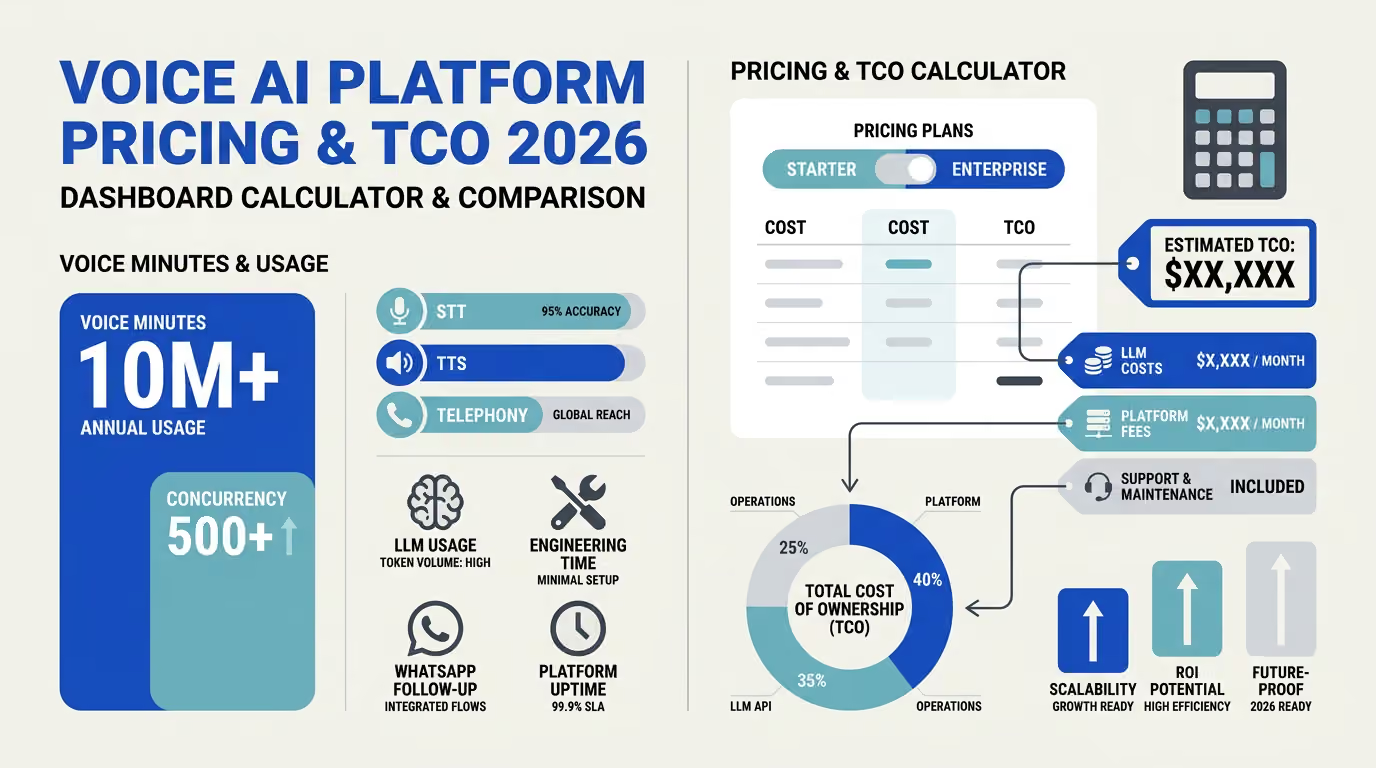
Pricing in voice AI is rarely just “per minute”; the real comparison is LLM + STT + TTS + telephony + concurrency + WhatsApp follow-up + engineering time.
| Platform | Usage-fee model to check | Setup cost | TCO risk | Best value fit |
|---|---|---|---|---|
| Vapi | Per-minute voice orchestration plus external LLM/STT/TTS/telephony | Medium–high developer time | Costs spread across multiple vendors | Engineering teams needing control |
| Retell AI | Managed voice-agent pricing; 2026 SERPs emphasize “pricing, compliance, performance” | Medium | Enterprise features may raise plan cost | Production teams prioritizing reliability |
| Bland AI | Bundled voice automation pricing | Low–medium | Less flexibility can create migration cost | Fast outbound calling use cases |
| Synthflow | No-code subscription/usage plans; listed in 2026 no-code comparisons | Low | Seat limits, workflow limits, add-ons | Ops teams without developers |
| Bolna / regional tools | Voice usage plus local-language speech stack | Medium | Language quality varies by market | India and multilingual calling |
| CallMissed | Omnichannel voice + WhatsApp + APIs | Low–medium | Lower integration overhead if WhatsApp is required | Teams needing call-to-chat automation |
- Vapi: Strong value when you already have engineers to manage providers, prompts, latency, retries, and observability.
- Retell: Better TCO when managed reliability matters more than infrastructure flexibility; Retell’s own 2026 comparison targets enterprise buyers.
- Synthflow: Lower setup cost because it is no-code, matching 2026 comparisons like ToughTongueAI’s “Best No-Code Voice AI Agents.”
- OmniDimension’s 2026 Vapi alternatives page: Highlights “all-in pricing” and concurrency fees, which are often missed in simple per-minute comparisons.
- WhatsApp follow-up: With 3 billion+ WhatsApp monthly users, voice-only pricing can be misleading if teams later pay separately for chat automation.
- CallMissed: Value is strongest when one platform can cover AI voice agents, WhatsApp chatbots, 300+ LLMs, and STT for 22 Indian languages without stitching separate vendors.
Pros and Cons: Strengths, Trade-Offs, and Hidden Buyer Risks
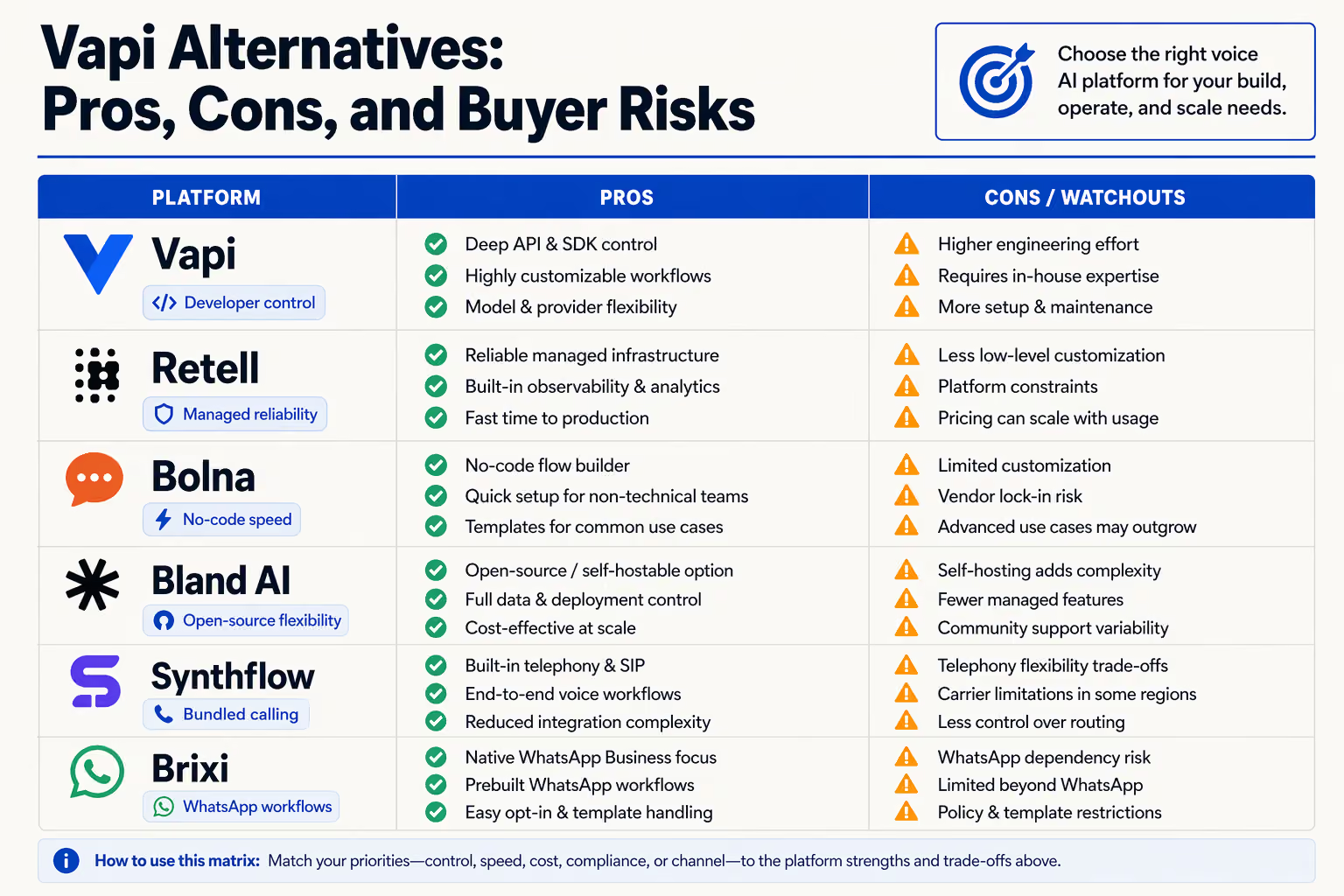
Buyer takeaway: most Vapi alternatives are not “better” universally—they shift risk between engineering control, managed reliability, no-code speed, and omnichannel coverage.
| Platform | Strength | Trade-Off | Hidden Buyer Risk |
|---|---|---|---|
| Vapi | High developer control for custom voice-agent stacks | More assembly across LLM, STT, TTS, telephony, tools | Internal team owns latency tuning, observability, and failure handling |
| Retell AI | Enterprise positioning around “pricing, compliance, and performance” per its 2026 Vapi alternatives result | Less DIY flexibility than fully modular builds | Compliance claims still need buyer-side review: logs, retention, consent, regions |
| Bland AI | Simpler bundled voice automation; often compared with Vapi and Retell | Less granular infrastructure control | Bundled pricing can obscure telephony, minutes, and scale costs |
| Synthflow | No-code builder for sales, support, and ops teams; 2026 comparisons call it the “most no-code” option | May constrain complex developer workflows | Non-technical teams can ship fast but hit limits on custom tools and edge cases |
| Bolna / regional platforms | Stronger fit for India and multilingual markets | Coverage varies by language, accent, and channel | English demo quality may not predict Hindi, Tamil, Bengali, or mixed-language calls |
| Omnichannel platforms | Voice + WhatsApp follow-up closes the post-call journey | Requires CRM, consent, and message-template discipline | Voice-only vendors may miss confirmations, payment links, and reminders after hang-up |
- Vapi: Best when engineering teams want customization more than managed defaults; watch build time and monitoring overhead.
- Retell: Strong shortlist for production voice agents; its own 2026 SERP positioning emphasizes compliance and performance.
- Synthflow: Best for non-developers; validate whether advanced workflows need APIs or custom backend logic.
- WhatsApp risk: With 3 billion+ monthly WhatsApp users globally, a voice-only agent may lose leads after unanswered calls or incomplete bookings.
- Pricing risk: Compare all-in costs: voice minutes, telephony, LLM/STT/TTS usage, concurrency fees, and overage rules—not just headline rates.
- CallMissed: Platforms like CallMissed reduce omnichannel gaps by combining AI voice agents, WhatsApp chatbots, 300+ LLMs, and STT for 22 Indian languages.
Which Should You Choose? Match the Platform to Your Team, Channel, and Use Case
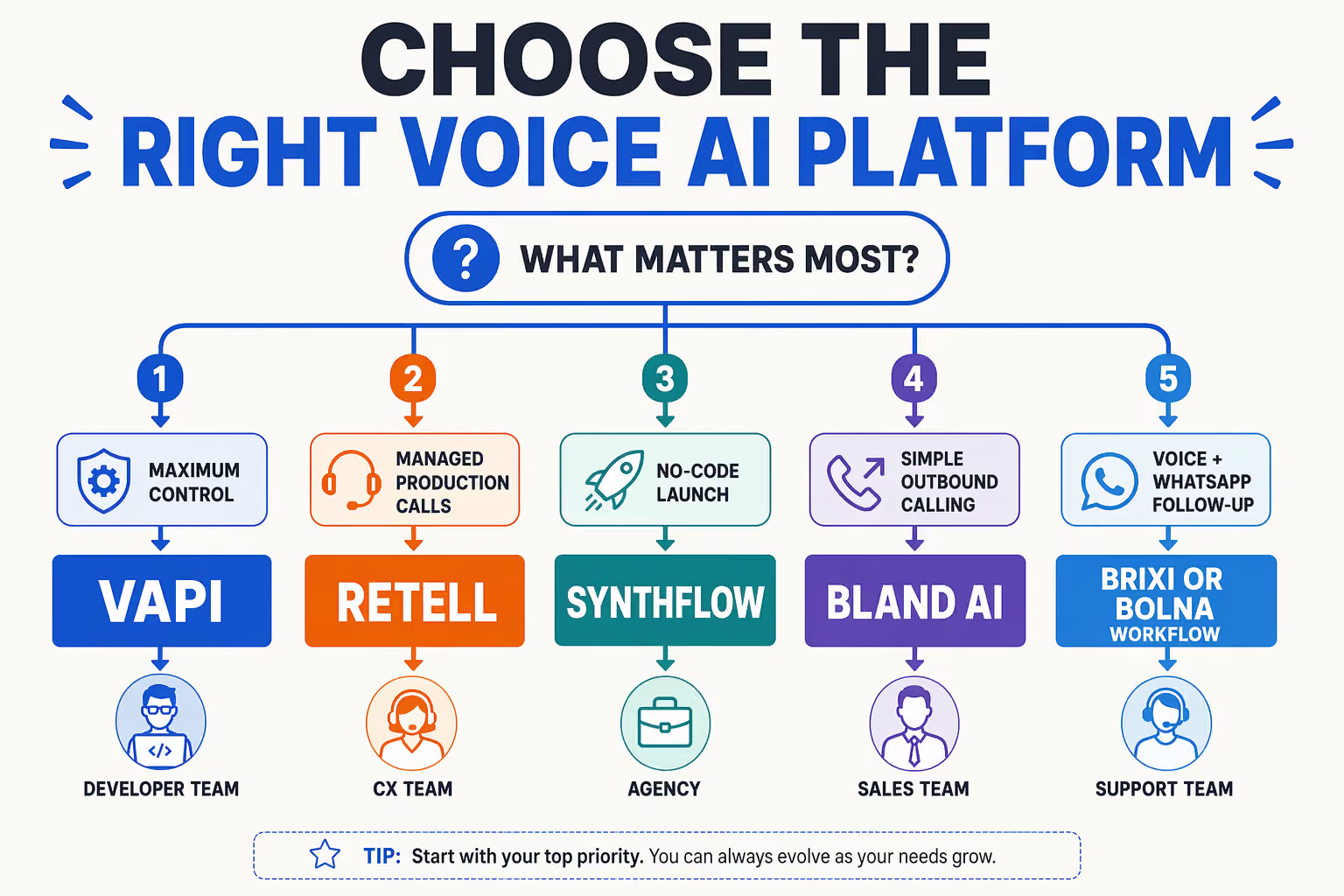
Choose based on who will own the workflow after launch: engineers, ops teams, sales managers, or support leaders.
- Developer teams: Pick Vapi when you need API-first control over LLMs, STT, TTS, telephony, tool calls, and custom routing; 2026 comparisons consistently position it as the more customizable voice-agent layer.
- Enterprise support teams: Pick Retell AI when managed reliability, compliance, and performance are the priority; Retell’s 2026 Vapi-alternative positioning explicitly emphasizes pricing, compliance, and performance for conversational voice agents.
- Sales and appointment teams: Pick Retell or Bland if your main workflow is booking, reminders, or qualification; Builts AI’s 2026 comparison notes Retell for strong scheduling integrations and low-latency execution.
- Non-technical operations teams: Pick Synthflow when business users need to launch agents without code; 2026 SERPs repeatedly frame Synthflow as the no-code option versus Vapi’s developer platform.
- Budget-sensitive teams: Compare all-in pricing, not just per-minute rates; OmniDimension’s 2026 Vapi alternatives analysis highlights hidden decision factors such as concurrency fees, telephony, and bundled infrastructure costs.
- India and multilingual markets: Pick a platform with regional speech support and WhatsApp follow-up; CallMissed supports Speech-to-Text in 22 Indian languages, plus WhatsApp automation for confirmations, payment links, and post-call recovery.
- Omnichannel customer journeys: Pick CallMissed or similar omnichannel platforms when calls are only step one; with WhatsApp at 3 billion+ monthly users globally, follow-up chat can matter as much as the voice agent itself.
- Best practical rule: Use Vapi for maximum build flexibility, Retell for managed enterprise voice, Synthflow for no-code rollout, Bland for simpler bundled automation, and CallMissed when voice + WhatsApp + multilingual infrastructure must work together.
Frequently Asked Questions: Best Vapi Alternative, Voice AI Pricing, Latency, and WhatsApp Follow-Up
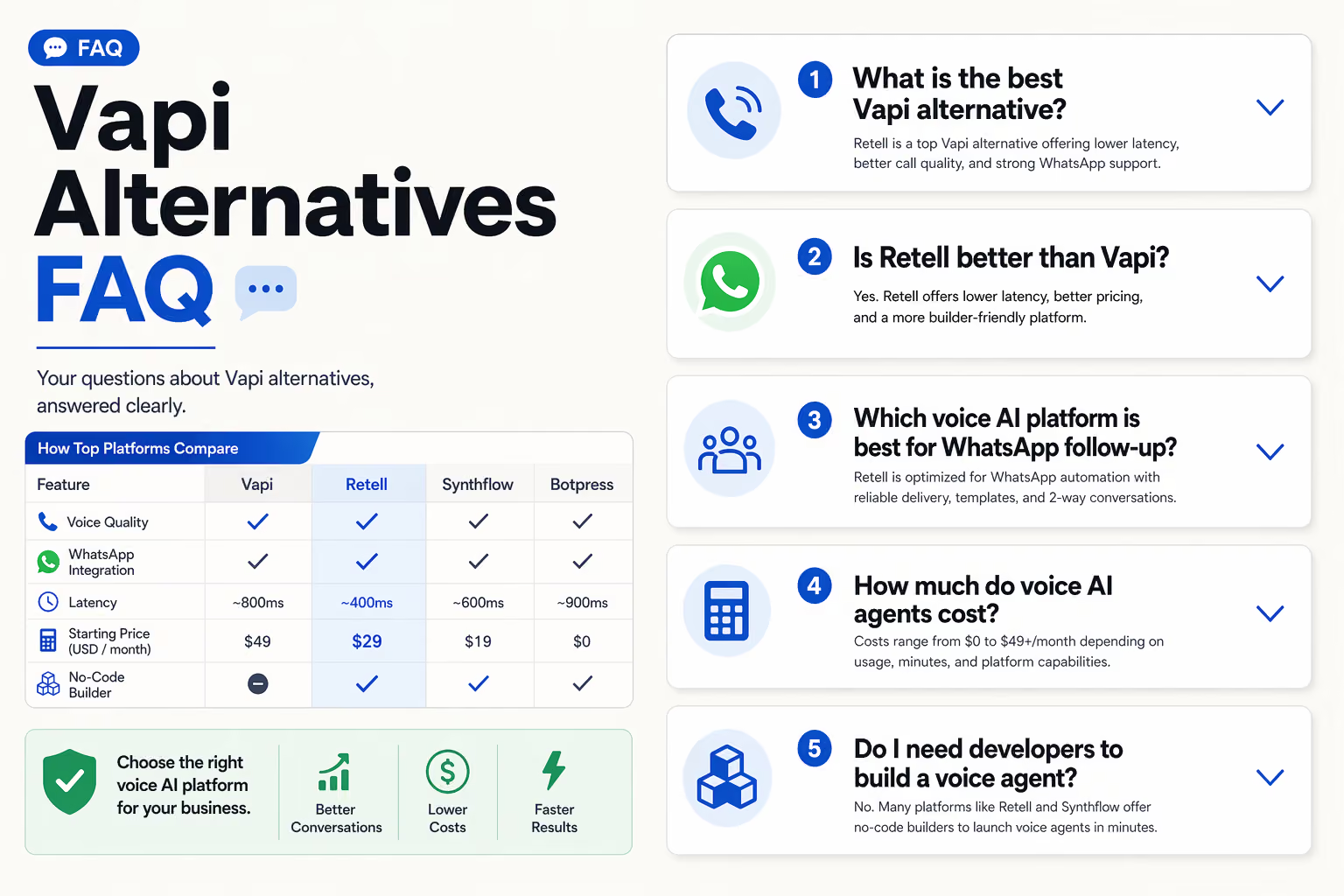
What is the best Vapi alternative for voice AI agents in 2026?
How should I compare Vapi AI alternatives for production use?
Is Retell better than Vapi for conversational voice agents?
What voice AI pricing should teams expect when comparing Vapi alternatives?
Why does WhatsApp follow-up matter after an AI voice agent call?
Which Vapi alternative is best for India or multilingual voice agents?
Conclusion
The best Vapi alternative in 2026 depends on what happens beyond the call:
- Choose Vapi for developer control and custom stacks.
- Consider Retell, Bland, or Synthflow for managed reliability, bundled workflows, or no-code teams.
- Prioritize platforms with WhatsApp follow-up, CRM integrations, pricing clarity, and multilingual readiness.
- In India and global markets, post-call automation is becoming as important as call quality.
Watch for voice AI moving from “agent demos” to full omnichannel customer journeys. To stay ahead, explore CallMissed — powering voice agents and multilingual WhatsApp chatbots for businesses.
Related Reading
Discussion
Loading discussion…