Bland AI vs Synthflow vs Retell AI vs Vapi: Best AI Voice Agent Solutions for Businesses in 2026
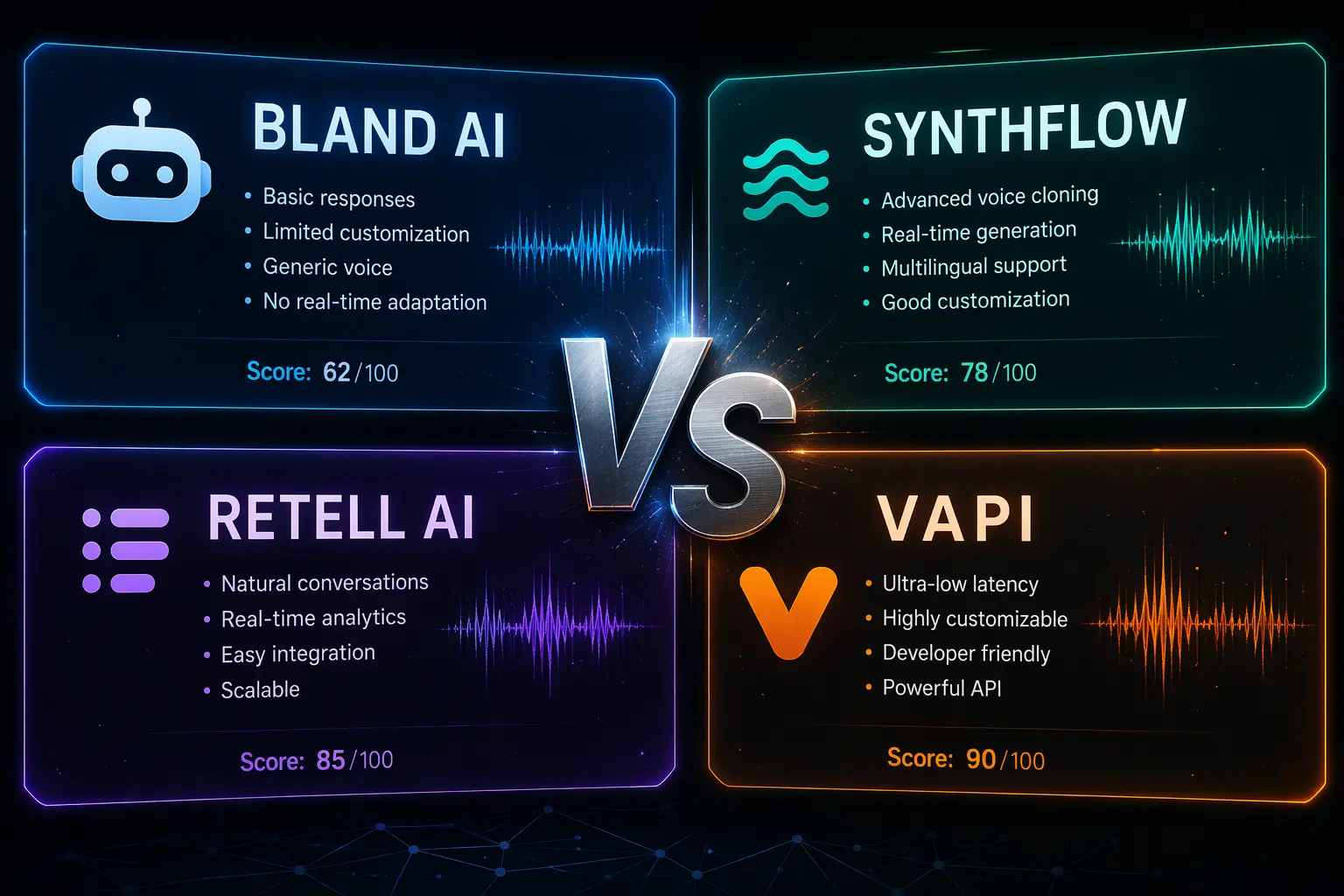
Compare the best AI voice agent platform options: Vapi, Retell, Bland, Synthflow and CallMissed for inbound calls, automation, integrations and deployment.
Introduction: The Rise of Sub-Second AI Phone Agents
There is no single best AI voice agent platform for every business. Vapi, Retell AI, Bland AI, Synthflow, and CallMissed differ most in how they are deployed, how workflows are built, which integrations they support, and how well they fit your calling languages, handoff requirements, and governance policies.
This comparison is for business and technical teams evaluating AI phone automation for inbound calls, outbound campaigns, missed-call follow-up, lead qualification, support routing, scheduling, and customer engagement. The right choice depends less on headline latency or advertised per-minute pricing than on whether the platform works reliably with your real callers, systems, operating regions, and approval processes.
Here is a practical comparison:
- Vapi — developer-led deployment and composable infrastructure: A strong option for engineering teams that want API access, configurable components, custom tools, and flexibility in how the voice stack is assembled. It may suit teams prepared to own more implementation, testing, and operational decisions.
- Retell AI — managed voice-agent operations: Worth evaluating for teams that want production-oriented call handling, testing, monitoring, and operational tooling without independently assembling every part of the stack. Confirm the support model, security controls, and service terms available on your plan.
- Bland AI — programmable outbound calling: Relevant for outbound automation and calling workflows that may need to operate at volume. Validate consent controls, regional calling rules, carrier performance, concurrency limits, and how the platform handles transfers or exceptions.
- Synthflow — visual workflow design: A potential fit for teams that prefer building voice workflows through a visual, lower-code interface rather than developing every call flow from scratch. Review how easily its workflows connect to your CRM, calendars, knowledge sources, and escalation processes.
- CallMissed — missed-call recovery and Indian-market journeys: Relevant for businesses that need to capture and follow up on missed or inbound calls, especially where multilingual Indian-language conversations and WhatsApp-connected workflows are important. Assess its fit for your routing, follow-up, integration, and compliance needs.
A capable AI voice agent platform should also support the operating model behind the conversation—not just the conversation itself. That means deciding who can change prompts and workflows, when a caller is transferred to a person, what data is retained, how recordings and transcripts are governed, and how failures are reviewed.
Before choosing, run identical test calls across the platforms and compare:
- Median and 95th-percentile time to first audio
- Interruption handling, endpointing, and recovery from overlapping speech
- Accuracy with realistic accents, background noise, names, and domain terminology
- Inbound routing, missed-call follow-up, transfer, and tool-call success rates
- Workflow design flexibility, approval controls, and ease of iteration
- CRM, calendar, WhatsApp, support-system, and custom API integration effort
- Language coverage and performance for the languages your customers actually use
- Human handoff rules, agent context transfer, and post-call follow-up
- Call connection rates, drop rates, concurrency, and regional availability
- Total cost per completed call, including telephony, phone numbers, voices, models, recordings, transfers, and platform fees
- Monitoring, transcripts, data retention, access controls, security, and compliance options
Latency and pricing should not be treated as fixed, platform-wide figures. Both can change with the telephony route, region, speech-to-text provider, model, text-to-speech engine, prompt size, tool calls, endpointing settings, network conditions, and plan terms.
Ultimately, the best AI voice agent platform is the one that delivers dependable outcomes on your actual calls while fitting your workflow ownership, integrations, language needs, human escalation process, and governance requirements.
At a Glance: Verdict
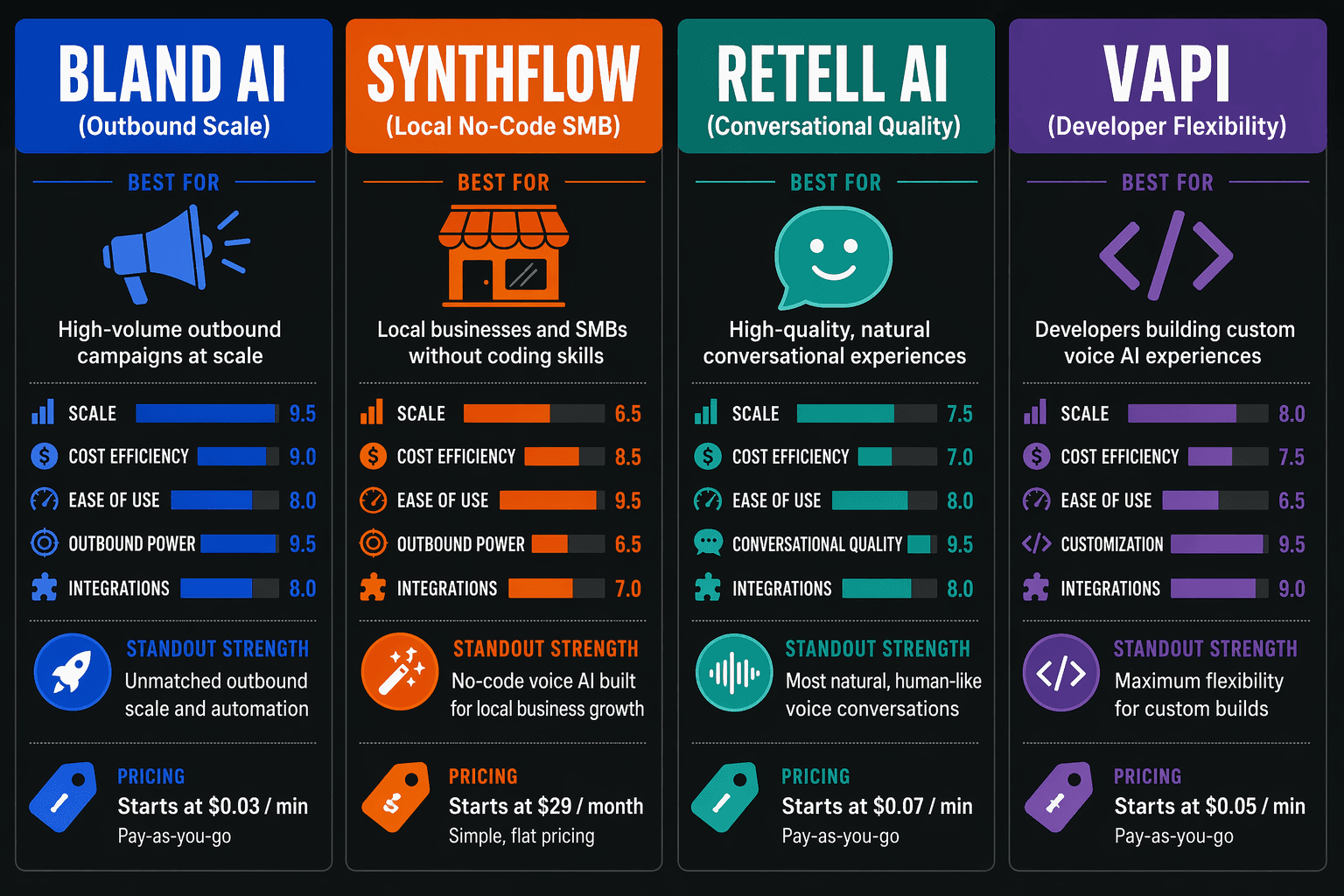
To help you cut through the marketing noise and choose the best AI voice agent solutions for business phone systems, we have boiled down the decision matrix into definitive, practical recommendations.
Choose your platform based on your primary business objectives:
- Bland AI: Best for enterprise-grade outbound cold calling and massive lead generation campaigns that require executing thousands of concurrent automated calls.
- Synthflow: Best for agency owners and small businesses looking for a complete no-code voice agent builder with pre-built CRM integrations and straightforward SaaS pricing starting at $29/month.
- Retell AI: Best for organizations demanding the absolute fastest, most natural conversational fluidity, leading the industry with ultra-low latency of 400–700ms.
- Vapi: Best for developer-first teams requiring granular control over their voice stack, offering a flexible pay-as-you-go API that easily integrates with external LLMs and custom telephony networks.
- Hybrid Operations: For enterprises seeking a unified communication layer, platforms like CallMissed bridge these ecosystems by offering access to over 300+ LLMs alongside built-in speech-to-text (STT) for 22 regional Indian languages.
Ultimately, your choice depends on whether your priority is raw speed (Retell AI), effortless setup (Synthflow), high-volume outbound campaigns (Bland AI), or total customizability (Vapi).
Feature Comparison
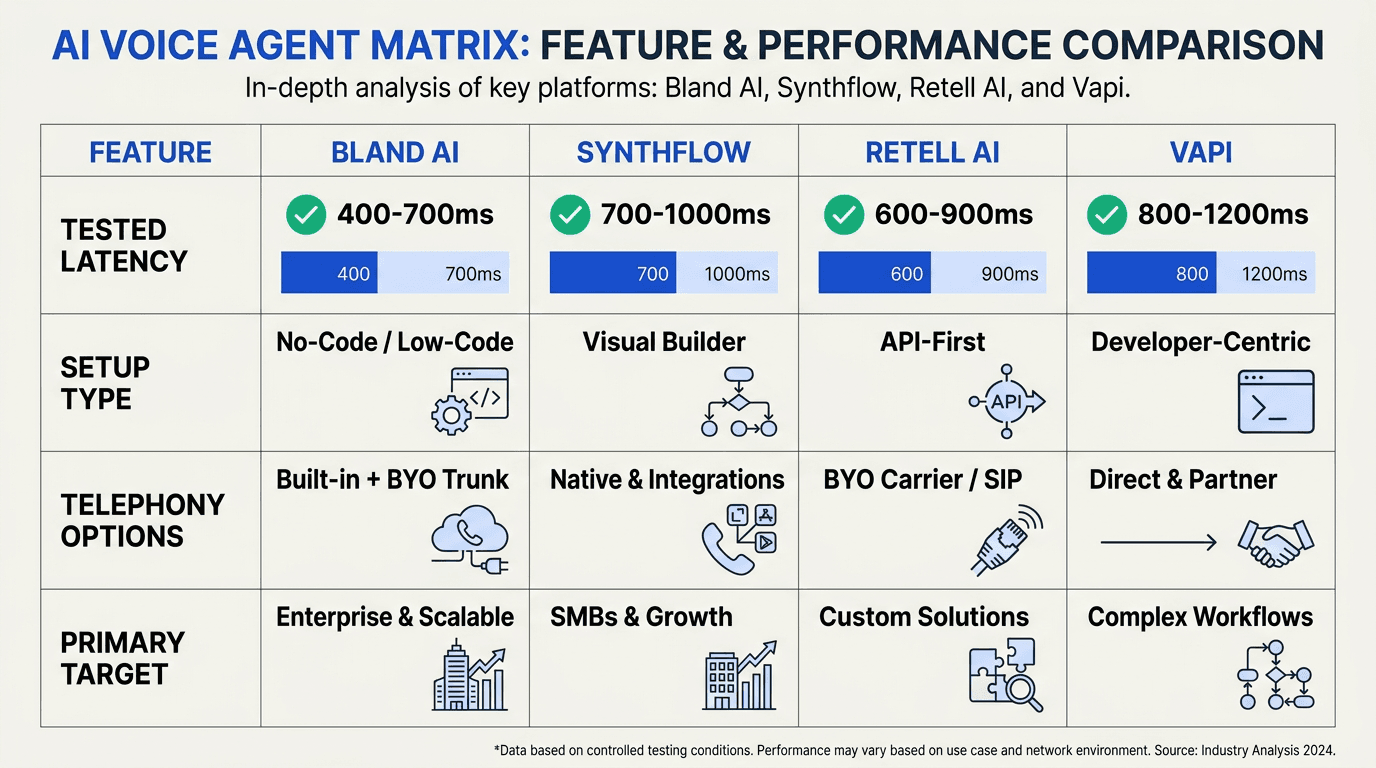
To help you identify the best AI phone agent for your business phone systems, we have compiled a direct technical and operational breakdown of the leading platforms.
| Platform | Latency Benchmark | Primary Pricing Model | Target User | Key Strength |
|---|---|---|---|---|
| Retell AI | 400–700ms | Pay-as-you-go API ($0.15/min) | Developers | Ultra-low latency & conversational control |
| Bland AI | 600–900ms | SaaS + Usage ($0.09/min base) | Enterprises | High-volume outbound campaigns |
| Synthflow | 700–1000ms | Subscription plans (from $29/mo) | Non-technical / SMBs | Visual no-code drag-and-drop builder |
| Vapi | 800–1200ms | Pay-as-you-go API ($0.15/min) | Developers | Multi-provider LLM & TTS flexibility |
Key Feature Takeaways
- Retell AI: Best-in-class for real-time responsiveness. It uses a proprietary WebRTC stack to achieve a 400–700ms latency, making it the most natural AI receptionist software for high-touch customer support.
- Bland AI: The ultimate engine for outbound calling campaigns. It is built to execute millions of concurrent automated phone calls, featuring robust API pathways for deep CRM syncing.
- Synthflow: The ideal zero-code AI calling agent platform. Its intuitive interface allows non-technical business owners to deploy a fully functional AI phone answering system in minutes without writing a single line of code.
- Vapi: A highly customizable, developer-first orchestrator. It allows you to mix and match LLM providers (OpenAI, Anthropic) and TTS engines (ElevenLabs, Deepgram) to construct highly tailored voice workflows.
- CallMissed: For businesses needing native multilingual support, CallMissed bridges the gap by offering a multi-model API gateway supporting 22 Indian regional languages alongside its production-ready voice agent infrastructure.
Pricing & Value
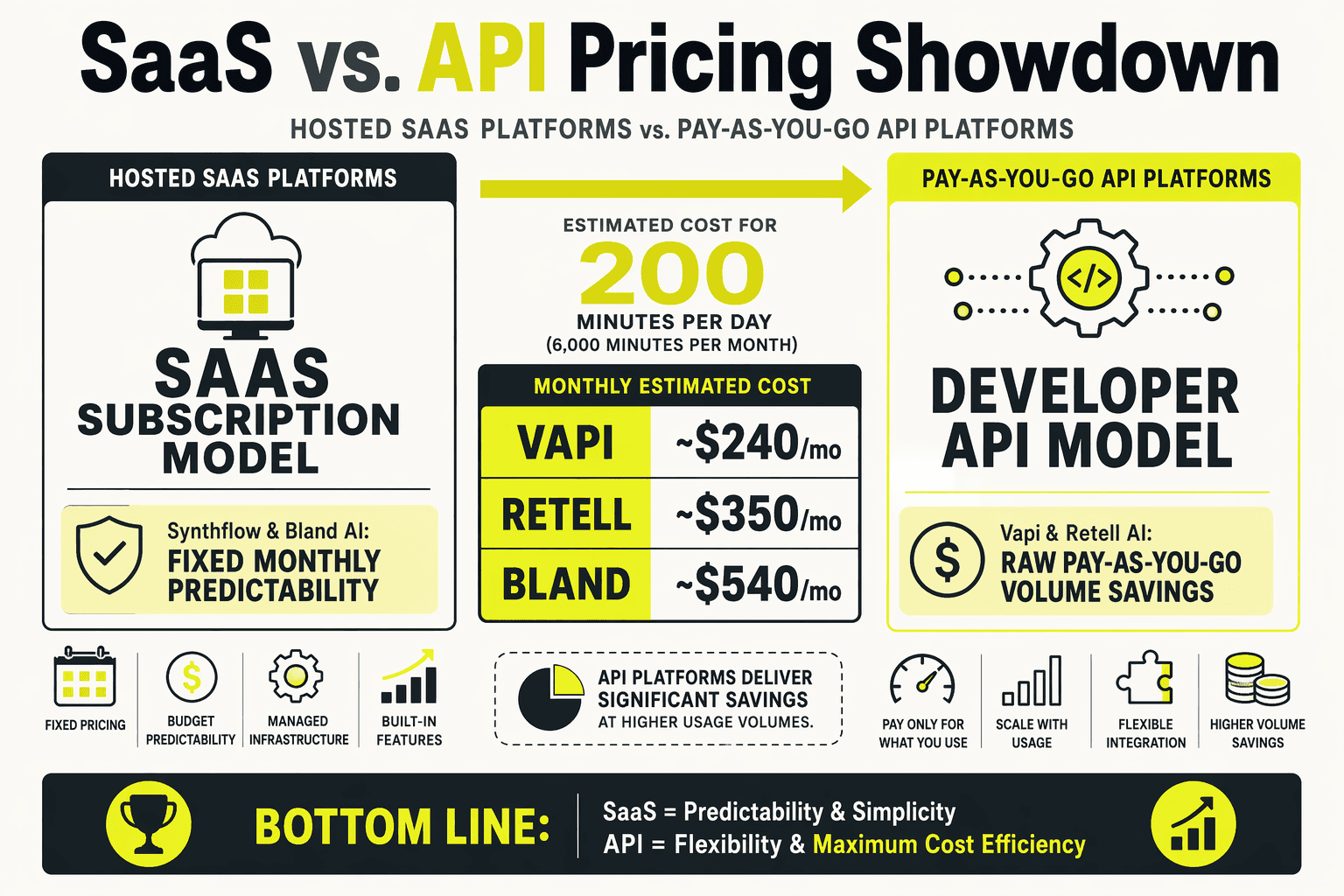
Evaluating the financial viability of an AI calling agent platform requires looking past the surface per-minute rates to analyze platform fees, hidden telecom surcharges, and commitments.
| Platform | Starting Price / Plan | Base Cost Per Minute | Key Pricing Feature | Target Audience |
|---|---|---|---|---|
| Vapi | Pay-as-you-go ($0/mo) | $0.15 / min | Bring Your Own Keys (BYOK) for TTS/LLM | Developers & Startups |
| Retell AI | Pay-as-you-go ($0/mo) | $0.15 / min | Dedicated low-latency infrastructure | Mid-Market & Enterprise |
| Bland AI | $19.99/mo (Subscription) | $0.09 - $0.15 / min | Low rates for massive outbound volume | Enterprise Outbound |
| Synthflow | $29/mo (Subscription) | $0.13 - $0.20 / min | Bundled minutes with no-code builder | SMBs & Agencies |
Key Pricing & Value Takeaways
- Vapi: Offers a developer-first, pure utility model with a flat $0.15 per minute platform fee, allowing you to plug in your own cheap LLM and TTS keys to keep overall costs exceptionally low.
- Retell AI: Matches Vapi's $0.15 per minute base rate but offers premium volume discounts for enterprises requiring guaranteed low-latency trunking and dedicated computing instances.
- Bland AI: Requires a monthly subscription starting at $19.99, but slashes per-minute rates down to $0.09 for high-volume enterprise outbound campaigns, making it the most cost-effective for mass cold-calling.
- Synthflow: Focuses on SaaS-style tiers starting at $29/month with bundled minutes; while per-minute costs are higher (up to $0.20), it provides the best out-of-the-box value for non-technical users who need an all-in-one AI receptionist software.
- The CallMissed Advantage: For businesses seeking to optimize their bottom line, infrastructure platforms like CallMissed offer a powerful alternative, letting teams deploy highly customizable voice agents across 22 regional Indian languages with transparent, multi-model pricing that avoids expensive SaaS lock-ins.
Pros and Cons
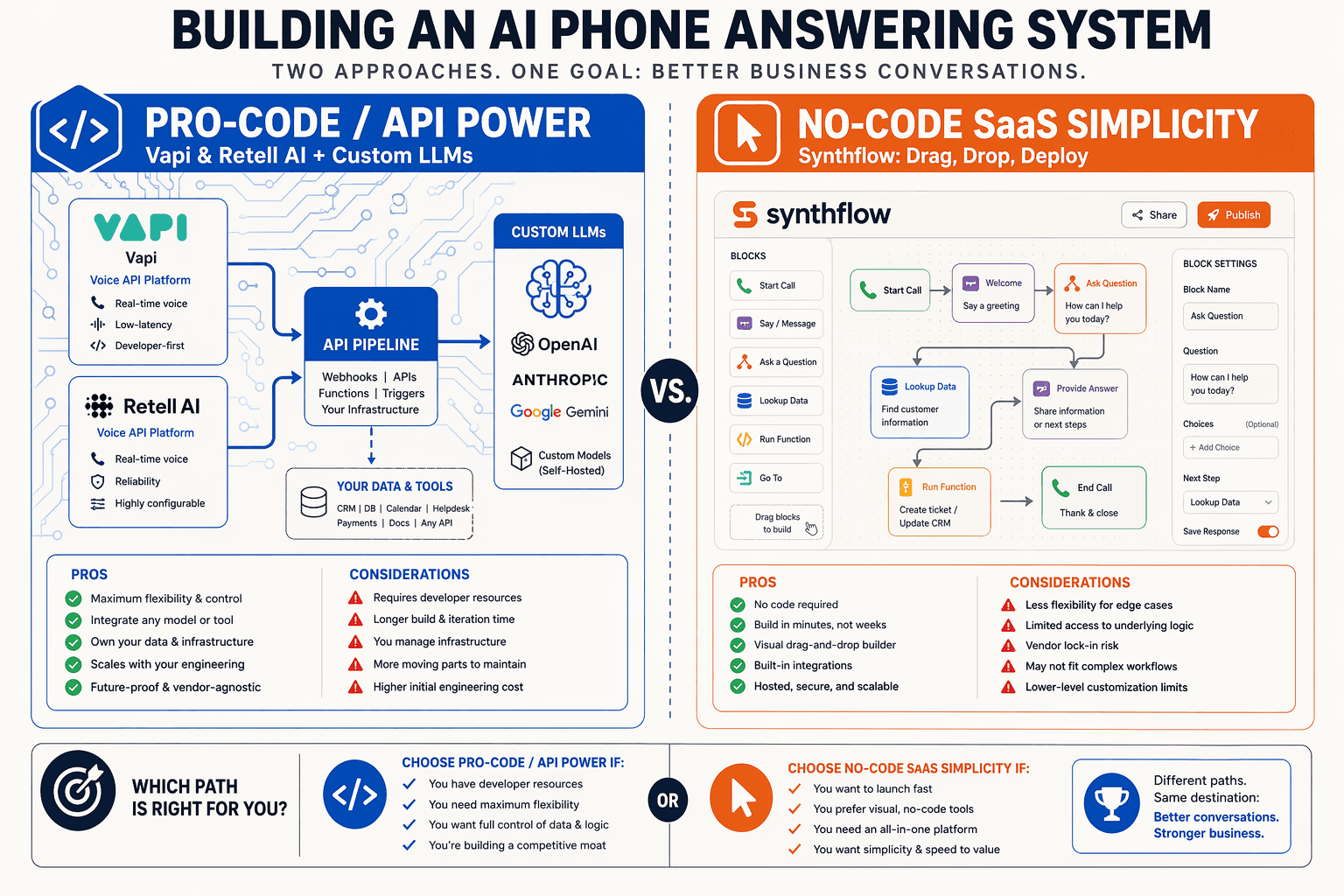
To make an informed choice, businesses must weigh the trade-offs of each platform. The best AI voice agent solutions for business phone systems vary significantly based on whether you prioritize developer control, outbound call volume, or no-code setup.
| Platform | Primary Strengths | Major Limitations | Pricing Model | Best For |
|---|---|---|---|---|
| Bland AI | Unmatched scale, custom pathway builder, robust enterprise outbound capability | Steeper developer learning curve, higher upfront setup complexity | Paid subscription tiers + usage fees | Enterprises running massive outbound call campaigns |
| Synthflow | Visual drag-and-drop workflow builder, fast setup, zero coding required | Higher cost-per-minute on lower tiers, restricted custom API integrations | Monthly subscription with bundled minutes | Non-technical agencies, SMBs, and local service providers |
| Retell AI | Ultra-low latency (400-700ms), advanced state tracking, incredibly natural voices | Requires software engineering resources to maximize its API potential | Pay-as-you-go developer API ($0.15/min base + LLM/TTS) | Inbound customer support and high-performance AI receptionists |
| Vapi | High developer flexibility, multi-provider interoperability, open system architecture | Requires external SIP/telephony configurations, slightly higher average latency | Pay-as-you-go developer API ($0.15/min base + third-party costs) | Tech-forward developers wanting complete control over their tech stack |
Strategic Trade-Offs at a Glance
- Bland AI: Pros: Best-in-class for handling millions of concurrent calls, enterprise-grade compliance, and programmatic routing. Cons: Complex implementation process compared to drag-and-drop competitors.
- Synthflow: Pros: Easiest no-code voice agent builder for quick deployments, seamless local CRM sync, and rapid template setups. Cons: Rigid pricing models make it highly expensive for large-scale enterprise rollouts.
- Retell AI: Pros: The market leader in raw conversational speed with sub-700ms response times, minimizing awkward call overlaps. Cons: Lacks a native, end-to-end visual flow builder for non-technical users.
- Vapi: Pros: Complete freedom to swap LLMs, speech-to-text, and TTS engines instantly to customize costs and features. Cons: Latency can fluctuate depending on your chosen third-party integrations (ranging up to 1200ms).
For businesses seeking a balanced approach—especially those operating globally or in multilingual markets—infrastructure alternatives like CallMissed offer unified multi-model gateways. Platforms such as CallMissed complement these engines by offering native support for 22 regional Indian languages and a library of 300+ LLMs, helping businesses deploy high-performance AI phone answering systems without getting locked into a single voice provider's ecosystem.
Which Should You Choose?
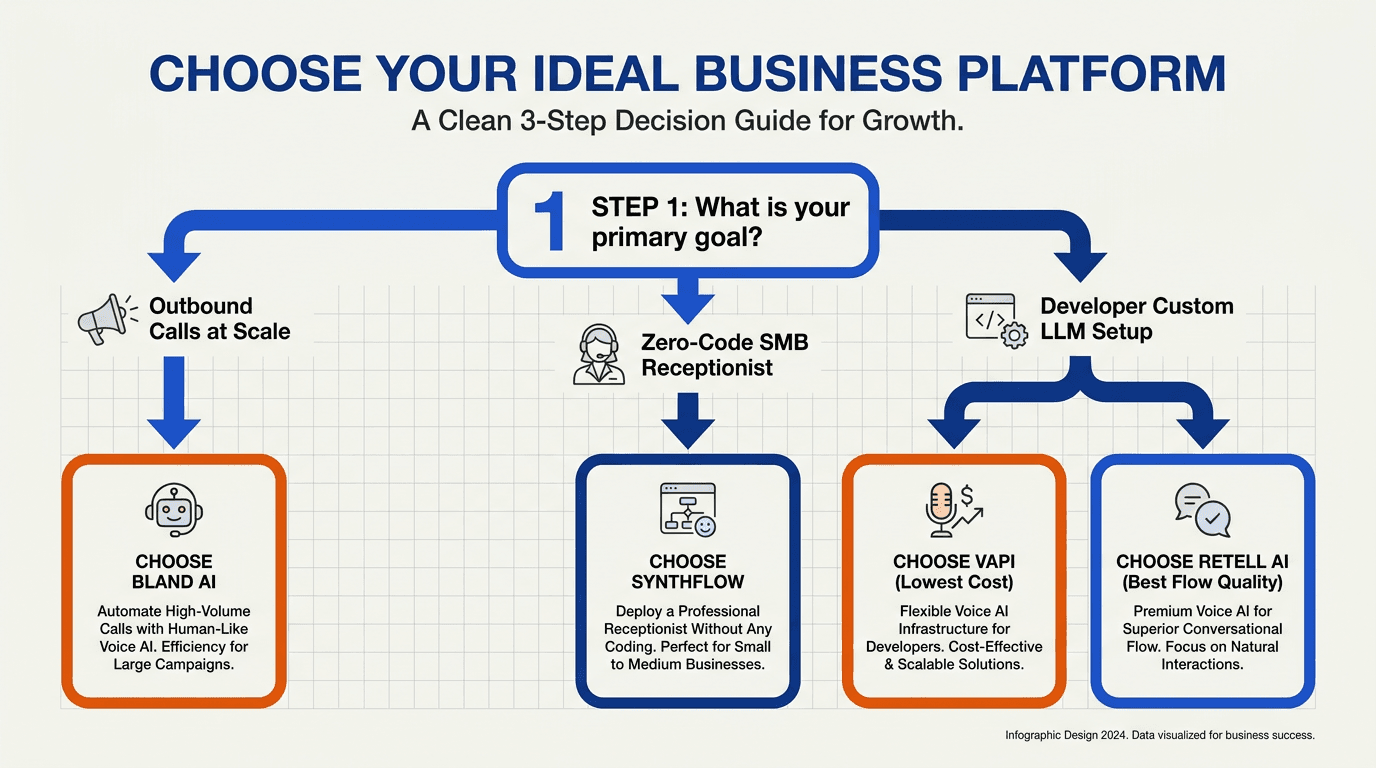
Choosing the right AI calling agent platform depends entirely on your team's technical expertise, call volume, and business goals.
Best For Outbound Scale: Bland AI
- Bland AI: The ideal choice if your primary goal is launching hyper-scale, high-volume outbound campaigns with up to millions of concurrent automated phone calls.
- Bland AI: Best suited for businesses comfortable with a SaaS-style subscription model with bundled minutes rather than pay-as-you-go pricing.
- Bland AI: Delivers strong enterprise compliance and custom tooling, though it sits at a slightly higher latency tier (600–900ms) compared to developer-first alternatives.
Best For Advanced Developers: Retell AI & Vapi
- Retell AI: The gold standard for real-time responsiveness, boasting a industry-leading latency of 400–700ms for natural, interruption-tolerant conversations.
- Retell AI: Offers deep voice customizability and seamless integration with leading LLMs and advanced TTS systems via its developer-first API.
- Vapi: Provides a highly flexible, pay-as-you-go developer API with 800–1200ms latency, making it the most cost-effective sandbox for building custom VoIP architectures from scratch.
- Vapi: Extremely customizable for engineering teams who want complete control over their LLM backends and telephony routing without paying subscription premiums.
Best For No-Code Deployment: Synthflow
- Synthflow: The best no-code voice agent builder on the market, allowing non-technical teams to deploy a functional AI receptionist software in minutes.
- Synthflow: Employs an intuitive drag-and-drop workflow that simplifies CRM integrations and local lead routing with respectable 700–1000ms latency.
- Synthflow: Perfect for small businesses and solopreneurs looking for predictable, tiered monthly subscription pricing rather than complex API billing.
For businesses seeking a unified approach, infrastructure platforms like CallMissed offer the best of both worlds by providing production-ready voice agent infrastructure alongside a multi-model API gateway, allowing you to deploy multilingual agents supporting 22 regional Indian languages natively.
Frequently Asked Questions
Here are some of the most frequently asked questions about deploying the best AI voice agent solutions for business phone systems in 2026:
Which AI calling agent platform has the lowest latency in 2026?
Can I build an AI phone agent for business tasks without writing any code?
How do pricing structures differ between an API platform and a SaaS-based AI calling agent platform?
Which AI receptionist software is best for high-volume outbound calling campaigns?
Do these AI voice platforms support multiple languages for global businesses?
Do I need to buy a separate phone number to use an AI receptionist?
Conclusion
Selecting the best AI voice agent solution for your business phone system ultimately depends on your technical resources and scaling goals:
- For developer-first customization and ultra-low latency: Retell AI and Vapi offer the most flexible, pay-as-you-go APIs.
- For rapid, no-code deployment: Synthflow provides an intuitive, visual drag-and-drop builder.
- For high-volume outbound campaigns: Bland AI delivers the infrastructure needed to scale millions of concurrent automated calls.
As sub-second AI receptionists become the standard, the future lies in unified, multi-model communication. To explore how AI communication is evolving, check out CallMissed — an AI infrastructure platform powering voice agents and multilingual chatbots for businesses. Ready to transition your business phone systems to the next generation of voice AI?
Related Reading
Discussion
Loading discussion…