Real-Time Speech-to-Speech APIs Compared: Best Voice Agent APIs in 2026


Compare real-time speech-to-speech APIs for voice agents by latency, stack control, pricing, telephony, tool calling, and best use case.
Real-Time Speech-to-Speech APIs Compared: Best Voice Agent APIs in 2026
What if the difference between a “smart” voice agent and a frustrating robocall is just 300 milliseconds? In 2026, real-time speech-to-speech APIs have become the core infrastructure behind customer support, sales, healthcare intake, and multilingual service automation. Developers are no longer comparing only STT or TTS quality—they’re evaluating full-stack latency, interruption handling, telephony support, LLM routing, compliance, and cost. Recent provider roundups now compare 8+ voice agent APIs, including OpenAI Realtime API, Deepgram Voice Agent API, Microsoft Voice Live API, Vapi, Retell, ElevenLabs, and others.
This guide breaks down the best voice agent API options for teams building production-ready real-time voice AI agents. You’ll learn how leading speech-to-speech API providers differ, when to choose orchestration platforms versus modular APIs, and where platforms like CallMissed—offering voice agents, 300+ LLMs, and multilingual STT across 22 Indian languages—fit into the 2026 voice AI stack.
Introduction: What Counts as a Voice Agent API in 2026?
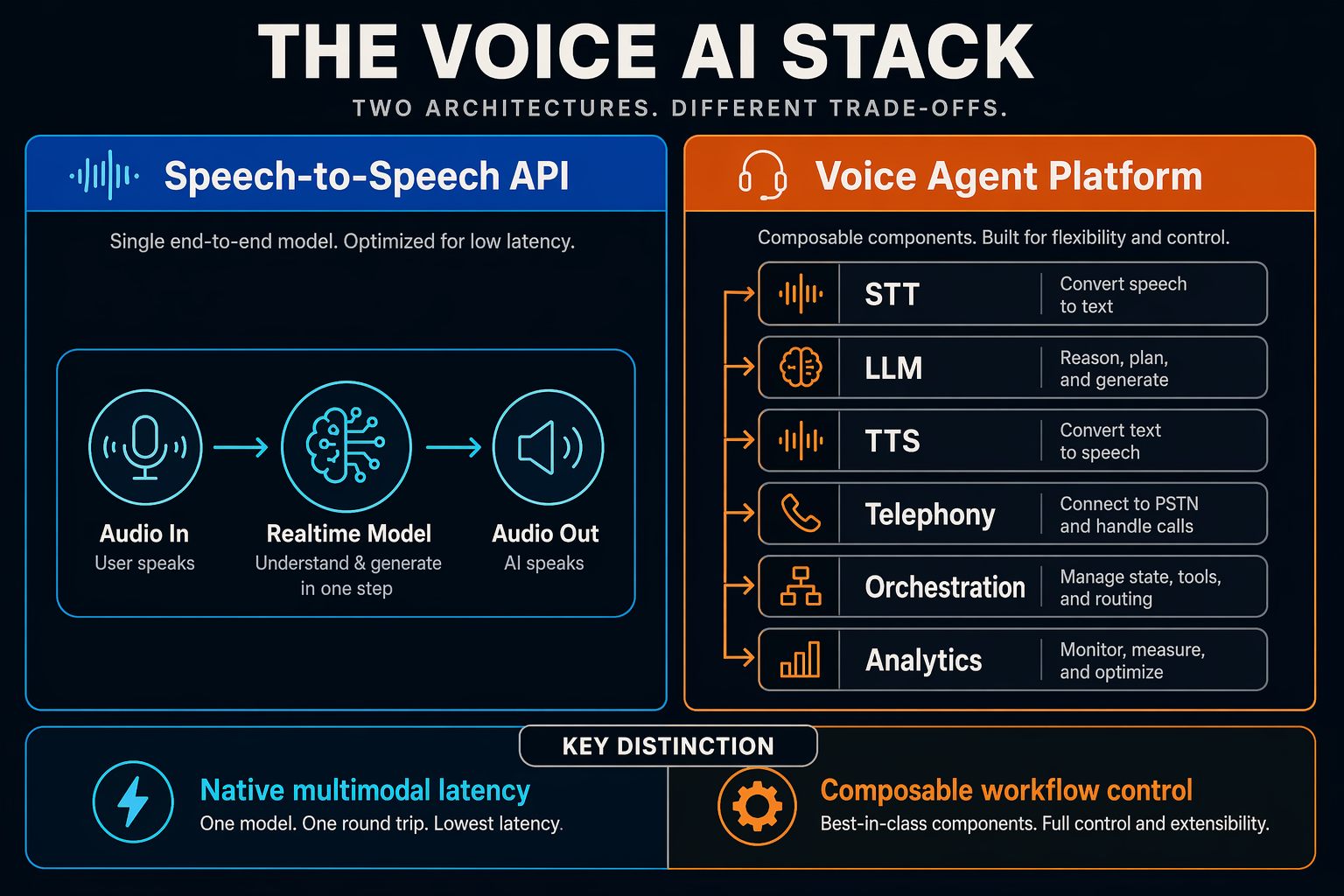
In 2026, a voice agent API means more than “STT + TTS.” It is the real-time infrastructure layer that lets developers build voice agents that listen, reason, speak, interrupt, call tools, and connect to phone systems.
- Core definition: A modern speech-to-speech voice agent API streams audio in, interprets user intent, routes to an LLM or workflow, and streams speech back with low latency—often over WebRTC, SIP, WebSocket, or telephony APIs.
- Not enough: Standalone speech-to-text or text-to-speech APIs do not count by themselves; they become voice-agent infrastructure only when paired with turn-taking, interruption handling, context memory, tool calls, and real-time response generation.
- OpenAI Realtime API: Best understood as a low-level real-time voice AI API for multimodal speech interaction, useful when teams want direct control over model behavior, audio streaming, and custom orchestration.
- Deepgram Voice Agent API: Deepgram’s 2026 roundup compares 8 voice agent APIs across STT, TTS, LLM, and telephony layers, reflecting how buyers now evaluate full stacks rather than isolated transcription accuracy.
- Microsoft Voice Live API: Fits the enterprise category: a managed path for building real-time voice AI agents inside the Microsoft/Azure ecosystem, where governance, identity, and compliance often matter as much as latency.
- Orchestration platforms: Vapi and Retell sit above the model layer; Retell’s 2026 provider comparison describes stacks using Deepgram for STT, GPT-4o for the LLM, and ElevenLabs for TTS through Vapi’s orchestration API, showing how modular voice infrastructure is commonly assembled.
- Specialized providers: Inworld’s 2026 enterprise voice-agent list highlights components such as Inworld Realtime TTS, Deepgram Voice Agent stack, and Cartesia Sonic 3.5, which shows the market splitting into orchestration, speech models, and end-to-end agent platforms.
- Production checklist: A provider counts as a serious build voice agents developer platform only if it supports real-time streaming, barge-in, multilingual speech, function calling, call transfer, analytics, monitoring, and predictable pricing under real call volumes.
- Regional readiness: For India and multilingual markets, the API must support local languages and accents; platforms like CallMissed address this with voice agents, WhatsApp chatbots, 300+ LLM access, and Speech-to-Text across 22 Indian languages.
- Bottom line: In this comparison, “voice agent API” means a deployable layer for real-time voice AI agents, not just a demo chatbot with a synthetic voice.
At a Glance: Verdict by Use Case
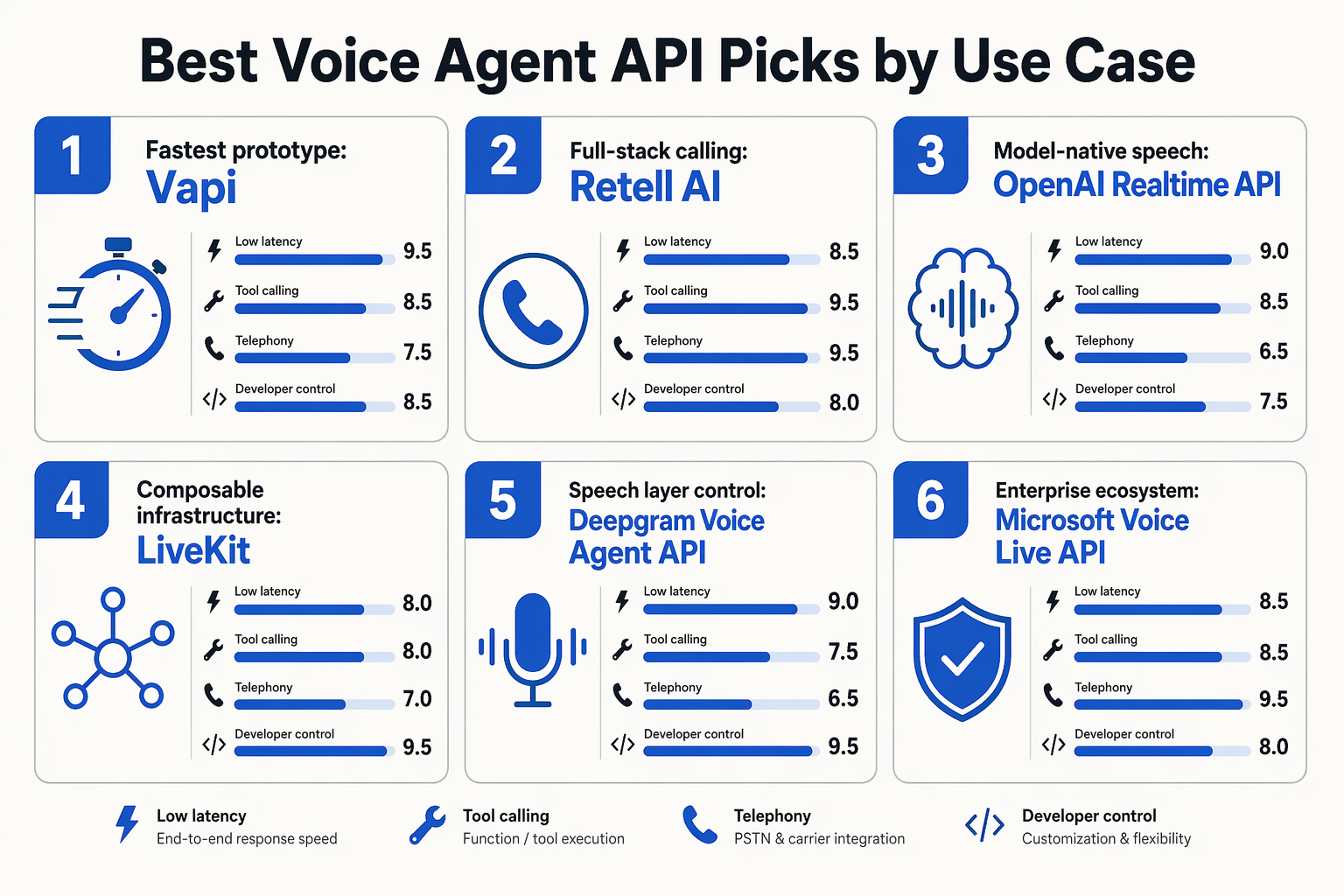
Use this shortlist to match each voice agent API category to the job, not the hype.
- OpenAI Realtime API: Best for teams needing direct control over real-time speech-to-speech APIs, multimodal behavior, custom tool calls, and low-level audio streaming.
- Deepgram Voice Agent API: Best for STT-first builders; Deepgram’s 2026 guide compares 8 voice agent APIs across STT, TTS, LLM, and telephony layers, making it strong for modular stack decisions.
- Microsoft Voice Live API: Best for enterprises already on Azure that need governance, identity, compliance, and managed deployment more than maximum provider flexibility.
- Vapi: Best orchestration layer when developers want to assemble best-of-breed components; Retell’s 2026 comparison cites stacks using Deepgram for STT, GPT-4o for LLM, and ElevenLabs for TTS through Vapi-style orchestration.
- Retell AI: Best all-around managed platform for business voice agents; Retell’s own 2026 ranking positions it as a practical choice for teams optimizing latency, pricing, and enterprise CX workflows.
- ElevenLabs Conversational AI: Best when natural voice quality is the priority; developer discussions in 2026 frequently compare ElevenLabs against OpenAI Realtime API and Deepgram for realtime voice-agent performance.
- Inworld / Cartesia / specialized TTS providers: Best for immersive, branded, or character-driven agents; Inworld’s 2026 enterprise list highlights Inworld Realtime TTS, Deepgram Voice Agent stack, and Cartesia Sonic 3.5.
- CallMissed: Best fit for multilingual business automation in India and global support teams needing voice agents, WhatsApp bots, 300+ LLMs, and STT across 22 Indian languages in one developer platform.
Feature Comparison: Latency, Barge-In, Tool Calling, Telephony, and Model Control
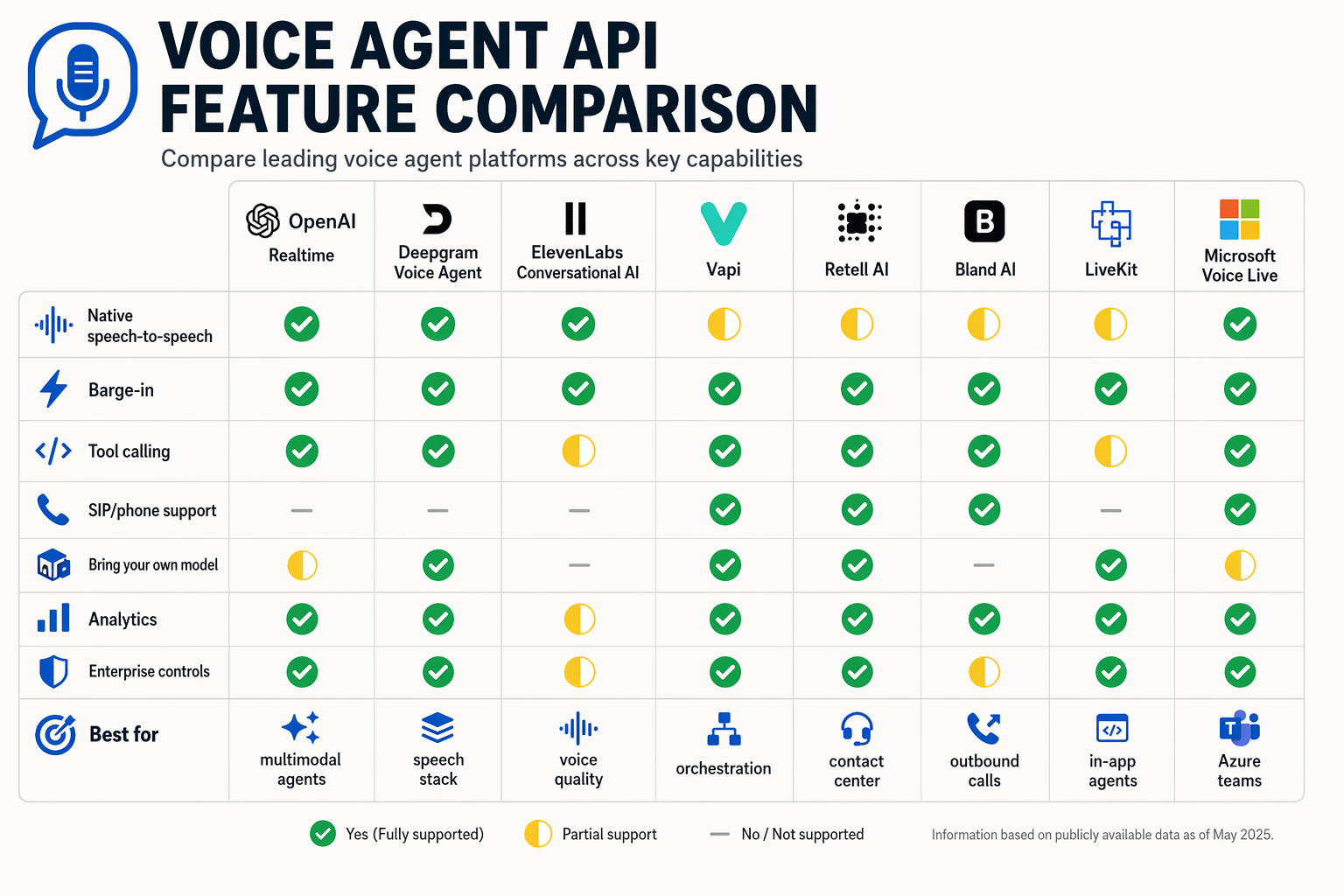
Use this as a buyer checklist: the “best” voice agent API depends less on demo voice quality and more on control over latency, interruptions, tools, phone routing, and model choice.
| Provider / Stack | Latency & Streaming | Barge-In / Turn-Taking | Tool Calling & Model Control | Telephony Fit |
|---|---|---|---|---|
| OpenAI Realtime API | Built for low-latency multimodal audio over real-time sessions | Strong conversational interruption handling | High control over model behavior, prompts, events, and function calls | Requires custom SIP/WebRTC/phone integration |
| Deepgram Voice Agent API | Positioned for real-time agents; Deepgram’s 2026 guide compares 8 APIs across STT, TTS, LLM, and telephony | Strong STT-first turn detection for conversational agents | Modular: combine Deepgram STT with external LLM/TTS | Usually paired with telephony/orchestration layers |
| Microsoft Voice Live API | Enterprise real-time voice inside Azure | Good for governed enterprise flows | Strong Azure identity, compliance, and app integration | Best for Microsoft/Azure contact-center stacks |
| Vapi / Retell-style orchestration | Optimized for production call flows, not just raw audio | Built-in interruption, call state, retries, and routing | Retell’s 2026 comparison cites stacks using Deepgram STT + GPT-4o + ElevenLabs TTS via Vapi | Strong: phone numbers, SIP, outbound/inbound calling |
| ElevenLabs / Cartesia / Inworld TTS-led stacks | Differentiated by expressive, fast speech output; Inworld lists Inworld Realtime TTS and Cartesia Sonic 3.5 among 2026 enterprise options | Depends on orchestration layer | Best when voice realism is the priority | Needs agent/telephony middleware |
| CallMissed | Production voice-agent layer with multilingual STT/TTS options | Designed for customer-call automation | Routes across 300+ LLMs and supports STT in 22 Indian languages | Strong fit for Indian and multilingual business telephony |
- OpenAI: Best when developers want maximum real-time model control and can build telephony plumbing themselves.
- Deepgram: Best when speech recognition quality and streaming transcription are the foundation of the agent stack.
- Vapi/Retell: Best when teams want faster deployment of inbound/outbound phone agents with less infrastructure work.
- Microsoft: Best for enterprises standardizing on Azure governance, security, and identity.
- CallMissed: Best for multilingual business voice agents where telephony, LLM routing, and Indian language coverage matter together.
Pricing & Value: Per-Minute, Token, Telephony, and Orchestration Costs
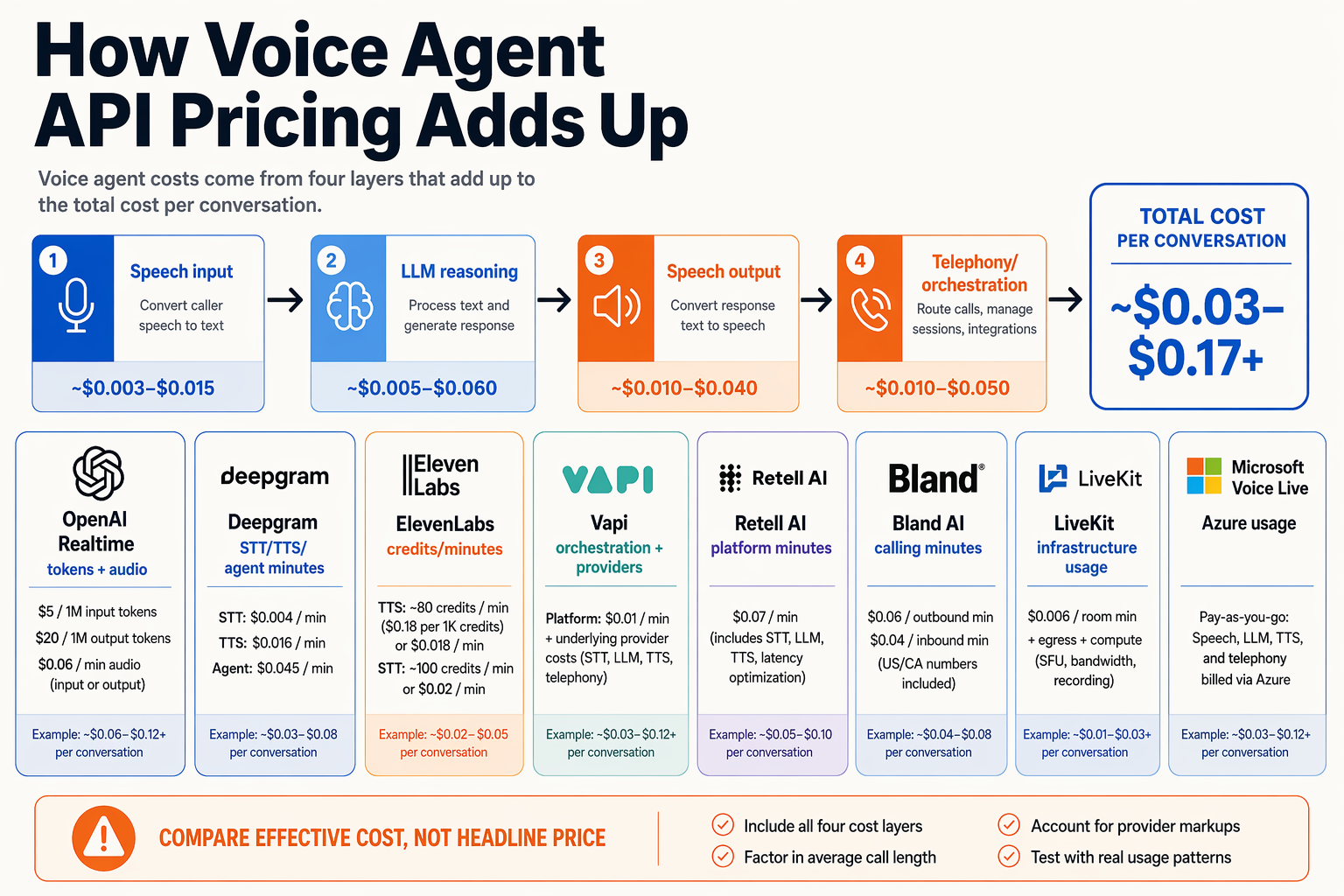
Pricing is no longer one line item: production voice agent API cost is usually a stack of audio minutes, LLM tokens, phone minutes, and orchestration fees.
| Provider / Stack | Main Pricing Unit | Extra Cost Layers | Best Value When | Watch-Out |
|---|---|---|---|---|
| OpenAI Realtime API | Audio + model usage | Tokens, session time, tool calls, custom telephony | You need low-level control over a real-time voice AI API | Telephony, call routing, retries, and observability are DIY |
| Deepgram Voice Agent API | Speech minutes / agent usage | STT, TTS, LLM, telephony depending on setup | You want optimized speech infrastructure; Deepgram’s 2026 guide compares 8 voice agent APIs across STT, TTS, LLM, and telephony | Final cost depends on chosen LLM and voice layer |
| Vapi / Retell-style orchestration | Per-minute orchestration | STT provider + LLM tokens + TTS + phone carrier | Fastest path to production call agents | Markup can compound across every call minute |
| Microsoft Voice Live API | Azure consumption model | Speech, model, storage, compliance, networking | Enterprises already standardized on Azure identity and governance | Best value usually comes with Azure volume commitments |
| Modular stack: Deepgram + GPT-4o + ElevenLabs | Separate vendor bills | STT minutes + LLM tokens + TTS characters + telephony | You want best-of-breed components; Retell’s 2026 comparison cites this pattern via Vapi orchestration | Harder cost forecasting and more vendor contracts |
| CallMissed-style platform | Platform/API usage | Voice agent, WhatsApp, LLM inference, STT/TTS, telephony | Teams needing multilingual deployment, including 22 Indian-language STT and access to 300+ LLMs | Compare bundled pricing against your expected call volume |
- OpenAI: Strong value for developer teams building custom speech-to-speech voice agent API flows, but you must budget engineering time for SIP/WebRTC, monitoring, and fallbacks.
- Deepgram: Better cost control when speech accuracy and streaming STT are the bottleneck; its 2026 comparison explicitly separates STT, TTS, LLM, and telephony layers.
- Vapi / Retell: Higher per-minute platform cost can be justified if orchestration reduces build time from months to weeks.
- ElevenLabs / Cartesia-style TTS: Premium voices improve conversion and CSAT, but character-based TTS pricing can spike for long support calls.
- Telephony: Always price separately—carrier minutes, number rental, recording, SIP trunks, and regional termination can materially change margins.
- LLM tokens: For complex agents, token spend may exceed speech cost because every turn includes context, tools, memory, and compliance instructions.
- Best rule: Model cost per successful outcome, not cost per minute; a $0.20/min agent that resolves calls in 2 minutes beats a $0.08/min agent that loops for 8.
Pros and Cons: Provider Trade-Offs for Developers
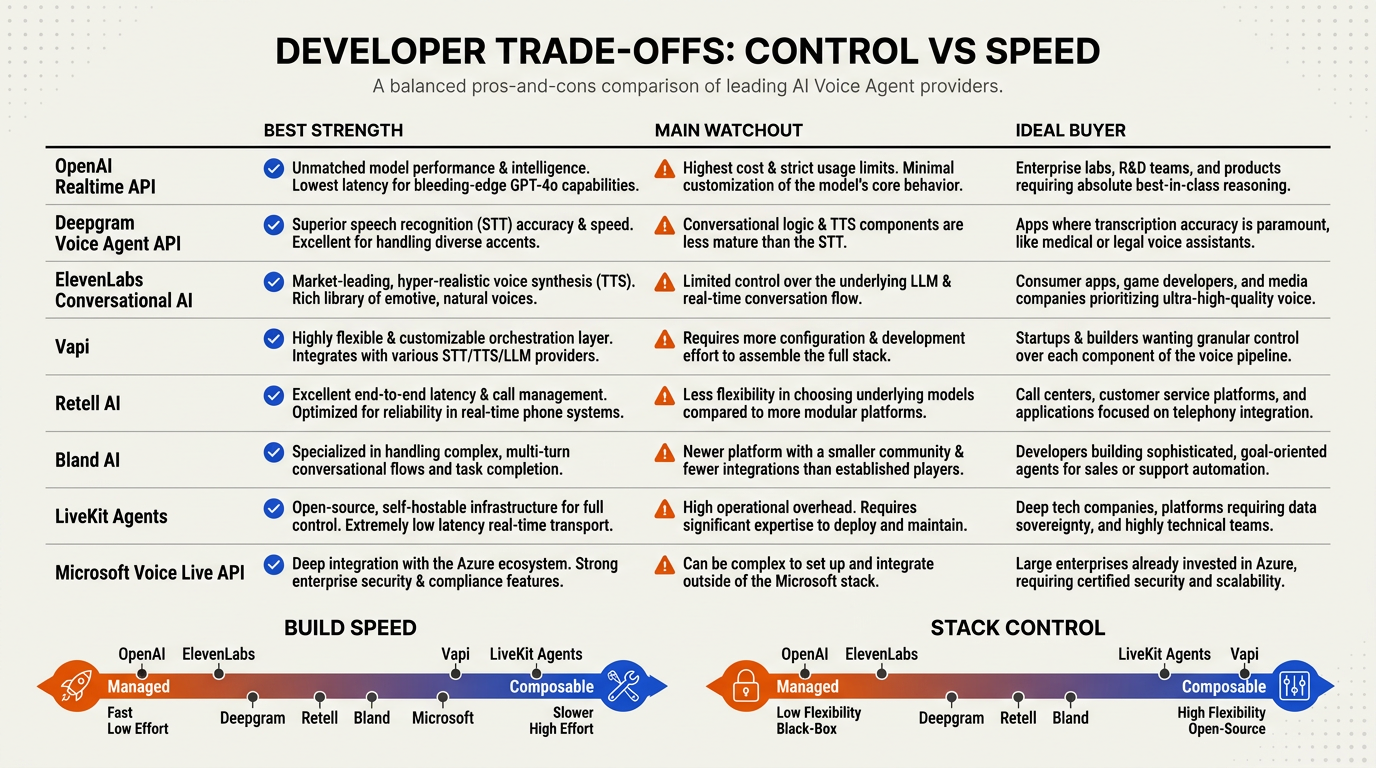
Developer trade-offs usually come down to control vs speed-to-market, plus whether you want one real-time voice AI API or a modular stack.
| Provider / Stack | Best Fit | Pros | Cons | Developer Trade-Off |
|---|---|---|---|---|
| OpenAI Realtime API | Custom speech-to-speech agents | Low-level control over audio streaming, model behavior, interruptions, and multimodal flows | Requires more orchestration for telephony, routing, analytics, and enterprise workflows | Best when your team wants to own the full agent architecture |
| Deepgram Voice Agent API | Real-time STT-first voice agents | Deepgram’s 2026 roundup compares 8 voice agent APIs across STT, TTS, LLM, and telephony layers; strong fit for streaming transcription | You may still combine separate LLM, TTS, and phone providers | Good for teams optimizing latency and transcription quality |
| Microsoft Voice Live API | Azure-heavy enterprises | Strong governance, identity, compliance, and Microsoft ecosystem integration | Less attractive for teams outside Azure or needing fast vendor-neutral experimentation | Best when procurement, security, and compliance outweigh stack flexibility |
| Vapi / Retell | Fast voice-agent deployment | Orchestration layer abstracts STT, LLM, TTS, and calls; Retell’s 2026 comparison cites stacks using Deepgram STT + GPT-4o + ElevenLabs TTS through Vapi | Less control over each low-level component; platform pricing can compound at scale | Best for shipping production agents quickly |
| ElevenLabs / Cartesia / Inworld TTS | Natural, expressive voices | Inworld’s 2026 enterprise list highlights Inworld Realtime TTS, Cartesia Sonic 3.5, and Deepgram’s stack | Usually not a complete voice-agent backend alone | Best as a premium voice layer inside a broader stack |
| CallMissed | Multilingual business voice agents | Combines voice agents, WhatsApp chatbots, 300+ LLMs, STT for 22 Indian languages, and TTS APIs | Regional language depth may matter more for India-first use cases than global generic deployments | Best for businesses needing production-ready multilingual voice infrastructure |
- OpenAI: Choose it if you need a programmable speech-to-speech voice agent API and can build your own telephony, observability, and fallback logic.
- Deepgram: Strong fit when real-time transcription is the bottleneck; its 2026 buyer guide explicitly frames evaluation around latency, cost, and compliance.
- Vapi / Retell: Choose orchestration when developer velocity matters; you can assemble STT, LLM, and TTS providers without rebuilding turn-taking from scratch.
- Microsoft: Best for regulated enterprise teams already standardized on Azure identity, monitoring, and compliance workflows.
- CallMissed: Practical for India and multilingual CX teams that need voice, WhatsApp, LLM routing, and regional-language STT in one developer platform.
- Bottom line: Low-level APIs maximize control; managed voice AI infrastructure providers reduce integration time but may limit optimization at scale.
Which Should You Choose? Decision Matrix for Support, Sales, In-App, and Enterprise Agents
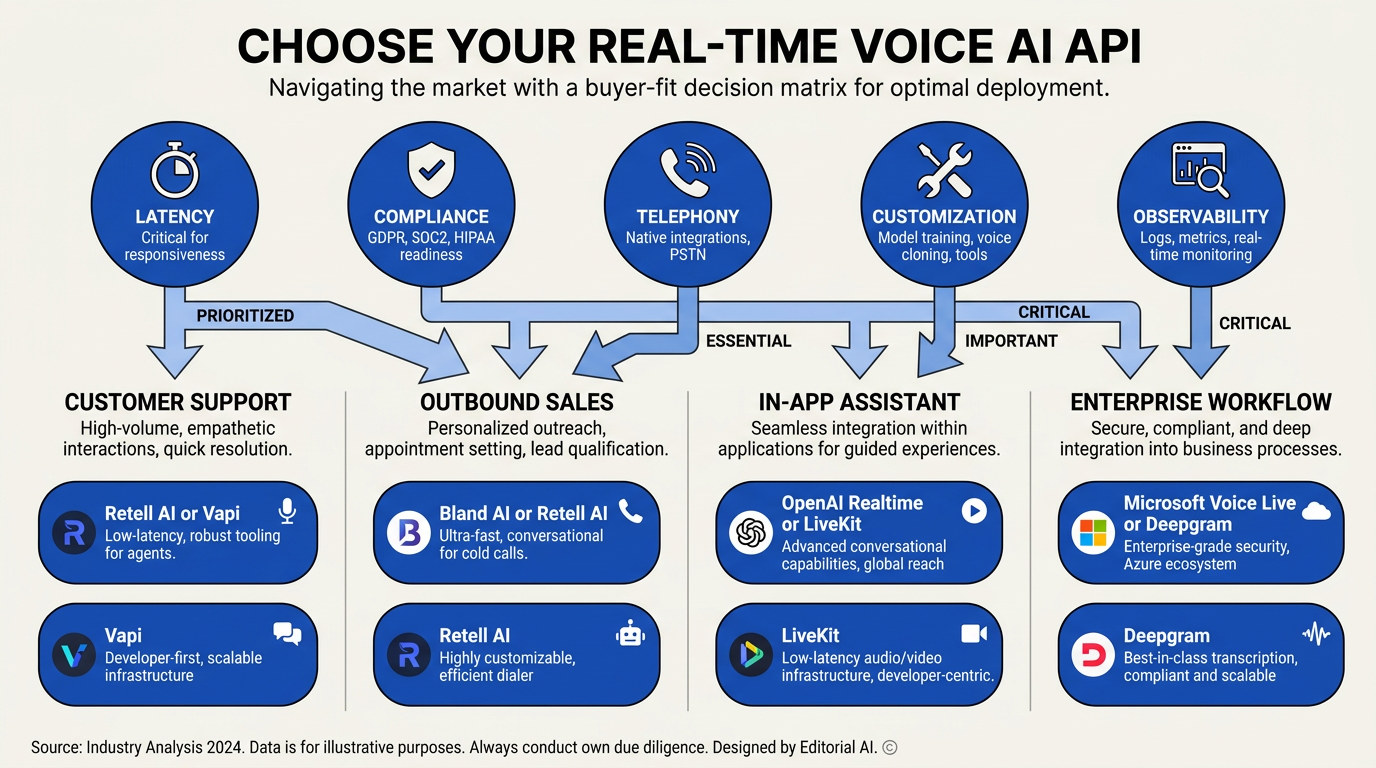
Choose based on the job-to-be-done: latency control, telephony depth, compliance, language coverage, and how much orchestration you want to own.
Decision Matrix by Agent Type
- Customer support: Choose Retell, Vapi, or Deepgram Voice Agent API when you need production call flows, interruption handling, and telephony; Retell’s 2026 roundup describes stacks using Deepgram STT + GPT-4o + ElevenLabs TTS through orchestration layers.
- Sales/outbound calling: Choose Vapi or Retell if speed-to-market matters; they reduce custom work around call routing, retries, CRM handoffs, and analytics compared with stitching together raw STT/TTS/LLM APIs.
- In-app voice assistants: Choose OpenAI Realtime API or Deepgram Voice Agent API when you need low-level control over WebRTC/WebSocket streaming, model behavior, and custom UI timing inside mobile or web apps.
- Enterprise agents: Choose Microsoft Voice Live API if your stack is already Azure-heavy and governance, identity, compliance, and procurement matter as much as speech quality.
- Gaming, avatars, and character agents: Consider Inworld Realtime TTS or Cartesia Sonic 3.5; Inworld’s 2026 enterprise list highlights these for expressive, low-latency voice experiences.
- Multilingual India-first deployments: Consider CallMissed when agents must support regional-language conversations; its platform combines voice agents, WhatsApp bots, 300+ LLMs, and STT across 22 Indian languages.
- Developer platform teams: Choose modular providers like Deepgram, ElevenLabs, OpenAI, LiveKit, and Twilio if you want to own orchestration, observability, and cost tuning across STT, TTS, LLM, and telephony.
- Fastest MVP: Start with an orchestration platform; Deepgram’s 2026 comparison evaluates 8 voice agent APIs across STT, TTS, LLM, and telephony, which is exactly the checklist teams should use before scaling.
Frequently Asked Questions
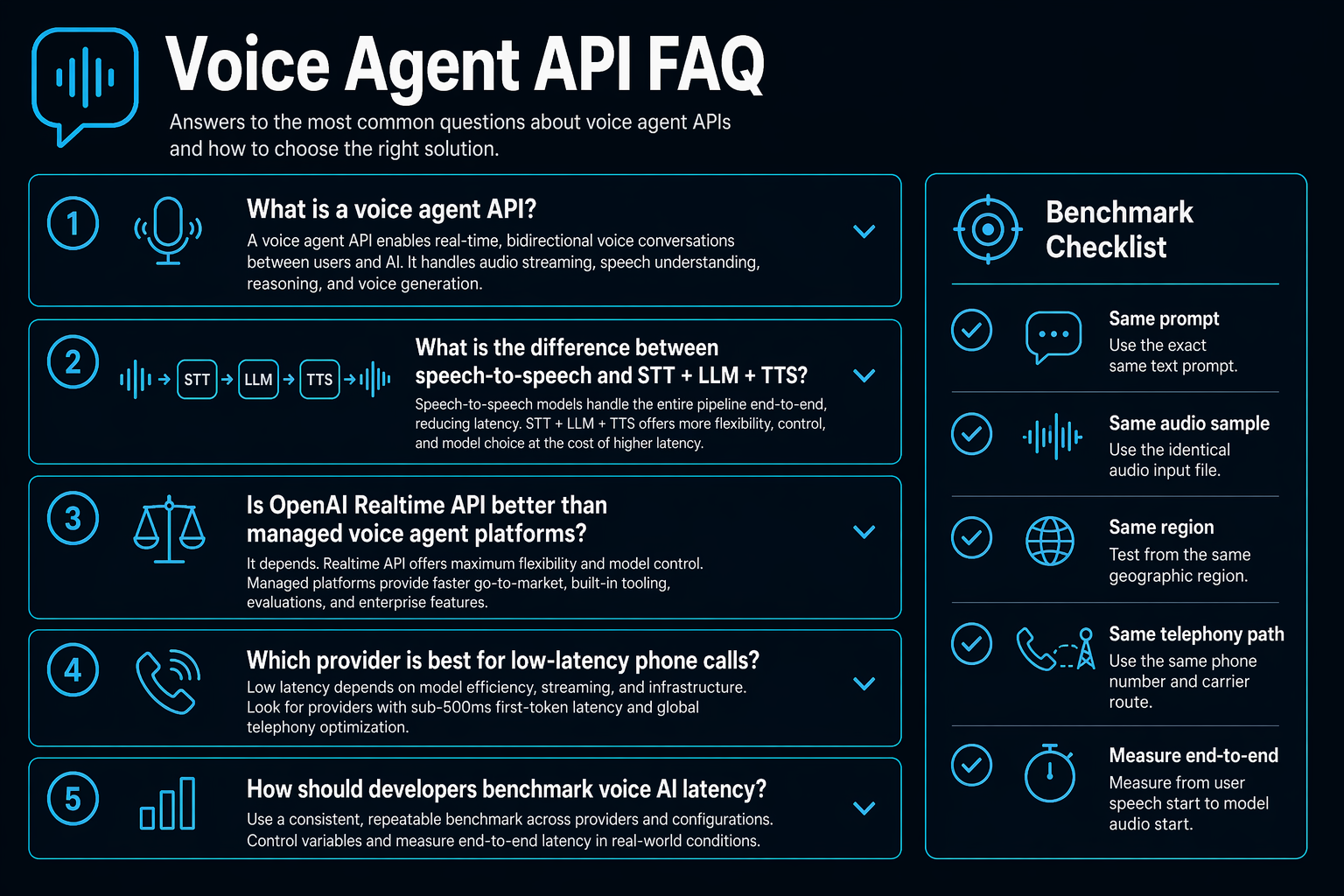
What is the best voice agent API for real-time customer calls?
How is a real-time voice AI API different from a normal speech-to-text API?
Which speech-to-speech API providers should developers compare in 2026?
Should I use OpenAI Realtime API or a managed voice agent platform?
What matters most when choosing voice AI infrastructure providers?
Can I build multilingual voice agents for India using these APIs?
Conclusion
The 2026 voice agent API landscape is shifting from “best model” to best real-time stack:
- Latency, interruption handling, and telephony now matter as much as STT/TTS quality.
- Teams must choose between low-level APIs like OpenAI Realtime and orchestration platforms like Vapi or Retell.
- Provider comparisons now span 8+ APIs across STT, TTS, LLM, compliance, and cost.
- Multilingual reach is becoming a core differentiator.
Watch for tighter LLM routing, lower-than-300ms interactions, and regional language support. To stay ahead, explore CallMissed—or ask: what will your customers expect from voice AI next year?