Missed Call Text Back Automation for Small Businesses in 2026: A Developer’s Guide


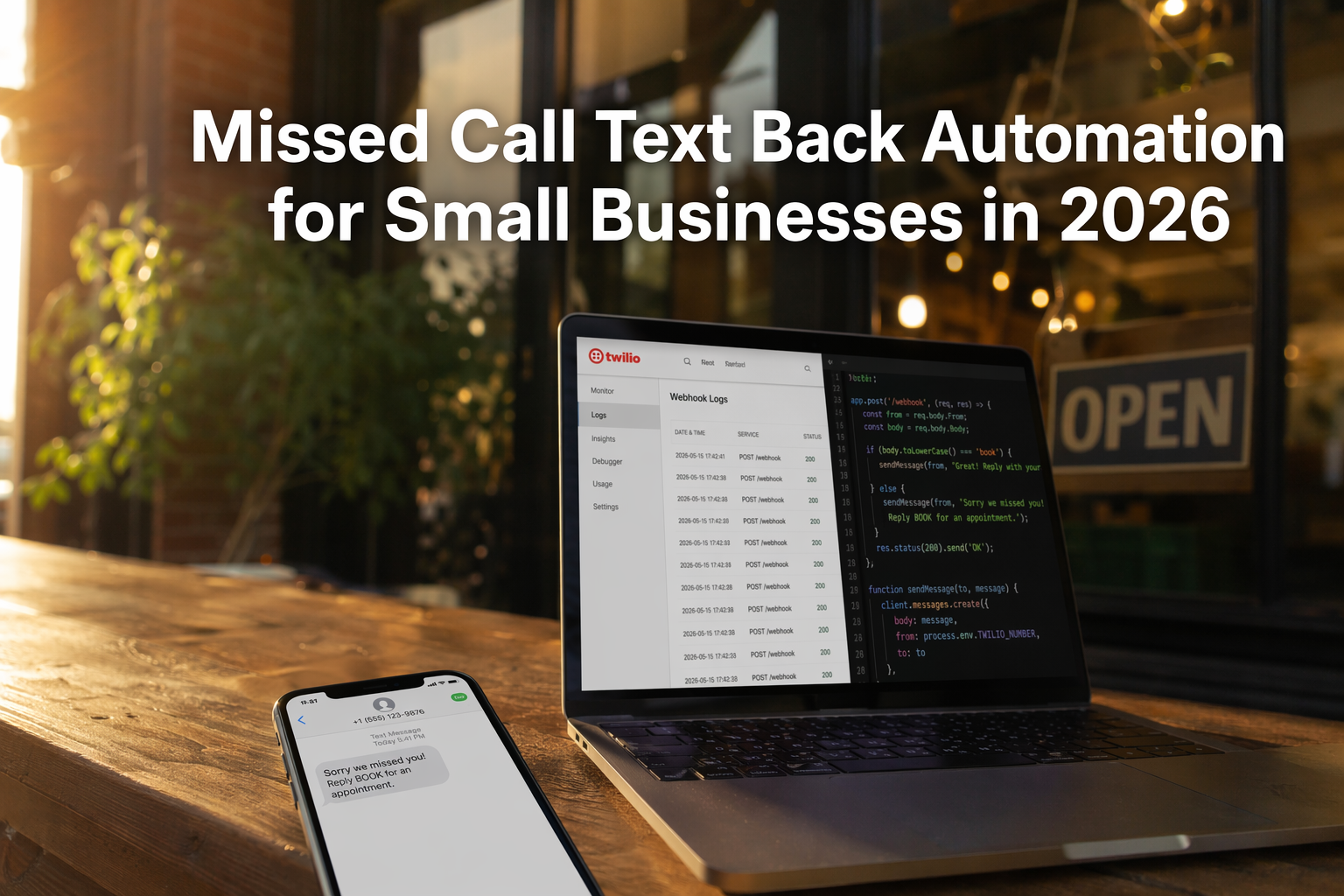
Learn how missed call text back automation works, how to set it up, and how to handle replies, consent, booking, CRM routing, and measurement.
Missed Call Text Back Automation for Small Businesses in 2026: A Developer’s Guide
If industry estimates are right, the phone is leaking revenue: OnceHub reports that 62% of calls to small businesses go unanswered, and missed call text back automation works by detecting that unanswered call, matching it to the caller ID, and sending an immediate SMS or WhatsApp reply with booking, callback, or intake options. In 2026, a typical setup connects your phone system, webhook listener, CRM, messaging provider, and consent rules so every missed call becomes a trackable conversation instead of a dead voicemail.
That matters because speed now decides who wins the customer. NextPhone’s 2026 missed-call text-back guide cites research that 78% of customers buy from the company that responds first, while its guide also highlights the practical advantage of text messaging over voicemail with a cited 98% SMS open rate. Ainora’s 2026 missed-call statistics guide reports that small businesses miss 20–35% of incoming calls during business hours and nearly 100% after hours, while 86% of callers who reach voicemail hang up. Branding Marketing Agency’s missed-call automation guide breaks the problem down by sector: home service companies miss 62% of inbound calls, professional service businesses miss 54%, and retail businesses miss 48%.
This guide explains missed call text back for small business from a developer’s point of view: not just “turn on auto-reply,” but how the system actually works end to end. You’ll see how to:
- Capture a missed-call event from a VoIP provider or telephony webhook
- Validate the caller number and business hours logic
- Send an instant, compliant text response
- Route replies into a CRM, shared inbox, or AI assistant
- Add booking links, quote flows, escalation rules, and opt-out handling
- Debug common failures like duplicate messages, carrier filtering, and webhook retries
The opportunity is not only operational—it is measurable. Veyri Labs states that automatic text-back can recover 25% to 45% of missed callers, which makes the workflow especially valuable for plumbers, clinics, salons, real estate agents, restaurants, legal offices, and local service teams where one missed call can equal one lost job. For Indian businesses, platforms such as CallMissed are part of the same shift toward AI-native communication, combining voice agents, WhatsApp automation, WhatsApp Business calling, and multilingual engagement across 22 Indian languages.
By the end, you’ll have a practical architecture for building missed call text back automation in 2026, plus code patterns, message templates, data tables, and a troubleshooting FAQ you can adapt for a real small-business deployment.
How does missed call text back automation work for small businesses in 2026?
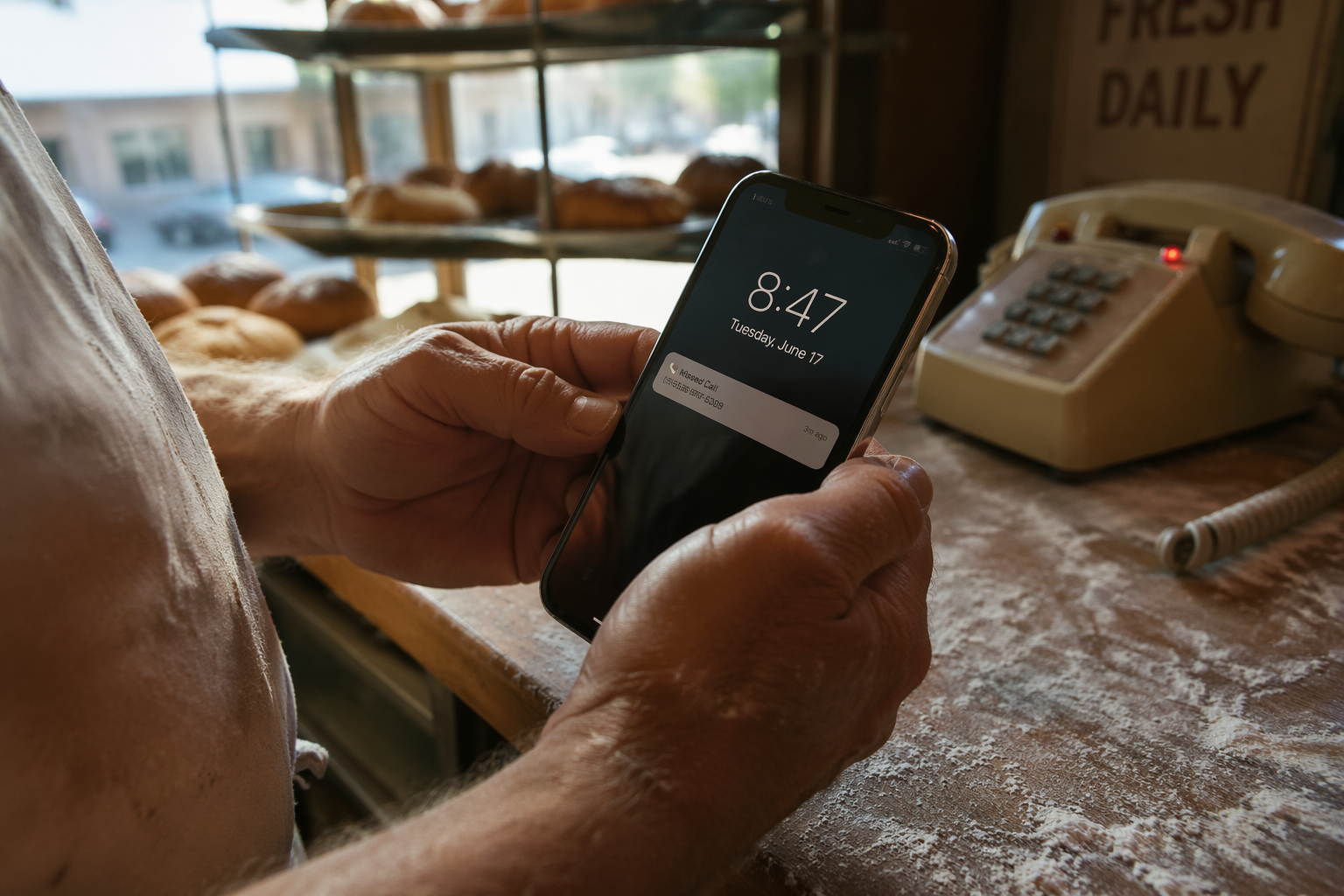
Missed call text back automation is a workflow that detects when a business call is not answered and sends the caller a timely SMS or WhatsApp message. The message can offer a callback, booking link, answers to common questions, or an urgent-support route. For a small business in 2026, the workflow usually connects a business phone number, telephony webhook, rules engine, messaging provider, shared inbox or CRM, and reporting tools. Its purpose is to turn an unanswered call into a trackable conversation—not merely to send “sorry we missed you.”
How does missed call text back automation work?
A practical six-step implementation flow is:
- Choose and connect the business number
Use a cloud telephony provider, VoIP number, PBX, call-tracking number, or another supported business line. Confirm that it can expose call-status webhooks and the caller’s number where legally permitted. If the business already uses a phone system, check whether missed-call events can be forwarded to an automation platform without changing the published number.
- Detect an unanswered call
Configure the telephony provider to send an event when a call reaches a final status such as missed, busy, rejected, abandoned, after-hours, or IVR timeout. Do not trigger a message from an intermediate ringing event. Validate the webhook signature, store the call and event IDs, normalize the number to an international format, and make the handler idempotent so provider retries cannot send duplicate messages.
- Apply business-hours and consent rules
Check the business timezone, opening hours, holidays, department schedules, caller history, and whether an employee or automated agent already handled the call. Decide whether the follow-up is a service message or marketing message under the applicable rules. An inbound call does not automatically authorize every type of promotional SMS or WhatsApp message. Exclude blocked, invalid, or suspected spam numbers, and honor previous opt-out requests.
- Send an SMS or WhatsApp message
Choose the channel the caller is eligible to receive. SMS may be suitable for a short callback or booking prompt. WhatsApp can support a richer conversation when the customer has opted in and the message follows the provider’s current business-messaging rules, including template or conversation-window requirements where applicable. Keep the first message short, identify the business, and offer one clear next action.
- Route the reply to a person, CRM, or booking flow
Send replies to a shared inbox, CRM conversation, help desk, booking system, WhatsApp workflow, or assigned employee. For example, a reply of 1 could create a callback task, while a reply of 2 could return a booking link. Urgent requests should have a clear human or on-call escalation path. A response should create a useful action rather than remain in an unmonitored number.
- Measure delivery, replies, and booking outcomes
Track whether the message was accepted and delivered, whether the caller replied or opted out, response time, completed callbacks, booked appointments, qualified leads, and revenue or pipeline attributed to the workflow. Compare outcomes with the cost of the phone number, automation platform, messaging provider, and staff time. A simple ROI calculation is:
   ROI = (incremental gross profit from recovered opportunities - workflow cost)
         / workflow cost
Use a defined attribution window and exclude calls that were already handled by a staff member so the results are not overstated.
A minimal event handler might follow this pattern:
receive missed_call webhook
verify signature
ignore duplicate event_id
normalize caller number

if caller is blocked, opted out, or number is invalid:
    stop

if a recent follow-up exists within the cooldown window:
    stop or update the existing conversation

apply timezone, business-hours, and consent rules
send the approved SMS or WhatsApp response

create or update the CRM conversation
record message ID, delivery status, reply, and outcome
What tools are needed?
A basic setup can use:
- A business phone number or call-tracking number
- A telephony or VoIP provider that exposes call events
- An automation layer or small webhook service
- An SMS provider and, if needed, a WhatsApp Business provider
- A shared inbox, CRM, help desk, or booking tool
- Reporting or analytics connected to delivery and conversion events
A platform such as CallMissed may be considered when a business wants a broader voice and WhatsApp workflow around missed calls. The exact channels, integrations, pricing, and capabilities should be verified before implementation rather than assumed from the platform name.
What should the automatic message say?
The first message should identify the business, acknowledge the missed call, and provide a simple next step.
During business hours:
Hi, this is GreenLine Plumbing. Sorry we missed your call. Reply 1 for a callback or book a visit here: example.com/book. Reply STOP to opt out.
After hours:
Hi, this is GreenLine Plumbing. We missed your call and are currently closed. Reply 1 for the next available callback, or book online: example.com/book. For an emergency, call 555-0100. Reply STOP to opt out.
Keep the message concise and avoid presenting more choices than the team can handle. The business name, callback or booking path, and urgent-contact instructions should match the actual operating process.
How should compliance and duplicate prevention work?
Document the consent basis for each channel, identify the sender, provide the required opt-out method, and process opt-out requests promptly. Do not assume that a missed call permits promotional follow-up. SMS and WhatsApp have different provider policies and regional requirements; WhatsApp may require opt-in, approved templates, or compliance with a customer-service conversation window. Confirm the current rules with the messaging provider and applicable regulator before launch.
Prevent duplicate messages by storing a unique event or call ID, using an idempotency key, and applying a cooldown window for repeated calls from the same number. Also suppress the automation when a human or another workflow has already sent a follow-up. This protects the customer experience and keeps delivery, reply, and booking reports accurate.
What do I need to build missed call text back automation?
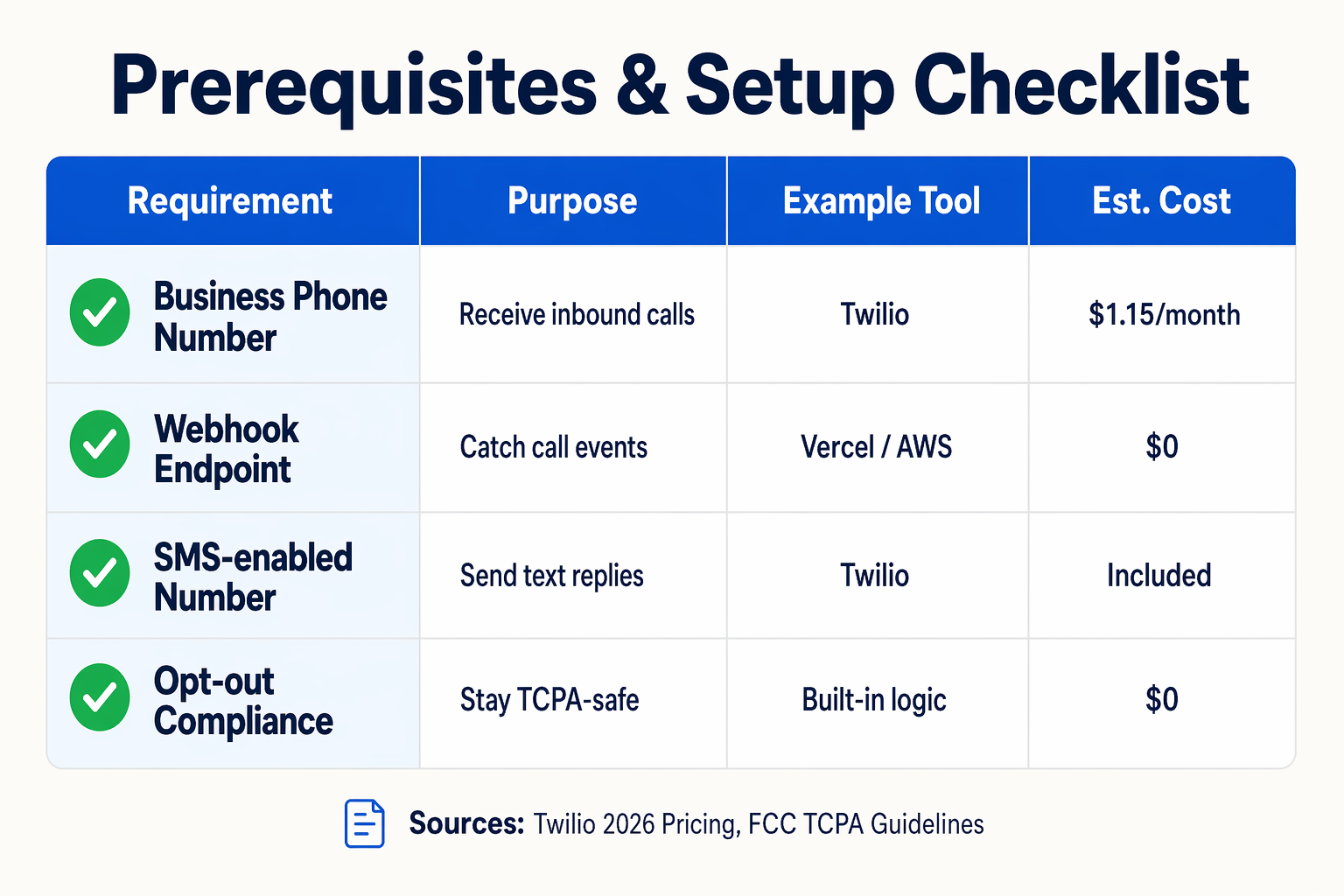
You need six building blocks: a phone system that emits missed-call events, a webhook or automation layer, a customer database or shared inbox, a messaging channel, consent and opt-out logic, and monitoring. For a small business in 2026, the simplest version can be no-code, but the most reliable version uses event-driven automation with logs, retries, and human handoff.
What components are required?
| Component | What it does | Developer requirement | Small-business example |
|---|---|---|---|
| Business phone number / VoIP system | Detects when a call is missed, busy, abandoned, or unanswered | Must support call status events, webhooks, API polling, or a native missed-call trigger | A clinic’s main number triggers an event after 20 seconds unanswered |
| Webhook endpoint or automation trigger | Receives the missed-call payload in real time | HTTPS endpoint, signature validation, idempotency key, retry handling | /webhooks/missed-call receives caller number and call timestamp |
| Smart IVR or AI voice layer | Answers, qualifies, routes, or records intent when staff are unavailable | Call flow logic, fallback rules, transcript or intent capture | “Press 1 to book, press 2 for billing,” or an AI agent captures the reason for calling |
| Messaging channel | Sends the automatic follow-up by SMS, WhatsApp, or another approved channel | Outbound messaging API, templates where required, delivery receipts | “Sorry we missed you—reply 1 to book, 2 for callback” |
| CRM or shared inbox | Stores the lead and routes replies to staff | Contact matching, conversation history, owner assignment, status updates | New caller becomes a lead assigned to the front desk |
| Consent and compliance layer | Prevents spam, handles opt-outs, and records messaging eligibility | STOP handling, do-not-contact checks, quiet hours, frequency limits | Do not message callers who previously opted out |
| Monitoring and fallback | Detects failures and escalates valuable leads | Logs, retries, alerts, duplicate suppression | If follow-up fails, create a task for manual callback |
What data should the missed-call event include?
At minimum, the event should include caller number, called business number, call status, timestamp, duration, voicemail or recording flag, and source campaign if available. The automation should not send a text or WhatsApp message for every call event; it should send only when the final call outcome is truly missed.
A practical missed-call payload might include:
{
  "event_type": "call.completed",
  "call_status": "no_answer",
  "from": "+919876543210",
  "to": "+911140001111",
  "started_at": "2026-07-08T10:31:00Z",
  "duration_seconds": 18,
  "business_id": "clinic_delhi_01",
  "source": "google_business_profile"
}
Your logic should check:
- Was the call actually missed? Exclude answered calls, spam calls, short accidental calls, and internal test calls.
- Has this number opted out? Never message contacts marked STOP, blocked, unsubscribed, or do-not-contact.
- Was a recent follow-up already sent? Use a cooldown window, such as 15–60 minutes, to avoid duplicates.
- Is the business open or closed? Send different messages for business hours, after-hours, holidays, and peak periods.
- Should the next action be SMS, WhatsApp, AI voice, or human callback? Choose based on region, consent, urgency, and customer preference.
- Does this caller already exist? Match by phone number before creating a new lead or conversation.
Where does CallMissed fit in the architecture?
A CallMissed-centered setup sits between your business phone workflow and your customer follow-up workflow. Instead of treating a missed call as a one-off telecom event, it turns the event into a routed conversation: IVR or AI voice response first when appropriate, WhatsApp follow-up next, and then human handoff through a shared inbox, CRM, or developer API.
A practical CallMissed architecture looks like this:
Incoming call
   ↓
Missed-call / no-answer / busy event
   ↓
CallMissed Smart IVR or AI voice response
   ↓
WhatsApp follow-up or callback workflow
   ↓
Shared inbox, CRM, or staff assignment
   ↓
Developer API, webhook, logs, and reporting
In this model, CallMissed can act as the orchestration layer for:
- Missed-call detection: identifying when a call was not answered and deciding whether automation should run.
- Smart IVR: collecting basic intent before routing the caller or creating a follow-up task.
- AI voice response: handling simple questions, capturing context, or escalating when a human is needed.
- WhatsApp follow-up: continuing the conversation in a channel many Indian customers already use.
- Shared inbox handoff: letting staff see the caller, message history, and next action in one place.
- Developer API layer: giving technical teams a way to connect events, contacts, conversations, and internal systems without rebuilding the full call-to-chat workflow from scratch.
This is especially useful for businesses that receive calls in multiple Indian languages or need a mix of automation and human follow-up. The developer still controls the business rules, but the call handling, WhatsApp conversation flow, and staff handoff do not have to be built as separate disconnected tools.
DIY Twilio-only build vs CallMissed-centered workflow
| Area | DIY Twilio-only build | CallMissed-centered workflow |
|---|---|---|
| Primary approach | Build call handling, messaging, routing, and reporting directly with telecom APIs | Use CallMissed as the missed-call, IVR/AI voice, WhatsApp, and handoff layer, with APIs for integration |
| Best for | Engineering teams that want full control over every call flow and message event | Small businesses or developers who want faster deployment with built-in call-to-conversation workflows |
| Missed-call trigger | Developer configures voice webhooks, call status callbacks, and filtering logic | Missed-call events can feed into predefined automation and handoff flows |
| IVR / AI response | Must be designed, hosted, tested, and maintained by the developer | Smart IVR and AI voice response can be part of the workflow before escalation |
| WhatsApp follow-up | Developer handles templates, routing, contact matching, and reply processing | WhatsApp follow-up can be connected to the missed-call workflow and staff inbox |
| CRM / inbox handoff | Developer builds or integrates the inbox, assignment logic, and conversation history | Handoff can be routed to a shared inbox or connected onward through APIs |
| Compliance logic | Developer implements opt-out, quiet hours, duplicate suppression, and audit logs | Developer still defines policy, while workflow controls can reduce custom plumbing |
| Monitoring | Developer builds logs, dashboards, retries, and alerting | Workflow visibility and API logs can support operational monitoring |
| Tradeoff | Maximum flexibility, more engineering and maintenance | Faster workflow launch, less custom infrastructure, with API extensibility |
A DIY build is a good fit when the business has a strong engineering team and unusual telecom requirements. A CallMissed-centered workflow is usually better when the business wants missed-call recovery, WhatsApp follow-up, Smart IVR, AI voice support, and staff handoff without maintaining every piece of the stack separately.
What tools can small businesses use?
Small businesses can build missed-call text back automation with either a no-code workflow, a platform-centered workflow, or a custom API workflow.
- No-code workflow: fastest for simple missed-call alerts, basic follow-up messages, and manual staff callbacks.
- Platform-centered workflow: best when you need missed-call detection, WhatsApp follow-up, IVR, AI voice response, and shared inbox handoff in one operational flow.
- Custom API workflow: best when you need deep CRM sync, custom scoring, campaign attribution, analytics, or internal system integration.
The business case is strong because the missed-call problem is measurable: unanswered calls represent lost bookings, delayed support, and untracked leads. Text and WhatsApp follow-up often perform better than waiting for voicemail because they give the customer an immediate next step while their intent is still fresh.
For Indian small businesses, WhatsApp is often as important as SMS. A practical workflow should support regional customer behavior, multilingual conversations, and escalation to a human when automation is not enough.
What should the first version include?
For a production-ready first version, build only the essentials:
- One trigger: missed, busy, abandoned, or no-answer call
- One instant follow-up: short apology plus next action
- One routing rule: create or update the contact, then assign it to the right team
- One consent rule: opt-out, unsubscribe, or do-not-contact handling
- One duplicate rule: cooldown window to avoid repeated messages
- One fallback: alert staff if automation or delivery fails
- One dashboard: missed calls, follow-ups sent, replies, bookings, callbacks, and unresolved conversations
The key is not to over-automate on day one. Start with reliable detection, fast response, and clean handoff; then add AI qualification, booking links, multilingual replies, source attribution, and advanced routing once the core workflow is stable.
How much revenue do small businesses lose from missed calls in 2026?
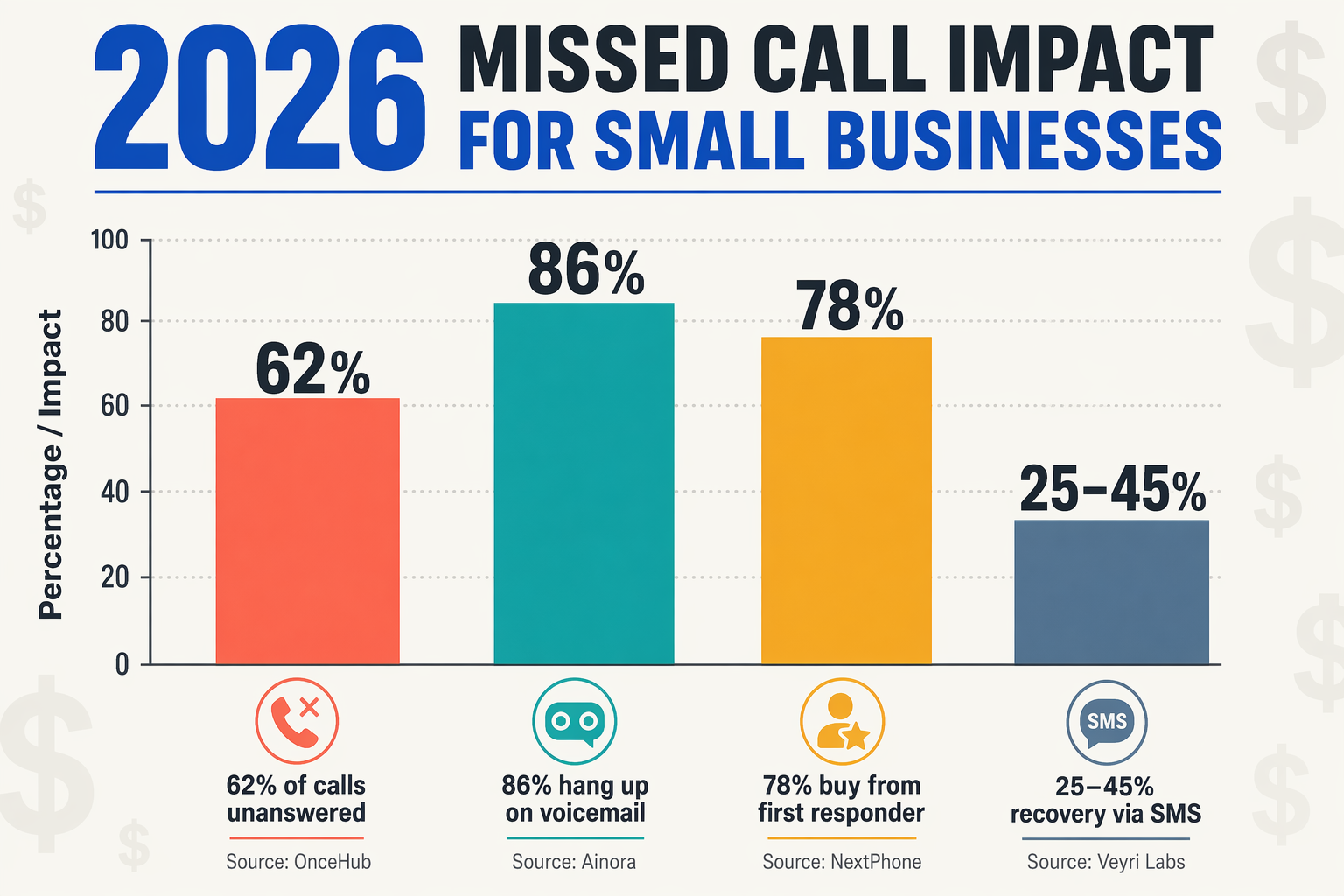
Small businesses can lose tens of thousands to more than $100,000 per year from missed calls in 2026, depending on call volume, ticket size, and conversion rate. The loss is large because the missed-call problem is not rare: OnceHub reports that 62% of calls to small businesses go unanswered, while Z360 cites the same 62% missed-call figure and estimates the cost at $126,000 per year.
The simple revenue-loss formula
Use this formula to estimate missed-call revenue leakage:
Monthly calls × missed-call rate × lead-to-customer rate × average sale value × 12 = annual revenue at risk
For example, if a business receives 1,000 calls per month, misses 35%, converts 30% of reachable callers, and earns $100 per customer, the annual revenue at risk is:
1,000 × 35% × 30% × $100 × 12 = $126,000 per year
That lines up with the Z360 estimate that missed calls can cost small businesses $126,000 annually.
Missed-call revenue risk by business type
The table below uses published missed-call rates from the cited sources and applies one consistent example model: 1,000 inbound calls per month, 30% lead-to-customer conversion, and $100 average transaction value. Your actual number will change with call volume, close rate, and job value.
| Business scenario | Missed-call rate | Named source | Example annual revenue at risk | Why it matters |
|---|---|---|---|---|
| Small business overall | 62% | OnceHub / Z360 | $223,200 | Most missed calls are high-intent prospects who called instead of browsing. |
| Home services | 62% | Branding Marketing Agency | $223,200 | Plumbers, electricians, HVAC teams, and cleaners often win or lose jobs on response speed. |
| Professional services | 54% | Branding Marketing Agency | $194,400 | Lawyers, accountants, consultants, and agencies lose trust when calls go unanswered. |
| Retail businesses | 48% | Branding Marketing Agency | $172,800 | Missed calls often mean lost product availability checks, reservations, or store visits. |
| During business hours | 20–35% | Ainora, 2026 | $72,000–$126,000 | Even staffed businesses leak revenue during lunch breaks, peak rush, and multitasking. |
| After hours | Nearly 100% | Ainora, 2026 | Up to $360,000 | Calls after closing still represent buying intent, especially for urgent local services. |
Why voicemail does not recover enough of the loss
Voicemail is a weak fallback for revenue recovery because callers often abandon it. Ainora’s 2026 missed-call statistics guide reports that 86% of callers who reach voicemail hang up, which means the business may never receive the customer’s name, need, budget, or urgency.
The economic issue is speed. NextPhone’s 2026 missed-call text-back guide cites research that 78% of customers buy from the company that responds first, so a missed call is not just a delayed conversation; it can become a competitor’s booked job.
How much can text-back automation recover?
Missed call text back automation does not recover every lost lead, but it can materially reduce leakage. Veyri Labs states that automatic text-back can recover 25% to 45% of missed callers, which makes the recovery math compelling for small businesses.
Using the earlier $126,000 annual revenue-at-risk example:
- 25% recovery = $31,500 potentially recovered per year
- 35% recovery = $44,100 potentially recovered per year
- 45% recovery = $56,700 potentially recovered per year
That is why missed call text back automation is usually evaluated as a revenue workflow, not just a phone feature. The goal is to convert a failed call into an immediate SMS or WhatsApp conversation with a booking link, quote form, callback option, or AI-assisted intake flow before the customer moves on.
How do I connect my business phone to Twilio and configure webhooks?
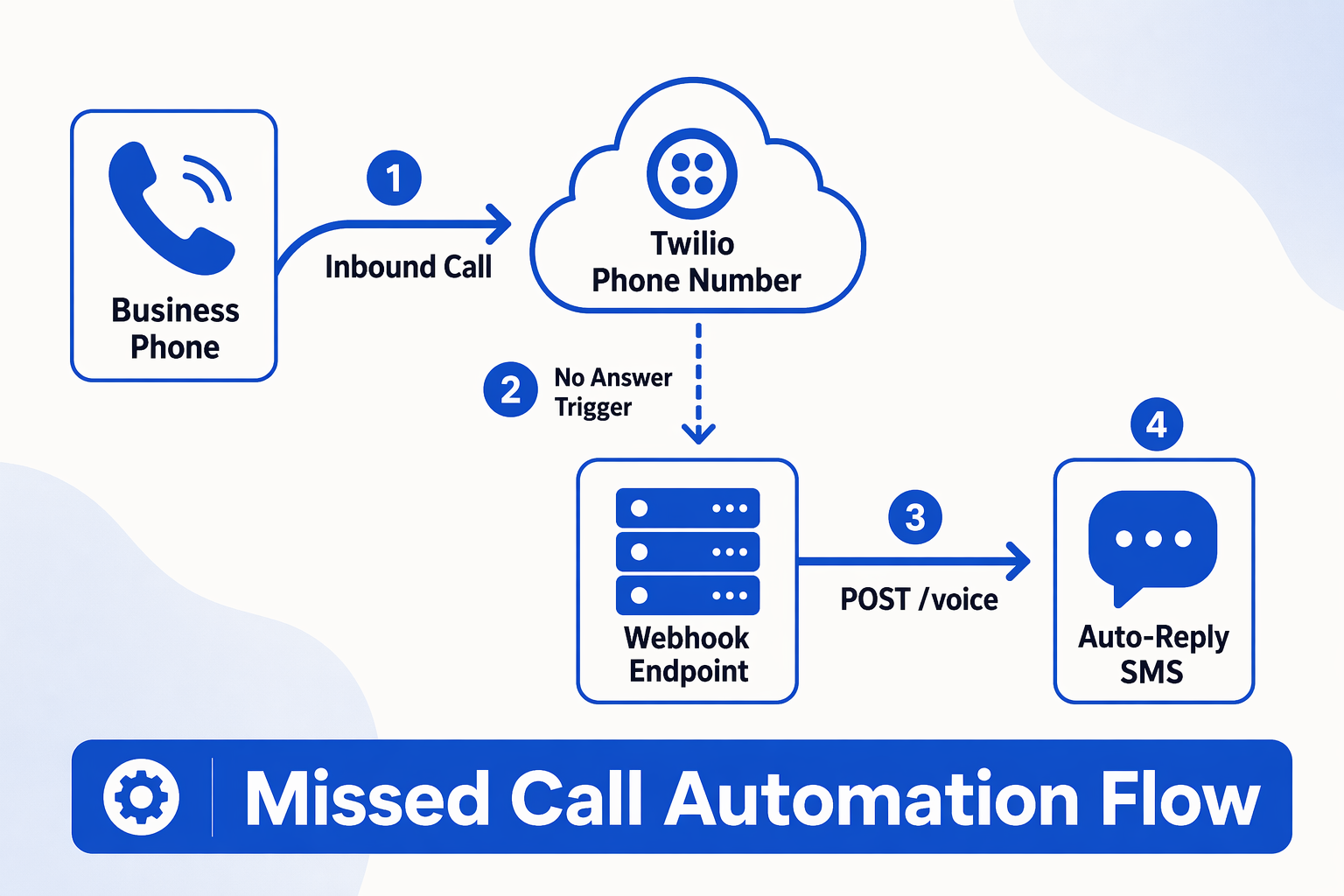
Connect your business phone to Twilio by making Twilio the call-control layer: buy or port a number, forward calls to your real business line, and use a webhook to detect when the forwarded call was not answered. When Twilio reports no-answer, busy, or failed, your app sends the caller an immediate SMS or WhatsApp follow-up.
OnceHub reports that 62% of calls to small businesses go unanswered, so this webhook layer is the technical point where missed-call text back automation starts.
What Twilio setup do I need first?
Start with a Twilio account, a voice-capable number, and a public HTTPS endpoint.
- Buy or port a phone number in Twilio
- In Twilio Console, go to Phone Numbers → Manage → Buy a number.
- Choose a number with Voice and SMS capability.
- If you already have a business number, you can either port it to Twilio or forward missed calls from your existing carrier/PBX to a Twilio number.
- Create two webhook URLs
POST /voice/incoming— receives new inbound calls.POST /voice/dial-status— receives the result after Twilio tries your business phone.- Optional:
POST /sms/inbound— receives customer replies.
- Configure the Twilio number
- Under Voice Configuration, set A call comes in to:
- Method:
POST - URL:
https://yourdomain.com/voice/incoming - Under Messaging Configuration, set A message comes in to:
- Method:
POST - URL:
https://yourdomain.com/sms/inbound
How do I route the call and detect “missed”?
Use Twilio Programmable Voice to forward the call to your business phone. The important part is the <Dial> action URL: Twilio calls this webhook after the dial attempt ends.
import express from "express";
import twilio from "twilio";

const app = express();
app.use(express.urlencoded({ extended: false }));

const BUSINESS_PHONE = "+15551234567";

app.post("/voice/incoming", (req, res) => {
  const twiml = new twilio.twiml.VoiceResponse();

  const dial = twiml.dial({
    timeout: 20,
    action: "/voice/dial-status",
    method: "POST",
  });

  dial.number(BUSINESS_PHONE);

  res.type("text/xml").send(twiml.toString());
});
The timeout: 20 setting means Twilio waits 20 seconds before treating the call as unanswered. This matters because Ainora’s 2026 missed-call statistics guide reports that small businesses miss 20–35% of incoming calls during business hours and nearly 100% after hours.
How do I send the automatic text back?
In the dial-status webhook, inspect DialCallStatus. If the value is no-answer, busy, or failed, send the missed-call text.
const client = twilio(
  process.env.TWILIO_ACCOUNT_SID,
  process.env.TWILIO_AUTH_TOKEN
);

app.post("/voice/dial-status", async (req, res) => {
  const caller = req.body.From;
  const dialStatus = req.body.DialCallStatus;

  const missedStatuses = ["no-answer", "busy", "failed"];

  if (missedStatuses.includes(dialStatus)) {
    await client.messages.create({
      from: process.env.TWILIO_SMS_NUMBER,
      to: caller,
      body:
        "Sorry we missed your call. Reply here and we’ll help, or book a callback: https://example.com/book",
    });
  }

  res.sendStatus(200);
});
NextPhone’s 2026 guide cites a 98% SMS open rate, which is why this immediate SMS often performs better than waiting for a voicemail.
What should I store in my database?
Log every missed-call event so the business can track recovery, attribution, and follow-up quality.
Store at minimum:
- Caller number:
From - Business number:
To - Twilio Call SID:
CallSid - Dial result:
DialCallStatus - Timestamp
- Message sent status
- CRM/contact ID, if matched
- Opt-out state, if the customer replied STOP or unsubscribed
How do I avoid duplicate texts?
Twilio webhooks can retry if your server times out, so make your handler idempotent. Use CallSid plus DialCallStatus as a unique key before sending the SMS.
const eventKey = `${req.body.CallSid}:${req.body.DialCallStatus}`;

const alreadyProcessed = await db.missedCalls.findUnique({
  where: { eventKey },
});

if (!alreadyProcessed) {
  // send message, then save eventKey
}
This prevents the same caller from receiving multiple “sorry we missed you” texts for one missed call.
What happens after the customer replies?
Route replies into your CRM, shared inbox, or AI assistant. For example, an inbound SMS webhook can create a lead, reopen a conversation, or notify staff.
app.post("/sms/inbound", async (req, res) => {
  const from = req.body.From;
  const text = req.body.Body;

  await db.messages.create({
    data: {
      channel: "sms",
      from,
      body: text,
      direction: "inbound",
    },
  });

  res.send("<Response></Response>");
});
For WhatsApp-first markets, the same pattern can be adapted to WhatsApp Business messaging or voice workflows. Platforms such as CallMissed extend this model by combining AI voice agents, WhatsApp automation, WhatsApp Business calling, and multilingual support across 22 Indian languages for businesses serving regional audiences.
How do I write the webhook code and auto-reply logic step by step?
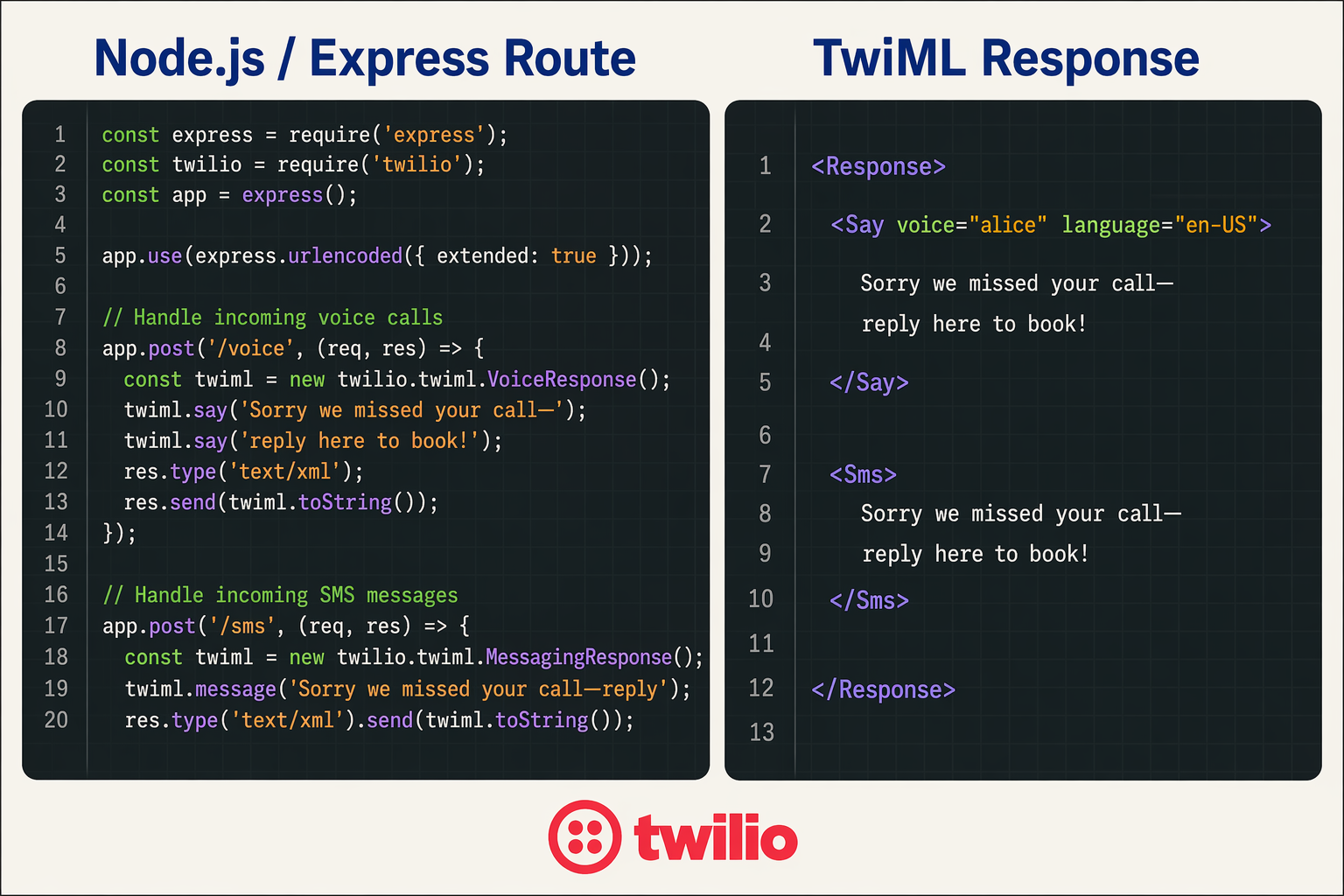
Write the webhook as a small, idempotent service: receive the missed-call event, verify it, check consent and business rules, send one immediate SMS or WhatsApp reply, then log the interaction in your CRM. The goal is speed without spam—NextPhone’s 2026 guide cites that 78% of customers buy from the company that responds first, so your code should respond in seconds, not minutes.
1. Create the webhook endpoint
Most VoIP or telephony providers can POST a call-status event when a call is missed, busy, failed, or unanswered. Start with an Express endpoint:
import express from "express";
import crypto from "crypto";

const app = express();
app.use(express.json());

app.post("/webhooks/missed-call", async (req, res) => {
  try {
    const event = req.body;

    // Always acknowledge quickly to avoid provider retries
    res.status(200).json({ received: true });

    await handleMissedCall(event);
  } catch (err) {
    console.error("Webhook error:", err);
  }
});

app.listen(3000, () => console.log("Webhook listening on port 3000"));
2. Validate the event and prevent duplicates
Webhook retries are normal, so your first real business rule should be idempotency. Use the provider’s call_id or create a hash from caller, business number, and timestamp.
const processedCalls = new Set(); // Replace with Redis/Postgres in production

async function handleMissedCall(event) {
  const callId = event.call_id;
  const caller = normalizePhone(event.from);
  const businessNumber = normalizePhone(event.to);
  const status = event.status;

  if (!["missed", "no-answer", "busy", "failed"].includes(status)) return;

  if (processedCalls.has(callId)) {
    console.log("Duplicate webhook ignored:", callId);
    return;
  }

  processedCalls.add(callId);

  await processAutoReply({
    callId,
    caller,
    businessNumber,
    occurredAt: event.timestamp || new Date().toISOString()
  });
}

function normalizePhone(number) {
  return String(number).replace(/[^\d+]/g, "");
}
This matters because small businesses miss a high volume of calls: Ainora’s 2026 missed-call statistics guide says small businesses miss 20–35% of incoming calls during business hours and nearly 100% after hours.
3. Apply consent, hours, and suppression rules
Before sending, check whether the caller has opted out, whether the number is valid, and whether the caller was recently messaged.
async function processAutoReply(call) {
  const optedOut = await hasOptedOut(call.caller);
  if (optedOut) return;

  const recentlyMessaged = await wasMessagedRecently(call.caller, 30); // minutes
  if (recentlyMessaged) return;

  const open = isBusinessOpen("Asia/Kolkata");

  const message = open
    ? `Sorry we missed your call. Reply 1 for a callback, 2 to book an appointment, or share your question here.`
    : `Thanks for calling. We are currently closed, but we can still help. Reply 1 for a callback tomorrow or 2 to book online.`;

  await sendText(call.caller, message);
  await saveConversation(call, message, open ? "open_hours" : "after_hours");
}
4. Send the auto-reply through SMS or WhatsApp
For SMS, call your messaging provider’s API. For WhatsApp-first businesses, use an approved WhatsApp Business provider or a communication platform that supports WhatsApp workflows.
async function sendText(to, body) {
  const response = await fetch(process.env.MESSAGE_API_URL, {
    method: "POST",
    headers: {
      "Authorization": `Bearer ${process.env.MESSAGE_API_KEY}`,
      "Content-Type": "application/json"
    },
    body: JSON.stringify({
      to,
      channel: "sms",
      text: body
    })
  });

  if (!response.ok) {
    const error = await response.text();
    throw new Error(`Message failed: ${error}`);
  }
}
NextPhone’s 2026 missed-call text-back guide cites a 98% SMS open rate, which is why this immediate text often outperforms voicemail. Ainora’s 2026 guide also reports that 86% of callers who reach voicemail hang up, making text-back a practical fallback.
5. Route replies into your CRM or AI inbox
After the first message, inbound replies should create or update a lead record:
async function saveConversation(call, message, reason) {
  await fetch(process.env.CRM_WEBHOOK_URL, {
    method: "POST",
    headers: { "Content-Type": "application/json" },
    body: JSON.stringify({
      phone: call.caller,
      source: "missed_call_text_back",
      call_id: call.callId,
      first_reply: message,
      routing_reason: reason,
      created_at: call.occurredAt
    })
  });
}
For Indian small businesses, this same pattern can extend beyond SMS. Platforms such as CallMissed can connect missed-call workflows with WhatsApp automation, AI voice agents, WhatsApp Business calling, and multilingual engagement across 22 Indian languages, which is useful when callers prefer regional-language voice or chat.
6. Add the minimum production checks
Before launch, add:
- Signature verification for telephony webhooks
- Redis or database idempotency, not in-memory storage
- STOP/opt-out handling for compliance
- Rate limits per caller and per business number
- Delivery logging for sent, failed, and replied messages
- Human handoff rules when someone replies “urgent,” “quote,” or “callback”
Veyri Labs says automatic text-back can recover 25% to 45% of missed callers, so these safeguards protect both revenue and customer trust.
Which advanced settings improve delivery, compliance, and reply rates?
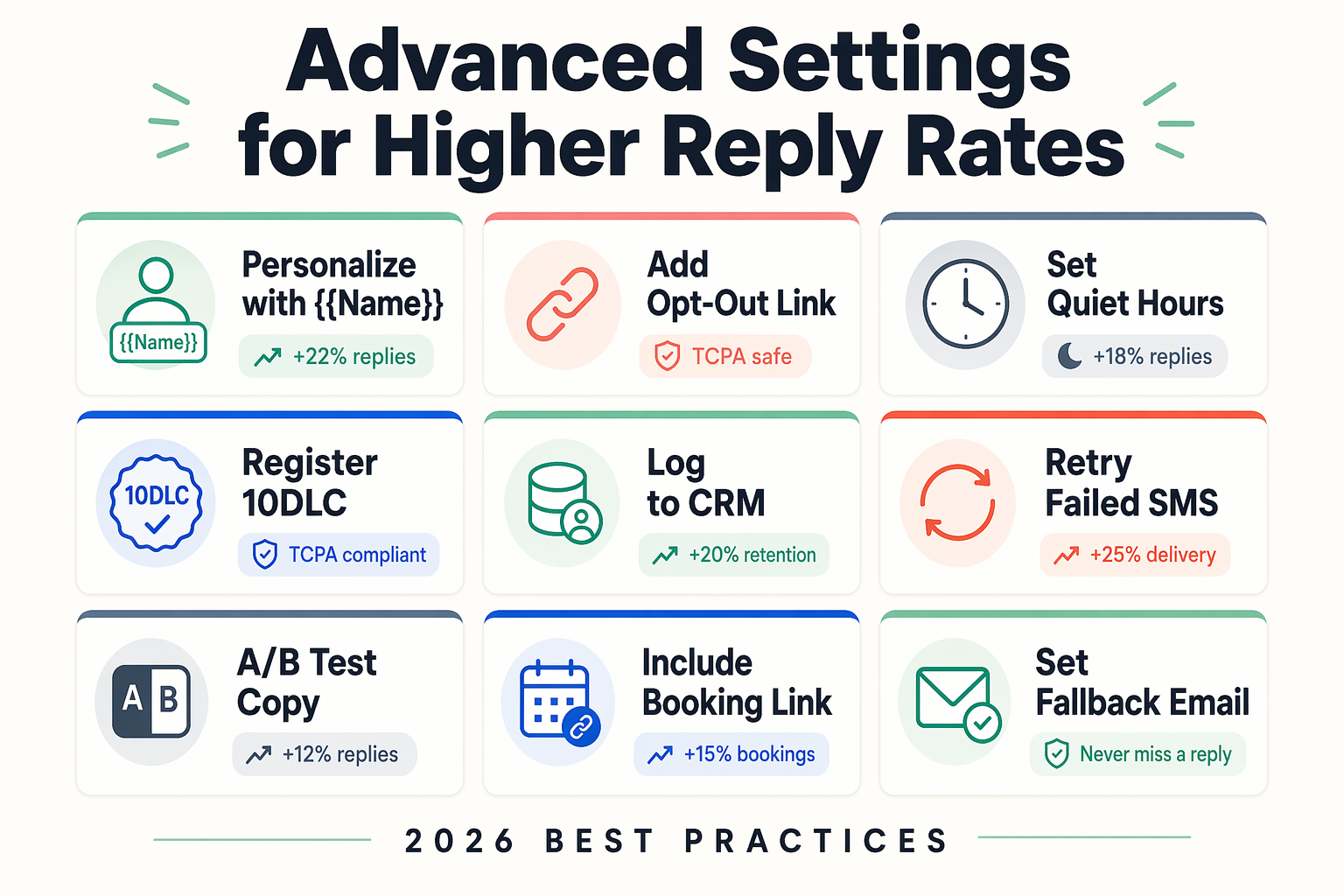
The best advanced settings are speed controls, consent rules, deduplication, channel fallback, routing logic, and reply classification. Together, these settings make missed call text back automation faster without becoming spammy, which matters because NextPhone’s 2026 guide states that 78% of customers buy from the company that responds first.
Advanced settings that matter most
| Advanced setting | What to configure | Recommended 2026 setup | Why it improves results |
|---|---|---|---|
| Send delay | Time between missed-call event and first text | Send within 5–30 seconds unless the caller reconnects | Speed captures intent while the customer is still available; NextPhone’s 2026 guide cites 98% SMS open rates. |
| Deduplication window | Prevent multiple texts from repeated call events | One auto-reply per number per 15–60 minutes | Avoids duplicate messages from webhook retries, transfers, or rapid redials. |
| Quiet hours and business hours | Different replies after hours, weekends, holidays | Use “we’re closed” templates with booking or callback links | Ainora’s 2026 guide says small businesses miss 20–35% of calls during business hours and nearly 100% after hours. |
| Consent and opt-out handling | Track opt-in, STOP, unsubscribe, DND status | Suppress future SMS after “STOP”; store timestamp and channel | Reduces compliance risk and carrier filtering while preserving audit logs. |
| Channel fallback | Choose SMS, WhatsApp, or voice callback | Try preferred channel first; fallback if undelivered | WhatsApp may perform better for relationship-led markets; SMS is useful for universal reach. |
| Intent-based routing | Classify replies like “urgent,” “book,” “price,” “cancel” | Route urgent replies to staff; send routine replies to CRM or AI agent | Veyri Labs says automatic text-back can recover 25% to 45% of missed callers. |
How to tune delivery without hurting compliance
A missed-call workflow should not blast every number immediately. It should apply eligibility checks before sending:
- Was the call genuinely missed?
Exclude answered calls, abandoned IVR tests, internal transfers, and known spam numbers.
- Has this number already received a message recently?
Use a cooldown period so one frustrated caller does not receive five identical texts.
- Is the number allowed to receive messages?
Check opt-out lists, country rules, consent source, and any CRM-level communication preferences.
- Which channel is most appropriate?
Use SMS for universal reach, WhatsApp where customers already engage there, and voice callback for urgent or high-value leads.
- Does the message include a clear next step?
Every auto-reply should include one action: book, reply, call back, confirm, or request a quote.
For Indian businesses, this is where WhatsApp-native automation becomes especially practical. Platforms such as CallMissed can connect missed-call flows with WhatsApp chatbots, WhatsApp Business calling, AI voice agents, and multilingual engagement across 22 Indian languages, so the response does not stop at a single SMS.
Message settings that increase reply rates
The highest-performing missed-call messages are short, specific, and conversational. Avoid vague templates like “We missed your call” with no action.
Use settings like:
- Personalized business name: “Hi, this is GreenCare Dental…”
- Context-aware timing: “We’re currently closed, but you can book here…”
- Reply shortcuts: “Reply 1 for booking, 2 for pricing, 3 for urgent help.”
- Human escalation trigger: Route messages containing “urgent,” “emergency,” “complaint,” or “cancel.”
- Link tracking: Use UTM tags for booking, quote, and payment links.
This matters because voicemail is a weak fallback. Ainora’s 2026 missed-call statistics guide reports that 86% of callers who reach voicemail hang up, meaning the reply channel needs to move the customer into a live text, WhatsApp, booking, or callback flow quickly.
Compliance checklist before going live
Before enabling automation, confirm:
- Opt-out keywords like STOP, UNSUBSCRIBE, and CANCEL are processed automatically.
- Suppression lists apply across SMS, WhatsApp, and campaigns.
- Templates avoid misleading urgency or fake human claims.
- Audit logs store caller number, timestamp, message, delivery status, and consent state.
- Staff override exists for sensitive industries such as healthcare, finance, legal, and emergency services.
The goal is simple: respond fast, but only when the message is expected, useful, and allowed.
What mistakes break missed call text back flows, and how do I avoid them?
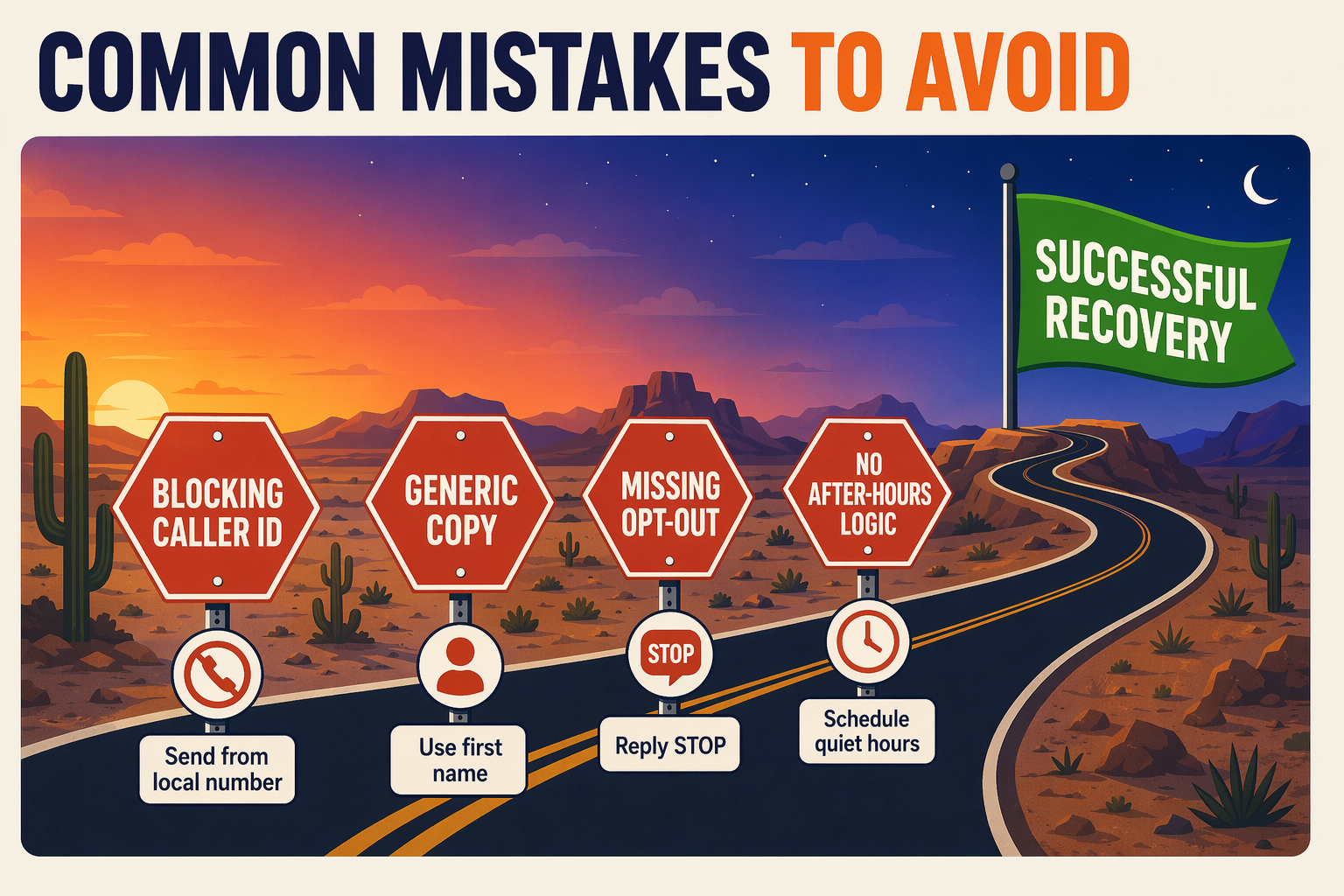
Most missed call text back flows fail because the automation is treated as a simple “send SMS after missed call” rule instead of a stateful workflow with timing, consent, deduplication, routing, and opt-out logic. To avoid breakage, test every missed-call path like a production payment flow: one event in, one compliant message out, one trackable conversation created.
Common failure points and fixes
| Mistake | What breaks | Why it matters | How to avoid it |
|---|---|---|---|
| Sending duplicate replies | Caller receives 2–5 identical texts | VoIP providers may retry webhooks after timeouts, and call events can arrive as no-answer, busy, and completed | Store a dedupe key such as call_id + caller_number; make webhook handlers idempotent |
| Texting without consent or opt-out handling | Messages get blocked, complaints rise, legal risk increases | SMS and WhatsApp both require clear opt-out behavior; customers expect “STOP” to work | Add consent source, message purpose, and automatic STOP / UNSUBSCRIBE processing |
| Replying too late | Customer books with a competitor | NextPhone’s 2026 guide cites research that 78% of customers buy from the company that responds first | Trigger within seconds; alert a human if delivery fails or no reply arrives |
| Using generic messages | Low reply rate and caller confusion | A missed emergency plumbing call and a salon booking call need different next steps | Use business-hours, department, campaign, and caller-history rules |
| No CRM or inbox routing | Staff cannot see who replied or what happened next | A text-back without ownership becomes another hidden queue | Create a conversation record, assign an owner, and sync status to CRM |
| Ignoring carrier filtering | SMS appears “sent” but never reaches the caller | High-volume, link-heavy, or spam-like templates may be filtered | Register sender profiles where required, avoid URL shorteners, and monitor delivery receipts |
The biggest mistake: not making the webhook idempotent
A missed call text back automation should assume that the same event can arrive more than once. Network retries, provider timeout policies, and multi-leg call routing can all create duplicate triggers.
A safe pattern is:
- Receive the missed-call webhook.
- Normalize the caller number into E.164 format.
- Check whether the same
call_idor caller-event pair has already been processed. - If yes, return
200 OKwithout sending another message. - If no, write the event to the database first, then send the text.
This matters because the automation is designed to recover high-intent callers, not annoy them. OnceHub reports that 62% of calls to small businesses go unanswered, and Veyri Labs states that automatic text-back can recover 25% to 45% of missed callers. Duplicate or irrelevant messages waste that recovery opportunity.
The second biggest mistake: treating every missed call the same
The best flows branch by context. For example:
- During business hours: “Sorry we missed you — would you like a callback in the next 10 minutes?”
- After hours: “We’re closed now, but you can book here or request a callback tomorrow.”
- Known customer: “Hi Priya, we missed your call about your appointment. Reply 1 to reschedule.”
- New lead: “Thanks for calling. What service do you need help with today?”
Ainora’s 2026 missed-call statistics guide reports that small businesses miss 20–35% of incoming calls during business hours and nearly 100% after hours, so after-hours logic should not be an afterthought. It is often the highest-volume missed-call path.
For Indian businesses, this branching may also include language and channel. Platforms such as CallMissed support AI voice agents, WhatsApp automation, WhatsApp Business calling, and multilingual engagement across 22 Indian languages, which is useful when a missed call should become a WhatsApp conversation or regional-language voice follow-up instead of only an English SMS.
A practical pre-launch checklist
Before enabling the flow for real callers, test these cases:
- One missed call creates only one outbound message.
- Voicemail, busy, rejected, and abandoned calls are classified correctly.
- “STOP” prevents future promotional or automated texts.
- Replies appear in the shared inbox or CRM within seconds.
- Booking links work on mobile and do not use suspicious short URLs.
- Delivery failures create an internal alert.
- After-hours messages use a different template from business-hours messages.
- Staff can manually take over the thread without fighting the bot.
The rule of thumb
If the automation cannot answer these three questions, it is not production-ready: Who called, what did we send, and who owns the next step? Missed call text back works best when it is fast, compliant, deduplicated, and connected to the system where the business actually manages customers.
What are the most common troubleshooting questions for missed call SMS automation?
Why is my missed call text back automation not sending SMS replies?
Why are customers receiving duplicate missed call text back messages?
Why are my missed call SMS automation messages being filtered or not delivered?
How fast should missed call text back automation respond to a customer?
Why does missed call text back automation trigger outside business hours?
What should I do if customers reply to the automated text but my team never sees it?
Where can I find copy-paste templates and next steps to launch today?

You can launch missed call text back automation today by copying the templates below, connecting them to your missed-call webhook, and routing every reply into your CRM or shared inbox. Start with one simple rule: if a call is unanswered, send a compliant reply within 30 seconds with a clear next action.
Copy-paste missed call text back templates
Use short, specific messages that match the caller’s intent. NextPhone’s 2026 guide cites a 98% SMS open rate, so the first message should be useful without requiring the customer to listen to voicemail.
1. General small business callback
Hi {{first_name}}, sorry we missed your call to {{business_name}}. Reply 1 for a callback, 2 to book an appointment, or share your question here and we’ll help. Reply STOP to opt out.
2. Home services quote request
Thanks for calling {{business_name}}. We’re currently helping another customer. Reply with your service needed, area/pincode, and preferred time, or book here: {{booking_link}}. Reply STOP to opt out.
3. Clinic or appointment-based business
Hi, this is {{business_name}}. Sorry we missed your call. To schedule or reschedule an appointment, use {{booking_link}} or reply with your preferred date and time. For emergencies, please call {{emergency_number}}.
4. Restaurant or salon
Thanks for calling {{business_name}}. We missed you, but we can still help. Reply BOOK for reservations/appointments, MENU for details, or call again at {{phone_number}}.
5. After-hours message
Hi, you’ve reached {{business_name}} after hours. We’ll reopen at {{opening_time}}. Reply with what you need, and we’ll respond as soon as we’re back. For urgent help, call {{urgent_number}}. Reply STOP to opt out.
Use this launch checklist
Before going live, test the full path from phone call to CRM record. Ainora’s 2026 missed-call statistics guide reports that small businesses miss 20–35% of incoming calls during business hours and nearly 100% after hours, so your after-hours rule is not optional.
- Define the trigger: missed call, busy call, abandoned call, or after-hours call.
- Choose the channel: SMS for universal reach; WhatsApp where customers already engage.
- Add variables:
{{caller_phone}},{{business_name}},{{booking_link}},{{agent_name}}. - Set timing: send the first message immediately; escalate unanswered replies after 5–15 minutes.
- Route replies: shared inbox, CRM lead, ticket, or AI assistant.
- Add opt-out handling: respect STOP, unsubscribe, and do-not-contact rules.
- Track outcomes: response rate, booked appointments, recovered leads, and spam/filter failures.
Recommended first automation flow
Start with this simple production flow:
- Missed call detected
- Check business hours
- Check whether the caller has opted out
- Send SMS or WhatsApp reply
- Create or update CRM contact
- Notify staff if the caller replies
- Escalate urgent keywords like “emergency,” “refund,” or “cancel”
- Log conversion outcome
Veyri Labs states that automatic text-back can recover 25% to 45% of missed callers, so even a basic workflow can produce measurable revenue impact for service businesses.
What should you do next?
If you are a developer, implement the webhook first and keep the first template simple. If you are an owner-operator, begin with one missed-call number, one booking link, and one inbox before expanding to multiple locations or departments.
For Indian businesses, also consider whether customers prefer WhatsApp replies, voice callbacks, or regional-language support. Platforms such as CallMissed can help teams combine WhatsApp automation, AI voice agents, WhatsApp Business calling, and communication workflows across 22 Indian languages, which is useful when missed calls come from customers who may not prefer English-first texting.
The fastest path is not a complex AI agent on day one. Launch the text back, measure recovered conversations for seven days, then add routing, booking, CRM enrichment, and AI-assisted replies once the basic missed-call loop is reliable.
Conclusion
Missed call text back automation works in 2026 by converting an unanswered call into an immediate, trackable SMS or WhatsApp conversation connected to your phone system, webhook, CRM, consent logic, and follow-up workflow. For small businesses, DIY automation solves the first-response problem: the caller gets a fast reply before they move on.
Key takeaways:
- Speed drives revenue: NextPhone’s 2026 guide cites that 78% of customers buy from the company that responds first, making instant text-back a competitive advantage.
- Missed calls are common: OnceHub reports that 62% of calls to small businesses go unanswered, while Ainora says small businesses miss 20–35% of calls during business hours and nearly 100% after hours.
- Text beats voicemail: NextPhone cites a 98% SMS open rate, while Ainora reports that 86% of callers who reach voicemail hang up.
- The developer architecture matters: reliable automation needs webhook retries, duplicate-message protection, opt-out handling, CRM routing, booking links, attribution, and escalation paths.
But a single auto-reply is only the beginning. As call volume grows, businesses often need more than “Sorry we missed you.” They need AI voice agents that can answer live calls, Smart IVR that routes customers intelligently, WhatsApp automation for ongoing conversations, multilingual support, and API-based workflows that connect every interaction to the rest of the stack.
That is where CallMissed fits. DIY missed-call text-back automation can capture the lead in the first few seconds; CallMissed extends that workflow into a full AI communication layer for voice, WhatsApp, chat, routing, and follow-up.
If your business only needs one instant reply, build the webhook. If you need conversations, qualification, routing, multilingual support, and automation beyond the first message, use CallMissed.
Related Reading
- Best AI Voice Agent for Small Businesses in 2026: Inbound Calls, Booking & Missed-Call Recovery
- How to Automate Missed Calls with AI: The Ultimate Multilingual WhatsApp & Voice Playbook for Indian Businesses (2026)
- Stop Bleeding Leads: The 2026 Guide to AI Voice Agents, Call Analytics, and Missed-Call Recovery for Small Business