AI Receptionist for Clinics: Stop Losing Patient Enquiries in 2026


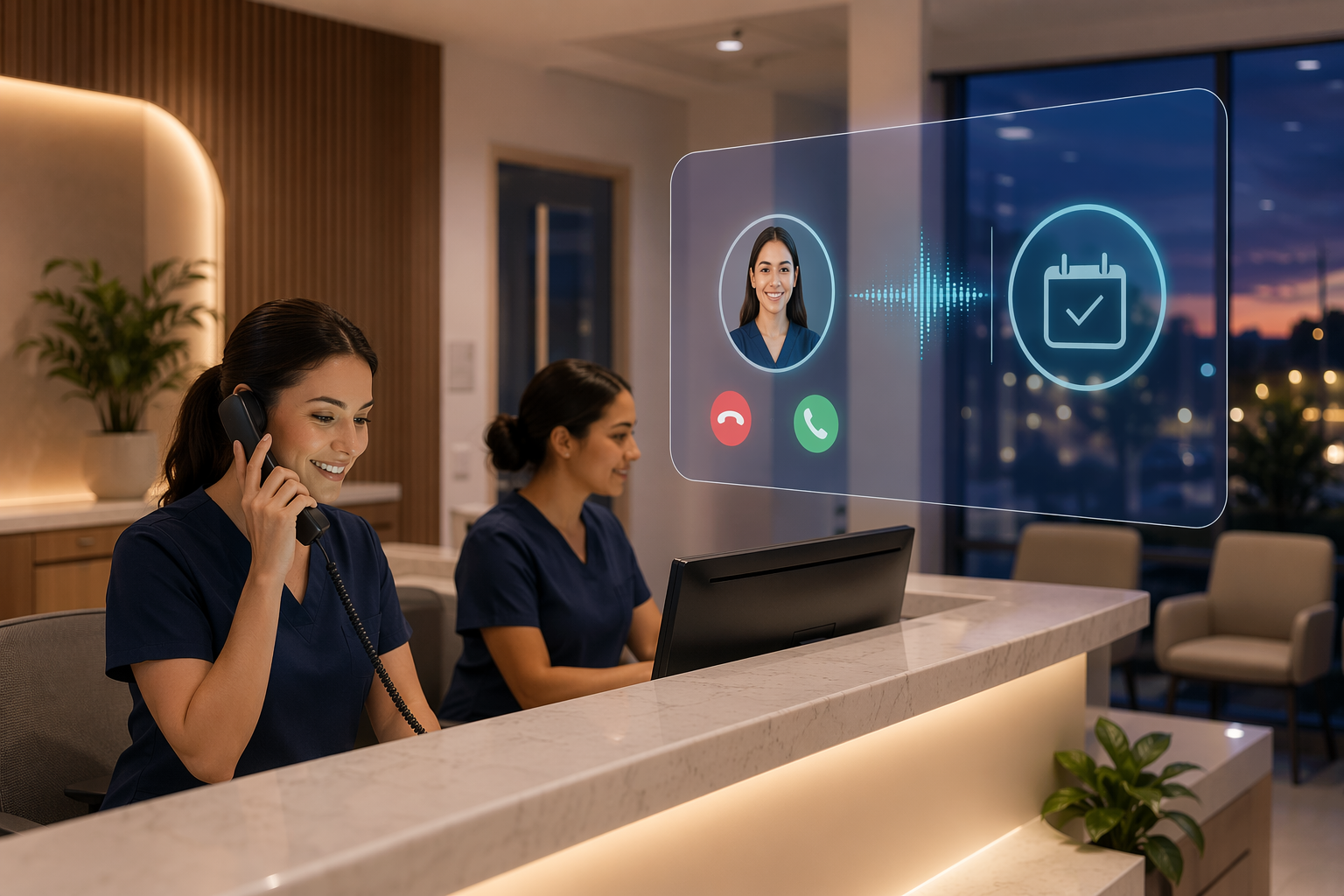
AI receptionist for clinics guide: see how CallMissed answers 24/7, recovers missed calls, follows up by SMS/WhatsApp and captures appointment enquiries.
AI Receptionist for Clinics: Stop Losing Patient Enquiries in 2026
What happens to a patient enquiry when your clinic phone rings at 1:15 p.m., your receptionist is on lunch, and the caller refuses to leave a voicemail? In 2026, an AI receptionist for clinics is becoming a practical way to stop those enquiries from disappearing—by answering calls 24/7, capturing patient intent, starting appointment intake, and triggering instant SMS or WhatsApp follow-up before the patient contacts another clinic.
This matters now because clinic communication has moved beyond “office hours.” Search results in 2026 already show a clear market shift: clinic-focused AI receptionist platforms are positioning around 24/7 call answering, appointment booking, rescheduling, report-status queries, urgent-call routing, multilingual support, and reduced admin workload. CloudTalk’s 2026 roundup frames AI virtual receptionists around appointment scheduling, while healthcare-specific providers such as HuskyVoice.AI and EasyClinic describe AI receptionists for hospitals and clinics that answer patient calls around the clock and prevent busy-line drop-offs. The pattern is simple: local healthcare businesses are no longer competing only on doctors, services, or location—they are competing on speed of response.
For appointment-based clinics, missed calls are not a minor admin issue. They usually cluster during predictable pressure points: morning opening rush, lunch-hour spikes, evenings after work, weekends, and campaign days after a WhatsApp broadcast, Google ad, or Instagram promotion. Voicemail does not solve the problem if patients do not leave messages. A traditional receptionist cannot answer every simultaneous call. A call center may add cost and handoff friction. Generic AI tools may answer, but fail to capture clinic-specific details such as preferred doctor, service type, branch, urgency, consent for follow-up, or whether the enquiry should move to WhatsApp.
This guide explains how an AI receptionist changes that workflow. You will learn how clinics can use AI voice answering for missed-call recovery, appointment intake, booking requests, rescheduling, reminders, patient enquiry capture, human escalation, shared inbox handoff, analytics, and compliance-aware consent or opt-out messaging. We will also compare AI receptionists against traditional receptionists, voicemail, call centers, and generic bots—without assuming AI should replace every human interaction.
Platforms like CallMissed fit into this shift by combining 24/7 AI voice answering with WhatsApp/SMS follow-up, multilingual Indian-language support, CRM-style handoff, and workflows designed for real local businesses that cannot afford to lose patient enquiries to a busy line.
How does an AI receptionist for clinics stop missed patient enquiries in 2026?
An AI receptionist for clinics stops missed patient enquiries by answering calls 24/7, capturing appointment intent, and triggering fast SMS or WhatsApp follow-up before the caller moves on to another provider. In 2026, the value is not “AI replacing receptionists”; it is AI covering the gaps—lunch breaks, after-hours calls, busy-line moments, campaign spikes, staff shortages, and voicemail drop-offs.
For appointment-based clinics, CallMissed positions the AI receptionist for clinics as a practical first-response layer: it answers missed or overflow calls, asks why the patient is calling, captures booking or callback details, sends instant follow-up by SMS or WhatsApp, escalates urgent calls, and hands the enquiry to the front desk with context.
The core problem: patients do not wait like leads in a spreadsheet
A missed patient enquiry is usually time-sensitive. Someone searching for a dentist, dermatologist, physiotherapist, diagnostic centre, veterinary clinic, or local specialist often calls multiple nearby options. If one clinic does not answer, the next clinic may get the appointment.
That is why an AI receptionist for clinics matters in 2026. It gives the clinic an always-available response channel when human staff are unavailable, already on another call, or busy with patients at the desk.
The 2026 clinic AI receptionist market is responding to exactly this behaviour. EasyClinic’s 2026 AI receptionist page describes the category around “answer every call 24/7,” reducing missed calls and helping clinics stop losing patients to a busy line. HuskyVoice.AI’s 2026 healthcare voice AI page positions AI receptionists for hospitals and clinics in India around 24/7 patient call answering, appointment booking, rescheduling, report-status queries, and urgent-call routing. Cabot Solutions’ 2026 roundup says AI voice receptionists help clinics answer calls 24/7, automate scheduling and intake, cut hold times, and reduce admin workload.
That pattern is important: the market is not just talking about automation; it is talking about availability, response speed, and missed-call recovery.
What an AI receptionist does when your clinic cannot answer
A clinic-focused AI receptionist acts as the first response layer for calls that would otherwise be missed, delayed, or sent to voicemail. Instead of a caller hearing a busy tone or waiting too long, the AI can:
- Answer the call immediately, including during lunch breaks, evenings, weekends, holidays, and high-volume periods.
- Recover missed calls quickly, so a patient who tried to reach the clinic can still be acknowledged and guided to the next step.
- Ask structured intake questions, such as service needed, preferred doctor, branch, symptoms category, urgency, preferred date, and callback number.
- Identify appointment intent, including new booking, rescheduling, cancellation, pricing enquiry, report-status request, or general clinic question.
- Send instant SMS or WhatsApp follow-up, so the patient receives confirmation, next steps, payment links, location details, or a booking form.
- Escalate sensitive or urgent calls to a human, instead of pretending every conversation should be automated.
- Log the enquiry into a shared inbox or CRM, so front-desk staff can see what happened and continue the conversation.
For example, CallMissed can be used by appointment-based clinics to combine 24/7 AI voice answering with missed-call recovery, WhatsApp/SMS follow-up, appointment-intent capture, urgent escalation, and CRM-style front-desk handoff. For Indian clinics, its support for 22 Indian languages is especially relevant when callers are more comfortable speaking in Hindi, Tamil, Telugu, Bengali, Marathi, Kannada, Malayalam, Gujarati, Punjabi, or other regional languages.
In practice, that means an AI receptionist for clinics does not just “take a message.” It turns an unanswered call into a structured patient enquiry that staff can review, prioritise, and convert into an appointment.
Why voicemail is no longer enough in 2026
Voicemail assumes the patient is willing to leave a message, wait for a callback, and still choose your clinic later. That is a risky assumption for local healthcare businesses.
An AI receptionist changes the workflow from passive to active:
- Voicemail says: “Leave a message.”
- AI receptionist says: “I can help you with an appointment. Which service do you need?”
- Voicemail creates: a delayed task.
- AI receptionist creates: a structured enquiry with contact details, intent, and follow-up.
- Voicemail depends on: the patient’s patience.
- AI receptionist depends on: instant response and automated routing.
This is why AI receptionist for clinics adoption is growing across appointment-led sectors such as dental clinics, physiotherapy centres, dermatology clinics, veterinary clinics, diagnostic labs, med spas, and local wellness practices.
The operational goal: capture, route, and recover
A good clinic AI receptionist should not be judged only by whether it “sounds human.” It should be judged by whether it helps the clinic capture, route, and recover enquiries.
The practical outcomes are:
- Fewer missed calls during peak hours, after hours, and staff breaks
- Faster patient response after Google, WhatsApp, Instagram, or referral-driven enquiries
- Cleaner appointment-intent capture before human staff intervene
- Better urgent-call escalation when a patient needs human attention quickly
- Better front-desk handoff through shared inbox or CRM workflows
- More consistent patient communication across voice, WhatsApp, SMS, and email
For clinic owners in 2026, the question is no longer whether every call can be answered by a human. The real question is whether every patient enquiry can be acknowledged, captured, routed, and followed up quickly enough to protect the booking opportunity. An AI receptionist for clinics helps make that possible without forcing the front desk to carry every call in real time.
Why do clinics lose bookings to lunch-hour call spikes, after-hours calls and voicemail drop-offs?
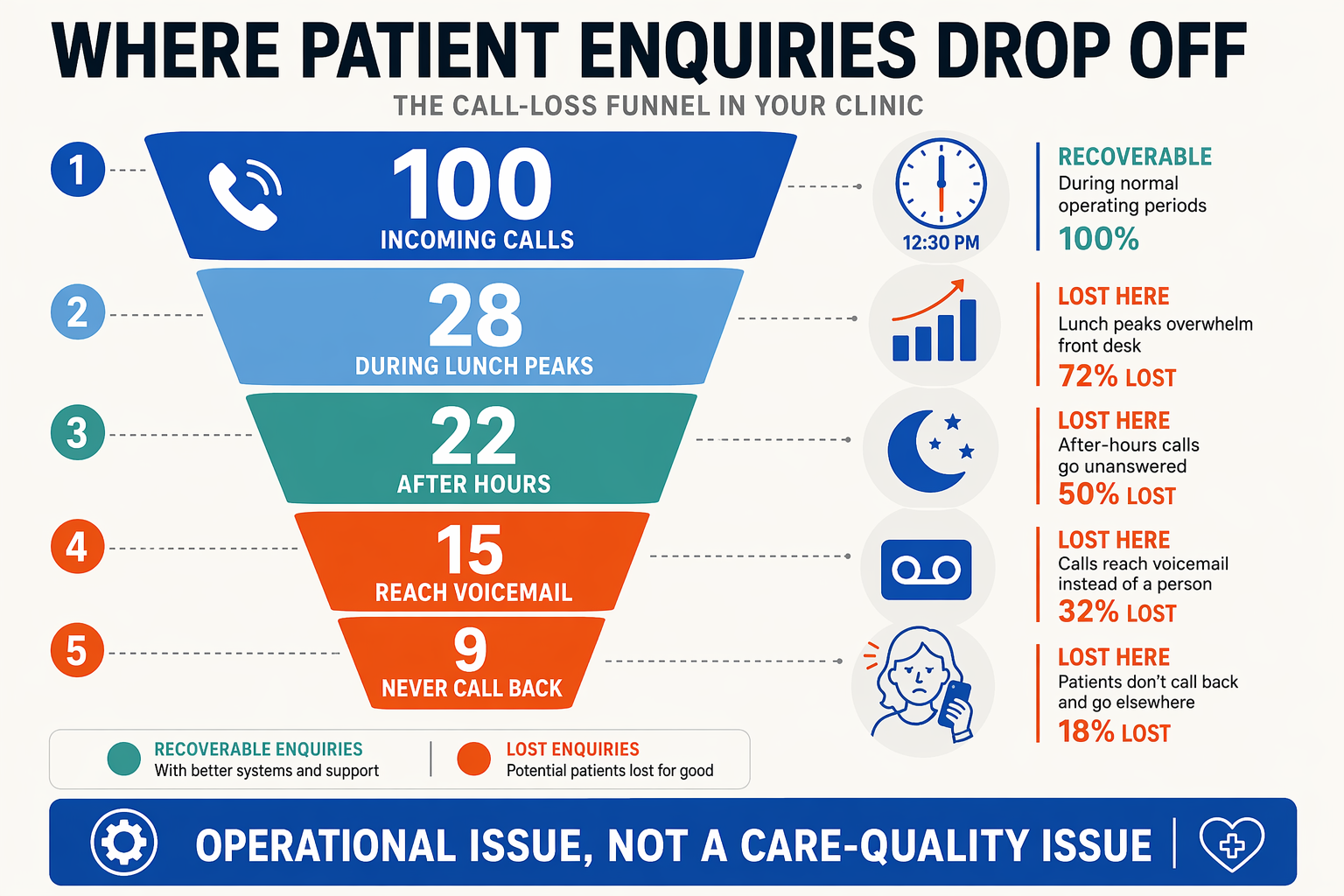
Clinics lose bookings because patient demand arrives in bursts, while front-desk capacity is fixed. When calls hit during lunch, evenings, weekends, or campaign-driven spikes, unanswered callers often do not wait, do not leave voicemail, and may contact the next clinic that answers first.
The problem is not “too few calls”—it is call timing mismatch
A clinic receptionist may handle routine traffic well at 10:30 a.m., but booking intent often peaks when staff availability drops. The highest-risk windows are:
- Lunch-hour spikes — patients call during their own break, exactly when clinic staff are also away.
- After-hours enquiries — working patients often search and call after office hours.
- Opening-hour rush — overnight missed enquiries pile up at 9:00 a.m.
- Campaign spikes — Google Ads, Instagram promotions, WhatsApp broadcasts, and seasonal offers can create simultaneous call bursts.
- Doctor-delay periods — when the front desk is busy managing waiting patients, incoming calls go unanswered.
Cabot Solutions’ 2026 clinic receptionist roundup says AI voice receptionists help clinics “answer calls 24/7, automate scheduling and intake, cut hold times, and reduce admin workload.” That framing matters because the operational failure is not just a missed ring—it is a missed moment of intent.
Voicemail fails because patients want resolution, not a recording
Voicemail sounds like a backup, but it creates friction at the exact point when a patient is deciding where to book. Many callers do not want to explain symptoms, preferred slots, insurance/payment questions, or branch preferences into a recorder with no confirmation.
A voicemail workflow usually creates four gaps:
- No instant acknowledgement: the patient does not know when the clinic will respond.
- No structured intake: the clinic receives an incomplete message, if any.
- No booking momentum: there is no suggested slot, callback promise, or WhatsApp link.
- No prioritisation: urgent, high-value, and routine calls sit in the same inbox.
EasyClinic’s 2026 AI receptionist page positions the category around helping clinics “never miss a call again” and preventing patient loss to busy lines. The commercial lesson is direct: a caller who reaches voicemail has not been captured as an enquiry until the clinic has a name, phone number, intent, and next step.
Lunch-hour and after-hours calls are often high-intent calls
Patients calling outside standard front-desk availability are not necessarily casual leads. They may be:
- comparing dental, dermatology, physiotherapy, diagnostic, or veterinary clinics;
- trying to book before symptoms worsen;
- calling after seeing a social ad or Google Business Profile;
- seeking rescheduling because they cannot attend an existing appointment;
- checking report status or doctor availability.
HuskyVoice.AI’s 2026 healthcare receptionist listing describes AI receptionists for hospitals and clinics that “answer patient calls 24/7, book appointments, handle rescheduling, share report status, and route urgent” calls. That list reflects the real call mix clinics face: bookings are only one part of the workload, but every non-booking call still consumes receptionist time.
Busy lines create a silent revenue leak
A busy line is worse than a missed call because the clinic may never know the enquiry existed. If two people call during lunch and one line is occupied, the second caller may simply disconnect. If a receptionist is speaking to an in-clinic patient, the caller hears ringing. If the clinic relies on callback discipline, the follow-up may happen hours later.
For appointment-based businesses, the leak usually appears as:
- fewer new-patient bookings than ad leads suggest;
- high Google Business Profile call volume but low confirmed appointments;
- reception staff saying “we were busy all day” while owners still see empty slots;
- WhatsApp messages arriving after missed calls, but without context;
- patients saying, “I tried calling earlier but nobody picked up.”
How CallMissed changes the failure point
CallMissed, an AI-native communication platform built for Indian businesses, addresses this gap by answering calls with an AI voice receptionist, capturing appointment intent, and triggering instant SMS or WhatsApp follow-up. For clinics serving multilingual local audiences, CallMissed’s support for 22 Indian languages is especially relevant because missed bookings often come from patients who prefer regional-language communication.
Instead of treating voicemail as the backup, clinics can treat every unanswered ring as a structured workflow:
- answer instantly;
- identify booking, rescheduling, report query, or callback request;
- collect name, number, service, preferred doctor/branch, and time window;
- escalate urgent or sensitive calls to a human;
- push the enquiry into a shared inbox or CRM view;
- send consent-aware WhatsApp/SMS confirmation or opt-out messaging.
The core reason clinics lose bookings is simple: patient intent is perishable. An AI receptionist preserves that intent before the caller moves on.
What changed in clinic call handling in 2026?
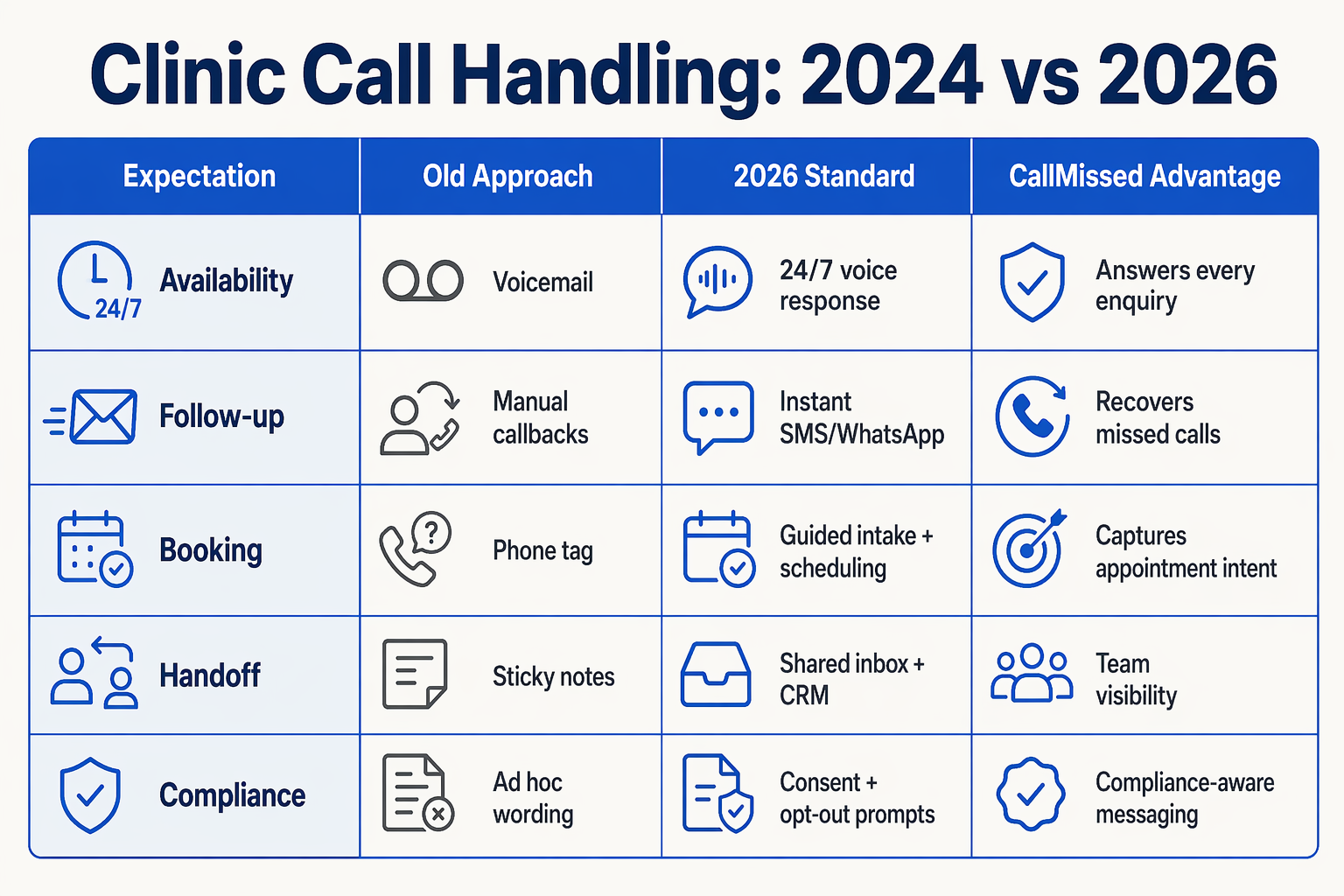
Clinic call handling changed in 2026 because “answering the phone” is no longer enough—clinics now need always-on intake, routing, booking follow-up, and multilingual communication across voice, SMS, and WhatsApp. The market signal is clear: multiple 2026 AI receptionist guides now position clinic call automation around 24/7 answering, appointment scheduling, rescheduling, report-status queries, urgent-call routing, and admin workload reduction.
2026 clinic call handling shift at a glance
| What changed in 2026 | Old clinic workflow | New AI receptionist workflow | Why it matters for clinics |
|---|---|---|---|
| After-hours calls became bookable opportunities | Caller hears voicemail or waits until morning | AI answers 24/7, captures intent, and starts appointment intake | EasyClinic’s 2026 clinic receptionist guide frames AI receptionists as a way to “answer every call 24/7” and stop busy-line drop-offs. |
| Lunch-hour and peak-time spikes need parallel answering | One receptionist handles one call while others abandon | AI can answer simultaneous calls and collect patient details | Cabot Solutions’ 2026 list says AI voice receptionists help clinics “cut hold times” and reduce admin workload. |
| Appointment handling moved beyond basic call pickup | Staff manually asks for service, doctor, branch, and timing | AI collects structured booking details before human confirmation | CloudTalk’s 2026 roundup lists AI virtual receptionists specifically for appointment scheduling. |
| Patient requests became more varied | Receptionist manually handles booking, rescheduling, reports, directions, and urgent queries | AI classifies intent: booking, reschedule, report status, billing, location, escalation | HuskyVoice.AI’s 2026 healthcare page highlights booking, rescheduling, report-status sharing, and urgent-call routing for hospitals and clinics in India. |
| Local-language support became operational, not optional | English/Hindi-only reception creates friction for regional callers | AI voice workflows can support multilingual intake and handoff | For Indian clinics, platforms such as CallMissed support voice and chat workflows across 22 Indian languages, which matters for Bharat-facing healthcare businesses. |
| Follow-up shifted to messaging channels | Staff writes down numbers and calls back later | AI triggers instant SMS or WhatsApp confirmation, reminders, or callback tasks | LeadsOrbit’s clinic AI receptionist content describes support for booking, intake, reminders, and follow-up across dental, chiro, and med-spa workflows. |
The big change: calls became structured patient enquiries
The practical difference in 2026 is that a clinic call is now treated like a workflow event, not just a conversation. Instead of only asking “Who called?”, modern AI receptionists capture:
- Caller name and phone number
- Reason for enquiry
- Preferred service or department
- Preferred doctor, branch, or time slot
- Urgency level
- Consent for SMS or WhatsApp follow-up
- Whether a human callback is required
That structure is what helps clinic owners reduce leakage. A missed call with no voicemail is invisible; a captured enquiry with WhatsApp follow-up becomes a trackable booking opportunity.
Why this matters for appointment-based local businesses
The same pattern applies beyond medical clinics. Dental clinics, physiotherapy centers, dermatology clinics, aesthetic clinics, diagnostic labs, veterinary clinics, salons, coaching centers, and repair businesses all face the same operational problem: demand arrives when staff are busy.
In 2026, the competitive gap is increasingly between businesses that merely publish a phone number and businesses that can respond instantly. Search visibility may bring the enquiry, but call handling determines whether that enquiry becomes an appointment.
For clinics, the winning model is not “replace the receptionist.” It is AI-first triage plus human escalation: let AI answer instantly, capture clean information, handle routine booking requests, and pass complex or sensitive cases to staff with context already attached.
How does CallMissed handle the full appointment enquiry workflow from first ring to booked visit?
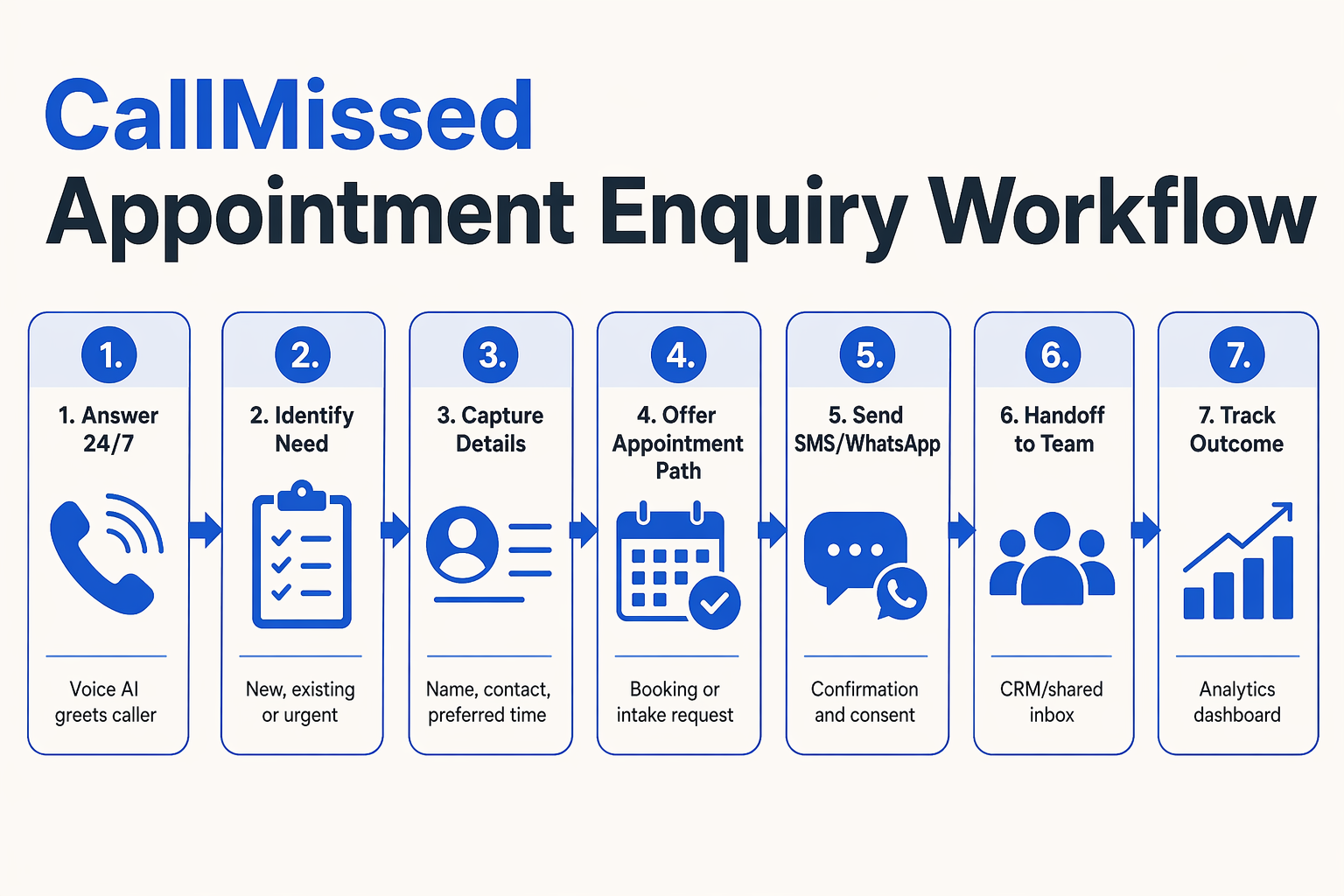
A CallMissed workflow turns a clinic call into a structured appointment enquiry: answer the call, identify intent, collect intake details, confirm next steps, follow up on WhatsApp/SMS, and hand off to staff when needed. The goal is not just “AI answering,” but converting the first ring into a trackable booked-visit pipeline.
1. First ring: answer before the patient drops off
When a patient calls during lunch hour, after closing, or while the front desk is already on another call, CallMissed’s AI voice receptionist can pick up instantly and greet the caller with clinic-specific context.
A typical opening can sound like:
“Hello, you’ve reached GreenCare Dental Clinic. I can help with appointments, rescheduling, directions, fees, or connecting you to the clinic team. How may I help you today?”
This matches the broader 2026 clinic AI trend. Cabot Solutions’ 2026 roundup says AI voice receptionists help clinics answer calls 24/7, automate scheduling and intake, cut hold times, and reduce admin workload. CloudTalk’s 2026 list similarly frames AI virtual receptionists around appointment scheduling, while HuskyVoice.AI highlights use cases such as booking appointments, rescheduling, report-status queries, and urgent-call routing for hospitals and clinics in India.
2. Intent detection: understand why the patient called
Instead of treating every call as the same, the AI receptionist categorizes the enquiry into a workflow. For clinics and appointment-based businesses, common intents include:
- New appointment request
- Existing appointment reschedule or cancellation
- Doctor availability or branch timing
- Service enquiry, such as dental cleaning, skin consultation, physiotherapy session, vaccination, or diagnostics
- Report status or follow-up query
- Urgent concern requiring human escalation
- Location, parking, payment, or preparation questions
This matters because a booking call and a report-status call should not follow the same script. A good AI receptionist collects only the operational details needed for routing and booking—without making medical claims or replacing clinical judgment.
3. Intake capture: collect the details your staff need
Once intent is clear, CallMissed can collect structured appointment information and save it into the clinic’s shared inbox/CRM view. For example:
- Patient name
- Mobile number
- Preferred doctor, department, service, or branch
- Preferred date and time window
- New or returning patient status
- Short reason for visit, in the patient’s own words
- Consent for WhatsApp/SMS follow-up
- Escalation flag, if the caller asks for human help
For Indian clinics, language can be a deciding factor. CallMissed supports Speech-to-Text and Text-to-Speech across 22 Indian languages, which helps clinics serve patients who are more comfortable speaking in Hindi, Tamil, Telugu, Bengali, Marathi, Gujarati, Kannada, Malayalam, Punjabi, Odia, or other regional languages.
4. Booking path: confirm, request approval, or hand off
Depending on how the clinic wants to operate, the AI receptionist can follow one of three booking models:
- Direct booking: confirm a slot if calendar rules are connected and availability is clear.
- Booking request: capture the preferred slot and send it to staff for approval.
- Human-assisted booking: transfer or flag the call when the case needs receptionist review.
For many clinics, the safest starting point is the second model: the AI captures the enquiry, sends the patient a confirmation message, and lets staff finalize the visit.
5. Follow-up: move the conversation to WhatsApp or SMS
After the call, CallMissed can trigger instant follow-up:
- “Thanks for calling GreenCare Dental. We received your appointment request for Saturday morning. Our team will confirm shortly.”
- “Please reply 1 to confirm, 2 to reschedule, or 3 to speak to the clinic.”
- “You can share previous reports here if requested by the clinic team.”
This is where CallMissed’s WhatsApp-native workflow is useful: clinics can continue the conversation in the channel patients already use, while keeping call notes, messages, and handoffs visible to staff.
6. Handoff and analytics: make every enquiry visible
The final step is operational visibility. Each enquiry should become a record—not a forgotten missed call. CallMissed can help teams review:
- Missed-call recovery volume
- Appointment requests by time of day
- Common patient questions
- Calls escalated to humans
- Follow-up status across WhatsApp/SMS
- Enquiries by branch, service, or campaign
That full workflow—call answered, intent captured, intake logged, follow-up sent, staff notified, booking tracked—is what separates a true AI receptionist for clinics from a simple voicemail replacement.
How does CallMissed compare with receptionists, voicemail, call centers and generic AI receptionist tools?
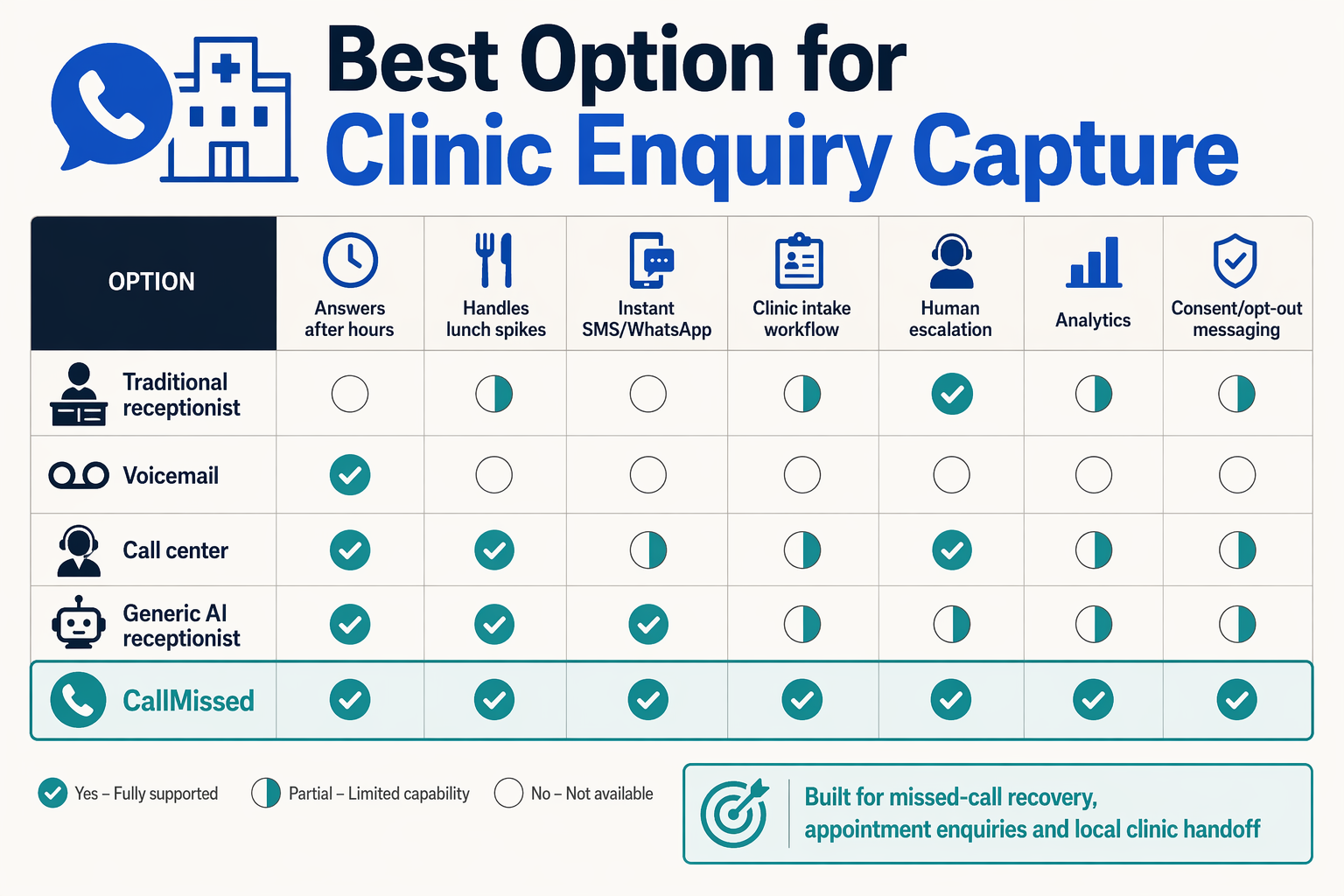
Choosing an AI receptionist for clinics means comparing more than who answers the phone. The important distinction is between capturing an appointment request and confirming a booking in the clinic’s EMR or scheduling system. A captured name, preferred doctor and time does not mean an appointment is booked.
CallMissed provides general-purpose AI voice agents, WhatsApp communication, a shared inbox and CRM tools. Clinics can evaluate these for enquiry intake and staff follow-up, but should verify scheduling integration, patient-data handling and escalation behaviour before deployment. Do not assume healthcare-specific integrations or certifications.
Comparison: clinic call-handling options in 2026
| Option | Appointment request versus confirmed booking | After-hours handling | Urgent escalation and human fallback | Privacy due diligence | Total cost components |
|---|---|---|---|---|---|
| Human receptionist | Can capture requests and confirm bookings when authorised to use the clinic’s scheduling system | Depends on staffing | Can follow clinic procedures and involve clinical staff; needs a clear escalation path | Access permissions, confidentiality training and record-handling procedures | Salary, benefits, training, supervision and additional shift coverage |
| Voicemail | Records a request; does not itself confirm a booking | Captures messages when enabled, but review may wait until staff return | Not a live escalation channel; callers need a clinic-approved emergency message | Recording access, retention and secure callback procedures | Phone service, storage and staff time reviewing messages and returning calls |
| Call center | May capture requests or book directly, depending on system access and scope | Depends on contracted coverage | Depends on scripts, transfer arrangements and availability of clinic staff | Contracts, operator access, recordings, subcontractors and data location | Coverage, usage or staffing fees, setup, integration and supervision |
| General AI platform, including CallMissed | Can support configured intake; confirmed booking requires a verified scheduling connection and successful write-back | Can be configured to handle calls outside staffed hours; test availability and failure behaviour | Requires clinic-approved rules and a tested human escalation path; do not assume medical triage | Verify permitted data use, contracts, access controls, retention, subprocessors and applicable legal requirements | Platform fees, voice usage, phone carriage, messaging, integration, testing and human follow-up |
| Healthcare-specialist platform | May advertise EMR booking; verify your exact EMR, supported actions and live write-back | Check contracted coverage and outage procedures | May advertise urgent routing; verify destinations, response expectations and failed-transfer handling | Verify claimed certifications, their scope and any required healthcare agreements | Subscription, implementation, EMR connectivity, usage, support and staff oversight |
What healthcare-specific vendor claims actually tell you
Official search snippets for Medreception name EMR connections and urgent routing. An official OmniMD snippet claims HIPAA compliance, SOC 2 Type II and live integration. These are vendor claims to verify, not proof that every clinic workflow, EMR version or deployment is covered.
Ask for current documentation, the supported integration list and a demonstration using your workflow. For booking, establish whether the system can check live availability, create or change an appointment, receive confirmation and recover safely from a failed write.
Privacy requirements are jurisdiction-specific. HIPAA is not a universal requirement for every clinic worldwide, and a security certification alone does not settle whether a deployment is appropriate. Have the clinic’s responsible privacy or legal adviser review the relevant obligations, contracts and data flows.
Where CallMissed fits—and what needs verification
CallMissed’s verified capabilities include:
- AI voice and chat agents configured with prompts, knowledge bases, tools and call settings.
- Speech recognition in 22 Indian languages plus English, including code-mixed speech such as Hinglish. Natural text-to-speech voices cover 10 Indian languages plus English, with additional languages available through other voice models.
- WhatsApp Business messaging, a shared inbox and human handoff for message threads.
- CRM records and AI call notes, including summaries, action items and follow-up.
- Custom REST tools and integrations, including Cal.com and Google Calendar.
These capabilities can support a configured appointment-request workflow. They do not establish native EMR integration, confirmed EMR booking, healthcare certification or medical triage capability. CallMissed is hosted in India, but hosting location alone does not establish suitability for patient data.
If SMS follow-up is a requirement, verify it separately rather than assuming it is included. Likewise, demonstrate the exact phone-to-human escalation workflow before relying on it.
Acceptance tests before patient-data deployment
Test each shortlisted option with realistic scenarios and explicit pass/fail criteria:
- Double booking: Two callers request the same slot. Only a successfully committed booking may be described as confirmed; the other caller receives an accurate alternative or pending-request status.
- Unavailable doctor: The requested doctor is absent or has no openings. The system must not invent availability or silently substitute another clinician.
- Uncertain identity: The caller cannot complete the clinic’s approved identity checks. The system must not disclose patient information or change an existing appointment.
- Urgent request: The system provides a clinic-approved emergency message and initiates immediate human escalation. It must offer no diagnosis or independent medical triage.
- Failed transfer: No human answers or the transfer fails. The system must not claim a successful handoff; it must follow the clinic’s approved fallback procedure and flag the unresolved request.
Also test scheduling outages, incomplete requests and recovery after interrupted calls. Review what information appears in recordings, transcripts, WhatsApp threads and staff records.
The practical choice is usually a hybrid workflow: automation captures routine enquiries, verified scheduling connections confirm bookings, and people handle exceptions and clinical concerns. Buy against demonstrated workflow outcomes—not a feature label or an unverified promise to “answer every call.”
What privacy, consent, opt-out and escalation safeguards should healthcare clinics use?
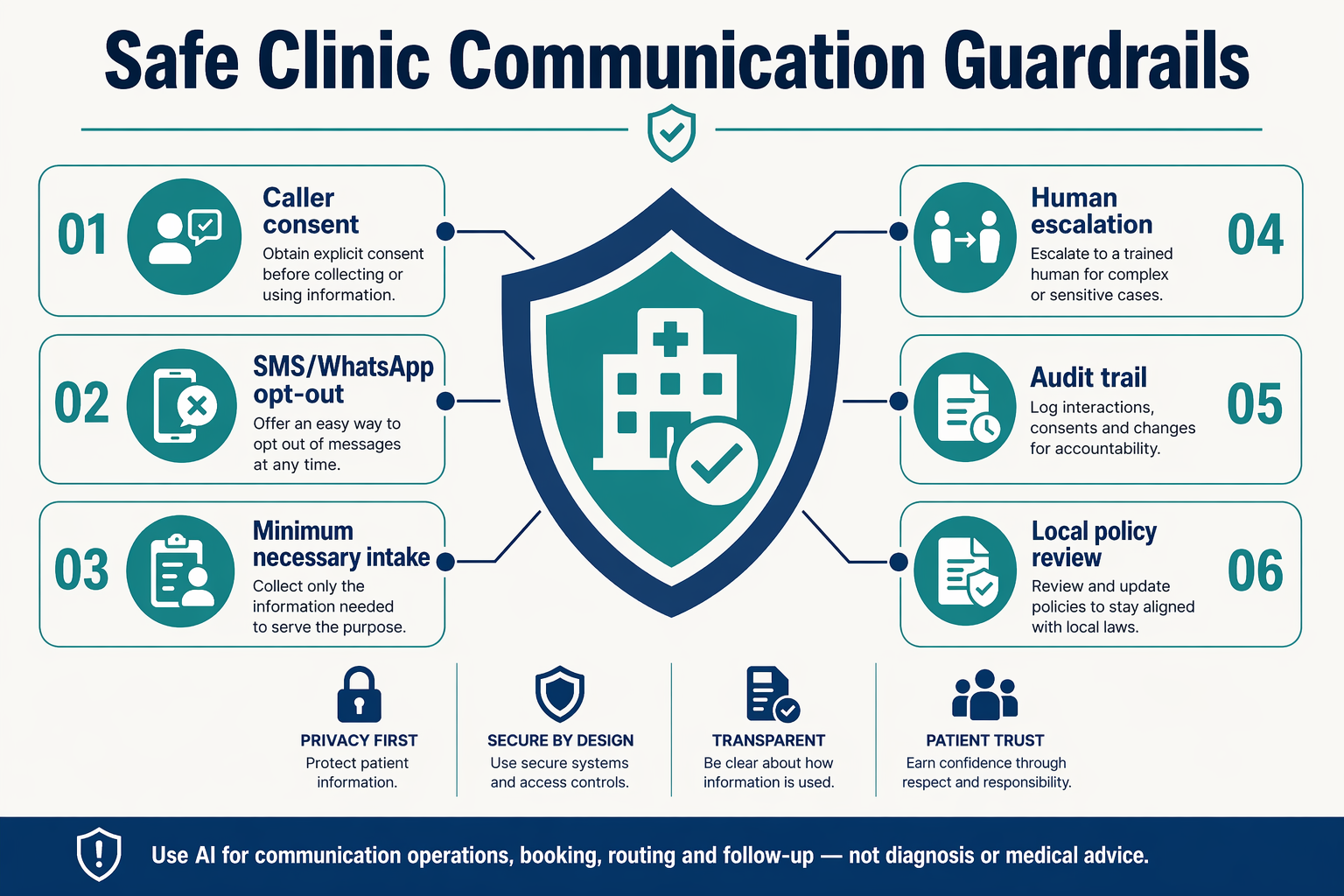
Clinics should treat an AI receptionist for clinics as a front-desk workflow tool, not a medical decision-maker: collect only the data needed to route or book the enquiry, get consent for follow-up, offer a clear opt-out, and escalate urgent or sensitive cases to humans immediately.
Start with data minimisation and purpose clarity
The safest AI receptionist workflow is the simplest one: answer the call, identify intent, capture booking details, and route the enquiry. The Digital Personal Data Protection Act, 2023 in India requires personal data to be processed for a lawful purpose with consent or another valid basis, so clinics should avoid collecting unnecessary health information during the first call.
A practical intake script should capture:
- Caller name and mobile number
- Reason for contact: appointment, reschedule, report status, billing, directions, emergency routing
- Preferred doctor, department, branch, date and time
- Consent for SMS or WhatsApp follow-up
- Escalation flag if the caller mentions pain, emergency, medication reaction, surgery complication, child/elderly risk, or distress
The AI should not ask for detailed diagnosis, prescriptions, lab values, or confidential history unless the clinic has a compliant, documented workflow for that information.
Use explicit consent for WhatsApp, SMS and callbacks
Consent should be short, understandable, and channel-specific. This matters because clinic AI receptionists increasingly trigger follow-up outside the call itself. The 2026 clinic AI receptionist SERP is already centred on 24/7 call answering, appointment booking, rescheduling, report-status queries and urgent-call routing, with sources such as HuskyVoice.AI and EasyClinic describing round-the-clock patient call handling for clinics and hospitals.
A compliant consent prompt can sound like:
“May we send appointment details and follow-up messages to this number by SMS or WhatsApp? You can reply STOP anytime to opt out.”
Clinics should store:
- Timestamp of consent
- Phone number and channel
- Exact consent wording or consent category
- Opt-out status
- Staff or AI workflow that captured consent
Platforms such as CallMissed can support this operationally by combining AI voice answering with WhatsApp/SMS follow-up and CRM-style handoff, so consent and conversation context are not scattered across personal phones.
Make opt-out easy, immediate and honoured everywhere
Opt-out should not be hidden in terms and conditions. Patients should be able to say “stop,” “unsubscribe,” “don’t message me,” or request only phone communication.
A clinic-safe opt-out policy should include:
- STOP keyword support for SMS/WhatsApp campaigns
- No promotional messages after opt-out
- Transactional exception rules only where legally and operationally appropriate, such as appointment confirmations the patient requested
- Shared inbox visibility so reception staff know not to message an opted-out patient casually
- Periodic audit logs showing when opt-outs were captured and applied
The goal is not just regulatory hygiene; it prevents trust damage. Healthcare communication is sensitive even when the message is “Your appointment is at 5 p.m.”
Define human escalation before launch
An AI receptionist should have a clear “do not continue” boundary. CloudTalk’s 2026 list frames AI virtual receptionists around appointment scheduling, and Cabot Solutions’ 2026 clinic receptionist roundup highlights use cases such as 24/7 answering, scheduling, intake, reduced hold times and reduced admin workload. None of those require the AI to make clinical judgments.
Escalate to a human when the caller:
- Mentions emergency symptoms, severe pain, bleeding, breathlessness, fainting, pregnancy complications, or a child/elderly risk
- Asks for medical advice, diagnosis, dosage, test interpretation or prescription changes
- Is angry, confused, grieving, distressed, or repeatedly says the AI is not helping
- Requests privacy-sensitive information such as reports, insurance, or billing disputes
- Fails identity checks for report-status or existing-patient queries
A safe escalation line is: “I’m not a medical professional, and I don’t want to delay urgent care. I’ll connect you to the clinic team now. If this is an emergency, please contact local emergency services immediately.”
Keep audit trails and role-based access
Every clinic using AI call handling should maintain logs for call time, transcript or summary, consent status, action taken, escalation reason and staff follow-up. Access should be role-based: front-desk staff may need scheduling details, but not every employee needs full call transcripts.
For Indian clinics serving regional audiences, multilingual support also needs governance. CallMissed supports voice and chat across 22 Indian languages, which is useful for accessibility—but clinics should still ensure translated scripts preserve consent, opt-out and escalation wording accurately.
What do clinic operators and front-desk experts say about AI medical receptionist adoption?
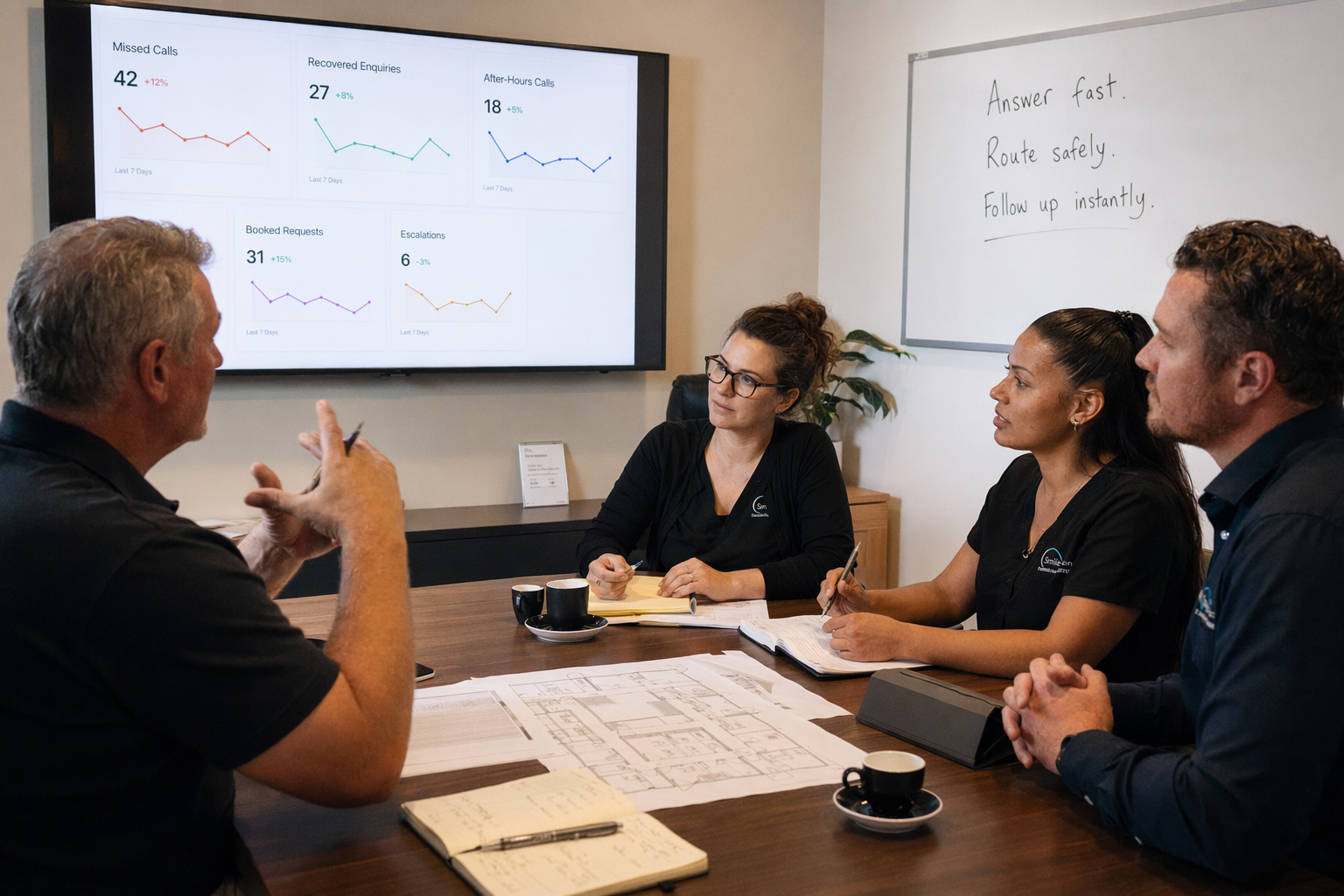
Clinic operators and front-desk experts are not describing AI medical receptionist adoption as “replace the receptionist.” They are describing it as capacity relief: answer calls when humans cannot, capture clean appointment intent, and hand off the right cases to staff.
The strongest adoption signal is 24/7 call coverage
Across 2026 clinic-focused AI receptionist content, the repeated operator pain point is simple: patients call outside neat office workflows. EasyClinic’s 2026 clinic guide positions AI receptionists around the promise to “Never Miss a Call Again” and highlights 24/7 answering for clinics. HuskyVoice.AI’s 2026 India healthcare page says AI receptionists can “answer patient calls 24/7, book appointments, handle rescheduling, share report status, and route urgent” calls.
That tells clinic owners something important: the market is not only buying automation for cost savings. Clinics are buying availability.
Front-desk teams usually support adoption when the AI is framed as a backup for predictable overload moments:
- Lunch-hour spikes when one receptionist cannot answer every call.
- After-hours appointment requests from working patients.
- Campaign response surges after WhatsApp, Google Ads, or Instagram activity.
- Repeat queries about timings, location, doctor availability, pricing ranges, and report status.
- Rescheduling requests that do not require clinical judgement.
Experts are focusing on booking flow, not “AI diagnosis”
The practical consensus is that AI receptionists should stay in the communication lane. Cabot Solutions’ 2026 roundup says AI voice receptionists help clinics “answer calls 24/7, automate scheduling and intake, cut hold times, and reduce admin workload.” LeadsOrbit frames the use case around “booking, intake, reminders, and follow up” for dental, chiropractic, and med-spa teams.
For clinic operators, that means the safest adoption path is operational:
- Identify the caller’s intent — new appointment, reschedule, cancellation, report query, billing query, location query, or urgent escalation.
- Collect structured details — name, phone number, preferred branch, service, doctor preference, time slot, and consent for follow-up.
- Confirm next step — appointment request logged, WhatsApp sent, staff callback scheduled, or urgent call routed.
- Escalate when needed — symptoms, emergencies, angry callers, payment disputes, or unclear requests go to humans.
This is where a platform such as CallMissed fits naturally: the AI voice agent can answer missed or overflow calls, capture appointment intent, and trigger WhatsApp/SMS follow-up while keeping staff in the loop through a shared inbox-style workflow.
Front-desk teams care about control, escalation, and language
The biggest adoption blocker is not usually AI accuracy in isolation. It is whether the front desk feels the AI will create more cleanup work.
Clinic teams tend to support AI receptionists when they can control:
- Scripts and approved answers for timings, services, fees, documents, and preparation instructions.
- Escalation rules for urgent, sensitive, or unclear calls.
- Calendar or booking workflow boundaries so the AI does not overpromise availability.
- Consent and opt-out language before sending SMS or WhatsApp follow-ups.
- Language coverage for local patients who may not be comfortable in English.
For Indian clinics, multilingual access is especially important. CallMissed supports Speech-to-Text and Text-to-Speech across 22 Indian languages, which is relevant for clinics serving regional patient bases where appointment enquiries arrive in Hindi, Tamil, Telugu, Bengali, Marathi, Kannada, Malayalam, Gujarati, Punjabi, Odia, Assamese, and other local languages.
The adoption pattern: start narrow, then expand
The most successful clinic rollouts usually start with a narrow receptionist workload instead of automating the entire front desk on day one.
A practical rollout sequence is:
- Week 1: After-hours answering and missed-call capture.
- Week 2: Appointment intake and WhatsApp confirmation.
- Week 3: Rescheduling, cancellation, and reminder workflows.
- Week 4: Analytics review—missed-call volume, booked requests, escalations, and unanswered intent categories.
CloudTalk’s 2026 list of “10 Best AI Virtual Receptionists for Appointment Scheduling” shows that appointment scheduling is now a mainstream AI receptionist category, not an experimental edge case. But operators and front-desk experts are clearest on one point: AI adoption works best when it makes the human team faster, calmer, and better informed—not invisible.
Which clinics benefit most from CallMissed, and what should each do next?
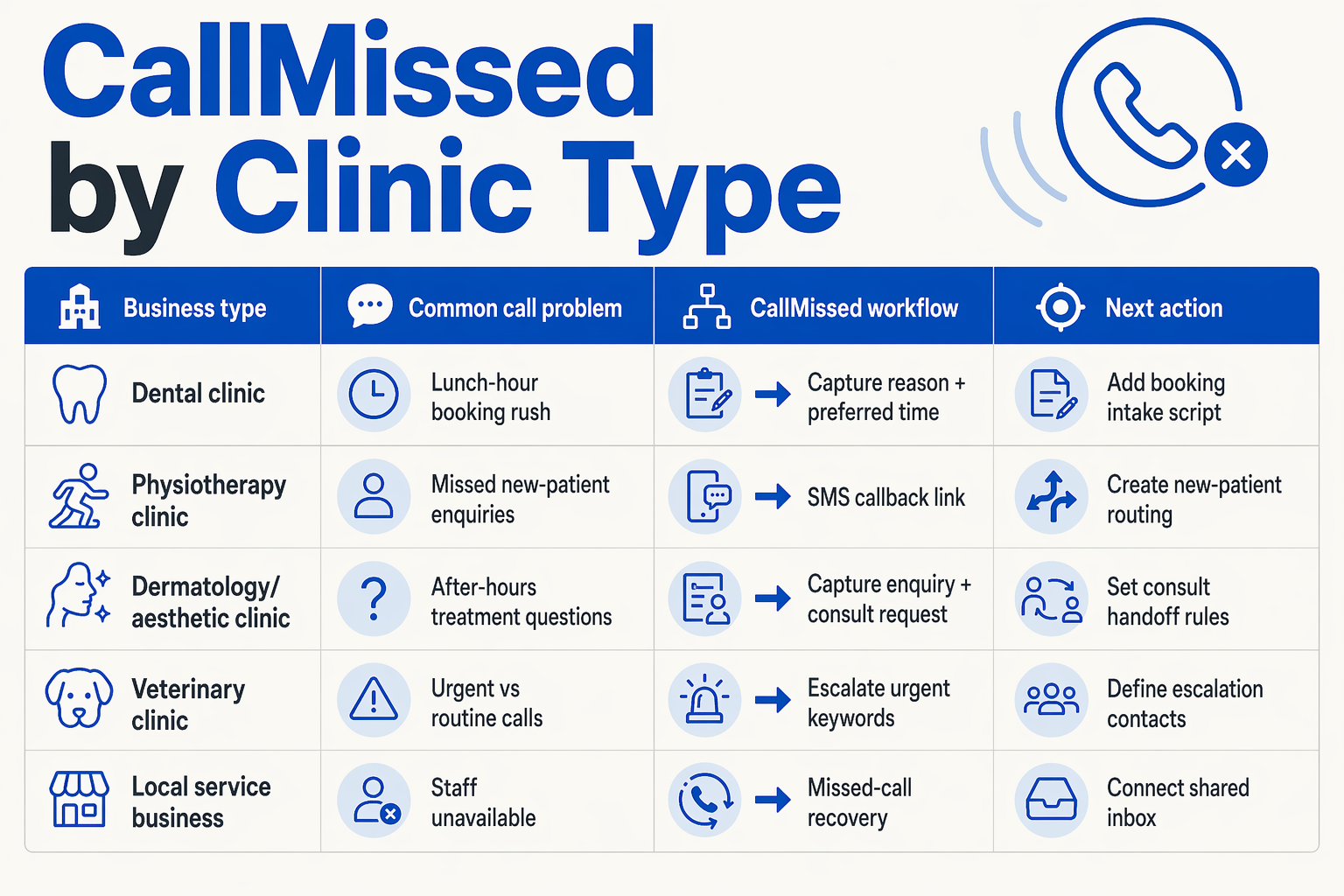
Clinics with high call volume, time-sensitive bookings, repeat visits, and after-hours enquiries benefit most from CallMissed first. The best next step is to map the top 5 call reasons, connect AI answering to WhatsApp/SMS follow-up, and route only complex or urgent conversations to staff.
Best-fit clinic types and next actions
| Clinic type | Why missed calls hurt most | High-value CallMissed workflow | What to do next |
|---|---|---|---|
| Dental clinics | Patients often call during pain, lunch breaks, or after work; if unanswered, they may book the next available dentist. | 24/7 AI voice answering, appointment intake, service selection, dentist preference, WhatsApp confirmation. | Create scripts for “tooth pain,” “cleaning,” “braces,” “implant,” and “follow-up visit.” |
| Dermatology & aesthetic clinics | Leads from Instagram, Google Ads, and WhatsApp campaigns can spike suddenly; cosmetic enquiries are comparison-driven. | Missed-call recovery, campaign source tagging, consultation request capture, shared inbox handoff. | Tag calls by treatment category: acne, hair, laser, skin consultation, aesthetic procedure. |
| Physiotherapy clinics | Patients need repeat sessions, rescheduling, and therapist-specific appointments; reception teams get overloaded. | Reschedule flows, recurring visit reminders, branch/therapist preference capture, human escalation. | Build separate flows for new injury, post-surgery rehab, sports therapy, and package follow-up. |
| Diagnostic centres & imaging clinics | Callers ask about test availability, fasting instructions, report status, pricing, and slot timing. | FAQ-style voice answering, report-status routing, appointment request capture, WhatsApp follow-up. | Add knowledge-base answers for timings, preparation instructions, home collection, and report pickup. |
| Veterinary clinics | Pet owners call urgently, often outside office hours; clinics need to separate emergency routing from routine bookings. | After-hours call answering, urgency detection, callback capture, WhatsApp location and timing message. | Define escalation words such as “bleeding,” “not breathing,” “accident,” or “poison.” |
| Multi-branch local clinics | Patients may call the wrong branch or ask for the nearest available slot; manual routing slows booking. | Branch selection, local-language intake, CRM handoff, analytics by location and service line. | Create branch-wise calendars, fallback numbers, and language preferences for each location. |
Why these categories are ready in 2026
The common pattern is not specialty—it is appointment friction. CloudTalk’s 2026 roundup of AI virtual receptionists frames the category around appointment scheduling, while Cabot Solutions’ 2026 clinic list says AI voice receptionists help clinics answer calls 24/7, automate scheduling and intake, cut hold times, and reduce admin workload. HuskyVoice.AI’s 2026 healthcare positioning similarly highlights 24/7 patient calls, appointment booking, rescheduling, report status, and urgent-call routing for hospitals and clinics in India.
That means clinics should not begin with “replace reception.” They should begin with the moments where human reception is most likely to fail:
- Lunch-hour spikes when one receptionist cannot answer simultaneous calls.
- After-hours calls from working patients who search and call after 7 p.m.
- Campaign bursts after WhatsApp broadcasts, Google Ads, or Instagram promotions.
- Repeat rescheduling that consumes staff time but follows predictable rules.
- Voicemail drop-offs where the clinic never receives the patient’s intent.
How CallMissed fits these clinic workflows
CallMissed is especially relevant for Indian appointment-based clinics because it combines AI voice answering, WhatsApp/SMS follow-up, CRM-style handoff, and multilingual support across 22 Indian languages. For clinics serving regional audiences, that matters: a missed Hindi, Tamil, Telugu, Bengali, Marathi, Kannada, Malayalam, Gujarati, Punjabi, or Odia enquiry is still a lost booking opportunity if the system only handles English comfortably.
A practical rollout should start with three steps:
- Choose one high-leakage call type — new appointments, reschedules, report queries, or campaign enquiries.
- Write a safe intake script — name, phone number, service, preferred slot, branch, urgency, and consent for WhatsApp/SMS follow-up.
- Set escalation rules — send complex, sensitive, or urgent conversations to a human receptionist or clinic manager.
The clinics that benefit fastest are not necessarily the largest. They are the clinics where every unanswered call can become a lost appointment, and where a fast, polite, always-on receptionist can turn patient intent into a confirmed next step.
How should you roll out CallMissed in 14 days, and what scripts should you use?
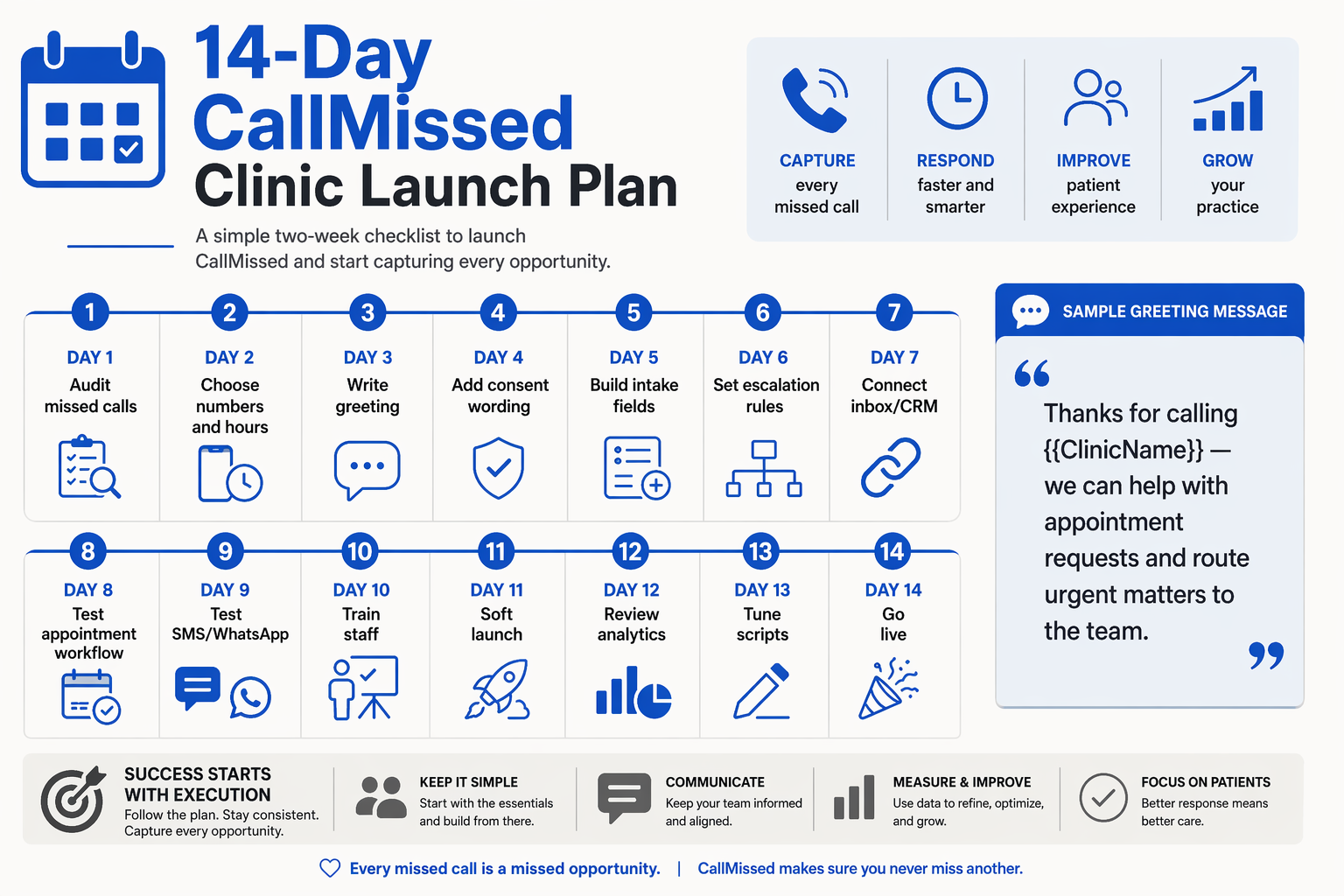
You can roll out CallMissed as an AI receptionist for clinics in 14 days by starting with one high-value workflow: answer missed and after-hours calls, capture appointment intent, and send instant WhatsApp/SMS follow-up. The goal is not to automate everything on day one—it is to stop enquiry leakage first, then expand into booking, rescheduling, reminders, and escalation.
Days 1–3: Map your clinic call flow
Start by documenting the top 10 reasons patients call. For most appointment-based clinics, these are:
- New appointment request
- Rescheduling or cancellation
- Doctor availability
- Pricing or consultation fee enquiry
- Location and parking directions
- Report/status update request
- Emergency or urgent symptom concern
- Follow-up visit
- Insurance/payment question
- Campaign or offer enquiry
HuskyVoice.AI’s 2026 healthcare receptionist page describes AI receptionists for hospitals and clinics as handling “appointment booking, rescheduling, report status, and urgent routing” 24/7. Use that same structure to decide what CallMissed should answer directly and what should be escalated to staff.
Days 4–6: Configure CallMissed intake fields
Set up CallMissed to capture only the details your front desk actually needs. For clinics, the minimum intake should include:
- Patient name
- Mobile number
- New or existing patient
- Service or department requested
- Preferred date/time
- Preferred doctor or branch
- Consent for WhatsApp/SMS follow-up
- Escalation flag if urgent, sensitive, or unclear
For Indian clinics, enable multilingual voice support where relevant. CallMissed supports Speech-to-Text and Text-to-Speech across 22 Indian languages, which matters when patients are more comfortable speaking in Hindi, Tamil, Telugu, Bengali, Marathi, Kannada, Malayalam, Gujarati, Punjabi, or another local language.
Days 7–9: Add WhatsApp and SMS follow-up
The fastest operational win is instant follow-up. If a caller asks for an appointment but does not complete the booking, CallMissed can send a WhatsApp or SMS message immediately.
Use this template:
Hi {{name}}, thanks for calling {{clinic_name}}. We received your appointment request for {{service}}. Please reply with your preferred time, or tap here to confirm: {{booking_link}}. Reply STOP to opt out.
For missed calls:
Hi, this is {{clinic_name}}. Sorry we missed your call. Would you like to book an appointment, reschedule, or speak to our front desk? Reply 1 for appointment, 2 for reschedule, 3 for callback.
EasyClinic’s 2026 clinic AI receptionist page positions the category around “never miss a call again,” while Cabot Solutions’ 2026 roundup says AI voice receptionists help clinics “answer calls 24/7, automate scheduling and intake, cut hold times, and reduce admin workload.” Your first CallMissed workflow should directly target those four outcomes.
Days 10–12: Write safe AI receptionist scripts
Use scripts that are helpful but do not provide medical advice.
New appointment script
“Thanks for calling {{clinic_name}}. I can help you request an appointment. Are you a new or existing patient?”
“Which service or doctor would you like to book for?”
“What day and time works best for you?”
“I’ll share this with the clinic team and send you a confirmation link on WhatsApp or SMS.”
Urgent concern script
“I’m sorry you’re experiencing this. I’m not a medical professional and can’t assess symptoms. If this may be an emergency, please contact emergency services or visit the nearest hospital. I can also alert the clinic team for a callback.”
Reschedule script
“I can help request a reschedule. Please share the patient name, current appointment date, and preferred new time.”
After-hours script
“The clinic is currently closed, but I can capture your request now. The team will review it during working hours. If this is urgent, please seek immediate medical help.”
Days 13–14: Test, train staff, and go live
Before full launch:
- Call from 5–10 different numbers and test peak-hour, lunch-hour, and after-hours flows.
- Check whether enquiries appear correctly in the CallMissed shared inbox/CRM.
- Confirm staff know which conversations need human escalation.
- Review opt-out wording for WhatsApp/SMS consent.
- Track missed-call recovery, booked appointments, callbacks completed, and unresolved enquiries.
CloudTalk’s 2026 roundup frames AI virtual receptionists around appointment scheduling, but clinics should measure the deeper operational metric: how many patient enquiries are captured that previously disappeared into busy lines, voicemail drop-offs, or unanswered lunch-hour calls.
Frequently Asked Questions
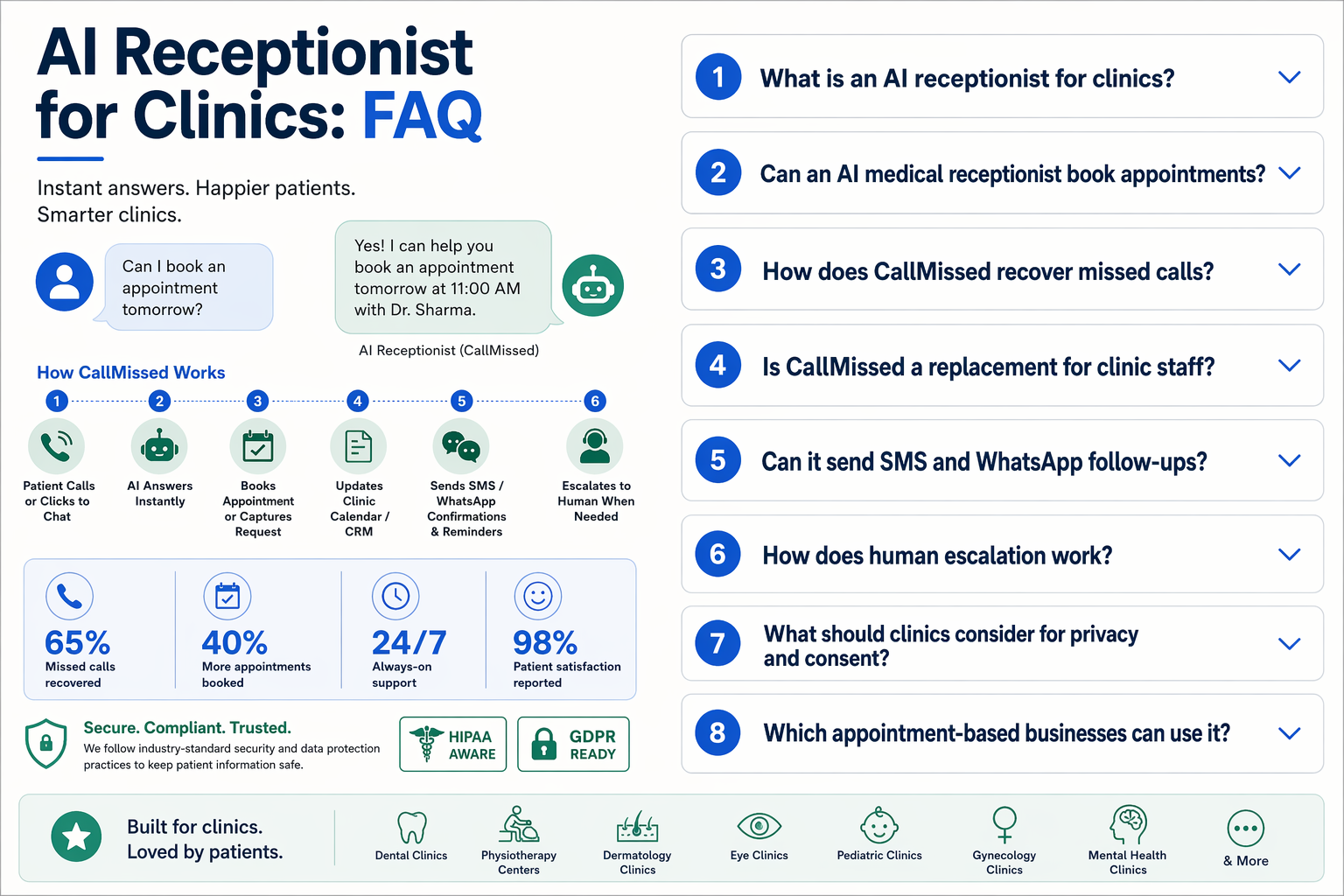
What is an AI receptionist for clinics and how does it work?
Can an AI receptionist for clinics book appointments automatically?
Will an AI receptionist replace my clinic receptionist?
How does an AI receptionist help with missed calls and voicemail drop-offs?
Can an AI receptionist handle WhatsApp follow-up for clinic enquiries?
Is an AI receptionist for clinics safe for healthcare communication?
Conclusion
In 2026, an AI receptionist for clinics is no longer just a convenience—it is becoming a practical safeguard against lost patient enquiries, unanswered lunch-hour calls, after-hours drop-offs, and voicemail silence.
Key takeaways for clinic owners and appointment-based local businesses:
- Missed calls are missed opportunities: Patients often move to the next clinic if no one answers, especially during busy hours, evenings, weekends, or campaign spikes.
- AI receptionists improve response speed: They can answer 24/7, capture patient intent, start appointment intake, route urgent calls, and trigger instant SMS or WhatsApp follow-up.
- Humans still matter: The strongest workflows combine AI for first response and data capture with receptionist or staff handoff for sensitive, complex, or high-priority enquiries.
- Clinic-specific workflows beat generic bots: Booking requests, rescheduling, branch selection, preferred doctor, consent, opt-outs, CRM notes, and shared inbox visibility all matter.
What to watch next: AI receptionists will become more multilingual, WhatsApp-native, analytics-driven, and integrated with clinic operations—not just “call answering” tools.
To explore how AI communication is evolving, check out CallMissed — an AI infrastructure platform powering voice agents, WhatsApp follow-up, CRM handoff, and multilingual chatbots for businesses. If your clinic missed ten calls this week, how many patients did you actually lose?