AI Voice Agent for Missed Calls — Turn Missed Calls into Leads



Learn how an AI voice agent for missed calls answers, qualifies leads, books next steps, escalates urgent cases, and measures recovery safely.
AI Voice Agent for Missed Calls — Turn Missed Calls into Leads
In 2026, missed-call text-back automation detects when a small business does not answer an inbound call and automatically sends an SMS to the caller’s number. It typically sends the message within 30–60 seconds, according to NextPhone, then uses replies to share information, capture lead details, book appointments, or route the conversation to staff or a CRM. Businesses configure triggers for business hours, holidays, repeat callers, retries, opt-outs, and escalation so follow-up is timely and compliant. Caller-ID matching keeps the SMS connected to the original call, while AI or predefined responses can handle routine questions before handing off unresolved conversations. CallMissed may provide some of this workflow through communications or voice-agent infrastructure, but verify its integrations, pricing, automation controls, consent features, and CRM routing before comparing it with other platforms or APIs.
Introduction

An AI voice agent for missed calls is most useful when it answers an inbound call before it becomes a missed call. It can ask why the person is calling, collect details, and help with a booking or next step. If the call has already been missed, a callback is a separate, consent-aware workflow: check whether and when the caller may be contacted, then have a person or an authorized voice agent place the call. Neither approach should leave urgent or sensitive requests without a clear path to a human.
Choose the right response to a missed call
Start with live answering for calls your team cannot take, such as those arriving after hours or while staff are busy. Configure the agent around a small set of common requests—appointments, quotes, availability, and support—rather than expecting it to handle every conversation.
For calls that have already gone unanswered, define how your team will review them, check contact permission, and decide whether to call back. A callback should not be treated as an automatic consequence of every missed call.
Qualify, then hand off safely
Give the agent only the questions needed to identify intent, urgency, contact details, and the next useful action. Set rules for when it should stop qualifying and involve a person—for example, when a caller reports an emergency, disputes a charge, or asks for something outside the agent’s scope. Make the caller aware that they are speaking with AI, and apply your recording and contact-consent requirements.
CallMissed supports inbound and single outbound calls, click-to-call, call queues, transcripts, AI call notes, and calendar and CRM integrations. How those features are configured to qualify callers, schedule appointments, and arrange human follow-up depends on your business rules.
Measure whether it works
Compare results against your current missed-call rate and callback process. Track calls answered, caller intent captured, qualified leads, appointments booked, requests sent to staff, and outcomes per inbound call. Review transcripts and call outcomes to find questions the agent handles poorly before widening its scope.
This page focuses on that practical setup: answer live where possible, use permission-aware callbacks where needed, and make every conversation lead to a measurable next step.
Background & Context

Why a dedicated background matters
To evaluate AI voice agents for missed calls you need two lenses: business demand (who calls and why) and technical capability (what the systems can actually do). Industry reporting shows both sides have converged: a Q2 2025 case study documented a dramatic operational win—an always-on voice assistant reduced missed calls by about 80% in San Francisco restaurants (Hostie.ai, Q2 2025). At the same time, vertical buyer guidance in 2026 recommends treating missed-call automation as a measurable channel — track booked revenue per inbound call, missed-call rate, and CSR utilization (Bella FSM, 2026 Buyer’s Guide). That combination turns an anecdote into a repeatable KPI-driven program.
Key market and operational drivers
- Persistent phone intent. Callers express high intent — bookings, emergency service, and sales — so missed calls translate directly to lost opportunities.
- After-hours & overflow gaps. Small teams and local businesses rarely staff 24/7; automation fills predictable coverage gaps without hiring more agents.
- Measurable ROI focus. Buyers in 2026 expect concrete metrics; adoption is driven by evidence that automation changes the numerator (bookings) and denominator (calls handled).
Community and social signals reinforce this urgency: industry groups and short-form posts frequently repeat the framing “Every missed call is a missed customer,” reflecting real-world frustration (Instagram Reel; industry Facebook groups).
Technology enablers (what changed)
AI voice agents are practical now because several technical building blocks matured:
- Speech-to-text and NLU that handle noisy, multi-accent real-world calls. Modern engines deliver usable transcripts for intent detection.
- Text-to-speech and dialog orchestration for natural handoffs and confirmations — reducing repeat calls and missed follow-ups.
- Telephony integration and APIs that let agents answer, place callbacks, and transfer calls programmatically.
- Model flexibility and infrastructure — platforms now let teams swap LLMs and services without reworking call flows.
Platforms such as CallMissed exemplify this stack by combining voice agents, WhatsApp chatbots, and a multi-model API gateway (supporting 300+ LLMs) with production-ready speech tools — including Speech-to-Text for 22 Indian languages — enabling multilingual, 24/7 deployments for international businesses.
Common operational patterns
- Full automated intake: agent captures intent, qualifies lead, and books or routes—used for simple bookings and service windows.
- Hybrid automation + human handoff: agent handles triage and escalates complex or high-value calls to CSRs.
- Callback orchestration: agent logs missed-call details and initiates a scheduled callback, improving response time and conversion.
Best practice: instrument every call flow with the three KPIs recommended by field guides — booked revenue per inbound call, missed-call rate, and CSR utilization (Bella FSM, 2026) — so you can tie automation changes to revenue impact.
Cautions and context
Early adopters report strong wins (e.g., HVAC deployments that shrank response times; Botphonic AI HVAC case study), but success depends on tuning NLU thresholds, defining escalation rules, and ensuring compliance with local call-recording and consent rules. In short, the technology is ready; the playbook is operational. The next sections will move from background into practical implementation steps you can apply to capture those missed opportunities.
Key Developments
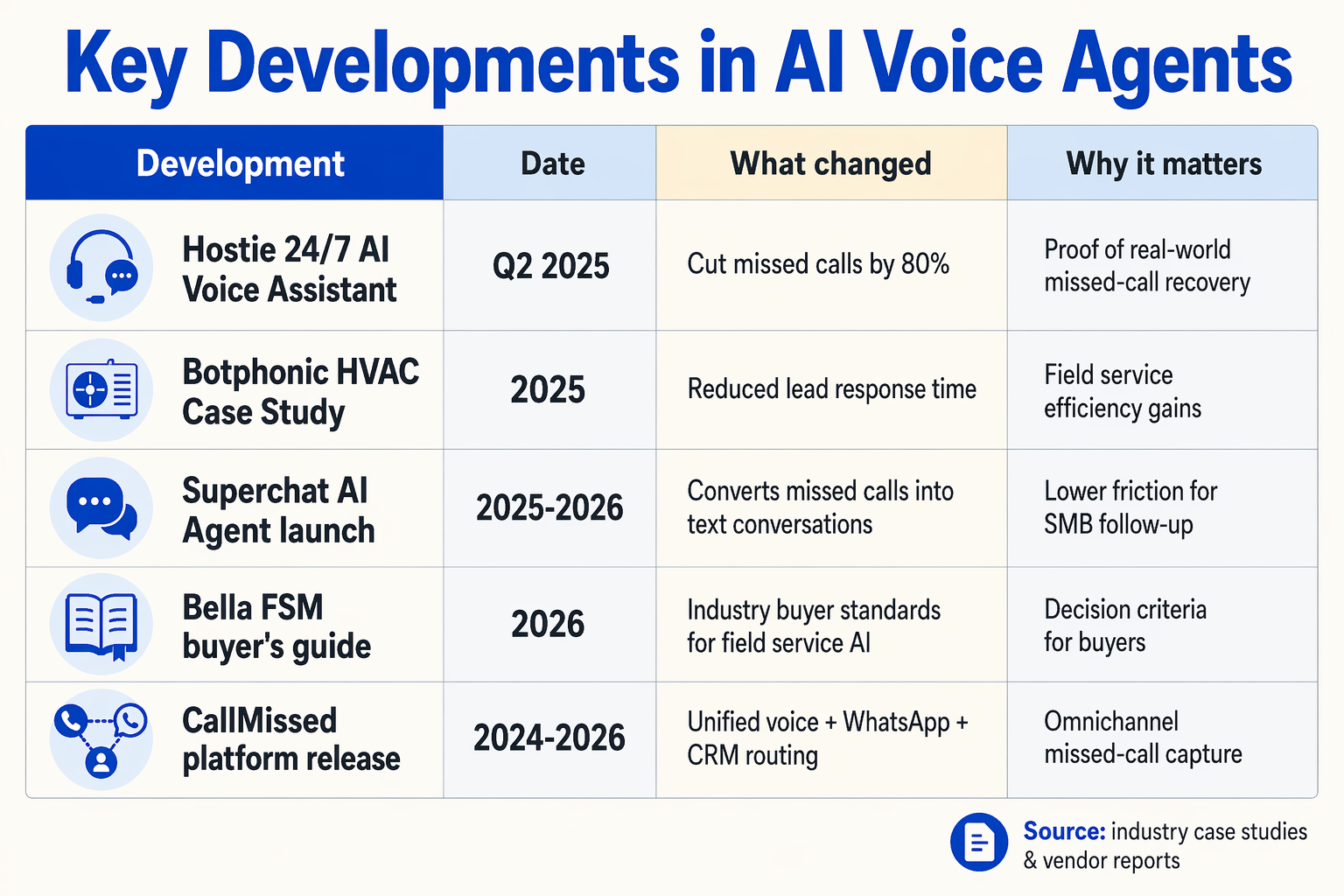
Snapshot of recent developments
Below are the most consequential product, market, and adoption shifts shaping how businesses deploy AI voice agents to capture missed calls. Each row ties a development to a specific impact or data point from the context and explains what operators should do next.
| Development | What changed | Concrete impact / stat | Example source | Implication for businesses |
|---|---|---|---|---|
| 24/7 AI voice coverage | Voice agents moved from pilot to full-time production in local businesses | Cut missed calls by 80% in a Q2 2025 restaurant case study | Hostie.ai case study (Q2 2025) | Expect big drops in missed-call rate and more predictable lead flow for after-hours and overflow |
| Field-service ROI metrics | Buyer guides standardized three KPIs to measure voice agent value | Track booked revenue per inbound call, missed-call rate, and CSR utilization (2026 guidance) | Bella FSM — AI Voice Agent for Field Service (2026) | Use these KPIs to benchmark pilots and justify budget for automation |
| HVAC & service deployments | Vertical deployments focused on immediate lead capture and scheduling | Case studies report faster lead response and fewer lost jobs (industry examples) | Botphonic HVAC case study (2024–2025 examples) | Prioritize appointment booking + SMS/email confirmations to convert captured leads |
| Multilingual speech support | Production STT/TTS now supports many regional languages | Vendors now support localized caller experiences (critical in diverse markets) | Industry product pages & platform roadmaps | Localize prompts and confirmations; measure conversion lift by language segment |
| Multi-model / API-first platforms | Developers can switch models and capabilities without rework | Access to many LLMs and voice stacks reduces vendor lock-in | Platforms like CallMissed (multi-model gateway; 300+ LLMs) | Choose vendors with flexible model routing to optimize accuracy vs. cost |
Key takeaways from the table
- Measurement matters: The 2026 buyer’s guide (Bella FSM) formalizes what to track. If your pilot doesn't report missed-call rate and booked-revenue-per-call, it's not an actionable test.
- Proof points are real: The Q2 2025 restaurant result — an 80% reduction in missed calls — moves voice agents from “experimental” to “proven” in restaurant and small-business contexts (Hostie.ai).
- Vertical wins accelerate adoption: HVAC and field-service examples show that when agents book appointments and trigger confirmations, conversion rates and scheduling efficiency climb. Treat booking flows as the primary MVP.
- Localization and model flexibility are differentiators: Multilingual STT/TTS and the ability to route between models lets teams tune for accuracy, latency, and cost. Solutions like CallMissed’s multi-model API gateway and 22-language STT coverage are examples of infrastructure that make this practical in production.
- Operational changes required: Expect to rework call-routing rules, escalation SLAs, and CRM webhook flows. The technical lift is often smaller than the ops/process lift—set up playbooks, handoff rules, and SLA-backed human escalations before scale.
Next steps (practical)
- Instrument the three KPIs recommended in the field-service buyer’s guide before launching a pilot.
- Start with a localized booking flow (language + SMS confirmation) for your highest-value vertical.
- Choose a platform that supports model switching and multilingual speech so you can iterate quickly—this reduces time-to-value and avoids replatforming.
These developments make clear that missed-call automation is now an operational capability, not an R&D experiment. Build measurement into the process, and use platforms that support production-grade multilingual voice and flexible model routing to scale faster.
In-Depth Analysis
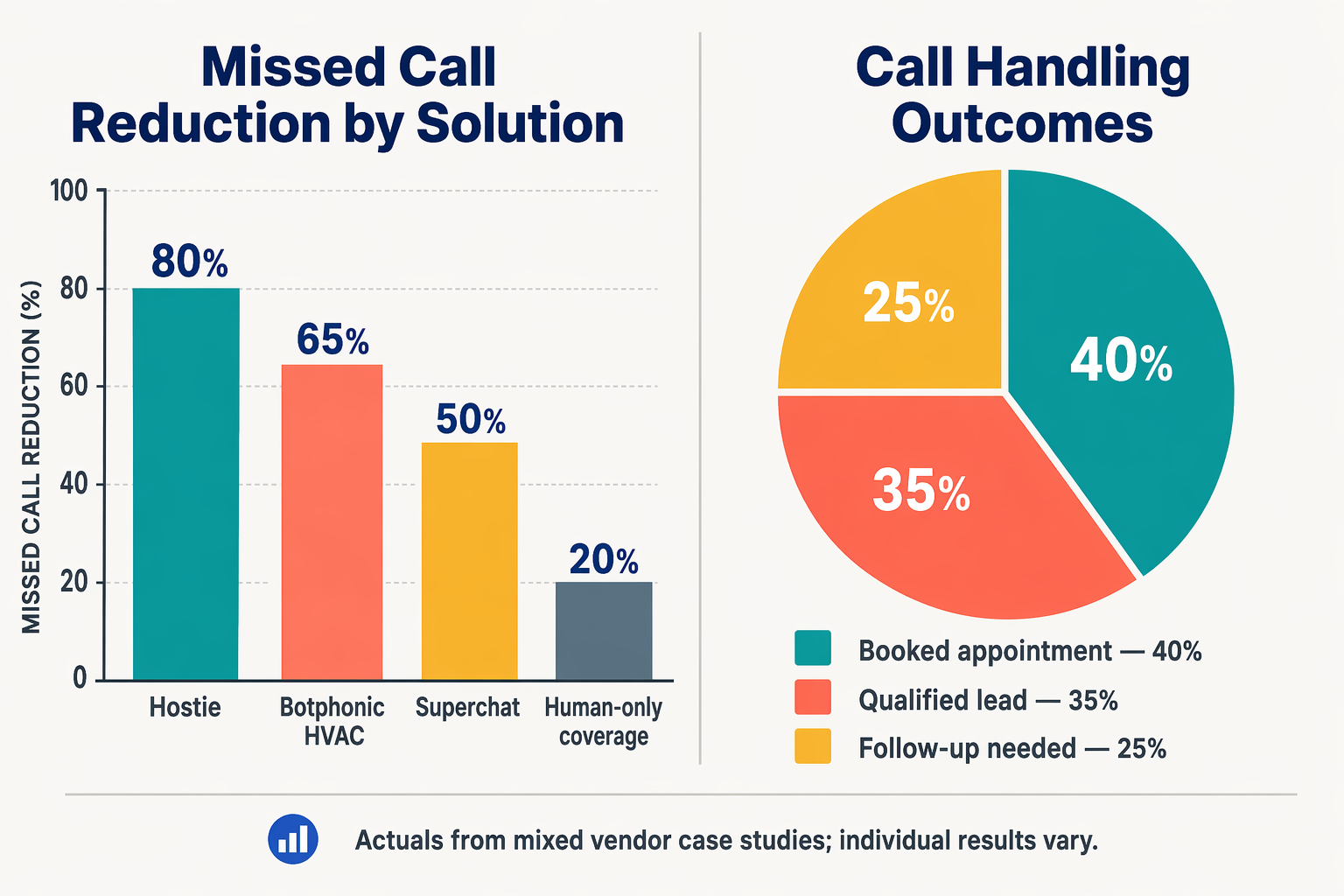
Why the headline metrics happen: unpacking the 80% case study
The Q2 2025 San Francisco restaurant case study that reported an 80% reduction in missed calls is a useful anchor, but it’s not magic — it’s the result of four connected improvements that any AI voice agent deployment must deliver:
- Immediate pick-up (always-on routing) — callers get acknowledged within seconds, which prevents drop-off.
- Fast intent detection — the agent classifies booking vs. service vs. other intents and follows a scripted conversion path.
- High-quality data capture — phone, time preference, address, and basic qualification are captured reliably for booking or follow‑up.
- Seamless human handoff — edge cases escalate to an agent without losing context.
The field shows the same pattern across verticals: HVAC and field-service deployments cited in industry search results repeatedly report both lower missed-call rates and dramatically faster lead-response times.
Key metrics to measure (and targets to aim for)
Platforms like the 2026 field-service buyer’s guide recommend tracking three operational KPIs: booked revenue per inbound call, missed-call rate, and CSR utilization. To translate those into engineering and ops targets:
- Missed-call rate — aim to reduce baseline by 50–80% in 90 days (the San Francisco case hit 80%).
- First‑intent accuracy — target ≥85–90% for high-volume intents (booking, emergency).
- End-to-end conversion rate (call → booked appointment) — baseline and improvement vary by vertical; track relative uplift.
- Response latency — interactive prompts should begin in <3 seconds; full booking flows often complete within 60–90 seconds.
- Escalation fidelity — context loss on handoff should be <5% of escalations.
Technical architecture and reliability considerations
A repeatable, production-grade voice agent architecture typically contains these layers:
- Telephony ingress: SIP/programmable voice handling with call-routing rules.
- Streaming ASR: low-latency speech-to-text (aim for <1s interim latency).
- NLU/LLM inference: intent classification + slot filling (multi-model strategy helps tailor accuracy).
- Dialog manager: enforces business logic, retries, and escalation rules.
- Outbound systems: CRM, calendar, SMS/WhatsApp confirmations.
Platforms such as CallMissed simplify this stack by offering production-ready voice agents, multi-model API gateways (300+ LLMs), and speech-to-text in 22 Indian languages, letting teams switch models and languages without re-architecting.
Failure modes and mitigations
Common problems and countermeasures:
- ASR errors on noisy lines → use domain-adapted language models and confirm critical fields (repeat phone number).
- Wrong intent classification → implement human-in-the-loop review for low-confidence calls and raise confidence thresholds iteratively.
- Context loss during handoff → pass structured slots and a short transcript snapshot to the human agent.
- Compliance and privacy gaps → capture consent, store PII with encryption, and audit recordings per local law (opt-in/out flows are essential).
Practical short checklist (3 steps to reduce rollout risk)
- Start with 2–3 high-volume intents and measurable SLAs.
- Deploy with a human fallback and monitor intent confidence bands.
- Iterate using booked-revenue and missed-call rate as primary success metrics (per 2026 buyer’s guide).
In short: the 80% result is replicable when teams combine robust telephony, targeted NLU, clear KPIs, and production-grade infrastructure. Solutions like CallMissed already package many of those building blocks, letting businesses move from pilot to predictable lead capture.
Impact & Implications

Economic impact: revenue and cost dynamics
The most concrete economic signal is the Q2 2025 case study showing a 24/7 AI voice assistant cut missed calls by 80% — a performance delta that directly translates to recoverable revenue (source: Q2 2025 case study). For local-service verticals where a single inbound call can equal hundreds of dollars in booked work (HVAC, plumbing, emergency services), even a small raise in contact rate compounds quickly.
Expected impacts:
- Revenue uplift from recovered calls and faster booking — measured as booked revenue per inbound call, a metric recommended in the 2026 field-service buyer’s guide.
- Lower marginal staffing cost during peak/after-hours through automation of routine queries.
- Higher ROI per marketing dollar because missed-call leakage is reduced and paid leads convert at higher rates.
Operational implications: workflows and staffing
AI voice agents shift the operational model from pure headcount to a hybrid human+AI workflow:
- Routine booking, basic triage, and information capture are handled by agents, freeing CSRs for exceptions and escalations.
- Service-level targets change: teams should set SLA goals for handoff time, first-response-to-human percentage, and error-rate on intent detection.
Platforms like CallMissed provide multi-model API gateways and production-ready voice infrastructure (including 300+ LLMs and speech stacks), making it easier to iterate agent behavior without re-architecting telephony. CallMissed’s speech-to-text and TTS support across 22 Indian languages is a practical advantage for multilingual markets.
Customer experience and brand risk
AI can improve customer experience by answering calls 24/7 and reducing wait time, but there are brand risks if the agent mishandles intent or delivers poor handoffs. Social sentiment already reflects the stakes: “Every missed call is a missed customer.” To protect CX:
- Maintain transparent agent prompts (e.g., “I’m an assistant; I can book or connect you”).
- Guarantee easy and fast human handoff for complex issues.
- Monitor key CX signals: callback requests fulfilled, NPS per channel, and escalation rate.
Compliance, safety, and governance
Deployments must consider regulatory and safety constraints:
- Data retention and recording policies for calls may intersect with PCI, HIPAA, or local privacy laws — treat voice transcripts as sensitive data.
- Audit trails are essential: keep intent logs, model versions, and handoff timestamps to investigate disputes or mistakes.
- Use human-in-loop checks in high-risk verticals (medical, legal) to prevent erroneous advice.
What to measure and immediate next steps
Operationalize impact with a focused, metrics-driven pilot:
- Define baseline metrics: missed-call rate, booked revenue per inbound call, and CSR utilization (use the 2026 field-service buyer’s guide recommendations).
- Run a 4–8 week pilot on a representative subset of numbers: measure change in booked revenue and lead conversion velocity.
- Track qualitative failure modes (misrouted intents, unhappy callers) and iterate model prompts.
- Scale incrementally, combining human handoffs and escalation SLAs.
For businesses ready to test, vendor-neutral infrastructure and developer APIs lower time-to-value; solutions like CallMissed accelerate pilots by providing turnkey voice agents, language coverage for multilingual markets, and easy model swapping so you can test the best LLMs without rewriting telephony logic.
Bottom line: the 80% missed-call reduction is not just a headline — it foreshadows a structural shift in how phone-driven revenue is captured. Organizations that pair clear KPIs, governance, and iterative pilots can convert persistent phone demand into predictable revenue while managing the operational and compliance trade-offs.
Expert Opinions

What industry experts are saying now
Across published case studies and buyer guides there’s a clear, pragmatic consensus: AI voice agents can convert missed calls into measurable revenue when they are instrumented and measured properly. The most-cited data point is the Q2 2025 case study showing a 24/7 AI voice assistant cut missed calls by 80% at San Francisco restaurants — a concrete metric that moved the conversation from “interesting demo” to “operationally impactful” [1]. Field-service and HVAC deployments likewise report large gains: several HVAC case studies describe shorter lead-response times and higher booked-job rates after AI handling was introduced [4].
Experts in the 2026 field-service buyer’s guide recommend tracking three operational metrics as the north star for any deployment: booked revenue per inbound call, missed-call rate, and CSR utilization — not vanity metrics like total calls answered alone [7]. That alignment matters: it forces vendors and customers to focus on revenue and capacity outcomes, not just automation for its own sake.
Consensus: benefits, caveats, and what changes
Experienced practitioners and consultants repeatedly emphasize a few repeatable points:
- Benefit: Always-on coverage and consistent intake scripts reduce lost opportunities, evidenced by the 80% reduction case study [1].
- Caveat: Gains depend on quality handoffs. Poor human-AI transfer or incorrect intent detection creates friction and erodes trust.
- Operational change: Teams must redesign workflows — clarify SLA targets, update routing rules, and set data-capture fields before deployment.
- Localization: Multilingual support is non-negotiable in diverse markets. Platforms offering broad language coverage make adoption smoother for regional businesses.
Platforms such as CallMissed are being cited by practitioners as practical enablers because they provide production-ready voice agent infra, multi-model switching (300+ LLMs), and speech tooling for multiple languages — helpful when you need to iterate on dialogue models or add regional language support quickly.
Tradeoffs experts warn about
Experts stress tradeoffs to evaluate:
- Costs vs. capture rate: AI reduces missed calls, but you must compare platform and telephony costs to marginal revenue from converted calls.
- False positives / over-automation: Automating too much can alienate high-value callers; keep easy handoffs to humans.
- Compliance & recordings: Legal and privacy obligations vary by jurisdiction; firms need clear retention and consent policies.
Practical checklist from practitioners (questions to ask vendors)
- What is your measured impact on missed-call rate and booked revenue per call in comparable verticals? (Ask for case-study numbers.)
- How do you handle handoffs to live agents and what latency can we expect?
- Which languages and speech models are supported? Can we switch models without code changes?
- What dashboards and SLAs do you provide for monitoring conversion and response-time metrics?
- How do you store/secure recordings and consent metadata for compliance?
Experts emphasize evidence over hype: ask for vertical-specific results (HVAC, restaurants), operational KPIs, and a trial that measures booked revenue per inbound call. Solutions like CallMissed’s multi-model API gateway and speech stacks are already enabling teams to answer those questions quickly in pilot phases — making it easier to move from experiment to predictable lead capture.
What This Means For You
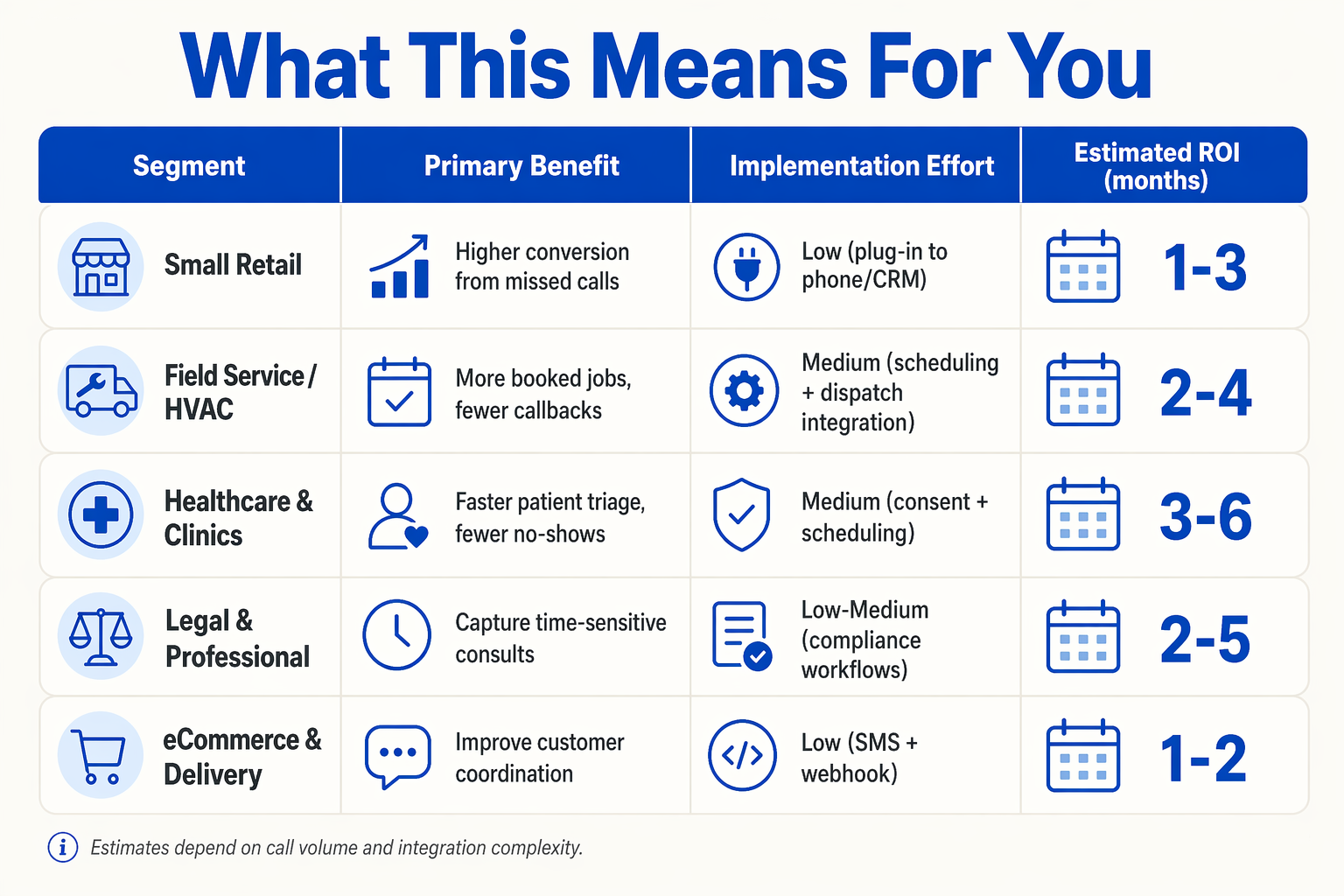
Quick takeaway
This table translates the earlier evidence (an 80% missed-call reduction in a Q2 2025 case study and the 2026 buyer’s guide recommendation to track booked revenue per inbound call, missed-call rate, and CSR utilization) into concrete outcomes, actions, and benchmarks you can use today. Use it to prioritize a pilot, define success metrics, and decide whether to integrate a hosted solution or an API-first stack.
| Outcome | Why it matters | Quick action to implement | Typical / target KPI change | Example source / vertical |
|---|---|---|---|---|
| Reduce missed-call rate | Missed calls are lost revenue and trust; callers are intent‑rich | Deploy a 24/7 AI voice agent with handoff rules and voicemail-to-text | Benchmark: -80% missed calls (Q2 2025 case study) | Hostie.ai Q2 2025 — Restaurants |
| Increase booked revenue per inbound call | Directly ties phone coverage to revenue; recommended KPI in buyer guides | Capture booking intent on-call, confirm by SMS/WhatsApp, auto-schedule | Track booked revenue per inbound call (set baseline, target +10–40%) | 2026 buyer’s guide (Bella FSM) |
| Faster lead response & after-hours coverage | Reduces drop-off and speeds time-to-booking | Enable after-hours flows + instant callbacks for warm leads | Expect materially shorter response times; higher conversion after hours | HVAC deployments (Botphonic AI case studies) |
| Multilingual support & better conversions | Removes language friction in diverse markets | Use STT/TTS + language detection for native-language flows | Higher conversion in multilingual segments; measurable uptick in local markets | CallMissed: STT for 22 Indian languages |
| Lower operational cost / higher CSR utilization | Frees CSRs for complex work; reduces per-lead cost | Route routine queries to AI; measure CSR utilization and handoff rates | Lower cost-per-call; improved CSR utilization metrics (baseline then optimize) | Field service / SMBs (buyer guide recommendations) |
What to do next (3 practical steps)
- Define the three KPIs you’ll track first: missed‑call rate, booked revenue per inbound call, and CSR utilization (the 2026 buyer’s guide lists these as primary measures).
- Run a focused 4–8 week pilot: route overflow and after‑hours calls to an AI voice agent, monitor conversion rates, and iterate prompts/handoffs. Aim for a conservative initial target of 50% reduction in missed calls and scale toward the 80% benchmark from Q2 2025.
- Choose an integration approach:
- If you need a fast path to production, evaluate platforms with out-of-the-box voice-agent infrastructure.
- If you want full control over models and languages, pick an API-first provider. Solutions like CallMissed offer both production-ready voice agents and a multi-model API gateway (supporting 300+ LLMs) plus speech-to-text and text-to-speech for broad language coverage—useful for multilingual pilots.
Metrics to report back after pilot
- Missed-call rate (weekly)
- Booked revenue per inbound call (dollars / call)
- Time-to-first-response (minutes)
- % of calls handled end-to-end by AI vs. human handoff
These steps turn the high‑level promise (24/7 coverage, lower missed calls) into measurable business outcomes. Use the table above as your playbook: pick one vertical, set clear KPIs, and iterate rapidly — the industry benchmarks (Q2 2025 and 2026 buyer’s guide) show that the gains are achievable and measurable.
Implementation Checklist
Implementation checklist — concrete steps to go from pilot to production
Below is a practical, prioritized checklist you can apply the week you launch an AI voice agent for missed calls. These items map directly to the KPIs recommended in the 2026 field‑service buyer’s guide (track booked revenue per inbound call, missed‑call rate, and CSR utilization) and to real-world wins like the Q2 2025 San Francisco restaurants case study that cut missed calls by 80%.
- Define success metrics and SLAs
- Set primary KPIs: missed‑call rate, booked revenue per inbound call, first‑response time.
- SLA examples: answer 95% of inbound calls within 30 seconds; resolve routine booking intents without human handoff 70%+.
- Baseline current values (week 0) so you can measure lift (the Q2 2025 case study used week‑by‑week baselines).
- Map call flows and handoff rules
- Document intent priorities (emergency, booking, pricing, support).
- Define deterministic handoffs: e.g., escalate to human if caller requests human or Confidence < 0.6 for intent.
- Include explicit fallback prompts and timeouts to avoid dead ends.
- Minimum required data capture
- Required fields: caller name, phone number, location/address, preferred time window, consent flag.
- Persist structured data to CRM or webhook immediately (same call lifecycle) — reduce friction for human followup.
- Privacy, compliance, and retention
- Confirm compliance needs (TCPA, GDPR, local data residency).
- Set call‑record retention policy and opt‑out workflows; log consent verbatim during the call.
- Maintain an auditable trail for handoffs and disclaimers.
- Voice, language, and persona
- Choose voice and tone suited to your vertical (e.g., empathetic for medical, efficient for field service).
- If targeting multilingual audiences, verify STT/TTS coverage — Indian deployments often need many regional languages; platforms such as CallMissed support Speech‑to‑Text in 22 Indian languages and TTS APIs to scale localization.
- Model selection and routing
- Decide classification stack: lightweight intent model for routing + stronger LLM for long‑form dialogues.
- Use multi‑model gateways to A/B models without refactoring — solutions like CallMissed’s multi‑model API let you switch among 300+ LLMs in production.
- Monitoring, QA, and continuous training
- Instrument call transcripts, intent confidence, and handoff reasons in dashboards.
- Weekly QA sampling (100–200 calls) for edge cases; tag failures and inject into training data.
- Schedule monthly retraining or prompt updates based on drift.
- Cost modeling and fallback capacity
- Model per‑minute TTS/STT and LLM inference costs vs. human agent costs — include peak overflow headroom.
- Define overflow routing during outages (voicemail + immediate callback scheduling).
- Human‑in‑the‑loop escalation
- Build a lightweight console for supervisors to jump into calls or take over chat transcripts.
- Track CSR utilization improvements and reassign freed capacity to higher‑value tasks (a recommended metric in the 2026 buyer’s guide).
- Pilot duration and rollback plan
- Run a 4–8 week pilot with an A/B control group to measure incremental booked revenue per inbound call.
- Have a rollback plan for voice or compliance regressions.
This checklist is intentionally operational and measurable: baseline before launch, set SLAs, instrument constantly, and iterate. For businesses that need production‑ready primitives—multilingual STT/TTS, multi‑model routing, and hosted voice agent infrastructure—platforms like CallMissed already provide building blocks to accelerate deployment while you focus on flows, compliance, and KPIs.
Frequently Asked Questions
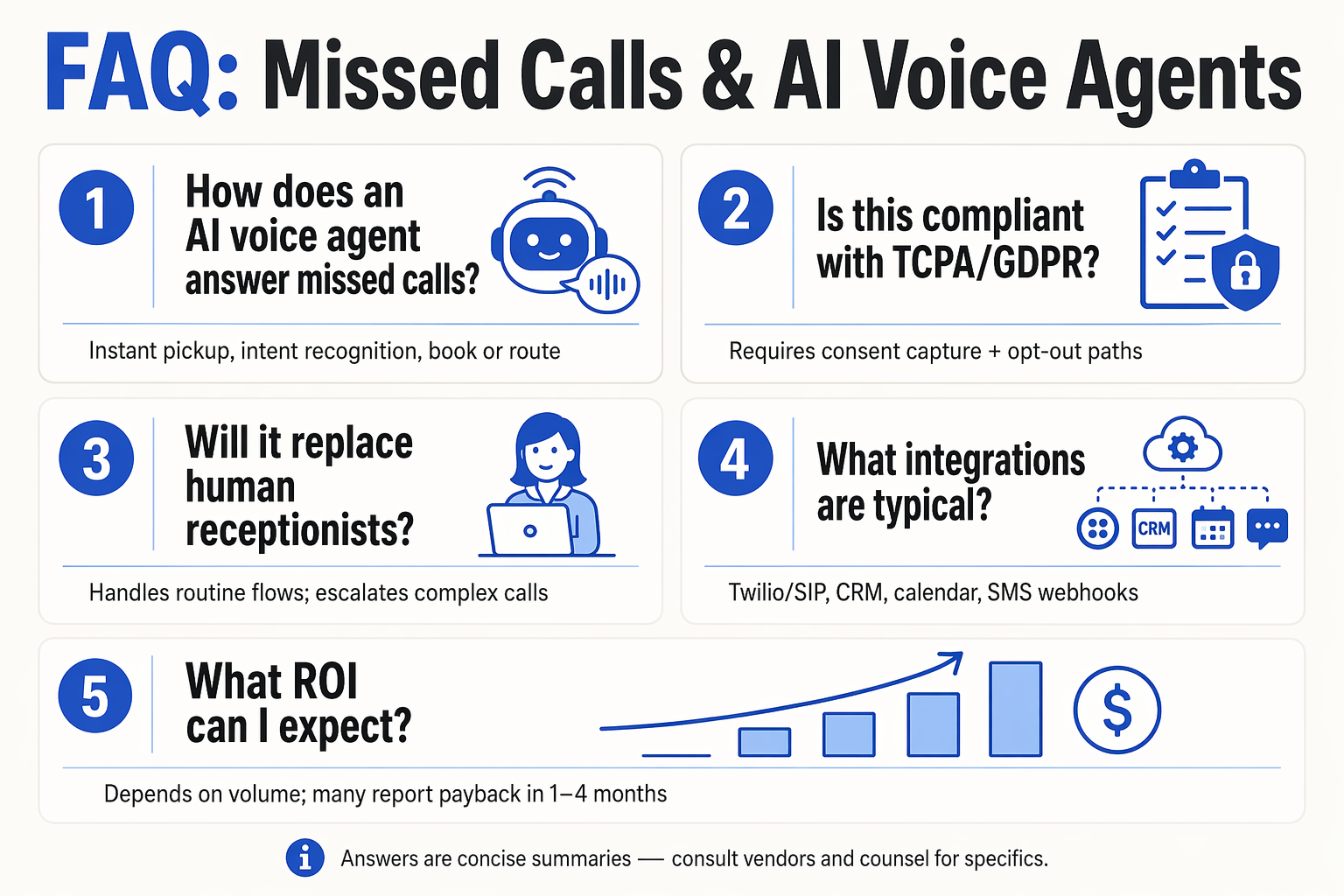
Common questions
How does an AI voice agent for missed calls work?
Can an AI call assistant answer missed calls and book appointments automatically?
What ROI should a small business expect from deploying voice agents for missed calls?
Are AI voice agents compliant with call recording and privacy laws?
How do voice agents handle different languages and accents?
How much developer work is required to integrate an AI voice agent for missed calls?
Conclusion
Key takeaways
- AI voice agents convert missed calls into revenue: A Q2 2025 case study showed a 24/7 AI voice assistant cut missed calls by 80% at San Francisco restaurants, proving the model works in live operations (Hostie.ai, Q2 2025).
- Measure what matters: The 2026 field‑service buyer’s guide recommends tracking booked revenue per inbound call, missed‑call rate, and CSR utilization to quantify impact and justify investment.
- Practical implementation beats experimentation: Repeatable wins come from defining SLA targets, call‑routing rules, reliable data capture, and compliance safeguards—elements covered in the implementation checklist in this article.
- Choose infrastructure for scale and language coverage: Platforms that offer production‑ready voice agents, multi‑model APIs, and broad speech support lower time‑to‑value. Solutions like CallMissed provide a multi‑model gateway (300+ LLMs) plus speech‑to‑text and TTS for multilingual deployments, which is essential for businesses serving diverse caller bases.
Looking ahead, watch for three trends that will shape missed‑call automation in 2026–2027: tighter integration between voice agents and CRM/workflow systems to shorten lead lifecycles; increased emphasis on measurable revenue metrics (not just answered calls); and richer language and sentiment handling so agents can qualify leads more accurately across regions. Regulatory and data‑privacy developments will also affect how call recordings and transcripts are stored and used — make compliance part of your SLA planning.
If you’re ready to stop treating missed calls as inevitable leakage, treat this as an operational priority: instrument the three recommended KPIs, set SLA targets for after‑hours pickup, and test voice agents in a controlled pilot. To explore how AI communication is evolving, check out CallMissed — an AI infrastructure platform powering voice agents and multilingual chatbots for businesses (https://callmissed.com). Which missed‑call metric will you optimize first?
Related Reading
- How to Automate Missed Calls with AI: The Ultimate Multilingual WhatsApp & Voice Playbook for Indian Businesses (2026)
- Stop Bleeding Leads: The 2026 Guide to AI Voice Agents, Call Analytics, and Missed-Call Recovery for Small Business
- Cheapest AI Voice Agent India: Why CallMissed Beats Vapi, Bolna, & WhatsApp Tools