
Text to Speech API for Indian Languages: Voice AI, LLM & STT Guide for India SMBs


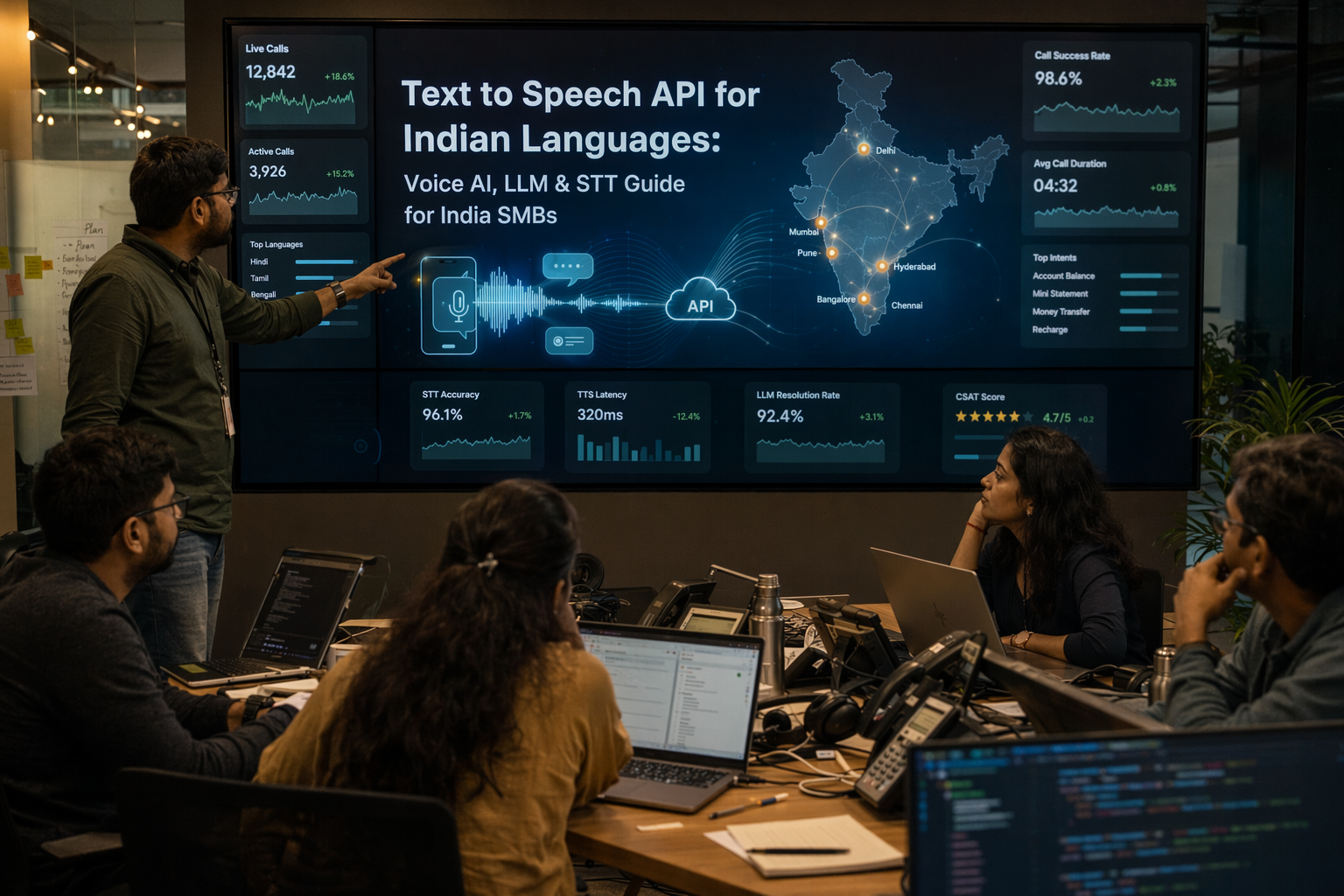
Compare text to speech API for Indian languages, STT, voice AI and LLM APIs for India SMB support, sales and automation.
Text to Speech API for Indian Languages: Voice AI, LLM & STT Guide for India SMBs
What if the next growth unlock for your business is not another app, but a voice that understands customers in Hindi, Tamil, Telugu, Bengali, Marathi, Kannada—or even Hinglish? In 2026, a Text to Speech API for Indian Languages is no longer a “nice-to-have” for large call centres; it is becoming core infrastructure for Indian SMBs, SMEs, startups, clinics, coaching centres, D2C brands, real-estate teams, fintechs, and local service businesses that need to answer, speak, listen, and follow up at scale.
The timing matters because India’s customer communication problem is uniquely multilingual and high-volume. Vendors focused on Indian speech AI now openly compete on regional-language coverage: Sarvam AI’s speech-to-text API advertises support for 22 Indian languages, plus speaker diarization, timestamps, and code-mixing support; Reverie’s 2026 STT comparison highlights support for 11+ Indian languages including Hindi, Tamil, Telugu, Kannada, Bengali, and Marathi; and Sarvam’s Microsoft Marketplace listing describes text-to-speech and translation across 10 Indian languages. A LinkedIn update from Aditya Goenka also reported Sarvam Audio reaching 87% accuracy on a Voice of India ASR benchmark—an example of how quickly India-first speech models are improving.
For a business in Bangalore, that may mean a WhatsApp voice bot handling appointment reminders in Kannada and English. In Mumbai or Pune, it could be automated sales follow-up in Marathi, Hindi, and Hinglish. In Chennai, a support workflow may combine Tamil speech-to-text with an LLM API to summarize customer issues. In Delhi, Hyderabad, and non-metro Bharat markets, voice AI can help teams respond to missed calls, qualify leads, confirm bookings, and route urgent cases to humans—without building a complex enterprise contact-centre stack.
This guide will explain how the pieces fit together:
- Text-to-Speech API: turns your business response into natural-sounding speech.
- Speech-to-Text API: converts customer voice into searchable, actionable text.
- LLM API: understands intent, drafts replies, summarizes calls, and powers agents.
- Voice AI API: connects STT, LLM, TTS, telephony, WhatsApp, CRM, and analytics into real workflows.
We’ll also cover buying criteria Indian teams should care about: ease of integration, SDKs, documentation, latency, Hinglish/code-switching, transparent pricing, data privacy, reliability, analytics, and human handoff. Platforms such as CallMissed are part of this shift, combining Indian-language voice and chat capabilities with APIs that help SMBs adopt AI communication without rebuilding their entire stack.
Introduction: Why Indian SMBs Need Easy Voice AI APIs in 2026
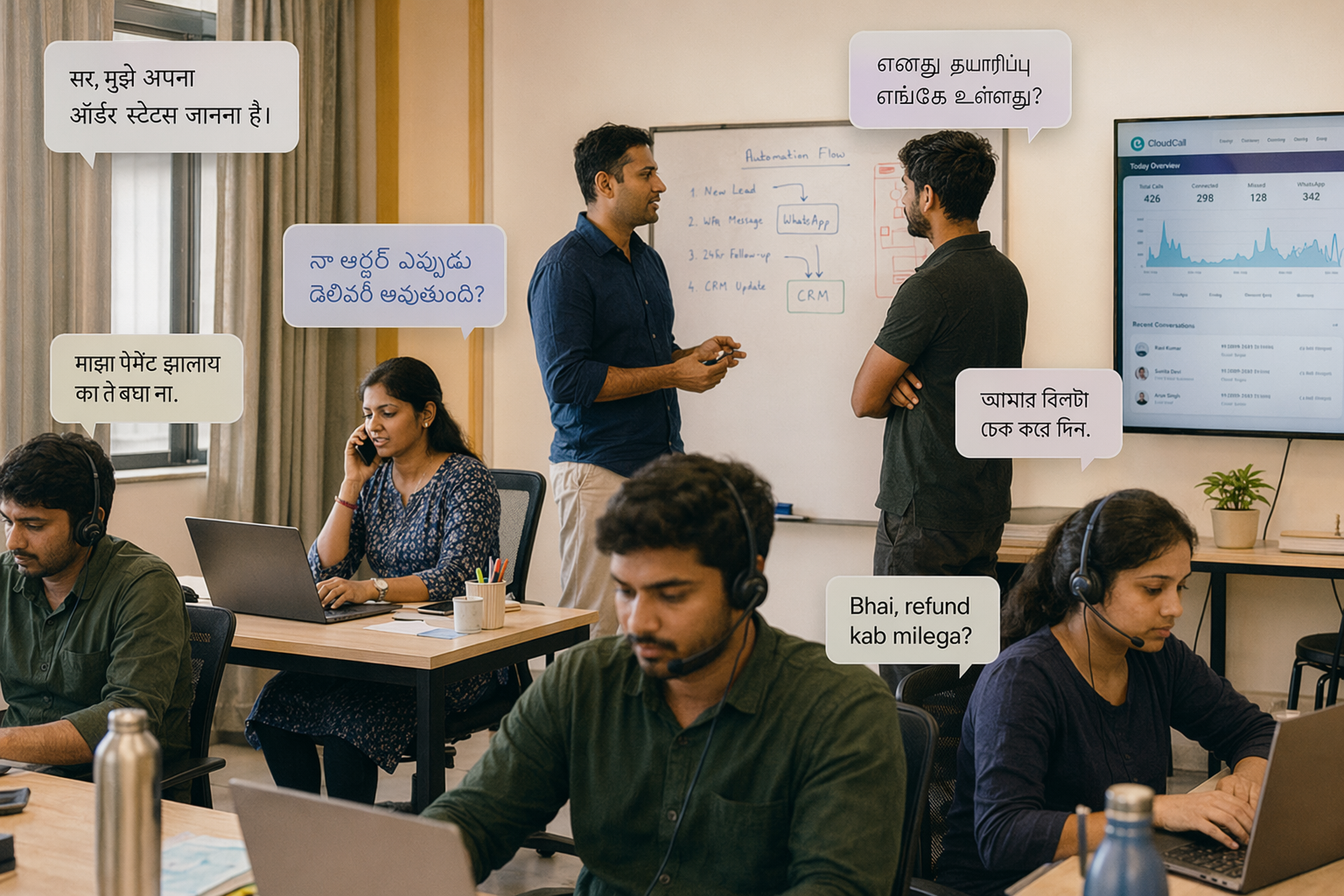
AI communication is becoming SMB infrastructure
For Indian SMBs, SMEs, and startups in 2026, customer communication is no longer only about hiring more agents, buying more SIM cards, or creating more WhatsApp groups. The sharper question is: can your business listen, understand, respond, and follow up automatically across calls, messages, languages, and locations—without deploying a complex enterprise contact-centre stack?
That is why an easy-to-use voice AI API matters. A practical AI communication system usually combines four building blocks:
- Speech-to-Text API — converts customer calls, voice notes, and recorded conversations into text.
- LLM API — understands intent, answers questions, summarizes conversations, and triggers workflows.
- Text-to-Speech API — converts written responses into natural-sounding speech.
- Channel integration — connects the AI layer to phone calls, WhatsApp, web chat, CRM, or support tools.
For a clinic in Pune, this could mean confirming appointments in Marathi and Hindi. For a coaching centre in Delhi, it could mean answering admission queries after office hours. For a D2C brand in Bangalore, it could mean summarizing complaints from support calls and escalating only high-priority cases to human agents.
Why India needs voice-first, multilingual AI
India’s SMB market has a communication challenge that many global API playbooks underestimate: customers often prefer voice, and they rarely speak in only one language. A single conversation may move between Hindi, English, and a regional language—what developers usually call code-mixing, code-switching, or Hinglish support.
The 2026 API market reflects this demand. Sarvam AI’s speech-to-text API page highlights support for 22 Indian languages, along with “speaker diarization, timestamps, and code-mixing support.” Reverie’s 2026 speech-to-text comparison notes coverage for 11+ Indian languages, including Hindi, Tamil, Telugu, Kannada, Bengali, and Marathi. Sarvam’s Microsoft Marketplace listing describes text-to-speech and translation capabilities across 10 Indian languages. A LinkedIn update from Aditya Goenka reported Sarvam Audio reaching 87% accuracy on a Voice of India ASR benchmark, showing how quickly Indian-language speech recognition is improving.
For Indian businesses, these improvements are not academic. They affect everyday workflows such as:
- Missed-call response for local service businesses.
- Sales qualification for real estate, education, lending, and insurance.
- Appointment booking for clinics, salons, diagnostics, and repair services.
- Customer support automation for ecommerce, logistics, SaaS, and fintech.
- Regional language engagement for Bharat and non-metro customers.
What “easy” really means for SMBs
An API is not easy just because it has a quickstart page. For Indian SMBs and startups, an easy voice AI stack should reduce engineering time, operational overhead, and vendor complexity.
Buyers should look for:
- Clear documentation and SDKs for faster developer onboarding.
- Low-latency voice response so conversations feel natural.
- Indian language STT and TTS, including Hindi, Tamil, Telugu, Bengali, Marathi, Kannada, and Hinglish.
- Transparent pricing, especially pay-as-you-go models that suit smaller teams.
- Model choice and reliability, including fallbacks when one provider is slow or unavailable.
- Data privacy controls for regulated or sensitive customer conversations.
- Human handoff for urgent, emotional, or high-value cases.
- Analytics to track call outcomes, intent, conversions, and support quality.
This is the broader shift in 2026: Indian teams increasingly want simpler AI communication APIs that connect voice, language understanding, and customer workflows without requiring enterprise-scale implementation. Platforms such as CallMissed are part of this movement toward making AI communication infrastructure more accessible for SMBs, startups, and regional businesses.
Background & Context: How LLM APIs, Voice AI APIs, Speech-to-Text APIs and Text-to-Speech APIs Fit Together
The core idea: voice AI is a pipeline, not one API
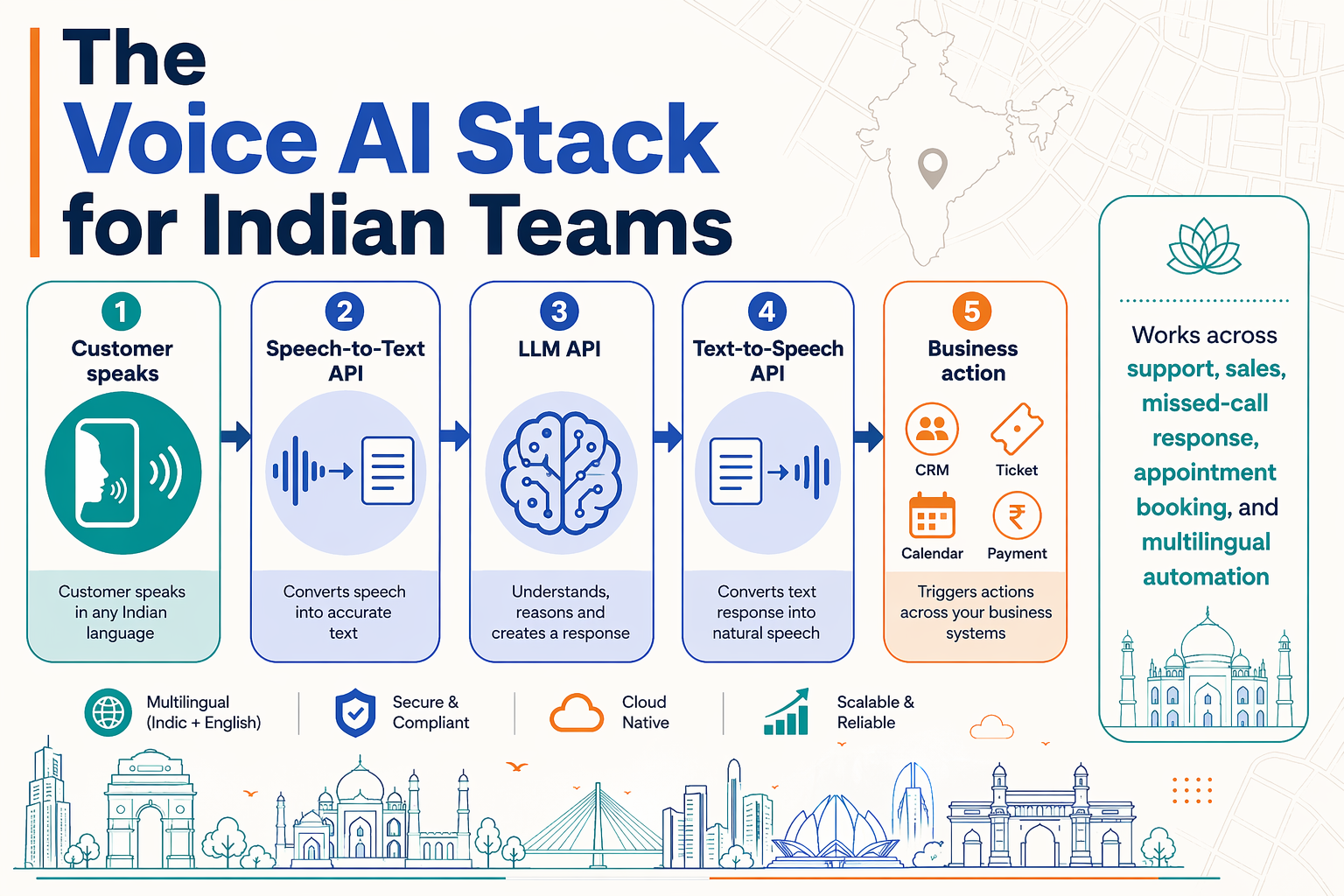
When Indian businesses search for an easy-to-use voice AI API, they are often looking for one outcome: “Can my software talk to customers, understand what they say, and take the next action?” Behind that simple experience, four API layers usually work together:
- Speech-to-Text API / STT API — converts a customer’s spoken words into text.
- LLM API — understands intent, extracts meaning, writes responses, summarizes, and decides the next step.
- Text-to-Speech API / TTS API — turns the AI’s written response into natural speech.
- Voice AI API — orchestrates the full conversation across telephony, WhatsApp, CRM, call routing, analytics, and human handoff.
Think of it as the “ears, brain, voice, and workflow” of an AI communication system.
For example, if a patient calls a clinic in Pune and says, “Kal dentist ka appointment mil sakta hai kya?”, the STT API transcribes the Hindi/Hinglish voice, the LLM API understands the appointment request, the business system checks availability, the TTS API speaks back a response, and the voice AI layer confirms the booking or transfers the call to a human receptionist.
How the four API layers work in a real customer conversation
A practical voice AI flow for an Indian SMB usually looks like this:
- Customer speaks on a phone call, WhatsApp call, web widget, or app.
- Speech-to-Text API converts the audio into text, ideally supporting Indian accents, background noise, and code-mixing.
- LLM API interprets the message: Is this a complaint, lead, booking request, payment reminder, cancellation, or support query?
- Business logic / CRM checks data such as order status, appointment slots, lead source, or ticket history.
- Text-to-Speech API generates a spoken reply in Hindi, Tamil, Telugu, Bengali, Marathi, Kannada, English, or Hinglish.
- Voice AI API manages turn-taking, latency, call state, escalation, summaries, and analytics.
This is why buyers should avoid evaluating these tools in isolation. A strong Text to Speech API for Indian Languages is useful, but it becomes much more powerful when paired with accurate STT, a reliable LLM, and workflow integration.
Why Indian-language support changes the architecture
India is not a single-language market. A business in Bangalore may need Kannada, English, and Hindi. A D2C brand in Mumbai may handle Marathi, Hindi, and Hinglish. A coaching centre in Chennai may need Tamil-first support, while a fintech team in Hyderabad may see Telugu, Hindi, Urdu-influenced speech, and English mixed in the same call.
That is why Indian-language STT and TTS vendors increasingly highlight regional coverage. Sarvam AI’s STT API advertises support for 22 Indian languages, along with speaker diarization, timestamps, and code-mixing support. Reverie’s 2026 STT comparison notes support for 11+ Indian languages, including Hindi, Tamil, Telugu, Kannada, Bengali, and Marathi. Sarvam’s Microsoft Marketplace listing also describes text-to-speech and translation across 10 Indian languages.
These details matter because Indian SMB workflows are rarely “clean English audio in, English response out.” They often involve:
- Hinglish and code-switching within the same sentence
- Regional accents and noisy environments
- Multiple speakers on one call
- Short, intent-heavy phrases like “payment link bhejo” or “order kab aayega?”
- Business-specific vocabulary: plot numbers, coaching batches, loan IDs, lab reports, delivery slots
Where LLM APIs fit: beyond transcription and speech
The LLM API is the reasoning layer. It does not just respond with generic text; it can structure the conversation into business actions.
For Indian SMBs and startups, common LLM-powered tasks include:
- Intent detection: lead, complaint, booking, refund, renewal, callback request
- Summarization: convert a 5-minute call into a 5-line CRM note
- Information extraction: name, city, order ID, preferred time, budget, urgency
- Response generation: draft a polite reply in the right language and tone
- Agent assistance: suggest next steps to a human sales or support rep
Platforms such as CallMissed reflect this combined approach: instead of treating voice, chat, and LLM APIs as separate silos, Indian businesses can connect multilingual STT/TTS, WhatsApp workflows, and AI agents into customer-engagement flows that match local communication habits.
The practical takeaway for SMBs
For most teams, the question is not “Which API is most advanced?” but “Which API stack helps us go live fastest with acceptable accuracy, latency, cost, and control?”
A good India-ready architecture should combine:
- STT for accurate Indian-language listening
- LLM for reasoning and workflow decisions
- TTS for natural regional-language responses
- Voice AI orchestration for telephony, WhatsApp, CRM, analytics, and escalation
That combination is what turns AI from a demo into a real business communication layer.
Key Developments in Indian Voice AI APIs in 2026
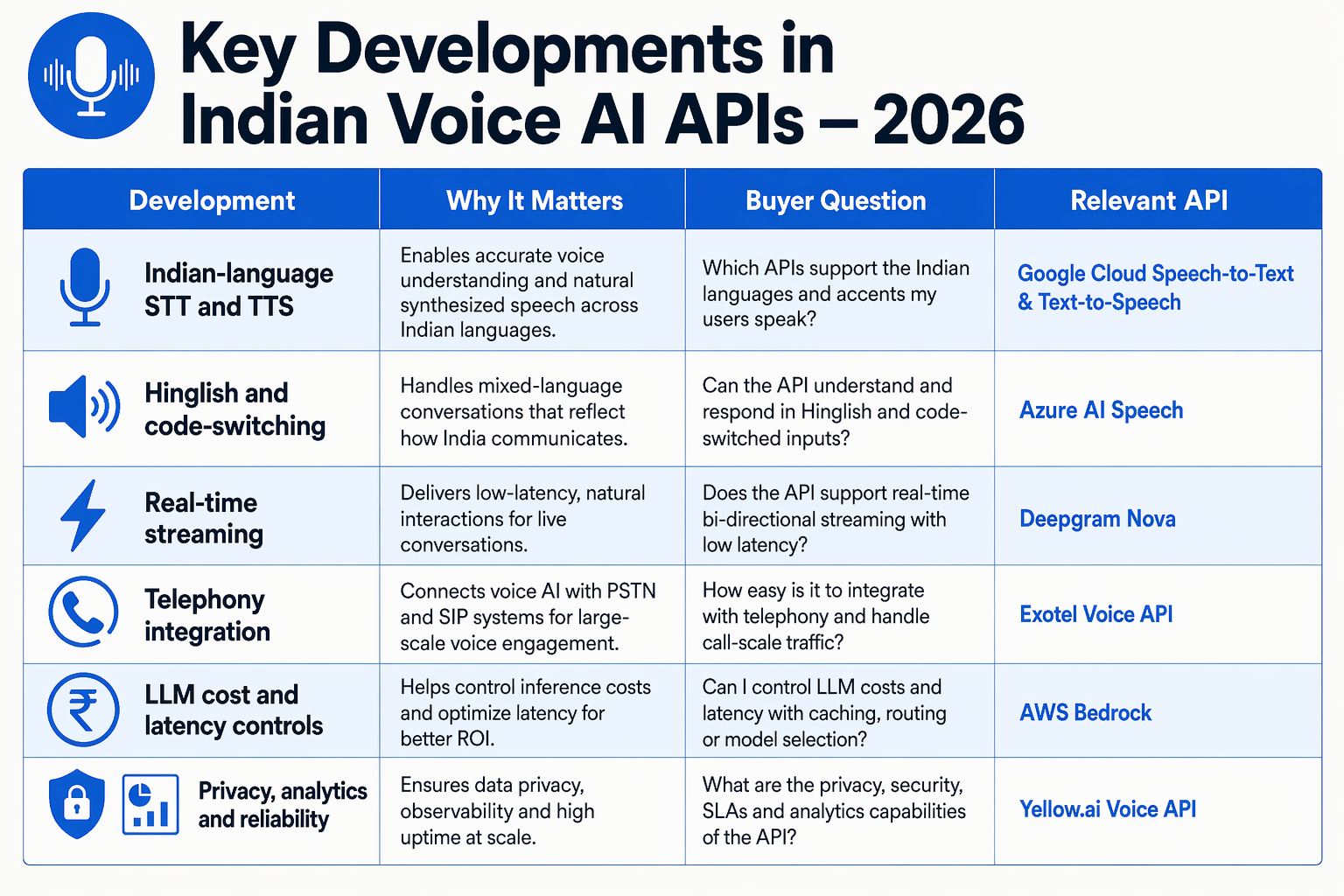
What changed in 2026: Indian voice AI became workflow-ready
The big 2026 development is that Indian-language voice AI is moving beyond generic Hindi transcription or English-first bots. Buyers now expect a connected pipeline: Speech-to-Text API + LLM API + Text-to-Speech API + telephony/WhatsApp integration. That matters for Indian SMBs because real conversations include regional languages, English words, background noise, interruptions, and Hinglish/code-switching.
Several vendor signals show the shift:
- Sarvam AI lists Speech-to-Text support for 22 Indian languages, with speaker diarization, timestamps, and code-mixing support, powered by Saaras V3.
- Sarvam’s Microsoft Marketplace listing describes translation and TTS-related capabilities across 10 Indian languages.
- A LinkedIn update from Aditya Goenka reported 87% accuracy for Sarvam Audio on a Voice of India ASR benchmark.
- Reverie’s 2026 STT comparison highlights 11+ Indian languages, including Hindi, Tamil, Telugu, Kannada, Bengali, and Marathi.
- Platforms are increasingly packaging STT, TTS, LLM reasoning, CRM actions, and channel integration instead of selling isolated APIs.
| 2026 development | What it means for Indian SMBs | Data point / source | Practical use case |
|---|---|---|---|
| Wider Indian-language STT coverage | Businesses can transcribe calls beyond English and Hindi | Sarvam AI lists STT for 22 Indian languages | A Pune coaching centre captures Marathi/Hindi enquiries as CRM notes |
| Better code-mixing support | APIs can handle natural Indian speech like “kal appointment confirm kar do” | Sarvam AI mentions code-mixing support | A Delhi clinic automates Hinglish appointment confirmations |
| Full speech pipelines | Teams can combine STT, LLM reasoning, and TTS into one workflow | CloudThat describes Sarvam as combining STT, TTS, and speech processing | A Chennai support team summarizes Tamil calls and drafts replies |
| Regional TTS adoption | Businesses can speak back in local languages, not just transcribe | Microsoft Marketplace mentions Sarvam capabilities across 10 Indian languages | A Mumbai D2C brand sends Marathi/Hindi delivery updates |
| Benchmark-led buying | Vendors are being compared on Indian-language accuracy, not just global ASR | Aditya Goenka reported 87% accuracy on Voice of India ASR | SMBs test APIs on real call recordings before purchase |
| Channel-integrated voice agents | Voice AI is moving closer to customer channels like phone and WhatsApp | Buyers should verify telephony, WhatsApp, handoff, and logging support in vendor docs | A Bangalore startup routes missed calls or WhatsApp enquiries into an automated follow-up flow |
Why this matters for city and Bharat use cases
For Indian teams, the question is not simply “Which API is most accurate?” It is: Can this API work in my city, my language mix, my customer channel, and my budget?
- Bangalore / Hyderabad startups often need LLM API flexibility, low latency, model choice, and developer-friendly documentation.
- Mumbai / Pune SMBs need Marathi, Hindi, English, and WhatsApp-first customer journeys.
- Chennai businesses need Tamil STT/TTS quality and reliable handoff to human agents.
- Delhi NCR service teams need Hinglish handling, missed-call response, and lead qualification.
- Bharat and non-metro businesses need voice-first automation because many customers prefer speaking over typing.
This is where simpler AI communication layers, including platforms like CallMissed, fit into the broader 2026 buying pattern: smaller teams want fewer moving parts, easier setup, and practical workflows across customer conversations without building a complex enterprise stack from scratch.
The takeaway for buyers
In 2026, don’t evaluate a Text to Speech API for Indian Languages, Speech-to-Text API, Voice AI API, or LLM API in isolation. Evaluate the complete customer workflow:
- Can it understand your customers’ language and code-mixing?
- Can it respond naturally with usable regional TTS?
- Can it connect to phone, WhatsApp, CRM, or support tools?
- Can humans take over when automation fails?
- Is pricing transparent enough for SMB usage?
For Indian SMBs and startups, the winning API stack is not just the most advanced model. It is the one that works reliably in real Indian conversations.
In-Depth Analysis: Buying Criteria for Easy-to-Use AI Communication APIs
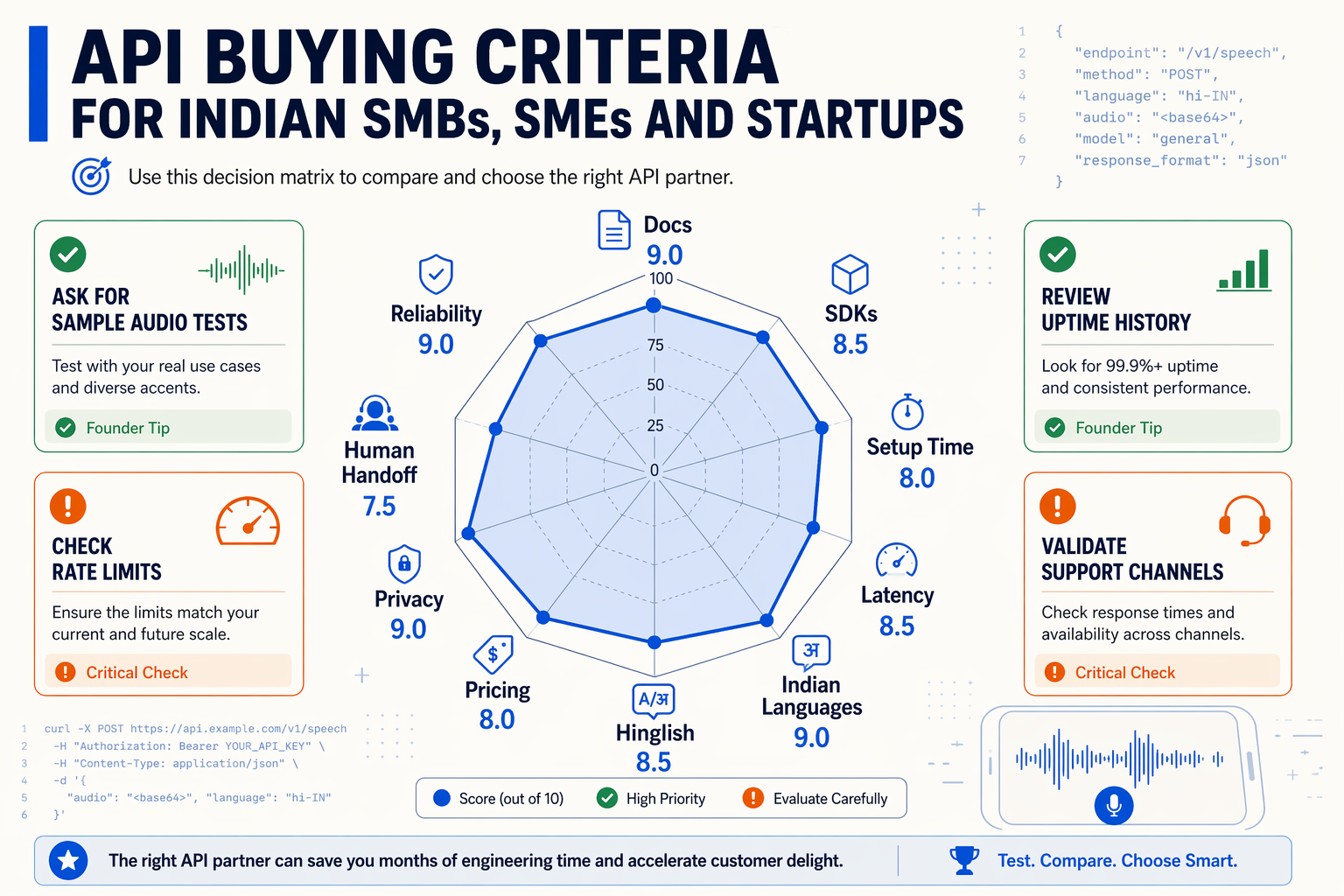
Start with the workflow, not the model name
For Indian SMBs and startups, the best voice AI API is not necessarily the one with the longest model card—it is the one that fits your real customer workflow with minimal engineering effort. Before comparing vendors, define the job clearly:
- Listen: capture customer speech using a Speech-to-Text API.
- Understand: use an LLM API to detect intent, summarize, classify, or draft a response.
- Speak back: generate natural audio with a Text-to-Speech API for Indian Languages.
- Act: update CRM, send WhatsApp follow-up, book appointments, create tickets, or escalate to a human.
A Bangalore SaaS startup may prioritize low-latency English-Kannada support calls. A Pune coaching centre may need Marathi/Hindi reminders. A Chennai clinic may need Tamil appointment confirmations. A D2C brand in Delhi or Mumbai may care more about campaign follow-ups, missed-call recovery, and CRM syncing.
Core buying criteria Indian teams should evaluate
Use these criteria before choosing an API stack:
- Ease of integration: Look for REST APIs, OpenAI-compatible endpoints, SDKs, clear docs, test consoles, webhook support, and sample code. SMB teams should not need a dedicated ML engineer to launch a basic voice workflow.
- Indian language depth: Do not stop at “Hindi supported.” Check whether the vendor supports your actual customer languages: Tamil, Telugu, Marathi, Bengali, Kannada, Malayalam, Gujarati, Punjabi, Odia, Assamese, and mixed Hindi-English usage.
- Hinglish and code-switching: Indian conversations often move between English and a regional language in the same sentence. Sarvam’s STT page specifically advertises code-mixing support, along with speaker diarization and timestamps, across 22 Indian languages.
- Latency: For live calls, every second matters. A chatbot can wait; a voice agent cannot. Ask vendors for streaming STT, streaming TTS, first-token latency, and end-to-end response time under real Indian network conditions.
- Model choice and fallback: LLM API buyers should compare cost, latency, quality, context length, rate limits, uptime, and fallback options. A single-model dependency can become risky during traffic spikes.
- Transparent pricing: Indian SMBs need predictable unit economics. Check whether billing is per minute, per character, per token, per call, or credit-based. Also evaluate free tiers and pay-as-you-go options.
- Human handoff: A good AI agent should know when to stop. For sales, healthcare, finance, and high-value support, escalation to a human agent is not optional.
- Analytics and auditability: Look for transcripts, call summaries, intent labels, failure reasons, latency logs, and conversion tracking.
- Data privacy and compliance: Ask where data is processed, whether recordings are stored, how long logs are retained, and whether customer PII can be masked or deleted.
Language support is now a competitive benchmark
In 2026, Indian-language coverage has become a visible differentiator. Sarvam AI promotes Speech-to-Text for 22 Indian languages with diarization, timestamps, and code-mixing. Reverie’s 2026 STT comparison highlights 11+ Indian languages, including Hindi, Tamil, Telugu, Kannada, Bengali, and Marathi. Sarvam’s Microsoft Marketplace listing describes text-to-speech and translation support across 10 Indian languages. A LinkedIn update from Aditya Goenka reported Sarvam Audio reaching 87% accuracy on a Voice of India ASR benchmark.
The practical lesson: ask for language evidence, not just a language list. Test your own calls—noisy shop floors, Mumbai traffic, rural accents, Hinglish sales conversations, and fast-speaking customers.
What “easy-to-use” really means for Indian SMBs
An easy API should reduce operational complexity, not just developer effort. For example, platforms like CallMissed combine an OpenAI-compatible gateway with voice, WhatsApp, and Indian-language capabilities, helping teams experiment across LLM, STT, TTS, and communication workflows from one integration path.
Before buying, run a 7-day pilot with real customer audio and measure:
- Word error rate for your languages and accents
- Average latency for live conversations
- Successful task completion rate
- Human escalation rate
- Cost per resolved conversation
- Customer satisfaction or callback conversion
That pilot will tell you more than any vendor brochure.
India Use-Case Map by API Type, City and Segment
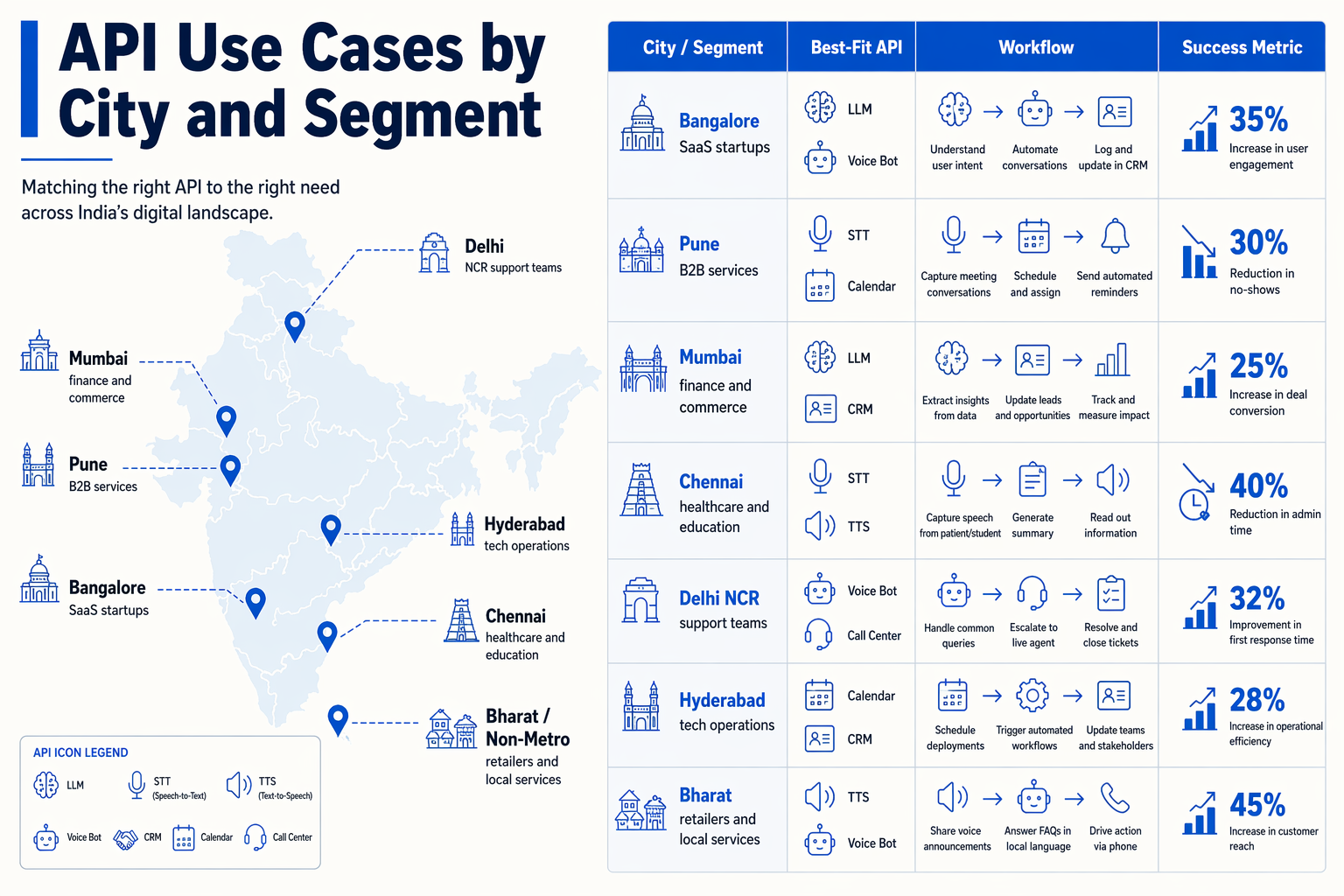
How to choose the right API stack by city, language and workflow
India’s SMB AI adoption is not one-size-fits-all. A Bangalore SaaS startup, a Mumbai D2C brand, a Chennai clinic, and a Bharat-focused lending business may all need voice automation—but the right mix of LLM API, speech-to-text API, text-to-speech API, and voice AI API changes by customer journey.
Map the workflow first:
- STT API when customers speak and you need searchable text, summaries, intent detection, or CRM notes.
- TTS API when your business needs to speak back in Hindi, Tamil, Telugu, Marathi, Kannada, Bengali, or Hinglish.
- LLM API when the system must understand intent, generate replies, classify leads, summarize calls, or draft follow-ups.
- Voice AI API when you need the full loop: telephony or WhatsApp call → STT → LLM reasoning → TTS response → human handoff.
Current 2026 vendor data shows why India-specific language support matters. Sarvam AI advertises speech-to-text for 22 Indian languages with speaker diarization, timestamps, and code-mixing support. Reverie’s 2026 STT comparison highlights 11+ Indian languages, including Hindi, Tamil, Telugu, Kannada, Bengali, and Marathi. Sarvam’s Microsoft Marketplace listing describes TTS and translation across 10 Indian languages, while a LinkedIn update from Aditya Goenka reported Sarvam Audio at 87% accuracy on a Voice of India ASR benchmark.
| API Type | City / Segment | Best-Fit Use Case | Language + Data Need | Business Outcome |
|---|---|---|---|---|
| Speech-to-Text API | Chennai clinics, diagnostics, hospitals | Convert patient calls, appointment requests, and lab-report queries into structured notes | Tamil + English STT, timestamps, diarization for doctor/patient separation | Faster appointment logging, searchable call records, reduced manual note-taking |
| Text-to-Speech API | Mumbai & Pune D2C, real estate, finance teams | Automated payment reminders, delivery updates, site-visit confirmations, renewal nudges | Marathi, Hindi, Hinglish TTS with natural-sounding brand voice | Higher follow-up coverage without increasing calling staff |
| LLM API | Bangalore startups, SaaS, edtech, fintech | Classify support tickets, summarize calls, draft WhatsApp/email replies, qualify leads | Low-latency model access, cost controls, rate limits, fallback models | Faster support resolution and better sales prioritization |
| Voice AI API | Delhi NCR service businesses, coaching centres, local marketplaces | Missed-call response, lead qualification, booking confirmation, escalation to human agents | Hindi + Hinglish STT/TTS, CRM integration, human handoff | Fewer lost leads and 24/7 first response for high-volume inbound calls |
| STT + LLM + TTS Pipeline | Hyderabad tech services, healthcare, logistics | Multilingual support bot that listens, understands, replies, and logs outcomes | Telugu, Hindi, English; code-switching support; analytics | End-to-end customer automation across voice and chat |
| Voice + WhatsApp AI | Bharat/non-metro SMBs, retailers, lenders, education centres | WhatsApp calling, regional-language reminders, loan/document follow-up, admission enquiries | Broad Indian-language coverage is valuable where customers prefer regional speech | Scalable customer engagement beyond English-first digital channels |
Practical pattern for Indian SMBs
For most Indian teams, the winning architecture is not a huge enterprise contact-centre migration. It is a thin, practical communication layer that connects existing channels to AI:
- Customer calls or sends a WhatsApp message.
- STT converts speech into text.
- LLM API detects intent and decides the next best action.
- TTS speaks back in the customer’s preferred language.
- CRM, inbox, or human agent receives the summary and context.
This is where India-focused platforms are trying to simplify adoption for SMBs: not by forcing teams to rebuild their entire stack, but by packaging common AI communication workflows—missed-call response, WhatsApp follow-up, lead qualification, appointment booking, and support summaries—into easier building blocks. Platforms such as CallMissed are examples of this broader shift toward simpler AI communication infrastructure for Indian businesses, especially teams that want to experiment without a large enterprise implementation.
The buying question is therefore practical: which API removes the most operational friction for your city, language mix, and customer journey? For a Chennai clinic, diarized Tamil call transcripts may matter most. For a Pune real-estate team, Marathi/Hinglish reminders and human handoff may be the priority. For a Bangalore startup, model choice, latency, rate limits, and fallback reliability may decide the LLM API stack.
Workflow Playbooks: Customer Support, Sales Follow-Up, Missed-Call Response and Appointment Booking
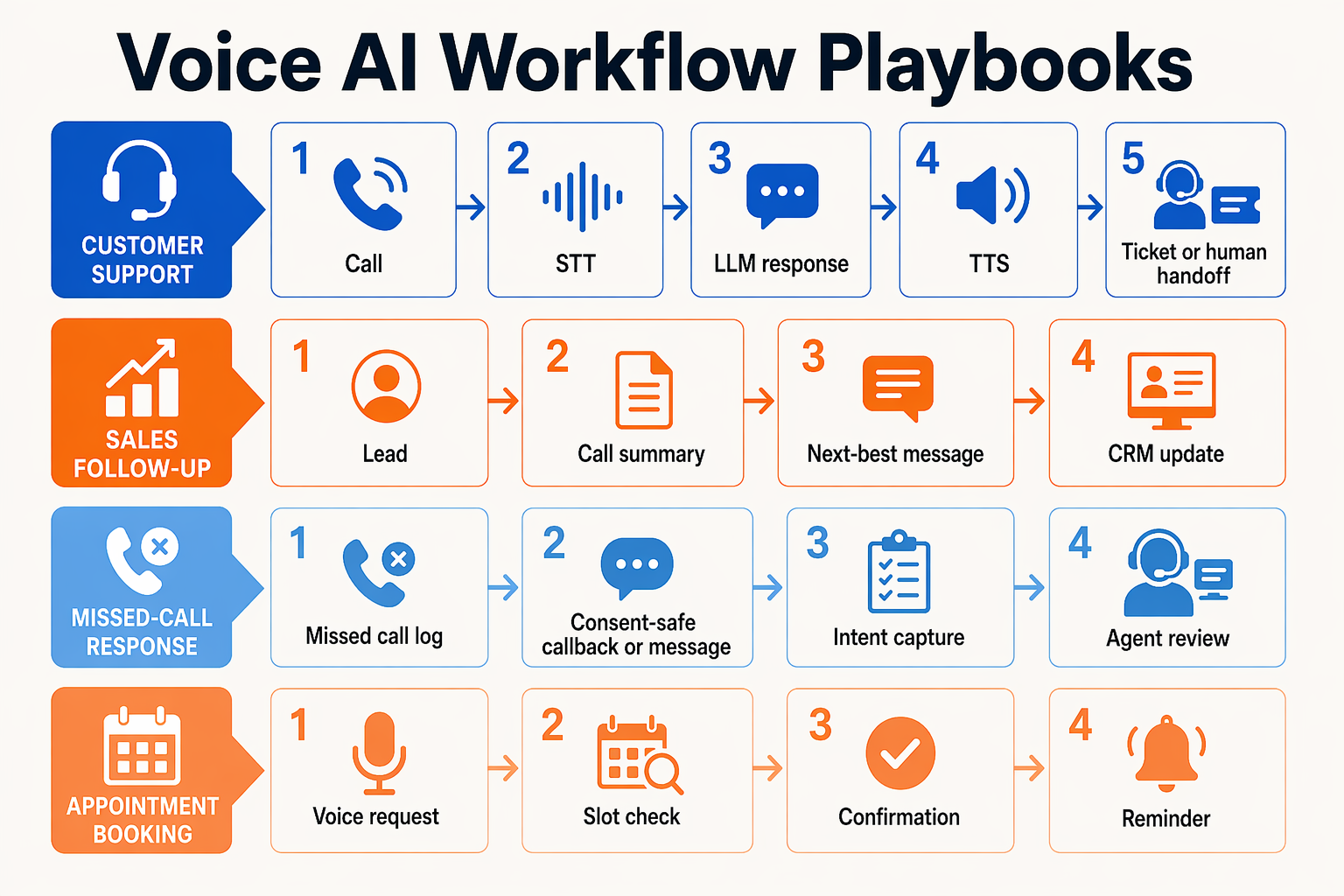
Playbook 1: Customer support that listens, summarizes, and routes
For Indian SMBs, the fastest support win is not “replace every agent”; it is turn every call or voice note into structured, searchable work. A practical support workflow looks like this:
- Speech-to-Text API transcribes the customer’s issue in Hindi, Tamil, Telugu, Kannada, Bengali, Marathi, or Hinglish.
- LLM API detects intent: complaint, refund, delivery delay, billing issue, warranty query, escalation.
- Knowledge-base RAG searches policies, FAQs, product manuals, or order data.
- Text-to-Speech API responds naturally, or drafts a WhatsApp/email reply.
- Human handoff triggers when sentiment is negative, confidence is low, or the customer asks for a person.
This is especially useful for D2C brands in Mumbai, SaaS startups in Bangalore, and service teams in Delhi NCR that handle repetitive queries but still need quality control. Indian-language readiness matters here: Sarvam’s STT API advertises support for 22 Indian languages, with speaker diarization, timestamps, and code-mixing support, while Reverie’s 2026 comparison highlights 11+ Indian languages including Hindi, Tamil, Telugu, Kannada, Bengali, and Marathi.
Playbook 2: Sales follow-up for leads that go cold after WhatsApp or calls
Most Indian sales teams lose revenue between “lead captured” and “lead followed up.” A voice AI workflow can automatically revive leads without making the process feel robotic.
Use this flow:
- New lead enters from website, IndiaMART, Meta ads, Justdial, WhatsApp, or a missed call.
- LLM classifies the lead by city, budget, urgency, product interest, and language preference.
- Voice AI calls or WhatsApps the lead in the right language.
- STT captures responses like “call me tomorrow,” “send price,” “I’m comparing options,” or “not interested.”
- CRM updates the next action automatically.
For example, a real-estate broker in Pune can follow up with Marathi/Hindi leads, while an edtech startup in Hyderabad can qualify Telugu and English-speaking parents. The key is not just automation; it is conversation memory—knowing who asked for a demo, who wanted pricing, and who needs a human salesperson.
Playbook 3: Missed-call response for high-intent customers
In India, a missed call is often a buying signal. The customer may not fill a form, but they are willing to ring your number. A missed-call response workflow should be almost immediate:
- Detect missed call.
- Auto-trigger callback or WhatsApp message.
- Ask the customer’s need in their preferred language.
- Convert speech to text.
- Use LLM to categorize: sales, support, booking, urgent complaint.
- Route to AI response or human agent.
This is powerful for clinics, coaching centres, local repair services, real-estate teams, logistics providers, and travel businesses. Platforms such as CallMissed fit this pattern by combining WhatsApp-native engagement, AI voice agents, and Indian-language speech capabilities across 22 Indian languages, including workflows where WhatsApp Business calls can be bridged to an AI agent.
Playbook 4: Appointment booking without back-and-forth
Appointment-heavy businesses need one thing: fewer abandoned conversations. A booking agent can ask for date, time, location, service type, and customer details—then confirm through WhatsApp or voice.
Best-fit examples include:
- Clinics in Chennai: Tamil voice booking, doctor availability, reminders.
- Salons and wellness centres in Bangalore: English/Kannada scheduling and rescheduling.
- Coaching classes in Kota, Jaipur, Patna, and Indore: Hindi follow-up for trial classes.
- B2B service firms in Delhi and Mumbai: meeting qualification before calendar booking.
The LLM handles messy human inputs like “kal shaam,” “Saturday morning,” or “next week after office,” while STT captures the request and TTS confirms it naturally.
What makes these playbooks work in production
Before launching, define:
- Fallback rules: when to transfer to a human.
- Latency target: voice conversations must feel real-time.
- Language strategy: Hindi-only is not enough for Bharat-scale operations.
- Analytics: track call completion, intent, conversion, drop-offs, and escalation rate.
- Consent and privacy: disclose recording/transcription where required.
The best workflows are not flashy demos—they are small, reliable automations that answer faster, follow up sooner, and keep humans focused on high-value conversations.
Impact & Implications for Bangalore, Pune, Mumbai, Chennai, Delhi, Hyderabad and Bharat Businesses

Why city context matters for Voice AI adoption
The impact of Voice AI APIs in India will not be uniform across markets. A startup in Bangalore, a clinic chain in Pune, a real-estate broker in Mumbai, a logistics company in Chennai, a coaching institute in Delhi, and a SaaS support team in Hyderabad may all use the same building blocks—LLM API, Speech-to-Text API, Text-to-Speech API, and telephony/WhatsApp integration—but the business outcome looks different.
What connects them is scale: Indian teams must serve customers across languages, channels, and response-time expectations. That is why Indian-language capability is now a buying criterion, not a feature checkbox. Sarvam AI’s STT API advertises support for 22 Indian languages with speaker diarization, timestamps, and code-mixing support; Reverie’s 2026 STT comparison highlights 11+ Indian languages including Hindi, Tamil, Telugu, Kannada, Bengali, and Marathi; and Sarvam’s Microsoft Marketplace listing describes TTS and translation across 10 Indian languages. These numbers matter because every missed call, misunderstood phrase, or delayed follow-up can directly affect revenue.
Bangalore and Hyderabad: developer-led automation for startups and SaaS
For Bangalore and Hyderabad startups, the first implication is speed. Product teams want APIs that are easy to integrate, OpenAI-compatible where possible, and reliable enough for production workflows.
Common use cases include:
- AI voice agents for demo qualification and inbound sales calls
- Speech-to-text summaries for customer success and support calls
- LLM-based routing that classifies issues by urgency, plan type, or account value
- Text-to-speech responses in English, Hindi, Telugu, Kannada, or Hinglish
For these teams, the business question is not “Can AI speak?” but “Can it plug into our CRM, WhatsApp, ticketing, and analytics without a three-month integration cycle?” This is where platforms such as CallMissed’s OpenAI-compatible gateway and Indian-language voice capabilities fit the broader shift: developers want one integration path for multiple AI models and communication workflows.
Mumbai and Pune: sales follow-up, collections, and local-language trust
In Mumbai and Pune, SMBs often operate in high-volume, high-intent markets: finance, real estate, education, healthcare, D2C, and local services. Here, Marathi, Hindi, English, and Hinglish automation can help teams reduce leakage from missed calls and slow follow-ups.
Key implications:
- Lead response becomes near-instant: an AI agent can answer, qualify, and schedule callbacks.
- Collections and reminders become more consistent: TTS can deliver polite, standardized messages.
- Sales managers get better visibility: STT transcripts and LLM summaries make calls searchable.
- Human agents focus on hot leads: automation handles repetitive qualification and reminders.
The strategic advantage is not replacing sales teams; it is giving them cleaner context before they speak to the customer.
Chennai and Delhi: multilingual service at operational scale
For Chennai, Tamil-first communication is critical across healthcare, logistics, education, and consumer services. A Speech-to-Text API for Indian languages can convert Tamil customer calls into structured notes, while an LLM API can summarize complaints, detect intent, and trigger workflows.
For Delhi NCR, the mix often includes Hindi, English, Punjabi, and Hinglish. Businesses can use voice AI to:
- Capture missed-call leads after hours
- Confirm appointments or site visits
- Translate customer queries into internal CRM notes
- Escalate legal, billing, or urgent service issues to humans
The context from Indian AI vendors is important here: models are improving specifically for Indian speech patterns. A LinkedIn update from Aditya Goenka reported Sarvam Audio reaching 87% accuracy on a Voice of India ASR benchmark, showing how fast India-focused ASR is progressing.
Bharat and non-metro businesses: voice as the real interface
For Bharat businesses, the biggest implication is accessibility. Many customers are more comfortable speaking than typing. A Text to Speech API for Indian Languages plus STT can make digital workflows usable for customers who may not prefer English apps or long web forms.
High-impact use cases include:
- Appointment booking for clinics and salons
- Order confirmation for local commerce
- Loan, insurance, and education enquiry handling
- Regional-language support for government-linked services
- WhatsApp voice and call-based engagement for semi-urban customers
The long-term shift is clear: Indian SMBs will not adopt AI only through dashboards. They will adopt it through voice, WhatsApp, missed-call response, and multilingual automation embedded into daily customer conversations.
Expert Opinions: What Developers, CX Leaders and Founders Should Validate Before Choosing APIs
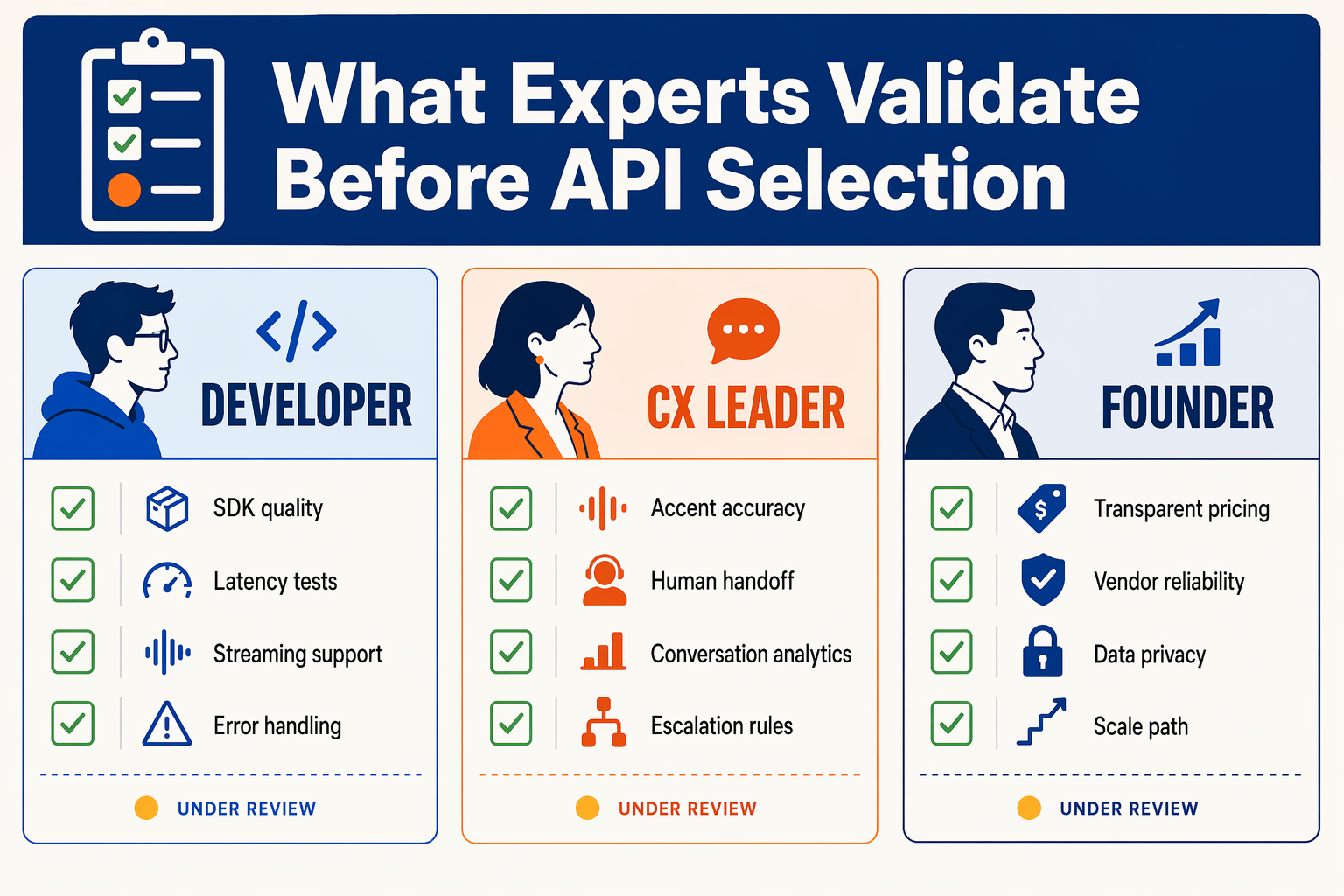
1. Developers: validate the integration before you validate the demo
For developers choosing an LLM API, speech-to-text API, text-to-speech API, or voice AI API in India, the first expert rule is simple: do not judge only by a polished dashboard. Judge by how quickly your team can ship a production workflow.
Validate:
- OpenAI-compatible API format: Can your existing chat-completions code work with minimal changes?
- SDKs and docs: Are there working examples for Node.js, Python, webhooks, streaming audio, and retries?
- Latency under Indian network conditions: Test from Bangalore, Mumbai, Delhi, Chennai, Hyderabad, Pune, and non-metro users—not only from cloud regions abroad.
- Fallback behaviour: What happens when a model times out, hits rate limits, or returns poor audio?
- Streaming support: Voice agents need partial STT and low-latency TTS, not just batch APIs.
This matters because Indian-language voice workflows are not “one API call.” They combine STT → LLM reasoning → TTS → telephony/WhatsApp → CRM update. CloudThat’s write-up on Sarvam AI describes the market direction well: instead of isolated APIs, platforms are moving toward a complete speech pipeline that combines STT, TTS, and language processing for Indian languages.
Platforms such as CallMissed follow a similar infrastructure trend with one OpenAI-compatible gateway for LLM chat, STT, TTS, image generation, and web search—useful when a startup wants model choice without maintaining separate integrations for every provider.
2. CX leaders: test Indian language reality, not just language lists
CX teams should go beyond “supports Hindi” claims. India’s real customer conversations are messy: Hinglish, background noise, mixed scripts, local phrases, and callers switching between languages mid-sentence.
Ask vendors to run a proof-of-concept with your own recordings:
- Hindi + English code-switching
- Regional language + English terms such as loan ID, order number, OTP, EMI, policy, recharge
- Noisy mobile audio
- Different accents from metro and Bharat users
- Long calls with interruptions and overlapping speech
The benchmarks are improving fast. Sarvam AI’s STT page advertises speech-to-text for 22 Indian languages, with speaker diarization, timestamps, and code-mixing support. Reverie’s 2026 STT comparison highlights support for 11+ Indian languages, including Hindi, Tamil, Telugu, Kannada, Bengali, and Marathi. A LinkedIn update from Aditya Goenka reported 87% accuracy for Sarvam Audio on a Voice of India ASR benchmark. These are useful signals—but your own call data is still the final test.
3. Founders: validate pricing, reliability, and ownership before scaling
For founders, the API choice is not just technical; it affects margins, customer experience, and future flexibility. Before committing, validate:
- Pricing transparency: Is pricing per minute, per character, per token, per call, or per credit?
- Total workflow cost: One customer interaction may include STT minutes, LLM tokens, TTS characters, telephony, WhatsApp messages, and storage.
- Rate limits: Can the API handle campaign spikes after a sale, webinar, admission deadline, or festive offer?
- Reliability SLAs: What uptime, retry, and incident visibility are offered?
- Data controls: Where is audio processed? Are logs retained? Can training on customer data be disabled?
- Human handoff: Can the AI transfer urgent, angry, payment-related, or medical queries to a real person?
For Indian SMBs, transparent pricing is especially important because communication volumes fluctuate. A coaching centre in Kota, a clinic chain in Pune, a real-estate team in Mumbai, and a D2C brand in Bangalore may all need the same APIs—but with very different peak loads.
4. The practical expert checklist
Before choosing any Text to Speech API for Indian Languages or broader voice AI stack, run a 7-day pilot and measure:
- Word error rate on your own Indian-language calls
- First response latency for live voice
- Call completion rate
- Fallback-to-human rate
- Cost per resolved conversation
- Customer satisfaction or callback reduction
- Performance across Hindi, English, Hinglish, and regional languages
The strongest buying signal is not the longest feature list. It is whether the API helps your team resolve real customer conversations faster, in the languages your customers actually speak.
What This Means For You: API Selection Checklist by Team Type
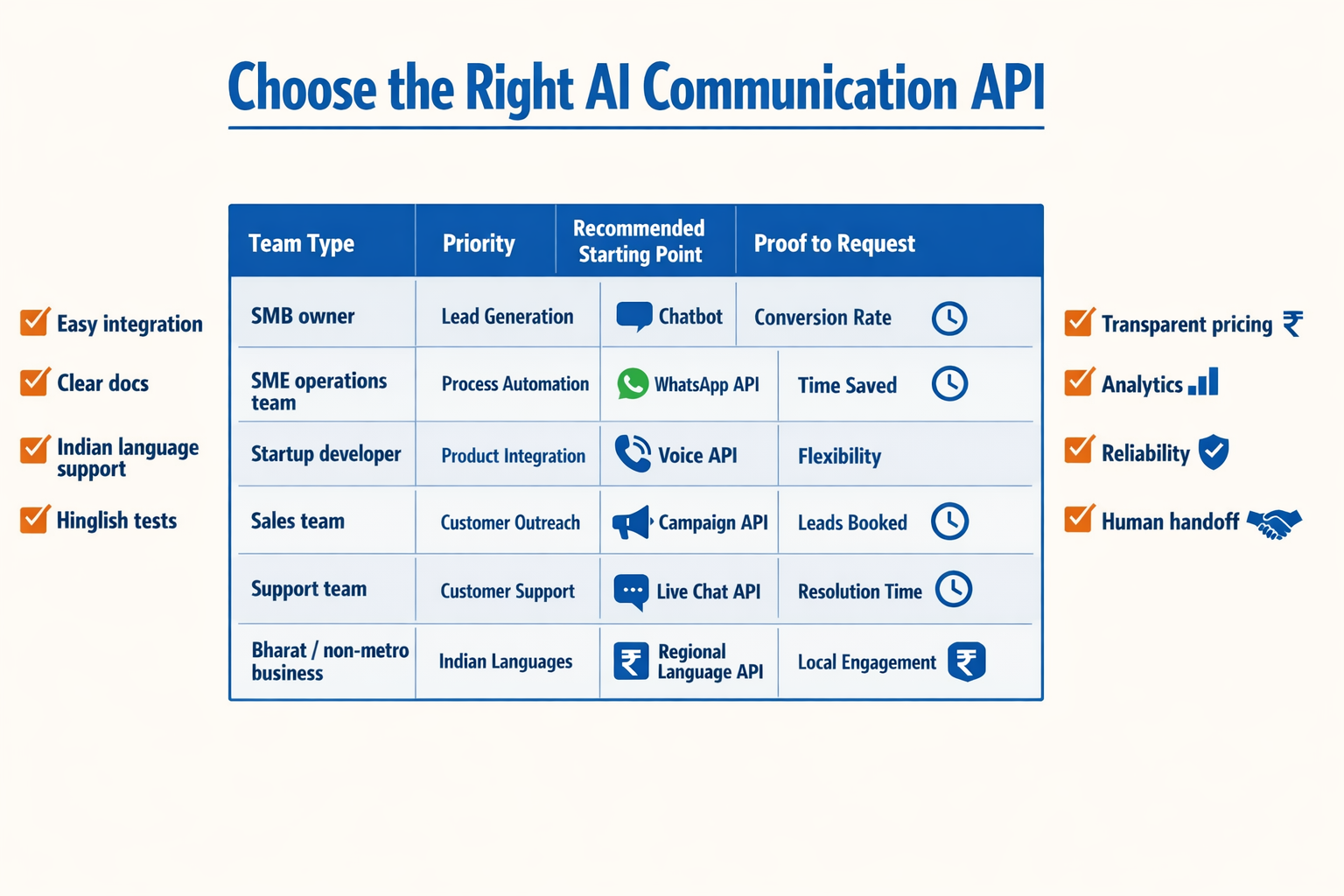
Use the checklist based on how your team actually works
The right voice AI API, LLM API, speech-to-text API, or text-to-speech API in India depends less on company size and more on workflow maturity. A 12-person clinic in Pune may need faster automation than a 200-person services company if it receives high-volume appointment calls. Similarly, a Bangalore SaaS startup may care more about OpenAI-compatible APIs, rate limits, and model choice, while a coaching centre in Patna may prioritise Hindi voice quality, missed-call response, and WhatsApp follow-up.
Use this table as a practical buying checklist before shortlisting vendors.
| Team type / location | Best-fit API stack | Priority use case | Must-check criteria | India-specific requirement |
|---|---|---|---|---|
| Local SMBs in Delhi, Pune, Jaipur, Lucknow | STT + TTS + WhatsApp/voice agent | Missed-call response, lead qualification, appointment confirmation | Simple setup, pay-as-you-go pricing, human handoff, call logs | Hindi + Hinglish/code-mixing; Sarvam advertises STT for 22 Indian languages with code-mixing support |
| Clinics, coaching centres, real estate teams in Mumbai/Chennai | Voice AI API + CRM + TTS | Booking reminders, follow-ups, inbound FAQ handling | Low latency, reliable retries, escalation to staff, analytics | Marathi/Tamil/Hindi support; vendors now highlight regional coverage such as Reverie’s 11+ Indian languages |
| Bangalore/Hyderabad startups and SaaS teams | LLM API gateway + STT/TTS | AI copilots, support summaries, product assistants | Model choice, rate limits, fallback models, docs, SDKs | Multilingual input and output for Indian users, not English-only UX |
| D2C, fintech, logistics SMEs across metros | LLM + STT + TTS + campaign tooling | Sales follow-up, delivery calls, payment reminders | Cost per interaction, latency, compliance, audit trails | Regional voice prompts for trust and conversion across Hindi, Kannada, Telugu, Bengali, Marathi |
| Bharat/non-metro businesses | Easy voice AI API + WhatsApp | First response automation, FAQs, service requests | No-code/low-code setup, transparent pricing, local-language accuracy | Strong Indic-first models; Sarvam Audio was reported at 87% accuracy on a Voice of India ASR benchmark |
| Developer teams building AI products | OpenAI-compatible LLM API + speech APIs | Embedded AI agents, transcription, voice UX | One API key, unified billing, logs, fallback routing | Access to Indian-language STT/TTS plus global LLMs through one integration |
The 5-point shortlisting rule
Before committing to any API provider, score each vendor from 1–5 on these five factors:
- Language depth, not just language count
Ask whether the API handles Hinglish, accents, noisy phone audio, and code-switching. A vendor saying “Hindi supported” is not the same as handling real customer calls from Delhi, Kanpur, Surat, or Indore.
- Workflow fit
If your goal is customer engagement, do not evaluate STT, TTS, and LLMs in isolation. You need the full loop: customer speaks → speech-to-text transcribes → LLM API understands intent → text-to-speech API replies → CRM/WhatsApp logs the outcome.
- Integration effort
Startups may prefer raw APIs and SDKs. SMBs may need ready-made dashboards, inboxes, and campaign tools. Platforms such as CallMissed sit in this middle layer by offering Indian-language voice/chat workflows alongside an OpenAI-compatible developer gateway.
- Commercial clarity
Look for transparent units: per minute, per token, per call, or per credit. For Indian SMBs, predictable billing often matters more than the cheapest benchmark price.
- Fallback and reliability
Voice automation fails when one model or provider goes down. For production use, check retries, same-tier fallbacks, monitoring, and escalation to humans.
Bottom line
If you are an Indian SMB or SME, buy for business outcome first: fewer missed calls, faster response, better regional-language support, and cleaner follow-up. If you are a startup or developer team, buy for API flexibility: model choice, latency, pricing, documentation, and reliability. The strongest setups combine both—easy workflows for business users and robust APIs for developers.
Frequently Asked Questions: text to speech API, Speech-to-Text APIs, LLM API and voice AI API India
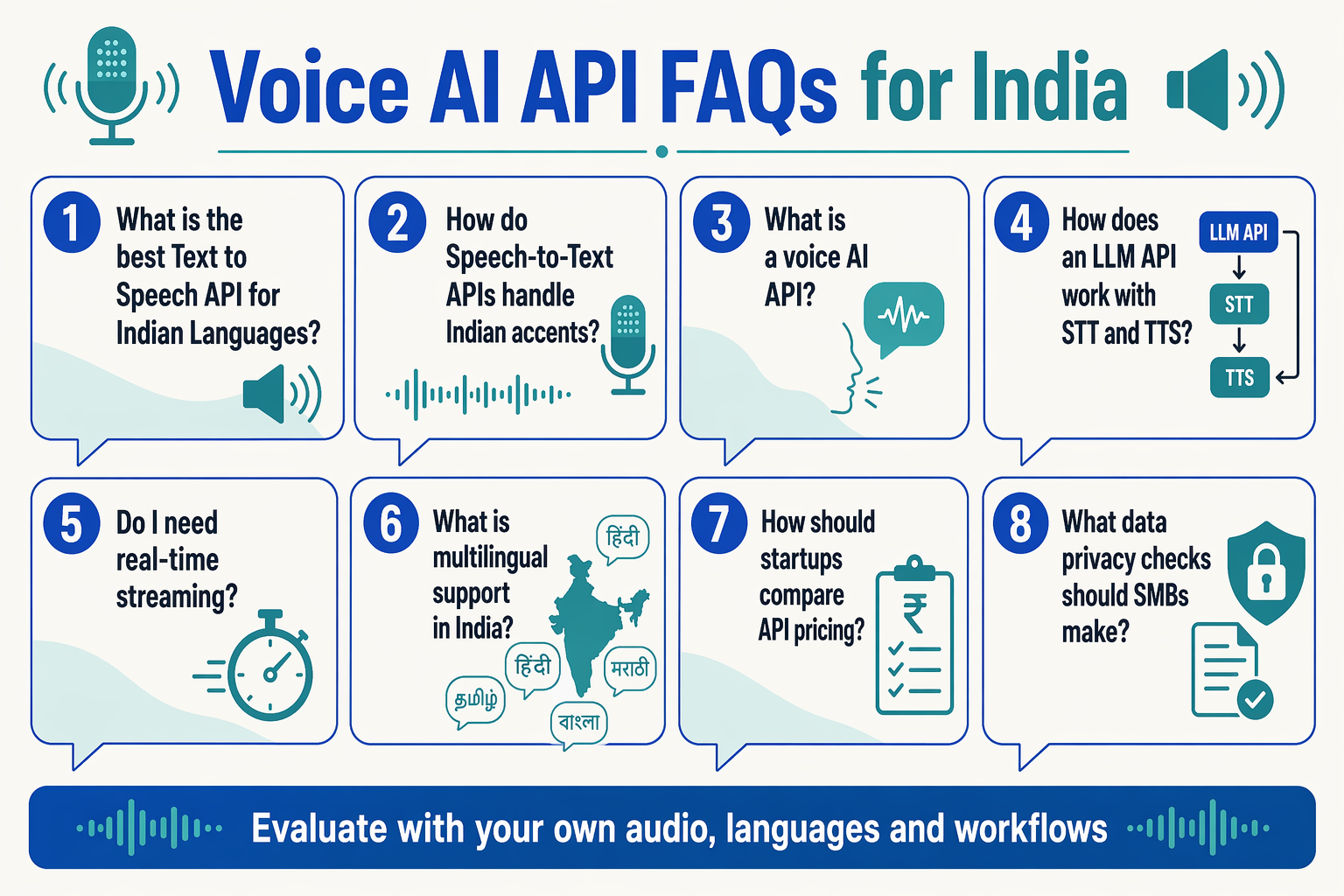
What is the best Text to Speech API for Indian Languages for SMBs in India?
How does a speech-to-text API help Indian businesses automate customer support?
What is the difference between an LLM API, voice AI API, speech-to-text API, and text-to-speech API?
Which Text to Speech API for Indian Languages supports Hindi, Tamil, Telugu, Kannada, Bengali, and Marathi?
How should startups compare an easy-to-use voice AI API in India?
Can Indian SMBs use a Text to Speech API for Indian Languages with WhatsApp and phone calls?
Conclusion
Voice AI in India is moving from experimentation to everyday SMB infrastructure. The real opportunity is not just “adding AI,” but connecting STT, LLM APIs, TTS, WhatsApp, telephony, CRM, and human handoff into workflows customers actually use.
- Indian-language coverage is now a buying criterion, with vendors highlighting support for 22 Indian languages, 11+ Indian languages, code-mixing, timestamps, and diarization.
- Text to Speech APIs for Indian languages help businesses speak to customers in Hindi, Tamil, Telugu, Bengali, Marathi, Kannada, Hinglish, and local language combinations.
- Speech-to-text + LLM APIs turn calls into summaries, intent detection, lead qualification, appointment booking, and searchable customer records.
- Ease matters for SMBs: transparent pricing, SDKs, latency, reliability, analytics, privacy, and smooth human escalation matter as much as model accuracy.
What to watch next is faster real-time voice, better Hinglish and code-switching, deeper WhatsApp calling workflows, and India-first models tuned for regional accents and business use cases.
To explore how AI communication is evolving, check out CallMissed — an AI infrastructure platform powering voice agents and multilingual chatbots for businesses. The question is no longer whether Indian SMBs will adopt voice AI, but how quickly they can make it useful.
Related Reading
Discussion
Related Posts

Ready to automate customer conversations?
Launch AI voice agents and WhatsApp bots with CallMissed — one API, 22+ Indian languages.