
WhatsApp AI Chatbot India: Easy 2026 Guide for SMEs, Startups and City Businesses


WhatsApp AI chatbot India guide for SMEs: compare AI agents vs chatbots, API readiness, city use cases, multilingual support and buying criteria.
WhatsApp AI Chatbot India: Easy 2026 Guide for SMEs, Startups and City Businesses
What if your next 100 customer enquiries from WhatsApp could be answered, qualified, routed, and followed up—even while your shop, clinic, coaching centre, real-estate office, or startup team is closed?
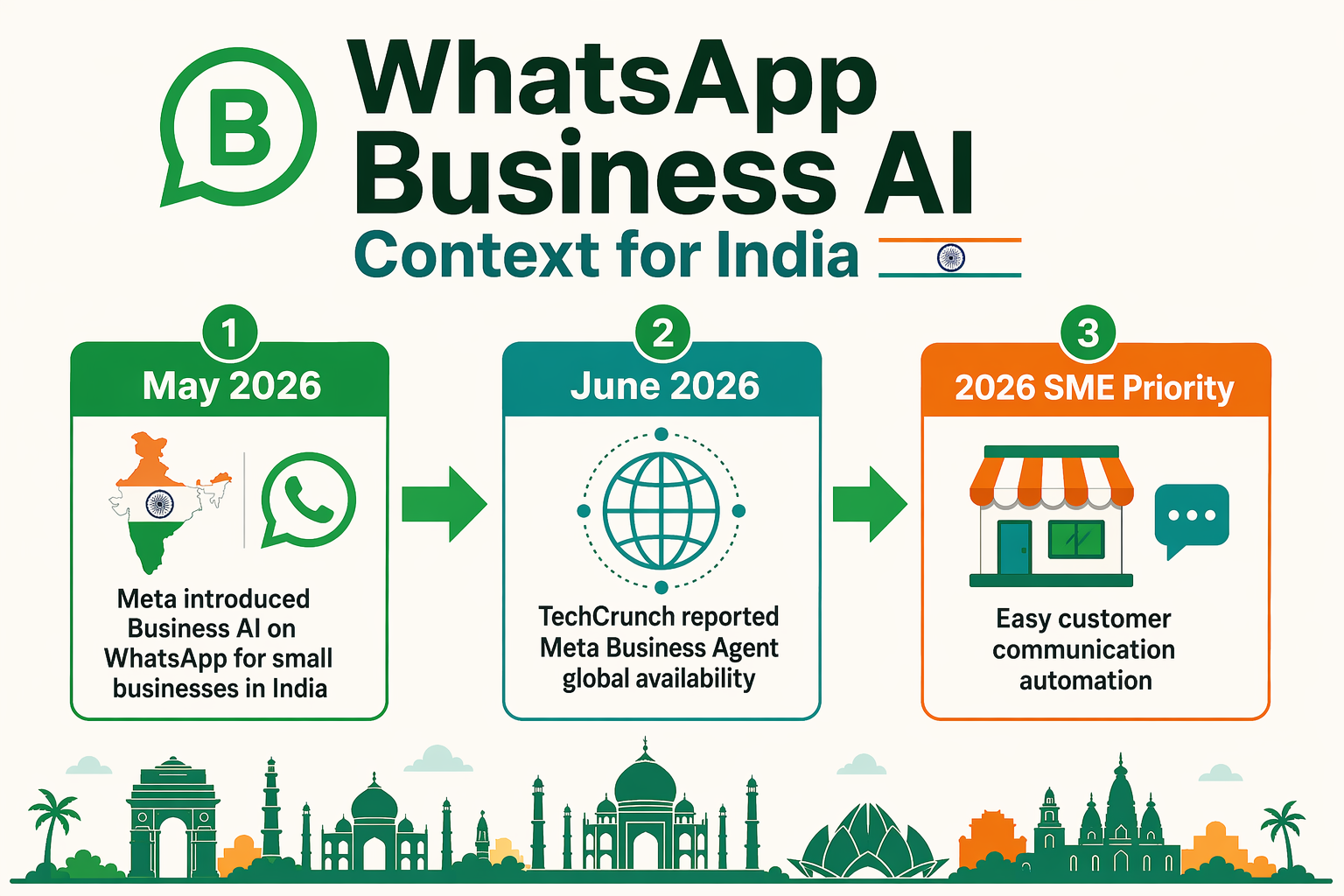
That is why WhatsApp AI Chatbot India has become a serious 2026 business priority, not just another tech trend. In May 2026, Meta introduced Business AI on WhatsApp for small businesses in India, describing it as a way for businesses to “respond to customers around the clock, recommend products, and drive sales” inside WhatsApp. Then, on June 3, 2026, TechCrunch reported that Meta Business Agent was becoming available globally within WhatsApp, signalling that AI-assisted customer conversations are moving from experimental pilots to mainstream business infrastructure.
For Indian SMEs, startups, and city-based businesses, the timing matters. Customers already expect fast replies on WhatsApp—whether they are asking a Pune clinic for appointment slots, a Mumbai boutique for catalogue prices, a Bangalore SaaS startup for demo details, a Chennai institute for course fees, a Delhi service provider for availability, or a Hyderabad real-estate team for site visits. The challenge is that most small teams cannot hire enough staff to answer every chat instantly, in multiple languages, across evenings, weekends, and peak campaign periods.
This guide is built for that exact problem: how to choose and use an easy-to-use WhatsApp AI agent or chatbot for Indian business realities.
You will learn:
- The difference between rule-based WhatsApp chatbots and modern WhatsApp AI agents
- Which use cases work best for SMEs, startups, retailers, clinics, institutes, real estate, local services, and D2C brands
- How WhatsApp automation differs across Pune, Mumbai, Bangalore, Chennai, Delhi, Hyderabad, and Bharat/non-metro markets
- What to check before buying: no-code setup, WhatsApp Business API readiness, multilingual/Hinglish support, lead qualification, appointment booking, CRM handoff, analytics, compliance, and ease of use
- How to evaluate tools without getting locked into a complex or overbuilt system
Platforms such as CallMissed are part of this broader India-first shift, combining WhatsApp automation with AI voice, multilingual communication, and customer-engagement workflows for businesses that want simpler customer communication automation.
By the end, you should be able to decide whether your business needs a basic WhatsApp chatbot, a more flexible AI agent, or a hybrid setup that handles FAQs, captures leads, books appointments, and escalates important conversations to your team.
Introduction: Why WhatsApp AI Chatbot India Searches Are Surging in 2026
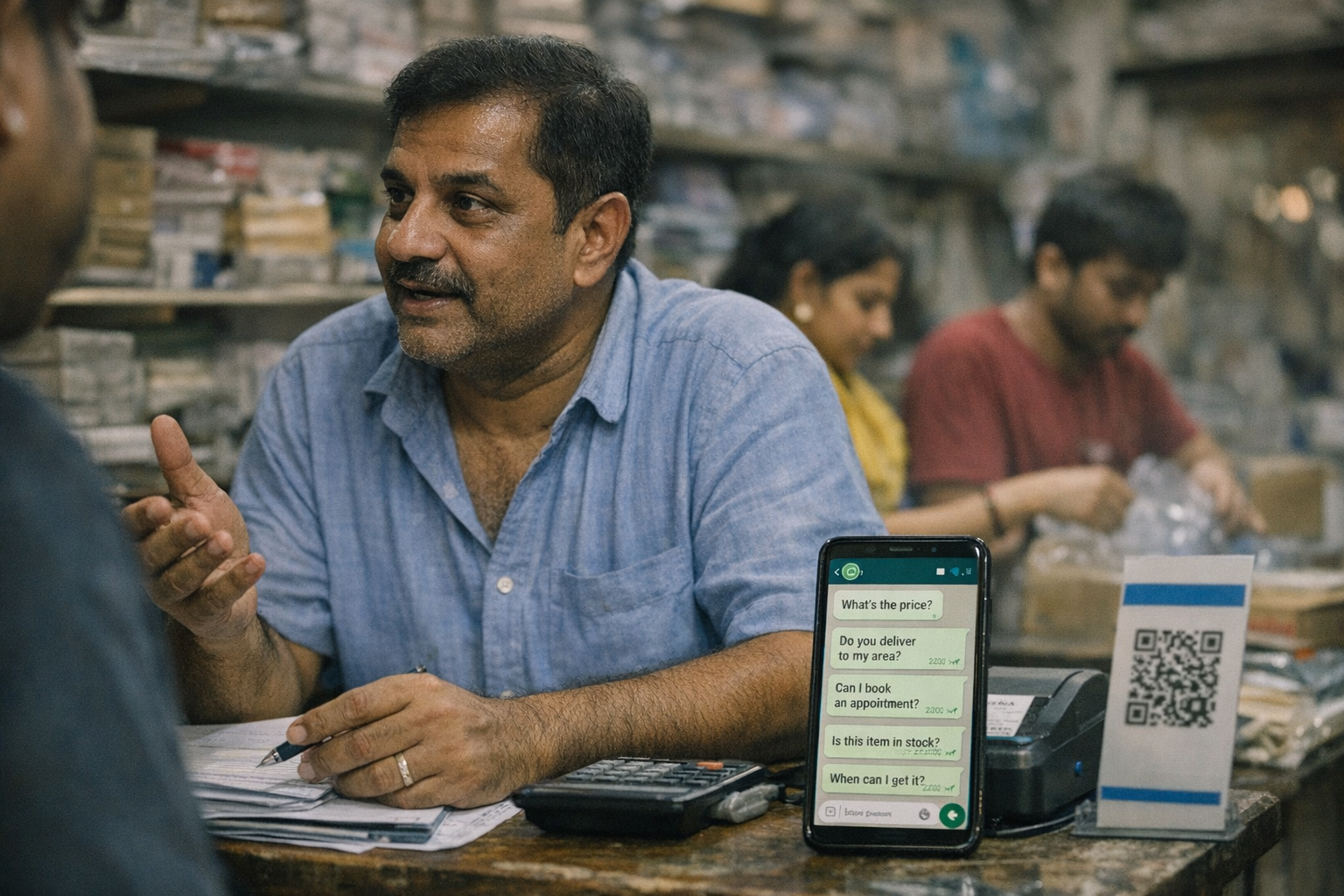
For Indian SMEs, the answer is simple: a WhatsApp AI chatbot India solution should do more than send instant replies. It should understand customer questions, collect lead details, complete actions such as booking appointments, and transfer complex conversations to an employee.
In July 2026, searches for “WhatsApp AI chatbot India” are rising because customers already use WhatsApp to ask about prices, stock, appointments, deliveries, courses, properties, and support. Many of these messages arrive outside normal business hours.
SMEs need a reliable way to respond quickly without adding staff for every shift.
The market also changed in May 2026, when Meta announced Business AI on WhatsApp for eligible small businesses in India. Meta said its native AI could help businesses answer questions around the clock, recommend products, and support sales conversations.
However, Meta’s native AI and third-party WhatsApp automation are different:
- Meta’s native Business AI is a WhatsApp feature being made available to eligible businesses. Its availability and capabilities can depend on the account and rollout.
- Third-party solutions generally connect through the WhatsApp Business Platform. They may add custom workflows, CRM updates, calendar booking, analytics, team inboxes, human escalation, and optional voice handoff.
For an SME, the right choice depends less on the word “AI” and more on what needs to happen after a customer sends a message.
Why Indian SMEs Need More Than Faster Replies
A customer may message at 11:30 PM for course fees, at 7:00 AM for a clinic appointment, or on Sunday to arrange a property visit.
During a campaign, hundreds of people may ask variations of the same questions:
- “Price kya hai?”
- “Delivery kab milega?”
- “Sunday ko appointment available hai?”
- “Is this product in stock?”
- “Can someone call me?”
- “Pune mein service available hai?”
A delayed reply can mean a lost lead. But an instant answer is not enough if the system cannot collect details, check availability, book a slot, update the CRM, or transfer the conversation to an employee.
That is why demand is moving beyond basic auto-replies. Businesses increasingly need systems that can support the customer journey from start to finish: answer, qualify, act, and hand off.
Native Tools, Rule-Based Automation, or an AI Agent?
Businesses comparing a WhatsApp AI chatbot India solution generally have three practical options:
| Option | Best suited for | What it can do | Main limitation |
|---|---|---|---|
| Native WhatsApp business tools | Small teams with straightforward enquiries | Greeting and away messages, quick replies, catalogues, and eligible native AI features | Availability and workflow customisation may be limited |
| Rule-based chatbot | Predictable, repetitive processes | Menus, keyword replies, FAQs, order-status links, forms, and routing | Struggles with unexpected or conversational questions |
| WhatsApp AI agent | Businesses handling varied enquiries or higher lead volumes | Understands natural language, qualifies leads, books appointments, updates CRM records, and escalates to people | Requires careful setup, approved WhatsApp access, monitoring, and clear handoff rules |
A small shop receiving a few standard questions may only need native tools. A coaching centre with fixed admission steps may benefit from a rule-based flow.
A clinic, real-estate business, dealership, D2C brand, or service company handling varied customer intent may need an AI agent connected to operational systems.
For example, an integrated agent could:
- Recognise that “Sunday evening consultation possible?” is an appointment request.
- Ask for the customer’s location and preferred time.
- Check the connected calendar.
- Offer an available slot.
- Save the lead in the CRM.
- Transfer the chat—or trigger an optional voice call—when the customer needs human help.
Why India-Specific Setup Matters
A WhatsApp AI chatbot in India cannot assume that every customer will use formal English. Real conversations frequently combine English with Hindi, Marathi, Tamil, Telugu, Bengali, Kannada, Malayalam, Gujarati, Punjabi, and other languages.
The system should be tested using actual customer phrasing, including Hinglish and transliterated text such as:
- “Fees kya hai?”
- “Kal slot milega?”
- “COD available hai?”
- “Site visit Sunday ko possible hai?”
- “Mujhe agent se baat karni hai.”
Requirements also vary by market and business type. Pune clinics may prioritise appointment booking, while Mumbai retailers may need help managing campaign-driven message volumes.
Bangalore startups may focus on demo qualification. Businesses in non-metro markets may place greater importance on multilingual assistance and an easy path from chat to voice.
What to Evaluate Before Choosing
When comparing native WhatsApp features with third-party platforms such as CallMissed, evaluate the full workflow rather than the product label.
Check whether the solution provides:
- Official WhatsApp Business Platform support where required
- Simple setup and management for non-technical teams
- Natural-language and multilingual handling
- CRM, calendar, catalogue, or helpdesk integrations
- Clear human takeover with access to conversation history
- Optional voice escalation for urgent or complex enquiries
- Consent, template, opt-out, and data-handling controls
- Reporting for response times, leads, bookings, and handoffs
The best WhatsApp AI chatbot India setup is not necessarily the one that automates every message. It is the one that answers routine questions consistently, completes useful actions, and involves an employee at the right moment.
Background & Context: Business AI on WhatsApp for Small Businesses in India
From Auto-Reply to AI-Led WhatsApp Conversations
For years, WhatsApp automation in India meant simple auto-replies or menu-based flows. In 2026, that context changed meaningfully: AI is moving closer to the everyday tools that Indian SMBs already use.
The market has broadly evolved through three stages:
- Manual WhatsApp replies — the owner, receptionist, sales executive, or support person answers every enquiry.
- Rule-based WhatsApp chatbots — fixed options such as “Press 1 for pricing” or “Press 2 for support.”
- WhatsApp AI agents — conversational systems that can understand intent, answer business-specific questions, qualify leads, recommend products, and escalate when needed.
In May 2026, Meta announced Business AI on WhatsApp for small businesses in India, saying it helps businesses “respond to customers around the clock, recommend products, and drive sales.” Moneycontrol also reported that WhatsApp’s Business AI for Indian SMEs supports local languages and can handle customer chats, bookings, and product questions.
Then, on June 3, 2026, TechCrunch reported that Meta Business Agent was becoming available globally within WhatsApp. The key takeaway for Indian SMEs: WhatsApp AI is no longer only an enterprise experiment. It is becoming a mainstream customer communication layer for small businesses, local service providers, startups, retailers, clinics, institutes, and D2C brands.
Why This Matters for Indian SMBs
Indian customer journeys are rarely linear. A buyer may discover a brand on Instagram, ask questions on WhatsApp, switch to Hinglish or a regional language, request photos, compare prices, ask for availability, and expect a reply after business hours.
For a small team, this creates real operational pressure:
- A missed WhatsApp enquiry can become a missed booking
- Slow replies can reduce lead conversion
- Repetitive questions consume staff time
- Customers expect fast answers even outside office hours
- Local language comfort can influence trust and purchase intent
That is why searches such as “easy to use WhatsApp AI agent India”, “WhatsApp chatbot for small business”, and city-led queries like “easy to use WhatsApp chatbot in Pune” are becoming more commercially important.
City and Business Context: Search Intent Is Local
Indian businesses often search for WhatsApp automation based on location, sector, and customer behaviour.
| Search Keyword / City Intent | Common Business Type | Typical WhatsApp AI Use Case | Why It Matters |
|---|---|---|---|
| WhatsApp AI agent Pune | Clinics, coaching classes, real estate | Appointment booking, course enquiries, site visits | High local-service enquiry volume |
| WhatsApp chatbot Mumbai | Retail, D2C, financial services | Catalogue sharing, lead capture, support routing | Fast response expectations in competitive markets |
| WhatsApp AI chatbot Bangalore | Startups, SaaS, education, services | Demo qualification, onboarding FAQs, CRM handoff | Tech-aware buyers expect automation |
| WhatsApp chatbot Chennai | Institutes, healthcare, local services | Multilingual FAQs, booking, follow-ups | Language comfort improves conversion |
| WhatsApp AI agent Delhi | Consultants, real estate, service firms | Lead filtering, availability checks, escalations | High enquiry volume needs prioritisation |
| WhatsApp chatbot Hyderabad | Real estate, education, clinics, startups | Site visit scheduling, admissions, support | WhatsApp is often the first sales touchpoint |
The Practical Background: AI Must Fit Indian Workflows
For Indian SMEs, the question is not simply: “Can AI answer messages?” The better question is: “Can it work the way Indian customers actually communicate?”
A practical WhatsApp AI or chatbot setup should be evaluated on:
- No-code setup for owners and non-technical teams
- WhatsApp Business API readiness for scale and reliability
- Multilingual and Hinglish support
- Lead qualification before human follow-up
- Appointment booking and reminders
- CRM or shared inbox handoff
- Analytics for missed leads, response times, and conversions
- Compliance controls for opt-ins, consent, and message templates
- Ease of use for daily operations, not just technical demos
As businesses compare India-first communication platforms, including options such as CallMissed, the right approach is to test them against real customer conversations: pricing questions, booking requests, support issues, language switches, and after-hours enquiries. The winning setup is not the most complex one—it is the one your team can actually use every day.
Key Developments Indian Businesses Should Know
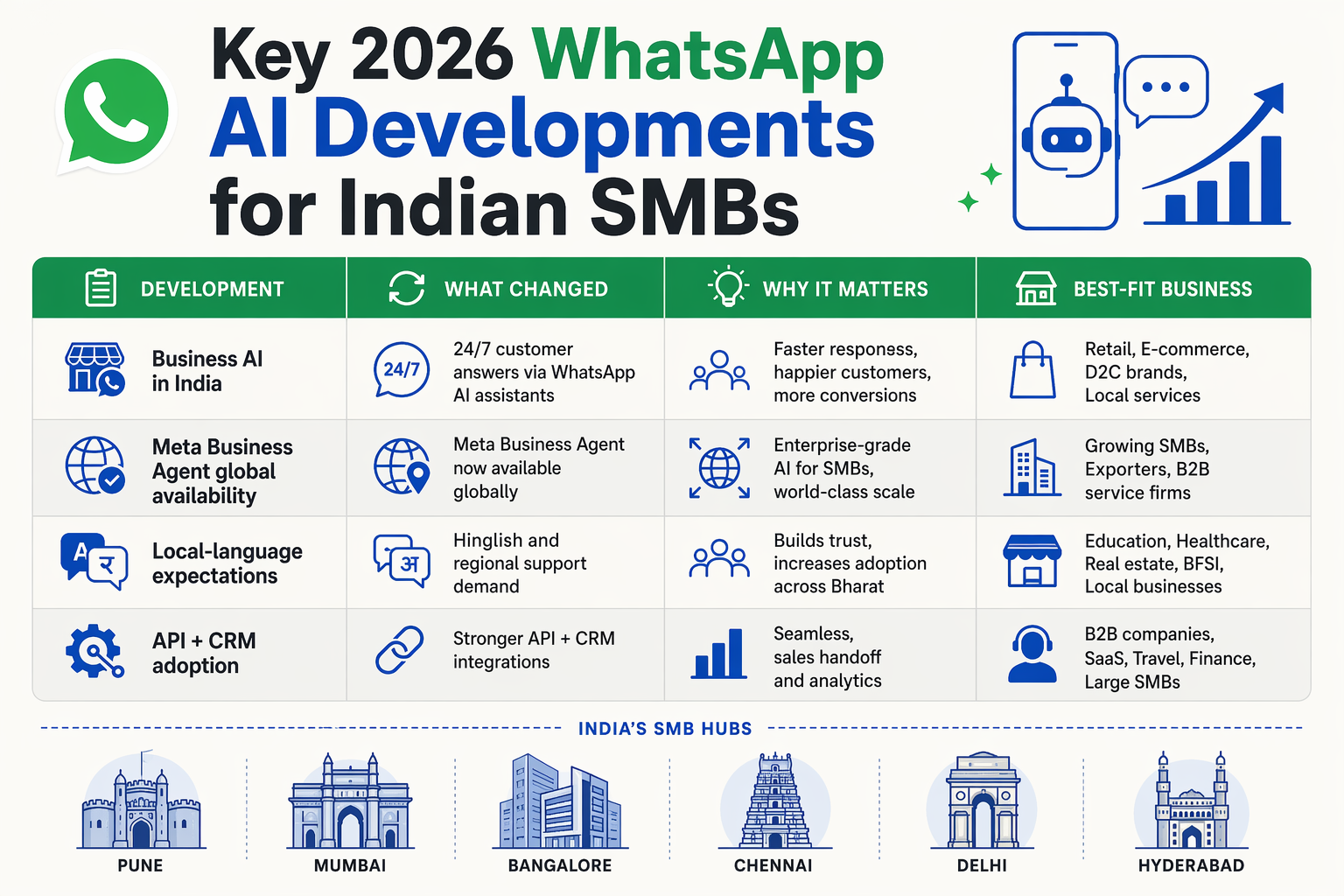
In 2026, WhatsApp AI for Indian businesses moved from experiment to mainstream buying consideration. In May 2026, Meta announced Business AI on WhatsApp for small businesses in India, describing it as a way to help businesses “respond to customers around the clock, recommend products, and drive sales” inside WhatsApp. Then, on June 3, 2026, TechCrunch reported that Meta Business Agent was becoming available globally within WhatsApp.
For Indian SMBs, SMEs, and startups, the key takeaway is simple: customers will increasingly expect WhatsApp conversations to be faster, more helpful, and more conversational than old menu-based bots.
| Development | Date / Source | What Changed | Why It Matters for Indian SMBs | Practical Action |
|---|---|---|---|---|
| Business AI on WhatsApp launched for India | May 2026, Meta | Meta introduced Business AI for small businesses in India to answer customers, recommend products, and support sales within WhatsApp. | Confirms that WhatsApp AI chatbot India is now a mainstream category, not only an enterprise automation project. | List your top 20 WhatsApp questions: price, timing, location, booking, delivery, availability, offers, refund, and payment queries. |
| Meta Business Agent expanded globally | June 3, 2026, TechCrunch | TechCrunch reported Meta’s customer-support AI bot, now known as Meta Business Agent, was becoming available globally within WhatsApp. | Indian customers may become more comfortable interacting with AI-assisted business chats as the feature becomes more visible. | Compare built-in WhatsApp AI options with external tools based on control, integrations, human handoff, analytics, and data governance. |
| AI can answer business-specific questions | Conversations 2026, WhatsApp Business Blog | WhatsApp Business said Business Agent can answer questions specific to a business and make product recommendations. | Raises expectations beyond “Press 1 / Press 2” flows. Customers will expect relevant answers based on your actual services and catalogue. | Prepare a clean knowledge base: product details, service rules, pricing, FAQs, appointment slots, delivery zones, and escalation instructions. |
| Local-language support is becoming central | 2026, Moneycontrol | Moneycontrol reported WhatsApp’s Business AI rollout for Indian SMEs included local-language support for chats, bookings, and product questions. | Bharat and non-metro customers often use Hindi, Hinglish, Tamil, Telugu, Marathi, Bengali, Kannada, Malayalam, Gujarati, and mixed-language queries. | Test tools with real customer messages such as “kal appointment milega?”, “price with GST?”, and “delivery Pune mein hai kya?” |
| AI is shifting from support to sales | 2026, Meta announcement | Meta highlighted product recommendations and sales outcomes, not only customer service automation. | Useful for clinics, coaching centres, salons, real estate teams, D2C brands, travel agents, and local service providers that receive high-intent WhatsApp enquiries. | Capture lead source, city, budget, urgency, preferred time, and next action before routing to a team member. |
| Workflow fit still matters | 2026 market context | Businesses may need CRM updates, appointment booking, team routing, follow-ups, campaign tracking, and reporting around WhatsApp conversations. | A simple FAQ bot may not be enough for SMEs handling sales pipelines, service tickets, and repeat customer engagement. | Evaluate automation tools using a checklist: no-code setup, WhatsApp Business API readiness, multilingual handling, CRM handoff, analytics, and compliance. |
What This Means for “Easy-to-Use” WhatsApp AI Tools
The strongest buying signal in 2026 is ease of deployment. Indian business owners are not just searching for “AI”; they are searching for tools that can go live without a full engineering team.
Prioritise:
- No-code setup for FAQs, lead forms, appointment rules, and escalation paths
- WhatsApp Business API readiness for scale, templates, opt-ins, and reliability
- Multilingual and Hinglish handling for real Indian customer messages
- Human handoff when AI confidence is low or the query is sensitive
- Analytics for response time, lead quality, conversion, and unresolved queries
- Compliance basics such as consent, approved templates, and clear customer communication
The practical lesson: do not buy a WhatsApp AI agent only because it says “AI.” Choose a tool that matches your city, language mix, customer journey, team size, and follow-up process.
In-Depth Analysis: WhatsApp AI Agents vs Rule-Based WhatsApp Chatbots
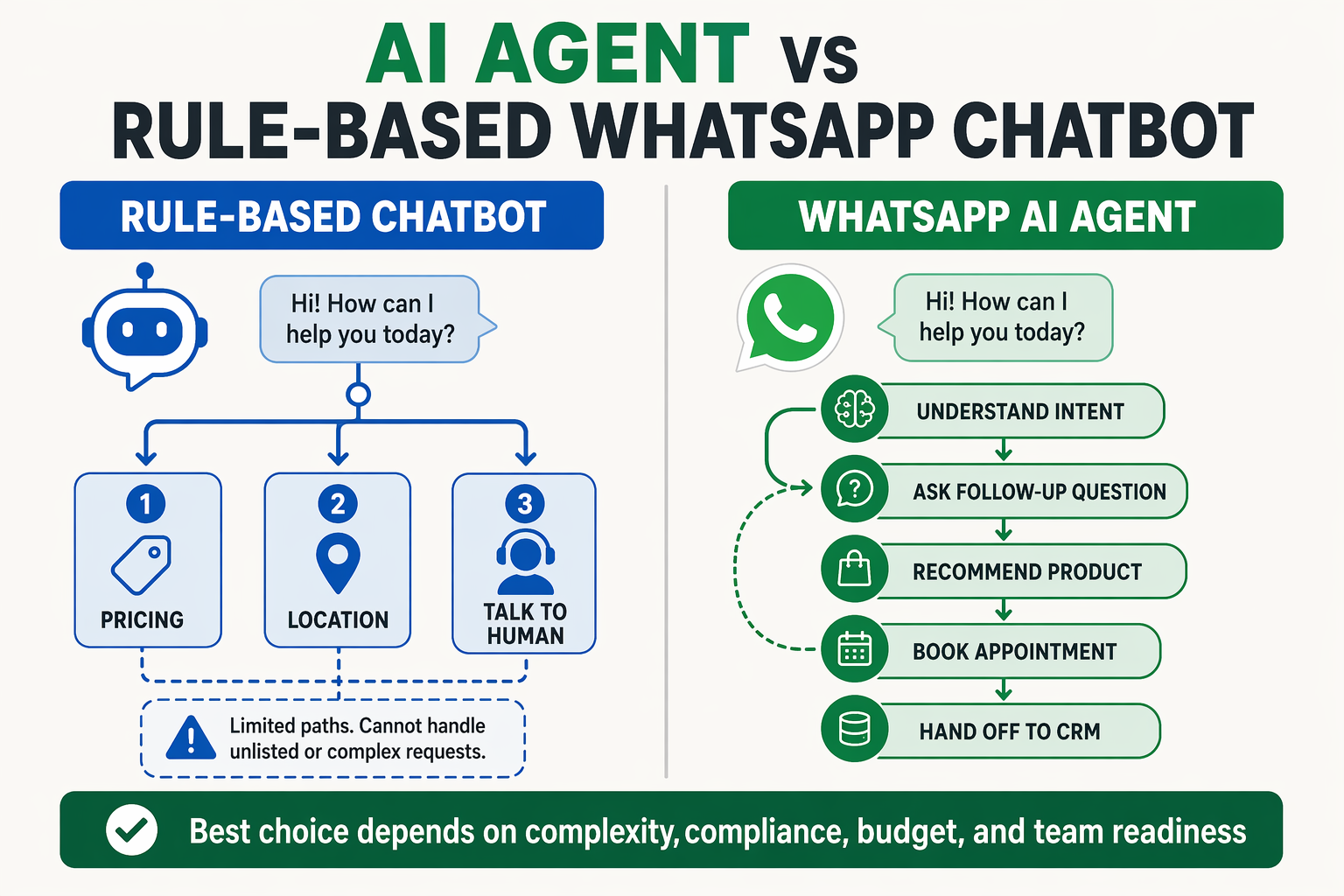
The Core Difference: Scripts vs Understanding
A rule-based WhatsApp chatbot follows predefined flows: “Press 1 for pricing,” “Press 2 for booking,” “Type YES to continue.” It is useful when customer journeys are predictable, such as collecting a name, phone number, city, budget, or appointment preference.
A WhatsApp AI agent, by contrast, can understand natural language, interpret intent, and respond more flexibly. This matters in India because customers rarely type in perfect menu-friendly formats. A real conversation may look like:
- “Kal dentist available hai kya?”
- “2BHK Hinjewadi under 80L?”
- “Fees batao for weekend digital marketing course”
- “COD milega kya Mumbai mein?”
- “Kannada mein details bhejo”
A rule-based bot may fail if the message does not match its buttons or keywords. An AI agent can identify that the user is asking about availability, location, price, language preference, or purchase intent, then continue the conversation.
This is why Meta’s 2026 direction is important. In May 2026, Meta introduced Business AI on WhatsApp for small businesses in India, saying it helps businesses “respond to customers around the clock, recommend products, and drive sales.” On June 3, 2026, TechCrunch reported that Meta Business Agent was becoming available globally inside WhatsApp. The signal is clear: WhatsApp automation is moving from static menus to AI-assisted selling and support.
Where Rule-Based WhatsApp Chatbots Still Work Well
Rule-based bots are not outdated. For many Indian SMBs, they are still the simplest starting point.
They work best for:
- Simple FAQs
Store timings, address, refund policy, delivery areas, clinic hours, or course start dates.
- Structured lead capture
Name, mobile number, city, budget, product interest, and preferred callback time.
- Appointment or callback routing
“Choose branch,” “select service,” “pick date,” then hand off to staff.
- Campaign responses
A customer clicks a WhatsApp ad and receives a fixed sequence: catalogue, offer, price list, and payment link.
For a small salon in Pune, tuition centre in Chennai, or local service provider in Delhi, this may be enough if 80% of enquiries follow the same pattern. Rule-based bots are also easier to audit because every path is predefined.
Where WhatsApp AI Agents Add More Value
AI agents become more useful when customer questions are varied, multilingual, or sales-heavy. Instead of forcing users into a fixed path, they can handle intent-based conversations.
For example:
- A real-estate team in Hyderabad can qualify buyers by location, budget, possession timeline, and property type.
- A D2C brand in Mumbai can answer product questions, suggest variants, and handle delivery objections.
- A clinic in Bangalore can explain services, capture symptoms at a basic intake level, and route urgent cases to staff.
- A coaching institute in Kota, Pune, or Chennai can answer course, batch, fee, and eligibility questions in Hinglish or regional languages.
The important distinction is that an AI agent is not just replying—it is interpreting context. If a customer asks, “Is this suitable for my 12-year-old?” the agent needs to understand age, product/service relevance, and whether escalation is needed.
India-first platforms such as CallMissed reflect this shift by supporting WhatsApp automation alongside AI voice and multilingual customer engagement workflows, including Indic-language communication needs that are common outside English-first metro audiences.
Practical Comparison for Indian Businesses
Use this quick decision framework:
- Choose a rule-based WhatsApp chatbot if:
- Your questions are repetitive
- You want a low-complexity setup
- Your team mainly needs lead forms and FAQ automation
- You prefer fixed, predictable conversation paths
- Choose a WhatsApp AI agent if:
- Customers ask open-ended questions
- You sell consultative products or services
- You need multilingual or Hinglish handling
- You want product recommendations, qualification, and smarter follow-ups
- Your team receives many after-hours enquiries
- Choose a hybrid setup if:
- You want buttons for simple actions
- You want AI for free-text questions
- You need human handoff for high-value, sensitive, or complex conversations
The Best Choice Is Usually Based on Conversation Complexity
For Indian SMEs, the question is not “AI agent or chatbot?” It is: how complex are your WhatsApp conversations?
If your customers only ask “price?”, “location?”, and “timing?”, a rule-based bot may work. But if they compare options, negotiate, switch between English and Hindi, ask product-specific questions, or need recommendations, an AI agent becomes more practical.
In 2026, the winning setup for many Indian businesses will be simple on the front end, intelligent in the background: easy for customers to use, easy for teams to manage, and flexible enough to grow from FAQs into lead qualification, appointment booking, CRM handoff, and sales assistance.
Keyword and City Use-Case Map for Pune, Mumbai, Bangalore, Chennai, Delhi, Hyderabad and Bharat
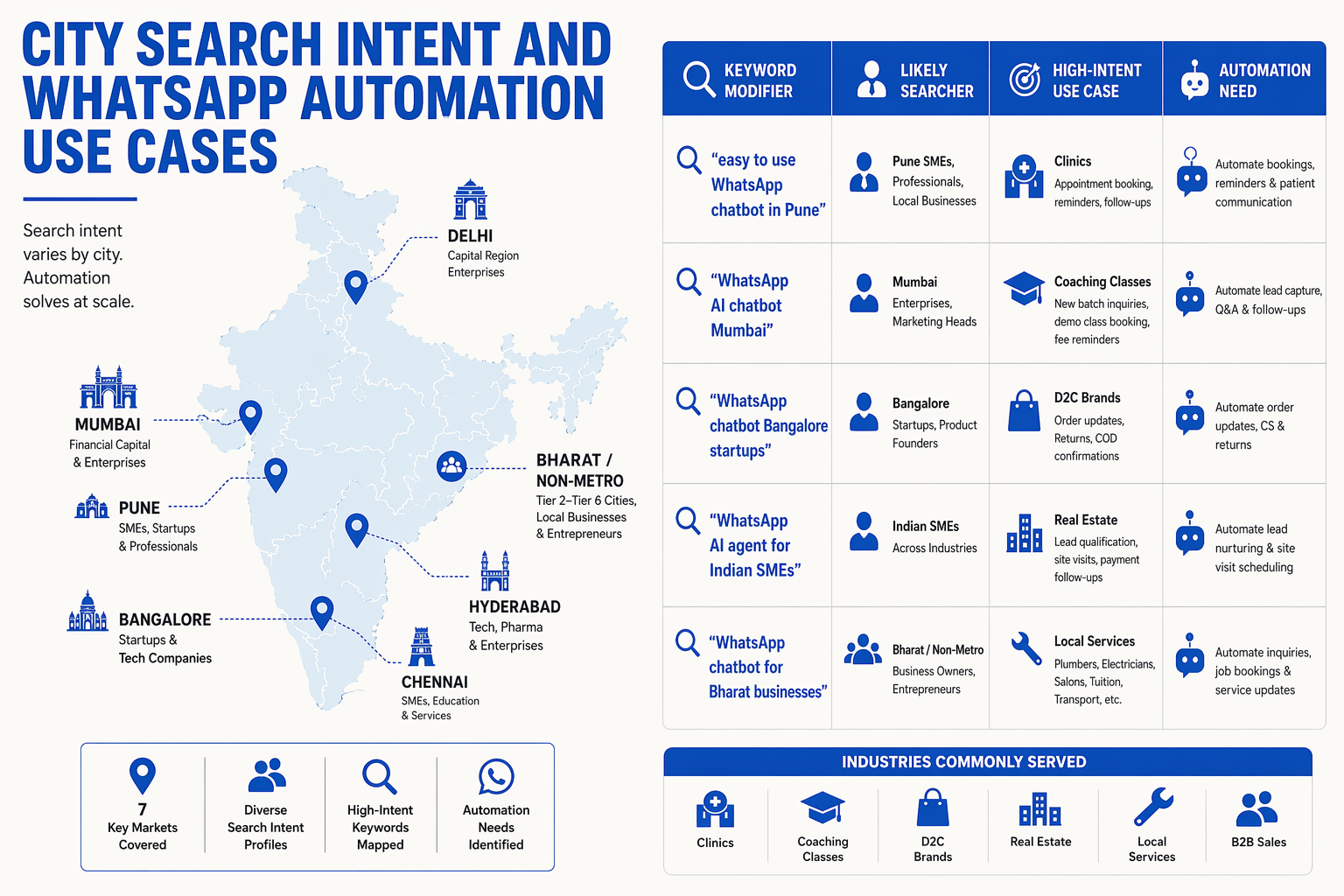
How to Match Search Intent to Local WhatsApp Automation
Indian buyers rarely search only for “WhatsApp chatbot.” They search with city, industry, simplicity, and outcome modifiers: “easy WhatsApp chatbot for clinic in Pune,” “WhatsApp AI agent for real estate leads Mumbai,” or “Hindi WhatsApp bot for small business.” This matters because your SEO pages, landing pages, and ad groups should mirror how Indian SMBs actually describe their problem.
The 2026 context makes this even more important. Meta announced Business AI on WhatsApp for small businesses in India in May 2026, saying it helps businesses “respond to customers around the clock, recommend products, and drive sales.” On June 3, 2026, TechCrunch reported that Meta Business Agent was becoming available globally within WhatsApp. In other words, search demand is shifting from “what is a chatbot?” to “which WhatsApp AI agent works for my city, language, and business workflow?”
City and Keyword Use-Case Map
| City / Market | High-Intent Keyword Cluster | Best-Fit Use Cases | Language / Buyer Nuance | What to Highlight |
|---|---|---|---|---|
| Pune | easy to use WhatsApp chatbot in Pune, WhatsApp AI agent for clinics Pune, chatbot for coaching classes Pune | Appointment booking, course enquiries, clinic FAQs, housing project leads | Marathi + Hindi + English; strong education, healthcare, real estate demand | No-code setup, calendar booking, lead capture, staff handoff |
| Mumbai | WhatsApp AI chatbot Mumbai, WhatsApp automation for D2C Mumbai, AI agent for real estate Mumbai | Catalogue sharing, order status, broker lead qualification, service bookings | Hindi + English + Marathi; fast-response expectations and high lead volume | 24/7 replies, CRM routing, campaign follow-up, analytics |
| Bangalore | WhatsApp AI agent Bangalore, WhatsApp chatbot for startups Bangalore, AI customer support WhatsApp India | SaaS demo qualification, tech support, onboarding, hiring queries | English + Hindi + Kannada; startup buyers compare integrations and APIs | API readiness, CRM sync, RAG knowledge base, human escalation |
| Chennai | WhatsApp chatbot Chennai, Tamil WhatsApp AI agent, chatbot for institutes Chennai | Course counselling, healthcare support, local services, appointment reminders | Tamil-first conversations matter for trust and conversion | Tamil support, structured FAQs, reminders, simple admin dashboard |
| Delhi NCR | WhatsApp AI agent Delhi, WhatsApp chatbot for service business Delhi, lead qualification bot NCR | Home services, legal/CA enquiries, education, events, B2B services | Hindi + English; buyers expect quick pricing and availability answers | Lead scoring, quotation flows, callback requests, compliance-safe messaging |
| Hyderabad | WhatsApp chatbot Hyderabad, AI WhatsApp agent for real estate Hyderabad, WhatsApp automation for SMEs Hyderabad | Property site visits, hospital enquiries, coaching leads, D2C support | Telugu + Hindi + English; strong real estate and education use cases | Site-visit booking, multilingual FAQs, CRM handoff, follow-up automation |
| Bharat / Non-metro | WhatsApp chatbot for small business India, Hindi WhatsApp AI agent, regional language WhatsApp bot | Retail, agri-services, local clinics, tuition centres, repair services | Voice + regional language support is often more important than advanced dashboards | Multilingual support, voice fallback, low setup effort, transparent pricing |
How to Use This Map in SEO and Campaigns
Use the table as a planning tool for landing pages, Google Ads, WhatsApp click-to-chat campaigns, and local SEO pages. A good structure is:
- City + product keyword: “WhatsApp AI Agent in Pune”
- Industry modifier: “for clinics,” “for coaching classes,” “for real estate”
- Outcome modifier: “book appointments,” “qualify leads,” “answer FAQs 24/7”
- Ease modifier: “no-code,” “easy setup,” “SMB-friendly”
For example, a Pune clinic page should not only say “AI chatbot.” It should say: “Easy WhatsApp AI agent for Pune clinics to answer patient FAQs, capture appointment requests, and route urgent enquiries to staff.”
Practical Keyword Clusters to Build Around
Prioritise these clusters across your content and landing pages:
- Easy-to-use intent: “easy WhatsApp chatbot India,” “no-code WhatsApp AI agent”
- SMB/SME intent: “WhatsApp AI agent for Indian SMEs,” “chatbot for small business India”
- City intent: “WhatsApp chatbot in Pune,” “WhatsApp AI agent Mumbai”
- Industry intent: clinics, coaching centres, real estate, D2C, local services, SaaS startups
- Language intent: Hindi, Tamil, Telugu, Marathi, Kannada, Hinglish
For India-first teams, this is where platforms such as CallMissed fit into the broader market: businesses need WhatsApp automation that works across chat, voice, and Indian-language customer journeys—not just a generic bot pasted into a global workflow.
Impact & Implications: Where WhatsApp AI Agents Create ROI for Indian SMEs
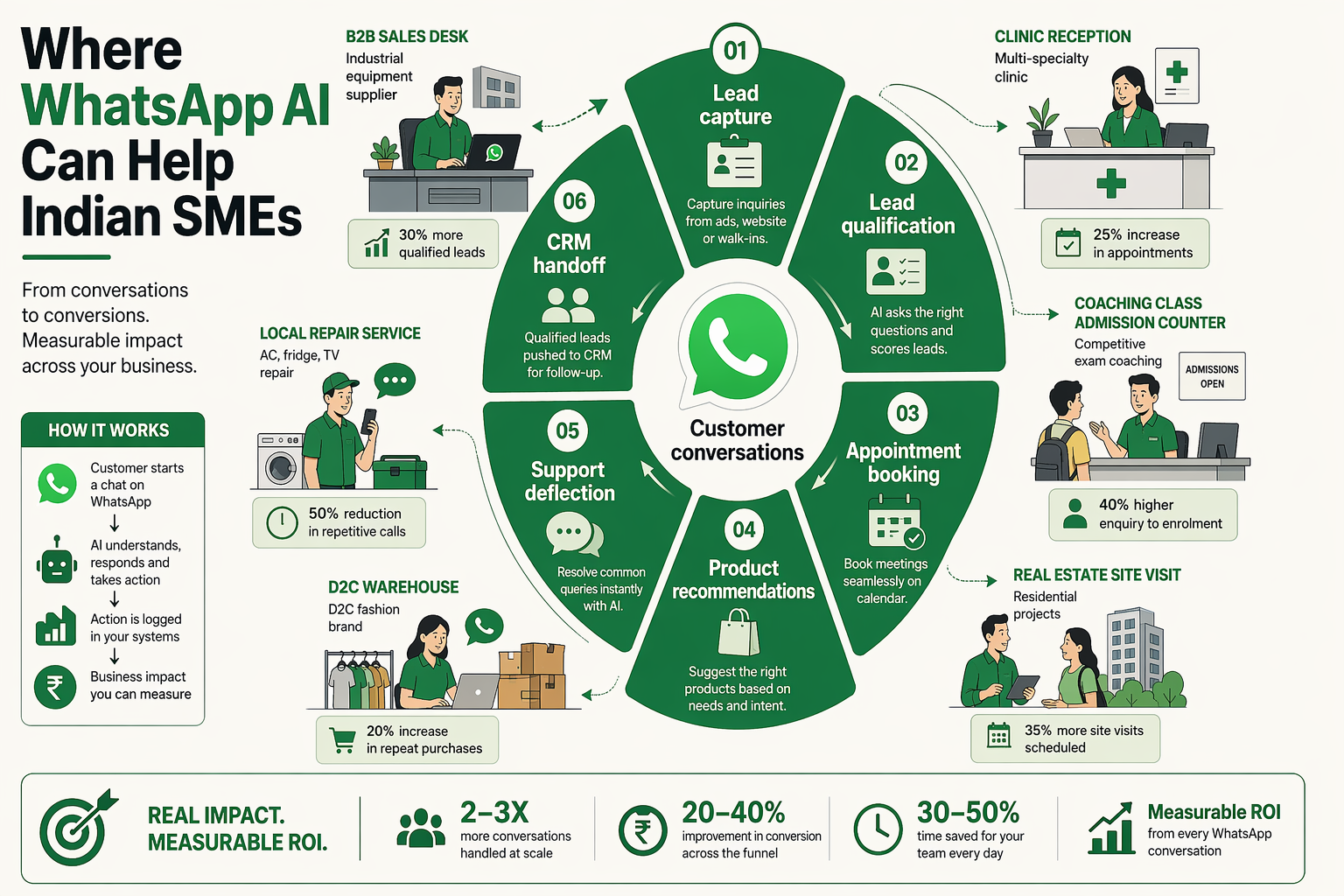
ROI Starts Where Response Time Stops Leaking Revenue
For Indian SMEs, the business case for a WhatsApp AI agent is not “AI for AI’s sake.” ROI comes from reducing missed enquiries, improving conversion speed, and keeping customer conversations moving after office hours.
Meta’s May 2026 launch of Business AI on WhatsApp for small businesses in India framed the value clearly: AI can help businesses “respond to customers around the clock, recommend products, and drive sales” within WhatsApp. TechCrunch then reported on June 3, 2026 that Meta Business Agent was becoming available globally inside WhatsApp—confirming that AI-led customer engagement is becoming mainstream infrastructure, not just an enterprise experiment.
For a small Indian team, the implication is simple: if customers already message you on WhatsApp, every delayed reply is a potential lost booking, lead, order, or visit.
High-ROI Use Cases for Indian SMEs
The strongest returns usually appear in repeatable, high-volume conversations where staff currently spend time answering the same questions.
- Lead capture and qualification: A real-estate broker in Hyderabad, a coaching centre in Pune, or a SaaS startup in Bangalore can ask structured questions—budget, location, urgency, course interest, company size—before routing the lead to sales.
- Appointment booking: Clinics, salons, consultants, diagnostic centres, tutors, and service businesses can let customers check slots, share details, and receive reminders without waiting for a receptionist.
- Product discovery and recommendations: Retailers, D2C brands, boutiques, electronics shops, and local distributors can guide customers through catalogues, sizes, prices, availability, and offers.
- After-hours support: Many Indian customers enquire during evenings, weekends, lunch breaks, or commute hours. A WhatsApp AI agent can answer FAQs even when the team is offline.
- Follow-up automation: SMEs often lose revenue not because leads are poor, but because follow-ups are inconsistent. AI can send reminders, payment nudges, document requests, and next-step prompts.
- Multilingual conversations: Businesses serving Bharat and non-metro markets need Hindi, Hinglish, Tamil, Telugu, Marathi, Bengali, Kannada, Malayalam, Gujarati, and other language support—not just English templates.
City-Specific Implications: Same Channel, Different ROI
The ROI pattern changes by city and business type:
- Mumbai: High enquiry volumes and fast customer expectations make instant replies valuable for retail, events, finance, clinics, and real estate.
- Bangalore: Startups, SaaS teams, education platforms, and B2B services benefit from demo qualification, support triage, and CRM handoff.
- Pune: Coaching institutes, healthcare providers, local services, and real-estate firms can automate FAQs, appointment slots, and lead routing.
- Delhi NCR: Competitive service markets—legal, healthcare, home services, education, and automotive—gain from faster first response and structured qualification.
- Chennai: Multilingual support and appointment-led workflows matter for healthcare, training, manufacturing services, and local retail.
- Hyderabad: Real estate, education, healthcare, and tech services can use WhatsApp AI agents to filter serious enquiries from casual browsing.
The Practical ROI Formula
Before buying, Indian SMEs should estimate ROI using a simple model:
Monthly value = missed enquiries recovered + staff hours saved + higher conversion from faster follow-up + repeat purchases enabled
Track these metrics before and after launch:
- First response time
- Number of missed WhatsApp enquiries
- Lead-to-appointment conversion
- Appointment no-show rate
- Sales follow-up completion
- Support tickets handled without human intervention
- Revenue from WhatsApp-originated leads
Even modest improvements can matter. For example, if a clinic, coaching centre, or local service business recovers only a few extra bookings per week, the automation can justify itself quickly—especially if it also saves staff time.
What This Means for Buying Decisions
The implication for SMEs is not that every business needs a complex AI stack. The better question is: which conversations should humans stop repeating manually?
Look for a WhatsApp AI solution that supports:
- No-code setup for non-technical teams
- WhatsApp Business API readiness
- Lead qualification and appointment booking
- CRM or inbox handoff
- Analytics to prove ROI
- Multilingual and Hinglish support
- Human escalation for sensitive conversations
India-first platforms such as CallMissed fit into this shift by combining WhatsApp automation with AI voice, omnichannel workflows, and support for 22 Indian languages, which is especially relevant for SMEs serving customers beyond English-first metro audiences.
Expert Opinions: What Buyers Should Ask Before Choosing WhatsApp AI Agent Platforms for Indian Businesses
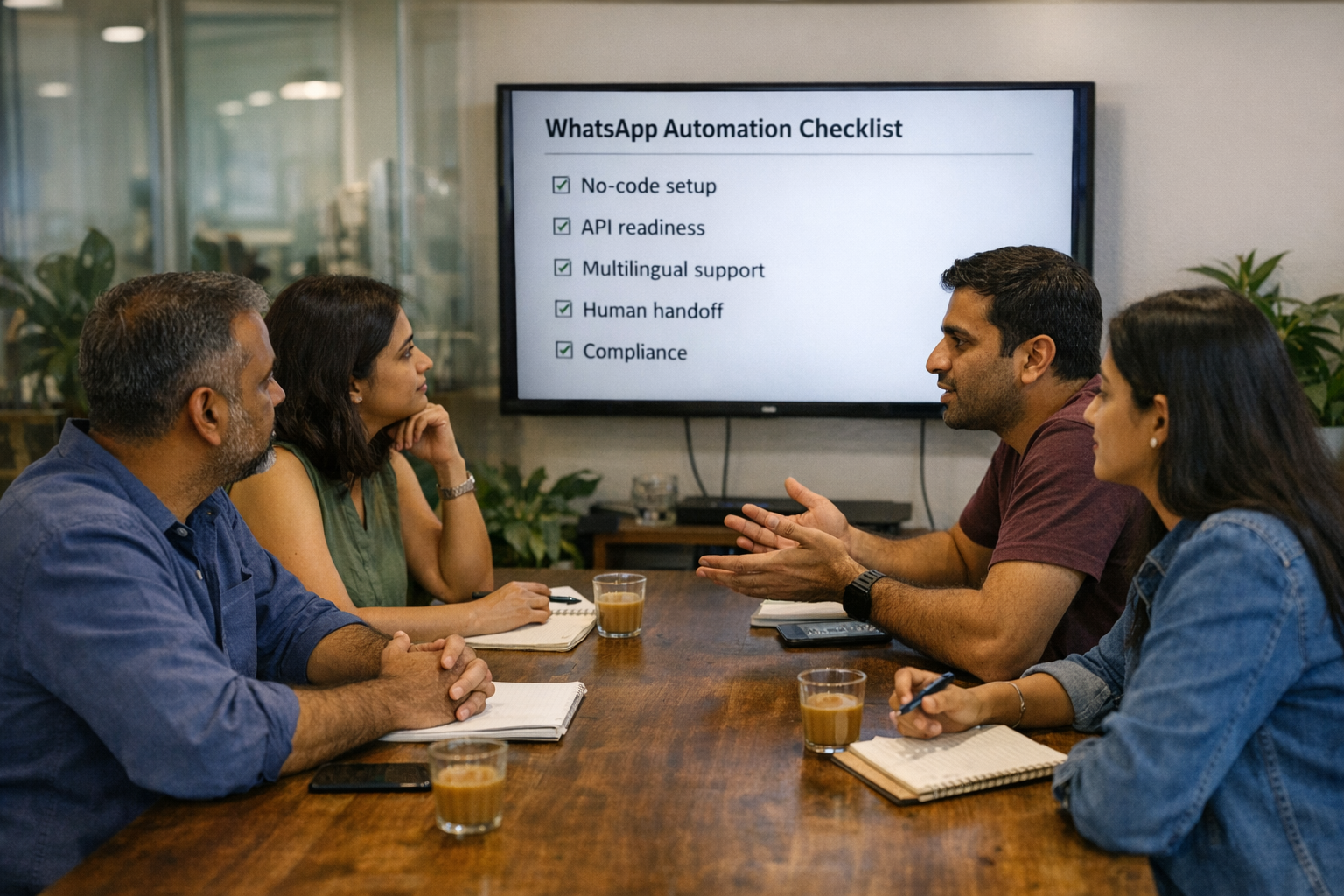
Start With Outcomes, Not Features
The biggest expert advice for Indian SMBs is simple: do not buy a WhatsApp AI agent because it “has AI.” Buy it because it can solve a measurable business problem—faster replies, more qualified leads, fewer missed bookings, better support, or higher repeat sales.
Meta’s May 2026 launch of Business AI on WhatsApp for small businesses in India is a strong signal that AI-assisted WhatsApp conversations are becoming mainstream. Meta described the use case clearly: helping businesses “respond to customers around the clock, recommend products, and drive sales.” On June 3, 2026, TechCrunch reported that Meta Business Agent was becoming available globally inside WhatsApp, making buyer evaluation even more important as more vendors enter the market.
Before choosing a platform, ask: What exact customer journey will this automate?
For example:
- A Pune coaching centre may need fee enquiry handling and demo class booking.
- A Mumbai D2C brand may need product recommendations and order-status replies.
- A Bangalore SaaS startup may need lead qualification and demo routing.
- A Chennai clinic may need appointment booking in English, Tamil, and Hinglish.
- A Delhi service business may need after-hours enquiry capture.
- A Hyderabad real-estate team may need site-visit scheduling and follow-up reminders.
Questions Experts Recommend Asking in Every Demo
When evaluating an easy-to-use WhatsApp AI agent India platform, buyers should ask practical questions, not just technical ones:
- Is it no-code for day-to-day changes?
Can your staff update FAQs, pricing, timings, locations, and offers without depending on a developer?
- Does it support WhatsApp Business API readiness?
Ask how templates, opt-ins, campaign rules, and handoffs are handled. A chatbot that works only in a limited inbox may not scale for serious customer communication.
- How does it handle Indian languages and Hinglish?
Moneycontrol reported WhatsApp’s Business AI rollout for Indian SMEs with local language support, including customer chats, bookings, and product questions. For India, multilingual capability is not optional—it is core to adoption.
- Can it qualify leads, not just answer FAQs?
A useful AI agent should capture name, city, budget, urgency, product interest, and preferred callback time before handing over to sales.
- What happens when the AI is unsure?
Look for clear escalation to a human agent, CRM note creation, and conversation history. The best implementations reduce confusion; they do not trap customers in endless bot loops.
- Can it connect WhatsApp with voice, CRM, and other channels?
Many Indian customers switch between WhatsApp messages and calls. Platforms such as CallMissed reflect this broader trend by combining WhatsApp automation with AI voice agents and multilingual customer-engagement workflows.
Red Flags Indian Businesses Should Watch For
Be cautious if a vendor:
- Cannot explain WhatsApp policy compliance clearly
- Charges unpredictably without transparent conversation or usage pricing
- Requires developers for every small content update
- Supports only English when your customers use Hindi, Tamil, Telugu, Marathi, Bengali, Kannada, or Hinglish
- Has no analytics for missed enquiries, bot resolution rate, lead quality, or handoff performance
- Promises “fully automatic sales” without discussing human escalation
The Buyer’s Final Test
Before signing, run a live test using your real customer questions. Include spelling mistakes, mixed-language messages, short replies like “price?”, and city-specific queries such as “available in Andheri?”, “clinic open Sunday?”, or “site visit Hyderabad weekend?”
If the platform can understand intent, respond accurately, collect lead details, and hand over smoothly, it is closer to a practical WhatsApp AI agent for Indian SMEs—not just a flashy chatbot demo.
What This Means For You: Practical Buying Criteria for Easy WhatsApp Automation
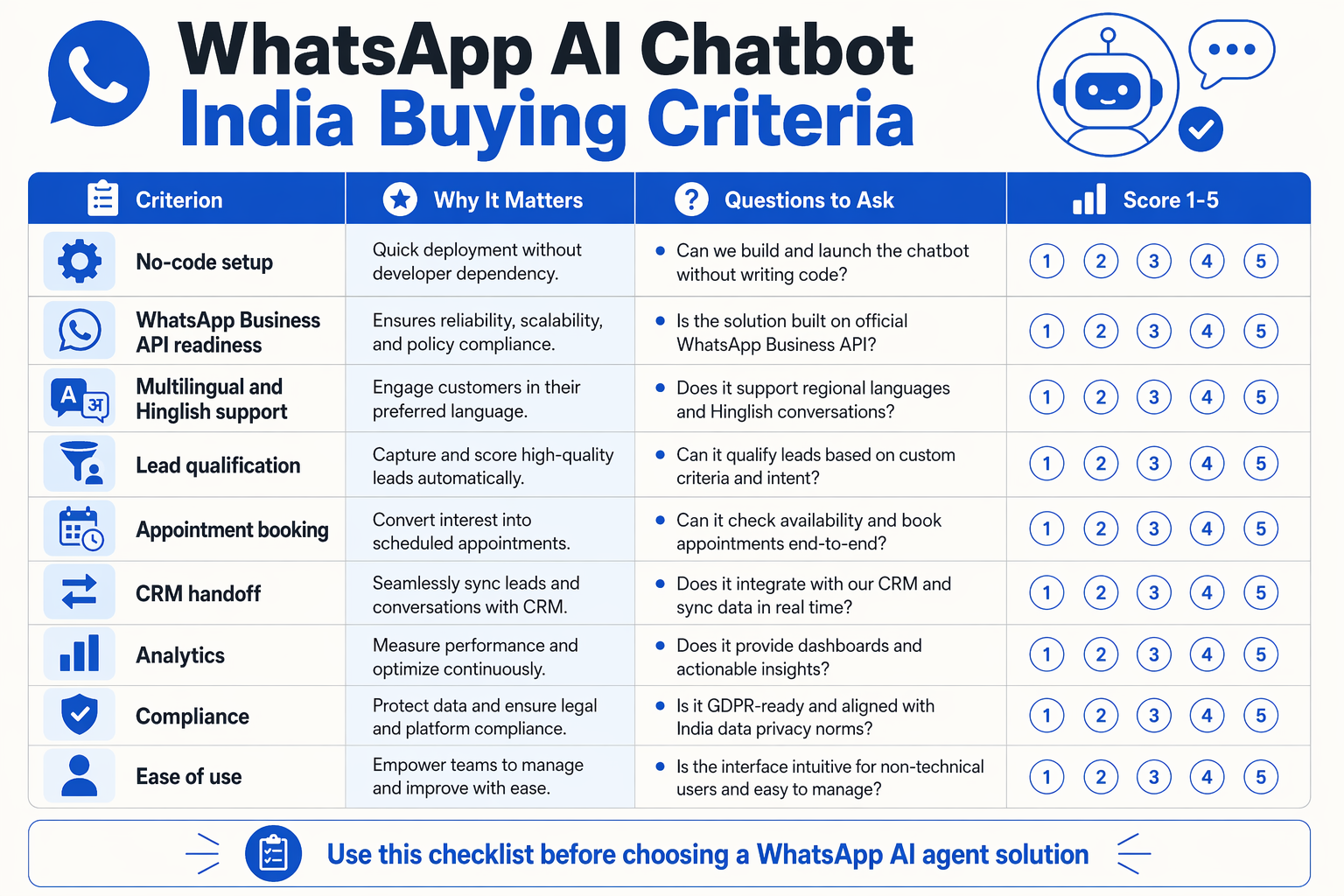
Turn “Easy to Use” Into a Buying Checklist
By 2026, WhatsApp automation is no longer only for large enterprises. Meta’s May 2026 launch of Business AI on WhatsApp for small businesses in India explicitly positioned AI as a way to “respond to customers around the clock, recommend products, and drive sales.” TechCrunch then reported on June 3, 2026 that Meta Business Agent was becoming available globally within WhatsApp.
For Indian SMBs, that means the buying question has changed from “Should we automate WhatsApp?” to “Which WhatsApp AI agent or chatbot can our team actually use every day?”
Use this table as a practical evaluation framework before shortlisting any vendor.
| Buying Criteria | What to Check | Why It Matters for Indian SMBs | Good Sign |
|---|---|---|---|
| No-code setup | Can your team create FAQs, flows, lead forms, and replies without developers? | Many clinics, institutes, retailers, and service businesses do not have in-house tech teams. | Drag-and-drop builder, templates, test mode, simple dashboard |
| WhatsApp Business readiness | Does it support WhatsApp Business Platform/API, approved templates, opt-ins, and conversation rules? | You need compliant messaging, especially for campaigns, follow-ups, and business-initiated chats. | Clear onboarding, template management, opt-in capture |
| Multilingual + Hinglish support | Can it handle English, Hindi, Hinglish, and regional languages used by your customers? | India search intent is city- and language-specific; a Delhi lead may type Hinglish, while a Chennai or Pune customer may prefer local-language support. | Language detection, multilingual replies, editable tone |
| Lead qualification + routing | Can it ask budget, location, requirement, urgency, and then assign the chat? | Real estate, coaching, healthcare, D2C, and B2B startups need more than FAQ answers—they need qualified leads. | Auto-tags, lead score, sales handoff, CRM sync |
| Appointments and follow-ups | Can it book slots, send reminders, and recover missed enquiries? | Clinics, salons, consultants, institutes, and local services lose revenue when customers do not get timely replies. | Calendar integration, reminders, missed-chat alerts |
| Analytics, control, and escalation | Can you see conversations, drop-offs, unresolved queries, and take over manually? | Automation should reduce workload, not hide customer problems. | Inbox view, agent takeover, reports, audit history |
Match the Tool to Your Business Maturity
A rule-based WhatsApp chatbot may be enough if your needs are simple:
- Store hours, address, pricing, catalogue links
- Basic menu-based responses
- Standard appointment or enquiry forms
- Limited products or services
A more flexible WhatsApp AI agent is better when customers ask unpredictable questions, compare options, mix Hindi and English, or need personalised recommendations. This is especially relevant now that Meta’s own WhatsApp AI direction includes agents that answer business-specific questions and recommend products.
For example:
- A Pune coaching centre may need course counselling and fee follow-ups.
- A Mumbai boutique may need product discovery and catalogue recommendations.
- A Bangalore startup may need demo qualification and CRM routing.
- A Chennai clinic may need appointment booking and language-sensitive support.
- A Delhi service provider may need urgent lead capture after business hours.
- A Hyderabad real-estate team may need project filtering by budget, location, and site-visit intent.
Do Not Buy Only for Features—Buy for Daily Usability
Before you commit, ask for a live demo using your own customer messages. Test queries like:
- “Fees kya hai?”
- “Kal appointment milega?”
- “Send catalogue under ₹2,000.”
- “I want 2BHK near Gachibowli.”
- “Can someone call me?”
Also check whether the platform supports human takeover, because even the best AI automation needs escalation for complaints, negotiations, medical concerns, high-value leads, or complex B2B deals.
India-first platforms such as CallMissed reflect where the market is heading: WhatsApp automation combined with AI voice, multilingual workflows, and customer-engagement infrastructure. The right choice is not the most complex tool—it is the one your team can launch quickly, trust with real enquiries, and improve every week.
Implementation Roadmap: From WhatsApp Inbox to AI-Assisted Customer Communication
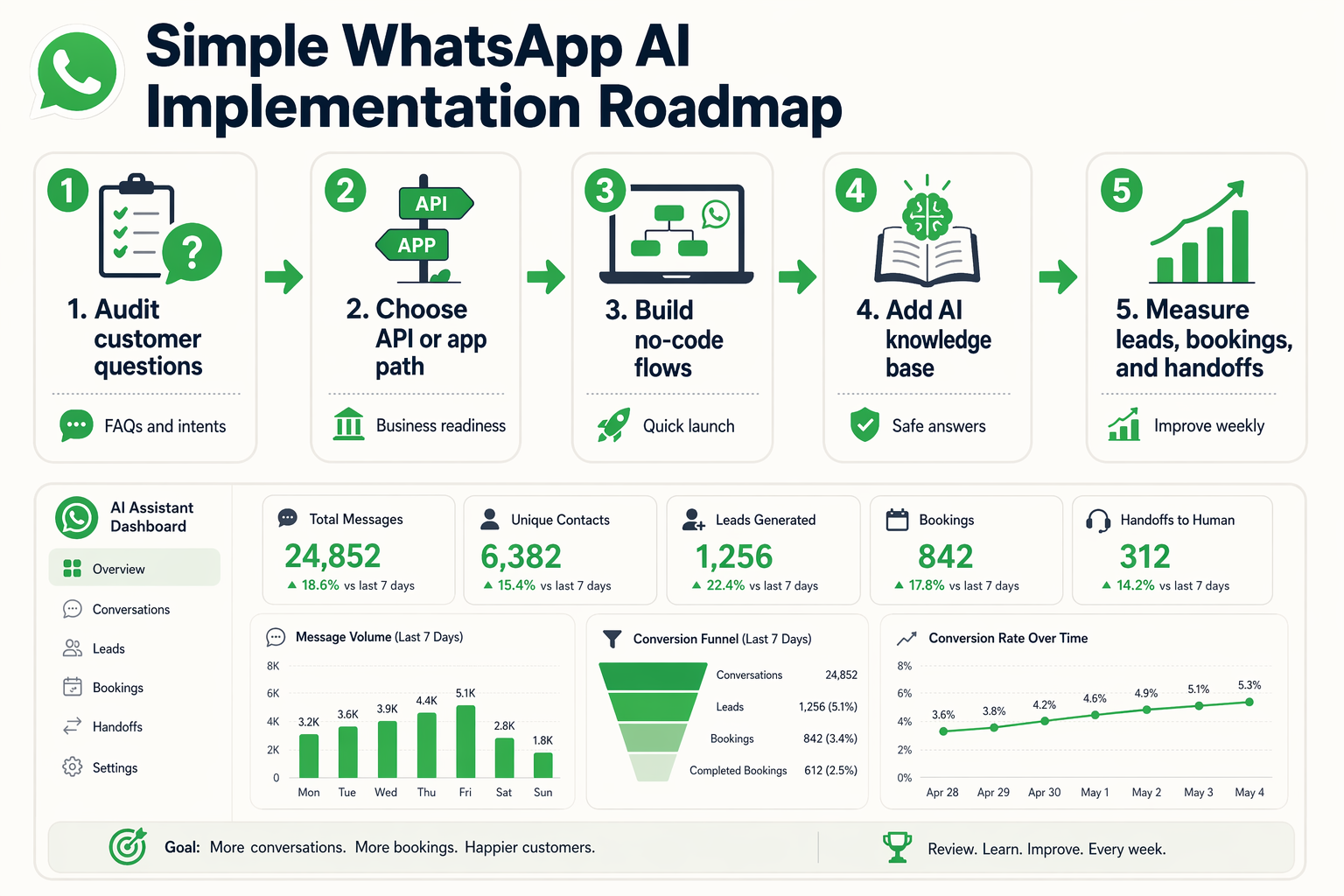
Start with one frequent, low-risk conversation—not a plan to automate the entire WhatsApp inbox. Review 200–500 recent chats and group them into categories such as:
- FAQs: prices, timings, locations, availability or delivery areas
- Lead intent: demo requests, appointments, site visits or course enquiries
- Support: order status, rescheduling, refunds or document requests
- Escalations: complaints, payment disputes, urgent requests or sensitive advice
Choose one use case with clear inputs and outcomes. For example:
- A clinic books appointments and transfers medical questions to staff
- A real-estate team qualifies buyers and schedules site visits
- A coaching institute answers fee questions and books demo classes
- A local service business checks the PIN code and requests a preferred time
- A SaaS startup qualifies demo enquiries and routes support issues
Record your current first-response time, unanswered-chat count, lead-completion rate and booking rate. These figures become the baseline for the 30-day pilot; they are not a promise of a particular return.
Days 4–7: Verify WhatsApp Business Platform Requirements
Decide whether the WhatsApp Business app is sufficient or whether you need the WhatsApp Business Platform for multiple agents, integrations, approved templates and higher-volume workflows.
Before building, verify the current requirements with Meta or your chosen solution provider. Depending on the setup, these may include:
- A Meta business portfolio and WhatsApp Business Account
- A phone number that can be registered for the intended setup
- Business details, display-name review and any applicable verification steps
- User roles, billing settings and account security
- A privacy notice and a documented method for collecting WhatsApp opt-ins
Do not assume that creating an account guarantees approval, verification, a particular messaging limit or access to every AI feature. Eligibility and account status depend on Meta’s current policies and review processes.
Obtain clear consent before sending business-initiated messages. Within the customer-service window opened by a user’s message, businesses can generally send free-form replies. Outside that window, an approved message template is typically required. Confirm the current window, template categories, pricing and policy requirements before launch because Meta may update them.
Days 8–12: Prepare the Knowledge and Conversation Rules
Create a compact, approved knowledge base for the selected use case. Include only information the agent is authorised to provide:
- Products, services, prices and current offers
- Branch addresses, service areas and business timings
- Appointment, delivery, cancellation and refund rules
- Frequently asked questions and approved answers
- Required lead fields, such as city, budget or preferred time
- Escalation contacts and team availability
- Links to your privacy policy, payment page or booking page
Assign an owner to every source. A branch manager might own timings, while operations owns delivery rules and sales owns pricing. Add a “last reviewed” date so outdated information does not remain in the agent’s responses.
Also define boundaries. The AI should not invent availability, guarantee a refund, negotiate an unapproved discount or provide medical, legal or financial advice. When information is missing or confidence is low, it should say so and transfer the conversation.
Days 13–17: Connect CRM, Calendar and Lead Routing
Connect only the systems required for the first use case. A practical workflow could be:
- The customer sends a WhatsApp message
- The AI identifies the intent and preferred language
- It answers approved questions and collects required details
- It checks a connected calendar or requests a preferred slot
- It creates or updates the CRM record
- It confirms the next step
- It transfers the chat when a human decision is needed
Test duplicate contacts, incorrect phone formats, unavailable calendar slots, cancelled appointments and failed CRM updates. If an integration fails, the customer should receive a safe response such as: “I’m unable to confirm that slot right now. A team member will check and reply.”
Platforms such as CallMissed can support this layer when a business wants WhatsApp conversations connected with multilingual chat, voice escalation and broader customer-communication workflows. Confirm the exact integrations and WhatsApp account requirements for your chosen configuration.
Days 18–21: Test Hindi, Hinglish and Regional-Language Inputs
Do not test only polished English. Use examples that resemble real Indian customer messages:
- “Kal doctor available hai kya?”
- “Wakad mein 2BHK under 90 lakh chahiye”
- “Weekend batch ka fee kitna hai?”
- “COD mere PIN code pe available?”
- “Demo book karna hai but evening mein”
Test spelling variations, Romanised Hindi, mixed-language sentences, voice-note transcripts, abbreviations and incomplete questions. For city-focused businesses, include the regional languages customers actually use—for example, Marathi, Tamil, Telugu, Kannada or Punjabi.
A speaker or translator should review important responses before launch. Language detection alone is not enough: prices, dates, addresses, consent language and policy explanations must remain accurate after translation. If the agent cannot reliably understand a message, it should ask the customer to rephrase or offer a human handoff.
Days 22–24: Configure Human and Voice Escalation
Create explicit transfer rules instead of asking the AI to handle every conversation. Escalate when:
- The customer asks for a person or calls repeatedly
- The message involves a complaint, refund or payment dispute
- The request is urgent, sensitive or safety-related
- Medical, legal or financial judgement is required
- The customer is angry or the AI fails to understand twice
- A high-value or complex B2B lead needs a salesperson
- A booking, CRM or payment integration fails
During staffed hours, route the chat to the correct queue with a summary of the customer’s request and the information already collected. Outside staffed hours, state when a person is expected to respond rather than implying immediate availability.
For customers who prefer speaking, configure a call request or voice escalation path. Pass the conversation summary, customer language and callback reason to the human agent so the customer does not have to start again.
Days 25–27: Run a Controlled Pilot
Launch the workflow to a limited audience, branch, campaign or percentage of incoming conversations. Tell users they are interacting with an automated assistant and make the human-help option easy to find.
Review pilot conversations daily. Check for:
- Incorrect or unsupported answers
- Leads created without required details
- Duplicate CRM records
- Invalid or double-booked calendar slots
- Inappropriate template use
- Language misunderstandings
- Transfers sent to the wrong team
- Customers trapped in repeated questions
- Sensitive information captured unnecessarily
Pause or narrow the workflow if it produces unsafe answers or repeated operational errors. A smaller reliable pilot is more useful than a broad launch with unclear ownership.
Days 28–30: Measure, Correct and Decide Whether to Expand
Compare pilot performance with the baseline from Days 1–3. Track:
- First-response time
- Unanswered or abandoned conversations
- FAQ resolution rate
- Lead-detail completion rate
- Appointment, demo or site-visit booking rate
- Human-handoff rate and routing accuracy
- Incorrect-answer and integration-failure rate
- Customer complaints or negative feedback
Review outcomes by language and use case, not just as one overall percentage. A workflow may perform well for English appointment requests but poorly for Hinglish rescheduling messages.
Expand only after the selected use case is accurate, policy-compliant and operationally manageable. The next step might be another branch, an additional language or a related workflow—not unrestricted automation. Continue reviewing failed conversations, template status, knowledge sources and escalation performance every two to four weeks.
30-Day Go-Live Checklist
| Area | Go-live check | Owner | Status |
|---|---|---|---|
| Use case | One low-risk use case has a defined start, outcome and escalation path | Business owner | ☐ |
| Baseline | Current response, missed-chat, lead and booking metrics are recorded | Operations | ☐ |
| WhatsApp setup | Platform, number, business-account and security requirements are verified | Admin/IT | ☐ |
| Consent | WhatsApp opt-in source and evidence are documented | Marketing/Compliance | ☐ |
| Templates | Required templates are submitted, approved and used in the correct situations | Operations | ☐ |
| Privacy | Privacy notice, data fields, retention and access permissions are reviewed | Compliance/Admin | ☐ |
| Knowledge | Prices, timings, policies, locations and FAQs have named owners | Department leads | ☐ |
| Guardrails | Restricted topics and prohibited promises are documented | Business owner | ☐ |
| CRM | Contact creation, updates, duplicates and failed-sync handling are tested | Sales/IT | ☐ |
| Calendar | Availability, confirmation, rescheduling and cancellation flows are tested | Operations | ☐ |
| Languages | English, Hindi, Hinglish and relevant regional-language inputs are reviewed | Language reviewer | ☐ |
| Human handoff | Staffed hours, queues, summaries and response ownership are configured | Support/Sales | ☐ |
| Voice escalation | Callback or call-transfer process is tested where offered | Support | ☐ |
| Failure handling | Low-confidence answers and integration failures produce safe responses | Project owner | ☐ |
| Pilot | A limited audience and daily review process are defined | Project owner | ☐ |
| Measurement | Pilot metrics and expansion criteria are agreed before launch | Management | ☐ |
The practical sequence is straightforward: choose one use case, verify the WhatsApp setup, obtain consent, prepare approved knowledge, connect essential systems, test real Indian-language inputs, configure human and voice escalation, run a controlled pilot, measure results and expand carefully.
Frequently Asked Questions
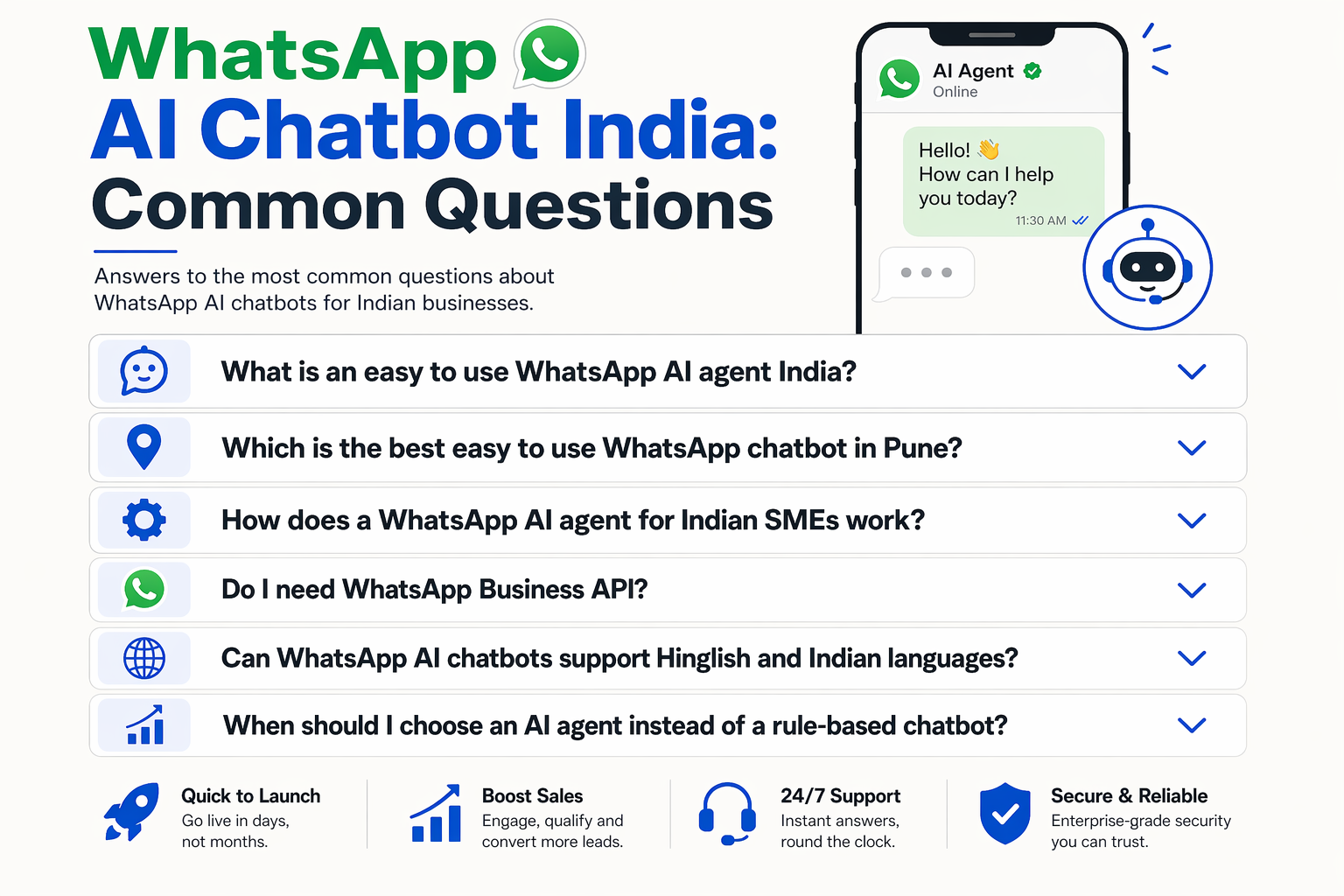
What is an easy to use WhatsApp AI agent India businesses can start with?
How is a WhatsApp AI Chatbot India solution different from a rule-based WhatsApp chatbot?
Which is the best easy to use WhatsApp chatbot in Pune for clinics, coaching classes, and local services?
What should I check before choosing a WhatsApp AI agent for Indian SMEs?
Is WhatsApp automation useful for Mumbai, Bangalore, Chennai, Delhi, Hyderabad, and non-metro businesses?
Is 2026 the right time to adopt WhatsApp AI Chatbot India tools for small business growth?
Conclusion
For Indian SMEs, choosing a WhatsApp AI chatbot India solution starts with the operating model. Meta’s native Business AI offers simpler, WhatsApp-led assistance, while third-party tools built on the WhatsApp Business Platform provide greater control over workflows, integrations, analytics, and specialised agents.
Key takeaways:
- A WhatsApp AI chatbot India buyer should test Hindi, English, Hinglish, and relevant regional languages using real customer messages—not scripted demos alone.
- Before launching a WhatsApp AI chatbot India workflow, obtain appropriate customer consent and use approved message templates where WhatsApp requires them.
- The right WhatsApp AI chatbot India setup should connect with your CRM, calendar, catalogue, or help desk so conversations lead to useful action.
- Every WhatsApp AI chatbot India deployment should support voice or human handoff when a request is sensitive, complex, or high-value.
- Roll out your WhatsApp AI chatbot India programme in phases, measuring response quality, resolution rates, bookings, qualified leads, opt-outs, and escalation patterns before expanding automation.
The best approach is usually hybrid: automate routine enquiries while keeping people available when judgement and empathy matter. To explore multilingual chatbots and AI voice agents, visit CallMissed.
Related Reading
Discussion
Related Posts
Ready to automate customer conversations?
Launch AI voice agents and WhatsApp bots with CallMissed — one API, 22+ Indian languages.