
IVR Software in India: Easy Omnichannel CRM Guide for SMBs, SMEs and Startups


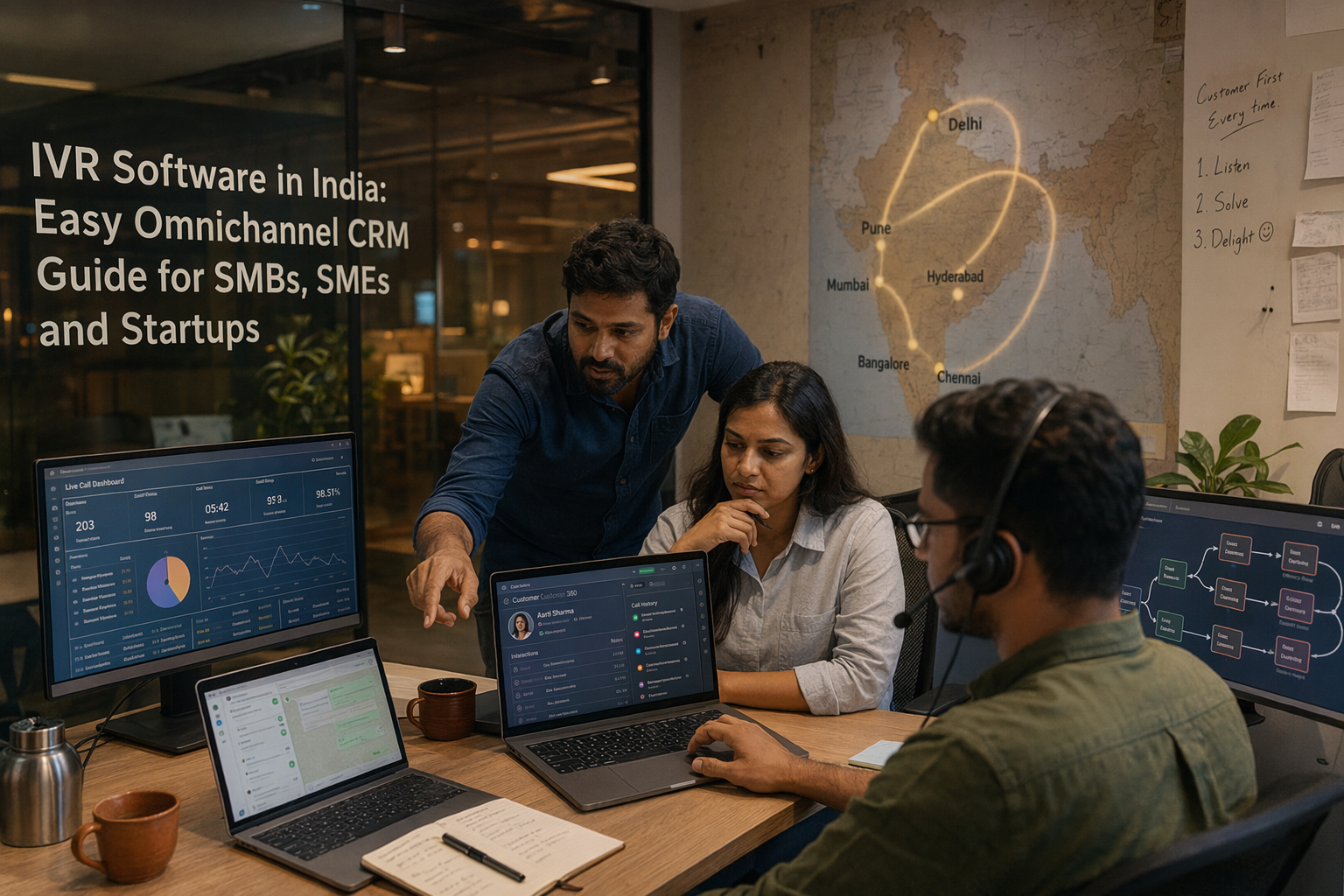
Compare IVR Software in India with omnichannel CRM workflows for WhatsApp, calls, lead tracking and support across Indian SMBs.
IVR Software in India: Easy Omnichannel CRM Guide for SMBs, SMEs and Startups
What if your next best customer is not filling a website form—but calling, sending a WhatsApp message, or giving a missed call after seeing your ad? That is why IVR Software in India can no longer be treated as a standalone “press 1 for sales” tool; in 2026, Indian SMBs, SMEs and startups need an easy omnichannel CRM layer that connects calls, WhatsApp, missed-call capture, lead tracking, support history and follow-ups in one workflow.
This matters right now because Indian buyers do not move in a neat, single-channel funnel. A Pune coaching institute may get enquiries on WhatsApp, a Mumbai real estate team may receive high-volume inbound calls, a Bangalore SaaS startup may need CRM handoffs from website chat, and a Bharat-first D2C brand may depend on regional-language voice support. At the same time, the 2026 CRM market in India is getting crowded: current comparison guides from Groweon, LeadNXT, Wortal and WeekMate focus heavily on affordability, AI features, pricing, integrations, automation and ease of use for small businesses. Zoho’s own CRM page says it is “trusted by over 300000 businesses,” showing how mainstream CRM adoption has become—but many Indian teams still struggle when CRM data, IVR routing and WhatsApp conversations sit in separate tools.
This guide simplifies that decision. Instead of treating CRM, IVR and WhatsApp inbox software as three disconnected purchases, we will map them as one practical customer communication stack for India. You will learn:
- How easy to use IVR software India search intent differs from generic call-center software
- When an SMB needs IVR menus, call routing, missed-call capture and call logs
- Why an easy to use omnichannel CRM India setup should include WhatsApp, calls, email, web enquiries and support history
- How businesses in Pune, Mumbai, Bangalore, Chennai, Delhi, Hyderabad and non-metro India should think about local customer behaviour
- What to compare in vendors: dashboards, routing, CRM integrations, call volumes, WhatsApp workflows, lead ownership and pricing
- Where AI voice agents and regional-language automation fit into the 2026 stack
Platforms such as CallMissed are part of this broader shift, especially for Indian businesses that want WhatsApp-native engagement, AI voice workflows and support for 22 Indian languages without stitching together too many tools.
By the end, you will have a clear, vendor-neutral framework to choose the right omnichannel CRM and IVR setup—whether you are a five-person startup, a growing SME, or a multi-city Indian business handling thousands of conversations every month.
Introduction: Why Indian SMBs Need One Easy Customer Communication Stack

Customers in India do not follow one channel
For Indian SMBs, SMEs and startups, customer communication rarely begins and ends in a CRM form. A buyer may discover you through Instagram, send a WhatsApp message, call your sales number, give a missed call, ask for pricing on email, and then expect support history to be available when they call again. If these interactions sit in different tools, teams lose context—and leads leak.
That is why the search for easy to use IVR software India is increasingly connected to the search for an easy to use omnichannel CRM India solution. IVR alone can route calls. CRM alone can store leads. WhatsApp inbox software alone can manage chats. But Indian businesses need these pieces to work together as one customer communication stack.
Why “easy” matters for Indian SMB adoption
The 2026 CRM market in India is full of choice, but SMBs are not just comparing long feature lists. Current Indian CRM guides from Groweon, LeadNXT, Wortal and WeekMate repeatedly highlight practical buying factors such as:
- Affordability for small businesses
- AI features such as lead scoring and automation
- Pricing transparency
- Integrations with existing sales and support tools
- Ease of use for non-technical teams
- Automation for follow-ups, reminders and routing
Zoho’s CRM page says it is “trusted by over 300000 businesses,” which shows that CRM adoption is now mainstream. But adoption does not automatically mean simplicity. A small real estate team in Mumbai, a clinic in Pune or a coaching institute in Delhi may still struggle if their CRM, IVR, call logs and WhatsApp conversations are disconnected.
For Indian SMBs, “easy to use” usually means:
- Fast setup without a large IT team
- Simple dashboards for owners, sales teams and support staff
- Automatic lead capture from calls, WhatsApp and web forms
- Clear ownership of every enquiry
- Follow-up reminders so hot leads do not go cold
- Call and chat history visible in one customer profile
The new stack: CRM + IVR + WhatsApp + AI
A modern Indian customer communication stack should bring together four core layers:
- CRM: Stores leads, contacts, deal stages, support tickets and customer history
- IVR: Routes inbound calls, manages menus, records call activity and handles peak volumes
- WhatsApp workflows: Supports chat, notifications, campaigns and customer replies
- AI automation: Handles repetitive queries, summarizes conversations and supports voice/chat automation
This is especially important in India because customer behaviour varies by region, industry and language. A Bangalore SaaS startup may prioritize website chat and CRM handoffs. A Pune training institute may need WhatsApp follow-ups after missed calls. A Bharat-first D2C brand may need voice support in regional languages. Platforms such as CallMissed reflect this broader shift by combining WhatsApp-native engagement, AI voice workflows and support for 22 Indian languages in a communication-first setup.
Why this guide combines CRM and IVR search intent
Most buyers do not wake up asking for an “omnichannel architecture.” They search for practical terms like best IVR service providers in India, easy to use IVR software in Pune, or easy to use omnichannel CRM for Indian SMEs. But the real business requirement is broader: capture every enquiry, route it to the right person, maintain context, and follow up on time.
This guide will help you evaluate that full stack—without forcing CRM, IVR and WhatsApp into separate decisions.
Background & Context: From Standalone CRM to WhatsApp, Calls, Missed Calls and Cloud IVR
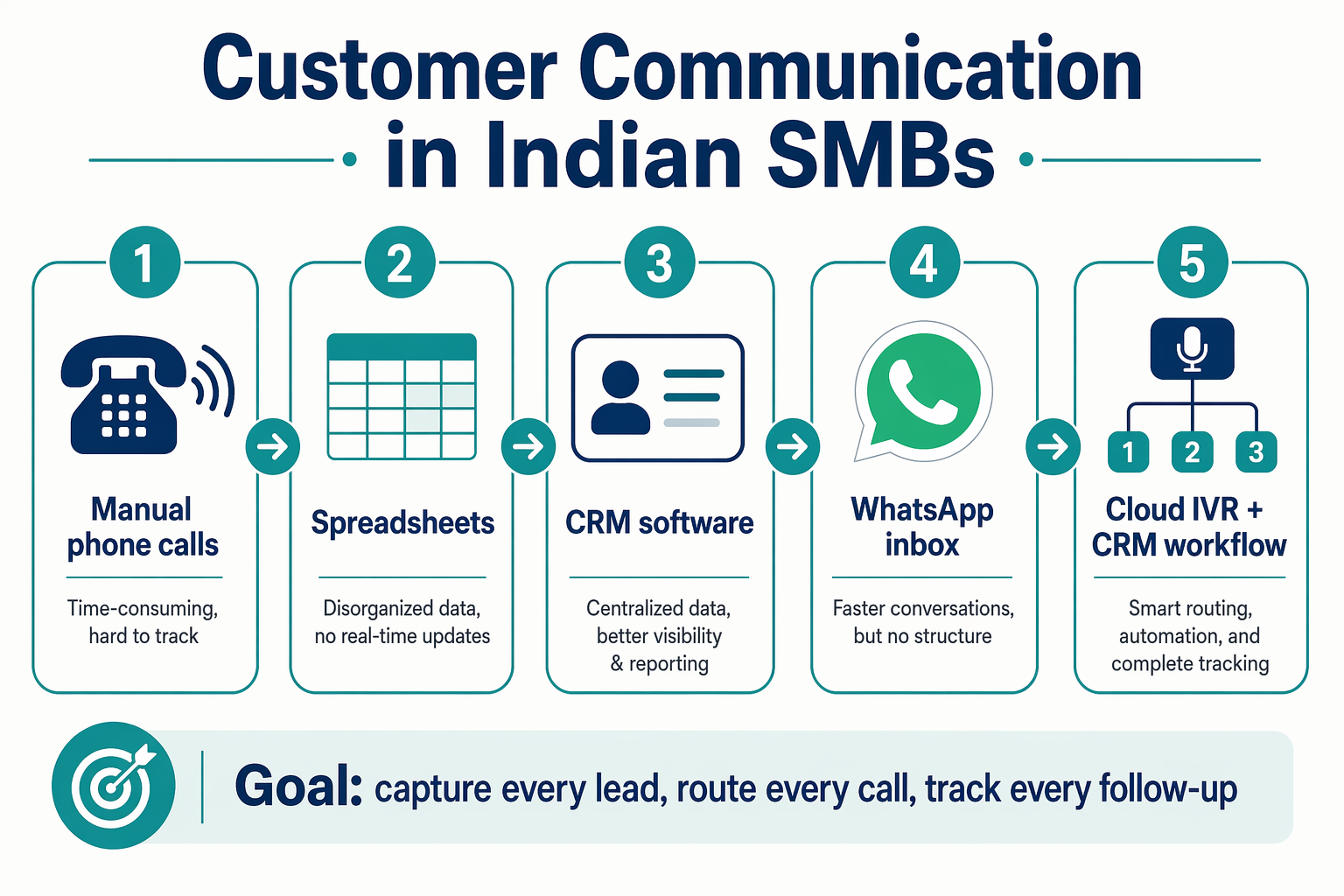
The old model: CRM as a digital address book
For many Indian SMBs, the first “CRM” was not a full customer engagement system. It was often:
- An Excel sheet with lead names and phone numbers
- A salesperson’s mobile call history
- A shared Gmail inbox
- A WhatsApp Business app on the owner’s phone
- A basic CRM used only after a lead was manually entered
This worked when enquiry volume was low. But once a business starts receiving calls from Google Ads, WhatsApp messages from Instagram, missed calls from print campaigns, and repeat support queries from existing customers, a standalone CRM becomes too passive. It stores data, but it does not always capture, route, respond and follow up across channels.
That is why 2026 CRM comparisons in India increasingly highlight automation, integrations, affordability, AI features and ease of use. Groweon’s 2026 CRM guide focuses on “features & pricing,” LeadNXT compares CRM options for small businesses with AI-powered lead scoring, and Wortal lists 15 CRM software options in India for small businesses in 2026. The market has clearly moved beyond “contact management” into workflow-driven customer communication.
Why calls and missed calls still matter in India
In India, voice remains a high-intent channel. A customer who calls your business usually wants a fast answer: pricing, availability, appointment slots, delivery status, loan eligibility, admission details or complaint resolution.
Missed calls are equally important because they are common in cost-sensitive and mobile-first markets. A missed call may mean:
- The customer wants a callback but does not want to spend talk time
- The sales team was busy and could not answer
- The caller dropped before IVR routing completed
- A campaign number generated interest outside office hours
- A non-metro customer preferred voice over typing
If these missed calls are not logged into a CRM, they become invisible lost leads. This is where cloud IVR software becomes more than a call menu. It helps businesses create structured call flows, capture caller IDs, assign leads, record call outcomes and connect phone activity with sales or support history.
WhatsApp changed the CRM expectation
WhatsApp has become a default business communication layer for Indian customers. A buyer may ask for a catalogue on WhatsApp, negotiate pricing over chat, request a callback, and later raise a support issue from the same number.
That creates a new expectation: the CRM should understand the customer across chat + call + follow-up, not just store a lead record. For example:
- A Pune coaching institute may receive a missed call, then send course details on WhatsApp
- A Mumbai real estate broker may route inbound calls by project location
- A Bangalore startup may qualify website leads and continue the conversation on email or WhatsApp
- A Chennai clinic may use IVR to separate appointments, reports and billing queries
- A Bharat-focused brand may need voice support in regional languages
This is why “easy to use omnichannel CRM India” is a different search intent from generic CRM software. The buyer is not only asking, “Where do I store leads?” They are asking, “How do I manage every customer conversation without losing context?”
Cloud IVR became part of the CRM stack
Traditional IVR was often associated with large call centers. In 2026, Indian SMBs and SMEs need lighter, cloud-based versions that are easier to deploy and manage. Instead of buying telecom hardware, teams look for dashboards, call routing, call logs, CRM integrations and campaign tracking.
Modern IVR fits into the communication stack in four layers:
- Capture: inbound calls, missed calls, campaign numbers and after-hours enquiries
- Route: sales, support, billing, location-wise teams or language-specific agents
- Contextualize: link call history with CRM notes, WhatsApp chats and lead status
- Automate: trigger callbacks, reminders, WhatsApp messages or AI voice responses
Platforms such as CallMissed reflect this broader shift by combining WhatsApp-native engagement, voice workflows and AI communication features, including support for 22 Indian languages—a practical requirement for teams serving both metro and Bharat customers.
The new context: one customer, many touchpoints
Zoho’s CRM page says it is trusted by over 300,000 businesses, showing how mainstream CRM adoption has become in India. But adoption alone does not solve fragmentation. A CRM without calls misses voice intent. IVR without CRM loses lead ownership. WhatsApp without shared history creates dependency on individual phones.
The new Indian SMB stack is therefore not “CRM versus IVR.” It is:
- CRM for customer records and pipeline
- IVR for call capture and routing
- WhatsApp inbox for conversational follow-up
- Automation for reminders, callbacks and qualification
- Analytics for source, response time and conversion tracking
That background is essential before comparing vendors, because the best-fit solution is not always the one with the longest feature list. It is the one your team can actually use every day across calls, WhatsApp, missed calls and CRM follow-ups.
Key Developments in CRM and IVR Software in India
The 2026 shift: CRM + IVR are converging
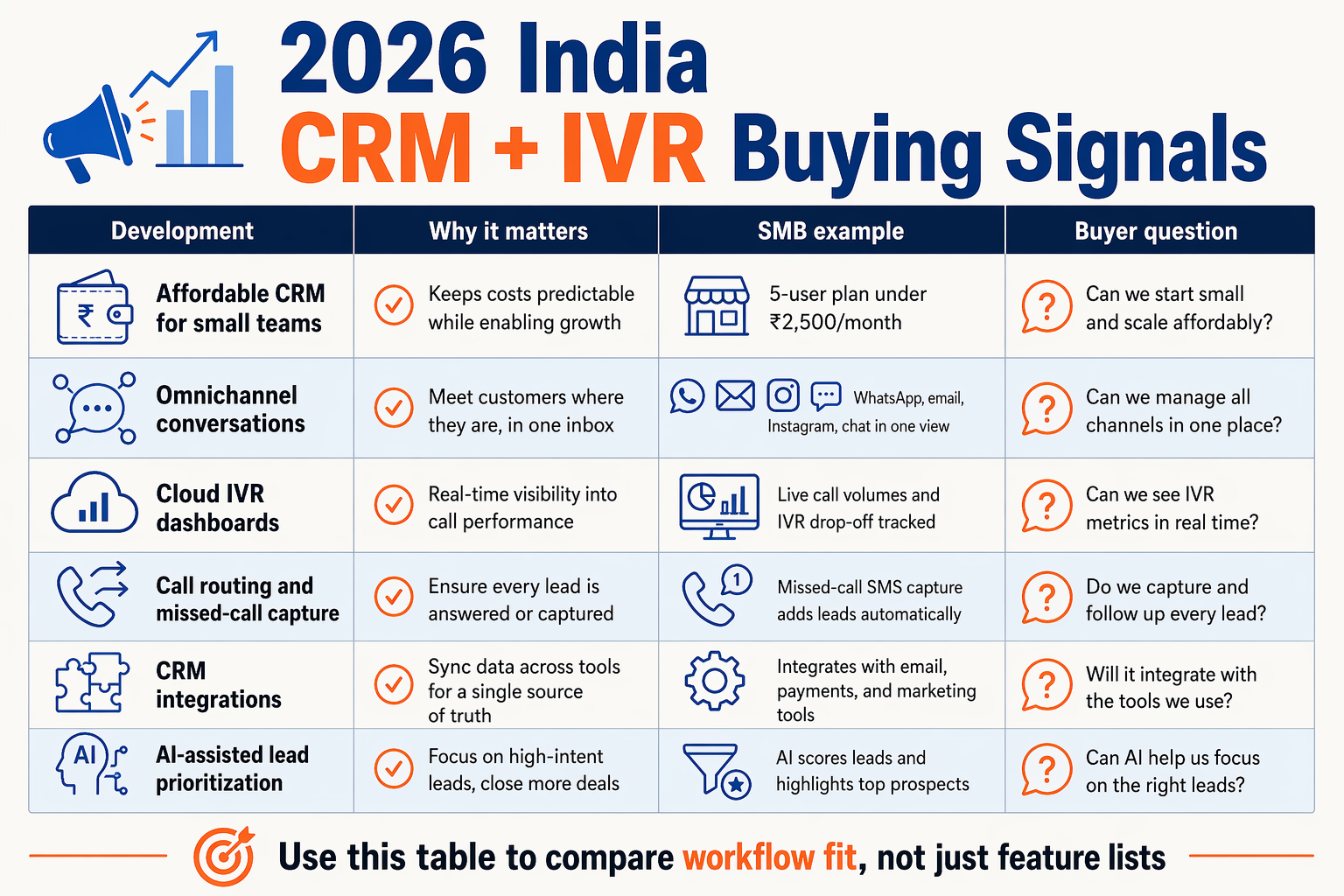
The biggest development in CRM and IVR software in India is that buyers no longer want separate tools for sales records, call routing, WhatsApp chats and support tickets. For Indian SMBs, the practical requirement is now a single customer communication stack: cloud IVR for inbound calls, CRM for lead ownership, WhatsApp for fast follow-ups, and automation for reminders, routing and reporting.
This is visible in 2026 CRM research. Groweon’s 2026 CRM guide highlights AI, pricing, features and integrations as key comparison factors. LeadNXT’s 2026 small-business CRM guide calls out AI-powered lead scoring, while Wortal’s 2026 list focuses on CRM options for small businesses in India. WeekMate’s 2026 comparison specifically names affordability, automation and ease of use as priorities for small businesses. Zoho’s India CRM page also says it is “trusted by over 300000 businesses,” showing that CRM adoption has moved from enterprise-only to mainstream.
| Key development | What changed in India | Evidence from 2026 context | Impact on SMBs/SMEs | What to evaluate |
|---|---|---|---|---|
| CRM adoption is mainstream | CRM is no longer just for large sales teams; small businesses now compare CRM actively | Zoho says its CRM is “trusted by over 300000 businesses” | Even 5–20 person teams need structured lead tracking and follow-ups | Ease of setup, mobile app, pipeline visibility, user permissions |
| AI features are now expected | CRM buyers look for AI lead scoring, automation and assistant-style workflows | LeadNXT’s 2026 guide references AI-powered lead scoring | Teams can prioritize hot leads instead of manually checking every enquiry | Lead scoring, auto-assignment, summaries, follow-up reminders |
| Affordability matters more | Indian SMBs compare price, value and pay-as-you-grow plans | WeekMate’s 2026 guide highlights affordability, automation and ease of use | Startups and local businesses avoid heavy enterprise contracts | Per-user pricing, call charges, WhatsApp costs, hidden setup fees |
| Cloud IVR is replacing legacy PBX | IVR now means dashboards, routing, call logs, call volumes and CRM integrations | Operator research notes IVR providers emphasize dashboards, call volumes, routing, cloud IVR and CRM integrations | Owners can monitor missed calls, agent performance and enquiry sources remotely | Call routing rules, missed-call alerts, reports, uptime, call recording |
| WhatsApp is becoming operational | WhatsApp is moving beyond informal chat into lead capture, support and sales workflows | 2026 CRM comparisons increasingly emphasize omnichannel communication and integrations | Sales teams need WhatsApp history inside the CRM, not scattered across phones | Shared inbox, templates, CRM sync, opt-ins, agent assignment |
| Regional voice automation is rising | Businesses serving Bharat need multilingual voice and speech workflows | Indian platforms such as CallMissed support STT and TTS across 22 Indian languages | Education, healthcare, finance, retail and local services can serve non-English callers better | Language coverage, call quality, escalation to humans, knowledge-base accuracy |
Why this matters for Indian city and regional markets
The same stack behaves differently by location. A Pune coaching institute may need missed-call capture from offline ads, a Mumbai real estate team may need high-volume inbound routing, and a Bangalore startup may care more about API integrations and CRM handoffs. In Chennai, Delhi and Hyderabad, multilingual support, WhatsApp follow-ups and sales-team accountability often become the deciding factors.
For Bharat and non-metro businesses, the change is even more important:
- Voice remains critical where customers prefer calling over filling forms.
- WhatsApp is often the default follow-up channel after a call or enquiry.
- Regional languages improve accessibility, especially in sectors like lending, healthcare, education and local commerce.
- Missed-call workflows still matter because many customers signal interest without completing a full conversation.
The practical takeaway: when evaluating easy to use IVR software India or an easy to use omnichannel CRM India, do not shortlist tools only by feature count. Shortlist them by whether they connect the customer journey end to end: call received, lead created, WhatsApp follow-up sent, owner assigned, history stored, and next action visible.
Omnichannel CRM vs IVR vs WhatsApp Inbox: What Each Tool Does
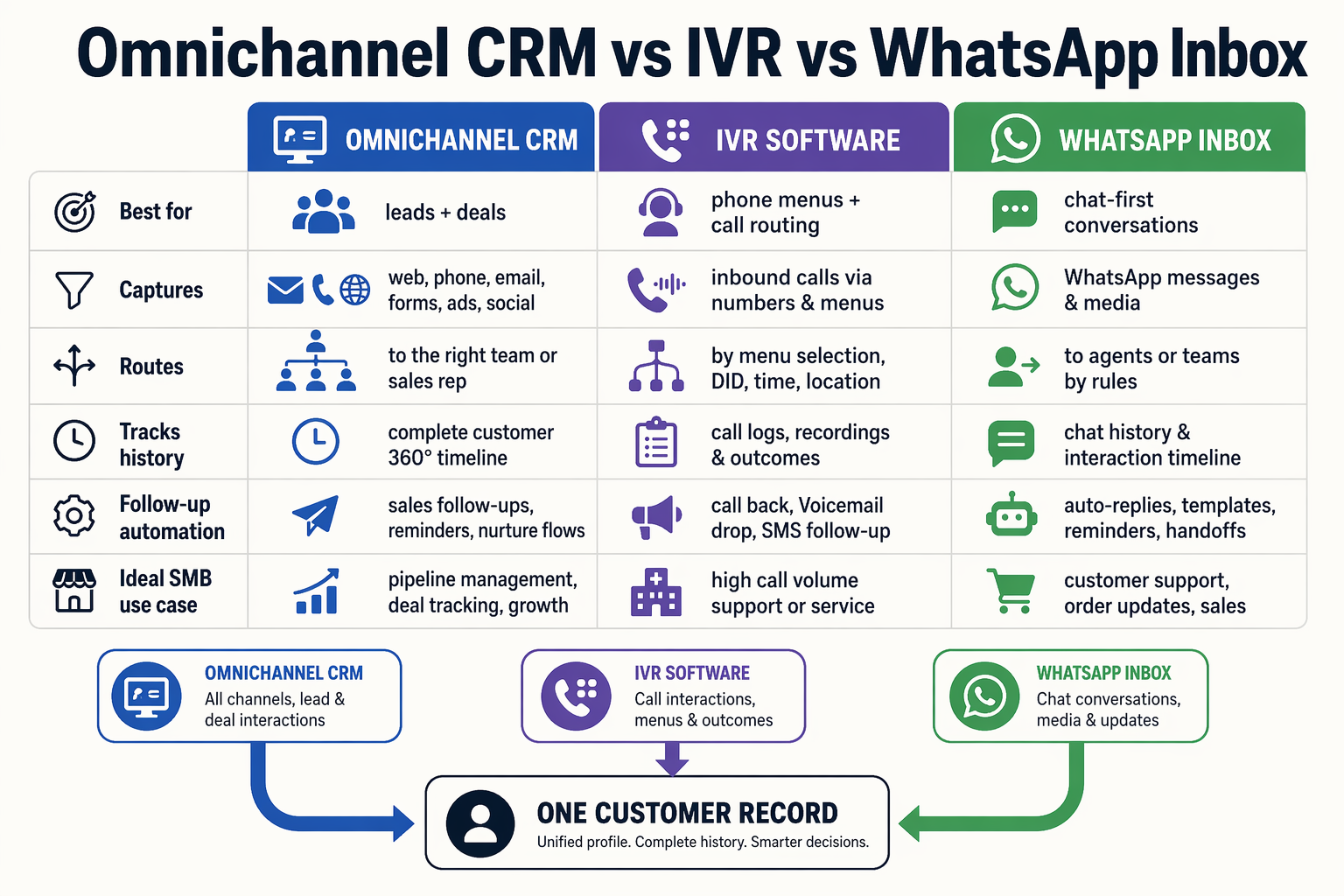
Think of them as layers, not substitutes
For an Indian SMB, CRM, IVR and WhatsApp inbox software solve different parts of the same customer journey. The mistake is buying one tool and expecting it to handle everything. A CRM tracks relationships and revenue. IVR manages structured phone traffic. A WhatsApp inbox captures fast, conversational buying intent.
This distinction matters because 2026 CRM comparison guides in India—such as Groweon, LeadNXT, Wortal and WeekMate—consistently highlight affordability, AI features, pricing, integrations, automation and ease of use as buying criteria for small businesses. Zoho’s CRM page also says it is “trusted by over 300000 businesses,” which shows how mainstream CRM adoption has become. But adoption alone does not solve the communication gap unless calls and WhatsApp conversations flow into the same customer record.
| Tool | What it does best | Best for Indian SMB use cases | Key limitation if used alone | What to integrate |
|---|---|---|---|---|
| Omnichannel CRM | Stores leads, contacts, tasks, deals, support history and follow-ups across channels | Sales teams, service businesses, SMEs with repeat customers, multi-city teams | Becomes a passive database if calls and WhatsApp are not logged automatically | IVR, WhatsApp inbox, email, website forms, campaign tools |
| IVR Software | Routes inbound calls using menus, departments, business hours and call queues | Clinics, coaching centres, real estate, logistics, local services, high-call-volume teams | Captures calls but may not show full customer context or buying stage | CRM, call recording, missed-call alerts, agent assignment |
| WhatsApp Inbox | Centralises WhatsApp chats, templates, customer replies and agent handoffs | D2C brands, education, travel, support, appointment-led businesses | Conversations can become scattered if not tied to leads, deals or tickets | CRM, chatbot, payment links, voice calling, support workflows |
| Missed-Call Capture | Turns unanswered calls into leads with callback tasks and notifications | India-first lead generation, offline ads, hyperlocal campaigns, Bharat audiences | Does not manage full sales pipeline unless linked to CRM | IVR, CRM lead creation, SMS/WhatsApp callback flows |
| AI Voice Agent / Bot Layer | Automates FAQs, lead qualification, reminders and simple support conversations | After-hours support, regional-language enquiries, appointment booking, order status | Needs a knowledge base and human escalation path for complex cases | CRM, IVR, WhatsApp, knowledge base, ticketing |
Where each tool fits in the customer journey
A practical Indian customer communication stack usually works like this:
- Discovery: Customer sees an ad, hoarding, Google listing or social post.
- First contact: They call, WhatsApp, submit a form or give a missed call.
- Routing: IVR sends the call to sales, support, billing or location-specific teams.
- Conversation: WhatsApp inbox or voice agent handles FAQs, documents and follow-ups.
- CRM record: Lead source, call log, chat history, owner and next action are stored.
- Conversion: Sales or support team follows up with context instead of asking the customer to repeat everything.
This is why easy to use IVR software India and easy to use omnichannel CRM India should not be evaluated separately. A Pune coaching centre, for example, may need IVR for admission enquiries, WhatsApp for brochure sharing, and CRM tasks for counsellor follow-up. If these sit in three disconnected dashboards, the team loses speed and accountability.
The simplest buying rule
Use this rule before comparing vendors:
- If your biggest problem is lost leads and poor follow-up, start with an omnichannel CRM.
- If your biggest problem is too many incoming calls, start with cloud IVR.
- If your biggest problem is WhatsApp chaos across employee phones, start with a shared WhatsApp inbox.
- If you have all three problems, choose a stack where these tools are already connected or easy to integrate.
Platforms such as CallMissed reflect this converged direction by combining WhatsApp-native workflows, voice automation and CRM-style engagement in one environment—useful for Indian teams that want fewer disconnected tools while still supporting call-heavy and chat-heavy customers.
In-Depth Analysis: Connect Calls, IVR and CRM Follow-Ups in One Workflow
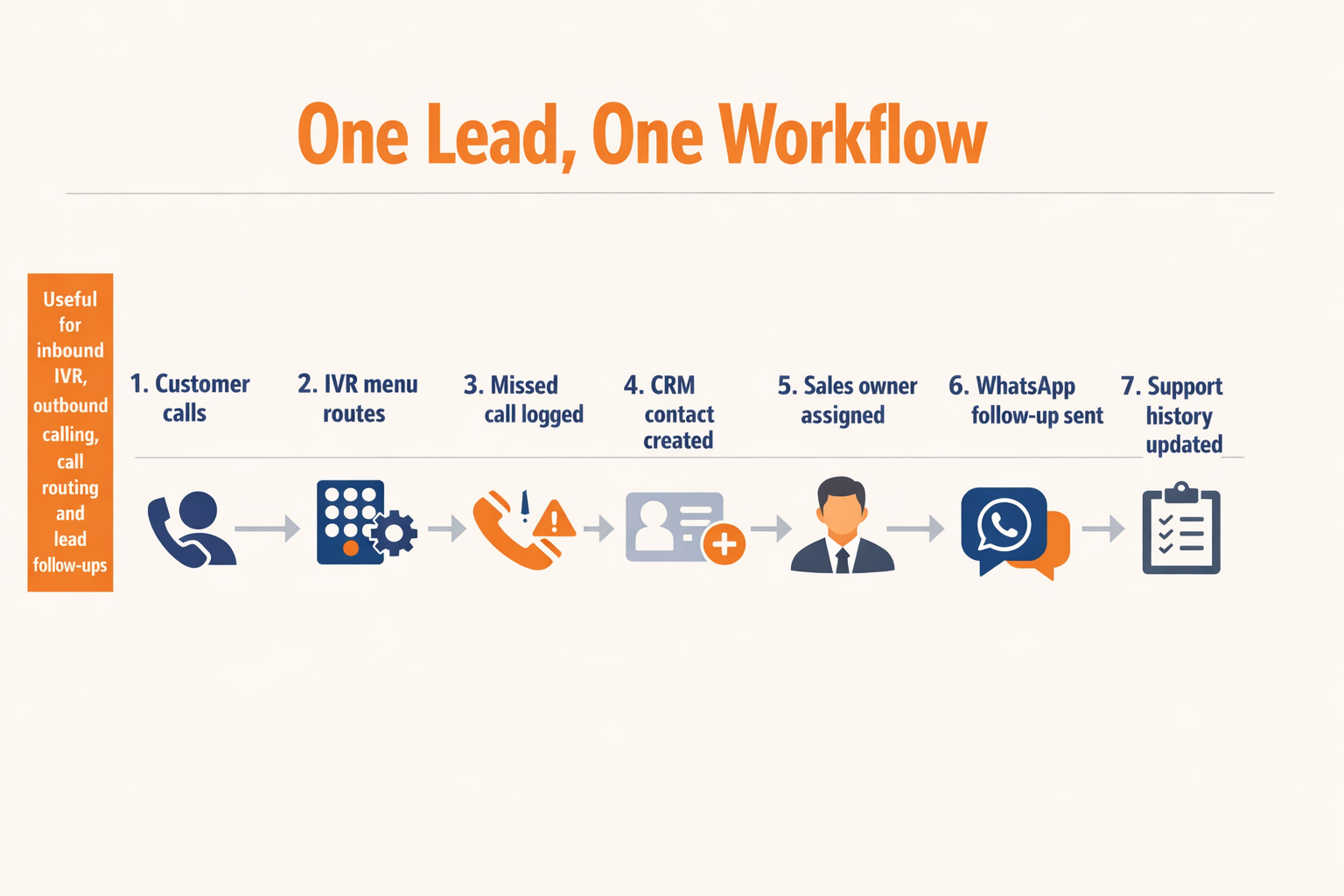
The workflow problem: conversations are easy, handoffs are hard
For most Indian SMBs, the issue is not “no leads.” The issue is that leads arrive through calls, IVR menus, WhatsApp, missed calls, web forms and walk-in enquiries, but the follow-up process depends on memory, spreadsheets or disconnected apps. That creates three common failures:
- A sales call is answered, but the CRM record is not updated
- A missed call is captured, but no one assigns ownership
- A WhatsApp conversation happens, but the support team cannot see previous call history
This is why 2026 CRM comparison guides in India—such as Groweon, LeadNXT, Wortal and WeekMate—keep emphasizing affordability, automation, AI features, integrations and ease of use for small businesses. The market has matured: Zoho CRM says it is “trusted by over 300000 businesses,” which shows CRM adoption is mainstream. But CRM alone is not enough if it does not connect to the actual communication channels Indian customers use.
What a connected IVR-to-CRM workflow should do
A practical easy to use IVR software India setup should not stop at routing calls. It should convert every interaction into a trackable customer event.
A strong workflow usually looks like this:
- Customer calls your business number
The IVR greets the caller and routes them by intent: sales, support, billing, appointment, delivery, admissions or service request.
- Caller identity is matched or created
If the number exists, the CRM opens the previous record. If it is new, a lead is created automatically with source, city, time and call status.
- Agent or AI handles the first response
The call may go to a human agent, a department queue, voicemail, callback flow or an AI voice agent depending on business hours and urgency.
- Outcome is logged in the CRM
Call answered, missed, abandoned, transferred, converted, escalated or pending callback should be visible without manual data entry.
- Follow-up is triggered automatically
The system can send a WhatsApp message, assign a task, create a ticket, schedule a callback or move the lead to a campaign.
This is the difference between “having IVR” and having a customer communication workflow.
Why this matters for Indian sales and support teams
In India, call intent is often high. A buyer who calls a coaching centre in Pune, a real estate broker in Mumbai or a clinic in Chennai usually expects a fast answer. If the business misses that moment, the customer may contact the next provider.
For SMEs and startups, connected workflows help teams:
- Reduce lead leakage from missed calls and unanswered enquiries
- Track ownership across sales, support and operations
- See full customer history before calling back
- Prioritize hot leads based on call behaviour and repeat enquiries
- Measure campaign performance by phone number, WhatsApp source or location
This is especially important when marketing spend is fragmented across Google Ads, Meta ads, Justdial listings, local SEO pages, referral campaigns and offline boards. Without CRM-connected IVR, the team may know calls are coming—but not which campaign, location or salesperson is driving revenue.
Where WhatsApp fits into the same flow
For Indian customers, the next step after a call is often WhatsApp, not email. A caller may ask for a brochure, fee structure, product catalogue, appointment confirmation, invoice or location pin. That means IVR and CRM workflows should connect to WhatsApp follow-ups.
For example:
- Missed call → automatic WhatsApp reply → lead created in CRM
- IVR sales enquiry → agent callback task → brochure sent on WhatsApp
- Support call → ticket created → status update sent on WhatsApp
- Repeat caller → previous CRM notes shown before agent answers
Platforms such as CallMissed fit into this broader trend by combining WhatsApp-native engagement, AI voice workflows and CRM-style follow-up context for Indian businesses, including support for 22 Indian languages where regional voice and chat matter.
The key test: can your team act without switching tabs?
The best workflow is not the one with the most features; it is the one your team actually uses. Before choosing any IVR or omnichannel CRM, ask:
- Can a new lead be created automatically from a call?
- Can missed calls trigger WhatsApp or callback tasks?
- Can agents see previous conversations before responding?
- Can managers track call volume, lead status and follow-up delays?
- Can the system work for non-technical sales and support users?
If the answer is yes, your IVR becomes more than a call-routing system. It becomes the front door to your CRM, your follow-up engine and your customer experience layer.
City and Use-Case Keyword Map for Pune, Mumbai, Bangalore, Chennai, Delhi, Hyderabad and Bharat
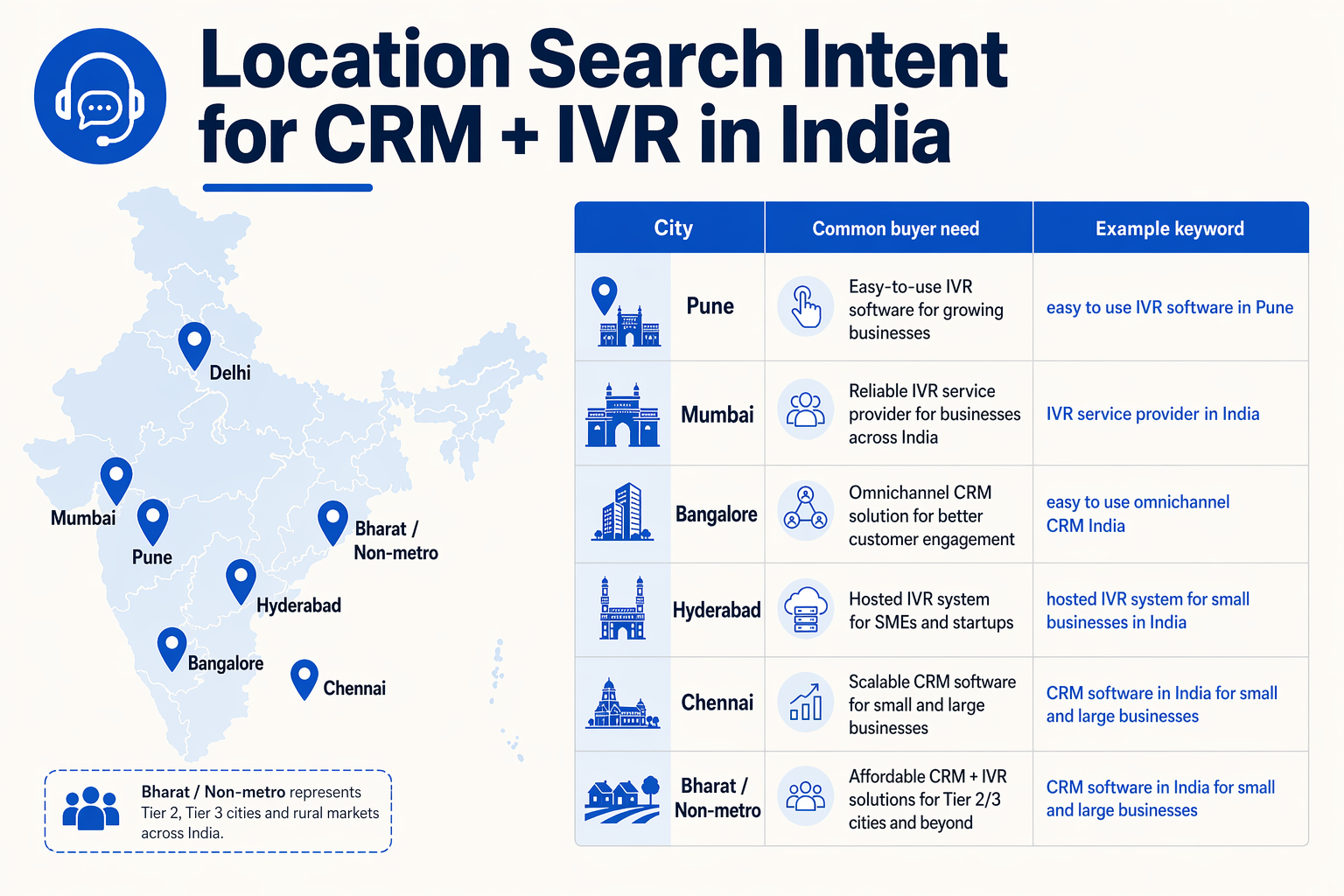
How to map city keywords to real CRM + IVR buying intent
City modifiers work best when they reflect how customers actually contact a business in that market. Someone searching “easy to use IVR software in Pune” may not want enterprise call-center software; they may run a coaching class, clinic, real estate office, logistics desk or SaaS support team that needs missed-call capture, WhatsApp follow-ups and a simple CRM view.
This is where 2026 CRM search behavior matters. Current Indian CRM comparison guides from Groweon, LeadNXT, Wortal and WeekMate repeatedly emphasize pricing, AI features, integrations, automation and ease of use for small businesses. Zoho also states that Zoho CRM is “trusted by over 300000 businesses,” which shows that CRM adoption is now mainstream—but city-level searchers still need practical, local use-case guidance.
| City / Market | High-Intent Keyword Cluster | Common SMB Use Cases | Must-Have CRM + IVR Workflow | Content Angle |
|---|---|---|---|---|
| Pune | easy to use IVR software in Pune, omnichannel CRM Pune | Coaching institutes, clinics, real estate, local services, B2B startups | IVR menu → missed-call lead capture → WhatsApp confirmation → CRM owner assignment | “Simple IVR and CRM for growing Pune SMBs” |
| Mumbai | IVR software Mumbai, CRM for sales teams Mumbai | Real estate, finance, agencies, D2C, high-volume inbound sales | Call routing by team/location → call logs → lead pipeline → WhatsApp follow-up | “Handle high call volumes without losing leads” |
| Bangalore | omnichannel CRM Bangalore, IVR for startups India | SaaS, tech startups, support teams, education platforms | Website chat/WhatsApp → CRM ticket/lead → IVR escalation → sales/support handoff | “Startup-ready CRM with voice and digital channels” |
| Chennai | IVR service provider Chennai, CRM for SMEs Chennai | Manufacturing, healthcare, logistics, B2B services | Department-wise IVR → callback scheduling → email/WhatsApp updates → support history | “Structured customer communication for operational SMEs” |
| Delhi NCR | IVR software Delhi, CRM for lead management Delhi | Education, legal, events, government-adjacent services, retail | Multi-agent call distribution → enquiry tagging → follow-up reminders → campaign tracking | “Lead tracking and routing for competitive markets” |
| Hyderabad | easy CRM Hyderabad, cloud IVR Hyderabad | Healthcare, real estate, IT services, training institutes | Cloud IVR → call recording/logs → CRM stage update → WhatsApp nurture | “Cloud-first communication stack for service businesses” |
| Bharat / Non-metro India | IVR software India, regional language CRM, WhatsApp CRM India | D2C, agriculture services, local finance, healthcare, education | Regional-language voice → missed-call capture → WhatsApp support → simple CRM timeline | “Voice-first and WhatsApp-first CRM for regional customers” |
Use the table as an SEO and product-planning map
For each location page or landing section, avoid repeating generic phrases like “best CRM software.” Instead, connect the keyword to a specific customer journey:
- Discovery: customer sees an ad, Google listing, hoarding or referral
- First contact: customer calls, sends WhatsApp, fills a form or gives a missed call
- Routing: IVR sends the enquiry to sales, support, accounts or location team
- CRM capture: lead source, phone number, conversation history and owner are logged
- Follow-up: WhatsApp, email, callback or campaign reminder is triggered
This structure helps you target both “easy to use IVR software India” and “easy to use omnichannel CRM India” without creating thin, duplicate city pages.
Bharat-first keywords need language and channel context
For non-metro businesses, the search intent is often less about advanced dashboards and more about accessibility: Can customers call easily? Can teams respond on WhatsApp? Can conversations happen in local languages? This is where India-focused platforms have an advantage when they support voice, WhatsApp and CRM together. For example, CallMissed supports Speech-to-Text and Text-to-Speech across 22 Indian languages, which is relevant for businesses serving regional audiences where English-first workflows may not be enough.
The strongest city keyword strategy is therefore not just “CRM + city.” It is city + use case + channel + outcome—for example, “IVR software in Pune for coaching enquiries” or “WhatsApp CRM in Mumbai for real estate leads.”
Impact & Implications for SMBs, SMEs and Startups
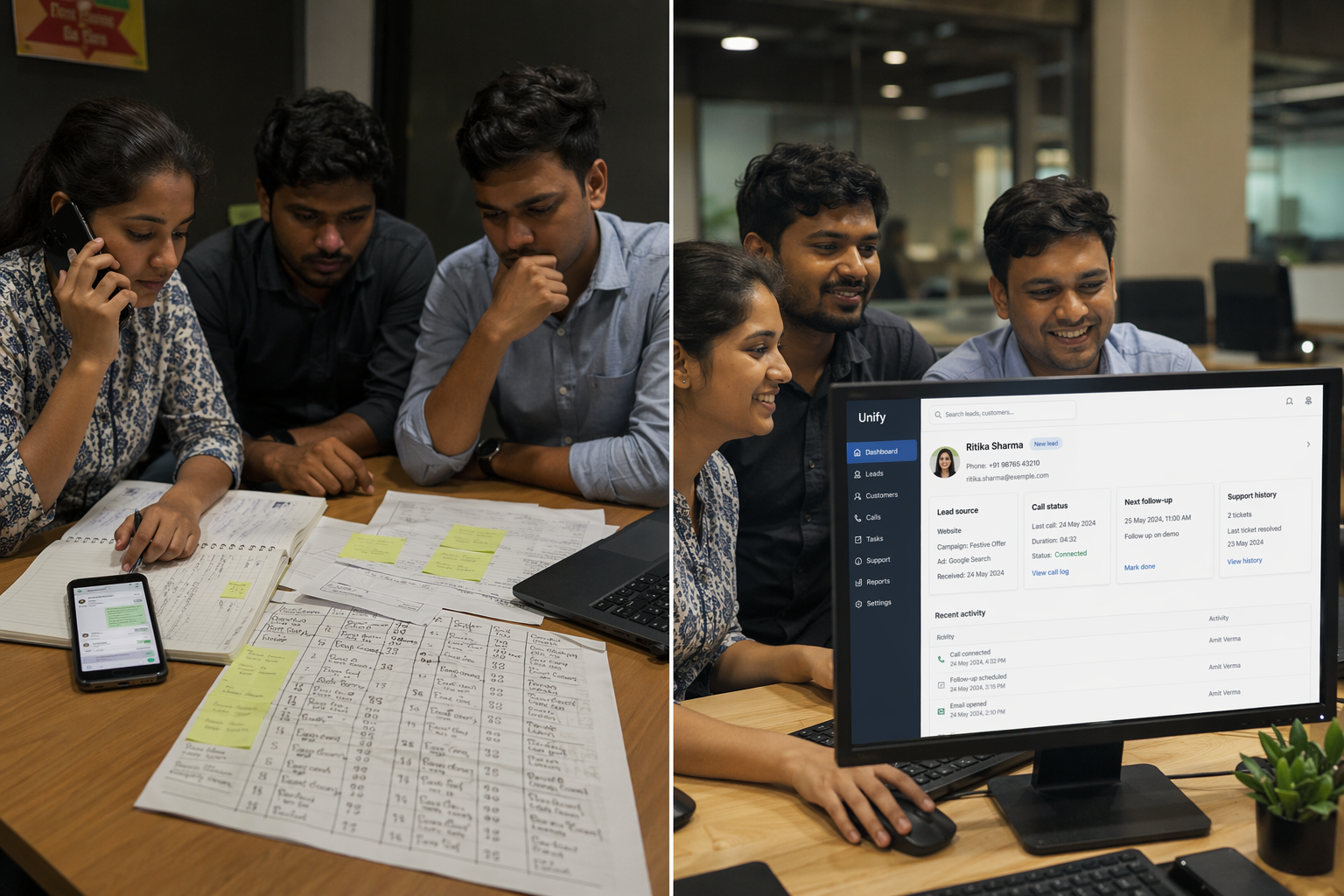
What changes when CRM, IVR and WhatsApp become one workflow
For Indian SMBs, SMEs and startups, the biggest impact of an easy omnichannel CRM + IVR stack is not “more software.” It is fewer lost enquiries, faster response times and better ownership of every customer conversation. In the 2026 CRM landscape, comparison guides from Groweon, LeadNXT, Wortal and WeekMate repeatedly highlight the same buying criteria for Indian small businesses: affordability, AI features, integrations, automation, pricing and ease of use. That tells us the market is moving away from heavy, enterprise-only CRM deployments toward practical tools that smaller teams can actually run every day.
The implication is simple: if your sales and support teams still manage calls in one system, WhatsApp in another, and lead follow-ups in spreadsheets, you are paying an operational tax. Every missed call, unassigned WhatsApp chat or unlogged support query becomes a revenue leak.
Impact on SMBs: fewer missed leads, better follow-up discipline
For SMBs, the first gain is visibility. A small business may not need a large call center, but it does need to know:
- Who called after seeing a Google ad
- Which WhatsApp enquiries are still unanswered
- Whether a sales lead was followed up today
- Which customers repeatedly call support
- Which city, product or campaign generates the most conversations
This is where easy to use IVR software in India becomes more than call routing. IVR menus, missed-call capture and CRM call logs help even a 5–20 person team behave like a more organized business. Instead of asking “Who spoke to this customer?”, the CRM timeline should show call history, WhatsApp messages, notes, lead stage and next action.
Zoho’s CRM page says it is “trusted by over 300000 businesses,” which reflects how mainstream CRM adoption has become in India. But adoption alone is not enough. SMBs need communication data to flow into the CRM automatically, not after someone manually updates a sheet at the end of the day.
Impact on SMEs: standardization across teams and cities
For SMEs operating across Pune, Mumbai, Bangalore, Chennai, Delhi, Hyderabad or tier-2 markets, the challenge is consistency. Different branches or teams often develop their own habits: one team uses WhatsApp groups, another depends on phone calls, another tracks leads in Excel.
An omnichannel CRM with IVR helps SMEs standardize:
- Lead capture: Every call, WhatsApp chat, website form or missed call creates a record.
- Routing: IVR sends sales, support, billing or regional-language queries to the right team.
- Accountability: Owners, statuses and follow-up dates are visible.
- Reporting: Managers can compare city-wise call volumes, response times and conversions.
- Customer memory: Support history travels with the customer, not with one employee’s phone.
This matters especially in high-intent sectors such as real estate, education, healthcare, logistics, finance, home services and B2B distribution, where customers often call before they fill a form.
Impact on startups: faster scaling without support chaos
Startups need speed, but customer communication breaks quickly when growth begins. A founder may manage early leads on WhatsApp, but once campaigns scale, enquiries arrive from ads, landing pages, calls, demos, referrals and support tickets.
For startups, the implication is to build the communication stack early enough that growth does not create chaos. Look for:
- Cloud IVR that can scale call handling without physical PBX hardware
- CRM integrations that connect lead source, call logs and deal stages
- WhatsApp workflows for reminders, confirmations and support updates
- AI assistance for first response, classification, summaries and follow-ups
- Regional language readiness for Bharat-focused expansion
Platforms such as CallMissed fit into this broader shift by combining AI voice agents, WhatsApp-native workflows and support for 22 Indian languages, which is particularly relevant for startups selling beyond English-first urban audiences.
The strategic implication: communication is now growth infrastructure
The real lesson for Indian businesses in 2026 is that CRM and IVR are no longer back-office tools. They are growth infrastructure. The best stack is not necessarily the most complex; it is the one your team can use consistently.
For SMBs, that means capturing every enquiry. For SMEs, it means standardizing customer communication across people and locations. For startups, it means building a scalable system before volume overwhelms the team. In all three cases, an easy to use omnichannel CRM India setup connected with IVR, WhatsApp and call history can turn fragmented conversations into measurable pipeline.
Expert Opinions: How to Evaluate Ease of Use, Routing, Dashboards and Integrations
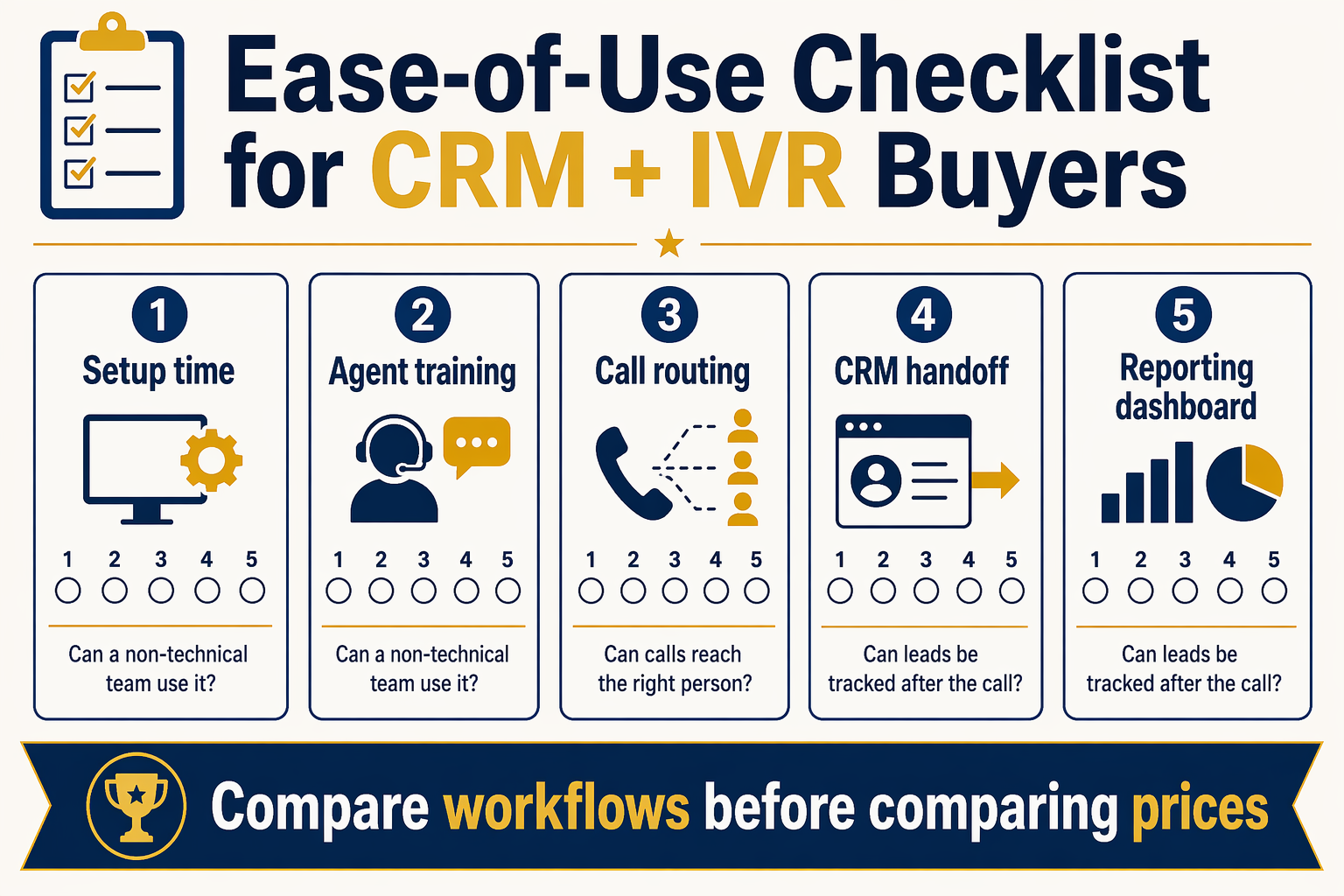
Start with adoption, not feature count
Experts evaluating easy to use omnichannel CRM India platforms generally look beyond long feature lists. A CRM or IVR tool is only useful if sales, support and operations teams actually use it every day. That is why 2026 comparison guides for Indian SMBs repeatedly highlight affordability, automation, ease of use, AI features, pricing and integrations rather than enterprise-only complexity. WeekMate’s 2026 CRM guide, for example, calls out platforms that offer “affordability, automation, and ease of use,” while LeadNXT’s 2026 small-business CRM research mentions AI-powered lead scoring as a key selection factor.
A practical expert checklist should begin with four questions:
- Can a new salesperson understand the dashboard in one day?
- Can managers see missed calls, WhatsApp chats, leads and follow-ups together?
- Can call routing be changed without developer support?
- Can the tool integrate with the CRM, website forms, email and WhatsApp workflows already in use?
If the answer is no, the system may look powerful in a demo but fail in daily execution.
Ease of use: test real workflows, not demo screens
For Indian SMBs in Pune, Mumbai, Bangalore, Chennai, Delhi and Hyderabad, ease of use should be tested with live business scenarios. Do not only ask, “Does the software have a CRM?” Ask whether your team can complete these actions quickly:
- Create a new lead from an inbound call
- Assign a WhatsApp enquiry to the right salesperson
- View previous conversations before calling back
- Add notes after a customer-support call
- Trigger follow-ups for missed calls or abandoned enquiries
- Filter leads by city, source, product, agent or status
This matters because CRM adoption is already mainstream. Zoho says its CRM is “trusted by over 300000 businesses,” which shows how crowded and mature the category has become. The differentiator for an Indian SME is not whether CRM exists—it is whether the CRM fits your team’s speed, language, channel mix and follow-up discipline.
Routing: judge flexibility and business control
For easy to use IVR software India searches, routing is usually the make-or-break feature. A good IVR setup should let a business route calls by:
- Department: sales, support, billing, renewals
- Location: Pune branch, Mumbai office, Delhi NCR team
- Time: business hours, after-hours, holidays
- Customer type: new lead, existing customer, VIP account
- Language preference: Hindi, English, Marathi, Tamil, Telugu or other regional languages
Experts recommend checking whether routing changes can be handled by an admin user, not only by the vendor’s technical team. For example, a coaching institute in Pune may need to route admissions calls differently during exam season, while a D2C brand may need after-hours support during festive campaigns.
This is where AI voice workflows are becoming relevant. Platforms such as CallMissed reflect the industry shift toward voice plus WhatsApp plus CRM workflows, including support for 22 Indian languages, which is useful for Bharat-first businesses handling regional customer conversations.
Dashboards: focus on decisions, not vanity metrics
A useful dashboard should help managers answer operational questions in minutes:
- How many calls were missed today?
- Which channel generated the most qualified leads?
- Which agent has pending follow-ups?
- What is the average first-response time?
- How many WhatsApp enquiries became CRM opportunities?
- Which campaign generated calls but poor conversions?
IVR dashboards should show call volume, missed-call trends, call recordings, agent performance and peak-hour traffic. CRM dashboards should show lead stage, owner, source, conversion rate and support history. Omnichannel dashboards should connect both views so managers do not need five browser tabs to understand one customer journey.
Integrations: avoid creating another silo
Finally, experts recommend testing integrations before signing an annual contract. The system should connect with your existing stack: CRM, WhatsApp Business, email, website forms, ad campaigns, payment tools, support desk and analytics.
Use this quick evaluation rule:
- Must-have integrations: CRM, WhatsApp, call logs, lead forms, email
- Growth integrations: marketing automation, payment links, helpdesk, analytics
- Advanced integrations: AI voice agents, knowledge-base search, developer APIs, webhooks
The right choice is not always the most feature-heavy tool. For Indian SMBs and startups, the better choice is usually the platform that makes daily calling, routing, WhatsApp follow-up, lead ownership and reporting simple enough for every team member to use consistently.
What This Means For You: Buyer Checklist by Business Type
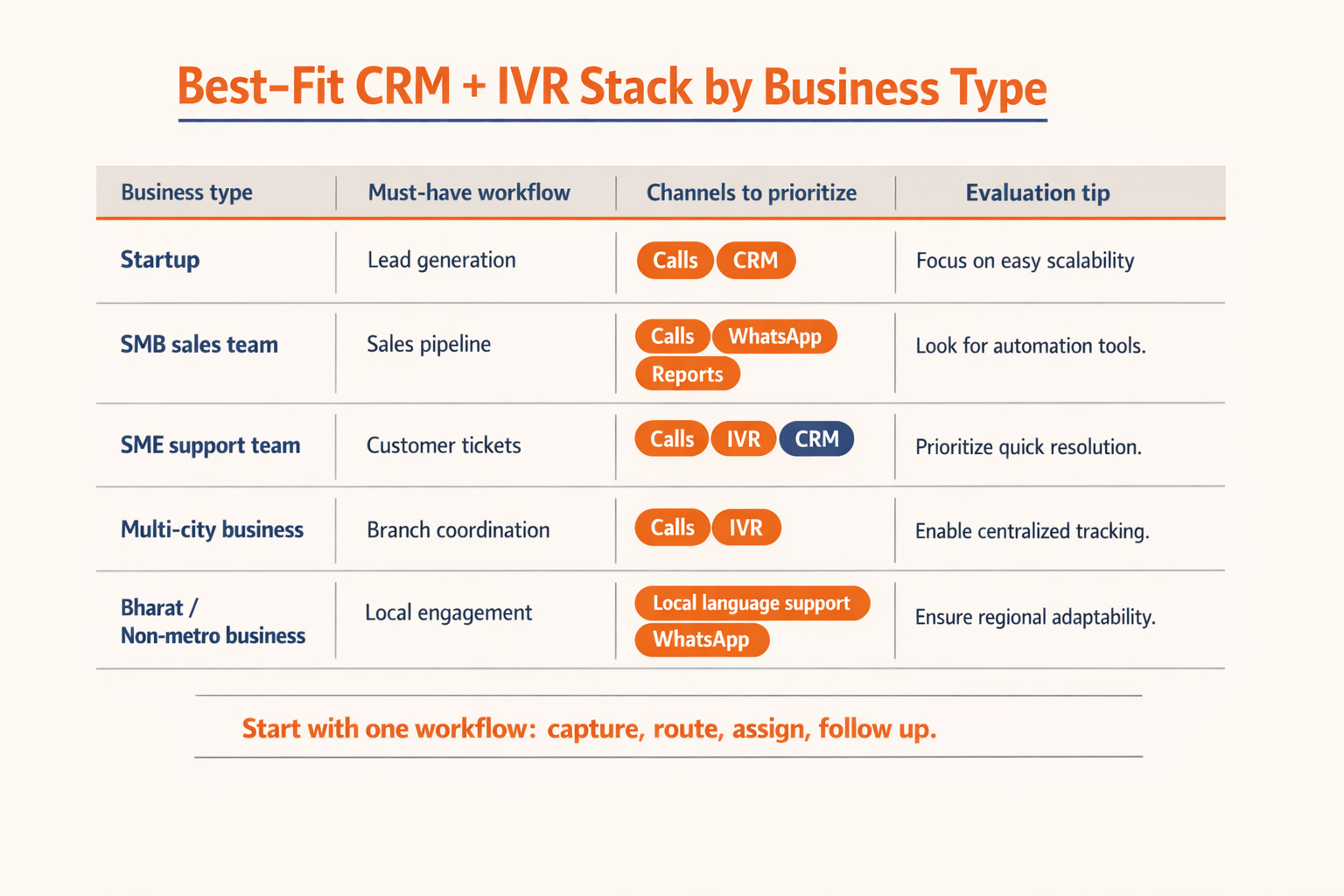
Use your business type to shortlist—not the longest feature list
By this point, the decision should be clearer: you are not buying “just CRM” or “just IVR.” You are choosing how your team will capture, route, track and close conversations across calls, WhatsApp, web, email and follow-ups. That matters because 2026 CRM comparison sources such as Groweon, LeadNXT, Wortal and WeekMate repeatedly evaluate tools on AI features, pricing, integrations, automation, affordability and ease of use—the exact criteria Indian SMBs need when teams are lean and enquiry volumes are unpredictable.
Zoho’s CRM page says it is “trusted by over 300000 businesses,” which shows how mainstream CRM adoption has become in India. But for many smaller companies, the bigger question is not “Which CRM is famous?” It is: Which setup will my sales/support team actually use every day?
| Business type | Must-have communication stack | Buyer checklist | City/location examples | Avoid this mistake |
|---|---|---|---|---|
| Local SMB: clinic, coaching class, repair service, salon | Cloud IVR, missed-call capture, WhatsApp follow-up, simple lead CRM | Check call routing, auto-reply on missed calls, WhatsApp templates, mobile app, basic reports | Pune coaching institute, Delhi clinic, Chennai service business | Buying a complex CRM before fixing call pickup and follow-up discipline |
| Growing SME: real estate, education, financial services, B2B sales | IVR + omnichannel CRM + lead ownership + campaign tracking | Look for team assignment, call logs, source tracking, WhatsApp history, manager dashboard | Mumbai real estate team, Hyderabad training company, Bangalore B2B sales team | Letting leads sit across Excel, personal phones and multiple WhatsApp numbers |
| Startup: SaaS, D2C, marketplace, app-first business | Website chat, CRM pipeline, email automation, IVR fallback, API integrations | Prioritise integrations, lead scoring, automation, webhook/API support, support tickets | Bangalore SaaS startup, Gurgaon app startup, Pune D2C brand | Choosing tools that cannot scale from founder-led selling to team-based workflows |
| High-call-volume support team | IVR menus, queue routing, call recording, support history, SLA dashboard | Compare call volumes, routing logic, agent availability, reporting depth, CRM sync | Mumbai support desk, Chennai logistics, Delhi service centre | Treating IVR as a phone menu only, without connecting it to customer history |
| Bharat/non-metro business | Regional-language voice, WhatsApp, missed-call lead capture, lightweight CRM | Check Indian-language STT/TTS, low-training UX, mobile-first workflows, pay-as-you-go pricing | Tier-2/3 retail, local finance, healthcare, education | Assuming English-first chatbots will work for every customer segment |
| Multi-city SME | Central CRM, city-wise routing, branch dashboards, campaign attribution | Need location tagging, city-wise numbers, role permissions, unified reporting | Pune + Mumbai + Hyderabad expansion | Running each city on separate tools with no central customer view |
Practical shortlisting rules before you buy
Use this 5-step filter before taking demos:
- Map your top 3 enquiry sources: calls, WhatsApp, website forms, ads, walk-ins or missed calls.
- Check daily volume: a 20-call/day business needs a different setup from a 2,000-call/month support team.
- Define ownership: every lead should have one owner, status and next follow-up date.
- Test ease of use with real staff: if sales executives will not update it, the CRM will fail.
- Ask for India-specific workflows: WhatsApp, regional languages, missed-call capture, local number routing and affordable pricing matter more for Indian SMBs than enterprise-only features.
For example, platforms such as CallMissed reflect where the Indian market is heading: WhatsApp-native engagement, AI voice agents, omnichannel inboxes and support for 22 Indian languages are becoming relevant when businesses serve customers beyond English-speaking metros.
The final buyer question
Before signing up, ask one simple question: “Can this system show me every customer conversation—call, WhatsApp, email, web enquiry and follow-up—in one place?”
If the answer is yes, you are evaluating a true easy to use omnichannel CRM India stack. If the answer is no, you may only be buying another disconnected tool.
Frequently Asked Questions: easy to use IVR software in Pune, easy to use IVR software India, easy to use omnichannel CRM India and easy to use omnichannel CRM for Indian SMEs
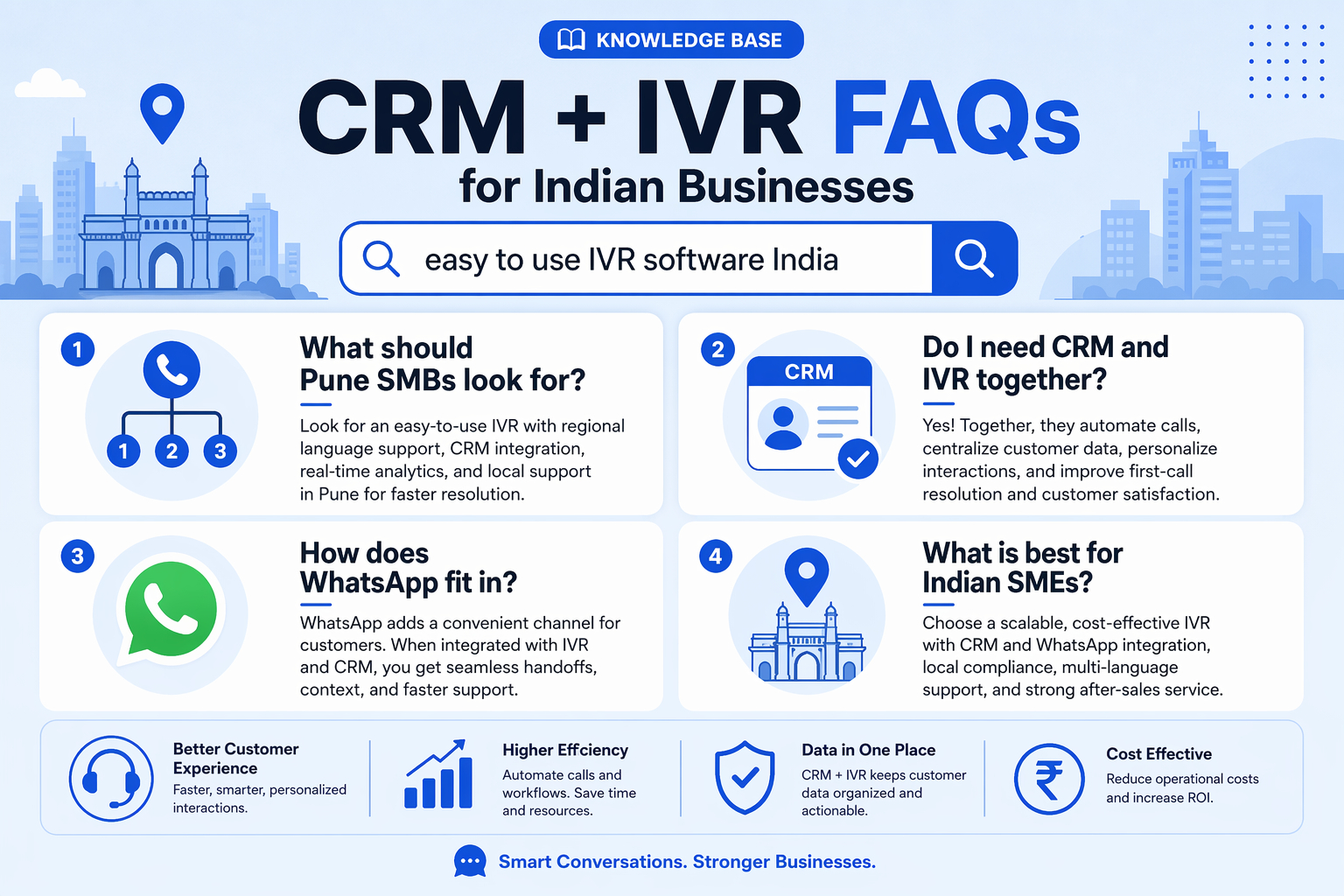
What is the best easy to use IVR software in Pune for small businesses?
How do I choose easy to use IVR software India for an SMB or startup?
What is the difference between IVR software and easy to use omnichannel CRM India solutions?
Why do Indian SMEs need WhatsApp, IVR and CRM in one workflow?
Which features matter most in an easy to use omnichannel CRM for Indian SMEs?
Can AI voice agents replace IVR for Indian businesses?
Conclusion
For Indian SMBs, SMEs and startups, the real decision is no longer “Which IVR tool should we buy?” It is: how easily can every customer conversation become trackable, assignable and actionable across calls, WhatsApp, email, web and CRM?
Key takeaways:
- IVR Software in India works best when it is connected to lead capture, call logs, routing, missed-call workflows and CRM follow-ups—not used as a standalone phone menu.
- An easy omnichannel CRM India setup should bring WhatsApp, voice, email, website enquiries and support history into one shared workflow for sales and service teams.
- Location matters: Pune coaching institutes, Mumbai real estate teams, Bangalore SaaS startups, Chennai service businesses, Delhi retailers, Hyderabad growth teams and Bharat-first brands all have different communication patterns.
- Vendor comparison should focus on ease of use, pricing, integrations, dashboards, routing, call volume handling, WhatsApp workflows and regional-language readiness.
Looking ahead, watch for AI voice agents, WhatsApp Business calling, multilingual automation and smarter CRM handoffs becoming standard for Indian customer engagement. To explore how this shift is evolving, check out CallMissed — an AI infrastructure platform powering voice agents, WhatsApp-native workflows and multilingual chatbots for businesses.
The question is simple: is your customer communication stack ready for how India actually buys?
Related Reading
Discussion
Related Posts


Ready to automate customer conversations?
Launch AI voice agents and WhatsApp bots with CallMissed — one API, 22+ Indian languages.