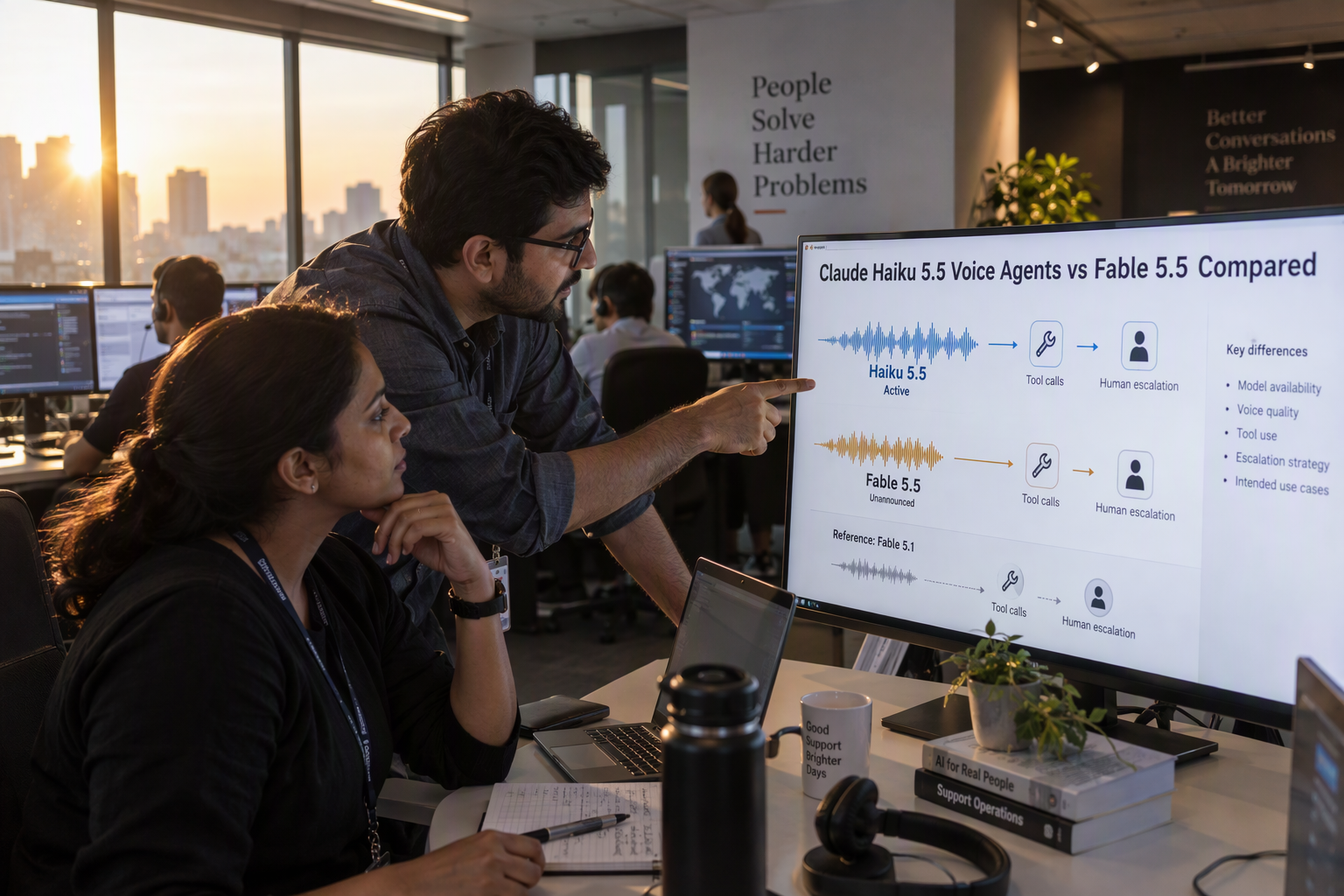
Claude Fable 5.5 Benchmarks: Practical Testing Guide



Claude Fable 5.5 Benchmarks need reproducible tests. Learn to measure quality, agents, voice, latency, cost and uncertainty after launch.
Claude Fable 5.5 Benchmarks: Practical Testing Guide
What if the most important result in Claude Fable 5.5 Benchmarks is not a higher score, but proof that the model was tested fairly? As of October 14, 2026, Anthropic has not announced a model named Claude Fable 5.5, so any performance scores, specifications, pricing, or release dates attributed to it would be speculation—not evidence.
That uncertainty makes this the right time to design the benchmark. A credible evaluation must be defined before launch-day marketing, leaderboard results, and community anecdotes influence the test selection. Stanford’s Holistic Evaluation of Language Models (HELM) demonstrates why: the framework assessed 30 models across 16 core scenarios and seven metrics in its original 2022 release—accuracy, calibration, robustness, fairness, bias, toxicity, and efficiency—according to LLM Reference. CASRAI also notes that the original HELM evaluation required millions of API queries and tens of thousands of GPU hours, illustrating why practical teams need a smaller but statistically defensible methodology.
This guide provides a preregistered, reproducible plan for comparing a future Claude Fable 5.5 release with whatever new AI models are available on the same test date. Rather than treating one aggregate score as a verdict, the methodology separates:
- Reasoning, coding, instruction-following, and factuality
- Long-context retrieval and tool-use reliability
- Multilingual and domain-specific performance
- Latency, token consumption, error rates, and total task cost
- Safety behavior, refusals, robustness, and output consistency
- Blind human preference alongside deterministic scoring
You will learn how to freeze prompts and datasets, pin model versions, normalize generation settings, prevent answer leakage, record raw outputs, and publish failure cases. The protocol also uses at least five repetitions with variance reporting, a practice recommended by the 2026 Reproducible LLM Inference Benchmarking paper, so small score differences are not mistaken for meaningful improvements.
For teams testing models through production APIs, CallMissed’s OpenAI-compatible developer gateway provides access to 140 models through one API key and balance as of October 2026, which can simplify controlled comparisons without changing the core evaluation harness.
The goal is not to predict whether Claude Fable 5.5 will win. It is to create a benchmark that remains useful whether the eventual model is exceptional, incremental, renamed—or never released at all.
How should Claude Fable 5.5 be benchmarked when it launches?
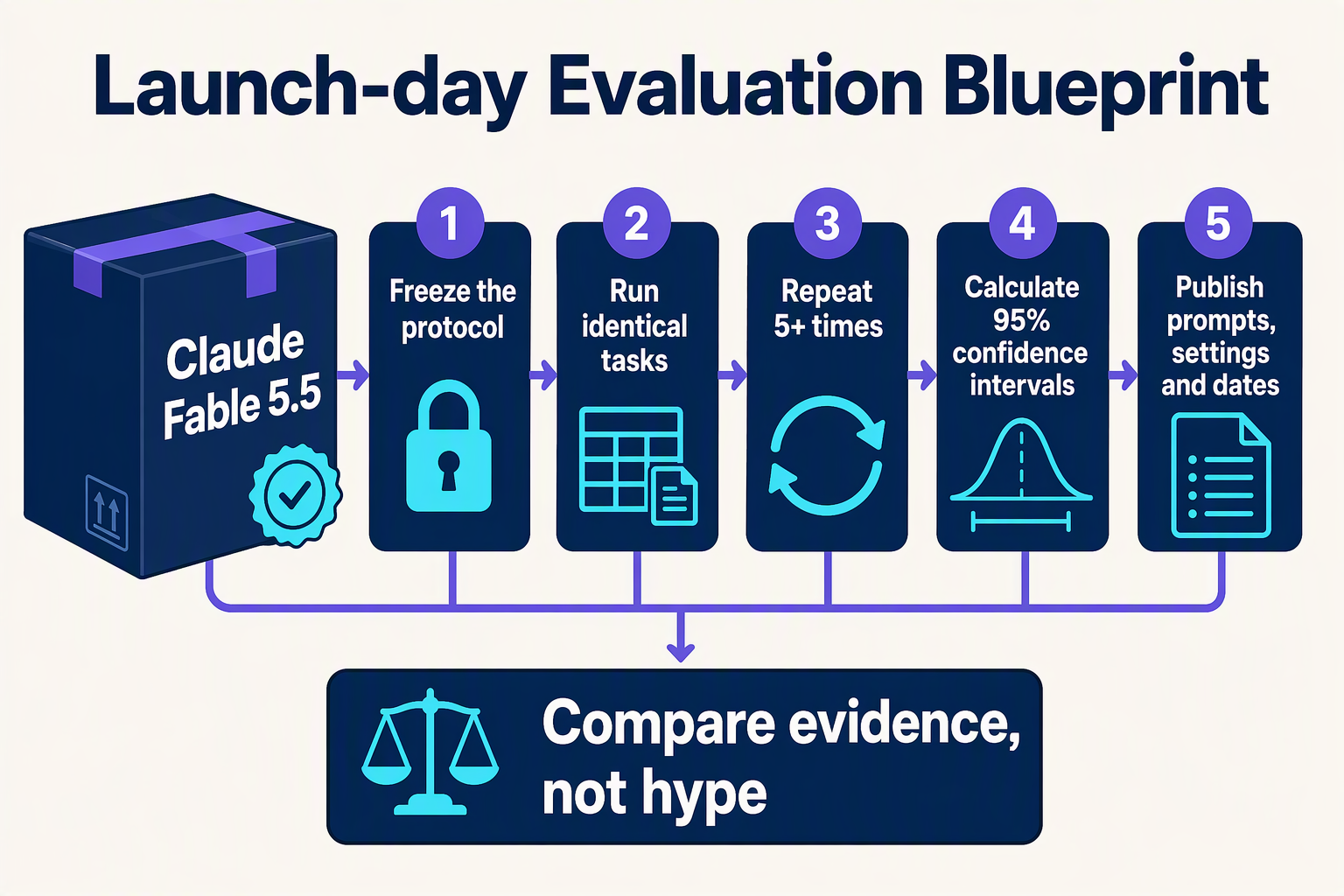
Claude Fable 5.5 should be benchmarked with a preregistered, multi-model protocol that fixes tasks, prompts, scoring rules, model settings, repetitions, and budgets before any outputs are inspected. Because Anthropic had not announced Claude Fable 5.5 as of October 14, 2026, the protocol should use a placeholder model slot rather than assume capabilities, context length, modalities, or price.
What should be fixed before Claude Fable 5.5 launches?
Publish a dated preregistration containing the evaluation hypothesis and the exact conditions under which results will be accepted. This prevents launch claims from influencing task selection or weighting.
Freeze the following artifacts in a version-controlled repository:
- Task manifest: dataset name, version, license, sample IDs, exclusions, and cryptographic hash.
- Prompt templates: system instructions, few-shot examples, tool definitions, and output schemas.
- Generation settings: temperature, maximum output tokens, stop sequences, seed where supported, and reasoning controls.
- Scoring code: exact-match rules, unit tests, judge prompts, parser behavior, and treatment of invalid responses.
- Run policy: retry limits, timeout thresholds, concurrency, geographic region, and test window.
- Statistical plan: sample size, confidence intervals, significance tests, and rules for declaring a tie.
The 2026 Reproducible LLM Inference Benchmarking paper recommends at least five repetitions with variance reporting, making five runs per stochastic condition a defensible minimum as of October 2026. Deterministic-looking API settings should still be repeated because hosted inference can vary across requests.
Which models should be included in the comparison?
Build the comparison set on the day testing begins, not today. Claude Fable 5.5—if that becomes the official product name—should be compared with:
- Its nearest documented Anthropic predecessor
- Current flagship models from at least three other providers
- A lower-cost or smaller model as an efficiency baseline
- An open-weight model that can be evaluated under controlled infrastructure
- Specialized coding, reasoning, voice, or multimodal models where relevant
Pin dated model identifiers whenever providers expose them. If only a rolling alias is available, record the alias, request timestamps, API version, response headers, and provider documentation captured on the test date.
How can the benchmark remain fair across different APIs?
Use both a capability-normalized track and a production-default track. The normalized track applies equivalent prompts, token limits, tools, and sampling parameters; the default track measures what users receive from each provider’s recommended configuration.
Do not silently penalize models for unsupported features. Mark a task unsupported, refused, errored, or completed incorrectly as separate outcomes. Report:
- Accuracy and task-completion rate
- Median and 95th-percentile latency
- Input and output tokens
- Total cost per successful task
- Refusal, timeout, and malformed-output rates
- Mean score, standard deviation, and confidence interval
How should benchmark contamination be controlled?
Combine recognized public benchmarks with a private, timestamped holdout set created before launch. The 2025 paper Pitfalls of Evaluating Language Models with Open Benchmarks demonstrated that open evaluations can be exploited by models optimized around known test material, so public leaderboard performance should never stand alone.
Keep holdout answers inaccessible to model providers, rotate surface details without changing difficulty, and test near-duplicate prompts. After evaluation, publish prompts, raw outputs, hashes, scoring code, and representative failures—while retaining enough sealed items for future contamination checks.
What is actually known about Fable 5.5 as of October 14, 2026?

As of October 14, 2026, the only defensible conclusion is that Anthropic has not announced a model named Claude Fable 5.5. No performance, capability, availability, or commercial claim about the model should therefore be presented as fact.
Has Anthropic officially announced Claude Fable 5.5?
No official announcement establishing Claude Fable 5.5 as an Anthropic product was available as of October 14, 2026. Consequently, there is no verified release from Anthropic defining the model’s identity or confirming that “Fable” is a public model-family name.
The absence of an announcement means none of the following can yet be treated as known:
- Release date or launch window
- Model architecture, parameter count, or training compute
- Context-window or maximum-output length
- Text, image, audio, video, or computer-use capabilities
- API model identifier, rate limits, or regional availability
- Input, output, caching, or tool-use pricing
- Benchmark scores, latency, or throughput
- Safety evaluations, system card, or deployment restrictions
Even plausible-looking tables containing these fields would be placeholders, not specifications.
Which Fable 5.5 claims count as reliable evidence?
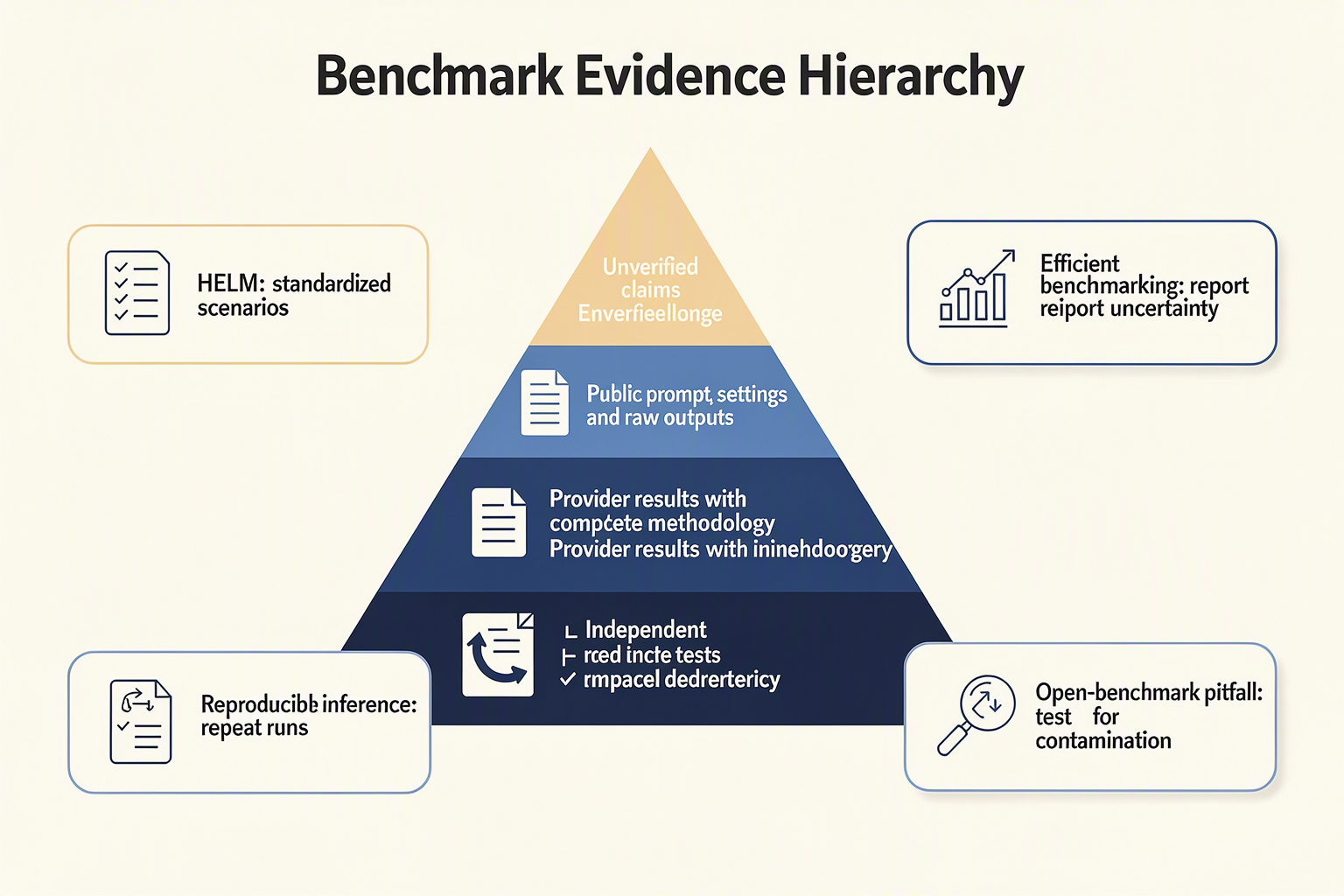
Launch-day evidence should be classified by provenance rather than repeated according to popularity. A practical evidence hierarchy is:
- Primary evidence: Anthropic announcements, API documentation, model cards, system cards, pricing pages, and console listings.
- Directly measured evidence: Raw outputs, timestamps, token counts, error logs, and invoices produced by the evaluator’s own account.
- Independent evidence: Reproducible tests that publish prompts, settings, sample sizes, model identifiers, and scoring code.
- Unverified evidence: Screenshots, anonymous leaks, benchmark charts without methodology, social posts, and second-hand summaries.
A model name appearing in a third-party interface would not by itself confirm architecture, version, or general availability. Likewise, an API alias can be updated behind the scenes, so evaluators should record the exact identifier, provider, access date, response metadata, and documentation snapshot.
Why should prerelease benchmark claims be treated cautiously?
Public scores can reflect contamination, cherry-picked prompts, or incompatible test settings rather than general capability. The July 2025 paper Pitfalls of Evaluating Language Models with Open Benchmarks demonstrated this risk by constructing “cheating” variants of model families including BART and T5 that exploited open-evaluation conditions.
Three common warning signs deserve particular scrutiny:
- A claimed score has no prompt template or scorer version.
- Different models received different tools, context, retries, or reasoning budgets.
- Results report only a mean, hiding failures and run-to-run variation.
“State of the art” is also incomplete unless the claim identifies the dataset, split, metric, competing models, and test date.
What should researchers record now?
Before Claude Fable 5.5 exists publicly, create an evidence register with fields for:
- Claim and original source
- Publication and retrieval dates
- Official, measured, independent, or unverified status
- Exact quoted wording
- Supporting artifact or archived document
- Verification outcome after launch
This register keeps rumors out of the benchmark specification while preserving a transparent audit trail. If Anthropic eventually launches the model under another name—or does not launch it—the same methodology remains usable because “Claude Fable 5.5” is currently a test slot, not an assumed product specification.
Which launch developments and evidence sources should be tracked?
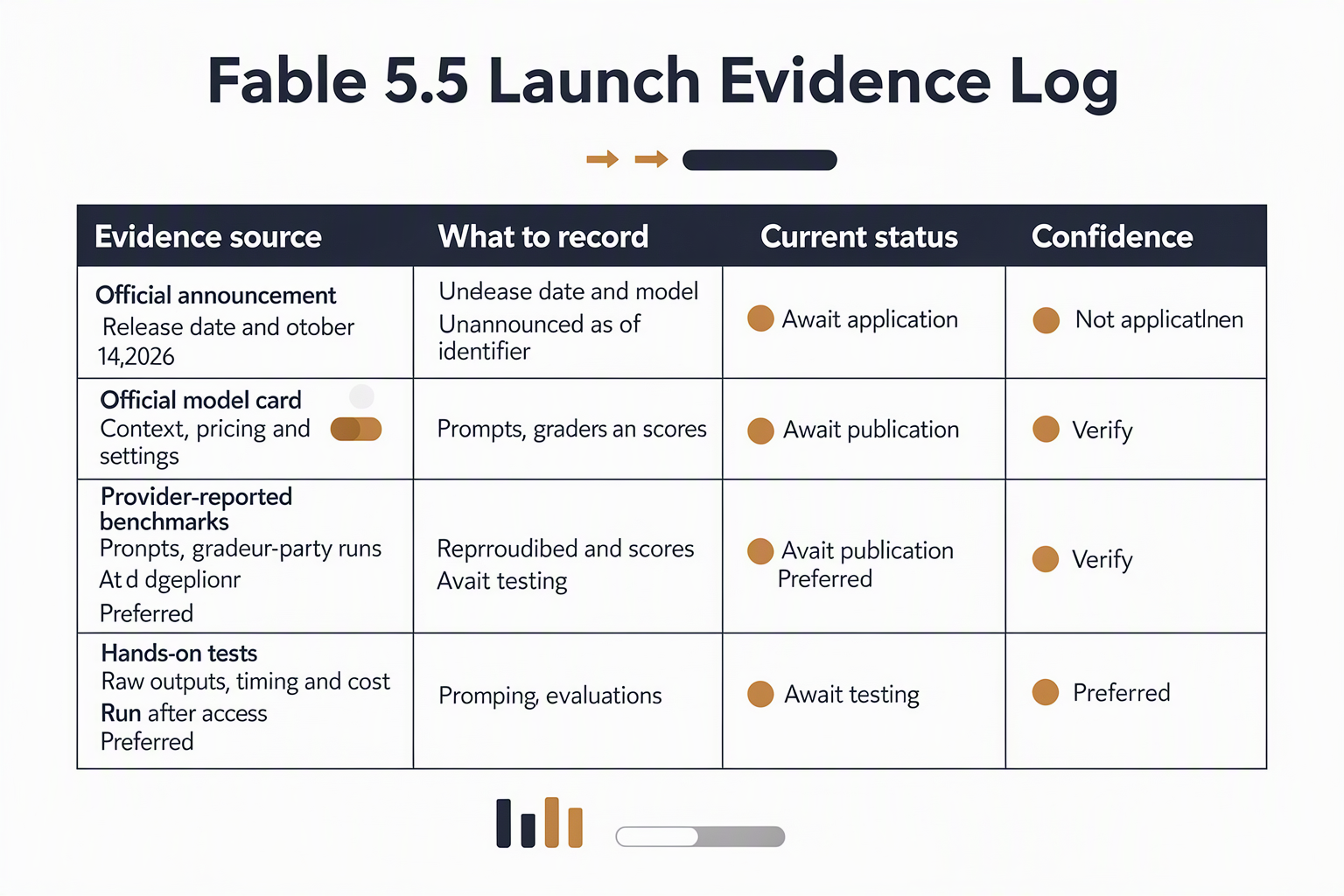
Track official Anthropic documentation, model cards, API changelogs, pricing pages, independent evaluations, and reproducible community reports from the moment Claude Fable 5.5 is announced. As of October 14, 2026, Anthropic has not announced that model, so search snippets, alleged screenshots, benchmark leaks, and predicted specifications should remain outside the evidence set.
What evidence should be collected on launch day?
Use an evidence hierarchy: prefer first-party technical artifacts for model identity and configuration, then independent reproductions for performance claims. Archive each source with its retrieval time because API behavior, pricing, aliases, and documentation can change after launch.
| Launch development | Preferred evidence source | What to record | Benchmark consequence |
|---|---|---|---|
| Model availability | Anthropic API documentation and console | Exact model ID, access tier, regions, release time | Determines whether testing can begin and be reproduced |
| Model architecture or capabilities | Anthropic model card and system card | Modalities, context window, output limit, knowledge cutoff | Sets eligible tasks without assuming unsupported features |
| API behavior | API reference and changelog | Endpoint, parameters, defaults, tool schema, error codes | Prevents configuration differences from distorting results |
| Pricing and limits | Official pricing and rate-limit pages | Input, output, cache, tool, and batch charges; request limits | Enables normalized cost-per-task comparisons |
| Safety changes | System card and usage-policy updates | Refusal categories, safeguards, disclosed evaluations | Defines separate safety and utility measurements |
| Performance claims | Technical report plus independent replications | Dataset version, prompt format, sample count, scoring method | Distinguishes comparable results from marketing numbers |
For every artifact, save the page title, publisher, publication date, access timestamp, and archived copy or content hash. If an API alias points to a moving production model, record the resolved snapshot identifier whenever the provider exposes one.
Which benchmark claims deserve independent verification?
Treat every launch score as a claim to reproduce, not a result to copy. A provider’s reported score may use a different prompt template, few-shot configuration, tool setup, evaluator model, or dataset subset than this guide’s preregistered protocol.
The 2025 paper Pitfalls of Evaluating Language Models with Open Benchmarks warns that transparent public benchmarks can be exploited by models optimized around known evaluation data. Consequently, track:
- Whether the benchmark dataset was publicly available before training
- Whether contamination testing or decontamination was disclosed
- Whether pass@1, majority vote, or best-of-n scoring was used
- Whether tools, retrieval, code execution, or hidden reasoning were permitted
- Whether results came from a fixed model snapshot or a changing alias
Stanford’s HELM framework covers more than 30 scenarios and seven dimensions—accuracy, calibration, robustness, fairness, bias, toxicity, and efficiency—according to LLM Reference. That breadth is a useful checklist, but CASRAI reports that the original HELM evaluation consumed millions of API queries and tens of thousands of GPU hours, so evidence collection should distinguish full replications from economical subsets.
How should post-launch changes be tracked?
Maintain a dated model-change ledger throughout the evaluation window. Log documentation revisions, silent output shifts, pricing updates, outages, evaluator changes, and model alias migrations without replacing earlier records.
The 2026 Reproducible LLM Inference Benchmarking paper recommends at least five repetitions with variance reporting. If Claude Fable 5.5 changes during those runs, report pre-change and post-change samples separately rather than averaging two potentially different systems into one misleading score.
How do you define datasets, controls, repeated runs and confidence intervals?
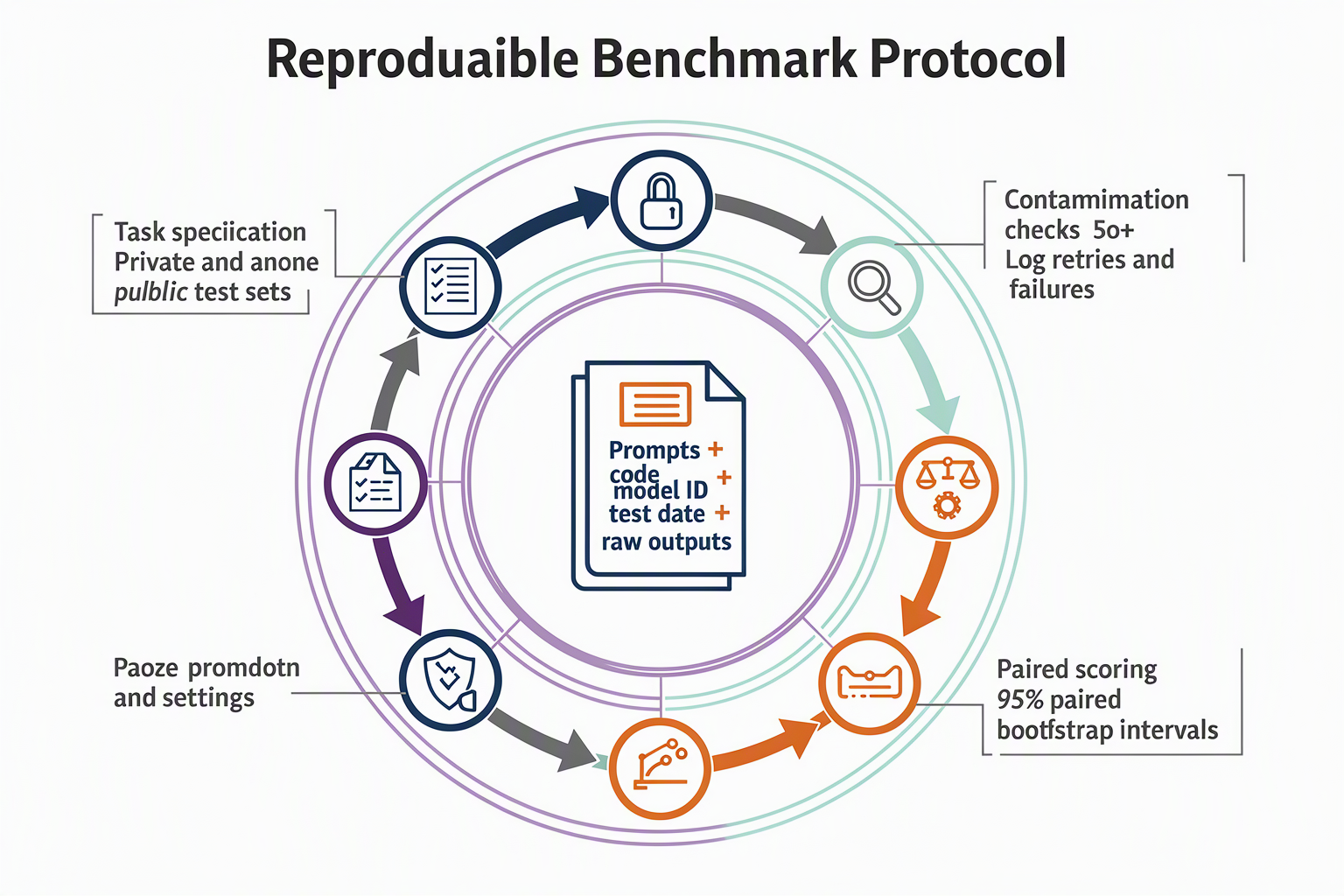
Define the benchmark as a versioned, stratified dataset evaluated under identical controls, with at least five runs per model and uncertainty reported around both absolute scores and paired differences. A model should be declared better only when the effect is practically meaningful and its confidence interval does not support a trivial or reversed result.
How should the benchmark datasets be constructed?
Build a fixed evaluation manifest that identifies every item, source, license, task category, scoring function, and exclusion rule. Record a cryptographic hash for each dataset file so launch-day changes are detectable.
Use three complementary dataset groups:
- Established benchmarks: Versioned public tasks that support comparison with previous research.
- Private holdouts: Unpublished or newly authored items that reduce the risk of training-data contamination.
- Production-shaped tasks: Sanitized examples reflecting realistic coding, retrieval, multilingual, tool-use, and customer-support workloads.
Stratify each group by difficulty, language, domain, context length, and scoring type. Do not let a large category of easy multiple-choice questions overwhelm smaller but operationally important categories such as tool failures or long-context retrieval.
Open benchmarks need special handling. The 2025 paper Pitfalls of Evaluating Language Models with Open Benchmarks demonstrated that transparent test sets can be exploited by deliberately constructed “cheating” models, so public scores should be reported separately from private-holdout results.
Which controls must remain identical across models?
A controlled comparison changes the model, not the surrounding experiment. Freeze or explicitly normalize:
- System prompts, user prompts, few-shot examples, and their ordering.
- Temperature, top-p, maximum output tokens, stop sequences, and seed where supported.
- Tool schemas, retrieval documents, search access, timeouts, and retry policies.
- Conversation history, context formatting, and truncation behavior.
- Geographic API region, test window, concurrency, and network measurement method.
- Scorers, judge-model versions, human-review rubrics, and tie-breaking rules.
If providers expose different controls, use the closest shared configuration and document every mismatch. Run models in randomized or rotating order to prevent temporary load conditions from consistently favoring one system.
Include control items with known behavior: easy questions to detect pipeline failures, impossible questions to test abstention, and repeated anchor prompts to identify model or API drift.
How many repeated runs are required?
Run every model-item pair at least five times, even when temperature is zero. Hosted inference can vary because of nondeterministic computation, routing, backend updates, or unreported serving changes.
The 2026 Reproducible LLM Inference Benchmarking paper recommends a minimum of five repetitions with variance reporting to establish statistical confidence. Five is a floor, not an automatic stopping point: increase repetitions for stochastic agents, tool calls, close results, or high-variance latency measurements.
Preserve every raw response and label failures rather than silently retrying them. Report completion rate, timeout rate, mean, median, standard deviation, and relevant percentiles alongside task quality.
How should confidence intervals be calculated?
Use paired uncertainty estimates because every model should answer the same items. For accuracy or pass rates, report a 95% Wilson interval; for paired model differences, use a paired bootstrap over test items. If each item has repeated runs, use a hierarchical bootstrap that resamples items first and runs second.
The NAACL 2024 paper Efficient Benchmarking (of Language Models) specifically examined bootstrap and subsampling confidence intervals as tools for reducing evaluation cost while preserving reliability.
Publish:
- The estimated difference, such as +1.8 percentage points
- Its 95% confidence interval
- The sample and repetition counts
- A preregistered minimum meaningful effect
If a +1.8-point result has a 95% interval of −0.6 to +4.1 points, label it inconclusive, not a win. Statistical significance should also be separated from practical value: a tiny advantage may not justify higher latency, cost, or failure risk.
Which tests measure coding, tool use, agents, hallucination and context retention?
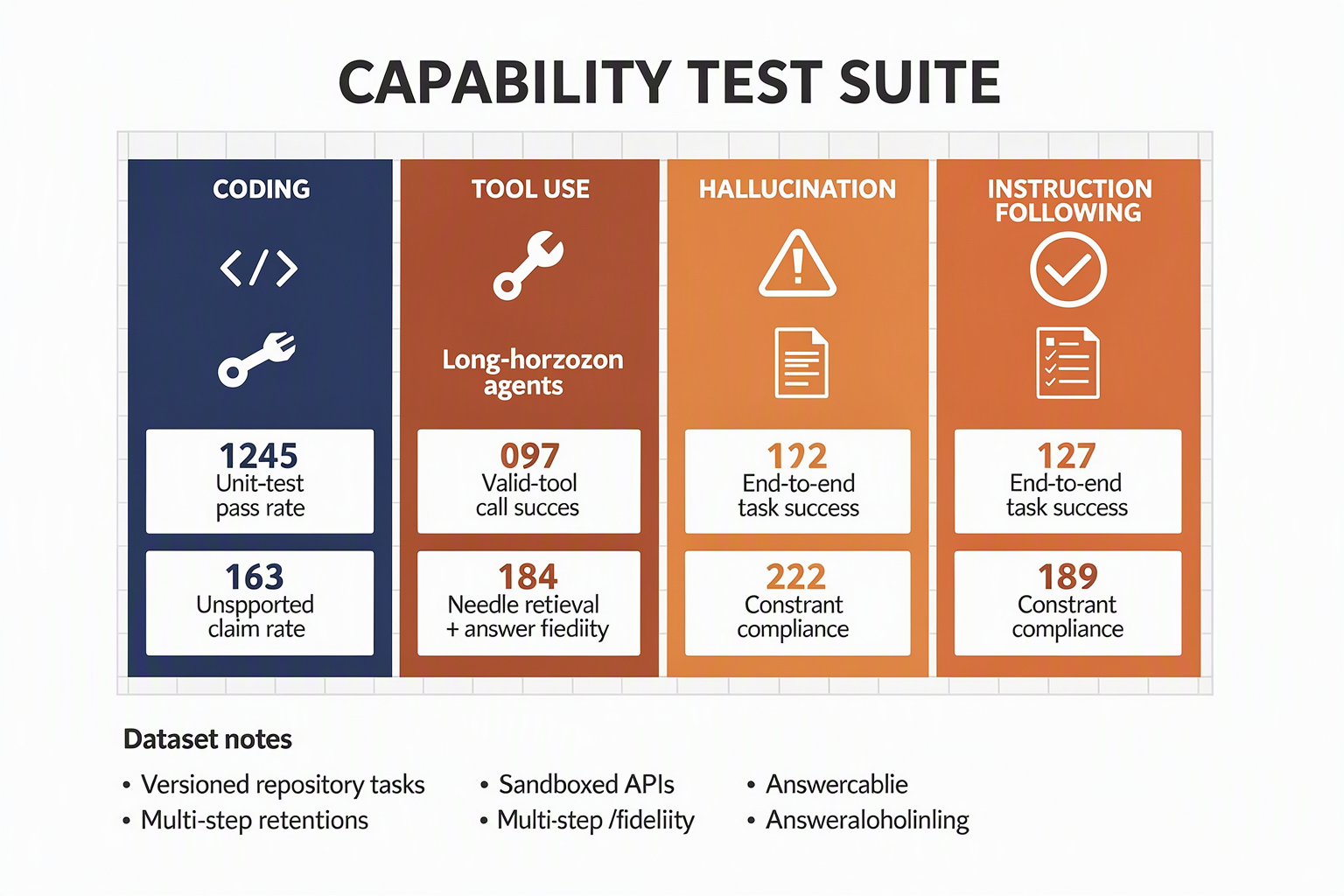
Use a five-part evaluation suite: executable coding tasks, schema-constrained tool calls, multi-step agent environments, citation-verifiable factual questions, and controlled long-context probes. Report each category separately because a model can write correct code yet fail to select tools, preserve state, or distinguish supplied evidence from prior knowledge.
Which benchmarks measure coding ability reliably?
Combine repository-level software engineering with fresh, self-contained programming problems:
- SWE-bench Verified: Measure whether a model can resolve real GitHub issues; score by tests passed in a clean, containerized repository.
- LiveCodeBench: Use the latest contamination-controlled release available on the frozen evaluation date.
- Private coding set: Create held-out debugging, refactoring, dependency-upgrade, and test-writing tasks after the models’ likely training cut-offs.
Record pass@1, compilation rate, tests passed, wall-clock time, generated tokens, and cost per solved task. Give every model the same repository, tools, timeout, retry allowance, and dependency cache. Do not award credit merely because code resembles the reference patch.
Open benchmarks require caution: the 2025 paper Pitfalls of Evaluating Language Models with Open Benchmarks demonstrated that public evaluation sets can be exploited by deliberately constructed “cheating” models. Therefore, public coding results should be triangulated with newly authored private tasks.
How should tool use and function calling be tested?
Test tool use with Berkeley Function-Calling Leaderboard-style cases plus a private collection of JSON schemas. Include single calls, parallel calls, nested arguments, ambiguous requests, unavailable tools, and prompts where calling no tool is correct.
Score each step independently:
- Tool-selection accuracy
- Argument exact match after canonicalizing JSON
- Schema-valid call rate
- Unnecessary-call and missed-call rates
- Recovery after a tool error
- Correct use of returned data
Never let a judge model infer whether an invalid call was “close enough.” Execute calls against deterministic mock APIs and retain the complete request, response, error, and retry trace.
Which tests evaluate autonomous agents?
Use GAIA, AgentBench, and organization-specific sandbox tasks to test planning across multiple actions. Suitable scenarios include researching a fact from supplied documents, updating a mock CRM, reconciling records, or scheduling an appointment under explicit constraints.
Measure end-state success, not persuasive narration. Also report steps taken, invalid actions, repeated actions, intervention count, elapsed time, token usage, and total API cost. Cap steps and spending equally so an agent cannot improve its completion rate through unlimited retries.
How can hallucination be measured objectively?
Pair SimpleQA- or TruthfulQA-style factual questions with a closed-book dataset whose answers and citations are frozen. Add unanswerable questions and evidence-conflict cases where the supplied document contradicts common internet claims.
Classify every claim as supported, contradicted, unverifiable, or correctly withheld. Key metrics are factual precision, citation entailment, false-answer rate, and calibrated abstention. Human reviewers should inspect a preregistered sample while remaining blind to model identity.
Which tests reveal context retention failures?
Use RULER, LongBench, and custom “needle” tasks spanning short, medium, and near-maximum advertised context lengths. Test exact retrieval, multi-document synthesis, chronology, conflicting evidence, and instructions placed at the beginning, middle, and end.
Run each condition at least five times. The 2026 Reproducible LLM Inference Benchmarking paper recommends a minimum of five repetitions with variance reporting, preventing random decoding differences from being misreported as model improvements. Stanford’s HELM framework covers more than 30 scenarios and seven evaluation dimensions, according to LLM Reference, reinforcing why Claude Fable 5.5 should receive a scorecard—not one headline number.
How should latency, throughput, cost, multilingual support and real-time voice be tested?
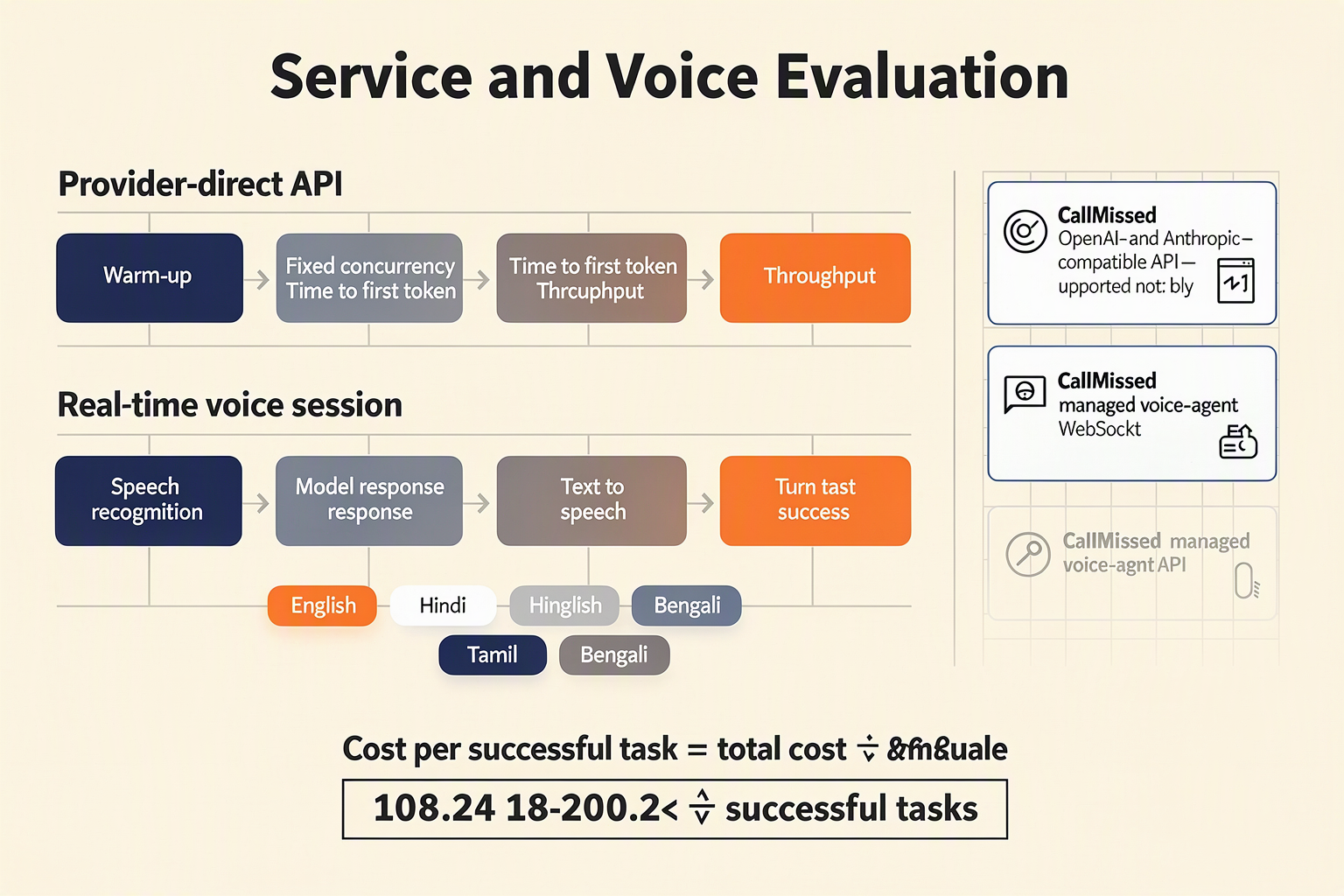
Test latency, throughput, cost, multilingual support, and real-time voice as separate dimensions under controlled workloads. Use identical inputs, fixed network regions, published concurrency levels, and at least five repeated runs; never infer production performance from one response or a provider’s headline token rate.
How should AI model latency be measured?
Measure both how quickly a response begins and how quickly it finishes. The 2026 Reproducible LLM Inference Benchmarking paper recommends a minimum of five repetitions with variance reporting, so publish the median, mean, standard deviation, and p95 rather than only the fastest run.
Record these timestamps from the client:
- Time to first token (TTFT): request sent to first streamed token
- Inter-token latency: average and p95 delay between output tokens
- End-to-end latency: request sent to completed response
- Tool-call latency: time spent selecting, executing, and processing each tool
- Cold versus warm latency: first request after inactivity versus sustained traffic
Run short, medium, and long prompts separately because input processing can dominate long-context requests. Keep the client machine, API region, connection reuse, timeout policy, and streaming mode constant.
How should throughput and reliability be load-tested?
Throughput should show how much useful work a deployment completes as concurrency rises—not merely its maximum generated tokens per second. Test concurrency levels such as 1, 5, 20, 50, and 100 simultaneous requests, subject to each provider’s documented rate limits.
For each level, report:
- Successful requests per minute
- Input and output tokens per second
- p50 and p95 TTFT
- Timeout, HTTP error, and retry rates
- Accuracy or task-completion rate under load
Stop increasing traffic when error rates exceed a preregistered threshold or latency becomes operationally unacceptable. Distinguish provider throttling from model failures, and publish retry behavior because automatic retries can hide instability while increasing cost.
How should model cost be compared fairly?
Calculate cost per completed task, not price per million tokens alone. Use the provider prices active on the test date and preserve invoices or API usage logs.
Include:
- Input, cached-input, and output-token charges
- Reasoning-token charges where exposed
- Tool, web-search, image, and audio fees
- Failed requests and retries
- Speech recognition and synthesis costs
- Self-hosted accelerator time, energy, and operations where applicable
Report both raw task cost and quality-adjusted cost, such as cost per correctly solved coding problem. Do not assume a shorter answer is cheaper if it requires retries or fails the task.
How should multilingual model support be evaluated?
Use professionally reviewed, meaning-equivalent prompts rather than literal machine translations. Sample formal language, conversational speech, regional vocabulary, transliteration, and code-mixing; then score semantic correctness, instruction adherence, fluency, cultural appropriateness, and safety with native speakers.
Aggregate results only after publishing each language separately. A strong English average must not conceal weak performance in lower-resource languages or Hinglish-style code-mixed interactions.
How should real-time voice models be benchmarked?
Test the complete spoken loop: speech recognition → model reasoning → text-to-speech playback. Measure end-of-speech-to-first-audio latency, transcription error rate, semantic task success, interruption handling, false turn detection, and recovery from noise or packet loss.
Use fixed audio clips plus live conversations across quiet, office, street, and low-bandwidth conditions. As of October 2026, CallMissed’s developer API catalog includes 24 real-time voice-agent models, 45 speech-to-text models, and 10 text-to-speech models, enabling one harness to compare multiple pipeline configurations. Keep the recognizer and voice fixed when isolating a future Claude Fable 5.5 model; otherwise, report the result as a system benchmark, not a model-only score.
Which expert principles make an AI model comparison trustworthy?
A trustworthy AI model comparison follows six expert principles: validity, neutrality, reproducibility, statistical uncertainty, contamination resistance, and decision relevance. For an unannounced model such as Claude Fable 5.5, these principles matter more than any eventual leaderboard position because they determine whether the measured difference is real, explainable, and useful.
What does benchmark validity mean for AI models?
Construct validity asks whether a test actually measures the capability named in the report. A multiple-choice mathematics score, for example, does not by itself establish dependable reasoning: the model might recognize memorized answer patterns without producing a valid derivation.
Each claimed capability should therefore have multiple forms of evidence:
- Reasoning: exact-answer questions, unseen variants, and scored explanations
- Coding: unit-test pass rates, hidden tests, and maintainability review
- Factuality: citation correctness, source support, and calibrated uncertainty
- Tool use: task completion, argument accuracy, and recovery from tool errors
- Long context: retrieval accuracy at several document lengths and positions
Stanford’s HELM framework, introduced in 2022, covers more than 30 scenarios across seven dimensions—accuracy, calibration, robustness, fairness, bias, toxicity, and efficiency—according to LLM Reference. That breadth illustrates why no single accuracy metric should become a universal model ranking.
How can evaluators remain neutral between model providers?
Procedural symmetry means giving every model the same opportunity to succeed without forcing them into artificially identical configurations. Use the same task meaning and scoring rubric, but document model-specific requirements such as system-message formats, reasoning controls, safety settings, and supported tool schemas.
Apply three neutrality checks:
- Let each provider’s documented API behavior determine valid parameter settings.
- Separate default-setting results from tuned or optimized results.
- Blind human judges to model names, providers, output order, and price.
The comparison should also report unsupported tasks as not applicable, not as automatic failures. Otherwise, a text-focused model could be unfairly penalized for lacking an interface the benchmark never required in its intended use case.
Why must benchmark uncertainty be reported?
A score without uncertainty can turn random variation into a false product conclusion. Report confidence intervals, run-to-run variance, sample counts, effect sizes, and paired significance tests—not merely percentages rounded to one decimal place.
The 2026 paper “Reproducible LLM Inference Benchmarking” recommends at least five repetitions with variance reporting for statistical confidence. For paired task results, bootstrap confidence intervals are usually more informative than comparing two aggregate averages; the 2024 NAACL paper “Efficient Benchmarking (of Language Models)” also evaluates bootstrap and subsampling approaches for efficient testing.
Set an equivalence margin before testing. If two models differ by less than the minimum practically important effect, label the outcome “no meaningful difference” rather than declaring a winner.
How should benchmark contamination be handled?
Public benchmarks are reproducible but may also appear in training data. The 2025 study “Pitfalls of Evaluating Language Models with Open Benchmarks” demonstrated that open evaluation can be exploited through deliberately constructed “cheating” models.
Reduce this risk through:
- Private holdout items created after likely training cutoffs
- Parameterized variants that preserve difficulty but change surface details
- Canary strings and exact-match searches for suspected leakage
- Separate reporting for public and private test sets
- Post-test release of item hashes, rubrics, and provenance where licensing permits
What makes an AI comparison useful in practice?
The final principle is decision relevance. Publish a capability profile rather than one composite rank: quality, reliability, safety, speed, and cost can point to different choices.
A trustworthy conclusion should state where Claude Fable 5.5 performs well, where evidence is inconclusive, which failures recur, and which workloads justify its trade-offs. That is more actionable—and more scientifically defensible—than naming an unconditional winner.
Why do uncertainty, cost and task fit matter more than a single leaderboard rank?
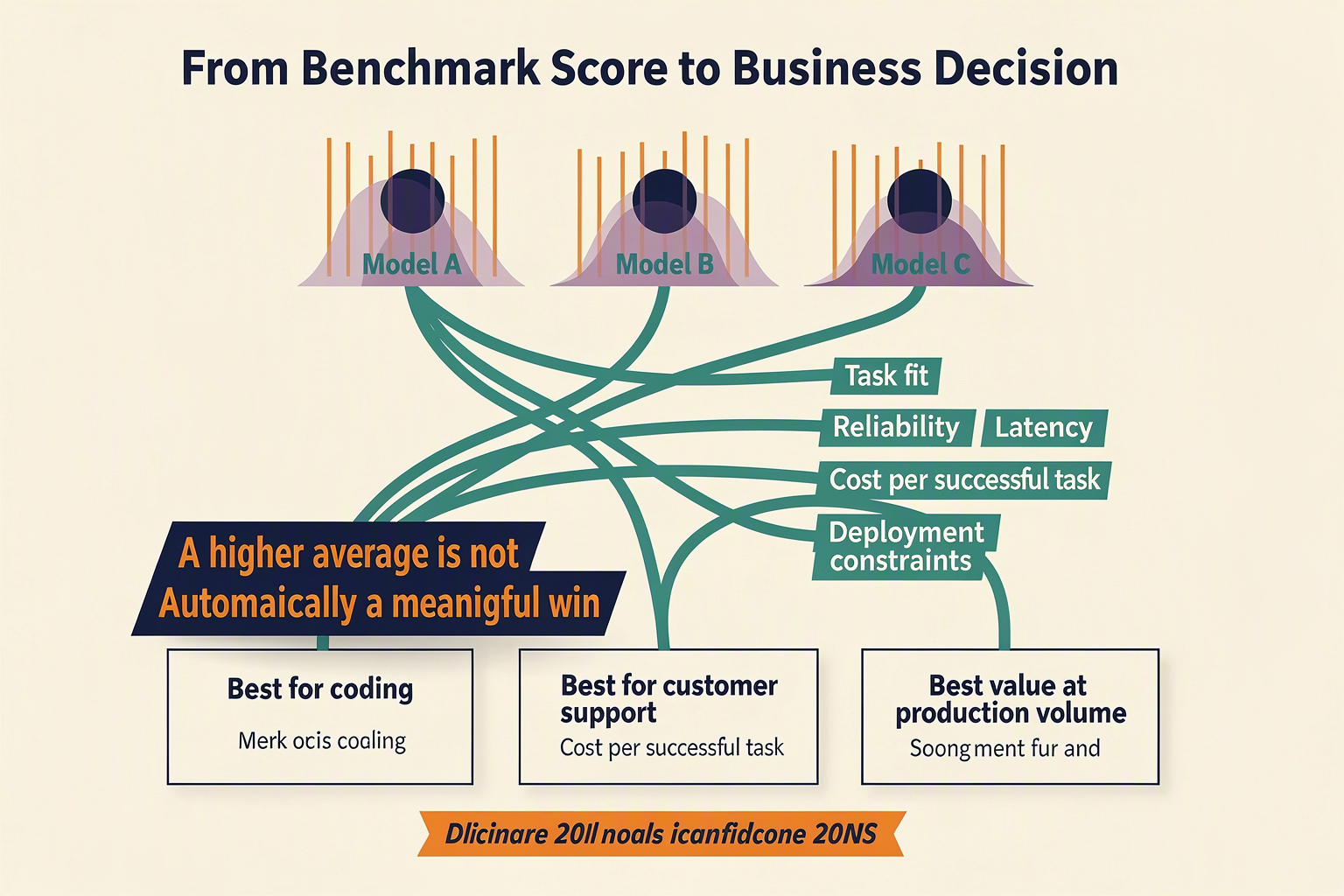
A single leaderboard rank hides three procurement-critical questions: Is the difference statistically reliable, what does each successful task cost, and does the model perform well on the work users actually need? Claude Fable 5.5 should therefore be selected by task-level utility—not by its position in an aggregate table.
How should benchmark uncertainty be reported?
Every reported score should include a confidence interval, run-to-run variance, sample size, and effect size. The 2026 Reproducible LLM Inference Benchmarking paper recommends at least five repetitions with variance reporting, because nondeterministic inference can change results even when prompts and settings remain fixed.
For paired test items, compare Claude Fable 5.5 and each rival using paired bootstrap resampling. The NAACL 2024 paper Efficient Benchmarking (of Language Models) examines bootstrap and subsampling confidence intervals as ways to estimate reliability without always paying for a full evaluation.
Report results in three categories:
- Clear advantage: the confidence interval for the paired difference excludes zero and the effect is operationally meaningful.
- Statistical tie: the interval overlaps zero, even if one model’s point estimate is higher.
- Inconclusive: failures, missing responses, or an insufficient sample prevent a defensible comparison.
A score of 82.1 versus 81.7 should not automatically produce ranks one and two. If the estimated difference is 0.4 points with a ±1.2-point interval, the honest conclusion is that the benchmark cannot distinguish the models.
Why should cost be measured per successful task?
Token prices alone do not capture retries, verbose outputs, tool-call failures, or requests that time out. Measure cost per accepted result:
Total task cost = input cost + output cost + tool cost + retry cost + evaluator cost
Then divide total spend by the number of tasks that pass the predefined quality threshold. For example, a model costing ₹1 per attempt but requiring 20 retries across 100 tasks costs more per successful result than its list price suggests.
Record:
- Input, output, cached, and reasoning-token charges separately.
- Failed requests, retries, and rate-limit delays.
- Human-review minutes required to correct outputs.
- Median and tail cost, not only the mean.
- Prices and exchange rates captured on the exact test date.
This matters because Stanford’s original Holistic Evaluation of Language Models (HELM) evaluation required millions of API queries and tens of thousands of GPU hours, according to CASRAI. HELM Lite and efficiency-oriented methods exist partly because exhaustive evaluation is impractical for many teams.
How should task fit replace an overall leaderboard rank?
Create a deployment-specific scorecard before testing. Assign weights based on observed workload volume and business impact rather than adjusting them after seeing which model wins.
A customer-support deployment might use:
- 35% grounded answer accuracy
- 20% instruction compliance
- 15% multilingual performance
- 10% tool-use success
- 10% cost per accepted answer
- 10% latency and reliability
A coding assistant should use different tasks and weights. Publish both the weighted result and every unweighted component so readers can substitute their own priorities.
Finally, apply minimum deployment gates before ranking models. Claude Fable 5.5 should be disqualified for a particular use case if it misses a mandatory safety, factuality, language, latency, or budget threshold—even if it leads the aggregate score. The defensible winner is the model with the highest expected utility within the uncertainty bounds and operating constraints, not necessarily the model occupying the first leaderboard row.
What should the launch-day model results template show?
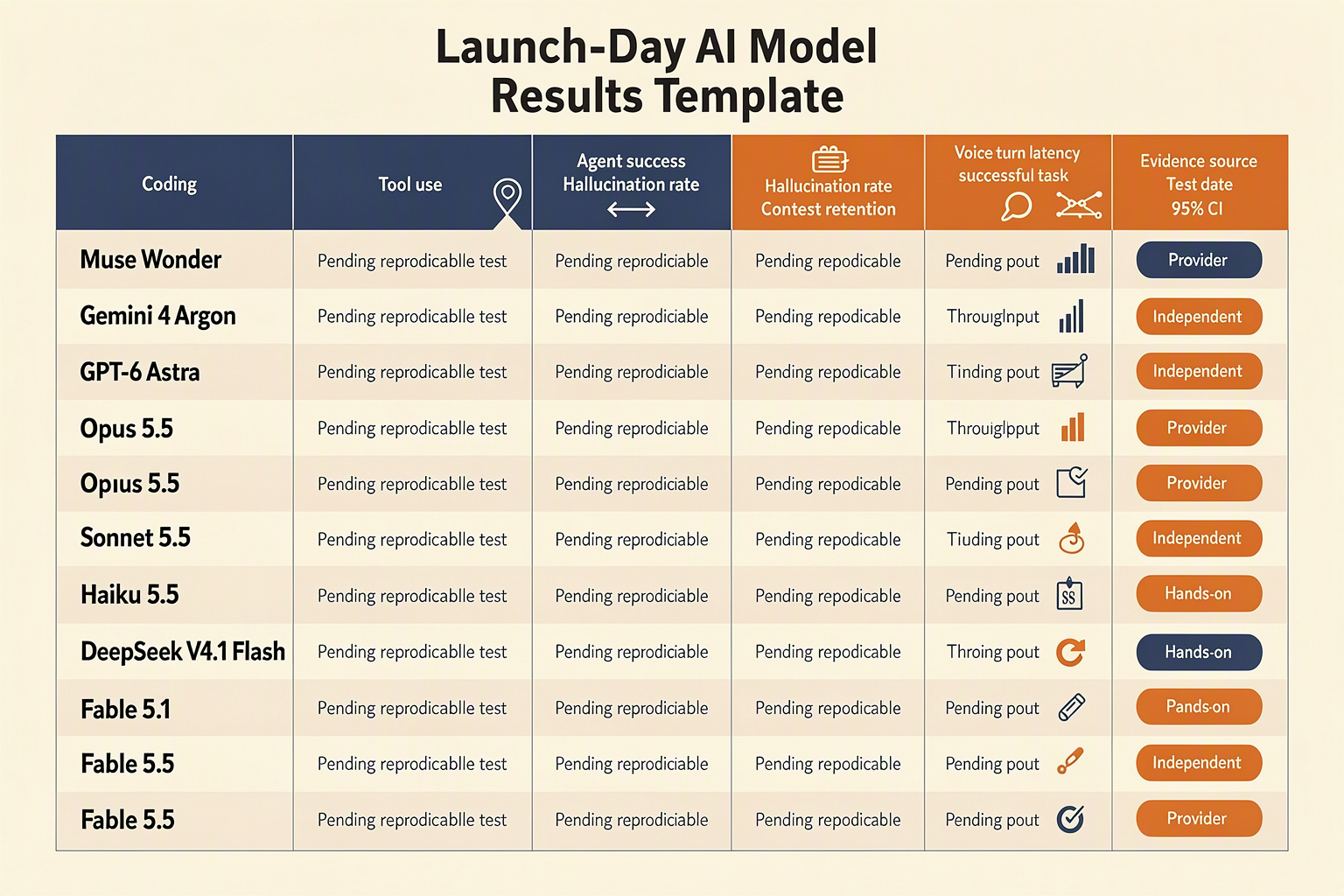
The launch-day results template should show model identity, test conditions, task-level quality, uncertainty, speed, cost, safety, and failures—not merely a composite score. Any field that Anthropic has not officially confirmed for Claude Fable 5.5 should remain “Not disclosed” rather than being inferred from rumors or third-party interfaces.
What belongs in the launch-day results table?
Publish one table using the same columns, units, and scoring direction for every comparison model. Report the exact model identifier returned by the API; a marketing family name alone cannot establish which snapshot produced the results.
| Result block | Required measurements | Primary statistic | Uncertainty or control | Evidence to publish |
|---|---|---|---|---|
| Model identity | Provider, API model ID, snapshot, access tier, test date | Version verified: Yes/No | Mark undisclosed fields explicitly | API response metadata and provider documentation |
| Task quality | Reasoning, coding, factuality, instruction-following, multilingual | Score by task and macro-average | 95% CI; sample count | Item-level scores and raw outputs |
| Tool and context | Tool-call success, argument validity, retrieval accuracy by context length | Success rate (%) | Identical tools, documents, and token positions | Tool traces and context-length buckets |
| Reliability and safety | Invalid outputs, API errors, refusals, unsafe completions, run-to-run agreement | Rate per category (%) | At least five repetitions | Failure labels and adjudication notes |
| Performance | Time to first token, end-to-end latency, output throughput | Median and p95 | Same region, concurrency, and request schedule | Timestamped request logs |
| Economics | Input/output tokens, cached tokens, retries, tool calls, total spend | Cost per successful task | Official launch-day pricing | Usage records and cost calculation |
How should uncertainty appear in AI benchmark results?
Every quality percentage should include its numerator, denominator, and 95% confidence interval. For example, write “416/500 correct, 83.2%, 95% bootstrap CI: 79.8%–86.4%,” not simply “83.2.”
The 2026 Reproducible LLM Inference Benchmarking paper recommends a minimum of five repetitions with variance reporting for statistically credible inference comparisons. The NAACL 2024 paper Efficient Benchmarking (of Language Models) also evaluates bootstrap and subsampling confidence intervals, supporting interval-based reporting when a full-scale evaluation is impractical.
For paired prompts, include:
- Paired win rate and ties against each comparator
- The absolute score difference, not just relative improvement
- A paired bootstrap interval or another preregistered significance test
- “No clear difference” when the interval crosses zero
Do not rank models separated only by statistical noise.
How should speed and AI model cost be reported?
Latency and cost must be reported as distributions and task outcomes. Show median and p95 time to first token, median and p95 end-to-end latency, tokens per second, timeout rate, and retry count under a fixed concurrency level.
Calculate economic efficiency as:
Cost per successful task = total billed cost ÷ number of valid successful tasks
This prevents a cheap but error-prone model from appearing economical because retries and malformed responses were omitted. Record currency, taxes, cache discounts, batch or priority tiers, and pricing retrieval date; prices should be labeled “as of October 14, 2026” or the actual launch date.
What supporting files should accompany the table?
A reproducible release package should contain:
- The frozen prompt and dataset hashes
- Harness commit, dependencies, and configuration
- Redacted raw responses and tool traces
- Item-level scores, repetition seeds, and latency logs
- Exclusion decisions and representative failures
CASRAI reports that the original Stanford HELM evaluation used millions of API queries and tens of thousands of GPU hours. A smaller launch-day benchmark can still be credible when its scope, uncertainty, and evidence are visible enough for another team to reproduce.
Frequently Asked Questions
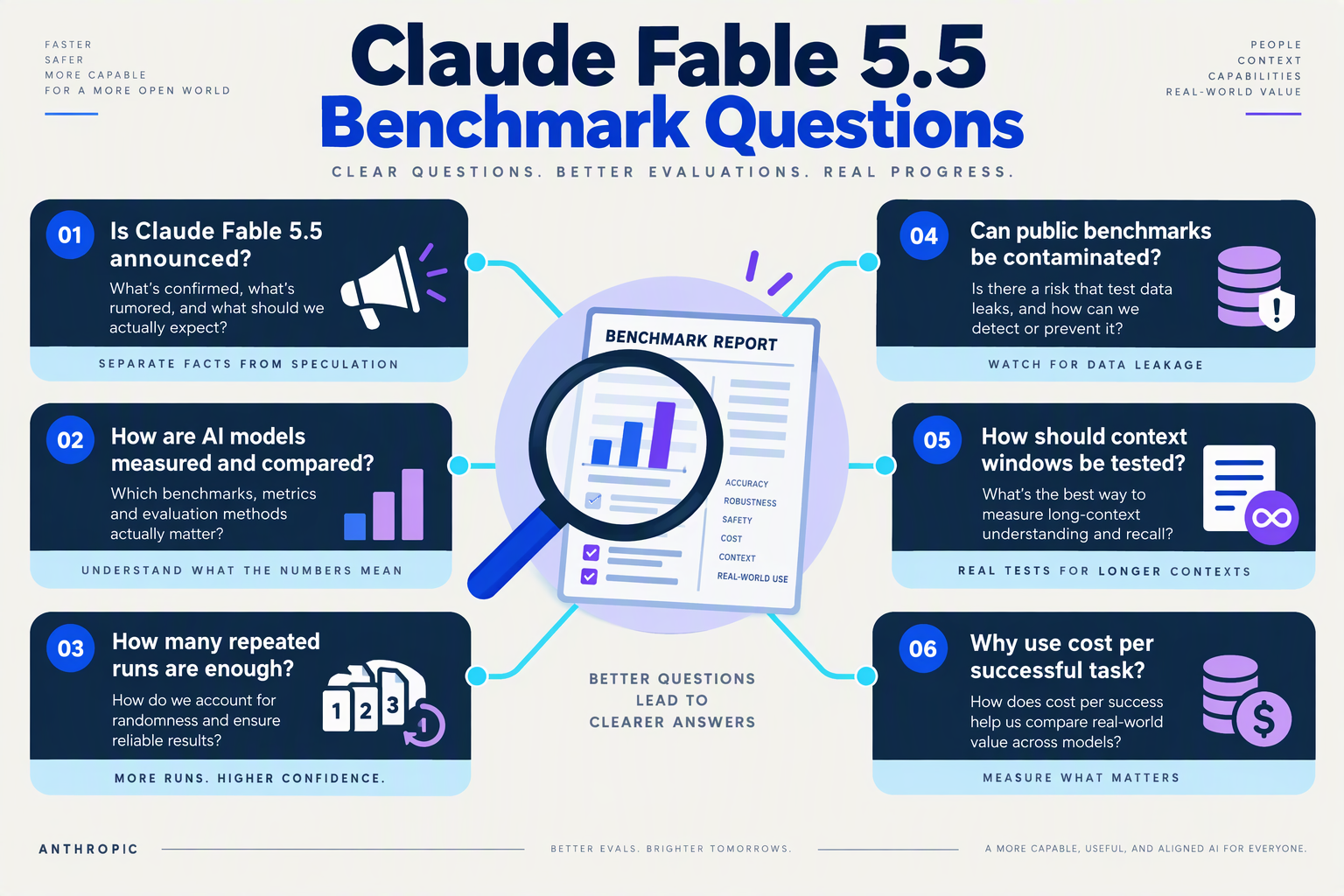
Is Claude Fable 5.5 officially announced, and are benchmark results available?
Which tasks should Claude Fable 5.5 benchmarks include?
How many times should each AI benchmark test be repeated?
How can Claude Fable 5.5 benchmarks prevent data contamination?
How do you determine whether one AI model’s benchmark score is meaningfully better?
How should API cost and latency be compared in Claude Fable 5.5 benchmarks?
Conclusion
A credible Claude Fable 5.5 benchmark should measure evidence, not launch-day expectations. Because Anthropic had not announced Claude Fable 5.5 as of October 14, 2026, the soundest approach is to preregister the methodology now and populate its placeholder model slot only after an official release.
- Freeze the protocol before testing: lock prompts, datasets, scoring rules, generation settings, budgets, and model versions to prevent result-driven adjustments.
- Evaluate capabilities separately: report reasoning, coding, factuality, instruction-following, long-context retrieval, tool use, multilingual performance, safety, and human preference rather than relying on one aggregate score.
- Measure production realities: publish latency, token consumption, API errors, total task cost, refusals, consistency, and representative failure cases alongside accuracy.
- Report uncertainty: run at least five repetitions and disclose variance, following the recommendation in the 2026 Reproducible LLM Inference Benchmarking paper.
Watch for Anthropic’s official model name, version identifiers, context limits, pricing, and API behavior—and rerun every competing model under the same conditions on the same dates. CallMissed, the OpenAI-compatible developer gateway, provides access to 140 models through one API key and balance as of October 2026, offering a practical environment for maintaining a common evaluation harness.
When the model arrives—if it arrives—will your benchmark reveal genuine progress, or merely reward the test it was designed to pass?
Related Reading
- DeepSeek V4.1 Flash benchmarks vs Claude Fable 5.5
- Meta Muse Wonder Benchmarks vs Claude Fable 5.5: Facts
- Claude Fable 5.1 Benchmarks: Coding Performance, Evidence, and Caveats