
Claude Opus 5.5 Launch: API Pricing & Migration Guide


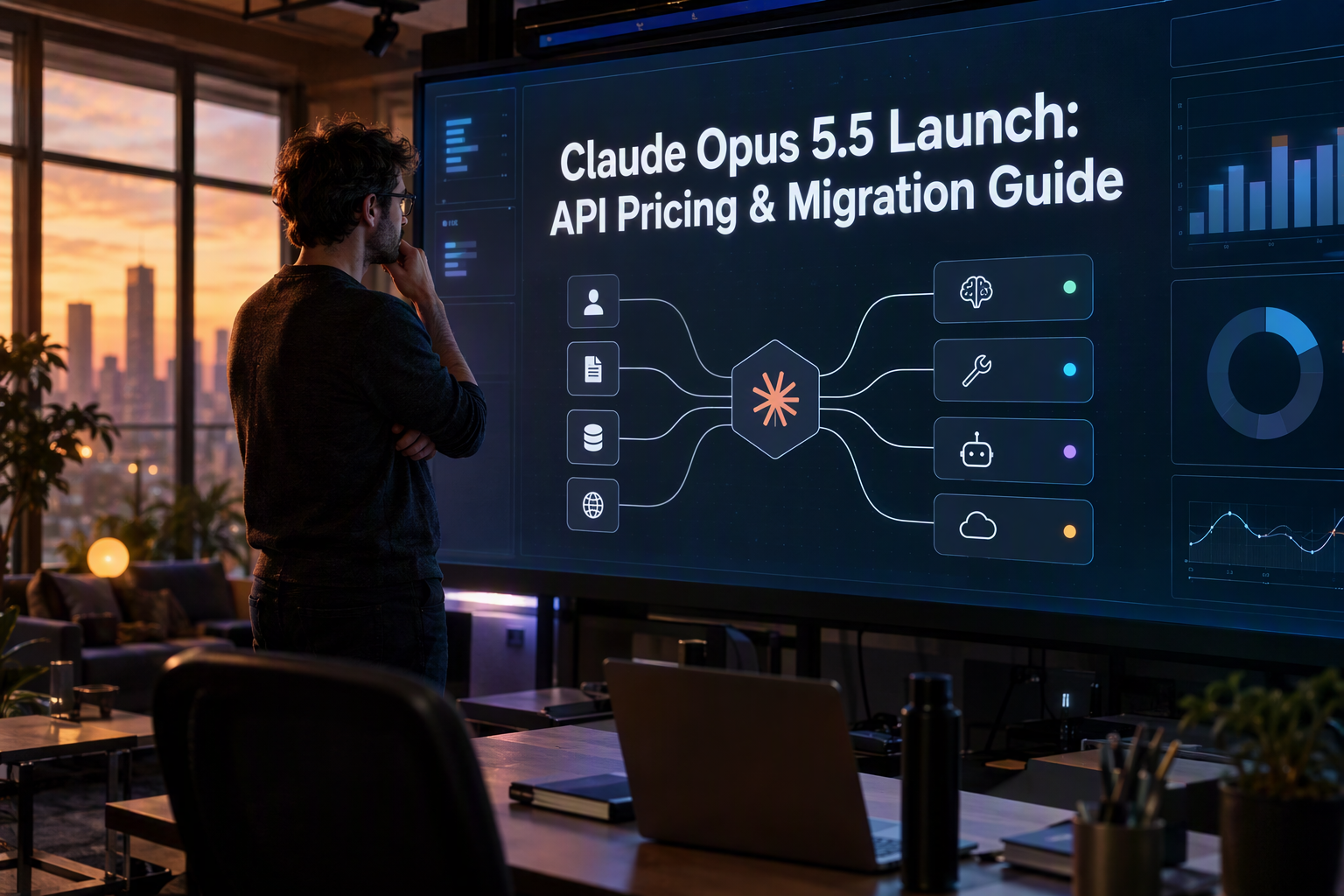
Get verified Claude Opus 5.5 availability, API pricing, context limits, coding claims, agent guidance, and a practical migration checklist.
Claude Opus 5.5 Launch: API Pricing & Migration Guide
What if a frontier model could accept one million tokens and still reduce typical workload costs by 40%? The Claude Opus 5.5 launch pairs a 1 million-token context window with lower API rates, always-on adaptive thinking and a sharper focus on agentic coding and knowledge work. For developers already using Claude Opus 5—or evaluating a move from an earlier Claude model—the launch makes migration economics as important as raw capability.
Why does the Claude Opus 5.5 launch matter?
As of September 2026, Anthropic lists Claude Opus 5.5 at $4 per million input tokens and $20 per million output tokens through the Claude Platform API. Anthropic’s September 2026 release notes compare that with $5 per million input tokens and $25 per million output tokens for Claude Opus 5, representing a 20% reduction in published per-token rates.
The practical calculation is straightforward: a request containing 1 million input tokens and generating 100,000 output tokens would have a list cost of $6—$4 for input and $2 for output—before any caching or other pricing adjustments. Anthropic separately claims that Claude Opus 5.5 “costs 40% less to run than Opus 5 on typical workloads.” That 40% figure is a vendor-reported workload claim, not a universal saving; actual costs will depend on output length, tool calls, prompt reuse and how adaptive reasoning behaves on each task.
Anthropic’s September 2026 documentation states that Claude Opus 5.5 provides a 1 million-token context window by default and at maximum, alongside a 128,000-token maximum output. Those limits make the model relevant to repository-scale code analysis, lengthy document workflows and agents that must retain extensive tool results—but a larger window does not automatically produce better accuracy or lower latency.
What should developers verify before upgrading?
This guide will separate Anthropic’s coding and reasoning claims from independently measurable results and explain:
- Availability and supported platforms, including what Anthropic has officially confirmed through Claude Platform materials
- API pricing and worked cost scenarios for long-context prompts and output-heavy agents
- Context and output limits, plus their effects on latency and budget controls
- Agentic workflows, including long-running coding tasks, tool use and knowledge work
- Migration considerations, such as model-name changes, prompt regressions, structured-output tests, rate limits, latency checks and rollback plans
- Who should upgrade now, and who may be better served by a less expensive or faster model
Multi-model infrastructure is also becoming more relevant during upgrades: CallMissed, an OpenAI- and Anthropic-compatible AI gateway, offers one API key and balance across 136 models as of September 2026, allowing teams to test fallback models without rebuilding every integration.
The central question is therefore not whether Claude Opus 5.5 is newer. It is whether its pricing, long-context capacity and agentic behavior improve your production workload under reproducible tests.
What is Claude Opus 5.5, and what changed at launch?
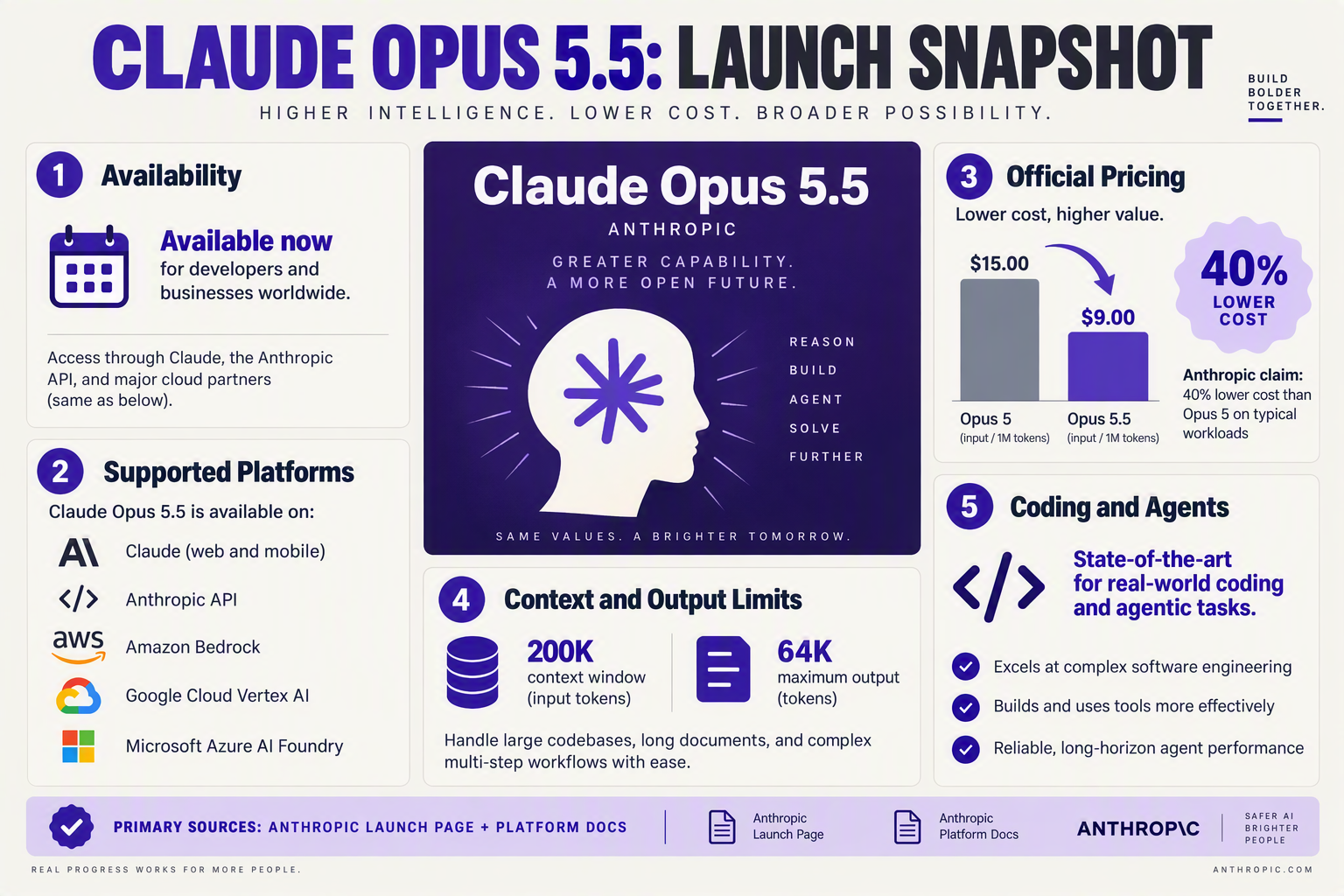
Claude Opus 5.5 is Anthropic’s updated flagship model for complex software engineering, reasoning and knowledge-work agents. At launch in September 2026, the meaningful change was not simply a larger version number: Anthropic combined new model behavior with always-on adaptive thinking, revised economics and an architecture intended for longer, tool-driven tasks.
What changed from Claude Opus 5 to Claude Opus 5.5?
Anthropic’s primary launch materials identify three broad changes beyond the context and pricing specifications outlined above:
- Adaptive reasoning became always-on. Anthropic’s September 2026 Claude Platform release notes describe Claude Opus 5.5 as using “always-on adaptive thinking,” meaning the model dynamically determines how much reasoning a request requires rather than treating deeper reasoning solely as a separately selected mode.
- Agentic coding became a central launch claim. Anthropic says Claude Opus 5.5 “leads in agentic coding and knowledge work.” This is a vendor claim and should be tested against each organization’s repositories, tools and acceptance criteria.
- Long-running work became more practical. The combination of a large working context, substantial output capacity and adaptive reasoning is designed for tasks that span code, documents and repeated tool interactions.
These changes matter because an agent’s success depends on more than answering one difficult prompt. A coding agent may need to inspect a repository, plan modifications, call search or test tools, interpret failures and revise its implementation without losing earlier constraints.
How does always-on adaptive thinking affect developers?
Always-on adaptive thinking allows Claude Opus 5.5 to vary its reasoning effort according to task complexity. A straightforward extraction request may need less internal work than debugging a distributed application or planning a multi-stage migration.
That behavior creates two practical implications:
- Prompts should describe outcomes and constraints clearly. Overly prescriptive chain-of-thought instructions may be less useful than explicit requirements, available tools, validation rules and stop conditions.
- Teams must measure full-task economics. Per-token rates do not reveal how many retries, tool calls or generated tokens an agent will consume before completing an assignment.
Developers should therefore evaluate cost per accepted task, not just cost per million tokens. Useful measures include first-pass test success, human-review time, tool-call count, output-token consumption and the percentage of tasks requiring rollback.
Where was Claude Opus 5.5 officially available at launch?
Anthropic’s Claude Platform release notes officially document Claude Opus 5.5 for API developers as of September 2026. The Anthropic launch page separately presents the model as its new offering for agentic coding and knowledge work.
Platform availability should nevertheless be verified independently. A model appearing in the Claude Platform API does not automatically prove same-day availability in every Claude application, enterprise plan or third-party cloud marketplace. Before deployment, teams should confirm:
- The exact model identifier supported by their endpoint and SDK
- Regional, account-tier and rate-limit access
- Support for required tools, streaming and structured outputs
- Availability through any cloud provider or managed platform in their stack
- Whether production traffic can roll back to Claude Opus 5
The launch is best understood as an agent-focused flagship update, not a guarantee that every workload will improve. Anthropic’s claims establish the intended direction; repository-specific coding tests and production traces determine whether Claude Opus 5.5 delivers a measurable upgrade.
Where is Claude Opus 5.5 available, and which platforms support it?
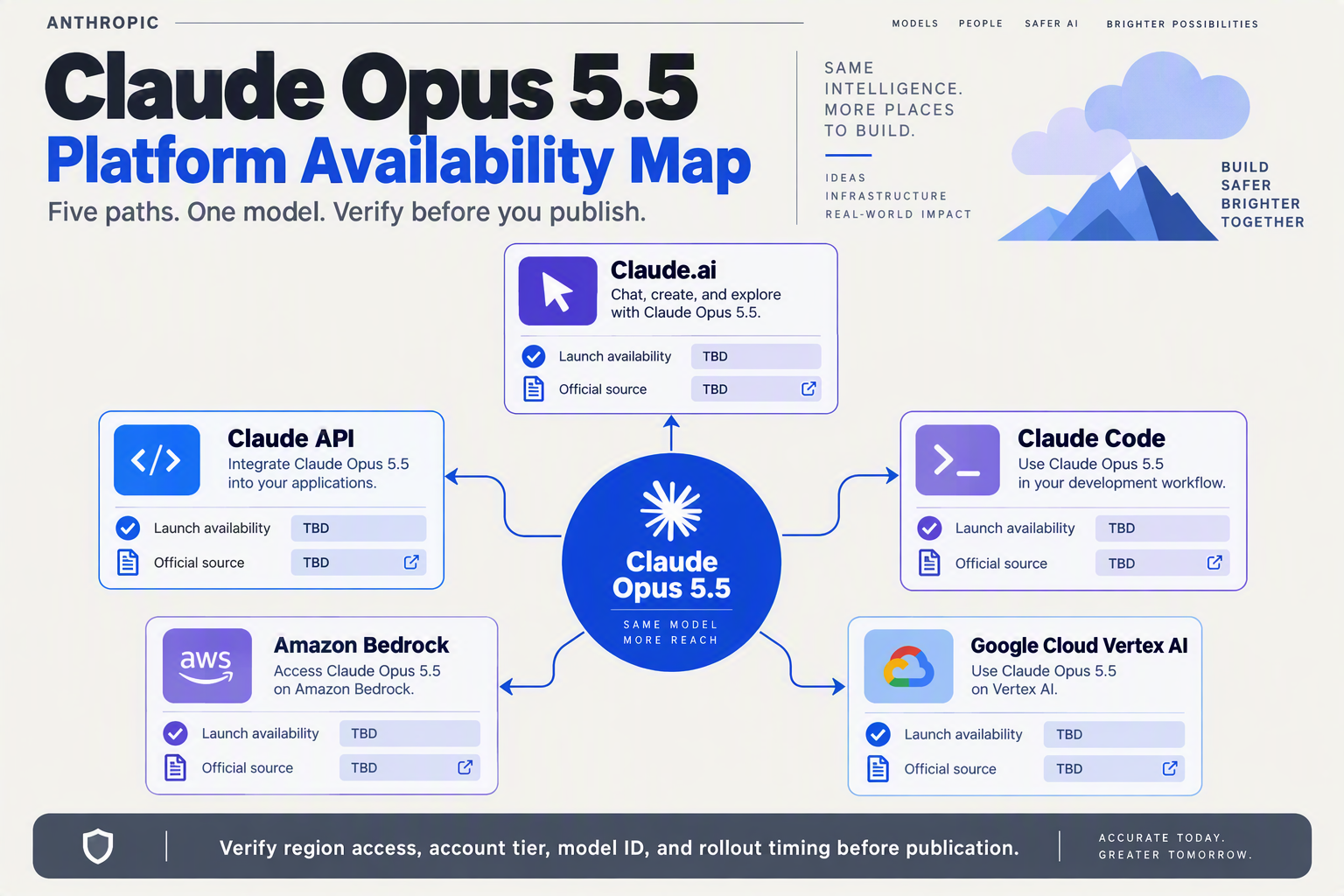
Claude Opus 5.5 is officially confirmed on the Anthropic Claude Platform API as of September 2026. The supplied primary-source materials do not independently confirm availability in every Claude subscription, Claude Code, Amazon Bedrock or Google Cloud Vertex AI, so developers should treat those channels as unverified until their respective model catalogues list Opus 5.5.
Which Claude Opus 5.5 platforms are officially confirmed?
Anthropic’s September 2026 Claude Platform release notes document Claude Opus 5.5 with API pricing, technical limits and always-on adaptive thinking. That makes the direct Claude Platform API the clearest confirmed route for production access.
| Platform or access route | Status as of September 2026 | What teams should verify |
|---|---|---|
| Anthropic Claude Platform API | Officially confirmed | Exact model identifier, account access and rate limits |
| Claude web and desktop apps | Not confirmed by the supplied model-specific sources | Plan eligibility, usage caps and model selector availability |
| Claude Code | Not confirmed by the supplied model-specific sources | Supported model name, configuration syntax and fallback behavior |
| Amazon Bedrock | Not confirmed by the supplied sources | Regional availability, model ID, quotas and Bedrock pricing |
| Google Cloud Vertex AI | Not confirmed by the supplied sources | Region, publisher model ID, quotas and Vertex AI pricing |
| Third-party AI gateways | Provider-specific | Whether Opus 5.5 is actually listed and how pricing is passed through |
“Not confirmed” does not mean unavailable. It means Anthropic’s launch page and Claude Platform release notes, as provided for this explainer, are insufficient evidence for a platform-specific availability claim.
How can developers access Claude Opus 5.5 through the API?
For direct API adoption, developers should use the exact Opus 5.5 model identifier published in the current Claude Platform documentation or returned by Anthropic’s model-discovery tooling. Avoid guessing a versioned model string from earlier Claude releases; incorrect aliases can cause failed requests or silently preserve an older configured model.
Before switching production traffic:
- Confirm account access by making a minimal request in a development project.
- Record the resolved model version rather than relying only on a floating alias.
- Check rate and token limits attached to the organisation and usage tier.
- Test adaptive thinking behavior, because Anthropic’s September 2026 release notes describe it as always on.
- Verify tool use, streaming and structured responses against the exact SDK and endpoint used in production.
Anthropic states in its September 2026 release notes that Claude Opus 5.5 supports a 1 million-token context window and a 128,000-token maximum output. Those limits apply to the documented Claude Platform model, but cloud resellers may impose separate request, quota or regional constraints.
Why can availability differ between platforms?
Model launches commonly roll out through separate control planes. Anthropic, Amazon Web Services and Google Cloud can use different model identifiers, regions, quotas, billing systems and release schedules even when they expose the same underlying model family.
Teams evaluating Claude Opus 5.5 should therefore distinguish three questions:
- Is the model listed on the platform?
- Is it enabled in the required account and region?
- Does that platform support the required context length, output limit and agent tools?
For production planning, the direct Claude Platform API is the confirmed baseline as of September 2026; every additional deployment channel requires a platform-specific catalogue and pricing check.
What are the key Claude Opus 5.5 launch developments?
Anthropic positions Claude Opus 5.5 as a lower-cost model for agentic coding, knowledge work and long-context reasoning. The launch combines a 1-million-token context window, 128,000-token maximum output, always-on adaptive thinking and API prices of $4 per million input tokens and $20 per million output tokens.
What changed in Claude Opus 5.5?
| Launch development | Anthropic’s published detail | Comparison with Claude Opus 5 | What it means operationally |
|---|---|---|---|
| Agentic coding | Anthropic claims Claude Opus 5.5 leads in agentic coding. | No benchmark figures or test conditions were supplied in the provided launch context. | Teams should test complete workflows—planning, tool calls, code edits and verification—not assume superiority from the headline alone. |
| Knowledge work | Anthropic claims the model leads in knowledge work. | The supplied source does not define the evaluated tasks or publish comparative scores. | Evaluate the model on representative research, synthesis, document analysis and structured-output tasks before migrating production workloads. |
| Context window | Anthropic’s API release notes specify a 1M-token context window, with 1 million tokens serving as both the default and maximum. | No smaller context variant is identified in the supplied information. | Applications can submit very large repositories or document collections, but teams should still control retrieval quality, prompt relevance, latency and token spending. |
| Maximum output | Claude Opus 5.5 supports up to 128K output tokens. | The supplied context does not identify a change from Opus 5. | Long outputs can support extensive code generation and reports, although applications should impose practical limits to avoid unnecessary cost or unwieldy responses. |
| Reasoning behavior | Anthropic describes adaptive thinking as always on. | The supplied context does not document an opt-out mode. | Migration testing should account for reasoning as standard model behavior and measure its effects on response time, token consumption and instruction adherence. |
| API pricing | As of September 2026, Anthropic lists $4 per million input tokens and $20 per million output tokens. | Opus 5 is listed at $5 per million input tokens and $25 per million output tokens. | The published per-token rates are 20% lower for both input and output. A request using 1 million input tokens and 100,000 output tokens would cost $6, before any other applicable platform charges. |
| Typical-workload cost | Anthropic claims Claude Opus 5.5 costs 40% less to run than Opus 5 on typical workloads. | This vendor claim is larger than the 20% reduction in headline token rates. | Buyers should not treat 40% as a universal discount; reproduce the comparison with their own prompts, outputs, tool use and agent loops. |
How should teams interpret the pricing claims?
The published API rate reduction is directly calculable: input pricing falls from $5 to $4 per million tokens, while output pricing falls from $25 to $20 per million tokens. Both changes equal a 20% reduction relative to Claude Opus 5.
Anthropic’s separate statement that Claude Opus 5.5 costs 40% less on typical workloads is a vendor claim, not a guaranteed saving for every application. The supplied primary-source context does not provide the workload mix, evaluation method or token-consumption breakdown behind that percentage.
What should developers verify before adopting Claude Opus 5.5?
- Confirm the model’s actual availability in the intended Anthropic product or API environment; the supplied context does not establish a complete platform list.
- Run regression tests for tool calling, structured outputs, coding accuracy and long-context retrieval.
- Compare total task cost rather than price per token alone, especially for multi-step agents.
- Measure output length and latency under always-on adaptive thinking.
- Set explicit output limits even though the model permits up to 128K tokens.
For teams using multi-model infrastructure, an Anthropic-compatible gateway such as CallMissed can simplify API integration through the /v1/messages endpoint, but developers should verify the current model catalogue before assuming Claude Opus 5.5 support.
How much does Claude Opus 5.5 cost, and how large is its context window?
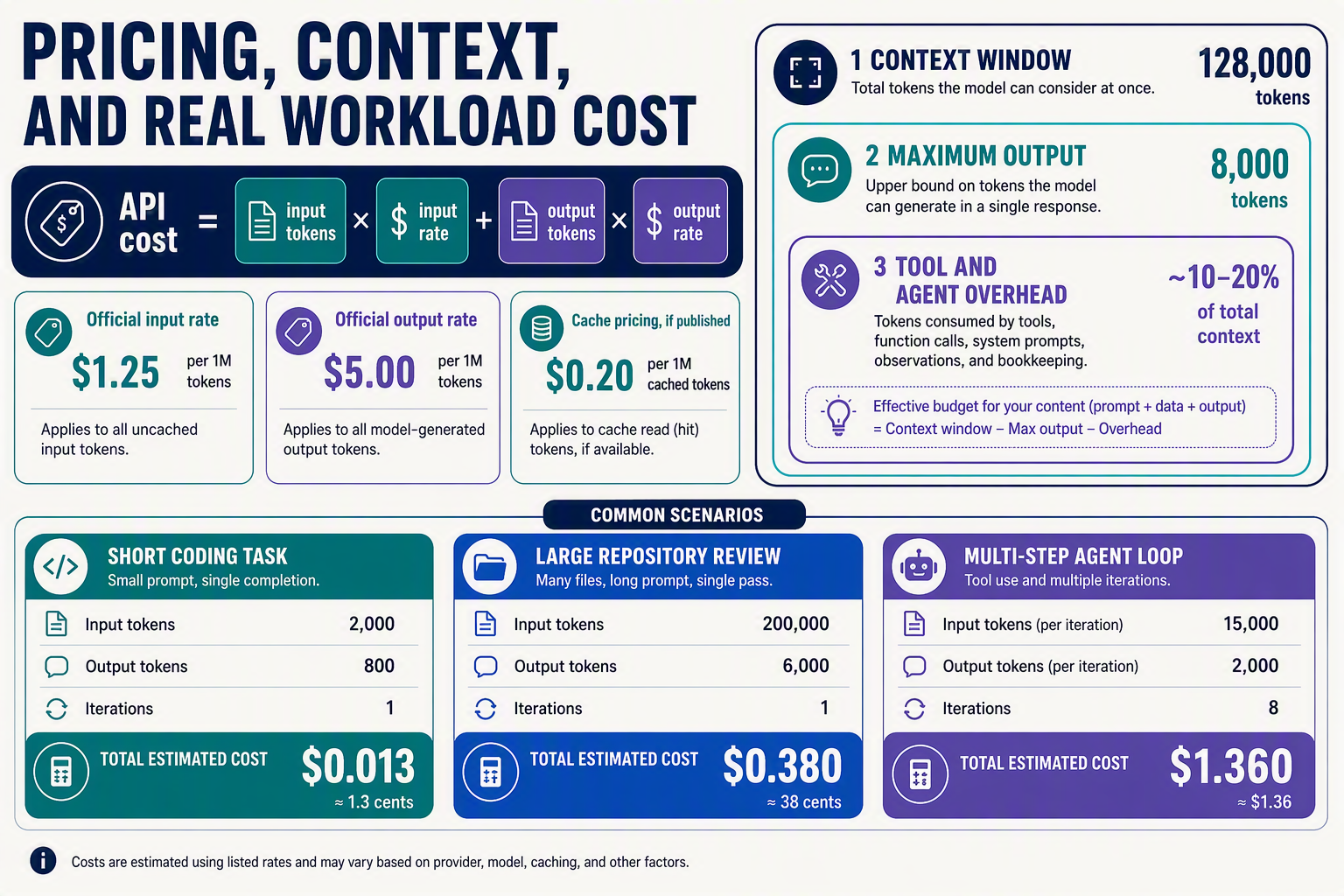
Claude Opus 5.5 costs $4 per million input tokens and $20 per million output tokens, with a 1 million-token context window and a maximum output of 128,000 tokens. Anthropic’s Claude Platform release notes list these API prices and limits as of September 2026.
What are the Claude Opus 5.5 API prices?
Anthropic bills input and output separately:
| Usage category | Claude Opus 5.5 | Claude Opus 5 | Change |
|---|---|---|---|
| 1 million input tokens | $4.00 | $5.00 | 20% lower |
| 1 million output tokens | $20.00 | $25.00 | 20% lower |
| 100,000 input tokens | $0.40 | $0.50 | 20% lower |
| 100,000 output tokens | $2.00 | $2.50 | 20% lower |
MTok means one million tokens. The basic calculation is:
Cost = (input tokens ÷ 1,000,000 × $4) + (output tokens ÷ 1,000,000 × $20)
Anthropic says Claude Opus 5.5 costs 40% less to run than Claude Opus 5 on typical workloads. That is a vendor claim about typical workload costs; the published base input and output rates themselves are each 20% lower. Teams should therefore estimate expenses using their own prompts, generated responses and agent traces rather than applying a blanket 40% discount.
How much would a Claude Opus 5.5 API request cost?
Here are several worked examples using Anthropic’s listed rates:
- 100,000 input tokens plus 10,000 output tokens:
$0.40 input + $0.20 output = $0.60.
- 1 million input tokens plus 100,000 output tokens:
$4.00 input + $2.00 output = $6.00.
- 1 million input tokens plus the 128,000-token maximum output:
$4.00 input + $2.56 output = $6.56.
- The same 1 million-input, 100,000-output workload on Claude Opus 5:
$5.00 input + $2.50 output = $7.50, versus $6.00 on Opus 5.5.
These calculations use the published base token rates only. They do not assume unconfirmed cache pricing, discounts or other adjustments.
Is the 1 million-token context window also the output limit?
No. Context window and maximum output are different limits. Anthropic’s September 2026 release notes state that Claude Opus 5.5 has a 1 million-token context window by default, and 1 million tokens is also the maximum; there is no smaller context variant.
The context window governs how much information the model can work with during a request. The 128K maximum output separately limits how many tokens Claude Opus 5.5 can generate in one response. A 1 million-token context window therefore does not mean the model can produce a 1 million-token answer.
Why can agentic workflows cost more than one calculation suggests?
An agent rarely makes only one model call. It may generate a plan, invoke tools, read results, revise its reasoning and repeat the loop. Each turn can add billable input and output tokens.
Actual agent cost consequently depends on:
- how much conversation or repository context is resent;
- how many tool-use loops the agent performs;
- how verbose its generated reasoning and answers are;
- whether failed steps trigger retries; and
- any applicable pricing adjustments on the account or platform.
For reliable budgeting, log token usage across the entire agent run, not merely the final response.
What does Anthropic claim about Opus 5.5 coding and reasoning?
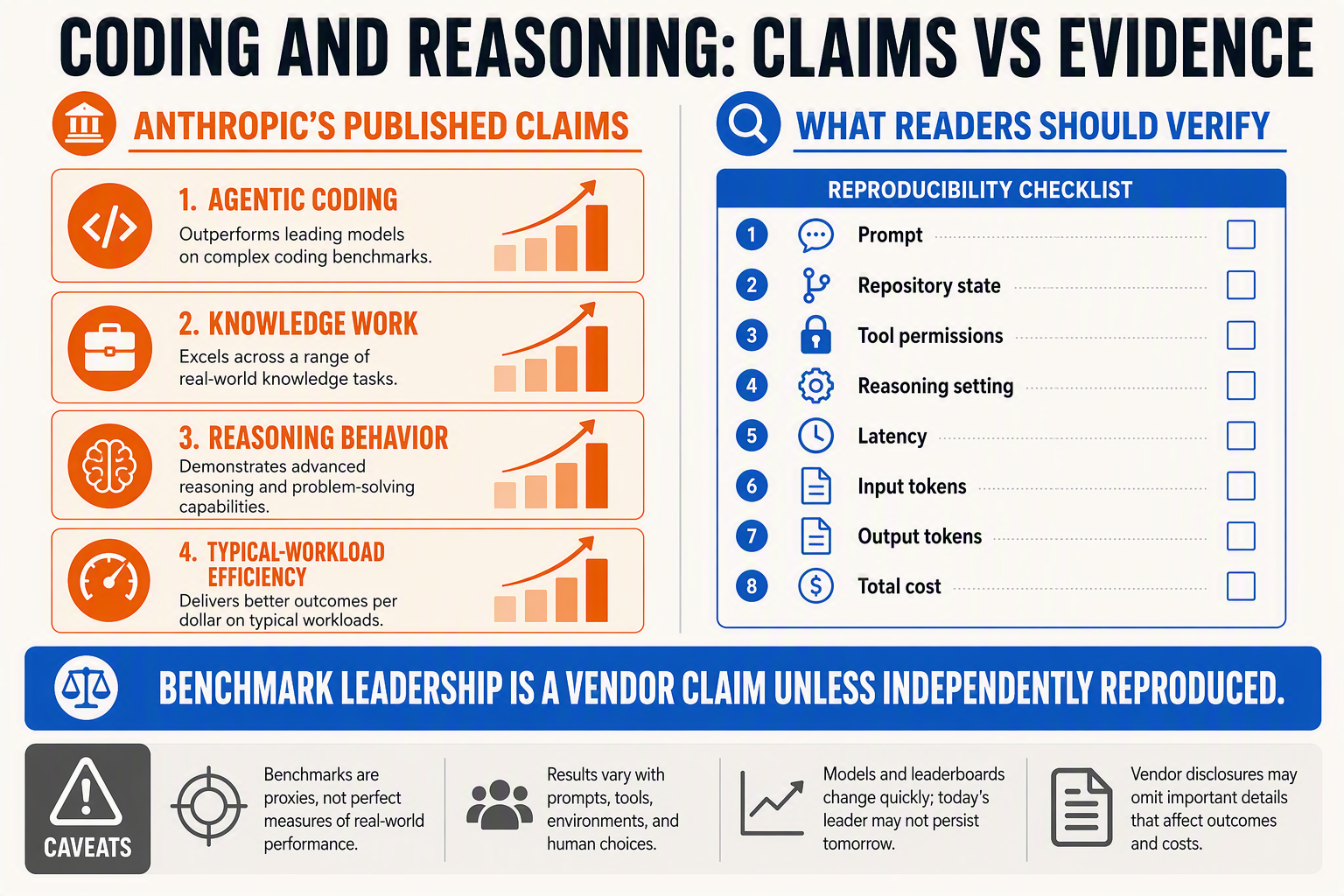
Anthropic claims Claude Opus 5.5 leads in agentic coding and knowledge work and costs 40% less than Claude Opus 5 on typical workloads. These are vendor claims from Anthropic’s September 2026 launch materials—not independent benchmark conclusions—and teams should validate them against their own repositories, tools, and production traffic.
What does “leads in agentic coding” mean?
Anthropic uses agentic coding to describe work that goes beyond generating an isolated function or code snippet. Typical agent tasks involve inspecting a repository, planning changes, editing several files, calling tools, running tests, diagnosing failures, and iterating toward a completed objective.
For buyers, “leads” should therefore be treated as a hypothesis to test rather than a universal ranking. Performance can change materially based on:
- Repository size, language, framework, and test coverage
- Prompt design and available repository context
- Tool definitions, permissions, and error handling
- Task duration and the number of required iterations
- Whether success is judged by tests, human review, or deployment outcomes
Anthropic’s launch announcement, accessed in September 2026, states that Claude Opus 5.5 leads in agentic coding and knowledge work; Anthropic does not establish through that sentence alone that the model leads every independent benchmark or every real-world workload.
How does always-on adaptive thinking affect reasoning?
Anthropic’s Claude Platform release notes describe Claude Opus 5.5 as using always-on adaptive thinking. This means reasoning behavior is built into normal model operation rather than presented merely as an optional mode that developers must enable for selected requests.
Adaptive thinking may be relevant to multi-step debugging, research synthesis, tool selection, and planning. However, the feature name does not by itself prove greater accuracy, lower latency, or better economics. Teams should check whether additional reasoning produces more accepted results or simply adds tokens and response time for straightforward tasks.
Anthropic’s September 2026 API release notes list Claude Opus 5.5 at $4 per million input tokens and $20 per million output tokens, compared with $5 and $25 respectively for Claude Opus 5. Those published rates are 20% lower at an identical token mix, so Anthropic’s separate claim of 40% lower cost on typical workloads should be understood as a workload-level vendor estimate that may also reflect differences in token consumption—not as a direct calculation from list prices alone.
How should teams test Claude Opus 5.5?
Run a paired evaluation using identical prompts, tool permissions, repositories, timeouts, and retry policies. Include representative production tasks rather than relying only on short coding puzzles.
Measure at least these dimensions:
- Accepted-task rate: Percentage of outputs approved without substantial correction.
- Test performance: Unit, integration, regression, and hidden-test pass rates.
- Human review time: Minutes engineers spend understanding, correcting, or rejecting each change.
- Token cost: Input and output tokens multiplied by official API prices, reported per accepted task.
- Tool-call efficiency: Total calls, failed calls, redundant calls, and recovery after tool errors.
- Latency: Median and tail completion times, including end-to-end agent execution.
- Change quality: Security findings, regressions, unnecessary edits, and maintainability concerns.
A credible upgrade decision should prioritize cost per accepted task, not price per token alone. Claude Opus 5.5 is most compelling if its claimed coding and reasoning gains survive reproducible tests under the same constraints your production agents face.
How should Claude Opus 5.5 be used in long-running agentic workflows?
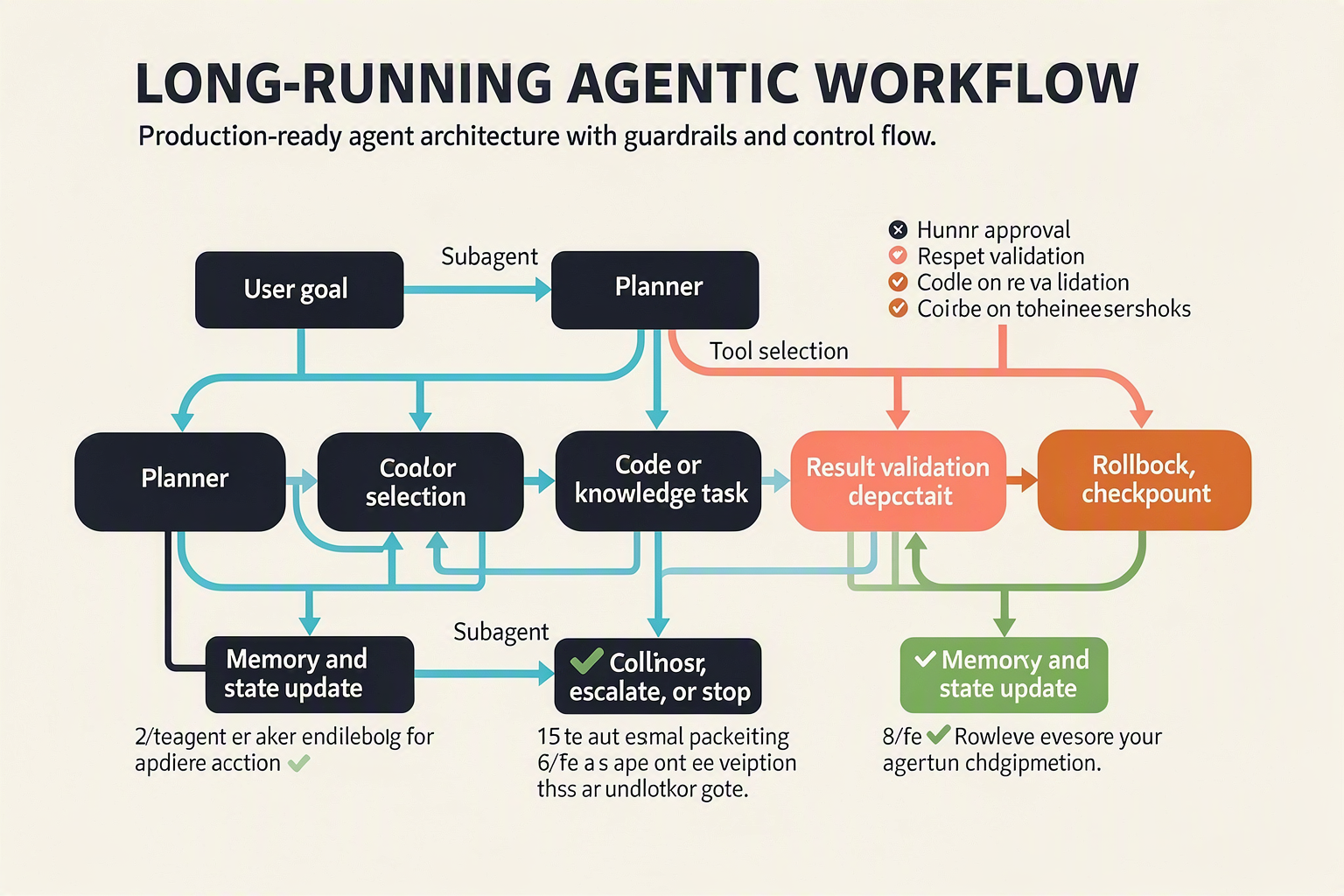
Claude Opus 5.5 should be used as a bounded agent inside a controlled workflow, not as an unrestricted autonomous operator. Give the model a narrowly scoped objective, explicit completion tests, limited tools, persistent artifacts, and mandatory approval gates for consequential actions.
How do you scope a long-running Claude Opus 5.5 agent?
Anthropic’s Claude Platform release notes state in September 2026 that Claude Opus 5.5 has a 1-million-token context window, a 128,000-token maximum output, and always-on adaptive thinking. These capacities support large codebases and lengthy tasks, but they do not guarantee accuracy, low latency, or successful autonomous completion.
Start each run with a task contract containing:
- Objective: Define one measurable outcome, such as “upgrade this service and preserve its documented API behavior.”
- Boundaries: Identify directories, systems, data, or infrastructure the agent must not modify.
- Success criteria: Require passing tests, clean static analysis, expected benchmark ranges, or schema validation.
- Permitted tools: Allow only the repositories, shells, databases, browsers, or APIs needed for the assignment.
- Stop conditions: End the run after a time limit, spending threshold, repeated failure, or unexpected environmental change.
Break broad projects into scoped stages. For a software migration, that might mean inventorying dependencies, drafting a plan, modifying one component, running tests, reviewing the diff, and only then continuing.
How should checkpoints and context be managed?
A 1-million-token context window is working context, not permanent memory. Long-running agents should save durable artifacts outside the conversation rather than repeatedly carrying every log, source file, and intermediate response.
At each checkpoint, require Claude Opus 5.5 to write:
- A compact summary of completed work.
- Decisions made and evidence supporting them.
- Files, records, or systems changed.
- Failed approaches and unresolved risks.
- The next approved action.
Store detailed artifacts—test reports, patches, plans, command outputs, and source references—in a retrievable workspace. On resumption, load the latest checkpoint plus only the artifacts relevant to the next step. This approach reduces context clutter and makes interrupted runs easier to audit or roll back.
What controls should an agentic tool loop include?
Tool access should follow least-privilege design. Read access can be broad where justified, while write, deployment, payment, deletion, customer-contact, and security-related operations should require narrower permissions.
A dependable loop is:
- Propose the next action and expected result.
- Execute through an allow-listed tool.
- Capture the tool response and resulting diff.
- Run tests, validators, or independent checks.
- Retry within a fixed limit or escalate with evidence.
- Record a checkpoint before moving to another subsystem.
Infrastructure such as CallMissed’s developer AI API can support controlled orchestration with function calling, structured outputs, caller-selected fallback models, and usage and request logs, as of September 2026. These controls help developers constrain and observe a workflow; they do not make model output inherently correct.
When should a human approve the agent’s work?
Require explicit human approval before production deployment, destructive database changes, credential rotation, financial transactions, external communications, permission changes, or handling sensitive data. Reviewers should see the proposed action, affected resources, validation results, estimated impact, and rollback plan.
Always-on adaptive thinking can help Claude Opus 5.5 allocate reasoning to complex steps, but organizations should still impose token budgets, cost ceilings, execution timeouts, retry limits, validation loops, and kill switches. The safest long-running agent is not the one given unlimited independence; it is the one designed to stop predictably when evidence is incomplete.
How do you migrate to Claude Opus 5.5 without production regressions?
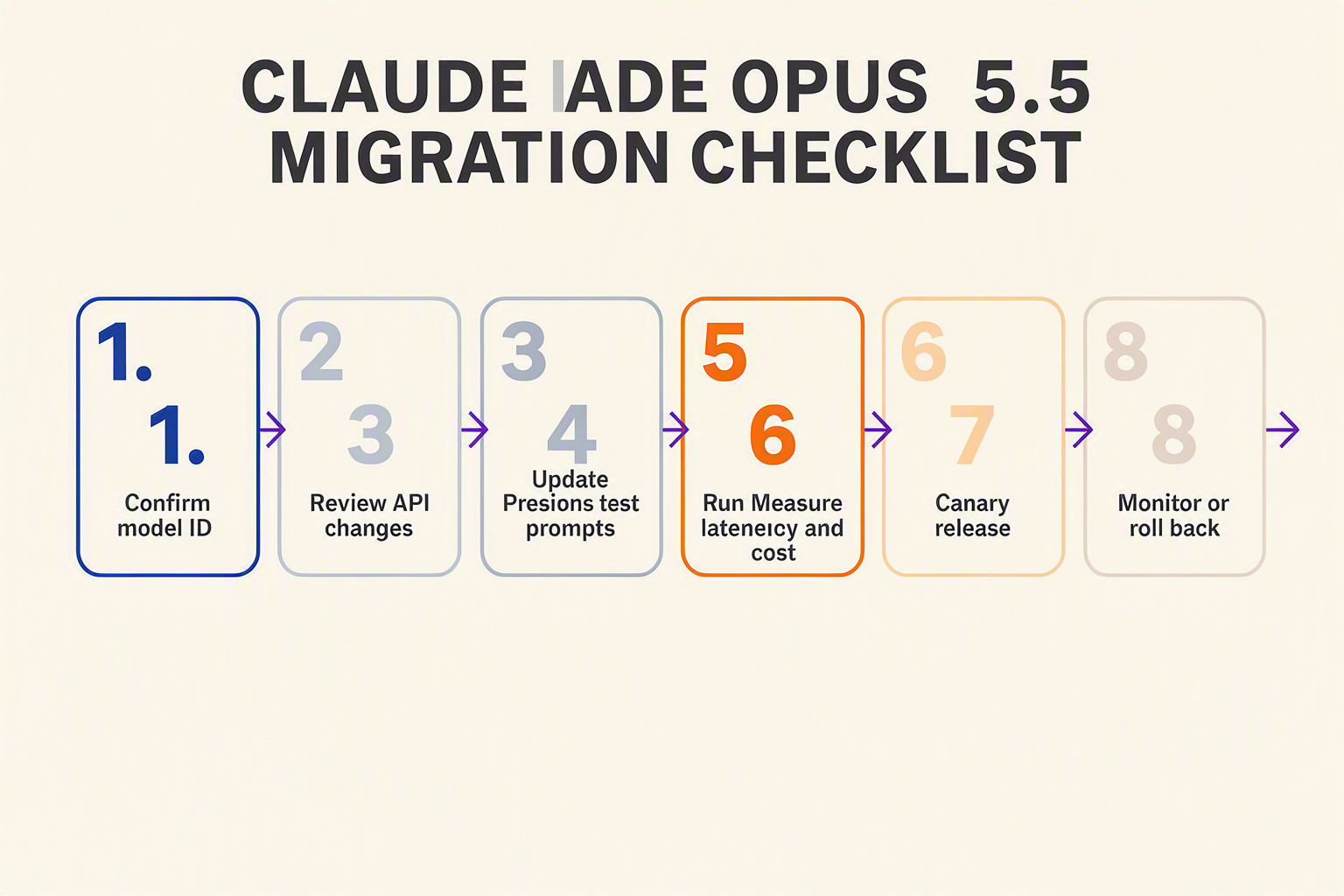
Migrate to Claude Opus 5.5 by treating the model change as a versioned production release: verify Anthropic’s current model identifier, replay representative workloads, canary real traffic, and retain Claude Opus 5 as an immediate rollback target. Do not assume that prompts, tool calls, token usage, or latency will remain identical merely because both models belong to the Claude Opus family.
What should you verify before changing the model ID?
- Confirm the exact model ID in Anthropic’s current documentation or console. Model aliases and dated identifiers can differ, so do not infer the Claude Opus 5.5 API name from earlier naming patterns.
- Confirm availability for your actual deployment path. Check the Anthropic API and each cloud or marketplace account separately rather than assuming simultaneous availability across platforms.
- Record the existing configuration. Preserve the Claude Opus 5 model ID, system prompt, sampling parameters, tool definitions, output schema, token limits, retry policy, and timeout settings.
- Check account-specific rate limits and quotas. Published platform defaults may not match the limits applied to your organization, usage tier, region, or provider account.
Keep the model selection behind a feature flag or configuration variable. That makes rollback a configuration change instead of an emergency code deployment.
Which regression tests should run before migration?
Build an evaluation set from real, anonymized production requests, including successful cases and known failures. Test Claude Opus 5 and Claude Opus 5.5 side by side for:
- Prompt adherence: required instructions, formatting, refusals, tone, and domain constraints.
- Tool use: tool selection, argument validity, parallel or sequential calls, retry behavior, and completion after tool errors.
- Structured responses: JSON-schema validity, required fields, enum compliance, escaping, and truncated objects.
- Agentic workflows: task completion, loop frequency, unnecessary tool calls, recovery from failed steps, and human-escalation triggers.
- Coding tasks: patch correctness, test-pass rate, repository navigation, dependency changes, and security-sensitive edits.
Anthropic says Claude Opus 5.5 costs 40% less than Claude Opus 5 on typical workloads, as of September 2026, but that is a vendor claim rather than a guarantee for every application. Calculate your own cost per completed task, not simply cost per token.
How should you test context, output, cost, and latency?
Anthropic’s Claude Platform release notes list a 1 million-token context window and a 128,000-token maximum output for Claude Opus 5.5 as of September 2026. Test behavior near both limits rather than assuming that a request accepted by Claude Opus 5 will produce equivalent output.
Include cases with:
- Short prompts, typical conversations, and near-1M-token inputs.
- Requested outputs approaching 128K tokens, including truncation and continuation handling.
- Large tool results, long conversation histories, and retrieval documents.
- Identical workloads measuring input tokens, output tokens, cache effects, time to first token, total latency, retries, and task success.
Longer outputs can erase per-token savings, while more reliable completion may reduce retries and total workflow cost.
How should the production rollout work?
Start with internal traffic, then route a small percentage of eligible production requests to Claude Opus 5.5. Increase exposure only when quality, schema validity, tool success, latency, error rates, and cost remain within predefined thresholds.
Monitor by model version, not as one blended Claude metric. Keep Claude Opus 5 available until Claude Opus 5.5 has passed peak-load periods, long-context workloads, and failure-recovery tests; automatically roll back if errors, malformed responses, latency, or task cost breach your release guardrails.
Which launch claims matter most, and what remains uncertain?

The most decision-relevant Claude Opus 5.5 launch facts are its 1-million-token context window, 128K maximum output, always-on adaptive thinking, and $4/$20 per million-token API pricing. Claims about leadership and lower workload costs come from Anthropic, however, and should be validated against each team’s own applications before migration.
Which Claude Opus 5.5 specifications are officially documented?
As of September 2026, Anthropic’s Claude Platform release notes document the following Claude Opus 5.5 specifications:
- Context window: 1 million tokens by default and at maximum, with no smaller context variant.
- Maximum output: 128,000 tokens.
- Reasoning behavior: Always-on adaptive thinking, which lets the model dynamically apply reasoning rather than requiring developers to enable a separate thinking mode.
- API price: $4 per million input tokens and $20 per million output tokens.
These specifications establish capacity and list price—not application-level performance. For example, a request containing 250,000 input tokens and producing 20,000 output tokens would have a base model cost of $1.40: $1.00 for input and $0.40 for output, before considering retries, tool loops or platform-specific charges.
A 1-million-token context window also does not guarantee that every token contributes equally to a result. Teams should test retrieval accuracy, instruction retention and evidence use at different prompt lengths rather than treating maximum context as maximum usable context.
Which statements are Anthropic’s launch claims?
Anthropic’s Claude Opus 5.5 launch announcement says the model “leads in agentic coding and knowledge work” and “costs 40% less to run than Opus 5 on typical workloads.” These are vendor claims, not universal conclusions about every repository, agent or production environment.
The 40% figure should not be interpreted simply as a comparison of published token prices. Anthropic’s release notes list Claude Opus 5.5 at $4/$20 per million input/output tokens and Claude Opus 5 at $5/$25—a 20% reduction in both listed rates. The larger typical-workload saving may reflect differences in token consumption, tool use, completion length or task efficiency, but each deployment needs its own measurement.
What remains uncertain until teams run evaluations?
A controlled trial should measure:
- Prompt compatibility: Existing prompts may behave differently with always-on adaptive thinking.
- Repository performance: Test real codebases, dependency graphs, test suites and coding conventions—not isolated coding questions.
- Tool configuration: Agent results depend on tool schemas, permissions, error handling, timeouts and maximum loop counts.
- Output volume: At $20 per million output tokens, verbose reasoning, generated code and repeated tool calls can materially affect cost.
- Effective cost: Track total input, output, retries and failed runs per completed business task.
- Latency and limits: Measure time to first token, end-to-end completion time, concurrency and the rate limits assigned to the account.
- Platform availability: Confirm the exact model identifier and feature support on the Anthropic API, Claude products and any cloud or gateway platform being considered.
For multi-model testing, CallMissed’s OpenAI-compatible developer API provides one key and balance across 136 models, with usage and request logs and caller-chosen fallbacks as of September 2026. Whatever platform teams use, the sound conclusion is the same: treat Claude Opus 5.5’s specifications as documented facts, Anthropic’s performance statements as hypotheses, and production traces as the final evidence.
Who should upgrade to Claude Opus 5.5, and who should wait?
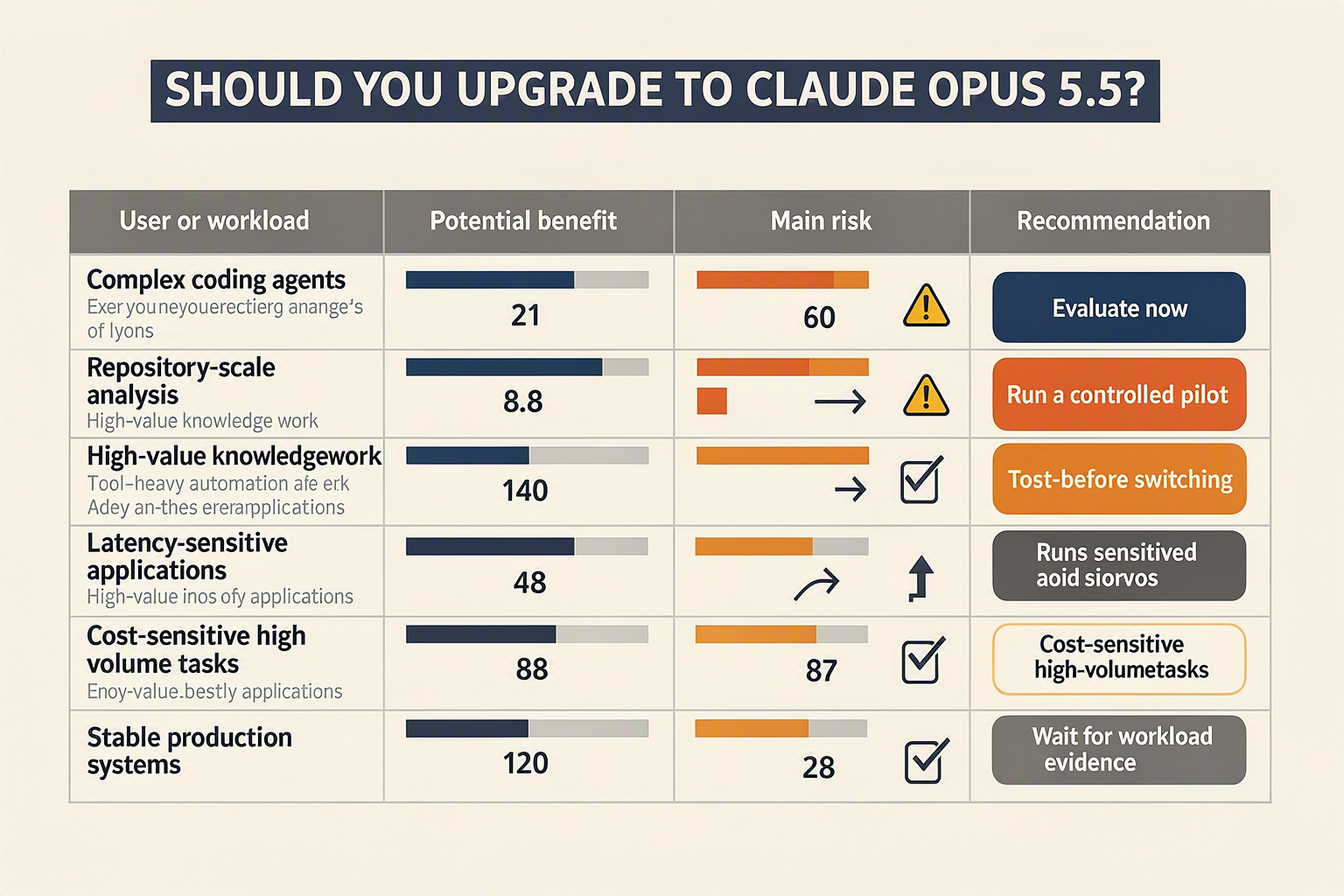
Teams should upgrade to Claude Opus 5.5 when long-context analysis, agentic coding, or complex knowledge work can deliver measurable gains—and when they can test those gains before full deployment. Teams without evaluation, observability, or rollback controls should wait, especially if they do not need the 1-million-token context window or 128K-token maximum output.
Which teams are strong candidates for Claude Opus 5.5?
| Team or workload | Recommendation | Why | Validation gate | Cost implication |
|---|---|---|---|---|
| Large-repository engineering teams | Upgrade in stages | The 1M-token context can accommodate substantial codebases, specifications, and issue history in one request. | Test repository navigation, patch accuracy, tool calls, latency, and regressions on real tasks. | $4/MTok input and $20/MTok output. |
| Agentic coding teams | Pilot now | Anthropic says Claude Opus 5.5 leads in agentic coding, making it relevant to long-horizon tasks involving planning, tools, and iterative execution. | Run sandboxed tasks with approval gates, timeout limits, and rollback paths. | Compare total task cost, not just per-token pricing. |
| Legal, research, and knowledge-work teams | Upgrade selectively | Long context and 128K output can support multi-document synthesis and unusually large generated reports. | Measure citation accuracy, omission rates, unsupported claims, and review time. | Savings depend on prompt size and output length. |
| Existing Claude Opus 5 API users | Evaluate migration | List prices are 20% lower for both input and output than Opus 5. | Shadow traffic, pin model versions, and retain an Opus 5 rollback route. | Opus 5.5 is $4/$20 versus Opus 5 at $5/$25 per MTok. |
| Teams using short prompts and brief responses | Wait or benchmark alternatives | A 1M context window and 128K output ceiling offer little value when requests are small and straightforward. | Compare quality, latency, and cost against the current production model. | Lower list prices do not guarantee the lowest cost per successful task. |
| Teams without model evaluations or rollback | Wait | Agentic and reasoning changes can alter tool use, formatting, and completion behavior. | Build a regression suite, canary deployment, monitoring, and rollback procedure first. | Uncaught failures can outweigh token savings. |
| Teams dependent on an unconfirmed channel | Wait for official support | The supplied primary sources confirm Claude Platform details but do not establish availability on every app, cloud marketplace, or third-party service. | Verify the exact model identifier and regional availability in that channel’s documentation. | Do not budget around access that has not been confirmed. |
How much could an upgrade save?
As of September 2026, Anthropic’s Claude Platform release notes price Claude Opus 5.5 at $4 per million input tokens and $20 per million output tokens, compared with $5 and $25 respectively for Claude Opus 5. Those published rates represent a 20% list-price reduction in each direction.
For example, a request consuming 1 million input tokens and producing 100,000 output tokens would cost approximately $6 with Claude Opus 5.5, versus $7.50 with Claude Opus 5, before any separate caching, tooling, or infrastructure charges.
Anthropic also claims Claude Opus 5.5 costs 40% less than Opus 5 on typical workloads. That is a vendor-reported workload claim—not a universal discount—and should be validated against each organization’s prompt lengths, retries, tool calls, completion rates, and human-review requirements.
What should teams test before migrating?
A safe upgrade should include:
- A representative set of coding, reasoning, and document-analysis tasks
- Quality, latency, token use, tool-call success, and total cost measurements
- Canary traffic rather than an immediate model-wide switch
- Version-pinned prompts and structured-output checks
- A tested rollback path to Claude Opus 5 or another approved model
The practical rule is simple: upgrade for demonstrated task-level value, not specifications alone.
Frequently Asked Questions
What is the Claude Opus 5.5 API price?
What are the Claude Opus 5.5 context-window and output limits?
Is Claude Opus 5.5 available through the Claude Platform API?
Is Claude Opus 5.5 available through third-party AI gateways?
Is Claude Opus 5.5 better for coding, reasoning, and agentic workflows?
How much cheaper is Claude Opus 5.5 than Claude Opus 5?
How should developers migrate to Claude Opus 5.5 safely?
Conclusion
Claude Opus 5.5 is a meaningful flagship update, but adoption should depend on measured production results rather than launch messaging alone.
- Confirmed specifications: Anthropic’s September 2026 Claude Platform release notes list a 1 million-token context window, 128,000-token maximum output, and always-on adaptive thinking.
- Lower API rates: As of September 2026, Anthropic prices Claude Opus 5.5 at $4 per million input tokens and $20 per million output tokens, down from $5 and $25 for Claude Opus 5.
- Vendor performance claims: Anthropic says Claude Opus 5.5 “leads in agentic coding and knowledge work” and costs 40% less to run than Opus 5 on typical workloads. Those claims require workload-specific validation because token prices alone do not capture retries, tool calls, latency or human-review effort.
- Migration strategy: Upgrade in stages by testing representative repositories and agent workflows, monitoring cost per accepted task and end-to-end latency, and retaining a documented rollback path.
Next, watch for broader platform availability, detailed migration guidance and independent evidence on long-running agent reliability. Developers exploring the wider shift toward model-powered communication can also evaluate CallMissed, an AI customer-communication platform and developer API offering OpenAI- and Anthropic-compatible endpoints.
Will Claude Opus 5.5 reduce your total task cost—or simply change where that cost appears?
Related Reading
- Claude Opus 5 Migration Guide: API Pricing for 2026
- Claude Opus 5.5 vs Gemini 3.8 Flash: API Buyer Guide
- Claude Fable 5.1 vs GPT-6 Astra Pricing: Real API Costs in 2026
Sources
Discussion
Related Posts


Ready to automate customer conversations?
Launch AI voice agents and WhatsApp bots with CallMissed — one API, 22+ Indian languages.