
Claude Fable 5.1 vs Opus 5.5: Verified Comparison Guide



Verify the Opus 5.5 name and compare Fable 5.1 with official Opus 5 on pricing, coding, reasoning, speed, writing and agentic work.
Claude Fable 5.1 vs Opus 5.5: Verified Comparison Guide
Here is the surprising finding: as of September 22, 2026, Anthropic’s supplied newsroom and platform documentation verifies Claude Fable 5.1 and Claude Opus 5—but not a model named Claude Opus 5.5. Any responsible Claude Opus 5.5 vs Claude Fable 5.1 comparison must therefore separate documented facts from assumptions, leaked labels, or unsupported benchmark claims.
Claude Fable 5.1 is real, newly announced, and positioned above the default model for especially difficult workloads. Anthropic introduced Claude Fable 5.1 on September 1, 2026, describing its new models as its “most advanced models for coding and knowledge work.” Anthropic’s model overview recommends starting with Claude Opus 5 for most workloads, while selecting Claude Fable 5.1 for demanding reasoning and long-horizon agentic work. That distinction matters when an AI system must navigate a large codebase, use tools repeatedly, preserve context across many steps, or complete a task with limited human supervision.
The price difference is equally consequential. Anthropic priced Claude Fable 5.1 at $10 per million input tokens and $50 per million output tokens as of September 2026. Anthropic also priced Fable 5.1 cache reads at $0.25 per million tokens, equivalent to 2.5% of its standard input rate. For agents that repeatedly reference the same repository, policy library, or project history, prompt caching can materially change the effective cost per completed task—even when the model’s headline token price looks high.
Availability is clearer than the naming confusion. Anthropic stated on September 1, 2026, that Claude Fable 5.1 was available across its platforms, including Amazon Web Services, Google Cloud and Microsoft Azure. By contrast, the supplied official sources do not establish Claude Opus 5.5 pricing, availability, specifications, or benchmark results. This guide will not invent them; where appropriate, it will use the officially documented Claude Opus 5 positioning as the valid comparison point.
The sections ahead will examine:
- Coding: implementation quality, repository-scale changes, debugging and agentic coding
- Reasoning: when deeper inference may justify greater token expenditure
- Long-horizon agents: tool use, persistence, recovery and supervision requirements
- Writing: clarity, style control and whether extra reasoning improves the final text
- Speed and cost: latency expectations, caching and cost per successful task
- Model selection: practical choices for startups, enterprises, developers and AI-agent builders
This comparison also reflects a wider shift toward model portability: as of September 2026, CallMissed’s developer API offers 136 models through one API key and balance, alongside an Anthropic-compatible /v1/messages endpoint. The central question is no longer simply which model is more capable—it is which verified model delivers the right reliability, speed and economics for your workload.
Is Claude Fable 5.1 or Claude Opus 5.5 the better model?
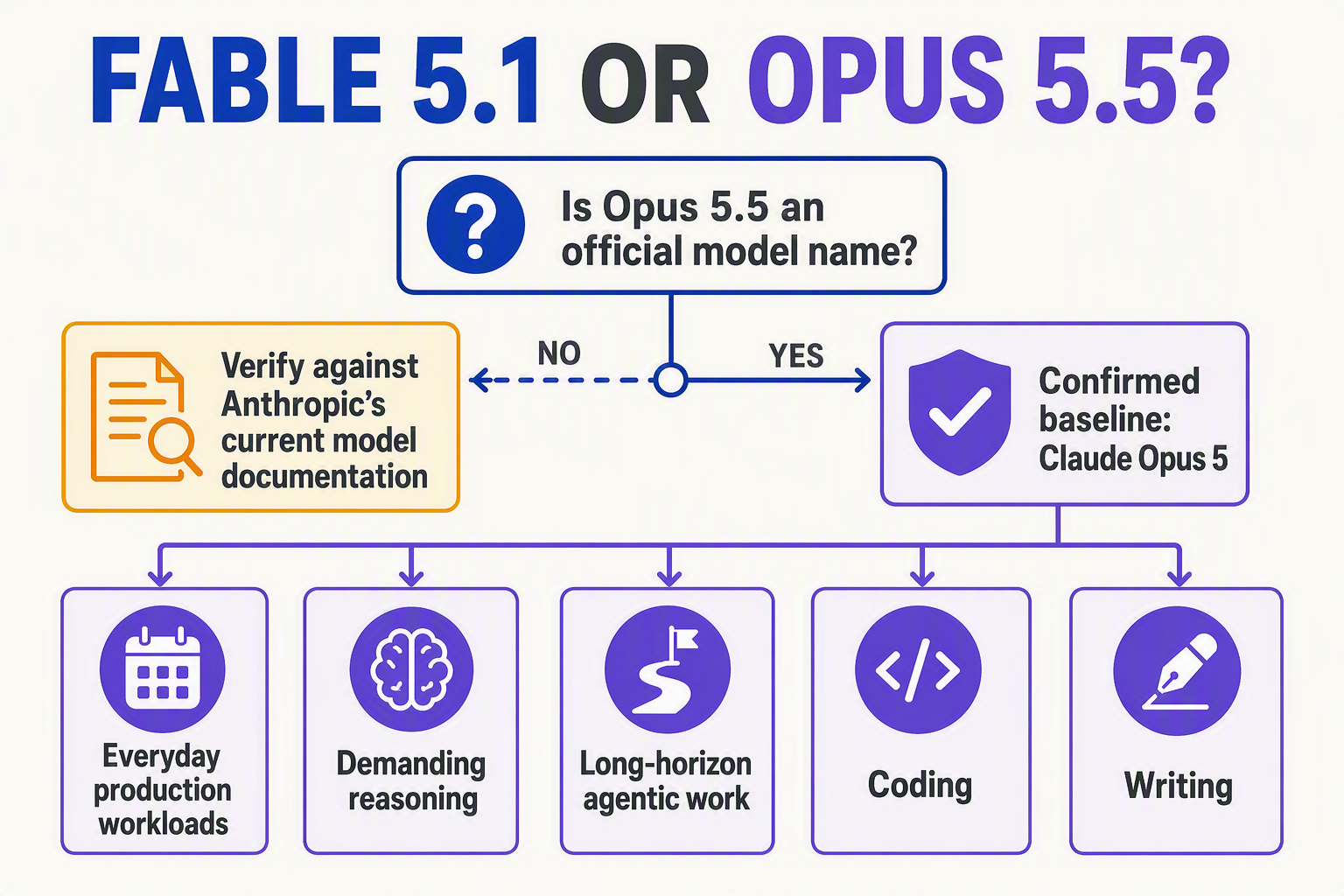
Claude Fable 5.1 is the better documented choice for demanding reasoning and long-horizon agentic work, while Claude Opus 5 is Anthropic’s recommended starting point for most workloads. A verdict on Claude Opus 5.5 vs Claude Fable 5.1 is not currently possible because Anthropic’s supplied official documentation does not verify a model named Claude Opus 5.5 as of September 22, 2026.
What is the verified Fable 5.1 vs Opus 5 positioning?
Anthropic’s Claude Platform model overview says, “If you’re unsure which model to use, start with Claude Opus 5 for most workloads.” The same documentation recommends Claude Fable 5.1 for demanding reasoning and long-horizon agentic work.
That guidance creates a practical hierarchy based on workload rather than a blanket ranking:
- Choose Claude Opus 5 by default for general coding, writing, analysis and knowledge tasks where Fable’s deeper agentic positioning is unnecessary.
- Escalate to Claude Fable 5.1 when a task requires sustained reasoning, repeated tool use or progress across a long sequence of dependent steps.
- Do not select “Claude Opus 5.5” for production until Anthropic publishes an official model identifier, price, availability statement and technical documentation.
Anthropic announced Claude Fable 5.1 on September 1, 2026, alongside Claude Mythos 5.1, calling the releases its “most advanced models for coding and knowledge work.” Anthropic’s system card describes Fable 5.1 and Mythos 5.1 as configurations of its “latest and most capable large language model.”
Which model is better for coding, reasoning and writing?
The answer depends on how much autonomy the task requires.
- Coding: Start with Claude Opus 5 for bounded implementation, explanation and debugging tasks. Consider Claude Fable 5.1 for repository-scale work in which an agent must inspect files, plan changes, invoke tools and revise its approach over many steps.
- Reasoning: Claude Fable 5.1 has the stronger official positioning for demanding inference. However, the supplied sources provide no verified head-to-head benchmark proving that Fable wins every reasoning task.
- Long-horizon agents: Fable 5.1 is the clearer choice when completion depends on maintaining a plan over extended tool interactions. Anthropic separately says that Fable-class models represent a major increase in “intelligence and agentic capabilities.”
- Writing: Claude Opus 5 remains the sensible starting point for routine drafting, editing and summarisation. Fable 5.1 may be justified when writing depends on complex source synthesis or prolonged research, but no official evidence here establishes universally better prose.
Is Claude Fable 5.1 worth its higher task cost?
Claude Fable 5.1 cost $10 per million input tokens and $50 per million output tokens, according to Anthropic in September 2026. Anthropic also priced Fable 5.1 cache reads at $0.25 per million tokens, or 2.5% of its standard input price, as of September 2026.
The decision should therefore use cost per successful task, not token price alone. Fable can be economical when deeper reasoning prevents retries, but Opus 5 is likely the more proportionate default when tasks are short and predictable. Anthropic has not supplied verified Opus 5.5 pricing or comparative speed figures, so claims that “5.5” is faster, cheaper or more capable would be speculation.
Why must the Opus 5.5 model name be verified first?

The Opus 5.5 name must be verified because model identity determines whether every subsequent claim—pricing, benchmarks, API IDs and availability—is attached to a real product. As of September 22, 2026, the supplied Anthropic sources document Claude Opus 5, Claude Fable 5.1 and Claude Mythos 5.1, but they do not verify a model called Claude Opus 5.5.
Is Claude Opus 5.5 an officially documented Anthropic model?
Not in the official evidence available for this comparison. Anthropic’s Models Overview, Pricing documentation, Newsroom, model cards and Claude Fable 5.1 and Claude Mythos 5.1 System Card provide a consistent naming trail without establishing Claude Opus 5.5.
The distinction is precise:
- Claude Opus 5 is the documented starting recommendation for most workloads in Anthropic’s Models Overview as of September 2026.
- Claude Fable 5.1 is the documented option for “demanding reasoning and long-horizon agentic work,” according to Anthropic’s Models Overview as of September 2026.
- Claude Opus 5.5 has no verified model card, API identifier, price sheet or release announcement in the supplied Anthropic materials as of September 22, 2026.
Absence from these sources does not prove that Anthropic could never announce that name. It means Claude Opus 5.5 cannot responsibly be treated as an available model today.
Why can’t Claude Opus 5 pricing or benchmarks be assigned to Opus 5.5?
A decimal version number is not a cosmetic label. Model revisions can change weights, context behavior, safety controls, latency, token pricing, regional availability and API identifiers. Copying Claude Opus 5 results into an “Opus 5.5” column would create unsupported data rather than a useful comparison.
The same rule applies to cost claims. Anthropic’s documented September 2026 pricing establishes Fable 5.1 at $10 per million input tokens and $50 per million output tokens, but the supplied sources establish no corresponding Opus 5.5 rates. Therefore, this article will mark Opus 5.5 pricing as unverified, not estimate it from another model.
How should an AI model name be verified?
A dependable verification process checks primary sources in this order:
- Release announcement: Confirm the exact public name and announcement date in the Anthropic Newsroom.
- Platform documentation: Find the model in Anthropic’s Models Overview and model-card catalogue.
- API identifier: Verify the deployable model string rather than relying on a display name or screenshot.
- Pricing page: Match input, output and prompt-caching prices to that exact model.
- Availability statement: Confirm whether access covers the Claude platform, Amazon Web Services, Google Cloud or Microsoft Azure.
- System card: Check whether Anthropic has published technical and safety documentation for the named release.
A social post, search snippet, reseller label or alleged leak does not satisfy this chain by itself.
What comparison will this article use instead?
The evidence-based comparison is Claude Fable 5.1 vs Claude Opus 5. Where the requested “Claude Opus 5.5 vs Claude Fable 5.1” framing appears, Opus 5.5 will remain explicitly unverified, while coding, reasoning, writing, agentic-work, speed and cost analysis will rely only on facts Anthropic attributes to documented models.
That approach prevents false precision and keeps future updates straightforward: if Anthropic later publishes Opus 5.5, its official model card, pricing and API availability can replace the current unknowns.
Which verified developments define Fable 5.1 and Opus 5?
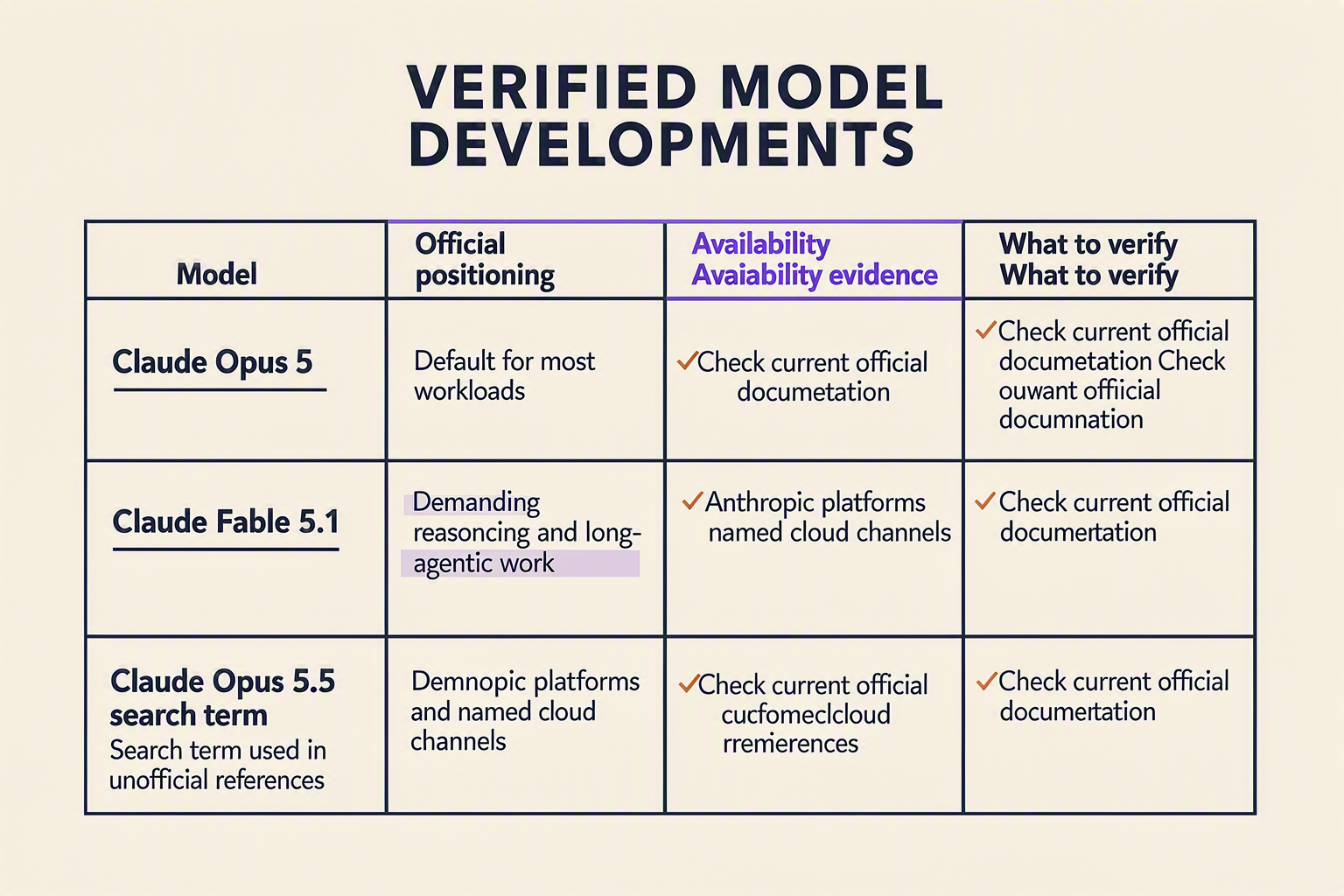
Anthropic’s verified September 2026 guidance positions Claude Opus 5 as the starting point for most workloads and Claude Fable 5.1 as the option for demanding reasoning and long-horizon agentic work. By contrast, the supplied Anthropic sources do not verify a model named Claude Opus 5.5, so specifications, pricing, benchmarks, and availability attributed to it should be treated as unconfirmed.
What has Anthropic officially confirmed?
| Development | Claude Fable 5.1 | Claude Opus 5 | Claude Opus 5.5 |
|---|---|---|---|
| Official status | Announced by Anthropic | Listed in Anthropic’s model overview | Not verified in the supplied Anthropic sources |
| Key date | Announced September 1, 2026, alongside Claude Mythos 5.1 | No launch date established by the supplied sources | No official date established |
| Model positioning | Demanding reasoning and long-horizon agentic work | Recommended starting point for most workloads | No verified positioning |
| Coding and knowledge work | Anthropic describes Fable 5.1 and Mythos 5.1 as its most advanced models for coding and knowledge work | No comparative coding claim established here | No verified coding claims |
| Verified API pricing | $10 per million input tokens and $50 per million output tokens | Not established by the supplied sources | Not established |
| Cache-read pricing | $0.25 per million tokens | Not established by the supplied sources | Not established |
| Verified availability | Available across Anthropic platforms, Amazon Web Services, Google Cloud, and Microsoft Azure | Specific availability details are not established here | No verified availability |
When was Claude Fable 5.1 announced?
Anthropic announced Claude Fable 5.1 and Claude Mythos 5.1 on September 1, 2026, describing them in its Newsroom as its “most advanced models for coding and knowledge work.” Anthropic’s accompanying system card identifies Fable 5.1 and Mythos 5.1 as two configurations of its latest and most capable large language model.
Anthropic also confirmed that Claude Fable 5.1 was available at launch across its platforms and through Amazon Web Services, Google Cloud, and Microsoft Azure. That makes Fable 5.1’s release, positioning, pricing, and distribution directly verifiable rather than inferred from third-party model listings.
How do Fable 5.1 and Opus 5 differ in official positioning?
Anthropic’s Claude Platform documentation says users who are uncertain should “start with Claude Opus 5 for most workloads.” The same model overview recommends Claude Fable 5.1 for demanding reasoning and long-horizon agentic work.
This distinction suggests a practical selection hierarchy:
- Choose Opus 5 as Anthropic’s documented general starting point.
- Evaluate Fable 5.1 when a task requires deeper reasoning or sustained, multi-step agent execution.
- Do not infer that Fable 5.1 is automatically faster, better for writing, or cheaper per completed task; the supplied sources provide no controlled comparison supporting those conclusions.
Is Claude Opus 5.5 officially verified?
No supplied Anthropic source verifies Claude Opus 5.5 as of September 22, 2026. Consequently, this comparison cannot responsibly assign Opus 5.5 an API model ID, context window, token price, release date, benchmark score, speed profile, or availability status.
The naming distinction matters: Opus 5 is documented, while Opus 5.5 is unverified in the available first-party material. Until Anthropic publishes a product page, documentation entry, system card, or announcement, claims about Opus 5.5 should be clearly labeled as rumor rather than used for purchasing or architecture decisions.
How much does Claude Fable 5.1 cost, and where is it available?
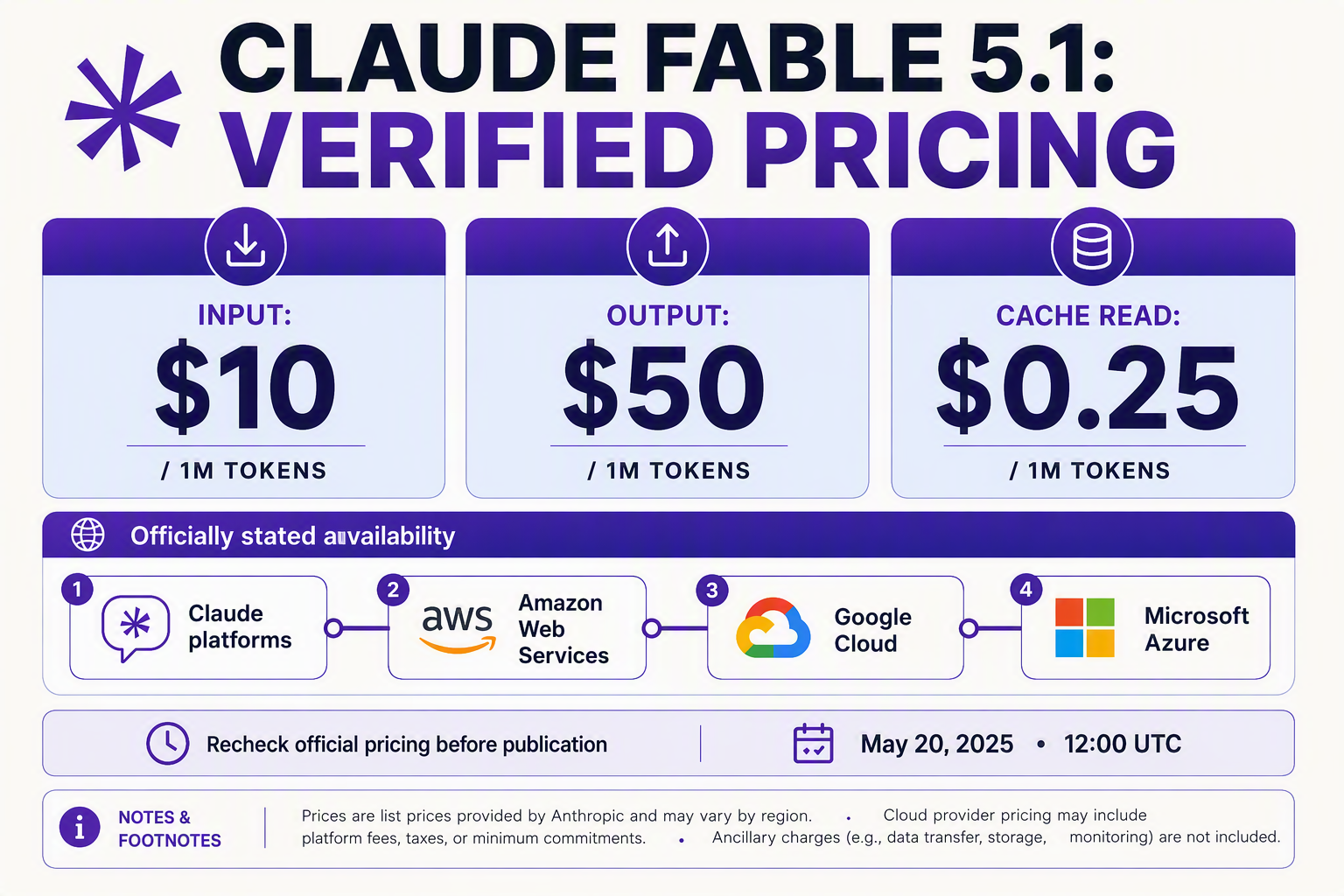
Claude Fable 5.1 costs $10 per million input tokens and $50 per million output tokens, while cache reads cost $0.25 per million tokens. Anthropic announced the model on September 1, 2026, with availability across Anthropic platforms and major cloud providers, including Amazon Web Services, Google Cloud, and Microsoft Azure.
What is the verified Claude Fable 5.1 API pricing?
As of September 2026, Anthropic lists the following standard prices for Claude Fable 5.1:
- Input tokens: $10 per million tokens
- Output tokens: $50 per million tokens
- Cache reads: $0.25 per million tokens
- Cache-read ratio: 2.5% of the standard input-token price
Anthropic’s Claude Platform documentation states that a cache hit for Claude Fable 5.1 costs 2.5% of standard input pricing. This can materially reduce the cost of workloads that repeatedly reuse large system prompts, repository context, policy documents, or agent instructions.
For example, reading one million tokens from cache costs $0.25, compared with $10 when processing one million tokens as standard input. That is a $9.75 difference per million reused tokens, although total workload cost will still include uncached input, generated output, and any other applicable platform charges.
Output is the larger cost driver: generating 100,000 output tokens would cost $5, while processing 100,000 uncached input tokens would cost $1 at the published rates. Teams comparing Claude Fable 5.1 vs Claude Opus 5 should therefore model realistic input/output ratios rather than compare only the headline input price.
Where is Claude Fable 5.1 available?
Anthropic announced Claude Fable 5.1 availability on September 1, 2026 across:
- Anthropic’s platforms
- Amazon Web Services
- Google Cloud
- Microsoft Azure
Anthropic’s announcement describes the model as available across all platforms, including those three named cloud providers. The supplied official sources do not establish additional regional limitations, account-tier requirements, rollout schedules, or cloud-specific prices, so those details should not be inferred.
Availability through several platforms gives organizations deployment choices, but it does not mean pricing, quotas, service terms, context limits, or ancillary cloud charges are necessarily identical. Buyers should verify the commercial terms in their selected provider’s current console or contract before estimating production costs.
Is verified Claude Opus 5.5 pricing available?
No verified Claude Opus 5.5 pricing or availability is established by the supplied official sources. As a result, a defensible Fable 5.1 vs Opus 5.5 pricing comparison cannot assign Opus 5.5 a token price, release date, cloud-provider list, or access tier.
The supplied Anthropic model overview mentions Claude Opus 5, but that reference does not verify a product named Claude Opus 5.5 or establish its commercial terms. Opus 5 pricing should not be used as a proxy: model-version prices and availability can change, and transferring figures between versions would create a misleading comparison.
For planning, treat Fable 5.1’s $10/M input, $50/M output, and $0.25/M cache-read rates as verified, while marking Claude Opus 5.5 commercial details as not established by the supplied official sources.
Which model is stronger for coding, reasoning and long-horizon agents?
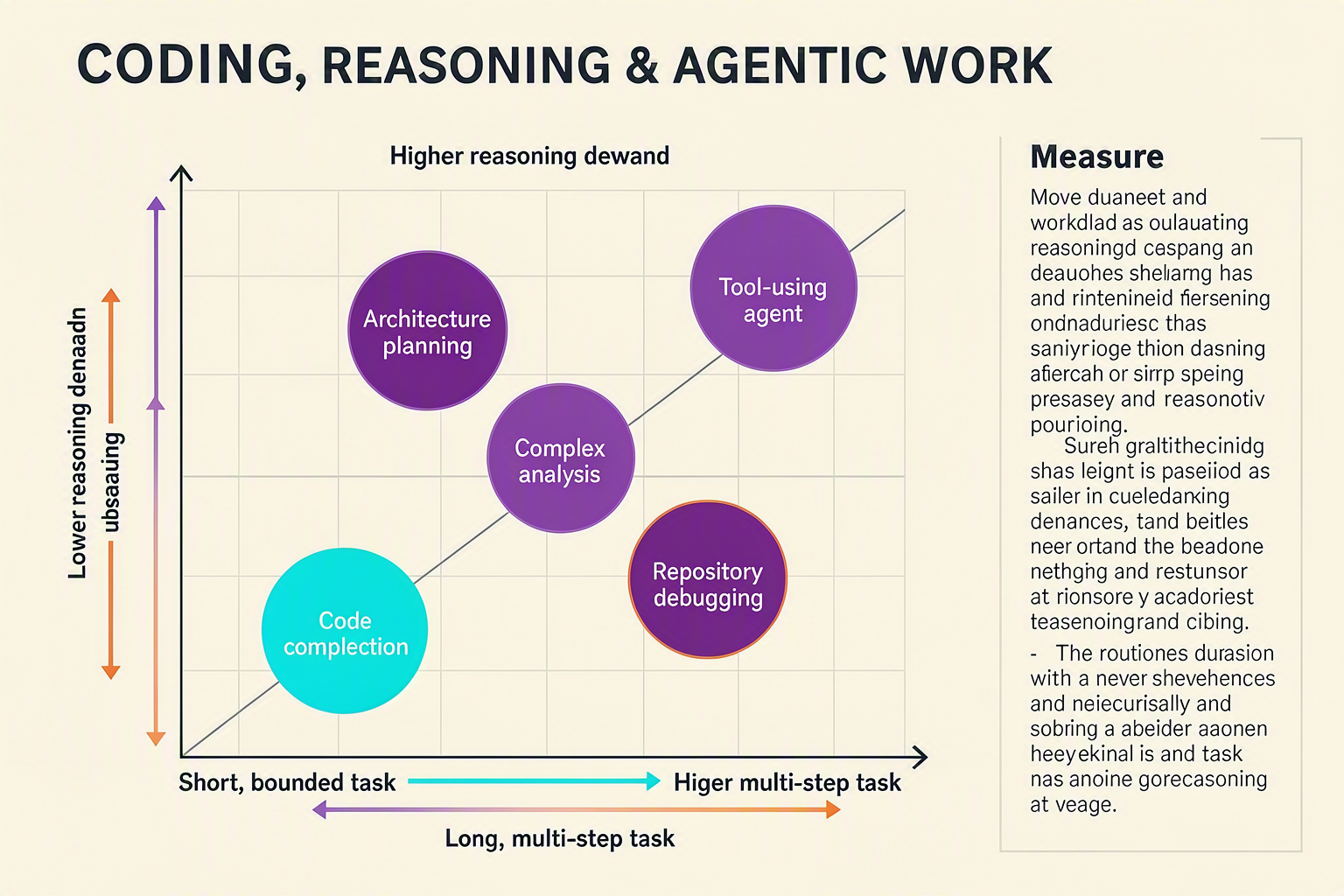
Claude Fable 5.1 is the officially recommended choice for demanding reasoning and long-horizon agentic work, while Claude Opus 5 is Anthropic’s suggested starting point for most workloads. The supplied official sources do not provide a head-to-head benchmark between these models—and they do not verify that a model named Claude Opus 5.5 exists—so claims that either model definitively “wins” at coding would be unsupported.
Which model should developers choose for coding?
Anthropic’s September 2026 model overview advises users who are unsure which model to select to “start with Claude Opus 5 for most workloads.” That positioning makes Opus 5 the practical default for common development tasks such as:
- Generating routine application code
- Explaining unfamiliar functions or repositories
- Writing unit tests and documentation
- Refactoring contained modules
- Supporting interactive coding workflows where tasks remain bounded
Claude Fable 5.1 becomes the stronger candidate when coding requires deeper planning or sustained autonomy. Examples include coordinating changes across a large repository, investigating an intermittent defect through several hypotheses, or running an agent that must plan, execute tools, inspect results and revise its approach over many steps.
These examples are selection guidance based on Anthropic’s positioning, not evidence of benchmark superiority. The supplied sources contain no directly comparable coding scores, identical test conditions or independently verified completion-rate data for Claude Fable 5.1 versus Claude Opus 5.
Which Claude model is positioned for demanding reasoning?
Anthropic explicitly recommends Claude Fable 5.1 for demanding reasoning in its model documentation as of September 2026. That makes Fable 5.1 the more appropriate option when a task involves ambiguous evidence, interacting constraints or a high cost of shallow analysis.
Potential use cases include:
- Evaluating several technical architectures with competing constraints
- Tracing dependencies across lengthy legal or financial documents
- Developing and checking a multi-stage migration plan
- Investigating security findings that require iterative hypothesis testing
- Synthesizing evidence from multiple tools before reaching a conclusion
For straightforward analysis, extraction or question answering, Opus 5 remains the officially recommended starting point for most workloads. Teams should therefore avoid routing every request to Fable 5.1 merely because it occupies a more advanced position in Anthropic’s model line.
Which model is better suited to long-horizon AI agents?
For agents operating across many steps, Claude Fable 5.1 has the clearest official positioning. Anthropic’s model overview specifically recommends it for “long-horizon agentic work,” while Anthropic’s enterprise safeguards announcement says the relevant frontier-model class represents a “major increase in intelligence and agentic capabilities.”
Long-horizon work can include agents that maintain a plan across extended tool use, recover from failed actions, preserve constraints and determine when a task is genuinely complete. However, Anthropic’s language describes intended capability and risk posture; it is not a quantified guarantee that Fable 5.1 will outperform Opus 5 in every agent framework.
The defensible decision rule is:
- Begin with Opus 5 for ordinary coding and bounded agents.
- Test Fable 5.1 when reasoning depth or task duration becomes the limiting factor.
- Evaluate both on your own repositories, tools and completion criteria.
- Do not label the comparison “Opus 5.5 versus Fable 5.1” without additional official documentation confirming Opus 5.5.
Which model is better for writing, speed and interactive work?

For writing, speed, and interactive work, Claude Opus 5 is the sensible default for routine workloads, while Claude Fable 5.1 is positioned for demanding reasoning and long-horizon agentic tasks. The supplied Anthropic sources do not provide head-to-head writing-quality tests, verified latency figures, or any documented data for a model called Claude Opus 5.5, so stronger claims would be speculative.
Which Claude model is better for writing?
Anthropic’s documentation does not establish that Claude Fable 5.1 or Claude Opus 5 produces better prose. There are no supplied side-by-side evaluations covering factual accuracy, tone control, editing quality, creativity, or adherence to a publication style guide.
For most everyday writing, documented Claude Opus 5 is therefore the pragmatic starting point. Typical workloads include:
- Drafting emails, reports, articles, and product documentation
- Summarising documents or meeting notes
- Rewriting content for tone, length, or audience
- Producing multiple headlines, outlines, or campaign variants
- Editing text through several short feedback cycles
Claude Fable 5.1 becomes more relevant when writing is inseparable from difficult analysis—for example, synthesising a large evidence base, maintaining constraints across a long project, or coordinating research and revision over an extended agentic workflow. That recommendation follows Anthropic’s model positioning, not a verified finding that Fable’s prose is inherently more polished.
Is Claude Opus 5 faster than Claude Fable 5.1?
No verified speed winner can be named from the supplied sources. Anthropic’s official materials provided here do not report tokens per second, time to first token, median response latency, or comparable end-to-end completion times for Claude Opus 5 and Claude Fable 5.1.
Perceived speed also depends on more than the model name:
- Prompt and context length
- Requested output length
- Reasoning depth
- Tool calls and external API latency
- Cloud region, traffic, and application architecture
- Whether the workflow requires retries or human correction
Consequently, teams should benchmark both models with representative prompts rather than assuming that a model positioned for routine work will always respond faster. A useful evaluation records time to first token, total completion time, task success rate, revision count, and cost per accepted result.
Which model is better for interactive work?
For rapid, human-guided loops—such as collaborative drafting, routine coding assistance, document Q&A, or iterative editing—Claude Opus 5 is Anthropic’s documented default for most workloads as of September 2026. Anthropic’s model overview specifically advises users who are unsure to begin with Opus 5.
For autonomous or extended workflows, Claude Fable 5.1 is the more clearly positioned option. Anthropic recommends Fable 5.1 for demanding reasoning and long-horizon agentic work, and announced its availability across Anthropic platforms, Amazon Web Services, Google Cloud, and Microsoft Azure on September 1, 2026.
Cost can materially affect interactive use. Anthropic prices Claude Fable 5.1 at $10 per million input tokens and $50 per million output tokens as of September 2026, with cache reads at $0.25 per million tokens. Without verified Opus 5 pricing in the supplied material—and without any official Opus 5.5 specifications—the defensible decision is to start with Opus 5 for routine interaction, then test Fable 5.1 where deeper reasoning or sustained autonomy could justify its cost.
How should you calculate real cost per successful task?
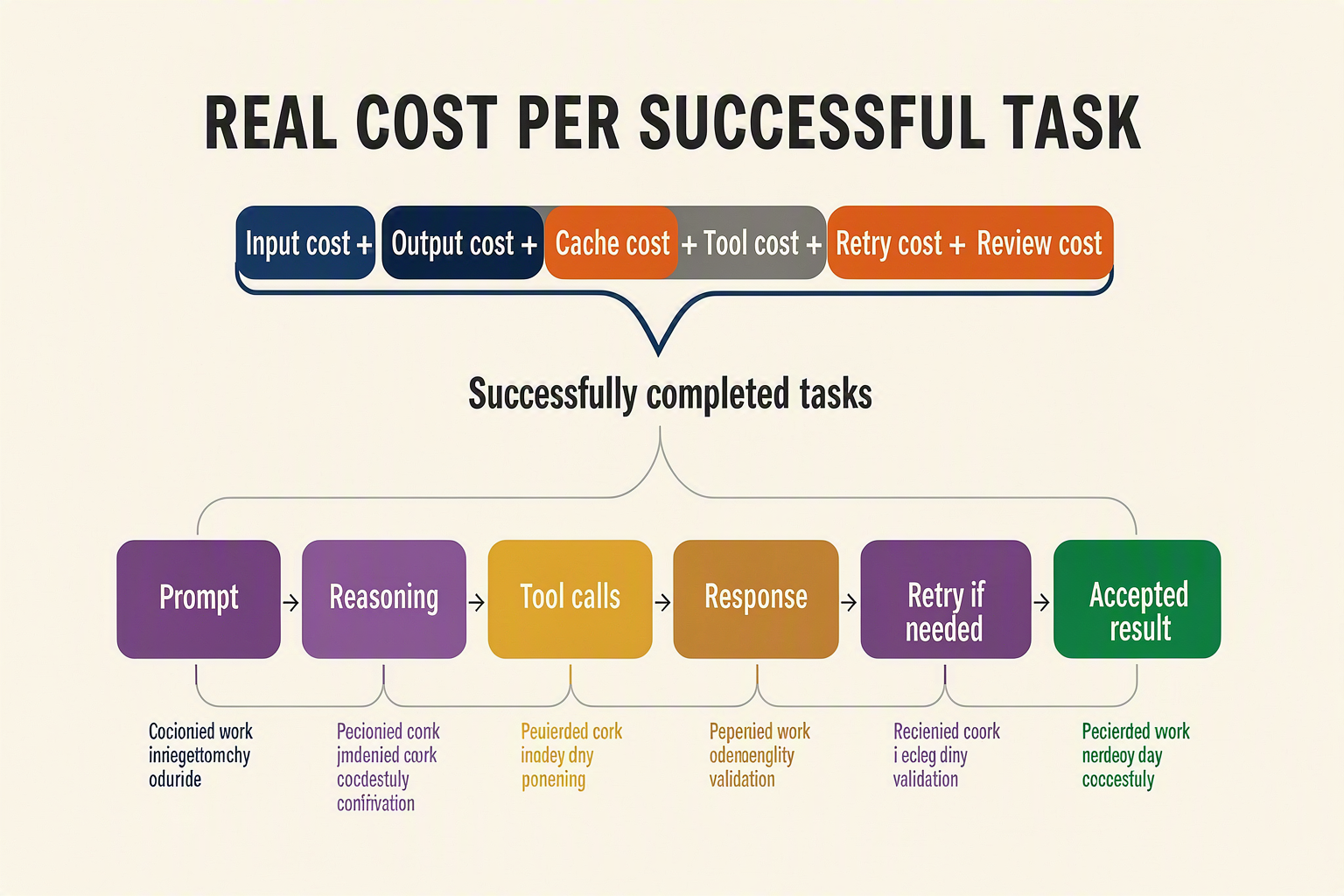
The real cost of Claude Fable 5.1 or Claude Opus is total workflow spend divided by accepted outcomes, not simply the advertised token rate. Measure every attempt—including retries and failures—and define success using a test, human review, or business outcome.
What is the formula for cost per successful AI task?
General analytical framework—not an Anthropic-published benchmark:
Cost per successful task = (input cost + output cost + cache-read cost + tool cost + workflow overhead across all attempts) ÷ accepted completions
For a measurement period, calculate:
\[
C_{\text{success}} =
\frac{
(T_{\text{input}}\times P_{\text{input}})
+(T_{\text{output}}\times P_{\text{output}})
+(T_{\text{cache}}\times P_{\text{cache}})
+C_{\text{tools}}
+C_{\text{workflow}}
}{
N_{\text{accepted}}
}
\]
Count these six factors:
- Input tokens: Prompts, retrieved context, code, files, conversation history, and tool results sent back to the model.
- Output tokens: Answers, generated code, reasoning output, and tool-call arguments.
- Cache reads: Reused system prompts, repository context, policies, or documentation served from prompt caching.
- Retries and failures: Timeouts, malformed outputs, rejected answers, unsuccessful tool calls, and human-triggered reruns.
- Tool and workflow overhead: Search APIs, databases, code sandboxes, browsers, vector stores, orchestration, logging, and compute.
- Completion rate: The percentage of requested tasks that satisfy a predefined acceptance criterion.
What does a Claude Fable 5.1 cost calculation look like?
As of September 2026, Anthropic prices Claude Fable 5.1 at $10 per million input tokens, $50 per million output tokens, and $0.25 per million cache-read tokens. Anthropic’s Claude Platform documentation says the $0.25 cache-hit rate equals 2.5% of the standard input price.
Consider 100 requested coding workflows that generate 125 total attempts because 25 retries are required. Across those attempts, assume the system records:
- 2.5 million uncached input tokens: $25
- 500,000 output tokens: $25
- 12.5 million cache-read tokens: $3.125
- External tools at $0.08 per attempt: $10
- Orchestration and logging at $0.02 per attempt: $2.50
- 80 accepted results from 100 requested tasks: 80% completion rate
The total measured cost is $65.625, producing a real cost of approximately $0.82 per successful task:
\[
\$65.625 \div 80 = \$0.8203
\]
Without retries, tools, overhead, and rejected results, the same workload could appear much cheaper than it actually is.
How should you compare Fable 5.1 with Opus fairly?
Run both models against the same task set, context, tools, retry policy, and acceptance rubric. Record aggregate consumption rather than estimating from one successful demonstration.
Do not invent an Opus 5.5 rate or reuse pricing from another Claude generation. The supplied Anthropic sources verify Fable 5.1 pricing but do not provide a verified Opus 5.5 price, so an honest comparison should leave that price blank until Anthropic publishes it and then apply the same formula.
A higher-priced model can still cost less per accepted result if it needs fewer retries, produces shorter valid outputs, or completes more workflows without human repair. Conversely, a capable lower-cost model may be more economical for high-volume tasks where its completion rate remains comparable.
What do official sources and expert evaluations actually prove?

Official Anthropic sources establish Claude Fable 5.1’s positioning, price, cache rate and availability, while recommending Claude Opus 5 as the starting model for most workloads. They do not establish an evidence-based Claude Opus 5.5 vs Claude Fable 5.1 comparison because the supplied research contains neither official Opus 5.5 documentation nor independent head-to-head evaluations.
What has Anthropic officially confirmed about Claude Fable 5.1?
Anthropic announced Claude Fable 5.1 and Claude Mythos 5.1 on September 1, 2026, describing them as its “most advanced models for coding and knowledge work.” That wording confirms Anthropic’s intended positioning, but it remains a first-party product claim rather than an independent finding.
Anthropic’s Claude model overview provides a more useful workload distinction:
- Claude Opus 5 is Anthropic’s default recommendation “for most workloads.”
- Claude Fable 5.1 is recommended for demanding reasoning and long-horizon agentic work.
- Anthropic’s enterprise safeguards publication says that “Mythos-class models, like Claude Fable 5.1, represent a major increase in intelligence and agentic capabilities.”
These statements support describing Fable 5.1 as the higher-demand option for sustained reasoning and agentic execution. They do not quantify how much better it is, how often it wins, or whether its higher capability reduces total cost per completed task.
Which pricing and availability facts are verified?
Anthropic priced Claude Fable 5.1 at $10 per million input tokens and $50 per million output tokens as of September 2026. Anthropic’s pricing documentation also states that a Fable 5.1 cache hit costs $0.25 per million input tokens, equal to 2.5% of the standard input price.
Anthropic reports that cache reads are 75% cheaper than the previous Fable cache rate. This could materially affect applications that repeatedly reuse long system prompts, code repositories or agent context, but no supplied benchmark measures the resulting cost per completed coding or reasoning task.
Anthropic’s September 2026 announcement states that Claude Fable 5.1 is available across Anthropic’s platforms and through Amazon Web Services, Google Cloud and Microsoft Azure. Availability may still vary by cloud region, account permissions and provider-specific deployment options.
What remains unproven in a Fable 5.1 vs Opus comparison?
The supplied research contains no independent expert evaluations, reproducible head-to-head tests or verified benchmark scores comparing Fable 5.1 with Opus 5—or with a model called Opus 5.5. Therefore, it cannot substantiate claims that either model:
- writes better production code;
- reasons more accurately on a defined benchmark;
- completes longer agent workflows more reliably;
- produces higher-quality prose;
- responds faster or has lower end-to-end latency;
- delivers a lower effective cost per successful task.
The supplied Anthropic system card is an official primary source, but no specific benchmark results from it were provided here and none should be inferred. Most importantly, the supplied official sources document Claude Opus 5, not Claude Opus 5.5. Until Anthropic publishes Opus 5.5 documentation, pricing and availability, any Opus 5.5 comparison should be labelled unverified rather than presented as an established model comparison.
Which model should startups, enterprises, developers and agent builders choose?
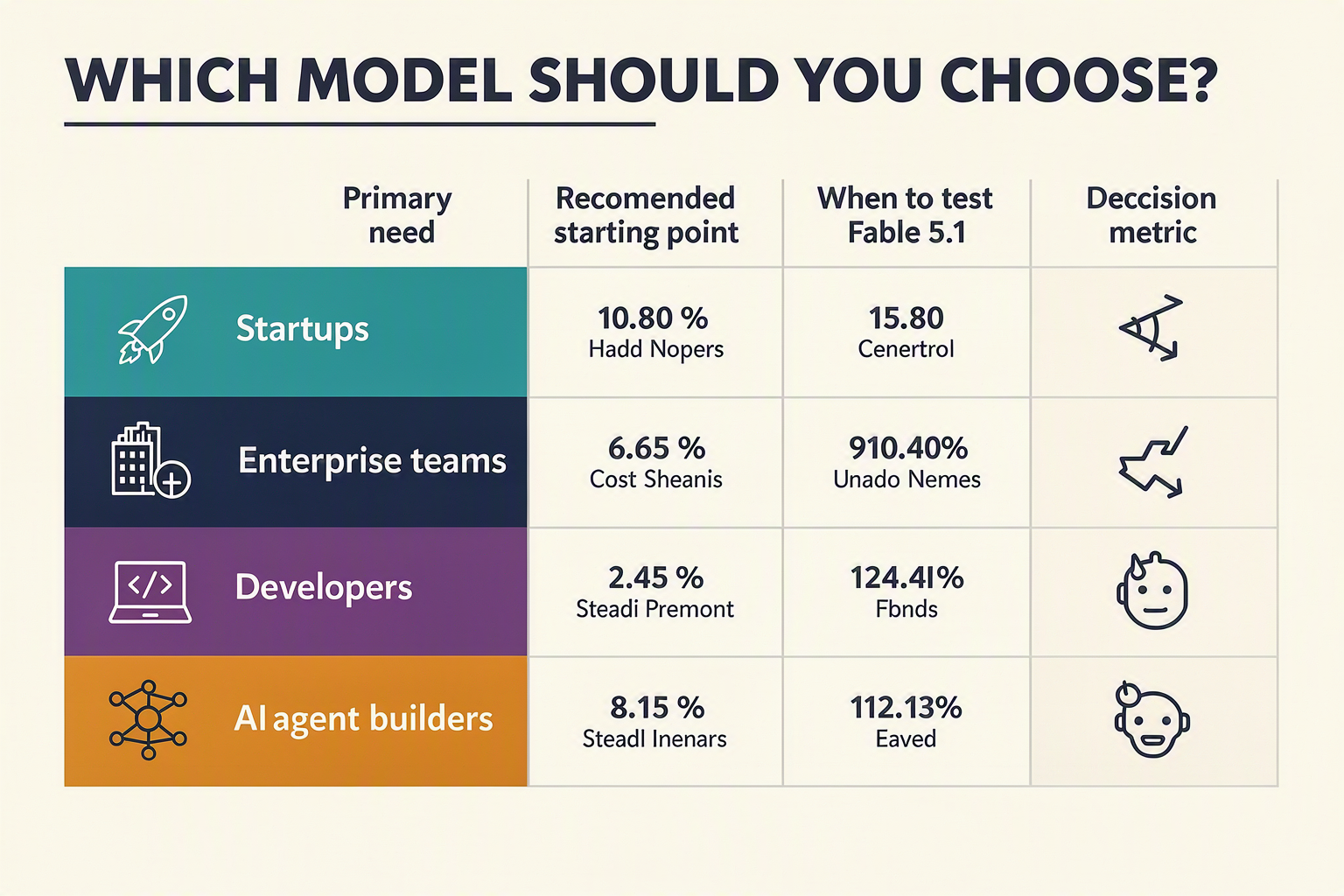
Choose Claude Opus 5 for most production workloads and move selected tasks to Claude Fable 5.1 when demanding reasoning or long-horizon agentic work justifies its known token cost. Do not select “Claude Opus 5.5” for production as of September 2026 because Anthropic’s supplied official materials do not verify its pricing, availability, performance, or release status.
Which Claude model fits each type of team?
| Team or workload | Recommended default | When to choose Fable 5.1 | Practical decision rule | Cost consideration |
|---|---|---|---|---|
| Startups | Opus 5 | Complex debugging, architecture decisions, or high-value research agents | Start with Anthropic’s recommended default; escalate only tasks that need deeper reasoning | Fable costs $10/M input tokens and $50/M output tokens |
| Enterprise teams | Opus 5 for general knowledge work | Long-running workflows with multiple tools, dependencies, or review stages | Pilot Fable on bounded use cases, then evaluate quality, completion rate, governance, and total task cost | Cache repeated context to reduce Fable input costs |
| Application developers | Opus 5 for routine coding and writing | Difficult refactoring, repository-scale planning, or reasoning-heavy coding agents | Route by task complexity rather than sending every request to the highest-cost model | A workload using 1M input and 200,000 output tokens would cost $20 on Fable 5.1, before caching |
| AI-agent builders | Opus 5 for short, predictable tool workflows | Long-horizon agents that must plan, recover from errors, and maintain state across many steps | Compare end-to-end task completion, tool-call accuracy, latency, and cost—not token price alone | Fable cache reads cost $0.25/M tokens, or 2.5% of standard input price |
| Risk-sensitive production teams | Verified Opus 5 or Fable 5.1 deployments | Fable when its reasoning profile matches a validated business requirement | Exclude unverified model names from deployment manifests and procurement estimates | Do not assume an Opus 5.5 price, SLA, speed, or cloud region |
Why is Opus 5 the safer default?
Anthropic’s Models Overview advises: “If you’re unsure which model to use, start with Claude Opus 5 for most workloads.” That official positioning makes Opus 5 the sensible baseline for ordinary coding, writing, analysis, and application features.
This is not evidence that Opus 5 is faster or cheaper than Fable 5.1; the supplied sources do not provide a verified head-to-head benchmark or Opus price. Teams should therefore run representative evaluations covering:
- Task success and human-review time
- End-to-end latency, including tool execution
- Output-token consumption
- Failure recovery across multi-step workflows
- Effective cost per completed task
When does Fable 5.1 justify its higher known cost?
Choose Fable 5.1 for demanding reasoning and long-horizon agentic work, matching Anthropic’s official September 2026 guidance. Anthropic priced Claude Fable 5.1 at $10 per million input tokens and $50 per million output tokens as of September 2026.
Anthropic also states that Claude Fable 5.1 cache hits cost $0.25 per million tokens as of September 2026, making prompt caching important for agents that repeatedly load the same policies, repository context, schemas, or documentation. Anthropic announced Fable 5.1 availability across its platforms, Amazon Web Services, Google Cloud, and Microsoft Azure on September 1, 2026.
For developers testing broader model-routing strategies, CallMissed’s developer AI API provides one balance for 136 models and supports OpenAI-compatible and Anthropic-compatible endpoints as of September 2026. Regardless of gateway, production selection should use verified model IDs and measured workload results—not assumptions about the unverified “Opus 5.5” name.
Frequently Asked Questions
Is Claude Opus 5.5 an official Anthropic model?
What is the official Claude Fable 5.1 pricing?
Where is Claude Fable 5.1 available?
Which model is intended for demanding reasoning and long-horizon agentic work?
Should most users start with Claude Opus 5 or Claude Fable 5.1?
Is Claude Fable 5.1 better than Claude Opus 5 for coding and writing?
How should developers compare Fable 5.1 and Opus 5 on speed and cost?
Conclusion
The verified Claude Fable 5.1 vs Claude Opus 5 comparison points to workload-based selection—not a universal winner. As of September 22, 2026, Anthropic’s supplied official sources do not document a model named Claude Opus 5.5, so its pricing, speed, availability and capabilities cannot be compared responsibly.
- Claude Opus 5 is Anthropic’s recommended default for most coding, writing, analysis and knowledge workloads.
- Claude Fable 5.1 is positioned for demanding reasoning and long-horizon agentic work, including repository-scale coding and extended tool use.
- Claude Fable 5.1 cost $10 per million input tokens and $50 per million output tokens as of September 2026, while cache reads cost $0.25 per million tokens, according to Anthropic.
- Claude Fable 5.1 was available across Anthropic’s platforms, Amazon Web Services, Google Cloud and Microsoft Azure following its September 1, 2026 launch.
The next development to watch is an official Anthropic announcement establishing whether Claude Opus 5.5 exists, along with a model identifier, benchmarks, pricing and deployment availability. Teams should verify those details in Anthropic’s documentation before changing production systems.
Developers can also explore CallMissed, an OpenAI- and Anthropic-compatible AI gateway offering one API key and balance for 136 models as of September 2026. Until verified Opus 5.5 documentation arrives, which documented model best matches your actual task complexity and budget?
Related Reading
- GPT-6 Sol vs Claude Opus 5.5: Verified Comparison
- GPT-6 Astra vs Claude Fable 5.1: Verified 2026 Comparison
- Claude Opus 5.5 vs GPT-6 Astra: 2026 Comparison
Sources
Discussion
Related Posts



Ready to automate customer conversations?
Launch AI voice agents and WhatsApp bots with CallMissed — one API, 22+ Indian languages.