Claude Fable 5.1 vs GPT-5.6 Sol: Pricing, Coding & Voice Agents



Compare Claude Fable 5.1 vs GPT-5.6 Sol on verified pricing, context, coding, tools, safety, multimodality, and voice-agent fit.
Claude Fable 5.1 vs GPT-5.6 Sol: Pricing, Coding & Voice Agents
As of September 5, 2026, Claude Fable 5.1 vs GPT-5.6 Sol is a comparison between two officially documented models. Anthropic positions Fable 5.1 for demanding reasoning and long-horizon agentic work, while OpenAI documents GPT-5.6 Sol within its GPT-5.6 family. A reliable buying decision should compare first-party specifications and matched workload evaluations rather than assume either model wins from branding or isolated benchmarks.
Anthropic launched Claude Fable 5.1 on September 1, 2026, according to the Claude Platform release notes. Anthropic describes claude-fable-5-1 as the successor to Claude Fable 5 for “long-running agentic coding, knowledge work,” and its model overview recommends Fable 5.1 for “demanding reasoning and long-horizon agentic work.” The company also states that Claude Fable 5.1 and Claude Mythos 5.1 use the same underlying model, but Fable applies additional cybersecurity and biology safeguards for general availability.
Why this comparison matters now
Model selection now affects far more than chatbot prose. Teams are choosing an inference layer for repository-scale coding, multi-step reasoning, tool calls, image understanding, latency-sensitive speech pipelines, and regulated workflows. A model that leads a benchmark may still be the wrong production choice if its API is unavailable, its tool schema is unstable, or its response latency breaks a live call. For voice agents, time to first token, streaming reliability, interruption handling, and total task cost can matter more than an isolated reasoning score.
This is especially relevant to platforms such as CallMissed, an OpenAI-compatible multi-model gateway, which combines model access with speech infrastructure and supports Speech-to-Text and Text-to-Speech across 22 Indian languages for real-time customer engagement.
What this guide will verify
You will get a source-led comparison that separates verified specifications from unavailable data, rather than forcing false equivalence. The analysis will examine:
- API pricing and context: published input, output, caching, and long-context terms, with unknowns labelled clearly.
- Coding and reasoning: first-party claims, benchmark methodology, and practical fit for long-horizon software work.
- Tools and multimodality: function calling, web or computer use, vision, audio, and streaming support.
- Availability and safety: model access, deployment constraints, system cards, and the distinction between Fable and Mythos safeguards.
- Voice-agent suitability: latency evidence, speech integration requirements, reliability, and cost per completed customer task.
The result is a decision framework grounded in what vendors have actually disclosed.
Which should you choose? There is no universal winner between Claude Fable 5.1 and GPT-5.6 Sol
Choose Claude Fable 5.1 when its documented strengths in demanding reasoning and long-horizon agentic work match your workload. Choose GPT-5.6 Sol when its documented capabilities and compatibility with the OpenAI ecosystem better fit your application. Both are officially documented models, so the decision should be based on first-party specifications, private evaluations, and total operating cost—not model branding alone.
The evidence-based choice today
As of September 5, 2026, Claude Fable 5.1 vs GPT-5.6 Sol is a comparison between two official models with first-party documentation. Anthropic documents Claude Fable 5.1, while OpenAI provides GPT-5.6 Sol information through its official model documentation.
Anthropic recommends Claude Fable 5.1 for “demanding reasoning and long-horizon agentic work.” That makes it a defensible candidate for workloads such as:
- Repository-scale coding and multi-file debugging
- Long-running research and knowledge-work agents
- Workflows involving repeated tool calls and stateful planning
- Root-cause analysis across large or complex inputs
- Enterprises whose deployment requirements align with Anthropic’s published safety documentation
GPT-5.6 Sol should receive the same evidence-based treatment. It may be the better fit where OpenAI API compatibility, existing tooling, supported capabilities, or integration with an established OpenAI stack reduces development and migration overhead.
GPT-6 Astra has since launched, but it is outside this direct Claude Fable 5.1 vs GPT-5.6 Sol comparison. Its availability does not eliminate the need to evaluate these two models for existing applications, compatibility requirements, and cost constraints.
Choose according to workload, not model branding
There is no permanent universal winner because performance depends on the task, prompts, tools, surrounding architecture, and production constraints. Use these decision rules:
- Choose Fable 5.1 for documented long-horizon work. Prefer it when Anthropic’s stated behavior for demanding reasoning and agentic projects is reflected in your own evaluations.
- Choose GPT-5.6 Sol for ecosystem fit. Prefer it when its official capabilities and compatibility with your OpenAI-based infrastructure produce a simpler, more reliable deployment.
- Run private coding evaluations before standardising. Measure issue-resolution rate, test pass rate, regressions, tool-call accuracy, elapsed time, and cost per successfully completed task—not token usage alone.
- Verify commercial and technical details directly. Use current first-party pages for API model identifiers, pricing, context limits, modalities, rate limits, regional availability, and safety controls.
- Treat benchmarks as directional evidence. Compare only first-party-published results with disclosed tasks, settings, and methodology. A benchmark lead may not translate into better performance on your repositories or agent workflows.
- Keep the model layer replaceable. OpenAI-compatible gateways such as CallMissed can help teams test providers through one integration and configure fallbacks, reducing dependence on a single model.
The practical verdict on Claude Fable 5.1 vs GPT-5.6 Sol should therefore come from representative production trials rather than a single headline score.
The voice-agent decision is separate
Strong coding or reasoning results do not automatically make either model the best choice for live calling. A production voice agent should be tested end to end for:
- Time to first token and streaming consistency
- Interruption and turn-taking behaviour
- Tool-call latency and recovery from failed actions
- Speech-to-Text accuracy across target languages and accents
- Text-to-Speech quality and response timing
- Total cost per completed call, including retries and supporting services
For Indian customer-service deployments, regional speech coverage may be decisive; CallMissed supports Speech-to-Text and Text-to-Speech across 22 Indian languages.
The cautious conclusion is conditional: deploy Claude Fable 5.1 where its documented long-horizon behavior performs best in your tests, or choose GPT-5.6 Sol where its documented capabilities and OpenAI ecosystem compatibility provide the stronger operational fit. For any Claude Fable 5.1 vs GPT-5.6 Sol decision, confirm current pricing and benchmark claims on first-party pages before procurement.
What are Claude Fable 5.1 and GPT-5.6 Sol, and are the model names officially verified?
Claude Fable 5.1 is an officially documented Anthropic model; GPT-5.6 Sol is not an officially verified OpenAI model in the supplied first-party research as of September 3, 2026. Any Claude Fable 5.1 vs GPT-5.6 Sol comparison must therefore treat Fable as a released product and GPT-5.6 Sol as an unverified name—not as two equally documented APIs.
Claude Fable 5.1 is verified across Anthropic’s first-party sources
Anthropic identifies Claude Fable 5.1 consistently across its newsroom, API documentation, product pages, and system-card library.
Anthropic’s Claude Platform release notes state that claude-fable-5-1 launched on September 1, 2026. The release notes call it the successor to Claude Fable 5 and position it for “long-running agentic coding” and knowledge work.
The verification trail includes:
- Official announcement: Anthropic’s newsroom lists “Introducing Claude Fable 5.1 and Claude Mythos 5.1” as a September 1, 2026 announcement.
- API model identifier: Claude Platform documentation specifies the model string
claude-fable-5-1, allowing developers to distinguish the deployable API model from a marketing label. - Product documentation: Anthropic’s model overview recommends Fable 5.1 for “demanding reasoning and long-horizon agentic work.”
- Safety documentation: Anthropic’s system-card directory lists a Claude Fable 5.1 and Claude Mythos 5.1 System Card dated September 2026.
- Availability statement: Anthropic says Fable 5.1 is generally available, while Mythos 5.1 has more restricted access.
Anthropic also makes an important naming distinction: Claude Fable 5.1 and Claude Mythos 5.1 use the same underlying model but different safeguards. According to Anthropic, Fable adds cybersecurity and biology protections intended to make the system suitable for general availability. Consequently, benchmark similarities between Fable and Mythos would not prove identical behavior on restricted tasks.
GPT-5.6 Sol remains an unverified model name
The supplied evidence contains no OpenAI launch post, API model identifier, pricing page, model card, system card, or developer documentation for “GPT-5.6 Sol.” It also contains no first-party confirmation that “Sol” is an OpenAI product tier, codename, reasoning mode, or ChatGPT configuration.
That absence does not prove that OpenAI could never release such a model. It means that, as of the article’s September 3, 2026 evidence cutoff, claims about GPT-5.6 Sol cannot be presented as verified facts.
Readers should be cautious when third-party pages attach precise specifications to the name, including:
- Token prices or cached-input discounts
- Context-window and maximum-output limits
- Coding or reasoning benchmark scores
- Vision, audio, tool-use, or computer-use support
- API regions, rate limits, latency, or safety controls
What counts as official verification?
For this comparison, a model is verified only when the vendor provides a traceable first-party record. Strong evidence includes an API identifier, dated release note, developer documentation, pricing schedule, and safety or model card.
A search result, screenshot, benchmark leaderboard entry, or repeated product name is not sufficient by itself. Until OpenAI publishes corresponding documentation, Fable 5.1 vs GPT-5.6 Sol is fundamentally a comparison between a documented model and an unsupported label, and all later tables should mark GPT-5.6 Sol specifications as unavailable, not estimated.
What changed by September 2026? Key releases, pricing updates, and availability milestones
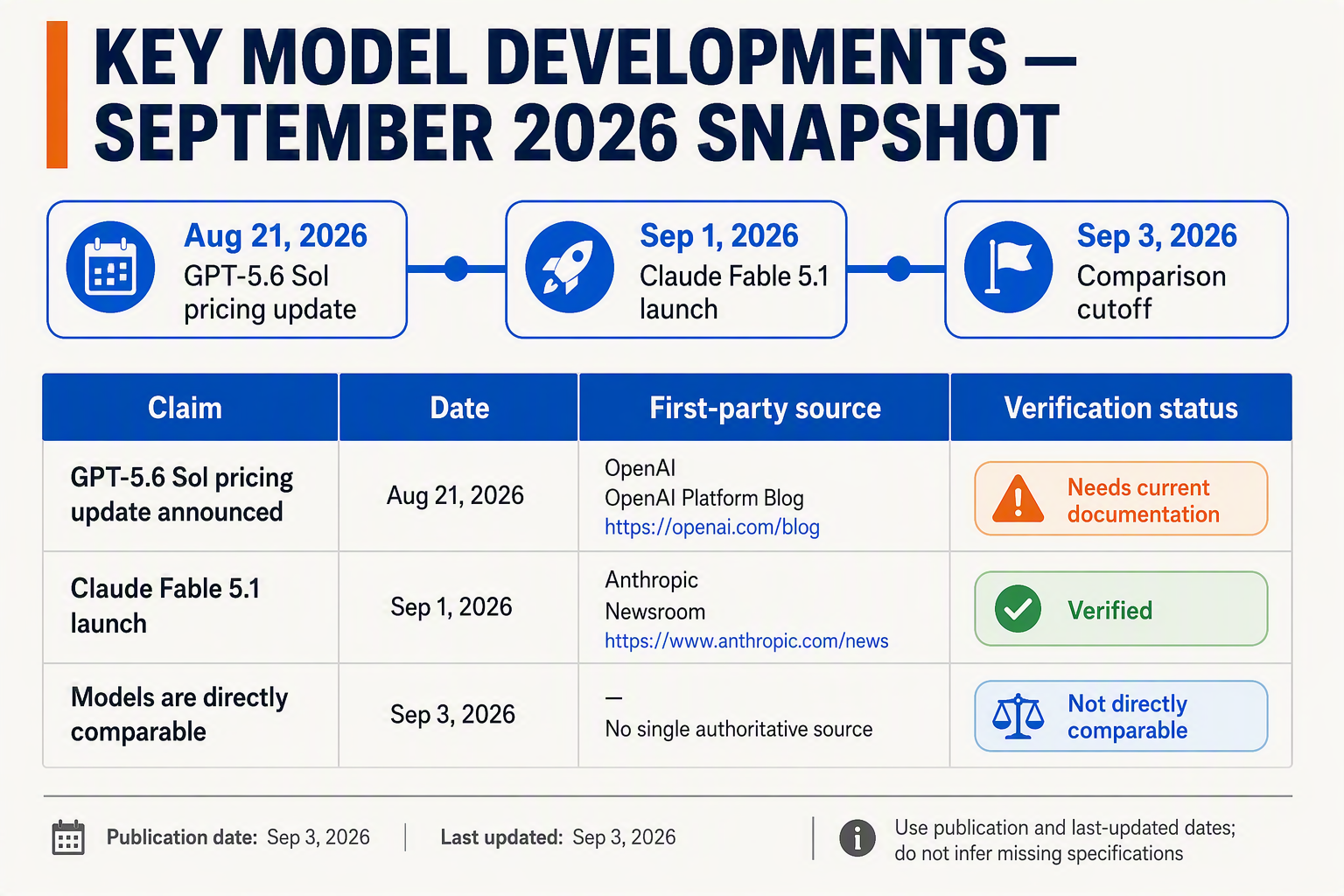
By September 3, 2026, the verified change is Anthropic’s release of Claude Fable 5.1, backed by API documentation and a system card. The supplied first-party record contains no equivalent OpenAI release, pricing, availability, or safety documentation for GPT-5.6 Sol, so any apparent specifications for that name remain unverified.
Verified release and availability timeline
| Date | Model or event | Verified change | Availability | First-party source |
|---|---|---|---|---|
| June 2026 | Claude Sonnet 5 | Anthropic published a model system card, establishing the first milestone in its documented mid-2026 model sequence. | Documented Claude model | Anthropic system-card index |
| July 2026 | Claude Opus 5 | Anthropic published the Claude Opus 5 system card, preceding the Fable 5.1 release. | Documented Claude model | Anthropic system-card index |
| September 1, 2026 | Claude Fable 5.1 | Anthropic launched claude-fable-5-1 as the successor to Claude Fable 5 for long-running agentic coding and knowledge work. | Generally available | Claude Platform release notes |
| September 1, 2026 | Claude Mythos 5.1 | Anthropic announced that Mythos 5.1 and Fable 5.1 share the same underlying model but apply different safeguard levels. | Separate access posture from Fable | Anthropic announcement |
| September 2026 | Fable/Mythos system card | Anthropic documented additional Fable safeguards for high-risk cybersecurity and biology tasks. | Public safety documentation | Anthropic system card |
| September 3, 2026 | GPT-5.6 Sol verification check | No official OpenAI announcement, API model identifier, model card, price sheet, or availability notice appears in the supplied research. | Not verifiable from supplied first-party sources | OpenAI evidence unavailable |
Anthropic’s system-card index dates Claude Sonnet 5 to June 2026, Claude Opus 5 to July 2026, and Claude Fable 5.1 and Mythos 5.1 to September 2026. This sequence provides a traceable release history rather than relying on third-party model names or screenshots.
What changed for developers
The most concrete operational milestone was the publication of the API identifier claude-fable-5-1. A documented identifier allows engineering teams to test authentication, request schemas, tool behavior, latency, and migration paths against a named production target.
Anthropic’s model overview also changed the recommended model-selection ladder. It directs developers toward Claude Fable 5.1 for demanding reasoning and long-horizon agentic work, including cases where evaluations using Claude Opus 5 at higher effort still fall short.
The availability distinction carries a safety implication:
- Claude Fable 5.1 is intended for general use.
- Claude Mythos 5.1 uses the same underlying model with a different safeguard posture.
- Fable adds restrictions intended to prevent certain high-risk cybersecurity and biology assistance, according to Anthropic’s September 2026 system card.
What did not become verifiable
No pricing update can responsibly be reported for GPT-5.6 Sol from the supplied evidence. There is also no verified OpenAI model ID, context limit, regional rollout schedule, ChatGPT plan mapping, benchmark report, or deprecation notice for that product name.
The same sourcing discipline applies to Claude Fable 5.1 pricing: the provided Anthropic materials verify its launch and positioning, but do not supply token prices. Until an official price sheet is available in the evidence set, input, output, cache, and long-context rates should be marked unavailable—not estimated from another Claude model.
How do API pricing, context windows, rate limits, and total cost per successful task compare?
A numeric cost comparison is not currently defensible. As of September 3, 2026, the verified research identifies Claude Fable 5.1’s API model name and availability, but it does not provide confirmed token prices, context-window limits, or rate-limit tiers; no first-party API specifications are available for a model named OpenAI GPT-5.6 Sol.
Verified API facts versus unresolved specifications
Anthropic launched claude-fable-5-1 on September 1, 2026, according to the Claude Platform release notes. Anthropic’s model overview positions Claude Fable 5.1 for “demanding reasoning and long-horizon agentic work,” but that description should not be converted into an assumed context length or throughput guarantee.
| Cost or capacity factor | Claude Fable 5.1 | GPT-5.6 Sol | Comparison status |
|---|---|---|---|
| API model identity | claude-fable-5-1 | No verified identifier supplied | Fable verified |
| Input-token price | Not established by supplied sources | No first-party figure | Incomparable |
| Output-token price | Not established by supplied sources | No first-party figure | Incomparable |
| Context window | Not established by supplied sources | No first-party figure | Incomparable |
| Rate limits | No verified tier figures supplied | No first-party figures | Incomparable |
This distinction is important: “long-running” does not necessarily mean a larger context window. Agent duration can depend on context compaction, retrieval, external memory, tool-result management, and repeated API calls—not merely the maximum number of tokens accepted in one request.
Why token price alone is an incomplete metric
The relevant production measure is total cost per successful task, not cost per million tokens in isolation. A practical calculation is:
Task cost = input cost + output cost + cached-context cost + tool charges + retry cost + orchestration overhead.
For a coding agent, customer-support workflow, or research assistant, teams should measure:
- Success rate: the percentage of tasks completed against a fixed acceptance test.
- Tokens per successful task: including failed attempts, corrections, and tool outputs.
- Retry frequency: failures caused by reasoning errors, timeouts, or invalid tool calls.
- Latency and throughput: especially under concurrent production traffic.
- External costs: web search, code execution, speech processing, databases, and human review.
For example, a model costing ₹10 per attempt with an 80% first-pass success rate has a simplified expected inference cost of ₹12.50 per successful task before accounting for correlated failures or retry limits. A ₹15 attempt that succeeds every time would cost ₹15 per completion. The cheaper token rate therefore does not automatically produce the cheaper workflow.
Context and rate limits require workload-specific testing
A published context maximum, once verified, would still not reveal how effectively either model uses distant information. Teams should test retrieval accuracy at multiple context depths, output-token ceilings, prompt-caching economics, and performance after repeated tool calls.
Rate limits also need to be evaluated at the actual account tier. Compare:
- Requests per minute
- Input and output tokens per minute
- Concurrent-request ceilings
- Burst allowances and throttling behavior
- Enterprise capacity or reserved-throughput options
Until OpenAI publishes verifiable documentation for GPT-5.6 Sol—and complete commercial terms are established for both models—the responsible conclusion is pricing, context, and throughput unknown, not a speculative winner. Buyers should request written pricing, run identical production traces, and rank models by cost per accepted outcome.
Which model is better for coding and reasoning when benchmarks use identical test conditions?
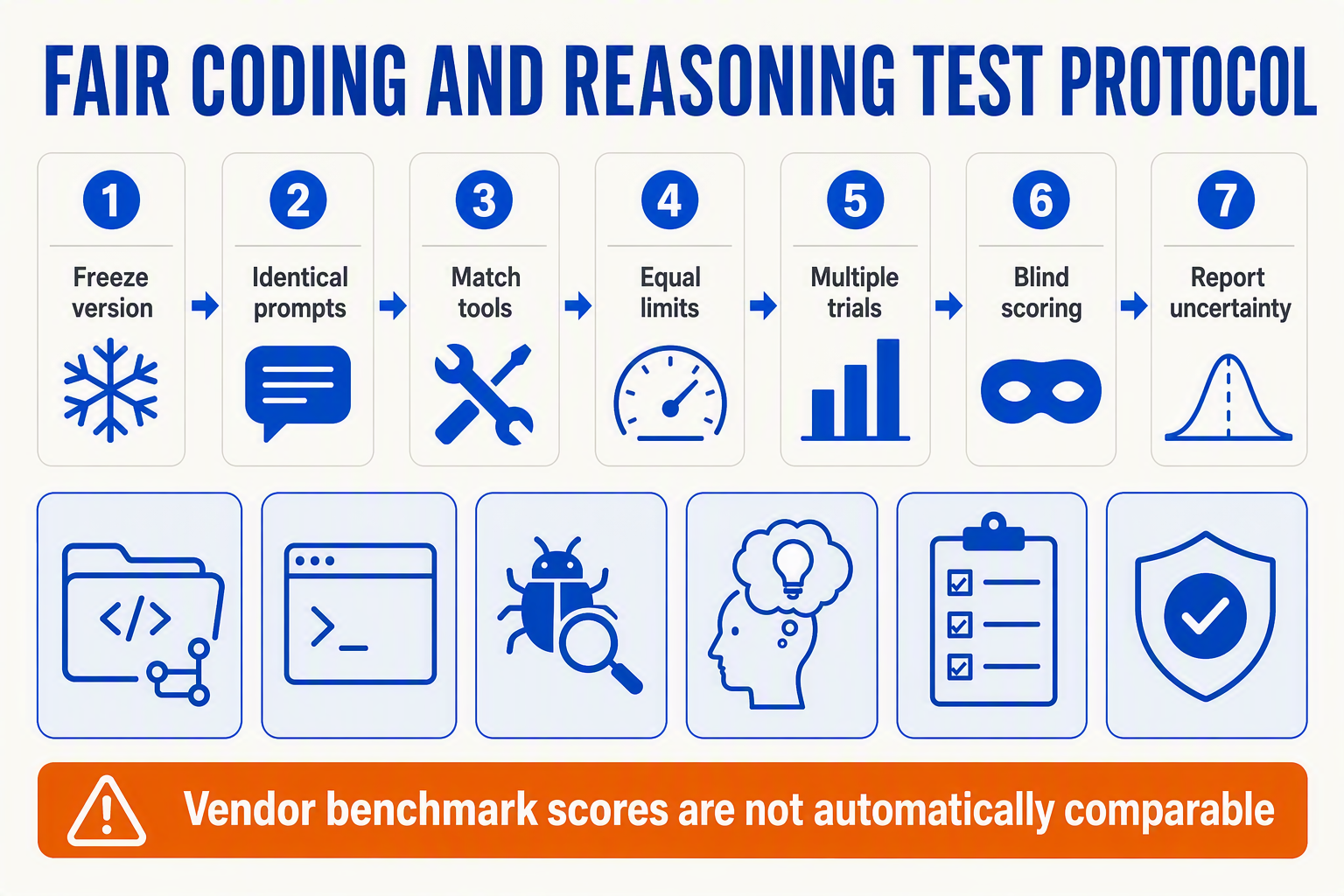
No statistically defensible coding or reasoning winner can be declared under identical test conditions because GPT-5.6 Sol lacks verifiable first-party specifications or benchmark results in the supplied research. Claude Fable 5.1 is therefore the evidence-backed option for evaluation—not a proven head-to-head winner.
What the available evidence establishes
Anthropic launched claude-fable-5-1 on September 1, 2026, according to the Claude Platform release notes, describing it as designed for “long-running agentic coding” and knowledge work. The Claude Platform model overview separately recommends Claude Fable 5.1 for “demanding reasoning and long-horizon agentic work.” These statements establish intended use, but vendor positioning is not equivalent to a controlled benchmark result.
As of September 3, 2026, the supplied first-party research contains zero official OpenAI benchmark disclosures, model cards, or API documentation for a model called GPT-5.6 Sol. Consequently:
- Unverified GPT-5.6 Sol scores should not be compared with Anthropic’s published claims.
- Scores attributed to “ChatGPT 5.6 Sol” cannot automatically be treated as API-model results.
- Community tests using unknown system prompts, reasoning settings, tools, or model snapshots are not identical-condition comparisons.
- The absence of evidence for GPT-5.6 Sol does not prove weaker performance; it means the performance is undetermined.
How to run an identical-condition coding test
A credible Fable 5.1 vs GPT-5.6 Sol for coding evaluation should use the same task corpus, execution environment, tool permissions, and scoring rules. Once a documented GPT endpoint exists, teams should:
- Pin exact model versions. Record the API model identifier and evaluation date rather than testing mutable consumer-chat interfaces.
- Equalise prompts and context. Use the same system instructions, repository snapshot, retrieved files, and token budget.
- Control tools. Run separate tool-free and tool-enabled tracks; giving one model terminal access while denying it to the other invalidates the comparison.
- Execute generated code. Score repository tasks through unit tests, build checks, and hidden regression tests—not subjective code review alone.
- Measure completion economics. Report pass rate, wall-clock time, input and output tokens, tool calls, retries, and cost per successfully completed task.
- Publish variability. Use repeated trials and confidence intervals instead of presenting one favourable run as a stable capability.
Suitable public suites include SWE-bench Verified for repository issue resolution, LiveCodeBench for contamination-resistant programming tasks, and Terminal-Bench for agentic command-line work. Results from different harness versions should remain separate.
Reasoning requires equally strict controls
Reasoning comparisons should distinguish accuracy from compute expenditure. Both models must receive equivalent reasoning budgets, stopping rules, calculators, search access, and retry allowances. Report pass-at-one alongside any best-of-multiple score because sampling several answers gives a system more opportunities to succeed.
Safety behaviour also needs isolation. Anthropic’s September 2026 system card says Claude Fable 5.1 uses additional cybersecurity and biology safeguards compared with Claude Mythos 5.1. A refusal on a high-risk security task may reflect policy enforcement rather than deficient reasoning, so benign software-engineering tests and dual-use cybersecurity tests should be scored separately.
The responsible conclusion is therefore provisional: Claude Fable 5.1 has documented positioning for advanced coding and reasoning, while GPT-5.6 Sol remains incomparable until OpenAI publishes a verifiable model and both systems can be tested through the same reproducible harness.
How do tool use, computer interaction, multimodal inputs, and structured outputs differ?
The verified evidence does not support a feature-by-feature winner for tool use, computer control, multimodal input, or structured output. Anthropic documents Claude Fable 5.1 as an agentic model, but the supplied first-party sources do not specify its complete tool or modality matrix; OpenAI provides no official documentation here for a model named GPT-5.6 Sol.
Verified capability comparison
| Capability | Claude Fable 5.1 | GPT-5.6 Sol | What buyers should conclude |
|---|---|---|---|
| Tool use | Agentic positioning is verified; exact tool specifications are not provided in the cited material | No official model or API documentation supplied | Do not infer supported tools from model naming |
| Computer interaction | No verified computer-use interface, action schema, or benchmark in the supplied sources | Unverified | Test through the intended runtime before procurement |
| Multimodal inputs | No complete image, audio, or video input specification is available in the supplied sources | Unverified | Treat each modality as unknown, not unsupported |
| Structured outputs | No cited JSON-schema guarantees or conformance rate | Unverified | Validate schemas, retries, and malformed-output handling |
| Safety during tool execution | Additional cybersecurity and biology safeguards are documented | No model-specific evidence | Fable may reject some high-risk actions by design |
Anthropic’s Claude Platform release notes state that claude-fable-5-1 launched on September 1, 2026, for “long-running agentic coding” and knowledge work. Anthropic’s model overview separately recommends Claude Fable 5.1 for “demanding reasoning and long-horizon agentic work.” These descriptions support its intended use in multi-step workflows, but they do not establish which first-party tools exist, which argument schemas are accepted, or how reliably calls execute.
Tool use is more than function calling
A production tool-use evaluation should measure the complete loop:
- Selection: Does the model choose the correct tool rather than answering from memory?
- Argument formation: Does it generate valid parameters, enums, dates, and identifiers?
- Execution recovery: Can it interpret timeouts, permission failures, and partial results?
- State management: Does it preserve constraints across many tool calls?
- Completion: Does it verify the real-world result before claiming success?
“Agentic” positioning alone cannot answer these questions. Teams comparing Claude Fable 5.1 vs GPT-5.6 Sol should run identical tool definitions and report completion rate, median calls per task, invalid-schema frequency, latency, and total cost.
Computer use and multimodality require separate verification
Computer interaction generally means interpreting a screen and issuing actions such as clicks, typing, scrolling, or navigation. That capability should not be assumed from coding strength, vision support, or generic function calling. Buyers need explicit documentation for supported environments, coordinate handling, screenshots, confirmation steps, and resistance to prompt injection embedded in webpages.
Likewise, “multimodal” can describe very different interfaces: image input, document understanding, native audio, video, or generated media. The supplied sources do not provide a complete modality specification for Claude Fable 5.1, and no equivalent specification exists here for GPT-5.6 Sol.
Structured output claims need measurable guarantees
For API workflows, test JSON validity separately from schema compliance. A model may return parseable JSON while omitting required fields, violating enums, or adding prohibited properties. Until first-party documentation establishes supported schema features and limitations, both models should be evaluated with adversarial inputs, nested schemas, streaming responses, retries, and tool-result injection.
Anthropic’s September 2026 system card also says Claude Fable 5.1 includes additional cybersecurity and biology safeguards compared with Claude Mythos 5.1. Those controls are operationally relevant: a safeguarded model may appropriately decline certain high-risk tool actions, so refusal behavior should be included in acceptance tests rather than misclassified automatically as tool failure.
Is Claude Fable 5.1 or GPT-5.6 Sol suitable for a real-time voice-agent system?

Claude Fable 5.1 may be suitable as the reasoning layer of a real-time voice agent, but the available first-party evidence does not establish its speech support or production latency. GPT-5.6 Sol cannot be recommended for deployment because, as of September 3, 2026, no official OpenAI API documentation, pricing, model card, or availability record for that model appears in the supplied research.
Voice agents need more than model intelligence
A real-time voice system is a pipeline, not a single model. It normally combines:
- Speech-to-Text (STT) to transcribe the caller.
- A language model to interpret intent, retrieve information, reason, and invoke tools.
- Text-to-Speech (TTS) to synthesize the response.
- Streaming and interruption control to support natural turn-taking and barge-in.
- Telephony infrastructure for routing, call state, recording, consent, and escalation.
Neither a strong coding score nor a large context window proves that a model will perform well in this pipeline. Teams need measurements for time to first token, tokens per second, tool-call latency, tail latency, error rate, and completed-task cost.
What is verified for Claude Fable 5.1?
Anthropic launched claude-fable-5-1 on September 1, 2026, according to the Claude Platform release notes. Anthropic positions Claude Fable 5.1 for “demanding reasoning and long-horizon agentic work,” making it potentially useful for complex support workflows such as troubleshooting, multi-step bookings, or cases requiring several backend tool calls.
However, the supplied first-party sources do not provide voice-specific evidence for:
- Native, bidirectional speech input and output
- End-to-end audio-streaming latency
- Interruption or barge-in behaviour
- Telephone-audio accuracy at narrowband sample rates
- Concurrent-call capacity or voice-session pricing
- Real-time response-latency percentiles
Therefore, Fable 5.1 should not be treated as a verified speech-to-speech model based on the available evidence. It is more defensible to evaluate it as the text-based reasoning and orchestration component between dedicated STT and TTS services.
Anthropic also states that Claude Fable 5.1 shares its underlying model with Claude Mythos 5.1 but adds cybersecurity and biology safeguards for general availability. Those controls may benefit customer-facing deployments, although businesses should test whether refusals affect legitimate technical-support conversations.
Why GPT-5.6 Sol remains unevaluable
As of September 3, 2026, the supplied research contains zero first-party OpenAI specifications for a model named GPT-5.6 Sol. Without a verified model identifier or API documentation, developers cannot validate streaming, function calling, audio support, context limits, rate limits, safety controls, or cost.
A similarly named model visible through an unofficial interface should not be assumed to be an OpenAI production model. Model aliases can hide routing, previews, or third-party substitutions.
Practical deployment decision
Run a call-level evaluation before selecting any reasoning model:
- Measure median, p95, and p99 response latency under concurrent load.
- Test accents, code-switching, noise, interruptions, and silence.
- Track tool-call success, hallucinated actions, transfers, and retries.
- Calculate cost per successfully resolved call, not merely cost per token.
- Maintain a faster fallback model for simple intents and latency spikes.
For Indian deployments, platforms such as CallMissed combine WhatsApp Business calling with AI voice agents and provide STT and TTS across 22 Indian languages. In that architecture, Claude Fable 5.1 could be tested as the reasoning layer; GPT-5.6 Sol should remain outside production consideration until OpenAI publishes verifiable documentation.
How do safety controls, deployment restrictions, and model transparency affect real-world use?
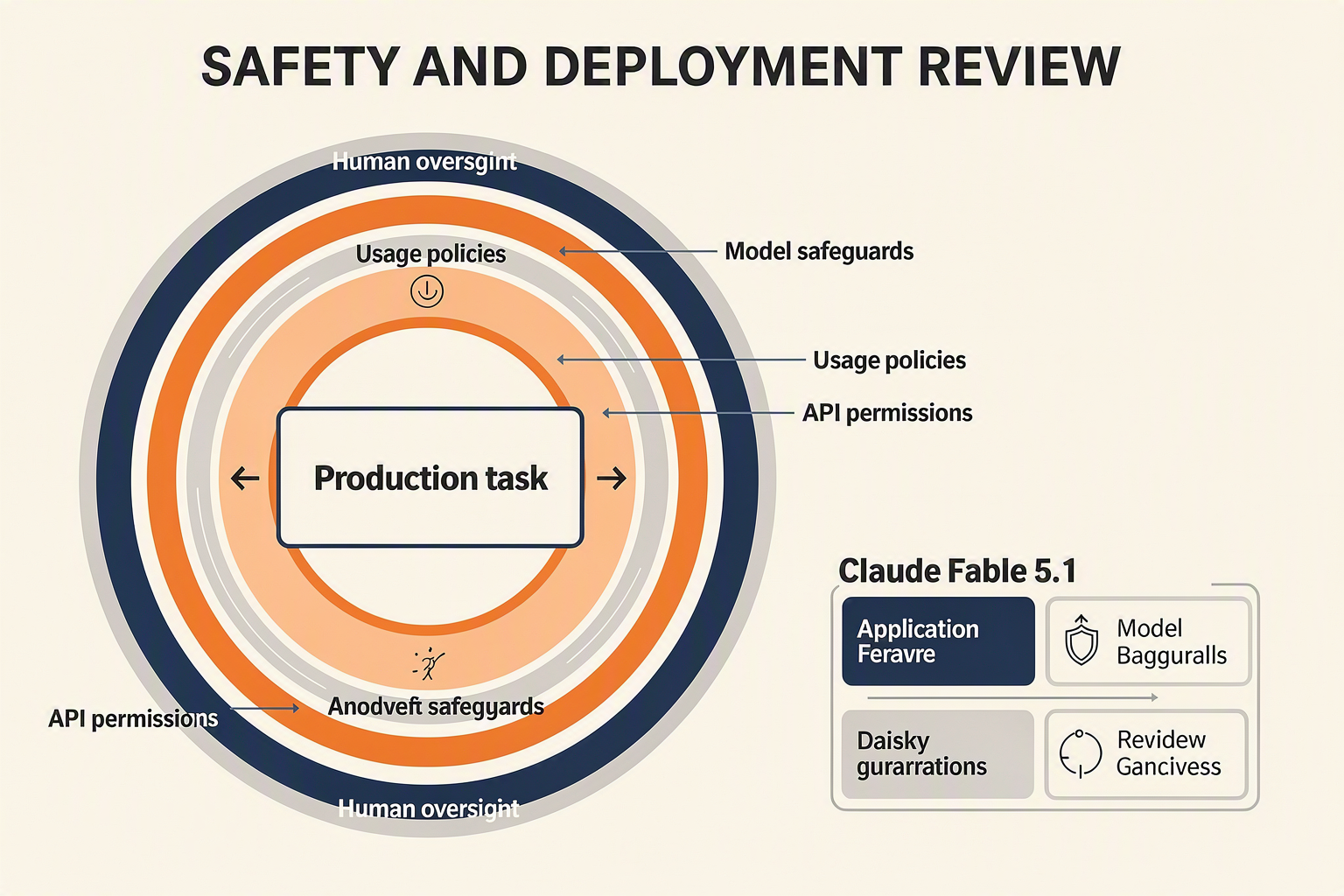
Safety controls materially affect which tasks a model can complete, while deployment restrictions determine whether an organization can legally and operationally use it. As of September 3, 2026, Claude Fable 5.1 has first-party safety and availability documentation; the supplied research provides no equivalent evidence for a model named OpenAI GPT-5.6 Sol.
Claude Fable 5.1 has documented, task-specific safeguards
Anthropic states that Claude Fable 5.1 and Claude Mythos 5.1 use the same underlying model but apply different levels of safeguards. Fable 5.1 is intended for general use and adds controls that prevent certain high-risk tasks, particularly in cybersecurity and biology.
This distinction has practical consequences:
- General enterprise workloads: Fable 5.1 is the documented choice for coding, knowledge work, and long-running agents.
- Dual-use security work: Some legitimate penetration-testing, malware-analysis, or vulnerability-research requests may trigger additional scrutiny or refusal.
- Biological research: Advanced workflows involving potentially dangerous biological procedures may be restricted even when a user has legitimate intent.
- Agentic deployments: A refusal during one step can interrupt an otherwise valid multi-tool workflow, so teams must test complete tasks rather than isolated prompts.
Anthropic launched the generally available claude-fable-5-1 API model on September 1, 2026, according to the Claude Platform release notes. General availability reduces procurement uncertainty, but it does not guarantee that every prompt, tool call, region, or use case will be permitted.
GPT-5.6 Sol cannot receive an equivalent safety assessment
The supplied evidence contains no official OpenAI system card, model card, API documentation, usage policy, or launch announcement for GPT-5.6 Sol as of September 3, 2026. Consequently, this comparison cannot verify its refusal boundaries, deployment regions, age restrictions, regulated-use conditions, monitoring controls, or eligibility for fine-tuning.
That absence should be treated as unavailable evidence, not as proof that GPT-5.6 Sol has weak or nonexistent safeguards. Before production adoption, buyers should require:
- An official model identifier and API availability record.
- A current system card describing evaluated risks and mitigations.
- Published usage policies for cybersecurity, healthcare, biometrics, and autonomous actions.
- Data-retention, training-use, residency, and audit-log terms.
- Documented procedures for policy appeals and false-positive refusals.
Transparency changes procurement risk
Anthropic provides three traceable disclosure layers for Fable 5.1: a September 1, 2026 announcement, Claude Platform release notes, and a dedicated Claude Fable 5.1 and Claude Mythos 5.1 System Card listed in Anthropic’s September 2026 system-card archive. These materials do not eliminate model risk, but they give security, legal, and engineering teams a common basis for evaluation.
Production governance must still extend beyond the base model. For example, a customer-service system built through CallMissed’s OpenAI-compatible multi-model gateway should combine model safeguards with authentication, tool permissions, consent handling, redaction, escalation rules, and audit logs.
The defensible conclusion is therefore narrow: Claude Fable 5.1 is assessable and generally available, whereas GPT-5.6 Sol is not verifiable from the supplied first-party record. For regulated or high-impact deployments, verifiable documentation is itself a product capability—not administrative paperwork.
What do first-party experts and system cards claim, and which conclusions remain uncertain?

Anthropic’s first-party materials support a narrow conclusion: Claude Fable 5.1 is a documented, generally available model designed for long-horizon coding and reasoning, with extra safeguards for high-risk cyber and biology tasks. They do not establish that Fable 5.1 is universally superior to GPT-5.6 Sol, because the supplied research contains no equivalent OpenAI launch documentation or system card for that name.
What Anthropic officially claims
Anthropic announced Claude Fable 5.1 and Claude Mythos 5.1 on September 1, 2026, describing them as its most advanced models for coding and knowledge work. The Claude Platform documentation recommends Fable 5.1 for “demanding reasoning and long-horizon agentic work,” particularly when evaluations using Claude Opus 5 at higher effort remain insufficient.
Anthropic’s first-party positioning makes several specific claims:
- Long-running software work: The Claude Fable product page says the model “avoids easy-seeming shortcuts” and attempts to fix root causes rather than surface symptoms.
- Shared underlying capability: Anthropic states that Claude Fable 5.1 and Claude Mythos 5.1 use the same underlying model.
- Different deployment boundaries: Fable 5.1 is generally available, while Mythos 5.1 has a different access and safeguards profile.
- Risk controls: The Claude Fable 5.1 and Claude Mythos 5.1 System Card says Fable includes additional safeguards that prevent certain tasks in high-risk cybersecurity and biology domains.
These statements are useful for understanding intended use, but they remain vendor claims, not independent comparative findings.
What the system card can—and cannot—prove
A system card documents evaluation procedures, observed risks, mitigations, and deployment decisions. It is stronger evidence than an unsourced leaderboard screenshot because Anthropic identifies the evaluated model and formally records its safety posture. However, even a detailed system card cannot by itself answer every procurement question.
The available first-party record does not establish:
- Universal coding leadership: “Built for long-running projects” does not prove higher success rates across every repository, language, or agent framework.
- Production reliability: Benchmark performance does not directly measure API outages, malformed tool calls, retry rates, or cost per completed workflow.
- Voice-agent suitability: No cited Anthropic claim here demonstrates the end-to-end latency needed for interruption-sensitive telephone or WhatsApp conversations.
- Safeguard perfection: Additional controls reduce specified risks; they do not imply zero jailbreaks, false refusals, or harmful outputs.
Why GPT-5.6 Sol conclusions remain unavailable
As of September 3, 2026, the supplied first-party research contains no OpenAI announcement, API model identifier, pricing page, system card, benchmark report, or availability statement for GPT-5.6 Sol. Consequently, claims about its context window, token price, coding scores, reasoning strength, multimodal inputs, tool use, latency, or safety controls are unverified—not zero, weak, or inferior.
That distinction is crucial. Absence of evidence cannot justify declaring Fable 5.1 the performance winner; it only makes Fable the better-documented and presently assessable option in this evidence set. A defensible Claude Fable 5.1 vs GPT-5.6 Sol comparison must therefore keep three labels separate: vendor-verified, independently reproduced, and currently unknown.
What does Claude Fable 5.1 vs GPT-5.6 Sol mean for your workload? Decision guide by use case
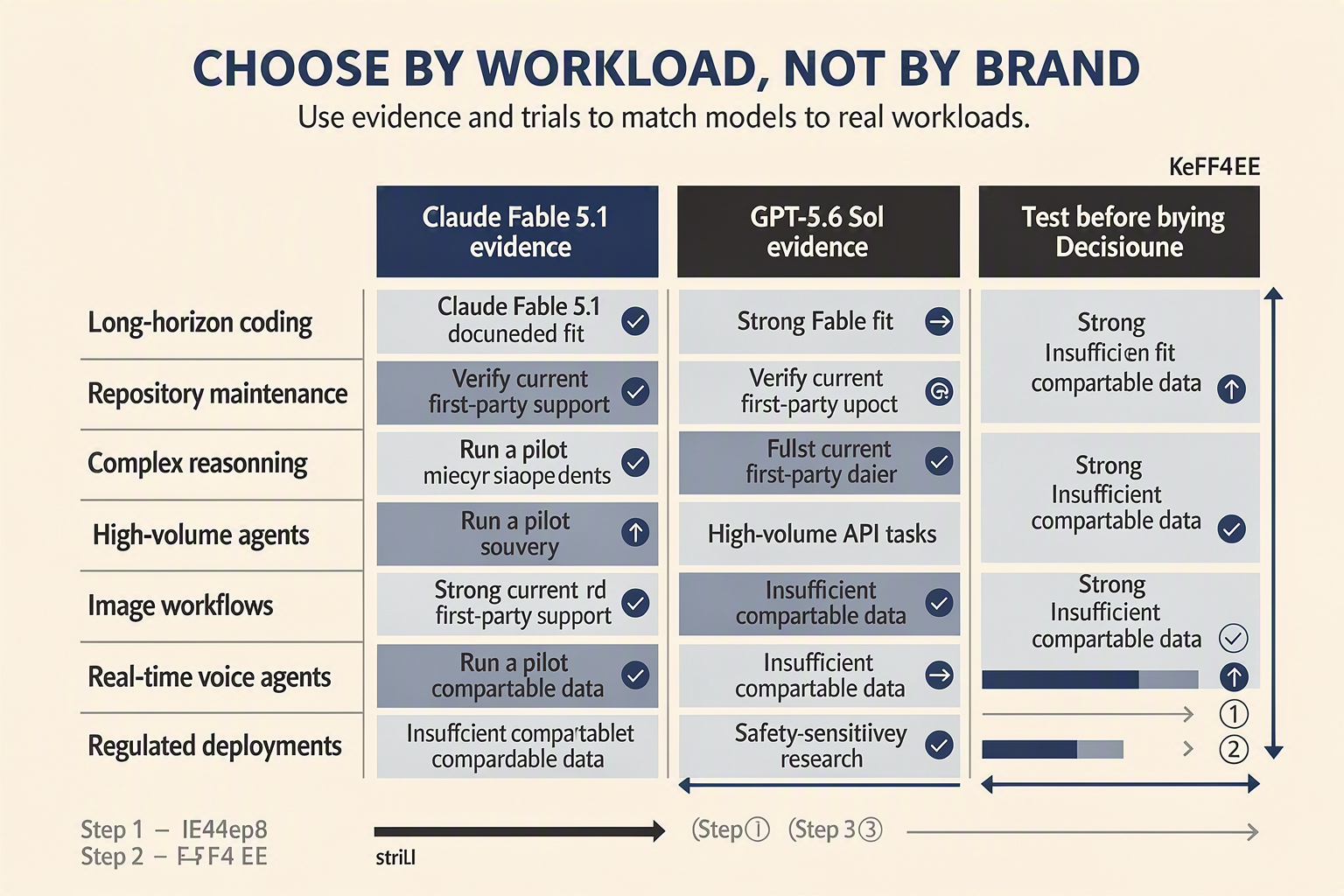
Choose Claude Fable 5.1 when the workload needs a purchasable, documented model for long-horizon reasoning or agentic coding. Do not select GPT-5.6 Sol for production until OpenAI publishes first-party API documentation, pricing, availability, and safety materials; as of September 3, 2026, the supplied research contains none.
Workload decision table
| Workload | Recommended path | Why | Deployment gate |
|---|---|---|---|
| Repository-scale coding agents | Evaluate Claude Fable 5.1 | Anthropic positions claude-fable-5-1 for long-running agentic coding and projects requiring root-cause fixes rather than shortcuts. | Test patch correctness, regression rate, tool-call recovery, latency, and cost per accepted change. |
| Complex research or knowledge work | Evaluate Claude Fable 5.1 | The Claude Platform model overview recommends Fable 5.1 for “demanding reasoning and long-horizon agentic work.” | Require citations, measure unsupported claims, and test performance across multi-step tasks. |
| Cybersecurity or biology workflows | Prefer Fable 5.1, subject to policy testing | Anthropic says Fable 5.1 shares its underlying model with Mythos 5.1 but adds safeguards for high-risk cybersecurity and biology requests. | Confirm legitimate tasks are not blocked and prohibited requests fail safely. |
| Existing OpenAI production stack | Keep the current verified model; do not assume a Sol upgrade | No supplied first-party OpenAI source confirms GPT-5.6 Sol, its endpoint, migration path, context limit, or compatibility. | Wait for OpenAI API documentation, a model card, pricing, and deprecation guidance. |
| Real-time multilingual voice agents | Benchmark the complete speech-to-speech pipeline | A strong reasoning model can still be unsuitable if first-token latency, streaming, interruption handling, or tool calls are unreliable. | Measure end-to-end latency, barge-in recovery, transcription quality, completion rate, and cost per resolved call. |
| High-volume, price-sensitive automation | Run a controlled Fable pilot; defer the direct price comparison | An unavailable GPT-5.6 Sol price makes token-cost comparisons and savings claims non-verifiable. | Calculate cached and uncached input, output, retries, tool calls, and human-escalation cost from actual invoices. |
How to interpret the recommendation
Anthropic launched Claude Fable 5.1 on September 1, 2026, according to the Claude Platform release notes. That documented general availability makes Fable 5.1 the practical candidate for evaluation—not an automatic winner on every workload.
Use three procurement rules:
- Compare deployable products, not names in search results. A benchmark attributed to GPT-5.6 Sol cannot support a buying decision without a traceable OpenAI model identifier and test conditions.
- Score completed tasks rather than tokens alone. Include retries, invalid tool arguments, engineer review, safety refusals, and escalations when calculating total task cost.
- Test the production architecture. For voice systems, evaluate Speech-to-Text, orchestration, model inference, Text-to-Speech, telephony, and CRM actions together.
For example, CallMissed’s OpenAI-compatible gateway can help teams evaluate multiple models without redesigning the application interface, while its Speech-to-Text and Text-to-Speech support across 22 Indian languages enables regional voice-agent testing. That flexibility does not remove the need for model-specific evaluations, but it reduces integration friction.
Bottom line
Select Fable 5.1 for a proof of concept when long-running coding, demanding reasoning, or documented high-risk safeguards are central. Treat GPT-5.6 Sol as unverified, not inferior: revisit the comparison if OpenAI releases authoritative specifications, pricing, benchmarks, and safety documentation.
Frequently asked questions about Claude Fable 5.1 vs GPT-5.6 Sol
Is GPT-5.6 Sol a real OpenAI model available in September 2026?
claude-fable-5-1, so any GPT-5.6 Sol specifications circulating without an OpenAI source should be treated as unverified, not as established product facts.What is the Claude Fable 5.1 vs GPT-5.6 Sol price and context-window comparison?
Which model wins the Claude Fable 5.1 vs GPT-5.6 Sol benchmarks?
Is Fable 5.1 vs GPT-5.6 Sol for coding a meaningful comparison?
How do Claude Fable 5.1 and GPT-5.6 Sol compare for tools and multimodal applications?
Which model is safer and more suitable for real-time AI voice agents?
Conclusion
The evidence supports Claude Fable 5.1 as the assessable production option, not an automatic universal winner. As of September 3, 2026, Anthropic provides first-party documentation for Fable 5.1, while the supplied research contains no official OpenAI launch record, model card, API documentation, pricing, or benchmark results for GPT-5.6 Sol.
- Availability comes before performance. Anthropic’s Claude Platform release notes state that
claude-fable-5-1launched on September 1, 2026, for long-running agentic coding and knowledge work. GPT-5.6 Sol should remain classified as unverified until OpenAI publishes corresponding first-party material.
- Price and benchmark comparisons are currently incomplete. Without confirmed GPT-5.6 Sol token rates, context limits, caching terms, coding evaluations, or test methodology, precise cost and performance rankings would be speculative. Buyers should compare cost per successfully completed task, including retries and tool calls, rather than token prices alone.
- Fable 5.1 has a clearly documented workload profile. Anthropic recommends Claude Fable 5.1 for demanding reasoning and long-horizon agentic work. Anthropic also says Fable 5.1 and Claude Mythos 5.1 share an underlying model, while Fable adds cybersecurity and biology safeguards for general availability.
- Voice-agent suitability requires system-level testing. Neither reasoning scores nor coding benchmarks establish conversational quality. Production evaluations must measure time to first token, streaming stability, interruption handling, tool-call reliability, speech accuracy, and end-to-end task completion under real network conditions.
The next development to watch is whether OpenAI formally announces GPT-5.6 Sol with reproducible benchmarks, API access, safety documentation, multimodal specifications, and stable pricing. Until then, procurement teams should treat unsupported specifications as unknown—not as facts—and keep their inference architecture flexible.
To explore how AI communication is evolving, check out CallMissed, an OpenAI-compatible AI infrastructure platform supporting voice agents, WhatsApp automation, and speech across 22 Indian languages. As frontier models change, is your stack ready to switch providers without rebuilding the customer experience?
Related Reading
- Claude Fable 5.1 Benchmarks: Coding Performance, Evidence, and Caveats
- Claude Fable 5.1 Features: What’s New, Pricing and Upgrade Guide
- Claude Fable 5.1 vs GPT-6: Enterprise Agent Tests