Claude Fable 5.1 Benchmarks: Coding Performance, Evidence, and Caveats



Compare Claude Fable 5.1 benchmarks, coding results, evidence quality, contamination risks, pricing, speed, and practical fit by workload.
Claude Fable 5.1 Benchmarks: Coding Performance, Evidence, and Caveats
What if the strongest headline about a new coding model comes from the company that built it—but the evidence needed to reproduce that claim is still incomplete? That is the central challenge in evaluating Claude Fable 5.1 benchmarks: separating promising first-party results from independently verified performance, then deciding whether either predicts success in a real codebase.
The timing matters because Anthropic positions Claude Fable 5.1 as a meaningful upgrade without a corresponding increase in standard token prices. Anthropic states that Claude Fable 5.1 solves more of its internal coding problems than both Fable 5 and Opus 5, according to the company’s launch announcement available on September 3, 2026. Anthropic’s documentation also says cache reads cost one-quarter as much as before, equivalent to a 75% reduction, while input and output pricing remains unchanged. DataCamp separately reports that the model more than doubles Fable 5’s performance on agentic science benchmarks and retains pricing of $10 per million input tokens and $50 per million output tokens.
Those claims are consequential—but they are not all equivalent forms of evidence. An internal benchmark may use private tasks that better represent production work, yet outsiders cannot necessarily inspect its dataset, harness, prompts, scoring rules, or failure cases. A public result can be easier to audit, but popular test sets also face training-data contamination, prompt sensitivity, repeated-submission overfitting, and differences in tool access or inference budgets. Even a high Claude Fable 5.1 coding benchmark score may say little about repository-scale refactoring, test-driven debugging, latency, or cost per successfully completed task.
What this analysis will establish
This Claude Fable 5.1 review will distinguish among three evidence tiers:
- Official claims: Results published by Anthropic, including internal coding comparisons and statements in the Claude Fable 5.1 and Claude Mythos 5.1 system card.
- Public benchmark evidence: Evaluations such as Terminal-Bench 4.0, examined only where the score, date, model configuration, and methodology can be verified.
- Independent observations: Third-party testing and deployment reports, clearly labelled so anecdotal impressions are not mistaken for controlled experiments.
The analysis will also explain what each benchmark actually measures, whether comparisons such as Claude Fable 5.1 vs Opus 5 are apples-to-apples, and how pricing, cache economics, speed, context handling, and agent scaffolding affect practical value. For developers using multi-model infrastructure such as CallMissed’s OpenAI-compatible gateway, this distinction matters because model selection should follow workload evidence—not a single leaderboard position.
The goal is not to crown a universal winner. It is to determine where Claude Fable 5.1’s reported performance is credible, where independent confirmation remains limited, and what teams should test before choosing it for coding, research, autonomous agents, or enterprise workflows.
What do Claude Fable 5.1 benchmarks actually show?
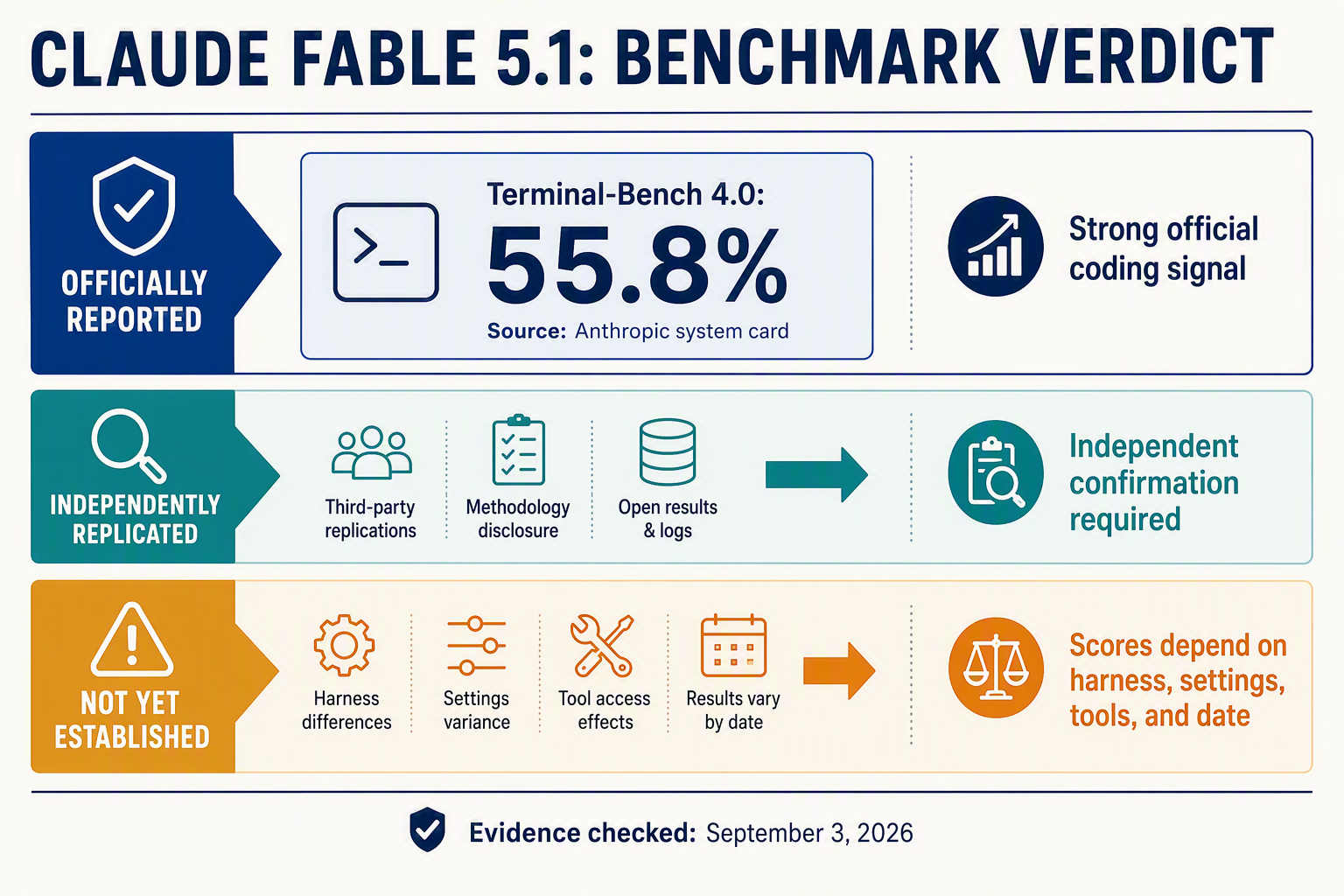
Claude Fable 5.1 benchmarks show a credible first-party improvement in coding, agentic science, and financial reasoning, but they do not yet prove that the model leads across independent public evaluations. As of September 5, 2026, Anthropic reports a documented 55.9% result on FrontierFinance, compared with 49.2% for Claude Fable 5. That is a meaningful gain under Anthropic’s evaluation setup, but it remains a first-party result rather than an independent reproduction.
The evidence hierarchy matters
Claims about Claude Fable 5.1 benchmarks should be separated by source and reproducibility:
- Documented first-party benchmark results: Anthropic reports 55.9% on FrontierFinance for Claude Fable 5.1 versus 49.2% for Fable 5, an absolute improvement of 6.7 percentage points. This is the clearest quantitative comparison currently available, but readers still need the complete evaluation protocol—including prompts, tools, reasoning settings, sampling method, token budget, and scoring rules—to reproduce it precisely.
- System-card evaluations: Results published in an Anthropic system card provide more evidence than an unsupported marketing statement because they generally identify evaluations and describe at least part of the methodology. Nevertheless, a system-card score is still produced or commissioned by the model developer. It should not be described as independently verified unless an unaffiliated group reruns the same test under disclosed, matching conditions.
- Internal coding and science evaluations: Anthropic reports improvements over Fable 5—and, on some internal coding work, stronger performance than Claude Opus 5. Internal tests can reflect realistic, long-horizon work better than narrow public benchmarks, but undisclosed task sets cannot establish a public ranking. Task selection, agent scaffolding, inference budgets, and adjudication may materially affect the result.
Weak third-party summaries should not be treated as additional confirmation when they merely repeat Anthropic’s figures. A report becomes independent evidence only when the evaluator obtains model access, publishes its methodology, and produces a separate result.
What the reported results measure—and what they do not
FrontierFinance provides evidence about performance on the tasks and scoring procedure included in that benchmark. The increase from 49.2% to 55.9% supports the narrower conclusion that Fable 5.1 performed better than Fable 5 in Anthropic’s reported run. It does not establish verified trading profitability, investment safety, or reliable performance under changing market conditions. Real-world results can be affected by stale information, data leakage, transaction costs, latency, risk constraints, and market-regime shifts.
Internal coding evaluations may test whether an agent can inspect repositories, edit files, invoke tools, run tests, and resolve software issues. They do not automatically predict success in an unfamiliar production codebase with proprietary conventions, incomplete documentation, dependency conflicts, security restrictions, or fragile deployment processes.
Agentic science evaluations can probe extended research behaviour, such as planning, tool use, evidence interpretation, and persistence across multiple steps. Better benchmark completion does not necessarily imply that every generated claim is factually correct, experimentally valid, or safe to act on without expert review.
Accordingly, Claude Fable 5.1 benchmarks are most informative as evidence of progress under particular evaluation conditions—not as a universal measure of model quality.
Why headline comparisons can mislead
A rigorous comparison should control for:
- Prompts: identical system instructions, task wording, examples, and repository context.
- Tools: the same tool definitions, permissions, test runners, search access, and execution environment.
- Reasoning effort: equivalent effort settings, planning options, temperature, and sampling parameters.
- Token and compute budgets: matching input limits, output limits, retries, wall-clock time, and parallel attempts.
- Agent scaffolding: identical planning loops, error recovery, memory, test execution, and human assistance.
- Pass/fail criteria: a predetermined rubric, the same unit and integration tests, and consistent treatment of partial solutions.
- Sampling and reporting: pass@1 should not be compared with best-of-N, and averages should include failure rates, cost, and latency.
- Contamination controls: evaluators should check whether tasks or close variants appeared in public repositories, tutorials, training material, or previous test feedback.
These controls are particularly important for Fable 5.1 vs Opus 5. A result obtained with different tools, more retries, greater reasoning effort, or a larger token allowance is a comparison of complete systems—not necessarily an apples-to-apples comparison of the underlying models.
How teams should reproduce the tests
For a practical evaluation, select representative tasks from your own workload and freeze the test before running either model. Use fixed prompts, identical tools, the same reasoning-effort setting, an equal token budget, and explicit pass/fail criteria. Run multiple trials where nondeterminism matters, record every failure, and report cost and completion time alongside accuracy.
Coding tests should use clean repository snapshots and automated tests that neither model can modify. Research or finance tasks should use time-bounded source material and expert-reviewed rubrics. Keep the evaluator blind to model identity where manual judgment is unavoidable.
The defensible conclusion today
The available Claude Fable 5.1 benchmarks support a measured conclusion: Anthropic has documented improved performance over Fable 5, including 55.9% versus 49.2% on FrontierFinance, and reports gains on internal coding and science evaluations. These findings are useful first-party evidence, but system-card publication and internal testing are not automatically independent reproductions.
Before selecting a production model, teams should seek public task-level results, disclosed configurations, unaffiliated reruns, and pilots on their own repositories or workflows. Multi-model gateways such as CallMissed’s OpenAI-compatible API can make those controlled, workload-specific comparisons easier to run.
What is Claude Fable 5.1, and why does its evaluation context matter?

Claude Fable 5.1 is Anthropic’s 2026 model for coding, long-running agents, and knowledge work, positioned as an extension of Fable 5 rather than a new pricing tier. Its evaluation context matters because benchmark outcomes depend not only on model weights, but also on prompts, tools, inference budgets, caching, agent scaffolds, and who conducted the test.
Product context: capability claims and economics
Anthropic presents Claude Fable 5.1 alongside Claude Mythos 5.1, with Fable aimed at strong capability without moving to the higher-cost model class. The release emphasizes several practical changes:
- stronger performance on Anthropic’s internal coding tasks;
- improved long-running agent behaviour;
- gains on agentic science evaluations;
- lower cache-read costs;
- unchanged standard input and output token prices.
Anthropic’s September 2026 documentation says Claude Fable 5.1 cache reads cost one-quarter of the previous amount, a 75% reduction. DataCamp reports pricing of $10 per million input tokens and $50 per million output tokens, unchanged from Fable 5.
That economic context belongs in a benchmark analysis. A model that completes more tasks but requires longer reasoning traces, more retries, or heavier tool use may cost more per successful outcome. Conversely, cheaper cache reads can materially benefit repository agents that repeatedly reuse system instructions, code context, and tool definitions.
Why the evaluation setup can change the result
A benchmark score is produced by a complete evaluation system, not by the model alone. At minimum, a rigorous Claude Fable 5.1 review should record:
- Model version and date: A stable identifier is needed because silent serving updates can affect reproducibility.
- Prompt and agent scaffold: Planning loops, reflection, memory, and error recovery can change task-completion rates.
- Tool access: Shell execution, browsers, test runners, package installation, and network access alter what the benchmark measures.
- Inference budget: Token limits, timeouts, retry counts, and sampling parameters can trade cost and latency for accuracy.
- Scoring method: Pass rates based on executable tests are generally more objective than judge-model ratings, but hidden tests may still be incomplete.
- Run count: A single pass hides stochastic variance; repeated trials are more informative.
- Evaluator independence: Vendor-run, benchmark-maintainer-run, and third-party reproductions carry different evidentiary weight.
These variables are especially important for Claude Fable 5.1 vs Opus 5 comparisons. If one model receives a newer scaffold, larger context budget, or more attempts, the result measures the combined systems rather than an intrinsic model difference.
What Anthropic’s wording establishes—and what it does not
Anthropic states that Claude Fable 5.1 solves more of the company’s internal coding problems than Fable 5 or Opus 5. This is useful first-party evidence that Anthropic observed an improvement on its own task distribution. It does not, by itself, establish the size of the gain, statistical significance, reproducibility, or superiority across public coding benchmarks.
Likewise, DataCamp reports that Claude Fable 5.1 more than doubles Fable 5’s agentic-science performance. That relative statement requires the underlying benchmark name, absolute scores, harness, and run conditions before readers can estimate practical impact.
The correct interpretation is therefore bounded: Claude Fable 5.1 has strong official evidence of progress, but each broader performance conclusion must be tied to a disclosed task, configuration, score, and evaluator. The following sections apply that standard to coding, science, agentic, and enterprise evidence.
Which Claude Fable 5.1 benchmark developments are officially documented?
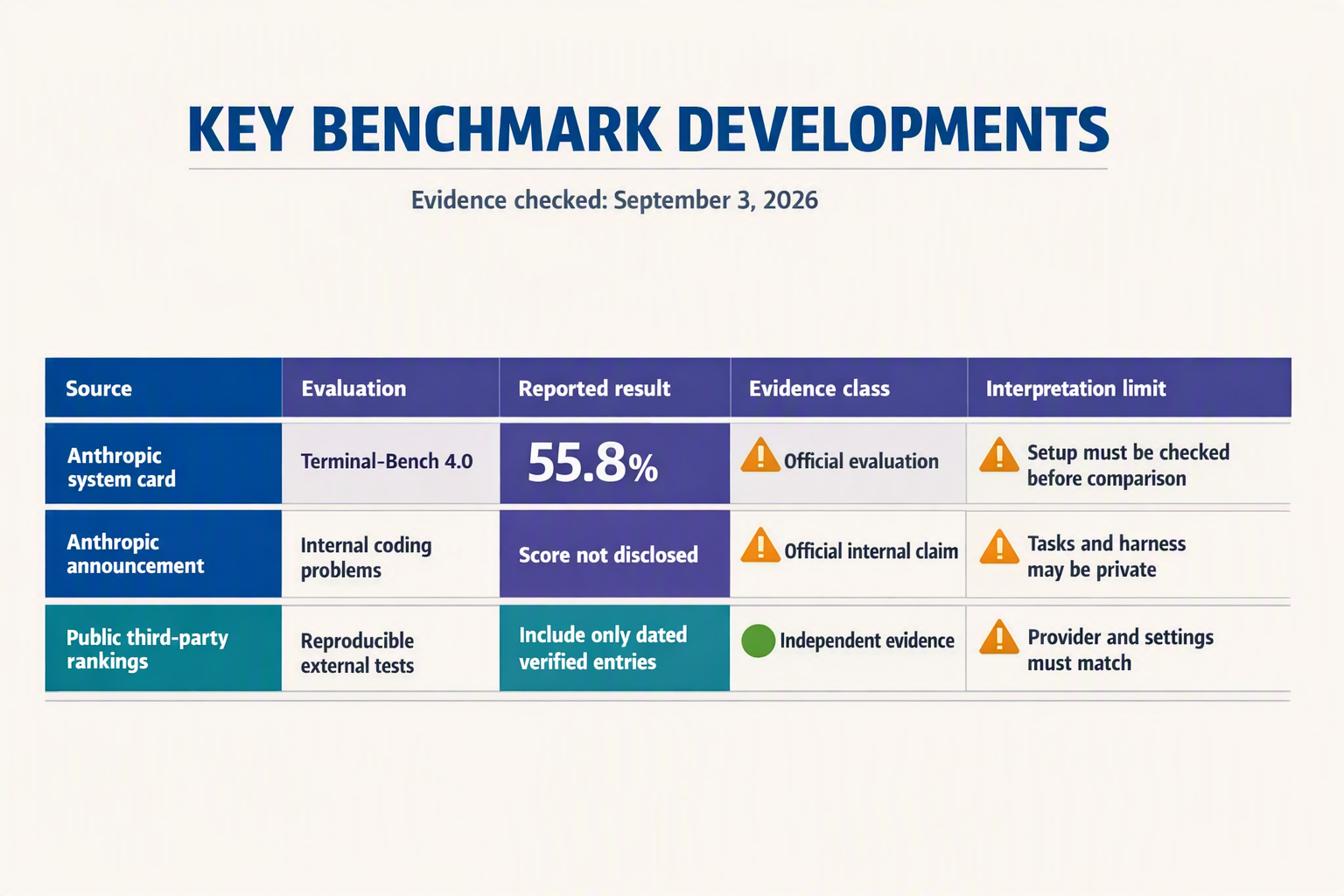
Anthropic officially documents directional gains in coding, trading intuition, long-running work, and cache economics, but the available materials do not disclose enough numerical or methodological detail to reproduce most Claude Fable 5.1 benchmark claims. The strongest first-party coding statement is comparative—not a published score with a public dataset and evaluation harness.
Officially documented claims and their limits
| Development | Documented result | What it measures | Evidence status and caveat |
|---|---|---|---|
| Internal coding benchmark | Anthropic says Fable 5.1 “solves more of our coding problems than Fable 5 or Opus 5.” | Success on Anthropic’s private coding-task set | Official, directional claim. No task count, score, prompt, tool configuration, pass criterion, or confidence interval is provided in the cited launch material. |
| Trading intuition | Anthropic says Fable 5.1 “achieves state of the art on trading intuition.” | Apparent reasoning about trading decisions or market scenarios | Official claim, incomplete methodology. The benchmark name, dataset, scoring method, baselines, and numeric result are not specified in the supplied material. |
| Agentic science | DataCamp reports that Fable 5.1 more than doubles Fable 5’s performance. | Autonomous or multi-step scientific reasoning and tool use | Secondary reporting of a vendor result, not independent replication. “More than doubles” needs the underlying scores, task suite, agent scaffold, and retry budget for interpretation. |
| Long-running tasks | Anthropic’s model documentation describes stronger long-running performance. | Ability to maintain progress across extended, multi-step workflows | Official qualitative claim. No duration distribution, completion rate, interruption policy, or matched baseline is included in the cited summary. |
| Cache-read economics | Anthropic says cache reads cost one-quarter of the previous amount—a 75% reduction. | Cost efficiency when reusing cached prompt context | Official and numerically explicit, but this is a pricing development rather than a capability benchmark. Savings depend on cache-hit rate and workload structure. |
| Safety evaluation | Anthropic’s system card reports performance comparable to Mythos 5 in the suicide and self-harm domain and continued high harmlessness. | Safety behavior on sensitive-domain and harmful-request evaluations | Official safety evidence, not proof of coding or reasoning quality. Aggregate wording cannot replace category-level scores, sample sizes, or error analysis. |
Anthropic’s launch announcement, available on September 3, 2026, states that Claude Fable 5.1 solves more internal coding problems than both Fable 5 and Opus 5. This supports a hypothesis of improved coding performance, but not a precise estimate of the improvement.
Anthropic’s documentation, available on September 3, 2026, states that cache reads cost one-quarter as much as before, which is a 75% reduction. DataCamp also reports unchanged pricing of $10 per million input tokens and $50 per million output tokens, making cost comparisons more concrete than most capability comparisons.
What is not yet established
The official record does not, from the supplied evidence, establish a verified Claude Fable 5.1 score for Terminal-Bench 4.0, nor does it provide a reproducible public result for the internal coding or trading evaluations. A benchmark number circulating through a model directory, blog, or leaderboard should therefore not be labelled an Anthropic result unless its model version, date, agent harness, inference settings, and source submission can be traced.
Three caveats matter most:
- Private benchmarks resist auditing: outsiders cannot inspect hidden tasks, exclusions, prompts, or grading.
- Public benchmarks risk contamination: widely circulated tasks may appear in training data or derivative datasets.
- Agent settings can dominate outcomes: tool access, token budgets, retries, and scaffolding can materially alter completion rates.
Accordingly, these official developments justify further testing—but not an unconditional conclusion that Claude Fable 5.1 outperforms Opus 5 across all coding, research, or enterprise workloads.
What do Terminal-Bench, science, coding, reasoning, and browsing benchmarks measure?
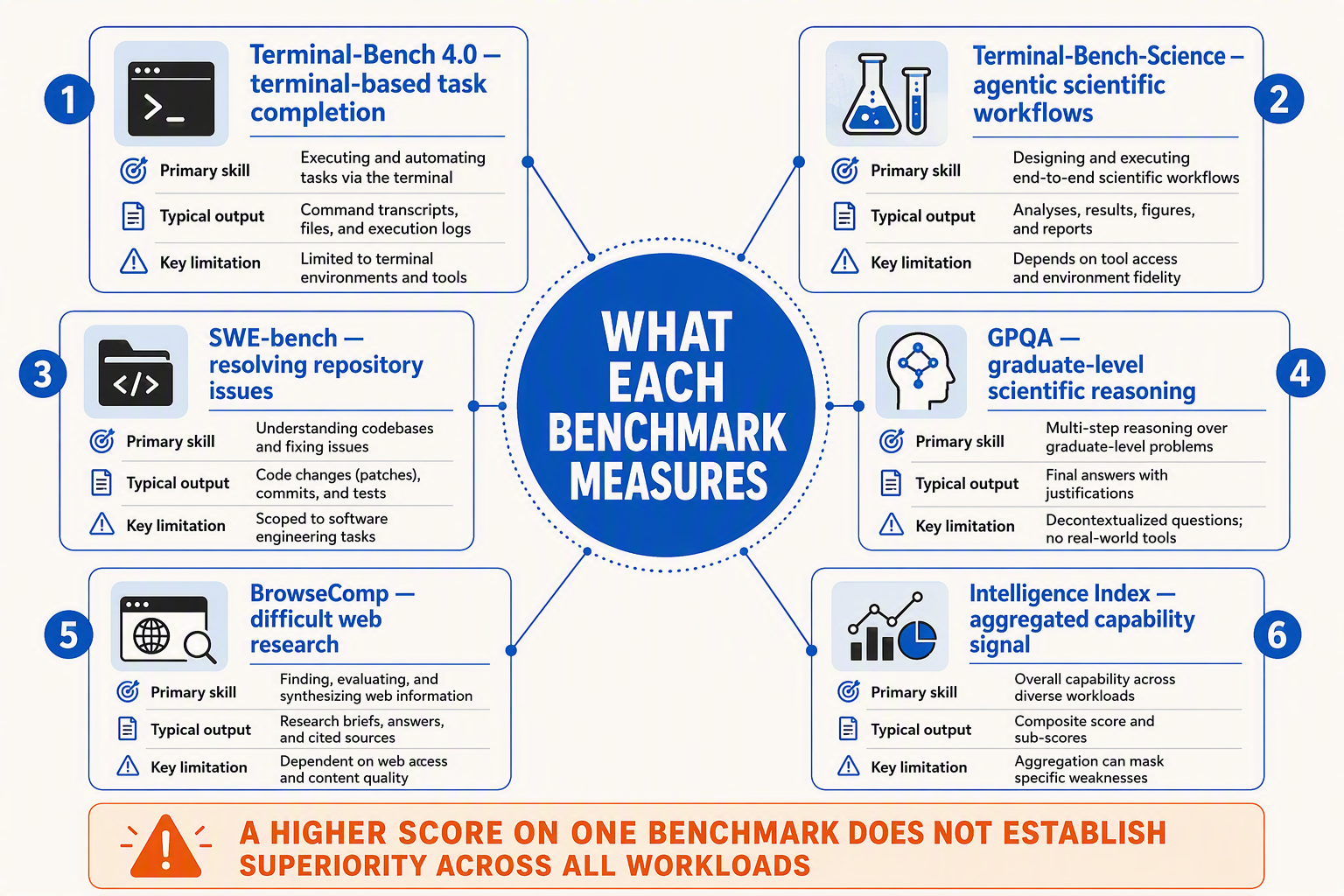
These benchmark families test different capabilities: Terminal-Bench measures tool-using execution, science benchmarks measure research workflows, coding tests measure software-task completion, reasoning suites measure answer correctness, and browsing evaluations measure web-based retrieval and synthesis. A strong result in one category should not be treated as proof of general superiority.
Terminal-Bench: operating a computer, not merely writing code
Terminal-Bench 4.0 is intended to evaluate whether an AI agent can complete multi-step tasks inside a terminal environment. Depending on the task set and harness, success may require inspecting files, running commands, installing dependencies, modifying code, interpreting errors, and verifying the final state.
This makes Terminal-Bench more operationally relevant than isolated code-generation questions. However, any reported Claude Fable 5.1 Terminal-Bench 4.0 result requires four accompanying details:
- Task-set version and evaluation date
- Agent scaffold, system prompt, and available tools
- Inference budget, including retries and token limits
- Scoring method, such as pass rate, pass@1, or best-of-N
Without those controls, two nominally identical scores may represent substantially different amounts of computation and engineering.
Agentic science: planning and using research tools
Agentic science benchmarks typically ask a model to pursue a scientific objective through several steps rather than answer a textbook question. Tasks can involve forming hypotheses, searching literature, analysing data, writing code, using specialist tools, and revising an approach after failure.
DataCamp reported in 2026 that Claude Fable 5.1 more than doubled Fable 5’s performance on agentic science benchmarks. That is a specific secondary-source claim, but interpreting it requires the benchmark name, absolute scores, trial count, variance, and agent configuration. A move from 10% to above 20%, for example, is a doubling while still leaving most tasks unsolved.
Coding and reasoning benchmarks
Coding evaluations span several fundamentally different workloads:
- Function-level generation: Produce code from a short specification.
- Repository repair: Diagnose an issue and modify an existing codebase.
- Agentic engineering: Navigate files, run tests, use tools, and iterate.
- Internal production tasks: Solve private problems selected by the model developer.
Anthropic stated on September 3, 2026, that Claude Fable 5.1 solved more of its internal coding problems than both Claude Fable 5 and Claude Opus 5. The private benchmark may reflect realistic work, but the claim cannot yet establish the size of the improvement or support independent reproduction without task and harness disclosure.
Reasoning benchmarks usually score final-answer accuracy across mathematics, logic, professional knowledge, or domain-specific judgment. Anthropic also claims state-of-the-art performance on “trading intuition,” but that phrase should not be equated with audited investment returns, risk-adjusted performance, or reliable forecasting until its dataset and scoring protocol are public.
Browsing benchmarks and contamination risk
Browsing tests measure whether an agent can find current sources, navigate pages, extract evidence, reconcile conflicting information, and provide a supported answer. Static question sets are easier to reproduce but more vulnerable to memorisation. Live-web tasks reduce that risk while introducing page changes, regional availability, search-ranking differences, and tool latency.
Across all five categories, reviewers should check for training-set leakage, public-test overfitting, grader-model bias, undisclosed retries, and unequal tool access. The defensible conclusion is capability-specific: benchmark scores indicate performance under a defined setup, not universal reliability across coding, research, browsing, and enterprise deployment.
How does independent evidence compare with Anthropic's official claims?
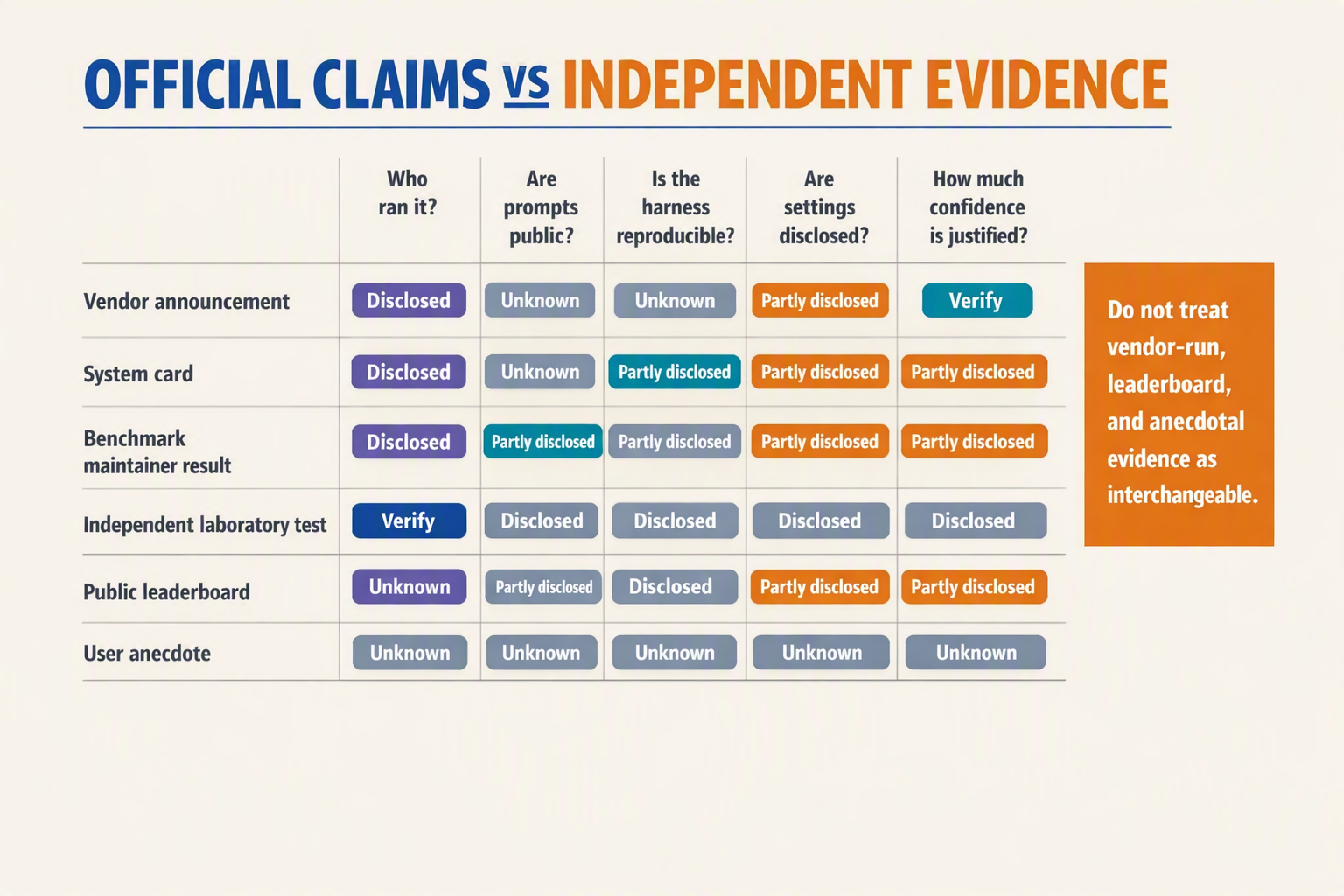
Independent evidence does not yet confirm Anthropic’s strongest Claude Fable 5.1 benchmark claims. As of September 3, 2026, the available third-party material largely repeats Anthropic’s findings or provides deployment metadata; it does not supply a reproducible, independently run comparison against Fable 5 or Opus 5.
Evidence comparison
| Claim or evidence | What it measures | Evidence owner | Independent status | Key limitation |
|---|---|---|---|---|
| Fable 5.1 solves more coding problems than Fable 5 and Opus 5 | Success on Anthropic’s private coding-task set | Anthropic | Not independently verified | No task list, sample size, scores, harness, prompts, or confidence intervals are disclosed |
| “State of the art on trading intuition” | Model judgment on unspecified trading scenarios | Anthropic | Not independently verified | “Trading intuition” lacks a public benchmark definition, numerical score, baseline table, and reproducible protocol |
| More than 2× Fable 5 on agentic science benchmarks | Tool-using scientific reasoning or research workflows | DataCamp, reporting launch results | Secondary reporting, not an independent rerun | Named datasets, raw scores, agent scaffold, tool budget, and statistical uncertainty are not provided in the available report |
| Claude Fable 5.1 Terminal-Bench 4.0 performance | Autonomous completion of terminal-based tasks | Public benchmark ecosystem | No verified score established in the supplied evidence | A score should not be quoted without a dated leaderboard entry, model configuration, and evaluation rules |
| Four-provider availability through OpenRouter | API deployment across Azure, Anthropic, Amazon Bedrock, and Google Vertex | OpenRouter | Independently observable, but not a quality benchmark | Provider availability reveals nothing about task accuracy; routing and inference settings may also vary |
| 75% lower cache-read price | Economics of reusing cached prompt context | Anthropic documentation | Verifiable product specification | Lower cost does not establish higher reasoning quality, coding accuracy, latency, or reliability |
What the evidence actually supports
Anthropic states that Claude Fable 5.1 solves more of its internal coding problems than Fable 5 or Opus 5, according to the company’s launch material available on September 3, 2026. That is a potentially valuable production-oriented signal because private tasks can resemble genuine engineering work more closely than static public exercises. However, “more problems” is not enough to calculate the absolute improvement, error rate, or statistical significance.
DataCamp reported by September 3, 2026 that Claude Fable 5.1 more than doubles Fable 5’s agentic-science performance. This corroborates that Anthropic presented such an improvement, but it is not equivalent to DataCamp independently executing the evaluation under a published harness.
OpenRouter’s listing offers a different kind of external confirmation: the model is served through four named provider routes. That helps buyers assess access and deployment flexibility, not whether Claude Fable 5.1 outperforms Opus 5.
Why public scores need scrutiny
Even when a verified Claude Fable 5.1 Terminal-Bench 4.0 result appears, three controls will determine whether it is persuasive:
- Configuration parity: Models must receive equivalent tools, time limits, token budgets, retries, and agent scaffolding.
- Contamination controls: Public tasks or solutions may have appeared in training data, repositories, issue discussions, or previous model-generated traces.
- Repeated-submission effects: Teams can tune prompts and scaffolds against a visible leaderboard without changing the underlying model.
The correct conclusion is therefore promising but unconfirmed. Anthropic’s claims justify controlled internal trials, especially for coding and long-running agents, but they do not yet establish a reproducible universal advantage over Fable 5 or Opus 5.
Could contamination, prompt choices, or evaluation settings distort the results?
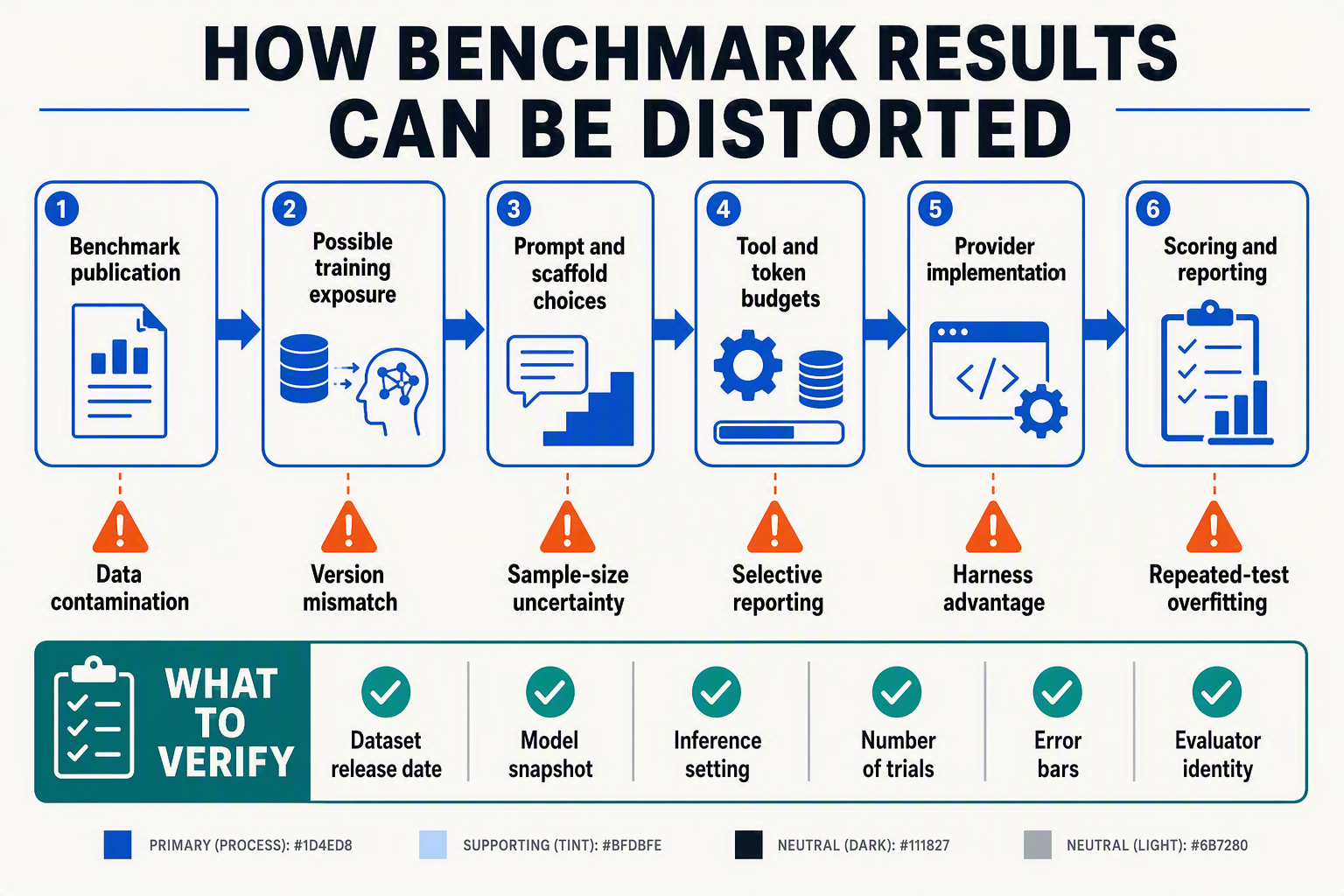
Yes. Claude Fable 5.1 benchmark results can shift materially when the test set overlaps with training data, prompts differ, or evaluators change tool access, inference budgets, and scoring rules. Until these variables are disclosed and independently reproduced, precise rankings should be treated as configuration-specific evidence—not fixed measures of model capability.
Contamination can inflate public benchmark scores
Training-data contamination occurs when benchmark questions, solutions, tests, or close derivatives appear in pretraining or post-training data. Coding benchmarks are especially exposed because repositories, issue discussions, patches, and benchmark harnesses may be publicly indexed.
Contamination is difficult to prove from score tables alone. A model may solve a familiar-looking task through genuine generalisation, memorisation, or both. Useful audits therefore include:
- Temporal holdouts: Evaluate on repositories, issues, and tasks created after the model’s training cutoff.
- Canary strings: Insert distinctive markers to detect whether evaluation material later enters training corpora.
- Near-duplicate detection: Compare tasks against public code, solutions, pull requests, and earlier benchmark versions.
- Private parallel sets: Build unpublished tasks that measure the same skills as the public benchmark.
- Perturbation tests: Rename variables, alter specifications, or change tests while preserving the underlying problem.
Anthropic’s internal coding set may reduce direct exposure because it is private, but privacy does not automatically guarantee independence. Without dataset provenance, construction dates, deduplication procedures, and model-cutoff details, readers cannot quantify leakage risk.
Prompting and scaffolding can change what is being measured
A benchmark score measures the model-plus-evaluation system, not the model in isolation. System prompts can encourage planning, testing, concise answers, or repeated verification. Agent scaffolds may supply repository maps, memory, search, shell access, and automatic retries.
Results can become non-comparable when evaluations differ in:
- Prompt wording and examples
- Temperature, sampling policy, and random seed
- Maximum output tokens or total inference budget
- Number of attempts, retries, or majority-vote samples
- Tool availability, permissions, and timeout limits
- Context-window use and repository retrieval
- Human intervention or hidden error recovery
For long-running agents, the number of steps matters particularly. A higher pass rate obtained with substantially more tool calls may still be unattractive when latency and cost are production constraints. Anthropic says Claude Fable 5.1 offers stronger long-running performance, but reproducing that claim requires reporting trajectories, token consumption, wall-clock time, and failure recovery—not only final task success.
Official claims need reproducible evaluation cards
Anthropic stated on September 3, 2026, that Claude Fable 5.1 solved more of its internal coding problems than Fable 5 or Opus 5. That is useful first-party evidence, but the available claim does not itself disclose enough detail to establish an independently reproducible Claude Fable 5.1 vs Opus 5 comparison.
DataCamp reported in 2026 that Claude Fable 5.1 more than doubled Fable 5’s agentic-science performance. “More than doubled” is meaningful directionally, but interpretation still depends on the baseline score, task composition, run count, confidence intervals, and agent configuration.
A rigorous evaluation card should publish:
- Exact model snapshot and provider
- Dataset version and evaluation date
- Full prompts and tool definitions
- Token, step, time, and retry budgets
- Scoring code and invalid-run policy
- Mean score, variance, and confidence interval
- Contamination and deduplication checks
- Per-task failures, not merely an aggregate
How readers should interpret the current evidence
Treat each result as a conditional statement: Claude Fable 5.1 achieved a given outcome under a specific harness and budget. Confidence rises when independent teams reproduce the ranking using identical settings, then retain it under prompt perturbations and fresh private tasks.
For deployment, run a blinded workload evaluation with fixed budgets and multiple trials. Platforms such as CallMissed’s OpenAI-compatible gateway can simplify consistent multi-model testing, but teams must still pin model versions, log prompts, equalise tool access, and compare cost and latency per successful task rather than headline accuracy alone.
What does Claude Fable 5.1 performance mean for coding, research, agents, and enterprise teams?
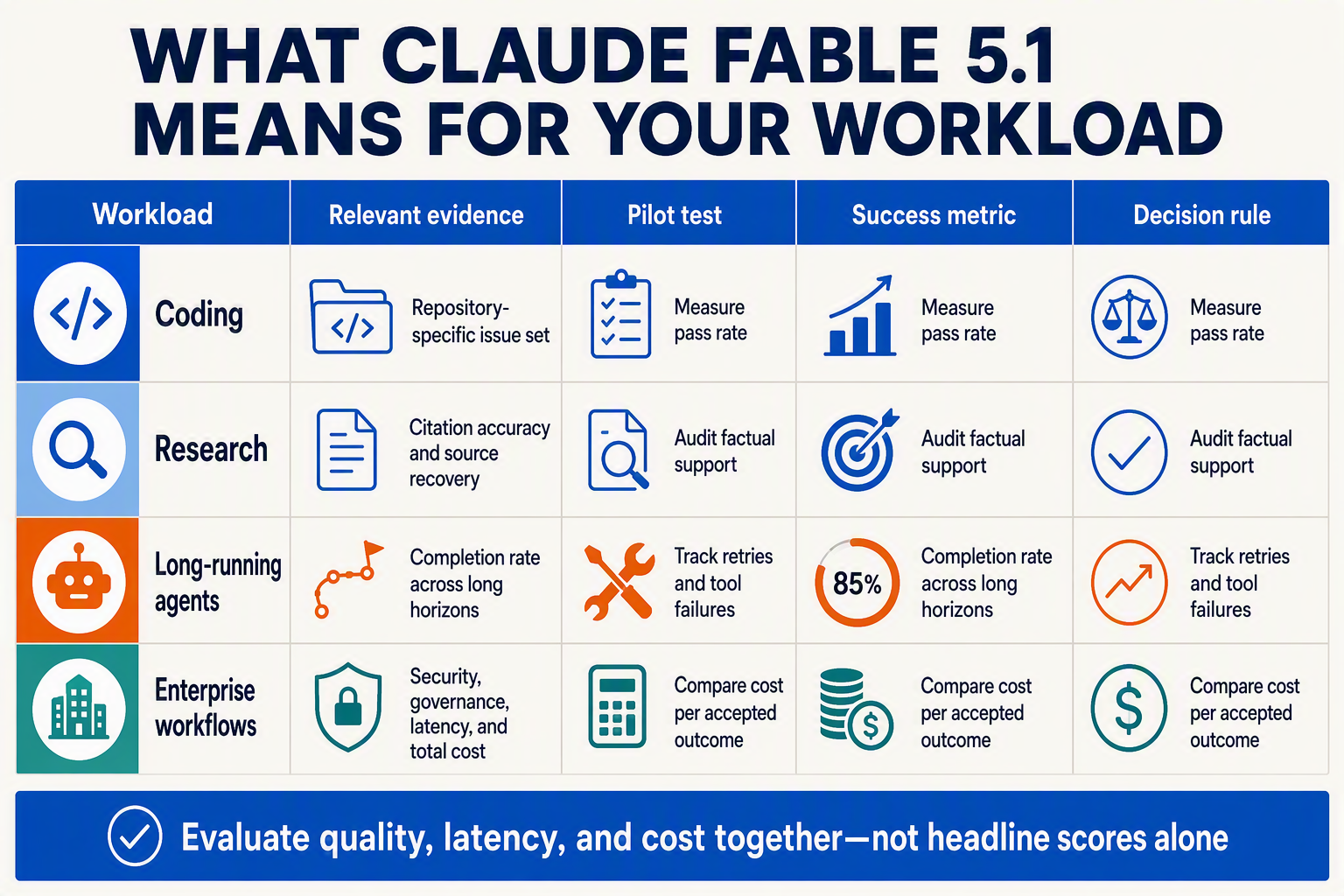
Claude Fable 5.1 performance should be treated as a strong signal for pilot selection, not as universal proof of production superiority. The available evidence most directly supports testing the model for coding, long-running agents, and tool-heavy research, while enterprise adoption still requires workload-specific measurements of accuracy, latency, cost, and reliability.
Practical decision map
| Workload | Evidence available | Practical implication | Validation required |
|---|---|---|---|
| Repository coding | Anthropic says Fable 5.1 solves more internal coding problems than Fable 5 or Opus 5 | Prioritise it for controlled trials involving debugging, migrations, and multi-file changes | Measure test-pass rate, regressions, human review time, and cost per merged task |
| Agentic research | DataCamp reports more than 2× Fable 5 performance on agentic science benchmarks | Promising for literature synthesis, iterative analysis, and tool-directed investigation | Audit citations, unsupported claims, tool failures, and results across repeated runs |
| Long-running agents | Anthropic documents stronger long-running task performance | Consider it for workflows requiring planning, state tracking, and repeated tool calls | Test completion rate, recovery from failed tools, context drift, and total wall-clock time |
| Trading analysis | Anthropic claims “state of the art on trading intuition” in internal benchmarks | Relevant enough to justify evaluation, but not autonomous financial deployment | Require time-separated data, transaction-cost modelling, risk controls, and regulatory review |
| Knowledge work | Anthropic positions Fable 5.1 for coding and knowledge work | Potential fit for document analysis, drafting, and structured decision support | Compare factuality, instruction adherence, source traceability, and domain-expert acceptance |
| High-volume enterprise use | Cache reads cost one-quarter of their previous price | Repeated system prompts and shared context may become materially more economical | Model cache-hit rates, full workflow spend, latency, availability, and fallback behaviour |
What teams should infer—and what they should not
For software engineering, the internal coding result is directionally useful because private tasks may resemble real production work more closely than small public exercises. However, Anthropic’s statement does not disclose enough detail to determine task difficulty, repository size, tool permissions, retry budgets, or whether the Claude Fable 5.1 vs Opus 5 comparison used identical scaffolding. Teams should therefore evaluate complete pull requests rather than isolated code generation.
For research workflows, agentic-science improvement matters only when the agent produces verifiable evidence. DataCamp reported in 2026 that Claude Fable 5.1 more than doubled Fable 5’s agentic-science performance, but a secondary report is not a substitute for disclosed task-level results. Citation precision, experiment reproducibility, and calibration should carry more weight than polished prose.
For autonomous agents, benchmark gains can disappear when tools time out, APIs return malformed data, or context accumulates over hours. A credible pilot should record:
- Successful completion per attempt, including retries;
- Cost per accepted outcome, not merely token price;
- Median and tail latency, especially p95;
- Human interventions and unrecoverable tool errors;
- Consistency across multiple runs of the same task.
For enterprise teams, economics may be as consequential as raw capability. Anthropic’s documentation stated on September 3, 2026 that cache reads cost 75% less than before, making stable prompts, policy documents, and reusable knowledge context attractive caching candidates. Yet there is no currently verified evidence here that Claude Fable 5.1 is faster in every deployment environment.
The defensible conclusion is therefore conditional: Claude Fable 5.1 merits serious evaluation where coding depth, extended reasoning, or reusable context dominate—but procurement decisions should follow representative pilots, not headline benchmarks.
What do researchers, benchmark maintainers, and practitioners say about Fable 5.1?

The available commentary is positive but heavily first-party. As of September 3, 2026, Anthropic describes Claude Fable 5.1 as a substantial coding and knowledge-work improvement, while the supplied evidence contains no named benchmark-maintainer endorsement or independently reproduced coding score.
What Anthropic’s researchers claim
Anthropic reports that Claude Fable 5.1 solves more internal coding problems than both Claude Fable 5 and Claude Opus 5. Anthropic also claims state-of-the-art performance on “trading intuition,” but the announcement excerpt does not disclose the task set, sample size, scoring method, inference budget, variance, or numerical result.
These omissions do not make the findings false; they make them non-reproducible from the public material currently available. Anthropic’s private tasks may reflect realistic engineering work better than a static public benchmark, but external researchers cannot test whether the result depends on:
- A particular system prompt or agent scaffold
- More tool calls, tokens, retries, or test-time compute
- Human selection of successful runs
- Tasks related to Anthropic’s own development environment
- Different configurations for Fable 5.1, Fable 5, and Opus 5
Anthropic’s Claude Fable 5.1 and Claude Mythos 5.1 System Card provides useful safety evidence, including comparable overall performance to Mythos 5 in the suicide and self-harm domain. However, safety evaluations should not be treated as independent confirmation of coding, research, or agentic performance.
What benchmark maintainers say
The supplied sources include no direct statement from the maintainers of Terminal-Bench 4.0 or another public coding benchmark validating Claude Fable 5.1’s result. That absence is not negative evidence about the model, but it means readers should not interpret a leaderboard appearance or third-party benchmark table as maintainer certification.
A credible maintainer-backed result should identify:
- The exact model snapshot and evaluation date
- The benchmark version and task exclusions
- The agent harness, tools, prompts, and timeout
- The number of attempts and pass-rate aggregation method
- Whether the run was official, submitted, or independently reproduced
These details matter because an agent benchmark measures the combined system, not merely the base model.
What practitioners and industry observers report
DataCamp characterizes Claude Fable 5.1 as more than doubling Fable 5’s performance on agentic science benchmarks. That is a concrete comparative claim, but DataCamp’s report remains a secondary account unless the underlying tasks, raw scores, and run configuration are independently available.
A Hacker News comment attributed to an Anthropic employee says, “Beyond all the benchmarks,” Fable 5.1 represents a major improvement in writing. This is useful qualitative testimony, but it is neither independent nor controlled: no fixed prompt set, blinded comparison, or inter-rater agreement is reported.
OpenRouter lists Claude Fable 5.1 through Anthropic, Microsoft Azure, Amazon Bedrock via bring-your-own-key, and Google Vertex AI. That demonstrates deployment availability across multiple providers; it does not establish equivalent latency, output consistency, or benchmark performance across those routes.
The defensible consensus
The strongest current conclusion is narrow: Claude Fable 5.1 appears promising, particularly for coding and long-running workflows, but public commentary has not yet matured into broad independent validation. Teams should treat official results as hypotheses, practitioner impressions as leads, and reproducible workload trials as the deciding evidence.
Frequently asked questions about Claude Fable 5.1 benchmarks
What do the Claude Fable 5.1 benchmarks actually show?
Is Claude Fable 5.1 better than Opus 5 for coding?
Is the Claude Fable 5.1 coding benchmark independently verified?
What does Terminal-Bench 4.0 measure for Claude Fable 5.1?
Can benchmark contamination inflate Claude Fable 5.1 performance?
How should businesses evaluate Claude Fable 5.1 pricing and speed alongside benchmark scores?
Conclusion
Claude Fable 5.1 appears promising for coding and agentic workloads, but the current evidence supports cautious evaluation rather than a universal performance verdict. Anthropic’s results establish a credible hypothesis; reproducible public benchmarks and independent production tests must now validate it.
- Official claims are not independent proof. Anthropic reported on September 3, 2026, that Claude Fable 5.1 solved more internal coding problems than Fable 5 or Opus 5, but the private dataset, prompts, harness, and failure cases remain unavailable for external replication.
- Benchmark scores require context. Tool access, agent scaffolding, inference budgets, prompt design, and scoring rules can materially change results, while popular public datasets face contamination and repeated-submission overfitting.
- Economics strengthen the practical case. Anthropic kept standard pricing at $10 per million input tokens and $50 per million output tokens, while reducing cache-read costs by 75%—potentially important for long-running, context-heavy workflows.
- Real codebases remain the decisive test. Teams should measure repository-scale debugging, refactoring, latency, reliability, and cost per successful task against their own acceptance criteria.
What matters next is independently reproduced evidence with disclosed dates, configurations, and methodologies. Multi-model platforms such as CallMissed can help developers compare models through one OpenAI-compatible gateway as that evidence develops.
Will Claude Fable 5.1’s headline gains survive transparent, production-scale testing?
Related Reading
- GPT-OSS 120B Open Source Performance on Coding: Specs, Benchmarks, Pricing, and API Access
- Claude Fable 5.1 Features: What’s New, Pricing and Upgrade Guide
- Claude Fable 5.1 Pricing: API Costs, Calculator and Examples