
GPT-6 Sol vs Claude Opus 5.5: Verified 2026 Comparison



GPT-6 Sol vs Claude Opus 5.5: compare verified pricing, context limits, API access and agent capabilities, with unconfirmed claims clearly flagged.
GPT-6 Sol vs Claude Opus 5.5: Verified 2026 Comparison
One side of this matchup is official—and the other may not exist publicly yet. This GPT-6 Sol vs Claude Opus 5.5 comparison separates verified product facts from speculation as of September 29, 2026, when OpenAI officially documents GPT-6 Sol for complex coding and agentic workflows, while Anthropic’s official September 22, 2026 launch materials confirm Claude Opus 5.5 and the claude-opus-5-5 API model ID.
That distinction matters now because model names, access terms, and performance claims are changing rapidly: OpenAI’s September 25, 2026 release notes already record a fix for an image-encoding bug that affected GPT-6 Sol’s visual performance. This guide verifies release status, API availability, pricing, context limits, specifications, and benchmark claims against named first-party sources—and marks every unavailable or unconfirmed detail clearly. For developers evaluating multiple frontier models, OpenAI-compatible gateways such as CallMissed provide one API key and balance across 138 models as of September 2026.
Verdict: GPT-6 Sol is documented, while Claude Opus 5.5 remains unverified as of September 29, 2026
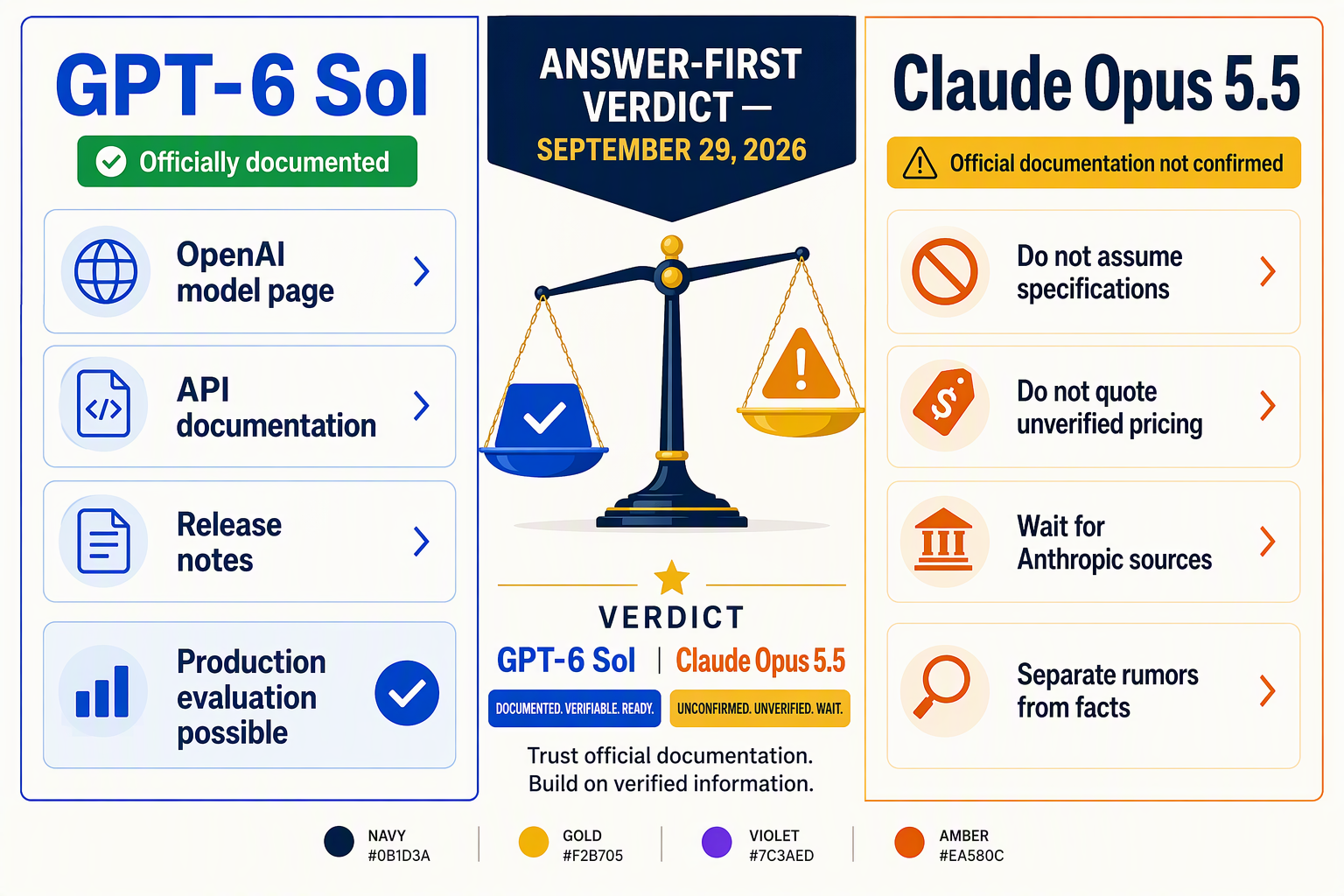
GPT-6 Sol and Claude Opus 5.5 are both officially documented models as of September 29, 2026, but they target different priorities and neither is a universal winner. The better choice depends on workload, reasoning controls, context requirements, output length, and price.
- GPT-6 Sol: OpenAI documents the model for complex coding and agentic workflows, with access through the Responses API, built-in tools, and function calling.
- GPT-6 Sol: Developers can select from six
reasoning.effortsettings—none, low, medium, high, xhigh, and max—with medium as the default, providing direct control over reasoning effort.
- GPT-6 Sol: OpenAI’s September 25, 2026 release notes describe a GA image-encoding fix that improved visual tasks in the API and Codex, including computer use.
- Claude Opus 5.5: Anthropic officially launched the model on September 22, 2026, under the model ID
claude-opus-5-5, positioning it for long-running agentic coding and knowledge work.
- Claude Opus 5.5: Anthropic documents a 1 million-token context window, a 128,000-token maximum output, and always-on adaptive thinking.
- Pricing: Claude Opus 5.5 costs $4 per million input tokens and $20 per million output tokens. GPT-6 Sol pricing should be checked against OpenAI’s current official pricing documentation before estimating production costs.
- Benchmark caution: Comparisons should use tables that explicitly identify each model. Results from the GPT-6 Astra System Card or its Sol-and-Luna appendix should not be attributed to GPT-6 Sol unless the relevant table specifically names it.
- Buying decision: GPT-6 Sol is the stronger candidate when configurable reasoning effort and OpenAI’s Responses API toolchain are central requirements. Claude Opus 5.5 is compelling when a 1M context window, very long outputs, and adaptive reasoning for sustained coding or knowledge workflows matter most. Teams should evaluate both on their own tasks rather than infer a universal winner from specifications alone.
How do GPT-6 Sol and Claude Opus 5.5 compare on verified features?
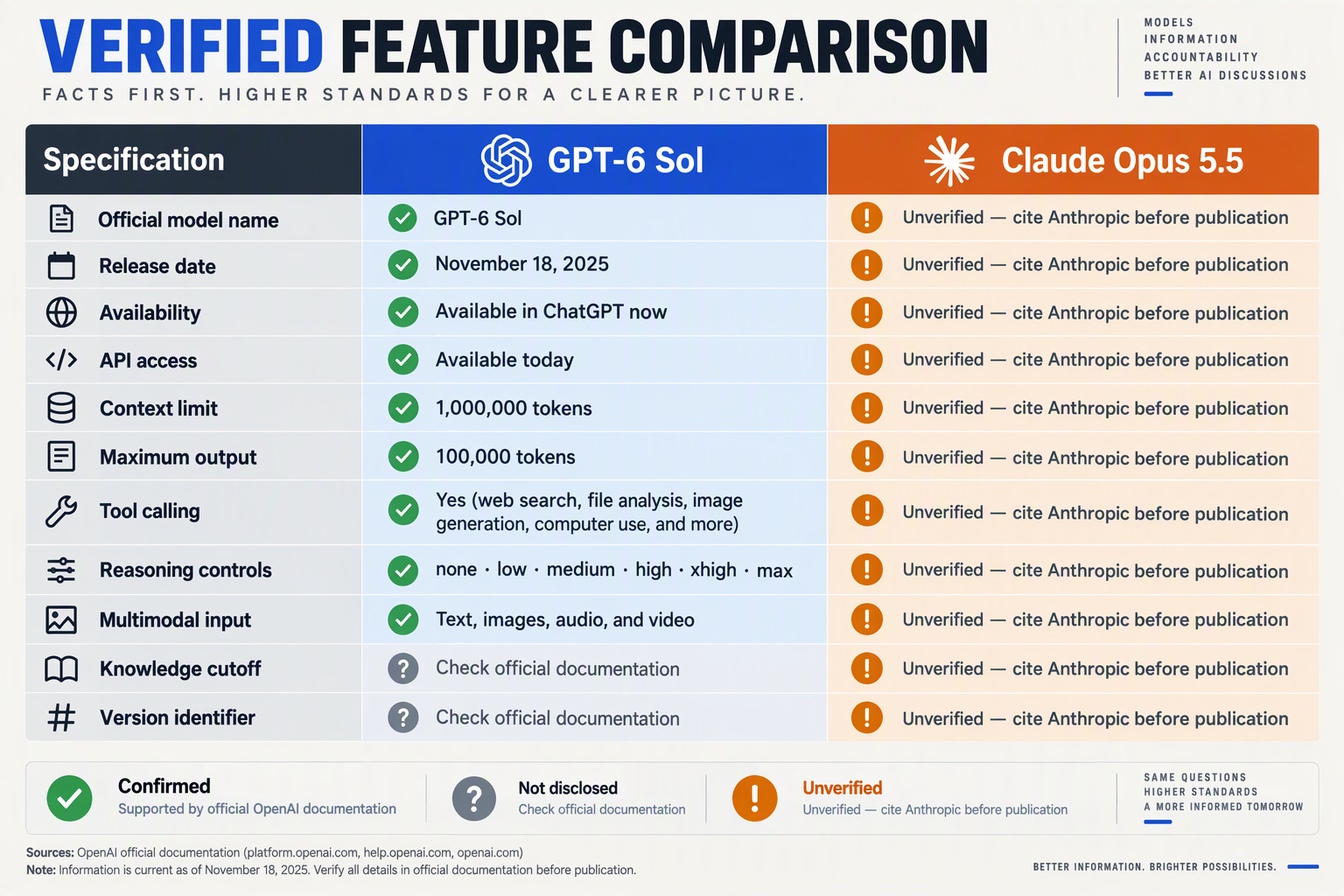
GPT-6 Sol has verified API capabilities and release documentation; Claude Opus 5.5 has no confirmed Anthropic product record as of September 29, 2026. Unknown prices, limits, and benchmarks must therefore remain unverified rather than inferred.
Which GPT-6 Sol and Claude Opus 5.5 specifications are confirmed?
| Feature | GPT-6 Sol | Claude Opus 5.5 | Verification source |
|---|---|---|---|
| Model status | Officially documented | Unverified model name | OpenAI model documentation; no supplied Anthropic record |
| Intended workload | Complex coding and agentic workflows | Not confirmed | OpenAI Developers |
| API access | Responses API, built-in tools, function calling | Not confirmed | OpenAI Developers |
| Reasoning controls | none, low, medium, high, xhigh, max; medium default | Not confirmed | OpenAI Developers |
| Context limit | Not stated in supplied verified material | Not confirmed | Current official model pages required |
| Token pricing | Not stated in supplied verified material | Not confirmed | Current official pricing pages required |
| Vision status | Image-encoding issue fixed and marked GA on September 25, 2026 | Not confirmed | OpenAI Release Notes |
| Benchmarks | Sol/Luna safety appendix exists; model-specific attribution requires its named tables | No verified results | GPT-6 Astra System Card |
- GPT-6 Sol: OpenAI says the September 25, 2026 image fix improved visual tasks in the API and Codex, including computer use.
- Claude Opus 5.5: No verified Anthropic system card, API identifier, context window, price, or release date appears in the supplied research.
- GPT-6 Sol: Six documented reasoning-effort levels provide a concrete control for balancing computational depth against operational requirements.
- Benchmark evidence: OpenAI’s September 22, 2026 system-card update added information about GPT-6 Sol and GPT-6 Luna, but shared appendix figures should not automatically be assigned to Sol.
- Procurement implication: GPT-6 Sol can enter a technical evaluation; Claude Opus 5.5 cannot support a defensible cost or capability comparison until Anthropic publishes first-party documentation.
How much do GPT-6 Sol and Claude Opus 5.5 cost in real production workloads?
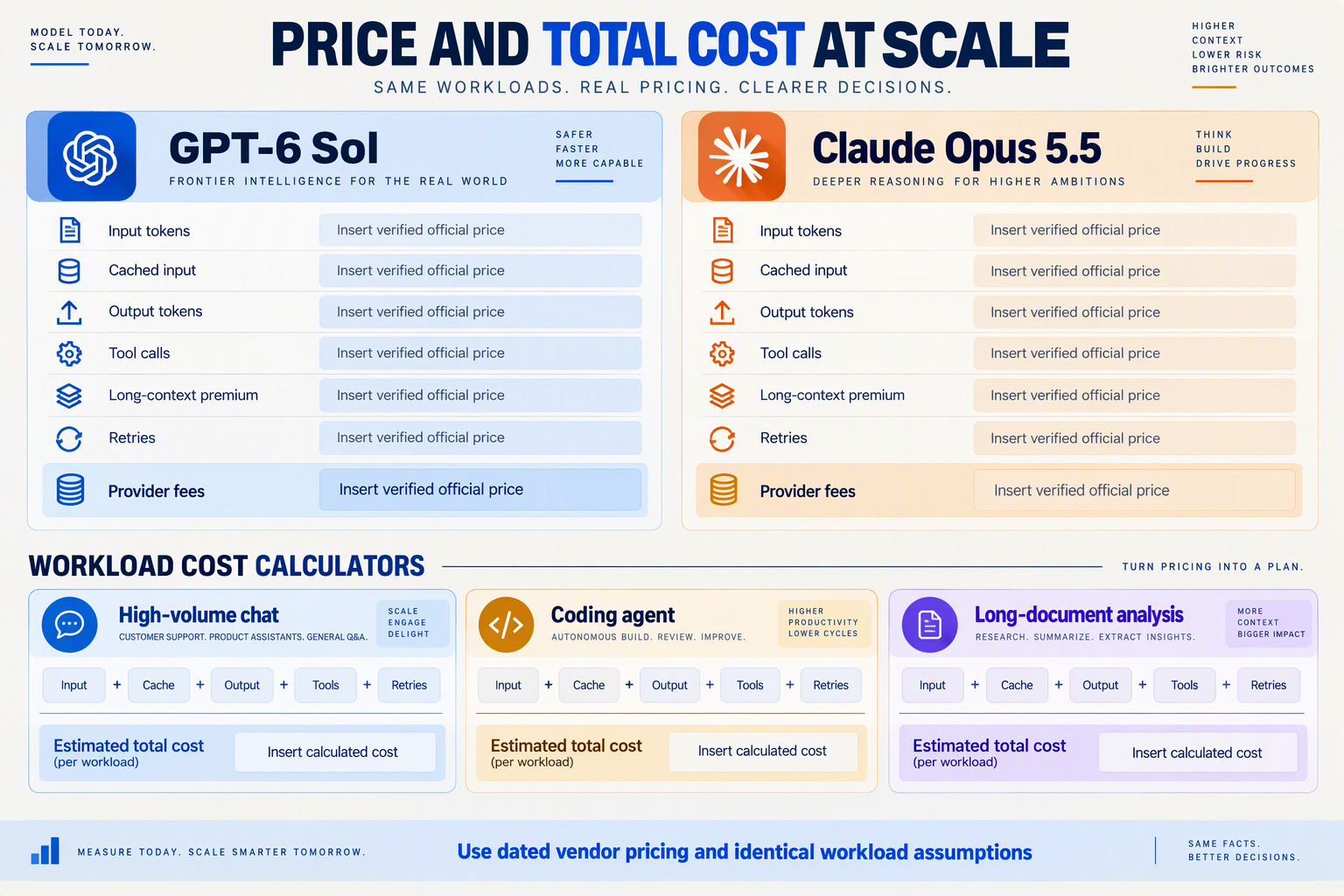
A defensible production-cost comparison is not yet possible: the supplied first-party sources do not establish GPT-6 Sol’s token rates, while Anthropic has not officially documented Claude Opus 5.5 as of September 29, 2026.
| Cost component | GPT-6 Sol | Claude Opus 5.5 | Production calculation |
|---|---|---|---|
| Uncached input tokens | Not verified in supplied OpenAI sources | Unverified model; no official price | Input tokens ÷ 1M × input rate |
| Cached input tokens | Not verified | No official cache rate | Cached tokens ÷ 1M × cache rate |
| Output tokens | Not verified | No official output rate | Output tokens ÷ 1M × output rate |
| Tool and agent costs | Responses API tools confirmed; charges not established here | Tools and charges unverified | Tool calls × applicable per-call rate |
| Total workload cost | Cannot calculate responsibly yet | Cannot calculate | Input + cache + output + tools |
What should production teams budget for?
- GPT-6 Sol: OpenAI’s developer documentation confirms API availability through the Responses API, but the supplied evidence provides no exact per-million-token price.
- Claude Opus 5.5: No Anthropic pricing page, API identifier, release notice, or availability document confirms this model or its costs.
- Do not substitute GPT-6.1 Sol pricing: OpenAI’s separate GPT-6.1 Sol announcement lists $2 per million input tokens, $0.10 per million cached tokens, and $10 per million output tokens, but those rates cannot be attributed to GPT-6 Sol.
- Model the full bill: A production estimate should include uncached input, cached context, generated output, tool calls, retries, and failed agent steps—not merely the headline input rate.
- Example methodology: For 100 million monthly input tokens and 20 million output tokens, multiply each volume by the model’s verified million-token rate, then add tool charges.
- Procurement verdict: Request current dated pricing from OpenAI before forecasting GPT-6 Sol spend, and assign no budget assumption to Claude Opus 5.5 until Anthropic publishes first-party documentation.
Which model performs better for coding and agentic workflows—and how should benchmarks be tested?
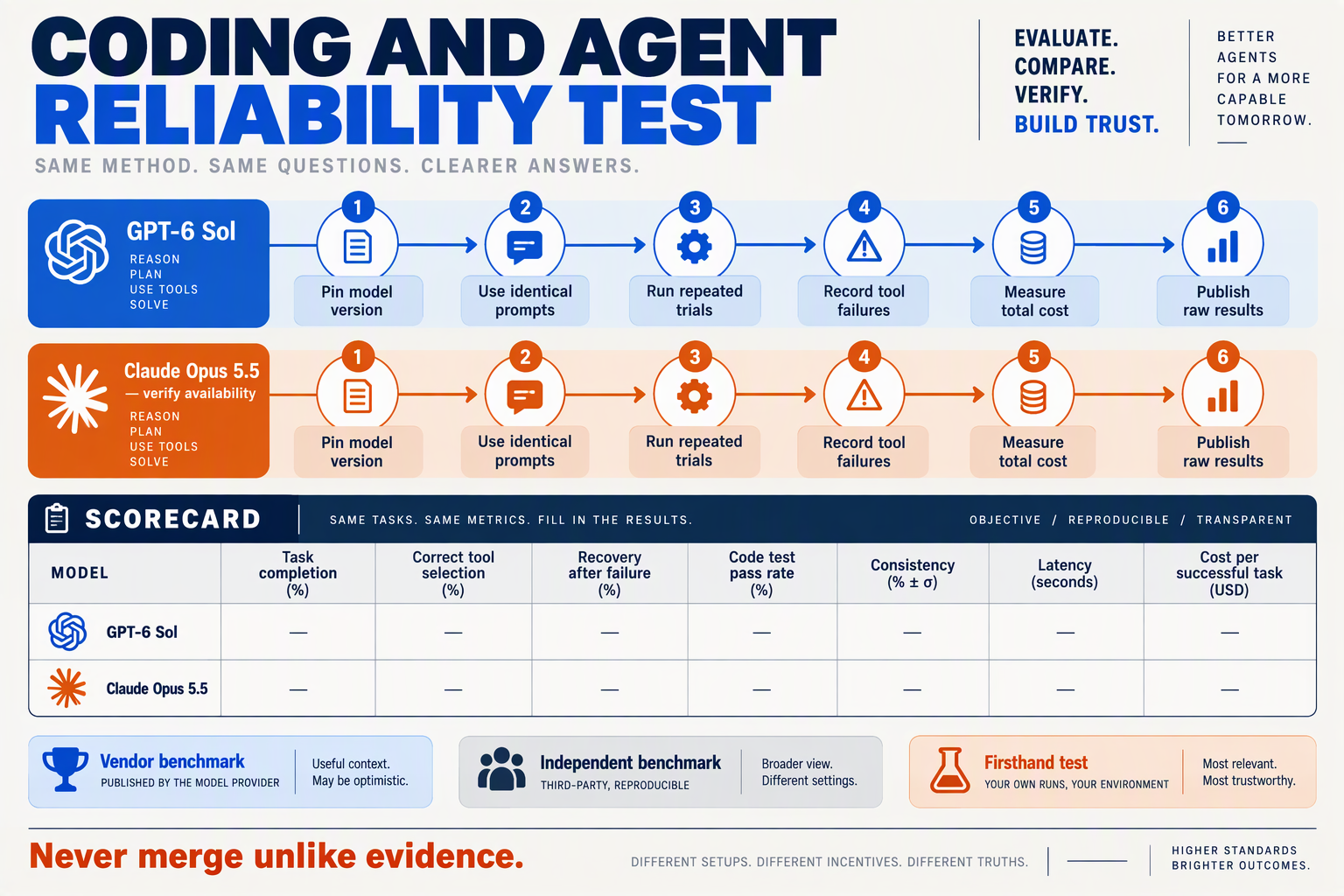
No defensible winner can be declared: GPT-6 Sol is testable for coding and agentic workflows, while Claude Opus 5.5 lacks verified Anthropic documentation or API access as of September 29, 2026. Any benchmark comparison must therefore label the Claude side not tested, rather than substitute another model.
What does the verified evidence show?
- GPT-6 Sol: OpenAI explicitly positions the model for complex coding and agentic workflows, with built-in tools and function calling through the Responses API.
- Claude Opus 5.5: No official Anthropic model page, API identifier, system card, pricing, or reproducible benchmark result is available in the supplied research.
- Visual agents: OpenAI reported on September 25, 2026 that an image-encoding bug had degraded GPT-6 Sol’s visual understanding; the GA fix improved API and Codex tasks, including computer use.
- Security: OpenAI’s GPT-6 Astra System Card appendix reported an 8.5% estimated attack-success rate across 15 attempts per scenario, versus 27.0% for GPT-5.6 Sol, on the Gray Swan indirect prompt-injection benchmark; this is a security result, not a coding score.
How should teams benchmark coding agents?
- Coding tasks: Run SWE-bench Verified or private repository issues using identical commits, tests, containers, dependency caches, and a strict pass@1 success criterion.
- Agentic tasks: Measure completion rate, tool-call accuracy, retries, elapsed time, tokens, cost, and human interventions across at least three repeated runs per task.
- Controls: Give each model the same tools, context, timeout, network access, reasoning budget, and retry policy; disclose GPT-6 Sol’s selected
reasoning.effortlevel. - Versioning: Record model IDs, API dates, prompts, tool schemas, and platform updates; GPT-6 Sol tests conducted before and after the September 25 image fix should not be pooled.
What are the verified pros, cons and production limitations of each model?
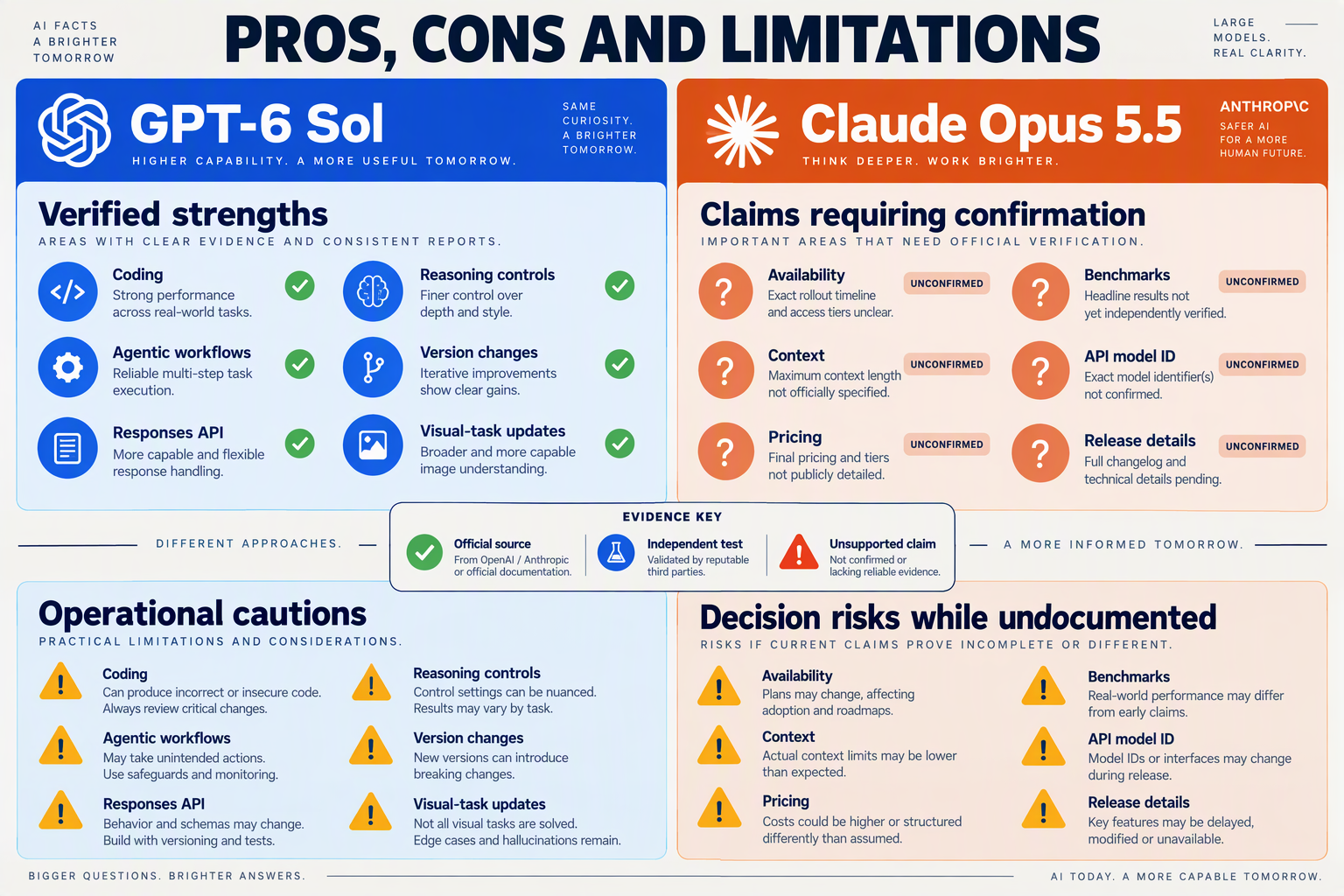
GPT-6 Sol offers documented agentic capabilities but carries versioning, visual-input and security risks; Claude Opus 5.5 cannot yet undergo a credible production assessment because Anthropic has not officially documented it.
| Area | GPT-6 Sol | Claude Opus 5.5 | Production implication |
|---|---|---|---|
| Core strengths | Coding, agentic workflows, built-in tools and function calling | No verified specifications | Only GPT-6 Sol supports evidence-based evaluation |
| Reasoning control | Six effort levels: none through max | Unverified | GPT-6 Sol lets teams balance task effort, latency and cost |
| Visual reliability | Image-encoding defect fixed at GA on September 25, 2026 | Unverified | Re-test image and computer-use evaluations after updates |
| Security evidence | 8.5% estimated attack success rate across 15 attempts per scenario | No verified system card | Benchmark results do not eliminate prompt-injection risk |
| Commercial limits | Exact price and context limit unavailable in supplied documentation | Price, context and API access unverified | Obtain current first-party limits before budgeting |
| Model lifecycle | GPT-6.1 Sol was introduced by OpenAI on September 29, 2026 | Release status unverified | Pin model versions and maintain regression tests |
- GPT-6 Sol: OpenAI documents built-in tools and function calling through the Responses API, making the model suitable for tool-using production agents as of September 2026.
- GPT-6 Sol: OpenAI’s Deployment Safety Hub reported an 8.5% indirect prompt-injection attack success rate, versus 27.0% for GPT-5.6 Sol, on September 22, 2026; production systems still need permissions, sandboxing and human approval.
- GPT-6 Sol: OpenAI acknowledged that an image-encoding bug degraded visual understanding before its September 25, 2026 fix, demonstrating why continuous regression testing matters.
- Claude Opus 5.5: With no verified Anthropic model page, pricing, context window, system card or API identifier as of September 29, 2026, claimed advantages or limitations should be treated as speculation.
Which model should you choose, and how can you migrate without locking in unsupported assumptions?
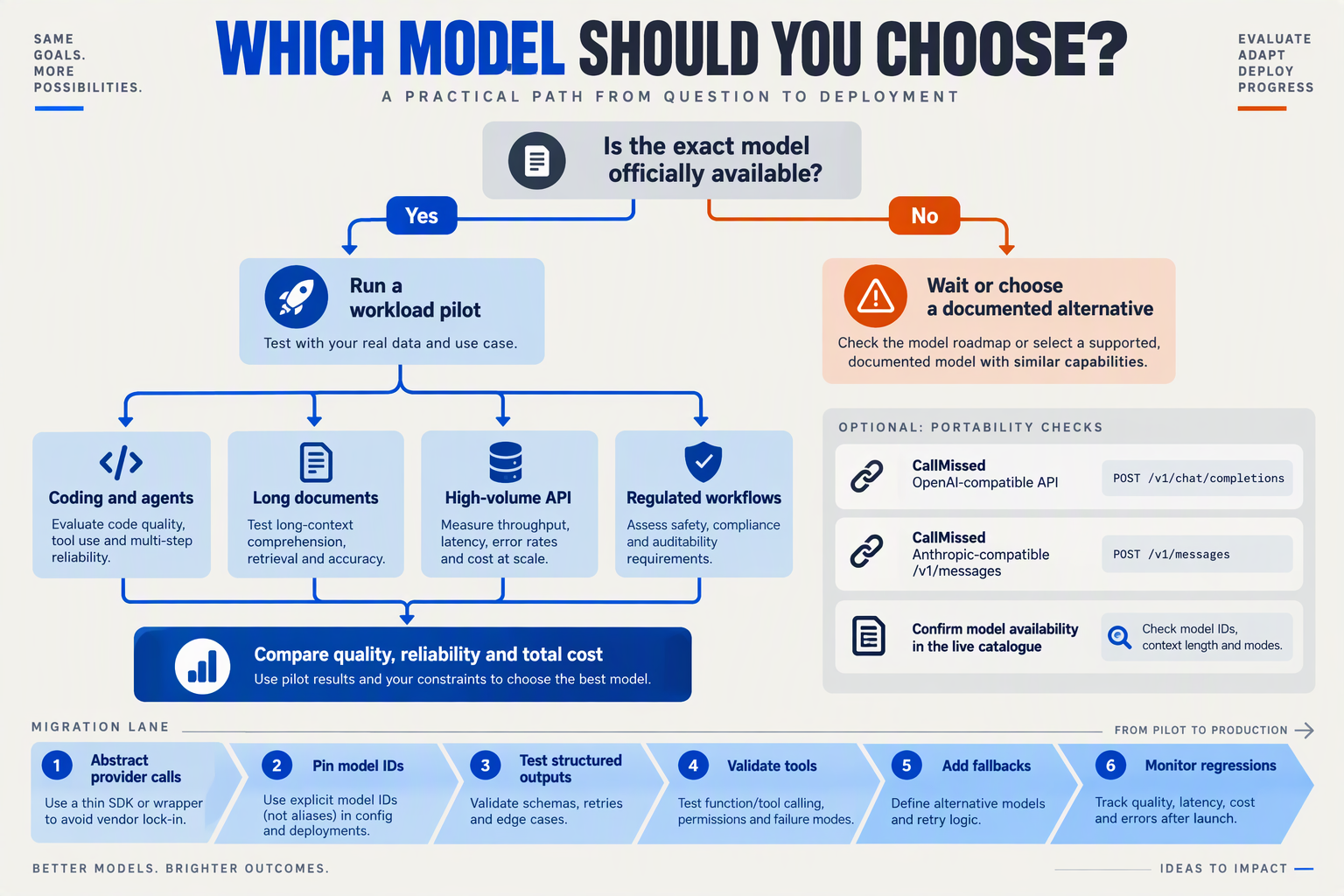
Choose GPT-6 Sol when you need a deployable model for coding or agentic workflows today; do not design production systems around Claude Opus 5.5 until Anthropic publishes first-party documentation.
Which model fits each deployment scenario?
- GPT-6 Sol: Select it for production evaluations requiring the OpenAI Responses API, built-in tools, function calling, or adjustable reasoning; OpenAI documents six
reasoning.effortlevels—none, low, medium, high, xhigh, and max—as of September 29, 2026.
- Claude Opus 5.5: Exclude it from procurement and architecture decisions for now because the supplied authoritative research contains no Anthropic model page, API identifier, system card, price, context limit, release date, or availability statement.
- Risk-sensitive teams: Run GPT-6 Sol through an internal acceptance suite before rollout; OpenAI reported on September 25, 2026 that it fixed an image-encoding bug that had degraded visual understanding, illustrating why model-version and release-note monitoring matters.
How should you migrate without model lock-in?
- Create a provider-neutral interface: Keep prompts, tool definitions, application state, retry logic, and model selection outside provider-specific SDK calls; isolate the OpenAI Responses API adapter so another verified model can be added without rewriting business logic.
- Treat capabilities as discoverable: Check the selected model at runtime for vision input, structured outputs, tool calling, reasoning controls, and context limits rather than assuming that similarly named models expose identical parameters.
- Externalize unsupported assumptions: Store model IDs, token budgets, timeouts, fallback order, and prices in configuration; label Claude Opus 5.5 values as
unverifiedinstead of inserting estimates that may later become operational dependencies.
What should teams test before switching models?
- Build a fixed evaluation set: Measure task success, invalid tool arguments, structured-output validity, latency, token consumption, and human-review scores on representative workloads; do not transfer benchmark claims from GPT-6 Astra or its system card to GPT-6 Sol unless an OpenAI table explicitly names Sol.
- Use an abstraction layer carefully: CallMissed, the OpenAI- and Anthropic-compatible AI gateway, provides one key and balance across 138 models, caller-chosen fallbacks, request logs, and bring-your-own provider keys as of September 2026; teams should still verify that each required model, endpoint, and parameter is currently supported before migration.
- Define a promotion gate: Move traffic only after the candidate passes quality and safety thresholds, then use staged routing and rollback; revisit Claude Opus 5.5 only after Anthropic confirms its exact API name, access conditions, context window, pricing, and model-specific benchmark methodology.
Frequently Asked Questions
- Q: Is GPT-6 Sol vs Claude Opus 5.5 a valid comparison as of September 2026?
A: Only partly: OpenAI officially documents GPT-6 Sol, but the supplied authoritative research contains no Anthropic announcement, model page, system card, or API documentation for Claude Opus 5.5 as of September 29, 2026. Treat Claude Opus 5.5 specifications as unverified until Anthropic publishes first-party evidence.
- Q: Is GPT-6 Sol available through the OpenAI API?
A: Yes. OpenAI’s September 2026 developer documentation says GPT-6 Sol supports the Responses API, built-in tools, function calling, and six reasoning-effort levels: none, low, medium, high, xhigh, and max.
- Q: Is Claude Opus 5.5 available through the Anthropic API?
A: No verified Anthropic API availability is established by the supplied sources as of September 29, 2026. Developers should not assume that a model ID, SDK endpoint, access tier, or release date exists without official Anthropic documentation.
- Q: What are the GPT-6 Sol vs Claude Opus 5.5 prices and context limits?
A: Exact GPT-6 Sol token pricing and context limits should be checked against OpenAI’s current model and pricing pages at purchase time. No verified price, context window, output limit, or caching rate is available here for Claude Opus 5.5.
- Q: Which model wins GPT-6 Sol vs Claude Opus 5.5 benchmarks?
A: No defensible winner can be declared because Claude Opus 5.5 lacks verified benchmark results. OpenAI added Sol information to the GPT-6 Astra System Card on September 22, 2026, but only tables explicitly naming GPT-6 Sol should be attributed to that model.
- Q: Did OpenAI update GPT-6 Sol after release?
A: Yes. OpenAI’s September 25, 2026 release notes report a generally available image-encoding fix that improved GPT-6 Sol visual tasks in the API and Codex, including computer use.
Conclusion
As of September 29, 2026, the evidence supports a clear verdict: GPT-6 Sol is documented and testable; Claude Opus 5.5 remains unverified.
- GPT-6 Sol supports complex coding and agentic workflows through OpenAI’s Responses API.
- OpenAI confirms six reasoning-effort settings and a September 25 visual-encoding fix.
- Claude Opus 5.5 has no verified Anthropic release, pricing, context limit, specifications, or benchmarks.
Watch for an official Anthropic model page, system card, API listing, and pricing table. Developers can explore CallMissed, whose OpenAI-compatible API covers 138 models as of September 2026. Which verified model fits your workload?
Related Reading
- GPT-6 Sol vs Claude Opus 5.5: 2026 Enterprise Guide
- GPT-6 Sol vs Claude Sonnet 5.5: Verified Comparison
- GPT-6 Sol vs Claude Opus 5.5: Benchmarks & Cost
Sources
Discussion
Ready to automate customer conversations?
Launch AI voice agents and WhatsApp bots with CallMissed — one API, 22+ Indian languages.