
Claude Sonnet 5.5 API Pricing, Context and Access



Get verified Claude Sonnet 5.5 API pricing, context limits, model IDs, rollout status, cost examples, use cases and migration guidance.
Claude Sonnet 5.5 API Pricing, Context and Access
What if a frontier AI model became more than 30% faster while costing up to 30% less than its predecessor? Anthropic says Claude Sonnet 5.5 delivers precisely that improvement over Claude Sonnet 5, making Claude Sonnet 5.5 API pricing, context and access immediately relevant to developers deciding which model should power their next coding assistant, workflow agent or production application.
As of September 29, 2026, Claude Sonnet 5.5 is an officially released Anthropic model—not a leak, rumor or speculative roadmap entry. Anthropic announced Claude Sonnet 5.5 on September 28, 2026, positioning it as a faster, lower-cost complement to Claude Opus 5.5. Anthropic describes Sonnet 5.5 as strongest for “well-scoped everyday” work, while Opus 5.5 targets complex tasks requiring more careful judgment.
Why does Claude Sonnet 5.5 matter now?
The release changes the practical trade-off between capability, speed and cost. A model that runs over 30% faster can shorten interactive coding and agent loops, while a price reduction of up to 30% can materially affect applications processing millions of tokens.
Claude Sonnet 5.5 also has a reliable knowledge cutoff of June 2026, according to Anthropic’s Claude Sonnet 5.5 System Card dated September 28, 2026. That cutoff is unusually recent for a newly released production model, but it does not provide live knowledge; applications still need search, retrieval or external tools for developments after June 2026.
For engineering teams, the important questions extend beyond headline benchmark claims:
- What are Anthropic’s verified input-token and output-token prices?
- How large is the supported context window, and are access conditions attached to it?
- Which API model identifier, SDKs and cloud channels can developers use?
- Which coding, tool-use and agentic workloads fit Sonnet 5.5 best?
- What limitations, safety controls and migration risks should teams evaluate?
What will this Claude Sonnet 5.5 guide verify?
This guide separates Anthropic’s official specifications from assumptions circulating around a newly launched model. It examines release status, availability, features, context capacity, API access, pricing mechanics, use cases and limitations, with dates attached so readers can identify details that may later change.
Multi-model infrastructure is also making model evaluation easier. As of September 2026, CallMissed’s developer AI API provides OpenAI-compatible and Anthropic-compatible endpoints across a 138-model catalogue, illustrating how unified gateways can reduce integration work when teams compare or switch models.
What is Claude Sonnet 5.5, and is it officially available?
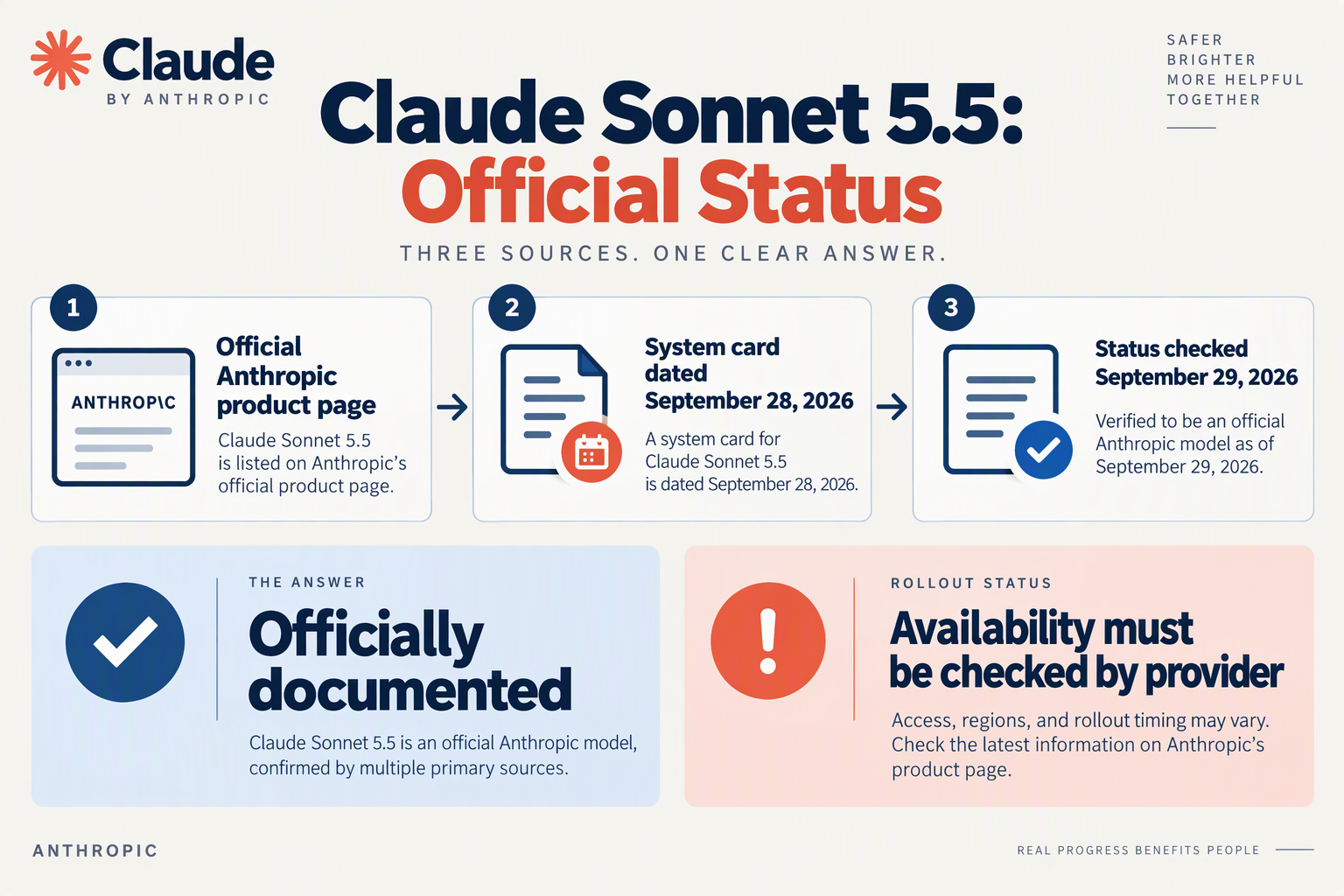
Claude Sonnet 5.5 is an officially released Anthropic model designed for fast, cost-efficient coding, tool use and well-scoped everyday tasks. Anthropic launched it on September 28, 2026, with the API model ID claude-sonnet-5-5.
How do we know Claude Sonnet 5.5 is official?
Anthropic announced Claude Sonnet 5.5 through its first-party release materials and published supporting model documentation on September 28, 2026. These sources establish that it is a production model—not an unreleased codename, benchmark leak or rumored roadmap entry.
Anthropic’s documentation confirms:
- Release date: September 28, 2026
- API model ID:
claude-sonnet-5-5 - Context window: 1 million tokens
- Reliable knowledge cutoff: June 2026
- Direct API pricing: $2 per million input tokens and $10 per million output tokens
- Prompt-cache read pricing: $0.20 per million tokens
The 1-million-token figure describes the model’s maximum context window, not its maximum response length.
What role does Claude Sonnet 5.5 serve?
Anthropic positions Claude Sonnet 5.5 as a speed-and-cost-optimized frontier model for workloads with relatively clear requirements and success criteria. Likely use cases include:
- coding and software-development tasks;
- tool-enabled agents and multi-step workflows;
- document analysis over large contexts;
- structured business tasks; and
- high-throughput applications where latency and token cost matter.
Anthropic says Claude Sonnet 5.5 runs more than 30% faster than Claude Sonnet 5. That percentage is a vendor-reported improvement, not a guarantee that every application will become 30% faster. Actual performance depends on prompt length, output length, tool calls, caching, infrastructure and workload design.
Teams should therefore benchmark the model with their own prompts before estimating production latency, quality or cost. Anthropic’s published results establish its claimed positioning; they should not be treated as independently reproduced results unless separate testing confirms them.
Where is Claude Sonnet 5.5 available?
As of September 29, 2026, Anthropic lists Claude Sonnet 5.5 as available through:
- the Claude API;
- Amazon Bedrock;
- Anthropic on AWS;
- Google Cloud; and
- Microsoft Foundry.
For the Claude API, developers should request claude-sonnet-5-5. The direct Anthropic API list price is $2 per million input tokens, $10 per million output tokens and $0.20 per million prompt-cache read tokens.
Does “officially available” mean identical access everywhere?
No. Official availability means Anthropic has launched and documented the model across the listed channels. It does not necessarily mean every account, region, subscription tier or cloud deployment exposes it under identical conditions.
Before a production migration, verify:
- that
claude-sonnet-5-5is enabled for the intended account; - that the required region supports the model;
- whether the platform uses a different deployment name or versioned identifier;
- the applicable pricing and usage limits for that channel; and
- whether the full 1-million-token context window is available in the chosen deployment.
The precise conclusion is: Claude Sonnet 5.5 is an official Anthropic model released on September 28, 2026, with model ID claude-sonnet-5-5, a 1-million-token context window and availability through Anthropic and the listed cloud platforms. Account- and channel-specific access should still be verified before deployment.
How does Sonnet 5.5 fit into Anthropic’s model lineup?

Claude Sonnet 5.5 occupies the middle of Anthropic’s Claude lineup: it prioritizes frontier-level capability with lower latency and cost than the more deliberative Claude Opus 5.5. Anthropic positions Sonnet 5.5 for coding, tool use and clearly bounded production tasks, while Opus handles work where nuanced judgment is worth additional compute.
What are the main tiers in Anthropic’s Claude lineup?
Anthropic organizes Claude models into three broad families rather than treating every release as interchangeable:
- Claude Opus: The capability-focused tier for complex analysis, difficult decisions and workflows requiring careful judgment.
- Claude Sonnet: The balanced tier for strong reasoning, coding and agentic work at production-friendly speed and cost.
- Claude Haiku: The smaller, faster tier designed for responsive and high-volume workloads where efficiency matters most.
Anthropic’s September 28, 2026 announcement explicitly calls Claude Sonnet 5.5 a “faster, lower-cost complement to Claude Opus 5.5.” The distinction is workload-driven: Anthropic says Opus 5.5 is built for complex work requiring careful judgment, whereas Sonnet 5.5 is strongest at “well-scoped everyday” work.
Haiku serves a different efficiency point. In its Claude Haiku 4.5 announcement, Anthropic described Haiku as its small-model line and said Haiku 4.5 delivered coding performance similar to what Claude Sonnet 4 had achieved five months earlier. That illustrates a recurring lineup pattern: capabilities can move from larger models into smaller tiers as Anthropic improves inference efficiency.
How has the Sonnet family evolved?
Claude Sonnet 5.5 is an incremental release within a rapidly moving model family, not a replacement for the Opus and Haiku tiers.
Anthropic’s published Sonnet history identifies several recent milestones:
- Claude Sonnet 4.6, announced on February 17, 2026, advanced the Sonnet line before the fifth generation.
- Claude Sonnet 5, announced on June 30, 2026, focused on agentic coding, tool use and everyday work.
- Claude Sonnet 5.5, announced on September 28, 2026, improved the speed-and-cost profile of Sonnet 5.
- Claude Opus 5.5 remains the corresponding option for more complex, judgment-intensive assignments.
Anthropic reported on September 28, 2026 that Claude Sonnet 5.5 runs more than 30% faster than Claude Sonnet 5 and costs up to 30% less for most work. Those improvements make Sonnet 5.5 particularly relevant when an application repeatedly invokes the model inside coding loops or multi-step agents.
When should developers choose Sonnet instead of Opus or Haiku?
The correct tier depends on the consequences of an error, task complexity and request volume:
- Choose Sonnet 5.5 for code generation, repository maintenance, structured tool calls, customer-facing assistants and repeatable agent workflows with clear success criteria.
- Choose Opus 5.5 when ambiguous evidence, architectural trade-offs or high-stakes reasoning require more careful judgment.
- Evaluate Haiku for classification, extraction, routing and latency-sensitive interactions where a smaller model can meet the quality threshold.
This is not a rigid quality ladder. A well-designed Sonnet workflow with retrieval, tools and validation may outperform an unnecessarily expensive Opus-only design on a bounded task, while difficult edge cases can be escalated to Opus. For production systems, routing by task complexity is therefore more useful than selecting one Claude model for every request.
When was Claude Sonnet 5.5 released and rolled out?
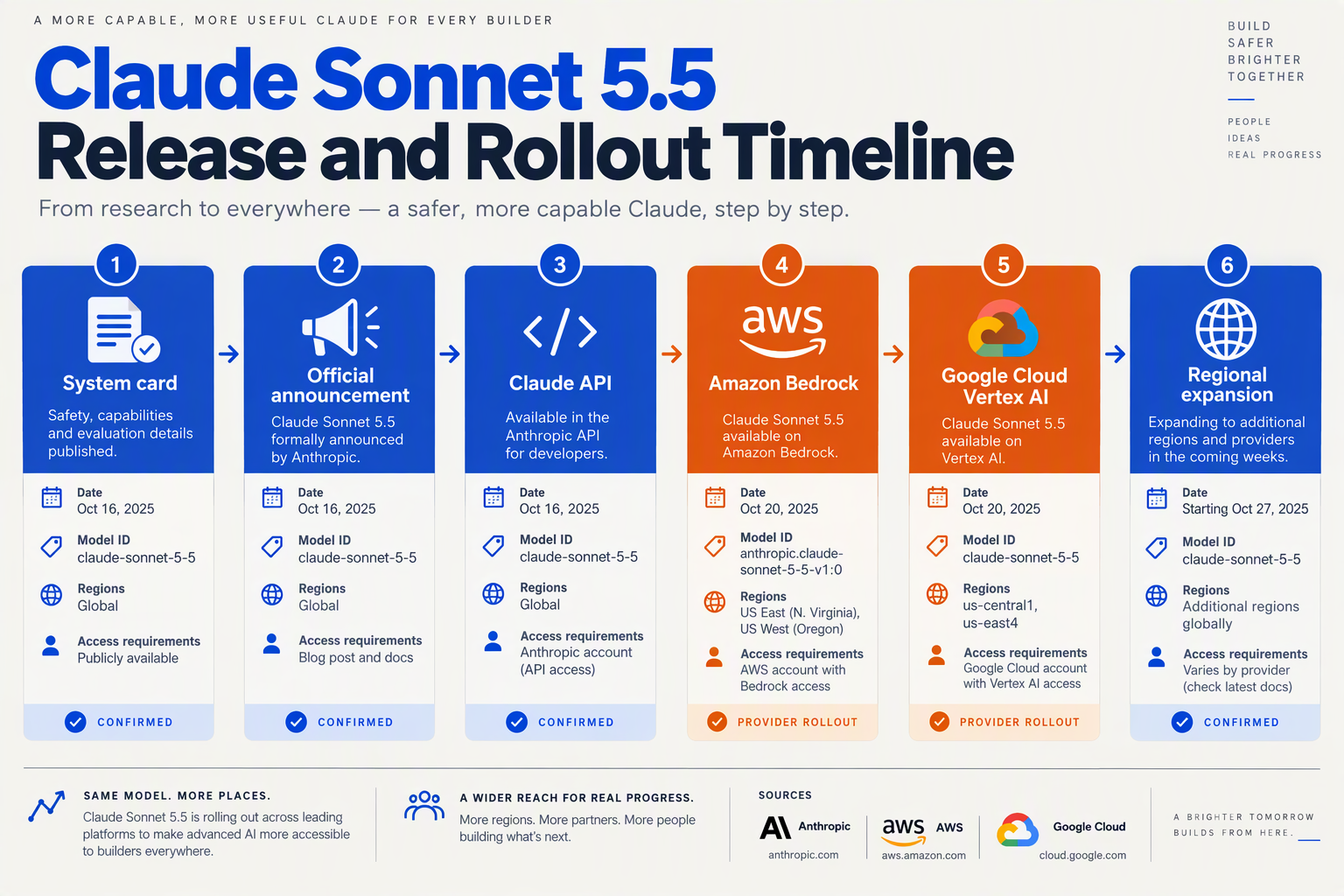
Anthropic released Claude Sonnet 5.5 on September 28, 2026. As of September 29, 2026, Anthropic’s product announcement and same-day system card confirm that Claude Sonnet 5.5 is a released model rather than a preview, leak or roadmap item; however, Anthropic’s cited materials do not publish a separate, channel-by-channel rollout calendar.
What is the official Claude Sonnet 5.5 release timeline?
| Date | Milestone | Official evidence | Status |
|---|---|---|---|
| February 17, 2026 | Claude Sonnet 4.6 announced | Anthropic’s Claude Sonnet model history | Previous generation |
| June 30, 2026 | Claude Sonnet 5 announced | Anthropic’s Claude Sonnet model history | Direct predecessor |
| September 28, 2026 | Claude Sonnet 5.5 announced | Anthropic’s “Introducing Claude Sonnet 5.5” page | Official release |
| September 28, 2026 | Sonnet 5.5 system card published | Anthropic’s Claude Sonnet 5.5 System Card | Technical and safety documentation released |
| September 29, 2026 | Release status independently checked for this guide | Anthropic product page and system card | Officially documented; rollout details may vary by access channel |
The sequence shows a relatively rapid Sonnet release cadence. Claude Sonnet 4.6 arrived on February 17, Claude Sonnet 5 followed on June 30, and Claude Sonnet 5.5 launched on September 28, 2026, according to Anthropic’s Claude Sonnet model history.
That means Sonnet 5.5 appeared 90 days after Claude Sonnet 5. The short interval supports treating version numbers and pinned model identifiers carefully in production: “Claude Sonnet” can refer to several materially different releases introduced within the same year.
Was Claude Sonnet 5.5 announced or merely previewed?
Claude Sonnet 5.5 was announced as a released model, not described as an experimental research preview in the cited Anthropic materials. Anthropic published both a public introduction and a detailed system card dated September 28, 2026.
The system card is particularly important because it documents the evaluated model and identifies June 2026 as Sonnet 5.5’s reliable knowledge cutoff. Anthropic’s publication of model-specific evaluation documentation provides stronger verification than an undated catalogue listing, social-media screenshot or third-party model name.
Did every Claude channel receive Sonnet 5.5 simultaneously?
Anthropic’s cited announcement establishes the release date, but it does not provide a granular rollout timetable for every region, account tier, cloud marketplace or interface. “Released” therefore should not be interpreted as proof that every user saw the model selector or obtained API access at precisely the same hour.
Teams should verify access in this order:
- Check Anthropic’s current model documentation for the supported model name or dated identifier.
- Inspect the relevant console or application selector rather than assuming website and API availability are identical.
- Confirm account, regional and platform eligibility before scheduling a migration.
- Run a direct API availability test in the intended production environment.
- Pin the documented model identifier where reproducibility matters, instead of relying on a moving alias.
The defensible conclusion as of September 29, 2026 is precise: Claude Sonnet 5.5 officially launched on September 28, 2026, with its system card published the same day, while access should still be verified on the specific channel a team plans to use.
How much does Claude Sonnet 5.5 API usage cost?
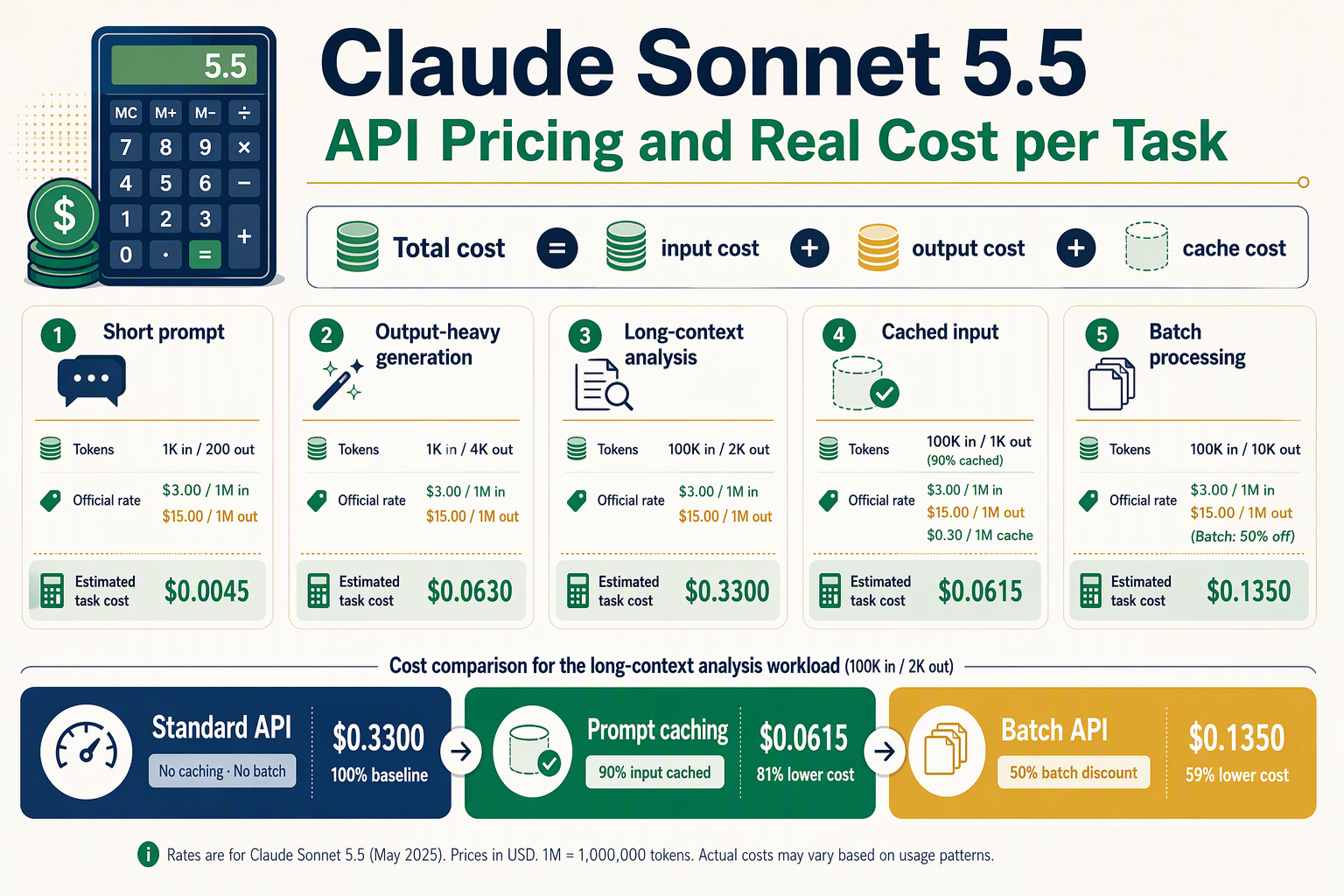
Anthropic says Claude Sonnet 5.5 costs up to 30% less than Claude Sonnet 5 for most work, but the verified source material available for this guide does not state exact per-million-token input and output rates. As of September 29, 2026, teams should therefore treat the 30% figure as a workload-dependent maximum—not a universal discount or a substitute for Anthropic’s live API pricing page.
What Claude Sonnet 5.5 pricing has Anthropic confirmed?
Anthropic’s September 28, 2026 announcement states that Claude Sonnet 5.5 “costs up to 30% less for most work” than Claude Sonnet 5. “Up to” matters: it indicates the realized saving can vary with token composition, model settings, caching and the type of workload.
| Pricing item | Verified status | Practical interpretation | Date checked |
|---|---|---|---|
| Discount versus Sonnet 5 | Up to 30% less | Maximum claimed reduction for most work | Sep. 29, 2026 |
| Input-token rate | Not specified in the supplied official context | Check Anthropic’s current pricing page before budgeting | Sep. 29, 2026 |
| Output-token rate | Not specified in the supplied official context | Output-heavy agents may have a different effective saving | Sep. 29, 2026 |
| Prompt-cache pricing | Not specified for Sonnet 5.5 in the supplied context | Do not assume another Claude model’s cache rates apply | Sep. 29, 2026 |
| Batch-processing discount | Not verified in the supplied context | Exclude it from forecasts until Anthropic documents support | Sep. 29, 2026 |
| Cloud-provider pricing | Not verified in the supplied context | Amazon Bedrock or Google Cloud rates may differ from direct API rates | Sep. 29, 2026 |
The Claude Sonnet 5.5 System Card, published by Anthropic on September 28, 2026, verifies model characteristics such as its June 2026 reliable knowledge cutoff, but it should not be treated as a billing schedule. Pricing can also change independently of a model’s system card.
How should teams estimate the possible savings?
A simple comparison can translate Anthropic’s maximum discount claim into a preliminary budget. If an equivalent Claude Sonnet 5 workload costs $100, a full 30% reduction would make the Sonnet 5.5 cost $70, saving $30:
Estimated Sonnet 5.5 cost = Sonnet 5 cost × (1 − applicable discount)
That calculation is illustrative, not an official token quote. A production estimate should separately model:
- Input tokens, including system prompts, retrieved documents and conversation history.
- Output tokens, especially for code generation and long-form responses.
- Repeated context, with caching included only if Anthropic confirms support and rates.
- Agent loops, because retries and tool results can multiply total token consumption.
- Provider-specific charges, where cloud marketplaces or gateways add distinct pricing terms.
Is lower token pricing the same as lower task cost?
No. Cost per completed task is usually more useful than price per token. Anthropic reported on September 28, 2026 that Claude Sonnet 5.5 runs more than 30% faster than Claude Sonnet 5; if the model also completes tasks with fewer retries, the effective saving may extend beyond its token rate.
Benchmark Sonnet 5.5 on representative requests and record tokens consumed, successful-task rate, retries, latency and tool calls. Until exact dated input and output rates are verified, any budget presenting precise Claude Sonnet 5.5 dollar figures should be labelled provisional.
What is the Claude Sonnet 5.5 context window in practice?
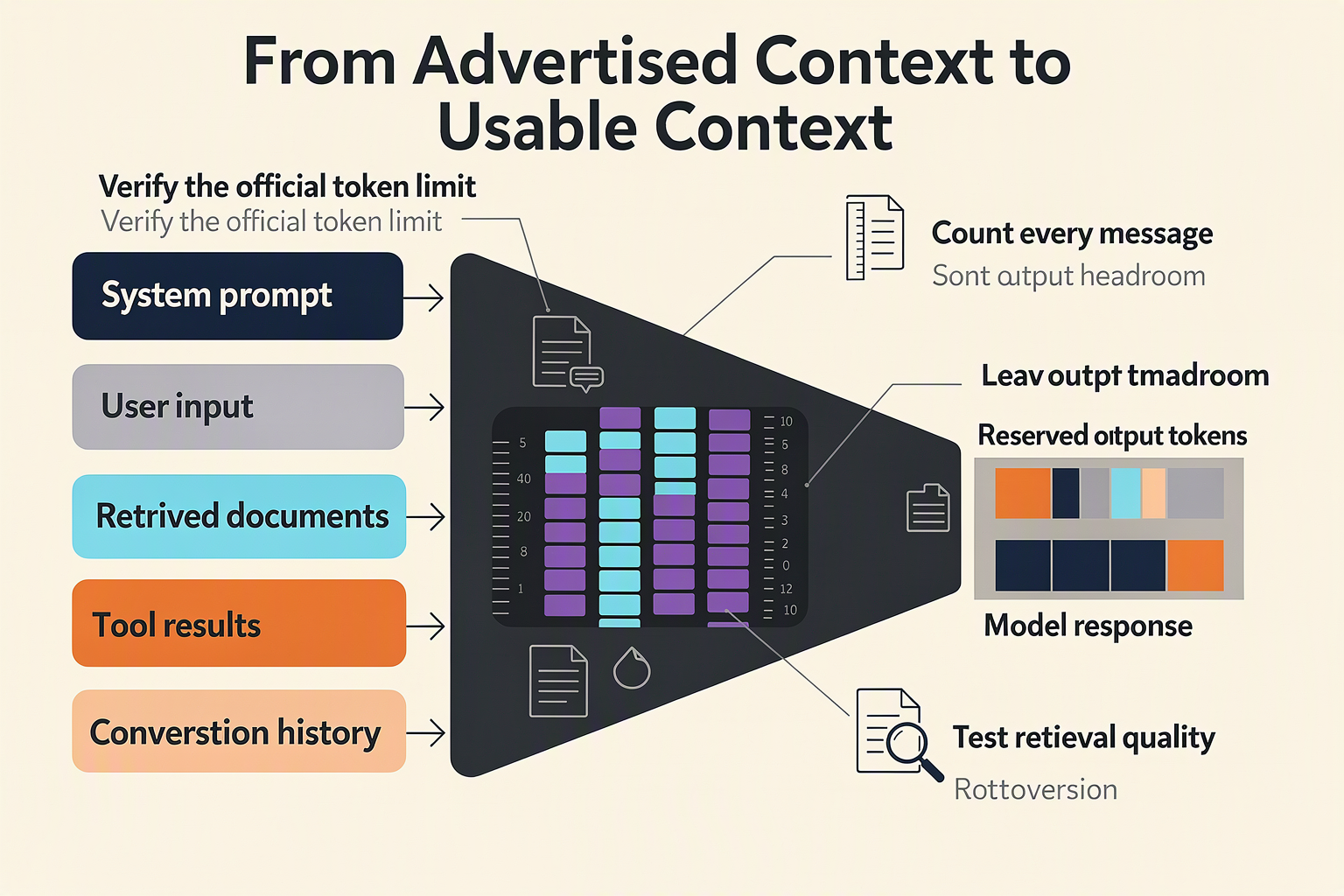
As of September 29, 2026, the official Anthropic material supplied for Claude Sonnet 5.5 does not verify a specific numeric context-window limit. Claims that Claude Sonnet 5.5 supports a particular maximum—such as 200,000 or 1 million tokens—should therefore be treated as unconfirmed until Anthropic’s model documentation, API response or cloud-provider listing states the limit explicitly.
Is the context window the same as the knowledge cutoff?
No. A context window is the amount of information Claude Sonnet 5.5 can process in one request, while a knowledge cutoff describes how recently its training knowledge was considered reliable.
Anthropic’s Claude Sonnet 5.5 System Card, published September 28, 2026, gives the model a reliable knowledge cutoff of June 2026. Supplying newer documents inside the prompt may let the model analyze post-cutoff information, but it does not update the model’s underlying training or guarantee awareness of omitted events.
The usable context generally needs to accommodate:
- System instructions and developer prompts
- Conversation history
- Uploaded documents or retrieved passages
- Tool definitions, tool results and structured data
- The tokens reserved for Claude’s generated answer
A nominal limit is therefore not equivalent to the amount of source material an application can safely insert.
How much context should applications actually use?
Developers should avoid designing around the theoretical maximum. Long prompts increase cost, consume output headroom and can make relevant evidence harder to locate—especially when documents contain duplication, stale instructions or conflicting facts.
A safer production workflow is:
- Measure the complete request, not only the user’s message. Include system prompts, tool schemas, prior turns and retrieval results.
- Reserve output capacity for the expected answer, code patch or tool call rather than filling the entire window with input.
- Retrieve selectively using metadata filters, semantic search and reranking instead of inserting every available document.
- Compress old history into a structured summary while retaining critical decisions, constraints and citations.
- Test information placement near the beginning, middle and end of long prompts to detect whether recall deteriorates.
For example, a coding agent should usually retrieve the relevant repository map, interfaces, failing tests and neighboring files before loading an entire monorepo. A contract-analysis workflow can split documents by clause, preserve page references and retrieve the sections relevant to each question.
How should teams verify the Claude Sonnet 5.5 limit?
Because Anthropic can apply different limits by model snapshot, account tier, API channel or cloud platform, teams should verify the deployment they will actually call.
Check these sources in order:
- Anthropic’s current model documentation and model identifier
- The Anthropic Console and SDK metadata
- Amazon Bedrock, Google Cloud Vertex AI or other provider-specific listings
- API validation errors and token-counting results from representative payloads
- Any beta headers or access conditions required for extended context
Do not infer Claude Sonnet 5.5’s capacity from Claude Sonnet 5, Claude Sonnet 4.5 or Claude Opus 5.5. Until Anthropic publishes a confirmed number for the selected endpoint, the practical answer is to measure requests, preserve output headroom and make the context budget configurable rather than hard-coding an assumed maximum.
How do developers access the API and find the model ID?
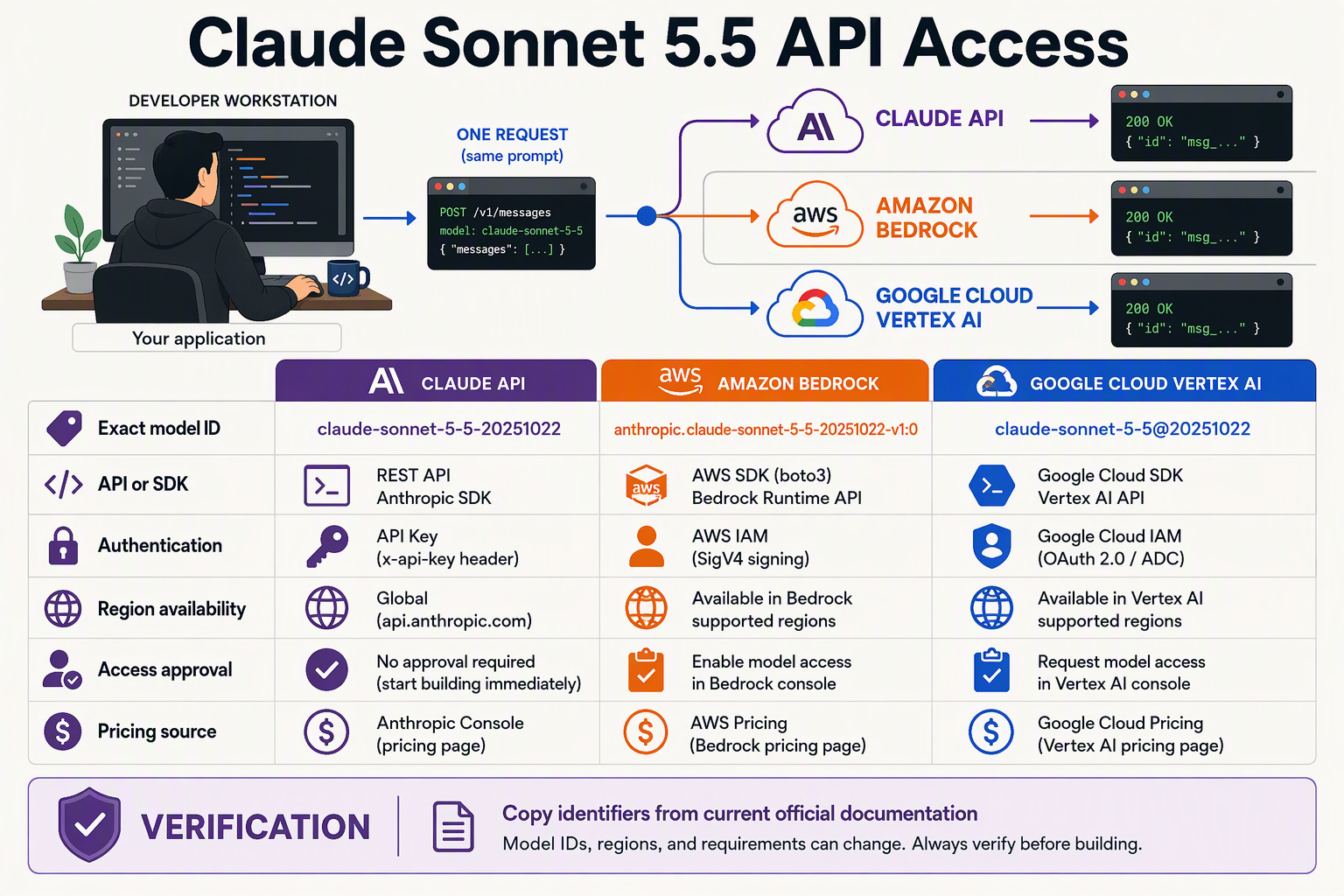
Developers should access Claude Sonnet 5.5 through Anthropic’s Messages API and copy the exact model identifier from Anthropic’s model catalogue rather than deriving it from the product name. As of September 29, 2026, Anthropic’s launch page confirms that Claude Sonnet 5.5 is released, but developers should verify that their API key can see the model before deploying it.
Where can developers find the Claude Sonnet 5.5 model ID?
The safest source is Anthropic’s Models API, which returns the models available to the authenticated account. This matters because a human-readable name such as “Claude Sonnet 5.5” is not necessarily identical to its API identifier, and provider aliases can differ from dated model snapshots.
| Step or access path | What to do | What to verify | Why it matters |
|---|---|---|---|
| Anthropic Console | Open the model selector or API documentation | Claude Sonnet 5.5 appears for the account | Availability may depend on account access |
| Models API | Send GET /v1/models | Match the display_name and copy its id | Avoids guessing the identifier |
| Anthropic SDK | Call the SDK’s model-listing method | Returned ID is accepted by the SDK | Reduces manual request handling |
| Messages API | Pass the copied ID to POST /v1/messages | A test prompt returns successfully | Confirms inference access |
| Cloud marketplace | Check the provider’s current model catalogue | Provider-specific ID, region and version | IDs can differ from Anthropic’s |
| API gateway | Inspect the gateway’s live model list | Routing name, availability and pricing | Compatibility does not guarantee listing |
A direct catalogue request follows this pattern:
curl https://api.anthropic.com/v1/models \
  -H "x-api-key: $ANTHROPIC_API_KEY" \
  -H "anthropic-version: 2023-06-01"
Developers should locate the entry whose display name is Claude Sonnet 5.5, then copy the returned id exactly. The supplied official launch material does not expose a verified API-ID string, so publishing an identifier inferred from Anthropic’s naming convention would risk sending production requests to a nonexistent alias.
How do developers make the first API request?
After retrieving the identifier, test it with a small Messages API request before configuring agents, tools or long-running workloads:
curl https://api.anthropic.com/v1/messages \
  -H "x-api-key: $ANTHROPIC_API_KEY" \
  -H "anthropic-version: 2023-06-01" \
  -H "content-type: application/json" \
  -d '{
    "model": "<MODEL_ID_RETURNED_BY_ANTHROPIC>",
    "max_tokens": 128,
    "messages": [
      {"role": "user", "content": "Return the text: API access confirmed."}
    ]
  }'
A practical rollout sequence is:
- List models using the same API key and project intended for production.
- Copy the returned ID, including any version suffix.
- Run a minimal request and record errors, headers and usage.
- Pin the tested identifier in production configuration.
- Evaluate new aliases or snapshots separately before changing the pinned value.
Anthropic’s September 28, 2026 announcement says Claude Sonnet 5.5 runs more than 30% faster than Claude Sonnet 5 and costs up to 30% less for most work, making side-by-side API evaluation worthwhile.
For multi-model applications, compatibility layers can reduce migration effort. As of September 2026, CallMissed’s developer AI API provides Anthropic-compatible /v1/messages and OpenAI-compatible endpoints across a 138-model catalogue; developers should still check its current catalogue for a specific model before assuming availability.
Which verified features and use cases suit Sonnet 5.5 best?
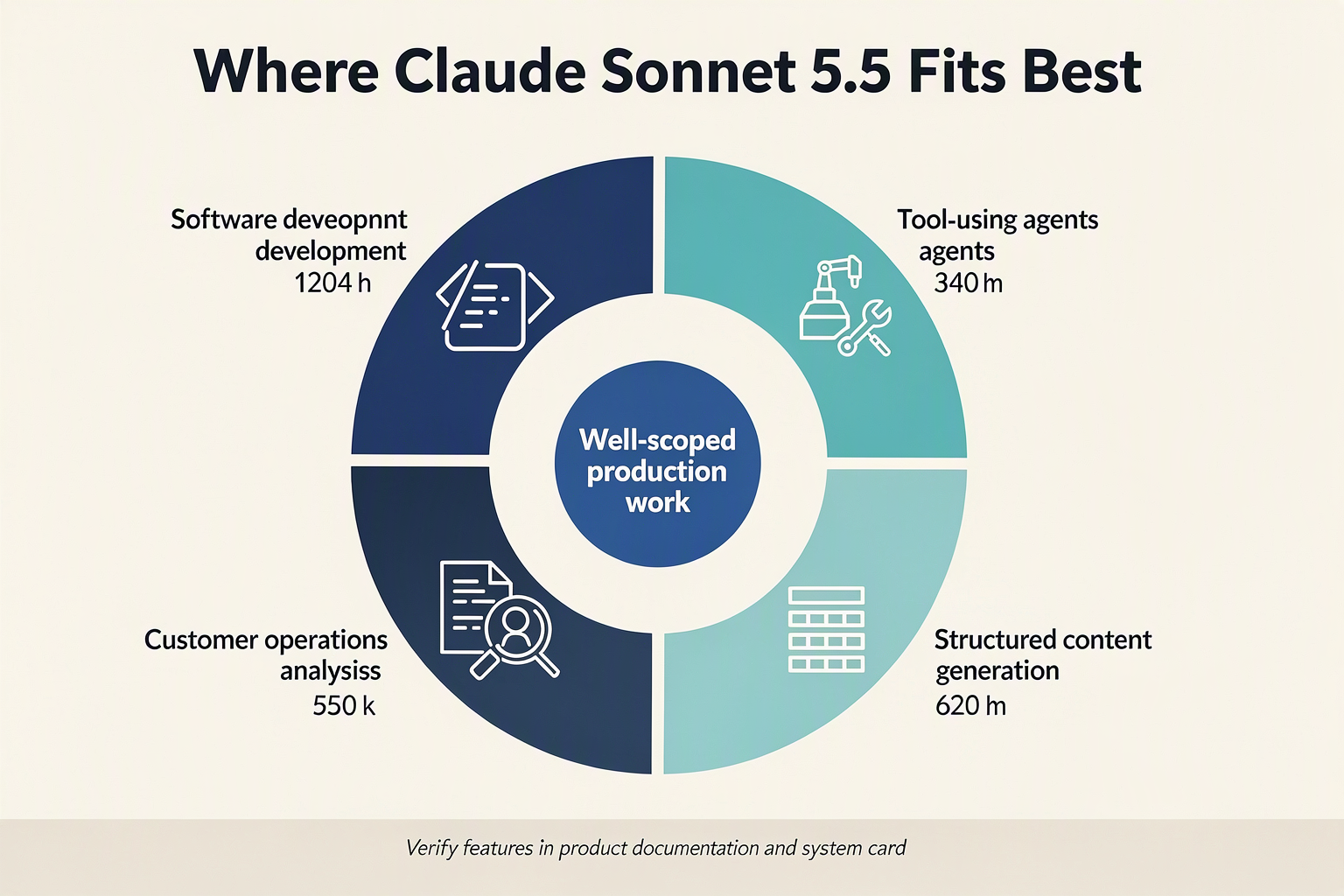
Claude Sonnet 5.5 is best suited to coding, tool-enabled agents and high-volume applications where tasks are clearly defined and responsiveness matters. Anthropic’s September 28, 2026 announcement describes the model as strongest for “well-scoped everyday” work, while Claude Opus 5.5 remains the intended choice for complex work requiring careful judgment.
What Claude Sonnet 5.5 features are officially verified?
The verified improvements focus on performance, economics and recent knowledge, rather than an entirely new interaction paradigm:
- Faster inference: Anthropic reported on September 28, 2026 that Claude Sonnet 5.5 runs more than 30% faster than Claude Sonnet 5.
- Lower cost: Anthropic reported on September 28, 2026 that Claude Sonnet 5.5 costs up to 30% less for most work than Claude Sonnet 5.
- Coding and tool use: Anthropic explicitly positions the Claude Sonnet family for coding, tool use and everyday work.
- Recent training knowledge: Anthropic’s Claude Sonnet 5.5 System Card, dated September 28, 2026, specifies a reliable knowledge cutoff of June 2026.
- Frontier-model positioning: Anthropic calls Sonnet 5.5 a “clear upgrade” over Sonnet 5 and a faster, lower-cost complement to Claude Opus 5.5.
“Up to 30% less” should not be interpreted as a guaranteed 30% reduction for every request. Actual savings depend on token volume, prompt caching, output length, tool calls and the pricing tier applicable to the workload.
Which coding use cases fit Sonnet 5.5 best?
Sonnet 5.5’s strongest coding fit is work with explicit requirements, bounded repositories and testable outputs. Practical examples include:
- Generating a defined component: Create an API endpoint, React component or database migration from a detailed specification.
- Debugging localized failures: Inspect an error trace, identify the likely cause and propose a patch with tests.
- Reviewing pull requests: Flag defects, explain risky changes and suggest focused improvements when supplied with the diff and project conventions.
- Modernizing repetitive code: Convert deprecated syntax, add type annotations or update similarly structured modules.
- Producing developer documentation: Generate docstrings, API examples, changelogs and onboarding notes from source material.
The 30%+ speed improvement reported by Anthropic in September 2026 is especially relevant to interactive coding assistants, where each edit-test-review cycle may require several sequential model responses.
Which agentic and business workflows are a strong match?
Claude Sonnet 5.5 should suit agents that follow a known process with constrained tools. Examples include retrieving an order, classifying a support request, querying an approved knowledge base, updating a CRM record or drafting a response for human review.
Good production candidates generally share three properties:
- The agent has a small, permissioned tool set.
- Success can be checked using schemas, tests or business rules.
- Ambiguous or consequential cases can be escalated to a human or stronger model.
Multi-model gateways can make that routing pattern easier to implement. As of September 2026, CallMissed’s developer AI API offers Anthropic-compatible /v1/messages endpoints, caller-selected fallback models, function calling and structured outputs, allowing developers to build compatible orchestration without tying application logic to one request format.
When should teams choose a different approach?
Sonnet 5.5 is not automatically the right choice for novel strategy, sensitive judgment or open-ended research. Anthropic directs the most complex judgment-heavy work toward Opus 5.5, while post-June 2026 questions require web search, retrieval or another current data source.
Regardless of model choice, consequential outputs involving cybersecurity, medicine, law, finance or production changes should remain subject to tool restrictions, validation and human review.
How does Sonnet 5.5 compare with Sonnet 5 and other models?
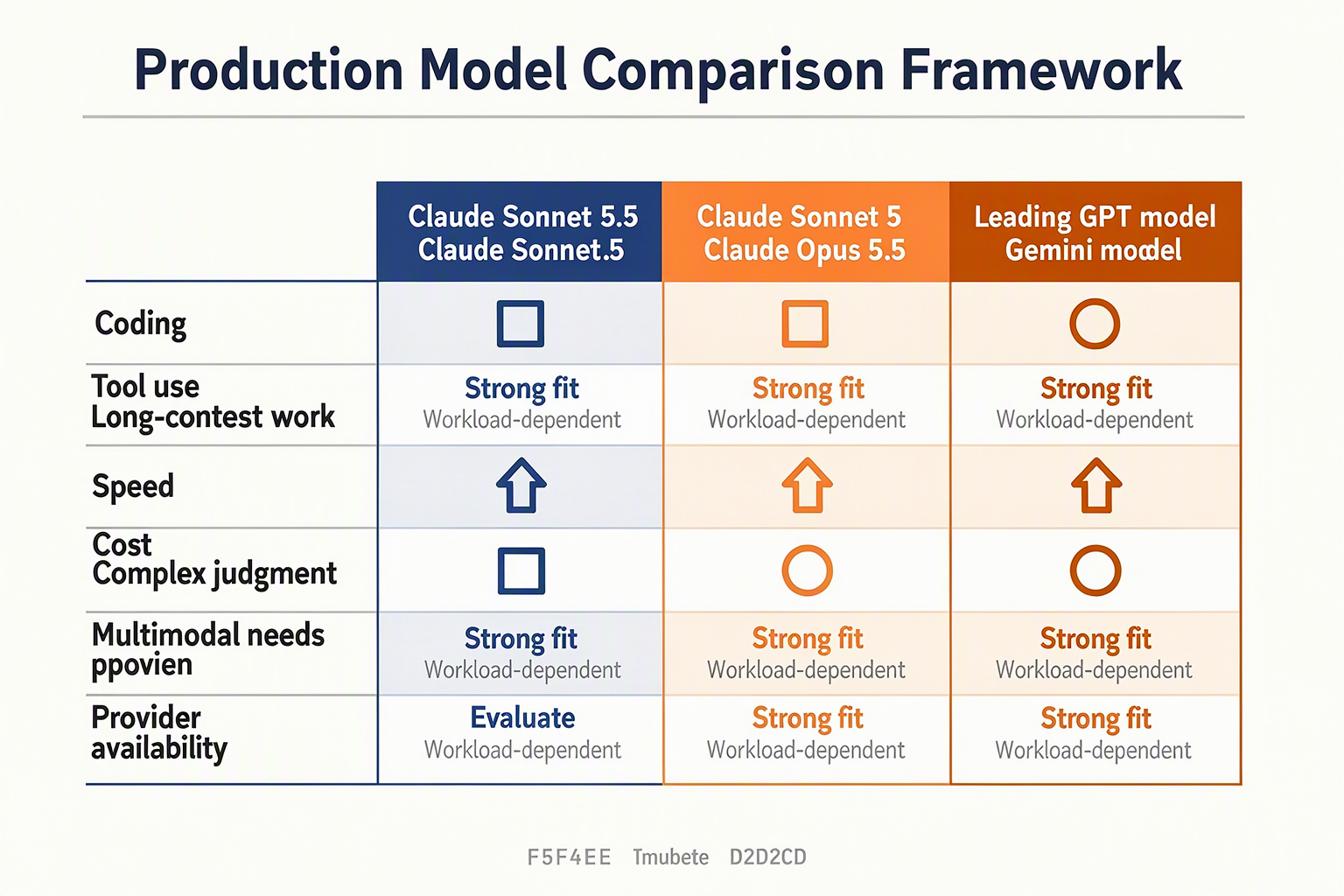
Claude Sonnet 5.5 is the practical upgrade from Sonnet 5 for workloads that prioritize throughput, predictable scope and token economics, while Claude Opus 5.5 remains positioned for harder work requiring careful judgment. Anthropic does not claim that Sonnet 5.5 is universally preferable to every Claude model; the right choice depends on task complexity, latency requirements and cost sensitivity.
What is the clearest Claude model comparison?
| Model | Verified positioning | Release or status | Strongest selection case | Key comparison caveat |
|---|---|---|---|---|
| Claude Sonnet 5.5 | Clear Sonnet 5 upgrade; 30%+ faster and up to 30% cheaper for most work | Announced September 28, 2026 | Coding assistants, tool use and well-scoped production agents | Gains are stated relative to Sonnet 5, not every model |
| Claude Sonnet 5 | Agentic Sonnet for coding, tool use and everyday work | Announced June 30, 2026 | Existing deployments needing a stable migration baseline | Its successor offers a stronger speed-cost trade-off |
| Claude Opus 5.5 | Frontier companion designed for complex work requiring careful judgment | Current alongside Sonnet 5.5 as of September 2026 | Ambiguous analysis, demanding reasoning and higher-stakes workflows | Anthropic’s provided comparison does not establish that Sonnet is equally capable on difficult tasks |
| Claude Sonnet 4.6 | Earlier Sonnet generation with frontier-oriented capabilities | Announced February 17, 2026 | Legacy applications evaluating a staged upgrade | No direct Sonnet 5.5 speed, price or quality ratio is provided |
| Claude Haiku 4.5 | Small, faster and cheaper model with coding performance Anthropic compared to Sonnet 4 | Available before Sonnet 5.5 | High-volume, simpler interactions where economy and responsiveness dominate | The comparison is against Sonnet 4, not Sonnet 5.5 |
Anthropic stated on September 28, 2026 that Claude Sonnet 5.5 “runs 30%+ faster” than Claude Sonnet 5 and “costs up to 30% less for most work.” These figures should be treated as vendor-reported relative improvements, not guarantees that every prompt, region or application will see an identical reduction.
Should existing Sonnet 5 applications migrate?
For most teams, Sonnet 5.5 should be the first migration candidate, but not an automatic production replacement. The largest potential benefit appears in repeated model loops—such as coding agents that inspect files, call tools, run tests and revise outputs—because faster individual turns can compound across an entire workflow.
A disciplined comparison should measure:
- Task success rate: Does Sonnet 5.5 complete the same internal evaluation set correctly?
- End-to-end latency: Measure the whole tool loop, not only time to first token.
- Total token cost: Include retries, longer outputs, caching and tool-call overhead.
- Behavioral compatibility: Check structured outputs, tool selection and prompt sensitivity.
- Human escalation rate: Faster responses create little value if reviewers must correct more results.
When should teams choose Opus 5.5 or Haiku instead?
Choose Claude Opus 5.5 when ambiguity, nuanced judgment or complex planning matters more than minimizing latency and cost. Anthropic’s September 2026 positioning explicitly assigns Opus 5.5 to complex work and Sonnet 5.5 to “well-scoped everyday” tasks.
Choose a Haiku-class model for simpler, high-volume operations where low cost and rapid responses outweigh frontier capability. In practice, a routed architecture can send routine classification and extraction to Haiku, defined coding or tool workflows to Sonnet 5.5, and unusually difficult cases to Opus 5.5. This tiered approach is more defensible than assuming one model should handle every request.
What limitations and buying decisions should teams consider?
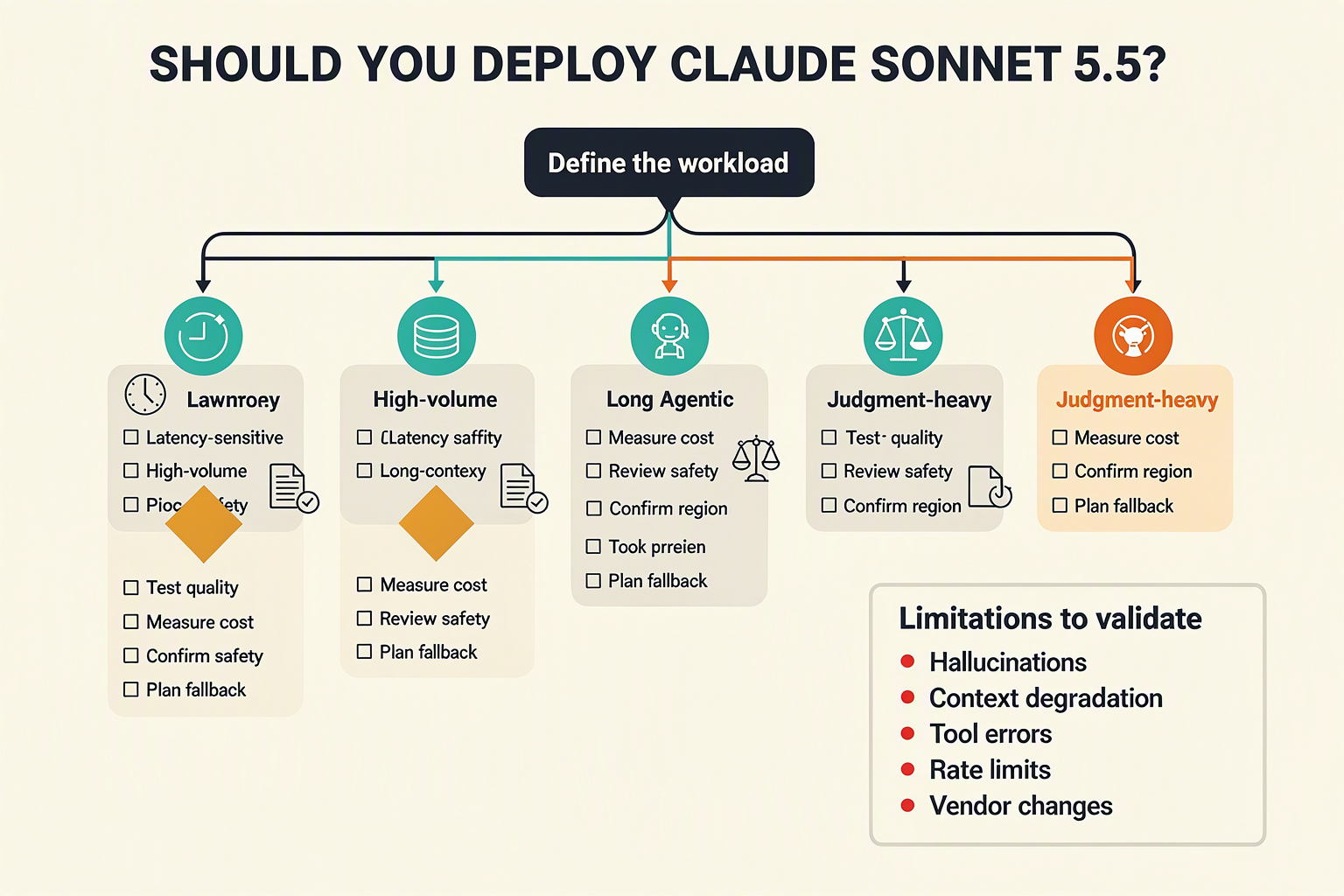
Teams should buy Claude Sonnet 5.5 when throughput, predictable task boundaries and cost efficiency matter more than maximum judgment on ambiguous work. Before committing, evaluate total token consumption, output quality, knowledge freshness, provider dependency and the operational risks of allowing an agent to use tools.
Which trade-offs matter when choosing Claude Sonnet 5.5?
| Buying consideration | Verified evidence | Practical decision | Recommended safeguard |
|---|---|---|---|
| Task complexity | Anthropic said on September 28, 2026 that Sonnet 5.5 is strongest for “well-scoped everyday” work, while Claude Opus 5.5 targets complex work requiring careful judgment. | Prefer Sonnet for bounded coding, extraction, support and repeatable agent workflows; test Opus for ambiguous, high-stakes analysis. | Route difficult cases to a stronger model or human reviewer using measurable escalation rules. |
| Speed versus end-to-end latency | Anthropic reported on September 28, 2026 that Sonnet 5.5 runs more than 30% faster than Claude Sonnet 5. | Do not assume model speed alone guarantees a 30% faster application; retrieval, tools and network calls can dominate latency. | Measure time to first token, full response time and complete agent-task duration separately. |
| Price versus total cost | Anthropic stated on September 28, 2026 that Sonnet 5.5 costs up to 30% less for most work than Sonnet 5. | Model large prompts, retries, tool loops and generated output—not merely the published per-token rate. | Run representative traces and calculate cost per successfully completed task. |
| Knowledge freshness | The Claude Sonnet 5.5 System Card, dated September 28, 2026, gives the model a reliable knowledge cutoff of June 2026. | Sonnet 5.5 should not be treated as a live source for current prices, regulations, incidents or product changes. | Add retrieval or web search, preserve citations and timestamp retrieved evidence. |
| Evaluation uncertainty | Anthropic’s September 2026 System Card notes that evaluations can involve different model “snapshots” taken at different training stages. | Published results may not reproduce the exact distribution, prompts or tool environment of a production workload. | Maintain an internal benchmark with fixed datasets, scoring rules and version records. |
| Safety and accountability | Anthropic’s Transparency Hub says Claude is not a substitute for professional medical advice and is not intended to diagnose or treat conditions. | Human oversight remains necessary for medical, legal, financial, security and other consequential decisions. | Restrict tools, validate outputs and require approval before irreversible actions. |
How should teams calculate the real cost?
The correct unit is cost per accepted outcome, not cost per million tokens in isolation. A cheaper run creates no saving if it requires repeated prompts, generates excessive output or causes an agent to take unnecessary tool steps.
A useful pilot should record:
- Input, cached-input and output-token consumption
- Tool calls, retries and failed task attempts
- Latency at the model and workflow levels
- Human correction time
- Percentage of tasks accepted without edits
- Cost per resolved ticket, merged code change or completed workflow
For coding agents, include repository indexing, test execution and review time. For customer-facing applications, test adversarial prompts, unsupported claims, multilingual inputs and handoff behavior.
Should teams use one model or a multi-model architecture?
A tiered architecture is usually more resilient than assigning every request to Sonnet 5.5. Sonnet can handle clearly defined default traffic, while policies route uncertain, sensitive or unusually complex cases to Claude Opus 5.5, another appropriate model or a person.
As of September 2026, CallMissed’s developer AI API supports caller-chosen fallback models, request logs and 138 models through OpenAI-compatible and Anthropic-compatible endpoints. Infrastructure of this kind can simplify comparative testing, but teams should still verify model availability, output consistency and provider-specific features before migration.
The buying decision should follow a controlled evaluation: define the workload, establish quality thresholds, measure complete task economics and deploy with rollback controls. Anthropic’s headline improvements are meaningful, but production value depends on the surrounding system rather than the model specification alone.
Frequently Asked Questions
Is Claude Sonnet 5.5 officially released and available?
How much faster and cheaper is Claude Sonnet 5.5 than Claude Sonnet 5?
What is Claude Sonnet 5.5 best used for?
What is the Claude Sonnet 5.5 knowledge cutoff?
Should developers choose Claude Sonnet 5.5 or Claude Opus 5.5?
What should teams test before migrating production workloads to Claude Sonnet 5.5?
Conclusion
Claude Sonnet 5.5 shifts the frontier-model trade-off toward faster, more economical production workloads. Anthropic officially released the model on September 28, 2026, positioning it for well-scoped coding, tool-use and agentic tasks rather than the most judgment-intensive work assigned to Claude Opus 5.5.
- Performance: Anthropic reported on September 28, 2026 that Claude Sonnet 5.5 runs more than 30% faster than Claude Sonnet 5.
- Cost: Anthropic stated that Claude Sonnet 5.5 costs up to 30% less for most work, potentially improving the economics of token-intensive applications.
- Knowledge: The Anthropic Claude Sonnet 5.5 System Card lists a June 2026 reliable knowledge cutoff, so post-cutoff information still requires search, retrieval or external tools.
- Deployment: Teams should evaluate actual token consumption, context requirements, API availability, tool reliability and migration behavior—not benchmarks alone—before moving production traffic.
What comes next matters just as much as launch-day specifications. Watch for updated API access conditions, pricing revisions, expanded distribution and independent evidence from sustained production workloads.
As of September 2026, developers can also explore CallMissed, an AI communication platform offering OpenAI-compatible and Anthropic-compatible endpoints across a 138-model catalogue, to evaluate multi-model architectures. Will Claude Sonnet 5.5’s speed and cost gains translate into measurable improvements for your application?
Related Reading
- Claude Opus 5.5 API Pricing, Features and Guide
- Claude Opus 5.5 API Pricing & Migration Guide
- Claude Opus 5 Migration Guide: API Pricing for 2026
Sources
Discussion
Related Posts


Ready to automate customer conversations?
Launch AI voice agents and WhatsApp bots with CallMissed — one API, 22+ Indian languages.