
GPT-6 Luna API Pricing, Limits and Setup Guide 2026



Verify GPT-6 Luna API pricing, model IDs, limits and access, then estimate costs, migrate safely and choose suitable production workloads.
GPT-6 Luna API Pricing, Limits and Setup Guide 2026
GPT-6 Luna costs just $0.10 per million input tokens—one-fifth of its $0.50 output-token price—making OpenAI’s newest GPT-6 model especially notable for high-volume AI workloads. This GPT-6 Luna API pricing, limits and setup guide for 2026 explains what developers and business buyers need to verify before deploying it, from API access and token economics to context length, multimodal support, tool use, coding performance, safety, and migration.
OpenAI launched GPT-6 Luna alongside GPT-6 Sol on September 22, 2026, extending the GPT-6 family after GPT-6 Astra. OpenAI describes Luna as its “most efficient model for focused, high-volume tasks,” while its announcement positions Sol and Luna as faster, more affordable ways to bring much of GPT-6 Astra’s capability to work at scale. The official model identifier is gpt-6-luna.
The timing matters because Luna’s published API rates materially change the cost calculus for classification, extraction, customer support, code assistance, document processing, and agent workflows. As of September 2026, the OpenAI API changelog lists GPT-6 Luna at $0.10 per million input tokens, $0.01 per million cached input tokens, and $0.50 per million output tokens. At those rates, an application processing 100 million uncached input tokens and generating 10 million output tokens would incur $15 in model-token charges, before accounting for separate tools, storage, search, or infrastructure fees.
But price alone does not determine production fit. Buyers also need confirmed answers about rate limits, context windows, maximum output, supported modalities, structured outputs, function calling, reasoning controls, data handling, regional availability, and model-version stability. Where OpenAI’s current primary documentation does not publish a figure or capability, this guide labels it unknown or unconfirmed rather than filling gaps with assumptions.
You will learn how to make a first API request, estimate real workload costs, assess coding and reasoning use cases, plan migration and fallbacks, and distinguish documented capabilities from launch-day uncertainty. For teams that prefer a multi-model integration, CallMissed’s OpenAI-compatible developer API provides one key and balance across 138 models, with caller-chosen fallbacks and request logs as of September 2026. The goal is practical: decide whether GPT-6 Luna belongs in your stack—and deploy it without letting an attractive headline price obscure operational limits.
What is GPT-6 Luna, and who should use it?

GPT-6 Luna is OpenAI’s efficiency-focused GPT-6 model for bounded, repeatable workloads where throughput and cost matter more than using the family’s highest-capability model. Developers, SaaS companies and enterprise automation teams should consider it for high-volume tasks—but should verify each required capability rather than assuming GPT-6 Astra features automatically carry over.
How does GPT-6 Luna fit into the GPT-6 family?
OpenAI positions GPT-6 Luna, identified in API requests as gpt-6-luna, as its “most efficient model for focused, high-volume tasks.” OpenAI’s September 2026 announcement says GPT-6 Luna and GPT-6 Sol build on the advances behind GPT-6 Astra, bringing “much of its strengths” into faster and more affordable models for work at scale.
That wording establishes Luna’s intended role, but it does not prove feature parity with Astra or Sol. A practical interpretation is:
- GPT-6 Astra: intended for the most demanding and consequential projects.
- GPT-6 Sol: another capability-and-cost balance within the GPT-6 family.
- GPT-6 Luna: optimized for economical, focused processing at high volume.
“Focused” should not be read as “basic.” It generally describes work that has a clear objective, constrained output format and measurable success criteria. Examples include assigning support categories, extracting invoice fields or producing a structured summary from supplied text.
Who should use GPT-6 Luna?
GPT-6 Luna is most relevant when an application sends substantial input volume and can define output quality objectively. Strong candidate workloads include:
- Classification: intent detection, moderation routing, lead qualification and ticket tagging.
- Structured extraction: converting contracts, forms, emails or product descriptions into validated JSON.
- Customer operations: drafting responses, summarizing conversations and retrieving answers from approved business content.
- Document pipelines: metadata generation, comparison, normalization and concise summarization.
- Developer tooling: code explanation, routine transformations, test generation and issue triage.
- Agent workflows: handling narrowly scoped steps such as deciding which function or business system to invoke.
The model’s low input-to-output price ratio also favors workloads that read considerably more than they generate. Retrieval-augmented generation, document review and transcript analysis often have this shape.
When should businesses choose another model?
GPT-6 Luna should not be selected solely because it has the lowest published GPT-6 token rate. Consider GPT-6 Sol, GPT-6 Astra or another specialized model when the workflow requires:
- Maximum performance on complex, ambiguous or multi-stage reasoning.
- Confirmed support for a particular image, audio, tool-use or computer-use feature.
- Long outputs that reduce Luna’s input-cost advantage.
- A published context window or output limit that exceeds Luna’s documented limits.
- Validated performance in regulated, safety-critical or high-consequence decisions.
As of September 2026, OpenAI’s available Luna description emphasizes efficiency but does not, by itself, confirm every technical limit or modality. Buyers should therefore run evaluations against representative production data, measure task accuracy and schema adherence, and test failure recovery before routing significant traffic.
What is the simplest buyer decision rule?
Choose GPT-6 Luna when the task is high-volume, clearly specified and easy to evaluate. Do not choose it by brand lineage alone: require a production test covering quality, latency, tool behavior, safety controls and total cost—including generated tokens and separately billed services.
What did OpenAI confirm at launch, and where is Luna available?
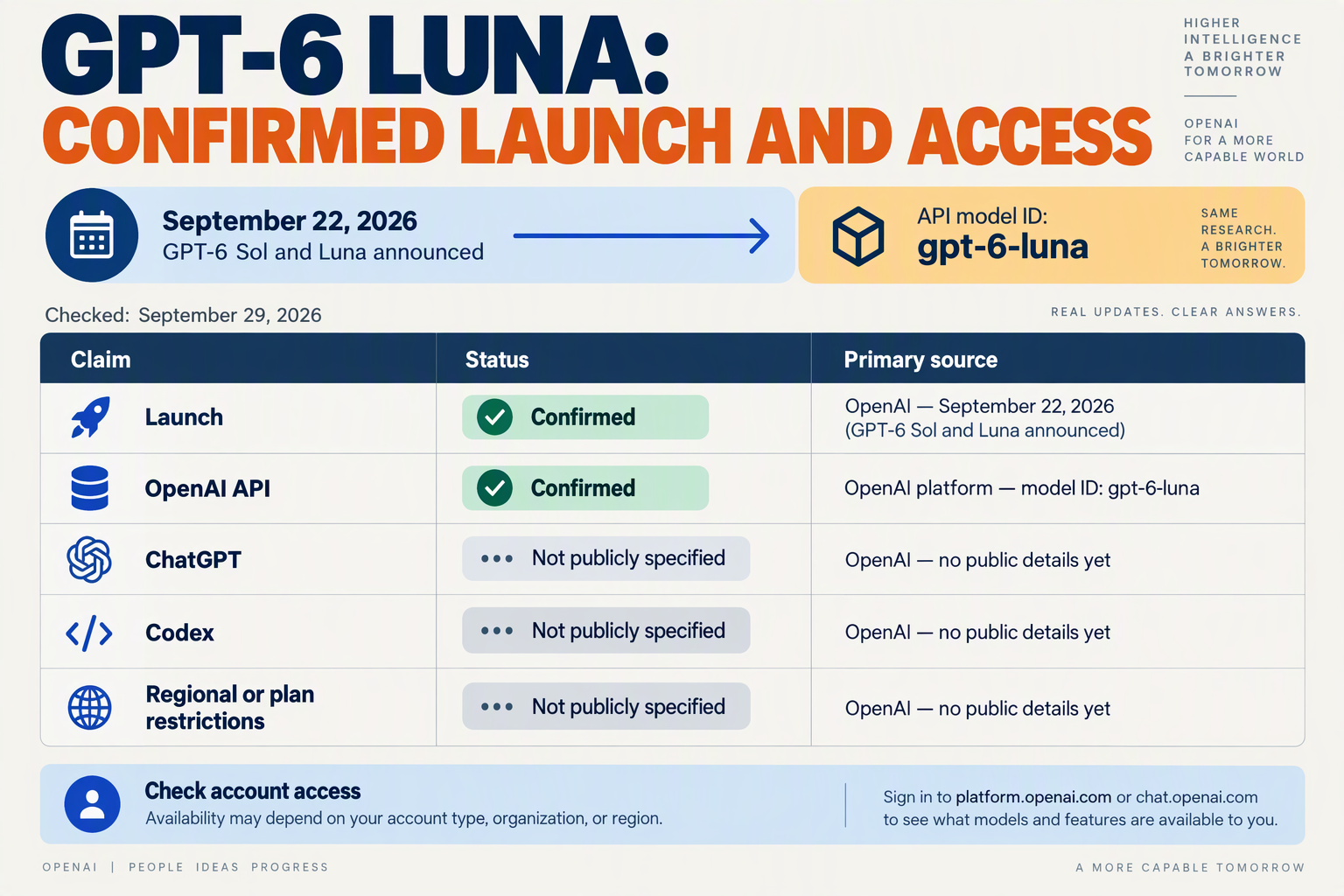
OpenAI confirmed GPT-6 Luna on September 22, 2026, for the OpenAI API, ChatGPT and Codex. However, launch availability does not guarantee immediate access for every account, subscription, workspace or region; OpenAI’s published materials do not yet document those eligibility details comprehensively.
Where was GPT-6 Luna available at launch?
OpenAI’s September 22, 2026 announcement says GPT-6 Sol and GPT-6 Luna are available through the API, Codex and ChatGPT. The OpenAI API documentation separately instructs developers to use gpt-6-luna in API requests, while the OpenAI API changelog records the model’s release and token prices.
| Surface or detail | Launch status | Official evidence | What buyers should verify |
|---|---|---|---|
| OpenAI API | Confirmed | OpenAI’s model page lists gpt-6-luna for API requests | Whether the model appears for the intended project and account |
| ChatGPT | Confirmed generally | OpenAI’s September 22 launch announcement names ChatGPT | Eligible plan, workspace policy and model-selector access |
| Codex | Confirmed generally | OpenAI’s official developer announcement names Codex | Codex client version and account-level availability |
| Model identifier | Confirmed | OpenAI API documentation specifies gpt-6-luna | Use the exact lowercase identifier in requests |
| Geographic availability | Unconfirmed in cited launch materials | No region-by-region list is provided | Legal-entity, data-location and regional-access requirements |
| Versioned model snapshot | Unconfirmed in cited documentation | The documented identifier is an alias without a dated suffix | Change management, regression tests and fallback strategy |
OpenAI’s API changelog dated September 22, 2026 records the release of both GPT-6 Sol and GPT-6 Luna. The same changelog also notes a subsequent image-encoding bug fix affecting image understanding in both models, demonstrating why production teams should monitor release notes rather than treating launch-day behavior as permanently fixed.
Does “available” mean every account receives immediate access?
No. Platform-level availability and account-level entitlement are different claims. OpenAI confirmed the three product surfaces, but the cited primary sources do not specify supported countries, eligible ChatGPT plans, enterprise workspace controls, rollout percentages or whether access was instantaneous worldwide.
An OpenAI Developer Community post on September 22, 2026 reported that one user could not find GPT-6 Luna in Codex. That individual report does not override OpenAI’s official availability announcement, but it illustrates how client rollout, caching, account eligibility or staged enablement can create gaps between an announced release and what a user sees.
How should teams verify GPT-6 Luna access?
Before committing a workload, developers and procurement teams should run a short access audit:
- Check the official model catalog for
gpt-6-lunaunder the production API project. - Send a minimal test request and record the response, request ID and any access error.
- Inspect ChatGPT and Codex separately, because access on one surface does not prove access on another.
- Confirm organizational controls, including workspace permissions, approved regions and internal data policies.
- Retest image workflows, because OpenAI’s September 2026 changelog confirms that an image-encoding defect required a post-launch fix.
- Maintain a fallback model until Luna’s availability and behavior are validated under real traffic.
As of September 29, 2026, API, ChatGPT and Codex access are officially confirmed; universal plan eligibility, regional coverage and a dated immutable model snapshot remain unconfirmed in the cited documentation.
How much does GPT-6 Luna cost at different usage levels?
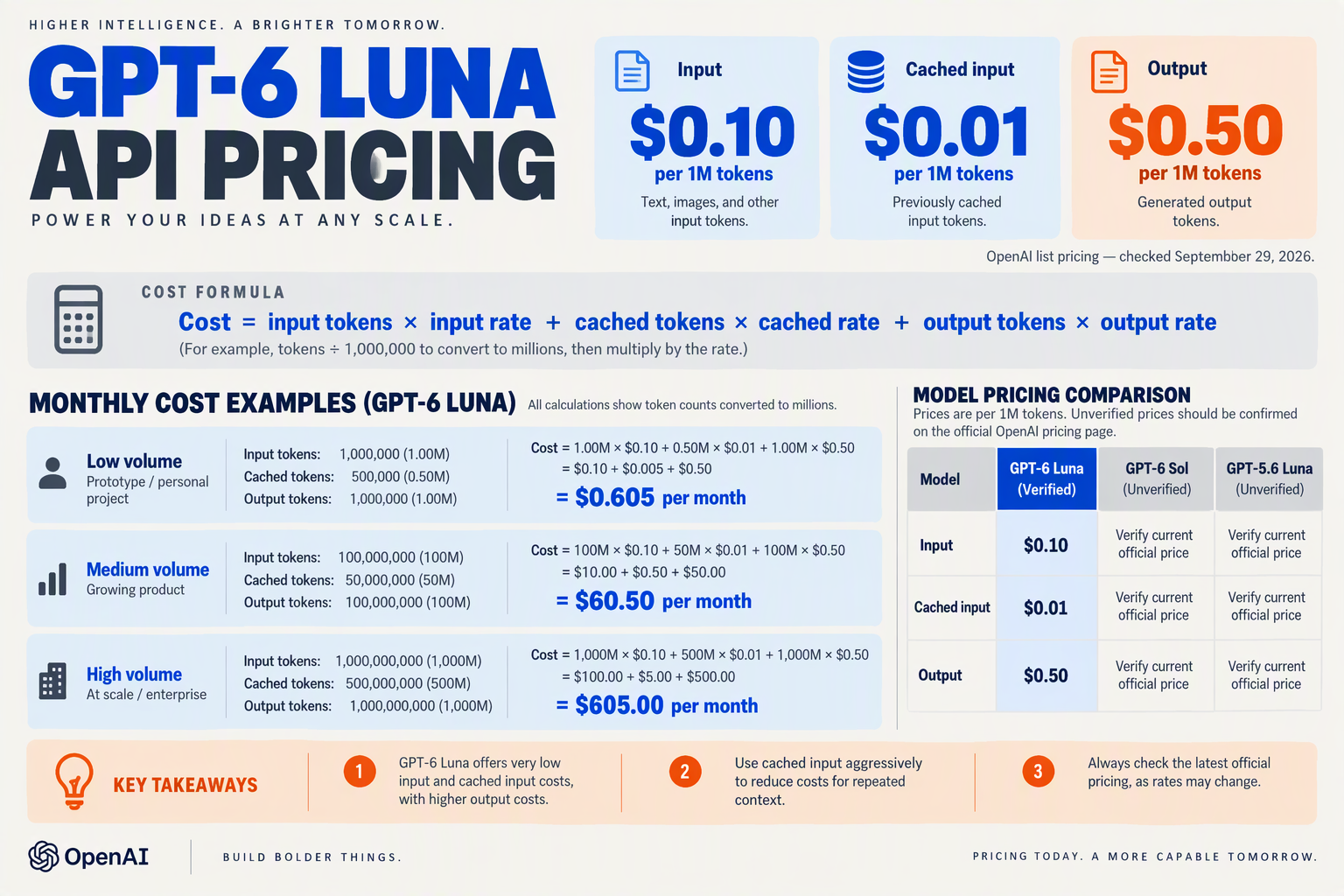
As of September 2026, GPT-6 Luna costs $0.10 per million uncached input tokens, $0.01 per million cached input tokens, and $0.50 per million output tokens through the OpenAI API. Actual spending therefore depends primarily on output volume, cache eligibility, and whether the application invokes separately billed tools.
What would GPT-6 Luna cost for typical workloads?
The following estimates apply OpenAI’s September 2026 token rates to workloads generating 200,000 output tokens for every 1 million input tokens. The cache scenario assumes that 90% of input tokens qualify for the $0.01 cached-input rate; it is a planning scenario, not a guaranteed cache-hit rate.
| Usage level | Input tokens | Output tokens | No cached input | 90% input cached |
|---|---|---|---|---|
| Small pilot | 1 million | 200,000 | $0.20 | $0.119 |
| Production feature | 10 million | 2 million | $2.00 | $1.19 |
| High-volume workflow | 100 million | 20 million | $20.00 | $11.90 |
| Enterprise deployment | 1 billion | 200 million | $200.00 | $119.00 |
| Large-scale platform | 10 billion | 2 billion | $2,000.00 | $1,190.00 |
These are model-token charges only. Taxes, application hosting, observability, vector storage, data transfer, web search, file storage, and other tool charges are excluded.
How do you calculate GPT-6 Luna API costs?
OpenAI’s API changelog listed the following GPT-6 Luna rates in September 2026:
- Uncached input: input tokens ÷ 1,000,000 × $0.10
- Cached input: cached tokens ÷ 1,000,000 × $0.01
- Output: output tokens ÷ 1,000,000 × $0.50
For example, a request stream containing 8 million uncached input tokens, 2 million cached input tokens, and 1 million output tokens would cost:
- Uncached input: 8 × $0.10 = $0.80
- Cached input: 2 × $0.01 = $0.02
- Output: 1 × $0.50 = $0.50
- Total model-token cost: $1.32
Why can output tokens dominate the bill?
One GPT-6 Luna output token costs five times as much as one uncached input token and 50 times as much as one cached input token as of September 2026, according to the OpenAI API changelog. A verbose assistant can consequently cost more than a tightly constrained extraction pipeline, even when both process the same documents.
Developers can control expenditure by:
- Setting appropriate output-token limits.
- Requesting concise structured results instead of narrative responses.
- Reusing stable instructions where prompt caching applies.
- Tracking input, cached-input, and output tokens separately.
- Testing cost per completed task, not merely cost per request.
Which pricing details remain unconfirmed?
The cited OpenAI materials confirm the three token rates, but the supplied primary-source context does not establish volume discounts, Batch API pricing, fine-tuning prices, dedicated-capacity terms, or GPT-6 Luna-specific tool fees. Business buyers should therefore obtain current contractual pricing from OpenAI before projecting committed enterprise spend.
Likewise, API token pricing should not be treated as evidence of identical pricing in ChatGPT, Codex, or other OpenAI products. Those products may use subscriptions, quotas, or access policies separate from direct API metering.
What are Luna’s context, output, multimodal and tool limits?
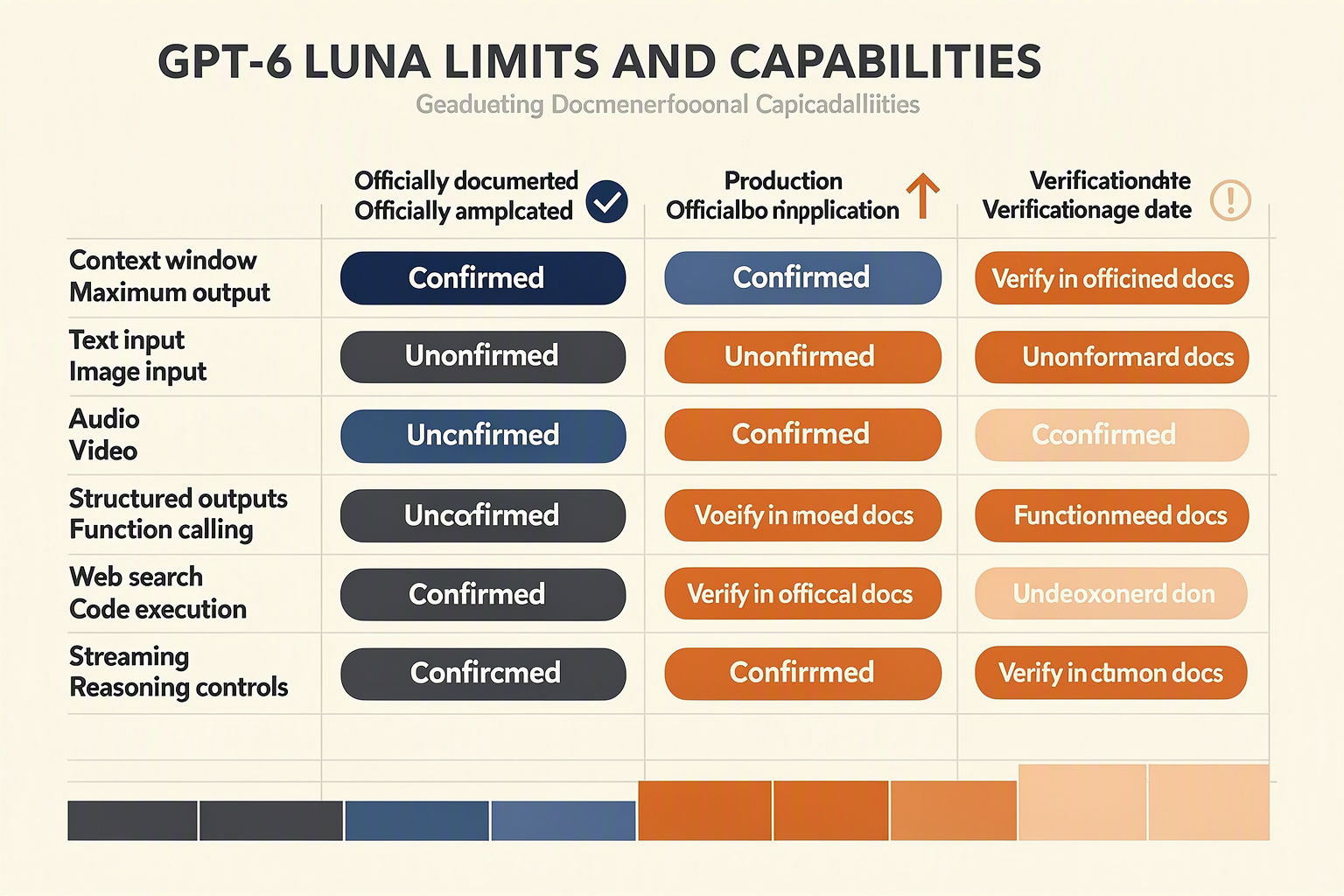
GPT-6 Luna supports API-based text responses and image understanding, but the cited OpenAI primary-source extracts do not supply its context-window size, maximum output, or detailed tool limits as of September 29, 2026. Buyers should treat those values as unknown in the available evidence, rather than assuming parity with GPT-6 Sol or GPT-6 Astra.
What are GPT-6 Luna’s documented limits?
| Capability or limit | Evidence status | Published limit | Production implication |
|---|---|---|---|
| Context window | Not supplied in cited extracts | Unknown | Test long prompts and retrieval workloads before fixing document-size limits. |
| Maximum output | Not supplied in cited extracts | Unknown | Detect truncation and plan continuation logic for reports, code and structured data. |
| Text input and response | Supported by documented API use; exact modality details require verification | Unknown | The OpenAI model page instructs developers to use gpt-6-luna in API requests, while this guide’s proposed text-response call illustrates that usage. |
| Image understanding | Confirmed by OpenAI’s API changelog | Formats, dimensions and image count unknown | Validate representative screenshots, scans and diagrams. |
| Audio and video | Not confirmed in cited extracts | Unknown | Do not assume native audio, speech or video support. |
| Tools and structured generation | Not confirmed in cited extracts | Unknown | Verify function calling, structured outputs and hosted tools separately. |
As of September 29, 2026, the cited GPT-6 Luna model-page extract describes gpt-6-luna as OpenAI’s “most efficient model for focused, high-volume tasks,” but it does not provide a context or output-token figure. This means the values are absent from the primary-source extracts used here—not necessarily unpublished across every OpenAI interface or account-specific API response.
A model’s context budget may need to accommodate system instructions, conversation history, retrieved documents, images, tool results and generated output. Developers should therefore inspect current API metadata and run boundary tests instead of copying limits from another GPT-6 model.
Does GPT-6 Luna support images, audio and video?
Image understanding is confirmed; native audio, speech and video capabilities are not established by the supplied sources. OpenAI’s September 2026 API changelog says it “fixed a bug in image encoding that degraded image understanding in GPT-6 Sol and GPT-6 Luna.”
That changelog conclusively establishes image input and understanding, but it does not specify:
- Supported image formats or file-size ceilings
- Maximum image dimensions or images per request
- How images count toward the context window
- Image generation or editing support
- Native audio input, speech output or video analysis
Teams evaluating invoice extraction, screenshot interpretation or visual quality assurance should test real files, especially small text, rotated scans and dense charts.
Which GPT-6 Luna tool limits require verification?
OpenAI’s September 22, 2026 announcement says GPT-6 Sol and GPT-6 Luna bring “much” of GPT-6 Astra’s strengths into faster, more affordable models. “Much” does not establish feature parity, so developers should verify each required behavior:
- Probe context and output boundaries using progressively larger requests.
- Test function calling with missing, invalid and parallel arguments.
- Validate structured outputs against nested JSON schemas and refusal cases.
- Check hosted tools individually, including web search, file retrieval and computer use.
- Measure image reliability after OpenAI’s documented encoding fix.
- Log the exact model identifier and API response metadata to trace changes.
The procurement-safe conclusion is straightforward: GPT-6 Luna’s API identity and image understanding are documented, while its numerical context, output and tool ceilings remain unresolved in the cited primary-source extracts.
How do developers call the GPT-6 Luna API reliably?
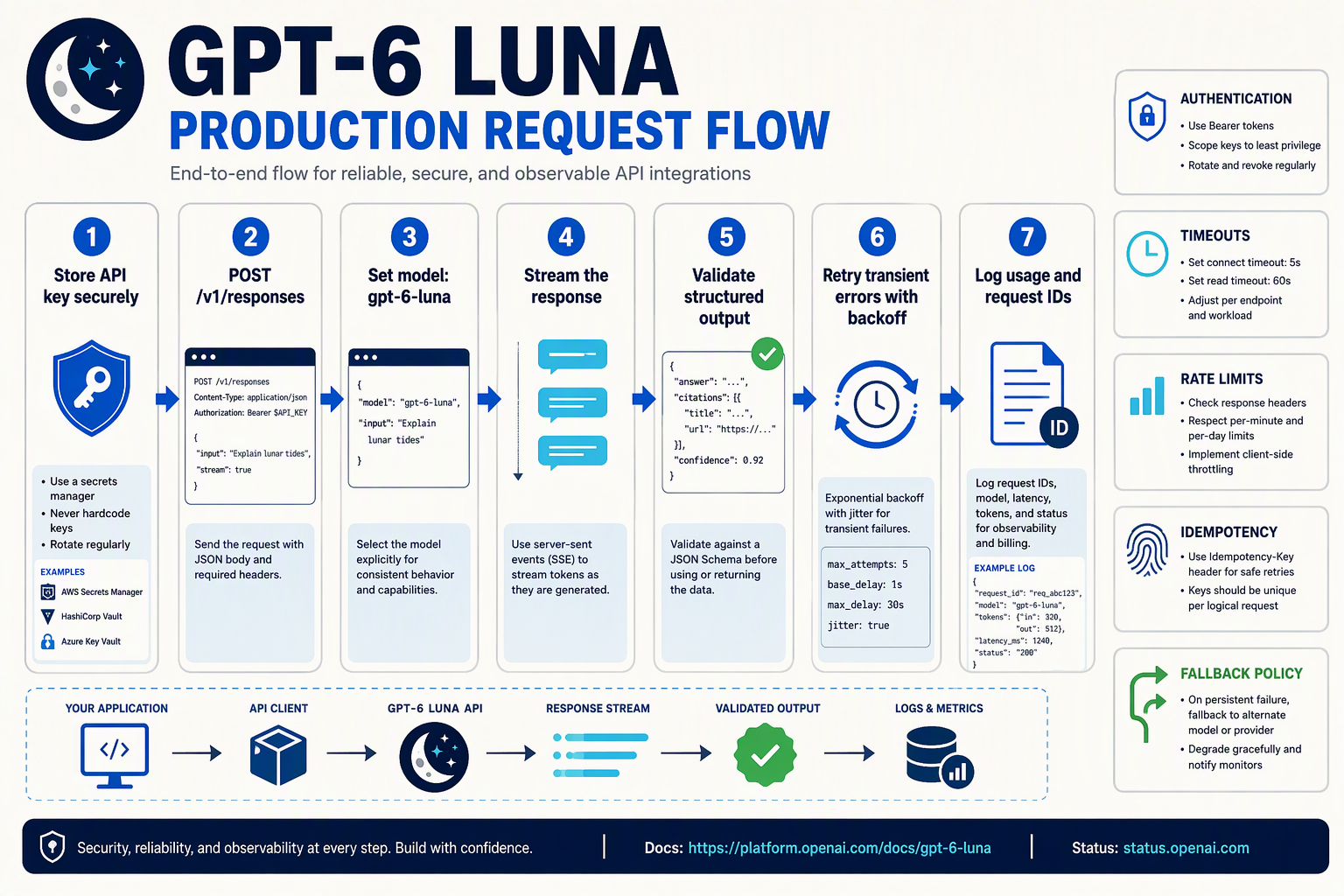
Developers should call GPT-6 Luna through a small, observable service layer—not directly from every application component. Use the documented model ID gpt-6-luna, set explicit timeouts, retry only transient failures, validate outputs, and maintain a tested fallback for availability or quality problems.
How do you make a basic GPT-6 Luna API request?
OpenAI’s GPT-6 Luna model page identifies gpt-6-luna as the API model name and describes it as the company’s “most efficient model for focused, high-volume tasks” as of September 2026. Using the current OpenAI Python SDK, a minimal Responses API request can be structured as follows:
from openai import OpenAI

client = OpenAI(
    timeout=30.0,
    max_retries=0  # Handle retries explicitly in your service layer
)

response = client.responses.create(
    model="gpt-6-luna",
    input=[
        {
            "role": "system",
            "content": "Return a concise, factual answer."
        },
        {
            "role": "user",
            "content": "Classify this ticket: My invoice contains a duplicate charge."
        }
    ],
    max_output_tokens=200
)

print(response.output_text)
Keep the API key in a secrets manager or environment variable rather than source code. Before deploying, run this request against the exact account, project and region intended for production; ChatGPT, Codex and API availability are separate access surfaces.
For example, an OpenAI Developer Community thread reported a Codex availability issue for GPT-6 Luna on September 22, 2026, but that does not establish whether the model was unavailable through the API. Test each required product surface independently.
Which failures should applications retry?
Retry temporary infrastructure failures, not every unsuccessful request. A practical policy is:
- Retry HTTP 429, selected 5xx responses and network timeouts.
- Use exponential backoff with random jitter, such as 1, 2, 4 and 8 seconds.
- Cap attempts and total elapsed time to protect user-facing latency.
- Do not automatically retry authentication errors, malformed requests or unsupported parameters.
- Apply concurrency limits so retries do not amplify an outage.
Record the model name, latency, token usage, HTTP status, application trace ID and provider request ID when available. Never log API keys, sensitive prompts or unrestricted model outputs.
How should teams protect production workflows?
A reliable GPT-6 Luna integration should include:
- Input validation: enforce length, encoding and allowed content types before submission.
- Output validation: check required fields, types and business rules before committing actions.
- Bounded generation: specify output limits to control latency and cost.
- Fallback handling: route eligible requests to a tested alternative model or a human queue.
- Evaluation gates: compare prompt or model changes against a fixed dataset before release.
- Versioned prompts: deploy prompts through review, canaries and rollback rather than editing production instructions in place.
- Operational budgets: enforce per-user and per-workflow usage limits.
Do not assume GPT-6 Luna supports a particular structured-output schema, tool configuration or multimodal input merely because another GPT-6 model does. Treat each capability as unconfirmed until OpenAI’s Luna-specific documentation or a successful account-level test verifies it.
How do you reduce model-change risk?
OpenAI’s API changelog confirms that GPT-6 Luna and GPT-6 Sol were released on September 22, 2026 and later records a fix for image encoding that had degraded image understanding in both models. That example shows why teams should monitor the changelog, rerun regression evaluations after provider updates, and avoid inventing snapshot identifiers that OpenAI has not documented.
For multi-model architectures, an OpenAI-compatible gateway can centralize fallbacks and observability. CallMissed’s developer API supports caller-chosen fallback models, response caching, and usage and request logs across 138 models as of September 2026, allowing teams to change providers without distributing routing logic throughout the application.
How capable is Luna at coding, reasoning and safe tool use?
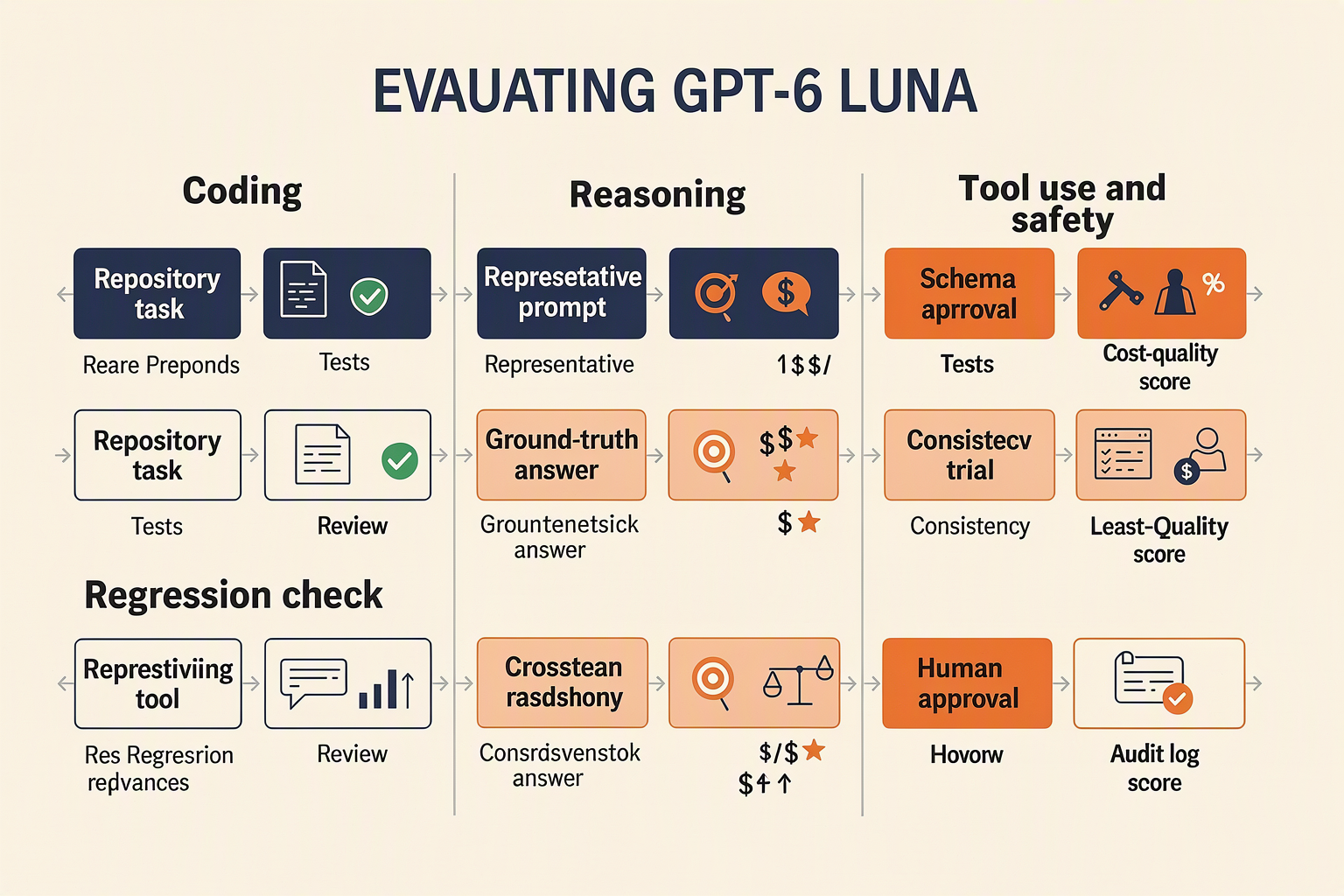
GPT-6 Luna appears capable of focused coding and reasoning tasks, but OpenAI has not published enough model-specific benchmark data to quantify its performance against GPT-6 Sol or GPT-6 Astra. As of September 2026, safe autonomous tool use should therefore be treated as an application-level engineering problem, not an assumed property of gpt-6-luna.
Is GPT-6 Luna good for coding?
OpenAI describes GPT-6 Luna as its “most efficient model for focused, high-volume tasks” on the official model page. OpenAI’s September 22, 2026 launch announcement also says GPT-6 Sol and GPT-6 Luna bring “much of” GPT-6 Astra’s strengths into faster, more affordable models for work at scale.
Those statements make Luna a plausible candidate for bounded software tasks such as:
- Code completion and boilerplate generation
- Unit-test creation
- Static-analysis explanations
- SQL, regex and configuration generation
- Documentation and code summarisation
- High-volume bug classification
- Small, well-scoped refactoring tasks
However, OpenAI has not provided Luna-specific pass rates for SWE-bench, HumanEval or another named coding benchmark in the available primary sources as of September 2026. “Much of” Astra’s capability does not establish parity with Astra on repository-scale debugging, cybersecurity analysis or long-horizon software engineering.
A community report posted on September 22, 2026 questioned whether Luna was immediately selectable in Codex, despite OpenAI’s developer-community announcement naming GPT-6 Luna for the API, Codex and ChatGPT. Treat that report as an availability anecdote, not proof of a model limitation; verify access in the exact product, account tier and region you intend to use.
How strong is GPT-6 Luna at reasoning?
Luna’s positioning suggests that it is optimised for focused, repeatable reasoning, rather than the family’s most demanding problems. Good candidate workloads include classification with policy rules, extraction with validation, document routing, structured decision support and constrained multi-step transformations.
No confirmed Luna-specific reasoning scores or comparisons are present in OpenAI’s cited launch materials. Buyers should run a private evaluation using representative inputs and measure:
- Task accuracy: correct final answers against a reviewed test set.
- Schema compliance: valid JSON or other required output structures.
- Consistency: variance across repeated runs and edge cases.
- Unsupported claims: fabricated citations, facts or calculations.
- Cost-adjusted quality: accepted outputs per dollar, not token price alone.
- Escalation rate: cases requiring a larger model or human review.
Can GPT-6 Luna use tools safely?
Tool support and tool safety are separate questions. The supplied official Luna materials do not confirm model-specific success rates for function selection, argument generation, prompt-injection resistance or long-running agent tasks, so those capabilities remain unquantified.
Production deployments should apply controls outside the model:
- Allowlist tools and validate every argument against strict schemas.
- Use read-only permissions by default and short-lived credentials.
- Require human approval for payments, deletion or external communication.
- Sandbox code execution and restrict network access.
- Add time, spending, recursion and retry limits.
- Log tool requests, responses and final actions for audit.
- Test prompt injection from documents, websites and tool output.
OpenAI’s API changelog states that it fixed an image-encoding bug that degraded image understanding in GPT-6 Sol and GPT-6 Luna. That September 2026 correction is a practical reminder to pin model versions where possible and rerun multimodal, coding and agent evaluations after platform changes.
How should teams migrate from GPT-5.6 Luna or another model?
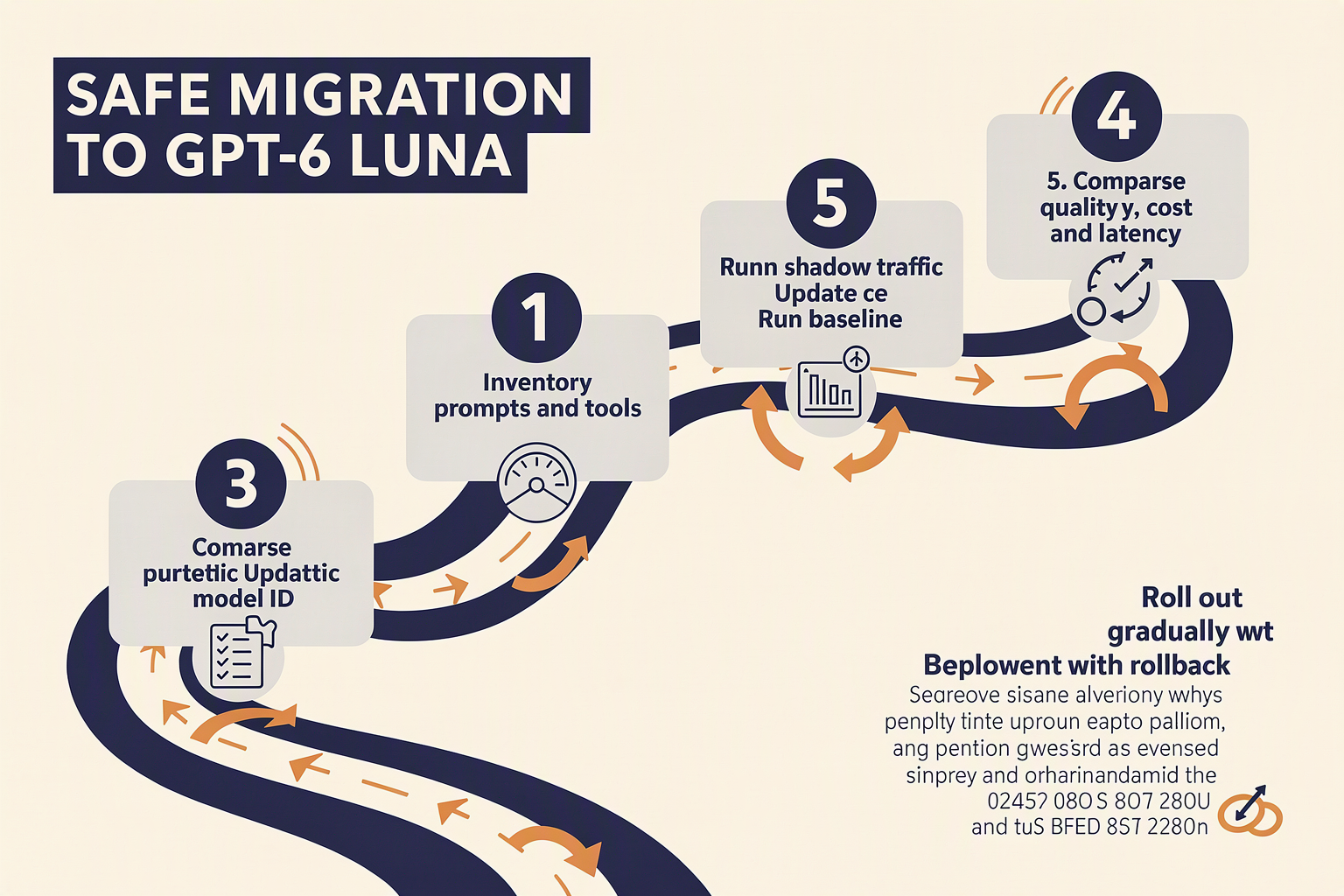
Teams should migrate from GPT-5.6 or another existing model to GPT-6 Luna through contract testing, shadow traffic and a reversible canary release—not a one-line model-ID swap. GPT-5.6 and GPT-6 Luna are documented OpenAI models, but the supplied primary sources do not establish a separate “GPT-5.6 Luna” model or identifier.
What should teams check before changing the model ID?
Inventory every dependency on GPT-5.6 or the current production model. OpenAI describes GPT-6 Luna as its “most efficient model for focused, high-volume tasks,” but that positioning does not guarantee identical reasoning, formatting, tool selection or token consumption.
Document the existing baseline for:
- Request contract: API endpoint, parameters, prompts and model identifier.
- Output contract: JSON fields, citations, classifications and refusal behavior.
- Tool contract: function names, argument schemas, permissions and retry rules.
- Operational profile: token usage, timeouts, rate-limit errors and latency percentiles.
- Quality profile: task accuracy, hallucinations, safety failures and human escalations.
As of September 2026, OpenAI’s documented GPT-6 Luna API identifier is gpt-6-luna. Treat any undocumented parameter, modality or version-pinned snapshot as unconfirmed, and retain the current production route until compatibility has been demonstrated.
How should developers test GPT-6 Luna?
Evaluate GPT-6 Luna and the existing model on the same representative requests. General benchmarks cannot reveal failures tied to a company’s schemas, tools, terminology or approval rules.
- Freeze an evaluation set. Include routine requests, long inputs, multilingual content, malformed data, adversarial prompts and rare but expensive edge cases.
- Run contract tests. Validate JSON schemas, enum values, required fields, tool arguments and deterministic business rules.
- Shadow production traffic. Send privacy-approved copies of real requests to GPT-6 Luna without showing its responses to users.
- Launch a small canary. Route a limited share of eligible traffic to
gpt-6-luna, with predefined automatic rollback thresholds. - Expand by workload. Move bounded tasks such as extraction and classification before autonomous workflows that can modify records, send messages or spend money.
OpenAI expanded the GPT-6 family with GPT-6 Sol and GPT-6 Luna on September 22, 2026. The OpenAI API changelog later recorded a fix for an image-encoding bug that degraded image understanding in both models, demonstrating why multimodal regression suites need known images and expected answers—not merely successful HTTP responses.
Which migration metrics matter most?
Measure business outcomes and cost per successful task, not token prices in isolation. According to the OpenAI API changelog, GPT-6 Luna cost $0.10 per million input tokens, $0.01 per million cached-input tokens and $0.50 per million output tokens as of September 2026.
Track:
- Task-success and schema-validity rates
- Input, cached-input and output tokens per completed task
- Tool-call precision, duplicate calls and invalid arguments
- P50, P95 and P99 end-to-end latency
- Refusal, hallucination and escalation rates
- Total cost per successful transaction
Set acceptance criteria before testing. A support summarizer, for example, might require 99% schema validity, no missing mandatory fields and no material increase in reviewer corrections.
How can teams preserve rollback and fallback options?
Keep model routing, prompts and schemas in configuration rather than hard-coding them. Log the selected model, prompt version, tool calls, token usage and evaluation result, and preserve the previous model through at least one complete business cycle.
For multi-model routing, CallMissed’s OpenAI-compatible developer API supports caller-chosen fallback models, structured outputs, function calling and request logs across 138 models as of September 2026. Whether teams use a gateway or connect directly to OpenAI, every fallback path should undergo the same contract, safety and tool-permission tests as the primary route.
Which applications and buyer profiles fit GPT-6 Luna best?
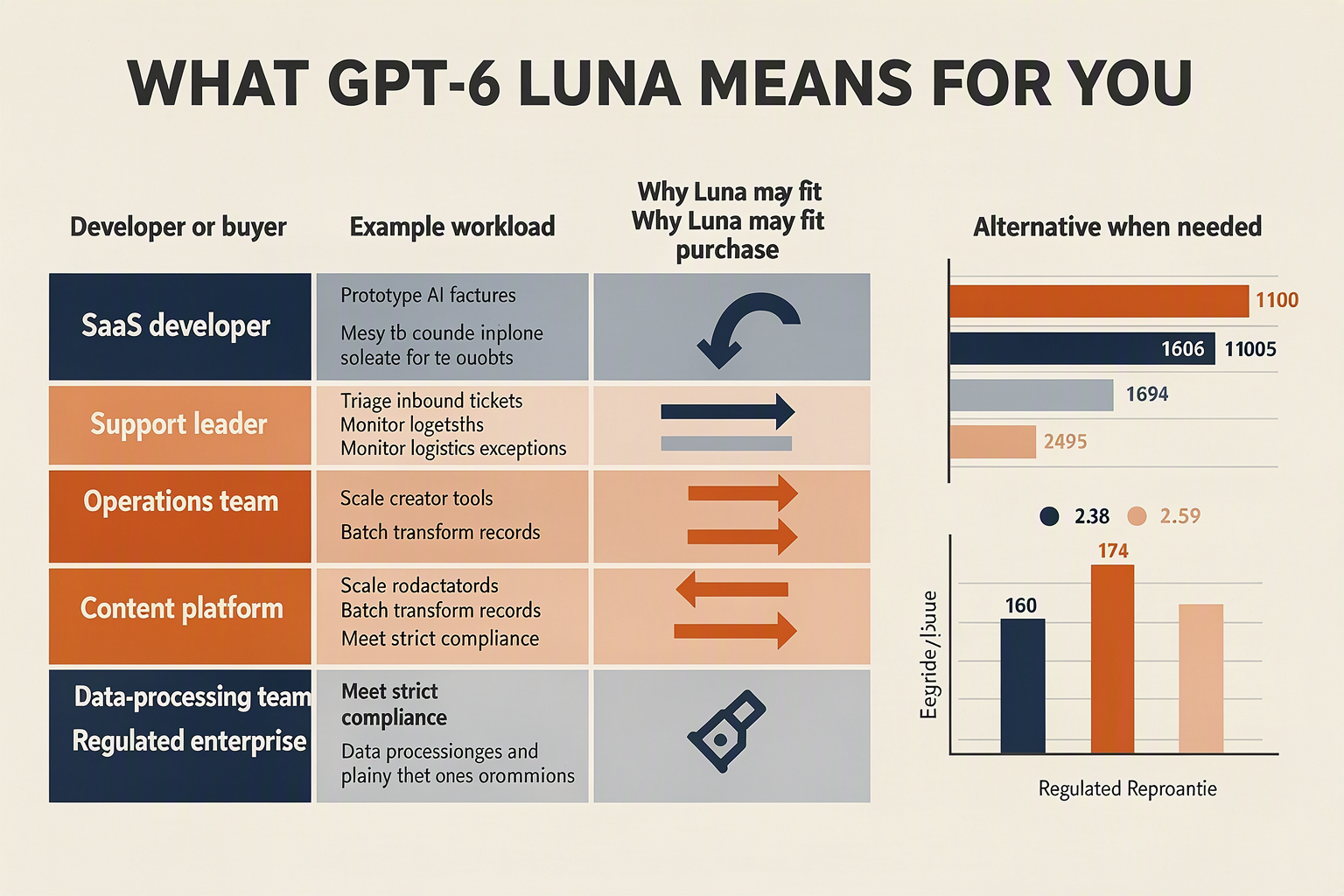
GPT-6 Luna best fits cost-sensitive, high-volume applications with focused objectives, measurable outputs and clear escalation paths. Buyers should prioritise cost per successful task, not token price alone, and benchmark Luna against GPT-6 Sol, GPT-6 Astra and relevant specialist models before deployment.
Which GPT-6 Luna use cases offer the clearest fit?
OpenAI describes gpt-6-luna as its “most efficient model for focused, high-volume tasks.” OpenAI’s September 2026 announcement says GPT-6 Sol and GPT-6 Luna bring “much” of GPT-6 Astra’s strengths into faster, more affordable models designed to support work at scale.
| Application | Best-fit buyer profile | Why Luna may fit | What to validate |
|---|---|---|---|
| Classification and routing | SaaS platforms, operations teams and shared-service centres | High request volumes, compact labels and objectively scored results | Domain accuracy, false-routing rate and multilingual quality |
| Structured data extraction | Insurers, retailers, logistics providers and finance teams | Input-heavy documents can produce small, schema-constrained outputs | Structured-output reliability, field recall and image support |
| Customer-support assistance | Contact centres and support-software vendors | Bounded tasks include intent detection, summarisation and reply drafting | Hallucinations, escalation logic and regional-language quality |
| Document processing | Legal operations, procurement and enterprise-search teams | Repeated document types support stable prompts and evaluation sets | Context limit, citation fidelity and long-document recall |
| Coding assistance | Developer-tool vendors and engineering teams | Candidate tasks include test generation, code explanation and bounded refactoring | Repository-level accuracy, tool access, security and Codex availability |
| Tool-using workflows | Automation platforms and internal AI teams | Lower token prices may reduce the cost of repeated planning and function-call loops | Function calling, loop control, rate limits and recovery behaviour |
These are candidate applications, not guaranteed capabilities. As of September 2026, teams should treat any context-window size, maximum output limit, tool integration or modality not explicitly listed on OpenAI’s GPT-6 Luna model page as unknown or unconfirmed.
Which buyers benefit most from GPT-6 Luna’s pricing?
GPT-6 Luna’s pricing is particularly relevant to input-heavy, output-light workloads. The OpenAI API changelog lists GPT-6 Luna at $0.10 per million input tokens, $0.01 per million cached input tokens and $0.50 per million output tokens as of September 2026.
For example, 10,000 requests averaging 8,000 uncached input tokens and 500 output tokens would consume 80 million input tokens and 5 million output tokens. The model-token charge would be $10.50—$8 for input and $2.50 for output—excluding retrieval, tools, storage and application infrastructure.
Strong buyer profiles include:
- Product-led SaaS companies processing many similar requests.
- Enterprises with stable workflows and labelled evaluation datasets.
- AI platforms using Luna as a default, with escalation for difficult cases.
- Teams that can exploit cached input pricing through repeated instructions.
- Procurement teams measuring cost per accepted result, including retries and human review.
For multi-model testing, CallMissed’s OpenAI-compatible developer API provides one API key and balance across 138 models as of September 2026, alongside caller-selected fallbacks, response caching, and usage and request logs.
When is GPT-6 Luna the wrong choice?
A higher-capability or specialist model may be preferable when tasks involve high-stakes autonomous decisions, deep multi-step reasoning, unusually complex coding or poorly bounded objectives. Human review remains important for legal, medical, financial and security-sensitive outputs.
Long responses also require workload-level cost analysis. Because Luna’s output tokens cost $0.50 per million versus $0.10 per million uncached input tokens, output-heavy generation increases Luna’s total bill more quickly; however, economic suitability can only be determined by comparing complete task costs, quality, retries, latency and review requirements across candidate models.
How can CallMissed support AI receptionist and missed-call workflows?
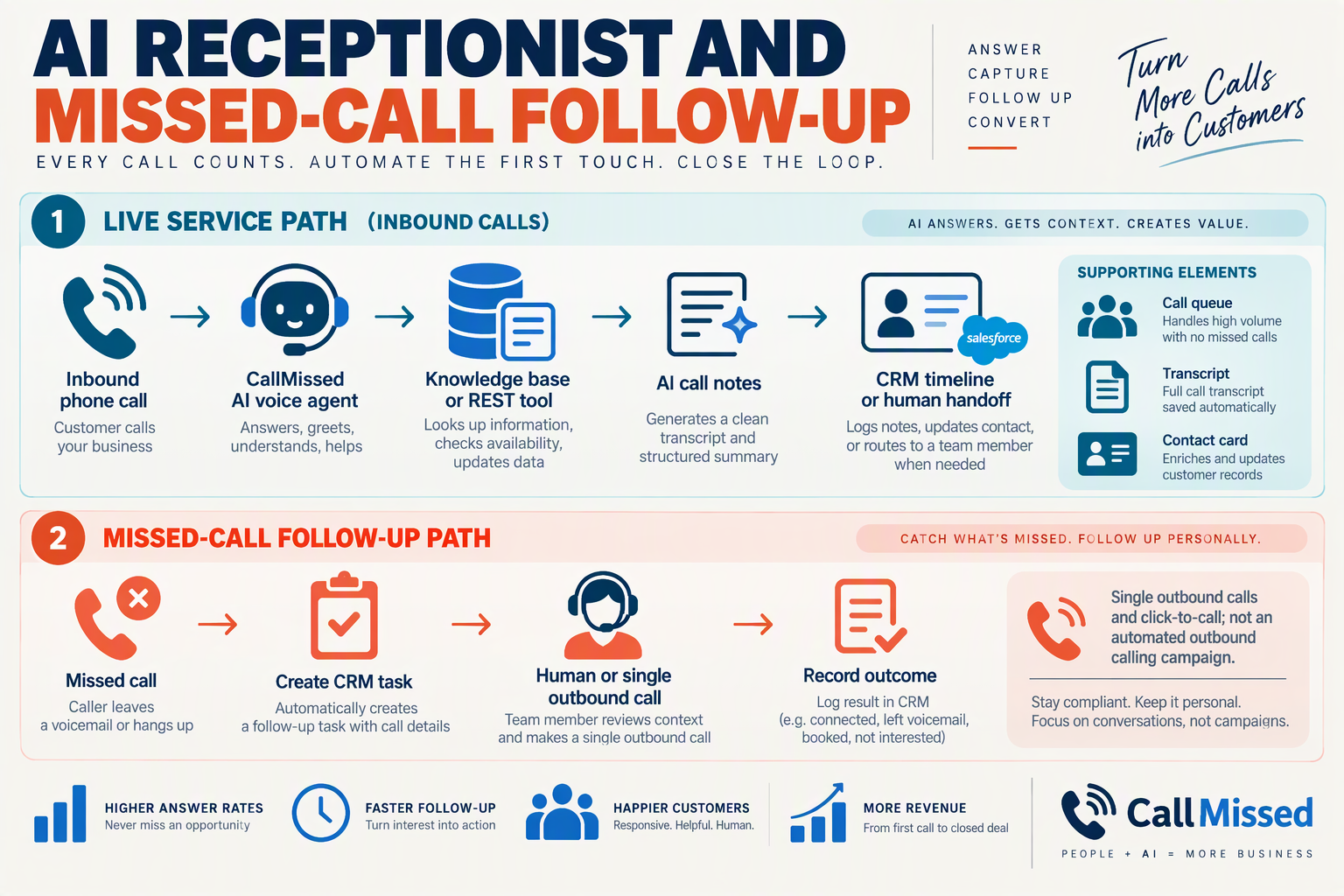
CallMissed can support AI receptionist and missed-call workflows by answering inbound phone or WhatsApp Business calls, retrieving approved information, taking actions, routing conversations and creating structured records for follow-up. GPT-6 Luna can complement this voice layer with focused transcript processing, although teams should verify model availability and real-time workflow compatibility before making it a production dependency.
How does an AI receptionist handle incoming calls?
CallMissed’s no-code builder lets teams configure an agent’s prompt, voice, language, knowledge base, tools, variables and call settings. The AI receptionist can answer inbound calls on a rented number or through an existing Twilio, Plivo or SIP trunk.
A typical workflow is:
- Identify intent, such as sales, support, order tracking or appointment booking.
- Retrieve grounded information from approved text, web pages or PDFs through retrieval-augmented generation.
- Take an action through a custom REST tool or integrations including Cal.com, Google Calendar, Shopify, WooCommerce and HubSpot.
- Route the conversation using call queues, DTMF keypad menus or squads that transfer a live call between agents.
- Create a follow-up record containing the recording, transcript, summary, action items, disposition and next steps.
Supervisors can listen, whisper or barge in during a live call. That human oversight is particularly useful for regulated, high-value or unfamiliar conversations.
Where does GPT-6 Luna fit into the workflow?
GPT-6 Luna is suited to bounded, high-volume processing around a call, rather than being assumed to provide the complete speech-recognition, reasoning and voice-synthesis stack. OpenAI’s September 2026 API documentation describes gpt-6-luna as its “most efficient model for focused, high-volume tasks.”
Relevant applications include:
- Classifying transcripts by intent, urgency or department
- Extracting names, dates, order numbers and callback preferences
- Producing structured summaries and follow-up tasks
- Drafting short agent-assist responses
- Scoring conversations against a defined QA rubric
- Converting caller requests into validated JSON
Developers could invoke GPT-6 Luna through OpenAI from an external service and expose that service to a CallMissed agent as a custom REST tool. CallMissed also provides OpenAI-compatible endpoints, structured outputs, function calling, stored prompts, request logs and caller-selected fallback models, but buyers should confirm whether gpt-6-luna is in CallMissed’s current model catalogue before designing around that route.
What happens when a customer’s call is missed?
A responsible missed-call workflow should create a traceable follow-up path without implying unrestricted outbound automation. CallMissed supports voicemail drops, call queues, click-to-call and individual outbound calls; its verified feature set does not include automated outbound calling campaigns.
Teams can prioritize follow-up through transcripts, AI call notes, CRM tasks and metric alerts. Through the official Meta Cloud API, customers can also initiate WhatsApp Business calls that an AI voice agent answers; Meta does not charge businesses for customer-initiated calls.
What does an AI receptionist cost?
As of September 2026, CallMissed lists flat voice-agent rates of ₹4 per minute for Standard, ₹5 for Expressive and ₹6 for Best Latency. These rates cover speech recognition, the language model and voice.
The 30-second minimum applies to these flat-rate voice-agent plans. Teams building a custom stack instead pay for each component by the second with no minimum; in both cases, phone carriage is billed separately, and a call that never connects costs nothing.
CallMissed recognizes speech in 22 Indian languages plus English, including Hinglish, and offers natural text-to-speech voices in 10 Indian languages plus English as of September 2026.
Frequently Asked Questions
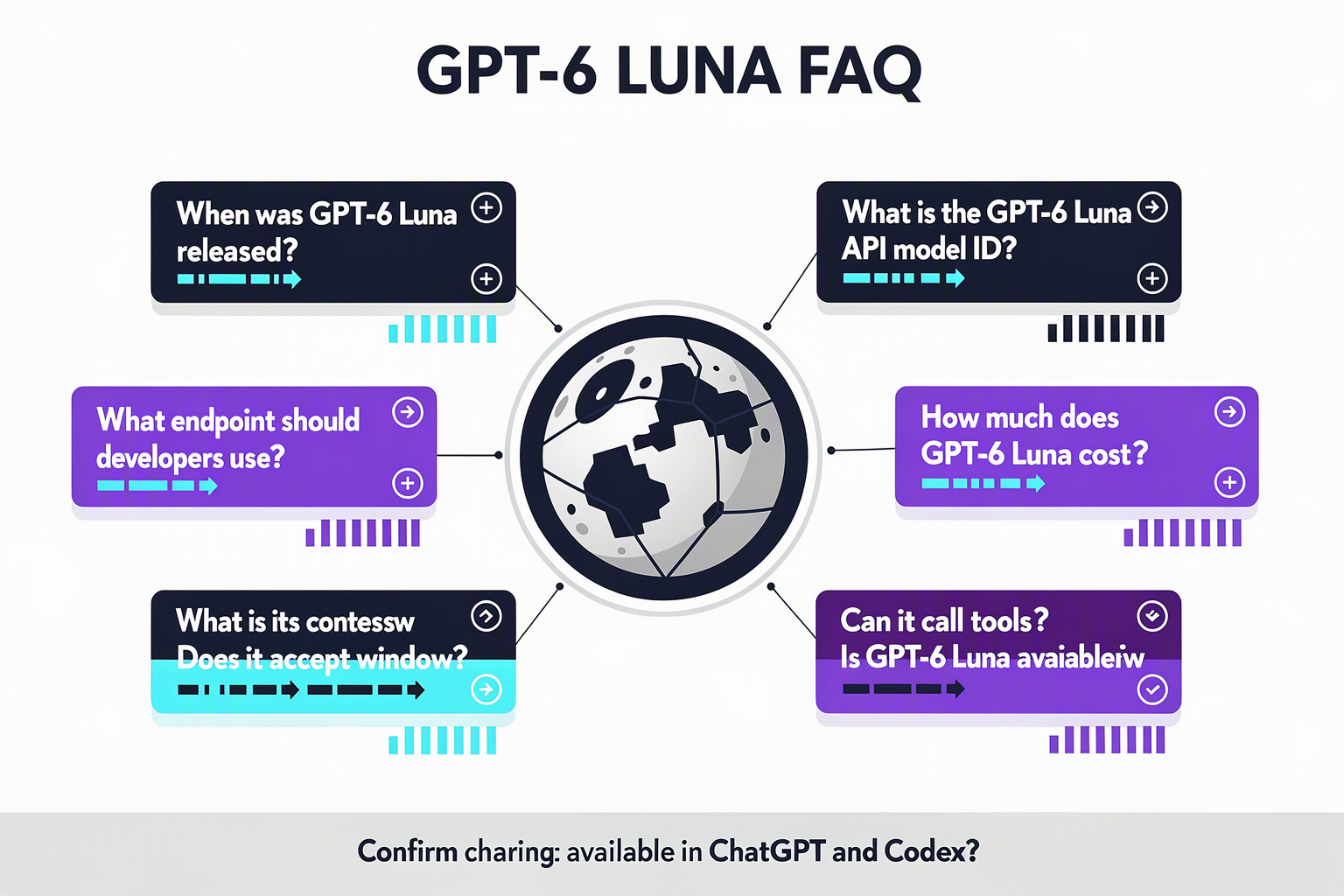
Launch, access and pricing
What is GPT-6 Luna, and when did OpenAI release it?
How much does the GPT-6 Luna API cost?
How can developers access GPT-6 Luna in the API, ChatGPT and Codex?
gpt-6-luna, the model identifier listed by OpenAI, through supported OpenAI API endpoints. OpenAI’s September 22, 2026 announcement names the API, ChatGPT and Codex, but availability may still vary by account, plan, region or rollout stage, so teams should check their live model list and product interface.Capabilities and limits
What are the GPT-6 Luna context window and maximum output limits?
Does GPT-6 Luna support images, audio, video, function calling and structured outputs?
Is GPT-6 Luna suitable for coding, reasoning and production AI agents?
Deployment and migration
What should businesses check before migrating to GPT-6 Luna?
Conclusion
GPT-6 Luna is a compelling option for focused, high-volume workloads, but its low token price should begin—not end—the production evaluation. OpenAI launched gpt-6-luna on September 22, 2026, describing it as its “most efficient model for focused, high-volume tasks,” yet deployment decisions still depend on documented limits, workload-specific testing and operational controls.
- The economics favor input-heavy applications. As of September 2026, the OpenAI API changelog prices GPT-6 Luna at $0.10 per million input tokens, $0.01 per million cached input tokens and $0.50 per million output tokens. Processing 100 million uncached input tokens while generating 10 million output tokens would therefore cost $15 in model-token charges, excluding tools, storage, search and infrastructure.
- Efficiency does not automatically establish suitability. Classification, extraction, customer support, document processing, code assistance and bounded agent workflows are logical candidates, but teams should test output quality, reasoning consistency, tool execution and structured-output reliability using representative production data.
- Confirmed documentation matters more than inherited assumptions. Features available in GPT-6 Astra or GPT-6 Sol should not be presumed available in GPT-6 Luna. Treat unpublished context length, maximum output, multimodal behavior, regional access or account-specific rate limits as unknown or unconfirmed until OpenAI documents them.
- Migration should remain reversible. Use the official
gpt-6-lunaidentifier, validate safety and data-handling requirements, monitor token consumption, and maintain fallbacks for requests that exceed Luna’s practical capability or access limits. Version pinning, regression evaluations and staged rollouts can reduce the risk of unexpected behavior.
The next signals to watch are OpenAI’s updates on context and output limits, supported modalities, tool compatibility, rate-limit tiers, model-version stability and benchmark evidence. These details will determine whether Luna becomes primarily a low-cost task model or a broader foundation for production agents.
Teams exploring multi-model resilience can also evaluate CallMissed, an OpenAI-compatible developer AI API offering one key and balance across 138 models, caller-chosen fallbacks and request logs as of September 2026. Will your architecture merely take advantage of Luna’s launch price—or remain adaptable as its limits, capabilities and alternatives evolve?
Related Reading
- GPT-6 Sol API Guide: Pricing, Context Window and Setup
- GPT-6 Luna vs Claude Opus 5.5: 2026 API Comparison
- GPT-5.6 Luna vs GPT-6 Luna: API Pricing & Model IDs
Sources
Discussion
Related Posts


Ready to automate customer conversations?
Launch AI voice agents and WhatsApp bots with CallMissed — one API, 22+ Indian languages.