
Gemini 4 Argon Release Status: Access and Launch Facts



Understand Gemini 4 Argon access, announcement versus public release, and which capabilities, pricing and safety claims still need verification.
Gemini 4 Argon Release Status: Access and Launch Facts
What if Google’s newest frontier-model announcement matters most for who cannot access it yet? The Gemini 4 Argon launch points to a restricted initial rollout, not confirmed public availability: the supplied Google Blog excerpt says Google is announcing the model and rolling it out to “a set of trusted cyber defenders through our Fairwind Program.”
As of September 30, 2026, that distinction is the central story: an official announcement and restricted rollout are not unrestricted public API availability. Google’s announcement excerpt positions Gemini 4 Argon around real-world coding, enterprise knowledge work and cyber defense, while describing a model built to sustain “deep reasoning across complex, long-horizon workflows.” Those are Google’s descriptions—not independently established performance results—and the supplied excerpts do not confirm the announcement’s publication date.
Who can access Gemini 4 Argon at launch?
The clearest access statement in the supplied Google Blog material concerns trusted cyber defenders participating through the Fairwind Program. That does not establish general availability in the Gemini app, Google AI Studio, the Gemini API or Vertex AI. An announcement, a restricted testing program, a developer preview and general availability (GA) are different milestones; treating them as interchangeable could mislead teams planning deployments.
This matters immediately for developers and enterprise buyers. A model aimed at longer, more complex workflows could change how organizations evaluate coding assistance and knowledge-work automation, but practical adoption depends on documented access, supported interfaces, usage conditions and safety controls—not launch language alone.
As of September 2026, CallMissed offers OpenAI-compatible developer endpoints, illustrating the broader move toward reusable AI integrations, but this draft does not establish Gemini 4 Argon availability through CallMissed.
Which launch claims still need verification?
This introduction separates what Google’s supplied announcement excerpts say from what still requires checking against the complete announcement and official Google developer documentation:
- Capabilities: Google identifies coding, enterprise knowledge work and cyber defense; benchmark scores, context limits and supported modalities remain unverified here.
- Access: The Fairwind Program is named; eligibility, geographic restrictions and wider rollout timing require confirmation.
- Pricing: Reported introductory rates should not be treated as confirmed until billing modes, discount conditions and expiry terms are checked.
- Safety: Cyber-defense positioning does not itself establish safeguards, evaluation results or permitted-use boundaries.
The review will explain what Google announced, who can actually try Gemini 4 Argon and which claims remain provisional. Gemini 4 is useful search shorthand, but Gemini 4 Argon is the name in the supplied announcement; no Pro or Flash variants are established by this material.
What did Google announce, and is Gemini 4 Argon publicly available?
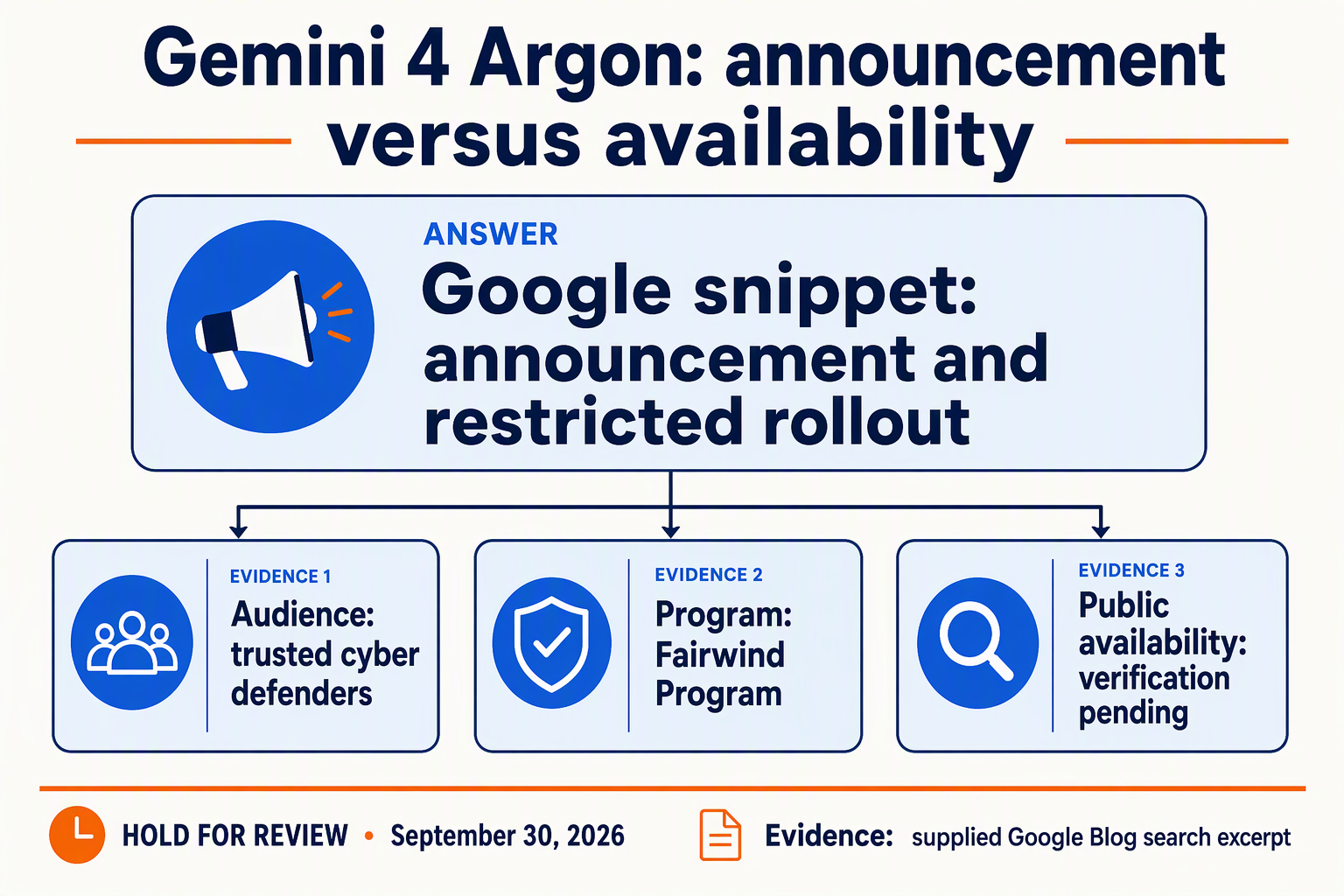
Google announced Gemini 4 Argon on September 30, 2026, with a limited initial rollout to trusted cyber defenders through its Fairwind Program. That announcement does not establish unrestricted public access through an API, Google AI Studio or the Gemini app, or confirm general availability.
Who can access Gemini 4 Argon now?
The announced initial access is for selected, trusted cyber defenders participating in Fairwind. It should not be read as an open developer preview or a service that anyone can immediately enable.
For eligibility and rollout conditions, consult [Google’s official launch announcement](GOOGLE_LAUNCH_URL) and the [official Fairwind Program page](GOOGLE_FAIRWIND_URL). Plans to expand access later describe future availability—not access available today.
Is there a public model ID or confirmed access expiry?
An exact, publicly callable model identifier and an access-expiry date are not confirmed by the supplied announcement details. The model’s announcement name alone is not enough to construct an API request.
Before planning a deployment, check official Google documentation for:
- Eligibility: who can participate and whether applications are open.
- Access surface: which API, interface or environment participants can use.
- Model identifier: the exact supported ID, rather than an inferred name.
- Terms and limits: permitted uses, regional restrictions, quotas and any access-expiry conditions.
Does announced pricing mean public access is available?
No. Announced pricing and access eligibility are separate questions.
The announced introductory rates are $2 per million input tokens and $10 per million output tokens. A 95% cache discount brings eligible cached input to $0.10 per million tokens during the introductory period. Announced post-introductory rates are $4 input and $20 output per million tokens. Those figures do not, by themselves, establish that an unrestricted public endpoint is available or confirm when introductory access expires.
For capability announcements, see our [launch-news article](LAUNCH_NEWS_SIBLING_URL). For cost calculations and caching assumptions, see the [pricing guide](PRICING_GUIDE_URL).
Bottom line: Argon has been announced with restricted initial access through Fairwind. Unrestricted public API, AI Studio or Gemini-app availability remains unverified.
Which capabilities does Google claim, and what evidence supports them?
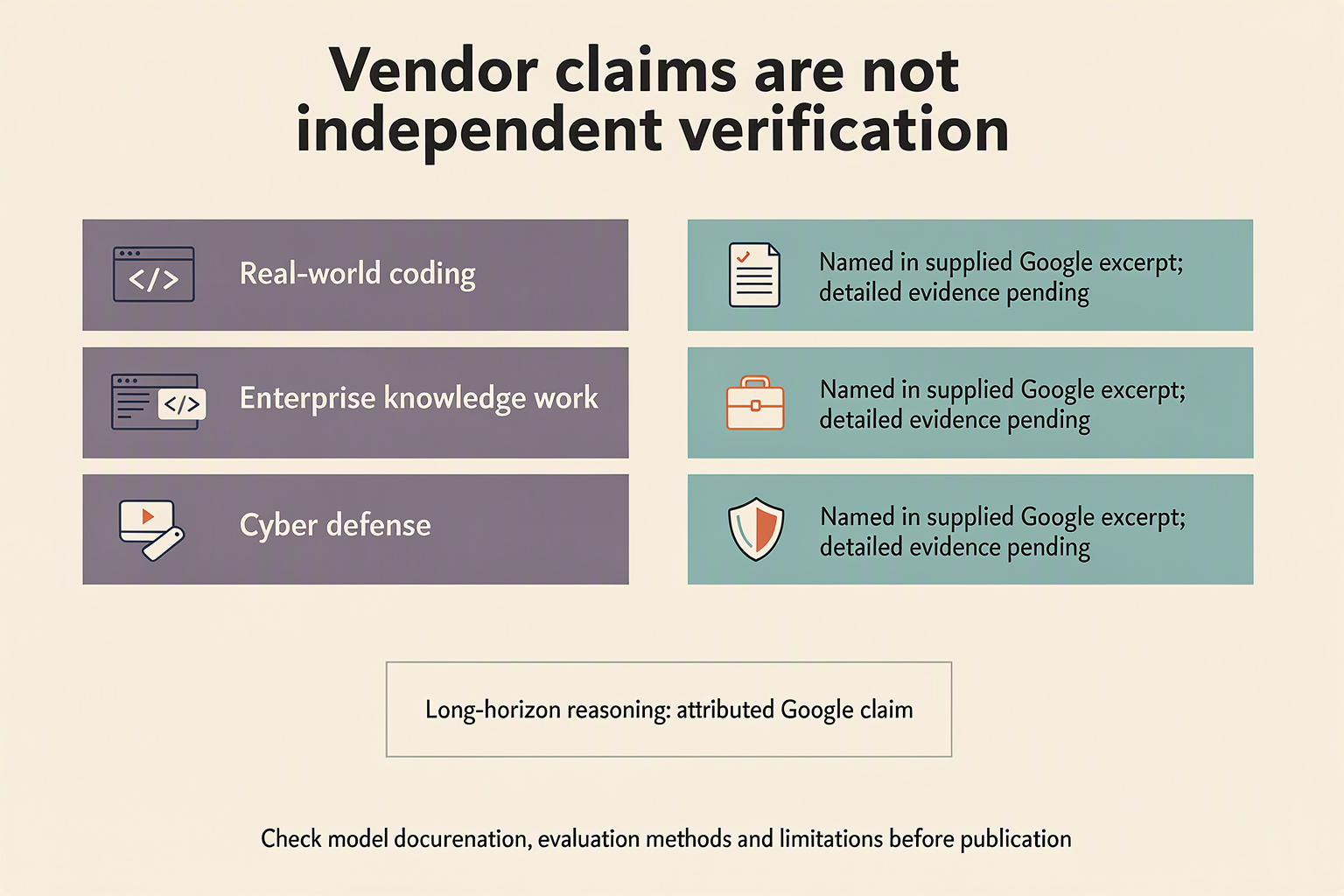
Google claims Gemini 4 Argon supports real-world coding, enterprise knowledge work and cyber defense, with sustained reasoning across complex workflows. For this September 30, 2026 review draft, the supplied Google Blog excerpts establish those claims, but do not provide benchmark results, reproducible tests or independent evidence of performance.
What does Google mean by long-horizon reasoning?
Google Blog describes Gemini 4 Argon as “built to sustain deep reasoning across complex, long-horizon workflows.” That is a capability claim about extended work—not a documented context-window size, execution-time limit or guarantee of autonomous task completion.
A useful evaluation would test whether the model preserves requirements, tracks intermediate decisions and recovers from mistakes across multiple steps. For example, a coding task might require investigating a bug, modifying several files and validating the change without breaking existing behavior. That is an illustrative test, not a verified Gemini 4 Argon demonstration.
Google Blog also says Argon is “fundamentally changing the way we work and build at Google.” This describes Google’s own experience, but the supplied excerpt does not identify deployments, productivity measurements or evaluation methods supporting that statement.
Which coding and enterprise capabilities are actually documented?
The supplied Google Blog material names application areas rather than detailed product specifications. As of this September 30, 2026 draft, the evidence supports the following distinctions:
- Real-world coding: Google identifies coding as a target use case. The excerpts do not establish repository-editing tools, supported programming languages, test-execution access or measured software-engineering performance.
- Enterprise knowledge work: Google names this category, but the excerpts do not confirm document connectors, retrieval behavior, citation accuracy, supported file types or enterprise data-handling terms.
- Cyber defense: Google explicitly positions Argon for defensive work. The excerpts do not quantify vulnerability-detection accuracy, false-positive rates or successful remediation.
These omissions matter because model capability and deployed-system capability are different. A model might generate a plausible patch, while a working engineering system also needs repository permissions, a test environment and review controls. Likewise, producing a convincing document summary does not establish that every statement is grounded in the source material.
Does restricted cyber-defense testing prove effectiveness or safety?
No. Google Blog’s statement that Gemini 4 Argon is rolling out to trusted cyber defenders through the Fairwind Program identifies an intended testing population; it does not itself demonstrate defensive effectiveness or safety.
Cyber-defense evaluation should distinguish useful findings from plausible but incorrect alerts. Reviewers also need evidence about misuse resistance, permitted activities and oversight requirements before interpreting a restricted rollout as assurance that the model is safe for broader deployment.
The supplied excerpts contain no such evaluation results. Neither strong defensive positioning nor restricted access should be substituted for a published safety assessment.
What evidence should reviewers request before accepting performance claims?
For manual review, assess each claim against three evidence levels:
- Vendor statement: Record Google’s exact wording and the announcement’s confirmed publication date.
- Documented evaluation: Request task definitions, model configuration, tool access, scoring methods and failure examples—not just a headline score.
- Reproducible validation: Look for independently repeatable tests or clearly described customer evaluations with comparable conditions.
The two supplied Argon search results point to the same Google Blog announcement, so they are not independent corroboration. Until fuller evidence is available, the defensible conclusion is that Google has announced ambitious workflow capabilities—not that Gemini 4 Argon’s performance advantage has been established.
Which launch facts and official sources are verified as of September 30, 2026?
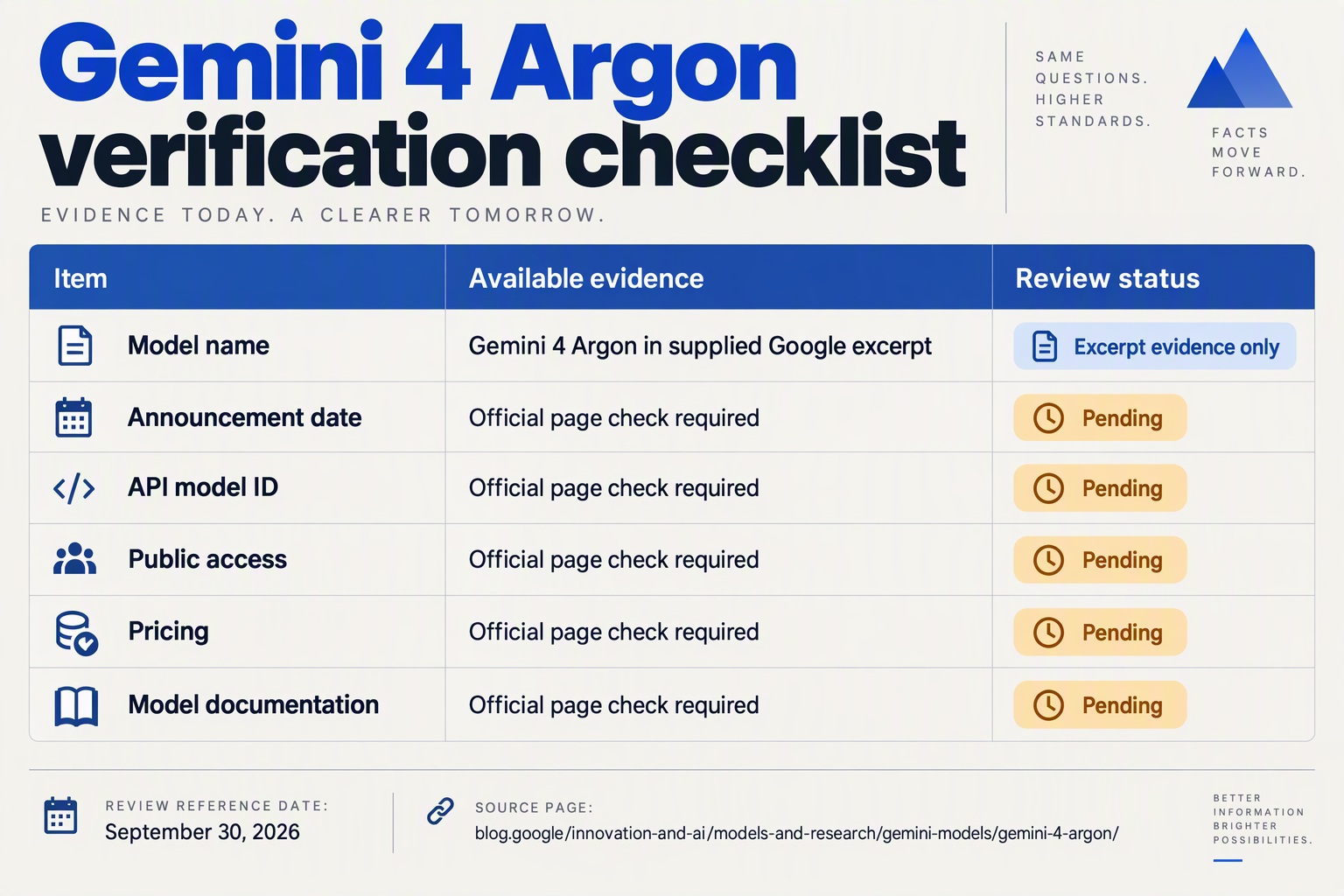
As of September 30, 2026, the supplied Google Blog excerpts support the Gemini 4 Argon name, Google’s stated use cases and a restricted rollout through the Fairwind Program. They do not independently verify the publication date, technical specifications, pricing terms or general availability; this remains a manual-review draft, not a completed launch verification.
Which Gemini 4 Argon claims have official-source support?
The table separates statements attributable to Google from facts that still need confirmation. “Supported by excerpt” means the supplied text contains the claim—not that the full page or developer documentation has been independently checked. All evidence statuses below are assessed as of September 30, 2026.
| Claim | Supplied official-source evidence | Verification status | Required editorial check |
|---|---|---|---|
| Model name | Google Blog names “Gemini 4 Argon” | Supported by excerpt | Confirm against the complete announcement |
| September 30 launch date | Google Blog excerpt says “Today,” without visible publication metadata | Date unverified | Check publication date, timezone and updates |
| Initial access | Google Blog names “a set of trusted cyber defenders through our Fairwind Program” | Restricted rollout supported | Confirm eligibility and whether access has begun |
| Intended capabilities | Google Blog identifies coding, enterprise knowledge work, cyber defense and long-horizon reasoning | Vendor positioning supported | Check evaluations and documented limitations |
| Developer or public availability | No supplied Gemini API, Google AI Studio, Vertex AI or Gemini app documentation establishes access | Not established | Locate product-specific availability documentation |
| Pricing and safety terms | Supplied official excerpts contain no billing conditions or safety evaluation details | Not established | Verify pricing documentation and published safety materials |
Which supplied search results count as corroboration?
The two supplied Google Blog results titled “Gemini 4 Argon: our next era of frontier intelligence” point to the same article, with one using query parameters. They are duplicate representations of one source, not two independent confirmations.
The other supplied results include Google product-category pages and localized Google I/O 2026 keynote pages. Their excerpts do not establish Argon-specific specifications, access conditions or a September 30 release date. Official publisher identity matters, but relevance to the exact claim matters too.
Google Blog describes Gemini 4 Argon as built to sustain “deep reasoning across complex, long-horizon workflows” in the excerpt supplied for this September 30, 2026 review. That quotation supports an attributed description; it does not establish a measured improvement over another model.
What must editors verify before publishing launch details?
Use a claim-by-claim verification sequence rather than treating the announcement as proof of every downstream product detail:
- Date and release stage: Confirm announcement metadata, then distinguish announced access from active testing, preview availability and GA.
- Technical access: Check official Google developer documentation for the exact model identifier, supported interfaces, regions and account restrictions.
- Specifications and evaluations: Source context limits, modalities, tool support and benchmark results directly, preserving evaluation conditions.
- Commercial and safety terms: Confirm billing modes, introductory-price expiry, caching eligibility, permitted uses and any published safeguards.
The operator brief flags introductory pricing for follow-up, but the supplied official excerpts do not substantiate those rates or their conditions. Hold price figures out of publish-ready copy until verified. Likewise, absent safety documentation means safety remains unresolved in this evidence set—not that safeguards do or do not exist.
Who can access Gemini 4 Argon, and which distribution phases are confirmed?
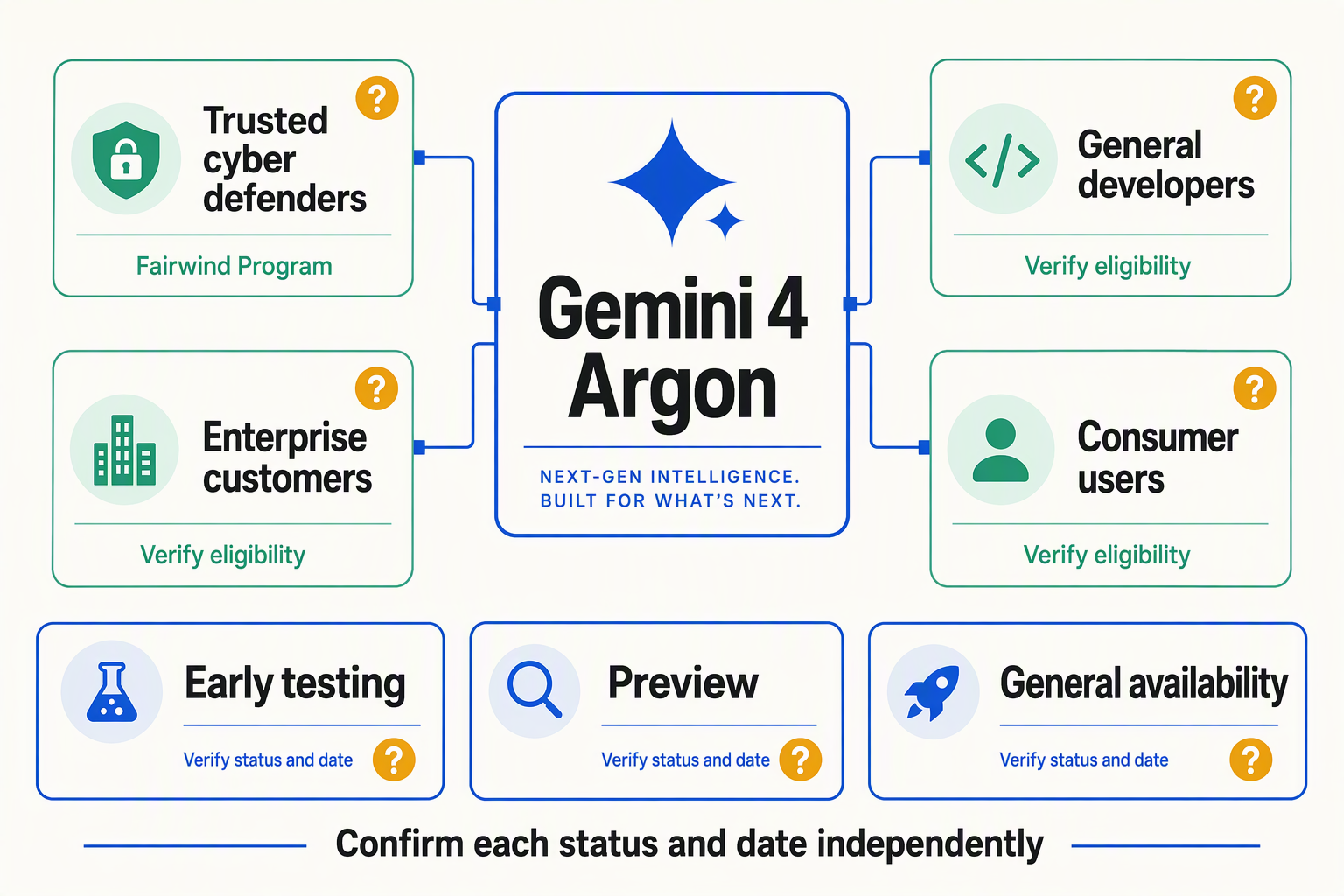
The supplied Google Blog excerpt identifies trusted cyber defenders in the Fairwind Program as Gemini 4 Argon’s initial access group; it does not establish public availability or a confirmed sequence of later distribution phases. For this September 30, 2026 review draft, that is the supported access position—not proof that every named participant already has working access.
Who qualifies for Gemini 4 Argon’s initial rollout?
Google Blog describes Gemini 4 Argon as “rolling out to a set of trusted cyber defenders through our Fairwind Program,” according to the excerpt reviewed for this September 2026 draft. The wording identifies a selected audience and a named distribution program, but leaves the selection process unspecified.
The supplied material does not explain whether organizations can apply, whether participation is invitation-only, or which countries and organization types qualify. “Trusted cyber defenders” should therefore be treated as Google’s description of the recipients, not a published eligibility checklist.
Before a security team plans a trial, the manual review should establish:
- Enrollment: Is there an official application process or a designated Google contact?
- Eligibility: Which organizations, researchers and jurisdictions can participate?
- Access mechanism: Is the model delivered through a managed environment, API or another interface?
- Usage boundaries: What activities, data handling and human oversight does the program permit or require?
These are verification questions, not confirmed Fairwind Program conditions.
Which Gemini 4 Argon distribution phases are confirmed?
Only the program-specific rollout is described in the supplied announcement excerpt. The following distinctions explain how to classify further evidence; they are not an announced Google roadmap:
- Announcement: Google publicly introduces Gemini 4 Argon. The excerpt supports an announcement, but its “Today” wording does not independently verify a September 30, 2026 publication date.
- Restricted rollout or early testing: Selected recipients receive access. Google’s Fairwind Program wording supports a restricted rollout, without establishing its operational details or labeling it “early testing.”
- Developer preview: Developers receive documented access under preview terms. No supplied Google developer documentation confirms this phase.
- General availability: A defined customer audience can obtain the model under published availability terms. The supplied evidence does not establish GA.
The search-result description also says “rolling out soon.” Read alongside “is rolling out,” those snippets do not settle when access begins or whether distribution is complete. The full announcement needs checking before assigning a precise rollout date.
Can developers access Gemini 4 Argon through Google’s public products?
Access through the Gemini app, Google AI Studio, the Gemini API or Vertex AI remains unconfirmed in the supplied evidence as of September 30, 2026. That means “not established here,” rather than a definitive claim that these channels lack access.
For implementation planning, developers should look for an exact Gemini 4 Argon model identifier, an official endpoint, supported regions, account requirements and applicable quotas. A marketing announcement alone cannot supply those deployment details.
For example, a team evaluating a coding workflow can prepare its test cases now, but should not schedule production integration around an assumed API release. The practical next milestone is documented access—not another announcement headline.
What pricing is confirmed, and which introductory terms need checking?
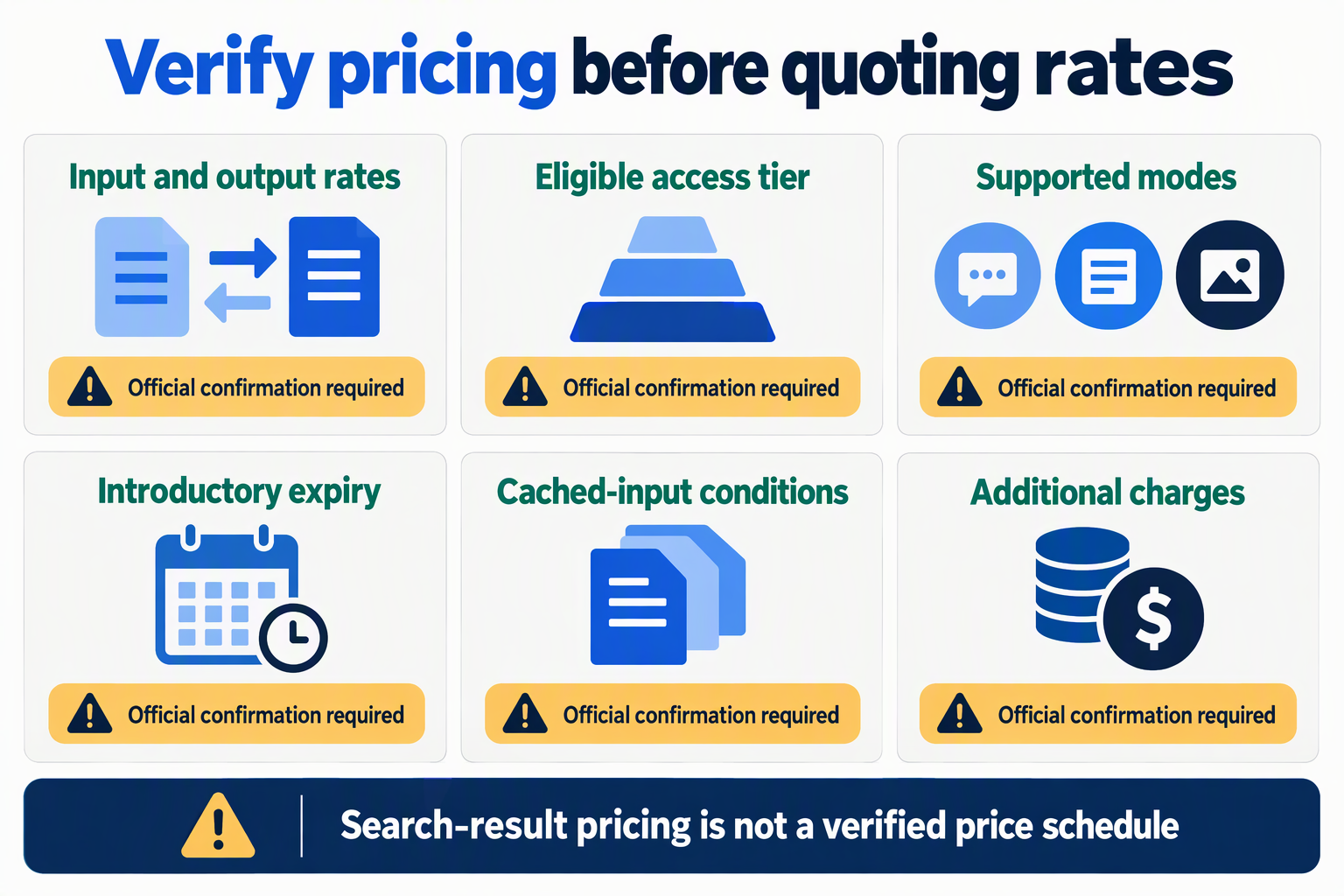
No Gemini 4 Argon pricing is confirmed by the supplied Google Blog excerpts as of September 30, 2026. Reported introductory token rates and a cached-input discount remain provisional until official Google pricing documentation establishes eligibility, billing modes and expiry terms.
Has Google confirmed Gemini 4 Argon API pricing?
The supplied Google Blog announcement describes Gemini 4 Argon as “rolling out to a set of trusted cyber defenders through our Fairwind Program,” but the available excerpts contain no pricing schedule. Restricted program access does not establish a publicly purchasable API, a free trial or standard commercial terms.
For this review draft, the reported introductory figures should therefore not be published as verified prices. The missing evidence is a model-specific official pricing page or program document identifying Gemini 4 Argon, its billing unit and the access route to which those charges apply.
A price associated with one Google service should not automatically be presented as applying across Google AI Studio, the Gemini API and Vertex AI. Each route needs its own availability and billing confirmation.
Which introductory pricing conditions need checking?
Before approving a launch-price paragraph, reviewers should establish:
- Eligibility: Does the offer apply to Fairwind participants, approved preview users or generally available accounts?
- Billing units: Are input and output charged per million tokens, and how are any reasoning tokens accounted for?
- Supported modes: Do the rates cover standard requests, asynchronous processing or other documented execution modes?
- Context thresholds: Does pricing change above a specified input length?
- Offer duration: Is there an explicit expiry date, usage allowance or transition to standard pricing?
- Currency and region: Are quoted amounts in US dollars, and are taxes or regional conditions separate?
These are verification questions, not confirmed Gemini 4 Argon features. An introductory offer without its conditions is not a dependable procurement estimate.
Does a cached-input discount describe the total saving?
No. A discount on eligible cached input would not automatically reduce output charges or every input token in a request. Reviewers must first verify whether caching is supported, which tokens qualify, and whether cache creation, storage or minimum-duration charges apply.
For illustration—not as a Gemini 4 Argon specification—a workflow might process 1 million input tokens and generate 100,000 output tokens. If only half the input qualifies for caching, a cost estimate needs separate calculations for ordinary input, cached input and output.
That distinction matters for repeated document analysis or coding workflows: a headline discount can look substantial while leaving other billable components unchanged.
How should teams budget before official terms are verified?
Use a three-step approval process:
- Record the evidence: Capture the official document title, publication or update date, exact model name and applicable service.
- Model a representative workload: Separate input, output, repeated context and any documented additional charges.
- Check the post-offer cost: Compare introductory terms with the published standard rate, if available.
For platform-level accounting, CallMissed’s verified fact sheet states that 1 credit equals ₹1 and credits never expire, as of September 2026. Those terms do not establish Gemini 4 Argon pricing or availability through CallMissed.
The editorial conclusion is straightforward: keep reported launch prices out of the confirmed-facts box until Google’s official billing terms can be checked.
What safety restrictions and rollout caveats has Google documented?
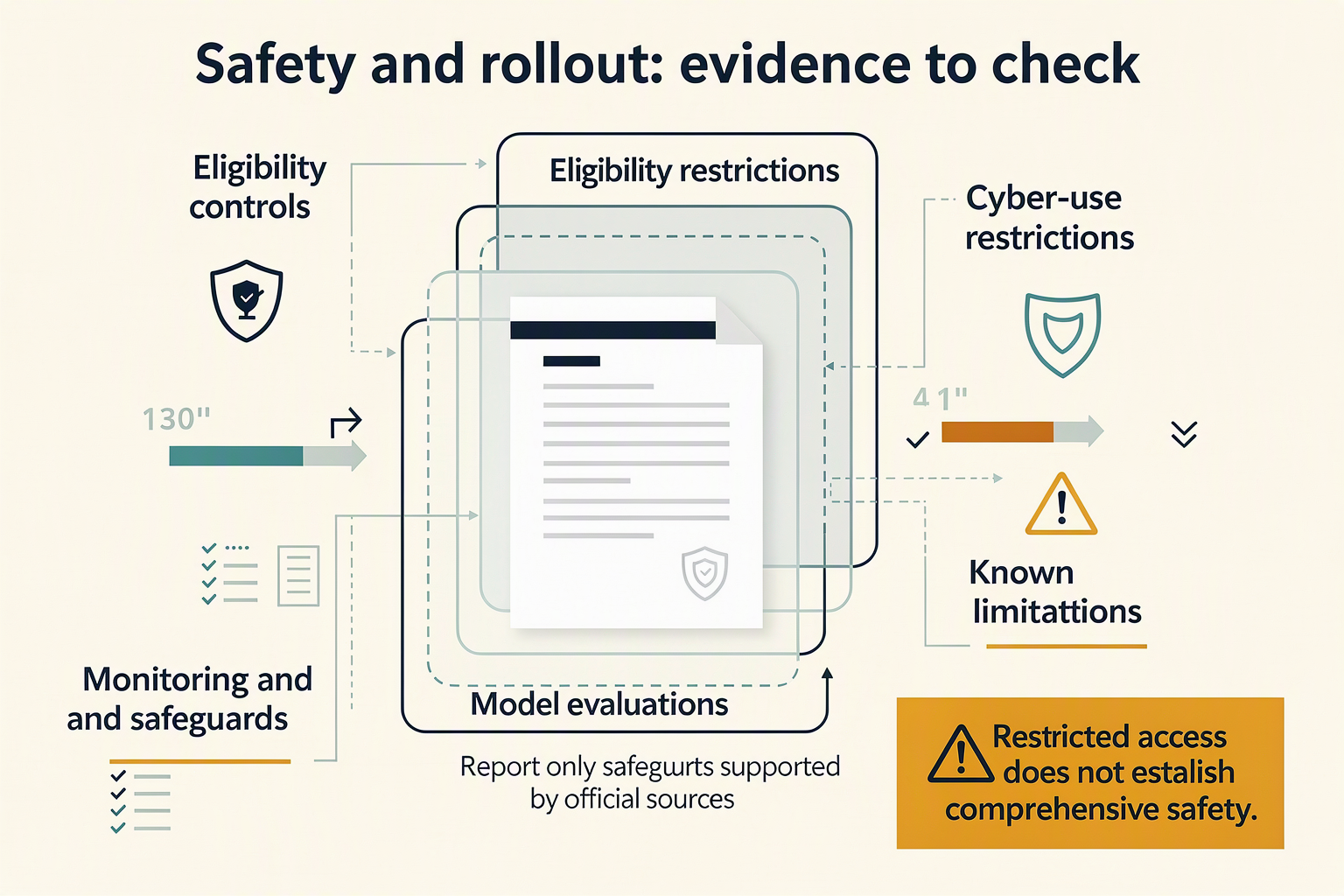
Google’s supplied announcement excerpt documents a restricted rollout to trusted cyber defenders through the Fairwind Program, but it does not establish detailed safety restrictions. For this September 30, 2026 review draft, permitted-use rules, evaluation results and wider release conditions remain unverified—not confirmed absent.
What safety controls has Google confirmed for Gemini 4 Argon?
The Google Blog excerpt supplied for this September 2026 review says Gemini 4 Argon is “rolling out to a set of trusted cyber defenders through our Fairwind Program.” That confirms a named access cohort; it does not explain how Google selects participants, monitors usage or responds to misuse.
Google also identifies cyber defense as an intended application. However, a defensive positioning statement is not a documented acceptable-use policy or evidence that a model reliably refuses harmful requests.
The supplied material does not establish:
- Prohibited activities: Which cybersecurity requests, tools or operational actions are disallowed.
- Enforcement mechanisms: Whether restrictions involve model refusals, account controls, monitoring or human review.
- Safety evaluations: Results for harmful assistance, prompt injection, sensitive-data exposure or autonomous tool use.
- Incident procedures: How participants report vulnerabilities, unexpected behavior or suspected misuse.
These are verification gaps in the available evidence, not findings that Google lacks safeguards.
Does the Fairwind Program restriction establish general availability?
No. The Fairwind Program access statement does not establish a public preview or general availability (GA) for Gemini 4 Argon as of this September 30, 2026 draft.
The supplied Google Blog results use both “rolling out soon” and “rolling out to a set of trusted cyber defenders.” Neither phrase supplies a complete availability schedule. Reviewers should check the full announcement and official Google developer documentation before describing access as immediately usable.
The release milestones should remain distinct:
- Announcement: Google publicly describes Gemini 4 Argon.
- Early testing: Selected participants receive access under defined conditions.
- Preview: Google documents a preview offering, its interfaces and limitations.
- GA: Google explicitly confirms general availability and applicable service terms.
The excerpt establishes an announcement and describes a restricted rollout; it does not establish the remaining milestones.
What should security teams verify before deployment?
Security teams should require documented permissions and operational boundaries, rather than treating the “trusted cyber defenders” label as authorization for any cybersecurity workflow.
For example, asking a model to explain a vulnerability differs materially from allowing an agent to execute commands against a production network. Before deployment, teams should verify authorized targets, tool permissions, approval requirements, logging and escalation procedures. These are recommended procurement checks—not claimed Gemini 4 Argon features.
For enterprise knowledge work, reviewers should also seek official documentation covering retention, training use, data location and access controls. No answers to those questions are established by the supplied excerpt.
What caveats must remain in the published story?
The final story should distinguish what Google says from what reviewers have verified. Google’s description of “deep reasoning across complex, long-horizon workflows” is a vendor capability claim, not a safety guarantee.
Before publication, confirm the announcement’s timestamp, Fairwind eligibility and current access terms. Until supporting documentation is available, avoid calling Gemini 4 Argon unrestricted, publicly available or independently validated as safe for autonomous cyber operations.
Why does the announcement matter, and what industry reaction is attributable?

The Gemini 4 Argon announcement matters because Google is positioning frontier AI around sustained work, rather than isolated answers. However, in the material available for this September 30, 2026 review draft, the attributable reaction is Google’s own assessment—not independently documented endorsement from developers, customers or security researchers.
Why could Gemini 4 Argon matter for enterprise AI?
Google Blog describes Gemini 4 Argon as built to sustain “deep reasoning across complex, long-horizon workflows.” That positioning raises an important enterprise question: can an AI system complete a sequence of interdependent tasks reliably, rather than perform well on individual prompts?
Consider a software-maintenance workflow involving a bug report, repository investigation, a proposed patch and regression tests. The business value depends on whether the model preserves constraints throughout that sequence, identifies uncertainty and produces changes a reviewer can validate. A convincing first response is insufficient if later steps introduce errors.
Google Blog’s supplied announcement excerpt identifies real-world coding, enterprise knowledge work and cyber defense as target areas. These are consequential applications because mistakes can affect production software, business decisions or security operations. Their inclusion establishes Google’s intended direction, but does not establish deployment readiness or independently measured improvements.
For enterprise buyers, the announcement therefore changes the evaluation agenda, not necessarily the procurement decision.
What industry reaction can actually be attributed?
The supplied Google Blog excerpt says Argon is “fundamentally changing the way we work and build at Google.” That is an attributable statement about Google’s internal experience, but it remains a vendor claim without supporting evaluation details in the supplied material.
The available source set supports three distinctions:
- Google’s assessment: Google describes substantial internal impact and emphasizes longer workflows.
- Named executive context: The supplied Google I/O 2026 keynote excerpts attribute to Sundar Pichai a broader emphasis on practical AI value in everyday products. They do not establish Pichai’s reaction to Gemini 4 Argon specifically.
- External response: No attributable Argon-specific comments from independent researchers, enterprise customers or competing model providers appear in the supplied excerpts.
The localized Google Blog category pages and duplicate announcement result do not provide independent corroboration. Consequently, descriptions such as “the industry welcomed the launch” or “developers praised its performance” would exceed the evidence.
Missing reaction evidence is not evidence of a negative reception. It means this draft should leave industry sentiment uncharacterized until named, dated responses are verified.
What should developers and security teams do next?
The practical implication is to prepare an evaluation plan without assuming access or superiority. Teams considering Gemini 4 Argon should prioritize:
- Workflow completion: Test complete tasks with explicit acceptance criteria, not just impressive intermediate answers.
- Human oversight: Define which code changes, business actions and security recommendations require approval.
- Deployment evidence: Verify supported interfaces, permission boundaries and rollout status before committing engineering resources.
As of September 2026, CallMissed’s developer API offers OpenAI-compatible endpoints and caller-chosen fallback models, illustrating how teams can design reusable integrations while comparing models. That capability does not establish Gemini 4 Argon availability through CallMissed.
The defensible takeaway is narrower than launch enthusiasm: Google has articulated an ambitious workflow-focused direction. Whether Gemini 4 Argon delivers meaningful industry-wide gains requires documented access, reproducible evaluations and independently attributable experience.
What happened when, and which release dates still need confirmation?
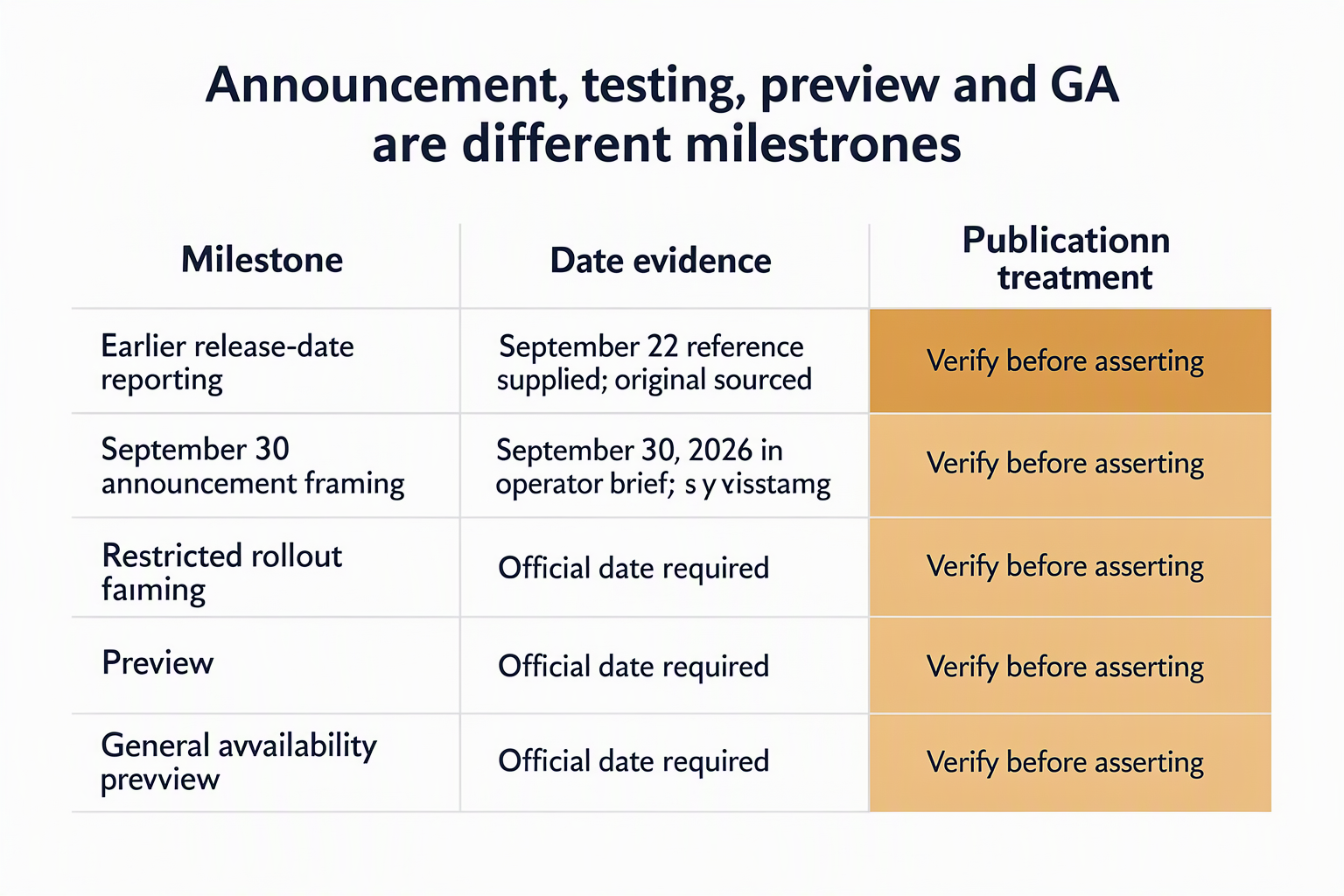
September 30, 2026 is the review date for this draft, not yet a verified Gemini 4 Argon release date. The supplied Google Blog excerpts establish an announcement and a restricted rollout statement, but do not provide the publication timestamp or dated developer documentation needed to confirm preview or general-availability milestones.
What does the Gemini 4 Argon release timeline actually establish?
As reviewed on September 30, 2026, Google Blog describes Gemini 4 Argon as “rolling out to a set of trusted cyber defenders through our Fairwind Program.” That wording identifies an intended access group; it does not establish when the first participant received access or when other users will qualify.
The timeline below separates the evidence available in this draft from dates that still need manual confirmation.
| Milestone | Supplied evidence | Date status | Required confirmation |
|---|---|---|---|
| Google announcement | Google Blog says, “Today, we’re announcing” Gemini 4 Argon | September 30, 2026 remains provisional | Original publication timestamp and timezone |
| Fairwind Program rollout | Google Blog names “trusted cyber defenders” | Start date not established | Dated program notice or access confirmation |
| Developer early testing | No separate developer-testing notice supplied | Unconfirmed | Official eligibility and enrollment documentation |
| API or platform preview | No dated Gemini API, Google AI Studio or Vertex AI listing supplied | Unconfirmed | Model identifier, preview status and availability date |
| General availability | No explicit GA statement supplied | Unconfirmed | Official GA announcement and supported access surfaces |
| Introductory pricing window | Operator brief flags a reported introductory offer | Start and expiry unverified | Official pricing terms, billing modes and effective dates |
“Unconfirmed” means the supplied evidence does not establish the milestone—not that Google has ruled it out. Editors should preserve that distinction when updating the timeline.
Why doesn’t “today” confirm a September 30 launch?
Google Blog’s supplied announcement excerpt uses the relative word “Today,” but the excerpt does not include its publication date. Reading that snippet on September 30, 2026 cannot, by itself, establish that Google published the announcement that day.
The supplied search material also uses “rolling out soon.” That phrase and the article excerpt’s “rolling out” language should be checked against the complete announcement before assigning a rollout start date. Neither phrase supplies a calendar deadline for public access.
For the publication review, record these separately:
- Publication time: when Google first posted the announcement, including timezone where available.
- Update time: whether Google subsequently changed access or rollout language.
- Access-effective time: when documented users could actually invoke Gemini 4 Argon.
Which dates should editors verify before publishing?
Use a three-step check rather than collapsing every milestone into “launched”:
- Confirm the announcement timestamp on the original Google Blog page, distinguishing publication from later updates.
- Check official Google developer documentation for dated model listings, supported interfaces and explicit early-access, preview or GA labels.
- Verify commercial effective dates separately, including any introductory-pricing expiry and restrictions.
For this September 2026 manual-review draft, the defensible timeline is therefore: announcement language identified; restricted Fairwind rollout described; exact publication date, broader access dates and commercial timing still awaiting confirmation. A verified announcement date should not automatically become the release date for every Google product surface.
Is Gemini 4 Pro an official name, and what should developers verify before switching?
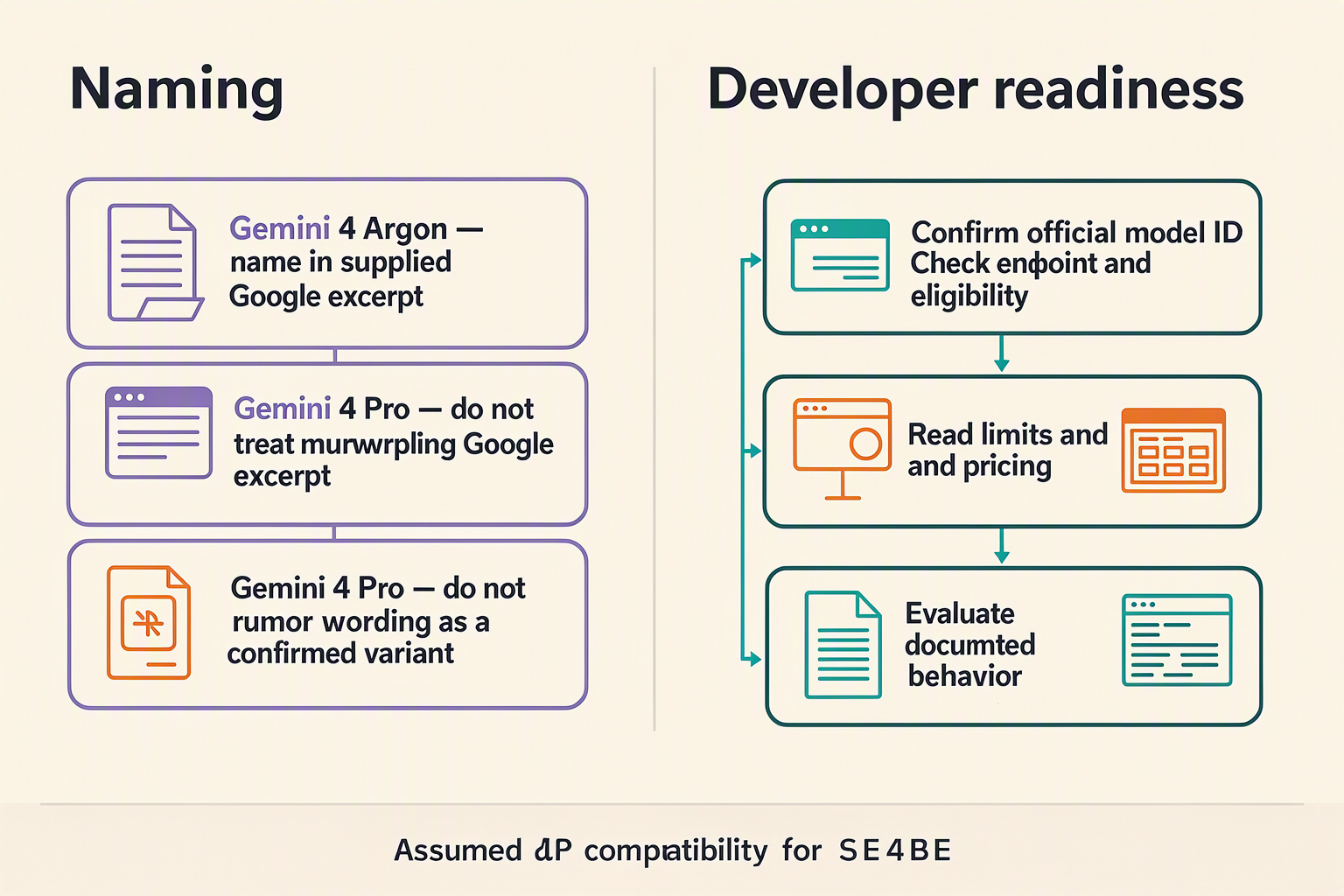
“Gemini 4 Pro” is not an official name established by the supplied Google announcement excerpts. For this September 30, 2026 review draft, use Gemini 4 Argon as the announcement name and Gemini 4 only as search shorthand; developers should verify the documented API identifier, access status and operating requirements before switching.
Google Blog’s supplied announcement says, “Today, we’re announcing our new frontier model, Gemini 4 Argon.” That wording supports the Argon name—not a Pro or Flash variant—and does not establish a production-ready API endpoint.
Is Gemini 4 Pro another name for Gemini 4 Argon?
Do not treat Gemini 4 Pro as an alias for Gemini 4 Argon. A familiar naming pattern from another model generation is not evidence that Google has reused it.
Keep three identifiers separate when reviewing the Gemini 4 Argon launch:
- Announcement name: Gemini 4 Argon, as stated in the supplied Google Blog excerpt reviewed for this September 2026 draft.
- Search shorthand: Gemini 4, useful for discussing the announcement but insufficient for configuring an application.
- API model ID: Not established by the supplied material; confirm it in official Google developer documentation before writing deployment instructions.
This distinction prevents a practical failure: copying an assumed model name into configuration and then mistaking an invalid-model response for a permissions or SDK problem. Editors should also remove unsupported “Pro” references from titles, metadata and comparison charts.
What should developers verify before switching models?
Treat migration as a documented compatibility check, not a name substitution. The supplied context does not include official developer specifications sufficient to authorize a production switch.
- Exact identifier and lifecycle status. Verify the model ID, any versioned identifier, and whether Google labels access as early testing, preview or general availability. Record the documentation’s publication or update date.
- Account and deployment eligibility. Confirm the supported service, project permissions, regions and onboarding requirements. Google Blog’s supplied excerpt names “a set of trusted cyber defenders through our Fairwind Program”; that statement does not establish access for an ordinary developer account.
- Request and response compatibility. Check supported input types, context and output limits, streaming, tool calls and structured responses. Do not infer these specifications from Google’s description of “deep reasoning across complex, long-horizon workflows.”
- Billing conditions. Verify standard versus introductory pricing, cache eligibility, applicable processing modes and offer expiry. Reported launch rates should stay out of migration budgets until official billing documentation confirms their conditions.
- Operational and safety requirements. Review quotas, error handling, data-handling terms and permitted-use restrictions, especially for workflows involving security tools or sensitive enterprise information.
As of September 2026, CallMissed’s developer AI API offers OpenAI-compatible endpoints and caller-chosen fallback models, according to its verified fact sheet. Those capabilities can support reusable integrations, but the supplied catalogue check did not detect Gemini 4; compatibility is not evidence of Argon availability.
How should teams decide whether to migrate?
Run a controlled evaluation only after access and documentation are confirmed. Use representative tasks, measure correctness and end-to-end cost, and test tool failures, refusals and rollback behavior—not just successful demonstrations.
For manual review, the defensible conclusion is: Gemini 4 Argon is the supported announcement name; Gemini 4 Pro is unverified, and a production migration remains conditional on official developer documentation and actual account access.
Frequently Asked Questions
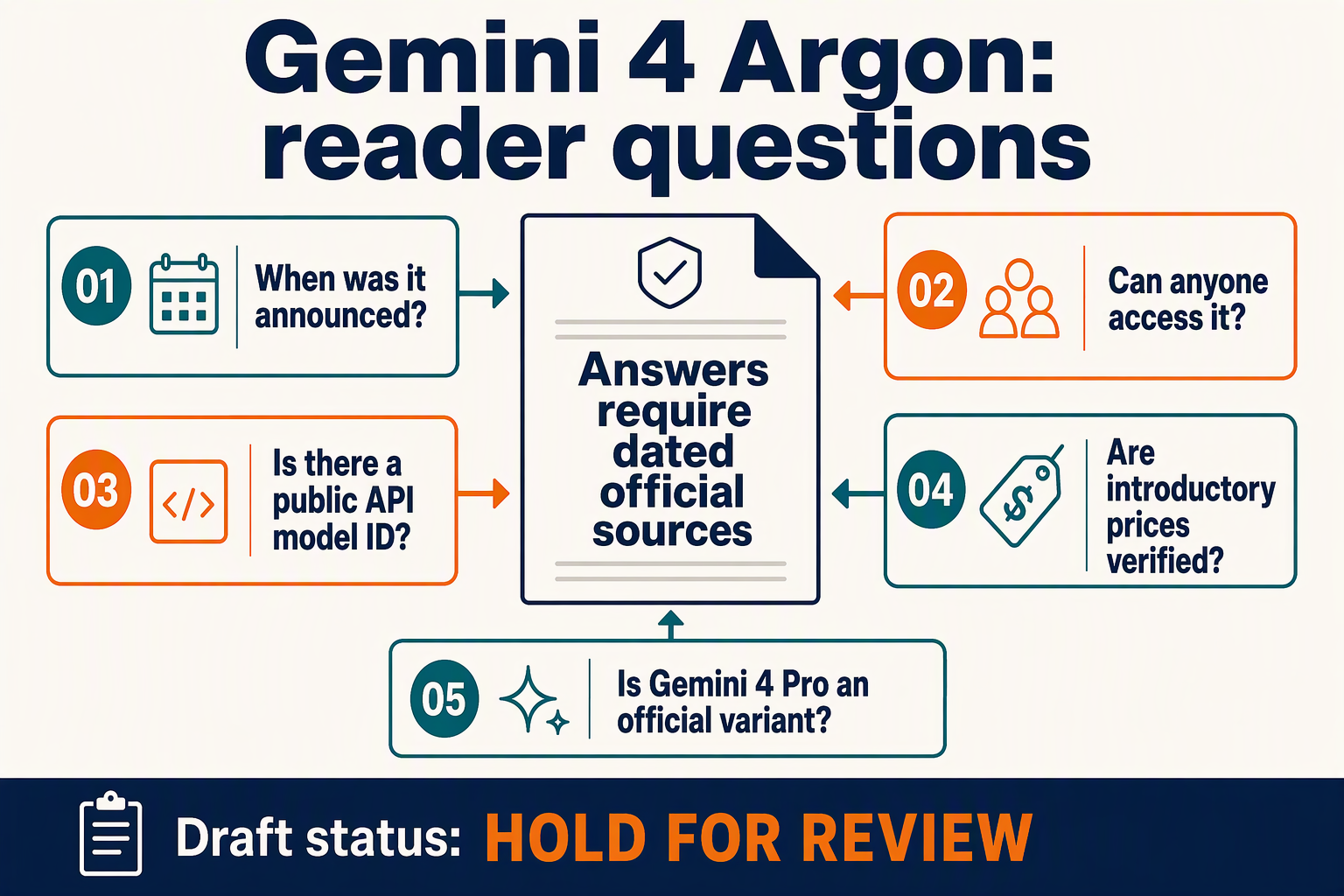
What is the Gemini 4 Argon release date, and was it launched on September 30, 2026?
Is Gemini 4 Argon publicly available, and who can access it?
Is there a Gemini 4 API in Google AI Studio or Vertex AI?
What is Gemini 4 Argon pricing, and are introductory or cached-input discounts confirmed?
Is the official model name Gemini 4 Argon, Gemini 4 Pro or Gemini 4 Flash?
What capabilities and safety safeguards has Google confirmed for Argon?
Conclusion
The Gemini 4 Argon launch is an announcement of a restricted rollout—not evidence of public availability. For this September 30, 2026 review draft, the central takeaway is that Google’s stated ambitions for coding, enterprise knowledge work and cyber defense must remain separate from verified access, specifications and deployment readiness.
Four points should guide how readers interpret the announcement:
- Access is the immediate constraint. The supplied Google Blog excerpt says Gemini 4 Argon is rolling out to “a set of trusted cyber defenders through our Fairwind Program.” That statement supports a restricted initial rollout; it does not confirm availability in the Gemini app, Google AI Studio, the Gemini API or Vertex AI. Eligibility, geographic restrictions and broader access dates still require official confirmation.
- Capabilities are vendor claims, not established benchmarks. Google Blog describes Gemini 4 Argon as supporting “deep reasoning across complex, long-horizon workflows,” with applications in real-world coding, enterprise knowledge work and cyber defense. Those descriptions explain Google’s positioning, but the supplied material does not establish benchmark scores, context limits or supported modalities. Readers should not convert an ambitious product description into a measured performance conclusion.
- Pricing and safety remain review checkpoints. Reported introductory pricing should not guide purchasing decisions until official documentation confirms billing modes, discount conditions and expiry terms. Likewise, a cyber-defense focus does not by itself establish safeguards, evaluation outcomes or permitted-use boundaries. Enterprise adoption requires both commercial clarity and documented controls, rather than assumptions drawn from the announcement.
- Announcement, testing, preview and general availability are different milestones. This draft is dated September 30, 2026, but the supplied excerpts do not independently confirm the announcement’s publication date. Gemini 4 Argon is the name used in the supplied Google Blog material; Gemini 4 is search shorthand, not evidence of additional variants or a wider product lineup.
What should developers watch for next?
The next meaningful developments will be official Google documentation establishing who can access Gemini 4 Argon, through which interfaces, under what terms and with which safety restrictions. Published evaluations and confirmed rollout milestones would help teams move from monitoring the announcement to deciding whether a controlled trial is appropriate.
The practical lesson is to prepare for longer-running AI workflows without making deployment commitments ahead of the evidence. As of September 2026, CallMissed offers OpenAI-compatible developer endpoints for teams exploring reusable AI integrations; that capability does not establish Gemini 4 Argon availability through CallMissed.
Explore CallMissed to understand the broader direction of AI communication infrastructure, while keeping model-specific access checks separate. Before planning an Argon deployment, ask: what has Google documented—and what are we still assuming?
Related Reading
- Gemini 4 Argon vs GPT-6 Astra: Evidence, Costs & Access
- Gemini 4 Argon vs Claude Sonnet 5.5: Coding & Scale
- Gemini 4 vs Claude Fable 5.1: September 30, 2026 Draft
Sources
Discussion
Related Posts



Ready to automate customer conversations?
Launch AI voice agents and WhatsApp bots with CallMissed — one API, 22+ Indian languages.