GPT-6 Astra API Availability, Access, and Pricing: Verified Status as of September 3, 2026


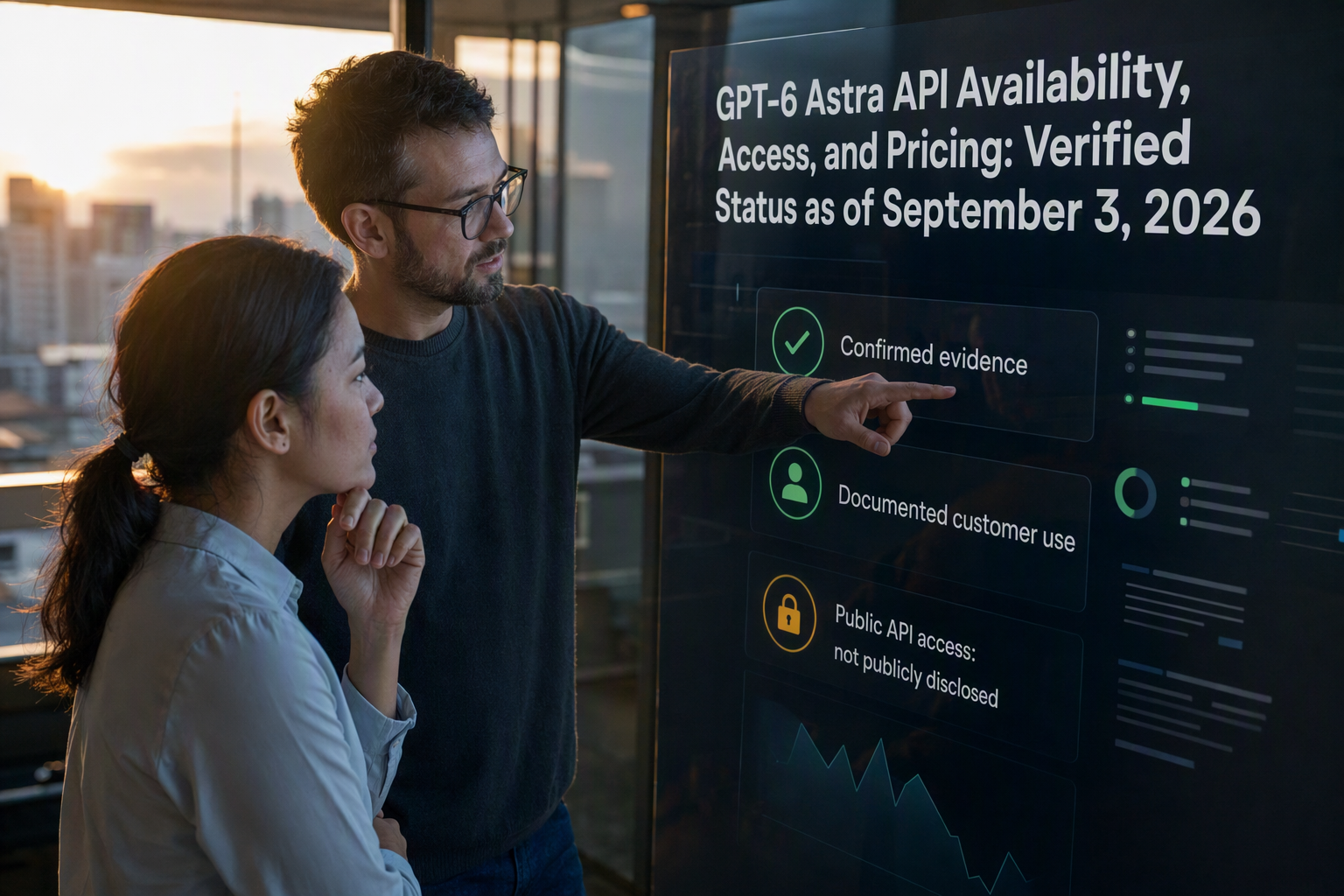
Verify GPT-6 Astra API availability, access status, model IDs, pricing, limits, and eligibility using OpenAI first-party sources.
GPT-6 Astra API Availability, Access, and Pricing: Verified Status as of September 3, 2026
GPT-6 Astra API availability, access, and pricing are now publicly documented. OpenAI officially released GPT-6 Astra on September 3, 2026, lists the API model ID gpt-6-astra, and publishes standard token prices. As of September 5, practical access can still depend on account, product, region, tier, quota and safety controls, but the model is no longer merely a selected-customer preview with undisclosed commercial terms.
What OpenAI has actually confirmed
Two OpenAI customer stories provide the clearest evidence that GPT-6 Astra exists in real-world workflows:
- Playco reported 50% fewer manual fixes while using GPT-6 Astra to create three themed game prototypes from one grey-box foundation, according to an OpenAI customer story published on September 3, 2026.
- Legora reviewed 41 documents in minutes, identified all four planted errors, and improved performance by nearly 40% using GPT-6 Astra, according to OpenAI’s September 3, 2026 customer story.
These are meaningful results, but they answer a different question from the one developers are asking. Documented use by named OpenAI customers does not automatically mean that GPT-6 Astra is available through the OpenAI API, accessible to every paid account, or released under a public-preview programme.
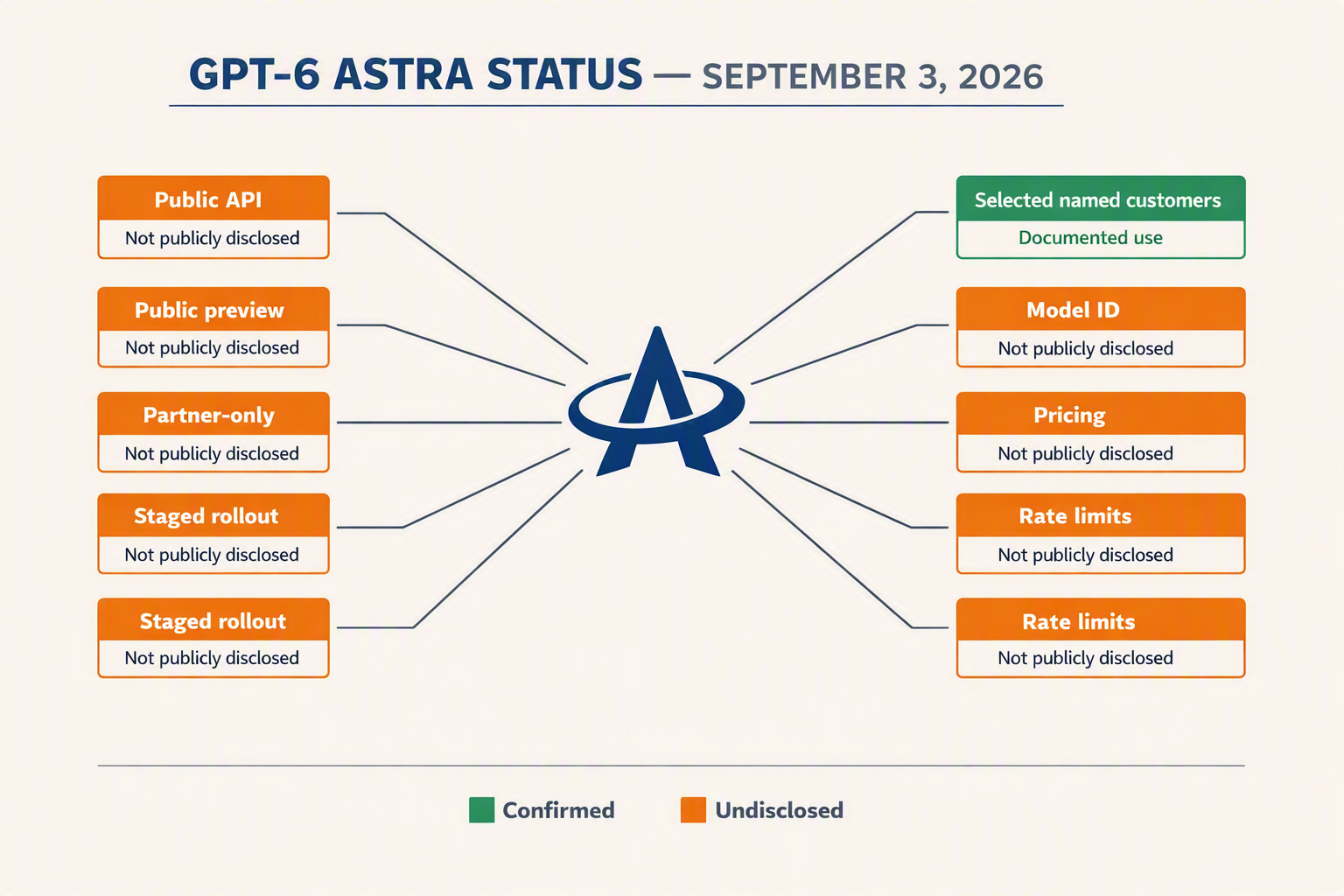
Based on the available first-party evidence, the only affirmative status is documented use by selected OpenAI customers. Public API access, public-preview availability, partner-only status, staged-rollout terms, eligible regions, prerequisites, rate limits, and service tiers are not publicly disclosed.
Why verification matters now
An API name repeated in community discussions can quickly be mistaken for an official model identifier. However, the researched OpenAI model-documentation results did not contain a GPT-6 Astra entry or documented model ID. Neither gpt-6-astra nor GPT-6-ASTRA should therefore be treated as a valid API model string unless OpenAI publishes it in official documentation or exposes it within an authorised account.
The researched OpenAI announcement results also did not reveal a dedicated GPT-6 Astra launch announcement. That finding does not prove that an account-scoped, invitation-only, or otherwise undiscoverable deployment cannot exist; it means broad developer availability cannot be verified from the reviewed public material.
The distinction has practical consequences. Before planning a production migration, engineering teams need confirmed endpoints, token pricing, cached-input rates, output pricing, batch discounts, quotas, data-governance terms, and regional support. For GPT-6 Astra, those details are not publicly disclosed in the first-party evidence reviewed.
This guide separates confirmed customer usage from public developer access, lists every known and undisclosed field, and provides a verification checklist for checking OpenAI documentation and account-level model access. It also explains how to evaluate future availability through direct integrations or multi-model infrastructure such as CallMissed’s OpenAI-compatible gateway, without assuming that an undocumented model is already supported.
Is the GPT-6 Astra API publicly available? Confirmed status as of September 5, 2026
Yes—GPT-6 Astra is officially available through the OpenAI API as of September 5, 2026. OpenAI released the model on September 3, 2026, describes it as broadly deployed, and documents the API model ID gpt-6-astra. OpenAI has also published standard token pricing, replacing the earlier uncertainty around GPT-6 Astra API availability, identifiers, and commercial terms.
Verified availability status
The official release and documented model identifier establish public API availability. However, “broadly deployed” does not guarantee that every account can use the model in every product or region without restrictions.
| Availability field | Verified status | Current official information |
|---|---|---|
| Official release | Confirmed | OpenAI released GPT-6 Astra on September 3, 2026 |
| Deployment status | Broadly deployed | OpenAI describes the model as broadly deployed |
| Public API access | Confirmed | GPT-6 Astra is officially available through the OpenAI API |
| API model ID | Confirmed | The documented model identifier is gpt-6-astra |
| Standard input price | $10 per 1M tokens | Applies to standard input-token processing |
| Cached-input price | $1 per 1M tokens | Applies to eligible cached input |
| Cache-write price | $12.50 per 1M tokens | Applies when writing eligible content to the cache |
| Standard output price | $50 per 1M tokens | Applies to generated output tokens |
| Universal account access | Not guaranteed | Account, product, region, tier, quota, and safety controls may affect access |
| Identical limits for all users | Not guaranteed | Practical limits can vary by account and deployment context |
The documented ID should be used exactly as published:
gpt-6-astraTeams should not substitute speculative aliases, uppercase variants, dated versions, or internally invented deployment names unless OpenAI separately documents or enables them for the relevant account.
Standard GPT-6 Astra API pricing
OpenAI’s published standard pricing for GPT-6 Astra is:
| Token category | Price per 1 million tokens |
|---|---|
| Input | $10.00 |
| Cached input | $1.00 |
| Cache writes | $12.50 |
| Output | $50.00 |
These figures establish the standard token prices but should not be treated as a complete estimate for every workload. Actual costs depend on input volume, output length, cache eligibility, cache usage, retries, and application architecture. Any separately priced platform features or account-specific commercial arrangements should be evaluated independently.
Developers should also distinguish cached-input reads from cache writes. Reused eligible input is billed at the cached-input rate, while writing eligible content into the cache carries the published cache-write rate. Applications should confirm that their requests meet OpenAI’s current caching requirements before forecasting savings.
What “broadly deployed” means for developers
Current GPT-6 Astra API availability is verified, but broad deployment is not the same as unrestricted access for every API key. Practical availability can still be affected by:
- Account eligibility: organisation verification, account standing, contractual terms, or other onboarding requirements.
- Product support: availability may differ across API products, interfaces, SDK versions, or managed environments.
- Region: geographic availability, data-processing options, and regulatory requirements can vary.
- Usage tier: rate limits, throughput, concurrency, and access may depend on the account’s tier or approved capacity.
- Quotas: requests can remain subject to token, request, spending, or project-level quotas.
- Safety restrictions: OpenAI may limit or reject requests based on policy, risk controls, model safeguards, or account-specific reviews.
Accordingly, an official model release does not guarantee that a particular request will succeed from every project. The authenticated account and selected API product remain the authoritative indicators of practical access.
Practical interpretation for API teams
Engineering and procurement teams can now classify GPT-6 Astra API availability as “officially released and broadly deployed, with account-specific access and limits.” It is no longer accurate to describe the model as merely selected-customer access, an unverified preview, or a model without a public identifier.
Before launching a production integration, teams should:
- Verify that
gpt-6-astrais available to the intended organisation, project, and API key. - Confirm that the chosen OpenAI product and SDK support the required request features.
- Review account-specific rate limits, quotas, and spending controls.
- Test regional availability and applicable data-handling requirements.
- Model costs using the published input, cached-input, cache-write, and output rates.
- Keep the model ID configurable rather than hard-coding it throughout the application.
- Handle access, quota, safety, and capacity errors gracefully.
As of September 5, 2026, the core GPT-6 Astra API availability question is settled: the API is officially released, the documented model ID is gpt-6-astra, and standard pricing is public. The remaining variables concern whether a particular account can access it under the required product, region, tier, quota, and safety conditions.
What background and context distinguish documented GPT-6 Astra customer use from general developer availability?

Documented GPT-6 Astra customer use confirms that selected organizations used the model, but it does not verify general developer access. As of September 3, 2026, OpenAI has not publicly disclosed whether Playco or Legora accessed GPT-6 Astra through a standard API, private evaluation, managed engagement, account-scoped entitlement, or another controlled programme.
Customer stories prove operational use, not an access tier
OpenAI’s first-party customer stories document practical use in gaming and legal-financial workflows:
- Playco built three themed game prototypes from one grey-box foundation using GPT-6 Astra.
- Playco reported 50% fewer manual fixes than with its previous process, according to OpenAI on September 3, 2026.
- Legora used GPT-6 Astra to review 41 financial documents in minutes, with deliberately inserted issues used to test performance.
- Legora found all four planted errors and improved performance by nearly 40%, according to OpenAI on September 3, 2026.
These findings support one narrow conclusion: selected OpenAI customers had working access to GPT-6 Astra in documented workflows. The stories do not identify an official endpoint, model ID, eligibility tier, contract type, region, quota, or onboarding process.
The correct status labels therefore remain:
- Documented customer use: Confirmed
- Public API availability: Not publicly disclosed
- Public-preview availability: Not publicly disclosed
- Partner-only status: Not publicly disclosed
- Staged-rollout terms: Not publicly disclosed
Describing GPT-6 Astra as “enterprise-only,” “partner-only,” or “in public preview” would go beyond the available first-party evidence.
Customer outcomes and developer availability are separate evidence categories
A customer case study answers, “Was the model used, and what happened?” API documentation answers, “Can developers access it, under what conditions, and at what cost?” Evidence in one category does not automatically establish the other.
A verifiable developer release would normally include some combination of:
- An official model ID and supported API endpoint
- Account, organization, contract, or usage-tier prerequisites
- Rate limits, quotas, context limits, and supported regions
- Input-token, cached-input, and output-token pricing
- Batch, fine-tuning, service-tier, and data-governance terms
- A defined launch state, such as general availability or public preview
For GPT-6 Astra, each of these implementation fields is not publicly disclosed in the reviewed OpenAI first-party evidence. In particular, neither gpt-6-astra nor GPT-6-ASTRA should be treated as a valid model ID without an official OpenAI model-documentation entry.
This distinction is provider-neutral: customer outcomes and documented developer availability are separate evidence categories. A model may be used through a private, managed, product-embedded, or account-scoped arrangement without appearing in a public API catalogue. Equally, the absence of a discoverable documentation entry does not prove that restricted access does not exist.
What the evidence supports as of September 3, 2026
The researched OpenAI sources support three precise findings:
- OpenAI names GPT-6 Astra in customer materials dated September 3, 2026.
- OpenAI documents Playco and Legora as users, including concrete workflow outcomes.
- Broad developer availability remains unverified because no GPT-6 Astra launch announcement, public model entry, model ID, endpoint, eligibility rules, or pricing was found in the researched first-party materials.
That third finding is a statement about the available documentation—not proof that an undiscoverable or account-scoped deployment cannot exist. Until OpenAI publishes an API reference, model page, pricing entry, changelog, launch announcement, or visible account entitlement, developers should treat customer use as confirmed and general API access as not publicly disclosed.
Which GPT-6 Astra developments are verified by OpenAI first-party sources? (TABLE: Playco customer story, Legora customer story, announcement-search finding, and model-documentation-search finding)
OpenAI’s first-party record verifies that Playco and Legora used GPT-6 Astra, but it does not verify a public API release. As of September 3, 2026, the researched OpenAI sources disclose customer outcomes while leaving access classification, model identifiers, endpoints, and pricing undocumented.
First-party evidence and what it establishes
| OpenAI first-party finding | Verified detail | What it establishes | API implication |
|---|---|---|---|
| Playco customer story | Playco created three themed game prototypes from one grey-box foundation and reported 50% fewer manual fixes. | A named customer used GPT-6 Astra in a game-prototyping workflow. | Public API access: not publicly disclosed. |
| Legora customer story | Legora reviewed 41 documents in minutes, found all four planted errors, and improved performance by nearly 40%. | A named customer used GPT-6 Astra for financial-document review. | Public preview and standard account access: not publicly disclosed. |
| OpenAI customer-stories index | OpenAI listed both the Playco and Legora stories on September 3, 2026. | The two case studies are part of OpenAI’s official customer-story catalogue. | Access programme classification: not publicly disclosed. |
| Researched OpenAI announcement search | No dedicated GPT-6 Astra launch announcement was found in the reviewed results. | A broad public launch cannot be verified from the researched announcements. | This does not rule out invitation-only or account-scoped access. |
| Researched OpenAI model-documentation search | No GPT-6 Astra documentation entry or official model ID was found in the reviewed results. | No public model string, endpoint, limits, or integration instructions were verified. | gpt-6-astra and GPT-6-ASTRA must not be treated as valid IDs. |
| Combined first-party record | Documented usage exists, but rollout terms are absent from the reviewed material. | Selected OpenAI customers used GPT-6 Astra. | Public, preview, partner-only, and staged-rollout status: not publicly disclosed. |
What the customer evidence confirms
OpenAI reported on September 3, 2026 that Playco reduced manual fixes by 50% while producing three themed game prototypes with GPT-6 Astra. This is a concrete performance claim tied to Playco’s particular workflow; it is not a general benchmark or API service-level commitment.
OpenAI reported on September 3, 2026 that Legora reviewed 41 documents in minutes, detected all four planted errors, and improved performance by nearly 40% with GPT-6 Astra. The result verifies applied usage, but OpenAI’s customer story does not establish token prices, rate limits, regions, prerequisites, or self-service availability.
Together, these stories support one precise conclusion: GPT-6 Astra has been used by selected named customers. They do not explain whether access came through an API, a private deployment, an evaluation programme, or another arrangement.
What remains unverified
The absence of a result in the researched announcement and model-documentation searches is a search finding, not proof of non-existence. An undiscoverable, authorised-account, or invitation-based deployment could exist without appearing in public documentation.
Developers should therefore record the current fields exactly as follows:
- Documented API endpoints: not publicly disclosed.
- Official model ID: not publicly disclosed.
- Public API access or public preview: not publicly disclosed.
- Partner-only status or staged-rollout terms: not publicly disclosed.
- Input, cached-input, output-token, batch, and fine-tuning pricing: not publicly disclosed.
- Rate limits, supported regions, eligibility requirements, and service tiers: not publicly disclosed.
Until OpenAI publishes documentation or exposes a model identifier inside an authorised account, customer-story evidence should not be converted into implementation assumptions or pricing estimates.
Which GPT-6 Astra API model ID, endpoints and capabilities are documented?
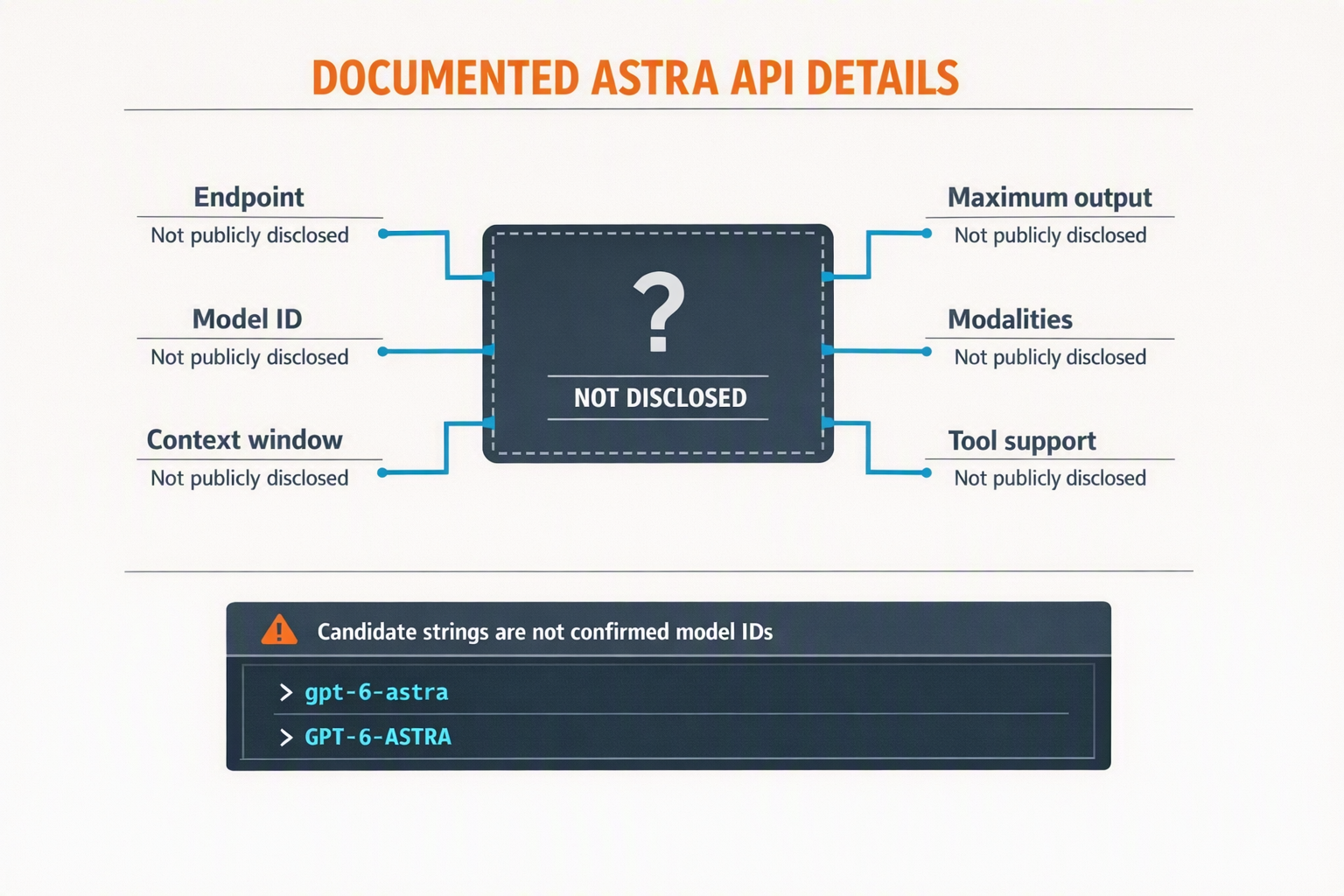
OpenAI’s current first-party documentation lists gpt-6-astra as the valid, canonical API model identifier. Developers should use that exact lowercase string wherever the applicable OpenAI API documentation requires a model ID.
Canonical identifier versus informal capitalization
| API field | Documented status |
|---|---|
| Canonical model ID | gpt-6-astra |
| Informal product name | GPT-6 Astra |
Uppercase form (GPT-6-ASTRA) | Not the canonical API identifier |
| Supported endpoints | Consult the live OpenAI model and API documentation |
| Supported capabilities and parameters | Consult the live OpenAI model and API documentation |
| Versioned snapshots, aliases, and deprecations | Use only identifiers currently listed by OpenAI |
“GPT-6 Astra” is appropriate as a human-readable product name, but capitalization in prose does not replace the documented API identifier. Applications, configuration files, SDK calls, and routing rules should use gpt-6-astra exactly rather than converting it to GPT-6-ASTRA or another guessed variation.
Endpoints and capabilities
Endpoint compatibility and feature support should be taken directly from OpenAI’s current model page and API reference. Developers should not infer that gpt-6-astra supports every interface or capability available to other OpenAI models.
Before implementation, verify the live documentation for:
- Supported API endpoints and SDK versions
- Request and response fields
- Streaming and structured-output support
- Tool calling and built-in tools
- Image, audio, video, and file-input support
- Context-window and maximum-output limits
- Reasoning controls and supported parameters
- Batch, realtime, and fine-tuning compatibility
- Rate limits, regional availability, and account permissions
- Versioned snapshots, aliases, and deprecation policies
Verification steps before implementation
- Open OpenAI’s current model documentation and confirm
gpt-6-astra. - Check the corresponding API reference for supported endpoints and parameters.
- Confirm that the authorized organization or project has access to the model.
- Use the exact lowercase identifier in a minimal non-production request.
- Treat authorization, rate-limit, and unsupported-feature errors according to the live API documentation rather than changing the model ID’s capitalization.
Third-party catalogues, gateways, and marketplaces may expose different aliases or interfaces. For direct OpenAI API integrations, gpt-6-astra is the documented model identifier, while current OpenAI documentation remains authoritative for supported endpoints, capabilities, limits, and access terms.
How much does the GPT-6 Astra API cost as of September 5, 2026?
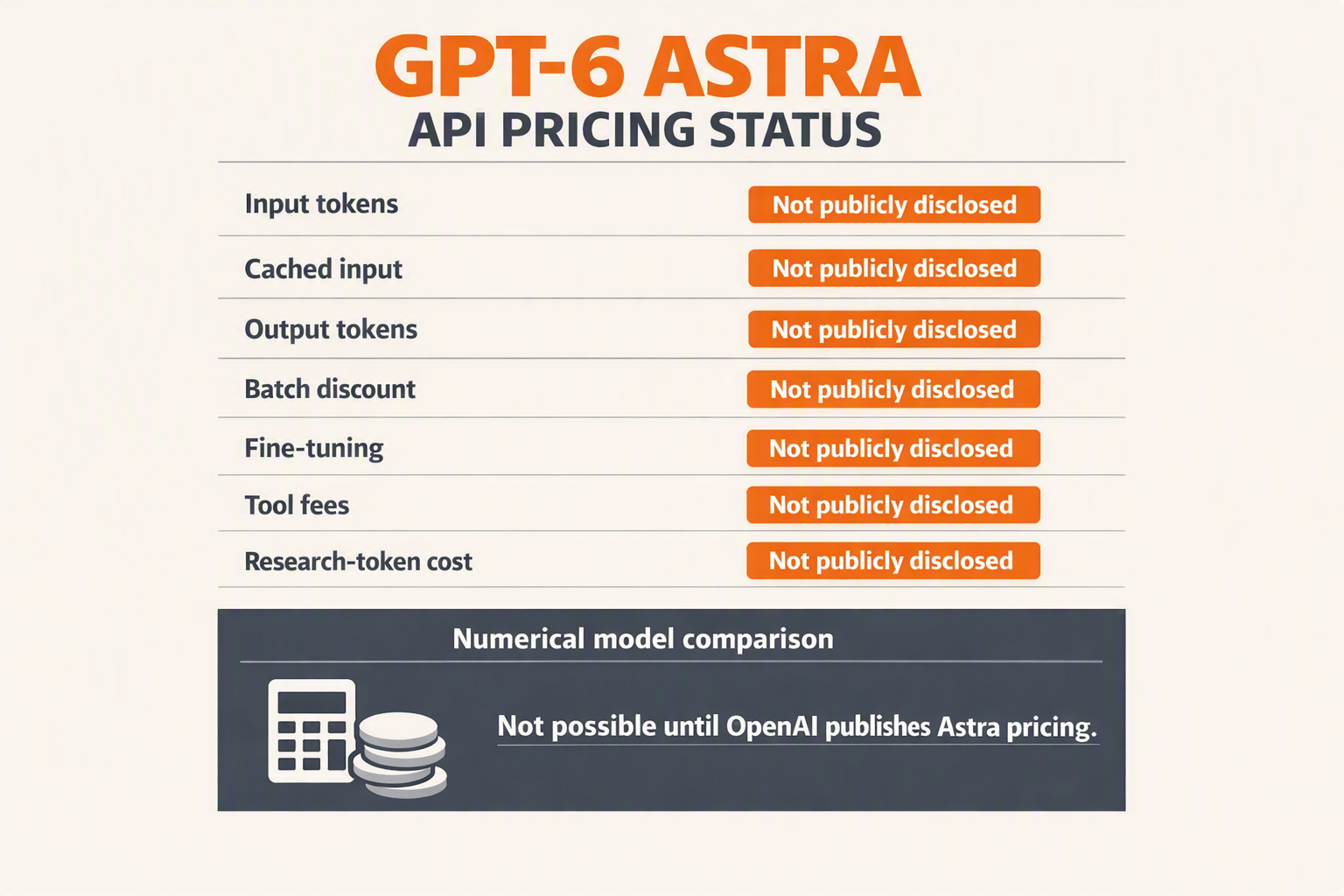
As of September 5, 2026, OpenAI’s first-party pricing lists GPT-6 Astra at $10 per million input tokens, $1 per million cached-input tokens, $12.50 per million cache-write tokens, and $50 per million output tokens. These published rates make numerical token-cost comparisons possible, provided competing APIs use equivalent billing categories and workload assumptions.
Published GPT-6 Astra token prices
| Pricing component | GPT-6 Astra public price | Comparison requirement |
|---|---|---|
| Input tokens | $10 per million tokens | Count standard billable input separately |
| Cached input | $1 per million tokens | Confirm cache eligibility and read accounting |
| Cache writes | $12.50 per million tokens | Confirm which tokens qualify as cache writes |
| Output tokens | $50 per million tokens | Count all billable generated tokens |
| Batch processing | Requires the live OpenAI pricing page | Verify any discount, completion window, and supported endpoints |
| Fine-tuning | Requires the live OpenAI pricing page | Verify training, hosting, and inference charges |
| Tools | Requires the live OpenAI pricing page | Verify per-call or usage-based charges |
| Audio | Requires the live OpenAI pricing page | Verify input, cached-input, and output units |
| Regional processing | Requires the live OpenAI pricing page | Verify whether location-specific rates apply |
| “Research tokens” | No verified separate rate | Require an official unit definition and first-party price |
The published token rates should not be extended to unverified categories. Batch, fine-tuning, audio, tool-use, regional-processing, service-tier, or alleged “research-token” charges must be checked against OpenAI’s live pricing page and applicable account terms before estimating production costs.
How to calculate token cost
For usage reported in separate billing categories:
Token cost = (input tokens ÷ 1,000,000 × $10) + (cached-input tokens ÷ 1,000,000 × $1) + (cache-write tokens ÷ 1,000,000 × $12.50) + (output tokens ÷ 1,000,000 × $50)
This formula covers only the four verified token rates. Any applicable tool, batch, fine-tuning, audio, regional, tax, or other charges must be added separately after confirmation from the live pricing page.
Worked example
Suppose a workload records:
- 1.2 million standard input tokens
- 3 million cached-input tokens
- 400,000 cache-write tokens
- 600,000 output tokens
The calculation is:
| Usage category | Calculation | Cost |
|---|---|---|
| Input | 1.2 × $10 | $12.00 |
| Cached input | 3 × $1 | $3.00 |
| Cache writes | 0.4 × $12.50 | $5.00 |
| Output | 0.6 × $50 | $30.00 |
| Total verified token cost | $50.00 |
The example’s verified token cost is $50, excluding any unverified charges.
Total cost per successful task
Cost per request can be misleading when workflows involve retries, invalid outputs, failed tool calls, or responses that do not satisfy the application’s acceptance criteria. Teams should instead calculate:
Cost per successful task = total workload cost ÷ number of successfully completed tasks
If the example workload produced 1,000 attempts but only 800 met a predefined success criterion:
$50 ÷ 800 = $0.0625 per successful task
That result is 6.25 cents per successful task for verified token usage alone. A production calculation should include all attempts—including failures and retries—and add any confirmed non-token charges. Teams should also define “successful” consistently, such as a correctly resolved support case, accepted document, passing code task, or completed agent workflow.
GPT-6 Astra can now be compared numerically with other APIs across the four published token categories. A fair comparison must use the same token volumes, cache assumptions, output requirements, success criteria, and included cost categories. The phrase “GPT Astra 6” should not be treated as a separately priced SKU unless OpenAI documents it as one.
What impact do the Playco and Legora examples have on the GPT-6 API status after OpenAI Astra—and what do they not prove?

The Playco and Legora examples materially strengthen the evidence that GPT-6 Astra has been used in real organizational workflows. They do not establish that developers can access Astra through a public API, nor do they reveal its commercial or technical access terms.
What the examples add to Astra’s verified status
OpenAI’s customer stories move GPT-6 Astra beyond an unverified name circulating in community discussions. They associate the model with named organizations, defined tasks, and reported outcomes:
- OpenAI reported on September 3, 2026, that Playco used GPT-6 Astra to build three themed game prototypes from one grey-box foundation and reduced manual fixes by 50%.
- OpenAI reported on September 3, 2026, that Legora used GPT-6 Astra to review 41 documents in minutes and identify all four deliberately planted errors.
- OpenAI reported on September 3, 2026, that Legora’s performance improved by nearly 40% in the documented financial-statement review workflow.
These examples support three limited conclusions: Astra exists as a deployed OpenAI model or capability, selected customers have used it, and OpenAI is willing to identify it publicly as GPT-6 Astra. They also indicate potential utility across distinct domains—game prototyping for Playco and document-intensive legal or financial analysis for Legora.
That evidence is commercially significant. Customer stories generally require an operational relationship and an actual use case, making them stronger evidence of deployment than a forum mention, screenshot, speculative model string, or third-party pricing page.
Why customer access is not the same as API availability
The stories describe outcomes, not an access programme. They do not explain how Playco or Legora received Astra, whether access occurred through an API, or whether the deployment used an account-scoped endpoint, private evaluation environment, managed engagement, or another arrangement.
Specifically, the customer examples do not prove:
- Availability to standard OpenAI API accounts
- A public or waitlisted developer preview
- Partner-only access or formal partner eligibility
- A staged rollout by region, account tier, or usage level
- Support for the Responses API, Chat Completions API, Batch API, or fine-tuning
- Any valid public model identifier, including
gpt-6-astra - Published token prices, cached-input rates, batch discounts, quotas, or service-level commitments
Each of those fields remains not publicly disclosed in the researched first-party material. The absence of those details also means developers cannot reliably estimate integration costs or production capacity from the Playco and Legora results.
How engineering teams should interpret the evidence
Treat the two stories as proof of observed customer usage, not proof of procurable API access. Their performance figures are use-case results rather than standardized benchmarks: neither story, based on the supplied evidence, provides enough methodology to generalize a 50% reduction or nearly 40% improvement to other workloads.
This distinction matters for multi-model infrastructure providers such as CallMissed, the OpenAI-compatible AI gateway: a model becomes safely integrable only when an authorized provider exposes confirmed identifiers, endpoints, permissions, and billing terms. Until OpenAI documents those elements, teams should avoid hard-coding speculative Astra model names or presenting estimated pricing as official.
In short, Playco and Legora raise confidence in GPT-6 Astra’s real-world existence and utility, but they do not change its verified public API status as of September 3, 2026.
How should experts interpret OpenAI’s Astra evidence without mistaking customer stories for a launch announcement, release date, or access policy?
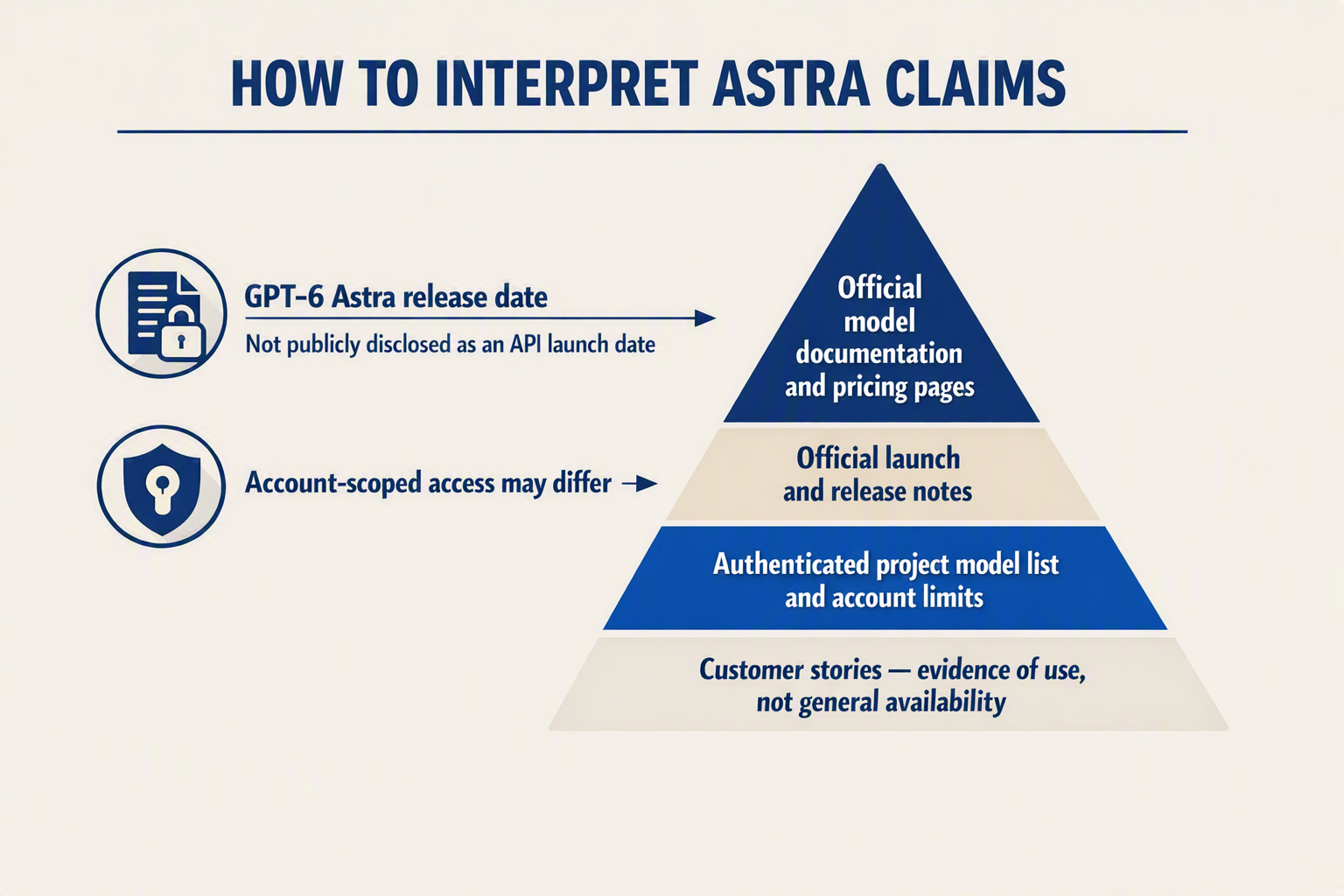
Experts should treat OpenAI’s GPT-6 Astra customer stories as evidence of controlled, real-world model use—not as API release documentation. The stories support claims about what Playco and Legora achieved, but they do not establish a launch date, public endpoint, account-eligibility rule, rollout category, or price.
Apply an evidence hierarchy
Different OpenAI pages answer different questions. A reliable interpretation separates them into three evidence levels:
- Customer stories establish observed use. They can confirm that a named organization used a named model for a described workload and reported specific results.
- Launch announcements establish release status. A dedicated announcement may define whether access is generally available, a public preview, a limited beta, or another rollout type.
- API documentation establishes implementable access. Model documentation, pricing pages, API references, account dashboards, and service terms provide usable model IDs, endpoints, quotas, regions, prerequisites, and costs.
For GPT-6 Astra, the available evidence reaches the first level but not the second or third. The researched OpenAI announcement and model-documentation results did not reveal a dedicated Astra launch page, model entry, or API identifier. This is a bounded research finding—not proof that no private or account-scoped deployment exists.
Read performance claims narrowly
Each reported result should remain attached to its original workload and customer:
- OpenAI reported on September 3, 2026, that Playco reduced manual fixes by 50% while producing three themed game prototypes from one grey-box foundation with GPT-6 Astra.
- OpenAI reported on September 3, 2026, that Legora reviewed 41 documents in minutes, found all four planted errors, and improved performance by nearly 40% with GPT-6 Astra.
These figures do not independently establish general benchmark superiority, reproducibility across unrelated tasks, or production performance under a public API service-level agreement. The stories may involve evaluation conditions, tooling, model configurations, or access arrangements that are not publicly disclosed.
Publication date also must not be converted into release date. September 3, 2026, is the date attached to the OpenAI customer stories; it is not verified as the date on which Astra became—or will become—available to developers.
Avoid unsupported access labels
Experts should not infer “partner-only,” “private preview,” “staged rollout,” or “public preview” merely because selected customers used GPT-6 Astra. Each label implies a defined access policy, and that policy is not publicly disclosed in the reviewed first-party material.
Safe language includes:
- “OpenAI has documented GPT-6 Astra use by Playco and Legora.”
- “Broad developer access has not been established by the reviewed OpenAI documentation.”
- “The model ID, endpoint, pricing, eligibility rules, and rollout classification are not publicly disclosed.”
- “Contacting OpenAI or checking an authorized account may reveal account-specific availability.”
Unsafe language includes “launched,” “generally available,” “coming soon,” or “available to enterprise customers” unless OpenAI explicitly publishes that status.
Keep implementation decisions documentation-led
Engineering teams should wait for a model listing or account-level authorization before writing Astra-specific code. OpenAI-compatible gateways such as CallMissed can reduce integration changes across documented models, but compatibility does not make an undocumented model identifier valid. Until OpenAI exposes an authorized identifier and commercial terms, customer outcomes are best interpreted as capability evidence without a verified public access contract.
What does GPT-6 Astra availability mean for developers, enterprises, procurement teams, and researchers?
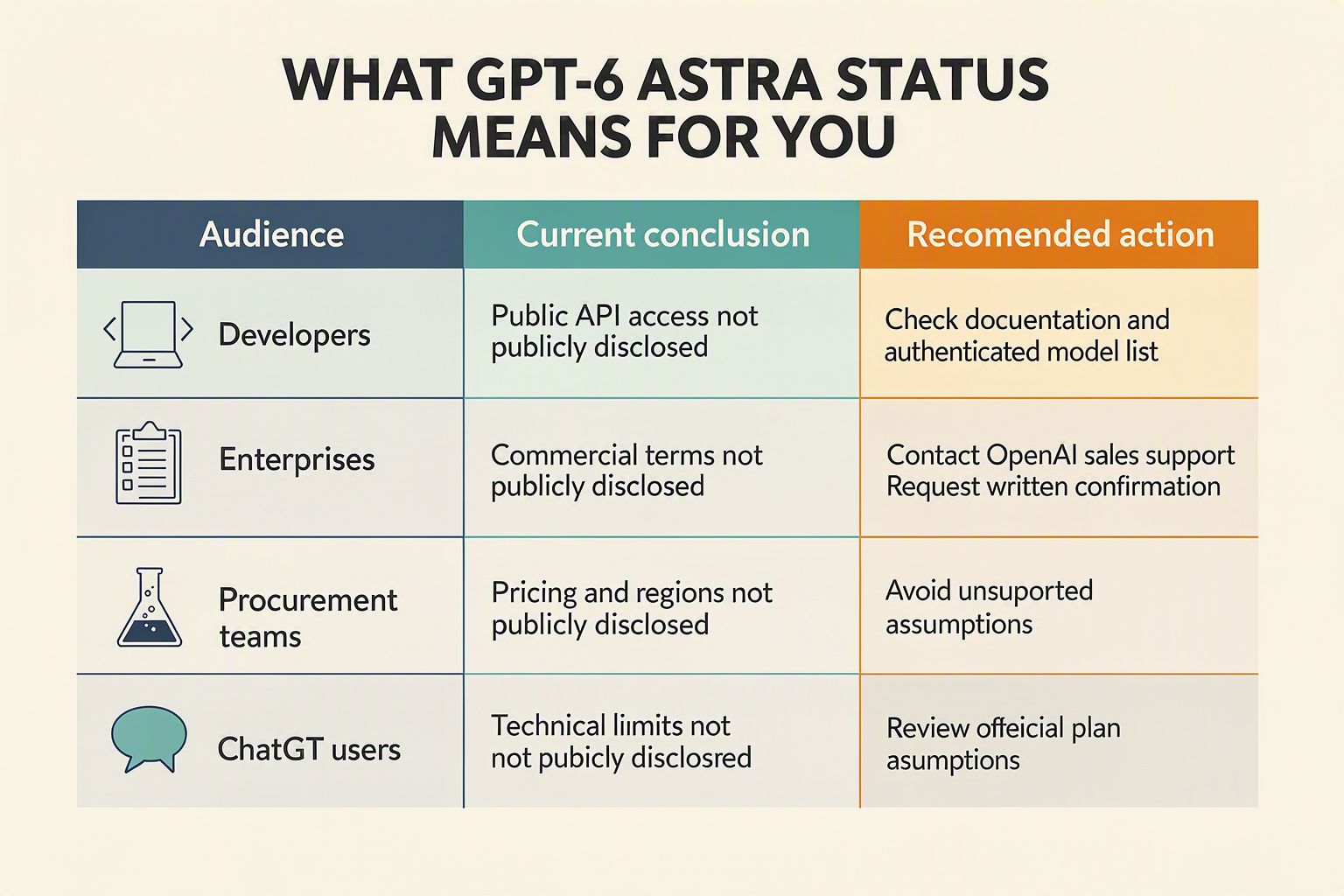
GPT-6 Astra’s documented customer use is a signal to evaluate, not a basis for production commitments. Developers, enterprises, procurement teams, and researchers should treat every unannounced access, pricing, governance, and technical field as not publicly disclosed until OpenAI publishes first-party documentation or confirms it inside an authorised account.
Practical implications by stakeholder
| Stakeholder | What is confirmed | What remains not publicly disclosed | Recommended action |
|---|---|---|---|
| Developers | OpenAI customer stories document GPT-6 Astra use by Playco and Legora. | API endpoints, model IDs, SDK support, rate limits, context window, regions and standard-account eligibility. | Do not code against guessed identifiers such as gpt-6-astra; use a configurable model layer and verify availability in official documentation and the account model list. |
| Enterprise architects | GPT-6 Astra has appeared in real workflows involving game prototyping and financial-document review. | Service tiers, latency targets, uptime commitments, quotas, deployment architecture and regional availability. | Keep Astra outside production architecture baselines until technical specifications and service terms are documented. |
| Procurement teams | Named organisations have reported measurable outcomes with GPT-6 Astra. | Input, cached-input and output-token pricing; batch discounts; minimum commitments; contract prerequisites and support terms. | Do not create estimated unit economics or approve a purchase order without an official quote, price sheet or contract schedule. |
| Security and legal teams | Legora used GPT-6 Astra for financial-statement review, according to OpenAI. | Data retention, training-use controls, subprocessors, residency, audit coverage and regulated-data eligibility specific to Astra. | Conduct a model-specific security and data-protection review rather than inheriting assumptions from another OpenAI product. |
| Researchers and evaluators | OpenAI has published two task-level outcome summaries. | Model card, system card, reproducible benchmark results, evaluation methodology, weights and research-access conditions. | Treat customer outcomes as case studies, not independent benchmarks; defer comparative claims until reproducible evidence exists. |
| Product leaders | Playco and Legora demonstrate potential use cases in creative development and document analysis. | Public preview status, partner-only status, staged-rollout terms, general-availability date and roadmap. | Prototype with currently documented models while keeping Astra as an optional future capability, not a launch dependency. |
Evidence is promising but narrow
OpenAI reported on September 3, 2026, that Playco achieved 50% fewer manual fixes while producing three themed game prototypes from one grey-box foundation with GPT-6 Astra. This supports a concrete prototyping use case, but it does not disclose the endpoint, commercial arrangement, evaluation baseline, or general eligibility.
OpenAI reported on September 3, 2026, that Legora reviewed 41 documents in minutes, found all four planted errors, and improved performance by nearly 40% with GPT-6 Astra. Procurement and research teams should preserve those qualifications: the figures describe a particular customer workflow, not a universal performance guarantee or a published benchmark.
Decisions teams can make now
- Separate capability evidence from availability evidence. Customer deployment proves observed use; it does not establish a public API, public preview, partner programme, or staged release.
- Mark unknowns explicitly. In architecture records, security reviews, budgets, and research papers, label Astra-specific pricing, limits, endpoints, regions, prerequisites, and governance terms not publicly disclosed.
- Avoid identifier speculation. Neither
gpt-6-astranorGPT-6-ASTRAis a verified model ID in the researched OpenAI documentation. - Design for substitution. An abstraction layer or OpenAI-compatible gateway can reduce migration work if Astra later becomes documented. For example, CallMissed’s OpenAI-compatible gateway provides access to multiple model providers with same-tier fallbacks, allowing teams to avoid making an undisclosed model critical to current delivery.
- Require first-party confirmation. Before contracting or deploying, obtain official OpenAI documentation, account-level access evidence, pricing, quotas, regional terms, and model-specific data controls.
How can you verify GPT-6 Astra API access for your own OpenAI account and project?
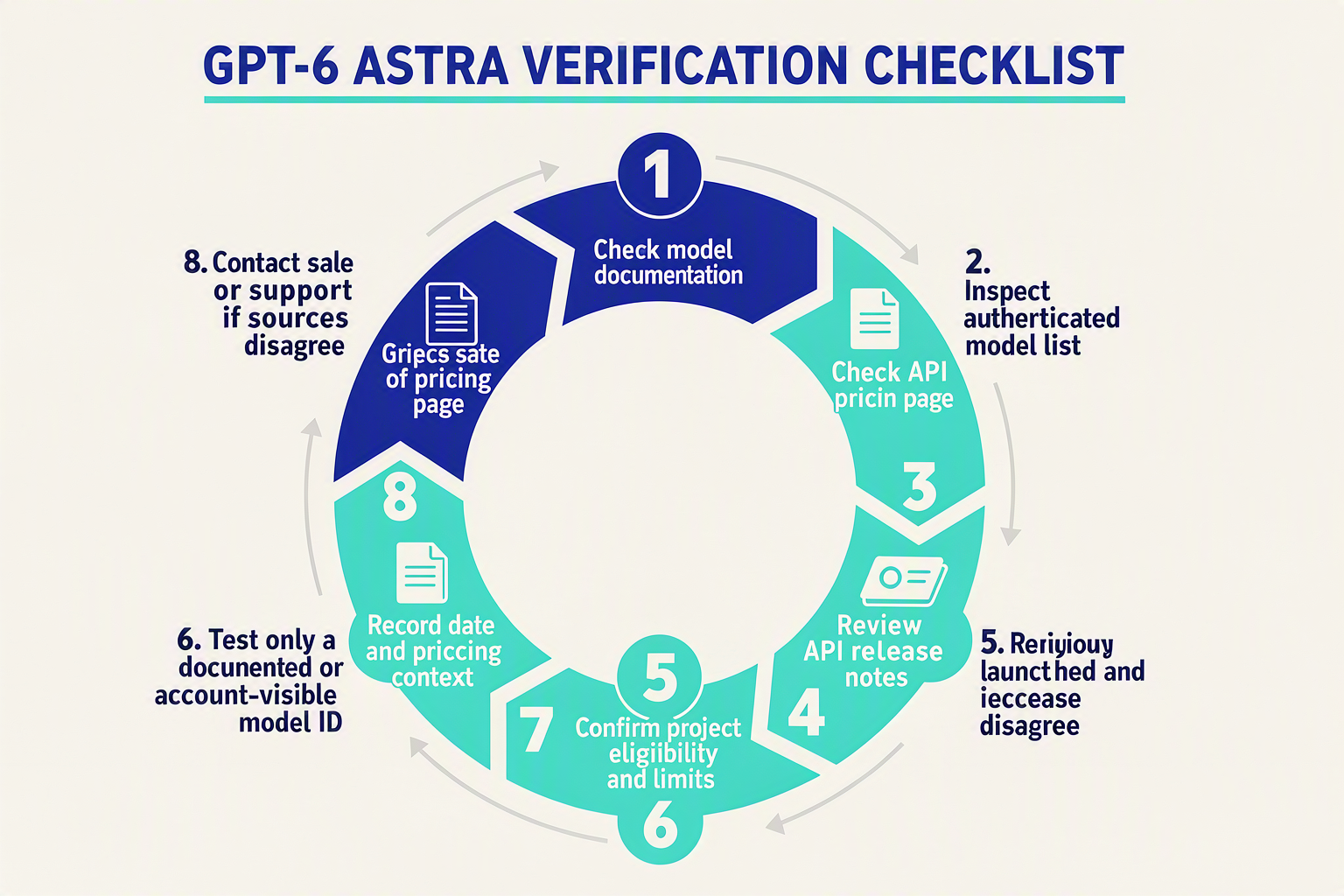
You can verify GPT-6 Astra access only by combining OpenAI’s official model documentation with the models and permissions exposed to your specific organisation, project, and API key. As of September 3, 2026, the researched first-party material does not provide a public GPT-6 Astra model ID, endpoint, eligibility process, or price.
Account-level verification checklist
- Check OpenAI’s official model documentation.
Search the OpenAI API documentation and model catalogue for “GPT-6 Astra” and “Astra.” The researched model-documentation results contained no GPT-6 Astra entry or confirmed model identifier as of September 3, 2026.
- Review your OpenAI organisation and project.
Sign in to the OpenAI Platform and select the exact organisation and project that will make the request. Model permissions, billing status, usage limits, and project configuration can differ across projects within the same account.
- Inspect the models available to your authenticated API key.
Use OpenAI’s documented model-listing method or the relevant dashboard view rather than relying on an unauthenticated website search. If GPT-6 Astra is available through an account-scoped programme, it should appear under an official identifier supplied by OpenAI.
- Do not guess the model name.
Neither gpt-6-astra nor GPT-6-ASTRA is a verified model ID in the researched first-party documentation. A failed request using an invented string proves only that the string did not work in that project; it does not establish Astra’s wider release status.
- Check project permissions and service limits.
Confirm that the API key belongs to the intended project and that the project permits the relevant endpoint. A missing model may reflect unavailable access, a different organisation, restricted project permissions, or an account-specific deployment.
- Request written confirmation from OpenAI.
If an OpenAI representative has offered access, ask for the exact model ID, supported endpoint, region, service tier, rate limits, pricing, data-processing terms, and rollout status. For GPT-6 Astra, each of these fields remains not publicly disclosed in the reviewed first-party sources.
- Save dated evidence before production planning.
Record the documentation page, dashboard state, API response, project ID, and confirmation date. Access can change, so a test from another developer’s account is not evidence that your project is eligible.
How to interpret the result
Treat verification as three distinct evidence levels:
- Documented and accessible: OpenAI publishes the model and your authorised project exposes it.
- Account-scoped access: Your project exposes an OpenAI-supplied model ID, but public documentation remains absent. Confirm contractual terms directly with OpenAI.
- Unverified: The model appears only in customer stories, community posts, screenshots, or unsupported model strings.
OpenAI reported on September 3, 2026 that Playco reduced manual fixes by 50% while using GPT-6 Astra. OpenAI separately reported that Legora reviewed 41 documents in minutes, found all four planted errors, and improved performance by nearly 40%. These results verify selected customer use—not access for your account.
If you use an intermediary such as CallMissed’s OpenAI-compatible multi-model gateway, inspect its published model catalogue separately; gateway availability cannot establish direct OpenAI account eligibility. For procurement or deployment, the decisive evidence is a documented identifier that successfully appears and operates within your authorised project under confirmed commercial terms.
Frequently asked questions about GPT-6 Astra API access, pricing, model IDs and availability
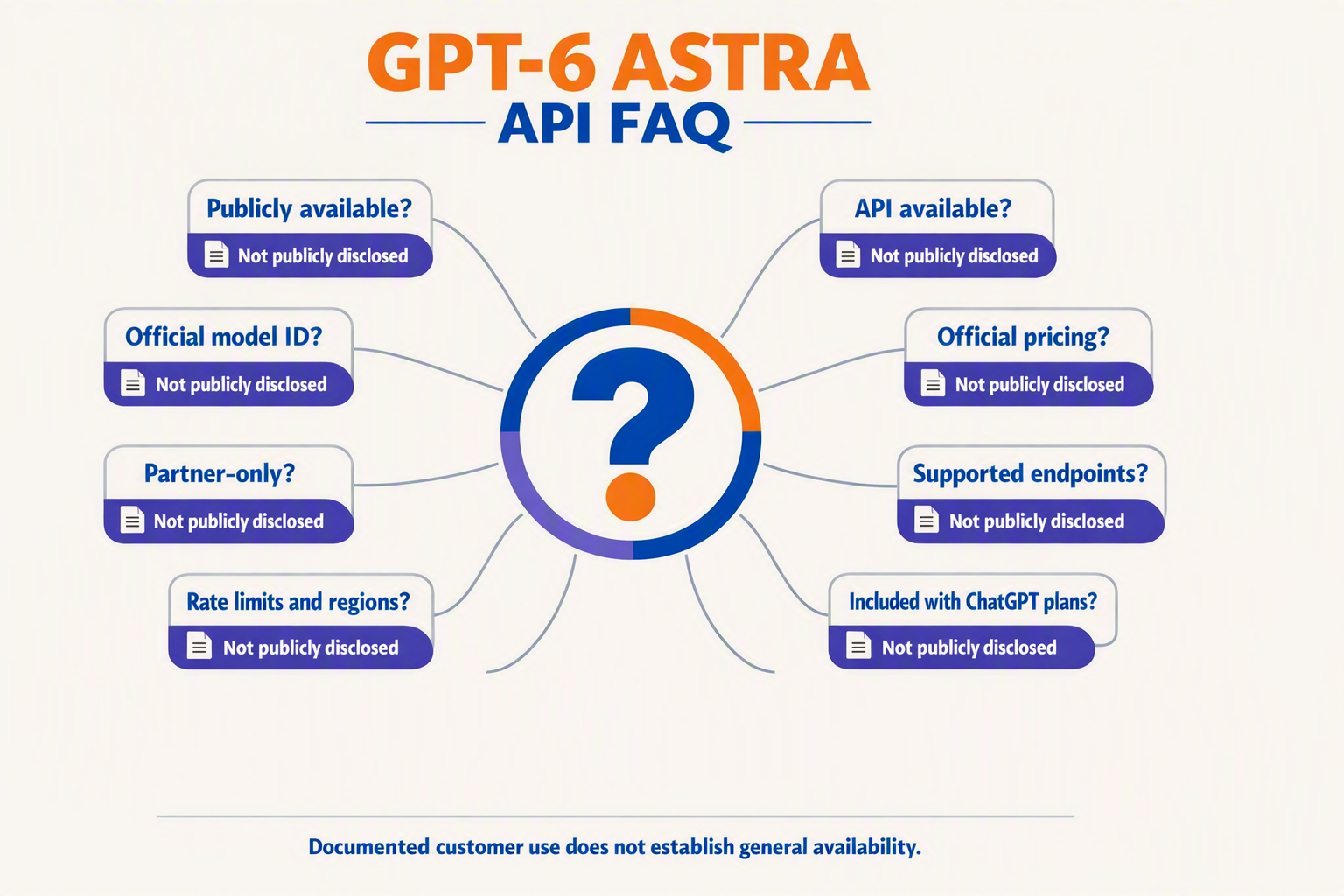
Is GPT-6 Astra publicly available as of September 3, 2026?
Does GPT-6 Astra have an API, official model ID, or supported endpoints?
gpt-6-astra. Endpoint and feature compatibility may differ by account or evolve after launch. Developers should check the current OpenAI model documentation and their account console before assuming support for the Responses API, Chat Completions, Batch API, fine-tuning, streaming, tools, or structured outputs.Pricing and eligibility
How much does the GPT-6 Astra API cost?
Is GPT-6 Astra partner-only, invitation-only, or being released through a staged rollout?
Limits, regions, and ChatGPT plans
What are the GPT-6 Astra API rate limits, context window, endpoints, and supported regions?
Do ChatGPT Plus, Pro, Business, Enterprise, or Edu subscriptions include GPT-6 Astra access?
Conclusion
Bottom line
As of September 3, 2026, GPT-6 Astra has documented customer use, but OpenAI’s reviewed first-party materials do not establish a public API release, public preview, standard paid-account access, or published pricing. Developers should therefore treat GPT-6 Astra as not publicly verified for general API use, rather than infer availability from customer stories or community references.
- Real-world use is confirmed. OpenAI reported on September 3, 2026, that Playco achieved 50% fewer manual fixes while creating three themed game prototypes with GPT-6 Astra.
- Performance evidence is promising. OpenAI reported on September 3, 2026, that Legora reviewed 41 documents in minutes, found all four planted errors, and improved performance by nearly 40% with GPT-6 Astra.
- Public developer access remains unverified. Public API availability, public-preview status, partner-only access, staged-rollout terms, eligible regions, prerequisites, rate limits, service tiers and endpoints are not publicly disclosed.
- Pricing and identifiers remain unverified. Model IDs, input-token prices, cached-input rates, output-token prices, batch discounts and fine-tuning prices are not publicly disclosed. Neither
gpt-6-astranorGPT-6-ASTRAshould be used as an assumed model identifier.
What to watch next
The signals that would change this status are straightforward: an official OpenAI launch announcement, a GPT-6 Astra entry in OpenAI’s model documentation, a documented model ID, account-level availability, published endpoints, and a first-party pricing page. Until those appear, engineering teams should avoid budgeting around speculative token costs or designing production systems that depend on an undocumented identifier.
This status could change through a public launch, controlled preview or account-scoped rollout, but none of those access paths can currently be confirmed from the reviewed public evidence. Teams should continue checking official documentation and their authorised OpenAI account rather than relying on community posts.
To explore how multi-model AI communication is evolving while availability changes, visit CallMissed, an OpenAI-compatible AI infrastructure platform supporting voice agents, multilingual chatbots and models across voice, text, images and search. When GPT-6 Astra’s API details emerge, will your architecture be flexible enough to evaluate them without a costly rewrite?
Related Reading
- GPT-6 Astra vs Claude Fable 5.1: Verified 2026 Comparison
- GPT-6 Astra Release Date: September 2026 Fact Check
- GPT-6 Astra Rumors vs Confirmed Facts: September 2026 Fact Check