GPT-6 Astra Release Date: September 2026 Fact Check


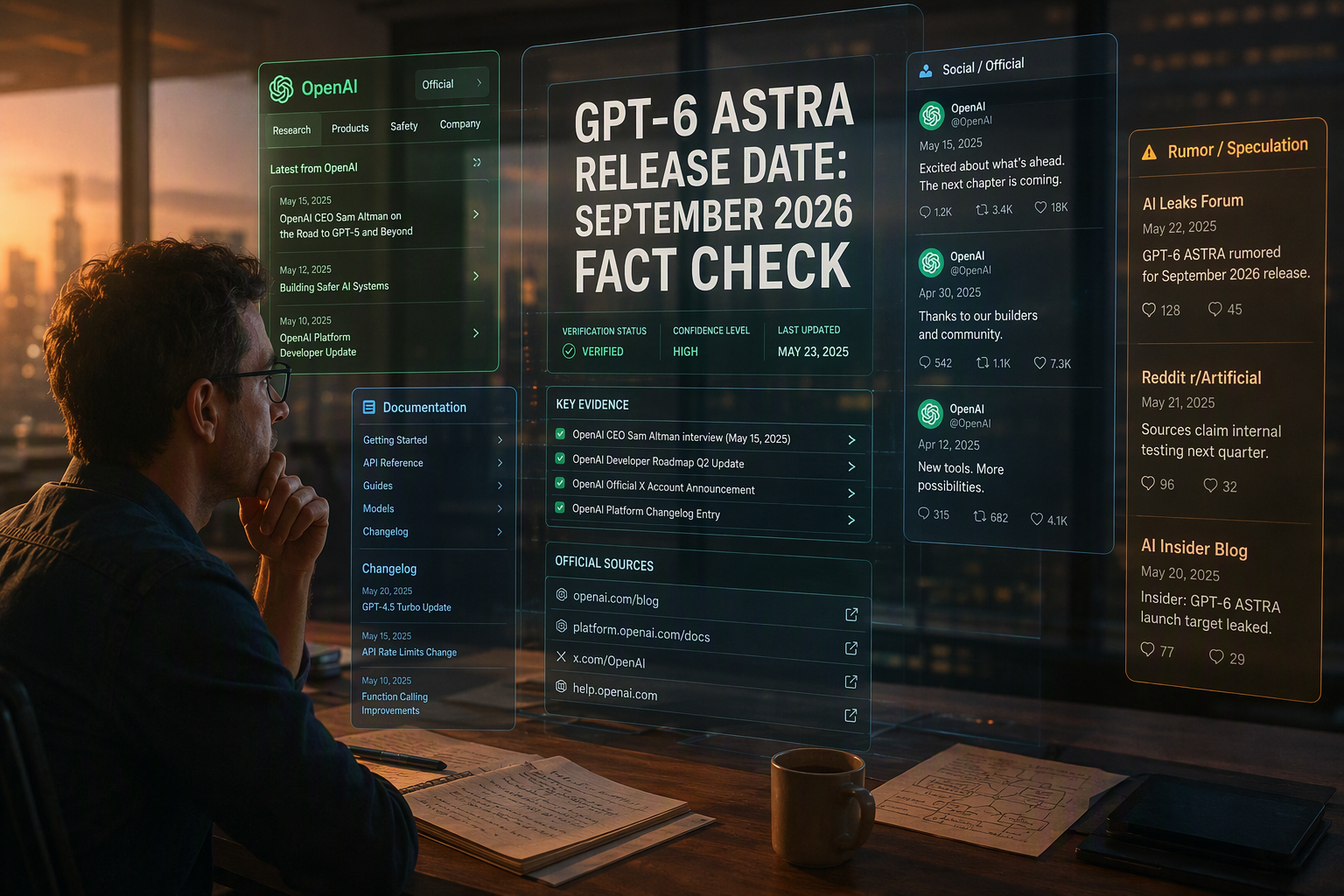
Verify the GPT-6 Astra release date, official OpenAI evidence, API availability, naming rumors, and buyer guidance as of September 2026.
GPT-6 Astra Release Date: September 2026 Fact Check
The GPT-6 Astra release date is now confirmed: OpenAI officially released GPT-6 Astra on September 3, 2026. As of September 5, OpenAI has published a launch page, system card, safety overview, API model identifier and standard pricing. This article has been updated to distinguish those confirmed release facts from earlier rumors and from access details that can still vary by account, product or region.
Status as of September 3, 2026: OpenAI’s customer-story listings provide first-party confirmation that the GPT-6 Astra label is being used publicly. However, those listings alone do not confirm that every customer or developer can access the model.
The strongest evidence comes from two OpenAI customer stories published or listed on September 3, 2026:
- OpenAI reports that Playco used GPT-6 Astra to create three themed game prototypes from one grey-box foundation and required 50% fewer manual fixes than its comparison workflow.
- OpenAI reports that Legora used GPT-6 Astra to review 41 documents in minutes, identify all four planted errors, and improve performance by nearly 40%.
Those are concrete, attributable claims—and materially stronger evidence than screenshots, anonymous leaks, community speculation, or social posts. Yet customer case studies can describe preview, partner, evaluation, or limited-access systems. They are not automatically equivalent to an entry in OpenAI’s API documentation or an announcement that a model is generally available.
The naming confusion makes careful verification especially important. “GPT-6 Astra” appears verbatim in the supplied OpenAI results, while “GPT Astra 6” is a reordered phrase without equivalent first-party support in the available evidence. “OpenAI Astra” may be used informally, but it should not be treated as an official product name unless OpenAI adopts it in release notes or technical documentation. Claims that Astra is really “GPT-5.7,” along with alleged cybersecurity scores, context windows, prices, and launch dates, remain rumors unless supported by traceable OpenAI materials.
This fact check will separate the GPT-6 Astra confirmed facts from GPT-6 Astra rumors, examine the current GPT-6 API status, and explain how to verify any future launch through model documentation, API availability, release notes, pricing pages, and safety evaluations. It will also show why benchmark and cost comparisons assembled before standardized access are unreliable: model variants, test settings, token accounting, tool use, and unpublished preview conditions can radically change results.
For developers who need deployable AI now, gateways such as CallMissed’s OpenAI-compatible API offer access to documented LLM, speech, image, and search models without requiring teams to build around an unverified future release.
Is GPT-6 Astra released? Confirmed September 3, 2026 launch, API access and pricing
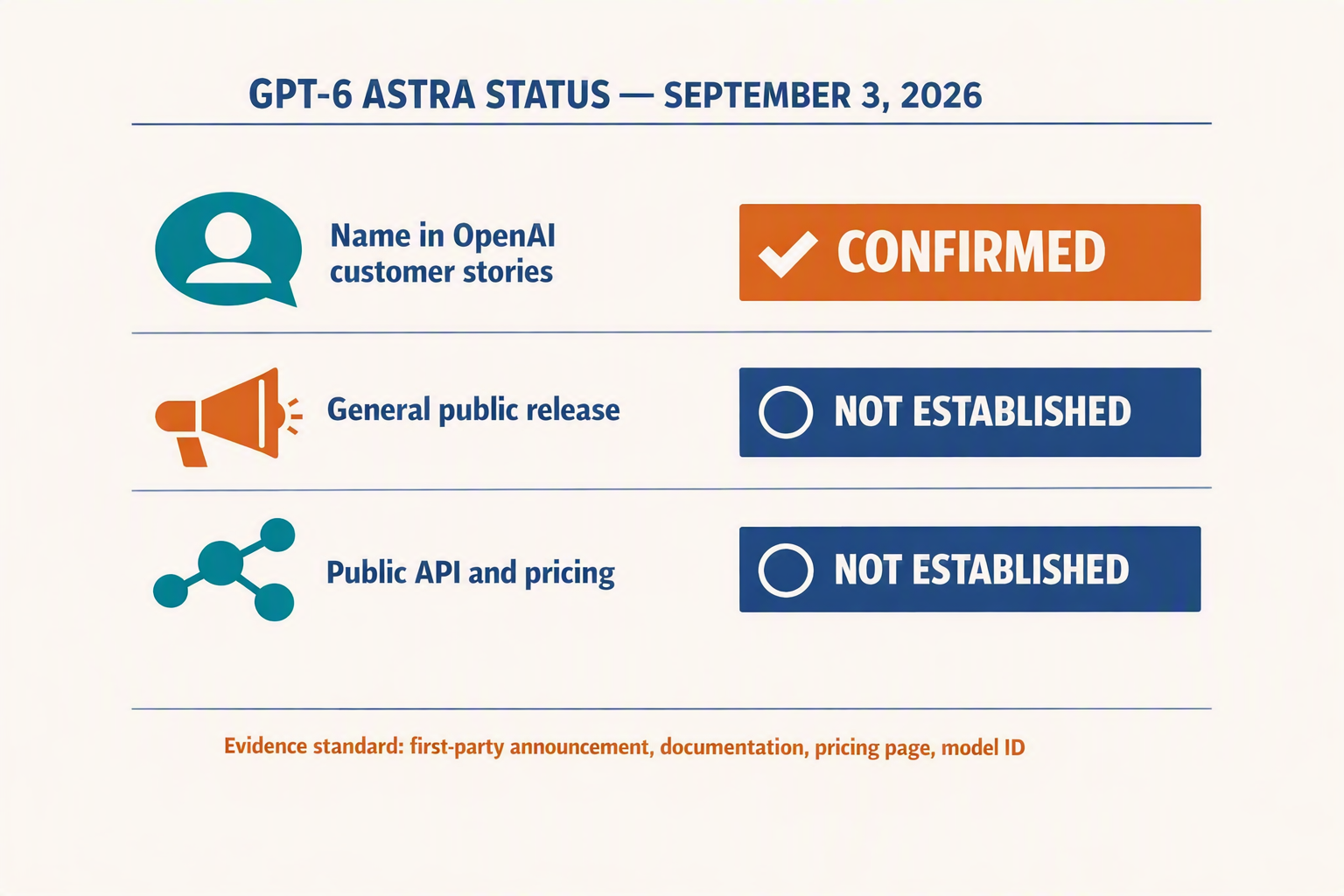
GPT-6 Astra was officially released on September 3, 2026. As of September 5, OpenAI describes the model as broadly deployed, has published a system card and safety overview, and lists the public API model identifier gpt-6-astra. September 3 is therefore the confirmed GPT-6 Astra release date, although availability can still differ by product, account, and region.
Status check — September 5, 2026
>
- Official release: Confirmed by OpenAI
- GPT-6 Astra release date: September 3, 2026
- Deployment status: Described by OpenAI as broadly deployed
- Public API model: gpt-6-astra
- System card and safety overview: Published
- Standard API pricing: Published
- Access for every product, account, and region: May vary
What OpenAI has confirmed
OpenAI’s September 3 materials establish that GPT-6 Astra is no longer merely a model name appearing in customer stories. The company officially released the model, described it as broadly deployed, documented its safety profile, and provided an API model identifier.
The standard API pricing is:
- Input: $10 per million tokens
- Cached input: $1 per million tokens
- Cache writes: $12.50 per million tokens
- Output: $50 per million tokens
The listing of gpt-6-astra resolves the earlier uncertainty about whether developers could identify a public API model. The published system card and safety overview also provide first-party technical and deployment documentation beyond the initial customer-use evidence.
Why availability may still differ after release
An official release does not necessarily mean every user receives identical access at the same moment. Product rollouts may depend on the interface being used, the customer’s plan or account, regional availability, organizational controls, capacity, and staged deployment decisions.
For that reason, a user who does not yet see GPT-6 Astra in a particular product should not conclude that the model remains unreleased. The relevant distinction is:
- Release status: Confirmed on September 3, 2026.
- API status: Confirmed through the
gpt-6-astramodel listing and published pricing. - Individual availability: Potentially variable by product, account, and region.
September 3 remains the confirmed GPT-6 Astra release date even if access reaches some customers or product surfaces later.
The fact-check verdict
The earlier “officially named but not generally released” assessment is now outdated. As of September 5, 2026:
- Confirmed: OpenAI officially released GPT-6 Astra on September 3.
- Confirmed: OpenAI describes the model as broadly deployed.
- Confirmed: The API model identifier is
gpt-6-astra. - Confirmed: OpenAI published a system card and safety overview.
- Confirmed: Standard API prices are $10 per million input tokens, $1 per million cached-input tokens, $12.50 per million cache-write tokens, and $50 per million output tokens.
- Important qualification: Access can still vary by product, account, and region.
The verified GPT-6 Astra release date is September 3, 2026. Any later date associated with a specific account or product should be understood as an access or rollout date, not the model’s official release date.
Why are “GPT Astra 6,” “GPT-6 Astra,” and “OpenAI Astra” being confused?
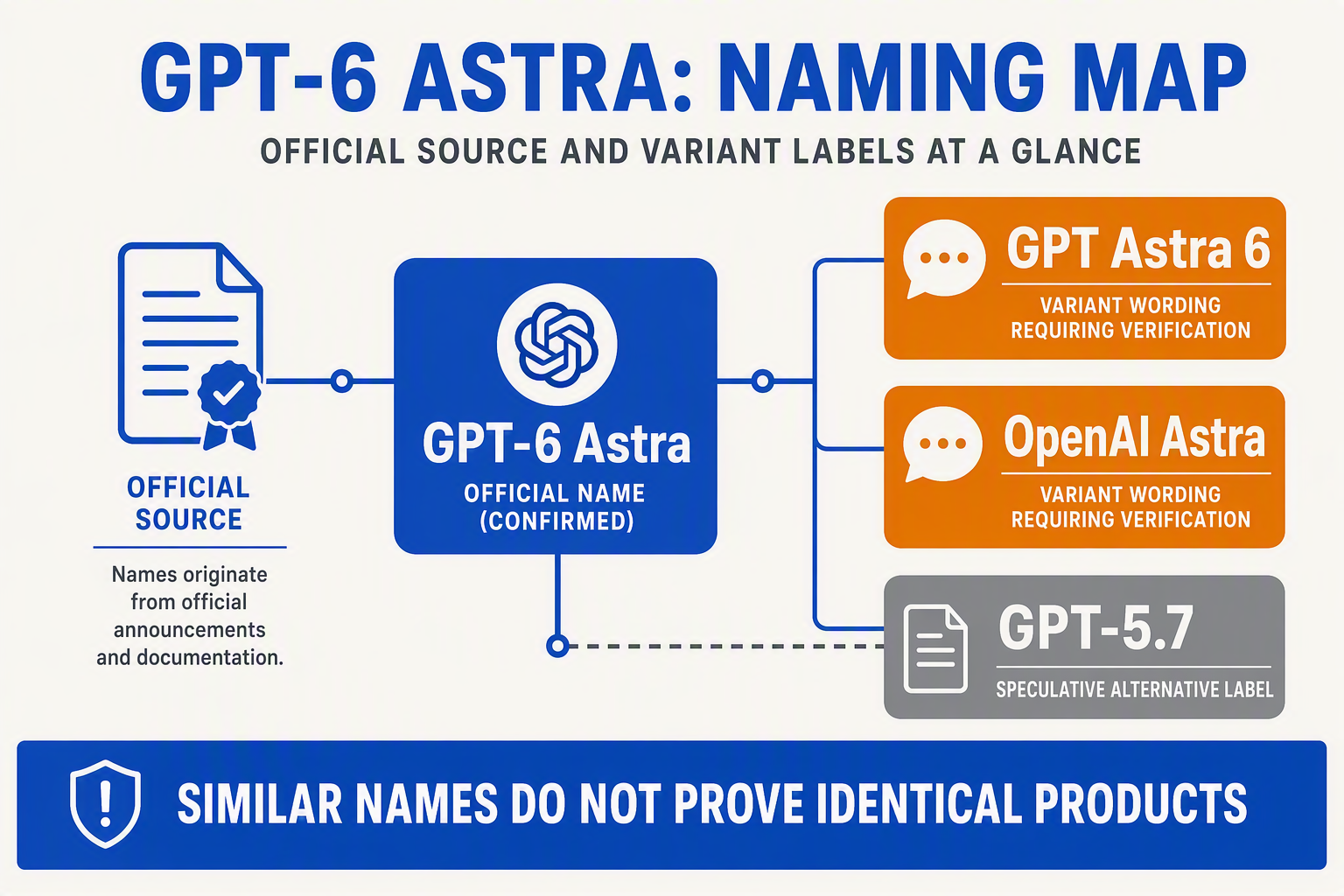
The three phrases are being confused because search engines, community posts, and informal summaries often reorder or shorten product names. Only “GPT-6 Astra” appears verbatim in the supplied first-party OpenAI evidence; “GPT Astra 6” and “OpenAI Astra” should not be treated as equivalent official names.
One confirmed label, two informal variants
The evidence supports a simple naming hierarchy:
- GPT-6 Astra — first-party usage. OpenAI’s customer-stories directory uses this exact label for the Playco and Legora case studies dated September 3, 2026.
- GPT Astra 6 — reordered wording. The supplied OpenAI pages do not use this word order. It may emerge from mistyped searches, machine-generated summaries, translated text, or people recalling the name imprecisely.
- OpenAI Astra — informal shorthand. This phrase combines the company name with “Astra,” but the available evidence does not identify it as the formal model or product name.
- Astra — ambiguous on its own. OpenAI’s case-study URLs end with phrases such as “with-astra,” which can encourage readers and search systems to drop the GPT-6 portion of the displayed name.
That distinction matters because brand-name variants are not interchangeable evidence. A webpage mentioning GPT-6 Astra does not independently confirm separate products called GPT Astra 6, Astra GPT-6, or OpenAI Astra.
Search snippets can collapse important distinctions
OpenAI’s customer-story listing provides unusually strong evidence that the name is real, but snippets expose it without the complete release context. OpenAI’s September 3, 2026 customer-story directory lists both “Legora reviewed 41 documents in minutes with GPT-6 Astra” and “Playco cut manual fixes 50% prototyping games with GPT-6 Astra.”
Those concise cards can be copied into posts, headlines, and AI-generated answers. During that process, several transformations commonly occur:
- A possessive phrase such as “OpenAI’s Astra” becomes “OpenAI Astra.”
- The model family and codename are reordered into “GPT Astra 6.”
- Quotation marks around “Astra” lead readers to interpret it as an internal codename.
- A documented customer use case is incorrectly summarized as a public launch.
- Repetition across OpenAI navigation modules is mistaken for multiple independent announcements.
The supplied search results illustrate the last problem: the same GPT-6 Astra story cards appear on OpenAI pages concerning NVIDIA, RingCentral, and startups. These placements reinforce visibility, but they do not constitute separate confirmations of API access, pricing, or general availability.
Community discussion is evidence of attention, not release status
An OpenAI Community discussion refers speculatively to a GPT-6 “Astra” model and says OpenAI “maybe” is preparing the next model. The word “maybe” is decisive: it signals interpretation rather than a company announcement.
A reliable fact check should therefore label every claim by evidence type:
- Confirmed name usage: OpenAI customer stories.
- Confirmed customer-reported outcomes: Playco’s 50% reduction in manual fixes and Legora’s nearly 40% performance improvement, as reported by OpenAI.
- Unconfirmed naming variants: GPT Astra 6 and OpenAI Astra.
- Unconfirmed product claims: public release dates, API model IDs, prices, context limits, benchmark scores, and the proposed GPT-5.7 identity.
Until OpenAI publishes model documentation or release notes, searches for these three names may describe the same rumored subject—but they do not carry the same factual weight.
Which key developments support or contradict the claimed GPT-6 Astra release timeline?
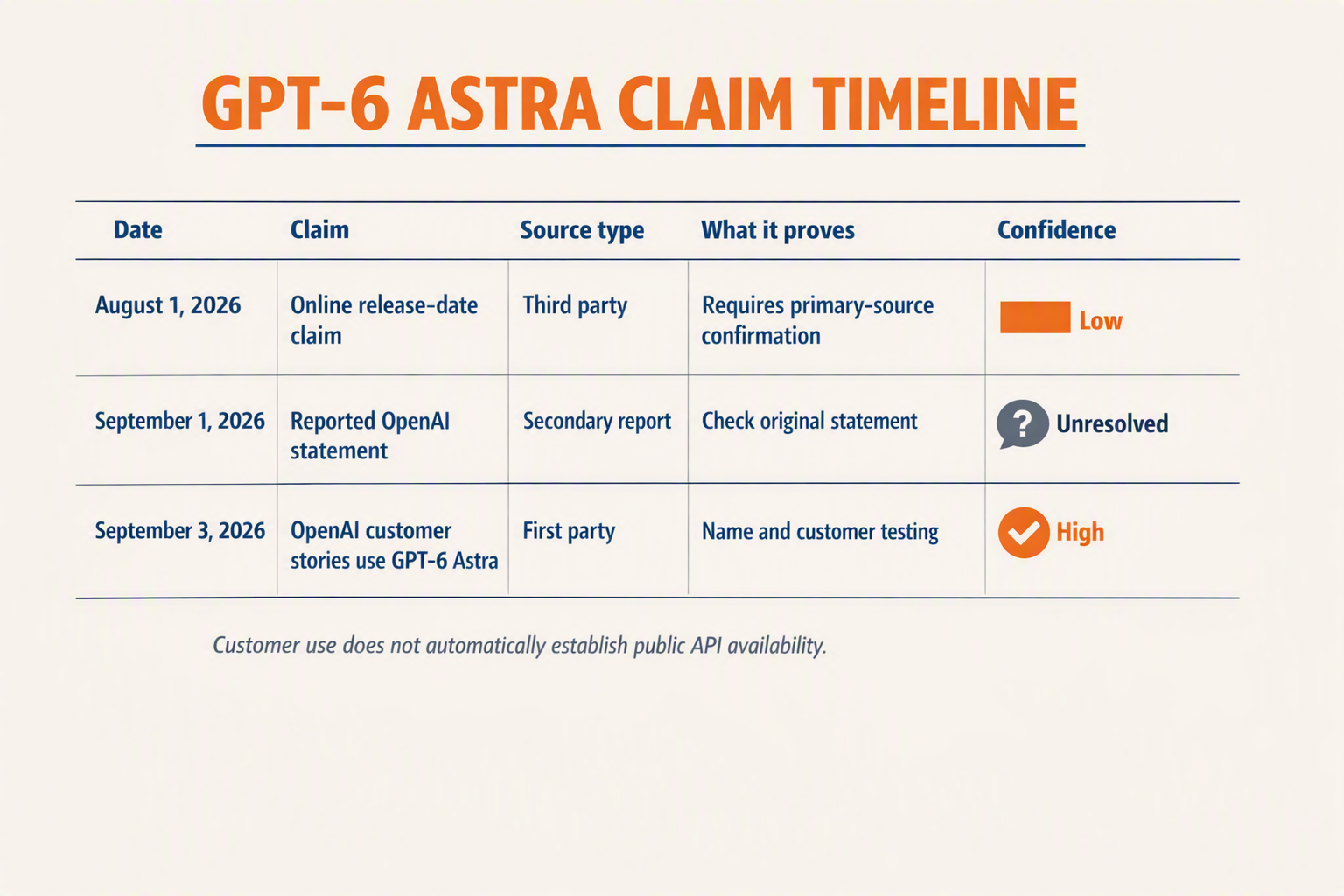
The available evidence supports September 3, 2026, as the date OpenAI publicly used the “GPT-6 Astra” name in customer stories—not as a confirmed general-release date. No supplied OpenAI announcement, API reference, pricing page, model card, or ChatGPT release note establishes when broader access began or will begin.
Evidence timeline and what each event proves
| Date or stage | Development | Evidence level | Effect on the claimed release timeline |
|---|---|---|---|
| Before September 3, 2026 | No earlier dated OpenAI launch announcement appears in the supplied evidence. | No verified release record | Contradicts claims of a documented earlier public launch unless additional first-party evidence emerges. |
| September 3, 2026 | OpenAI’s customer-story directory listed Playco and Legora stories using the exact name “GPT-6 Astra.” | First-party naming evidence | Confirms that OpenAI publicly used the name by this date, but does not prove general availability. |
| September 3, 2026 | OpenAI reported that Playco created three themed game prototypes from one grey-box foundation with 50% fewer manual fixes than its comparison workflow. | First-party customer case study | Supports real-world or evaluation-stage use, but does not identify an API launch date, access tier, or rollout scope. |
| September 3, 2026 | OpenAI reported that Legora reviewed 41 documents in minutes, found all four planted errors, and improved performance by nearly 40%. | First-party customer case study | Supports access by a named customer, not a confirmed release to all developers or ChatGPT users. |
| September 3, 2026 | GPT-6 Astra cards also appeared across OpenAI pages for startups and other customer stories, including NVIDIA and RingCentral pages. | First-party site cross-listing | Strengthens confirmation of the label, but repeated cards may reflect sitewide content syndication rather than separate launch announcements. |
| As of September 3, 2026 | The supplied evidence contains no GPT-6 Astra API documentation, model identifier, pricing, model card, safety report, or general ChatGPT rollout notice. | Missing launch documentation | Strongly contradicts claims that a conventional, fully documented public release has already occurred. |
Why the customer stories matter—but are not enough
The Playco and Legora reports move GPT-6 Astra beyond an anonymous leak or invented model name. OpenAI itself attributes measurable outcomes to the system, making September 3 a defensible first-party public-evidence date within the available record.
However, a customer story can cover several access states:
- Private preview with selected organizations
- Research or product evaluation under controlled conditions
- Partner access before broader availability
- Limited production deployment without a public API
- General availability, but only when explicitly documented
The stories do not specify which state applies. They also do not establish that “GPT Astra 6” or “OpenAI Astra” are official alternative names.
What would confirm the actual release date?
A credible GPT-6 Astra release date should be tied to at least one operational artifact:
- An OpenAI launch announcement stating availability and rollout timing.
- A documented API model ID with endpoint compatibility.
- Published pricing, rate limits, regional access, and usage terms.
- A model card or safety evaluation identifying the released variant.
- ChatGPT release notes naming eligible plans and deployment dates.
Until one or more of those records appears, the precise conclusion is: GPT-6 Astra was publicly named and shown in customer use on September 3, 2026, but the supplied evidence does not confirm a general public or API release on that date.
What do OpenAI’s Playco and Legora customer stories actually confirm about GPT-6 Astra?
OpenAI’s Playco and Legora customer stories confirm that OpenAI publicly used the name “GPT-6 Astra” on September 3, 2026 and attributed specific task results to it. They do not, by themselves, confirm a public launch, general ChatGPT access, an API model ID, pricing, or a release date.
What the Playco story confirms
The Playco case study describes a game-prototyping workflow rather than a standardized model benchmark. OpenAI reported on September 3, 2026, that Playco created three themed game prototypes from one grey-box foundation with GPT-6 Astra and needed 50% fewer manual fixes than its comparison workflow.
That supports several narrow conclusions:
- GPT-6 Astra was used in a real customer evaluation or workflow.
- The task involved transforming a shared game foundation into three themed prototypes.
- Playco reported a 50% reduction in manual fixes under the tested conditions.
- OpenAI considered the result suitable for publication under the exact GPT-6 Astra label.
However, “50% fewer manual fixes” is not a universal coding-quality score. Without the complete baseline, sample size, prompting method, model settings, reviewer criteria, and repeated-trial data, the figure cannot establish how Astra would perform across unrelated games, software repositories, or coding benchmarks.
What the Legora story confirms
The Legora case study concerns financial-document review. OpenAI reported on September 3, 2026, that Legora used GPT-6 Astra to review 41 documents in minutes, identify all four planted errors, and improve performance by nearly 40%.
The first-party claim therefore confirms:
- A test set containing 41 documents;
- A completion time described as minutes;
- Detection of four out of four planted errors;
- A reported performance improvement of nearly 40%.
These details are meaningful evidence of a customer deployment or evaluation, but they are not equivalent to an independent legal-AI benchmark. The supplied OpenAI result does not specify enough methodological detail to extrapolate the result to every contract, jurisdiction, financial statement, or production environment. “Nearly 40%” also requires a defined baseline and metric before buyers can compare it with another model.
What neither story establishes
Customer stories document outcomes; product documentation defines availability. Based on the supplied evidence, the Playco and Legora pages do not establish:
- A GPT-6 Astra release date for general users;
- A selectable model in ChatGPT;
- A public GPT-6 API status or official API model identifier;
- Input, output, cached-token, image, audio, or tool-use pricing;
- Context-window and maximum-output limits;
- A model card, system card, safety report, or cybersecurity evaluation;
- Whether access was a preview, private beta, partner program, or production tier.
The correct fact-check verdict
The defensible wording is: “GPT-6 Astra is a first-party-confirmed OpenAI model name associated with two published customer results.” It is not yet defensible, from these stories alone, to write: “GPT-6 Astra is generally released” or “the GPT-6 Astra API is available.”
The distinction also resolves part of the naming dispute. OpenAI’s customer-story index uses “GPT-6 Astra” verbatim for both Playco and Legora; the supplied first-party evidence does not use “GPT Astra 6,” “OpenAI Astra,” or “GPT-5.7” as equivalent official model names. Until OpenAI publishes release notes, API documentation, pricing, and access instructions, those alternative labels—and any specifications attached to them—should be treated as unverified.
What is the GPT-6 API status, and which official signals would prove public availability?
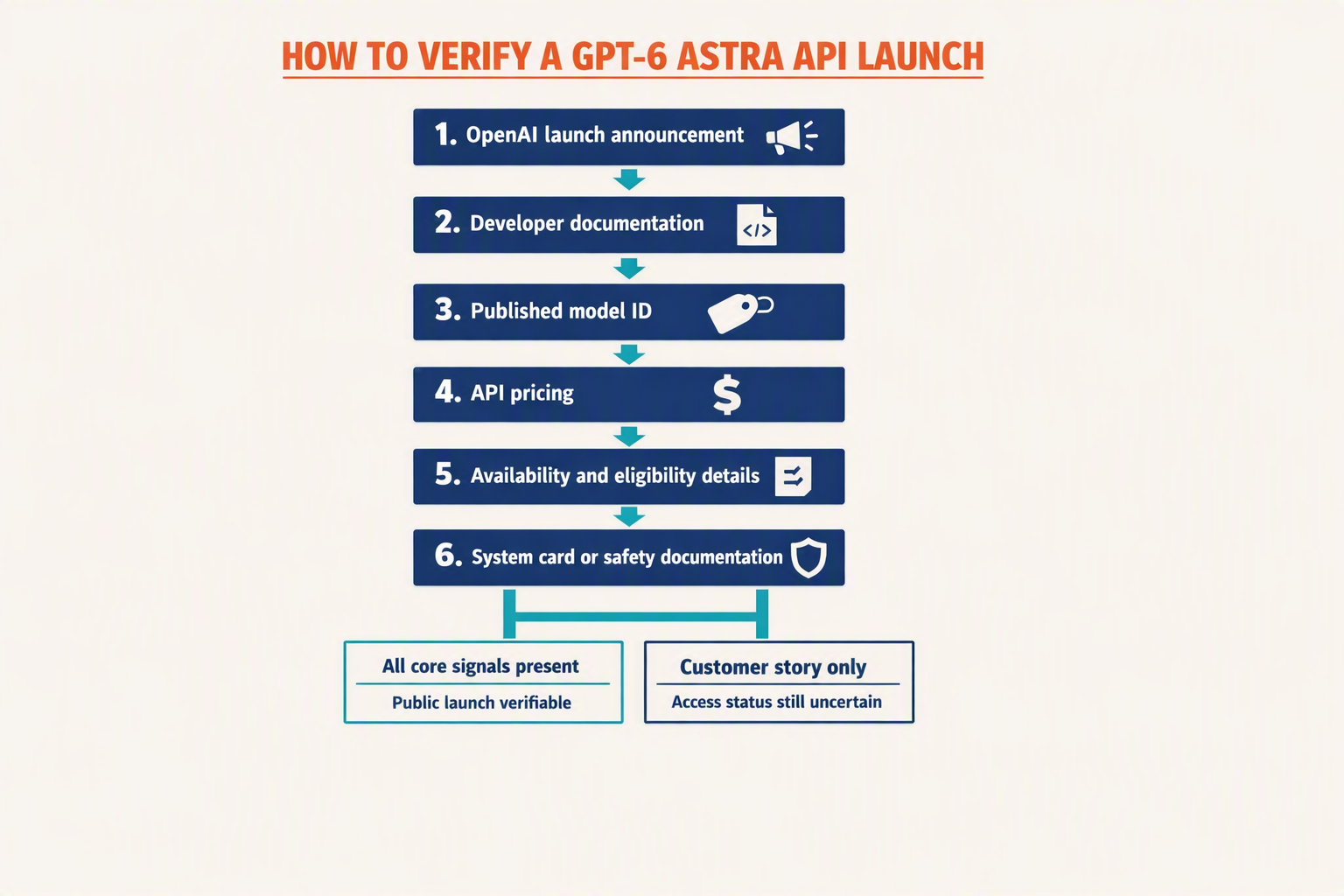
As of September 5, 2026, OpenAI has confirmed the public GPT-6 Astra API through its official launch announcement, published pricing, and documented model ID: gpt-6-astra. Developers can now integrate the model through the OpenAI API, subject to account eligibility, regional availability, quotas, and safety controls.
What confirms the GPT-6 Astra API launch?
The launch is supported by multiple consistent first-party signals:
- Official launch announcement: OpenAI publicly announced GPT-6 Astra API availability.
- Documented model ID: API requests use the official identifier
gpt-6-astra. - Published pricing: OpenAI lists standard token prices for input, prompt caching, and output.
- Developer access: Eligible API customers can request the model under the access conditions applied to their accounts.
- Official technical guidance: OpenAI’s documentation establishes the supported API behavior and applicable usage requirements.
Together, these signals establish public API availability more reliably than customer stories, screenshots, source-code strings, or third-party model listings.
What does the GPT-6 Astra API cost?
OpenAI’s standard GPT-6 Astra API prices are:
- Input: $10 per 1 million tokens
- Cached input: $1 per 1 million tokens
- Cache writes: $12.50 per 1 million tokens
- Output: $50 per 1 million tokens
Actual spending depends on request volume, input and output length, cache usage, and any account-specific commercial terms. Teams should use OpenAI’s current pricing page and their account billing information when preparing production budgets.
Public availability does not mean identical access for every account
A public launch means OpenAI has officially released and documented the API; it does not guarantee that every developer can use it immediately under the same conditions. Access can vary based on:
- Account eligibility or verification
- API product or service tier
- Supported country or region
- Rate limits, token limits, and usage quotas
- Organization-level spending controls
- Capacity constraints
- Safety reviews and policy enforcement
- Feature-specific permissions or staged rollouts
A valid gpt-6-astra request may therefore work for one organization while another receives an access, quota, region, or policy error. Such differences do not negate the public launch; they indicate that availability remains subject to OpenAI’s operational and safety controls.
How should teams verify access?
Before budgeting for or deploying GPT-6 Astra, engineering and procurement teams should:
- Confirm that
gpt-6-astraappears in the official OpenAI documentation. - Check the current official pricing page.
- Verify access from the intended organization, project, and region.
- Submit a reproducible test request using the documented model ID.
- Review applicable quotas, rate limits, safety policies, and data-governance terms.
- Benchmark quality, latency, cache behavior, and total cost using representative workloads.
OpenAI’s earlier Playco and Legora customer stories remain evidence of pre-launch customer use. The September 2026 official launch materials, pricing page, and gpt-6-astra model identifier now provide the stronger evidence required to confirm public API availability.
Which GPT-6 Astra rumors about parameters, benchmarks, pricing, and cybersecurity evaluations remain unsupported?
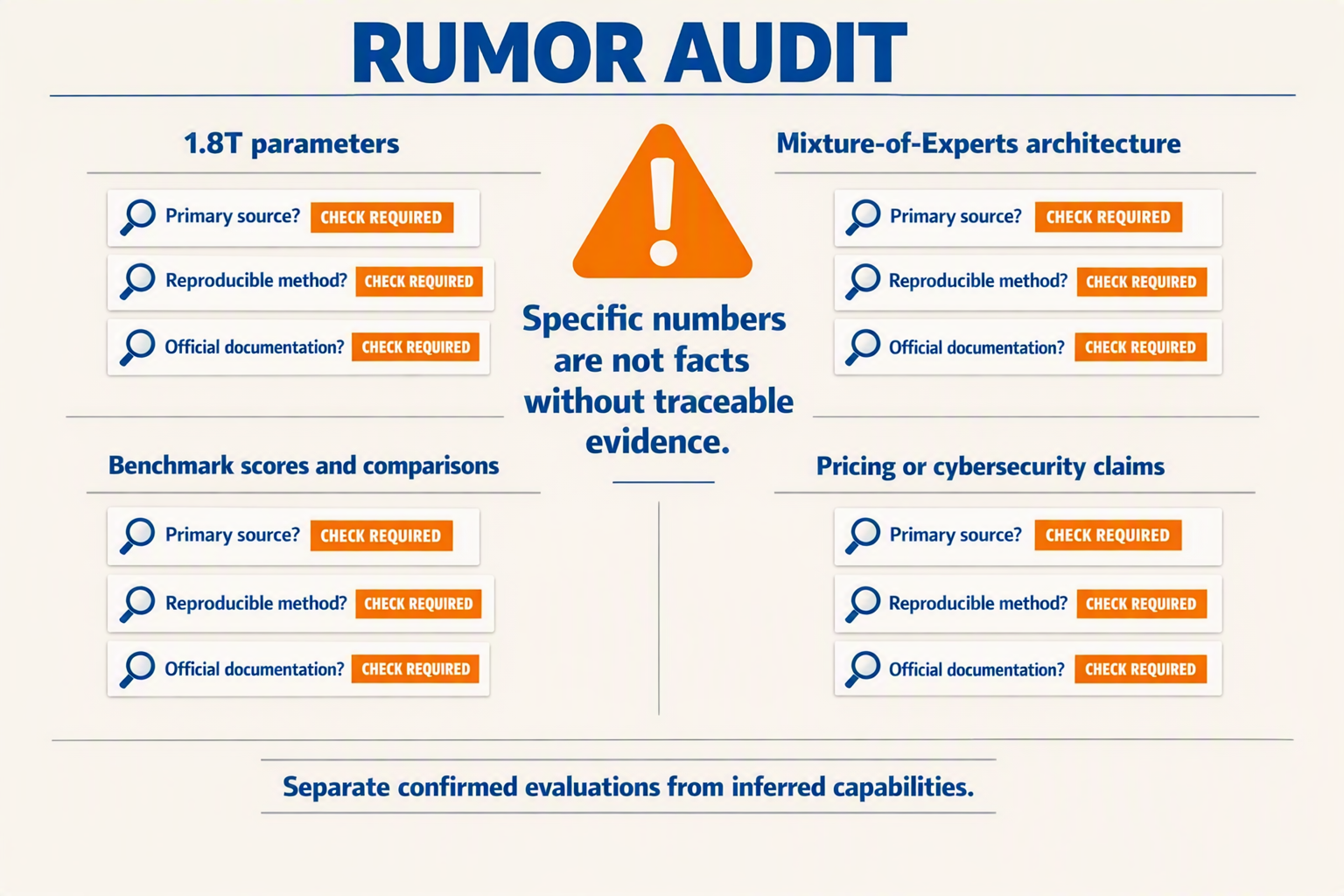
Claims about GPT-6 Astra’s parameter count, standardized benchmark scores, token pricing, context window, and cybersecurity evaluation results remain unsupported as of September 3, 2026. OpenAI’s customer stories confirm the GPT-6 Astra name and two applied outcomes, but the supplied first-party evidence does not include a model card, system card, pricing page, API reference, or reproducible benchmark report.
Parameters and architecture: no verified figure
No cited OpenAI document specifies GPT-6 Astra’s parameter count, active parameters, architecture, mixture-of-experts configuration, training-compute budget, or knowledge cutoff. Numbers circulating in social posts, screenshots, forums, or unattributed comparison tables should therefore be treated as speculation.
Parameter claims require a traceable source such as:
- An OpenAI technical report or model card
- Official API documentation naming the exact model variant
- A statement from an identifiable OpenAI representative
- Reproducible technical analysis clearly labeled as an estimate
Even an authentic release would not guarantee disclosure: AI developers do not always publish parameter counts, and parameter count alone does not reliably predict quality, latency, or deployment cost.
Customer outcomes are not standardized benchmarks
The two confirmed results are customer-specific evaluations, not evidence for rumored MMLU, GPQA, SWE-bench, ARC-AGI, coding, or multimodal leaderboard scores.
OpenAI reported on September 3, 2026, that Playco created three themed game prototypes from one grey-box foundation with GPT-6 Astra and required 50% fewer manual fixes than its comparison workflow.
OpenAI reported on September 3, 2026, that Legora reviewed 41 documents in minutes, found all four planted errors, and improved performance by nearly 40%.
These results are meaningful within their described workflows, but they do not establish general superiority. A defensible benchmark comparison would need the exact model snapshot, prompt set, scoring method, tool permissions, sampling settings, retry policy, test contamination controls, and baseline configuration. Without those details, a chart assigning GPT-6 Astra precise scores is not independently reproducible.
Pricing and API costs remain unconfirmed
No supplied OpenAI pricing page establishes a price for GPT-6 Astra input tokens, cached input, output tokens, reasoning tokens, batch processing, fine-tuning, or tool calls. Likewise, the customer stories do not demonstrate a generally available API model identifier.
Treat claims such as “$X per million tokens” as unsupported unless the figure appears in OpenAI’s official pricing documentation and identifies:
- The exact model and version
- Input and output rates separately
- Cached-token treatment
- Regional or service-tier conditions
- The pricing page’s effective date
Estimated costs derived from another GPT model cannot be relabeled as GPT-6 Astra pricing.
Cybersecurity scores require safety documentation
Claims about OpenAI Astra cybersecurity evaluations also remain unverified in the supplied evidence. There is no cited GPT-6 Astra system card describing cyber-capability tiers, safeguard testing, external red-team results, deployment restrictions, or Preparedness Framework findings.
A credible cybersecurity claim should identify the evaluation suite, task difficulty, access level, scoring baseline, tool availability, evaluator, and mitigation results. Phrases such as “passed cyber safety testing” or “achieved expert-level exploitation” are too vague without those details.
The correct verdict is unsupported, not necessarily false. OpenAI’s September 3 customer stories establish limited facts about the model’s name and two use cases; they do not validate the broader specification sheets now being attributed to “GPT Astra 6,” “GPT-6 Astra,” or “OpenAI Astra.”
How should expert commentary, media reports, leaks, and social posts be weighed against OpenAI documentation?
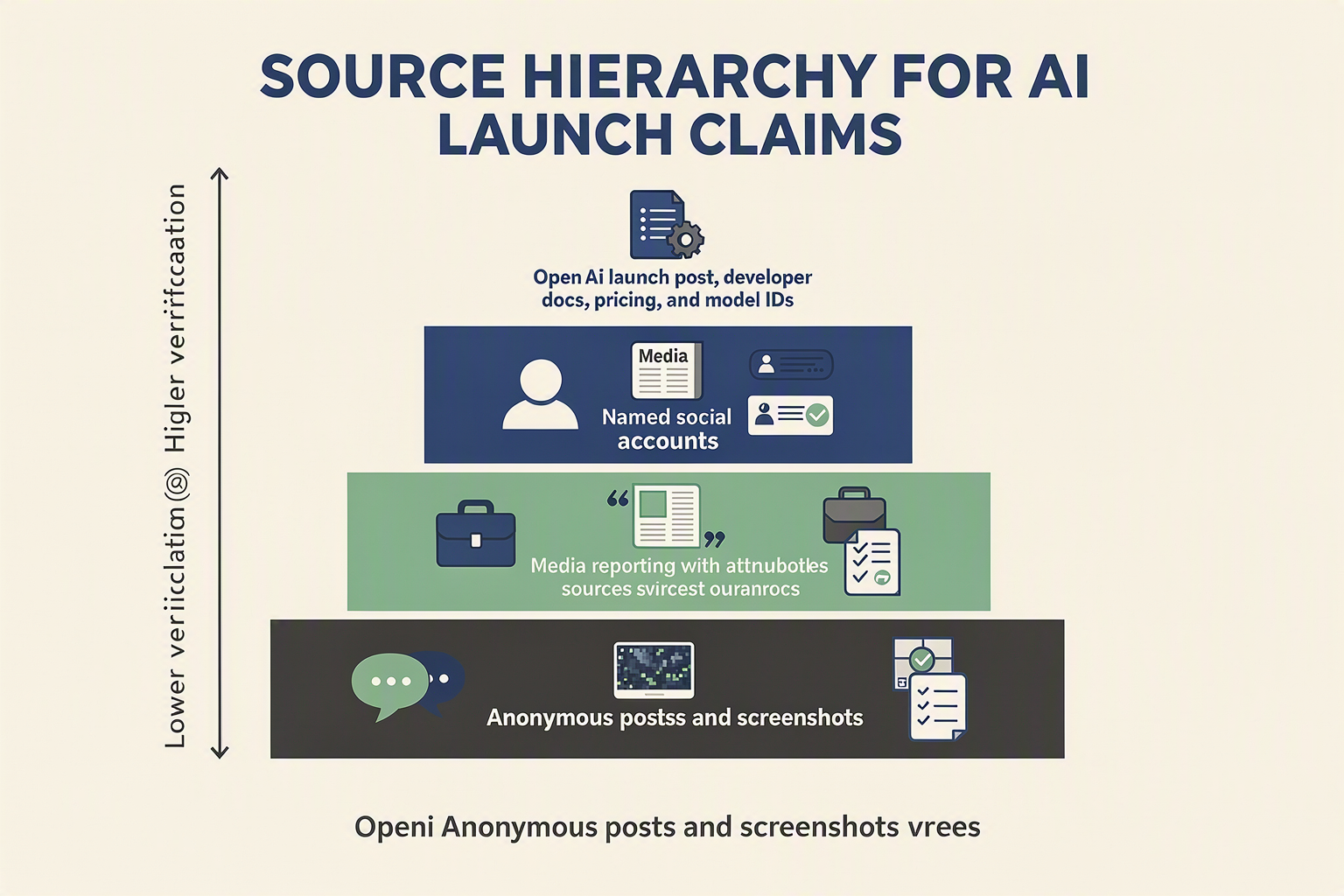
OpenAI documentation should carry the most weight; expert commentary, journalism, leaks, and social posts should be treated as progressively weaker evidence unless they point to independently verifiable first-party records. For GPT-6 Astra, OpenAI customer stories confirm public use of the name, but they do not by themselves establish general availability, API access, pricing, or a release date.
Use an evidence hierarchy, not a popularity contest
A practical verification order is:
- OpenAI API documentation, model catalog, release notes, pricing pages, model cards, and system cards
- A dated OpenAI launch announcement describing access, eligible users, regions, and rollout status
- OpenAI customer stories or partner case studies
- Reputable media reports with named sources, documents, or reproducible access
- Independent expert testing that states the exact model identifier, settings, date, and methodology
- Leaks, screenshots, forum comments, and social posts
The top two levels can establish whether a product is publicly documented and deployable. Customer stories establish that a named system was used in a particular setting, but access may have occurred through a preview, evaluation, research partnership, or controlled deployment.
What the current first-party evidence proves
OpenAI’s customer-story index listed two GPT-6 Astra case studies on September 3, 2026. That is strong evidence that OpenAI publicly uses the exact label “GPT-6 Astra,” rather than the reordered “GPT Astra 6.”
The underlying claims are specific:
- OpenAI reported on September 3, 2026, that Playco produced three themed game prototypes from one grey-box foundation with GPT-6 Astra and needed 50% fewer manual fixes than its comparison workflow.
- OpenAI reported on September 3, 2026, that Legora reviewed 41 documents in minutes with GPT-6 Astra, found all four planted errors, and improved performance by nearly 40%.
These figures are attributable, but their scope matters. They describe two customer workloads—not universal benchmarks, public API service-level commitments, or proof that the model appears in every ChatGPT account.
How to evaluate commentary and reporting
Expert analysis can clarify architecture, economics, safety, or likely rollout strategy, but expertise is not first-party confirmation. A strong report should answer:
- Does it cite an accessible OpenAI document or named spokesperson?
- Does it distinguish preview access from general availability?
- Does it provide an exact model or API identifier?
- Are testing conditions, comparison models, tools, and token budgets disclosed?
- Is the publication date clear, and has the claim been corrected or updated?
Multiple stories repeating one anonymous claim do not create multiple independent confirmations. Likewise, a search-result snippet appearing across OpenAI pages may originate from a shared customer-story module; repetition across pages is not necessarily separate evidence.
Why leaks and social posts rank lowest
Screenshots can be altered, labels can be internal aliases, and interface experiments can reach small cohorts without becoming products. The OpenAI Community post speculating that OpenAI “maybe” was preparing a GPT-6 “Astra” model is useful as evidence of public discussion—not as confirmation of release.
Treat claims about GPT-5.7 aliases, cybersecurity evaluations, context windows, token prices, benchmark scores, or launch dates as unverified until OpenAI documentation or reproducible testing supports them. A disciplined label helps:
- Confirmed: directly stated in first-party documentation
- Reported: attributed to credible journalism but not independently confirmed
- Observed: reproducibly seen by identified testers
- Rumored: sourced to leaks, anonymous claims, or social speculation
For OpenAI Astra September 2026, the defensible conclusion remains narrow: the name GPT-6 Astra is first-party confirmed in customer stories, while broader release and GPT-6 API status claims require higher-tier documentation.
Why does uncertain naming and availability matter to AI buyers, developers, and security teams?

Uncertain naming and availability matter because a public label is not a deployable product specification. Buyers, developers, and security teams need an exact model identifier, first-party documentation, access terms, pricing, version details, and safeguards before treating GPT-6 Astra, GPT Astra 6, or OpenAI Astra as production-ready.
Buyers risk purchasing a promise, not a service
OpenAI’s customer stories dated September 3, 2026, provide first-party evidence that the name GPT-6 Astra has been used in selected workloads. However, a customer case study does not by itself confirm general availability, a public API, standard pricing, or contractual service levels.
Before procurement, buyers should verify:
- Access status: general availability, limited preview, partner evaluation, or private deployment
- Commercial terms: token pricing, quotas, minimum commitments, rate limits, and service-level agreements
- Deployment channels: ChatGPT, the OpenAI API, Microsoft Azure, or another documented service
- Data governance: retention, training-data controls, processing locations, and contractual protections
- Product scope: supported modalities, context limits, tools, and regional availability
OpenAI reported on September 3, 2026, that Playco built three themed game prototypes with GPT-6 Astra and required 50% fewer manual fixes than in the comparison cited by the company.
OpenAI also reported on September 3, 2026, that Legora reviewed 41 documents in minutes, detected all four planted errors, and improved performance by nearly 40% using GPT-6 Astra.
These are workload-specific results—not universal benchmarks. Buyers should request the baseline model, test conditions, inference settings, human-review process, sample size, and commercial terms before using either figure in an ROI calculation.
Developers need exact model IDs and resilient architecture
“GPT-6 Astra,” “GPT Astra 6,” and “OpenAI Astra” must not be treated as interchangeable API identifiers unless OpenAI explicitly maps those labels in its official documentation. Approximate names can cause failed requests, incorrect capability assumptions, and unreliable cost estimates.
A safer implementation pattern is to:
- Use only documented, currently available model IDs.
- Keep model selection in environment variables or configuration files rather than application logic.
- Pin model versions or snapshots when reproducibility matters.
- Define fallbacks to documented models with compatible inputs, outputs, and safety requirements.
- Run workload-specific tests for accuracy, latency, cost, structured output, tool use, and failure handling.
- Require a controlled rollout before replacing a production model.
Fallbacks should not be assumed equivalent. A replacement model may differ in context length, reasoning behavior, tool-calling syntax, regional availability, or safety controls.
Security teams cannot approve a rumor
Customer stories establish credible usage, but they do not replace first-party security and safety documentation. Before approval, security teams should verify:
- A model or system card covering risks and evaluation methods
- Data-retention and model-training policies
- Authentication, audit logging, rate limits, and abuse monitoring
- Prompt-injection, tool-use, and data-exfiltration controls
- Exact version identifiers for inventories and incident response
Naming ambiguity also undermines allowlists and forensic records. If an incident log records “OpenAI Astra” while the provider uses another model ID, investigators may be unable to reproduce the output or determine which safeguards applied.
The practical rule is: treat GPT-6 Astra as a name supported by OpenAI customer-story evidence, but not as a generally deployable product until first-party API documentation, pricing, release notes, safety materials, and access terms confirm its availability.
What should buyers and developers do now that GPT-6 Astra is released?
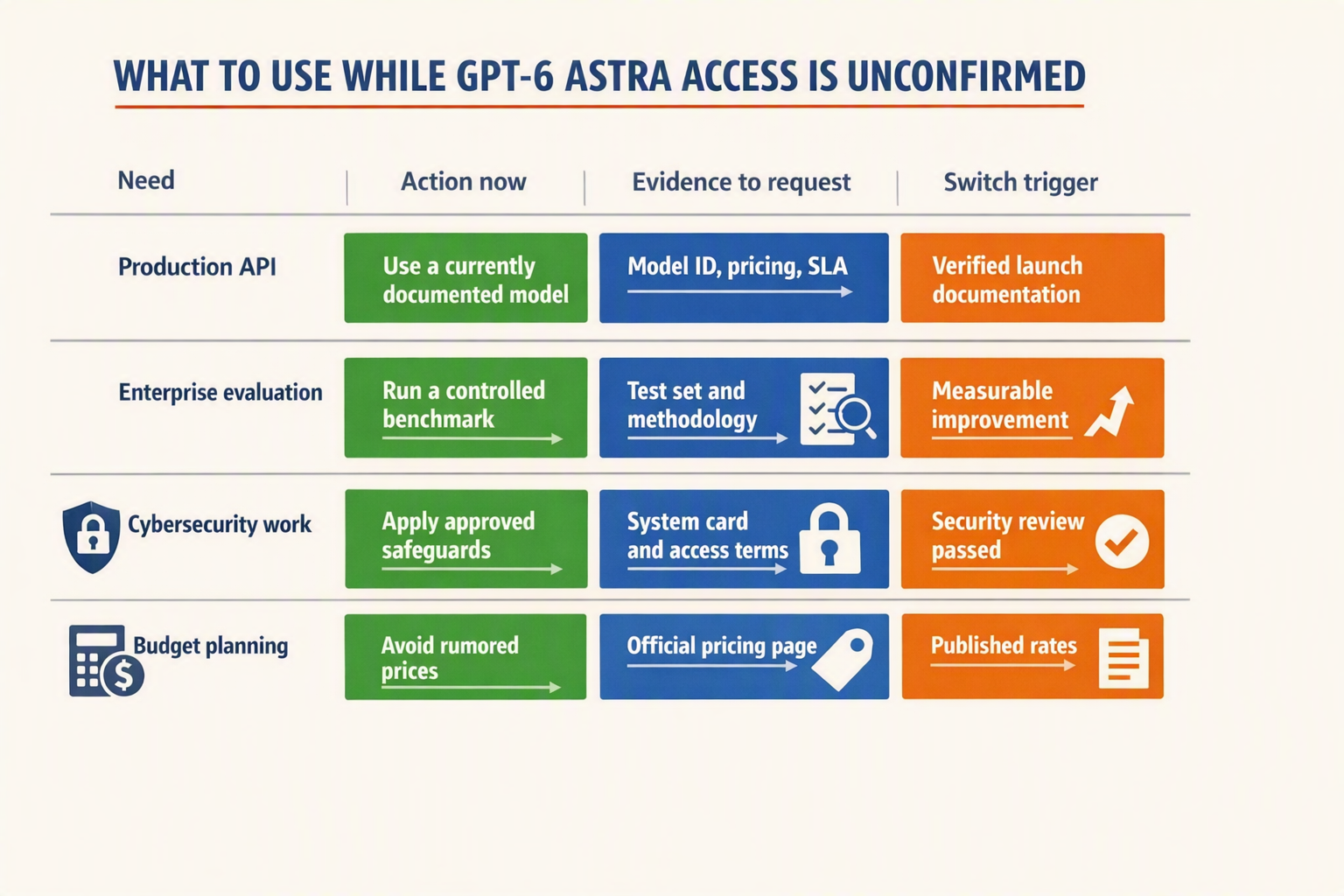
Now that GPT-6 Astra has been released, buyers and developers should treat deployment as a controlled production change—not assume that announced capabilities, account access and workload performance are identical for every organization.
Practical actions after release
| Action | What to verify | Recommended approach |
|---|---|---|
| Confirm access | GPT-6 Astra appears in the authenticated model catalogue for the intended project, region and account tier | Record the exact model ID, version, API endpoint, quotas and access restrictions |
| Run controlled evaluations | Quality, tool use, structured-output reliability, safety and failure rates on representative tasks | Compare identical prompts, datasets, tools and scoring criteria against the incumbent model |
| Compare total cost | Input, output, cached-token, tool-use, retrieval and media charges | Calculate cost per completed workflow, including retries, validation and human review |
| Measure latency and capacity | Time to first token, end-to-end latency, concurrency, rate limits and timeout behavior | Test normal and peak traffic under production-like conditions |
| Review safeguards | System-card findings, usage policies, deployment guidance and known limitations | Map documented risks and mitigations to the organization’s own controls and approval process |
| Prepare deployment controls | Version stability, monitoring, escalation paths and rollback readiness | Use staged rollout, version pinning, traffic routing and tested fallback models |
| Validate public claims | Whether parameter counts, benchmark scores or architecture details appear in official documentation | Do not make purchasing or engineering decisions based on unsupported rumors |
Verify model visibility before integration
A public release does not necessarily mean that every account receives immediate access under identical terms. Teams should sign in to the relevant developer console or query the authenticated model catalogue to confirm that GPT-6 Astra is visible for the project that will use it.
Verify the exact model identifier, supported endpoints, regional availability, rate limits and applicable pricing. Do not build against model names copied from screenshots, social posts or third-party reports.
Evaluate the complete workflow
Benchmark GPT-6 Astra against the current production system using representative data and fixed scoring criteria. Tests should cover task accuracy, structured outputs, tool selection, citation quality, refusal behavior, consistency and recovery from tool or network failures.
For customer service, voice or agentic workflows, measure the complete pipeline rather than model response time alone. Retrieval, speech processing, tool execution, validation, retries and human escalation can materially affect both total cost and end-to-end latency.
Review safeguards and deployment guidance
Read the official system card, usage policies and related safety documentation before approving production use. Pay particular attention to limitations relevant to the intended workload, including hallucinations, prompt injection, sensitive-data handling, high-impact decisions and autonomous tool use.
Document which safeguards are provided by the model and which must be implemented in the application, such as access controls, output validation, human approval, audit logging and spending limits.
Retain rollback and fallback options
Deploy gradually and preserve the ability to return traffic to a proven model or workflow. Keep prompts, retrieval, tools and business rules behind modular interfaces; pin model versions where supported; monitor quality, latency and cost; and test rollback procedures before increasing traffic.
Unsupported claims about parameter counts, architecture details or benchmark results should not guide procurement or production design. Use official documentation and reproducible workload testing instead. GPT-6 Astra may be a strong deployment candidate, but production adoption should depend on verified access, measured performance, acceptable economics and appropriate safeguards.
Frequently asked questions about the GPT-6 Astra release date, OpenAI Astra, GPT-5.7, API access, pricing, and verification
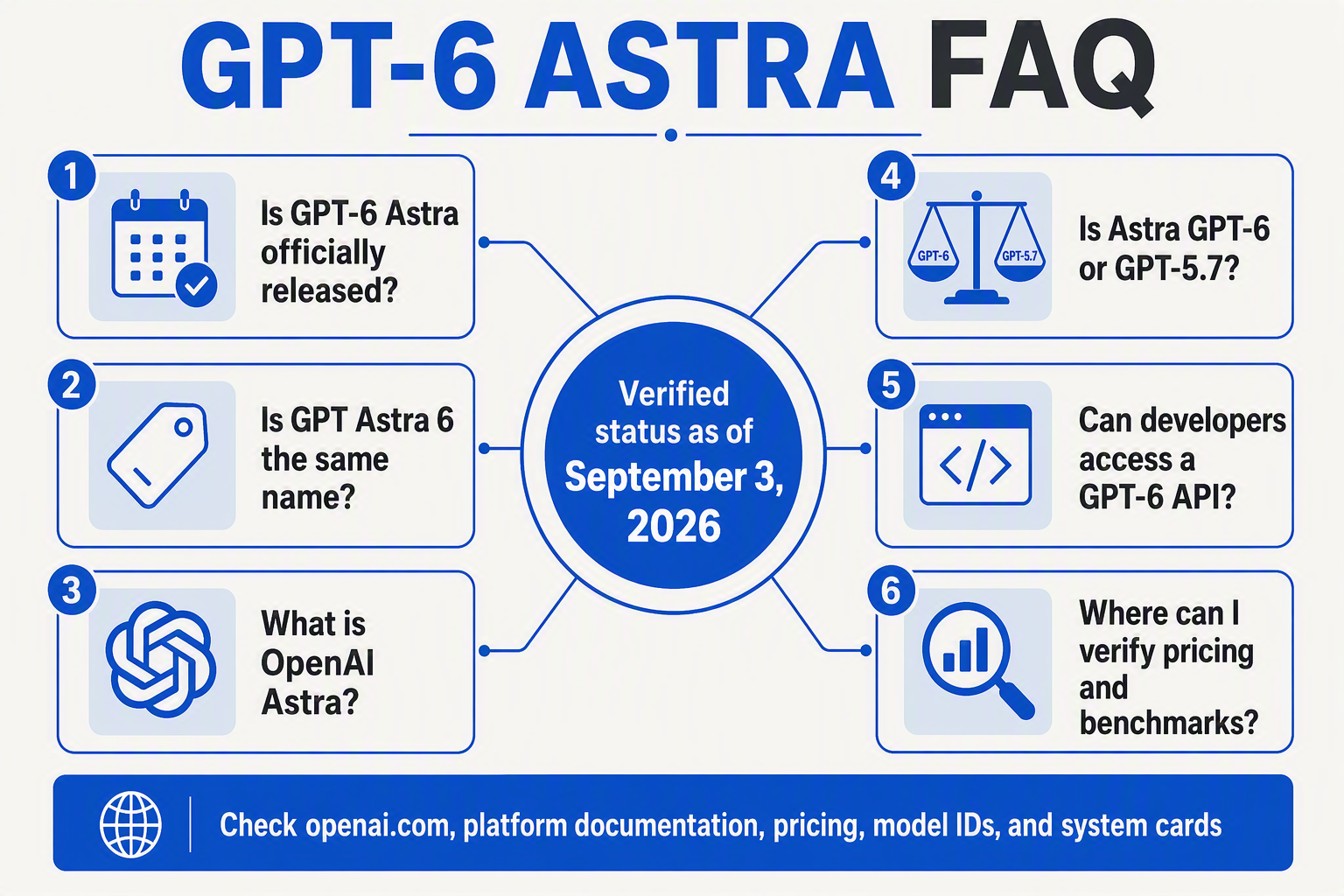
What is the confirmed GPT-6 Astra release date?
Is OpenAI Astra an official product name?
Is Astra GPT-6 or GPT-5.7?
Can developers access the GPT-6 Astra API now?
How much does GPT-6 Astra cost, and are online pricing comparisons reliable?
How can I verify a future GPT-6 Astra release date or launch announcement?
Conclusion
As of September 3, 2026, GPT-6 Astra is a confirmed OpenAI label, but its public release date and general availability remain unconfirmed. OpenAI customer stories establish that selected organizations have used the model; they do not, by themselves, prove a public ChatGPT or API launch.
- “GPT-6 Astra” is the supported name. OpenAI used that exact label in customer-story listings dated September 3, 2026; “GPT Astra 6” and “OpenAI Astra” lack equivalent confirmation as official product names.
- The reported results are specific but limited. OpenAI says Playco achieved 50% fewer manual fixes, while Legora reviewed 41 documents, found all four planted errors, and improved performance by nearly 40%.
- Availability remains unresolved. The supplied evidence does not establish public API documentation, pricing, a model card, release notes, or a general ChatGPT rollout.
- Rumored dates, prices, context windows, cybersecurity scores, and “GPT-5.7” claims should not be treated as facts without traceable first-party documentation and reproducible testing.
Next, watch OpenAI’s API model catalog, release notes, pricing pages, system cards, and ChatGPT announcements. Those sources—not screenshots or speculative comparisons—will determine when Astra becomes a deployable public product.
Meanwhile, developers can explore CallMissed, an AI communication-infrastructure platform offering documented models through one OpenAI-compatible gateway. Until OpenAI publishes formal access details, the decisive question remains: Is GPT-6 Astra publicly usable—or merely publicly named?
Related Reading
- GPT-6 Astra Financial Document Review: Legora Case Study Analysis
- Gemini 3.5 Flash Release Date and Capabilities: What’s Verified?
- Best AI Models of July 2026: Kimi K3 vs Claude Opus 5 vs GPT-5.6