GPT-6 Astra Financial Document Review: Legora Case Study Analysis



Analyze GPT-6 Astra financial document review at Legora: learn the workflow, reported results, evidence gaps, privacy risks, and evaluation steps.
GPT-6 Astra Financial Document Review: Legora Case Study Analysis
What can an AI model really prove by reviewing 41 financial documents in minutes? The official GPT-6 Astra Financial Document Review customer story, published by OpenAI on September 3, 2026, says Legora used GPT-6 Astra to complete that task—but speed alone does not establish accuracy, reliability, or readiness for high-stakes financial and legal decisions.
The timing matters. OpenAI is positioning Astra as a major step in frontier-model capability while simultaneously warning that an upcoming Astra model may meet the Critical cybersecurity capability threshold under its Preparedness Framework. OpenAI also announced $110 billion in new investment at a $730 billion pre-money valuation in 2026, illustrating the extraordinary capital flowing into systems expected to perform valuable professional work. Against that backdrop, the Legora case study offers something more concrete than model speculation: a documented enterprise workflow involving real financial material.
What the case study can—and cannot—tell us
OpenAI’s September 3, 2026 customer story reports that Legora reviewed 41 documents in minutes with GPT-6 Astra. This analysis will examine the claim without treating one vendor-published example as a universal benchmark. In particular, it will explore:
- The workflow: how documents were gathered, processed, queried, compared, and presented for professional review, based only on disclosed information.
- The test design: what GPT-6 Astra was asked to identify or synthesize—and which details about document length, complexity, accuracy, and baselines remain unspecified.
- The reported outcome: why “in minutes” is operationally meaningful, but incomplete without precision, recall, error severity, cost, and human-review data.
- Enterprise implications: potential applications in due diligence, contract analysis, financial investigations, audit preparation, and regulatory review.
- Risk controls: human approval, access governance, retention policies, confidentiality safeguards, and testing against an organization’s own document set.
This distinction is essential because a customer story is evidence of a specific deployment, not independent proof of generalized performance. OpenAI’s own AI scorecard emphasizes useful work, cost per successful task, and dependability as practical measures of return on AI investment; those dimensions provide a stronger evaluation framework than speed alone.
The article will also show how enterprises can reproduce the evaluation responsibly, including failure testing and privacy review. Multi-model infrastructure such as CallMissed’s OpenAI-compatible gateway reflects the broader trend toward testing several models through one integration rather than assuming any single case study settles the procurement decision.
What did the GPT-6 Astra Legora case study report? OpenAI says Legora reviewed 41 documents in minutes, found all four planted errors, and improved performance by nearly 40%, but these are vendor-reported case-study results rather than universal benchmarks
OpenAI’s September 3, 2026 case study reports three headline outcomes from Legora’s use of GPT-6 Astra financial document review: 41 financial documents reviewed in minutes, all four intentionally planted errors detected, and a nearly 40% performance improvement in the evaluated workflow. These are OpenAI- and Legora-reported case-study results, not findings from an independent benchmark or third-party audit.
GPT-6 Astra was officially released on September 3, 2026, and is now broadly deployed. That release status makes the model generally available for production use, but it does not independently validate Legora’s results or establish that other organizations will obtain the same speed, accuracy, or performance gains.
What Legora tested
Legora, an AI workspace for legal professionals, evaluated GPT-6 Astra financial document review using a defined collection of financial materials. Based on the case-study information disclosed by OpenAI and Legora, the test can be summarized as follows:
- Legora prepared a collection of 41 financial documents.
- Evaluators intentionally planted four errors in the materials.
- GPT-6 Astra reviewed the document collection within Legora’s workflow.
- The system’s findings were checked against the four known errors.
- Performance was compared with a baseline, resulting in the reported improvement of nearly 40%.
OpenAI and Legora reported that all 41 documents were reviewed in minutes.
OpenAI and Legora reported that GPT-6 Astra found all four planted errors.
OpenAI and Legora reported a nearly 40% performance improvement in the evaluated workflow.
Planting errors gives evaluators a known answer key. Detecting four out of four planted issues represents 100% recall on that specific four-error subset. It does not establish 100% accuracy, overall document-level recall, or the absence of additional missed issues.
What “nearly 40% better” does not yet explain
The publicly reported performance claim requires more methodological detail before it can be generalized. The headline alone does not establish whether “nearly 40%” measures:
- Review speed or documents processed per unit of time
- Accuracy compared with a previous model
- Improvement over an unaided or human-led workflow
- Reviewer productivity or time saved
- A composite quality score
- Completion rates across a broader set of tasks
The baseline is especially important. A nearly 40% improvement over an older AI system would mean something different from the same improvement over manual professional review. Independent reproduction of the GPT-6 Astra financial document review result would require access to the baseline, scoring rubric, prompts, model settings, document characteristics, error definitions, run conditions, and human-verification process.
The phrase “in minutes” also establishes only a broad time range. The case-study summary does not provide enough information to calculate exact review time per document, total human oversight time, or end-to-end time after verification and correction.
Why the findings are encouraging—but bounded
The encouraging aspect of the case study is the combination of rapid multi-document review and successful detection of the four deliberately embedded errors. Under the conditions Legora tested, GPT-6 Astra appears to have navigated a collection of financial documents and surfaced the known issues efficiently.
However, the disclosed results do not provide enough information to calculate or independently verify:
- Precision: how many flagged findings were false positives
- Full-document recall: whether GPT-6 Astra missed unplanted issues
- Overall accuracy: how the system performed beyond the four known errors
- Severity-weighted performance: whether detected issues were financially material
- Cost per successful review
- Consistency across repeated runs
- Human time required to check and approve the output
- Performance across different document types, industries, and risk environments
Accordingly, the Legora case study is best understood as evidence of one promising deployment of GPT-6 Astra financial document review, not as a universal benchmark. GPT-6 Astra’s official release and broad deployment may enable more organizations to test comparable workflows, but only transparent methodology, repeated evaluations, and independent testing can show whether the reported results generalize beyond Legora’s case study.
What background and confirmed facts distinguish the September 3, 2026 Legora story from Astra rumors and release-date speculation?
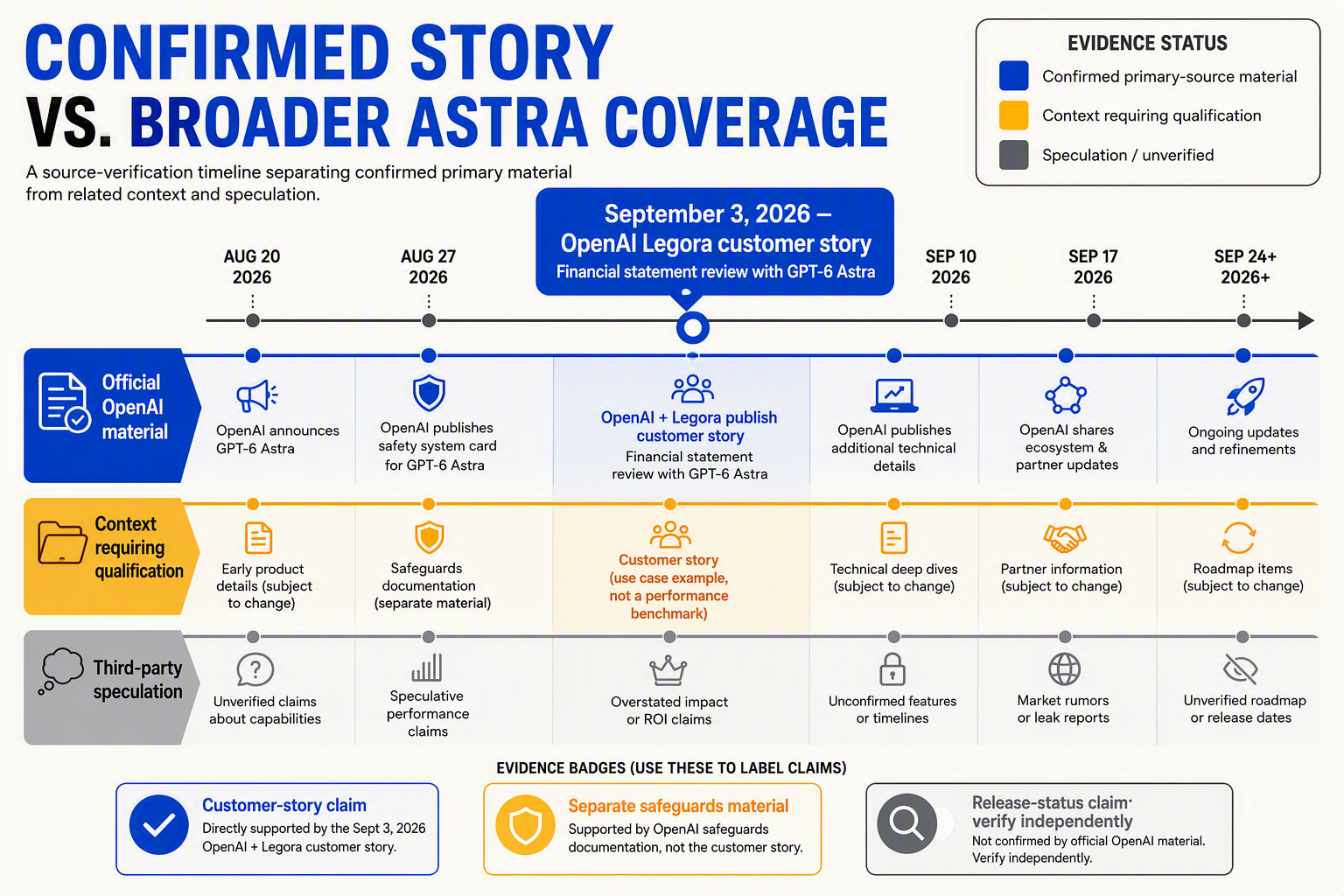
The September 3, 2026 Legora story is a confirmed OpenAI customer case study about a specific financial-document workflow, not evidence for every rumored GPT-6 Astra capability or a public release timetable. It establishes that Legora received access to GPT-6 Astra for the reported exercise, but it does not by itself confirm general availability, pricing, API access, or a universal GPT-6 Astra release date.
Three different claims are being conflated
Search coverage around Astra combines three distinct categories of information:
- A documented customer deployment: OpenAI’s September 3, 2026 customer story says Legora reviewed 41 financial documents in minutes with GPT-6 Astra. Legora is an AI workspace for legal professionals, making document analysis a relevant enterprise use case rather than a generic chatbot demonstration.
- An official model-development announcement: OpenAI separately said in 2026 that “one of our upcoming models, Astra, may meet the Critical cybersecurity capability threshold” under the OpenAI Preparedness Framework. That statement concerns anticipated cybersecurity capabilities and safeguards; it does not disclose the Legora test methodology or establish a broad product-launch schedule.
- Release-date speculation: Predictions about when GPT-6 Astra might reach ChatGPT, the OpenAI API, particular subscription tiers, or specific regions remain unconfirmed unless OpenAI identifies those details in official product documentation. A customer’s early or controlled access does not necessarily mean an identical model is generally available.
The wording therefore matters. “Legora used GPT-6 Astra” is a deployment claim attributed to OpenAI’s customer story. “GPT-6 Astra is publicly available to everyone” would be a separate claim requiring release notes, API documentation, model identifiers, pricing, and availability terms.
What the publication date actually confirms
The September 3, 2026 date anchors the story as a contemporaneous first-party account. It helps distinguish the case study from earlier prediction articles, synthetic benchmark forecasts, and commentary based only on the Astra name.
The confirmed record supports several narrow conclusions:
- OpenAI published the story, so it carries more evidentiary weight than an unattributed leak or social-media prediction.
- Legora is the named customer or deployment partner in the reported workflow.
- The corpus contained 41 financial documents.
- Completion was reported in minutes, although the disclosed context does not establish an exact duration.
- The task involved professional document review, not merely conversational question answering.
Important product details remain outside those confirmed facts. The available material does not establish whether Legora used a production API, private preview, research build, dedicated environment, or customized configuration. Nor does it show whether “GPT-6 Astra” in the customer story is identical to every Astra model discussed in OpenAI’s broader development communications.
Why official does not mean independently validated
An official customer story verifies what OpenAI and Legora chose to report, but it is still vendor-authored evidence. OpenAI’s own AI scorecard recommends evaluating useful work, cost per successful task, and dependability—criteria that require more information than a document count and a speed claim.
Accordingly, the Legora story should be treated as a credible account of one deployment, while claims about generalized accuracy, safety, pricing, scalability, and release timing should remain explicitly labeled unverified until supported by technical documentation or independent testing.
Which key developments, reported facts, and unanswered questions define the GPT-6 Astra case study?
The GPT-6 Astra Legora case study establishes a concrete enterprise use case—rapid financial-document review—but leaves most of the information needed to judge accuracy, economics, and production readiness undisclosed. Its defining tension is therefore clear: the reported workflow is notable, while the available evidence remains too narrow for broad performance conclusions.
Confirmed developments versus open questions
| Development or claim | What OpenAI reported | Why it matters | What remains unanswered |
|---|---|---|---|
| Official customer story | OpenAI published the Legora case study on September 3, 2026. | This is an attributable deployment account rather than an Astra rumor or release-date prediction. | Was the study independently reviewed, audited, or reproduced outside OpenAI and Legora? |
| Enterprise workflow | Legora, an AI legal workspace, used GPT-6 Astra for financial-document review. | The test connects Astra to professional legal and financial analysis, where errors can have material consequences. | What ingestion, retrieval, prompting, citation, and verification pipeline surrounded the model? |
| Document volume | OpenAI reported on September 3, 2026, that Legora reviewed 41 documents with GPT-6 Astra. | A multi-document task can test cross-file retrieval and synthesis more realistically than a single isolated prompt. | How many pages, tables, clauses, currencies, jurisdictions, and scanned or handwritten elements were included? |
| Completion time | OpenAI said on September 3, 2026, that Legora reviewed the 41 documents “in minutes.” | Shorter review cycles could accelerate due diligence, investigations, audit preparation, and transaction work. | What was the exact elapsed time, hardware or service configuration, token volume, latency distribution, and total cost? |
| Quality claim | The customer story presents the review as a successful outcome. | Successful issue identification would be more important than raw summarization speed. | What were the ground truth, precision, recall, false-positive rate, missed-issue rate, and severity of any errors? |
| Evidence category | The result appears in an OpenAI customer story, not a published independent benchmark. | Customer stories can demonstrate feasibility in a specific workflow. | Would the result generalize to unseen documents, different reviewers, longer files, adversarial wording, or other industries? |
What the case study meaningfully adds
The central development is workflow evidence. GPT-6 Astra was not presented solely through an abstract benchmark; OpenAI associated the model with a named enterprise, a defined document-review category, and a disclosed batch size. That makes the story relevant to teams considering AI for:
- financial due diligence and disclosure review;
- contract-linked financial investigations;
- audit evidence preparation;
- covenant, liability, or risk extraction;
- cross-document inconsistency detection.
However, “reviewed” is not a standardized measurement. It could mean retrieval, extraction, summarization, issue spotting, comparison, or a combination of these operations. Without the task instructions and scoring rubric, readers cannot determine how demanding the test was.
Questions procurement teams should carry forward
The most important unanswered questions concern dependability, not novelty:
- Were all outputs reviewed by qualified professionals before use?
- Were citations mapped to exact pages, tables, and source passages?
- How were ambiguous, contradictory, scanned, or incomplete records handled?
- Were confidentiality, data retention, residency, and access controls evaluated?
- What did each successful review cost after retries and human verification?
- How did GPT-6 Astra compare with prior models, conventional search, or manual review?
Until those details are available, the case study supports a limited conclusion: GPT-6 Astra completed Legora’s disclosed 41-document workflow quickly under the reported conditions, but the public evidence does not yet establish universal accuracy, cost-effectiveness, or autonomous decision readiness.
How did Legora’s document-review workflow operate, and which implementation details should be separated into documented, inferred, and undisclosed steps?
The documented workflow is narrow: Legora used OpenAI GPT-6 Astra to review a set of 41 financial documents and returned results in minutes. Everything beyond that core account—such as OCR, retrieval architecture, prompt design, parallel processing, validation, and human approval—must be labelled as inferred or undisclosed, not presented as fact.
Documented steps
OpenAI’s official customer story, published on September 3, 2026, establishes the following elements:
- A defined document set was assembled. The test involved 41 financial documents, rather than an unspecified corpus.
- Legora provided the review environment. Legora, an AI workspace for legal professionals, used GPT-6 Astra for the financial document-review task.
- The model searched for predefined findings. OpenAI reports that the workflow found all four target items identified for the exercise.
- Results were produced quickly. OpenAI states that Legora reviewed 41 documents in minutes with GPT-6 Astra.
These facts support a limited but useful conclusion: the system processed multiple financial documents together and surfaced the four expected findings within the reported time window. They do not reveal how much work occurred before or after the timed model run.
Reasonable inferences—not confirmed implementation facts
A functioning multi-document review normally requires several technical stages. The likely sequence below is an architectural inference, not a description confirmed by OpenAI or Legora:
- Ingestion: Files were uploaded or connected to the Legora workspace.
- Text extraction: Machine-readable text was obtained directly or through optical character recognition for scanned pages.
- Document preparation: Content may have been segmented, indexed, tagged with metadata, or inserted into a sufficiently large model context.
- Task specification: Instructions likely defined the financial facts, inconsistencies, clauses, or relationships to locate.
- Cross-document reasoning: GPT-6 Astra compared relevant passages and synthesized findings across files.
- Result presentation: Legora displayed the model’s answers, potentially alongside citations or source passages.
- Professional verification: A lawyer or finance specialist may have checked the findings before relying on them.
These are plausible because an enterprise review system needs a path from files to reviewable output. However, calling the workflow retrieval-augmented generation, agentic search, long-context analysis, or a particular orchestration pattern would exceed the published evidence unless the customer story explicitly names that architecture.
Material details that remain undisclosed
The missing implementation details affect both reproducibility and interpretation:
- Input characteristics: file formats, page counts, total tokens, scan quality, languages, tables, footnotes, and duplicate documents.
- Ground truth: who selected the four targets, how ambiguous they were, and whether reviewers agreed on the correct answers.
- Prompting: system instructions, examples, retries, tool calls, and whether prompts were tuned to this document set.
- Model configuration: exact GPT-6 Astra version, context limits, temperature, reasoning settings, and concurrency.
- Performance measurement: precise elapsed time, ingestion time, human-review time, false positives, and near misses.
- Operational economics: token consumption, model cost, infrastructure cost, and cost per successful task.
- Controls: citation checking, access permissions, encryption, retention, regional processing, and audit logs.
OpenAI’s AI scorecard identifies useful work, cost per successful task, and dependability as practical AI-return measures. Applied here, the published result demonstrates a promising workflow outcome, but the undisclosed steps prevent an independent assessment of repeatability, total cost, and production-grade reliability.
What exactly was tested, how should the reported outcomes be interpreted, and which baseline produced the nearly 40% improvement?
The disclosed test was a bounded document-review exercise: Legora used GPT-6 Astra to examine 41 financial documents and locate four target issues. OpenAI reports that the model found all four in minutes, but the published information does not clearly identify the comparison baseline or define whether the cited nearly 40% improvement is relative, absolute, or based on a broader internal benchmark.
What the exercise actually measured
According to OpenAI’s September 3, 2026 customer story, Legora reviewed 41 financial documents in minutes with GPT-6 Astra. The reported result demonstrates performance on one defined document set rather than finance-document review in general.
The exercise appears to measure three practical capabilities:
- Cross-document retrieval: finding relevant information distributed across a collection rather than answering from one file.
- Issue detection: identifying the four issues Legora expected the review to surface.
- Synthesis speed: completing the review in minutes and presenting findings for professional use.
Finding four out of four known issues corresponds to 100% recall on those four targets. It does not establish overall accuracy because the story, as supplied, does not report false positives, unsupported conclusions, or the number of non-issue passages examined.
Important test-design details remain undisclosed:
- Total page count, token count, file formats, languages, and document quality
- Whether tables, scans, handwriting, or optical character recognition were involved
- Whether the four issues were preselected, planted, or discovered during genuine work
- Prompt design, retrieval configuration, tool use, and number of model attempts
- Human-review time and whether reviewers corrected the output
- Precision, citation accuracy, cost, latency distribution, and repeat-run consistency
Why “nearly 40% better” needs a named denominator
The nearly 40% improvement cannot be interpreted rigorously without the baseline value and metric definition. The available case-study summary does not establish whether GPT-6 Astra was compared with an earlier OpenAI model, Legora’s previous workflow, human-only review, or an internal evaluation suite.
A relative improvement is not the same as a percentage-point increase. For example:
- Moving from 50% to 70% is a 20-percentage-point increase.
- The same change is a 40% relative improvement, calculated as
(70 − 50) ÷ 50. - Reducing review time from 100 minutes to 60 minutes is a 40% time reduction, not a 40% accuracy gain.
Unless OpenAI or Legora names the denominator, metric, sample size, and scoring method, readers should describe the result only as a nearly 40% improvement reported by the vendor case study—not as “40% more accurate.”
How enterprises should interpret the outcome
The strongest supported conclusion is narrow: GPT-6 Astra successfully surfaced all four target issues in Legora’s 41-document exercise and did so in minutes, according to OpenAI on September 3, 2026.
That is meaningful evidence of workflow feasibility, but not an independent benchmark. OpenAI’s own AI scorecard recommends assessing useful work, cost per successful task, and dependability. Applying that framework would require repeated trials, blinded expert scoring, false-positive tracking, severity-weighted errors, end-to-end cost, and comparisons against a clearly named baseline.
What caveats apply when OpenAI publishes a customer case study about its own model?
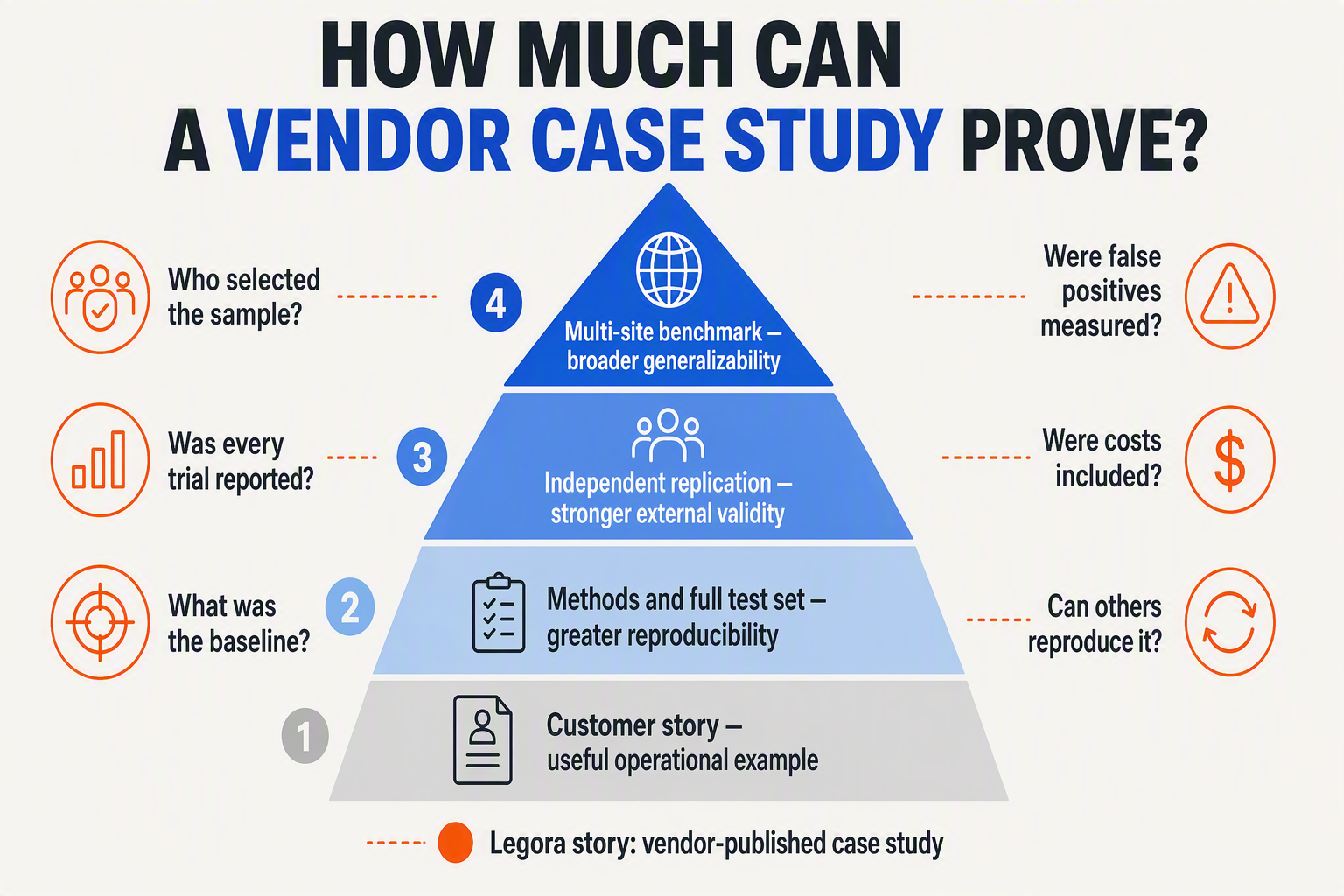
A vendor-published customer story is useful evidence that GPT-6 Astra supported one Legora workflow, but it is not an independent benchmark or proof of universal financial-document accuracy. OpenAI and Legora have legitimate reasons to highlight a successful deployment, so readers should separate the reported facts from conclusions the study did not test.
The publisher is also the model provider
OpenAI published the GPT-6 Astra Legora case study on September 3, 2026, meaning the organization presenting the results also develops and sells the underlying model. That does not invalidate the story, but it creates an inherent selection and presentation bias: successful workflows are more likely to become customer stories than failed pilots or ambiguous evaluations.
A rigorous interpretation should ask:
- Who selected the documents, prompts, and success criteria?
- Did Legora, OpenAI, or an independent evaluator judge the outputs?
- Were unsuccessful runs, prompt revisions, or retries included?
- Was the example chosen from a larger set of tests?
- Did either company publish the complete evaluation protocol?
Without those disclosures, the case study should be treated as a deployment example, not a controlled experiment.
Forty-one documents are a workload, not a benchmark
OpenAI reported on September 3, 2026, that Legora reviewed 41 documents in minutes with GPT-6 Astra. The number establishes the scale of that specific run, but it does not reveal the number of pages, tables, scanned images, jurisdictions, currencies, accounting conventions, or contradictory statements involved.
“Minutes” is similarly underspecified. It could describe model-processing time, elapsed application time, or the period before an initial answer appeared. A reproducible benchmark would disclose:
- Document formats and total page or token count.
- Hardware, API configuration, model version, and context limits.
- Upload, optical character recognition, retrieval, and inference time.
- Prompt templates, tool calls, retries, and human interventions.
- Total cost and time required for final professional approval.
These omissions matter because reviewing 41 short, machine-readable files differs substantially from analysing 41 lengthy filings containing poor scans, nested footnotes, and inconsistent tables.
Speed does not establish correctness
The public claim reported here provides a throughput outcome, but not standard quality measures such as precision, recall, false-positive rate, citation accuracy, or error severity. It also does not disclose whether the system identified every relevant fact or merely produced a useful initial review.
OpenAI’s own AI scorecard identifies useful work, cost per successful task, and dependability as practical measures of AI return on investment. By that framework, elapsed time is only one variable. A fast answer that requires extensive correction may deliver less value than a slower, more dependable workflow.
Generalisation requires independent testing
The result should not automatically be extended to every audit, due-diligence exercise, regulatory investigation, or contract portfolio. Performance can change with document quality, language, domain terminology, prompt design, retrieval settings, and the consequences of an error.
Enterprises should therefore reproduce the workflow on a representative, access-controlled dataset and compare GPT-6 Astra against:
- A documented human-review baseline.
- Existing search or extraction software.
- Alternative models under identical conditions.
- Adversarial cases containing omissions, conflicting figures, and ambiguous clauses.
The defensible conclusion is narrow but meaningful: the OpenAI customer story demonstrates a plausible real-world Legora workflow at reported speed; it does not independently establish accuracy, economic value, or production readiness for all financial-document review.
Where could Astra-assisted review help legal and finance teams, and where must qualified humans retain decision authority?
GPT-6 Astra could help legal and finance teams search, extract, compare, and summarize document evidence, but qualified professionals must retain authority over legal conclusions, accounting judgments, disclosures, and consequential actions. OpenAI’s September 3, 2026 customer story says Legora reviewed 41 financial documents in minutes with GPT-6 Astra; that result supports assisted-review use cases, not autonomous decision-making.
High-value uses for Astra-assisted review
The strongest applications are bounded tasks where the model produces a reviewable work product linked to source documents:
- Financial due diligence: Extract revenue, debt, liabilities, related-party transactions, and unusual changes across financial statements, loan documents, and management reports.
- Contract-to-financial reconciliation: Compare payment terms, price-adjustment clauses, earn-outs, indemnities, and termination rights against spreadsheets or financial disclosures.
- Cross-document consistency checks: Flag mismatched dates, company names, currencies, totals, definitions, or representations across agreements and supporting materials.
- Audit preparation: Organize evidence, generate request lists, map documents to controls, and identify missing support before an auditor evaluates it.
- Regulatory review: Locate clauses, transactions, or statements relevant to a defined regulatory requirement while preserving citations for human verification.
- Investigation support: Build timelines, identify repeated entities, and surface potentially relevant transactions for investigators to examine.
“In minutes” can be operationally valuable when it shortens the first-pass review queue. However, OpenAI’s own AI scorecard says enterprise value should be measured through useful work, cost per successful task, and dependability, not raw processing speed alone.
Decisions that must remain with qualified humans
Astra’s output should be treated as analysis support, not a legal opinion, audit conclusion, or investment recommendation. Human authority is especially important where a mistake could affect rights, reporting obligations, capital allocation, or regulatory exposure.
Qualified lawyers, accountants, auditors, compliance officers, and financial professionals should retain final control over:
- Legal interpretation: Determining whether a clause is enforceable, whether conduct creates liability, or how law applies to disputed facts.
- Materiality judgments: Deciding whether an omission or misstatement is material to investors, lenders, auditors, or regulators.
- Accounting treatment: Approving revenue recognition, impairment, consolidation, valuation, provisioning, and disclosure classifications.
- Risk escalation: Initiating investigations, reporting suspected misconduct, freezing transactions, or making regulatory notifications.
- External representations: Signing filings, audit opinions, board papers, transaction documents, or communications carrying professional accountability.
- Strategic decisions: Recommending an acquisition, rejecting a borrower, changing a valuation, or accepting contractual risk.
A practical human-in-the-loop boundary
Teams should require Astra to return document-level citations, quoted passages, uncertainty indicators, and an explicit “not found” result rather than encouraging unsupported completion. Reviewers should verify every high-impact finding against the original page, table, footnote, or clause.
Escalation rules should be predetermined. For example, contradictory figures, missing schedules, low-confidence extraction, scanned pages, handwritten annotations, unusual accounting terms, or jurisdiction-specific clauses should automatically enter a specialist queue.
The correct operating model is therefore AI proposes; professionals verify and decide. The Legora case demonstrates that rapid multi-document review is feasible in a disclosed workflow, but it does not transfer professional responsibility from the lawyer, accountant, auditor, or finance executive to GPT-6 Astra.
Which privacy, confidentiality, security, and governance controls matter for sensitive financial documents?
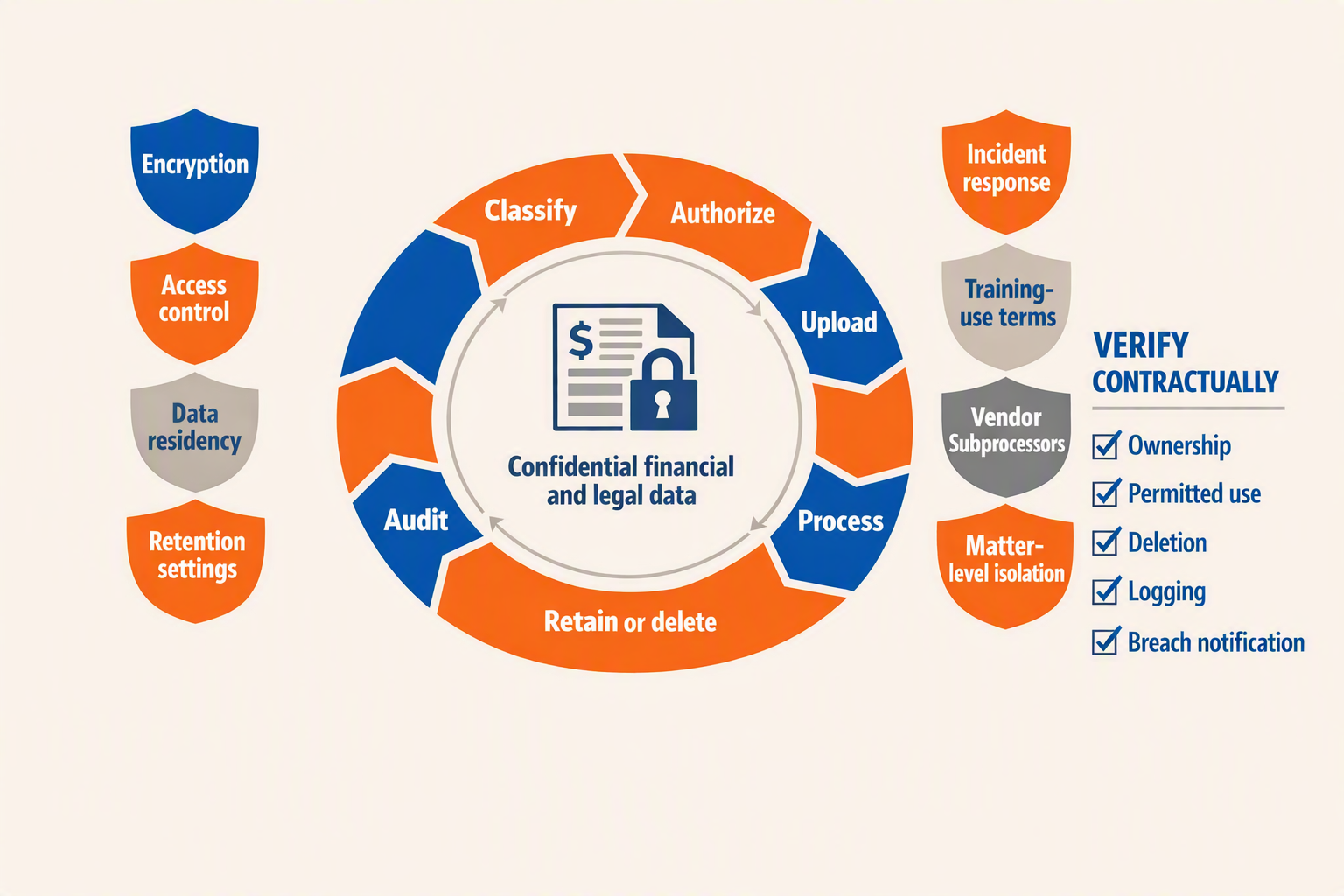
Sensitive financial-document review requires controls across the entire data lifecycle, not merely a secure model endpoint. Before production use, enterprises should verify who can upload documents, where copies and embeddings reside, whether prompts train models, how long data persists, and who approves AI-generated conclusions.
Treat the case study as capability evidence—not a security assessment
OpenAI reported on September 3, 2026 that Legora reviewed 41 financial documents in minutes with GPT-6 Astra. That result describes workflow speed, but the disclosed case-study material does not establish the deployment’s encryption design, retention periods, data residency, subprocessor access, tenant isolation, or incident-response procedures.
The absence of these details does not prove weak controls; it means buyers must obtain separate evidence through security documentation, contracts, audits, and technical testing. A procurement team should request:
- A data-processing agreement defining controller, processor, and subprocessor responsibilities.
- Written confirmation of whether prompts, files, outputs, logs, and human feedback are used for model training.
- Data-location, cross-border-transfer, deletion, backup, and legal-hold policies.
- Current independent assurance reports, penetration-test summaries, and vulnerability-management procedures.
- Contractual confidentiality terms covering the model provider, application vendor, cloud hosts, and support personnel.
Apply privacy and confidentiality controls before upload
Financial records may contain personal data, bank details, transaction histories, compensation information, trade secrets, merger plans, or legally privileged communications. Teams should classify and minimize material before model processing rather than uploading an unrestricted data room.
Important safeguards include:
- Redaction and tokenization: Remove unnecessary PANs, account numbers, signatures, personal addresses, and authentication credentials.
- Purpose limitation: Restrict processing to the documented review question and prevent reuse for unrelated analytics.
- Privilege preservation: Segregate attorney-client material, record who authorized processing, and involve counsel in assessing whether third-party disclosure could affect privilege.
- Retention limits: Automatically delete source documents, extracted text, embeddings, prompts, and outputs after the approved period.
- Jurisdictional review: Map obligations under applicable regimes such as the European Union’s General Data Protection Regulation and India’s Digital Personal Data Protection Act, 2023.
Under Article 33 of the GDPR, qualifying personal-data breaches generally must be reported to the supervisory authority within 72 hours after the controller becomes aware of them. India’s DPDP Act permits penalties of up to ₹250 crore for failure to take reasonable security safeguards to prevent a personal-data breach.
Secure the complete document pipeline
Controls should cover ingestion, optical character recognition, indexing, retrieval, inference, output storage, and export—not just GPT-6 Astra itself. A defensible architecture typically includes:
- Encryption in transit and at rest, preferably with managed or customer-controlled keys.
- Single sign-on, multifactor authentication, role-based access, and least privilege.
- Tenant isolation and private-network options where risk warrants them.
- Immutable audit logs for uploads, searches, prompts, exports, and administrative actions.
- Malware scanning and defenses against document-borne prompt injection, where hidden instructions attempt to manipulate the model.
- Data-loss-prevention rules that block sensitive output from being copied into unapproved systems.
Make governance operational
Each deployment needs a named business owner, security owner, privacy reviewer, and accountable human decision-maker. High-impact findings—fraud allegations, covenant breaches, valuation adjustments, or regulatory conclusions—should require source-linked verification and human approval.
Finally, test access revocation, deletion, breach escalation, model changes, and erroneous-output handling before launch. “41 documents in minutes” is an efficiency claim; production readiness depends on whether every document, inference, and user action remains controlled, traceable, and reviewable.
What should legal, finance, security, privacy, and AI-risk experts verify before an enterprise pilot or deployment?
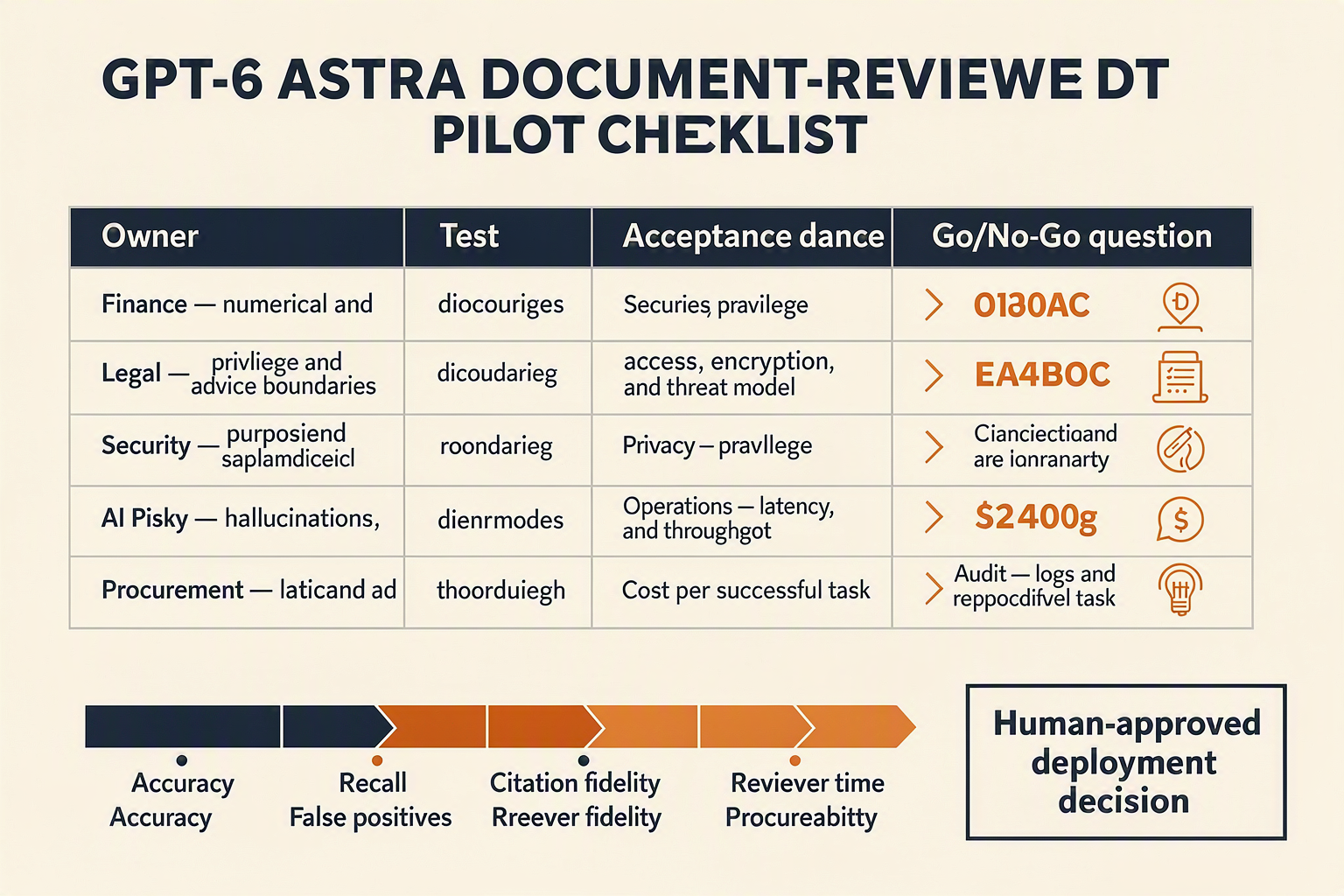
Enterprises should approve a GPT-6 Astra financial document review pilot only after legal, finance, security, privacy, and AI-risk specialists define measurable acceptance gates. OpenAI’s reported result—Legora reviewed 41 documents “in minutes” with GPT-6 Astra on September 3, 2026—supports further evaluation, but it does not replace organization-specific assurance testing.
Cross-functional verification checklist
| Review owner | What to verify | Evidence required | Deployment gate |
|---|---|---|---|
| Legal and compliance | Permitted document use; legal privilege; confidentiality; recordkeeping; applicable financial-services, employment, competition, and disclosure rules | Counsel-approved use-case map, contractual terms, jurisdiction analysis, privilege protocol, mandatory human-approval policy | Block deployment if AI output could trigger advice, filing, disclosure, or contractual action without qualified review |
| Finance and procurement | Total cost per completed review, expected labour savings, model/API charges, integration expense, and cost of correcting errors | Itemized pilot costs, human-review time, baseline workflow cost, and scenario analysis at production volume | Require a defensible improvement in cost per successful task, not merely lower processing time |
| Security | Identity controls, encryption, tenant isolation, audit logging, incident response, model access, and resistance to malicious instructions embedded in documents | Architecture diagrams, penetration-test results, security certifications, role-based access tests, prompt-injection exercises, and incident SLAs | No sensitive production data until critical findings are remediated and access is least-privileged |
| Privacy and data governance | Lawful basis, data minimization, residency, international transfers, retention, deletion, subprocessors, and whether inputs train provider models | Data-processing agreement, retention schedule, deletion test, subprocessor list, transfer assessment, and data-flow inventory | Restrict or redact personal and confidential information until every processing route is documented |
| AI-risk and validation | Accuracy by document type, omission rates, unsupported claims, citation fidelity, consistency, abstention, and performance under ambiguous inputs | Representative test set, expert ground truth, precision and recall, severity-weighted error log, repeated-run testing, and adversarial cases | Establish thresholds separately for low-impact extraction and high-impact legal or financial conclusions |
| Operations and assurance | Human escalation, model-version changes, monitoring, fallback procedures, reproducibility, business continuity, and rollback | Named process owner, reviewer queue, version log, alert thresholds, outage test, fallback workflow, and post-deployment audit plan | Launch only when every material output remains traceable to its source document and reviewer |
Questions the pilot must answer
A defensible evaluation should test the organization’s own files rather than reproduce only the reported 41-document exercise. The test corpus should include scanned pages, tables, amendments, contradictory clauses, missing schedules, multilingual content, and documents containing irrelevant or adversarial instructions.
Teams should pre-register:
- Task definitions: Specify whether Astra must extract facts, reconcile figures, detect clauses, summarize risks, or recommend action.
- Ground truth: Have qualified lawyers, accountants, or analysts independently label expected findings before viewing model outputs.
- Error severity: Treat a misplaced date differently from a missed liability, incorrect covenant, or fabricated financial amount.
- Human-review rules: Identify which outputs require approval and prohibit autonomous filing, payment, disclosure, or legal advice.
- Stop conditions: Pause the pilot after confidentiality leakage, repeated unsupported conclusions, material numerical errors, or failures to cite source passages.
OpenAI’s AI scorecard frames enterprise value around “useful work, cost per successful task, and dependability.” Those measures are more decision-relevant than elapsed time alone: a fast review that creates substantial verification work may not improve either cost or risk.
Heightened security scrutiny for Astra
Security review deserves particular attention because OpenAI said in 2026 that an upcoming Astra model may meet the Critical cybersecurity capability threshold under its Preparedness Framework. That warning does not establish that the Legora workflow was unsafe, but it makes capability controls, monitoring, access restrictions, and misuse testing essential before broader deployment.
What are the most frequently asked questions about GPT-6 Astra, Legora’s 41-document review, release status, accuracy, privacy, and human oversight?
What did the GPT-6 Astra Legora financial document review test?
Did Legora review 41 documents in minutes with GPT-6 Astra?
What is the official GPT-6 Astra release date and is the model generally available?
How accurate was the GPT-6 Astra financial document review?
Is GPT-6 Astra safe for confidential legal and financial documents?
Does GPT-6 Astra eliminate the need for human review in Legora-style workflows?
Conclusion
The GPT-6 Astra Legora financial document review case study demonstrates a potentially valuable enterprise workflow, not a universal performance benchmark. OpenAI reported on September 3, 2026, that Legora reviewed 41 financial documents in minutes with GPT-6 Astra; the next question is whether organizations can reproduce that speed while meeting their own standards for accuracy, confidentiality, cost, and professional oversight.
- Speed is meaningful but insufficient. Processing 41 documents in minutes could accelerate due diligence, financial investigations, audit preparation, contract analysis, and regulatory review. However, the published result does not by itself establish precision, recall, error severity, or performance on longer and more complex document sets.
- Human review remains essential. Lawyers, accountants, auditors, and compliance teams must verify extracted facts, trace conclusions back to source documents, resolve contradictions, and approve any consequential decision. GPT-6 Astra should support professional judgment rather than silently replace it.
- Enterprise evaluation must reflect real operating conditions. Teams should test representative documents, known-answer questions, missing or conflicting evidence, scanned files, tables, and deliberate failure cases. OpenAI’s AI scorecard identifies useful work, cost per successful task, and dependability as practical measures of AI return on investment—dimensions that are more informative than latency alone.
- Governance belongs inside the workflow. Access controls, data-retention rules, confidentiality protections, audit logs, human escalation, and model-output monitoring should be established before sensitive legal or financial material enters production.
What to watch next
Future evidence should include independently reproducible evaluations, task-level accuracy, error classifications, human-review time, total cost, and comparisons across models. This scrutiny is especially important because OpenAI has warned that an upcoming Astra model may reach the Critical cybersecurity capability threshold under its Preparedness Framework.
Enterprises should therefore treat the Legora story as a promising starting point for controlled testing. Multi-model infrastructure can help teams avoid prematurely standardizing on one model: CallMissed provides an OpenAI-compatible gateway through which developers can evaluate multiple models using one integration, alongside AI communication capabilities for voice and multilingual engagement.
The defining question is no longer whether an AI can review 41 documents quickly—it is whether your organization can prove that the resulting work is dependable, secure, economical, and ready for accountable human approval. What evidence would GPT-6 Astra need to produce before your team trusted it with a high-stakes financial review?
Related Reading
- Claude Fable 5.1 vs GPT-6: Enterprise Agent Tests
- CallMissed Review: Pricing, Features, Evidence Limits, and Alternatives
- Best Text-to-Speech API for Hindi in 2026: A Practical Decision Guide by Use Case, Voice Quality, and Cost