Grok Bot Automation in 2026: Use Cases, Controls, and Pilot Plan


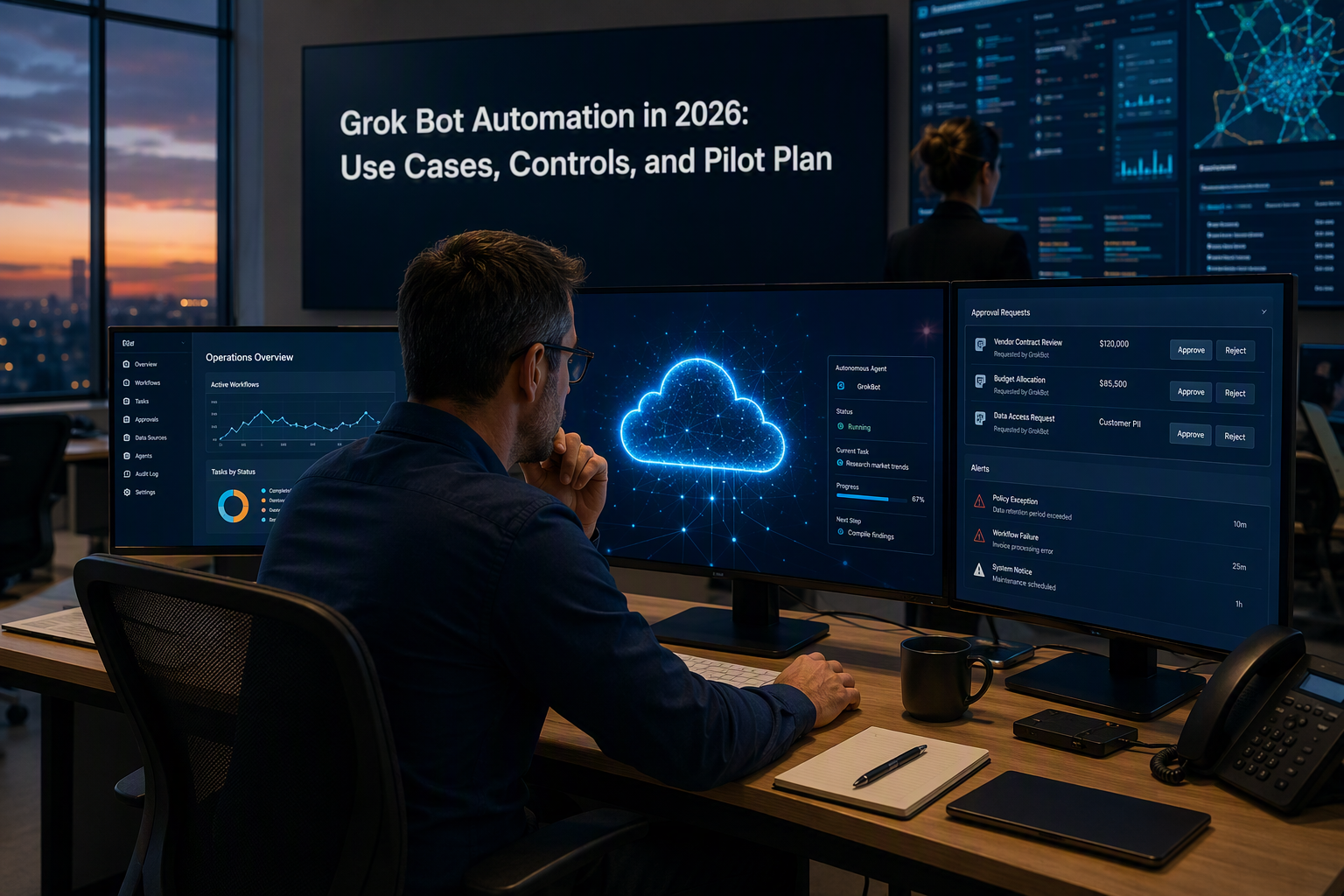
Learn where Grok Bot automation fits, how to secure browser workflows, control costs, require approvals, and run a measurable 2026 pilot.
Grok Bot Automation in 2026: Use Cases, Controls, and Pilot Plan
What changes when an AI assistant no longer waits for prompts, but logs into business software, works through the night, and returns only when the job is complete? Grok Bot automation in 2026 turns that scenario into a practical possibility—but giving an AI persistent access to browsers, inboxes, files, and operational systems also creates risks that ordinary chatbots never posed.
xAI launched Grok Bot in early beta on August 11, 2026, according to xAI’s launch announcement as reported by Zeniteq and AIToolsReview. Each Grok Bot receives a persistent cloud computer with a browser, filesystem, and terminal, allowing it to execute multi-step work across websites and applications while its user is away. HokAI reports that Grok Bot can connect to more than 20 external services, including Gmail, Slack, and GitHub. On August 26, 2026, xAI expanded access across SuperGrok tiers and selected Cursor plans, according to IMI Softs—making the technology relevant to a much broader group of developers and business teams.
The important distinction is that Grok Bot is designed as a delegated worker, not simply another conversational interface. A conventional chatbot may explain how to compile a competitor report; an always-on agent can potentially visit approved sources, collect updates on a schedule, organize findings, and notify a team when predefined conditions are met. That model is promising for recurring research, browser-based administration, inbox triage, operational monitoring, and structured reporting.
However, capability does not equal suitability. A bot using real credentials could send an incorrect message, expose sensitive information, misinterpret a changed webpage, or take an irreversible action at machine speed. High-impact work—such as releasing payments, changing production infrastructure, terminating accounts, or making regulated decisions—should therefore remain behind human approval gates, role-based permissions, spending limits, and complete audit trails.
This implementation guide will show how to:
- Identify high-value, low-risk use cases for persistent automation.
- Separate tasks suitable for autonomous execution from those requiring approval.
- Design safer browser workflows with restricted credentials and scoped access.
- Establish recurring monitoring, research, and operations routines.
- Define escalation paths, evidence capture, audit logs, and rollback procedures.
- Run a measurable pilot before expanding Grok Bot into critical workflows.
Grok Bot also reflects a wider shift toward AI systems that act across communication channels and business tools. Platforms such as CallMissed apply this agentic model to customer engagement through AI voice agents, WhatsApp chatbots, WhatsApp Business calling, email, and web workflows.
The goal is not to automate everything. It is to give Grok Bot bounded autonomy: clear assignments, minimum necessary access, observable actions, and humans retaining authority where mistakes carry meaningful consequences.
What can Grok Bot automation reliably do in 2026—and where should humans stay in control?
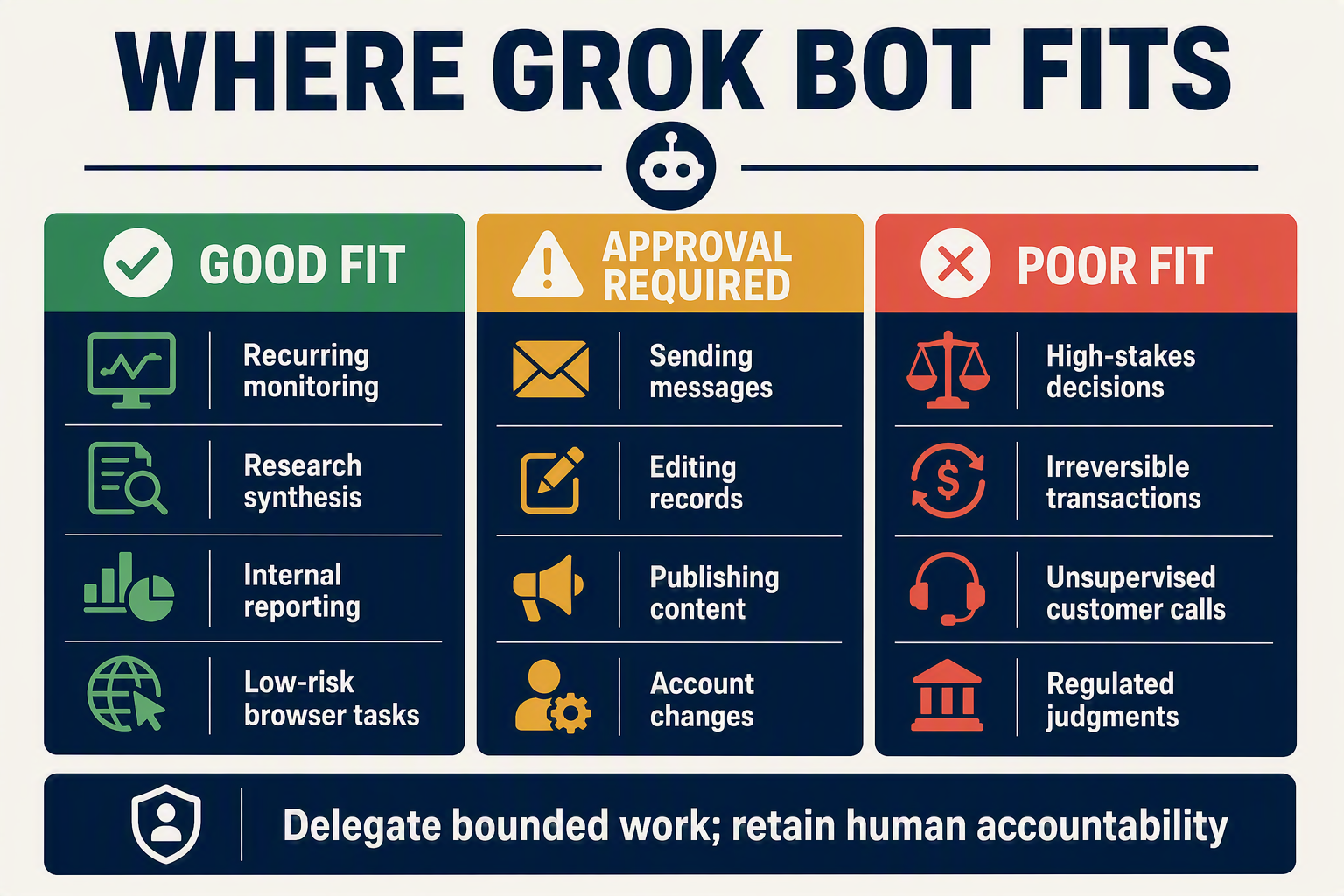
Grok Bot can reliably handle bounded, repetitive, evidence-based work in 2026; humans should retain control over ambiguous, sensitive, high-impact, or irreversible decisions. The practical dividing line is not whether a task can be automated, but whether errors are detectable, containable, and reversible.
Reliable use cases: repeatable work with clear success criteria
Grok Bot is well suited to workflows that follow explicit rules and operate within approved systems. According to AIToolsReview’s September 2026 overview, each bot has a persistent cloud computer with a browser, filesystem, and terminal, enabling end-to-end execution rather than answer generation alone.
Suitable assignments include:
- Recurring monitoring: Check approved webpages, dashboards, inventory levels, service status, or policy pages on a schedule; compare results with a baseline; alert only when thresholds are crossed.
- Structured research: Gather information from named sources, record publication dates, preserve citations, remove duplicates, and produce a standardized briefing.
- Inbox and ticket triage: Classify messages, extract fields, draft replies, assign labels, and escalate exceptions without sending externally unless approved.
- Browser administration: Download reports, transfer data between low-risk systems, update noncritical records, and capture confirmation screens.
- Operational reporting: Reconcile routine datasets, identify missing values, summarize activity, and prepare daily or weekly reports.
- Development support: Review GitHub issues, reproduce documented checks, organize logs, or prepare pull-request summaries without merging code.
HokAI reports that Grok Bot connects to more than 20 external services, including Gmail, Slack, and GitHub, as of 2026. That breadth makes cross-application workflows practical, but every additional connection also expands the security and failure surface.
Use a risk ladder, not a binary automation decision
Teams should classify each action by impact before granting autonomy:
- Observe: Read data, search, compare, and summarize. These tasks are generally appropriate for autonomous operation when access is scoped.
- Prepare: Draft emails, populate forms, assemble reports, or propose changes. The bot may work independently, but a person reviews the output.
- Act reversibly: Apply labels, create internal tickets, update staging records, or schedule draft content. Permit these actions only with logging and rollback.
- Act irreversibly: Send payments, delete data, alter production infrastructure, publish legal statements, or close customer accounts. Require explicit human approval—and consider prohibiting bot execution entirely.
A useful rule is: the higher the financial, legal, safety, privacy, or reputational consequence, the narrower the bot’s authority should be.
Where humans must remain accountable
Grok Bot should not independently make employment decisions, approve credit, interpret medical or legal obligations, commit contractual terms, disclose confidential data, or resolve emotionally sensitive customer disputes. It should also avoid workflows where success depends on unstated organizational context or where a changed webpage could silently redirect an action.
Human review is essential when:
- Inputs conflict, sources lack provenance, or confidence is low.
- An action affects money, access rights, production systems, or regulated records.
- Communication could create a binding promise or public commitment.
- The workflow encounters CAPTCHA, unexpected authentication, changed interfaces, or requests for broader permissions.
- The bot cannot produce evidence showing what it observed, decided, and changed.
Because xAI launched Grok Bot in early beta on August 11, 2026, according to Zeniteq and AIToolsReview, organizations should treat reliability as something to verify in their own environment—not assume. Start with read-only monitoring, measure exception and correction rates, then expand authority only when logs demonstrate stable performance.
What is Grok Bot, and how is an always-on AI teammate different from a chatbot or fixed workflow?

Grok Bot is a persistent, tool-using AI agent that can accept an outcome, operate a cloud computer, and complete multi-step work asynchronously. Unlike a chatbot that mainly generates responses or a fixed workflow that follows predefined branches, Grok Bot can choose intermediate actions based on what it encounters.
From answering questions to owning outcomes
HokAI describes Grok Bot as a “delegated worker, not another chat window.” That distinction changes how teams assign work:
- A chatbot answers a prompt, drafts content, or recommends an action; the user normally executes the next step.
- A fixed workflow runs explicitly programmed logic, such as “when a form is submitted, create a CRM record and send an email.”
- A browser automation script reproduces predetermined clicks, selectors, and data-entry steps.
- An always-on AI teammate receives a goal, inspects the current state, selects tools, adapts its path, and continues until it reaches a stop condition or needs help.
For example, a chatbot can summarize instructions for updating supplier records. A fixed workflow can update records when every field arrives in a predictable format. Grok Bot can potentially open the supplier portal, examine inconsistent records, gather missing information from approved sources, update eligible entries, and escalate ambiguous cases.
This flexibility is valuable, but it is also the primary source of risk. A deterministic workflow should produce the same action from the same input; an AI agent may interpret context differently across runs.
Persistence changes the operating model
AIToolsReview reported in September 2026 that each Grok Bot has a persistent cloud computer containing a browser, filesystem, and terminal. Zeniteq similarly characterizes Grok Bot as capable of remaining active in the cloud and operating connected applications rather than ending with a generated answer.
Persistence gives the agent three important capabilities:
- State retention: Files, intermediate results, and task context can remain available between steps.
- Asynchronous execution: The user can delegate work and return later instead of supervising every interaction.
- Recurring responsibility: A bot can revisit an approved process on a schedule, such as checking a portal each morning or compiling a weekly research digest.
“Always-on” should not mean unrestricted. It means the execution environment remains available for delegated work, while every assignment should still have a defined scope, schedule, budget, and completion rule.
Goal-based automation versus fixed instructions
A conventional workflow encodes the path; Grok Bot is designed to reason about the path. A useful assignment therefore specifies an operational contract:
- Objective: What business outcome must be produced?
- Allowed resources: Which websites, applications, folders, and accounts may be used?
- Constraints: What data, actions, or spending levels are prohibited?
- Approval points: Which steps require a person to confirm before execution?
- Evidence: What screenshots, files, source citations, and activity logs must be retained?
- Stop conditions: When should the bot finish, retry, or escalate?
Consider recurring competitor monitoring. A rigid scraper may fail when a webpage changes structure. An AI teammate may navigate the revised page and still locate the relevant announcement—but it could also misclassify a claim or use an unapproved source. The safer design lets Grok Bot collect and organize evidence autonomously, while a human approves externally published conclusions.
The practical definition, therefore, is not “a chatbot that runs longer.” Grok Bot represents stateful, goal-directed automation operating through real software, with enough autonomy to handle variable steps—but only safely when permissions, approvals, and auditability are designed into the assignment.
Which Grok Bot beta developments are officially documented, observed in practice, or still speculative?
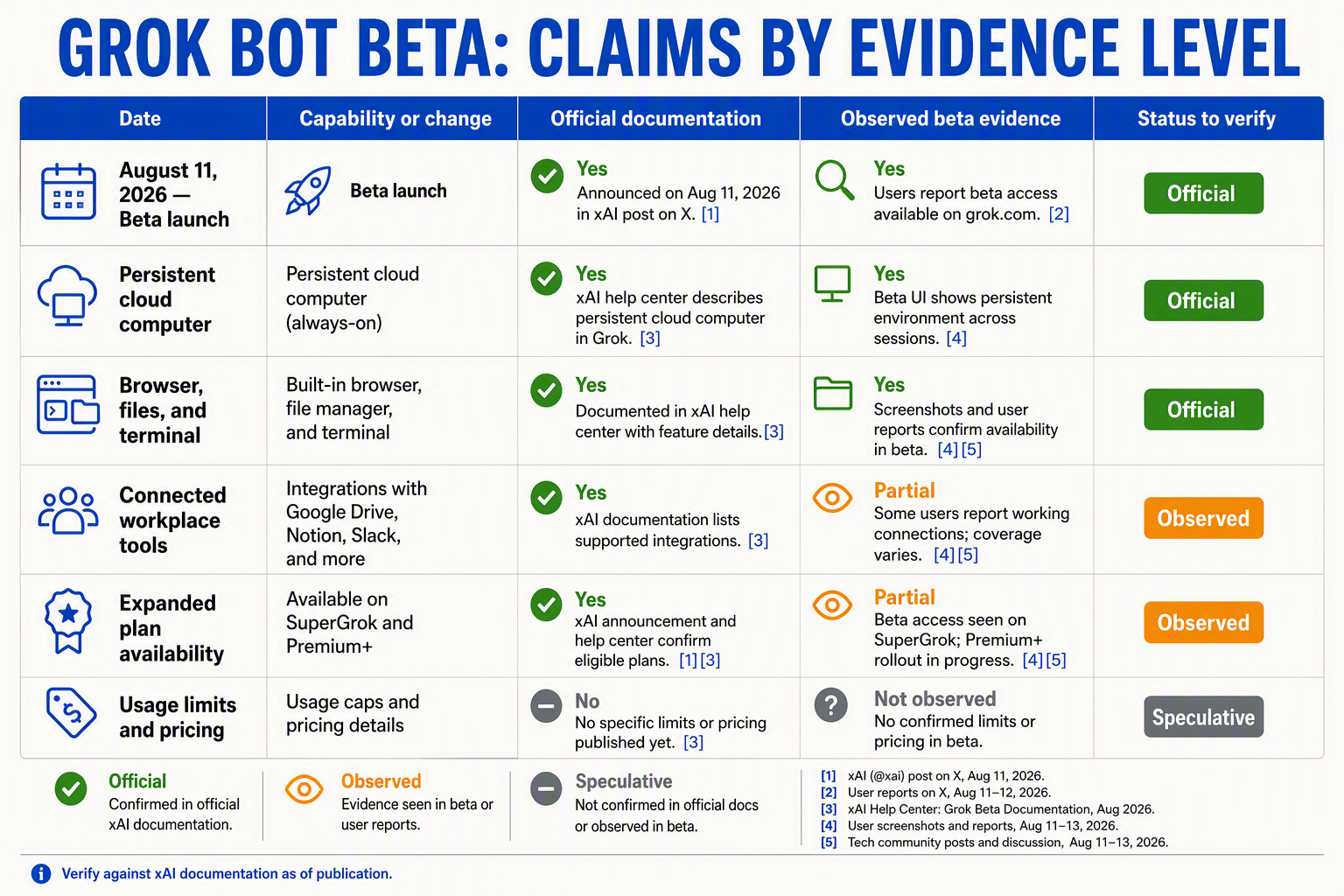
The safest way to evaluate Grok Bot beta in September 2026 is to separate xAI-documented capabilities from third-party observations and unverified expectations. Persistent cloud execution, browser/filesystem/terminal access, connected services, and expanded plan availability have public sourcing; enterprise-grade controls and performance guarantees remain less certain.
Evidence map for Grok Bot beta
| Development or claim | Status | Evidence available by September 8, 2026 | Implementation implication |
|---|---|---|---|
| Early-beta launch on August 11, 2026 | Officially documented | Zeniteq and AIToolsReview report xAI’s launch announcement and describe Grok Bot as an always-on AI teammate. | Treat the product as beta software: begin with reversible, low-impact workflows and expect interface or behavior changes. |
| A persistent cloud computer for each Bot | Officially documented | AIToolsReview reports that every Bot receives a browser, filesystem, and terminal for multi-step work while the user is away. | Assume credentials, downloaded files, cookies, and generated artifacts may persist; define retention, logout, and cleanup procedures. |
| Work across websites, applications, files, and inboxes | Officially documented | Zeniteq attributes this operating model to xAI’s August 11 announcement. | Browser-based operations are plausible, but every target application should be tested against layout changes, session expiry, CAPTCHA, and permission boundaries. |
| Connections to more than 20 external services | Observed/reported in practice | HokAI reports over 20 integrations, including Gmail, Slack, and GitHub, and characterizes the product as a delegated worker rather than another chat window. | Verify each required connector inside the tenant before procurement; do not infer support for a service merely because browser login is possible. |
| Wider access from August 26, 2026 | Officially announced and independently reported | IMI Softs reports availability across every SuperGrok tier plus Cursor Pro and Cursor Teams; earlier access included SuperGrok Heavy, Cursor Ultra, and Cursor Teams Premium, according to Jigar Joshi. | Confirm current regional, platform, and plan eligibility because beta entitlements can change faster than implementation documentation. |
| Reliable unattended completion of arbitrary business processes | Still speculative | Sources describe end-to-end, multi-step execution, but the supplied evidence provides no cross-industry success rate, failure benchmark, or service-level agreement. | Establish task-specific evaluations: completion rate, exception rate, human-review time, cost per run, and recovery success. |
| Enterprise controls such as immutable audit logs, granular RBAC, data residency, and formal SLAs | Not established by the supplied evidence | None of the cited reports documents a complete enterprise governance specification or quantified uptime commitment. | Do not assume these controls exist. Require written confirmation and add external identity, logging, secrets-management, and approval systems where needed. |
How to interpret the labels
Officially documented does not mean proven under every production condition. It means the capability was attributed to an xAI announcement or product-access update. Observed/reported means an independent reviewer described the feature, but teams should reproduce it in their own environment. Speculative means the claim may be plausible yet lacks a documented specification, representative benchmark, or contractual commitment.
Two dates anchor the current record. xAI launched Grok Bot in early beta on August 11, 2026, according to Zeniteq and AIToolsReview. xAI expanded Grok Bot access on August 26, 2026, according to IMI Softs. Everything else should be checked against the live product and contract before deployment.
Turn uncertainty into an implementation checklist
Before approving a workflow, capture:
- The source and date for every assumed capability.
- A screen recording or run log proving the behavior in your tenant.
- Credential scope, file retention, and session-cleanup rules.
- Measured success and failure rates across representative test cases.
- A human-approval boundary for messages, purchases, deletions, deployments, and account changes.
This evidence-led approach prevents launch descriptions from becoming security assumptions. For a beta agent operating real software, verified behavior—not product category language—should determine the autonomy granted.
Which Grok Bot use cases are suitable, unsuitable, or safe only with approval gates?
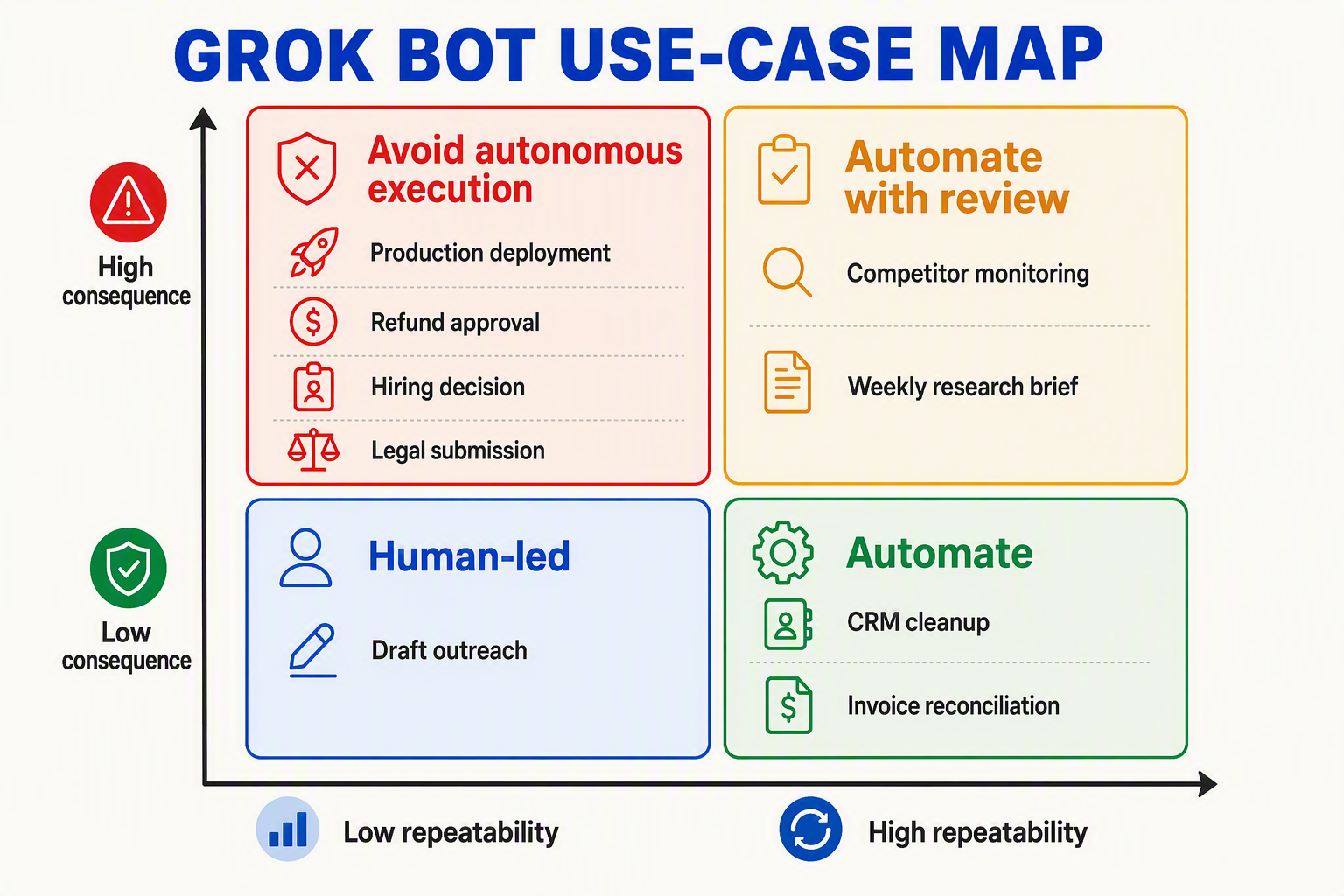
Grok Bot is best suited to repetitive, reversible, rules-based work with verifiable outputs. Tasks that affect money, permissions, customers, production systems, legal rights, or regulated decisions should require explicit approval—or remain entirely outside the bot’s scope.
Classify work by impact and reversibility
Because Grok Bot remains a beta product as of September 2026, organizations should apply a conservative autonomy model. HokAI reports that Grok Bot can connect to more than 20 external services, including Gmail, Slack, and GitHub; that reach increases both its usefulness and the potential blast radius of an error.
| Classification | Suitable examples | Required control | Why |
|---|---|---|---|
| Autonomous | Public-web monitoring, report formatting, internal reminders | Read-only access and logging | Outputs are reviewable and easily corrected |
| Autonomous with limits | CRM enrichment, ticket tagging, draft generation | Field restrictions, confidence thresholds | Errors are reversible but may affect operations |
| Approval required | Sending external messages, changing records, publishing content | Human review before execution | Actions create business or reputational consequences |
| Unsuitable | Final hiring decisions, unrestricted payments, legal determinations | Keep human-owned | Errors may be irreversible, discriminatory, or regulated |
A practical autonomy test asks four questions:
- Can the action be reversed quickly?
- Can correctness be checked against an authoritative source?
- Is the maximum loss bounded by technical controls?
- Would a reasonable reviewer understand why the bot acted?
If any answer is “no,” add an approval gate or reject the use case.
Suitable tasks for bounded autonomy
Good assignments have stable instructions, predictable interfaces, and measurable completion criteria. Examples include:
- Monitoring public webpages for price, policy, inventory, or product changes.
- Collecting research from an approved source list and attaching citations.
- Producing daily summaries from read-only dashboards.
- Classifying inbound messages without replying or deleting them.
- Checking whether scheduled jobs completed and escalating exceptions.
- Creating draft reports, tickets, emails, or knowledge-base updates.
- Reconciling records and flagging mismatches without changing source data.
Browser automation is safest when Grok Bot interacts with non-sensitive, low-variance workflows. Require screenshots, timestamps, source references, and the final page state as evidence—not merely a message saying the task succeeded.
Tasks that need approval gates
Require a named human approver immediately before any consequential action, including:
- Sending customer, supplier, employee, or public communications.
- Publishing website, social-media, pricing, or policy changes.
- Issuing refunds, placing orders, modifying subscriptions, or initiating payments.
- Merging code, deploying software, changing cloud resources, or rotating credentials.
- Editing CRM ownership, contract status, payroll data, or access permissions.
- Deleting files, messages, accounts, repositories, or business records.
The approval screen should show the proposed action, target, changed fields, supporting evidence, expected cost, and rollback method. Approval must authorize that exact action—not grant a reusable blank cheque.
Tasks that should remain unsuitable
Do not delegate decisions that require legal accountability, protected-trait judgment, privileged interpretation, or unbounded discretion. This includes final decisions on hiring, termination, credit, insurance, medical treatment, legal advice, regulatory filings, and fraud accusations.
Also prohibit credential sharing, CAPTCHA circumvention, access-control bypasses, covert surveillance, and actions outside the organization’s authorization. As AIToolsReview noted in September 2026, each Grok Bot operates through a persistent cloud computer; therefore, access should be treated like a service account with least privilege, session expiry, complete audit logs, and immediate revocation capability.
How do you build browser automation, recurring monitoring, research, and operations workflows that fail safely?
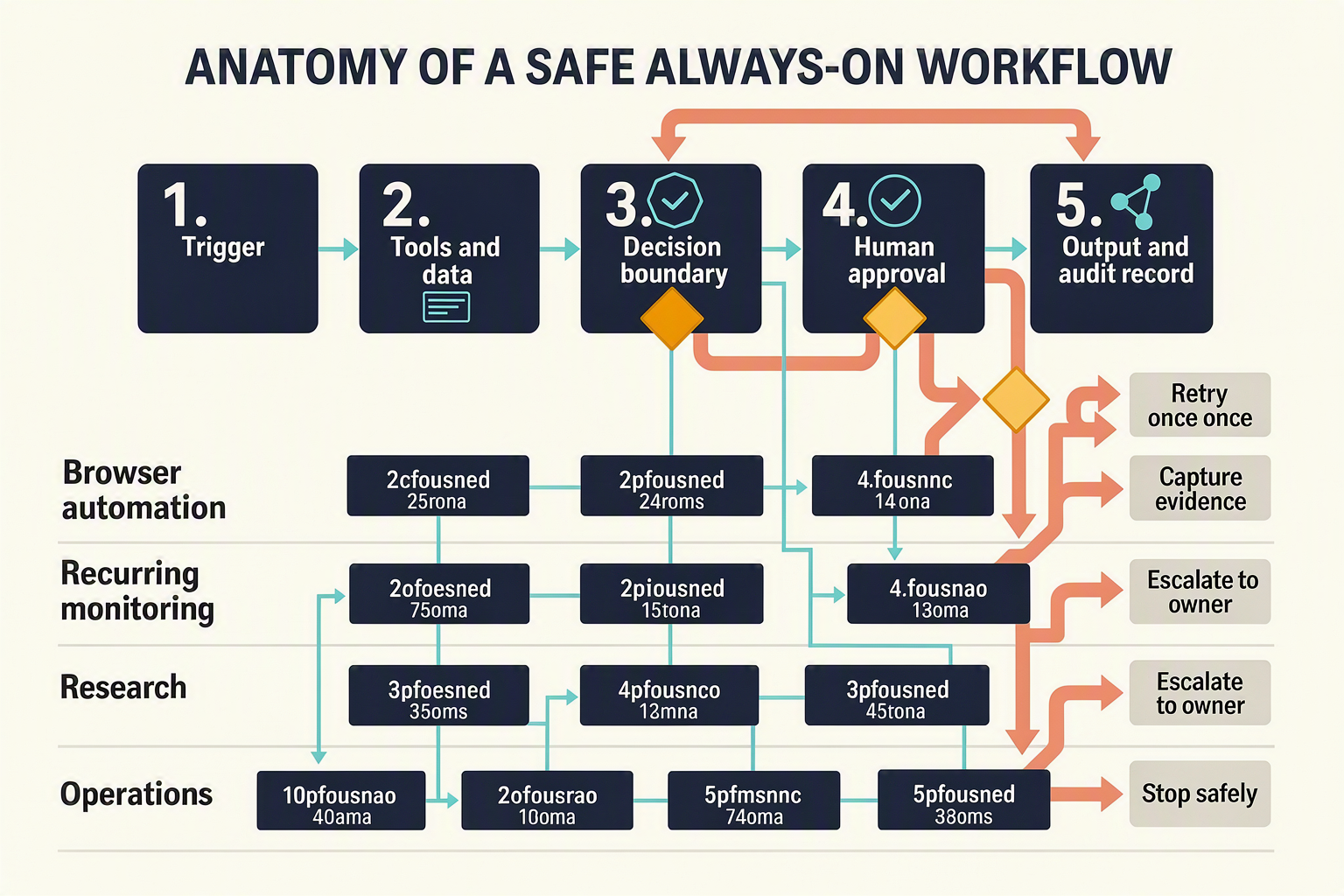
Build every Grok Bot workflow as a bounded, observable state machine: collect evidence, validate it, prepare an action, request approval when necessary, execute once, and verify the result. A safe workflow must stop on ambiguity rather than improvising, while preserving enough evidence for a human to understand and resume the job.
Use a fail-safe execution pattern
HokAI reports that Grok Bot can connect to more than 20 external services, including Gmail, Slack, and GitHub, increasing both its automation reach and the potential blast radius of an error. Apply the following sequence to each workflow:
- Observe: Read pages, messages, files, or system status without making changes.
- Validate: Confirm the account, date range, record count, permissions, and expected page structure.
- Prepare: Generate a draft, proposed update, or structured action plan.
- Approve: Pause before consequential actions such as publishing, emailing customers, changing permissions, or spending money.
- Execute once: Attach an idempotency key or unique job ID so retries cannot duplicate the action.
- Verify: Re-read the target system and confirm that the intended state exists.
- Record: Save timestamps, inputs, outputs, approvals, screenshots, and error details.
The default failure behavior should be stop, preserve state, and escalate—not retry indefinitely or find an unapproved workaround.
Harden browser automation against page changes
Browser workflows are fragile because labels, layouts, authentication steps, and page structures change. Prefer supported APIs when available; use the browser for systems without adequate API coverage.
For safer browser execution:
- Give the bot a dedicated least-privilege account, not an employee’s administrator login.
- Restrict it to an allowlist of domains, pages, file types, and permitted actions.
- Validate stable identifiers, such as record IDs and account names, rather than relying only on screen position.
- Capture a screenshot before and after every write operation.
- Set limits for records processed, messages sent, files downloaded, and execution time.
- Stop on CAPTCHAs, unexpected login prompts, permission changes, or materially altered page layouts.
- Never instruct the bot to bypass access controls or a website’s usage restrictions.
Design recurring monitoring around state, not repetition
A recurring job needs a checkpoint showing what was previously observed. Without one, the bot may repeatedly report the same incident or process the same record.
For each monitoring run, store:
- Last successful execution time and source cursor.
- Hashes or IDs of previously processed items.
- The observed value, alert threshold, and comparison result.
- Consecutive failure count and next retry time.
- Notification destination and escalation owner.
Use bounded retries with exponential backoff. For example, retry a temporary timeout three times, but escalate immediately when credentials fail or a source produces structurally invalid data.
Separate research from operational truth
Research automation should produce evidence-backed briefs, not unsupported conclusions. Require Grok Bot to record the source name, publication date, retrieval time, exact excerpt, and any conflicting evidence. Mark missing information as unknown rather than asking the agent to infer facts.
Operational workflows need stronger controls:
- Low risk: Read dashboards, classify inbox items, summarize updates, or draft reports.
- Moderate risk: Update CRM fields or create tickets within predefined schemas and limits.
- High risk: Send external communications, modify production systems, change access, issue refunds, or approve payments—always require human authorization.
Every run should create an immutable audit entry containing the bot identity, workflow version, credentials role, inputs, tool calls, approval identity, outcome, and rollback status. This makes failure diagnosable and turns persistent automation into controlled operations rather than unattended experimentation.
How should teams manage secrets, account permissions, approvals, persistent files, and audit logs?
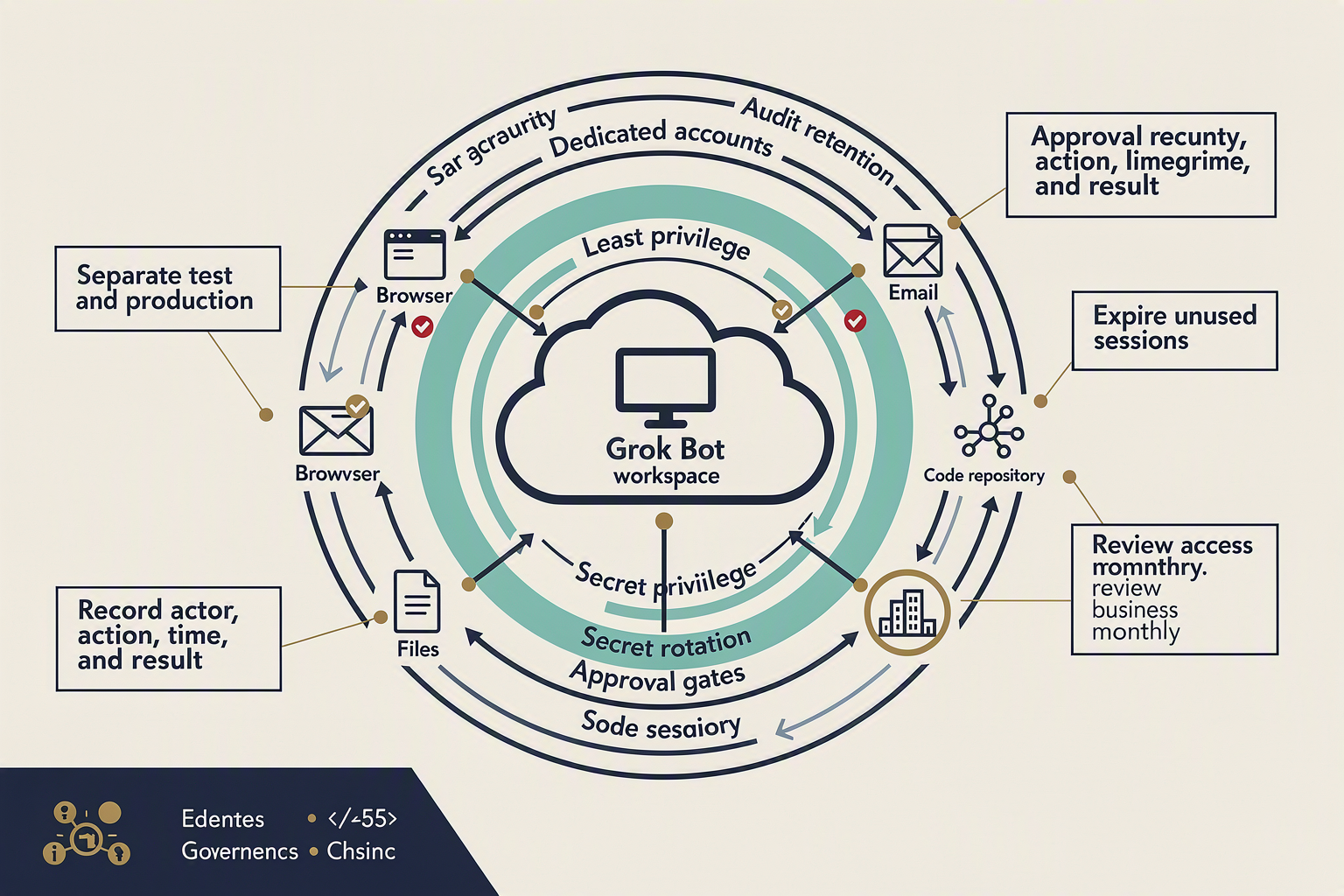
Teams should treat each Grok Bot as a persistent service account operating an internet-connected computer, not as a disposable chat session. Use bot-specific credentials, least-privilege roles, explicit approval gates, controlled file retention, and an audit trail stored outside the bot’s own environment.
Isolate secrets and identities
AIToolsReview reported in September 2026 that each Grok Bot receives a persistent cloud computer with a browser, filesystem, and terminal and can sign into tools using the user’s credentials. Persistence is operationally useful, but browser cookies, downloaded exports, command histories, and cached tokens may remain available between runs.
Apply these controls:
- Create a separate identity for each bot and workflow; never share an executive’s or administrator’s account.
- Store API keys in an approved secrets manager, and inject them only when required rather than placing them in prompts, scripts, or files.
- Prefer short-lived OAuth tokens over permanent passwords or unrestricted API keys.
- Disable credential export, password synchronization, and unnecessary browser extensions.
- Rotate credentials after personnel changes, suspected exposure, and pilot completion.
- Never place passwords, recovery codes, private keys, or customer records inside instructions.
HokAI reports that Grok Bot connects to more than 20 external services, including Gmail, Slack, and GitHub, as of August 2026. Teams should authorize only the specific integrations required for one documented job.
Enforce least privilege and separation of duties
Permissions should match actions, not departments. A research bot may need read access to selected websites and a reporting folder, but it does not need permission to send email externally or modify GitHub repositories.
Use a simple permission ladder:
- Read: search, view, and download approved data.
- Draft: prepare messages, tickets, reports, or proposed changes.
- Execute with approval: send communications or alter business records after confirmation.
- Restricted: block payments, production deployments, user deletion, credential changes, and regulated decisions unless governed by a separate control system.
Because Grok Bot remains an early-beta product launched on August 11, 2026, according to Zeniteq, teams should verify current native controls rather than assume that enterprise features such as granular roles, retention settings, or immutable logs are available.
Put irreversible actions behind approvals
Approval must occur outside the bot’s editable workspace. Route a structured request to a human reviewer containing:
- The proposed action and business reason.
- Target account, recipient, system, or record.
- Data sources and evidence used.
- Expected impact, cost, and rollback method.
- An expiration time and unique request ID.
Require two reviewers for high-value transactions or security-sensitive changes. An approval should authorize one exact action—not an open-ended instruction such as “make any necessary updates.”
Control persistent files
Classify files as temporary, working, or retained evidence. Delete temporary downloads after each run; encrypt sensitive working files; and move final evidence to company-controlled storage with retention policies. Block local storage of payment data, authentication secrets, health information, and unnecessary personally identifiable information.
Maintain tamper-resistant audit logs
Record every run in an external logging system, including:
- Bot identity, workflow version, start time, and end time.
- Sites, applications, files, and records accessed.
- Inputs, tool calls, outputs, and changed fields.
- Approval request, approver identity, timestamp, and decision.
- Errors, retries, screenshots, and rollback actions.
Reconcile logs against SaaS audit records and alert on unusual access, repeated failures, new domains, or activity outside scheduled windows. If an action cannot be reconstructed, attributed, and reversed, it should not be delegated autonomously.
How can you run a reproducible 30-day pilot while measuring reliability, risk, and total operating cost?
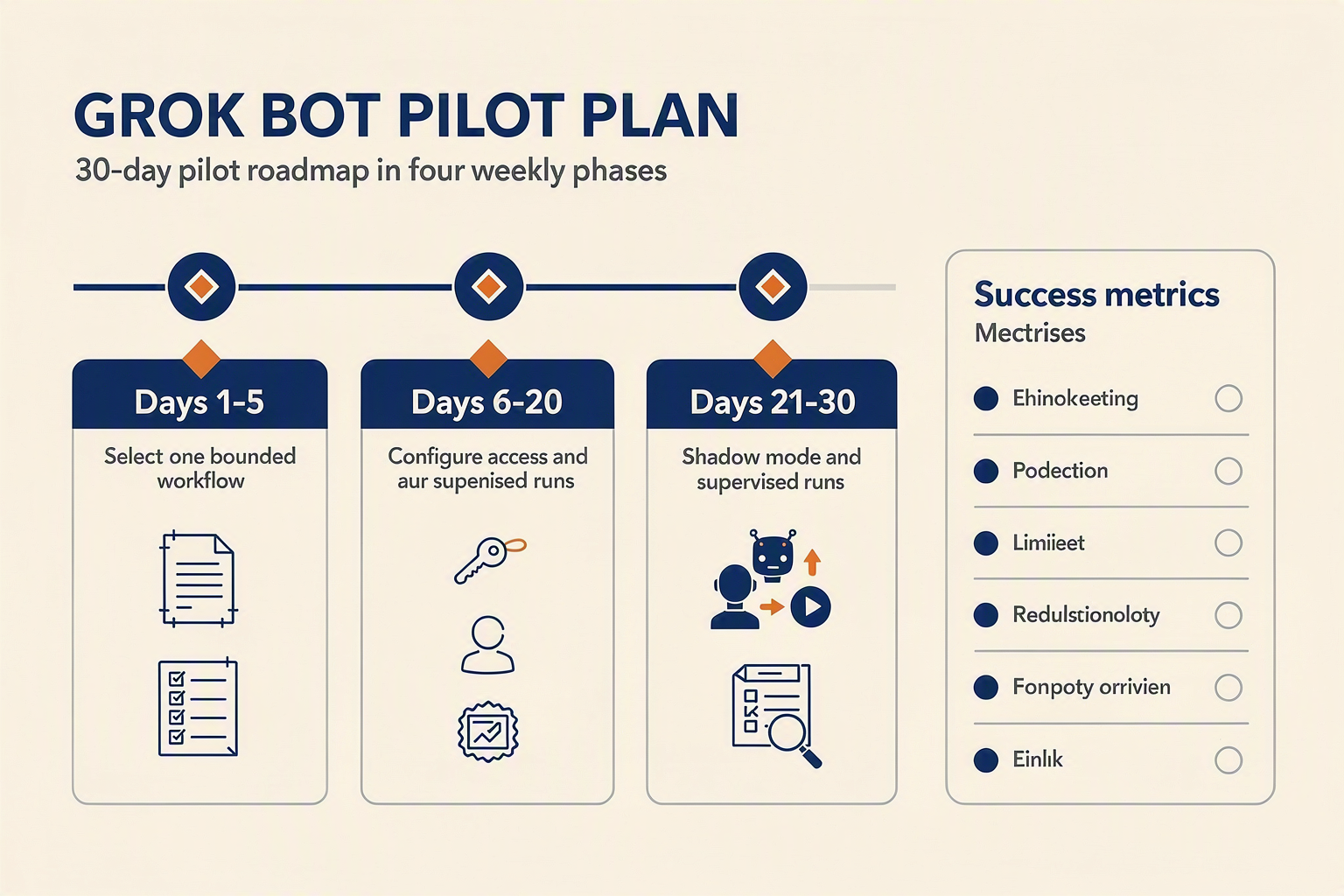
Run the pilot as a controlled experiment, not an informal trial: freeze the workflow definition, use a representative test set, log every action, and compare Grok Bot with the current human process for 30 days. Expansion should depend on predefined reliability, risk, and cost thresholds—not anecdotal time savings.
Days 1–5: establish scope and a baseline
Select one high-volume, reversible workflow with stable inputs—for example, checking approved websites for changes and drafting a daily summary. Avoid payments, production changes, account deletion, regulated decisions, and unsupervised external communication.
Document:
- Trigger, inputs, expected output, approved sources, and completion deadline.
- Every permitted action and explicit prohibited action.
- Human owner, approval points, escalation route, and rollback procedure.
- A fixed set of at least 50 representative cases, including missing data, login failures, changed page layouts, duplicates, and ambiguous instructions.
- The current process’s median handling time, labour cost, error rate, rework rate, and deadline compliance.
Keep prompts, credentials, browser environment, validation rules, and output format version-controlled. Grok Bot’s persistent computer includes a browser, filesystem, and terminal, according to AIToolsReview in September 2026, so reproducibility requires recording environment changes—not merely saving the initial instruction.
Days 6–12: run in shadow mode
Let Grok Bot complete the workflow without committing external actions. A reviewer compares each proposed result against a predefined answer key or checklist.
Measure four reliability indicators:
- Task success rate: fully correct completions ÷ attempted cases.
- Intervention rate: cases requiring human correction ÷ attempted cases.
- False-action rate: incorrect proposed actions ÷ total proposed actions.
- Recovery rate: transient failures resolved safely without manual repair ÷ recoverable failures.
HokAI reported in 2026 that Grok Bot can connect to more than 20 external services, including Gmail, Slack, and GitHub. Test each connector separately because aggregate success can conceal one unreliable integration.
Days 13–22: allow bounded execution
Enable write access only for reversible, low-impact steps. Require approval for messages, record changes, purchases, permission changes, or any action exceeding a defined threshold.
For every run, preserve an audit packet containing:
- Timestamp, workflow version, initiator, and bot identity.
- Input references and retrieved evidence.
- Pages visited, tool calls, files changed, and messages drafted.
- Approval identity and decision.
- Final outcome, exception category, and rollback status.
Use a stop rule: immediately pause the pilot after credential exposure, unauthorised access, irreversible action, or repeated failures of the same class. Grok Bot remains beta software: xAI launched the early beta on August 11, 2026, according to Zeniteq, and expanded access on August 26, 2026, according to IMI Softs.
Days 23–30: calculate total operating cost
Do not compare subscription fees alone. Calculate:
TCO = platform fees + model or usage charges + integration labour + reviewer time + exception handling + security and compliance overhead + expected incident cost.
Expected incident cost equals incident probability × estimated impact. Also report cost per successful task, not cost per attempt:
Cost per successful task = total pilot cost ÷ accepted outputs.
Compare this with the baseline’s fully loaded human cost, while keeping quality and turnaround requirements equal.
Make the go/no-go decision
Proceed only if the pilot meets thresholds fixed on day one—for example:
- ≥95% accepted outputs for a low-risk workflow.
- 0 unauthorised or irreversible actions.
- ≤10% human intervention rate.
- Positive savings after reviewer and exception costs.
- Complete audit packets for 100% of runs.
Otherwise, narrow permissions, simplify the workflow, improve validation, and rerun the same test set. A reproducible pilot produces a defensible decision: scale, redesign, or stop.
What do automation and security experts say about persistent AI agents, and what are the wider business implications?

Persistent AI agents should be treated as privileged software operators, not unusually capable chatbots. Automation and security guidance converges on one principle: autonomy is acceptable only when access, actions, and consequences are explicitly bounded and continuously observable.
The expert view: assume the agent can make mistakes
The NIST AI Risk Management Framework organizes AI governance around four functions—Govern, Map, Measure, and Manage—which translate naturally to persistent agents: assign ownership, document each workflow, test failure modes, and monitor operation after deployment. Meanwhile, NIST Special Publication 800-207 defines zero trust around having “no implicit trust,” regardless of where a user or system operates.
That distinction matters because Grok Bot works inside a persistent cloud environment rather than an isolated conversation. AIToolsReview reported in September 2026 that every Grok Bot receives a browser, filesystem, and terminal and can sign into existing tools using the user’s credentials. HokAI also reported in 2026 that Grok Bot connects with more than 20 external services, including Gmail, Slack, and GitHub.
Security teams should therefore design for predictable agent failure modes:
- Prompt injection: Malicious instructions embedded in emails, webpages, documents, or support tickets can attempt to redirect the agent.
- Excessive agency: A broad objective such as “resolve every overdue account” may permit actions the operator never intended.
- Credential leakage: Browser sessions, downloaded files, terminal output, and logs can expose secrets.
- Automation drift: A changed website layout, policy, or data format can silently invalidate a previously reliable workflow.
- Compounding errors: An incorrect classification can trigger messages, record updates, or downstream automations before a human notices.
The appropriate operating assumption is not that the model will always fail, but that any individual run can fail.
Persistent agents change the control model
Traditional automation usually follows deterministic rules. Persistent agents interpret goals, select tools, and adapt their path, so businesses must control both what the agent may access and what outcomes it may produce.
A mature deployment separates controls into three layers:
- Preventive controls: Dedicated identities, allowlisted domains, read-only access by default, transaction ceilings, secret vaults, and prohibited-action policies.
- Detective controls: Timestamped tool calls, screenshots, input and output records, anomaly alerts, and reconciliation against source systems.
- Corrective controls: Session revocation, workflow suspension, rollback procedures, incident ownership, and customer-notification playbooks.
An audit record should capture the objective, initiating user, model or agent version, credentials or role used, external systems accessed, evidence reviewed, actions attempted, approvals obtained, and final outcome. A chat transcript alone is not an adequate operational record.
The wider business implications
Grok Bot signals a shift from purchasing software seats to supervising a mixed workforce of people, conventional automation, and AI agents. Zeniteq reported that xAI launched Grok Bot in early beta on August 11, 2026, specifically to complete work across websites, applications, files, and inboxes. IMI Softs reported that access expanded on August 26, 2026, bringing the product to every SuperGrok tier and selected Cursor plans.
This creates several organizational consequences:
- Managers become workflow designers, defining objectives, exceptions, and escalation thresholds.
- Identity governance must include non-human workers, with owners and periodic access reviews.
- Procurement must assess reversibility and observability, not merely model accuracy.
- Compliance teams need evidence at action level, particularly for financial, employment, healthcare, and customer-data workflows.
- Productivity measurement should track completed, verified outcomes, not hours saved or tasks attempted.
The durable advantage will not come from granting maximum autonomy. It will come from building governed autonomy that remains useful even when the agent encounters ambiguity, hostile content, or operational change.
When should you choose Grok Bot, ChatGPT, Zapier, n8n, or a specialized platform such as CallMissed?
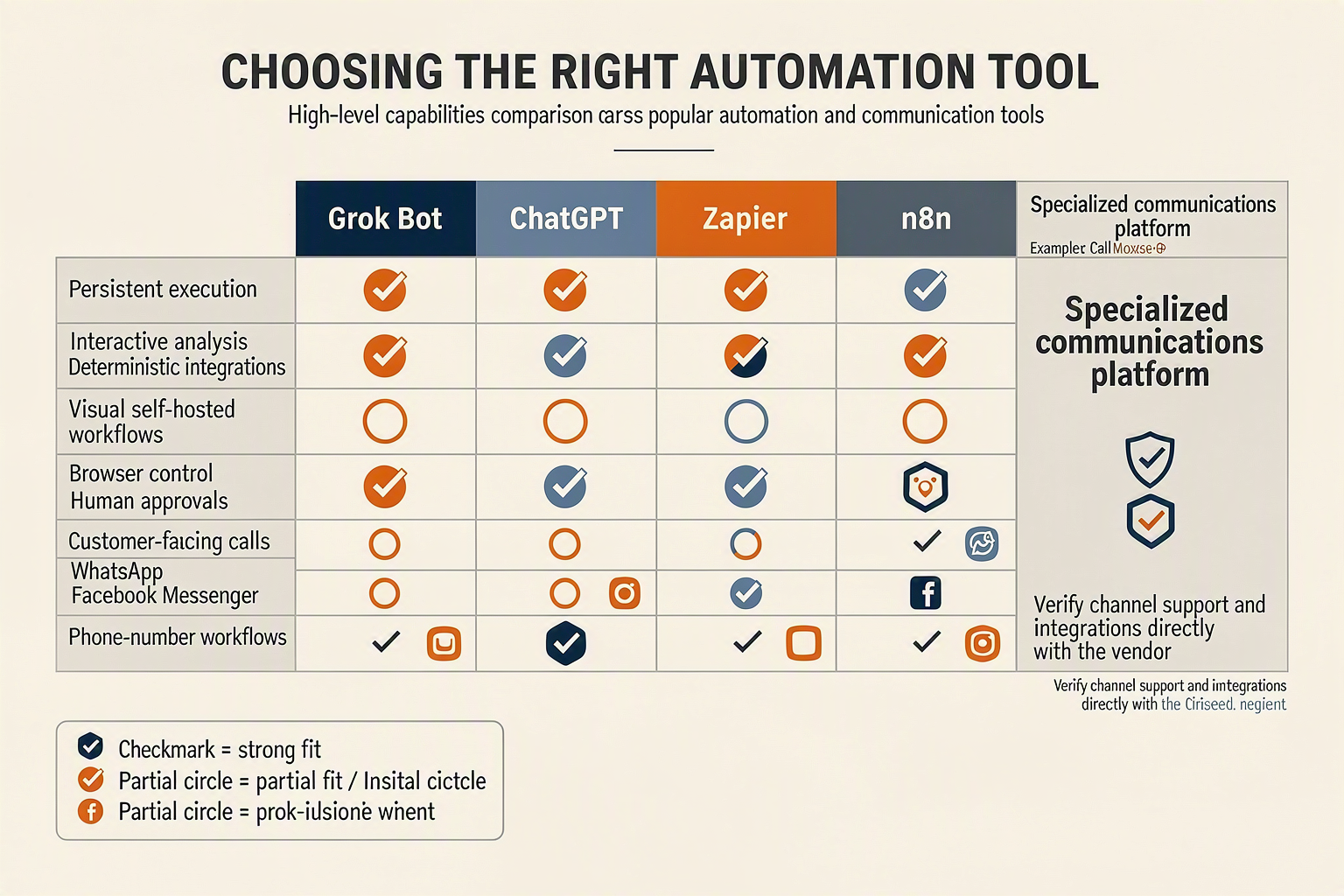
Choose Grok Bot for persistent, browser-led assignments; ChatGPT for interactive reasoning; Zapier for managed trigger-action workflows; n8n for customizable, self-hostable orchestration; and CallMissed for customer communication across voice, WhatsApp, email, and web. The right choice depends less on model intelligence than on the required execution surface, predictability, governance, and channel specialization.
Platform fit at a glance
| Platform | Best suited to | Execution model | Key advantage | Main consideration |
|---|---|---|---|---|
| Grok Bot | Recurring research, browser administration, inbox review, cross-application operations | Persistent cloud computer with browser, filesystem, and terminal | Can navigate existing interfaces and continue working asynchronously | Beta-stage browser actions require strict permissions, approvals, and evidence capture |
| ChatGPT | Analysis, drafting, coding assistance, document synthesis, interactive investigation | Prompt-led conversations and product-dependent agent tools | Strong human-in-the-loop reasoning and rapid iteration | Not every chat workflow is designed for unattended, recurring execution |
| Zapier | SaaS event automation, notifications, record synchronization, simple approvals | Managed triggers and predefined application actions | Fast setup for structured workflows across supported connectors | Complex branching or unsupported application behavior may require custom code |
| n8n | API orchestration, data transformation, internal automations, controlled AI pipelines | Visual workflows with code, API nodes, and self-hosting options | Greater deployment and workflow customization | Teams must operate, secure, test, and monitor their own automation environment |
| CallMissed | AI voice agents, WhatsApp chat and calling, omnichannel support, regional-language engagement | Specialized communication platform plus developer APIs | Supports voice and chat across 22 Indian languages, including WhatsApp Business calls connected to AI agents | Intended for communication workflows rather than general-purpose desktop automation |
Match the tool to the control surface
Grok Bot is most compelling when a task must be completed through a website or application that lacks a suitable API. AIToolsReview reported in September 2026 that each Grok Bot receives a persistent cloud computer containing a browser, filesystem, and terminal. HokAI also reports that Grok Bot connects to more than 20 external services, including Gmail, Slack, and GitHub.
That flexibility should not automatically make browser automation the default. Prefer deterministic API or connector workflows when they exist:
- Use Zapier when a known event should reliably produce a standard action—for example, copying a submitted form into a CRM and notifying Slack.
- Use n8n when the workflow requires custom API calls, data transformations, private deployment, branching, or detailed technical control.
- Use ChatGPT when a person needs to explore ambiguity, challenge an answer, or refine a deliverable before anything is executed.
- Use Grok Bot when success requires navigating changing interfaces, gathering information across tools, or maintaining a long-running assignment.
- Use CallMissed when the workflow’s primary surface is a customer conversation, particularly AI voice or WhatsApp Business calling for Indian and multilingual audiences.
Apply a governance test before deciding
Grok Bot remains a relatively new operational system. xAI launched Grok Bot in early beta on August 11, 2026, according to Zeniteq and AIToolsReview. IMI Softs reported that xAI expanded access on August 26, 2026, to every SuperGrok tier and selected Cursor plans. Teams should therefore validate current security controls and product limits rather than assume enterprise readiness from broad availability.
Before selection, ask:
- Does the task have a reliable API or require visual browser interaction?
- Must execution be deterministic, or can the agent exercise bounded judgment?
- Are approval checkpoints, immutable logs, screenshots, or rollback available?
- Does the workflow involve regulated data, payments, production access, or customer promises?
- Is a specialized channel platform more appropriate than a general-purpose agent?
In practice, these tools are often complementary: n8n or Zapier can coordinate predictable system events, Grok Bot can handle bounded browser work, ChatGPT can support human analysis, and CallMissed can manage customer-facing communication.
Frequently asked questions about Grok Bot pricing, beta access, browser automation, security, alternatives, and business use cases
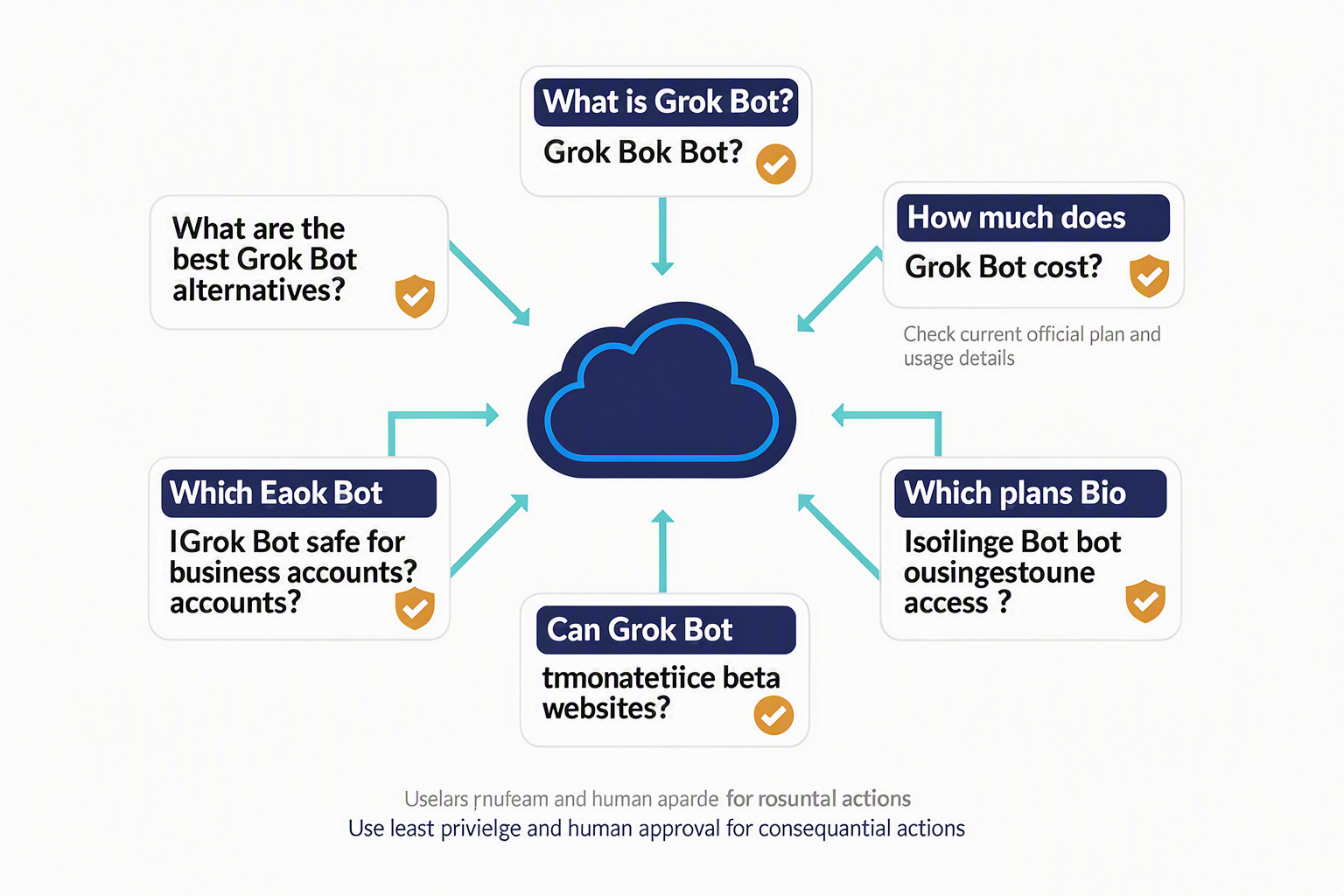
How much does Grok Bot cost in 2026?
How do I get Grok Bot beta access?
Can Grok Bot automate websites and workplace applications?
Is Grok Bot automation secure enough for company data?
Does Grok Bot have a public API?
What are the best alternatives to Grok Bot automation?
Which business use cases are suitable for Grok Bot automation?
Conclusion
Grok Bot automation in 2026 should be deployed as bounded autonomy, not unrestricted delegation. Its strongest role is completing repeatable, observable work across approved systems while people retain authority over consequential or irreversible decisions.
- Start with high-value, low-risk tasks. Recurring research, inbox triage, browser-based administration, operational monitoring, and structured reporting are practical candidates when inputs, outputs, and success criteria are clearly defined. Grok Bot is particularly relevant here because each bot receives a persistent cloud computer with a browser, filesystem, and terminal, according to xAI’s August 11, 2026 launch announcement as reported by Zeniteq and AIToolsReview.
- Keep high-impact actions behind approval gates. Payments, production changes, account termination, sensitive external communications, and regulated decisions require human review. Role-based permissions, restricted credentials, spending limits, escalation paths, rollback procedures, and complete audit logs should be part of the workflow—not controls added after deployment.
- Treat browser automation as inherently changeable. Websites, page structures, authentication flows, and business rules can shift without warning. Every workflow should capture evidence, validate outputs, stop safely when conditions differ from expectations, and escalate uncertainty rather than improvising.
- Pilot before expanding. Begin with one bounded workflow and measure completion rate, exception frequency, human review time, false actions, and recovery effort. HokAI reported in August 2026 that Grok Bot could connect to more than 20 external services, including Gmail, Slack, and GitHub; broader connectivity increases potential value, but also enlarges the permission and audit surface.
What matters next is whether always-on agents become more controllable as they become more capable. Watch for stronger permission scoping, clearer activity records, dependable approval mechanisms, and safer recovery from changed interfaces or incorrect actions.
This shift will also extend beyond internal operations into customer communication. To explore how AI communication is evolving, check out CallMissed—an AI-native platform supporting voice agents, WhatsApp automation and calling, and multilingual engagement across 22 Indian languages. Which recurring workflow can your team safely delegate first—and what evidence would prove the pilot deserves to scale?
Related Reading
- Manus vs Grok Bot: Which Autonomous AI Agent Wins in 2026?
- Grok Bot Pricing 2026: Verified Access, Features, Risks and Limits
- Meta Muse vs Grok Bot: Which Personal AI Agent Wins in 2026?