
Best OpenAI-Compatible API Gateway in 2026: 7 Compared


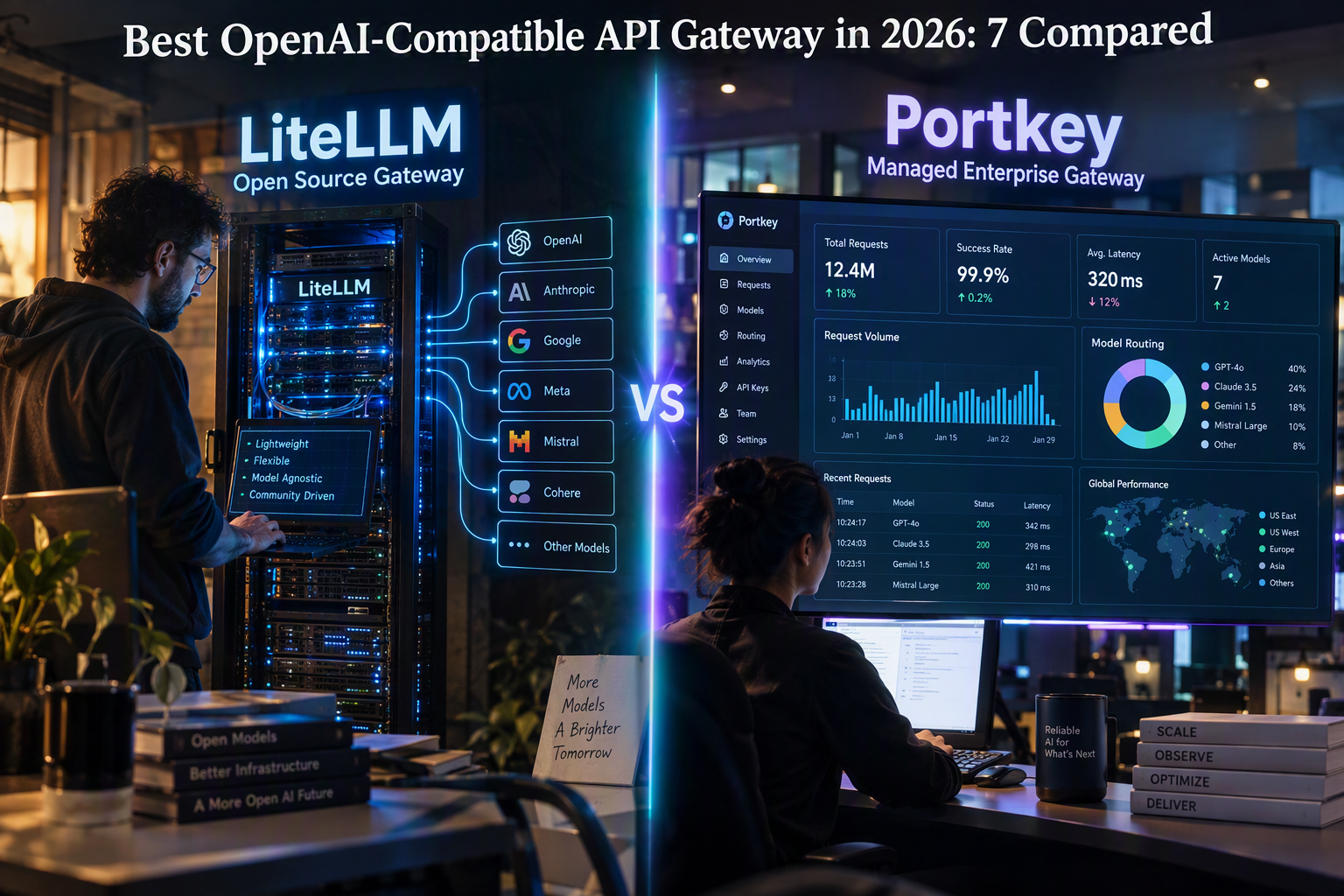
Compare the best OpenAI-compatible API gateways for production apps by routing, compatibility, pricing, observability, security, and self-hosting.
Best OpenAI-Compatible API Gateway in 2026: 7 Compared
The best OpenAI-compatible API gateway in 2026 depends on your priority: choose LiteLLM for open-source self-hosting, Portkey for enterprise governance, Kong AI Gateway for API-management depth, or OpenRouter for fast access to a broad model catalog. For production LLM applications, the right gateway is less about a single winner and more about deployment model, routing, observability, pricing, and operational control.
Why does this matter now? An OpenAI-compatible API endpoint lets developers switch models without rewriting application code, while an AI gateway can add provider routing, fallbacks, rate limits, monitoring, and centralized billing. The 2026 comparison landscape includes LiteLLM, Portkey, Kong AI Gateway, Helicone, Cloudflare AI Gateway, OpenRouter, and other specialized platforms, according to Respan, Flotorch, and Zuplo’s 2026 gateway guides.
Pricing varies significantly. Respan lists LiteLLM as free to start, with a referenced paid plan of $499 per month, while Ofox describes enterprise gateway deployments such as Portkey or Kong AI Gateway at $5,000 or more per month; these figures are not directly comparable because self-hosted, usage-based, and enterprise contracts cover different capabilities. This guide separates infrastructure cost from model-inference cost so you can evaluate the real budget impact.
You will learn:
- Which gateway best fits open-source and self-hosted deployments
- Which platforms suit enterprise governance and production LLM workloads
- How OpenAI-compatible RESTful APIs support managed LLM access
- Which options provide routing, fallbacks, rate limits, observability, and multi-provider access
- What trade-offs matter for startups, developers, and global engineering teams
Platforms such as CallMissed, an OpenAI-compatible AI gateway, reflect the broader shift toward one integration for multiple AI capabilities, including LLM chat, speech-to-text, text-to-speech, image generation, and web search.
The final recommendation is decision-ready rather than ranking-driven: use LiteLLM when control and self-hosting matter most; consider Portkey or Kong when governance and API management are central; evaluate OpenRouter when broad model access and integration speed are priorities; and compare Cloudflare AI Gateway or Helicone when observability, traffic management, or platform-native operations lead the buying decision.
Which is the best OpenAI-compatible API gateway in 2026?
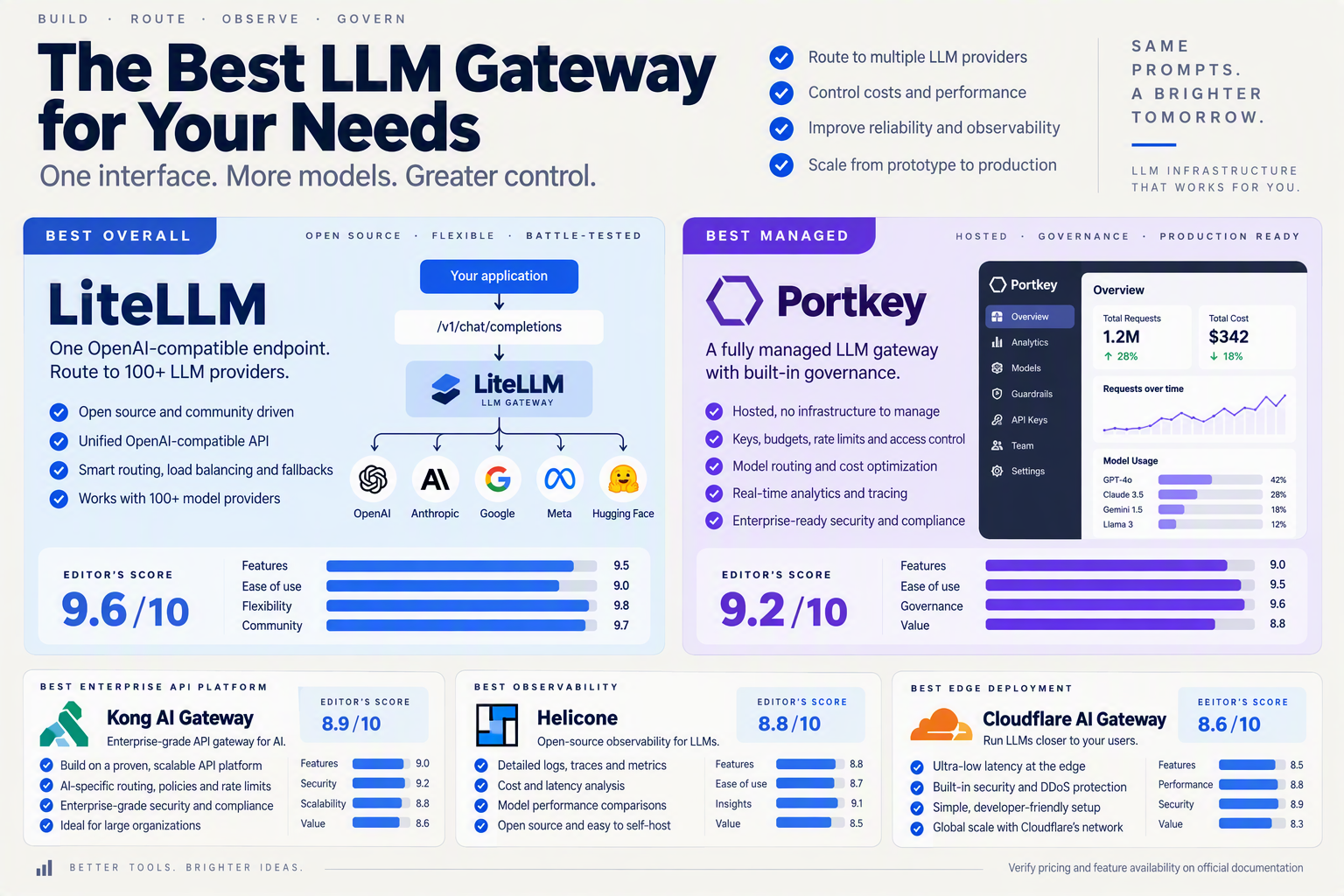
The best OpenAI-compatible API gateway in 2026 depends on your deployment priorities: choose LiteLLM for open-source self-hosting, Portkey for enterprise LLM governance, Kong AI Gateway for established API-management environments, OpenRouter for rapid multi-provider model access, Cloudflare AI Gateway for Cloudflare-native operations, or Helicone when observability is the primary requirement. For most production teams, the decision should balance compatibility, routing, governance, deployment control, and total operating cost rather than rely on a universal ranking.
Which OpenAI-compatible API gateway fits your requirements?
| Gateway | Best fit | Deployment focus | Referenced pricing | Primary decision factor |
|---|---|---|---|---|
| LiteLLM | Self-hosting and infrastructure control | Open-source gateway | Free to start; $499/month paid plan cited by Respan | Provider flexibility and ownership |
| Portkey | Enterprise LLM governance | Managed production gateway | $5,000+/month enterprise reference from Ofox; not a standardized list price | Routing, policies, and governance |
| Kong AI Gateway | Mature API-platform teams | Enterprise API-management layer | $5,000+/month enterprise reference from Ofox; not a standardized list price | Authentication, traffic policies, and integration |
| OpenRouter | Rapid multi-model experimentation | Managed provider-access layer | Not specified in the cited context | Model discovery and integration speed |
| Cloudflare AI Gateway | Existing Cloudflare customers | Cloudflare-native gateway and traffic layer | Not specified in the cited context | Operational proximity to Cloudflare infrastructure |
| Helicone | Request-level observability | Monitoring and gateway tooling | Not specified in the cited context | Logs, tracing, and usage visibility |
- Choose LiteLLM when an OpenAI-compatible RESTful API, self-hosting, and provider portability are more important than a fully managed control plane. Respan describes LiteLLM as free to start and cites a $499-per-month paid plan.
- Choose Portkey when production LLM applications need centralized routing, governance, policy enforcement, and operational controls. Ofox cites $5,000 or more per month for enterprise gateway deployments such as Portkey, but this is a reference point rather than a standardized public price.
- Choose Kong AI Gateway when AI and LLM workloads must operate within an existing API-management estate. Kong is a practical fit for teams that already manage authentication, rate limits, traffic policies, and service integration centrally.
- Choose OpenRouter when the priority is testing and accessing multiple models without building separate provider integrations. FutureAGI lists OpenRouter among Portkey alternatives in 2026.
- Choose Cloudflare AI Gateway when the application already depends on Cloudflare services and gateway operations should remain close to the application edge. Guptadeepak and FutureAGI include Cloudflare AI Gateway among their 2026 comparisons.
- Consider Helicone when observability, request monitoring, and usage analysis lead the buying decision. Flotorch includes Helicone among the eight gateways it evaluates in its 2026 enterprise comparison.
What is the clear verdict?
LiteLLM is the strongest fit for open-source and self-hosted deployments. Portkey and Kong AI Gateway are better aligned with governed enterprise environments, while OpenRouter suits rapid multi-model access. Cloudflare AI Gateway fits Cloudflare-centric infrastructure, and Helicone is the focused choice when observability drives selection.
What is the best OpenAI-compatible API gateway for self-hosting?
Which gateway is best for enterprise governance?
Is Kong AI Gateway suitable for existing API platforms?
Which gateway is best for trying many models quickly?
Which option prioritizes observability?
What is the verdict at a glance for the top OpenAI-compatible AI gateways?
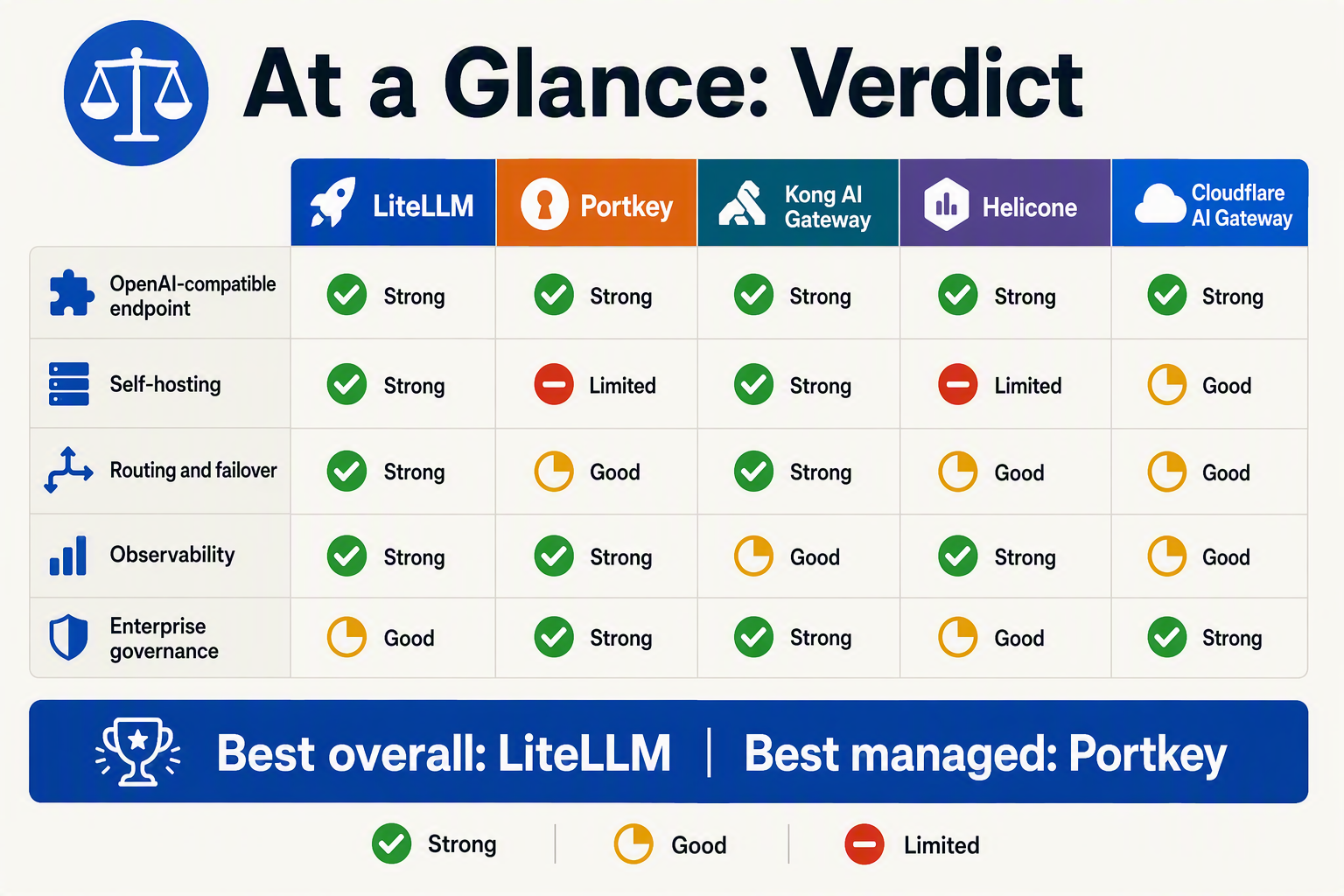
The best OpenAI-compatible API gateway depends on your primary requirement: choose LiteLLM for self-hosted, open-source routing; Portkey for enterprise governance; Kong AI Gateway for full API-management controls; and OpenRouter for fast access to a broad model catalogue. Cloudflare AI Gateway and Helicone are strong alternatives for edge traffic management and observability respectively.
Which OpenAI-compatible AI gateway fits each use case?
| Gateway | Best fit | Key capability | Researched pricing or positioning |
|---|---|---|---|
| LiteLLM | Open-source and self-hosted teams | One compatible interface across providers, routing, and deployment control | Respan lists it as free to start, with a referenced paid plan of $499/month |
| Portkey | Production LLM applications and enterprises | Governance, routing, observability, and centralized controls | Ofox describes enterprise deployments at $5,000+ per month, depending on scope |
| Kong AI Gateway | Organizations with API-management infrastructure | Authentication, policies, rate limits, and traffic controls | Ranked among leading production gateways by Flotorch and Zuplo in 2026 |
| OpenRouter | Developers seeking rapid multi-model access | Compatible API access to a broad model catalogue | FutureAGI identifies OpenRouter as a major Portkey alternative in 2026 |
| Cloudflare AI Gateway | Teams already using Cloudflare | AI traffic management within an edge and developer-platform ecosystem | Included among leading 2026 options by Deepak Gupta and Zuplo |
| Helicone | Teams focused on visibility and optimization | Request tracing, analytics, observability, and cost visibility | Flotorch includes Helicone among the eight frequently evaluated gateways in 2026 |
LiteLLM is the clearest choice for teams that want maximum infrastructure control. Its open-source, self-hosted model reduces dependence on a managed gateway and supports a single OpenAI-compatible API endpoint for multiple LLM providers.
Portkey is the strongest enterprise-oriented recommendation when governance matters more than minimal cost. Centralized routing, observability, and policy controls make it suitable for organizations operating production LLM applications across teams or environments.
Kong AI Gateway is the practical choice for established API platforms. Its value is less about model discovery and more about applying familiar API-management capabilities—authentication, rate limiting, and policy enforcement—to AI and LLM workloads.
OpenRouter is the fastest route to model breadth without operating gateway infrastructure. It suits developers who want to test or integrate multiple managed models through a compatible endpoint, while Cloudflare AI Gateway is more relevant when edge controls and Cloudflare integration are priorities.
What is the overall verdict?
For most evaluation teams, shortlist LiteLLM, Portkey, Kong AI Gateway, and OpenRouter first. Use LiteLLM for self-hosting, Portkey for enterprise governance, Kong for API-management depth, and OpenRouter for rapid multi-model access. Add Helicone when observability is the deciding factor and Cloudflare AI Gateway when the application already depends on Cloudflare’s platform.
Which gateway should you choose first?
What is the best OpenAI-compatible API gateway for self-hosting?
Which gateway is best for enterprise LLM governance?
Which option provides the deepest API-management controls?
Which gateway is best for accessing many models quickly?
Which gateway is best for LLM observability?
How do the leading gateways compare on features, compatibility, and production readiness?
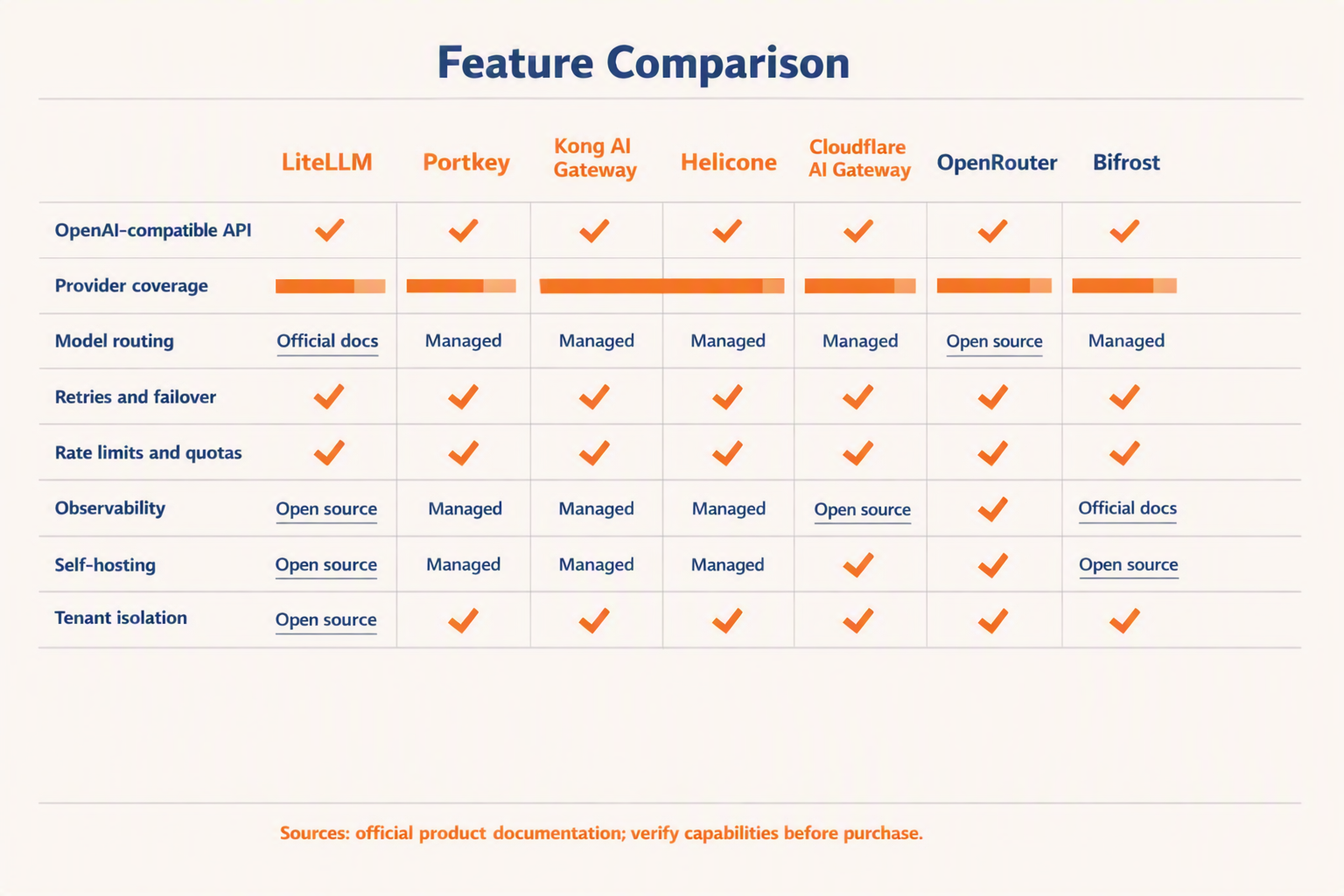
The best OpenAI-compatible API gateway depends on your operating model: choose LiteLLM for open-source, self-hosted control; Portkey or Kong AI Gateway for enterprise governance and API-management requirements; and OpenRouter for rapid access to a broad model catalogue. Helicone and Cloudflare AI Gateway are stronger candidates when monitoring, traffic management, or platform integration is the primary concern.
Gateway comparison matrix
| Gateway | Best fit | Compatibility and routing | Production-readiness focus | Referenced pricing |
|---|---|---|---|---|
| LiteLLM | Teams seeking open-source or self-hosted deployment | OpenAI-compatible interface for routing requests across multiple LLM providers | Deployment control through self-managed infrastructure | Free to start; $499/month plan referenced by Respan |
| Portkey | Organizations prioritizing enterprise governance | Managed gateway with provider routing and centralized controls | Governance, observability, and managed operations | $5,000+/month cited as an enterprise-deployment reference by Ofox; not a stated list price |
| Kong AI Gateway | API-management-heavy enterprises | AI traffic routing within Kong’s API platform | Rate limits, security policies, and centralized API management | Enterprise pricing; Ofox cites $5,000+/month enterprise examples, not a public list price |
| Helicone | Teams focused on LLM monitoring and analytics | Gateway and observability layer for model traffic | Monitoring-led production operations and usage analysis | Volume-based pricing should be verified, according to Flotorch |
| Cloudflare AI Gateway | Teams already using Cloudflare infrastructure | AI request routing and traffic controls | Edge-oriented operations and Cloudflare platform integration | Varies by Cloudflare usage and plan |
| OpenRouter | Developers needing fast, broad model access | One API for a large model catalogue | Rapid integration; evaluate governance requirements separately | Usage-based pricing varies by selected model |
Respan describes LiteLLM as an open-source gateway with an OpenAI-compatible interface, making it the clearest fit when infrastructure ownership and deployment flexibility matter. The referenced $499/month figure is a plan cited by Respan, not a universal cost for every LiteLLM deployment.
Portkey and Kong AI Gateway are better evaluated as enterprise infrastructure choices than as simple model aggregators. FutureAGI and Guptadeepak position both products around provider routing and organizational controls, while Kong’s fit is especially relevant for teams already managing APIs through Kong’s platform.
The $5,000+/month figure associated with Ofox should be read carefully: Ofox presents it as an enterprise-deployment reference, not as a published list price for either Portkey or Kong AI Gateway. It is therefore not directly comparable with LiteLLM’s self-hosted economics or OpenRouter’s usage-based model pricing.
- Choose LiteLLM when open-source deployment and infrastructure control are the deciding factors.
- Choose Portkey when centralized governance and observability are more important than self-hosting.
- Choose Kong AI Gateway when AI traffic must fit into an existing enterprise API-management program.
- Choose Helicone when monitoring and analytics drive the gateway decision.
- Choose Cloudflare AI Gateway when edge traffic controls and Cloudflare integration are strategic.
- Choose OpenRouter when integration speed and broad model availability matter most.
These recommendations reflect positioning in the 2026 comparisons from Respan, Flotorch, FutureAGI, Guptadeepak, Contabo, and Ofox; buyers should validate current limits, supported providers, security controls, and contract pricing before production rollout.
How much does each OpenAI-compatible API gateway cost?
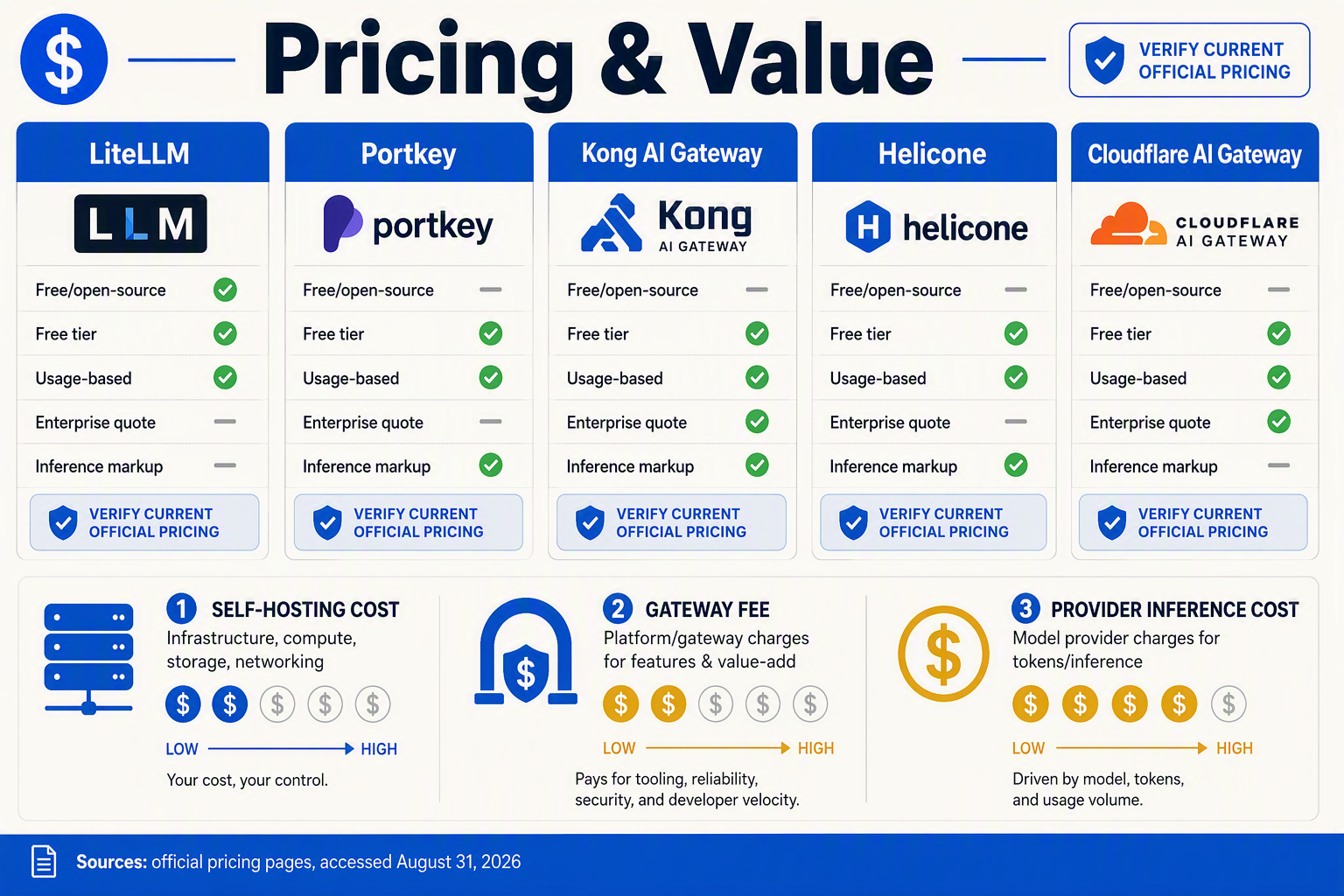
The best OpenAI-compatible API gateway for budget-conscious teams is LiteLLM, while Portkey and Kong AI Gateway target higher-cost enterprise deployments. Pricing must be compared separately from model-inference charges because self-hosted, usage-based, and enterprise-contract gateways use different billing models.
What does each OpenAI-compatible API gateway cost?
| Gateway | Gateway pricing cited | Pricing basis | Best fit |
|---|---|---|---|
| LiteLLM | Free to start; $499/month paid plan | Self-hosted or managed plan | Open-source control and provider routing |
| Portkey | $5,000+/month enterprise reference | Enterprise contract | Governance and production controls |
| Kong AI Gateway | $5,000+/month enterprise reference | Enterprise contract | API management and platform integration |
| OpenRouter | Usage-based; no fixed figure cited | Model and request usage | Broad model access and fast integration |
| Cloudflare AI Gateway | Usage or platform-dependent; no fixed figure cited | Cloudflare deployment and usage | Edge traffic management |
| Helicone | Volume-based; verify current quote | Request volume and observability | LLM monitoring and analytics |
- LiteLLM: Respan’s 2026 gateway comparison lists LiteLLM as free to start and cites a $499-per-month paid plan; infrastructure and model-token costs may remain separate.
- Portkey and Kong AI Gateway: Ofox’s 2026 guide references enterprise gateway deployments at $5,000 or more per month, but the figure is not a standardized public list price.
- OpenRouter: The practical cost is generally tied to selected model usage, making it suitable when teams want one OpenAI-compatible API endpoint without negotiating a large enterprise gateway contract.
- Cloudflare AI Gateway and Helicone: Flotorch’s 2026 comparison describes gateway pricing as volume-based or platform-dependent, so expected request volume should be part of the quote.
- Decision rule: Choose LiteLLM for predictable gateway software costs and maximum deployment control; choose Portkey or Kong when governance, support, and API-management capabilities justify enterprise pricing.
- Important comparison limit: Respan and Ofox publish different pricing references, and those figures are not directly comparable because they cover different deployment and support models.
What are the pros and cons of each gateway?
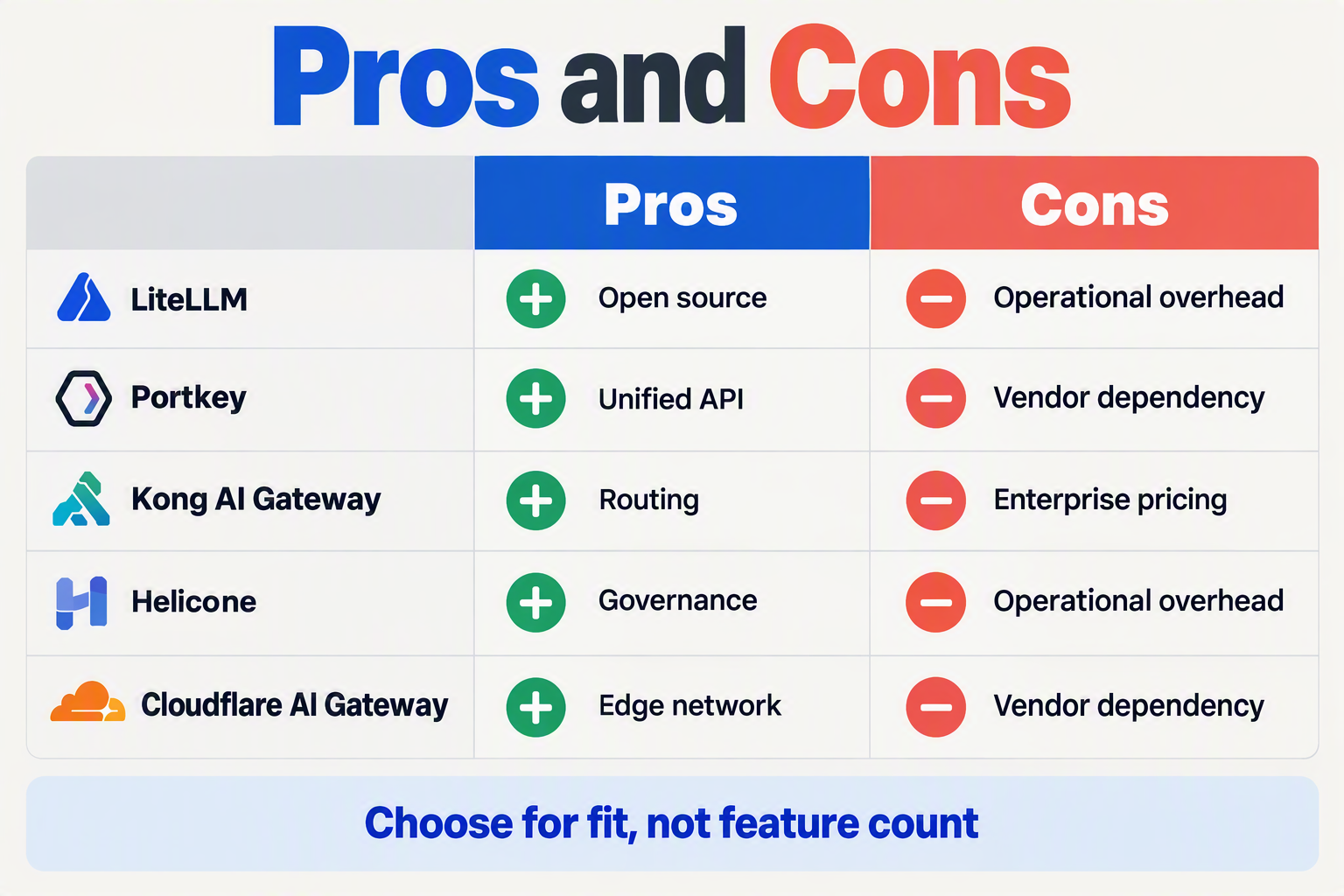
The best OpenAI-compatible API gateway depends on the trade-off you need: LiteLLM for self-hosting, Portkey for enterprise governance, Kong AI Gateway for API-management depth, and OpenRouter for broad model access. Cloudflare AI Gateway and Helicone are strong alternatives when traffic operations or observability are the primary requirements.
| Gateway | Best fit | Key strengths | Pricing signal | Main trade-off |
|---|---|---|---|---|
| LiteLLM | Open-source, self-hosted teams | OpenAI-compatible interface, multi-provider routing, deployment control | Free to start; Respan cites $499/month for a paid plan | Requires more operational ownership |
| Portkey | Enterprise LLM governance | Routing, fallbacks, observability, controls for production workloads | Enterprise deployments may reach $5,000+/month, according to Ofox | Higher budget and procurement overhead |
| Kong AI Gateway | API-platform and infrastructure teams | Deep API management, policy enforcement, rate limits, provider routing | Enterprise contract pricing; Ofox cites $5,000+/month examples | Broader platform complexity than a lightweight proxy |
| OpenRouter | Fast, broad model access | One endpoint for a large model catalogue and rapid integration | Usage-based; verify current model and platform rates | Less suited to teams requiring full self-hosted control |
| Cloudflare AI Gateway | Cloudflare-native operations | Traffic management, gateway controls, and platform integration | Usage and plan dependent; verify current Cloudflare pricing | Most compelling when Cloudflare is already part of the stack |
| Helicone | AI observability teams | Request monitoring, analytics, and production visibility | Usage or contract-based; verify current plan | Observability focus may require complementary routing infrastructure |
- Choose LiteLLM when infrastructure ownership, open-source deployment, and provider portability matter more than managed operations; Respan identifies it as a leading self-hosted option in 2026.
- Choose Portkey or Kong AI Gateway when governance, access policies, auditability, and enterprise API controls justify higher spend; Ofox describes comparable enterprise gateway deployments at $5,000 or more per month.
- Choose OpenRouter when developers want the shortest path to many models through an OpenAI-compatible API endpoint.
- Choose Cloudflare AI Gateway or Helicone when platform-native traffic controls or observability are more important than self-hosting.
- Consider CallMissed when one OpenAI-compatible gateway must cover LLM chat plus 22 Indian-language speech-to-text and text-to-speech, image generation, and web search.
Which OpenAI-compatible API gateway should you choose for your workload?
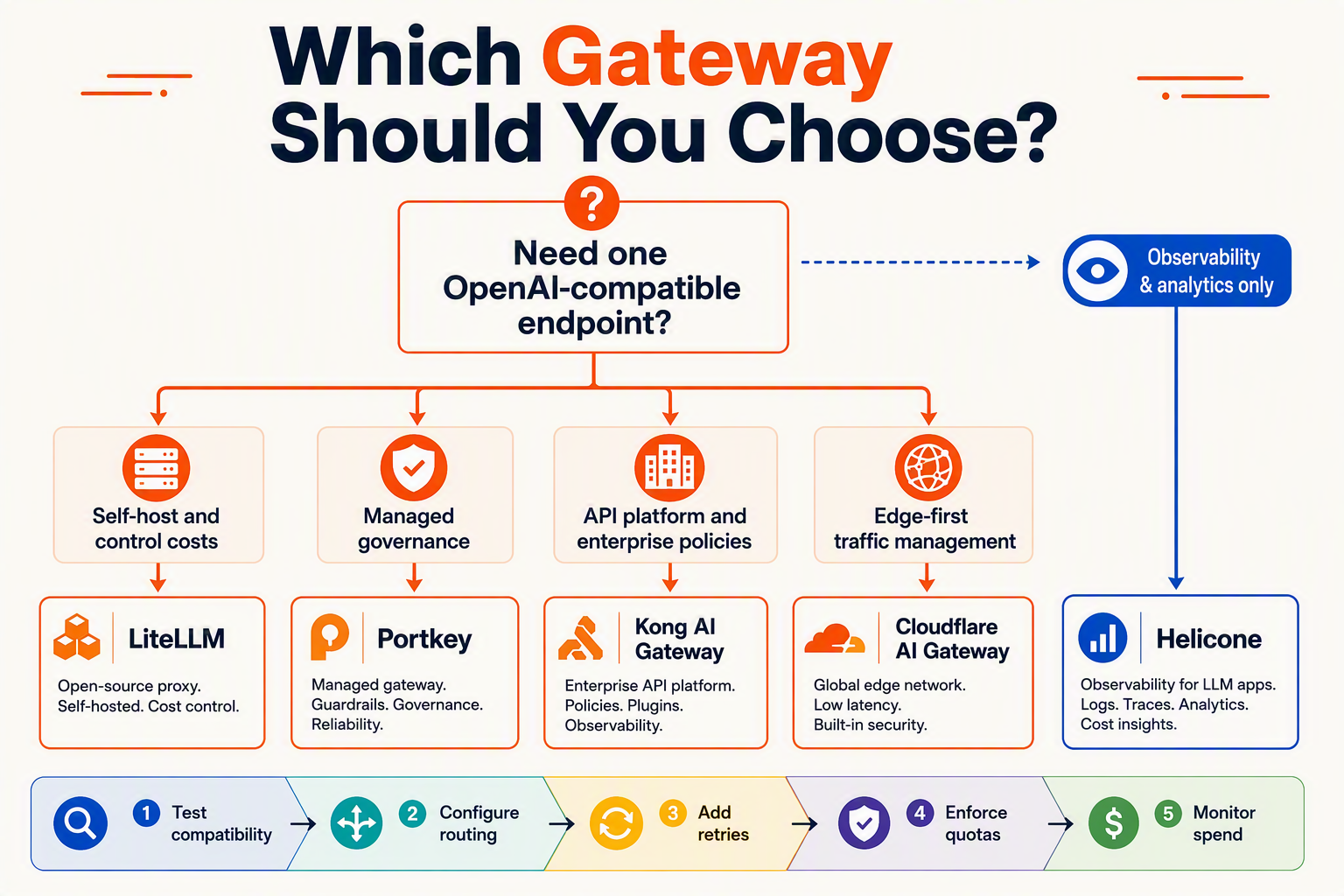
The best OpenAI-compatible API gateway depends on your workload: choose LiteLLM for self-hosting, Portkey or Kong AI Gateway for enterprise controls, and OpenRouter for rapid multi-model access. For one OpenAI-compatible endpoint spanning LLM, speech, image, and search APIs, CallMissed is relevant for developers seeking broader AI infrastructure.
Decision matrix
| Gateway | Best fit | Referenced pricing | Key decision factor |
|---|---|---|---|
| LiteLLM | Open-source and self-hosted teams | Free to start; $499/month paid reference | Maximum deployment control |
| Portkey | Enterprise governance and routing | $5,000+/month enterprise reference | Policies, observability, and production controls |
| Kong AI Gateway | API-management-heavy organizations | $5,000+/month enterprise reference | Existing Kong and gateway infrastructure |
| OpenRouter | Fast access to many models | Usage-based; verify current quote | Broad catalogue and integration speed |
Pricing figures are directional references: Respan lists LiteLLM as free to start with a $499/month paid plan, while Ofox describes enterprise deployments such as Portkey or Kong AI Gateway at $5,000 or more per month. These prices are not directly comparable because self-hosted, usage-based, and enterprise plans include different infrastructure and support.
- Choose LiteLLM when data residency, customization, and infrastructure ownership matter more than managed operations.
- Choose Portkey when centralized governance, model routing, and production observability are required across engineering teams.
- Choose Kong AI Gateway when AI traffic must integrate with established API-management, authentication, and policy systems.
- Choose OpenRouter when developers prioritize model discovery and a fast OpenAI-compatible API endpoint over deep internal control.
- Choose CallMissed when the workload extends beyond text: its gateway covers LLM chat, 22 Indian-language STT and TTS, image generation, and web search through one billing account.
Verdict: For top AI gateways for production LLM applications, start with LiteLLM for control, Portkey or Kong for governance, and OpenRouter for speed. Evaluate total cost—including inference, hosting, observability, and support—rather than comparing gateway subscription prices alone.
Frequently Asked Questions
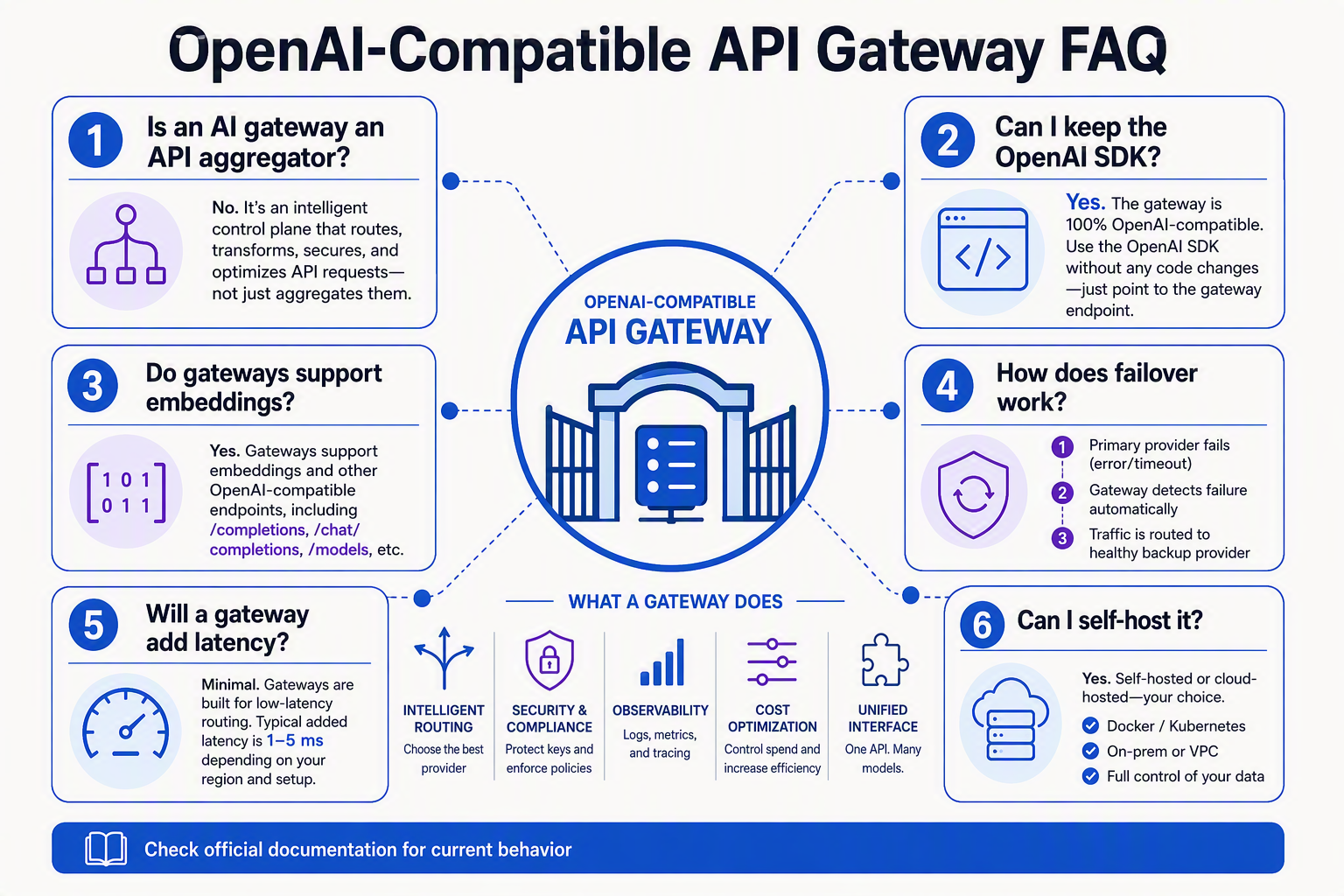
The best OpenAI-compatible API gateway depends on whether you prioritize self-hosting, governance, API-management depth, or rapid multi-model access. Compare deployment model, routing, observability, rate limits, fallback behavior, and total cost—not just endpoint compatibility.
- Q: What is the best OpenAI-compatible API gateway for production LLM applications?
A: LiteLLM fits teams prioritizing open-source control and self-hosting, while Portkey and Kong AI Gateway suit enterprise governance and API-management requirements. Respan’s 2026 guide lists LiteLLM at free to start, with a referenced paid plan of $499 per month.
- Q: Which is the best OpenAI-compatible API gateway for enterprise governance?
A: Portkey is a strong fit for centralized policies, routing, and observability; Kong AI Gateway is suitable when AI traffic must integrate with broader API-management infrastructure. Ofox reports that enterprise gateway deployments such as Portkey or Kong can cost $5,000 or more per month, depending on contract and scope.
- Q: Is LiteLLM the best OpenAI-compatible API gateway for self-hosting?
A: LiteLLM is the clearest choice when teams need an open-source, self-hosted gateway with an OpenAI-compatible interface across multiple LLM providers. Portkey’s buyer guide also describes LiteLLM as an open-source gateway for routing requests across providers.
- Q: Which OpenAI-compatible API gateway provides the fastest access to many models?
A: OpenRouter is designed for rapid access to a broad model catalogue through one integration, making it practical for experimentation and multi-model applications. The 2026 comparisons from FutureAGI and Contabo include OpenRouter among leading alternatives to Portkey and LiteLLM.
- Q: What should buyers compare in an OpenAI-compatible API gateway?
A: Compare provider coverage, automatic fallbacks, routing rules, rate limits, logging, security controls, deployment options, and model-inference pricing. Flotorch’s 2026 enterprise guide compares LiteLLM, Portkey, Kong AI Gateway, and Helicone across these production concerns.
- Q: Can one gateway support more than LLM chat?
A: Yes; CallMissed, an OpenAI-compatible AI gateway, provides one API for LLM chat, speech-to-text, text-to-speech, image generation, and web search. Its Indic-first voice stack supports 22 Indian languages, which is relevant for regional customer-engagement applications.
Conclusion
The best OpenAI-compatible API gateway in 2026 depends on your operating model: choose LiteLLM for self-hosting, Portkey for enterprise governance, Kong AI Gateway for API-management depth, or OpenRouter for rapid multi-model access. Key takeaways:
- Separate gateway costs from model-inference costs.
- Evaluate routing, fallbacks, rate limits, observability, and billing.
- Consider CallMissed for one OpenAI-compatible endpoint spanning LLMs, speech, images, and web search.
As gateways evolve toward broader multimodal infrastructure, watch for deeper automation and lower switching costs. Which platform best matches your production priorities? Explore CallMissed to see how AI communication infrastructure is evolving.
Related Reading
- Best OpenAI-Compatible API Gateway: A Decision Guide Beyond the 7-Way Comparison
- OpenAI Astra Launch Status: GPT-6 Release and API Facts for September 2026
- Voice Agent API With LiveKit Support: Verified 2026 Comparison
Sources
Discussion
Related Posts



Ready to automate customer conversations?
Launch AI voice agents and WhatsApp bots with CallMissed — one API, 22+ Indian languages.