
AI Agent Access Control: A Customer-Support Safety Guide



Implement AI agent access control with support permission matrices, customer-data boundaries, human approval rules and practical rollout checks.
AI Agent Access Control: A Customer-Support Safety Guide
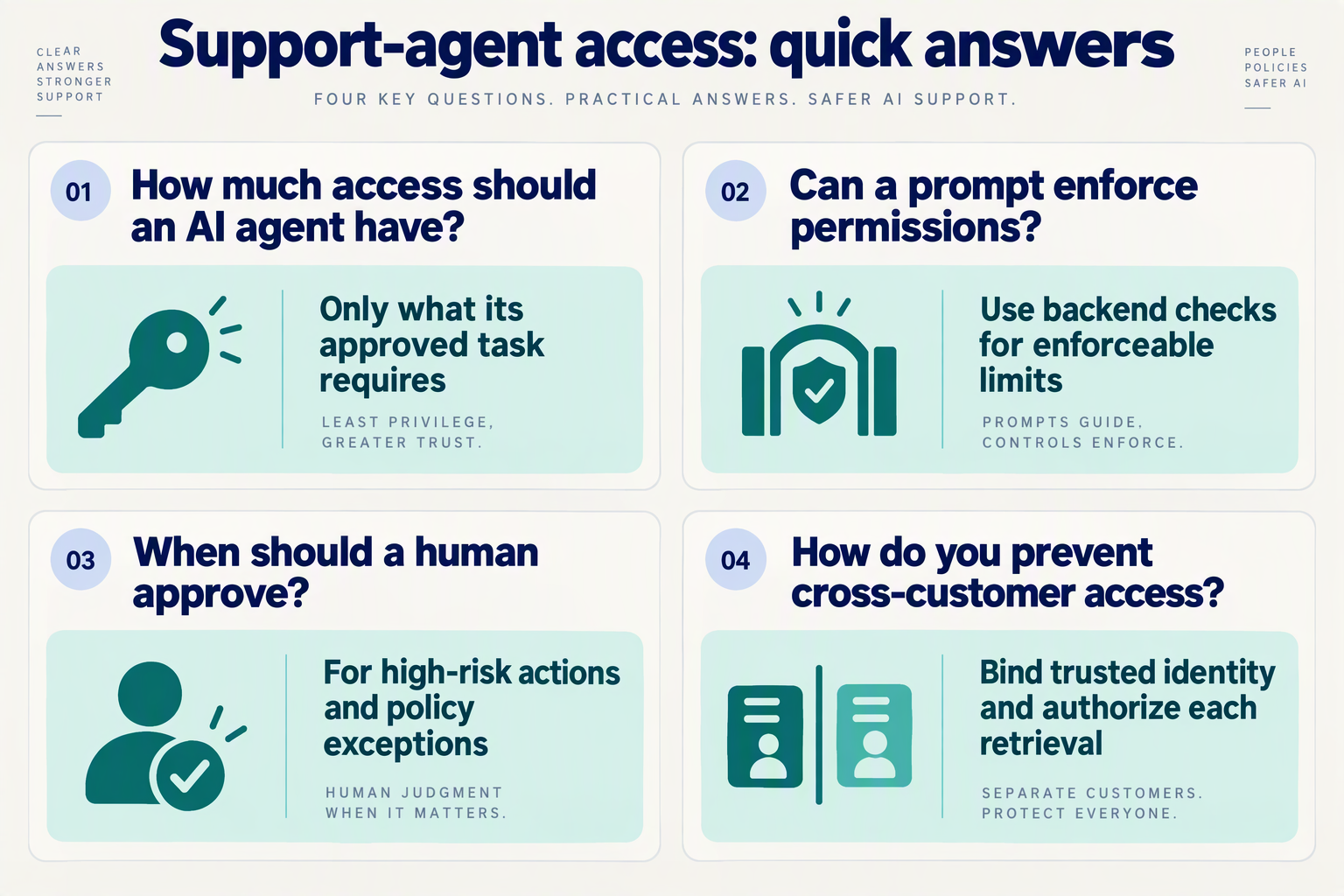
What stops a customer-support AI agent from turning a routine refund request into an unauthorized payment? AI agent access control should—not a sentence in its prompt. The practical answer is to give each agent only the data and actions its task requires, with enforceable limits and human approval for consequential changes.
That distinction matters because answering a question and executing a transaction are different responsibilities. An agent may need to read an order’s delivery status without changing its shipping address, explain a refund policy without issuing money, or summarize a complaint without exporting a customer’s account history. Permission management for AI agents makes those boundaries explicit—and enforceable outside the language model.
The governance conversation is shifting toward precisely this execution layer. eSecurity Planet’s “AI Governance Meets Reality: How to Control What AI Agents Can Actually Do,” dated September 25, 2026, in the supplied research, emphasizes that governance extends beyond policies into identity and access. Microsoft’s January 20, 2026, security article, “Four priorities for AI-powered identity and network access security in 2026,” likewise places AI agents within the identity and network-security discussion. As of October 2026, the operational question is not simply whether an agent follows instructions; it is what connected systems will allow that agent to do.
How much access should you give a customer-support AI agent?
Give an agent the minimum access needed for a defined support workflow—not the permissions of the employee who configured it. For example, a delivery-status agent could receive read-only order access, while a refund agent uses a separate, narrowly scoped tool with eligibility checks and an approval requirement.
Consider a hypothetical ₹5,000 refund request. A safe workflow does not rely solely on telling the model, “Ask a manager first.” The transaction service must reject execution until the required approval exists, regardless of what the agent generates.
As of October 2026, CallMissed supports custom REST tools, knowledge bases, and a human-handoff queue—capabilities that make tool boundaries and escalation design relevant implementation questions.
This guide turns AI governance in customer service into a practical operating model. You will learn how to:
- Map support tasks to specific read, write, and transaction permissions.
- Separate agent identities and credentials from broad employee access.
- Validate tool inputs and enforce limits at execution time.
- Require human approval for sensitive or irreversible actions.
- Build an AI agent governance checklist covering ownership, audit evidence, testing, and revocation.
The goal is useful autonomy with enforceable boundaries.
How do you control support AI agents? Enforce least privilege, customer isolation and approved actions
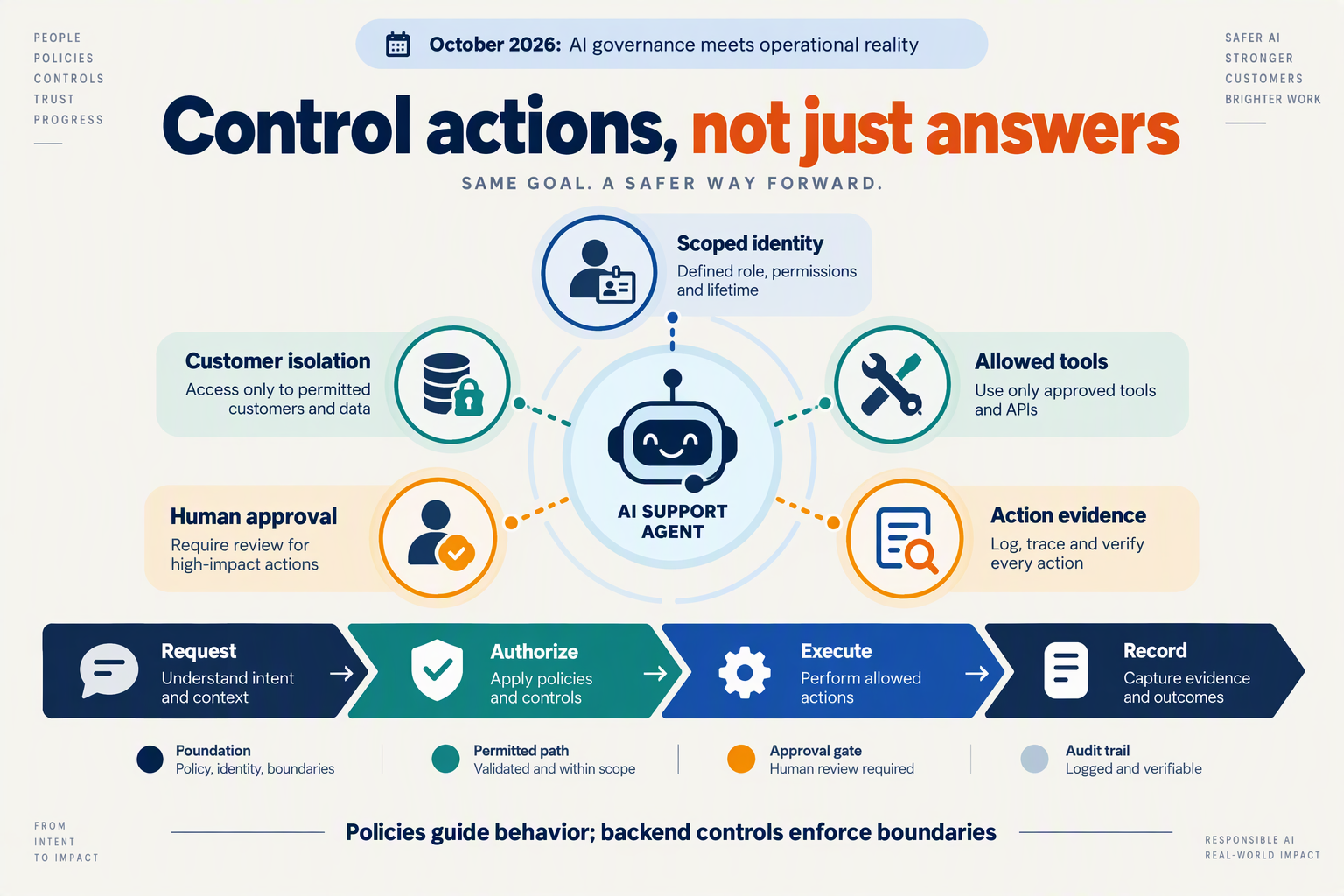
Control support AI agents by enforcing task-specific permissions, customer-scoped data access, and an explicit allowlist of actions in the systems that execute their requests. Treat every tool call as an authorization decision: the model can propose an action, but trusted application code must decide whether it is permitted.
How do you turn support workflows into enforceable permissions?
Start with an action inventory, not a broad role such as “support assistant.” Separate permissions that sound related but carry different consequences: reading an invoice, correcting billing details, and issuing a credit should not share one unrestricted credential.
For each workflow, document:
- Resource: Which records can the agent access?
- Operation: Can it read, create, update, or delete?
- Scope: Which customer, organization, and active support case?
- Conditions: What eligibility checks or approvals must pass?
- Owner: Who can change or revoke the permission?
A returns assistant, for example, might read purchased items and create a return request without permission to issue refunds or alter payment details. If its job changes, update the permission definition deliberately rather than adding broad access to resolve a single failed request.
Microsoft’s January 20, 2026, article, “Four priorities for AI-powered identity and network access security in 2026,” places AI agents within identity and network-security planning. The practical implication for AI agent access control is to govern the agent’s execution identity separately from its conversational instructions.
How do you prevent an AI agent from accessing another customer’s data?
Bind customer scope to authenticated application context, not to identifiers supplied by the model. A customer saying “look up account 4821” is a request—not evidence that the customer owns that account.
Use this execution sequence:
- Authenticate the customer through the application’s established process.
- Attach the verified customer and organization identifiers to the support session.
- Have the tool service check that the requested record belongs to that scope.
- Reject mismatches before returning data or performing an action.
For example, an order-status tool should retrieve an order only when both the order identifier and authorized customer scope match. Removing a customer filter must not be an option the model can select.
Apply isolation to knowledge retrieval, cached results, and conversation memory, too. A correctly protected order API cannot compensate for a retrieval system that exposes another customer’s support history.
How do you restrict agents to approved actions?
Expose narrow tools such as create_return_request, rather than unrestricted database queries or a general-purpose HTTP requester. Validate inputs server-side, reject unsupported fields, and check permissions again when executing consequential changes.
For human-approved actions, bind approval to the exact transaction: customer, order, amount, and operation. If those details change after approval, require a new decision; an approval for one refund must not authorize another.
As of October 2026, CallMissed supports custom REST tools and connections to MCP servers by URL. When connecting those tools, implement authorization and transaction checks in the receiving service; tool connectivity alone is not an access-control guarantee.
Finally, test denials as deliberately as successful requests: another customer’s order, an unapproved refund, and an attempted permission override should all fail. That turns permission management for AI agents into a verifiable operating boundary rather than a policy statement.
What prerequisites and owners do you need before granting agent access?
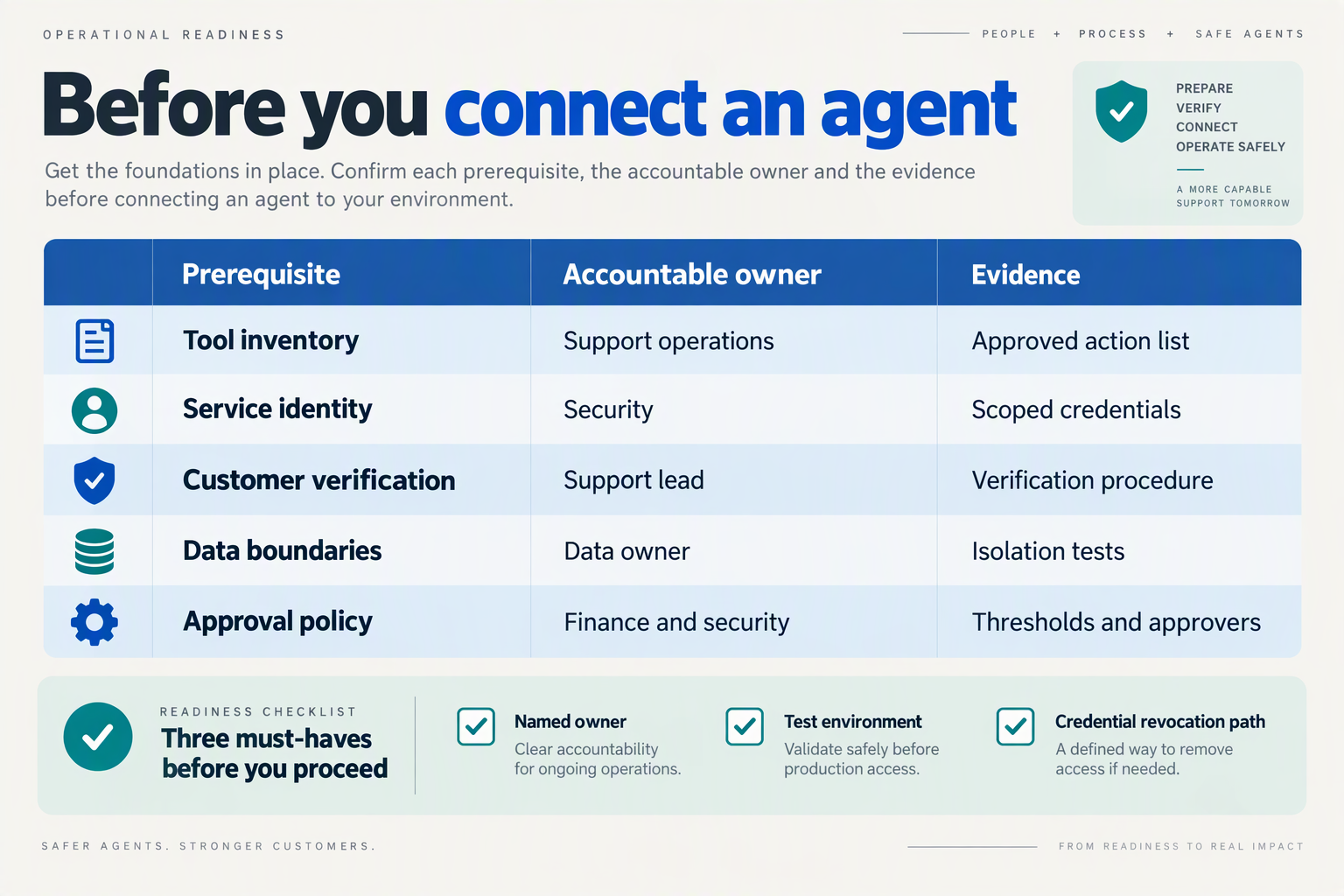
Before granting agent access, you need a documented workflow, an accountable business owner, and technical owners who can approve, monitor, and revoke the connection. No named owner or verifiable authorization path should mean no production access, even when the pilot works well.
Who should own customer-support AI agent permissions?
The support owner defines the business need; the system owner authorizes access; security validates the controls. These responsibilities can overlap in a small team, but they should remain explicit rather than defaulting to whoever connected the integration.
Microsoft’s January 20, 2026, security article identifies integrating AI agents into workflows as a priority for 2026, alongside identity and network-access security. The practical implication for AI governance in customer service is that agent deployment needs operational ownership—not just a prompt author.
Use this prerequisite matrix as an October 2026 implementation checklist, not as a claim that every platform supplies these controls automatically.
| Prerequisite | Accountable owner | Required evidence | Access blocker |
|---|---|---|---|
| Defined support workflow | Support operations lead | Approved tasks, exclusions, and success criteria | “Handle all support” remains the scope |
| Agent and integration inventory | Platform or engineering lead | Agent ID, environment, tools, and connected systems | An integration has no recorded owner |
| Data-use authorization | Data owner; privacy reviewer where needed | Approved fields, purpose, and retention rules | Sensitive data use is unresolved |
| Credential lifecycle | Identity or security lead | Credential storage, rotation, expiry, and revocation procedure | Shared or unmanaged credentials |
| Action and approval policy | Business process owner | Allowed actions, thresholds, approvers, and exception route | Approval authority is undefined |
| Operational readiness | Service owner or on-call lead | Test results, monitoring, escalation, and shutdown runbook | Nobody can stop or investigate execution |
The accountable owner is the person who accepts responsibility for the decision. Other teams may implement or review it, but “security owns everything” leaves business authority unclear.
What evidence should exist before you connect a tool?
Create a short access request record for each agent–tool connection. Treat it as an operational contract that reviewers can inspect without reading the entire agent configuration.
Include:
- Purpose: Which support outcome requires this connection?
- Dependencies: Which API, database, or third-party service will it reach?
- Authority: Who approved the data access and resulting business actions?
- Lifecycle: When must access be reviewed, and what triggers earlier removal?
- Evidence: Where are test results, configuration versions, and incident instructions stored?
For example, an appointment-support agent’s request should identify the calendar owner, permitted booking operations, cancellation authority, and the response when the calendar service fails. That is more actionable than an approval labeled “calendar integration.”
As of October 2026, CallMissed’s no-code agent builder supports versioning with publish and rollback. Teams can use those capabilities within a change-management process, while separately documenting who may authorize deployment and connected-system access.
What should block production access?
Use a simple release sequence:
- Business approval: Confirm the workflow and responsible owner.
- Technical verification: Check credentials, dependencies, and enforcement behavior.
- Operational acceptance: Demonstrate monitoring, escalation, and access removal.
A configuration rollback and a credential revocation solve different problems: reverting the agent does not necessarily invalidate its access to an external service. Before launch, ask the operational owner to demonstrate both procedures.
If an approver is unavailable, a dependency changes, or test evidence is missing, keep the connection disabled or restricted to an explicitly approved test environment. Ownership must remain valid after deployment—not merely exist on launch day.
How do you get started with scoped identities and read-only tools?
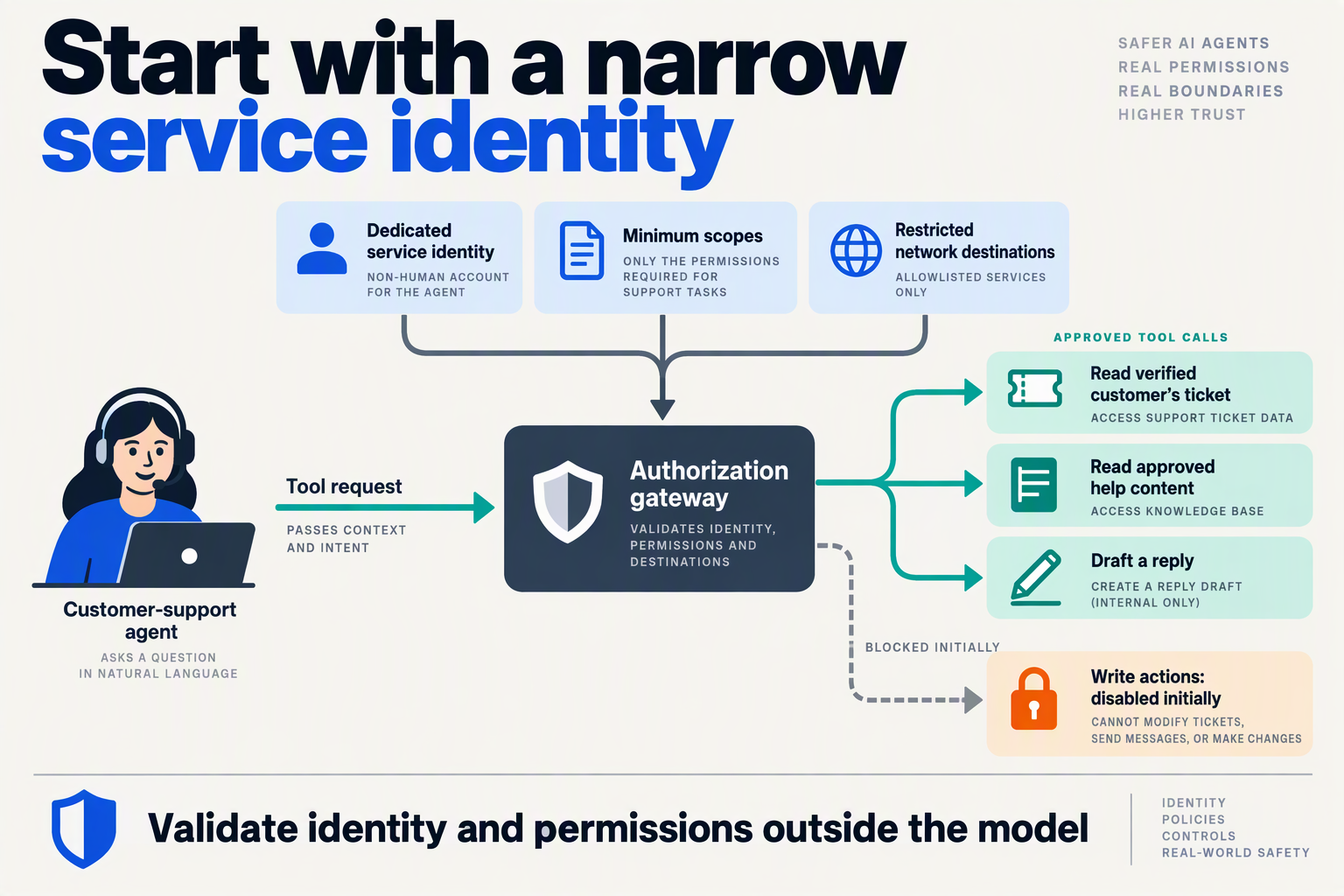
Start with a dedicated identity for each support workflow and tools that can only retrieve approved data. Keep credentials outside the model’s context, and make the backend—not the agent—decide which customer records that identity can access.
Microsoft’s January 20, 2026, article, “Four priorities for AI-powered identity and network access security in 2026,” places AI agents within the identity and network-security discussion. The practical starting point is to make every tool request attributable to a narrowly authorized identity.
How do you create a scoped identity for a support AI agent?
Create a service account or workload identity specifically for the agent’s job, rather than reusing an administrator’s API key. For an initial delivery-status pilot, name the identity something recognizable, such as support-delivery-reader, and assign an accountable owner.
Use this setup sequence:
- Define the workflow: Answer delivery-status questions for authenticated customers.
- List the required permissions: Read shipment status and estimated delivery dates; exclude address changes, refunds, exports, and account administration.
- Create the dedicated identity: Use your identity provider’s workload authentication where supported, or a narrowly scoped credential stored in a secrets manager.
- Restrict the destination: Permit calls only to the approved support backend, not arbitrary URLs.
- Document revocation: Record who can disable the identity and which workflows will stop when access is removed.
Scope names such as shipment:read are illustrative; actual permissions depend on the connected service. If a provider offers only broad access, put a restricted backend adapter between that provider and the agent instead of exposing the broad credential directly.
What should a read-only support tool return?
A read-only tool should return the smallest useful answer, not an entire customer record. For example, get_delivery_status(order_reference) might return the shipment state, estimated arrival date, and an approved tracking link.
The backend should obtain the customer identity from the authenticated session, verify that the order belongs to that customer, and then retrieve the permitted fields. An order reference identifies a record; it does not prove authorization. Never trust a model-supplied customer ID as the access decision.
Also distinguish read-only permissions from HTTP methods. A GET request is not sufficient proof of safety: inspect whether the underlying endpoint triggers updates, sends notifications, or exposes sensitive information.
For each tool, specify:
- Allowed inputs: Validated order references and bounded query parameters.
- Allowed outputs: An explicit field allowlist.
- Forbidden effects: No writes, emails, payments, or workflow triggers.
- Failure behavior: A safe error or human escalation—not a fallback to broader access.
As of October 2026, CallMissed supports custom REST tools. When connecting those tools to customer systems, enforce these identity and response restrictions in the backend; tool availability alone does not establish authorization.
How do you test scoped access before launch?
Test denied actions as deliberately as successful lookups. A useful AI agent access control pilot should verify that:
- Another customer’s order reference returns no protected data.
- Requests for extra fields cannot expand the response.
- Write operations fail even when the agent explicitly requests them.
- Missing or expired credentials stop access.
- Revoking the identity blocks subsequent tool requests.
Log the agent identity, authorization result, requested resource, and outcome without unnecessarily recording sensitive payloads. Start with one workflow and expand only after its boundaries hold: a successful pilot demonstrates both that customers get useful answers and that unauthorized actions remain impossible through the exposed tools.
How much access should you give an AI agent for each support task?
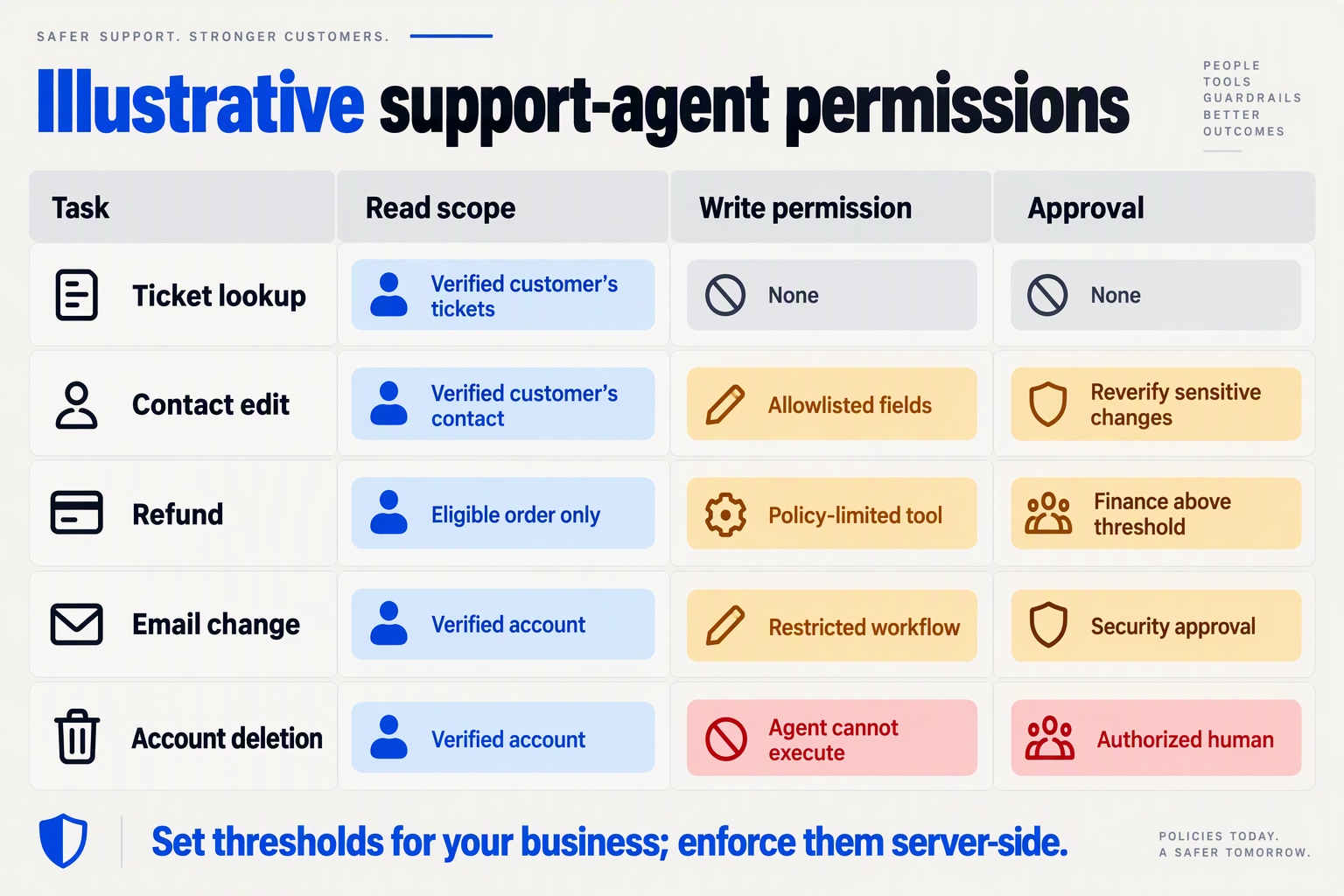
Give a support AI agent read access for answers, narrowly scoped write access for routine updates, and approval-gated access for financial or identity changes. Assign permissions to individual operations—not entire applications—so permission to check an order never implies permission to refund or redirect it.
What permissions should each customer-support task receive?
Use this recommended permission matrix as of October 2026 as a starting point, not a universal policy. Approval requirements should reflect your business’s fraud exposure, contractual obligations, and ability to reverse an action.
| Support task | Minimum data access | Allowed action | Execution limit | Human approval |
|---|---|---|---|---|
| Answer policy questions | Published, approved knowledge base | Retrieve and explain policies | No customer-record access | For unresolved exceptions |
| Check delivery status | Verified customer’s selected order | Read tracking and delivery events | No address or order edits | For conflicting records |
| Create a support ticket | Current conversation and necessary contact fields | Create ticket; add summary | No unrelated history; no bulk export | Usually unnecessary |
| Reschedule a service appointment | Customer’s booking and available slots | Update that booking | Allowed slots; prevent duplicate bookings | For fee or policy exceptions |
| Issue an eligible refund | Selected payment, order, and refund policy | Submit a refund request | Server-enforced eligibility and amount cap | Before execution during initial rollout |
| Change account recovery details | Minimum account-verification data | Open a recovery case | No direct email, phone, or credential change | Required through a verified recovery workflow |
The distinction between requesting and executing matters. A refund tool can let an agent prepare a proposed transaction without giving the agent authority to release money.
Microsoft’s January 20, 2026, article, “Four priorities for AI-powered identity and network access security in 2026,” places AI agents within identity and network-security planning. For support teams, the practical implication is to translate that infrastructure concern into specific permissions such as read_order_status, rather than a broad “commerce administrator” role.
How should you choose limits for actions an agent can take?
Set limits around the consequences of the operation, not how confidently the agent describes its answer. An appointment change can be low-risk when reversible and fee-free, but consequential when it cancels a scarce appointment or triggers a charge.
For each table row, document:
- Scope: Which customer, record, fields, and operation are permitted?
- Magnitude: What amount, frequency, or number of records is allowed?
- Reversibility: Can the business undo the change without customer harm?
- Approval trigger: Which exceptions require a named human decision-maker?
For example, a hypothetical ₹1,000 refund cap is a policy choice—not an industry benchmark. Your transaction service should also check previous refunds against the same order; otherwise, several individually permitted requests could exceed the intended total.
How do you turn the matrix into working tool permissions?
Implement one bounded operation per tool where practical. Prefer reschedule_verified_booking over a general-purpose tool that accepts arbitrary database updates.
As of October 2026, CallMissed supports custom REST tools and per-agent event subscriptions for outbound webhooks. Teams using those capabilities should enforce the matrix in their connected services; tool availability alone does not establish authorization.
Before enabling an operation:
- Identify the service owner responsible for its permission boundary.
- Test unauthorized customers, excessive amounts, and repeated requests.
- Record the approved scope and a procedure for disabling access.
This makes permission management for AI agents a reviewable operating contract, rather than an informal promise about agent behavior.
How do you enforce isolation and approvals, step by step, for a refund request?
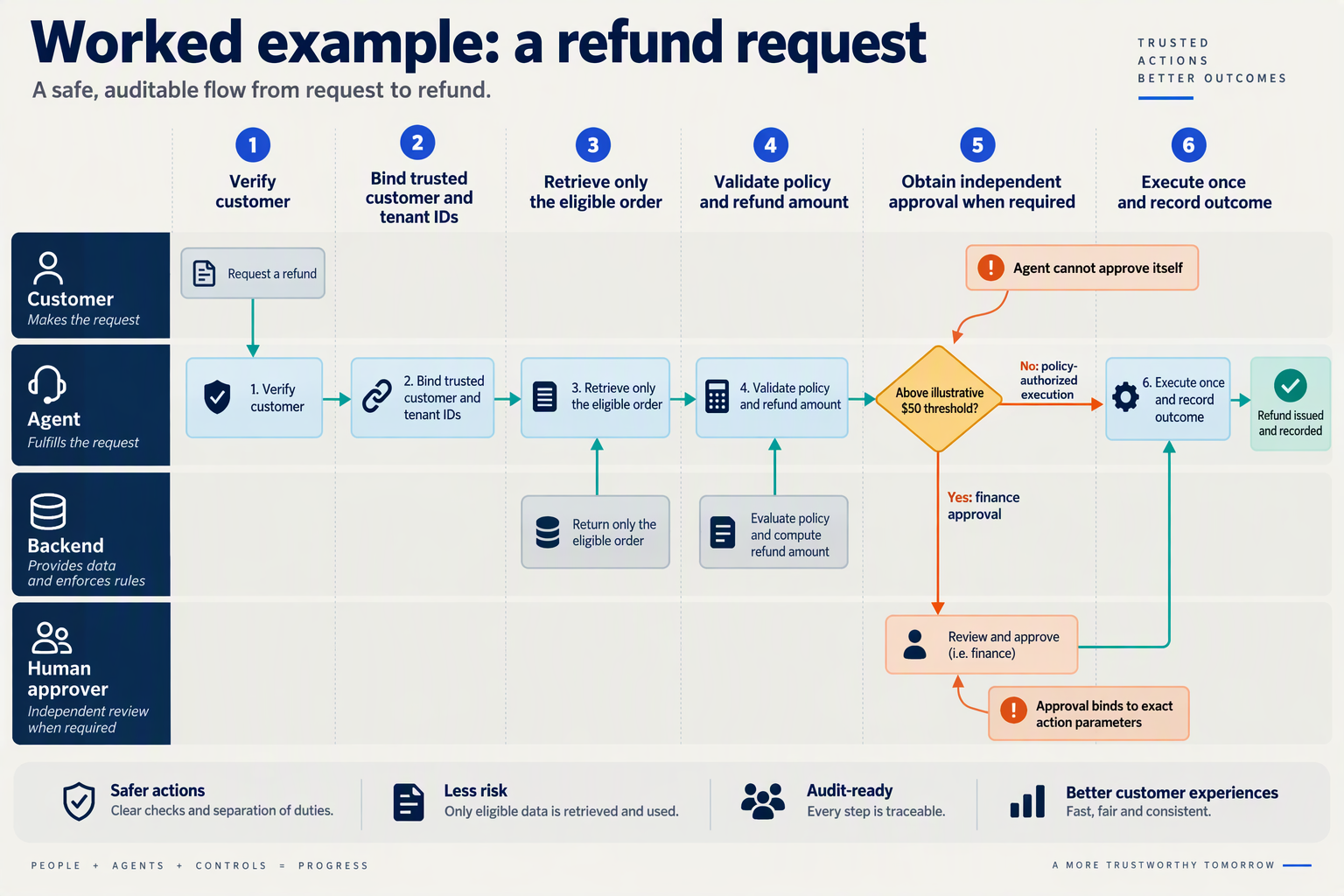
Enforce refund isolation in the backend, then require approval tied to one exact transaction before money moves. The support agent should gather evidence and propose a refund; a separate execution service should verify customer ownership, eligibility, approval, and duplicate protection.
Use the hypothetical ₹5,000 refund from earlier as a worked example—not a recommended approval threshold. This workflow turns AI agent access control into checks that remain effective even when the model produces an incorrect tool call.
How do you isolate the customer and order before reviewing a refund?
- Establish customer identity outside the model.
Authenticate the customer through your support channel’s verified identity process. Your backend should derive the customer and tenant identifiers from that session, rather than trusting identifiers supplied in a message or generated by the agent.
A customer saying “use this other account ID” must not change the authorization context.
- Retrieve only the authorized order.
Give the agent a narrow tool such as get_refund_context(order_id). The backend must verify that the order belongs to the authenticated customer within the correct tenant before returning refund-relevant information.
Return a purpose-built response containing:
- Eligible items and remaining refundable value.
- Delivery status and relevant policy conditions.
- Existing refunds or pending refund requests.
Do not expose payment credentials, unrelated orders, or another customer’s history. A nonexistent order and an unauthorized order should produce similarly limited responses to avoid revealing account information.
How do you make human approval enforceable rather than advisory?
- Create a proposal, not a payment instruction.
Let propose_refund create a pending request after server-side eligibility checks. Store the order, item selection, currency, amount, reason, policy version, and requesting agent identity.
For the illustrative ₹5,000 request, configure the workflow to require an authorized reviewer. A pending proposal must not be executable merely because the agent labels it “approved.”
- Bind approval to the exact proposal.
Present the reviewer with the evidence and transaction details in an authenticated interface. Record the reviewer’s identity, decision, timestamp, and approval expiry against an immutable proposal version.
Changing the amount, items, destination, or other material terms must invalidate approval and require another review. Keep the approval interface inaccessible to the agent’s credentials; otherwise, the agent could approve its own request.
What checks must run immediately before issuing the refund?
- Revalidate and execute through a separate service.
The execution service should confirm that approval is valid, the reviewer remains authorized, the order is still eligible, and the refundable balance has not changed. Refund only through the payment provider’s permitted route for the original transaction.
Use an idempotency key tied to the approved proposal so retries cannot create additional payments. Coordinate balance checks and execution to prevent concurrent requests from exceeding the remaining refundable amount; do not assume an earlier eligibility check still holds.
- Record the outcome and test rejection paths.
Log the proposal, policy decision, approval, execution attempt, and payment-provider result with a shared correlation identifier. If the provider times out, reconcile its transaction status before attempting another refund.
Test cross-customer order access, altered amounts, expired approvals, revoked reviewer permissions, and duplicate submissions.
Microsoft’s January 20, 2026, article, “Four priorities for AI-powered identity and network access security in 2026,” places AI agents within identity and network-security planning. For refund workflows, that principle becomes concrete: the model proposes; independently authorized systems approve and execute.
Which advanced controls make support-agent permissions harder to bypass?
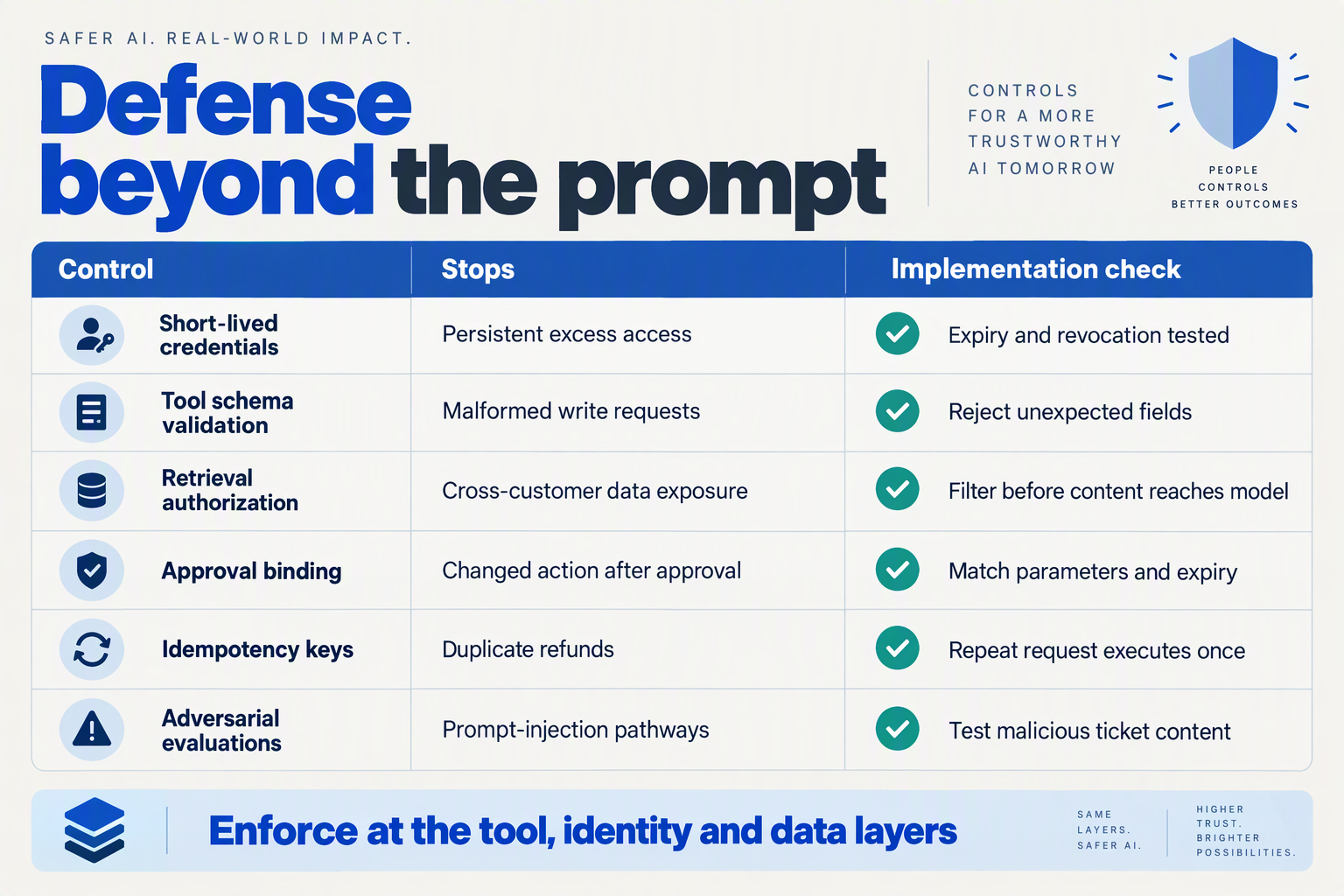
Advanced controls make support-agent permissions harder to bypass by checking identity, transaction context, workflow state, and network destinations outside the model. The strongest designs also prevent an agent from combining individually permitted actions into an unauthorized outcome.
Microsoft’s January 20, 2026, article, “Four priorities for AI-powered identity and network access security in 2026,” places AI agents within identity and network security. For AI agent access control, the practical implication is that an authorized tool call still needs checks on its destination, parameters, and relationship to earlier actions.
Which advanced permission controls should support teams implement?
The following are recommended implementation patterns as of October 2026, not claims that every support platform provides them natively.
| Advanced control | What to enforce | Bypass attempt addressed | Verification test |
|---|---|---|---|
| Short-lived, scoped credentials | Bind credentials to an agent, customer context, permitted action, and expiry | Reusing a stolen token elsewhere | Try the token against another customer and after expiry |
| Transaction-bound approvals | Bind approval to the exact customer, action, amount, and transaction identifier | Changing parameters after approval | Modify the approved amount; execution must fail |
| Stateful action budgets | Check cumulative limits atomically across calls and sessions | Splitting one prohibited action into smaller requests | Submit concurrent requests that collectively exceed the limit |
| Canonical input validation | Normalize inputs, validate schemas, and authorize the resolved resource | Using alternate identifiers or encoded values to evade checks | Test aliases, unexpected fields, and encoded resource paths |
| Restricted network egress | Allow only required destinations; recheck redirects and resolved addresses | Sending customer data to an attacker-controlled endpoint | Try an external URL and a redirect to a blocked address |
| Delegation without privilege expansion | Ensure downstream agents receive no more authority than the initiating workflow | Routing a denied action through a more privileged agent | Ask a second agent to perform the blocked action |
No single row eliminates prompt injection. Together, these controls reduce what malicious instructions in a message, document, or tool response can cause the execution system to do.
How do you stop an agent from chaining allowed actions into a forbidden outcome?
Evaluate the whole workflow, not just each request. An agent allowed to make small adjustments could otherwise repeat that action until the total exceeds its authorized budget.
Consider an illustrative October 2026 test configuration: a workflow permits adjustments totaling ₹2,000. Three ₹900 requests each fall below that ceiling individually, but collectively total ₹2,700.
A robust implementation should:
- Reserve budget atomically before executing each adjustment, so parallel requests cannot spend the same remaining allowance.
- Use idempotency keys so retries do not create duplicate transactions.
- Track committed and pending actions across the relevant customer and workflow, rather than resetting the counter with each conversation.
These figures are hypothetical test values, not industry benchmarks. The important design choice is enforcing limits in trusted transaction state.
Where should these controls sit when connecting support-agent tools?
Place enforcement in the tool service, authorization layer, and network infrastructure, where the model cannot rewrite it. Customer messages and retrieved documents may supply information, but they must never become authority to expand permissions.
As of October 2026, CallMissed supports custom REST tools and connections to MCP servers by URL, making the connected tool service an important enforcement boundary. Those integration capabilities should not be mistaken for automatic implementation of the controls above.
Before deployment, require evidence that:
- Changed parameters invalidate an approval.
- Concurrent calls cannot exceed a shared budget.
- Expired credentials fail even when the conversation continues.
- Agent handoffs preserve—not broaden—the original authorization scope.
Which common permission-management mistakes should support teams avoid?
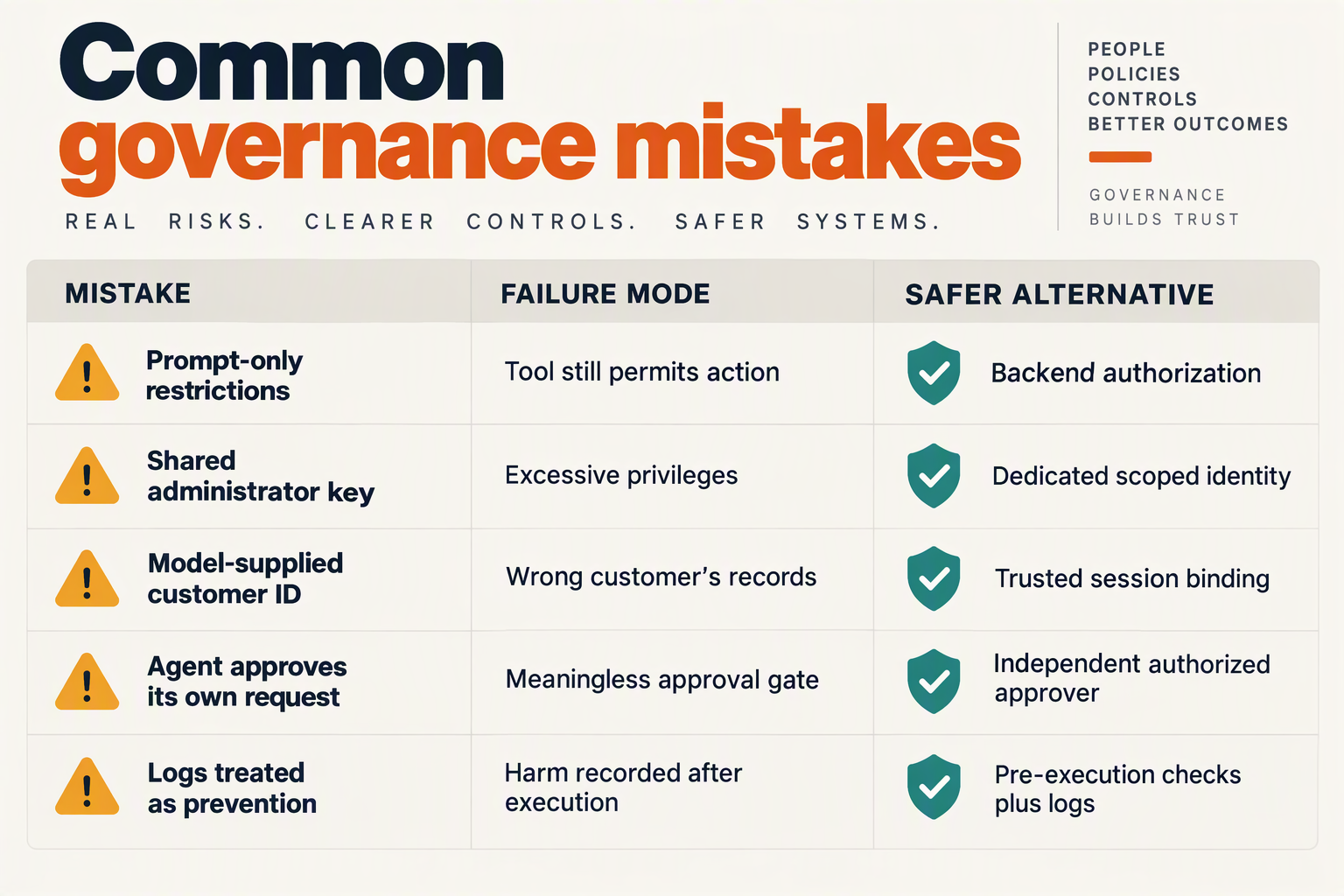
Support teams should avoid permission drift: access that quietly expands through deployments, shared credentials, fallback tools, or forgotten approvals. The most dangerous mistakes are often operational—not an obviously overpowered agent, but a previously safe workflow whose permissions no longer match its job.
As of October 2026, permission management for AI agents should cover the full lifecycle: deployment, delegation, changes, incident response, and retirement. Microsoft’s January 20, 2026, article, “Four priorities for AI-powered identity and network access security in 2026,” explicitly brings AI agents into the identity and network-security conversation—a useful reminder to involve security and infrastructure owners, not just support managers.
Which permission mistakes are easiest to overlook?
Use this troubleshooting table during deployment reviews and whenever a support workflow changes. The examples are illustrative failure scenarios, not reported incidents.
| Common mistake | Support failure scenario | Safer operational control | Verification step |
|---|---|---|---|
| Copying production access into testing | A staging agent sends a real customer message while testing an escalation flow. | Separate environments, credentials, and customer datasets; use simulated transactions. | Confirm staging credentials cannot reach production write endpoints. |
| Allowing fallback tools broader access | A restricted refund tool fails, so the agent tries a general-purpose account-update endpoint. | Apply equivalent authorization checks to every alternative execution path. | Disable the primary tool and verify the fallback still rejects prohibited actions. |
| Treating handoffs as permission transfers | A specialist agent inherits access from the agent that routed the conversation. | Authorize the receiving agent independently; pass only necessary context. | Route a restricted request between agents and confirm access does not expand. |
| Leaving approvals reusable | Approval for one refund is reused for another order or a larger amount. | Bind approval to the customer, action, amount, and expiry; consume it once. | Retry with changed parameters and replay the original approval. Both should fail. |
| Assuming rollback restores security | An older agent configuration returns, but a newly granted backend permission remains active. | Review agent configuration and external authorization separately during rollback. | Compare tool availability and backend grants before and after restoration. |
| Retiring agents without revoking access | A discontinued support agent’s credential still works through an integration. | Remove grants, revoke credentials, and stop active sessions where supported. | Attempt a harmless authenticated request using the retired identity. |
Why can configuration rollback leave permissions behind?
Agent configuration and backend authorization are separate control surfaces. Restoring an earlier prompt or tool list does not necessarily revoke credentials, invalidate approvals, or remove permissions in connected systems.
As of October 2026, CallMissed’s no-code agent builder supports versioning with publish and rollback, alongside custom REST tools. Those capabilities make controlled releases practical, but teams must separately verify authorization in the services those REST tools invoke; configuration rollback should not be treated as proof of permission rollback.
What should a permission review actually test?
Review denied actions, not just successful support journeys. A delivery-status test passing says little about whether the same agent can change an address through an unintended route.
For each release, record:
- Expected denial: the prohibited action and the service responsible for blocking it.
- Evidence: the rejected request, identity used, and authorization decision.
- Revocation result: whether removed access stops working across alternative tools and active sessions.
This operational approach matches the September 25, 2026, eSecurity Planet article’s emphasis on governance extending beyond policy into identity and access. The practical lesson for AI governance in customer service is straightforward: review what changed, test what must remain impossible, and verify that revoked permissions are genuinely gone.
How can CallMissed tools, human handoff and evals support a controlled rollout?
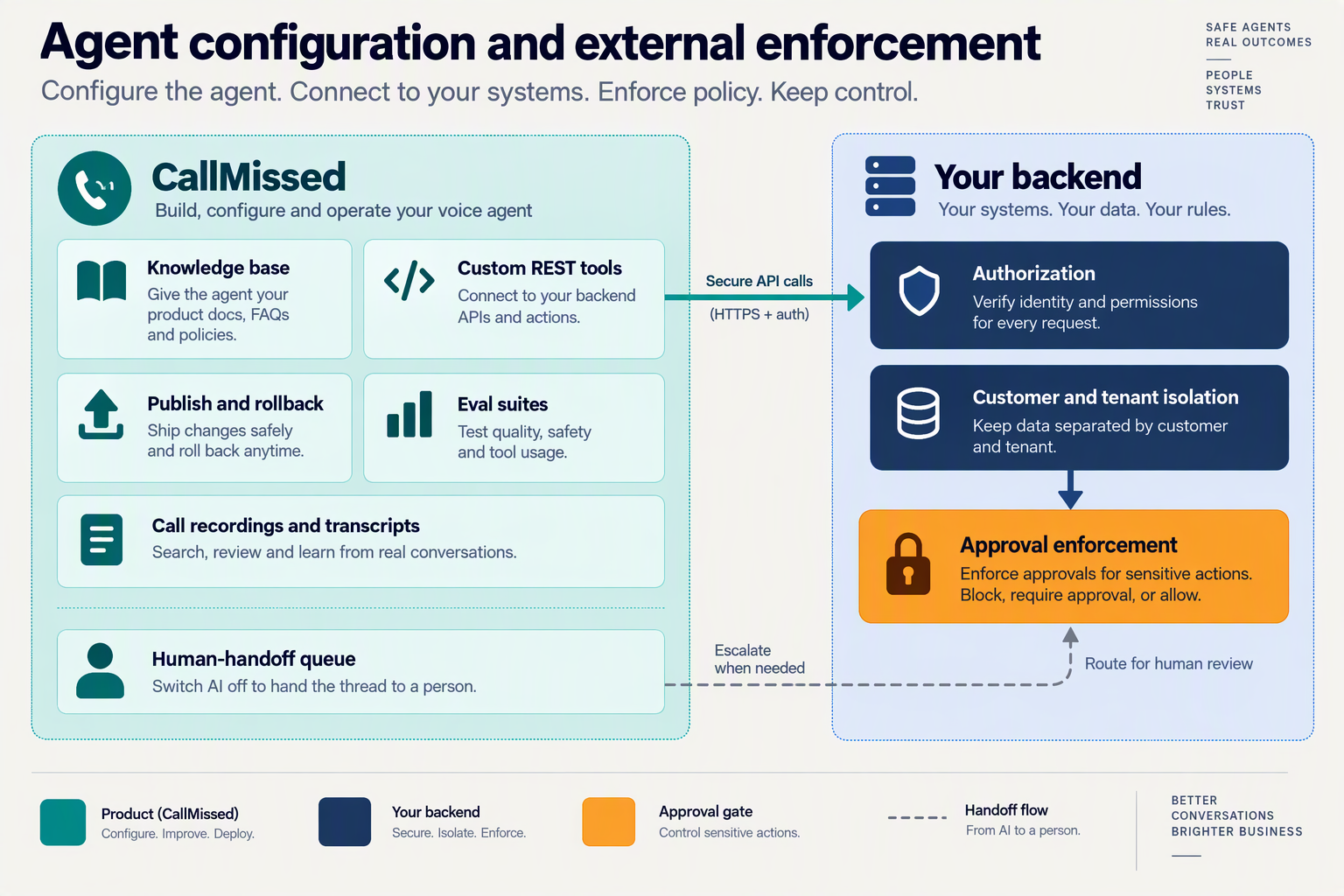
CallMissed’s custom REST tools, human-handoff queue, and eval suites can support a controlled rollout by connecting narrow workflows to escalation and testing. Use these capabilities to introduce autonomy gradually, while keeping authorization and transaction approval enforceable in the systems that execute actions.
As of October 2026, CallMissed’s verified product fact sheet lists custom REST tools, agent versioning with publish and rollback, human handoff, call scoring against your own QA rubrics, eval suites, and A/B experiments. These are useful building blocks—not evidence that a connected refund service automatically enforces your approval policy.
How should you connect tools without expanding agent authority?
Start with a single, bounded support workflow, such as checking delivery status. Translate the permission matrix established earlier into a small tool interface rather than exposing a general-purpose backend operation.
For example, your integration could expose get_delivery_status(order_id) instead of a tool that accepts arbitrary database queries. The backend should establish which customer is authenticated and whether that customer can access the requested order.
Use this rollout sequence:
- Connect read-only operations first. Let the agent retrieve delivery information and explain the result.
- Introduce requests before transactions. A proposed
submit_refund_reviewtool could create a review request without issuing money. - Add execution only after validation. A separate transaction service should check authorization, eligibility, and required approval before changing anything.
Those tool names are illustrative designs, not built-in platform features. The important distinction is between what the model requests and what your service permits.
When should a support AI agent hand off to a person?
Define handoff conditions before launch, then test whether the customer actually reaches the right person. Escalation should cover approval-dependent actions, disputed account ownership, conflicting policy information, and requests outside the agent’s assigned workflow.
For messaging, the platform’s human-handoff queue transfers the thread to a person when the AI is switched off. For voice operations, live call monitoring lets a supervisor listen, whisper, or barge in; squads can transfer a live call between agents. These capabilities are listed in the verified product fact sheet as of October 2026.
A handoff is not an approval mechanism. If a customer asks for an address change during a delivery-status conversation, the agent should explain the boundary and escalate—not interpret the transfer itself as permission to make the change.
Define the escalation record your workflow needs:
- The customer’s request and relevant identifiers.
- Information already verified and unresolved uncertainty.
- Any attempted tool action and its outcome.
- The decision or authorization required from the receiving person.
What should evals prove before you expand the rollout?
Use eval suites to test boundaries, not just helpfulness. A fluent answer is insufficient if the agent attempts an unauthorized action or falsely tells a customer that a transaction succeeded.
Include ordinary requests alongside adversarial and failure cases:
- A customer requests another customer’s order details.
- A retrieved document instructs the agent to ignore its restrictions.
- A refund request lacks required approval.
- A tool times out after a potentially successful write.
- A customer repeatedly pressures the agent to bypass escalation.
Record tool attempts, backend outcomes, customer-facing responses, and handoff completion. Treat unauthorized execution as a release blocker, rather than averaging it into a quality score.
Finally, expand one workflow at a time. Version rollback can restore an earlier agent configuration, but it cannot undo an external transaction; consequential actions still need backend safeguards and a remediation plan.
Frequently Asked Questions
How much access is safe for a customer-support AI agent?
When should AI agent access control require human approval?
Is read-only AI agent access control enough to protect customer data?
Can an AI confidence score replace human approval for refunds or account changes?
Does transferring a conversation to a human count as transaction approval?
How do you test AI agent access control before giving an agent more permissions?
What resources and checklist should you use before expanding agent autonomy?
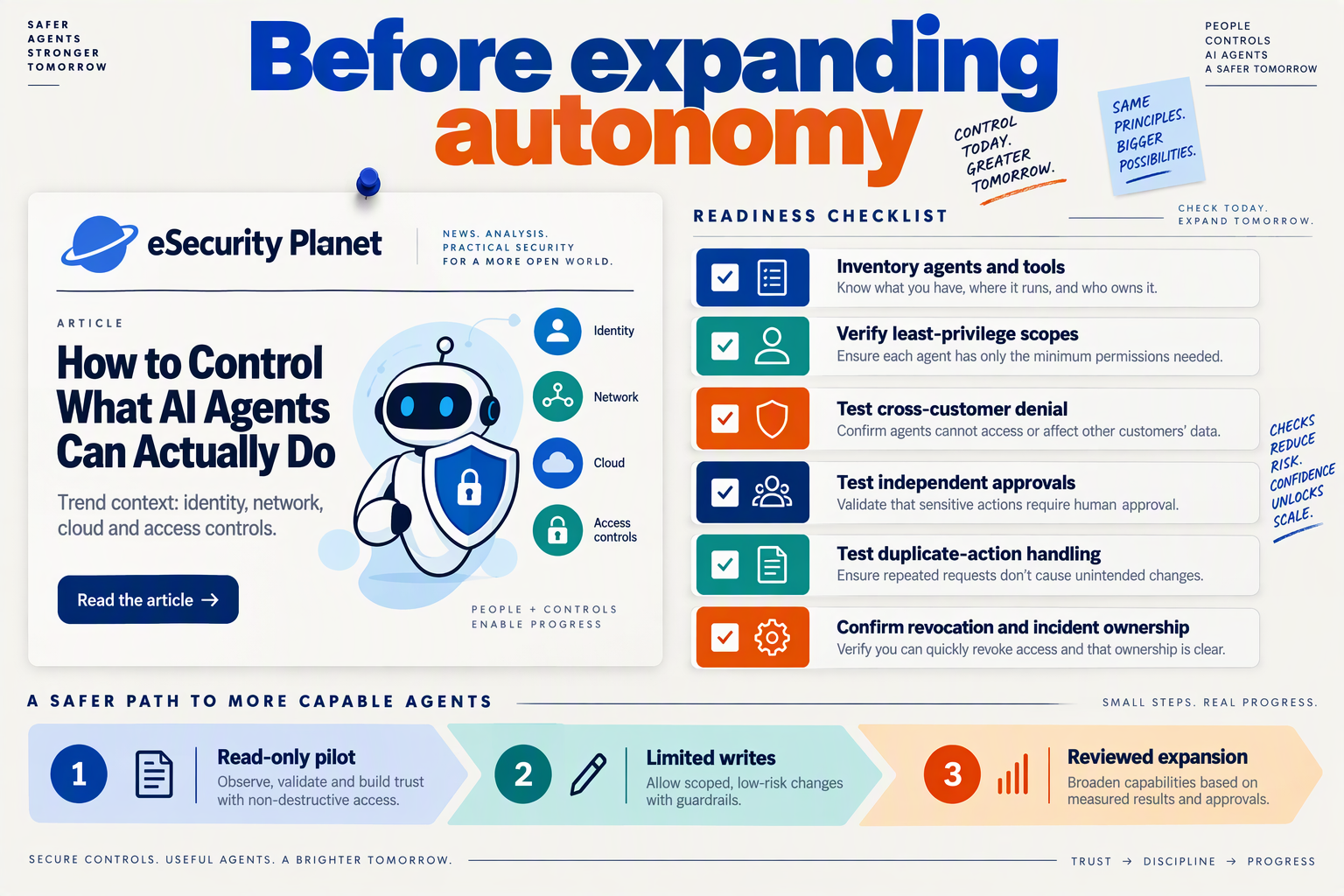
Before expanding customer-support agent autonomy, use a release checklist backed by evidence: a documented permission change, adversarial test results, an accountable owner, and a rehearsed rollback plan. Treat each new action as a separate release—not as permission to make the entire agent more autonomous.
Which resources should your governance team review?
Use this October 2026 reading list to connect your support workflow to broader security requirements:
- eSecurity Planet: “AI Governance Meets Reality: How to Control What AI Agents Can Actually Do,” published September 25, 2026, frames AI governance as more than policy, extending into identity and access. Use it to ask whether your written restrictions match what connected systems actually permit.
- Microsoft Security: “Four priorities for AI-powered identity and network access security in 2026,” published January 20, 2026, places AI agents within identity and network-security planning. Bring your identity and infrastructure owners into the release review—not just the chatbot team.
- Cloud Security Alliance Lab Space: “The Non-Human Identity Governance Vacuum” identifies non-human identity governance as a security gap. Use that perspective to review who owns agent credentials, how access is inventoried, and what happens when an agent is retired.
These resources provide direction, not proof that your deployment is safe. Your strongest evidence comes from testing the exact tools, credentials, and customer workflows you intend to release.
What should an AI agent governance checklist contain?
Build a compact approval packet that reviewers can inspect without reconstructing the project:
- Scope change: State the existing capability and the proposed addition. “Read delivery status → request a delivery reschedule” is reviewable; “handle more complex tickets” is not.
- Ownership: Name the business approver, technical owner, and incident contact. Record who can suspend the new action outside normal working hours.
- Permission evidence: Attach the proposed access configuration and a denied-action test. Demonstrate that unrelated customer records and unapproved operations remain inaccessible.
- Test results: Include ordinary requests, ambiguous instructions, prompt injection, approval bypass attempts, duplicate submissions, and downstream timeouts. Record expected versus actual outcomes.
- Operational readiness: Show the escalation route, monitoring signals, and response procedure when execution succeeds but the agent loses confirmation.
- Recovery evidence: Rehearse disabling the action, revoking its credential, and reconciling partially completed work. Record what requires manual correction.
- Release decision: Capture approval, unresolved risks, pilot boundaries, and the next review date. A missing artifact should trigger a hold, not an optimistic assumption.
How should you decide whether to expand autonomy?
Use predeclared acceptance criteria, rather than a persuasive demo. For example, a hypothetical delivery-rescheduling pilot could require zero successful cross-customer access attempts in the agreed test suite, rejection of every tested approval bypass, and reconciliation of every simulated timeout.
Those are proposed release criteria—not industry benchmarks or guarantees. Passing a finite test suite does not establish that an agent is universally safe.
As of October 2026, CallMissed supports eval suites, A/B experiments, and agent versioning with publish and rollback. These capabilities can support controlled iteration, but application owners must still verify downstream permissions and recovery procedures.
Expand one capability at a time, retain the previous release’s evidence, and review failures before widening scope. The right question is not “Does the agent seem smarter?” but “Can we prove this additional action is bounded, observable, and recoverable?”
Conclusion
AI agent access control means enforcing what a support agent can do—not merely describing what it should do in a prompt. Useful autonomy starts with narrowly scoped permissions, customer isolation, execution-time checks, and human approval for consequential actions.
The central lesson is that answering and acting require different authority. A delivery-status agent may need to read an order, but that does not justify changing an address, issuing a refund, or exporting account history. Those boundaries should remain effective even when the model misunderstands a request or generates an inappropriate tool call.
Four takeaways should anchor your AI agent governance checklist:
- Grant access by task, not by employee role. Map each support workflow to its required read, write, and transaction permissions. Keep agent identities and credentials separate from broad employee access, and restrict customer data to the account involved in the request.
- Enforce restrictions outside the model. Validate tool inputs and apply limits where connected systems execute actions. In the guide’s hypothetical ₹5,000 refund scenario, the transaction service—not a reminder in the prompt—must prevent payment until the required approval exists.
- Make human approval operational. Define which sensitive or irreversible actions require authorization, who can approve them, and when the agent should hand the conversation to a person. Explaining a refund policy should not automatically confer permission to issue money.
- Keep governance testable and revocable. Assign ownership, retain audit evidence, test permission boundaries, and establish a way to withdraw access. Treat these as operating requirements rather than documentation completed once before launch.
What should support teams watch for next?
Watch whether AI governance moves from written policies to demonstrable execution controls. eSecurity Planet’s September 25, 2026, article, “AI Governance Meets Reality: How to Control What AI Agents Can Actually Do,” emphasizes that governance extends into identity and access. For customer support, the practical implication is straightforward: evaluate agents by what their connected systems permit, not only by the quality of their answers.
As of October 2026, CallMissed offers custom REST tools, knowledge bases, and a human-handoff queue. Readers can explore CallMissed as a platform for applying these workflow-design questions, while ensuring that connected services enforce their own authorization and approval requirements.
The next step is not to grant more autonomy everywhere. Choose one support workflow, document its permitted actions, and test whether an unauthorized request is actually blocked.
If your agent attempted a refund without approval tomorrow, what would stop the transaction?
Related Reading
- Customer Support Voice Agent: Python Workers Backends
- AI Agent Access Control and Least Privilege: A Guide
- AI Agent Human Oversight Rules for Customer Support
Sources
Discussion
Related Posts



Ready to automate customer conversations?
Launch AI voice agents and WhatsApp bots with CallMissed — one API, 22+ Indian languages.