
AI Agent Access Control and Least Privilege: A Guide


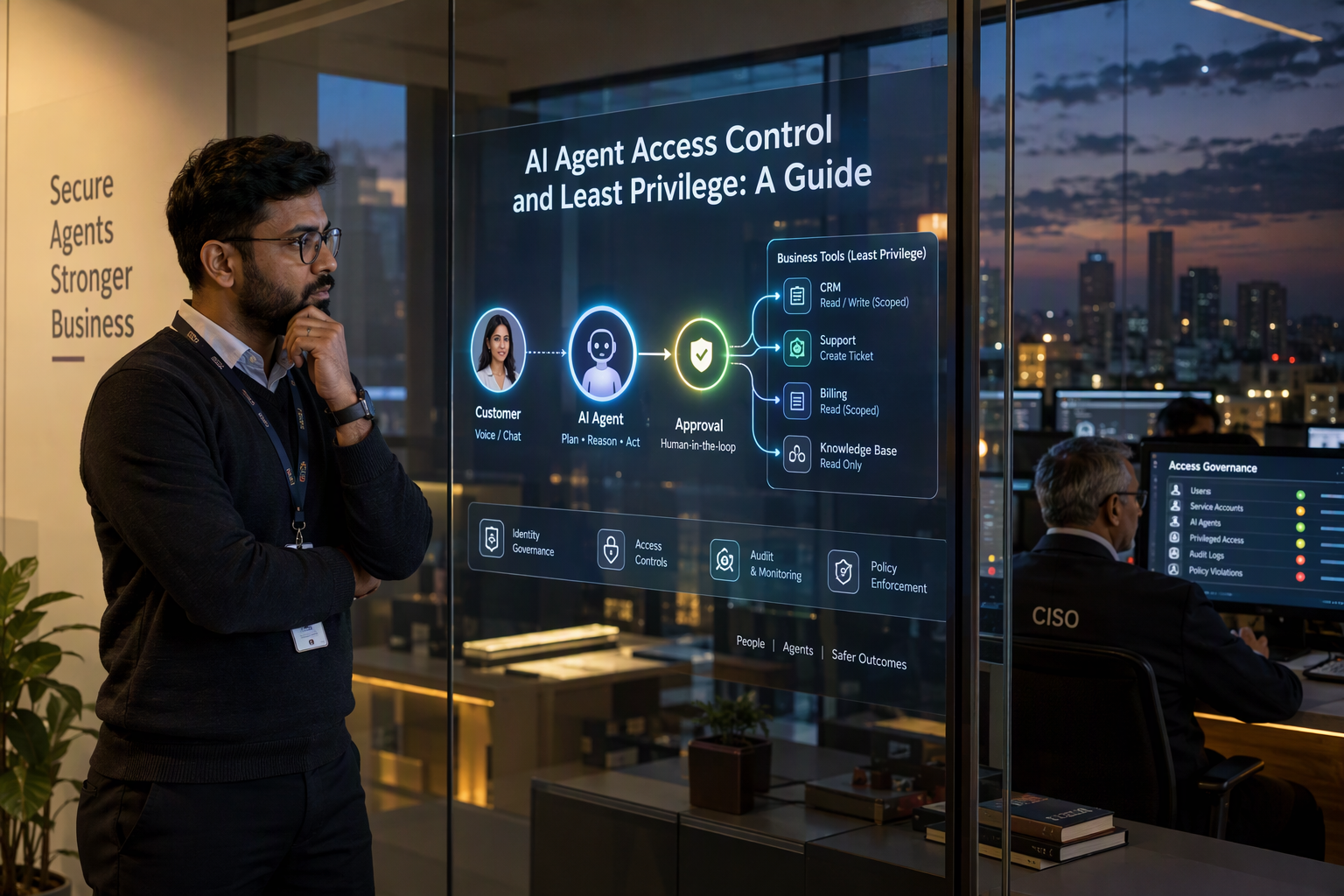
Learn how to map human, agent, and workload identities to least-privilege tools, approval gates, and voice-specific safeguards for safer automation.
AI Agent Access Control and Least Privilege: A Guide
What happens when a customer-service bot can hear a caller, consult a knowledge base, and trigger a business tool—but its permissions are broader than the task requires? That is the practical security question behind AI Agent Access Control and Least Privilege: every voice or chat agent needs a verifiable identity, narrowly scoped access, and clear limits on what it can do.
The issue is moving up the CISO agenda as agents shift from generating answers to taking actions across business systems. CISO Forum warns that non-human identities can operate at machine speed with privileged access, while Cyber Magazine’s coverage of Cognizant cybersecurity leader Vishal Salvi highlights identity, access, context, oversight, and accountability as central to securing agentic systems. Cognizant’s May 7, 2026 announcement of Secure AI Services makes the direction concrete: its “provable trust” approach checks security both at build time and at runtime, emphasizing evidence and traceability rather than assumed trust.
For voice and chat automation, least privilege is not just a rule about API keys. It means deciding which agent may retrieve which information, invoke which tools, update which records, and hand a conversation to a person—and then ensuring those permissions match the task. A voice agent that answers order-status questions, for example, may need to read an order’s status but not change the shipping address or issue a refund. The same principle applies to a chat agent that can look up a customer record: access to a record should not automatically mean permission to edit it.
Platforms such as CallMissed, which lets teams configure voice and chat agents with knowledge bases and tools, reflect how agent capabilities are becoming operational; those capabilities also make deliberate permission design essential. The control model must account for the agent’s identity, the user’s request, the data involved, and the actions available—not simply whether the agent is “trusted.”
This guide explains how to assign agent identities, scope tool and data permissions, separate read access from write actions, and build human oversight into voice and chat workflows. It also covers practical questions for security and product teams: how to limit blast radius, review access as agents change, and preserve accountability when an automated conversation leads to a real-world action.
How do AI-agent identity and access controls secure voice and chat automation?
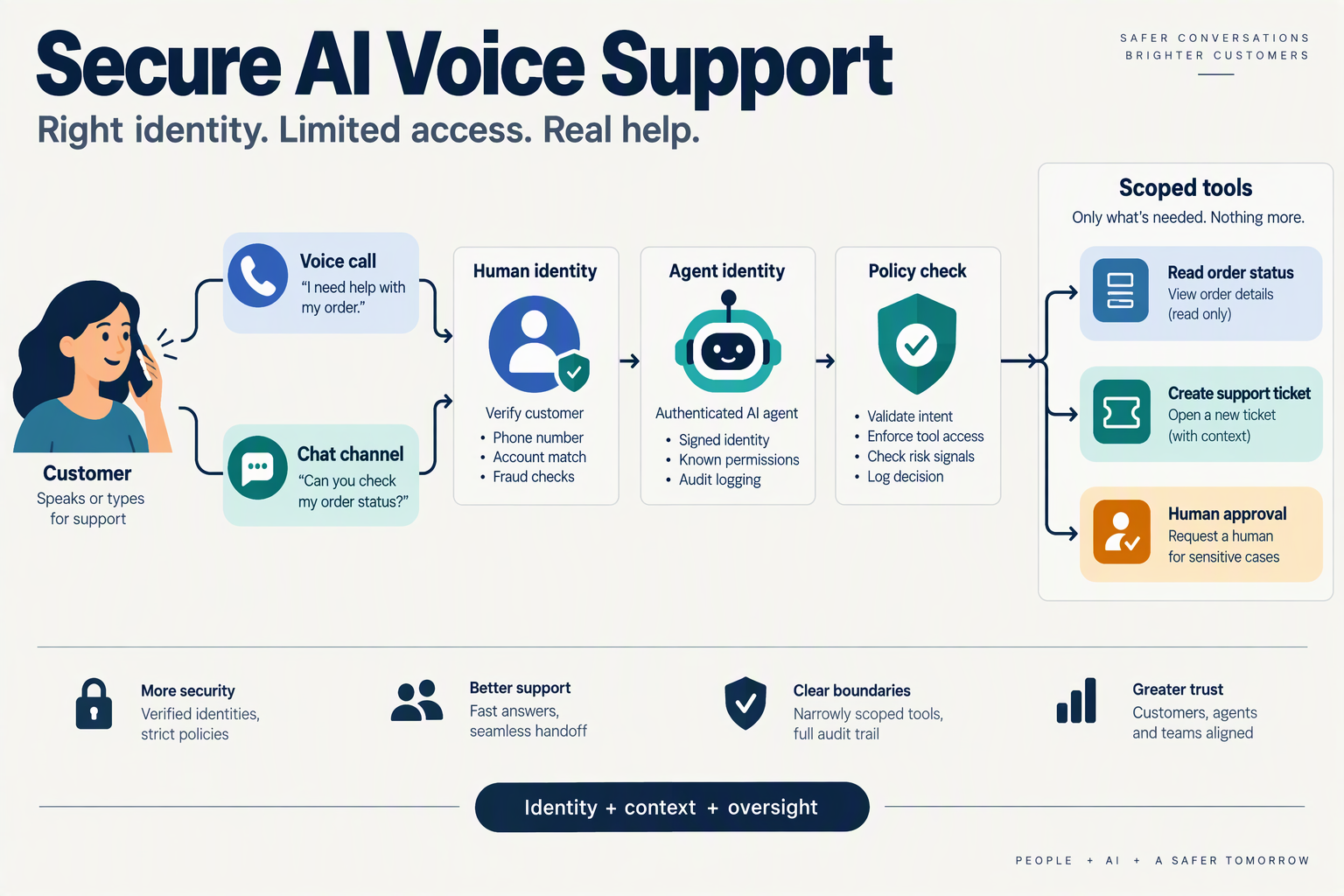
AI-agent identity and access controls secure voice and chat automation by assigning each agent a distinct, auditable identity and limiting its access to the data and actions required for a specific task. The controls should also check the context of each request, record consequential actions, and provide a clear path to human review.
What should an AI agent’s identity represent?
An agent identity should describe which automated worker is acting, for which workflow, and under whose authority. A shared credential used by multiple agents makes it harder to tell whether a lookup, message, or record change came from the order-status agent or another workflow.
Treat agents like non-human identities, not like ordinary users. Give each agent its own credentials or tool-level authorization, keep secrets out of prompts and conversation transcripts, and make the identity visible in logs. CISO Forum warns that non-human identities can operate at machine speed with privileged access, making weakly scoped access especially consequential.
Identity also needs context. The same agent may be allowed to answer a general question but not to disclose account-specific details until the caller or chat user has been appropriately verified. A phone number or a fluent conversation alone should not be treated as proof that someone is authorized to access a customer record.
How do you apply least privilege to voice and chat tools?
Start with the smallest permission set that completes the task, then expand only when a reviewed business need requires it. For example, an order-status agent may need to find a matching order and read its status; that does not automatically justify changing an address, issuing a refund, or exporting customer data.
A practical permission review can map each workflow across four questions:
- What data can the agent read? Limit retrieval to the records and fields needed for the conversation.
- What actions can it take? Separate lookup permissions from write, refund, or messaging permissions.
- When can it act? Add conditions such as verified identity, transaction limits, or human approval for higher-impact actions.
- What happens when uncertain? Restrict the agent to a safe response or route the conversation to a person.
Voice and chat platforms increasingly make agents operational through knowledge sources, tools, and handoffs. As of September 2026, CallMissed’s agent builder supports knowledge bases, custom REST tools, agent versioning with publish and rollback, and live-call handoffs between agents; these capabilities make workflow-level permission design concrete, but do not by themselves establish that a particular deployment is secure.
How do oversight and evidence complete the control model?
Permissions should be reviewable after deployment, not just set once during setup. Track which agent version ran, which tool it invoked, what action resulted, and whether a person approved or took over. Test permission changes before publishing them, and remove access that is no longer necessary.
Cognizant’s May 7, 2026 announcement of Secure AI Services describes “provable trust” through evidence, traceability, and continuous assurance, with security checks at build time and runtime. Cyber Magazine’s coverage of Cognizant cybersecurity leader Vishal Salvi likewise emphasizes identity, access, context, oversight, and accountability. For a voice workflow, that means reviewing not only whether the agent answered correctly, but whether it was authorized to perform the action and whether the resulting record can be traced to the agent and conversation.
The goal is bounded autonomy: agents can resolve routine requests within defined limits, while sensitive actions trigger additional checks or human intervention. This makes identity and access control part of the conversation design—not a permission setting added after launch.
Prerequisites & Setup: What should be in place before deployment?
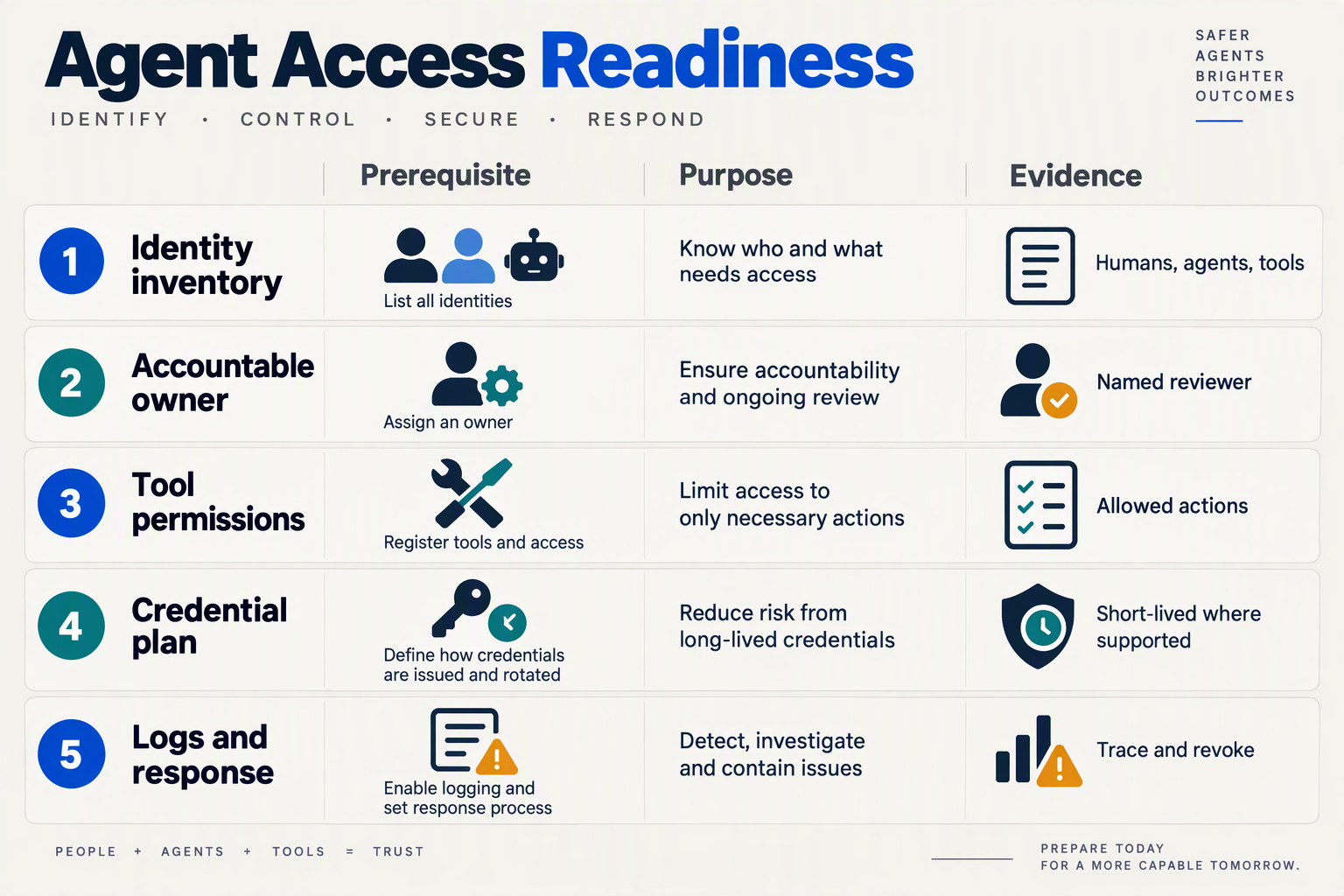
Before deploying voice or chat automation, teams should define the agent’s purpose, approve its data and tool access, set limits for consequential actions, and decide how to monitor and review its behavior. This preparation turns least-privilege policy into deployable controls—and supports the shift toward “provable trust” highlighted by Cognizant’s May 7, 2026 announcement of Secure AI Services.
What should be in place before an AI agent goes live?
Use this readiness checklist to connect each agent’s job to the permissions, safeguards, and evidence needed in production.
| Prerequisite | What to decide | Example control | Evidence to retain |
|---|---|---|---|
| Defined use case | Which channel, users, and requests the agent serves | Limit an order-status agent to order inquiries | Approved workflow and owner |
| Agent identity and scope | Which data and tools the agent can use | Allow order-status lookup, not refunds or address changes | Identity-to-permission map |
| Tool and system access | Which integrations can read or change records | Separate read operations from write operations | Tool inventory and access review |
| Data boundaries | Which knowledge sources and customer records are in scope | Restrict answers to approved policies and relevant records | Source list and data-owner approval |
| Action safeguards | Which actions need confirmation or human approval | Route refund or account-change requests to a person | Escalation rules and test results |
| Monitoring and rollback | How teams detect errors and reverse risky changes | Review call outcomes and restore a prior agent version | Logs, review cadence, rollback plan |
Start by writing a short agent charter: its task, intended users, permitted actions, prohibited actions, and escalation conditions. Make the scope concrete. “Help customers with orders” is too broad; “read the status of the caller’s order and explain the return policy” is easier to translate into permissions and test cases.
Next, map every connected resource to an operation: read, create, update, or trigger. A chat agent that can retrieve a customer record should not automatically inherit permission to edit it. Where the system supports it, use separate credentials or tool permissions for distinct workflows, and keep secrets out of prompts and conversation text.
How should teams validate controls before launch?
Test normal requests and boundary cases before enabling real actions. Include prompts that ask the agent to exceed its role, requests involving another customer’s data, ambiguous caller identity, and tool failures. Confirm that the agent refuses, asks for clarification, or hands off appropriately—and that the resulting event can be reviewed.
A practical pre-launch sequence is:
- Approve the use case and data sources with business, security, and data owners.
- Grant only required tool permissions, with human approval for sensitive or irreversible actions.
- Run scenario tests for allowed, denied, and escalated requests.
- Assign an owner and review cadence for permissions, incidents, and changes to the agent.
As of September 2026, CallMissed’s no-code voice and chat agent builder includes configurable knowledge bases, tools, call settings, and versioning with publish and rollback. Those controls can support a disciplined setup process, but teams still need to decide which tools and sources are appropriate for each workflow. Cognizant’s “provable trust” framing is a useful deployment test: can the organization show what the agent was allowed to do, what it actually did, and who is accountable for reviewing the evidence?
How should identity be separated across users, agents, and tools?

Separate identity into three principals: the human or business initiating a request, the AI agent interpreting it, and each tool or service the agent contacts. Keeping these identities distinct makes it possible to tell who requested an action, which agent performed it, and which system executed it.
What is the difference between a user identity and an agent identity?
A user identity represents the person or authenticated business account behind a conversation. An agent identity represents the automated process handling it; it should not inherit the user’s credentials or become indistinguishable from a human operator.
For voice, caller ID alone is not proof of identity. A caller might need to complete a separate verification step before the agent can reveal account details or initiate a sensitive action. In chat, a logged-in customer’s identity should likewise remain distinct from the agent’s identity. The system can then apply both user-specific rules—such as which account the person may access—and agent-specific rules—such as which actions this automation is permitted to perform.
A useful authorization record links the request to its actor and context: the authenticated user or caller, the agent version, the conversation or session, and the requested action. That record should support review without treating the model’s interpretation of a request as proof that the user is authorized.
Why should tools have separate identities and permissions?
Each connected tool should authenticate as its own service identity and expose only the operations the agent needs. For example, an order lookup tool can have permission to read order status, while a separate refund tool can require additional checks or human approval. The agent’s ability to call one tool should not automatically grant it access to every operation offered by the underlying business system.
In practice, teams can:
- Give each agent workflow its own credentials rather than sharing a broad key across bots.
- Scope tool credentials to specific records, operations, and environments.
- Separate read and write operations, and require explicit authorization for higher-impact changes.
- Set short-lived or revocable credentials where the integration supports them.
- Record the user, agent, tool, operation, and outcome together for later investigation.
This model also limits credential exposure: a compromise of one workflow need not provide access to unrelated tools or business data.
How should delegated actions be recorded?
Treat an agent’s tool call as delegated activity, not as the user directly calling the tool. The audit trail should preserve the chain: who asked, which agent interpreted the request, what authorization decision was made, which tool acted, and what changed. If a person approves an action, record that approval as a separate event rather than overwriting the agent’s role.
Cognizant’s May 7, 2026 announcement of Secure AI Services describes “provable trust” built on evidence and traceability, with security checks at both build time and runtime. Applied to voice and chat, that means reviewing agent and tool permissions before deployment, then checking during operation that actual calls align with those permissions.
Platforms such as CallMissed let teams configure agents with tools, knowledge bases, and agent versioning, including publish and rollback. Those capabilities make it especially important to review permissions when an agent changes: a new prompt or tool can alter what the agent is able to do, even if its name stays the same.
How do you implement least privilege in a voice-agent workflow?
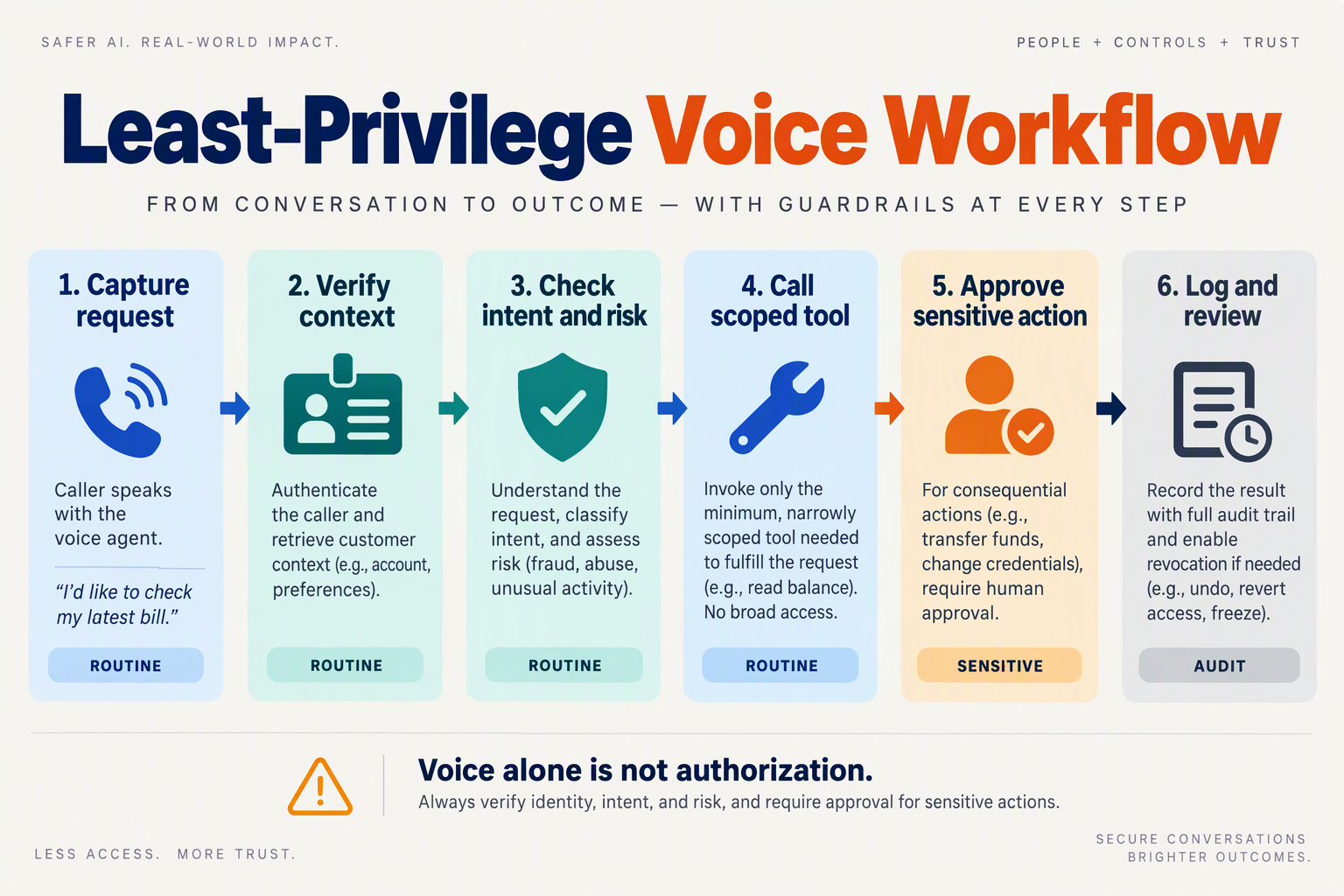
Least privilege in a voice-agent workflow means giving each agent only the data access and tool permissions needed for its defined task, then checking each consequential action against the caller’s request and authorization. Put limits in the systems the agent calls—not just in its prompt—so a persuasive or mistaken response cannot exceed the workflow’s approved scope.
How should you define a voice agent’s permitted job?
Start with one workflow and write down what the agent may read, change, and never do. For an order-status agent, for example:
- Read: the status of an order linked to the verified customer.
- Change: nothing; it cannot edit an address, cancel an order, or issue a refund.
- Escalate: requests for exceptions, identity mismatches, or actions outside the approved task.
Treat these as separate permissions. Access to a customer record should not automatically grant permission to modify it, and a caller’s request should not itself prove that the caller is entitled to make the change. Require the organization’s established authentication and authorization checks before exposing sensitive details or allowing a consequential action.
This task-level design aligns with the direction described in Cyber Magazine’s coverage of Cognizant cybersecurity leader Vishal Salvi: identity, access, context, oversight, and accountability are central to securing agentic systems. Cognizant’s May 7, 2026 announcement of Secure AI Services also frames “provable trust” around evidence and traceability at build time and runtime.
How do you scope tools and data access?
Give the agent only the specific tools and records its job needs. Where possible, create separate read and write operations, restrict records to the relevant customer or transaction, and enforce authorization in the tool or business system. A prompt saying “do not issue refunds” is not a security boundary if the agent can still call a refund tool.
A practical implementation sequence is:
- Map the workflow: list each data source, tool call, and possible side effect.
- Assign a distinct agent identity: tie access to a specific purpose, such as order-status support, rather than a general-purpose assistant.
- Grant the minimum scope: expose only the required fields and actions; keep administrative functions unavailable.
- Add decision gates: require verified identity, policy checks, or human approval before sensitive actions.
- Record and review: capture which agent acted, what it accessed, the decision basis, and the result; periodically remove permissions no longer needed.
For voice, account for ambiguity and interruptions: if the customer’s identity, intent, or requested transaction is unclear, the safe outcome is to ask a focused follow-up or hand the conversation to a person—not infer authorization.
How can teams apply this to agent platforms?
As of September 2026, CallMissed lets teams configure voice and chat agents with knowledge bases, custom REST tools, call settings, and versioning with publish and rollback. Those capabilities can support carefully bounded workflows, but teams should define and enforce permissions in the connected tools and systems rather than assume an agent configuration alone provides authorization.
Test both normal and adversarial cases before publishing: an unrelated customer record, a request to perform an unapproved action, missing identity evidence, and a tool error. Review the agent’s permissions whenever its prompt, tools, or workflow changes. The goal is not merely to make the agent behave correctly in a test; it is to ensure that even when it behaves unexpectedly, the available access keeps the impact contained.
Which controls strengthen agent identity governance?
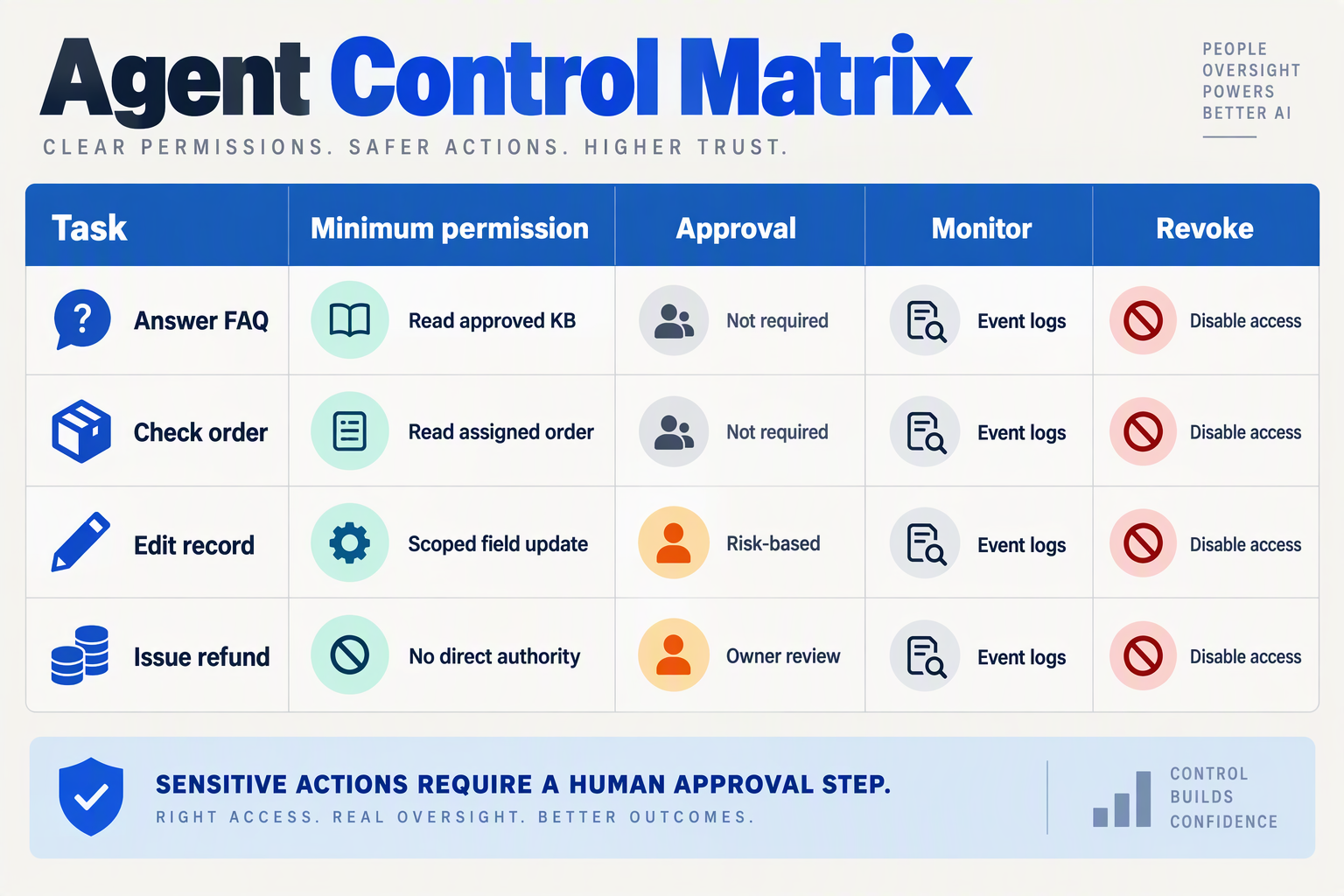
Agent identity governance is strongest when each voice or chat agent has a distinct workload identity, only task-specific permissions, and controls that verify requests before consequential actions. Security teams should be able to connect an action to the agent, the user request, the data accessed, and the approval or policy that allowed it.
Which controls should an agent identity include?
Treat an agent’s identity as a practical permission boundary, not merely a label. Give each agent a defined purpose—such as answering order-status questions—and keep its credentials and permissions separate from other agents, workflows, and human users. That way, a compromised or misconfigured agent has a smaller potential blast radius.
Cognizant’s May 7, 2026 announcement of Secure AI Services describes “provable trust” grounded in evidence, traceability, and continuous assurance, with security checks at build time and runtime. For voice and chat automation, that direction translates into controls teams can test and review:
| Control | Governance design | Example test |
|---|---|---|
| Distinct agent identity | Assign an identity to each workflow or agent role; avoid shared credentials across unrelated tasks. | Can investigators tell which agent initiated a customer-record lookup? |
| Scoped data access | Limit the records and fields an agent can retrieve to what its task requires. | Can an order-status agent access status without exposing unrelated customer data? |
| Tool permissions | Allow only approved tools and operations; separate read, create, and update permissions. | Can the agent read an order without changing its address or issuing a refund? |
| Context checks | Validate the customer, request, and relevant policy before permitting sensitive actions. | Does a requested account change require identity verification or additional review? |
| Human oversight | Route high-impact, ambiguous, or policy-sensitive actions to an authorized person. | Is there a clear handoff when a request falls outside the agent’s permitted scope? |
| Evidence and review | Record the action, agent identity, relevant decision, and outcome; review permissions when the workflow changes. | Can a reviewer reconstruct why the action was permitted and who or what approved it? |
How should teams test permissions before deployment?
Use realistic conversations to test both allowed and denied actions. For example, an agent may be permitted to retrieve an order’s delivery status, while an address change requires a separate authorized workflow. Testing only successful responses misses the key question: whether the agent refuses or escalates when the request exceeds its permissions.
A focused test plan can include:
- Map each task to tools and data. Document what the agent needs, then remove access that does not support its stated purpose.
- Test boundary cases. Try requests for another person’s record, a restricted field, or an action the agent should not perform.
- Verify handoffs and evidence. Confirm that escalations reach a person and that reviewers can understand what happened.
- Re-test after changes. Recheck permissions when prompts, tools, knowledge sources, or workflows are updated.
How can agent configuration support this governance model?
As of September 2026, CallMissed’s voice and chat agent builder supports configuring prompts, knowledge bases, tools, call settings, and versioning with publish and rollback. CallMissed also supports custom REST tools and skills that an agent loads only when needed. These capabilities make it possible to organize an agent around a defined task; teams still need to decide which data and operations each tool should permit, and validate those boundaries in their own deployment.
What common mistakes weaken AI-agent security?
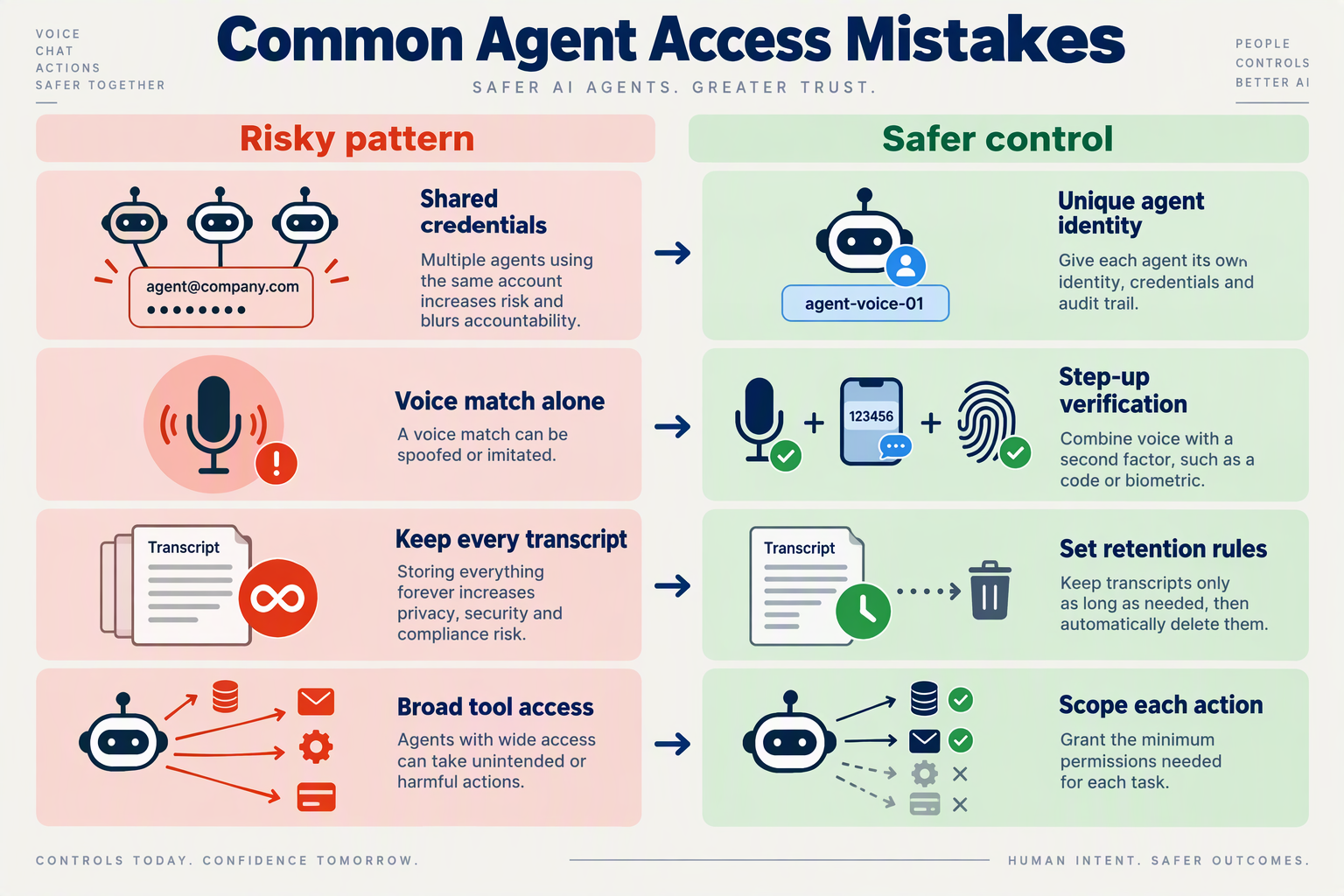
Weak AI-agent security usually comes from mismatches: an agent can do more than its assigned task, a conversation is treated as proof of authorization, or nobody can reconstruct what happened afterward. Cognizant’s May 7, 2026 announcement of Secure AI Services frames the emerging standard as “provable trust”—evidence and traceability at build time and runtime, not trust by assumption.
Which AI-agent security mistakes should teams avoid?
| Common mistake | Voice or chat failure mode | Stronger practice | Evidence to retain |
|---|---|---|---|
| Reusing one identity across agents | A voice agent and a chat agent share credentials, making it difficult to attribute a tool call or contain a compromised workflow. | Assign separate identities and credentials by agent, environment, and business purpose; rotate or revoke them independently. | Agent identity, credential owner, scope, and change history. |
| Treating a caller or chat user as authenticated because they know personal details | A caller’s spoken request is accepted as sufficient proof to change an account or disclose sensitive information. | Define separate verification steps for sensitive actions, and do not let the language model decide on its own that identity has been proven. | Verification result and the rule that permitted or denied the action. |
| Giving a tool broad permissions “for convenience” | An agent that needs to check an order can also edit customer data, issue a refund, or trigger unrelated actions. | Expose narrow tool operations, validate inputs, and require a separate approval path for high-impact actions. | Tool invoked, parameters, affected record, and approval decision. |
| Trusting retrieved content as instructions | A document, webpage, or customer message contains text that attempts to redirect the agent or extract information. | Treat retrieved material as data, not authority; constrain which tools can act on its contents and test prompt-injection scenarios. | Source document, retrieved content reference, and resulting tool decision. |
| Letting access drift as agents change | A new prompt, tool, or workflow quietly expands what an existing agent can access. | Review permissions whenever the agent’s purpose or tools change; test the deployed version, not only the design. | Version, permission review, test results, and release approval. |
| Logging only the final answer | A transcript shows what the agent said but not which data or tools shaped a consequential outcome. | Record a privacy-appropriate audit trail for tool calls, handoffs, and decisions, with retention and access rules. | Timestamped action trail linked to the conversation and agent version. |
How can teams make these controls operational?
Cognizant’s May 2026 announcement emphasizes checking trust both at build time and at runtime. For voice and chat, that means reviewing an agent before launch and checking its behavior during live use—not assuming a successful test guarantees safe future actions.
A practical review can ask:
- Before release: Does each tool match the agent’s purpose? Are sensitive actions tested with denied, ambiguous, and adversarial requests?
- During operation: Can a supervisor identify the agent, inspect consequential actions, and route an uncertain conversation to a person?
- After a change: Have prompt, knowledge-source, model, or tool updates triggered a fresh review?
CallMissed supports configurable voice and chat agents with knowledge bases and tools, so teams using such capabilities should define access boundaries and audit expectations around each workflow. The platform also offers versioning with publish and rollback; teams can incorporate those release points into their own permission-review process, without treating version control as a substitute for authorization checks.
Frequently Asked Questions
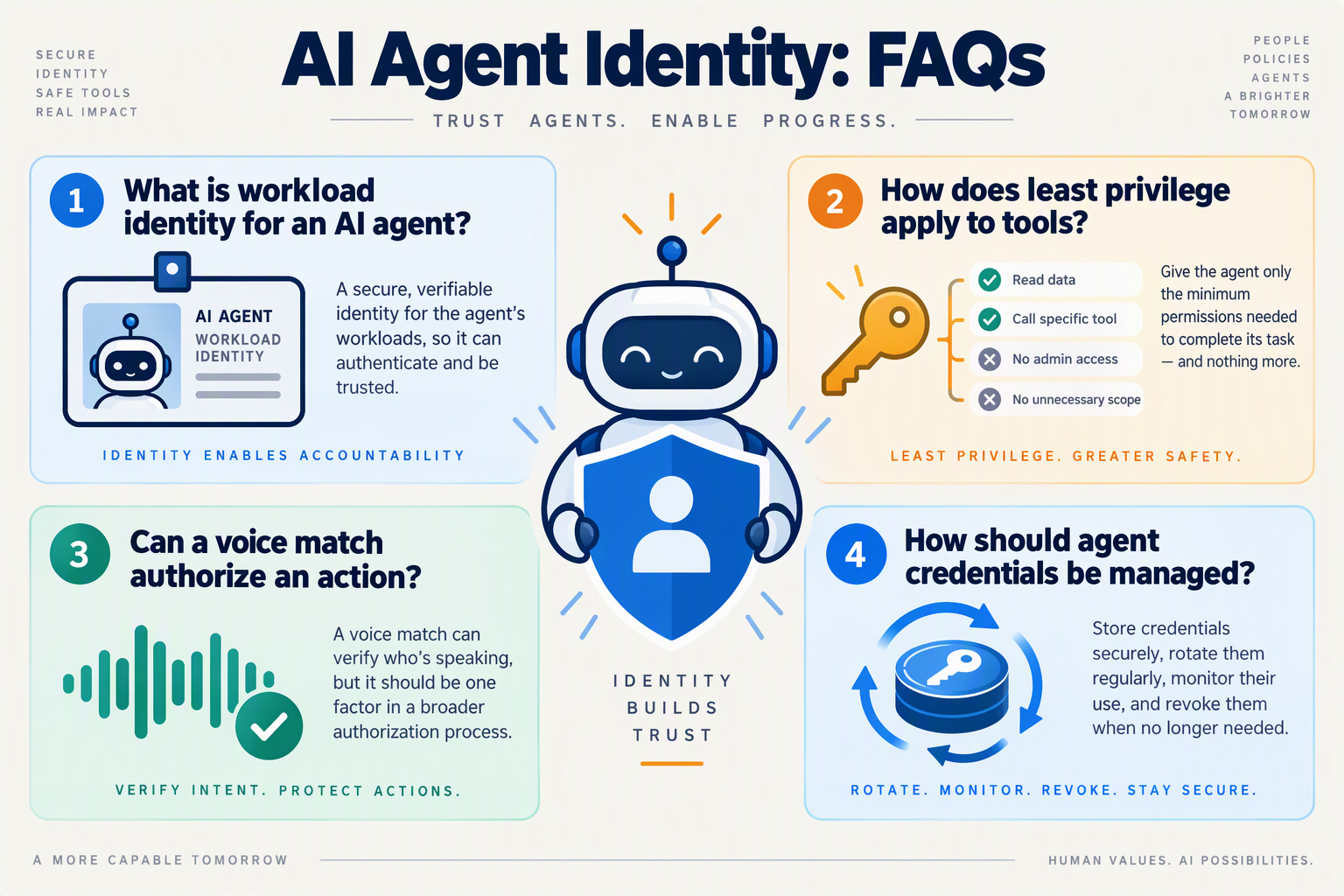
What does AI-agent identity mean in voice and chat automation?
How does AI Agent Access Control and Least Privilege limit an agent’s permissions?
How should voice agents handle caller identity and sensitive actions?
What permissions should an AI chat agent have when using business tools?
How can teams monitor and audit AI-agent access over time?
When should a team change or revoke an AI agent’s access?
What should you do next to operationalize agent access governance?

Operationalize agent access governance by inventorying each voice and chat agent, assigning a named owner, limiting its data and tools to the task, and testing those permissions before and during deployment. Then log consequential actions and define when a person must take over.
What should an agent-access inventory include?
Start with a register that makes every automated identity accountable. For each agent, record:
- Purpose and owner: the workflow it serves and the person accountable for approving changes.
- Data access: which records or knowledge sources it may read, and whether it may retain conversation context.
- Available actions: tools it can invoke, including any that create, update, send, or delete information.
- User and channel context: whether it handles inbound calls, outbound calls, web chat, or messaging—and what must be verified before it acts.
- Limits and escalation: actions it must refuse or defer, and the conditions that send a conversation to a human.
CISO Forum warns that non-human identities can operate at machine speed with privileged access. That makes a current inventory more than documentation: it gives security teams a way to find agents with unnecessary access before a mistake can scale.
How do you test least privilege in real workflows?
Test permissions against specific user requests, not just a successful demo. For an order-status agent, for example, confirm it can retrieve the relevant status but cannot change an address or issue a refund. Test ambiguous requests, failed identity checks, unavailable tools, and attempts to get the agent to act outside its purpose.
A practical rollout sequence is:
- Define the task boundary. Write down what the agent may answer, what it may do, and what it must not do.
- Grant the minimum access. Separate read access from write actions; make sensitive actions require an additional check or human approval.
- Exercise edge cases. Use test conversations to check both allowed and denied actions, including voice recognition errors and incomplete customer details.
- Review evidence. Confirm that transcripts, action records, and escalation outcomes let an operator understand what happened.
- Reassess after changes. Repeat the review when prompts, tools, knowledge sources, or workflows change.
Cognizant’s May 7, 2026 announcement of Secure AI Services describes “provable trust” through evidence, traceability, and continuous assurance, checking security at both build time and runtime. For an operations team, that translates into retaining test results before launch and reviewing real interactions after launch—not treating initial approval as permanent.
How should you build human oversight into automation?
Define handoff rules before deployment. Escalate when identity or intent is uncertain, a request falls outside the agent’s scope, a permitted tool fails, or the requested action has material consequences. Make sure the receiving person gets enough conversation context to continue without asking the customer to start over.
As of September 2026, CallMissed offers configurable voice and chat agents with knowledge bases, custom REST tools, versioning with publish and rollback, and a human-handoff queue across supported inbox channels. Those capabilities can support a governed workflow, but teams still need to choose appropriate permissions, escalation rules, and review practices.
What should you measure after launch?
Track whether agents stay within scope, whether denied actions are handled correctly, how often conversations escalate, and whether action records are complete enough for review. Assign an owner to investigate exceptions and set a regular access review—plus an immediate review after a workflow or tool changes. This closes the loop: permissions are designed, tested, observed, and adjusted as the agent’s role evolves.
Conclusion
AI-agent access control is not a one-time permission setting; it is an ongoing way to keep automated actions aligned with a specific task. For voice and chat workflows, that means knowing which agent is acting, what information it can access, which tools it can invoke, and when a person should review or take over.
The guide’s core takeaways are:
- Give each agent a distinct, auditable identity tied to its workflow and purpose.
- Apply least privilege: allow only the data access and actions the task requires, separating read permissions from changes such as refunds or record updates.
- Check request context and preserve accountability by recording consequential actions and providing a clear route to human oversight.
- Review permissions as agents evolve so new tools or capabilities do not quietly expand their blast radius.
Cognizant’s May 7, 2026 launch of Secure AI Services signals a broader shift toward “provable trust,” with security checks at build time and runtime. Watch for that emphasis on evidence, traceability, and continuous assurance to shape how organisations govern agents—not just how they deploy them.
CallMissed, an AI customer-communication platform where teams configure voice and chat agents with knowledge bases and tools, offers one way to explore how these systems are becoming operational. As your agents gain new capabilities, can you show exactly what each one is allowed to do—and why?
Related Reading
- AI Agent Orchestration Layer: Enterprise Support Blueprint
- Multilingual AI Voice Agent India: CallMissed Handoff QA
- How to Build a Voice Agent With LiveKit: Python Guide
Sources
Discussion
Related Posts



Ready to automate customer conversations?
Launch AI voice agents and WhatsApp bots with CallMissed — one API, 22+ Indian languages.