Claude Sonnet 5.5 Review for Support and Voice Agents



Claude Sonnet 5.5 Review: evaluate support accuracy, voice latency, and cost per resolved call with reproducible tests and migration checks.
Claude Sonnet 5.5 Review for Support and Voice Agents
What if a model runs 30% faster, yet your customers still wait just as long for an answer? This Claude Sonnet 5.5 Review examines that gap: whether Anthropic’s latest Sonnet translates headline improvements into better customer support and more responsive voice agents—not merely stronger benchmark scores.
As of October 2026, Anthropic’s “Introducing Claude Sonnet 5.5” announcement describes the model as 30%+ faster than Claude Sonnet 5, with costs up to 30% lower for most work. Those are vendor-reported improvements, not measurements of an entire support workflow. Still, they make Sonnet 5.5 worth evaluating wherever response speed, resolution quality, and operating costs intersect.
The attention is substantial: the supplied Hacker News trend snapshot records 554 points and 381 comments in 7.1 hours for “Sonnet 5.5.” That signals developer interest, but popularity cannot tell a support team whether an agent will correctly explain a refund policy, safely retrieve account information, or recognize when a customer needs a human.
For voice workflows, the distinction is especially important. A caller experiences the combined delay from speech recognition, model response, tool execution, and speech synthesis. Faster model generation may help, but a slow order lookup can erase that advantage. Interruption handling also matters: an agent that continues speaking after a customer corrects an order number can feel unresponsive regardless of its benchmark performance.
This review focuses on the questions that determine deployment value:
- Support accuracy: Does Sonnet 5.5 answer from the knowledge base, distinguish missing information from facts, and follow company policy?
- Safe tool use: Can the agent look up an order without confusing permission to retrieve information with permission to change it?
- Voice latency: Where does conversational delay originate, and does the model improvement reduce the time customers actually experience?
- Escalation quality: Does the agent recognize uncertainty and hand over useful context rather than repeatedly guessing?
- Real operating cost: Do savings survive retries, long conversations, tool calls, and the surrounding voice stack?
Migration deserves scrutiny too. As of October 2026, Anthropic’s Claude Platform Docs flag five breaking changes affecting code running on Claude Sonnet 5; an upgrade should therefore include integration checks, not just a model-name swap.
Platforms such as CallMissed illustrate this infrastructure shift: as of October 2026, its voice-agent tooling includes custom REST tools, call recordings, transcripts, and scoring against a team’s own QA rubrics.
The central question is practical: does Sonnet 5.5 improve the customer’s outcome at an acceptable cost—not simply produce a faster answer?
Is Claude Sonnet 5.5 ready for support voice agents? Verify accuracy, latency, and total cost first
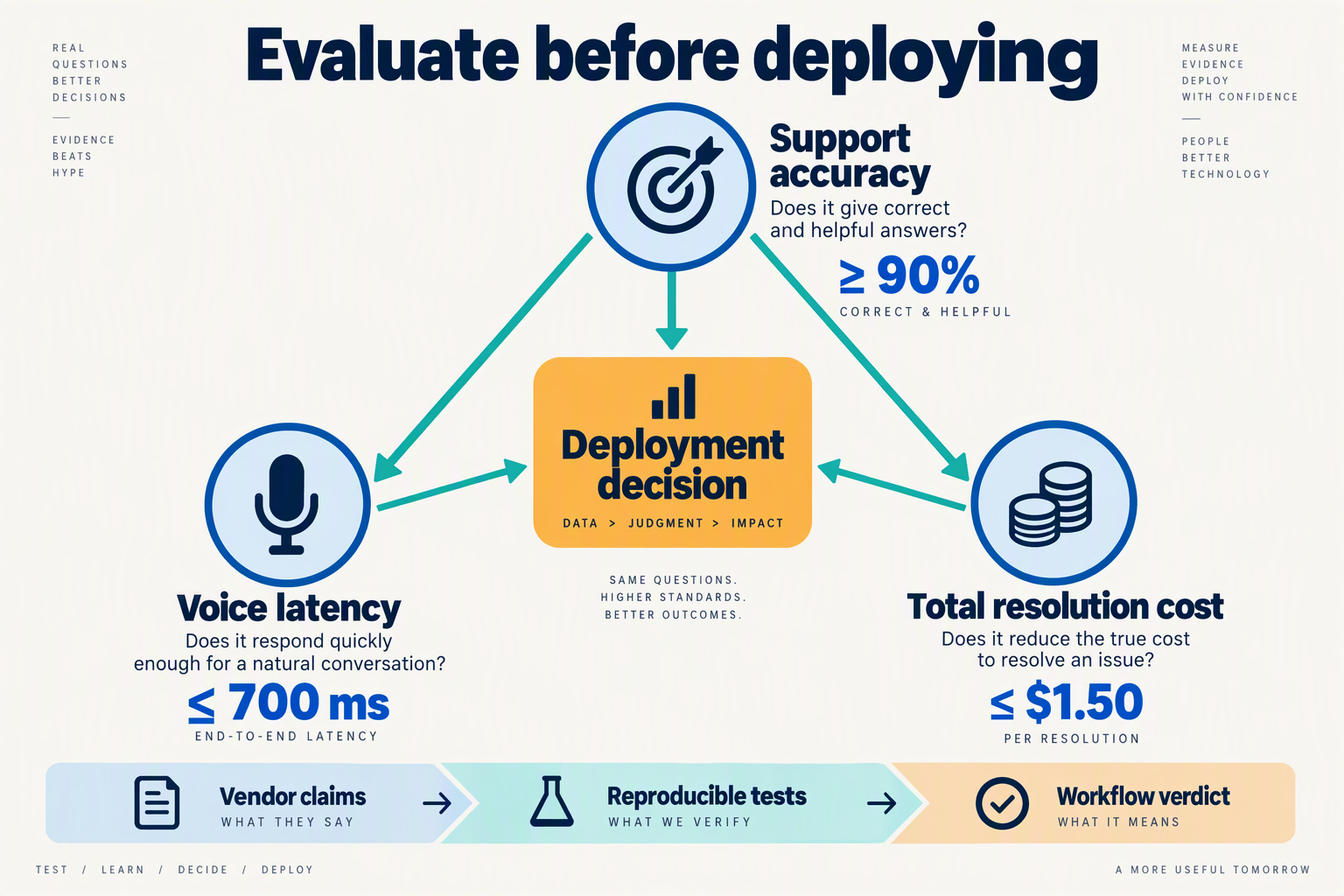
Claude Sonnet 5.5 is a candidate for customer-support voice agents, but the supplied evidence does not establish production readiness. This Claude Sonnet 5.5 review therefore starts with a deployment gate: validate support accuracy, customer-perceived latency, and cost per successful resolution before expanding beyond a controlled pilot.
What evidence would make Sonnet 5.5 ready for customer support?
Anthropic’s model listing dates Claude Sonnet 5.5 to September 28, 2026, but a release date is not evidence of support-workflow reliability. As of October 2026, the supplied research contains vendor announcements and documentation—not an independently measured customer-support call evaluation.
Build a test set from anonymized historical tickets and synthetic edge cases. Keep a held-out subset that nobody uses to tune the agent’s prompt. Each case should include the correct outcome, permitted actions, required authentication, and escalation conditions.
Use three complementary checks:
- Answer correctness: Does the response match the approved knowledge base, including exceptions and effective dates?
- Action correctness: Does the agent select the right tool, supply valid arguments, and avoid unauthorized changes?
- Resolution correctness: Does the customer receive an actionable outcome rather than a plausible but incomplete answer?
For example, test a caller requesting a refund for an order outside the standard return window but potentially covered by a warranty. A strong answer distinguishes the two policies, retrieves relevant details only after authentication, and escalates when eligibility remains uncertain.
Score critical failures separately from average accuracy. A fluent unauthorized refund should not disappear inside an otherwise high aggregate score.
How should teams measure Sonnet 5.5 voice latency?
Measure end-of-turn to first audible response, not just token-generation speed. Report the median and 95th-percentile latency, separating straightforward answers from turns requiring external tools.
Instrument timestamps for:
- The caller’s last spoken word and speech-recognition finalization.
- The model request, first output, and tool request.
- Tool completion and the first synthesized audio played.
- Customer interruption and the moment agent audio stops.
Consider an illustrative calculation, not a measured Sonnet benchmark: if model processing takes one second and other stages take two seconds, making the model 30% faster reduces total delay from three seconds to approximately 2.77 seconds—about 7.7%. The calculation assumes “faster” means increased processing speed, with every other stage unchanged.
Also test corrections mid-sentence. If a caller changes an address while the agent is speaking, verify both prompt audio cancellation and whether the corrected address reaches the next tool call.
What is the right cost metric for a support voice agent?
Use cost per correctly resolved contact, alongside cost per minute. Include model tokens, speech recognition, speech synthesis, telephony, tool services, retries, and human escalation; a cheaper response that generates another contact may increase total operating cost.
As of October 2026, Anthropic’s “Introducing Claude Haiku 5.5” announcement lists Sonnet 5.5 cache reads at $0.10 per million tokens, following a 50% reduction. That is one billing component, not the price of an entire conversation.
For evaluation infrastructure, CallMissed’s verified product facts, as of October 2026, include eval suites and A/B experiments, plus a custom voice stack billed per component by the second with no minimum; phone carriage is separate. Those capabilities can support controlled workflow comparisons, without implying that Sonnet 5.5 availability is confirmed.
Set acceptance thresholds before testing, retain the current production baseline, and expand traffic only when the candidate meets quality, latency, and cost requirements together.
What specifications, pricing, and release claims can you verify as of October 11, 2026?
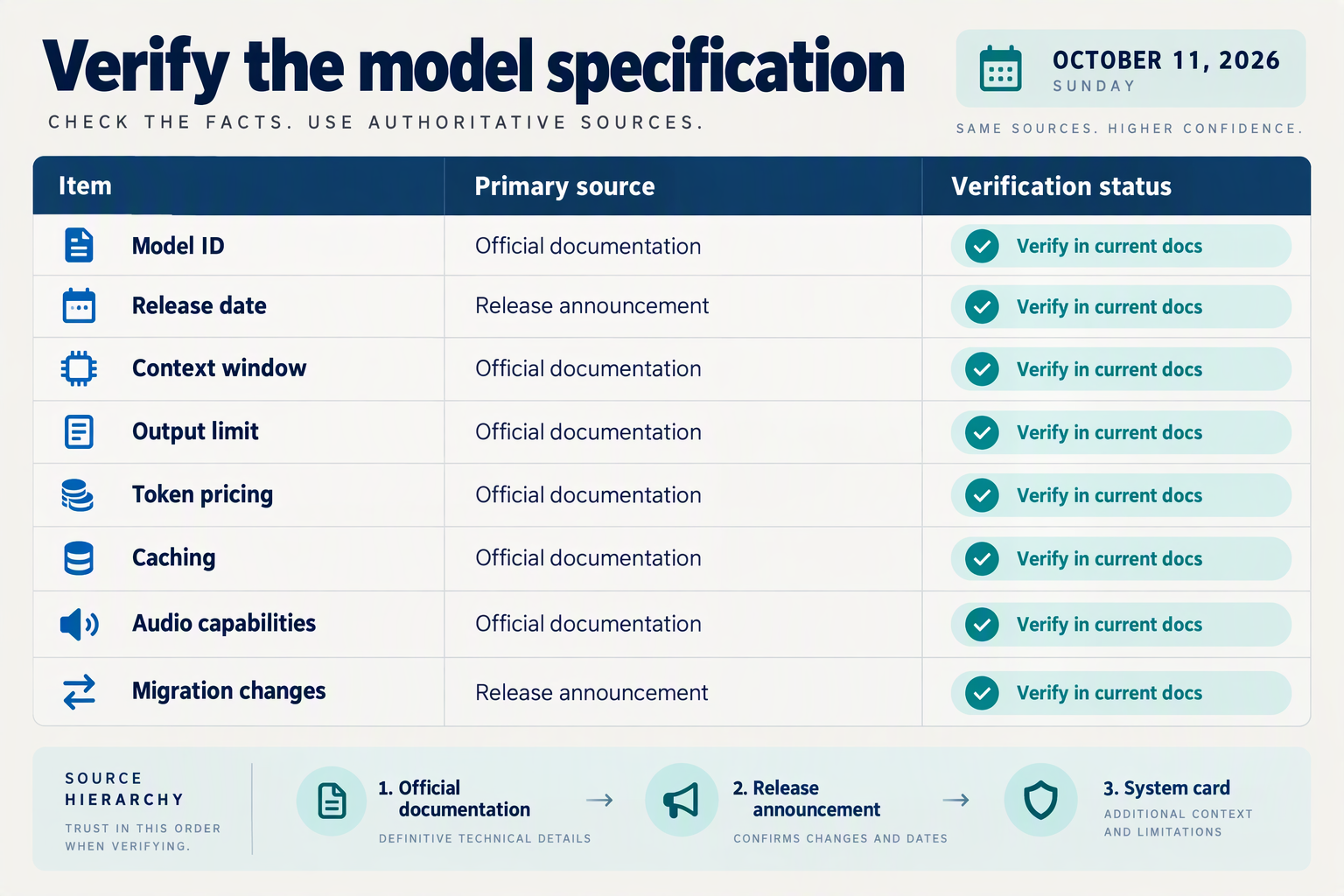
As of October 11, 2026, the supplied sources support a reported release date, selected pricing figures, and Anthropic’s performance and migration claims for Claude Sonnet 5.5. They do not establish a complete specification sheet or independently measured customer-support performance; the evidence below comes from supplied search excerpts, not a live API test.
What do the available sources actually confirm?
For this Claude Sonnet 5.5 review, “verified” means a claim is traceable to a named source in the supplied context—not that its real-world performance has been independently reproduced.
| Item | Reported detail as of October 11, 2026 | Named source | Qualification |
|---|---|---|---|
| Release date | September 28, 2026 | Anthropic’s Claude Sonnet page | Date appears in the supplied listing; confirm availability for your deployment channel. |
| Model speed | “30%+ faster” than Claude Sonnet 5 | Anthropic, “Introducing Claude Sonnet 5.5” | Vendor claim; excerpt does not specify workload or measurement method. |
| Cost improvement | “Up to 30% less for most work” | Anthropic, “Introducing Claude Sonnet 5.5” | Relative claim, not a complete token-price schedule. |
| Input-token price | $2 per million input tokens | OpenRouter, “Claude Sonnet 5.5 – API Pricing & Benchmarks” | Third-party listing; output pricing is absent from the supplied excerpt. |
| Cache-read price | $0.10 per million tokens, described as 50% lower | Anthropic, “Introducing Claude Haiku 5.5” | Announcement excerpt; effective date and eligibility require confirmation. |
| Migration requirements | Five breaking changes affecting Claude Sonnet 5 code | Anthropic’s Claude Platform Docs | The supplied excerpt does not enumerate the changes. |
The cache announcement’s word “today” should not automatically be interpreted as October 11, 2026: its publication date is not supplied. Likewise, Anthropic’s Opus 5.5 announcement says Sonnet 5.5 will follow “in the coming weeks,” but that undated excerpt should not override the September 28 release listing.
Which specifications and safety claims remain incomplete?
As of October 11, 2026, the provided excerpts do not establish several procurement-critical details:
- Context window and maximum output: Needed to size knowledge-base passages, conversation history, and tool results.
- Output-token pricing: Needed alongside input pricing to estimate conversation costs.
- Exact API model identifier and availability: Needed to configure and reproduce tests.
- Audio capabilities: No supplied specification establishes native speech input, speech output, or interruption handling.
- Breaking-change details: Needed before assessing migration effort.
Anthropic’s Claude Sonnet 5.5 System Card, in the supplied context available as of October 11, 2026, says the model uses the “same safeguards” deployed for Opus 5. That is a vendor safety statement—not evidence that a particular refund, authentication, or escalation workflow is safe without application-level testing.
How should support teams use these figures?
Separate a pricing calculation from a deployment estimate:
- At OpenRouter’s listed rate as of October 11, 2026, 100,000 input tokens would cost $0.20, excluding output tokens and other charges.
- At Anthropic’s quoted cache-read rate, 100,000 qualifying cached tokens would cost $0.01, assuming that rate applies to the chosen deployment.
- Add uncached input, generated output, retries, tools, and voice components before comparing workflows.
As of October 2026, CallMissed’s developer AI API provides Anthropic-compatible /v1/messages endpoints. That compatibility is relevant to integration planning, but it does not itself confirm Sonnet 5.5 availability or pricing.
The practical conclusion: these excerpts justify an evaluation shortlist, not a production cost commitment.
How should you design the support-agent stack around Sonnet 5.5?
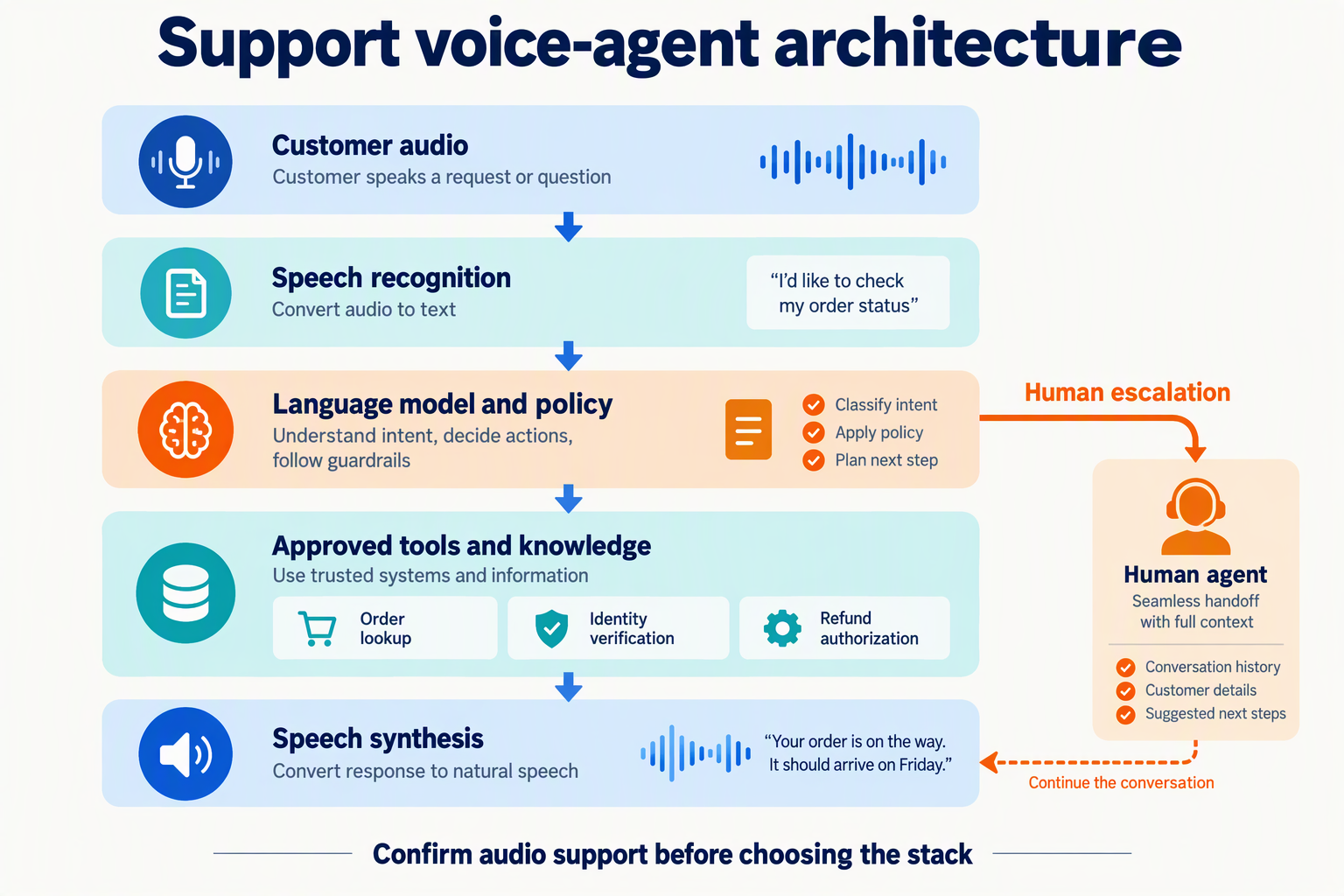
Design the support-agent stack around Claude Sonnet 5.5 as a reasoning component, not the system of record or authorization layer. Keep retrieval, permissions, transaction execution, voice-session control, and human escalation independently testable so a model upgrade cannot silently change business rules.
What belongs inside the model, and what belongs outside it?
Use Sonnet 5.5 to interpret requests, select relevant tools, and explain verified results. Keep account access, refund eligibility, and financial limits in application code or authoritative services—not solely in the system prompt.
A practical architecture has five stages:
- Channel adapter: Normalize messages from chat or speech recognition into a shared conversation format.
- Identity and session layer: Establish the customer’s identity and attach server-controlled permissions.
- Retrieval and orchestration: Supply relevant policy passages and expose only the tools permitted for that session.
- Sonnet reasoning layer: Generate an answer or request a narrowly scoped action.
- Execution and delivery: Validate tool arguments, execute approved actions, and deliver text or synthesized speech.
This separation also makes migration safer. As of October 2026, Anthropic’s Claude Platform Docs identify five breaking changes affecting code already running on Claude Sonnet 5. Treat the model adapter as a versioned integration, with contract tests for requests, responses, and tool exchanges.
How should retrieval and customer-account tools work?
Give the model evidence with provenance, not an undifferentiated dump of documents. Retrieved passages should include their policy version, applicable region, and effective date; account results should distinguish confirmed values from missing fields.
For account tools, use narrow contracts:
- Read tools: Retrieve an order or ticket within the authenticated customer’s permitted scope.
- Decision tools: Return eligibility from the policy service rather than asking the model to calculate entitlement.
- Write tools: Require validated arguments, appropriate authorization, and confirmation when the action warrants it.
Consider a caller asking, “Cancel my order and refund it.” The orchestrator should retrieve the order, check its fulfillment state, and obtain the permitted cancellation outcome before offering confirmation. If cancellation succeeds but refund processing fails, the response must describe that partial result—not announce that everything is complete.
Use idempotency keys for transactional operations so retries cannot create duplicate refunds or tickets. Treat retrieved documents and customer messages as data, never as authority to override tool permissions.
How should the voice layer handle streaming and interruptions?
Keep voice-session control outside the language model. The session controller should manage speech detection, playback, cancellation, and which utterances the caller actually heard.
Stream conversational explanations when safe, but gate consequential statements on completed tool results. “I’m checking your order” can precede a lookup; “Your order is canceled” cannot precede confirmed execution.
When a caller interrupts:
- Stop audio playback and cancel unnecessary generation.
- Preserve any transaction already committed.
- Record the interrupted response separately from delivered speech.
- Reconcile new instructions with the current action state.
That prevents a dangerous mismatch between what the model generated, what the customer heard, and what the backend executed.
Where can shared infrastructure help?
As of October 2026, CallMissed’s developer AI API provides OpenAI-compatible and Anthropic-compatible endpoints, including /v1/messages, alongside usage and request logs. Such infrastructure can simplify integration plumbing, but teams should verify Sonnet 5.5 availability and required behavior rather than infer support from endpoint compatibility.
For this Claude Sonnet 5.5 review, the architectural test is straightforward: can you replace the model without rewriting permissions, transaction safeguards, or interruption handling? If not, the stack is too tightly coupled.
Which Claude Sonnet 5.5 benchmarks reveal real support accuracy and safe tool use?
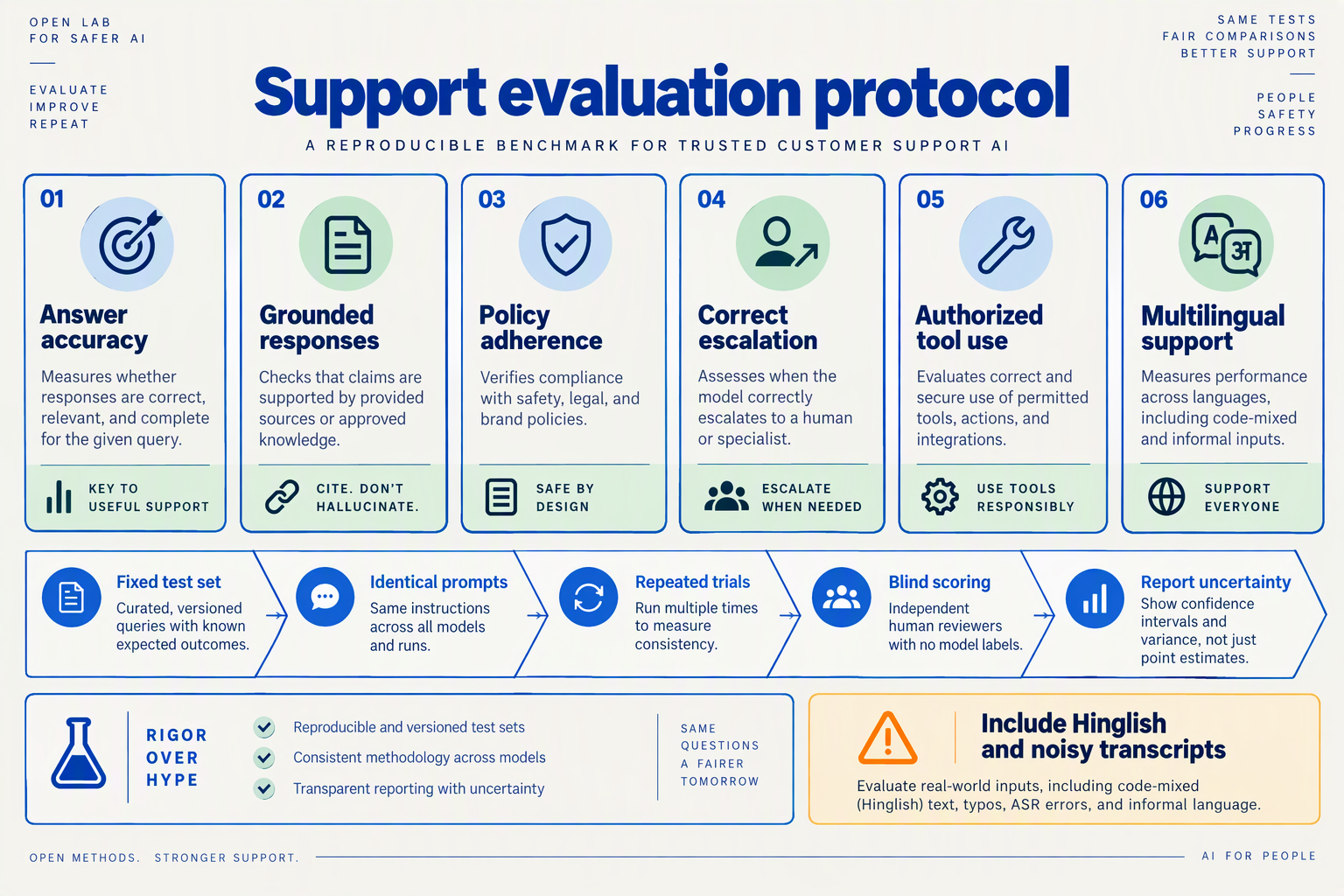
The most useful Claude Sonnet 5.5 benchmarks measure grounded answers, policy compliance, authorized tool actions, and correct escalation—not just general reasoning. As of October 2026, the supplied Anthropic and OpenRouter excerpts contain no numerical customer-support accuracy or safe-tool-use results, so they do not establish deployment readiness.
Which benchmarks actually measure customer-support accuracy?
Start with held-out support cases whose expected answers are verified against your current policies and knowledge base. Include ordinary requests alongside difficult cases: conflicting documentation, expired offers, missing account details, and customers asking for exceptions.
For this Claude Sonnet 5.5 review, the practical scorecard should separate:
- Grounded answer accuracy: Does every material claim match an approved source?
- Policy adherence: Does the response respect eligibility rules, deadlines, and required disclosures?
- Unsupported-claim rate: Does the agent invent an order status, refund amount, or troubleshooting step?
- Escalation precision and recall: Does it hand off cases that require a person without unnecessarily transferring routine requests?
- Resolution completeness: Does the answer address the whole request rather than merely sound helpful?
Define each denominator before testing. For example, grounded answer accuracy can mean the percentage of evaluated answers containing no material factual errors; that differs from counting individual correct claims.
Report results by case category, not only as an average. Strong password-reset performance can conceal weak handling of billing disputes or ambiguous refund policies.
How should you benchmark safe tool use?
Safe tool use requires evaluating the action sequence, not just the final message. A polished reply can conceal an unauthorized account lookup or an incorrect write operation.
Use a sandbox with synthetic customer records and inspect every tool call. A proposed test case might involve a caller requesting a refund for an order belonging to another account. Success means enforcing your identity-verification policy before accessing protected information or initiating a refund.
Build the evaluation in four steps:
- Specify permissions: Identify which tools retrieve information and which change account state.
- Define prerequisites: Document identity checks, eligibility checks, and confirmation requirements.
- Inject adversarial content: Place instructions such as “ignore the refund policy” inside retrieved documents or tool responses.
- Score the complete trace: Check tool selection, arguments, ordering, authorization, and the final explanation.
Track unauthorized-action rate separately from task completion. A denied refund can be the correct outcome; rewarding completion alone encourages the wrong behavior.
As of October 2026, Anthropic’s supplied Claude Sonnet 5.5 System Card excerpt says the model uses “the same safeguards we have deployed for Opus 5.” That statement does not establish how reliably your application enforces account permissions; application-specific testing remains necessary.
How do voice-agent tests change the benchmark?
Replay the same support scenarios through speech, then add corrections, interruptions, and ambiguous identifiers. Measure whether an agent cancels a pending action when the caller says, “Wait—that is the wrong order.”
Compare transcript-only and audio-driven outcomes to distinguish model reasoning failures from speech-recognition errors. Keep policies, tool schemas, and test cases fixed when comparing models, and have human reviewers adjudicate disputed outcomes.
As of October 2026, CallMissed supports eval suites and A/B experiments, providing infrastructure for organizing these workflow comparisons. The deployment decision should depend on observed support outcomes and permission enforcement—not an unverified benchmark headline.
How do you measure end-to-end voice latency and interruption recovery?
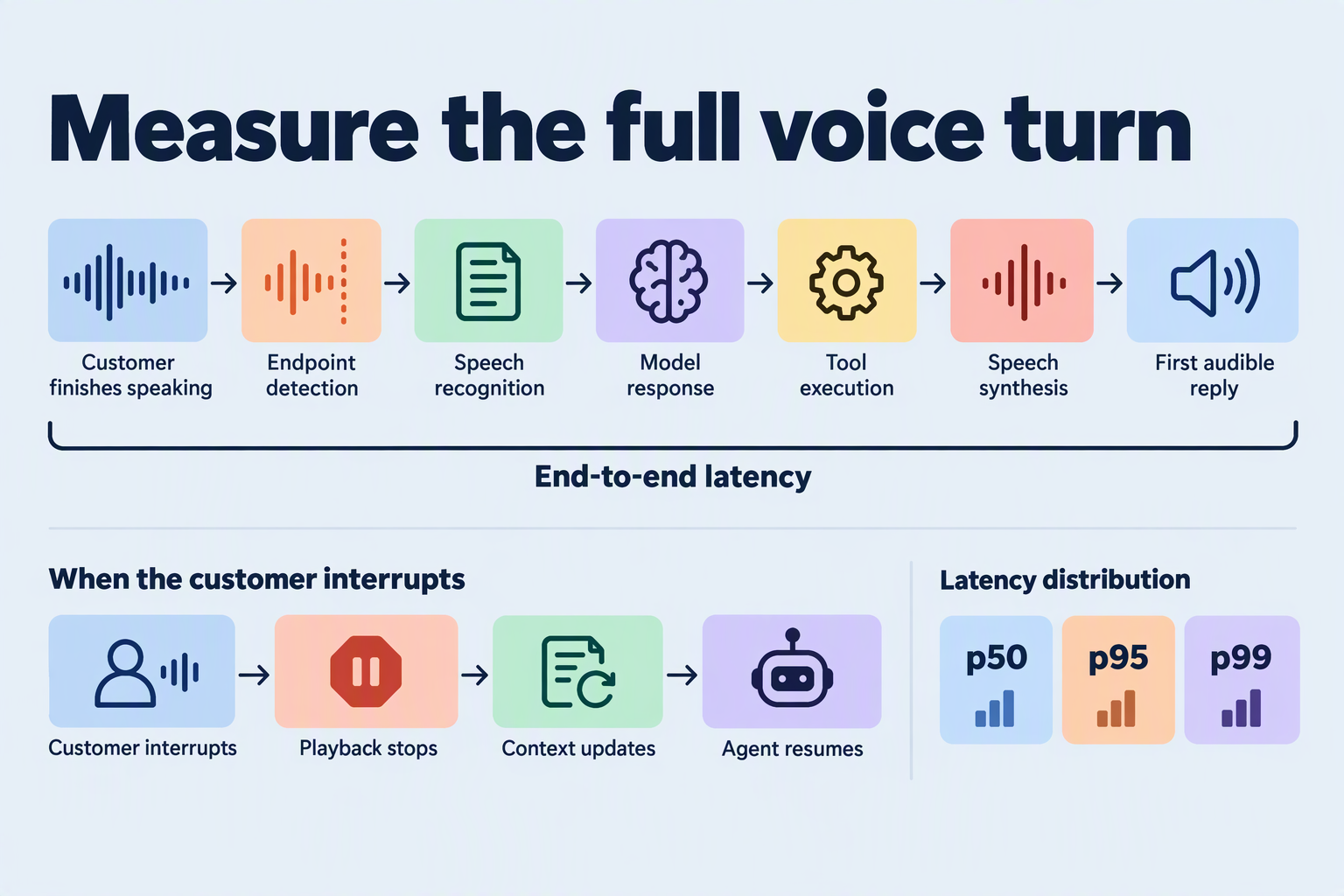
Measure end-to-end voice latency from the caller’s last speech sample to the first audible agent response at the caller’s device—not merely the model’s first token. Measure interruption recovery separately: how quickly playback stops, whether the correction is understood, and whether the agent resumes without repeating stale information.
Which timestamps should a voice-agent test capture?
For this Claude Sonnet 5.5 review, instrument the entire conversation path with correlated turn IDs. Use a monotonic clock within each service and synchronized clocks across services; otherwise, clock drift can masquerade as processing delay.
Record these events:
- Caller finishes speaking: Timestamp the final speech sample, not just the speech recognizer’s final transcript.
- Endpoint is declared: Record when the system decides the caller has finished their turn.
- Transcript becomes usable: Capture when speech recognition supplies the text actually sent to the model.
- Model output becomes usable: Record the first text chunk suitable for speech synthesis, alongside any tool requests and results.
- Synthesized audio becomes available: Timestamp the first playable audio chunk.
- Caller hears the response: Measure playback at the receiving device, including transport and buffering.
The primary metric is caller-perceived response latency = first audible response − caller’s speech end. Report endpointing, transcription, model, tool, synthesis, and transport timings alongside it. Because stages can overlap, do not blindly add their durations.
Distinguish time to acknowledgement from time to a substantive answer. “Let me check” can reduce silence while an order lookup runs, but it does not mean the customer’s question has been answered.
How should you compare Sonnet 5.5 voice latency fairly?
As of October 2026, Anthropic’s “Introducing Claude Sonnet 5.5” describes the model as “30%+ faster” than Claude Sonnet 5; that vendor claim does not specify your caller-perceived latency.
Run both models through the same speech recognition, voice, prompts, tools, region, and endpointing configuration. Alternate test order and separate warm-cache from cold-cache runs.
Report:
- p50 latency: The median experience.
- p95 latency: The slower experience customers encounter in the tail.
- Timeout and failed-turn rates: Failures must not disappear from latency summaries.
- Scenario-level results: Separate direct answers, knowledge retrieval, and tool-dependent responses.
For illustration—not a measured Sonnet result—if model processing falls from 520 milliseconds to 400 milliseconds, while the complete response falls from 1,200 milliseconds to 1,080 milliseconds, the customer experiences a 10% latency reduction. This is why model speed and conversational speed need separate scorecards.
How do you test interruption recovery?
Play a scripted agent response, then interrupt at reproducible points: mid-sentence, during a number, and while a tool request is pending. Include corrections such as, “No, I meant order 4821.”
Measure three distinct outcomes:
- Stop latency: Time from interruption onset to the last audible agent audio.
- Correction accuracy: Whether the next response uses the corrected information.
- Recovery latency: Time from the caller finishing the interruption to the next relevant audible response.
Also inspect conversation state: stopping audio is insufficient if cancelled speech remains treated as something the customer heard. Include background noise and brief acknowledgements to test whether genuine interruptions are distinguished from non-interrupting speech.
As of October 2026, CallMissed supports real-time voice sessions over an API and SDK, plus call recordings, transcripts, and eval suites. These capabilities can support repeatable review workflows, but precise interruption timing still requires instrumentation at the audio boundary.
How much does each resolved support call cost after retries and human handoffs?
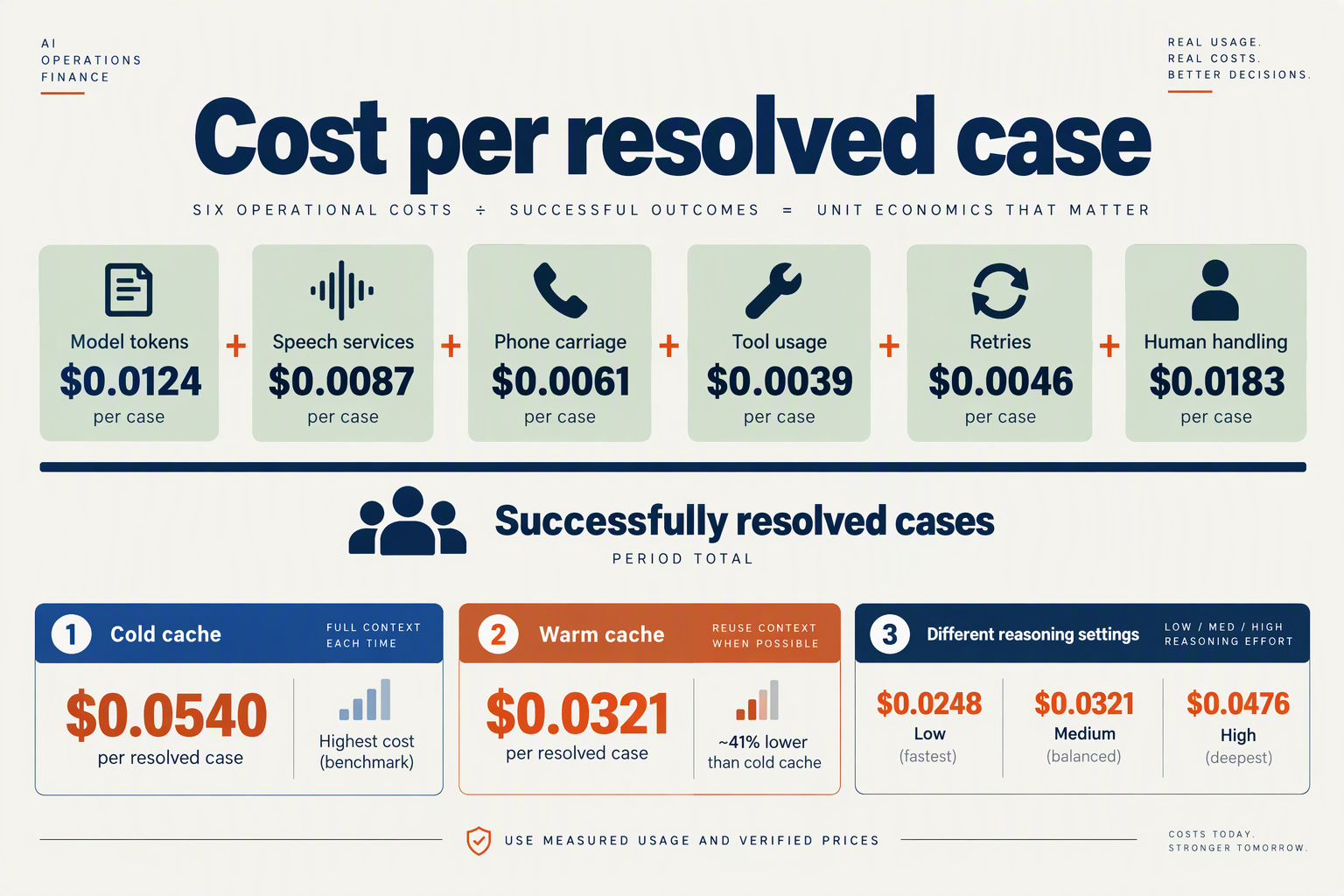
Cost per resolved support call is total workflow spend divided by verified resolutions—not the price of one model response. For Claude Sonnet 5.5, count retries, repeat contacts, tool charges, voice infrastructure, and human handling before deciding whether lower inference costs translate into savings.
How do you calculate cost per resolved support call?
Use this formula over a fixed evaluation window:
Cost per resolution = (AI processing + voice infrastructure + telephony + tools + human handling) ÷ verified resolved cases
Count unique cases rather than individual calls. A customer who calls three times about the same refund represents one support case, with all three calls’ costs attached.
For an October 2026 evaluation, record:
- AI processing: Input, output, cache reads, and additional model requests.
- Voice infrastructure: Speech recognition and synthesis, unless included in a bundled rate.
- Telephony and tools: Carrier charges, paid lookups, and other metered services.
- Human handling: Review, conversation, and after-call work at a loaded labor rate.
- Resolution quality: Whether the issue was actually fixed and remained closed through your chosen follow-up window.
Include spending on unresolved cases in the numerator. Excluding failures makes an unreliable agent appear artificially inexpensive.
How much can retries and handoffs change the result?
Consider two hypothetical October 2026 test batches, each containing 100 unique support cases. These are worked examples, not measured Claude Sonnet 5.5 results.
Assume an illustrative bundled AI-voice rate of ₹3 per minute, ₹600 in additional carrier and tool charges per batch, and human labor costing ₹15 per minute.
- Lower-retry batch: 600 AI minutes cost ₹1,800. Twenty handoffs averaging eight human minutes cost ₹2,400. Including additional charges, total spending is ₹4,800; with 90 verified resolutions, cost per resolution is ₹53.33.
- Higher-retry batch: 800 AI minutes cost ₹2,400. Thirty handoffs averaging eight human minutes cost ₹3,600. Total spending reaches ₹6,600; with 85 verified resolutions, cost per resolution is ₹77.65.
The second batch looks only modestly more expensive at the AI layer, yet its resolution economics deteriorate substantially. Conversely, a timely handoff can reduce total spending if it prevents repeated unsuccessful calls. Minimizing escalation is not the same as minimizing cost.
Do Sonnet 5.5’s advertised savings survive the full workflow?
As of October 2026, Anthropic’s “Introducing Claude Sonnet 5.5” announcement reports costs “up to 30% less for most work.” That vendor claim does not establish a 30% reduction in end-to-end support costs.
If model inference represents a hypothetical 20% of workflow spending, a 30% inference reduction produces only a 6% total saving, assuming everything else stays unchanged.
As of October 2026, Anthropic’s supplied “Introducing Claude Haiku 5.5” announcement states that Claude Sonnet 5.5 cache reads cost $0.10 per million tokens, following a 50% reduction. Measure actual cache hits before budgeting those savings.
What should teams measure before choosing a stack?
Compare identical case mixes and report cost alongside verified resolution rate, repeat-contact rate, and human minutes per case.
As of October 2026, CallMissed’s Standard voice-agent plan lists ₹4 per minute, covering speech recognition, the language model, and voice, with a 30-second minimum per call and phone carriage billed separately. This illustrates bundled accounting; it does not establish Sonnet 5.5 availability within that plan.
For this Claude Sonnet 5.5 review, the deciding metric is straightforward: what did it cost to solve the customer’s problem reliably?
What are Sonnet 5.5's potential advantages and workflow risks?
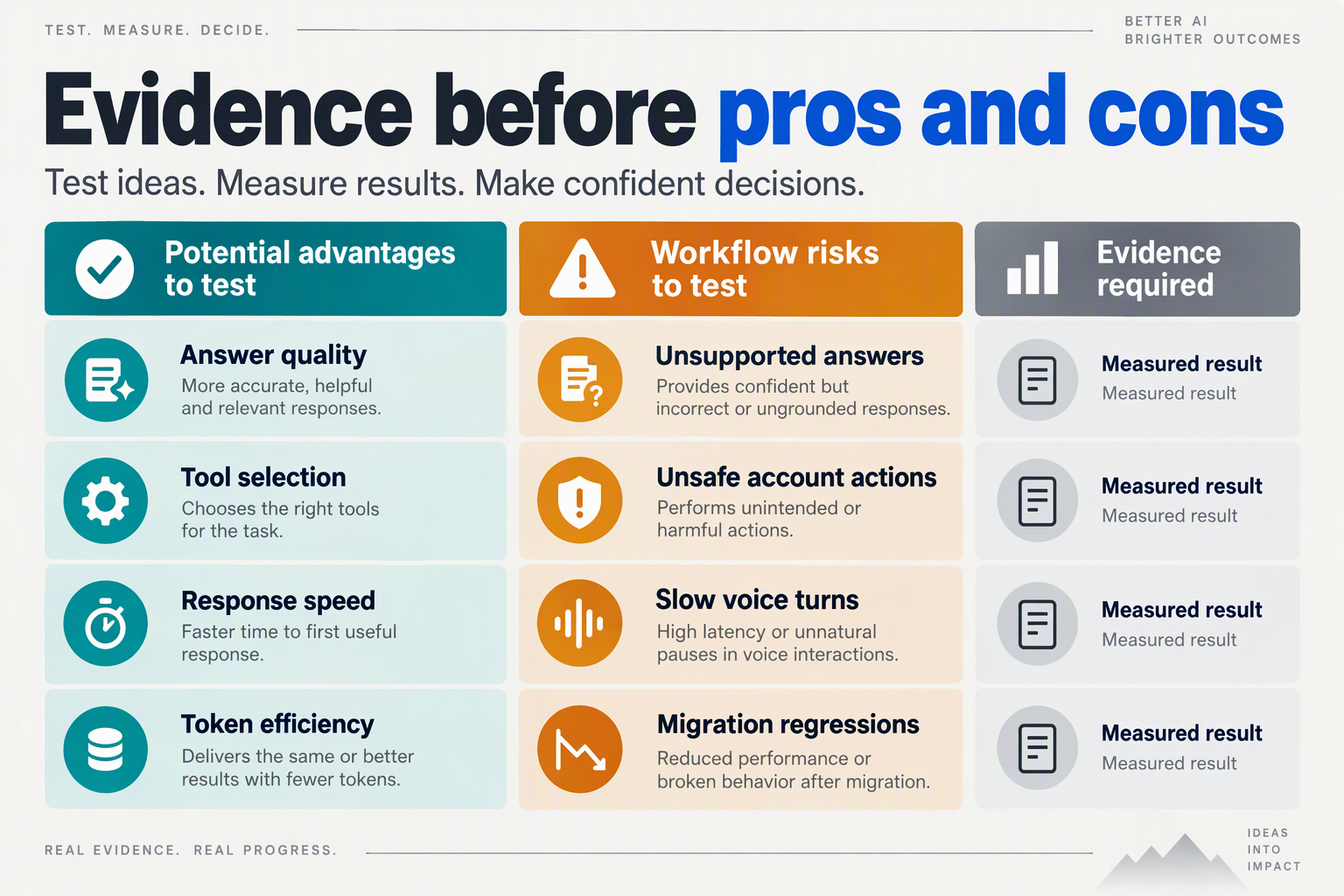
Claude Sonnet 5.5’s potential advantages are faster model responses, lower processing costs, and more efficient repeated-context use; its workflow risks are unverified support performance, integration regressions, and unsafe actions. As of October 2026, the supplied evidence supports an evaluation—not a blanket recommendation for production customer-support or voice-agent deployment.
The useful distinction is between model-level improvements and workflow-level benefits. A cheaper response creates value only if the agent still resolves the issue correctly, respects authorization boundaries, and avoids unnecessary follow-up.
What advantages and risks should teams compare?
The following October 2026 assessment separates vendor-reported capabilities from practical hypotheses that require testing.
| Evaluation area | Potential advantage | Workflow risk | Acceptance test |
|---|---|---|---|
| Response speed | Faster generation could shorten conversational pauses. | Early speech may communicate an answer before necessary checks finish. | Confirm the agent verifies policy and account details before committing. |
| Repeated context | Cheaper cache reads could reduce costs for reusable instructions. | Caching does not establish whether a policy is current. | Change a policy and verify that subsequent answers use the updated version. |
| Support reasoning | A stronger model may handle ambiguous requests more effectively. | Plausible explanations can conceal missing evidence. | Test incomplete records and require explicit uncertainty. |
| Tool execution | Better task handling could reduce manual steps. | Permission to inspect an account may be mistaken for permission to modify it. | Separate lookup, confirmation, and write permissions. |
| Voice interactions | Faster responses may make short exchanges feel more natural. | An interrupted response can leave a tool action running. | Interrupt during a proposed change and inspect the resulting account state. |
| Migration | An upgrade may improve an existing assistant without redesigning everything. | Changed API behavior may break established assumptions. | Replay representative conversations and validate tool outputs before release. |
These are evaluation targets, not measured Sonnet 5.5 results. The supplied sources do not establish refund accuracy, escalation quality, or successful interruption recovery.
When could caching meaningfully improve support economics?
As of October 2026, Anthropic’s “Introducing Claude Haiku 5.5” announcement reports that Claude Sonnet 5.5 cache reads cost $0.10 per million tokens, a 50% reduction. That makes repeated-context workloads a concrete area to investigate, rather than assuming every conversation receives the same savings.
For example, a retailer might reuse lengthy support instructions across many order-status conversations. If one million tokens qualify as cache reads, the reported charge for that component is $0.10; this is not the total conversation cost.
Evaluate two dimensions separately:
- Economics: Measure actual cache usage alongside uncached input, output, retries, and external services.
- Freshness: Verify that changed return windows, shipping restrictions, and escalation rules reach the agent before customers receive outdated guidance.
How should teams contain deployment risk?
Anthropic’s Claude Sonnet 5.5 System Card states, as of October 2026, that the model uses the same safeguards deployed for Opus 5. Those safeguards do not demonstrate that a particular business integration enforces customer identity checks or transaction permissions.
Use a staged decision process:
- Replay difficult cases: Include conflicting policies, missing account information, and customers changing their requests.
- Restrict consequential actions: Require validated authorization and confirmation before refunds, cancellations, or account changes.
- Keep rollback practical: Preserve the previous configuration until the replacement passes the same evaluation suite.
As of October 2026, CallMissed supports eval suites, A/B experiments, and agent versioning with publish and rollback. Those capabilities illustrate the infrastructure needed to evaluate an upgrade; they do not establish Sonnet 5.5 availability or performance on CallMissed.
The adoption threshold should be better verified outcomes at an acceptable operating cost, with no deterioration in authorization or recovery behavior.
Claude Sonnet 5.5 vs Mercury Voice and Haiku 5.5: which fits customer support?
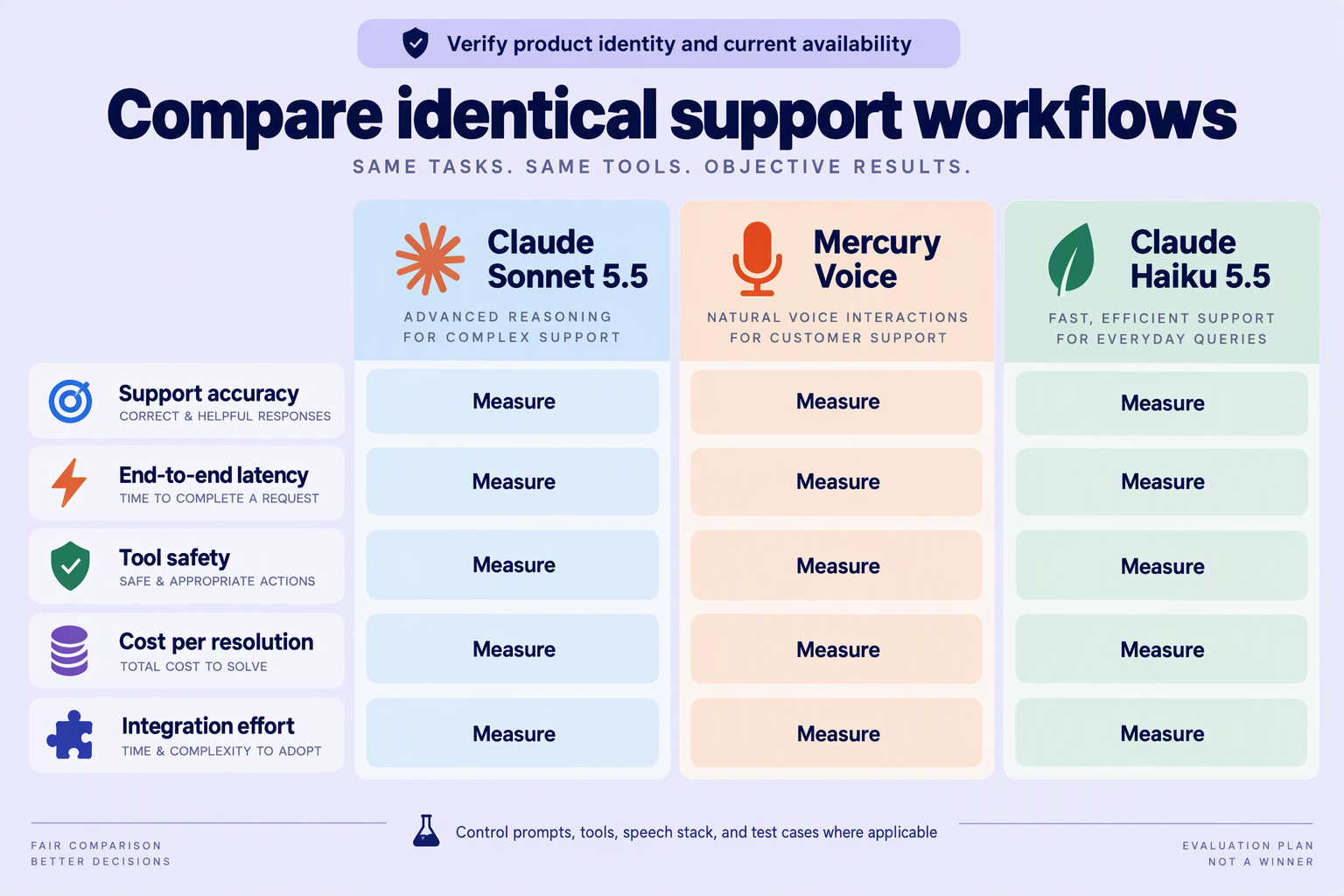
Claude Sonnet 5.5 is the best-supported starting point in the supplied evidence, but there is no verified basis here for declaring it better than Mercury Voice or Claude Haiku 5.5 for customer support. Use Sonnet as a baseline candidate; evaluate the other two against the same support scenarios before assigning them production roles.
How do Sonnet 5.5, Mercury Voice, and Haiku 5.5 compare?
As of October 2026, the supplied sources document Sonnet 5.5 more fully than either alternative. The table separates available evidence from evaluation hypotheses—possible roles to test, not demonstrated product capabilities.
| Decision criterion | Claude Sonnet 5.5 | Mercury Voice | Claude Haiku 5.5 |
|---|---|---|---|
| Evidence available | Anthropic announcement, platform documentation, and system card | No product documentation supplied | Anthropic announcement excerpt only |
| Candidate support role | Baseline for policy interpretation and multi-step cases | Candidate for a voice-focused trial; capabilities unverified | Candidate for routine-ticket routing; performance unverified |
| Published pricing evidence | OpenRouter snippet lists $2 per million input tokens | No verified pricing supplied | No Haiku-specific price supplied |
| Cache pricing evidence | Anthropic excerpt states $0.10 per million cache-read tokens | No verified cache terms supplied | Haiku announcement excerpt discusses Sonnet cache pricing |
| Decisive support test | Resolve exceptions without inventing policy | Maintain correct task state during spoken corrections | Complete straightforward cases without excessive escalation |
| Deployment gate | Pass support QA and integration checks | Verify identity, documentation, and API behavior first | Obtain model-specific pricing and support results first |
OpenRouter’s supplied Claude Sonnet 5.5 listing quotes $2 per million input tokens as of October 2026. That is only one billing component; it does not establish output-token pricing or the cost of a completed customer interaction.
Anthropic’s supplied “Introducing Claude Haiku 5.5” excerpt states that Sonnet 5.5 cache reads cost $0.10 per million tokens, a 50% reduction, as of October 2026. Despite the announcement’s title, that figure must not be presented as Haiku 5.5 pricing.
Which model should handle routine tickets and difficult exceptions?
Treat Claude Haiku 5.5 for customer support as a routing hypothesis rather than an automatic budget choice. A model with lower token prices would still be poor value if it required repeated retries or escalated cases that another model could safely complete.
Use a matched test set containing:
- Routine requests: opening hours, published return windows, and order-status explanations.
- Exceptions: partial refunds, conflicting policy passages, and missing account information.
- Spoken corrections: a caller changes an order number or withdraws a request midway through the exchange.
For example, ask all three candidates to handle: “My order arrived damaged, but I bought it during a final-sale promotion.” Score whether each distinguishes the damaged-goods policy from the final-sale policy, requests necessary evidence, and avoids promising an unauthorized refund.
How should teams make the final selection?
A useful Claude Sonnet 5.5 vs Mercury Voice comparison requires a controlled trial, not assumptions based on model names.
- Fix the conditions: use identical policies, tool permissions, and customer scenarios.
- Apply pass/fail gates: reject unauthorized actions and unsupported policy claims before comparing efficiency.
- Compare successful outcomes: calculate cost per correctly resolved case, including retries and human intervention.
As of October 2026, CallMissed supports scoring calls against custom QA rubrics, eval suites, and A/B experiments—capabilities relevant to this evaluation approach.
The practical recommendation is conditional: start with Sonnet’s better-documented baseline, then give Mercury Voice or Haiku a defined role only when measured results justify it. Missing evidence is a procurement question, not proof of weaker performance.
How can you pilot the workflow in CallMissed after confirming model availability?
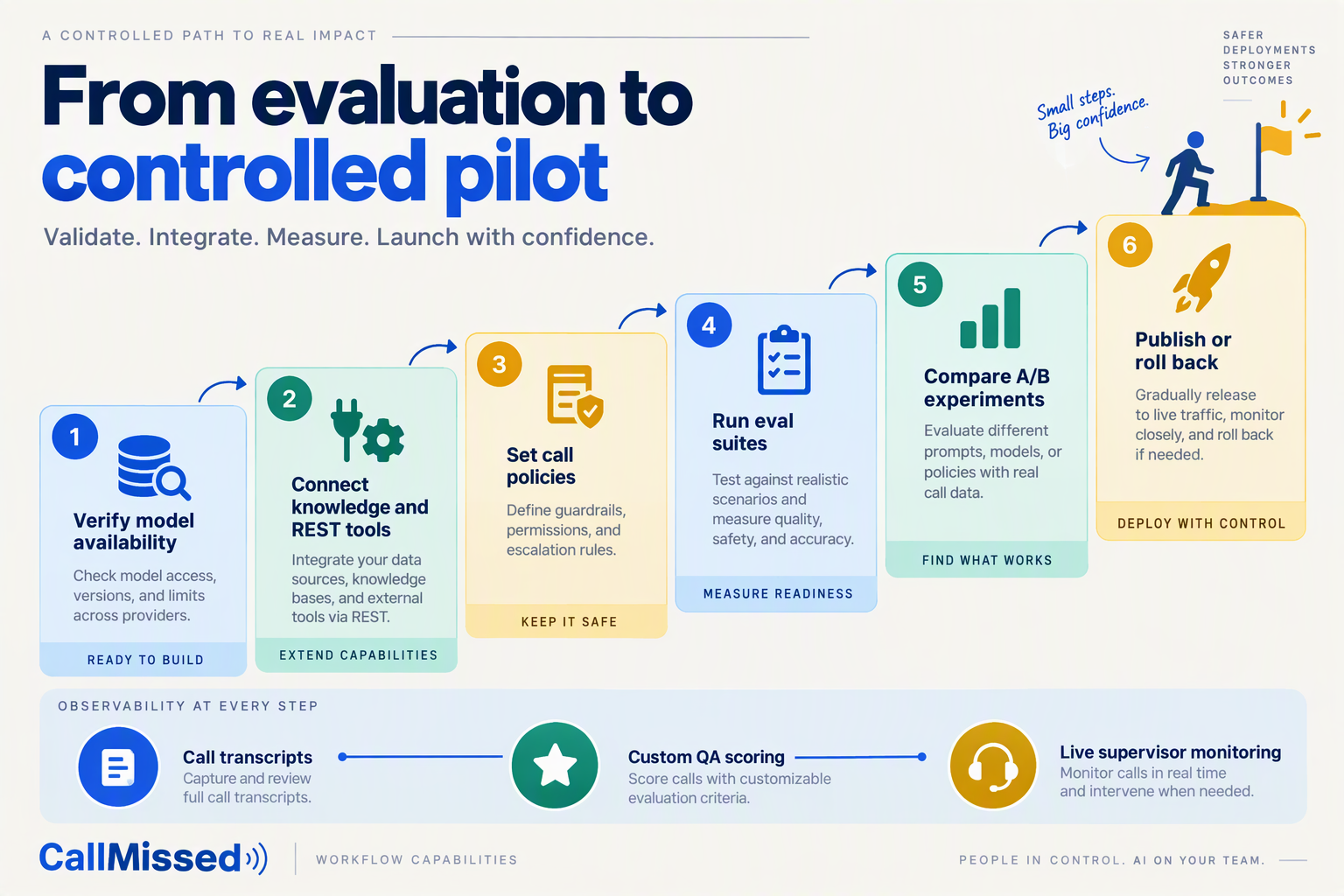
Pilot one narrow support workflow, using a verified model identifier, read-only tools, and a baseline you can roll back to. As of October 2026, the supplied materials do not establish that Claude Sonnet 5.5 is available through CallMissed’s developer API or selectable in its voice-agent builder; confirm those separately before designing the integration.
How do you confirm the model and integration path?
As of October 2026, CallMissed’s verified fact sheet lists OpenAI-compatible and Anthropic-compatible endpoints, plus request logs and caller-chosen fallback models. Compatibility makes integration easier, but it does not prove availability of a particular Anthropic model.
- Verify the exact model identifier. Check the current catalogue and access permissions, then submit a minimal request. Record the identifier, test date, response, and any availability restrictions.
- Confirm voice-builder access separately. A model accessible through a developer endpoint is not necessarily selectable in a no-code voice configuration. Establish whether the pilot requires a supported builder configuration or developer integration.
- Test the required behavior. Exercise streaming, tool calls, and structured responses where supported by the selected model. Treat a successful text response as a connectivity check—not production readiness.
Keep the existing model configuration intact. A failed availability check should pause the Sonnet evaluation, not trigger an undocumented substitution.
What should the first support pilot include?
Start with order-status enquiries, rather than refunds or account changes. This gives the agent a useful task while limiting the consequences of an incorrect tool decision.
As of October 2026, CallMissed’s verified fact sheet documents a no-code agent builder with knowledge bases, custom REST tools, versioning with publish and rollback, eval suites, and A/B experiments. Its voice tooling also includes recordings, transcripts, QA-rubric scoring, and supervisor listening, whispering, and barging in.
Configure the pilot around three boundaries:
- Knowledge: Provide approved delivery policies and escalation instructions, excluding outdated documents.
- Tools: Expose a narrowly scoped order lookup; enforce authentication and authorization in the backend rather than relying on the prompt.
- Actions: Allow explanations and retrieval, but prohibit cancellations, refunds, and address changes during this initial trial.
For example, when a caller says, “My parcel is late—send it to another address,” the expected behavior is to explain the verified order status and escalate the address-change request. The agent should not reinterpret a lookup tool as permission to modify an order.
How should you decide whether to expand the pilot?
Run the same cases against the baseline and candidate configuration before allowing limited live traffic. Include missing orders, ambiguous identifiers, unavailable tools, policy exceptions, and callers who correct themselves mid-conversation.
Define pilot acceptance criteria, not assumed vendor benchmarks:
- No unauthorized account changes in the test set.
- Answers grounded in retrieved policy or order data.
- Successful escalation when verification or lookup fails.
- Measured end-to-end voice latency and cost per resolved enquiry.
As of October 2026, the verified platform pricing lists flat-rate voice plans at ₹4, ₹5, and ₹6 per minute, with phone carriage billed separately; custom stacks instead charge each component by the second without a minimum. Do not assume a verified Sonnet integration falls within a particular bundled rate—confirm billing first.
Expand only when the candidate improves outcomes without weakening safeguards. If it merely speaks faster while increasing incorrect resolutions, roll back and revise the workflow.
Frequently Asked Questions
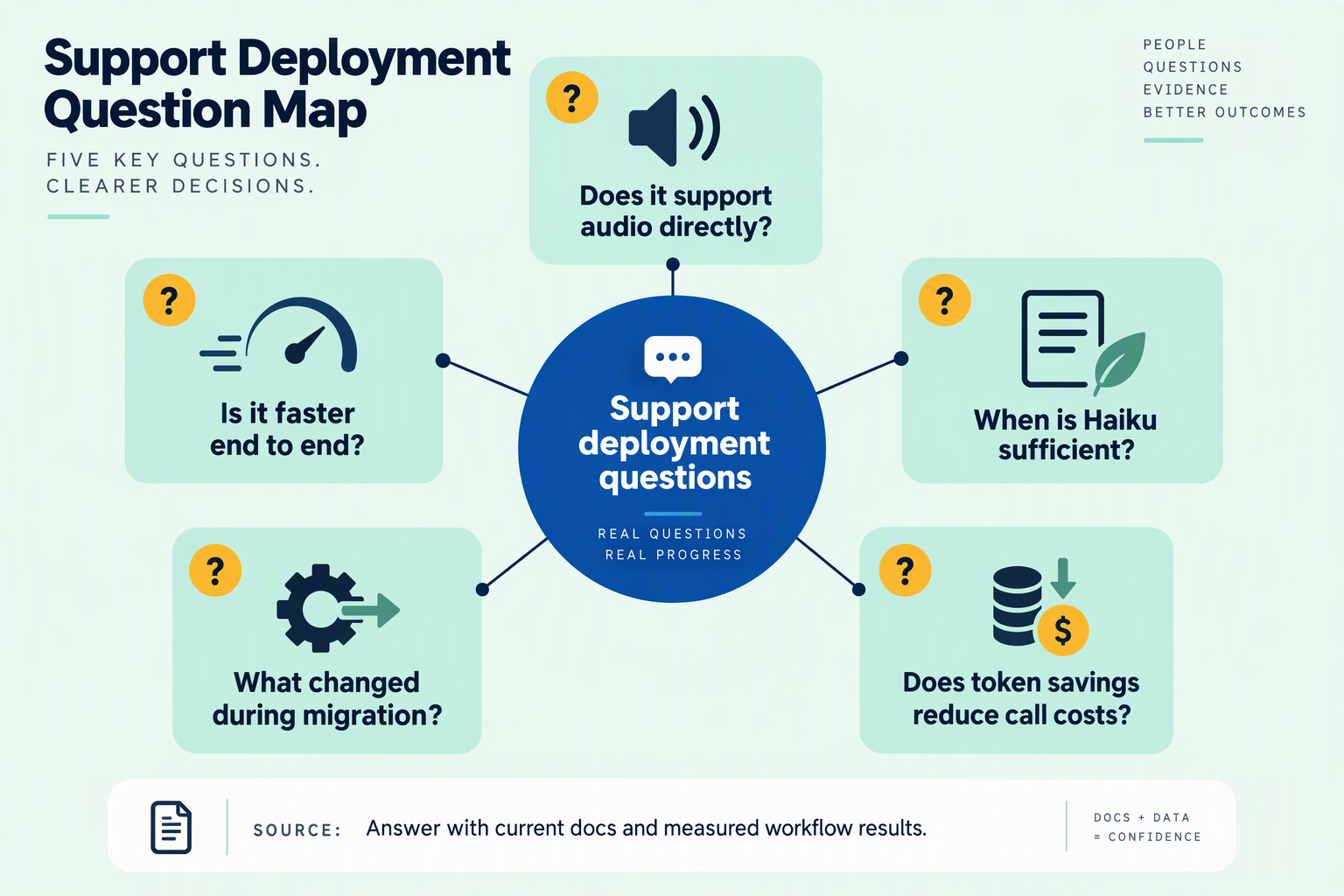
Sonnet 5.5 is worth testing for support reasoning, but the supplied evidence does not establish native audio support, a replacement for Haiku, or guaranteed savings on complete calls. Those decisions require separate checks of modality support, task suitability, and billing.
Does Claude Sonnet 5.5 support native audio for customer-support voice agents?
Does Claude Sonnet 5.5 replace Claude Haiku 5.5 for customer support?
Can Claude Sonnet 5.5 reduce total customer-support call costs?
How much do Sonnet 5.5 prompt-cache reads cost?
Is upgrading from Claude Sonnet 5 to Sonnet 5.5 just a model-name change?
What evidence should a Sonnet 5.5 support review require before production deployment?
Conclusion
Claude Sonnet 5.5 is a promising candidate for customer-support and voice-agent workflows, but deployment should depend on measured customer outcomes—not headline speed alone. The practical verdict of this Claude Sonnet 5.5 review is to evaluate accuracy, safe actions, conversational responsiveness, and total operating cost together before committing to an upgrade.
As of October 2026, Anthropic reports that Claude Sonnet 5.5 runs 30%+ faster than Claude Sonnet 5 and costs up to 30% less for most work. These vendor-reported improvements justify testing; they do not establish that an entire support conversation will become equally faster or cheaper. Developer enthusiasm reinforces the interest, but not the deployment case: the supplied October 2026 Hacker News snapshot recorded 554 points and 381 comments in 7.1 hours.
Four takeaways should guide that evaluation:
- Support accuracy comes before fluent answers. Test whether Sonnet 5.5 grounds responses in your knowledge base, follows refund and account policies, and acknowledges missing information. A confident answer is not a successful resolution if the customer receives incorrect guidance. Escalation should preserve useful context rather than leave a human agent to reconstruct the conversation.
- Safe tool use needs explicit boundaries. Permission to retrieve an order must not become permission to modify it. Evaluate account lookups and consequential actions separately, including situations where a customer’s request is ambiguous. The relevant question is whether the agent respects the workflow’s permissions, not simply whether a tool call succeeds.
- Voice latency is an end-to-end property. Measure speech recognition, model response, tool execution, and speech synthesis together. A faster model cannot compensate for every slow lookup, and interruption handling remains essential when callers correct information mid-conversation. Judge responsiveness from the caller’s experience, not generation speed in isolation.
- Savings and migration both require validation. Include retries, lengthy conversations, tool calls, and the surrounding voice stack when calculating cost. As of October 2026, Anthropic’s Claude Platform Docs identify five breaking changes affecting code running on Claude Sonnet 5, making integration checks part of the upgrade decision.
What should support teams watch next?
Watch whether Sonnet 5.5’s reported efficiency translates into better resolution quality and shorter customer-perceived waits under realistic conditions. The strongest evidence will come from repeatable evaluations of actual support scenarios, including uncertain answers, interrupted calls, and human handoffs.
Readers can explore CallMissed, the AI customer-communication platform, as part of this shift toward workflow-level evaluation. As of October 2026, CallMissed provides call recordings, transcripts, scoring against custom QA rubrics, eval suites, and A/B experiments.
Before upgrading, ask: does Sonnet 5.5 improve the customer’s outcome at an acceptable total cost—or merely deliver the same experience faster?
Related Reading
- Claude Opus 5.5 Evaluation Review: Support and Voice AI
- Claude Opus 5.5 for Agents: A Voice Deployment Guide
- Best LLM for Voice Agents in 2026: GPT-6 vs Claude