GPT-5.4 Mini vs Claude Sonnet 4.6 for Agentic Workflows: Pricing, Tools and Trade-offs


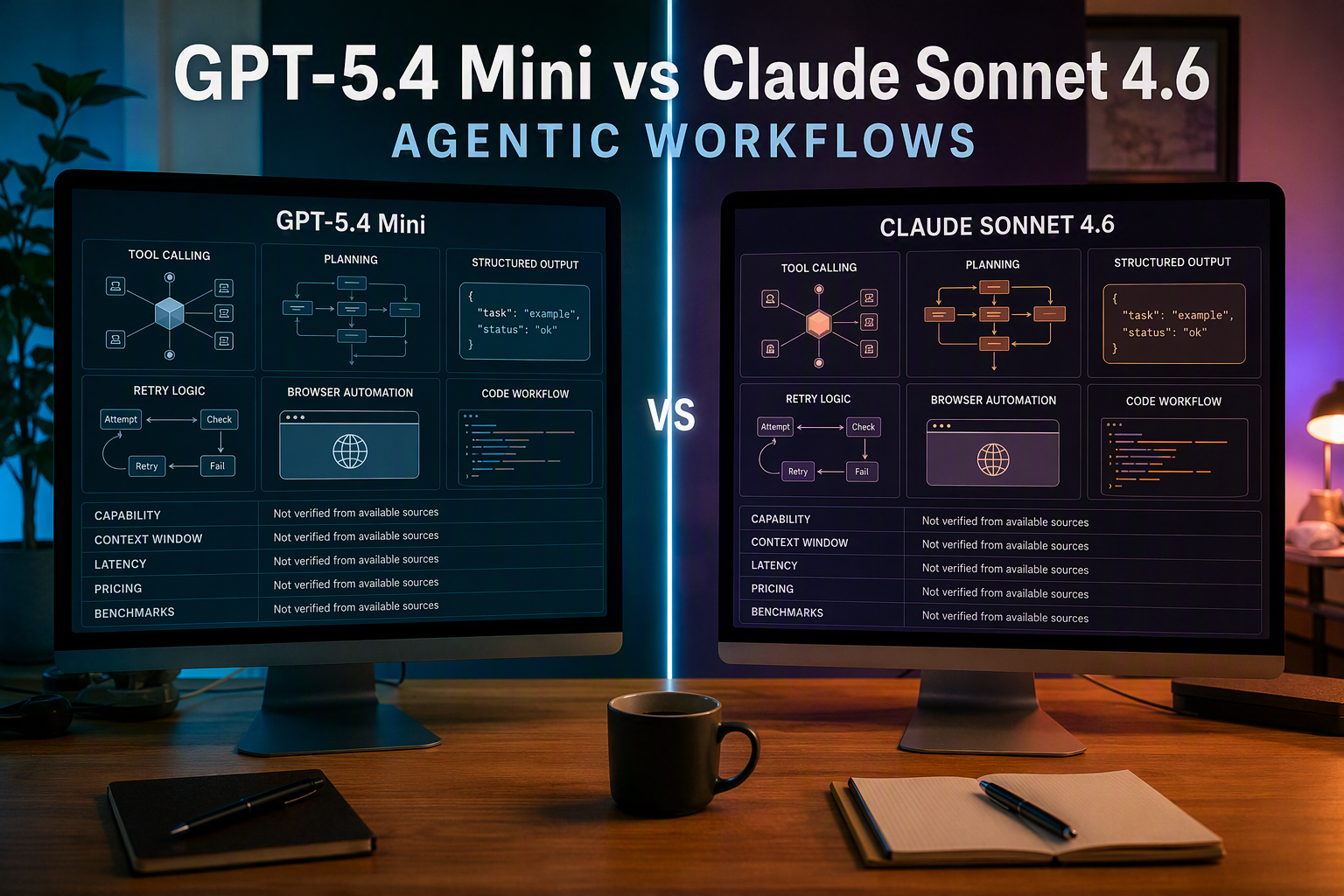
Compare GPT-5.4 Mini and Claude Sonnet 4.6 for agents using verified data, tool tests, pricing checks and a reproducible evaluation framework.
GPT-5.4 Mini vs Claude Sonnet 4.6 for Agentic Workflows: Pricing, Tools and Trade-offs
Which model is better for agentic workflows: GPT-5.4 Mini or Claude Sonnet 4.6? The honest answer is conditional: no verifiable live source data was supplied for their current pricing, context windows, latency, or tool-use performance, so neither model can responsibly be declared the winner. The right choice depends on measured tool-calling accuracy, structured-output compliance, planning, recovery from errors, latency, and cost per successful task.
This comparison separates confirmed facts from assumptions and shows how to run a reproducible side-by-side test using identical tools, fixed prompts, and 20–30 cases per workflow category. You’ll find feature and pricing tables with “not verified” labels where official OpenAI or Anthropic figures are unavailable, plus a practical scoring framework for support automation, coding, research, browser orchestration, and classification. Platforms such as CallMissed reflect the broader shift toward model-agnostic AI infrastructure for production workflows.
Which model is better for agentic workflows? A conditional verdict based on what can be verified
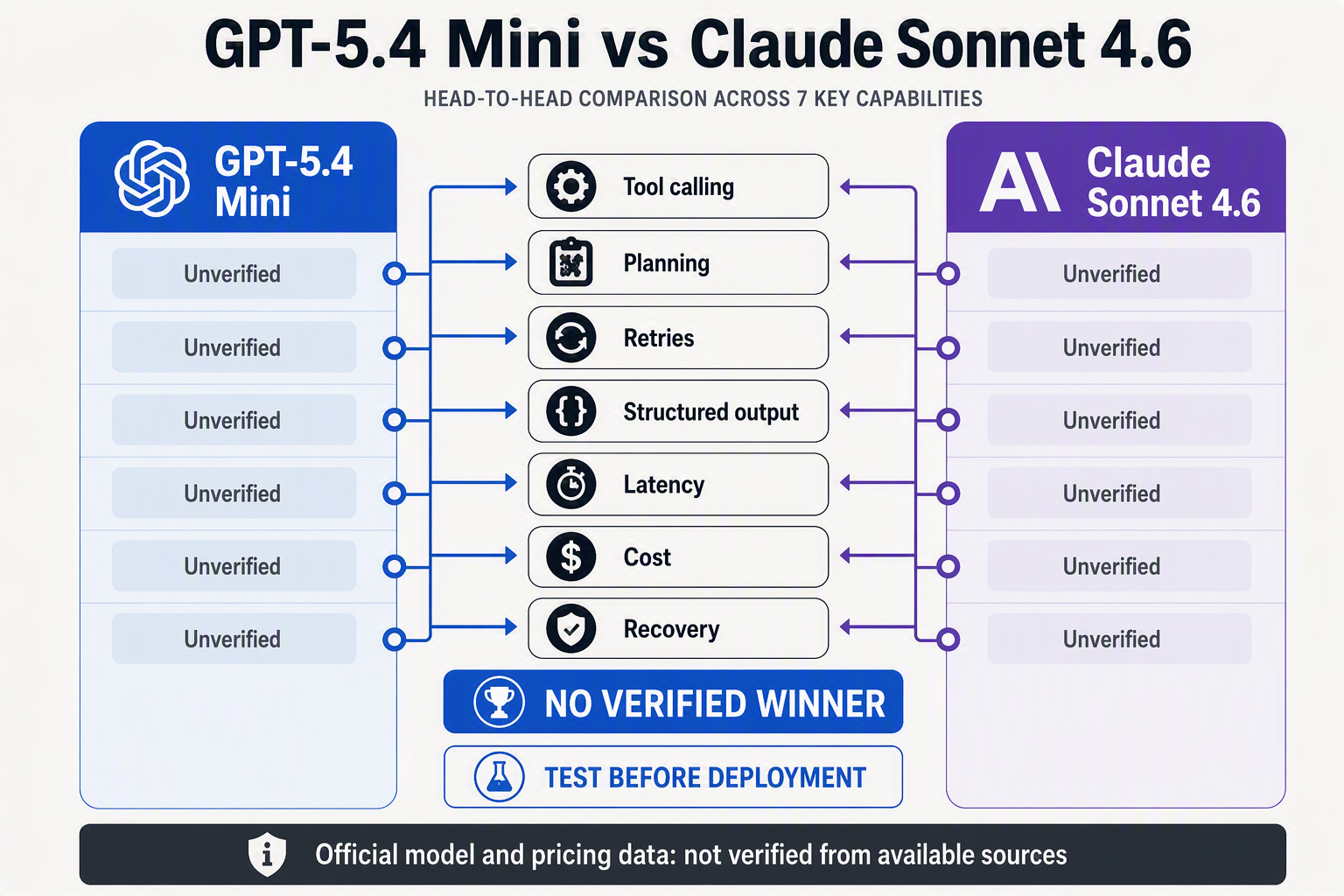
GPT-5.4 Mini and Claude Sonnet 4.6 cannot be ranked responsibly for agentic workflows from the currently available evidence. The supplied research does not verify current pricing, context limits, latency, rate limits, or tool-use results for either model. The better choice is therefore the model that produces the lower cost per successful task on your tools, prompts, and failure conditions—not necessarily the model with the stronger general benchmark reputation.
What can be verified about GPT-5.4 Mini and Claude Sonnet 4.6?
The available research does not provide verifiable model-specific results for either GPT-5.4 Mini or Claude Sonnet 4.6. Do not infer capabilities from the model names or from results reported for other versions.
- GPT-5.4 Mini: tool-calling accuracy, structured-output compliance, reasoning quality, context window, multimodal support, latency, rate limits, and deployment options are not verified from the available sources.
- Claude Sonnet 4.6: current input and output pricing, cached-input pricing, service tiers, context capacity, latency, and agent benchmark results are also unverified from the supplied research.
- Generic coding, knowledge, or chat benchmarks should not be treated as evidence of agent performance. They do not directly measure function selection, argument validity, recovery after tool errors, or behavior across long workflows.
What should an agentic-workflow comparison measure?
Compare the models on the complete execution loop, not only on the first response:
- Correct tool selection and valid function arguments
- Structured JSON compliance and schema adherence
- Plan adherence across multiple steps
- Unnecessary-call frequency and resistance to loops
- Recovery after failed, delayed, or malformed tool responses
- Citation and grounding behavior when using retrieved information
- Task completion rate, latency, and cost per successful task
Workflow priorities will differ. Customer-support and CRM automation may emphasize safe recovery and reliable structured outputs. Coding and research agents may place more weight on planning, evidence use, and long-horizon consistency. Browser or API orchestration may prioritize precise arguments and latency, while high-volume classification may focus primarily on cost per successful task.
How should you test both models fairly?
Use a controlled side-by-side evaluation with identical system prompts, tool definitions, schemas, temperature settings where supported, and input data. Seed requests or repeat trials when the API permits it, and record both successful and failed runs.
The following are recommended methodology parameters, not reported results for GPT-5.4 Mini or Claude Sonnet 4.6:
- Test at least 20–30 cases per workflow category.
- Track task success rate and tool-call success rate.
- Measure average tool calls per completed task.
- Record p50 and p95 latency.
- Calculate total cost per successful task after retries and failed calls.
- Rate each result from 0–3 points for tool selection, argument validity, task completion, recovery, grounding, JSON compliance, latency, and cost.
The practical verdict is conditional: choose GPT-5.4 Mini if controlled testing shows stronger economics and reliability for your workload; choose Claude Sonnet 4.6 if it performs better on long-horizon or tool-heavy tasks; and retain both when fallback value justifies the additional integration complexity.
How do GPT-5.4 Mini and Claude Sonnet 4.6 compare on tools and agent capabilities?
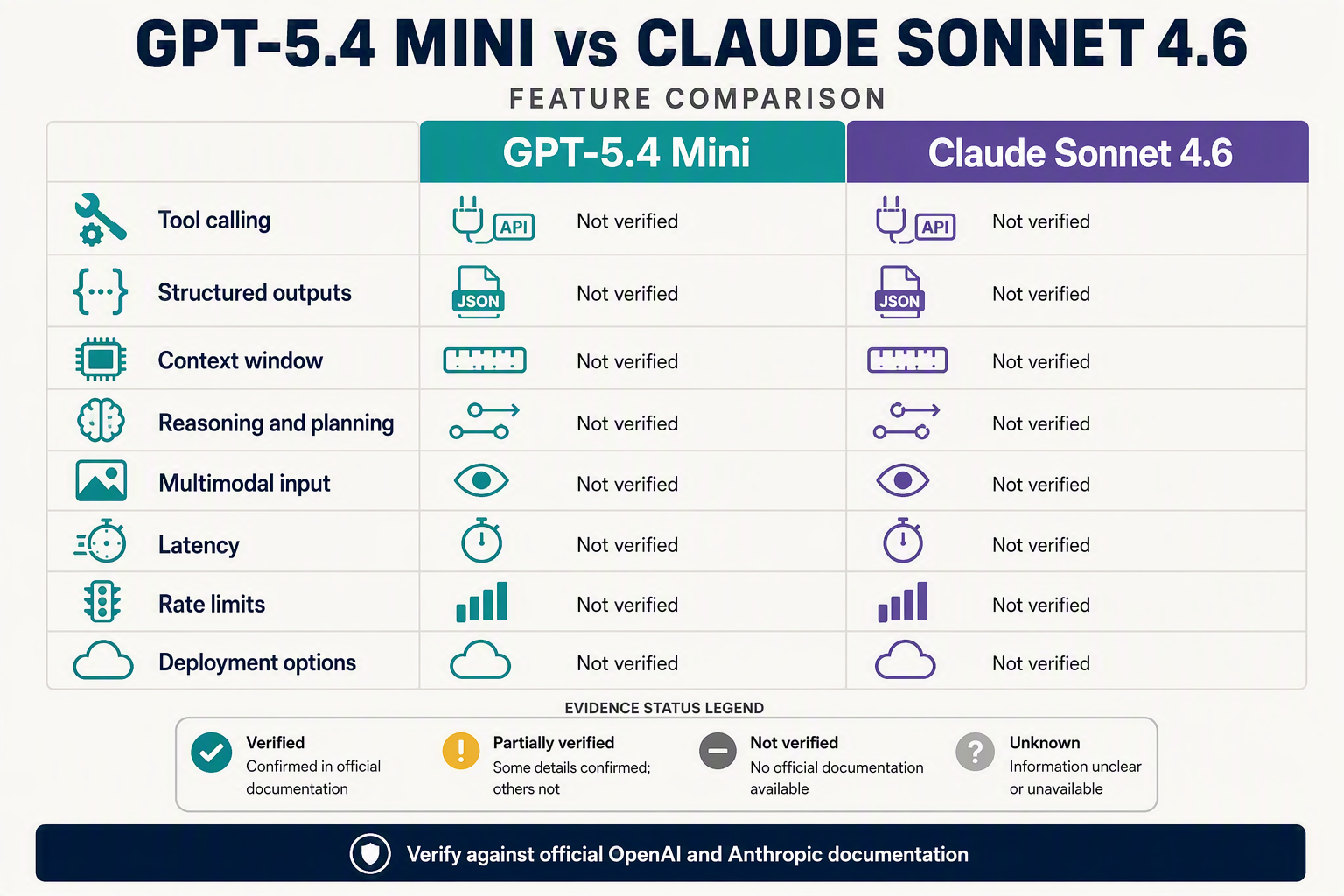
Neither GPT-5.4 Mini nor Claude Sonnet 4.6 can be identified as the stronger agentic model from the available evidence. Model-specific specifications, pricing, and benchmark results are not verified in the supplied research, so the responsible verdict is conditional: test both models with identical tools, prompts, schemas, and workloads before selecting one.
Tool and agent capability comparison
The table below separates verified knowledge from recommended evaluation criteria. “Not verified” means the supplied research does not provide a confirmed value; it is not evidence that a model lacks the capability.
| Capability | GPT-5.4 Mini | Claude Sonnet 4.6 | What to measure |
|---|---|---|---|
| Tool calling | Not verified from available sources | Not verified from available sources | Correct tool selection, argument validity, and unnecessary-call rate |
| Structured outputs | Not verified from available sources | Not verified from available sources | Valid JSON rate and compliance with the required schema |
| Context window | Not verified from available sources | Not verified from available sources | Task success as instructions, documents, and tool traces grow |
| Reasoning and planning | Not verified from available sources | Not verified from available sources | Plan adherence, decomposition quality, and completion of multi-step tasks |
| Multimodal input | Not verified from available sources | Not verified from available sources | Accuracy with supported images, documents, or other input formats |
| Latency | Not verified from available sources | Not verified from available sources | Time to first token, total response time, and p50/p95 latency |
| Rate limits | Not verified from available sources | Not verified from available sources | Requests or tokens permitted, throttling behavior, and retry requirements |
| Deployment options | Not verified from available sources | Not verified from available sources | API availability, hosting region, access controls, and integration requirements |
Agent performance should be judged by completed outcomes rather than generic model reputation. For CRM, support, and workflow automation, prioritize:
- Accurate tool selection and schema-valid arguments
- Safe retries after failed, delayed, or malformed tool responses
- Resistance to loops and repeated actions
- Grounded answers supported by retrieved evidence
- Reliable termination when a task cannot be completed
- Stable behavior across long tool traces and changing state
The supplied research brief recommends testing 20–30 cases per workflow category. This is a methodology recommendation, not a reported performance result for either GPT-5.4 Mini or Claude Sonnet 4.6.
Recommended evaluation method
Use identical system instructions, user prompts, tool definitions, schemas, retrieval data, timeout rules, and retry policies for both models. Repeat trials where supported, and divide tests across customer support, coding, research, browser/API orchestration, and classification workflows.
Track:
- Task success rate
- Tool-call success rate
- Average tool calls per completed task
- Invalid-argument and schema-failure rate
- Recovery rate after tool errors
- Loop or redundant-call frequency
- p50 and p95 latency
- Cost per successful task
A practical 0–3 scoring rubric can assign points for each criterion: 0 for failure, 1 for inconsistent behavior, 2 for acceptable completion, and 3 for reliable completion. These scores should be calculated from the controlled test set; they must not be presented as existing benchmark results. Platforms such as CallMissed can also help developers evaluate multi-model workflows through an OpenAI-compatible gateway, but the underlying model results still require workload-specific testing.
Which one costs less for agentic workflows?
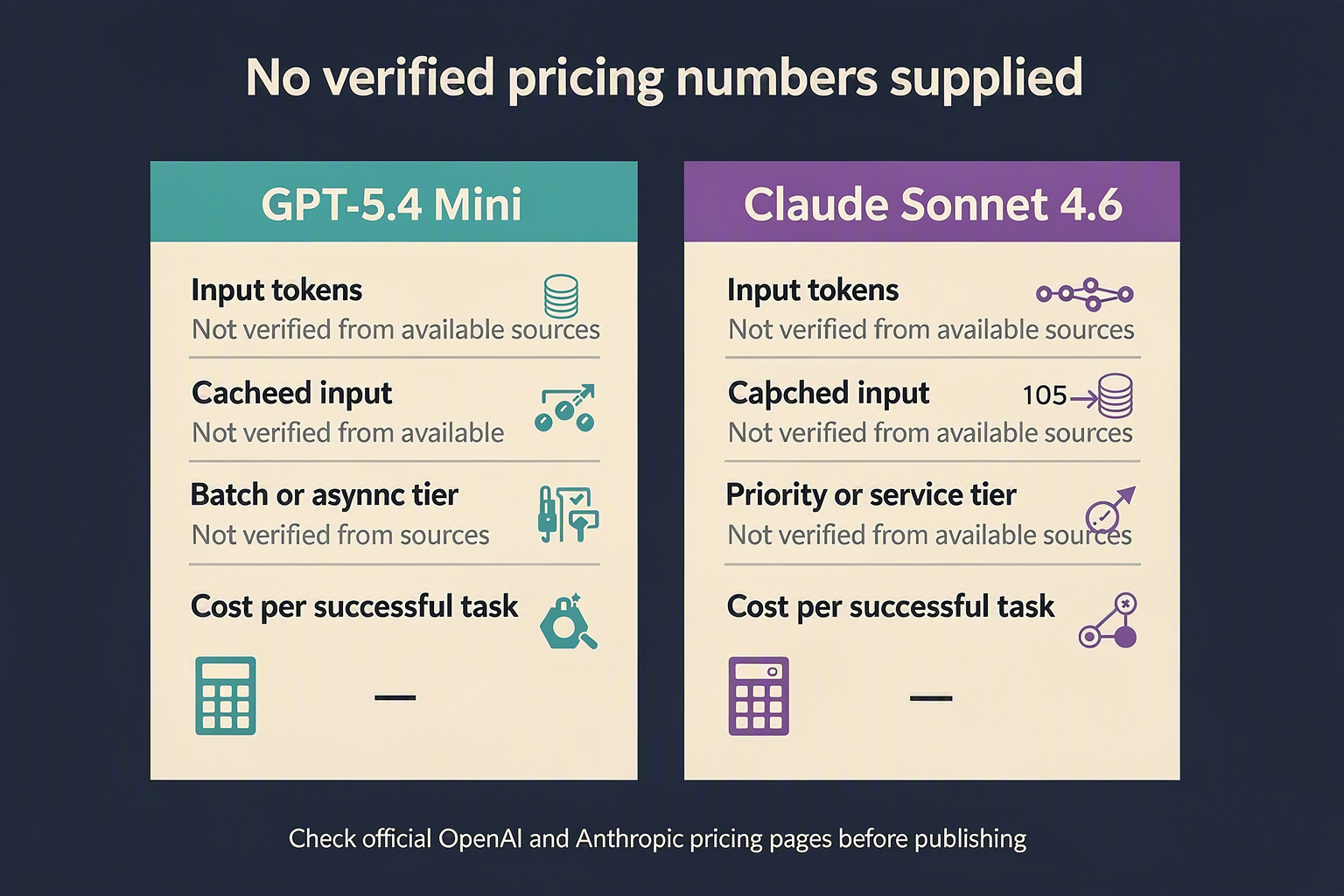
GPT-5.4 Mini and Claude Sonnet 4.6 cannot be declared cheaper for agentic workflows because verifiable token prices, cached-input rates, and service-tier costs were not supplied. The reliable comparison is cost per successful task: retries, failed tool calls, and unnecessarily long outputs can outweigh a lower nominal token price.
| Cost factor | GPT-5.4 Mini | Claude Sonnet 4.6 | How to compare |
|---|---|---|---|
| Input-token price | Not verified from available sources | Not verified from available sources | Confirm rates on the official OpenAI and Anthropic pricing pages |
| Output-token price | Not verified from available sources | Not verified from available sources | Record generated tokens for each completed task |
| Cached-input pricing | Not verified from available sources | Not verified from available sources | Include this only when identical context is repeatedly submitted |
| Tool-call overhead | Must be measured | Must be measured | Track successful, failed, and unnecessary tool calls |
| Retry and recovery cost | Must be measured | Must be measured | Count extra tokens and calls after errors or invalid outputs |
| Cost per successful task | Not a published model fact | Not a published model fact | (input cost + output cost + tool/retry cost) ÷ successful tasks |
What should the cost test measure?
A lower list price does not automatically produce a lower workflow cost. For example, an agent may spend more when it generates longer responses, selects the wrong tool, produces invalid JSON, or repeats a failed action. GPT-5.4 Mini and Claude Sonnet 4.6 should therefore be evaluated using identical tasks, tools, schemas, and retry policies.
Track these metrics for each model:
- Total input and output tokens
- Number of tool calls per completed task
- Tool-call success and failure rates
- Retry count and recovery success
- p50 and p95 latency
- Number of successfully completed tasks
- Total spend and cost per successful task
Do not infer pricing or efficiency from a model’s name, family, or expected positioning. All prices in this comparison remain unverified from the supplied OpenAI and Anthropic source data.
Recommended 20–30-case methodology
Run 20–30 cases per workflow category, using the same prompts, tool definitions, structured-output requirements, context, and maximum retry limits. Repeat cases where supported to identify variance rather than relying on a single successful run.
A practical test set can include:
- Customer-support or CRM actions
- API and browser orchestration
- Coding or debugging tasks
- Research tasks requiring multiple tool calls
- High-volume classification
For each case, record whether the task reached the required outcome, not merely whether the model returned an answer. Include tool-selection accuracy, argument validity, plan adherence, loop resistance, and recovery after tool errors in the evaluation log.
The decision rule is straightforward: choose the model with the lower measured cost per successful task for the target workflow. If both models have unverified prices, report measured token usage and success metrics separately, then calculate cost only after confirming the applicable rates from the official OpenAI and Anthropic pricing pages.
What are the practical pros and cons of each model?
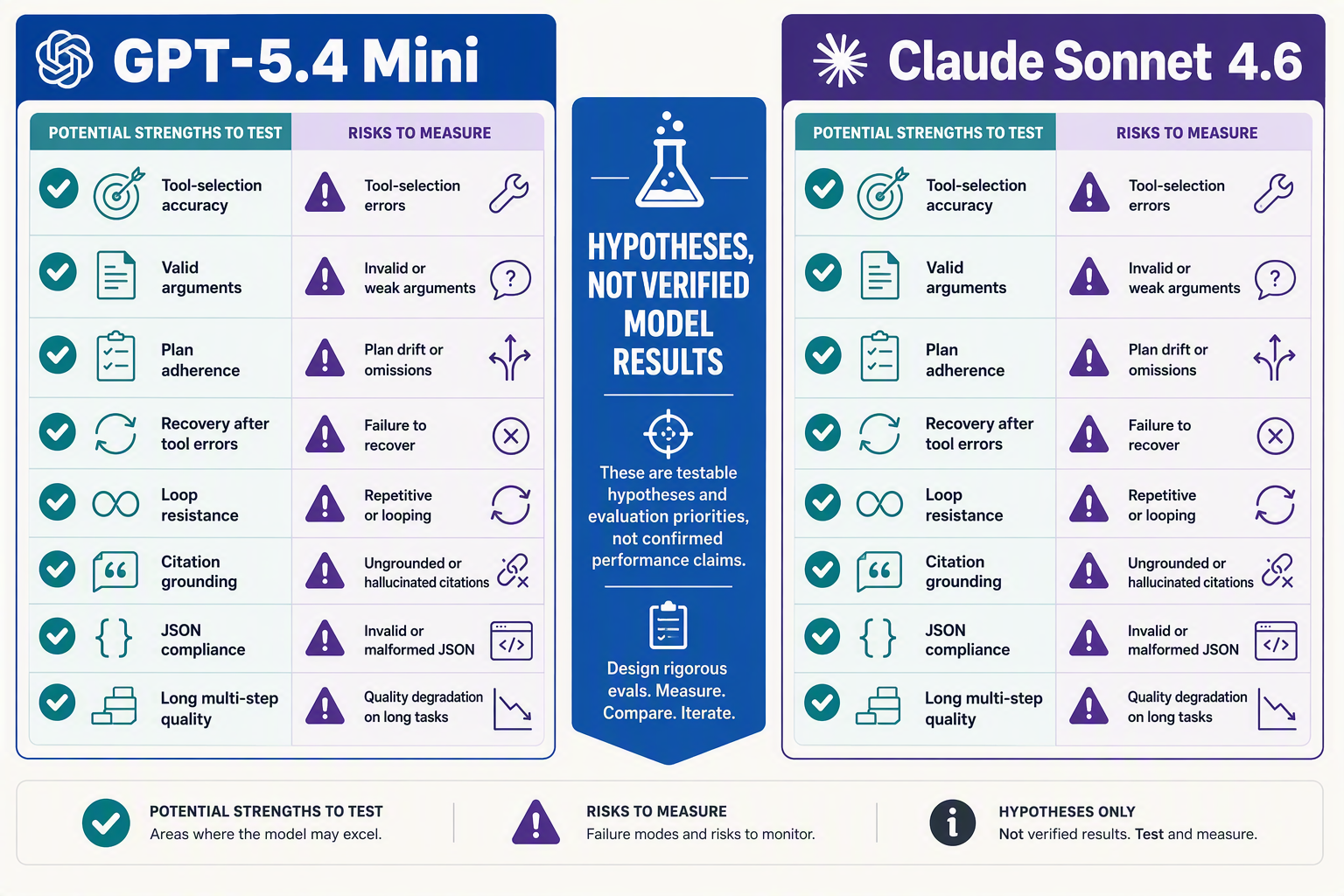
Neither model can be declared the practical winner without verified specifications or workflow tests. GPT-5.4 Mini and Claude Sonnet 4.6 should be compared on cost per successful task, tool reliability, latency, and recovery—not model names or generic benchmark reputation.
Practical trade-offs at a glance
- GPT-5.4 Mini: Potentially attractive where lower-cost, high-volume execution matters, but current pricing, context limits, latency, and tool-use performance are not verified from the available sources.
- Claude Sonnet 4.6: May suit workflows that prioritize planning and long, multi-step reasoning, but current pricing, context capacity, rate limits, and reliability are also not verified from the available sources.
- Both models: Require testing for valid function arguments, structured-output compliance, unnecessary tool calls, loop resistance, and recovery after tool errors.
- Production teams: Score each model across 20–30 cases per workflow category, as recommended in this comparison, before selecting a default.
- India-focused deployments: Platforms such as CallMissed can provide a model-agnostic route for voice, WhatsApp, and API workflows, allowing teams to evaluate models without rebuilding every integration.
| Decision factor | GPT-5.4 Mini | Claude Sonnet 4.6 | Practical implication |
|---|---|---|---|
| Tool selection | Not verified from available sources | Not verified from available sources | Measure correct-tool rate and avoidable calls |
| Structured outputs | Not verified from available sources | Not verified from available sources | Track valid JSON and schema compliance |
| Planning and recovery | Not verified from available sources | Not verified from available sources | Test multi-step plans and tool-error recovery |
| Context window | Not verified from available sources | Not verified from available sources | Confirm official limits before long workflows |
| Latency and reliability | Not verified from available sources | Not verified from available sources | Record p50 and p95 latency, retries, and failures |
| Pricing and deployment | Not verified from available sources | Not verified from available sources | Calculate cost per successful task, not token cost alone |
- Best selection rule: Choose the model with the higher successful-task rate at an acceptable cost and latency on your own tools, prompts, and failure conditions.
How should you test GPT-5.4 Mini and Claude Sonnet 4.6 fairly?
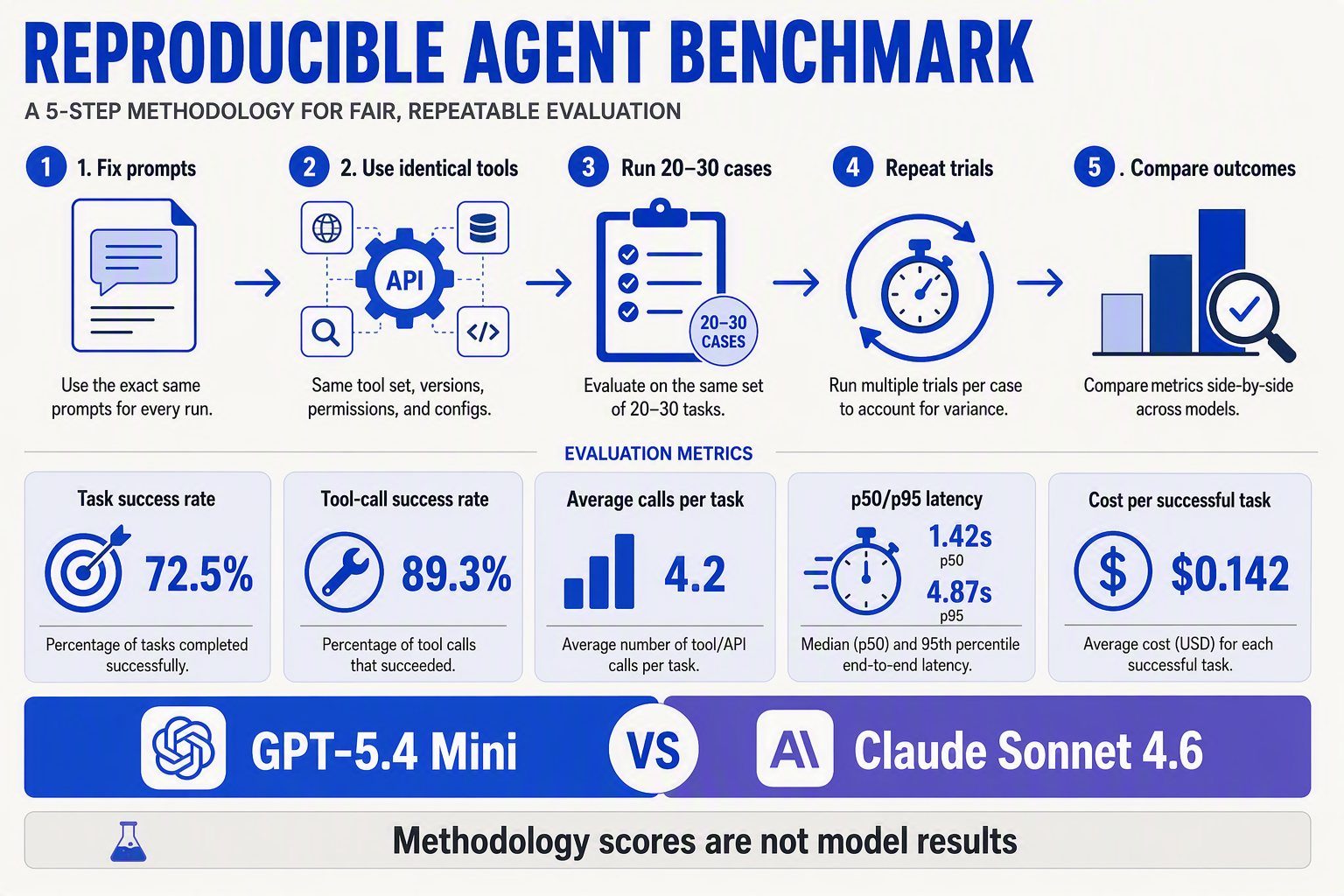
Test GPT-5.4 Mini and Claude Sonnet 4.6 with identical prompts, tools, schemas, and failure conditions; choose the model with the lower cost per successful task, not the stronger marketing claim. The recommended benchmark uses 20–30 cases per workflow category and reports both quality and operational metrics.
What should a fair agent benchmark control?
- Inputs: Use the same system prompt, user tasks, tool definitions, JSON schemas, temperature settings where available, and model-independent test data.
- Workflow coverage: Test customer support, coding, research, browser/API orchestration, and high-volume classification separately; a model may perform differently across each category.
- Tool behavior: Record correct tool selection, valid arguments, unnecessary calls, tool-call success rate, recovery after tool errors, and resistance to repetitive loops.
- Long-horizon tasks: Include multi-step workflows that measure plan adherence, structured-output validity, citation or grounding quality, and final-answer accuracy after several tool calls.
- Repetition: Run seeded trials where supported; otherwise repeat each case enough times to expose variability rather than relying on one successful completion.
- Metrics: Report task success rate, tool-call success rate, average tool calls per completed task, p50 and p95 latency, invalid-JSON rate, and cost per successful task.
- Scoring: Apply a fixed 0–3 rubric for correctness, tool use, recovery, and output compliance; these scores describe the test methodology, not verified GPT-5.4 Mini or Claude Sonnet 4.6 results.
- Production check: Re-test with anonymized real workloads before deployment, including rate-limit behavior, timeout handling, prompt-injection attempts, and fallback responses. A model gateway such as CallMissed can help teams compare multiple providers through a consistent API and billing workflow.
Which model should you choose for CRM, coding, research, browser and high-volume workflows?
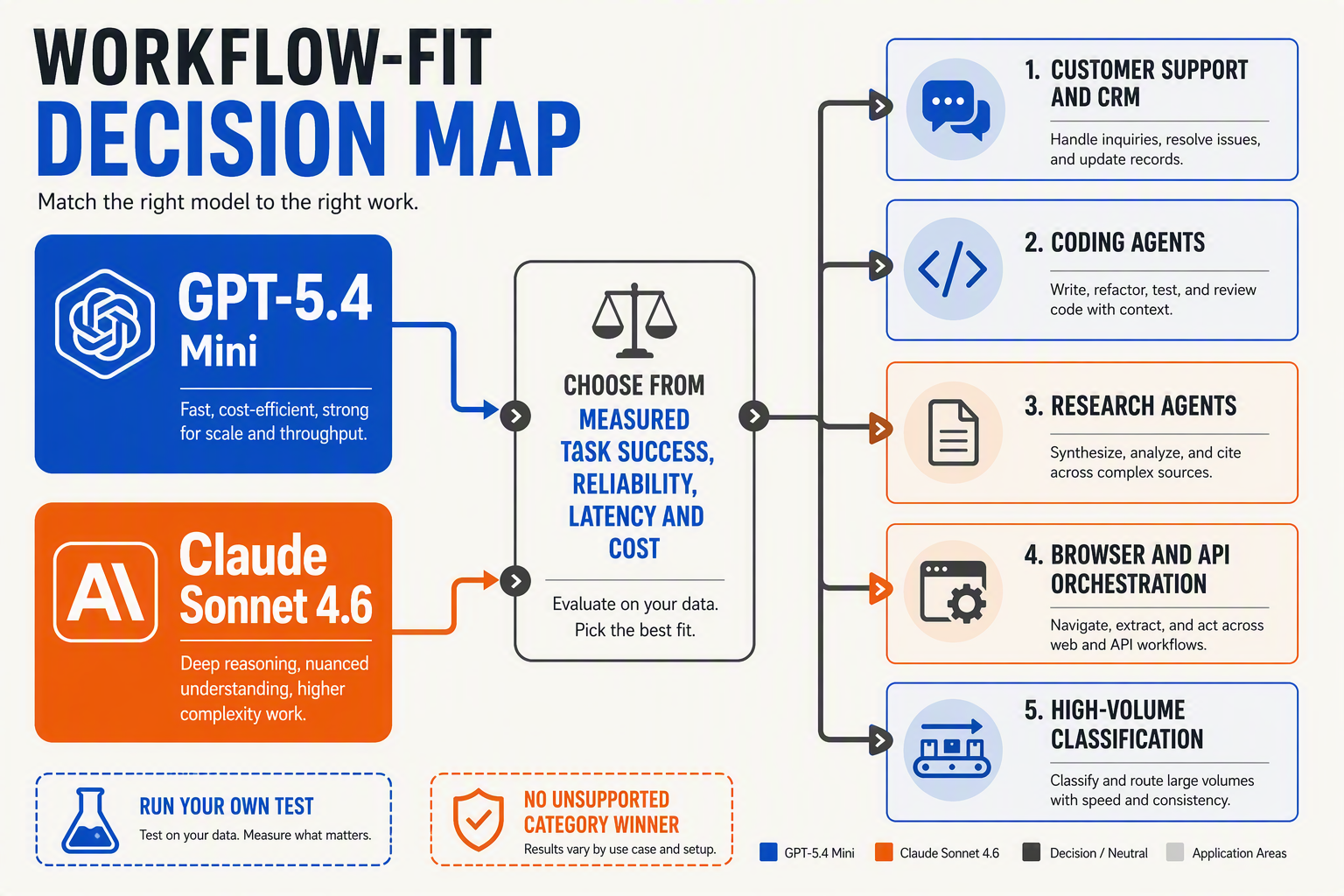
The right choice depends on your measured cost per successful task, not on an unverified assumption that GPT-5.4 Mini or Claude Sonnet 4.6 is universally stronger. With no confirmed pricing, latency, context, or agent benchmark data in the supplied sources, run both models against identical tools and prompts before committing.
- CRM and customer support: Choose the model with higher structured-output validity, safer escalation, and better recovery after failed CRM or WhatsApp API calls; measure successful ticket updates, not response quality alone.
- Coding workflows: Compare repository-level task completion, patch correctness, test-pass rate, tool-call count, and resistance to repeated debugging loops; generic coding benchmarks cannot establish a winner for your stack.
- Research agents: Prefer the model that follows a fixed research plan, cites retrieved evidence accurately, and avoids unsupported claims; score citation grounding and answer completeness across 20–30 cases.
- Browser and API orchestration: Prioritize valid function arguments, correct page or endpoint selection, recovery from timeouts, and low p50/p95 latency; a fluent answer has little value if the agent triggers the wrong action.
- High-volume classification: Select the model with the lower cost per correctly classified item, stable JSON compliance, and acceptable error rates at production concurrency; verify input, output, cached-input, and service-tier pricing from official OpenAI and Anthropic pages before calculating savings.
- India-focused omnichannel workflows: Platforms such as CallMissed can connect model-agnostic agents to CRM, WhatsApp, voice, and email workflows; test Indian-language support, escalation behavior, and tool reliability rather than assuming an English-language benchmark transfers to Bharat.
- Practical verdict: Use a 0–3 score for tool selection, argument validity, planning, recovery, grounding, JSON compliance, latency, and cost, then weight each category by business impact; deploy the higher-scoring model per workflow rather than forcing one model across every workload.
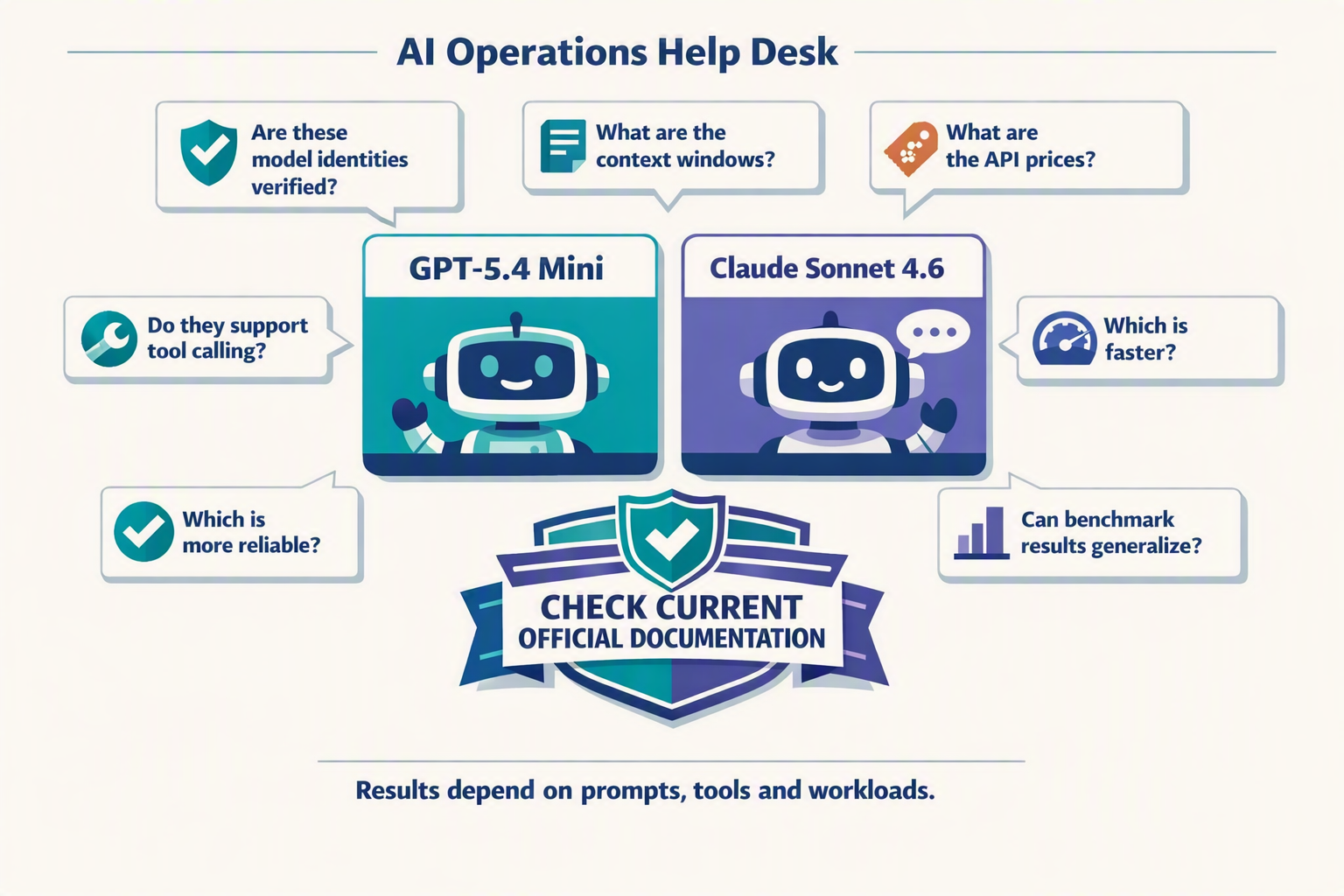
What should you know about model identity, context, pricing, tools, latency and reliability?
Frequently Asked Questions
What are the official model identities of GPT-5.4 Mini and Claude Sonnet 4.6?
What are their context-window limits?
Which model is less expensive?
How do GPT-5.4 Mini and Claude Sonnet 4.6 compare for tool calling?
Which model has lower latency?
Which model is more reliable for agentic workflows?
Can public benchmarks determine which model is best for production agents?
How should teams choose between the models for production?
Conclusion
The evidence does not establish a universal winner: GPT-5.4 Mini and Claude Sonnet 4.6 should be selected by measured workflow fit.
- Treat pricing, context limits, latency, and tool performance as unverified until confirmed by OpenAI and Anthropic.
- Compare tool accuracy, structured outputs, planning, recovery, and cost per successful task.
- Test identical prompts and tools across 20–30 cases per workflow category, measuring success, p50/p95 latency, and tool calls.
Watch for verified pricing and independent agent benchmarks. To explore how AI communication is evolving, visit CallMissed. Which model will perform better on your real failure cases?