Claude Fable 5.1 Agentic Coding Guide for Long-Running Software Tasks


Learn Claude Fable 5.1 agentic coding setup, prompts, tools, context, testing, security, recovery, and cost controls for durable agents.
Claude Fable 5.1 Agentic Coding Guide for Long-Running Software Tasks
What changes when a coding model is designed not merely to suggest the next function, but to pursue a software task across hours of repository exploration, tool calls, tests, and corrections? Claude Fable 5.1 coding workflows target exactly that challenge: Anthropic positions the model for demanding reasoning and long-horizon agentic work where a conventional coding assistant may lose context, stop prematurely, or declare success without sufficient verification.
Why Claude Fable 5.1 matters now
Anthropic launched Claude Fable 5.1, identified in the API as claude-fable-5-1, on September 1, 2026—just two days before this guide’s publication—according to the Claude Platform release notes. Anthropic describes Claude Fable 5.1 as the successor to Claude Fable 5 and its most capable widely released model, with stronger support for long-running agentic coding and knowledge work.
That timing matters because software teams are moving beyond autocomplete toward agents that can:
- Inspect unfamiliar repositories and trace dependencies
- Create an implementation plan before editing files
- Use terminals, code search, test runners, and version-control tools
- Diagnose failures and revise their approach
- Preserve progress across lengthy, multi-stage tasks
- Produce evidence that the requested change actually works
Long-running autonomy also introduces new risks. An agent can consume excessive tokens, modify the wrong files, execute unsafe commands, repeat a failing action, or compress away a critical requirement. Cost therefore becomes an architectural constraint rather than an afterthought: Anthropic’s pricing documentation lists several Claude Fable 5.1 token rates—including $10, $12.50, $20, and $0.25 per million tokens, depending on the token category. Anthropic’s service-tier documentation also states that Priority Tier is not supported for Claude Fable 5.1, an operational detail teams should consider when designing production workloads.
What this hands-on guide will build
This guide will show you how to structure a reliable Claude Fable 5.1 coding agent from the ground up. You will learn how to configure API access conceptually, define scoped objectives, expose tools safely, manage repository context, request explicit progress updates, and require tests before completion. That last prompting detail is important: Anthropic’s prompting guidance says Claude Fable 5.1 tends to provide fewer user-facing updates between tool calls, so developers should ask for progress reporting explicitly.
We will also cover token budgets, checkpoints, failure recovery, least-privilege execution, secret protection, human approval gates, and the situations in which a faster, lighter model is the more economical choice. Platforms such as CallMissed’s OpenAI-compatible gateway reflect the broader multi-model trend by letting developers access different model classes through one integration and use same-tier fallbacks where appropriate.
The goal is not a theatrical agent that generates lots of activity. It is a controlled engineering workflow that plans carefully, changes only what is necessary, tests its work, reports uncertainty, and leaves behind an auditable result.
How do you use Claude Fable 5.1 for agentic coding? Use a bounded plan–act–test–checkpoint loop
Availability note (September 5, 2026): Claude Fable 5.1 is generally available under the model ID claude-fable-5-1. Anthropic launched it on September 1, 2026, and documents it for long-horizon agentic work. Published pricing is $10 per million input tokens, $50 per million output tokens, and $0.25 per million cache-read tokens. Confirm current pricing, context limits, regional availability, and account access before starting a production run.
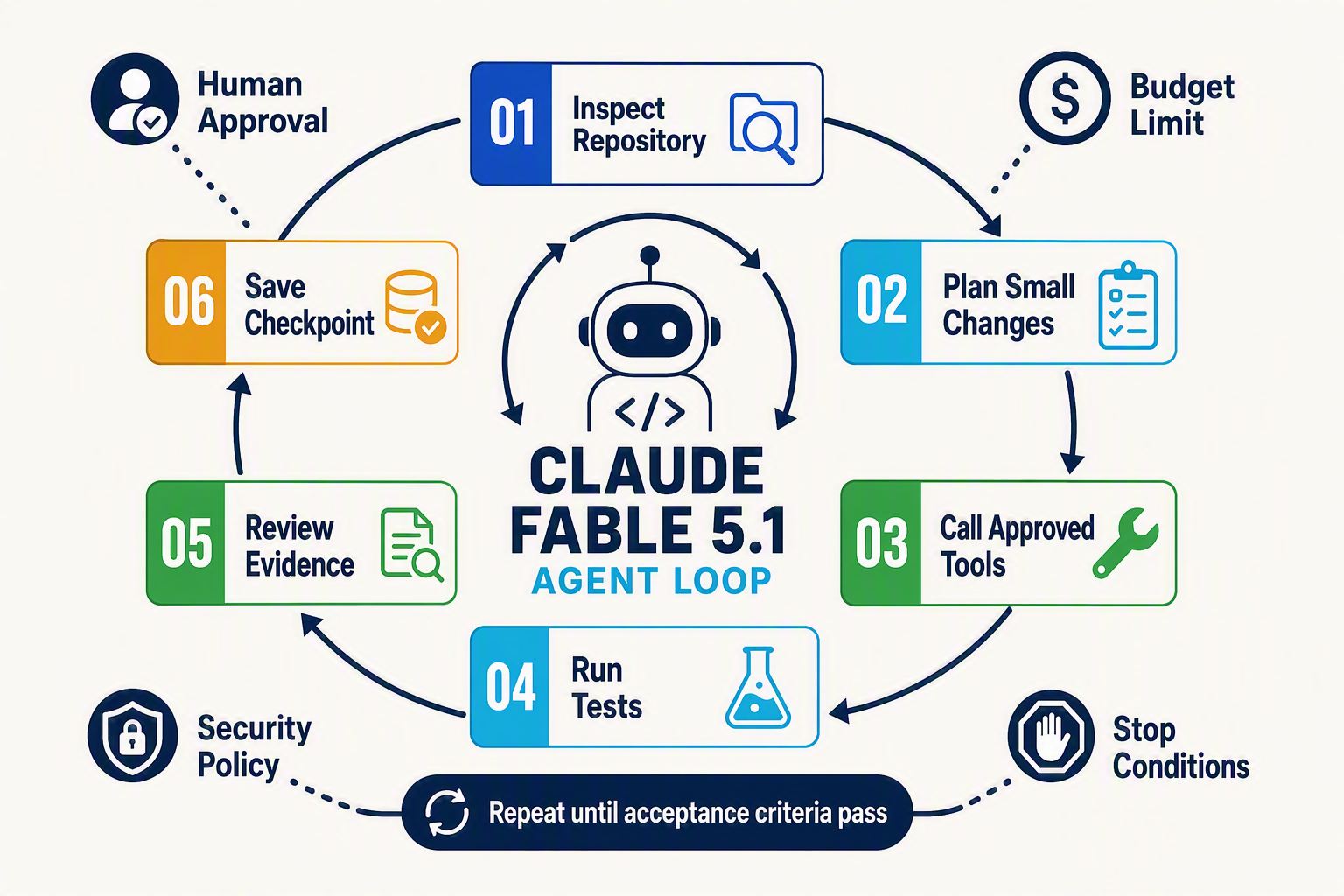
Use Claude Fable 5.1 agentic coding as a bounded executor—not as an unattended developer. Even a model designed for long-running tasks should operate through a controlled plan–act–test–checkpoint loop:
- Plan one reversible, verifiable increment.
- Act only through explicitly permitted tools.
- Test against a predefined, objective gate.
- Checkpoint the evidence, diff, cost, risks, and rollback state.
- Continue only while the task remains within its approved scope, budget, and policy.
1. Define an executable task contract
Replace broad requests such as “fix authentication” with a contract specifying scope, permissions, acceptance evidence, budgets, approvals, and stopping conditions:
Model:
claude-fable-5-1

Objective:
Add refresh-token rotation to the Node.js authentication service.

Allowed paths:
- src/auth/**
- tests/auth/**

Read-only paths:
- package.json
- database schema and migration history

Denied paths and data:
- .env*
- credentials, key stores, production data, and deployment secrets
- files outside the repository workspace

Permitted tools:
- search_code and read_file within the repository
- apply_patch within allowed paths
- run_tests using approved commands
- git_diff and git_status
- restore_checkpoint

Human approval required before:
- adding or updating dependencies
- creating or changing migrations
- changing public APIs or authentication policy
- accessing a network, external service, or production system
- deleting files, rewriting Git history, or deploying code
- expanding the allowed paths or tool set

Completion evidence:
- Existing authentication tests pass
- New tests cover rotation, reuse detection, and expiry
- Every acceptance criterion maps to a passing test
- Final diff contains no unrelated files, secrets, or debug artifacts
- Changed files, commands, results, and residual risks are summarized

Budgets:
- Maximum 8 loops
- Maximum 45 minutes elapsed time
- Maximum 20 tool calls
- Maximum 6 changed files
- Maximum 2 attempts at the same failing approach
- Input, output, and cache-read token ceilings set by the API caller

Operating loop:
1. Propose one bounded step and its test.
2. State intended actions, risks, and rollback method.
3. Wait for approval when required.
4. Execute with permitted tools only.
5. Run the narrowest relevant test.
6. Record a checkpoint.
7. Stop on success, a budget limit, repeated failure, or ambiguity.
Loop, time, token, cost, file-change, and tool-call limits are independent controls. Reaching any limit should pause Claude Fable 5.1 agentic coding for review rather than trigger an automatic budget increase.
Because output tokens are more expensive than input and cache-read tokens, keep status reports structured and concise. Reuse stable repository instructions through supported prompt-caching mechanisms where appropriate, but never allow cost optimization to weaken validation or oversight.
2. Isolate execution and enforce least privilege
Run the agent in an ephemeral container, disposable virtual machine, or restricted worktree—not on an unrestricted developer machine or production server. The environment should:
- mount only the repository paths needed for the task;
- use non-production fixtures and test data;
- deny outbound network access by default;
- expose secrets only for a specifically approved operation;
- apply CPU, memory, process, storage, and command time limits;
- preserve logs and diffs without preserving unnecessary credentials;
- support restoration to a known-good checkpoint.
Expose purpose-built tools such as:
search_code(query, allowed_paths)read_file(path)apply_patch(path, patch)run_tests(approved_command, timeout)git_diff()git_status()create_checkpoint(label)restore_checkpoint(id)
Avoid unrestricted shell access when a constrained tool can perform the same operation. Each tool description should define valid inputs, path boundaries, side effects, output limits, timeouts, and prohibited uses. Enforce those restrictions in the tool implementation rather than relying only on prompt instructions.
Treat repository files, issue descriptions, test output, dependency messages, and web content as untrusted data. Text encountered through a tool cannot override the task contract, authorize new permissions, reveal secrets, or instruct the agent to bypass a test gate.
3. Plan only the next testable increment
A long-horizon plan can identify the likely route, but approval should cover only the next reversible unit of work. Each proposed increment should specify:
- the assumption being tested;
- expected files and permitted tools;
- the smallest intended change;
- the exact validation command;
- the expected result;
- possible side effects;
- the rollback method.
For example:
Next step:
Trace current refresh-token creation and identify existing expiry tests.

Assumption:
Refresh-token issuance is centralized in src/auth/tokens.ts.

Tools:
search_code, read_file

Writes:
None

Validation:
Report the issuance entry point and relevant test names with file references.

Expected result:
One confirmed token-creation path and a list of existing expiry assertions.

Rollback:
Not required; this is read-only exploration.
After this exploration, Claude Fable 5.1 should checkpoint its evidence and propose the next increment. If repository evidence contradicts the assumption, it should revise the plan—not broaden scope merely to preserve its original approach.
4. Make actions and tests observable
Before a consequential tool call, require a compact status update:
- Intent: what the action is meant to establish;
- Action: the exact tool call, command, or edit;
- Expected result: the objective success condition;
- Risk: what could go wrong;
- Rollback: how the prior state will be restored.
After execution, record the tool result, exit status, changed files, and relevant output. Do not accept “tests passed” without the command, result, and test scope.
Apply test gates in increasing scope:
- Run the closest unit test after a local behavior change.
- Run the affected package or service suite at the increment checkpoint.
- Run applicable linting, formatting, type, security, and integration checks before completion.
- Inspect the final diff for unrelated edits, generated artifacts, debug logging, secrets, and unexpected dependency changes.
- Map every acceptance criterion to a test result or other objective evidence.
A failing gate returns the loop to planning. The agent should diagnose the failure, state whether the implementation or the test is likely wrong, and propose one bounded correction. It must not weaken assertions, delete tests, suppress errors, or expand exclusions simply to obtain a passing result.
5. Create durable checkpoints and explicit rollback points
Long-running work should not depend on the model retaining an informal narrative of everything it has done. At the end of each increment, save a compact checkpoint containing:
Checkpoint ID:
auth-rotation-03

Objective status:
3 of 5 acceptance criteria satisfied

Changes:
- src/auth/tokens.ts
- tests/auth/refresh-token.test.ts

Commands and results:
- npm test -- tests/auth/refresh-token.test.ts
- Exit 0; 14 tests passed

Evidence:
- Rotation test passes
- Reuse-detection test passes
- Expiry test still pending

Budgets consumed:
- 3 of 8 loops
- 9 of 20 tool calls
- 2 of 6 changed files
- 21 of 45 minutes
- Token and estimated API cost totals

Open risks:
- Concurrent refresh requests have not been tested

Rollback:
Restore checkpoint auth-rotation-02 or revert the listed patch

Next proposed step:
Add a concurrency test without changing production code
Store checkpoints outside the model’s conversational summary when possible—for example, in orchestration metadata, a task ledger, or an isolated Git worktree. Before compressing context or resuming a paused run, reconstruct state from the task contract, current diff, test evidence, and latest checkpoint rather than relying on an unverified generated summary.
6. Stop for approvals, ambiguity, or repeated failure
Human approval should be mandatory when a step would:
- alter dependencies, lockfiles, schemas, migrations, or public interfaces;
- change security, authorization, retention, or authentication policy;
- access external networks, third-party services, secrets, or production data;
- delete files or perform an irreversible operation;
- deploy, publish, merge, tag, or rewrite repository history;
- exceed a budget or expand the original scope;
- resolve an ambiguous product or architectural decision.
Also stop when the same approach fails twice, test results are nondeterministic, required evidence is unavailable, or rollback cannot be guaranteed. The escalation should include the current checkpoint, attempted approaches, exact failures, remaining budgets, and a small set of options. “Ask for help” is less useful than presenting a decision a reviewer can evaluate.
Approval should authorize a specific action, not permanently relax the boundary. For example, permission to install one reviewed package does not grant general network access or permission to update unrelated dependencies.
7. Finish with evidence, not a claim of completion
A successful Claude Fable 5.1 agentic coding run should end with a reviewable completion packet:
Outcome:
Refresh-token rotation implemented within the approved paths.

Acceptance evidence:
- Existing authentication suite: passed
- Rotation test: passed
- Reuse-detection test: passed
- Expiry test: passed
- Type check and lint: passed

Changed files:
- src/auth/tokens.ts
- tests/auth/refresh-token.test.ts

Final diff review:
- No unrelated edits
- No dependency changes
- No secrets or debug artifacts
- No deployment performed

Budgets used:
- 6 of 8 loops
- 16 of 20 tool calls
- 2 of 6 changed files
- 37 of 45 minutes
- Final input, output, cache-read, and estimated cost totals

Residual risks:
- Multi-region token-store consistency was not tested

Rollback:
Restore checkpoint auth-rotation-02 or revert the final patch

Human action:
Review the diff and approve or reject merge
This structure lets Claude Fable 5.1 work across a substantial coding task while keeping every increment bounded, testable, recoverable, and subject to human control. The objective of Claude Fable 5.1 agentic coding is not maximum autonomy; it is sustained progress with explicit permissions, measurable evidence, controlled cost, and safe stopping points.
What is Claude Fable 5.1, and why is it suited to long-running coding agents?

Claude Fable 5.1 is Anthropic’s high-capability model for demanding reasoning, long-horizon agentic work, and software tasks that require repeated tool use and correction. It is suited to long-running coding agents because Anthropic specifically positions it to sustain multi-stage work across repository analysis, implementation, testing, and recovery—not merely generate isolated code snippets.
The model is not the agent
Anthropic released Claude Fable 5.1 on September 1, 2026, under the API model identifier claude-fable-5-1, according to the Claude Platform release notes. Anthropic’s model-selection documentation calls Claude Fable 5.1 its “most capable widely released model” and says it extends Claude Fable 5 with stronger long-running agentic coding.
A Claude Fable 5.1 coding agent is the complete system around that model. The production architecture normally includes:
- An orchestration loop that submits objectives and processes responses
- Repository tools for reading files, searching symbols, and inspecting diffs
- Execution tools such as a shell, compiler, linter, and test runner
- Persistent state for plans, completed steps, failures, and checkpoints
- Security controls that restrict commands, files, credentials, and network access
- Completion rules requiring test results or other verifiable evidence
This distinction matters because model capability alone does not guarantee reliable autonomy. The surrounding agent determines what Claude can access, how long it may continue, when it must stop, and whether a human must approve risky actions.
Why it fits long-horizon software work
Long-running coding is difficult because each action changes the state of the task. A test failure may invalidate the plan; a dependency discovered deep in the repository may require edits across several modules; an implementation that compiles may still violate an API contract.
Claude Fable 5.1 is designed for workflows where the model must repeatedly:
- Investigate the repository before making changes.
- Plan a sequence of edits and identify likely risks.
- Act through file, terminal, search, or version-control tools.
- Observe tool output rather than assume success.
- Revise the implementation after errors or failed tests.
- Verify the final state against explicit acceptance criteria.
Anthropic’s Models Overview recommends Claude Fable 5.1 for “demanding reasoning and long-horizon agentic work,” including cases where evaluations using Claude Opus 5 at higher effort still fall short. That recommendation makes the model especially relevant for repository migrations, difficult debugging, cross-file refactoring, and feature work with extensive validation.
What “long-running” should mean in practice
Long-running should mean stateful and checkpointed, not unlimited or unsupervised. A well-designed agent divides work into bounded phases and records what happened after each phase.
For example, a dependency migration might use these checkpoints:
- Inventory affected packages and call sites
- Propose a migration plan without editing
- Update one module and run targeted tests
- Expand changes only after the first module passes
- Run the full suite and inspect the final diff
- Stop for approval before publishing or deployment
One behavioral detail requires explicit handling: Anthropic’s prompting best-practices documentation says Claude Fable 5.1 provides fewer user-facing updates between tool calls during agentic work. Therefore, prompts should require concise progress reports after major milestones, including completed actions, current blockers, test status, and the next intended step.
Claude Fable 5.1 is consequently best understood as a capable reasoning engine for controlled software agents—not permission to remove budgets, checkpoints, tests, or human oversight.
Which Claude Fable 5.1 developments matter to developers?
The developments that matter most are stronger long-horizon execution, changed progress-reporting behavior, explicit migration guidance, variable token economics, and the absence of Priority Tier support. Together, these changes affect how developers design prompts, observability, model routing, budgets, and production safeguards—not merely which model ID they call.
Developer impact matrix
| Development | Verified detail | Why it matters | Recommended action |
|---|---|---|---|
| Long-running agentic coding | Anthropic’s September 1, 2026 release notes position Claude Fable 5.1 for extended coding and knowledge-work tasks. | The model is intended to sustain repository exploration, implementation, testing, and correction over longer trajectories. | Divide work into milestones and persist plans, diffs, test results, and unresolved issues after each milestone. |
| Higher-end model positioning | Anthropic’s Models Overview recommends Claude Fable 5.1 for demanding reasoning and long-horizon work, including cases where Claude Opus 5 at higher effort falls short in evaluations. | Fable 5.1 should be an evaluation-driven escalation option, not the automatic choice for every code request. | Route simple transformations to lighter models; invoke Fable 5.1 when measured task complexity or failure rates justify it. |
| Reduced progress narration | Anthropic’s Prompting Best Practices says Claude Fable 5.1 produces fewer user-facing updates between tool calls during agentic work. | An agent may be working correctly while appearing inactive, weakening observability and operator confidence. | Require a short update after each milestone: completed work, files changed, tools used, blockers, and next action. |
| Multi-category pricing | Anthropic’s Pricing documentation lists Claude Fable 5.1 rates of $10, $12.50, $20, and $0.25 per million tokens, depending on token category. | Repository-scale tasks can repeatedly ingest code, tool output, and cached context, making cost depend on workload shape as well as total tokens. | Track usage by category, cap iterations, filter tool output, and reuse stable context where the API supports it. |
| No Priority Tier | Anthropic’s Service Tiers documentation states that Priority Tier does not support Claude Fable 5.1 as of September 3, 2026. | Teams cannot assume the same priority-capacity option available for supported models. | Design queues, retries, timeouts, fallback routing, and human handoff around documented availability characteristics. |
| Formal migration resources | Anthropic publishes a dedicated migration guide and a Claude Fable 5.1 and Mythos 5.1 System Card. | Upgrading should include behavioral and safety evaluation, not just changing the model name. | Re-run coding evals, tool-call tests, security checks, latency measurements, and cost comparisons before rollout. |
What changes in an actual coding agent
These developments shift the implementation pattern from an open-ended “solve this issue” loop toward a checkpointed state machine:
- Plan: inspect the repository and define acceptance criteria.
- Act: permit only the tools required for the current milestone.
- Report: emit the explicitly requested progress update.
- Verify: run targeted tests, then broader regression checks.
- Checkpoint: store the current commit, decisions, failures, and remaining work.
- Continue or stop: proceed only while budget, permissions, and iteration limits remain valid.
The model’s positioning does not prove that it will outperform alternatives on your codebase. Anthropic’s recommendation itself is evaluation-oriented: use Claude Fable 5.1 when demanding tasks or internal evaluations warrant it. A practical evaluation set should include repository navigation, multi-file edits, test repair, rollback behavior, and resistance to malicious instructions embedded in source files.
The key engineering takeaway
Treat Claude Fable 5.1 agentic coding as a systems capability rather than a model upgrade. Its long-running focus can support more ambitious tasks, but reliable results still depend on explicit status prompts, bounded tools, durable checkpoints, test-based completion criteria, cost telemetry, and model fallbacks.
How do you set up the API and build a safe coding-agent tool loop?
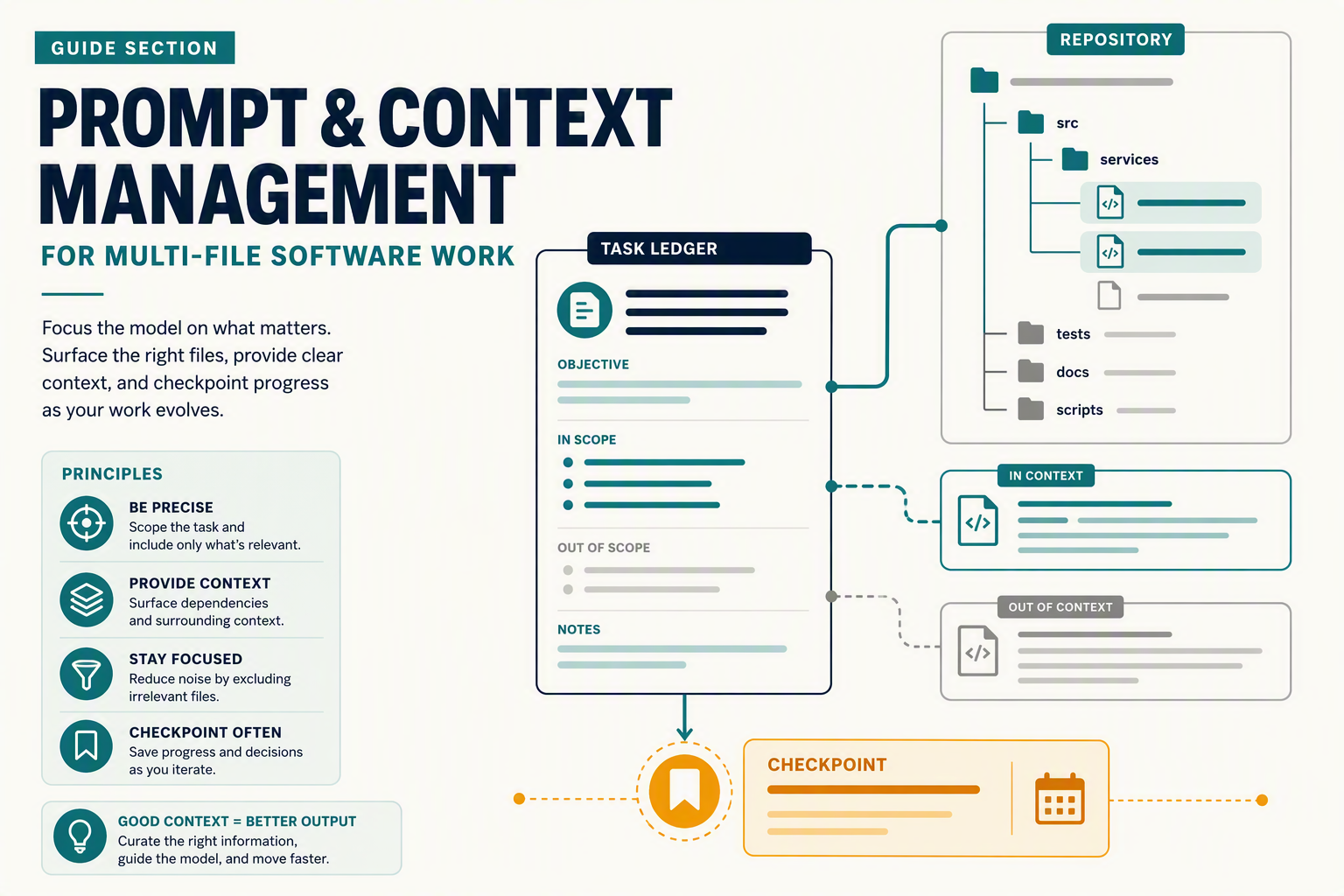
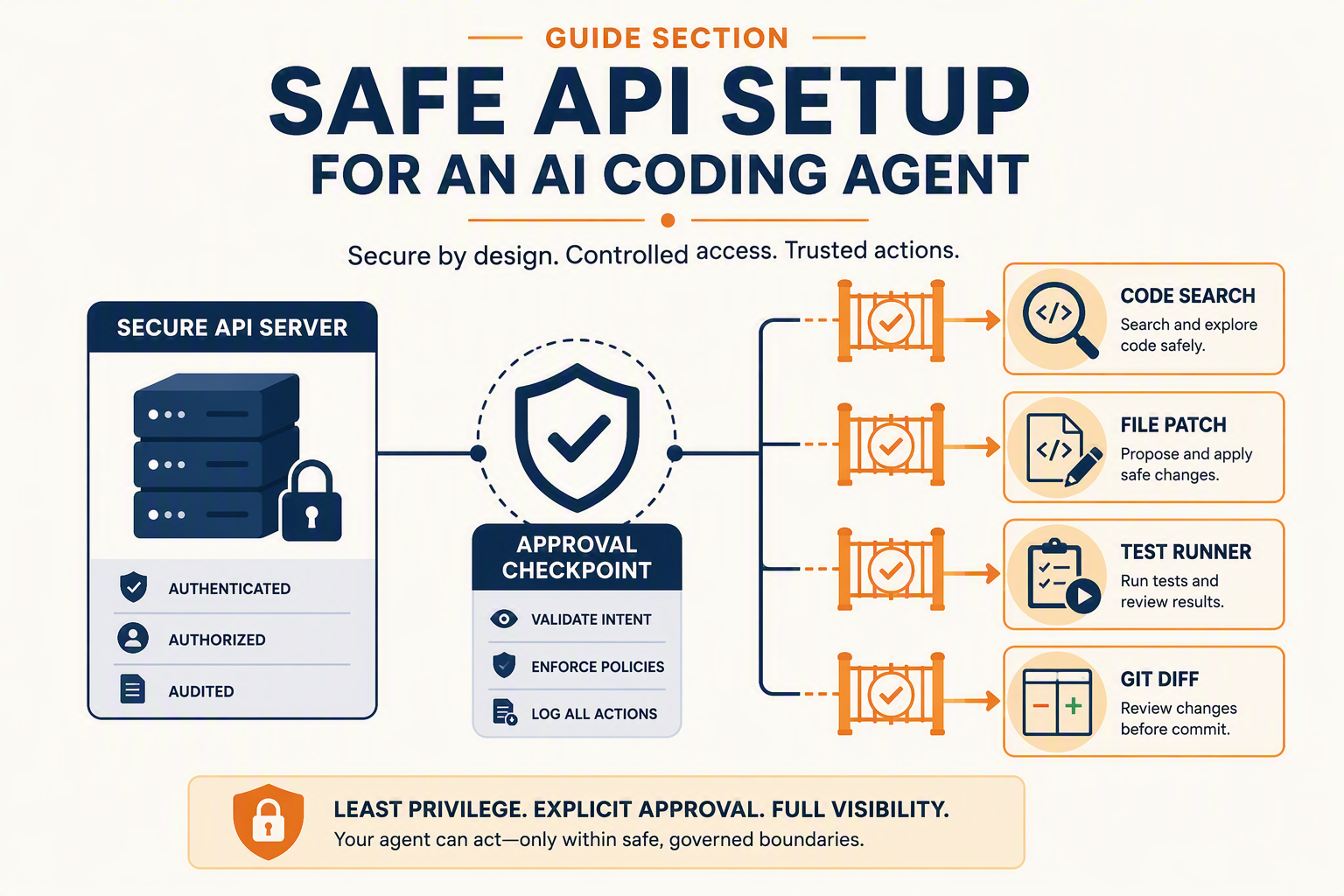
Set up Claude Fable 5.1 through Anthropic’s Messages API, then wrap it in a bounded orchestration loop that validates every tool request before execution. The model should decide what action to request, but your application—not the model—must control permissions, timeouts, budgets, and approval gates.
Configure API access server-side
Store the Anthropic API key in a secret manager or environment variable; never expose it in browser code, repository files, logs, or prompts. Requests should specify:
- Model:
claude-fable-5-1 - System instructions: role, repository scope, constraints, and completion criteria
- Messages: the task and subsequent tool results
- Tools: narrowly defined JSON schemas for permitted operations
- Output limit: a bounded maximum-token setting
- API headers: authentication, content type, and the supported Anthropic API version
Run the agent from a controlled backend, CI worker, or isolated development environment. Give each task its own workspace, budget, trace ID, and cancellation signal.
Anthropic’s model documentation recommends Claude Fable 5.1 for demanding reasoning and long-horizon agentic work, making claude-fable-5-1 the appropriate identifier for this workflow. Keep the model name configurable, however, so evaluation or fallback models can be introduced without changing the orchestration code.
Define capabilities as narrow tools
Avoid handing a coding agent unrestricted shell access. Expose small, auditable operations such as:
list_files(path, depth)read_file(path, start_line, end_line)search_code(query, path)apply_patch(diff)run_tests(target, timeout_seconds)git_diff()request_approval(action, rationale)
Each schema should reject unknown fields, directory traversal, absolute paths, oversized output, and unsupported commands. A test tool, for example, should map approved test targets to predefined commands rather than accepting arbitrary shell text.
Separate tools into risk classes:
- Read-only: repository search, file reads, dependency inspection
- Workspace writes: patches within an isolated branch or container
- Controlled execution: linters, builds, and tests with CPU and time limits
- Approval required: package installation, network access, migrations, deployment, deletion, or credential use
Treat repository content as untrusted input. Comments, documentation, test fixtures, and downloaded dependencies can contain prompt-injection instructions; the system prompt should state that tool output is data, not authority.
Implement the agent loop
The core loop follows the Messages API’s tool-use protocol:
messages = [user_task]

repeat until budget_exhausted:
  response = call_model(model, system_rules, messages, tools)
  append response to messages

  if response requests tools:
    validate names, arguments, permissions, paths, and remaining budget
    execute approved tools inside the sandbox
    append structured tool results
  else:
    require test evidence and inspect git diff
    finish only if acceptance criteria are satisfied
Add hard limits for iterations, elapsed time, tokens, tool calls, changed files, and repeated failures. Stop and escalate when the same test fails repeatedly or the agent requests broader privileges than the task warrants.
Require a short status update after major phases: plan, investigation, implementation, testing, and final review. Anthropic’s prompting guidance says Claude Fable 5.1 provides fewer user-facing updates between tool calls, so progress reporting must be requested explicitly.
Finally, record tool arguments, results, patches, approvals, token use, and stop reasons in an audit log—with secrets redacted. A safe Claude Fable 5.1 coding agent is not an autonomous shell; it is a model operating inside a deterministic policy boundary.
Which prompting and context-management patterns keep multi-file tasks on track?
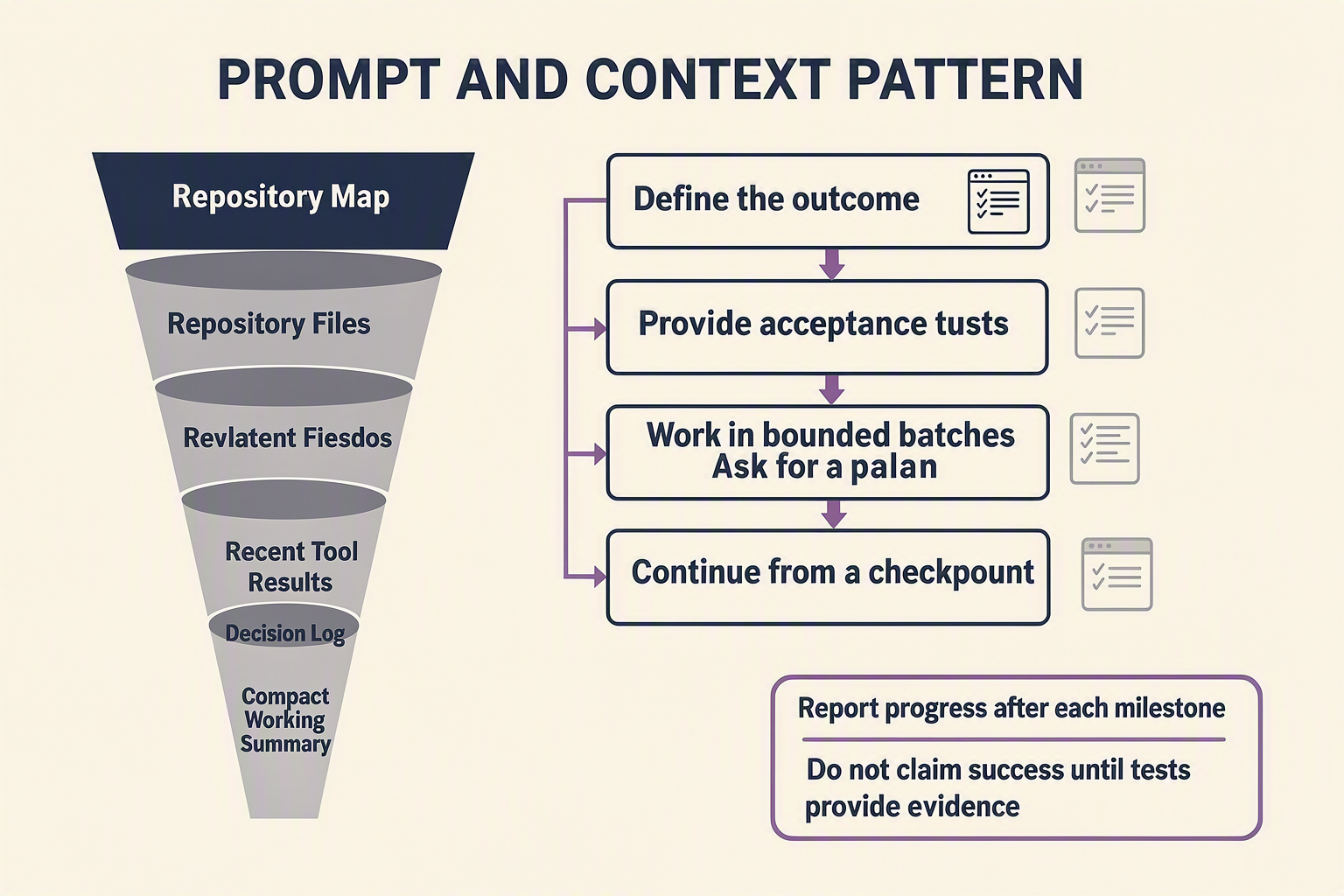
Multi-file work stays on track when the agent receives a stable task contract, maintains an external progress ledger, and reloads only the repository context needed for the next decision. Treat the prompt as an operating procedure—not a one-time request—and require Claude Fable 5.1 to plan, verify, and checkpoint before moving between task stages.
Start with a testable task contract
Define success in terms the Claude Fable 5.1 coding agent can verify. A strong initial prompt includes:
- Objective: the user-visible behavior to implement
- Scope: directories and components that may change
- Constraints: APIs, dependencies, compatibility, and style rules
- Non-goals: adjacent changes the agent must avoid
- Acceptance criteria: specific tests, commands, or observable outcomes
- Stop conditions: situations requiring human approval
Avoid prompts such as “refactor authentication.” Instead, specify: “Add rotating refresh tokens without changing the public login response, database engine, or existing access-token lifetime. Run unit and integration tests before completion.”
Then instruct the agent to follow a gated sequence:
- Inspect repository instructions and relevant files.
- Summarize the current architecture.
- Propose a file-by-file plan.
- Identify assumptions and risks.
- Wait for approval when the plan crosses a defined boundary.
- Implement in small batches and test each batch.
Keep a persistent task ledger
Conversation history is not a reliable substitute for structured state. Ask the agent to maintain a concise ledger in its responses or, where appropriate, in a temporary workspace artifact:
OBJECTIVE:
FIXED CONSTRAINTS:
DECISIONS MADE:
FILES INSPECTED:
FILES CHANGED:
TESTS RUN AND RESULTS:
OPEN RISKS:
NEXT ACTION:
Require an update after every meaningful milestone rather than every tool invocation. Anthropic’s Prompting Best Practices documentation states that Claude Fable 5.1 tends to provide fewer user-facing updates between tool calls during agentic work, so prompts should request progress text explicitly.
A practical instruction is: “After each implementation batch, report changed files, evidence gathered, unresolved uncertainty, and the next action in no more than 150 words.” This keeps the human informed without flooding the context with terminal narration.
Load context in layers
Do not paste an entire repository into the opening request. Use progressive disclosure:
- Begin with repository maps, manifests, configuration, and local instruction files.
- Search for relevant symbols and call sites.
- Read implementation files together with their tests and interfaces.
- Retrieve adjacent modules only when imports, failures, or runtime traces justify it.
- Prefer diffs, signatures, and targeted excerpts over repeatedly loading unchanged files.
For a cross-service change, have the agent trace one vertical path—such as API route → service → data layer → test—before editing. This reduces speculative changes across unrelated modules.
Compact without losing requirements
Before context becomes noisy, request a handoff checkpoint containing decisions, modified paths, failing tests, and exact next steps. Preserve original acceptance criteria verbatim; summarize exploration and superseded hypotheses instead.
Use a continuation prompt such as:
Resume from the checkpoint. Re-read the acceptance criteria and current diff first. Do not assume listed tests passed unless results are recorded. Continue with the next unresolved item, then update the ledger.
Finally, instruct Claude Fable 5.1 to treat repository files, issue text, logs, and tool output as untrusted data rather than higher-priority instructions. This prevents embedded comments or generated content from silently redirecting a long-running coding task.
How should you test tools, secure execution, and recover when a long-running agent fails?
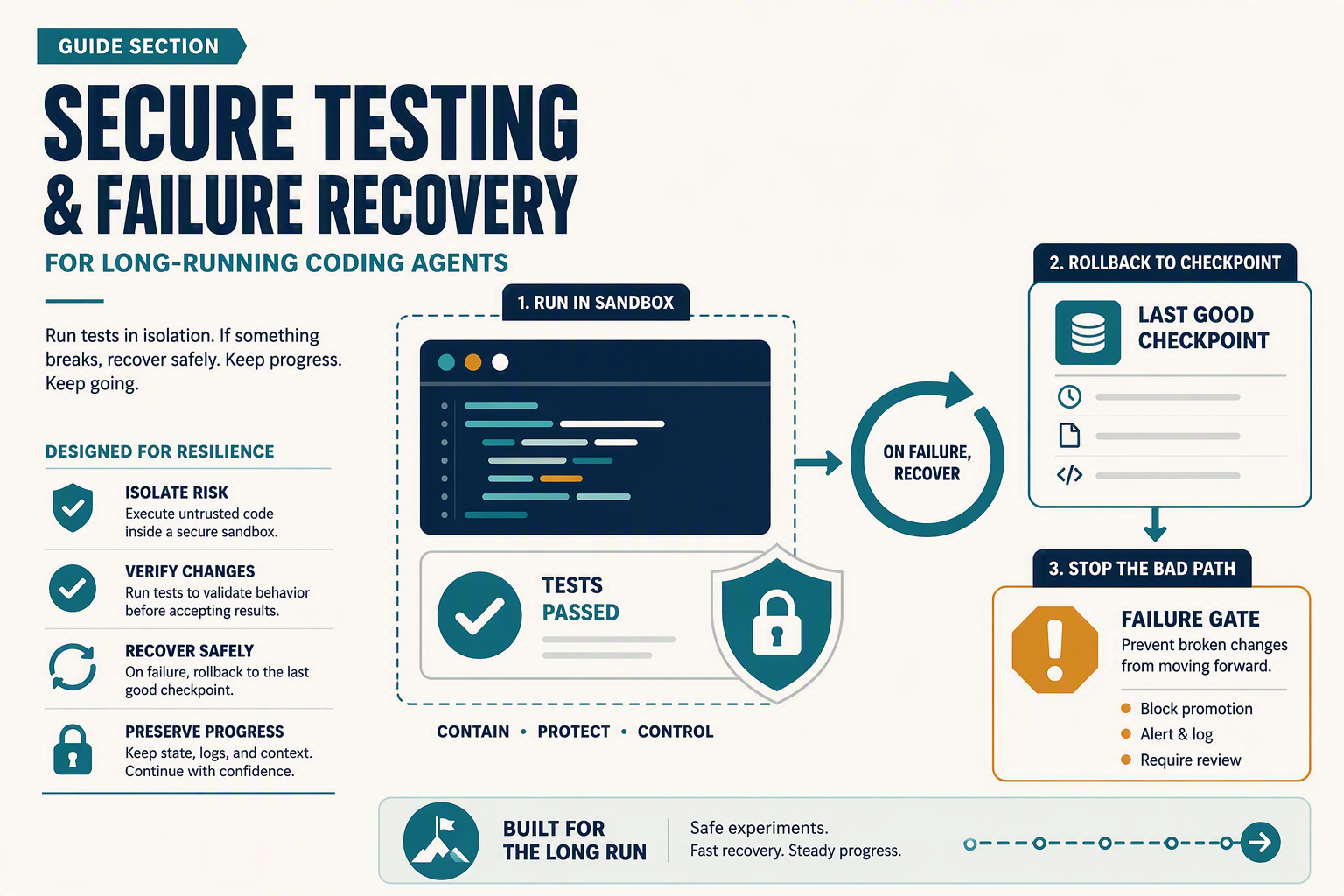
A reliable Claude Fable 5.1 coding agent should treat every tool call as untrusted, every code change as provisional, and every checkpoint as recoverable. Run the agent inside a least-privilege sandbox, validate tool inputs and outputs, require layered tests, and persist enough state to resume without replaying the entire task.
Test the tools before trusting the agent
Test the harness independently of Claude Fable 5.1. Each tool should have a narrow contract, structured parameters, predictable output, timeouts, and explicit error codes.
For every file, shell, search, test, and Git tool, verify:
- Happy path: The requested operation succeeds and returns structured evidence.
- Invalid input: Malformed paths, arguments, and commands fail safely.
- Boundary enforcement: Attempts to access files outside the workspace are rejected.
- Timeout behavior: Hung processes are terminated without blocking the agent loop.
- Output limits: Large logs are truncated or stored as artifacts rather than flooding context.
- Idempotency: Retrying an interrupted operation does not corrupt the repository.
Use a disposable fixture repository to test destructive cases. For example, confirm that the shell wrapper rejects sudo, raw network downloads, recursive deletion, credential-store access, and writes outside the checked-out worktree.
Make verification a completion gate
Do not let the agent define “done” as “the code looks correct.” Require a staged verification sequence:
- Run formatters and static analysis on changed files.
- Execute focused unit tests for the modified component.
- Run integration or contract tests across affected boundaries.
- Execute the broader regression suite when cost and runtime permit.
- Inspect
git diff, list changed files, and compare results with the acceptance criteria.
Ask Claude Fable 5.1 to report the exact commands, exit codes, failed tests, and skipped checks. Anthropic’s prompting best-practices documentation says Claude Fable 5.1 provides fewer user-facing updates between agentic tool calls, so progress and verification reports should be explicit requirements.
A useful completion rule is: “Do not claim success unless all required checks pass; otherwise return a partial-completion report.” For security-sensitive changes, add dependency scanning, secret detection, static application security testing, and human code review.
Secure the execution environment
Apply least privilege at every layer:
- Run work in an ephemeral container or virtual machine as a non-root user.
- Mount only the target repository, preferably in a temporary Git worktree.
- Keep production databases, cloud credentials, SSH keys, and
.envfiles unavailable. - Disable outbound networking by default; allowlist package registries only when necessary.
- Separate read-only inspection tools from write and execution tools.
- Require human approval for dependency installation, schema migration, deployment, force-push, or data deletion.
- Redact secrets from prompts, tool output, logs, traces, and checkpoint summaries.
Treat repository content as potentially hostile. Comments, documentation, test fixtures, and issue text can contain prompt-injection instructions; they are data, not higher-priority commands.
Recover from long-running failures
Persist a checkpoint after each meaningful milestone, not merely after every message. A useful checkpoint contains:
- Objective, constraints, and remaining acceptance criteria
- Current Git commit or patch
- Files changed and decisions made
- Commands executed with results
- Known failures and the next intended action
- Token, time, retry, and tool-call budgets
If the run crashes, start a fresh agent from the last clean checkpoint and repository state. Do not paste the entire transcript back into context; provide the compact state record plus relevant artifacts.
Use bounded retries: retry transient API or infrastructure errors with exponential backoff, but stop repeated logical failures after two or three materially different attempts. Anthropic’s service-tier documentation states that Priority Tier does not support Claude Fable 5.1 as of September 2026, making application-level checkpointing, timeout handling, and resumable queues especially important for production reliability.
How can you run a reproducible multi-hour coding evaluation and control total cost?
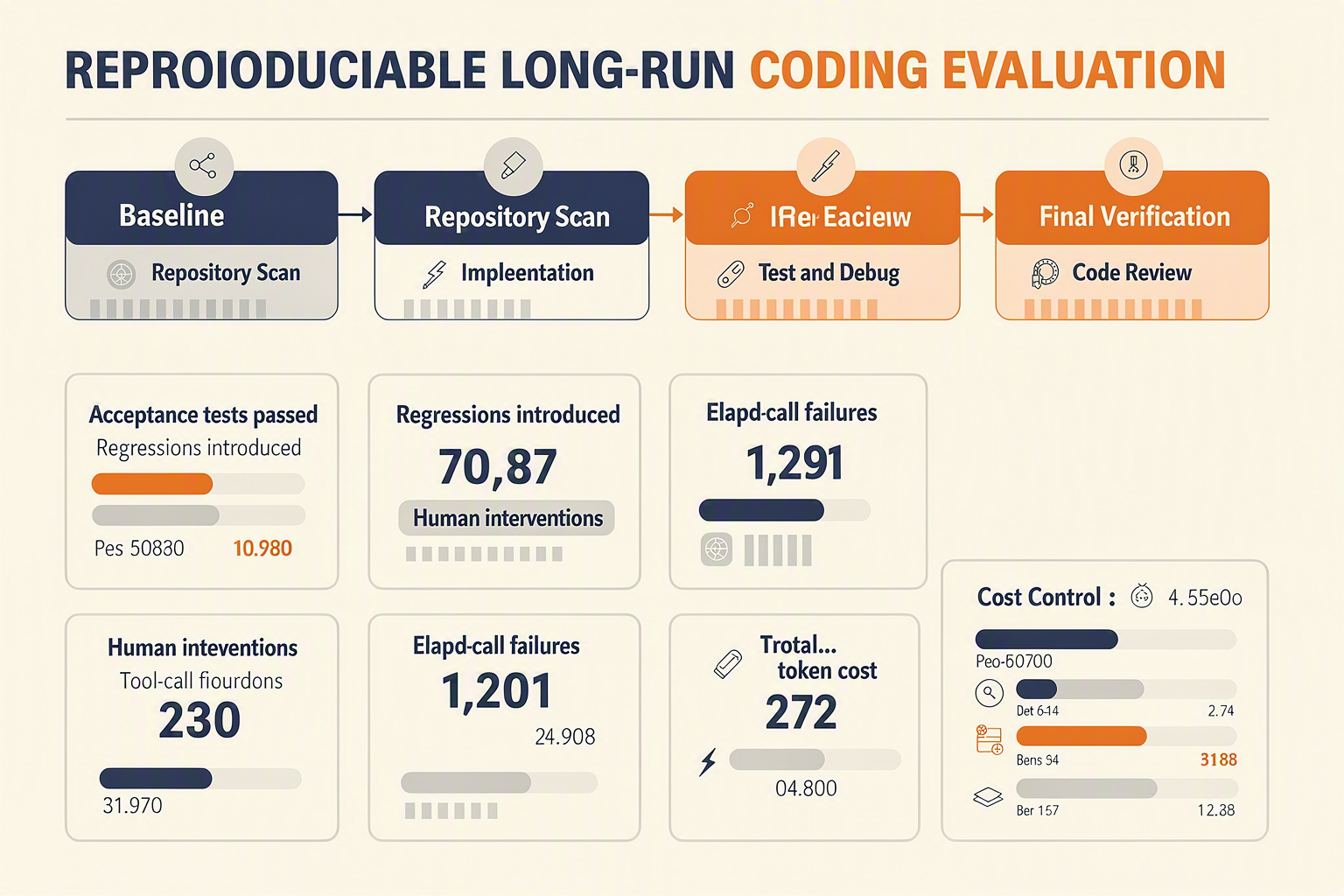
Run a reproducible multi-hour evaluation by freezing the model, repository, environment, task specification, tool permissions, and budget, then recording every API response and tool result. Control total cost with an external supervisor that enforces token, request, tool-call, and wall-clock limits rather than relying on the coding agent to stop itself.
Build a versioned evaluation fixture
Treat each evaluation as an experiment with a machine-readable manifest. Claude Fable 5.1 was released as claude-fable-5-1 on September 1, 2026, according to the Claude Platform release notes; record that exact model identifier rather than a floating alias.
Pin the following inputs:
- Git commit SHA and clean working-tree status
- Container image digest, operating system, runtime, and dependency lockfiles
- System prompt, task prompt, API parameters, and enabled tools
- Network policy, environment variables, test command, and timeout
- Maximum input tokens, output tokens, requests, tool calls, and elapsed time
- Random seed where supported, while recognizing that hosted model execution may still vary
Create a fresh repository checkout for every run. Never reuse an agent’s modified workspace, dependency cache, conversation history, or generated files unless those artifacts are explicitly part of the test.
Define measurable completion criteria
Use a task that can be scored independently of the model’s explanation. For example:
Implement issue EVAL-17 without changing public API signatures. Run unit tests and static analysis. Stop after four hours or when all required checks pass. Report changed files, commands executed, test results, and unresolved risks.
Score each run against a fixed rubric:
- Correctness: hidden and visible tests passed
- Scope control: unrelated files remained unchanged
- Reliability: no fabricated test claims or suppressed failures
- Efficiency: tokens, requests, tool calls, and wall time consumed
- Maintainability: linting, type checks, and reviewer-defined quality checks
Run the same fixture multiple times and report the success rate, median cost, and failure modes. A single successful run does not establish reproducibility.
Capture an auditable event log
Store structured records for every step:
- Timestamp, request ID, model ID, and usage fields
- Prompt or context hash
- Assistant text and tool-call arguments
- Tool stdout, stderr, exit code, and duration
- Git diff and checkpoint commit after each phase
- Tests attempted, tests passed, and termination reason
Anthropic’s prompting guidance states that Claude Fable 5.1 provides fewer user-facing updates between tool calls, so explicitly require a short progress record after each milestone. These updates improve observability but should not replace raw tool logs.
Enforce cost outside the agent
Calculate spend from the API’s returned usage categories, not from local text estimates:
run_cost = Σ(category_tokens ÷ 1,000,000 × category_rate)
total_cost = Σ(run_cost) + tool and infrastructure charges
As of September 3, 2026, Anthropic’s pricing documentation lists Claude Fable 5.1 rates of $10, $12.50, $20, and $0.25 per million tokens, depending on token category. Map each returned usage category to Anthropic’s current pricing table rather than assuming that all tokens have one rate.
Configure the supervisor to stop safely when any limit is reached:
- Soft threshold: ask for a checkpoint, remaining-work estimate, and concise context summary
- Hard threshold: block further model and tool calls
- Loop detector: stop repeated commands or materially identical patches
- Approval gate: require human authorization before extending time or budget
Finally, note that Anthropic’s service-tier documentation excludes Claude Fable 5.1 from Priority Tier as of September 3, 2026. Record queueing and latency separately from reasoning time so infrastructure variability does not distort the coding evaluation.
What do Anthropic documentation, system cards, and independent evaluations actually establish?
Anthropic’s documentation establishes that Claude Fable 5.1 is intended for demanding reasoning and long-horizon agentic work, but it does not prove that the model will outperform alternatives on every repository. The supplied sources contain no independent benchmark results, so claims about real-world superiority, reliability, or return on investment require project-specific evaluation.
What the official documentation confirms
The strongest verified claims concern product identity, intended use, and operational behavior:
- Anthropic launched Claude Fable 5.1 on September 1, 2026, under the API identifier
claude-fable-5-1, according to the Claude Platform release notes. - Anthropic’s Models Overview recommends Claude Fable 5.1 for “demanding reasoning and long-horizon agentic work”, including cases where evaluations using Claude Opus 5 at higher effort remain insufficient.
- Anthropic’s Choosing the Right Model documentation calls Claude Fable 5.1 its “most capable widely released model” and says it strengthens long-running agentic coding relative to Claude Fable 5.
- Anthropic’s prompting documentation warns that Claude Fable 5.1 produces fewer user-facing updates between tool calls, establishing a concrete reason to request progress reports in the agent prompt.
- Anthropic’s Service Tiers documentation states that Priority Tier does not support Claude Fable 5.1, which may affect latency-sensitive production designs.
These are useful engineering facts, but the capability descriptions remain first-party positioning. They establish what Anthropic designed and recommends the model for—not how accurately or economically it will modify your codebase.
What a system card can—and cannot—show
Anthropic lists a combined Claude Fable 5.1 and Claude Mythos 5.1 System Card in its model-card resources. A system card can document evaluation methodology, observed capabilities, safety testing, limitations, and mitigations under specified conditions.
However, even a strong system-card result does not automatically establish that a Claude Fable 5.1 coding agent will:
- Understand an undocumented internal architecture
- Avoid regressions across your complete test suite
- Use shell, network, and deployment tools safely
- Maintain requirements through context compaction
- Finish more cheaply than a lighter model
- Operate reliably under your concurrency and latency constraints
Treat system-card findings as bounded evidence, not a production guarantee. Check the tested model version, tool permissions, task scaffolding, sample size, scoring rules, and whether failures were independently adjudicated.
What independent evaluation must demonstrate
No numerical independent evaluation appears in the supplied research context. Therefore, this guide cannot responsibly quote a third-party Claude Fable 5.1 coding benchmark score or claim that independent testing confirms Anthropic’s positioning.
For an actionable evaluation, run a blinded comparison on representative repository tasks:
- Select 20–50 previously resolved issues covering bug fixes, refactors, migrations, and test creation.
- Give every model the same repository snapshot, tools, prompt, token ceiling, and wall-clock limit.
- Measure task completion, tests passed, regressions introduced, human-review time, tool-call failures, tokens consumed, and total cost.
- Require evidence such as diffs, test logs, and unresolved-risk summaries rather than accepting the agent’s success declaration.
- Repeat runs because agentic outcomes can vary across executions.
The correct conclusion is deliberately narrow: official evidence supports Claude Fable 5.1 as a model designed for long-running coding agents; only controlled evaluations on your own workload establish whether it is dependable and cost-effective for production.
What does Claude Fable 5.1 mean for your workflow, and when is a lighter model better?
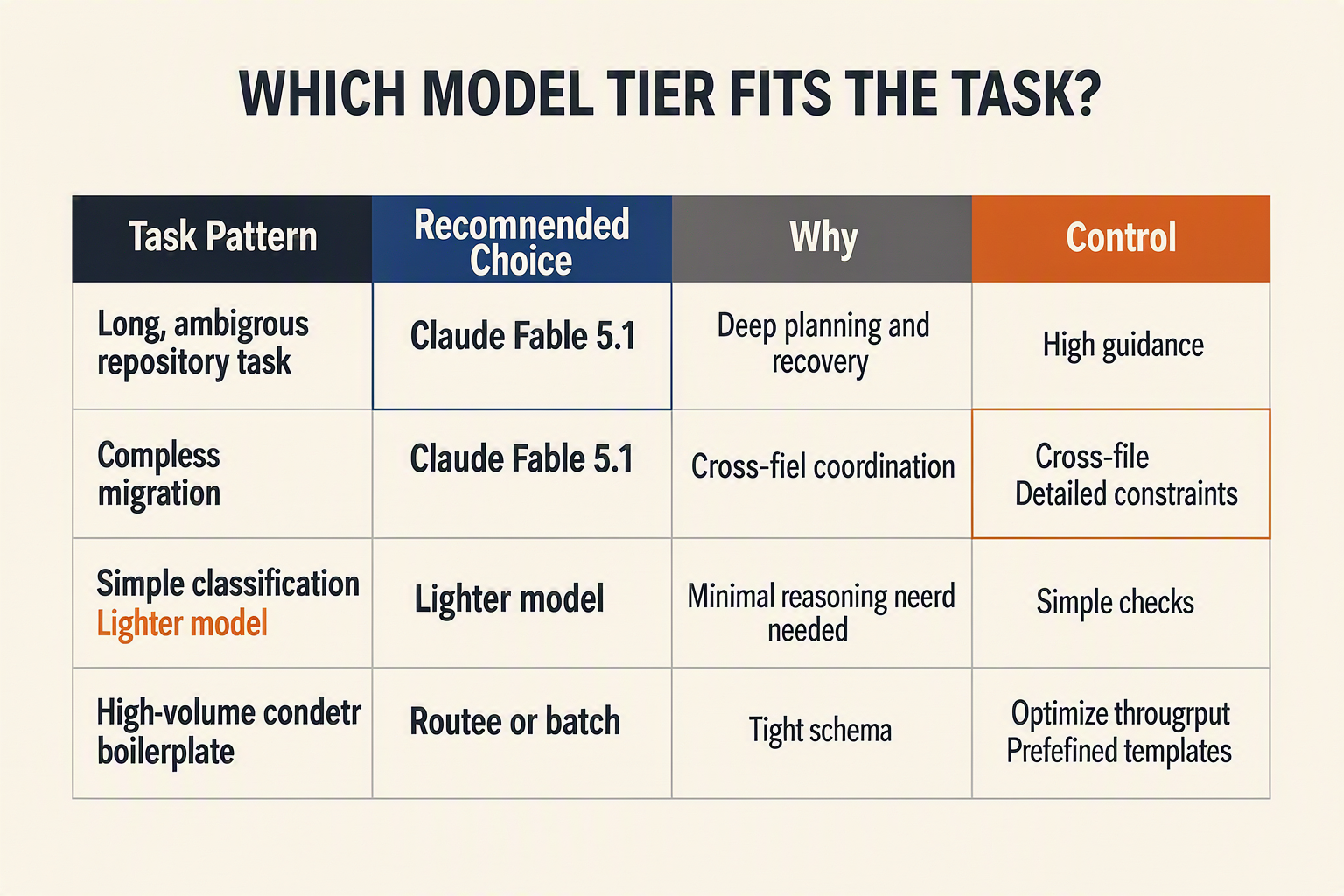
Claude Fable 5.1 should change your workflow from “use one model everywhere” to “route work by complexity and risk.” Reserve claude-fable-5-1 for ambiguous, cross-repository, long-running tasks; use a lighter model when the job is bounded, repeatable, easy to verify, or latency-sensitive.
Route tasks instead of defaulting to maximum capability
As of September 3, 2026, Anthropic’s model overview describes Claude Fable 5.1 as its “most capable widely released model” for demanding reasoning and long-horizon agentic work. Anthropic specifically recommends Claude Fable 5.1 when evaluations using Claude Opus 5 at higher effort still fall short.
That does not make Fable 5.1 the economical default for every coding request. A practical routing matrix looks like this:
| Workload | Recommended model class | Why | Escalate to Fable 5.1 when… |
|---|---|---|---|
| Formatting, lint fixes, boilerplate | Lighter model | Narrow scope and deterministic checks | Changes repeatedly fail lint or affect generated code |
| Single-function implementation | Lighter model first | Small context and fast unit-test feedback | Requirements are ambiguous or tests expose hidden dependencies |
| Test generation | Lighter model first | Highly parallel and easy to validate | The agent must infer complex invariants across modules |
| Repository-wide refactor | Claude Fable 5.1 | Requires dependency tracing and sustained planning | Use Fable from the start for tightly coupled systems |
| Intermittent bug investigation | Claude Fable 5.1 | Needs hypothesis revision across logs, code, and tests | Human approval is needed for production-data access |
| Documentation or code explanation | Lighter model | Usually read-only and bounded | Accuracy depends on reconciling many packages or specifications |
The dividing line is not simply repository size. It is the amount of state, uncertainty, tool use, and recovery the agent must manage before producing a verifiable result.
Measure completed work, not model prestige
Evaluate candidate models on your own task distribution rather than relying on a general coding benchmark. Record:
- Cost per accepted change, including failed attempts and retries
- End-to-end completion time, not merely first-token latency
- Human interventions per task
- Test-pass rate and regression count
- Tool-call loops, such as repeatedly searching for the same symbol
- Escalation rate from a lighter model to Claude Fable 5.1
A lighter model can be the better operational choice even if it needs occasional escalation. Multi-model gateways reinforce this architecture: for example, CallMissed’s OpenAI-compatible gateway exposes multiple model classes through one integration, making workload routing and same-tier fallback possible without maintaining separate provider interfaces.
Adopt a staged escalation policy
A simple production policy is:
- Classify the task by scope, risk, context breadth, and verification difficulty.
- Start light for isolated, reversible changes with strong automated tests.
- Escalate once, rather than allowing repeated low-quality retries to consume the apparent savings.
- Start with Fable 5.1 when work spans subsystems, requires prolonged investigation, or has expensive failure modes.
- Keep approval gates model-independent; greater capability does not justify unrestricted shell, network, credential, or deployment access.
This approach turns Claude Fable 5.1 into a deliberate engineering resource: the model handles the tasks where long-horizon reasoning creates measurable value, while lighter models absorb routine volume efficiently.
Frequently asked questions: Is Claude Fable 5.1 good for coding, how much does it cost, how does it compare with Fable 5, and can it run autonomously?
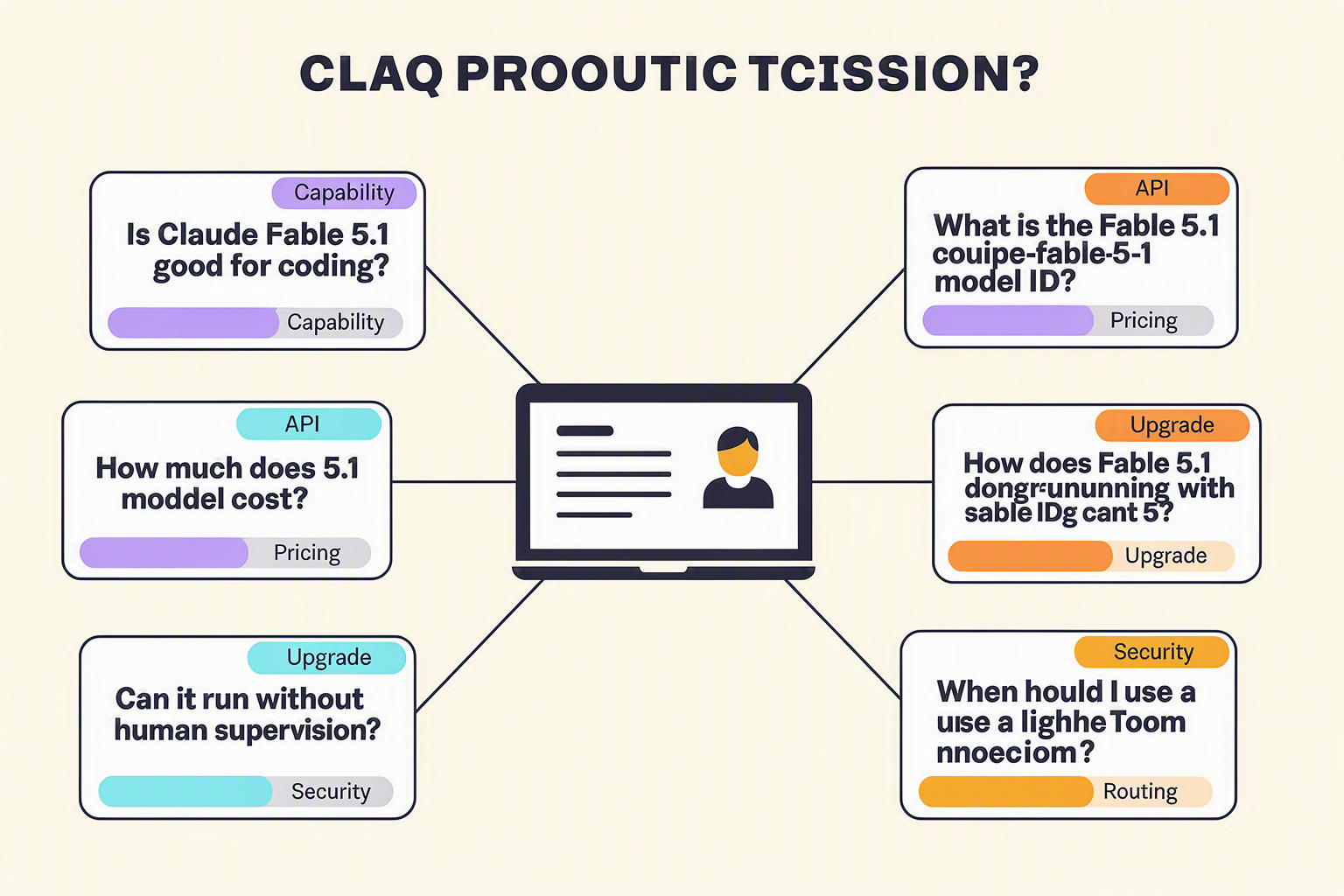
Is Claude Fable 5.1 good for coding and complex repository tasks?
How much does Claude Fable 5.1 cost through the API?
How does Claude Fable 5.1 coding compare with Claude Fable 5?
claude-fable-5-1 as the successor to Claude Fable 5, specifically emphasizing long-running agentic coding and knowledge work. Anthropic’s Choosing the Right Model documentation says Fable 5.1 extends Fable 5 with stronger long-running agentic coding, but teams should validate that improvement against their own repositories, test suites, latency requirements, and cost ceilings rather than relying on a generic benchmark alone.Can a Claude Fable 5.1 coding agent run autonomously for hours?
How do developers access Claude Fable 5.1 and connect coding tools?
claude-fable-5-1. Your application should send structured instructions and tool definitions, then execute approved operations—such as file reads, code search, test commands, or version-control queries—in a sandbox before returning results to the model; credentials and production systems should never be exposed unless the task explicitly requires narrowly scoped access.When should developers choose a lighter model instead of Claude Fable 5.1?
Conclusion
Claude Fable 5.1 coding agents are most effective when autonomy is paired with explicit boundaries, durable checkpoints, controlled tools, and test-backed completion criteria. The goal is not to let the model run indefinitely; it is to create a workflow that can explore, implement, verify, recover, and report progress safely.
- Start with a precise operating contract. Configure
claude-fable-5-1through the Claude API, define the objective and permitted scope, and require a plan before code changes. Anthropic’s September 2026 prompting guidance notes that Claude Fable 5.1 provides fewer user-facing updates between tool calls, so prompts should explicitly request progress summaries, blockers, and next actions.
- Treat tools and context as managed resources. Grant least-privilege access to repository search, terminals, test runners, and version control while blocking secrets, destructive commands, and unapproved external actions. Preserve requirements, decisions, changed files, test results, and unresolved issues in structured checkpoints rather than relying on an ever-growing transcript.
- Make verification the definition of done. Require the agent to run relevant unit, integration, linting, type-checking, and security checks; inspect failures; and provide evidence before claiming success. Use iteration limits, token budgets, human approval gates, and resumable checkpoints to stop repeated failures or unsafe execution.
- Match model capability to task economics. Anthropic’s pricing documentation lists Claude Fable 5.1 rates of $10, $12.50, $20, and $0.25 per million tokens, depending on token category, while Anthropic’s service-tier documentation states that Priority Tier does not support Claude Fable 5.1. Reserve long-horizon capability for difficult migrations, debugging, and repository-scale changes; use lighter models for routine transformations and straightforward fixes.
What matters next is how reliably long-running coding agents maintain state, recover from tool failures, control costs, and prove correctness under real production constraints. Developers exploring multi-model architectures can also evaluate CallMissed, an OpenAI-compatible AI infrastructure platform offering one integration for multiple model classes with same-tier fallbacks.
Which software task would you trust an agent to run for hours—and what evidence would you require before merging its work?
Related Reading
- Claude Fable 5.1 vs GPT-5.6 Sol: Pricing, Coding & Voice Agents
- Claude Fable 5.1 Benchmarks: Coding Performance, Evidence, and Caveats
- Claude Fable 5.1 vs GPT-6 Astra: 2026 Buyer’s Guide