Claude Fable 5 Orchestrator: Advisor vs Orchestrator Guide



Claude Fable 5 orchestrator patterns with Haiku 5.5 and Sonnet 5.5: routing rules, an architecture diagram and a cost table with stated assumptions.

Claude Fable 5 Orchestrator: Advisor vs Orchestrator Guide
A single model pairing can quietly break your agent: according to Anthropic's Sonnet 5.5 release notes on platform.claude.com, a Claude Haiku 5.5 advisor works with a Claude Sonnet 5 executor but returns a 400 invalid_request_error with a Claude Sonnet 5.5 executor. That is why picking a Claude Fable 5 orchestrator pattern deserves more care than "use the smartest model for everything." As of November 2026, the Claude 5.5 family gives you a real cost ladder, and the main design question is which model sits where.
Anthropic describes two roles for Claude Fable 5.2. As an advisor, Fable 5.2 stays in the background while a smaller, cheaper model does the work and consults it only when it needs guidance. As an orchestrator, Fable 5.2 takes the lead, breaks the task into pieces and delegates them to workers.
The worker tier has become much more capable. Anthropic positions Claude Sonnet 5.5 (claude-sonnet-5-5) as "the best combination of speed and intelligence," and Claude Haiku 5.5 now covers narrow tasks that used to need Sonnet. Caylent's analysis concludes that if you currently use Sonnet 5.5 for a narrow task, Haiku 5.5 will likely give you lower costs and faster responses.
Developers are already building on this layered approach. One widely shared X post from @dr_cintas describes a workflow where Opus plans, Sonnet 5.5 at medium effort edits files and runs tests, Haiku reads, and Fable reviews. A Reddit user in r/ClaudeCode re-ran six tasks that Opus 5.5 had already completed on Sonnet 5.5 and Haiku 5.5 at high effort to see where the cheaper models hold up. In Claude Code, the sonnet and haiku aliases now resolve to the 5.5 models on the Anthropic API, so many teams are running this tiering by default.
In this guide, you will learn:
- When to use Fable 5.2 as an advisor and when to promote it to orchestrator
- How to assign Haiku 5.5 and Sonnet 5.5 to the right jobs, and how effort settings affect cost
- Which advisor and executor pairings are unsupported, so you avoid 400 errors in production
- How to structure the handoffs to keep agent costs predictable
The same logic of matching each model to its role is why multi-model platforms such as CallMissed, whose developer API offers 159 models behind OpenAI-compatible and Anthropic-compatible endpoints, are gaining traction.
Should Claude Fable 5.2 Be Your Advisor or Your Orchestrator?
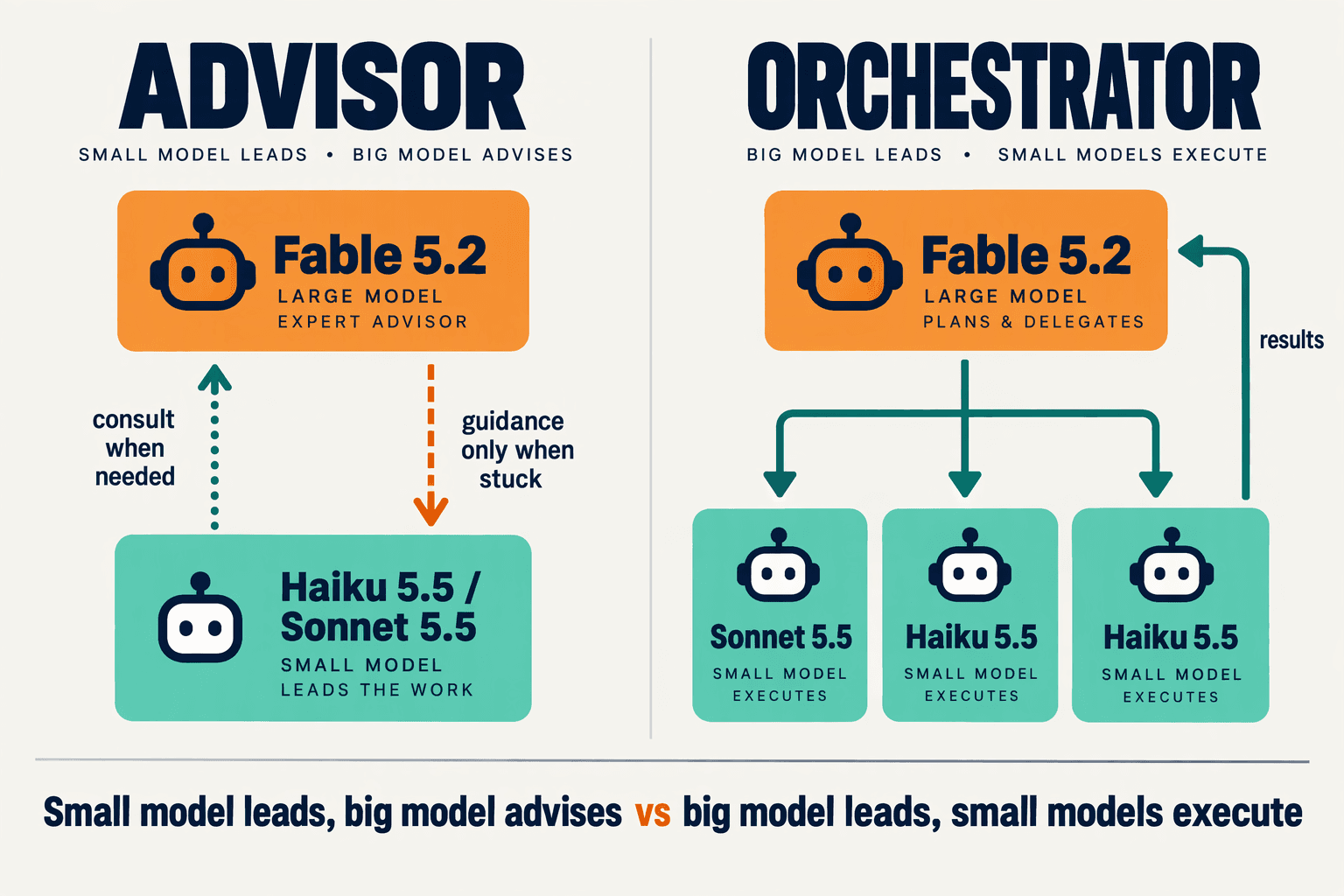
Use Claude Fable 5.2 as an advisor when a cheaper model can do most of the work and only needs help with occasional hard decisions. Use it as an orchestrator when the task has to be planned, split up and merged back together. The choice decides which model's tokens you pay for on every turn.
What is the difference between an advisor and an orchestrator?
In the advisor pattern, a smaller executor such as Claude Sonnet 5.5 or Claude Haiku 5.5 runs the loop. It calls Fable 5.2 only when it is stuck or facing a high-stakes choice, so the expensive model's usage stays small.
In the orchestrator pattern, Fable 5.2 owns the loop. It decomposes the goal, assigns pieces to worker models and checks what comes back. Its tokens are spent on planning and synthesis every run, but it also controls how the work is divided.
When should Fable 5.2 be the advisor?
Choose the advisor role when most steps are routine and judgment is needed only at a few points. Typical cases:
- Single-threaded tasks where one executor works through steps in order, such as editing a file and running tests.
- Narrow, repeatable jobs. Caylent's analysis concludes that if you use Sonnet 5.5 for a narrow task, Haiku 5.5 will likely give you lower costs and faster responses, which makes Haiku 5.5 a natural cheap executor.
- Cost-sensitive volume, where you want the strong model's judgment without paying for it on every call.
Check the pairing before you ship. According to Anthropic's Sonnet 5.5 release notes on platform.claude.com, as of November 2026 several advisors return a 400 invalid_request_error with a Claude Sonnet 5.5 executor. The notes list Claude Opus 4.8, Opus 4.7, Sonnet 5 and Haiku 5.5. Fable 5.2 is not named in that excerpt, so test your exact advisor and executor combination in staging rather than assuming it works.
When should Fable 5.2 be the orchestrator?
Promote it when the task needs real decomposition. Good signals include:
- Independent subtasks that different workers can handle, such as reading, editing and verifying.
- Mixed difficulty, where some pieces suit Haiku 5.5 and others need Sonnet 5.5.
- A review step where a stronger model should check the output before it is accepted.
The workflow shared by @dr_cintas on X shows how this tiering looks in practice. Opus plans, Sonnet 5.5 at medium effort edits files and runs tests, Haiku reads, and Fable reviews. The poster's configuration for the worker is model: sonnet, effort: medium. Fable's job in that setup is review, so it uses the strongest model for judgment rather than for volume.
How do you decide in practice?
Start with the advisor pattern and move to orchestration only when the work no longer fits a single executor loop. Validate each worker tier on your own tasks first. One r/ClaudeCode user re-ran six tasks that Opus 5.5 had already completed on Sonnet 5.5 and Haiku 5.5, all at high effort, to see where the cheaper models hold up. That kind of test tells you which steps can be delegated.
Aliases also help. According to claude-world.com, sonnet resolves to Sonnet 5.5 from Claude Code v2.1.284 and haiku resolves to Haiku 5.5 from v2.1.293 on the Anthropic API. Many teams are therefore already running this tiering without changing a line of config.
What Changed With Fable 5.2, Sonnet 5.5 and Haiku 5.5?

Three things changed in the Claude 5.5 family as of November 2026: Claude Sonnet 5.5 became the default mid-tier worker, Claude Haiku 5.5 became a credible option for narrow tasks, and the advisor tool gained a pairing restriction that can break existing agents. Here is what the sources confirm and what each change means for an orchestrator design.
What is new in Claude Sonnet 5.5?
According to Anthropic's release notes on platform.claude.com, Claude Sonnet 5.5 (claude-sonnet-5-5) is described as "the best combination of speed and intelligence." For agent builders, the feature list matters more than the tagline. Anthropic says Sonnet 5.5 supports:
- Per-message effort (beta), so you can change reasoning depth mid-conversation
- Mid-conversation system messages and mid-conversation tool changes (beta)
- Prompt caching with a 512-token minimum cacheable prompt
- Batch processing, the Files API, PDF support and vision
- Server-side and client-side tools
Per-message effort is the most useful of these for cost control. A worker can run at medium effort for routine edits and be raised for one hard step without switching models.
What is new in Claude Haiku 5.5?
Caylent's analysis calls Claude Haiku 5.5 a major upgrade over Haiku 4.5. Its conclusion is direct: if you currently use Sonnet 5.5 for a narrow task, Haiku 5.5 is likely to get you lower costs and faster responses. That makes Haiku the natural choice for the high-volume, low-ambiguity steps in an agent, such as reading files, extracting fields and classifying inputs.
Which advisor pairings are now unsupported?
Anthropic's Sonnet 5.5 release notes list this as a breaking change. Claude Opus 4.8, Claude Opus 4.7, Claude Sonnet 5 and Claude Haiku 5.5 advisors work with a Claude Sonnet 5 executor. With a Claude Sonnet 5.5 executor, they return a 400 invalid_request_error.
The practical consequence is that upgrading the executor can break a pairing that worked yesterday. The release notes do not name Fable in that list. Even so, test every advisor and executor pair in staging before you promote a model change to production.
How do the aliases map in Claude Code?
claude-world.com documents the alias changes on the Anthropic API:
| Alias | Resolves to | Minimum Claude Code version |
|---|---|---|
| - | - | - |
opus | Opus 5.5 | not stated in the source |
sonnet | Sonnet 5.5 | v2.1.284 |
haiku | Haiku 5.5 | v2.1.293 |
The same source notes that aliases still depend on your provider, so a team on a different cloud may not get the same mapping. If your agents pin behavior to an alias, check what it resolves to in your environment.
What are developers actually doing with these models?
Two community examples show the tiering in practice:
- In a post on X, @dr_cintas assigns Sonnet 5.5 as the worker, with the settings
model: sonnet, effort: medium. The worker edits files and runs tests. - A r/ClaudeCode user took six tasks that Opus 5.5 had already completed and re-ran them on Sonnet 5.5 and Haiku 5.5, with high effort for all.
Neither example is a formal benchmark, so treat them as starting points for your own evals. The next section turns these patterns into concrete role assignments.
What Are the Key Facts on Fable 5.2, Sonnet 5.5 and Haiku 5.5?
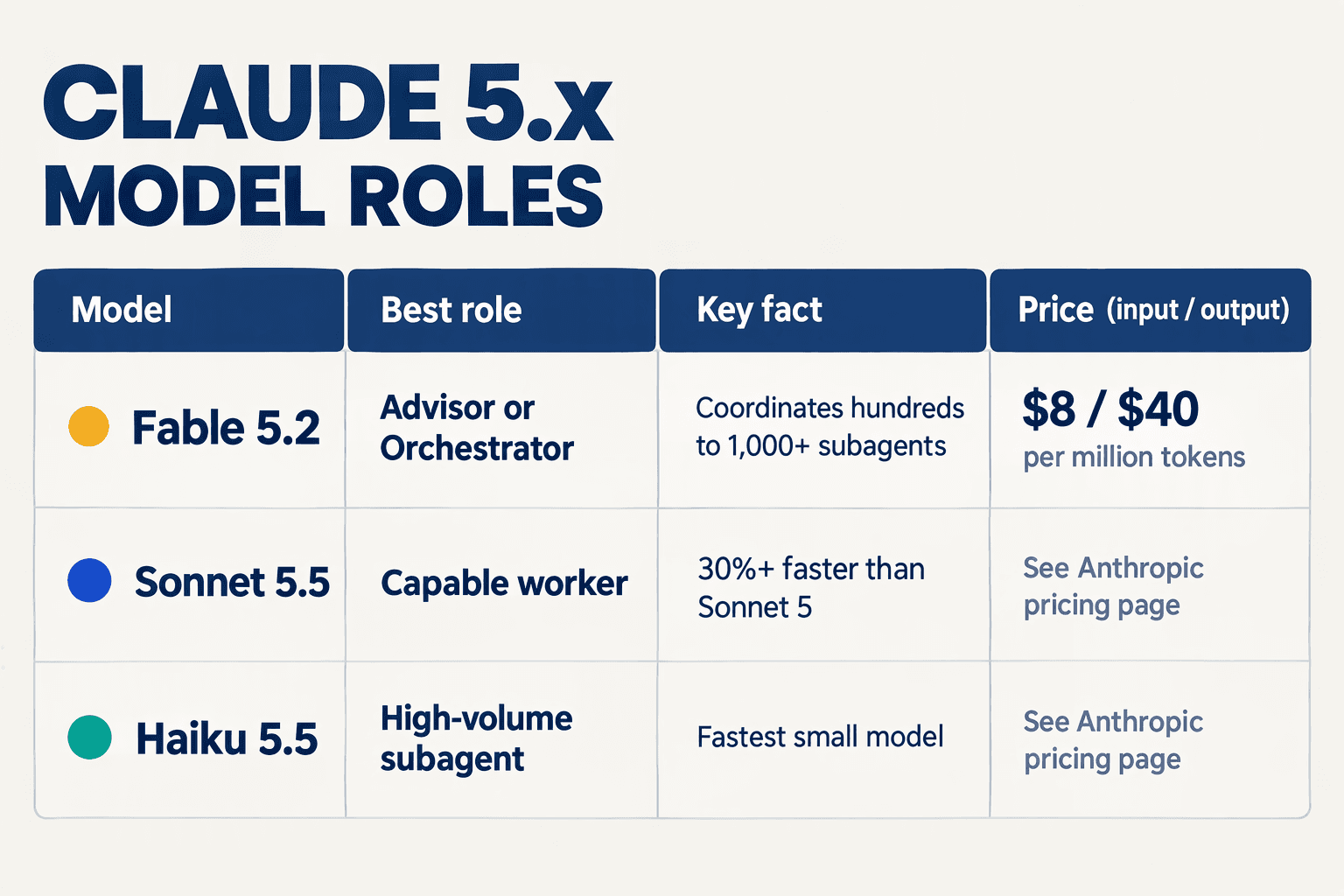
Claude Fable 5.2, Claude Sonnet 5.5 and Claude Haiku 5.5 each fill a different tier: Fable 5.2 advises or orchestrates, Sonnet 5.5 is the general-purpose worker, and Haiku 5.5 handles narrow, high-volume jobs. As of November 2026, the table below collects only what the cited sources state, and marks gaps instead of guessing.
How do the three models compare?
| Model | Best role | API ID / Claude Code alias | Key fact (source) | Caveat |
|---|---|---|---|---|
| Claude Fable 5.2 | Advisor or orchestrator | Not listed in the sources reviewed | Anthropic describes two roles: background advisor, or lead orchestrator that delegates | Check Anthropic's docs for the current ID and pricing before budgeting |
| Claude Sonnet 5.5 | General-purpose worker | claude-sonnet-5-5; sonnet alias (Claude Code v2.1.284+) | Anthropic calls it "the best combination of speed and intelligence" | Rejects some advisor pairings with a 400 error |
| Claude Haiku 5.5 | Narrow, high-volume tasks | haiku alias (Claude Code v2.1.293+) | Caylent says Haiku 5.5 is likely to give lower costs and faster responses than Sonnet 5.5 on narrow tasks | Unsupported as an advisor for a Sonnet 5.5 executor |
| Claude Opus 5.5 | Planning, hard reasoning | opus alias on the Anthropic API | claude-world.com lists it as the opus target on the Anthropic API | The earlier Opus 4.8 and 4.7 advisors are also blocked with a Sonnet 5.5 executor |
What does Sonnet 5.5 support that matters for agents?
According to Anthropic's Sonnet 5.5 release notes on platform.claude.com, the model supports several features that directly affect orchestration cost and control:
- Per-message effort (beta): lets you change effort mid-conversation, so a worker can run at medium effort for edits and higher effort for a tricky step.
- Prompt caching: the minimum cacheable prompt is 512 tokens, so a shared system prompt and tool list can be reused across worker calls.
- Mid-conversation system messages and tool changes (beta): a coordinator can adjust a worker's instructions or tools without restarting the thread.
- Batch processing, Files API, PDF support and vision: these cover document-heavy and non-urgent workloads.
The @dr_cintas workflow on X shows the effort lever in practice. The worker runs with model: sonnet and effort: medium, editing files and running tests.
Which advisor and executor pairings fail?
Anthropic's release notes state that Claude Opus 4.8, Claude Opus 4.7, Claude Sonnet 5 and Claude Haiku 5.5 advisors work with a Claude Sonnet 5 executor. With a Claude Sonnet 5.5 executor, they return a 400 invalid_request_error.
| Advisor | Executor | Result |
|---|---|---|
| Claude Haiku 5.5 | Claude Sonnet 5 | Works |
| Claude Haiku 5.5 | Claude Sonnet 5.5 | 400 invalid_request_error |
| Claude Sonnet 5 | Claude Sonnet 5.5 | 400 invalid_request_error |
The sources reviewed don't say whether Fable 5.2 is affected, so test your exact pairing in staging before rollout. Pin model IDs, because the Claude Code aliases move with each release. The sonnet and haiku aliases now resolve to the 5.5 models on the Anthropic API, but claude-world.com notes that aliases still depend on your provider.
How should you validate Haiku 5.5 before moving work to it?
Re-run real tasks. One r/ClaudeCode user took six tasks that Opus 5.5 had already completed in their project and replayed them on Sonnet 5.5 and Haiku 5.5, all at high effort. That is a cheap, repeatable method:
- Pick five to ten completed tasks from your own logs.
- Replay them on the cheaper model with identical prompts.
- Compare correctness, retries and total tokens, not just price per token.
The next section applies these facts to concrete handoff patterns.
What Does a Fable 5.2 Orchestrator Architecture Look Like?
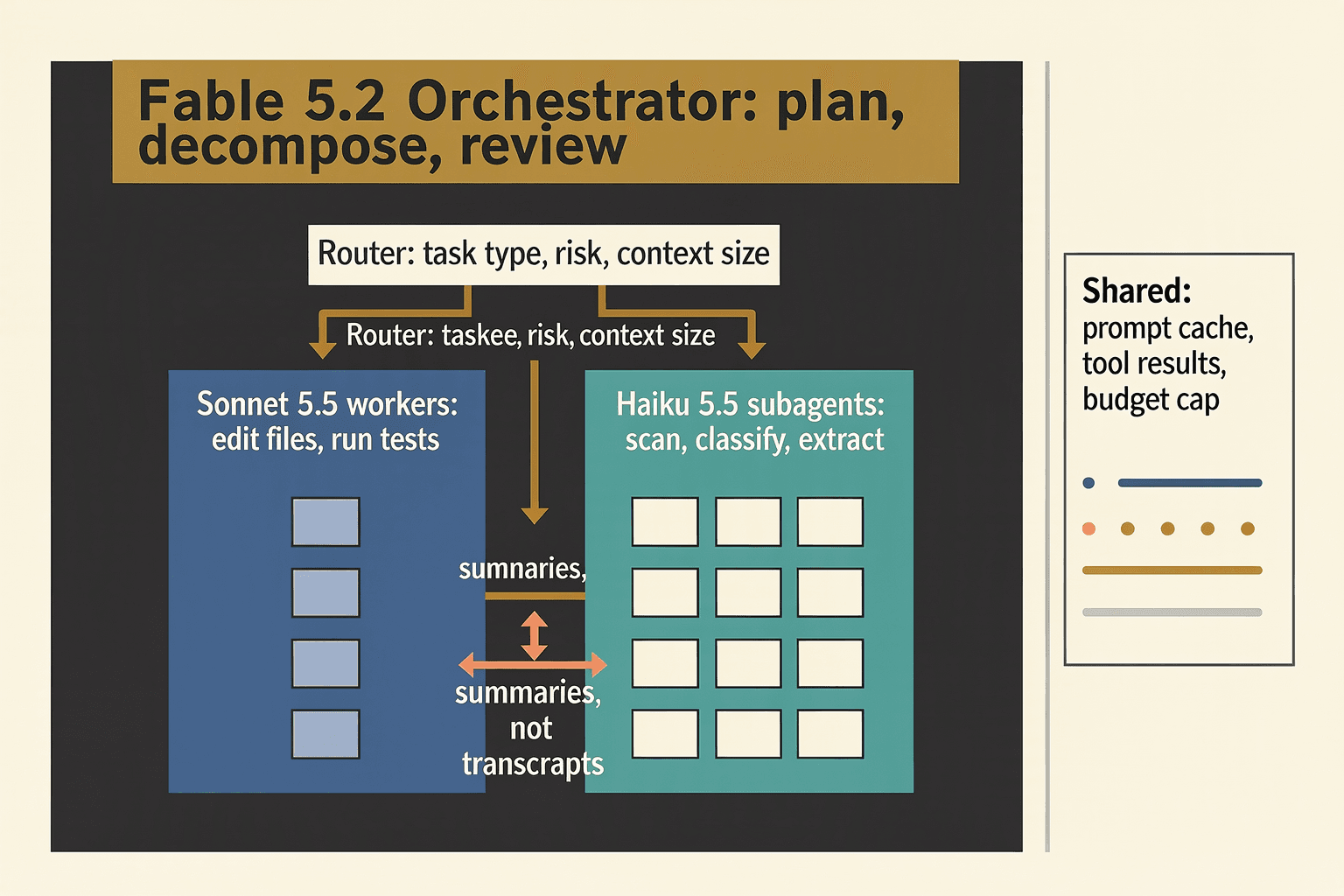
A Claude Fable 5.2 orchestrator architecture is a three-tier loop: Fable 5.2 plans and delegates, Claude Sonnet 5.5 executes the substantial work, and Claude Haiku 5.5 handles cheap, narrow jobs such as reading. Fable 5.2 then returns at the end to review the merged result. As of November 2026, this is the layout developers are converging on.
How does the orchestrator loop work step by step?
The workflow shared by @dr_cintas on X maps closely to this structure: planning at the top, Sonnet 5.5 at medium effort editing files and running tests, Haiku reading, and Fable reviewing. A generic version looks like this:
- Plan. Fable 5.2 receives the goal, decomposes it into discrete subtasks and writes a brief for each one.
- Delegate reads to Haiku 5.5. File scans, log parsing and retrieval run on the cheapest tier. Caylent's analysis suggests Haiku 5.5 is likely to deliver lower cost and faster responses on narrow tasks that teams previously gave to Sonnet 5.5.
- Delegate execution to Sonnet 5.5. The worker edits files and runs tests. The @dr_cintas post sets
model: sonnetwitheffort: mediumon this worker. - Merge and review. Workers return compact results, and Fable 5.2 checks them against the original goal before anything ships.
What should each handoff contain?
Handoffs are where most agent cost leaks, so treat them like an API contract:
- A self-contained brief. State the objective, the relevant file paths or data, and the expected output format. Workers should not need the full orchestrator history.
- A bounded return value. Ask for a short summary plus structured results, not a transcript. Fable 5.2 tokens are the most expensive, so keep what flows back to it small.
- An explicit effort level per worker. Sonnet 5.5 supports per-message effort (beta), per Anthropic's release notes, so you can raise effort for a hard step and lower it for routine ones within one conversation.
- A stable, cacheable prefix. Sonnet 5.5 supports prompt caching with a 512-token minimum cacheable prompt. Put shared instructions and tool definitions first so repeated worker calls reuse them.
Do cheaper workers hold up in practice?
Evidence is still community-sourced, so validate on your own workload. One r/ClaudeCode user re-ran six tasks that Opus 5.5 had already completed on Sonnet 5.5 and Haiku 5.5, using high effort for all, to see where the smaller models hold up. Use the same method: replay a handful of real tasks through each tier before you lock in routing rules.
What pitfalls should you plan for?
Anthropic's Sonnet 5.5 release notes document that a Haiku 5.5 advisor paired with a Sonnet 5.5 executor returns a 400 invalid_request_error. That restriction is documented for advisor tool pairings. If your system mixes advisor consultations with orchestrated delegation, test each pairing in staging rather than assuming it carries over.
Also remember that Claude Code's sonnet and haiku aliases resolve to the 5.5 models on the Anthropic API, but, as claude-world.com notes, aliases still depend on your provider. Pin explicit model IDs such as claude-sonnet-5-5 in production code.
Teams that want fallbacks or mixed-vendor workers can use a gateway such as CallMissed's Anthropic-compatible /v1/messages endpoint, which supports caller-chosen fallback models, so a worker call has a defined alternative if a pairing fails.
Which Routing Rules Decide What Goes to Haiku, Sonnet or Fable?
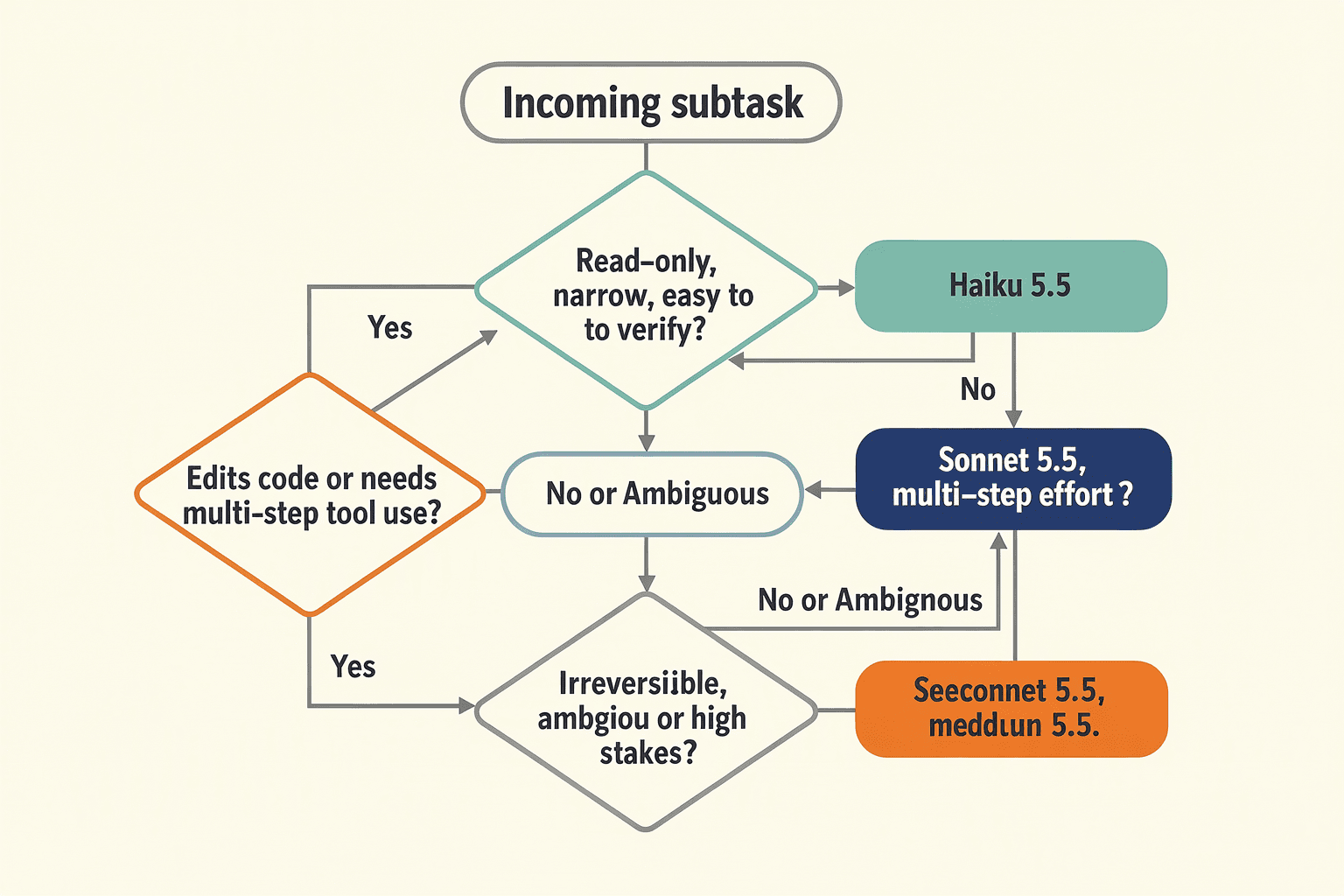
Route by task shape, not by prestige: send narrow, well-specified work to Claude Haiku 5.5, multi-step execution to Claude Sonnet 5.5, and only planning, review and hard judgment calls to Claude Fable 5.2. As of November 2026, the public evidence suggests this ladder holds up, though the benchmarks behind it are mostly anecdotal. Treat the rules below as defaults to validate against your own workload.
Which tasks should go to Haiku 5.5?
Send Haiku 5.5 work that is narrow, read-heavy and easy to verify. Caylent's analysis of the release concludes that if you currently use Sonnet 5.5 for a narrow task, Haiku 5.5 is likely to give you lower costs and faster responses.
Good Haiku candidates:
- Reading files, logs or documents and returning a summary
- Classifying, tagging or extracting fields from input
- Searching a codebase or knowledge base and reporting what it found
The workflow shared by @dr_cintas on X follows this rule: Haiku reads, and nothing downstream depends on it making a judgment call.
Which tasks belong with Sonnet 5.5?
Give Sonnet 5.5 (claude-sonnet-5-5) the execution work, meaning anything that edits, calls tools or loops until a check passes. Anthropic calls it "the best combination of speed and intelligence." In the same X workflow, Sonnet 5.5 is the worker at medium effort, editing files and running tests, set with model: sonnet, effort: medium.
Medium effort is a sensible starting point for routine edits. Raise it only when a task fails verification. A Reddit user in r/ClaudeCode re-ran six tasks that Opus 5.5 had already completed on Sonnet 5.5 and Haiku 5.5, with high effort for all. That is a useful test design because it holds effort constant and isolates the model.
When should a task escalate to Fable 5.2?
Escalate when a wrong answer is expensive or when the task needs decomposition. Use these triggers:
- Ambiguous goals: the executor cannot say what "done" looks like.
- Irreversible actions: deletes, payments, production deploys.
- Failed verification twice: the same test or check fails after two attempts by the worker.
- Final review: a quality gate before output reaches a user or a main branch.
This matches the "Fable reviews" step in the layered workflow. Fable's tokens go only to the few moments where they change the outcome.
What routing rules prevent expensive mistakes?
- Make escalation explicit. Put the triggers above in the executor's system prompt, or the cheap model will rarely ask for help.
- Keep prompts stable for caching. Claude Sonnet 5.5 supports prompt caching with a 512-token minimum cacheable prompt, so shared worker instructions should sit above that threshold and not change between turns.
- Use per-message effort. Sonnet 5.5 supports per-message effort (beta), so you can raise effort for one hard step without changing the whole session.
- Check pairings before deploying. Anthropic's Sonnet 5.5 release notes say a Haiku 5.5 advisor returns a 400
invalid_request_errorwith a Sonnet 5.5 executor. Test every advisor and executor combination in staging. - Pin models in production. In Claude Code,
sonnetandhaikuresolve to the 5.5 models on the Anthropic API, according to claude-world.com, but aliases still depend on your provider. Use explicit model IDs where behavior must not shift.
How do you apply the same routing outside Claude Code?
The rules are model-agnostic. Gateways such as CallMissed, the OpenAI-compatible and Anthropic-compatible AI API, support caller-chosen fallback models and a single key across 159 models. That makes it practical to encode "try the cheap tier first, escalate on failure" in one request layer.
How Much Does an Advisor or Orchestrator Setup Cost?
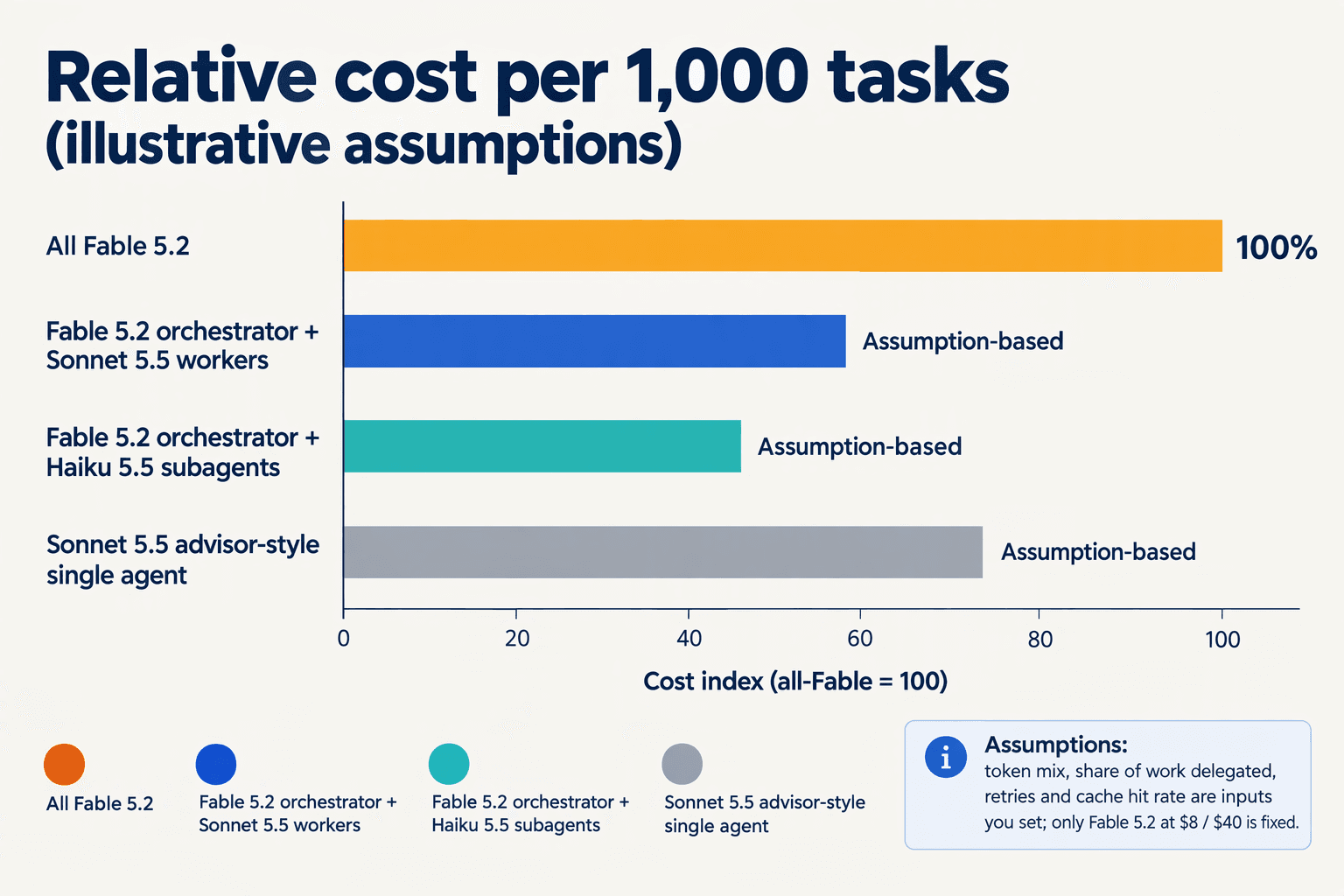
A Fable 5.2 advisor or orchestrator setup costs roughly what its executor costs, plus a small premium for each time Fable is called. As of November 2026, the biggest cost driver is how many tokens flow through the most expensive model, not which pattern you pick. Check Anthropic's pricing page for current per-token rates before you budget, because list prices change between releases.
How do the main setups compare on cost?
The table ranks each setup by where the bulk of the tokens land.
| Setup | Who handles most tokens | Fable 5.2 usage | Relative cost | Best for |
|---|---|---|---|---|
| Haiku 5.5 alone | Haiku 5.5 | None | Lowest | Narrow, well-defined tasks |
| Sonnet 5.5 alone (medium effort) | Sonnet 5.5 | None | Low to moderate | General coding and tool use |
| Sonnet 5.5 or Haiku 5.5 executor + Fable 5.2 advisor | The executor | Occasional short consults | Low plus a small premium | Mostly routine work with rare hard calls |
| Fable 5.2 orchestrator + Sonnet 5.5 workers | Workers | Planning and merging every run | Moderate to high | Tasks that must be split and recombined |
| Fable 5.2 orchestrator + Haiku readers + Sonnet workers | Haiku and Sonnet | Planning and review | Moderate | Large codebases with heavy reading |
| Haiku 5.5 advisor + Sonnet 5.5 executor | n/a | n/a | Request fails | Avoid |
The last row is not a cost optimization. Anthropic's Sonnet 5.5 release notes on platform.claude.com state that a Haiku 5.5 advisor paired with a Sonnet 5.5 executor returns a 400 invalid_request_error. Test every new pairing in staging before you route production traffic through it.
What drives the bill in each pattern?
- Advisor pattern: You pay for the executor's full loop, plus Fable's input and output tokens on each consult. Keep consult prompts short and summarized.
- Orchestrator pattern: Fable's cost grows with the number of workers, because it reads and merges every result. Return compact worker summaries instead of raw transcripts.
- Effort settings: Sonnet 5.5 supports per-message effort (beta), so you can use medium effort for routine steps and raise it only when needed. The @dr_cintas workflow on X uses
model: sonnet, effort: mediumfor the worker. - Prompt caching: Sonnet 5.5 supports caching with a 512-token minimum cacheable prompt. Orchestrator and worker prompts that repeat large instructions are good candidates.
- Batch processing: Sonnet 5.5 supports batch processing, which suits non-urgent worker jobs.
How do I estimate my own monthly cost?
- Log tokens per run for each role (executor, advisor or orchestrator, workers).
- Multiply each role's input and output tokens by its current per-token rate.
- Subtract expected prompt-cache savings on repeated prefixes.
- Compare the total against running Sonnet 5.5 alone at medium effort.
If the Fable share of tokens stays small, the layered setup usually wins on cost. If Fable ends up reading everything, you have built an expensive single-model agent with extra steps. Caylent's analysis adds that for a narrow task currently on Sonnet 5.5, Haiku 5.5 is likely to give lower costs and faster responses, so test the cheaper tier first.
Can I run these tiers through one API balance?
If you want to keep budgeting simple, one balance across tiers helps. CallMissed's developer API exposes Anthropic-compatible (/v1/messages) and OpenAI-compatible endpoints, so existing SDKs work by changing the base URL. It prices in credits (1 credit = ₹1), which makes it easy to compare the cost of a model ladder in a single unit.
When Is Multi-Agent Orchestration Worth It Versus a Single Agent?

Multi-agent orchestration is worth it when a task splits into independent, differently priced pieces. For a short, sequential task, a single well-prompted agent is usually cheaper and easier to debug. As of November 2026, the Claude 5.5 family makes tiering attractive, but every extra agent adds tokens, latency and failure modes.
When does a single agent win?
Stay with one agent, such as Claude Sonnet 5.5 (claude-sonnet-5-5), when most of these are true:
- The task is linear. Each step depends on the last, so there is nothing to parallelize.
- The context is small. Handing context between agents costs tokens, and a short task never earns that back.
- One capability level fits the whole job. If every step needs the same intelligence, routing saves nothing.
- You need simple debugging. One transcript is far easier to audit than several agents passing summaries.
Caylent's analysis of Claude Haiku 5.5 points to a cheaper form of the same idea. If you use Sonnet 5.5 for a narrow task, Haiku 5.5 will likely give you lower costs and faster responses. That is a model swap, not an orchestration project.
When does multi-agent orchestration pay off?
Orchestration earns its overhead when work is decomposable, parallel or uneven in difficulty. Typical signals:
- Cheap bulk work surrounds a few hard decisions. Reading files, searching and extracting can run on Haiku 5.5, while planning and review go to Fable 5.2.
- Subtasks can run in parallel. An orchestrator fans work out to workers and merges the results.
- Context would otherwise bloat. A worker can read a large file set and return only a summary, which keeps the lead agent's context small.
- Failure is expensive. A reviewer tier catches errors before they reach production.
The workflow @dr_cintas shared on X fits this profile. Sonnet 5.5 at medium effort is the worker that edits files and runs tests, Haiku reads, and Fable reviews. Each tier does the work it is cheapest for.
How do you test whether it's worth it before committing?
Run your own comparison instead of trusting a generic benchmark. One r/ClaudeCode user took six tasks that Opus 5.5 had already completed and re-ran them on Sonnet 5.5 and Haiku 5.5 at high effort. That is a good template.
- Pick 5-10 real tasks from your own workload.
- Run a single-agent baseline on one model.
- Run the tiered version with workers and an advisor or orchestrator.
- Compare cost per successful task, not cost per token, and include retries.
- Track latency and handoff failures, since a cheap worker that needs rework erases the saving.
What hidden costs does orchestration add?
- Coordination tokens. Briefs, summaries and merge steps are billed on every handoff.
- Compatibility risk. Anthropic's Sonnet 5.5 release notes say a Haiku 5.5 advisor returns a 400
invalid_request_errorwith a Sonnet 5.5 executor, so a pairing that works on one model can break on its successor. - Caching limits. Sonnet 5.5 supports prompt caching with a 512-token minimum cacheable prompt, so short worker prompts may not benefit.
The same trade-off applies outside coding agents. In voice, platforms like CallMissed offer squads that hand a live call from one agent to another, which only pays off when each agent has a clearly separate job.
A practical rule: start with one agent, add a worker tier only where a measured step is both cheap and repeatable, and add an orchestrator only when parallelism or context size forces it.
What Do Early Tests and Practitioners Report About This Pairing?
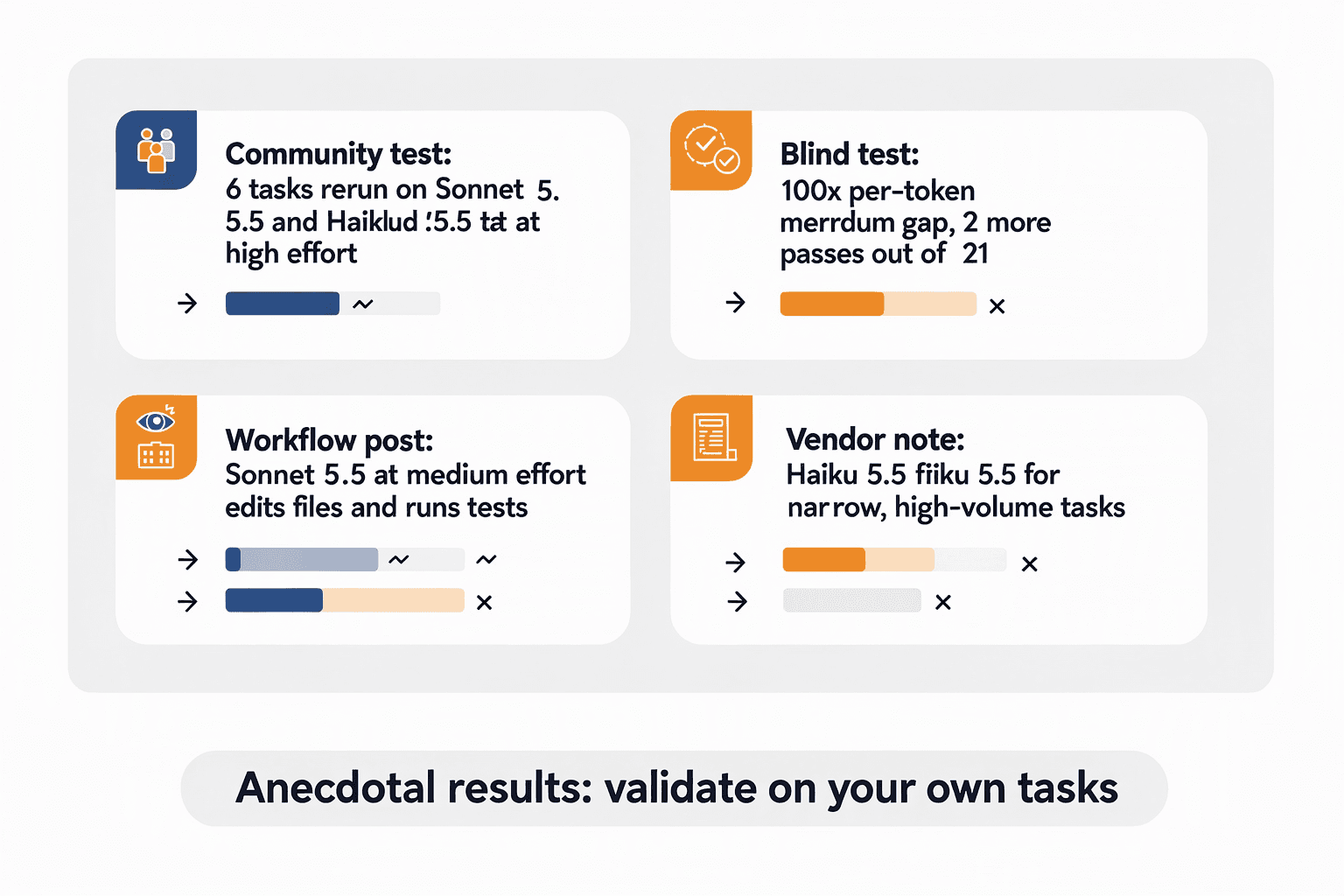
Early reports agree on the shape of the pairing: a cheaper Claude 5.5 model does the hands-on work, and a premium model plans or reviews. The evidence so far is practitioner anecdote plus vendor and consultancy analysis, not a controlled benchmark, so treat it as a starting hypothesis to verify on your own workload.
What did the Reddit test and the X workflow show?
A r/ClaudeCode user took six tasks that Claude Opus 5.5 had already completed in their project and re-ran them on Sonnet 5.5 and Haiku 5.5 as subagents, using high effort for every model. Holding the task set and the effort level constant is the right way to compare tiers. The excerpt available to us does not include the outcome table, so read the thread for per-task results before quoting them.
The X post by @dr_cintas shows the same layering from a different angle. In that workflow, Opus plans, Haiku reads, Fable reviews, and Sonnet 5.5 is the worker that "edits files, runs tests." The configuration is explicit: model: sonnet, effort: medium on the worker. Note that this practitioner chose medium effort for execution, while the Reddit test used high effort for everything. Those are different cost profiles, so don't compare the two directly.
What does Caylent's analysis say about Haiku 5.5?
Caylent's analysis of Claude Haiku 5.5 concludes that if you currently use Sonnet 5.5 for a narrow task, Haiku 5.5 is likely to get you lower costs and faster responses. The key word is narrow. File reading, extraction, classification and similar bounded steps fit that description. Open-ended editing and multi-step tool use are where Sonnet 5.5 still earns its place.
Is this tiering already the default in Claude Code?
For many teams, yes. According to claude-world.com, the sonnet alias resolves to Sonnet 5.5 on the Anthropic API from Claude Code v2.1.284. The haiku alias resolves to Haiku 5.5 from v2.1.293. Aliases still depend on your provider, so check what sonnet and haiku point to on your platform before assuming you are running the 5.5 models.
What should you be cautious about?
- Anecdotes are not benchmarks. Six tasks from one project say little about yours.
- Effort settings differ across reports. Medium and high effort change both quality and token spend, so compare like with like.
- Pairing limits are real. Anthropic's Sonnet 5.5 release notes say a Haiku 5.5 advisor returns a 400
invalid_request_errorwith a Sonnet 5.5 executor. Test your exact advisor and executor combination before shipping. - Narrow-task evidence does not transfer. Caylent's conclusion covers narrow tasks, not complex agent loops.
How can you replicate these tests on your own work?
- Pick five to ten tasks your current premium model already completed.
- Re-run them on Sonnet 5.5 and Haiku 5.5 with the same effort setting.
- Repeat the Sonnet 5.5 run at medium effort to see what you save.
- Score outputs against the premium-model result, and log token usage per run.
- Promote the cheaper model only for task types where quality holds.
The same method works beyond one vendor. Teams that route through a multi-model gateway, such as CallMissed's developer API with caller-chosen fallback models, can run this kind of tier comparison with a single key and balance and compare cost per task directly.
What Should You Do Next Based on Your Team and Workload?
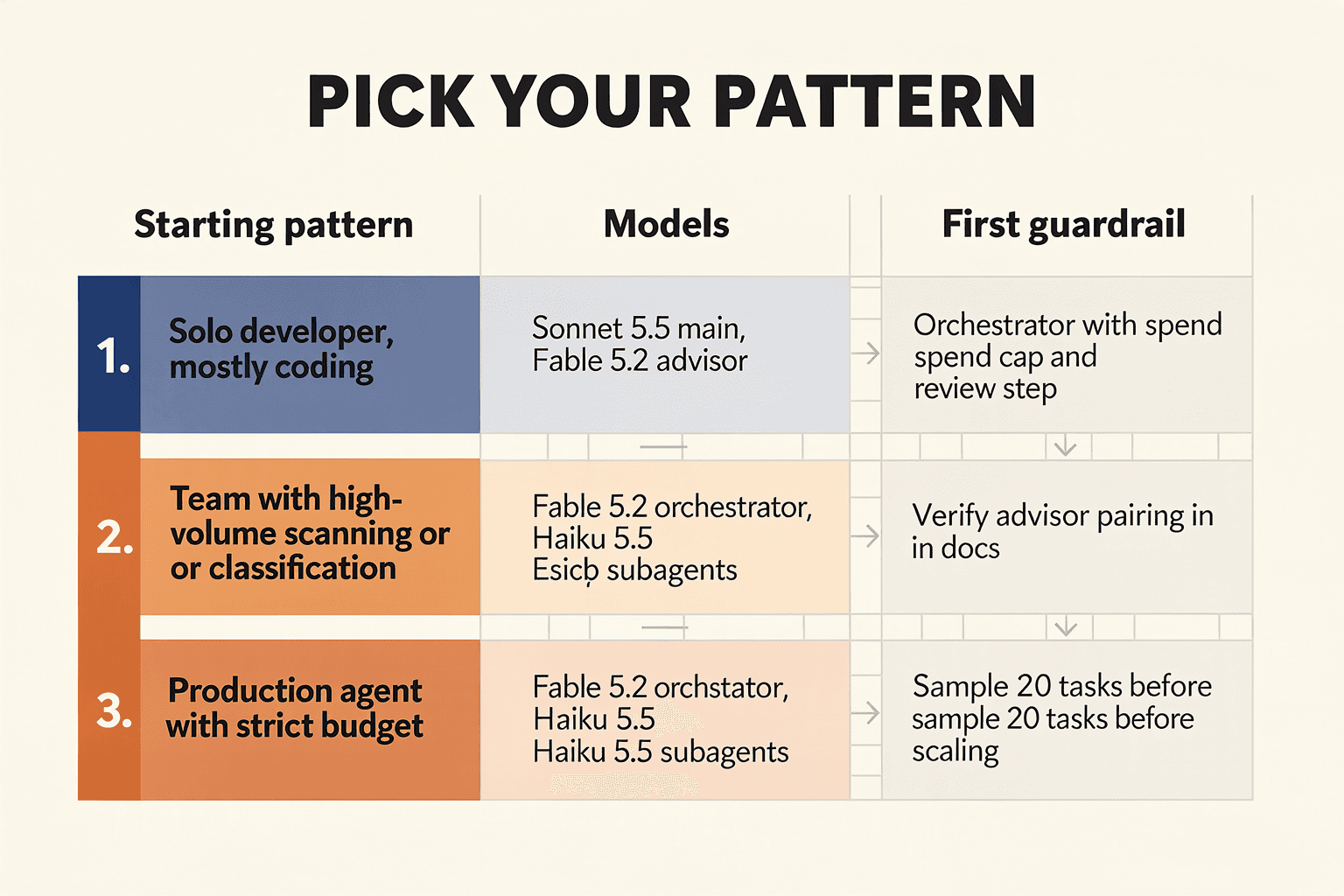
Start with the smallest change that fits your workload, then add Fable 5.2 only where a cheaper model demonstrably struggles. As of November 2026, the table below maps common team situations to a first move, using only the pairings and settings documented in the sources above.
Which pattern fits your team?
| Team / workload | Start with | Model roles | First action |
|---|---|---|---|
| Solo developer in Claude Code | Tiered aliases | sonnet and haiku resolve to the 5.5 models on the Anthropic API | Update to v2.1.284+ (Sonnet 5.5) and v2.1.293+ (Haiku 5.5) |
| High-volume narrow tasks (classification, extraction, file reading) | Haiku 5.5 as the worker | Haiku 5.5 runs the loop, with no orchestrator | Re-run a sample of Sonnet 5.5 jobs on Haiku 5.5 and compare quality |
| Mostly routine agent with rare hard decisions | Advisor pattern | Sonnet 5.5 or Haiku 5.5 executes and consults Fable 5.2 when stuck | Define what counts as "stuck" in the system prompt |
| Multi-step projects that need planning and merging | Orchestrator pattern | Fable 5.2 plans and delegates, Sonnet 5.5 edits and tests, Haiku 5.5 reads | Copy the shape of the @dr_cintas workflow and set the worker to sonnet at medium effort |
| Existing production advisor setup | Pairing audit | Check every advisor and executor combination | Remove any Haiku 5.5 advisor paired with a Sonnet 5.5 executor |
| Teams needing many vendors behind one API | Gateway layer | Route each role to the model that suits it | Test the routing and fallback logic in staging first |
What should you do in the first week?
- Audit your pairings. According to Anthropic's Sonnet 5.5 release notes on platform.claude.com, Claude Opus 4.8, Claude Opus 4.7, Claude Sonnet 5 and Claude Haiku 5.5 advisors work with a Claude Sonnet 5 executor but return a 400
invalid_request_errorwith a Claude Sonnet 5.5 executor. Catch this in staging, not in production. - Replay real tasks, not benchmarks. The r/ClaudeCode tester re-ran six tasks that Opus 5.5 had already completed on Sonnet 5.5 and Haiku 5.5 at high effort. Do the same with your own traces and note where the cheaper model falls short.
- Set effort per role. The @dr_cintas workflow runs the Sonnet 5.5 worker at medium effort. Anthropic lists per-message effort (beta) as a supported Sonnet 5.5 feature, so you can raise effort only on hard turns.
- Turn on prompt caching. Anthropic's documentation gives Sonnet 5.5 a 512-token minimum cacheable prompt, so stable system prompts and tool definitions are good candidates. Worker agents that repeat the same instructions on every call benefit most.
- Move non-urgent work to batch. Anthropic lists batch processing as supported on Sonnet 5.5, which suits overnight evaluations or bulk document runs.
When does a multi-model gateway make sense?
If your agents mix vendors, for example one model for planning and another for speech or embeddings, a gateway keeps the integration surface small. CallMissed's developer API exposes 159 models behind one key through OpenAI-compatible and Anthropic-compatible endpoints, with caller-chosen fallback models, response caching and request logs. Existing SDKs work by changing the base URL. That is useful for comparing worker models without rewriting your orchestration code.
Whatever you choose, follow Caylent's guidance: if Sonnet 5.5 currently handles a narrow task, try Haiku 5.5 first, since it is likely to give lower costs and faster responses.
Frequently Asked Questions
What is a Claude Fable 5 orchestrator?
When should I use Claude Fable 5.2 as an advisor instead of an orchestrator?
Which advisor and executor pairings return a 400 error?
claude-sonnet-5-5), the same advisors return a 400 invalid_request_error. Test every advisor and executor pairing in staging before you upgrade a worker model.Can Claude Haiku 5.5 replace Sonnet 5.5 as a worker?
What effort setting should worker models use in an orchestrator setup?
How do I keep costs predictable in a multi-model agent?
- Tier: send reading and narrow tasks to Haiku 5.5, editing and tool-heavy work to Sonnet 5.5, and planning or review to Fable 5.2.
- Caching: Claude Sonnet 5.5 supports prompt caching with a 512-token minimum cacheable prompt, so stable system prompts and tool definitions are worth caching.
- Batching: Sonnet 5.5 supports batch processing for work that does not need an immediate reply.
In Claude Code, sonnet resolves to Sonnet 5.5 from v2.1.284 and haiku resolves to Haiku 5.5 from v2.1.293 on the Anthropic API, so check your version before assuming which model a worker is using.
If you want to apply the same tiering logic outside Anthropic's lineup, CallMissed's developer API exposes Anthropic-compatible (/v1/messages) and OpenAI-compatible endpoints across 159 models. Existing SDK code works by changing the base URL, and usage and request logs show what each tier costs. Check the catalogue at docs.callmissed.com for the models available today.
Conclusion
The right Claude Fable 5 orchestrator setup comes down to where Fable 5.2's tokens are spent, and which cheaper model does the rest.
Key takeaways:
- Advisor vs. orchestrator: Use Fable 5.2 as an advisor when a smaller executor handles most turns and needs help only with hard decisions. Promote it to orchestrator when the work must be planned, split and merged.
- Match workers to jobs: Claude Haiku 5.5 suits narrow tasks. Claude Sonnet 5.5 handles heavier edits and test runs. Effort settings are a cost lever too.
- Check pairings before shipping: As of November 2026, Anthropic's Sonnet 5.5 release notes say a Haiku 5.5 advisor returns a 400
invalid_request_errorwith a Sonnet 5.5 executor. - Structure handoffs deliberately: Clear delegation points keep agent spend predictable.
Expect the ladder to keep shifting. Each new Haiku or Sonnet release can move work down a tier, so re-test your assignments rather than treating them as fixed. Watch for changes to supported advisor and executor pairings in Anthropic's release notes.
The same role-matching logic applies beyond one vendor. To see how it works across many models, explore CallMissed, an AI infrastructure platform whose developer API offers 159 models behind OpenAI-compatible and Anthropic-compatible endpoints, alongside voice agents and multilingual chatbots.
Which of your agent's steps are still running on a model that costs more than the task needs?
Related Reading
- Claude Fable 5.2 release date: Nov 9, 2026 Access FAQ
- Fable 5.2 vs Opus 5.5: Which Claude Should Developers Use?
- Claude Fable 5.2 vs Fable 5.1: Should You Upgrade?