Claude Fable 5.2 API Pricing: $8/$40 Rates and Migration



Claude Fable 5.2 API pricing is $8 input and $40 output per million tokens. See fast mode, US-only costs, cost examples and a 5.1 migration checklist.

Claude Fable 5.2 API Pricing: $8/$40 Rates and Migration
Claude Fable 5.2 API pricing is $8 per million input tokens and $40 per million output tokens, a flat 20% cut from the $10/$50 that Anthropic charged for Fable 5 and Fable 5.1. According to Anthropic's Claude Fable page, the model launched on November 9, 2026, with the API id claude-fable-5-2. That makes it one of the rare cases where a newer frontier model is both faster and cheaper than its predecessor.
The timing creates a problem for anyone budgeting. Many pricing pages still show the old rate card. Finout, CloudZero and MindStudio, for example, list Fable 5 or 5.1 at $10/$50, and at least one third-party page describes 5.2 pricing as "not yet confirmed." Anthropic's own documentation now lists Fable 5.2 at $8 / $40 per MTok, with a 1M-token context window, 128K max output and a June 2026 knowledge cutoff. If your cost model, vendor comparison or procurement document predates today, it is probably wrong.
The price cut is not the whole story. Anthropic also reports:
- Cache reads now cost $0.20 per million tokens.
- Fast mode runs up to 2.5x faster at $16 input and $80 output per million tokens.
- US-only inference is priced at 1.1x.
- Output is up to 30% faster than Fable 5.1 (a vendor-reported figure).
- Preserved thinking now applies to all accounts.
- 30-day data retention is the default.
This guide is a dated, side-by-side pricing reference, current as of November 9, 2026. You will get:
- The full Fable 5.2 vs. 5.1 rate comparison
- A worked cost example table showing what standard mode, fast mode and US-only inference cost on real workloads
- Guidance on where Fable 5.2 is available: Claude Platform, marketplaces, AWS, Google Cloud and Microsoft Foundry
- A step-by-step migration checklist from Fable 5.1
Any performance claims here are vendor-reported unless stated otherwise. Teams that route requests through gateways should also check model availability. For example, CallMissed offers an Anthropic-compatible /v1/messages endpoint across 159 models, but Fable 5.2 availability there is not confirmed.
How much does Claude Fable 5.2 API pricing cost per million tokens?
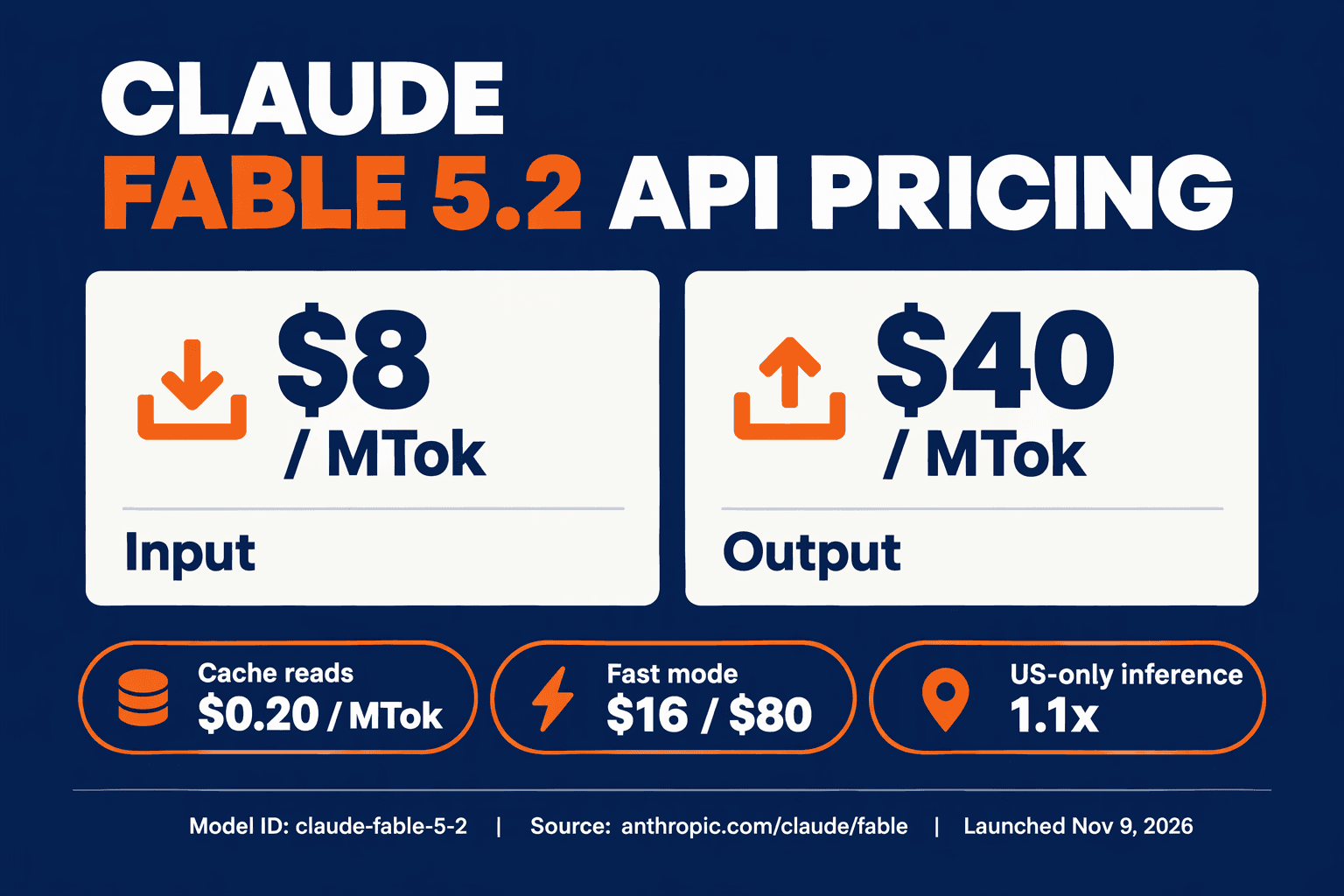
Claude Fable 5.2 costs $8 per million input tokens and $40 per million output tokens, as of November 9, 2026. Anthropic's Claude Platform docs list the model at "$8 / $40" per MTok, with a 1M-token context window and 128K max output. That is 20% below the $10/$50 rate card for Fable 5 and Fable 5.1.
What is the full Fable 5.2 rate card?
The table below combines Anthropic's published figures for Fable 5.2 with the older rates still circulating. Prices are in USD per million tokens (MTok), as of November 9, 2026.
| Price component | Fable 5 / 5.1 | Fable 5.2 standard | Fable 5.2 fast mode |
|---|---|---|---|
| Input | $10 | $8 | $16 |
| Output | $50 | $40 | $80 |
| Cache read | $0.25 (5.1, per CloudZero) | $0.20 | Not stated |
| 1h cache write | $20 (Fable 5 docs) | Not stated in sources | Not stated |
The 5.2 cache-write rates are not in the sources reviewed for this guide, so check Anthropic's pricing page before budgeting a cache-heavy workload.
How do you convert these rates into per-request costs?
Divide the per-million rate by 1,000,000. At standard rates, Fable 5.2 costs $0.000008 per input token and $0.00004 per output token. Output tokens cost 5x as much as input tokens, so output volume, not prompt size, usually drives the bill.
Two examples at standard rates:
- A 10,000-token prompt with a 1,000-token reply costs $0.08 for input plus $0.04 for output, or $0.12. On Fable 5.1, the same request cost $0.10 plus $0.05, or $0.15.
- A 500,000-token cached context read costs $0.10 at $0.20 per MTok. At the 5.1 cache-read price of $0.25, it cost $0.125.
How do fast mode and US-only inference change the price?
Anthropic prices fast mode at $16 input and $80 output, exactly 2x the standard Fable 5.2 rate, in exchange for output up to 2.5x faster. Compared with Fable 5.1's standard rate, that is a 60% premium ($16 vs. $10 input, $80 vs. $50 output). The speedup is vendor-reported.
US-only inference is priced at 1.1x. Applied to standard rates, that works out to $8.80 input and $44.00 output per MTok. This is our arithmetic. Anthropic's announcement does not say whether the multiplier stacks with fast mode, so confirm that on Anthropic's pricing page before committing a data-residency workload.
Why do other pricing pages still show $10/$50?
Most third-party trackers were written before the November 9 launch. Finout describes Fable 5 as "$10/$50 per million tokens — 2x Opus 4.8, 2x GPT-5.5 on input." CloudZero lists Fable 5.1 at $10/$50 with $0.25 cache reads. MindStudio, OrcaRouter and Concentrate also show $10/$50. These figures were accurate for their models, but they are not the Fable 5.2 rate.
Check the model id before trusting any number. The rates in this section apply only to claude-fable-5-2, so any page that quotes $10/$50 is describing the older models.
What changed between Fable 5, Fable 5.1 and Fable 5.2?
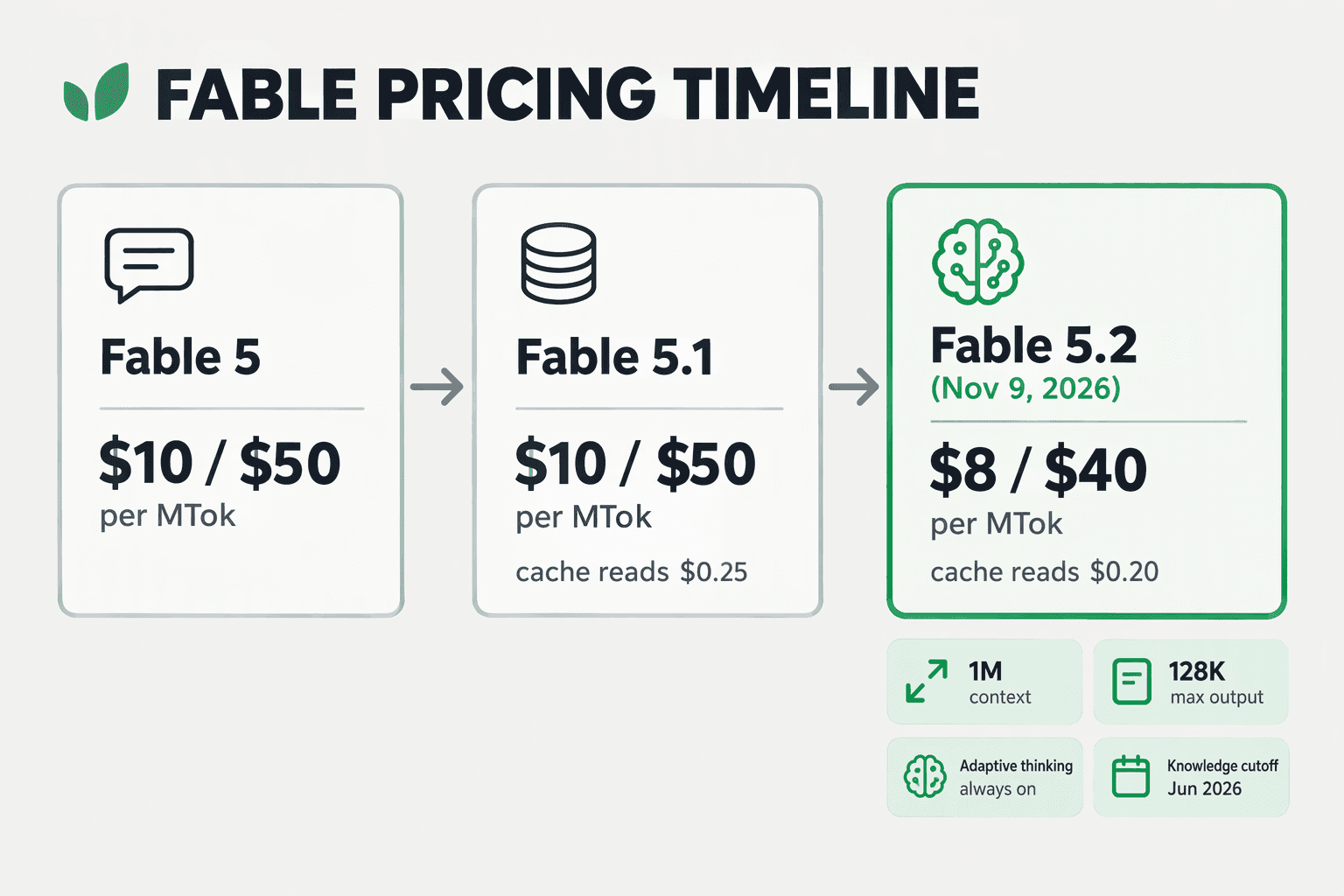
Between Fable 5 and Fable 5.1, the price stayed at $10/$50 per million tokens. Fable 5.2 is the first release in the line to cut it, to $8/$40, and it adds fast mode, US-only pricing and new defaults, as of November 9, 2026. Here is what each version changed, using only what the sources state.
How do Fable 5, 5.1 and 5.2 compare?
| Item | Fable 5 | Fable 5.1 | Fable 5.2 |
|---|---|---|---|
| Input / output per MTok | $10 / $50 | $10 / $50 | $8 / $40 |
| Cache read per MTok | Not stated in sources | $0.25 (CloudZero) | $0.20 |
| 1h cache write per MTok | $20 (Anthropic docs) | Not stated | Not stated |
| API id | Not stated in sources | Not stated in sources | claude-fable-5-2 |
| Fast mode | Not stated | Not stated | Up to 2.5x faster, $16 / $80 |
Anthropic's Fable 5 documentation lists input at $10 and output at $50 per MTok. CloudZero's rate card puts Fable 5.1 at the same $10/$50, with cache reads at $0.25. The sources do not give a launch date for Fable 5 or 5.1, so this guide does not either.
What is new in Fable 5.2 beyond the lower price?
The Fable 5.2 launch brings several changes that Anthropic reports on its Claude Fable page:
- Lower token rates. Input and output are each 20% below Fable 5.1. Cache reads fall from $0.25 to $0.20, which is also a 20% cut.
- Fast mode. It runs up to 2.5x faster at $16 input and $80 output per million tokens. That is double the standard 5.2 rate and 60% above Fable 5.1's standard $10/$50.
- US-only inference at 1.1x pricing. If the multiplier applies to standard 5.2 rates, that works out to $8.80 input and $44.00 output. Confirm the exact basis on Anthropic's pricing page before budgeting.
- Speed. Anthropic says output is up to 30% faster than Fable 5.1. This is a vendor-reported figure, not an independent benchmark.
- Preserved thinking for all accounts.
- 30-day data retention by default. Review this with your security or compliance team.
Anthropic's docs also list the model's core specifications: a 1M-token context window, 128K max output, adaptive thinking that is always on, a default effort of high and a June 2026 knowledge cutoff.
Why does the price change matter for existing Fable users?
Fable 5 was priced at a premium. Finout described it as 2x Opus 4.8 and 2x GPT-5.5 on input, and a Reddit user on r/claude noted that the $10/$50 rate was "exactly double" a cheaper tier when explaining why a Max 20x plan drained quickly. A 20% cut narrows that gap but does not close it.
The change also raises a budgeting trap. Third-party pages from Finout, MindStudio, OrcaRouter and Concentrate still show $10/$50 for Fable 5. MindStudio's page also references a free subscription window that closed on June 22, 2026. None of these reflect the 5.2 rate card.
If you budget from those pages, you will overestimate standard-mode spend by 25% (a $10 rate against an $8 rate). You will also miss that fast mode and US-only inference introduce separate pricing lines.
What should you check first?
- Confirm your code points to
claude-fable-5-2, not a 5.1 id. - Re-run cost projections at $8/$40, with cache reads at $0.20.
- Decide whether fast mode's 2x premium is justified for any latency-sensitive path.
- Check whether US-only inference is a requirement for your workloads.
The migration checklist later in this guide covers these steps in order.
How does Fable 5.2 pricing compare with Fable 5.1 side by side?
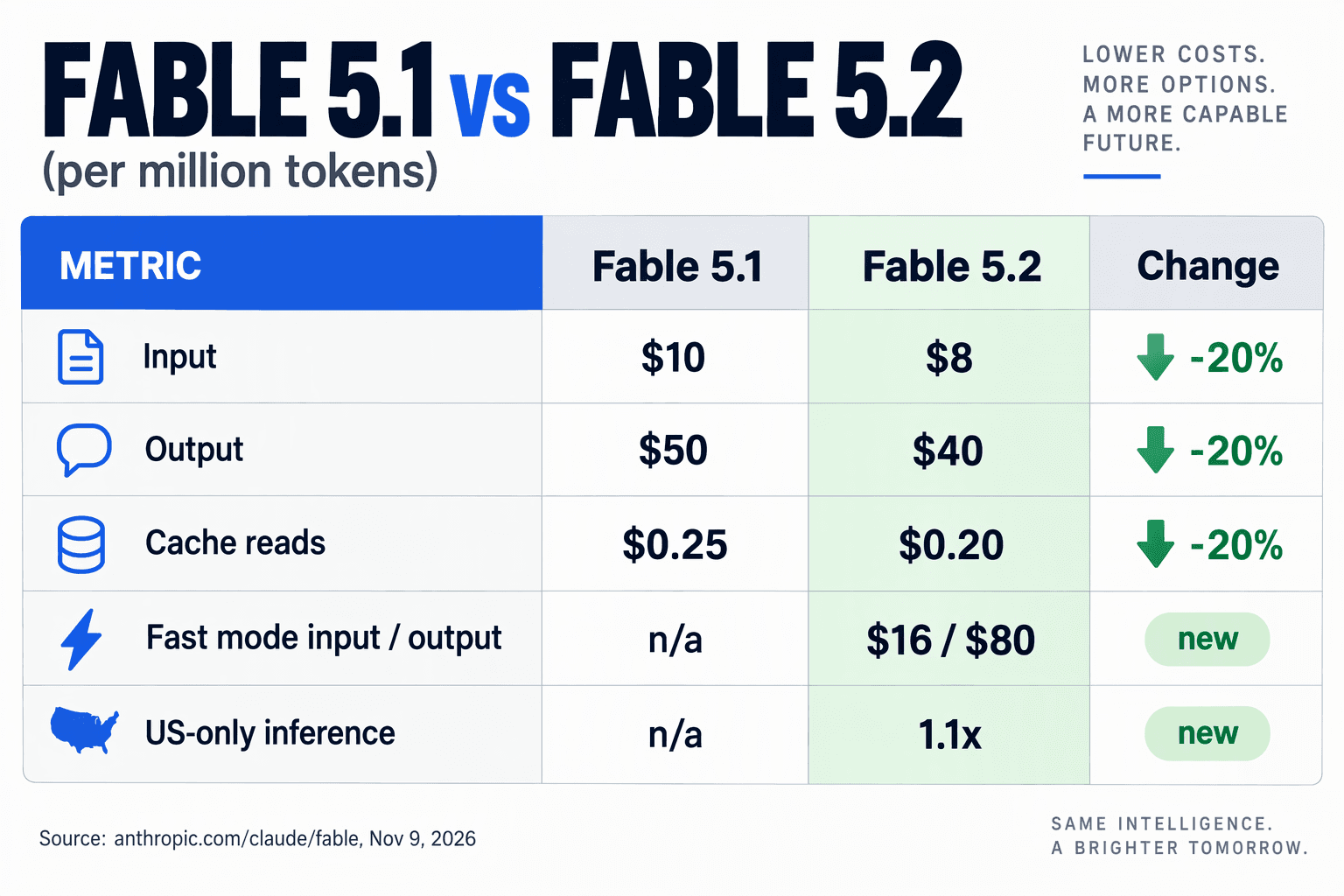
Fable 5.2 is 20% cheaper than Fable 5.1 on every standard token price, as of November 9, 2026. Input drops from $10 to $8 per million tokens, output from $50 to $40, and cache reads from $0.25 to $0.20. The table below puts the two models side by side, with "Not stated" wherever the sources don't give a figure.
How do the Fable 5.1 and Fable 5.2 specs compare?
Prices are in USD per million tokens (MTok). Fable 5.1 figures come from CloudZero and Anthropic's Fable 5 docs. Fable 5.2 figures come from Anthropic's Claude Fable page.
| Attribute | Fable 5.1 | Fable 5.2 | Change |
|---|---|---|---|
| Input price | $10 | $8 | −20% |
| Output price | $50 | $40 | −20% |
| Cache read | $0.25 | $0.20 | −20% |
| 1M input + 1M output | $60 | $48 | −$12 |
| Fast mode (input / output) | Not stated | $16 / $80 | 2x the 5.2 standard rate |
| US-only inference | Not stated | 1.1x pricing | $8.80 / $44 on standard rates |
| Output speed | Baseline | Up to 30% faster (vendor-reported) | Faster |
| Preserved thinking | Not on all accounts | All accounts | Broader access |
| Context / max output | Not confirmed in sources | 1M / 128K | n/a |
| Knowledge cutoff | Not confirmed in sources | June 2026 | n/a |
The API id for the new model is claude-fable-5-2.
What does the table actually tell you?
The discount is uniform. Input, output and cache reads all fall by exactly 20%, so your blended cost drops 20% whatever your input-to-output ratio. A workload that was output-heavy under 5.1 saves $10 per million output tokens, and an input-heavy one saves $2 per million input tokens.
Fast mode is a premium on top of the new price. At $16 input and $80 output, fast mode costs twice the standard 5.2 rate. Against the old 5.1 card it is 1.6x. Anthropic says fast mode runs up to 2.5x faster, so you are paying a 2x multiplier for up to 2.5x the speed.
US-only inference is a smaller surcharge. The 1.1x multiplier adds $0.80 per million input tokens and $4.00 per million output tokens at standard rates. Anthropic's page, as quoted in the sources, doesn't say whether the multiplier also applies to cache reads, so confirm that before budgeting for it.
What is not a price change?
Several differences affect operations rather than invoices:
- Preserved thinking now applies to all accounts, per Anthropic.
- 30-day data retention is the default, which matters for compliance reviews.
- Speed gains of up to 30% are vendor-reported, so benchmark on your own prompts before relying on them.
What should you watch for when updating a cost model?
- Replace every $10/$50 assumption with $8/$40, but keep the old numbers in a column for historical comparison.
- Update cache-read assumptions from $0.25 to $0.20.
- Treat fast mode and US-only inference as separate line items rather than blending them into one rate.
- Don't rely on third-party rate cards. Finout, MindStudio, OrcaRouter and Concentrate still show $10/$50 for Fable 5, and resellers may price differently from Anthropic's direct rates.
If you reach Claude models through a gateway or router, check the model list first. Fable 5.2 may not be available there yet, and the per-token price may differ from Anthropic's.
What do fast mode, US-only inference, caching and batch cost on Fable 5.2?
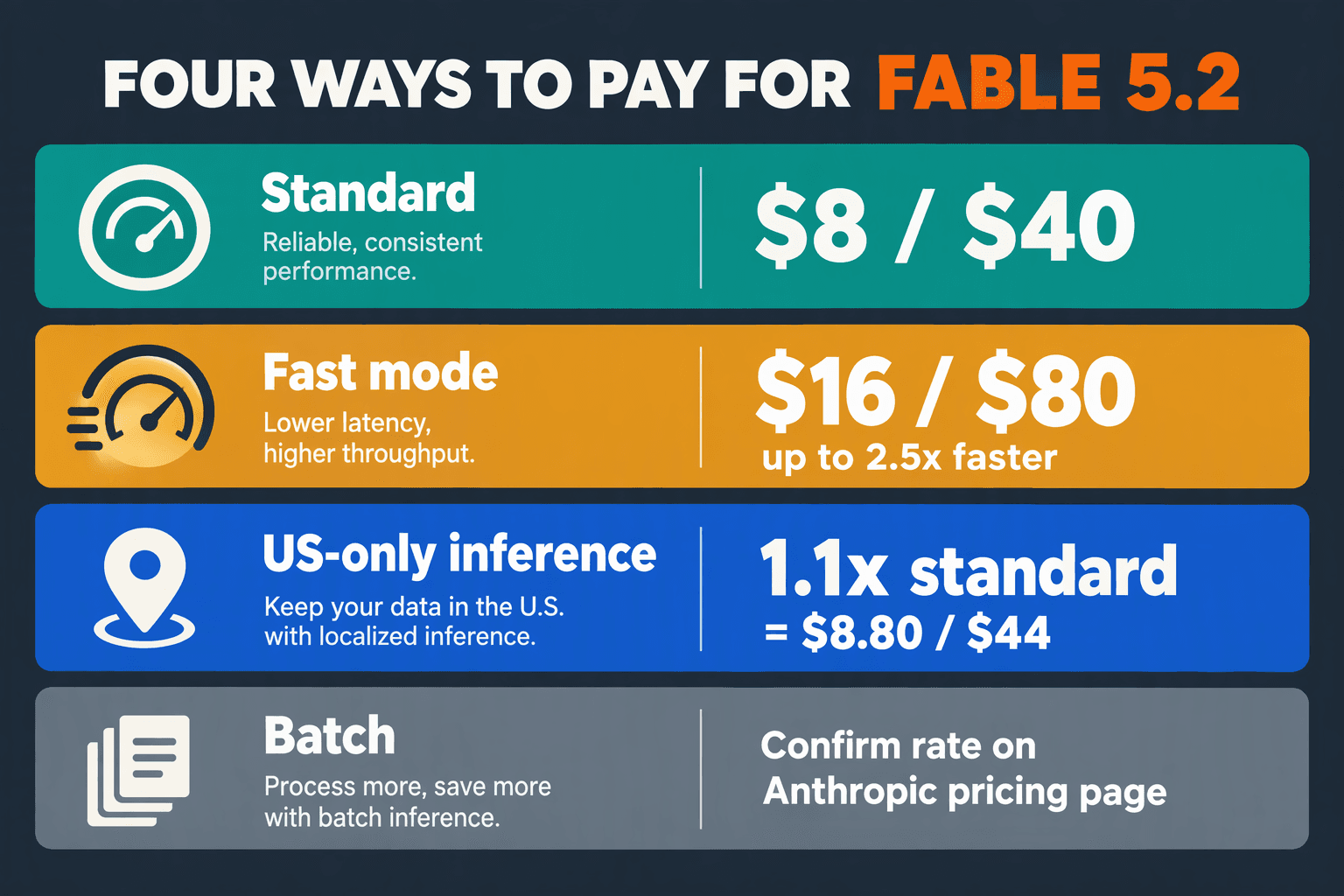
On Fable 5.2, fast mode costs $16 per million input tokens and $80 per million output tokens, US-only inference adds a 1.1x multiplier, and cache reads cost $0.20 per million tokens, as of November 9, 2026. Anthropic's sources reviewed for this guide do not state a batch rate for Fable 5.2.
How much does Fable 5.2 fast mode cost?
Anthropic reports that fast mode runs up to 2.5x faster (a vendor-reported figure). It is priced at exactly 2x the standard rate on both input and output.
| Mode | Input / MTok | Output / MTok | Cost vs. Fable 5.2 standard |
|---|---|---|---|
| Fable 5.1 standard | $10 | $50 | 1.25x |
| Fable 5.2 standard | $8 | $40 | 1x |
| Fable 5.2 US-only (1.1x) | $8.80 | $44 | 1.1x |
| Fable 5.2 fast mode | $16 | $80 | 2x |
Fast mode on 5.2 is therefore 1.6x the price of standard Fable 5.1 ($16 vs. $10 input, $80 vs. $50 output). Teams that paid the old rate for latency-sensitive traffic will see a smaller premium than the 2x headline suggests.
What does US-only inference add?
Anthropic prices US-only inference at 1.1x the standard rate. Applied to Fable 5.2 standard, that works out to $8.80 input and $44 output per million tokens. On a workload of 100M input and 10M output tokens a month, the standard bill is $1,200 and the US-only bill is $1,320, a $120 premium for keeping inference in the US.
Anthropic's published material does not say whether the 1.1x multiplier stacks with fast mode. Do not budget a combined rate until Anthropic's pricing page confirms one. Multiplying the two would give $17.60/$88, but that is arithmetic, not a published price.
How much do prompt caching reads cost?
Cache reads on Fable 5.2 cost $0.20 per million tokens, which is 2.5% of the $8 standard input rate. CloudZero lists Fable 5.1 cache reads at $0.25 against $10 input, so the ratio is unchanged and the absolute price is 20% lower.
A worked example: an agent that resends a 50,000-token system prompt and tool schema on 200,000 calls processes 10 billion tokens of repeated prefix.
- Uncached at $8 per MTok, that costs $80,000.
- Read from cache at $0.20 per MTok, it costs $2,000.
Cache writes are billed separately. Anthropic's Fable 5 documentation lists a 1-hour cache write at $20 per MTok, but the sources reviewed do not restate the write rate for 5.2. Check it before modelling a cache-heavy workload.
Is there a batch discount on Fable 5.2?
Not confirmed. None of the sources reviewed (Anthropic's Fable page, the Claude Platform docs, Finout, CloudZero, MindStudio) publishes a batch price for Fable 5.2. Any page quoting a specific batch percentage for this model is going beyond what Anthropic has documented.
For now:
- Model batch-eligible jobs at standard rates.
- Treat any batch discount as upside, not a planning assumption.
- Check Anthropic's pricing page before committing a large offline workload.
Which modifier should you budget first?
- Cache reads deliver the largest savings for repetitive prompts, up to 97.5% off input on cached tokens.
- US-only inference is a small, predictable 10% premium and only matters if you have data-residency requirements.
- Fast mode doubles cost, so reserve it for user-facing paths where the 2.5x speed-up changes the experience.
How much will Fable 5.2 cost per month for support chat, coding agents and RAG?
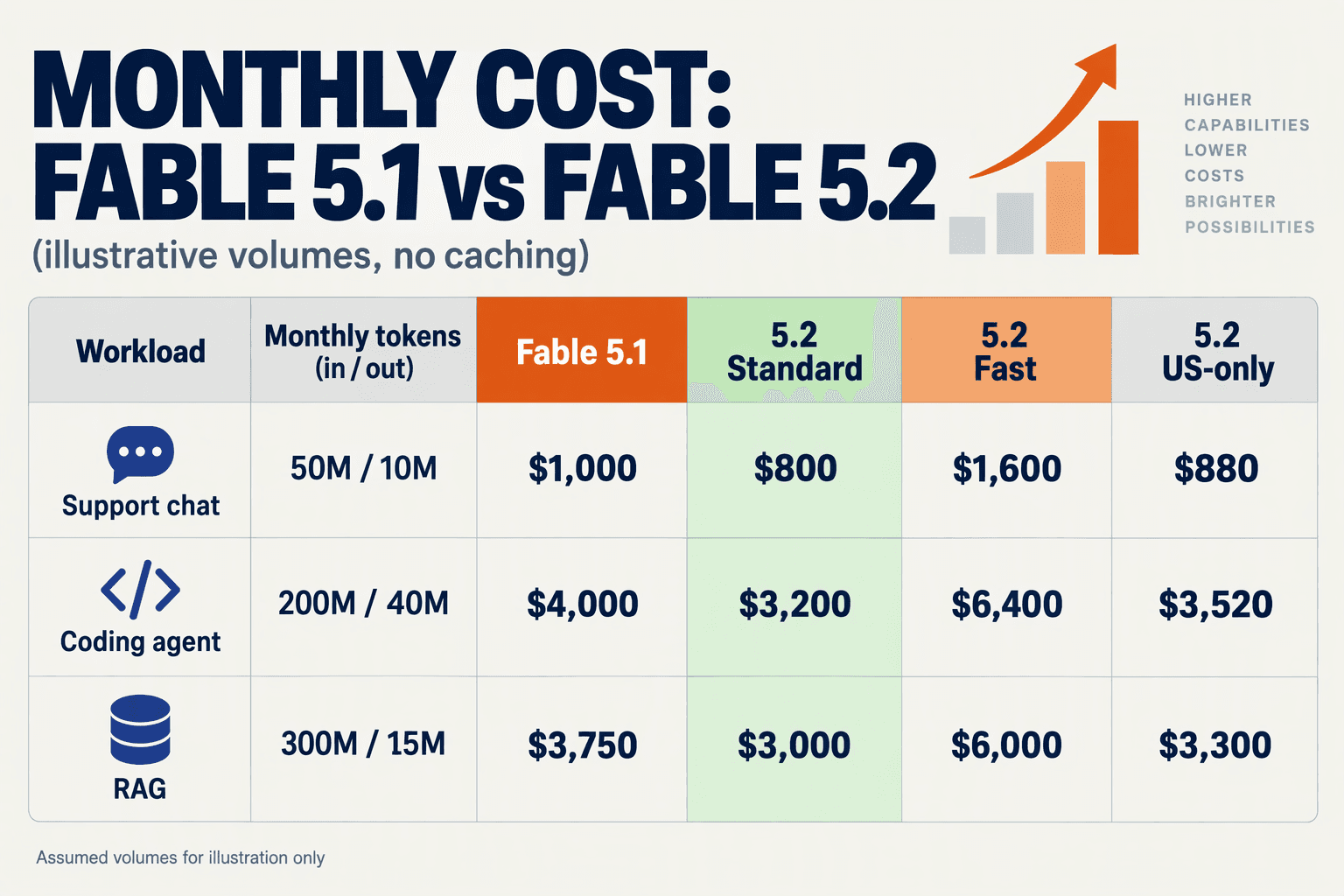
For three common workloads, Claude Fable 5.2 costs 20% less than Fable 5.1 on standard mode, and exactly double the standard price on fast mode. The figures below use Anthropic's published rates of $8 input and $40 output per million tokens, as of November 9, 2026. The traffic volumes are my own illustrative assumptions, so replace them with your logs.
What are the assumptions behind the monthly estimates?
- Support chat: 100,000 conversations a month, each with 3,000 input and 500 output tokens. That is 300M input and 50M output tokens in total.
- Coding agents: 2,000 agent sessions a month, each with 400,000 input and 40,000 output tokens. That is 800M input and 80M output tokens in total.
- RAG: 200,000 queries a month, each with 6,000 input tokens (retrieved chunks plus the question) and 400 output tokens. That is 1,200M input and 80M output tokens in total.
None of these scenarios assume prompt caching. All costs are in USD.
How much does each workload cost per month?
| Workload | Fable 5.1 ($10/$50) | Fable 5.2 standard ($8/$40) | Fable 5.2 US-only (1.1x) | Fable 5.2 fast ($16/$80) |
|---|---|---|---|---|
| Support chat | $5,500 | $4,400 | $4,840 | $8,800 |
| Coding agents | $12,000 | $9,600 | $10,560 | $19,200 |
| RAG | $16,000 | $12,800 | $14,080 | $25,600 |
The US-only column assumes the 1.1x multiplier that Anthropic lists applies to both input and output rates. Confirm that on your invoice.
How much does the Fable 5.2 price cut save?
- Support chat: saves $1,100 a month, or $13,200 a year.
- Coding agents: saves $2,400 a month, or $28,800 a year.
- RAG: saves $3,200 a month, or $38,400 a year.
Because both rates fell by 20%, the saving is 20% whatever your input-to-output mix.
Is fast mode worth paying double for?
Fast mode is worth it only where a person is waiting on the response. Anthropic says fast mode runs up to 2.5x faster, a vendor-reported figure, at $16 and $80 per million tokens. That is twice the standard rate for up to 2.5x the speed.
- Likely worth it: live support chat and interactive coding sessions, where latency affects the user directly.
- Likely not worth it: nightly RAG indexing, summarisation jobs and other batch-style work, where standard mode finishes the same task at half the price.
A practical approach is to route only the live, user-facing turns to fast mode. In the support chat example, if 20% of traffic used fast mode, the bill would be about $5,280, which is $880 above all-standard.
How much can prompt caching reduce the RAG bill?
Cache reads on Fable 5.2 cost $0.20 per million tokens, against $8 for uncached input. Suppose 2,000 of the 6,000 input tokens per RAG query are a stable prefix, such as system instructions and fixed policy text. That is 400M tokens a month, which costs $3,200 uncached and $80 as cache reads.
That is a saving of about $3,120 a month. The saving is before cache-write costs, which the sources I reviewed do not state for Fable 5.2, so check Anthropic's pricing page before finalising a budget.
What should you do with these numbers?
- Replace my token assumptions with averages from your own request logs.
- Model standard mode as your baseline and fast mode only for latency-critical paths.
- Add 10% if data residency requires US-only inference.
- Rebuild any budget that still uses the $10/$50 rate card, which pages such as Finout and CloudZero still list for Fable 5 and 5.1.
How does Fable 5.2 cost compare with Opus 4.8, GLM 5.2 and a Max plan?
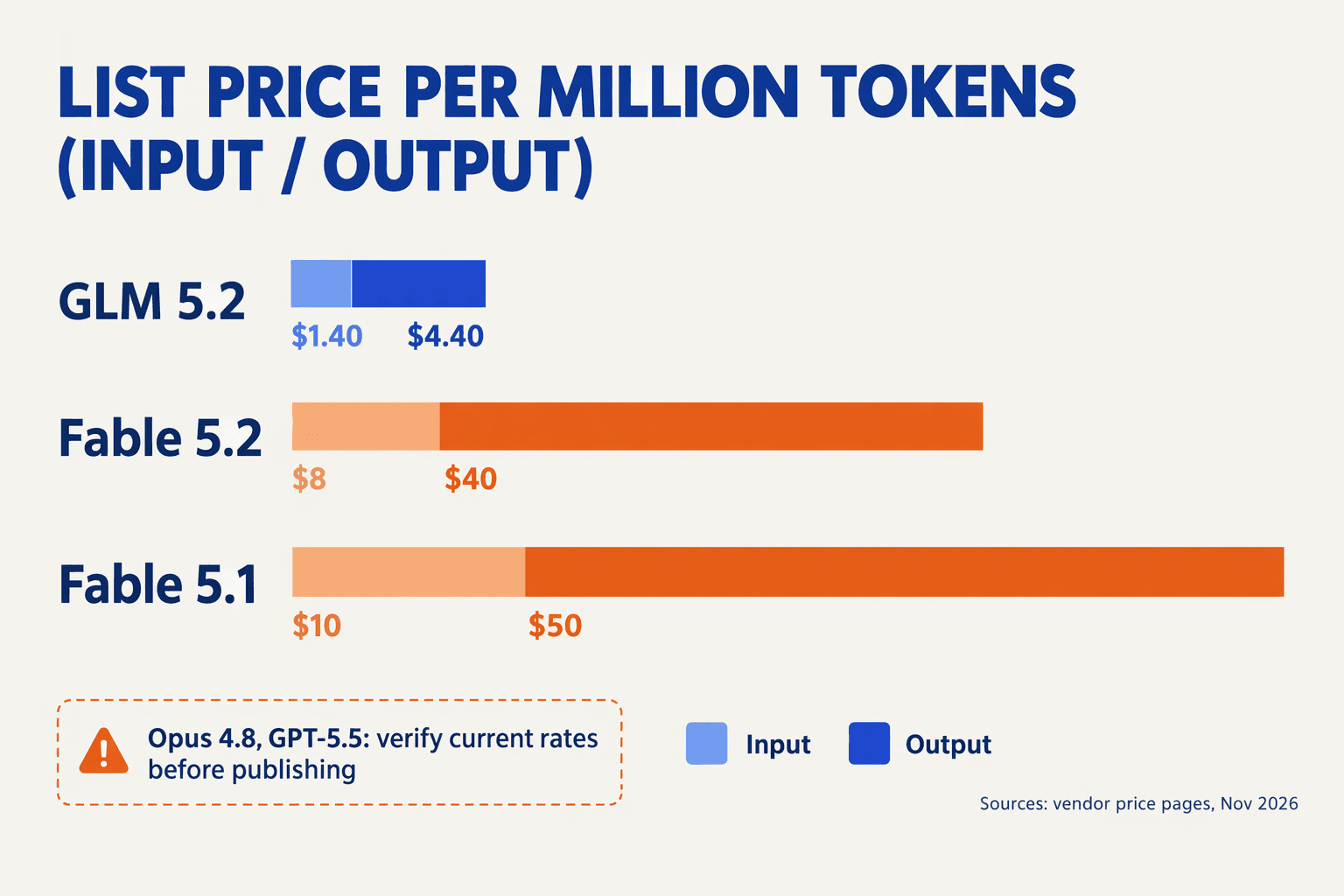
Fable 5.2 at $8/$40 per million tokens costs more per token than Opus 4.8, but the gap narrowed on November 9, 2026. Finout's pricing analysis described Fable 5 at $10/$50 as "2x Opus 4.8" on input. If that ratio holds, Opus 4.8 input sits near $5 per MTok, and the Fable 5.2 premium falls from 2x to roughly 1.6x. GLM 5.2 and Max plan comparisons need more care, because the sourced research does not give clean per-token numbers for them.
How do the prices line up side by side?
| Option | Input / MTok | Output / MTok | Billing model | Confidence |
|---|---|---|---|---|
| Fable 5.2 | $8 | $40 | Metered | Anthropic docs, Nov 9, 2026 |
| Fable 5 / 5.1 | $10 | $50 | Metered | Anthropic docs; CloudZero, Finout |
| Opus 4.8 | ~$5 (implied) | Not confirmed | Metered | Inferred from Finout's "2x" ratio |
| GLM 5.2 | Not in sourced research | Not in sourced research | Metered | Verify with the provider |
| Claude Max plan | n/a | n/a | Flat subscription with usage limits | Plan price not in sourced research |
I have deliberately left blanks instead of guessing. A comparison table with invented GLM 5.2 or Opus 4.8 output rates would repeat the stale-data problem this guide is meant to fix.
Is Fable 5.2 worth the premium over Opus 4.8?
Judge it by cost per completed task, not cost per token. A pricier model that needs fewer retries or shorter outputs can come out cheaper. Anthropic's claim of up to 30% faster output than Fable 5.1 is vendor-reported and says nothing about token efficiency.
A simple test:
- Run 50-100 real prompts through both models.
- Record input tokens, output tokens and pass/fail on your own acceptance check.
- Divide total spend by passing results, not total calls.
How does GLM 5.2 fit into the comparison?
GLM 5.2 is the sort of model teams consider when cost matters more than frontier capability. Because the sourced research has no verified GLM 5.2 rate card, check the provider's current pricing before putting it in a spreadsheet. CallMissed's developer API lists Zhipu (GLM) among its model makers across 159 models, but specific model availability and rates should be confirmed in its catalogue and pricing page.
Does a Max plan beat the API for Fable 5.2?
It depends on volume. A Max subscription is a flat fee with usage limits. The API is metered. A Reddit r/claude thread titled about Fable 5 "eating my Max 20x plan" had a URL referencing roughly $2 per minute of use. The poster tied that burn rate to the $10/$50 API pricing. That is one anecdote, not a benchmark, and the thread predates 5.2.
Use this break-even formula:
- Blended rate = (input share × $8) + (output share × $40). At a 3:1 input-to-output token mix, that is $16 per MTok, down from $20 on Fable 5.1.
- Break-even tokens = monthly plan price ÷ blended rate. For a hypothetical $200 plan, that is 12.5M blended tokens a month.
If your team reliably exceeds that volume inside the plan's limits, the subscription wins. If you need programmatic access, prompt caching at $0.20 per MTok cache reads, or predictable limits, the API wins. All figures are as of November 9, 2026.
What do vendor-reported benchmarks and early user reports say about Fable 5.2?

As of November 9, 2026, the only published performance claims for Claude Fable 5.2 come from Anthropic, and independent benchmarks and long-run user reports do not exist yet. The model launched today, so treat every speed and quality figure below as vendor-reported until third parties test it.
What has Anthropic reported about Fable 5.2's performance?
Anthropic's Claude Fable page makes three performance claims for Fable 5.2:
- Output up to 30% faster than Fable 5.1 in standard mode.
- Fast mode up to 2.5x faster, at $16 input and $80 output per million tokens.
- Preserved thinking now applies to all accounts, so reasoning context can carry across turns.
Anthropic's model comparison table also lists adaptive thinking as always on, with a default effort of high and a June 2026 knowledge cutoff.
Note the wording "up to." Neither speed figure is a guaranteed average, and Anthropic has not published the workload, prompt length or effort level behind them. Anthropic's page does not include per-task accuracy scores for 5.2 in the material available here, so this guide does not quote any.
What do early user reports say?
There is no Fable 5.2 field data yet. The closest evidence concerns its predecessor, and it is about cost rather than quality:
- A widely shared Reddit r/claude thread describes Fable 5 consuming a Max 20x subscription quickly. The poster concluded the API rates explained it: $10 input and $50 output per million tokens.
- Finout's pricing analysis characterized Fable 5 at launch as costing 2x Opus 4.8 and 2x GPT-5.5 on input.
Those findings suggest that for heavy users, token spend was the main complaint about Fable 5. Applying Finout's ratio to the new $8 input price implies roughly 1.6x those models on input. That is our arithmetic, assuming the competitors' prices have not changed, not a published figure.
How should you verify Fable 5.2 yourself before migrating?
Treat the 30% and 2.5x numbers as hypotheses and test them on your own traffic:
- Replay real prompts. Run 100-500 production requests through
claude-fable-5-1andclaude-fable-5-2at the same effort level. - Measure end-to-end latency. Record time to first token and total completion time at the 50th and 95th percentiles, not just averages.
- Compare token counts. Always-on adaptive thinking can change how many output tokens a request uses, and output is the $40 line. A lower per-token price helps only if volume doesn't climb.
- Score quality on your rubric. Use your own pass/fail test set, since vendor benchmarks rarely match your domain.
- Price fast mode separately. At 2x the standard rate, fast mode pays off only where a 2.5x speedup has real business value, such as live user-facing replies.
Teams building voice or chat agents can apply the same discipline with any model. CallMissed's console, for instance, includes eval suites and A/B experiments for agents, which suit this kind of side-by-side comparison. Whether Fable 5.2 can be selected there is not confirmed.
When will independent data arrive?
Expect third-party latency and accuracy tests over the coming weeks as providers on AWS, Google Cloud and Microsoft Foundry expose the model. Until then, pair Anthropic's claims with your own measurements. This page will need re-dating once credible independent numbers appear.
How do you migrate from Fable 5.1 to Fable 5.2?
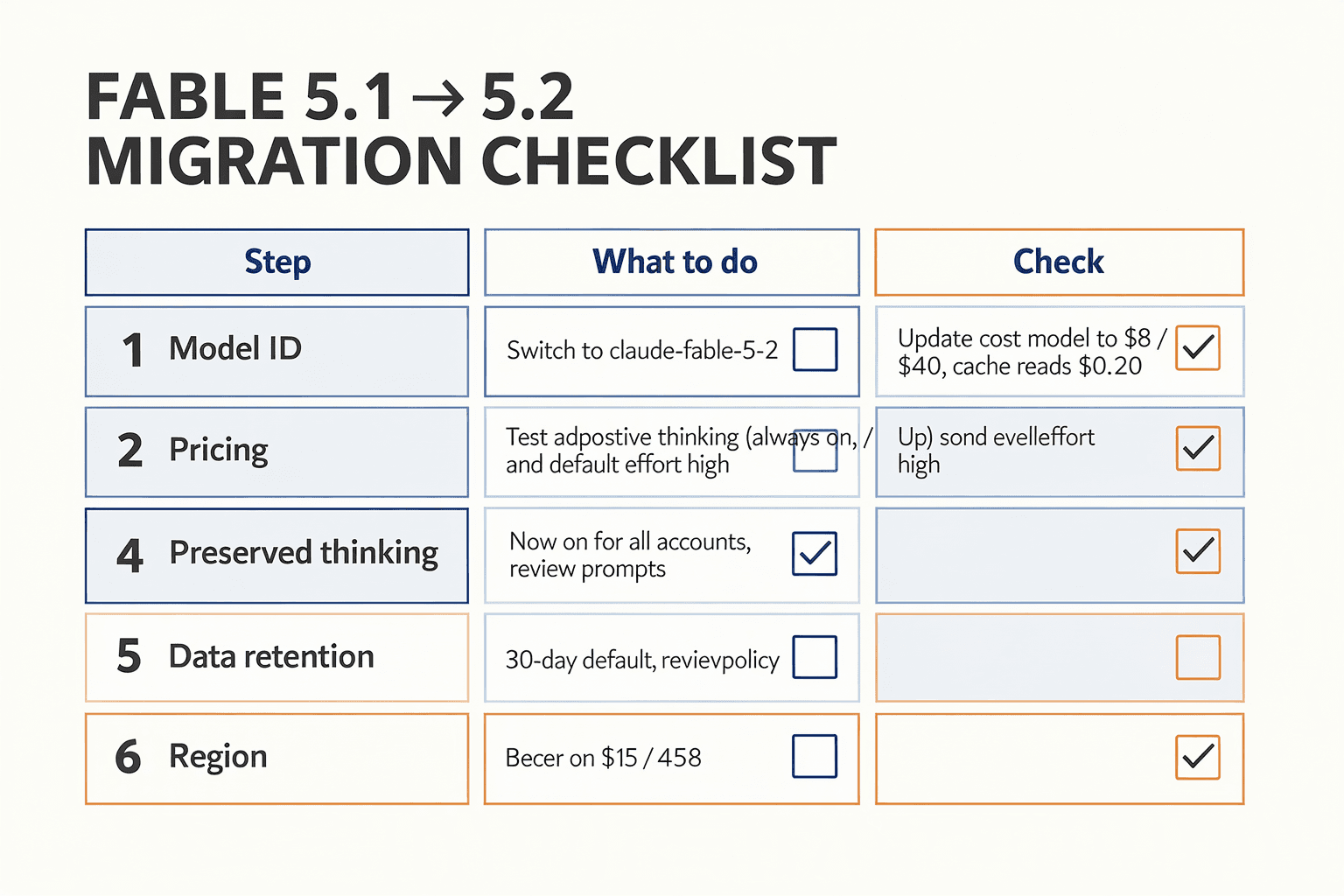
Migrating from Fable 5.1 to Fable 5.2 is mostly a model-ID swap plus a cost-model refresh, as of November 9, 2026. Anthropic lists the new API id as claude-fable-5-2, and the price drops to $8/$40 per MTok from $10/$50. The real work is re-testing behavior and updating budgets, not rewriting integrations.
What is the Fable 5.1 to 5.2 migration checklist?
| Step | What to do | Why it matters | Source status |
|---|---|---|---|
| 1. Change the model ID | Replace your 5.1 identifier with claude-fable-5-2 in config, not in scattered code | One change point makes rollback trivial | Anthropic |
| 2. Update the rate card | Set input to $8, output to $40, cache reads to $0.20 per MTok | Old $10/$50 figures overstate spend by 20% | Anthropic |
| 3. Re-run your eval suite | Compare 5.2 against 5.1 on your own prompts before shifting traffic | The "up to 30% faster output" claim is vendor-reported | Vendor-reported |
| 4. Review thinking and effort settings | Check how your prompts behave with adaptive thinking (always on) and default effort high | Thinking tokens bill as output, so effort affects cost | Anthropic docs |
| 5. Decide on fast mode | Enable it only for latency-critical paths | It costs $16/$80, double the standard rate, for up to 2.5x speed | Anthropic |
| 6. Check data and region needs | Confirm 30-day default retention and whether you need US-only inference at 1.1x | Compliance and cost both change | Anthropic |
| 7. Confirm your access route | Verify 5.2 is live on your platform: Claude Platform, marketplaces, AWS, Google Cloud or Microsoft Foundry | Availability can differ by route | Anthropic |
What should you test before switching production traffic?
Run a shadow or canary rollout rather than a hard cutover. Send a small share of traffic to claude-fable-5-2, then compare output quality, latency and token counts against 5.1 on the same inputs.
Three things deserve particular attention:
- Output length: Cost per request depends on tokens generated, not just the rate. A model that reasons or writes more can erase part of the 20% saving.
- Preserved thinking: Anthropic says it now applies to all accounts. If you handled multi-turn reasoning context yourself, test whether that workaround is still needed.
- Cache behavior: The cache-read price fell to $0.20 per MTok. Recalculate whether your caching strategy still pays off at the new write and read ratios.
How do you handle gateways and third-party routers?
If requests pass through a gateway, check its model catalog first. Many routers still list Fable 5 at $10/$50, so a swapped ID may fail or bill at old rates.
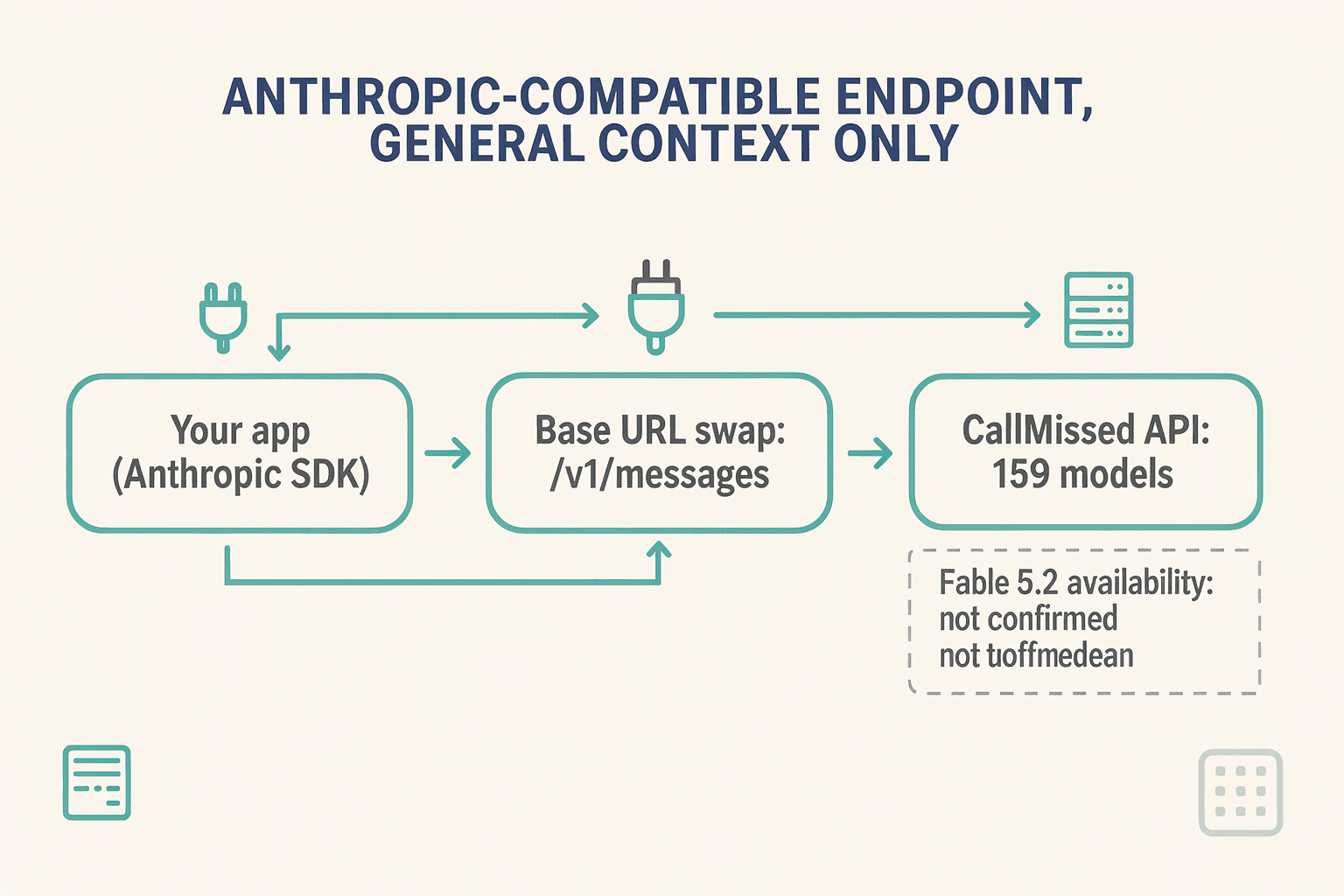
Gateways that expose Anthropic-compatible endpoints let existing SDKs work by changing the base URL. CallMissed, for example, offers an Anthropic-compatible /v1/messages endpoint across 159 models. Fable 5.2 availability there is not confirmed, so verify the model list before you migrate.
What should you check after the migration?
- Compare invoices: Check the first week's spend against your forecast at $8/$40.
- Log fast mode usage: Make sure only intended routes use the $16/$80 tier.
- Keep a rollback path: Retain the 5.1 identifier in config until your evals pass.
- Check Anthropic's documentation for the 5.1 deprecation timeline. The sources reviewed here do not state one, so do not assume a retirement date.
Treat the savings as an estimate until your own token mix confirms them. A 20% rate cut only becomes a 20% bill cut if output volume stays flat.
Can you reach Anthropic-style models through other gateways, and where does CallMissed fit?
Yes, third-party gateways list Claude models, but as of November 9, 2026 you should not assume any of them carries Fable 5.2 at the new $8/$40 rate. Anthropic's own page names the confirmed channels for Fable 5.2: Claude Platform, marketplaces, AWS, Google Cloud and Microsoft Foundry. Everything else needs checking.
Do third-party gateways show Fable 5.2 pricing yet?
Not in the sources reviewed for this guide. OrcaRouter lists Claude Fable 5 for any OpenAI SDK at $10.00 / $50.00 per 1M tokens. Concentrate.ai also lists Claude Fable 5 from $10.00/M input and $50.00/M output. Both are the old rate card, and neither page confirmed Fable 5.2 availability.
That does not mean those gateways lack the model. It means their listings predate the launch or have not been updated. Treat any gateway price as unverified until the page names claude-fable-5-2 and shows $8/$40.
What should you check before routing Fable 5.2 through a gateway?
Use this checklist before you move production traffic:
- Model id: confirm the gateway exposes
claude-fable-5-2, not only Fable 5 or 5.1. - Per-token rate: compare it to Anthropic's $8 input and $40 output.
- Cache reads: check whether the $0.20/M cache-read price is passed through.
- Fast mode: confirm whether the $16/$80 tier is offered at all.
- US-only inference: ask whether the 1.1x data-residency option is supported.
- Data retention: Anthropic defaults to 30 days, so confirm what the gateway itself retains.
- Fees and markup: find out whether the gateway adds a margin or platform fee on top of provider rates.
Where does CallMissed fit?
CallMissed, the AI communication platform with a developer API at api.callmissed.com, is a multi-model gateway. It gives you one API key and one balance across 159 models: 45 general-purpose LLMs, 28 realtime voice-agent models, 50 speech-to-text, 25 text-to-speech, 9 image and 2 embedding models. Of these, 21 are on the free tier.
It also exposes an Anthropic-compatible /v1/messages endpoint alongside OpenAI-compatible endpoints, so existing SDKs work by changing the base URL. The named makers in its catalogue include OpenAI, Google, Moonshot (Kimi), Sarvam, DeepSeek, Zhipu (GLM), Amazon, xAI, NVIDIA and Mistral.
One caveat matters here. An Anthropic-compatible endpoint means the request format matches Anthropic's Messages API. It does not mean a specific Claude model is served. Fable 5.2 availability on CallMissed is not confirmed, so do not plan a migration around it. Check the model catalogue in the console or the docs at docs.callmissed.com first.
When is a gateway like CallMissed worth considering?
A gateway makes sense when Fable 5.2 is one of several models in your stack rather than the only one. CallMissed offers:
- Caller-chosen fallback models and response caching
- Bring-your-own provider keys
- Usage and request logs
- Default rate limits per key from 60 requests per minute on Free up to 80,000 on Corporate
Pricing is in credits, where 1 credit = ₹1 (about US$0.0104 at US$1 = ₹96) and credits never expire. You get 1,000 free credits on signup, and payment is by UPI, cards or net banking with GST invoices. That is convenient for Indian teams that would rather not handle USD billing. As of November 2026, the pricing page at callmissed.com/pricing has the current plan details.
If you need Fable 5.2 specifically at the published $8/$40 rate, go direct to Anthropic or to one of its confirmed cloud channels. If you want a single integration across many providers, a gateway can be a useful complement.
Frequently Asked Questions
How much does Claude Fable 5.2 API pricing cost per million tokens?
How much will I save by moving from Fable 5.1 to Fable 5.2?
What does Claude Fable 5.2 fast mode cost?
Is the US-only inference premium included in the $8/$40 price?
Does Claude Fable 5.2 API pricing differ on AWS, Google Cloud or Microsoft Foundry?
Can I use Claude Fable 5.2 through CallMissed's Anthropic-compatible API?
/v1/messages endpoint across 159 models, meaning existing Anthropic SDKs work by changing the base URL. Check the model catalogue at docs.callmissed.com before routing Fable 5.2 traffic there. If you go direct to Anthropic, use the API id claude-fable-5-2.Quick pre-migration reminders
Before you switch production traffic, confirm these as of November 9, 2026:
- Update your cost model to $8/$40 and the $0.20 cache read rate.
- Set
claude-fable-5-2explicitly rather than relying on an alias. - Re-test prompts, since Anthropic's 30% faster output claim is vendor-reported, not independently verified.
- Review data handling, since 30-day retention is now the default.
Conclusion
Claude Fable 5.2 API pricing is $8 per million input tokens and $40 per million output tokens as of November 9, 2026, a 20% cut from the $10/$50 rate on Fable 5 and 5.1.
Key takeaways:
- Standard rates: $8/$40 per MTok, with cache reads at $0.20 per MTok, per Anthropic.
- Fast mode: up to 2.5x faster at $16 input and $80 output, so it costs double standard mode.
- Variants: US-only inference is priced at 1.1x.
- Migration: switch to the
claude-fable-5-2API id, update your cost model, and re-test latency. The "up to 30% faster" output figure is vendor-reported.
Many third-party rate cards still show the old prices, so expect them to update over the coming weeks. Watch for independent benchmarks that confirm Anthropic's speed claims, plus any changes to the cache write rates that the sources don't yet state.
If you route models through a gateway, verify availability before you migrate. CallMissed's Anthropic-compatible /v1/messages endpoint spans 159 models, but Fable 5.2 availability there is not confirmed. To explore how AI communication is evolving, check out CallMissed, an AI infrastructure platform powering voice agents and multilingual chatbots for businesses.
When your next invoice arrives, will it show the $8/$40 rate?
Related Reading
- Claude Opus 5.5 API Pricing & Migration Guide
- Claude Opus 5 Migration Guide: API Pricing for 2026
- GPT-6 Claude API Migration Guide for Engineering Teams