
AI Agent Performance Metrics: CallMissed Analytics and QA Guide



Track AI agent performance metrics across voice, WhatsApp, email and missed-call recovery, then build defensible dashboards, QA reviews and scorecards.
AI Agent Performance Metrics: CallMissed Analytics and QA Guide
What if your AI agent answers every call but quietly loses the customers who matter most? The answer is not another activity chart: teams need AI agent performance metrics that connect conversations to completed tasks, recovered opportunities, compliance, and customer outcomes.
That measurement challenge is especially urgent in 2026, when a single journey can move from a missed phone call to WhatsApp, an AI voice conversation, email follow-up, CRM capture, and human escalation. CallMissed analytics brings these events into an omnichannel operating view, while the platform’s support for voice and chat across 22 Indian languages makes language-level QA essential rather than optional.
Why activity is not quality
A dashboard can look healthy while the experience fails. High message volume may reflect confusion; long calls may indicate engagement or friction; and a high containment rate may conceal abandoned requests, incorrect resolutions, or customers who could not reach a person. Voice agent quality assurance therefore has to combine quantitative telemetry with transcript reviews, outcome checks, and policy testing. The same principle applies to WhatsApp and email: delivery is not the same as resolution, and a captured phone number is not automatically a qualified lead.
What this guide will measure
You will learn how to define and interpret:
- Reach and recovery: answer rate, missed-call recovery rate, delivery, response, opt-out, and contactability.
- Conversation performance: latency, interruption handling, recognition quality, task completion, containment, repeat contact, and human handoff.
- Commercial outcomes: lead-capture completeness, qualification, booking or payment completion, conversion, and revenue attribution where reliable.
- Quality and safety: factual accuracy, grounding, consent, escalation correctness, tone, language performance, and critical-error rates.
The guide shows how to plan executive, operations, and QA dashboards; set daily and weekly review cadences; and build a sample scorecard that weights outcomes alongside experience and risk. It distinguishes diagnostic metrics from decision metrics, explains when to segment by channel, use case, language, campaign, and handoff reason, and shows how to investigate failures without blaming a single model.
Most importantly, it avoids invented benchmarks. A “good” latency, containment rate, or call duration depends on the workflow, customer intent, conditions, language, and the cost of an answer. The practical baseline is your verified performance: define each metric, validate event tracking, establish an observation period, and improve against a target. By the end, you will have a measurement system designed not to prove that automation is busy, but to determine whether it is useful, safe, and improving.
Which AI agent performance metrics should CallMissed teams track?
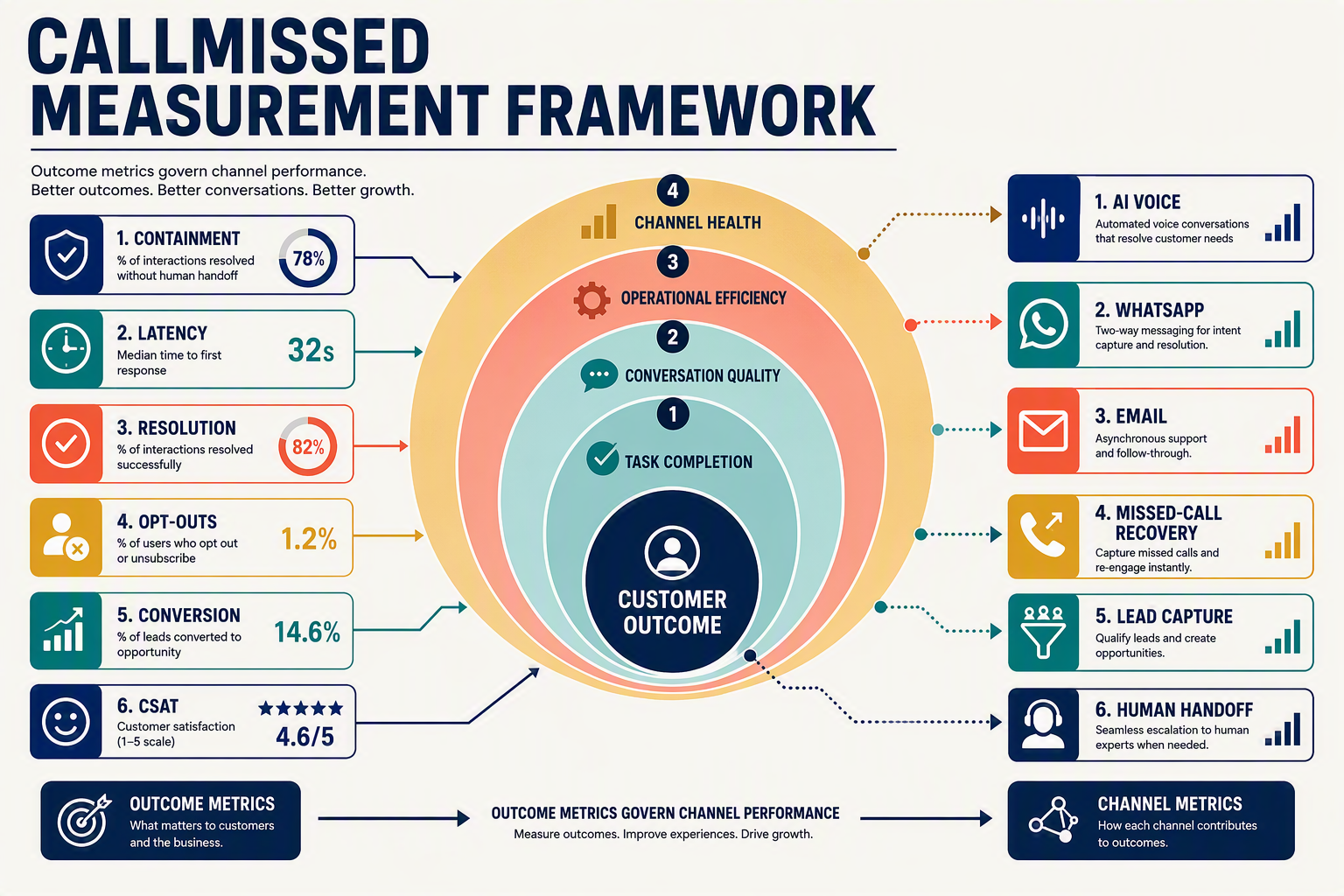
CallMissed teams should track AI agent performance metrics across five groups: customer and commercial outcomes, journey completion, channel reach and recovery, conversation performance, and quality and safety. Use these metrics together—containment, answer rate, or response time alone cannot reliably represent agent quality.
1. Start with customer and commercial outcomes
These metrics show whether the AI agent created real value rather than simply handled activity. Define a verified success event for each intent, such as a confirmed appointment, resolved support request, completed payment, or qualified lead.
Track:
- Task-completion rate: Verified completed tasks ÷ eligible conversations.
- Customer-outcome rate: Conversations producing the intended customer result ÷ eligible conversations.
- Lead-capture completeness: Leads containing all required fields ÷ leads initiated.
- Qualification rate: Leads meeting documented criteria ÷ captured leads.
- Conversion rate: Bookings, purchases, or other conversions ÷ eligible conversations or qualified leads.
- Repeat-contact rate: Customers returning about the same unresolved intent within a defined period ÷ customers served.
Verify outcomes through authoritative systems such as the CRM, booking platform, or payment gateway. Do not count an agent’s statement—such as “Your booking is complete”—as proof of completion.
2. Measure journey completion
Journey metrics identify where customers progress, abandon, or require human help. Core AI agent performance metrics for journey completion include:
- Containment rate: Eligible conversations completed without human assistance ÷ eligible conversations.
- Validated containment: Contained conversations with a confirmed successful outcome ÷ eligible conversations.
- Human-handoff rate: Conversations transferred or queued for a person ÷ eligible conversations.
- Handoff success rate: Transfers accepted with usable context ÷ attempted handoffs.
- Fallback rate: Responses triggered by low confidence, missing knowledge, or tool failure ÷ agent turns.
Validated containment is more meaningful than raw containment because it confirms that the customer’s task was actually completed.
3. Track reach, response, and recovery by channel
Reach and recovery metrics show whether customers could enter and continue the journey.
- Voice: Answer rate, connection rate, customer-abandonment rate, voicemail rate, and average speed to answer.
- Missed-call recovery: Eligible missed calls receiving follow-up, time to first recovery attempt, and recovered-conversation rate.
- WhatsApp: Delivery rate, read rate where available, response rate, response time, template failures, and opt-out rate.
- Email: Accepted, delivered, bounced, opened where technically reliable, replied, unsubscribed, and spam complaints.
Measure each stage of an end-to-end recovery workflow separately:
Missed call → WhatsApp delivered → customer replied → lead captured → task completed
This prevents a delivered message from being misreported as a recovered opportunity.
4. Diagnose conversation performance
Conversation-level AI agent performance metrics help teams explain why outcomes improved or deteriorated.
Track:
- End-to-end latency: Time from the end of customer input to the start of a useful agent response.
- Interruption recovery: Successful responses after customer barge-in ÷ detected interruptions.
- Recognition-error rate: Material transcription errors ÷ reviewed speech segments.
- Fallback rate: Low-confidence, missing-knowledge, or tool-failure responses ÷ agent turns.
- Tool success rate: Successful tool actions ÷ attempted tool actions.
- Handoff-context completeness: Handoffs containing the required summary and customer details ÷ attempted handoffs.
CallMissed’s 2026 platform specification supports voice and chat across 22 Indian languages, so teams should segment results by language. Aggregate performance can conceal problems involving Hindi-English code-switching, regional vocabulary, names, addresses, or noisy mobile calls.
5. Add quality, safety, and compliance controls
Voice agent quality assurance should combine automated checks with sampled human review. Score conversations for:
- Factual accuracy and grounding
- Correct consent and disclosure
- Tone, clarity, and language appropriateness
- Escalation correctness
- Sensitive-data handling
- Critical errors, including fabricated confirmations or unsafe advice
Critical safety or compliance failures should be reported separately rather than averaged into a general quality score.
In CallMissed analytics, segment AI agent performance metrics by channel, intent, language, campaign, agent version, knowledge-base version, tool used, and handoff reason. Always report the rate with its denominator: 8 failures from 40 conversations represents a very different risk from 8 failures from 40,000.
Why do definitions, event tracking and business context matter for CallMissed analytics?

Definitions, event tracking, and business context determine whether CallMissed analytics measures genuine customer outcomes or merely counts activity. A metric is trustworthy only when its formula, event source, eligibility rules, time window, and business meaning are explicit.
Define the metric before building the chart
Teams often use the same label for different calculations. For example, “containment” might mean that no human joined the conversation, or it might require the customer’s task to be completed without repeat contact. Those definitions produce very different results.
Create a metric dictionary containing:
- Business question: What decision will this metric support?
- Numerator and denominator: Which records count, and which are eligible?
- Start and end events: For example,
call_connectedtotask_completed. - Time window: Per interaction, within 24 hours, or within seven days.
- Exclusions: Test traffic, spam, duplicates, employee calls, and outages.
- Segmentation: Channel, intent, campaign, language, agent version, and customer type.
- Owner: The person responsible for validating and acting on the result.
For instance:
Missed-call recovery rate = eligible missed calls that later produced a successful customer connection ÷ all eligible missed calls.
“Successful connection” still needs a precise definition. A delivered WhatsApp message, a customer reply, an answered callback, and a completed booking represent four different recovery stages.
Track journeys as linked events
An omnichannel journey should not become unrelated rows in separate channel reports. Assign durable identifiers such as customer_id, conversation_id, interaction_id, and journey_id, while retaining channel-specific IDs for troubleshooting.
A practical event sequence could be:
inbound_call_receivedcall_missedwhatsapp_followup_sentwhatsapp_deliveredcustomer_repliedlead_fields_capturedhuman_handoff_requestedtask_completed
Each event should carry a timestamp, channel, intent, language, campaign, consent status, agent or workflow version, and outcome code. Store both event time and processing time so delayed webhooks do not distort sequence analysis.
Event validation is equally important. Monitor duplicate IDs, missing timestamps, impossible sequences, and unexplained volume changes. A dashboard cannot correct defective instrumentation downstream.
Add the context needed to interpret performance
The same AI agent performance metrics can mean opposite things in different workflows. A 90-second call may be efficient for appointment booking but inadequate for a complex insurance enquiry. A handoff may indicate automation failure, or it may be the correct response to a payment dispute, safety issue, or explicit request for a person.
Segment results by:
- Intent and risk level
- New versus returning customer
- Business hours versus after-hours
- Language, accent, and code-switching
- Network and audio conditions
- Agent, prompt, knowledge-base, and model version
- Outcome value, such as qualified lead, booking, payment, or resolved case
Language context is particularly important for voice agent quality assurance. As of August 2026, CallMissed product specifications document voice and chat support across 22 Indian languages, so aggregate accuracy can conceal material differences between Hindi, Tamil, Bengali, Marathi, and other regional journeys.
Definitions establish comparability, events establish evidence, and context establishes meaning. Without all three, teams risk optimising a number rather than improving the customer experience.
Which channel and workflow metrics belong in the core framework?
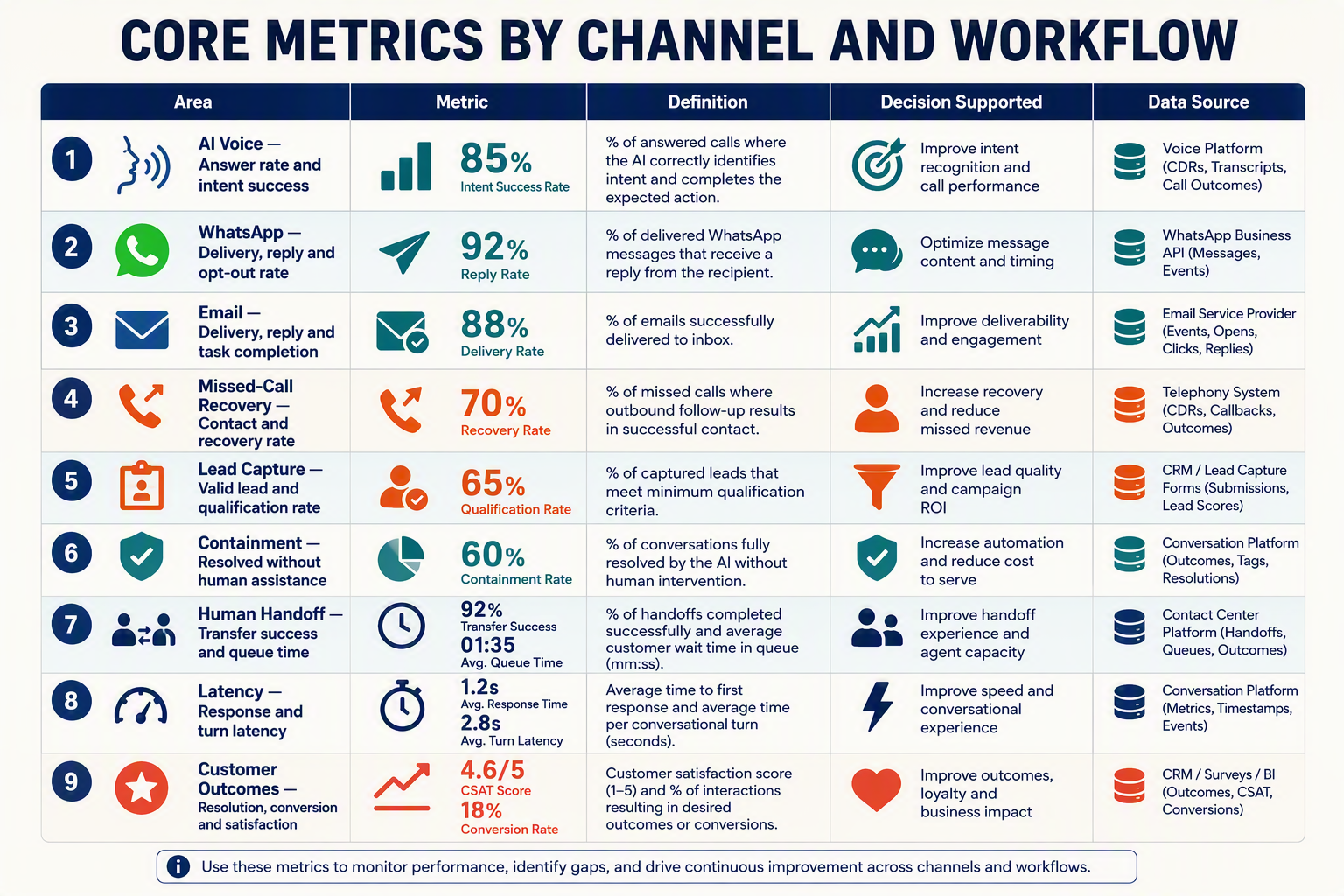
The core framework should pair every channel’s reach metric with a workflow outcome and a quality guardrail. This structure prevents teams from treating answered calls, delivered messages, or automated conversations as proof of successful customer engagement.
Core channel and workflow matrix
| Channel or workflow | Core decision metrics | Practical definition | QA guardrail |
|---|---|---|---|
| AI voice and WhatsApp Business calling | Answer rate, task-completion rate, p50/p95 response latency, abandonment rate | Answered eligible calls ÷ offered eligible calls; completed intended tasks ÷ valid task attempts | Recognition accuracy, interruption recovery, grounding, consent, critical errors, language |
| WhatsApp chat | Delivery rate, customer response rate, completion rate, opt-out rate | Delivered messages ÷ accepted messages; completed workflows ÷ valid conversations; opt-outs ÷ delivered outreach | Template compliance, response relevance, duplicate sends, escalation availability |
| Delivery rate, bounce rate, reply rate, unsubscribe rate, downstream conversion | Delivered emails ÷ attempted emails; attributable completed outcomes ÷ delivered emails | Consent, suppression-list enforcement, factual accuracy, broken links, attribution confidence | |
| Missed-call recovery | Recovery-attempt rate, contact rate, recovery time, recovered-outcome rate | Missed calls receiving follow-up ÷ eligible missed calls; successful outcomes ÷ eligible missed calls | Duplicate contact, quiet-hour compliance, correct customer matching, retry limits |
| Lead capture and qualification | Capture completeness, valid-contact rate, qualification rate, booking or payment completion | Required valid fields captured ÷ required fields expected; qualified leads ÷ assessable leads | Field validation, consent evidence, CRM deduplication, unsupported qualification claims |
| Containment, handoff and outcomes | Valid containment, handoff success, time to human, repeat-contact rate, CSAT or verified outcome | Resolved without human help ÷ eligible resolved conversations; accepted handoffs ÷ attempted handoffs | False containment, missing context, incorrect routing, unresolved repeat contacts |
Apply denominator discipline
Every metric needs a documented numerator, denominator, eligibility rule, event source, owner, and reporting window. For example, missed-call recovery should exclude spam, immediate customer callbacks, test numbers, and callers who have withdrawn consent. Otherwise, operational changes can move the percentage without changing customer performance.
Use separate denominators for:
- Attempted: the system initiated an action.
- Reached: the customer received or answered it.
- Engaged: the customer meaningfully interacted.
- Completed: the intended task passed defined validation.
- Verified: CRM, payment, booking, ticket, or human review confirmed the result.
This event ladder makes AI agent performance metrics comparable without pretending that all channels behave alike. A WhatsApp message can be delivered asynchronously, while an AI voice interaction is sensitive to silence, turn-taking, network quality, and response latency.
Segment before drawing conclusions
Aggregate results should always be drillable by intent, campaign, customer type, time window, language, model or workflow version, and escalation reason. CallMissed supports voice and chat across 22 Indian languages, so voice agent quality assurance should report recognition, completion, handoff, and critical-error rates separately for each deployed language. A portfolio average can conceal a serious regional-language failure.
For latency, publish both p50 and p95, not only the mean. The median describes a typical interaction, while the 95th percentile exposes the slowest 5% of measured events. Define the timing boundary explicitly—for example, “end of customer speech to first audible agent response”—so releases remain comparable.
Distinguish success from automation
In CallMissed analytics, containment should count only conversations with a verified resolution or an explicit customer-confirmed outcome. A conversation that ends because the customer disconnects, stops replying, or cannot reach a human is not successful containment.
The same rule applies across the framework: pair activity with evidence. Report message volume alongside completion, lead count alongside valid-contact and qualification rates, and handoff volume alongside acceptance, context transfer, and eventual resolution. This turns the dashboard into a decision system rather than an activity scoreboard.
How should voice agent quality assurance evaluate conversations beyond call volume?
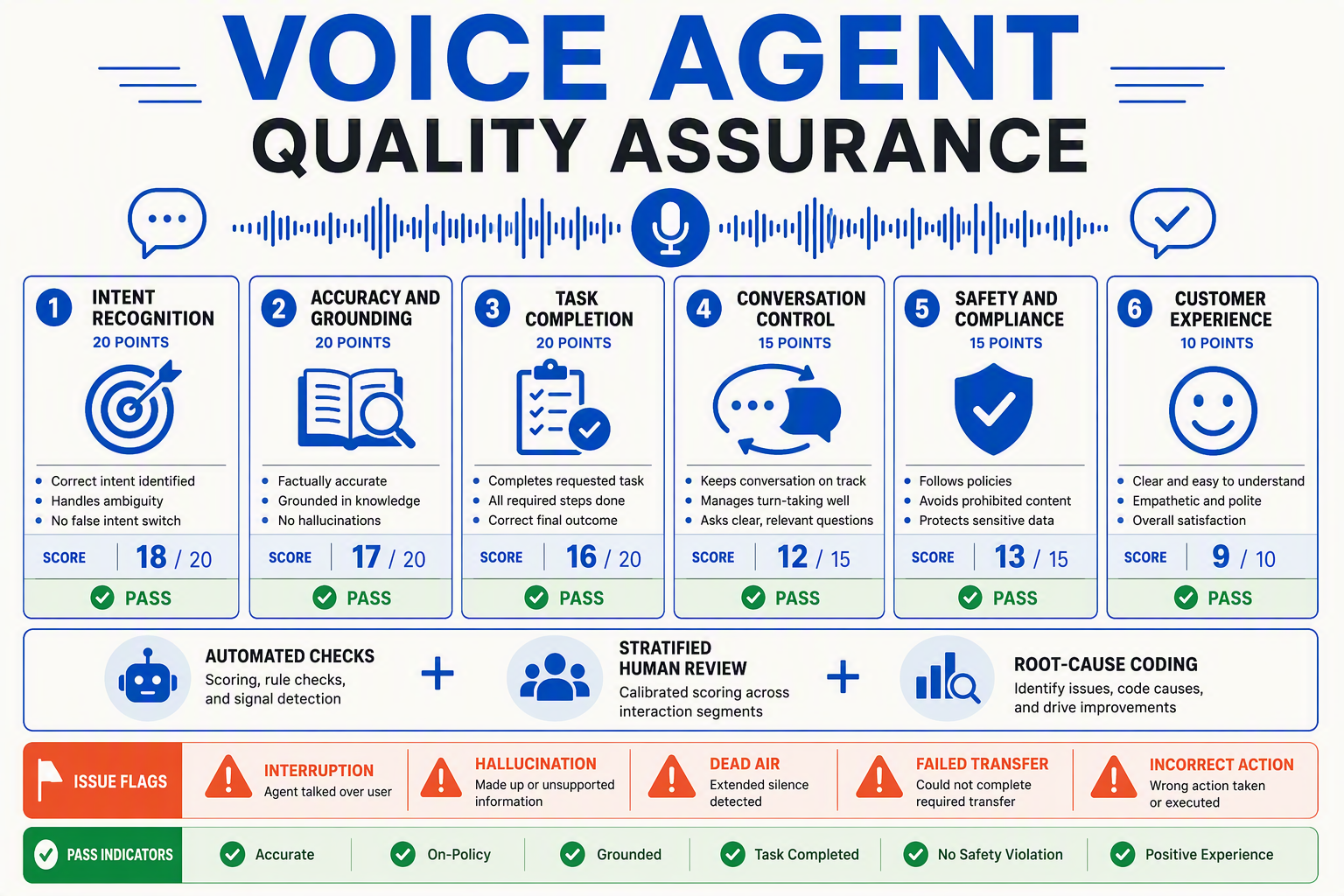
Call volume shows demand and system availability; it does not show whether an AI voice agent understood the caller, supplied a correct answer, or completed the requested task. Voice agent quality assurance should score every conversation across outcomes, accuracy, experience, safety, and escalation—not merely duration or answer count.
Score the complete conversation
A practical QA framework evaluates five dimensions:
- Outcome: Did the caller book an appointment, obtain a valid answer, make a payment, qualify as a lead, or complete another intended task?
- Understanding: Did speech recognition preserve the caller’s intent, entities, dates, amounts, addresses, and names?
- Response quality: Was the answer relevant, grounded in the approved knowledge base, and free from unsupported claims?
- Conversation experience: Did the agent respond promptly, handle interruptions, avoid repetition, and use an appropriate tone?
- Safety and escalation: Did the agent obtain required consent, protect sensitive data, follow policy, and transfer when necessary?
Each dimension should have explicit pass, fail, and not-applicable criteria. A booking should not pass because the agent said, “Your appointment is confirmed”; QA should verify that the appointment exists in the scheduling system.
Measure diagnostic and outcome metrics together
Core AI agent performance metrics for voice include:
- Verified task-completion rate: completed eligible tasks divided by eligible conversations.
- Grounded-answer accuracy: supported factual answers divided by factual answers reviewed.
- Intent-recognition accuracy: correctly identified intents divided by evaluated intent-bearing calls.
- Entity-capture accuracy: correctly recorded names, dates, numbers, or locations divided by entities checked.
- First-response and turn latency: measure both median and tail performance, such as the 95th percentile; an average can conceal severe delays.
- Interruption-recovery rate: successful resumptions after caller barge-in divided by interruption events.
- Repeat-contact rate: customers returning about the same unresolved issue within a defined window.
- Handoff correctness: required transfers completed appropriately, plus unnecessary transfers and missed escalations.
- Critical-error rate: conversations containing a serious compliance, safety, privacy, or materially incorrect outcome.
Call duration remains useful diagnostically. Compare it with task completion, repetition, silence, and escalation rather than assuming shorter or longer calls are inherently better.
Audit representative conversations
Automated evaluators can score every transcript, but human reviewers should validate a structured sample. Build the sample using:
- Random calls from normal traffic.
- All critical-error alerts and customer complaints.
- Failed tasks, abandoned calls, and repeat contacts.
- Human handoffs, unusually long calls, and high-latency sessions.
- Each supported language, intent, campaign, and telephony condition.
CallMissed analytics should be segmented by language because CallMissed supports voice and chat across 22 Indian languages. An overall score can hide poor recognition for one regional language, mixed-language speech, accented English, code-switching, noisy environments, or uncommon names.
Turn reviews into controlled improvements
For every failed call, reviewers should identify the failure stage: telephony, speech-to-text, intent detection, retrieval, reasoning, text-to-speech, workflow integration, or escalation. Then teams can:
- Attach the transcript, recording, trace, and system-of-record outcome.
- Assign a failure category and severity.
- Retest the conversation against the proposed fix.
- Compare performance with a verified pre-change baseline.
- Monitor for regressions across other intents and languages.
Do not adopt an invented “industry-standard” quality score. Establish use-case-specific baselines, weight critical errors more heavily than stylistic imperfections, and require evidence that improvements produce safer conversations and better customer outcomes.
How do missed-call recovery, lead capture, containment and human handoff connect?
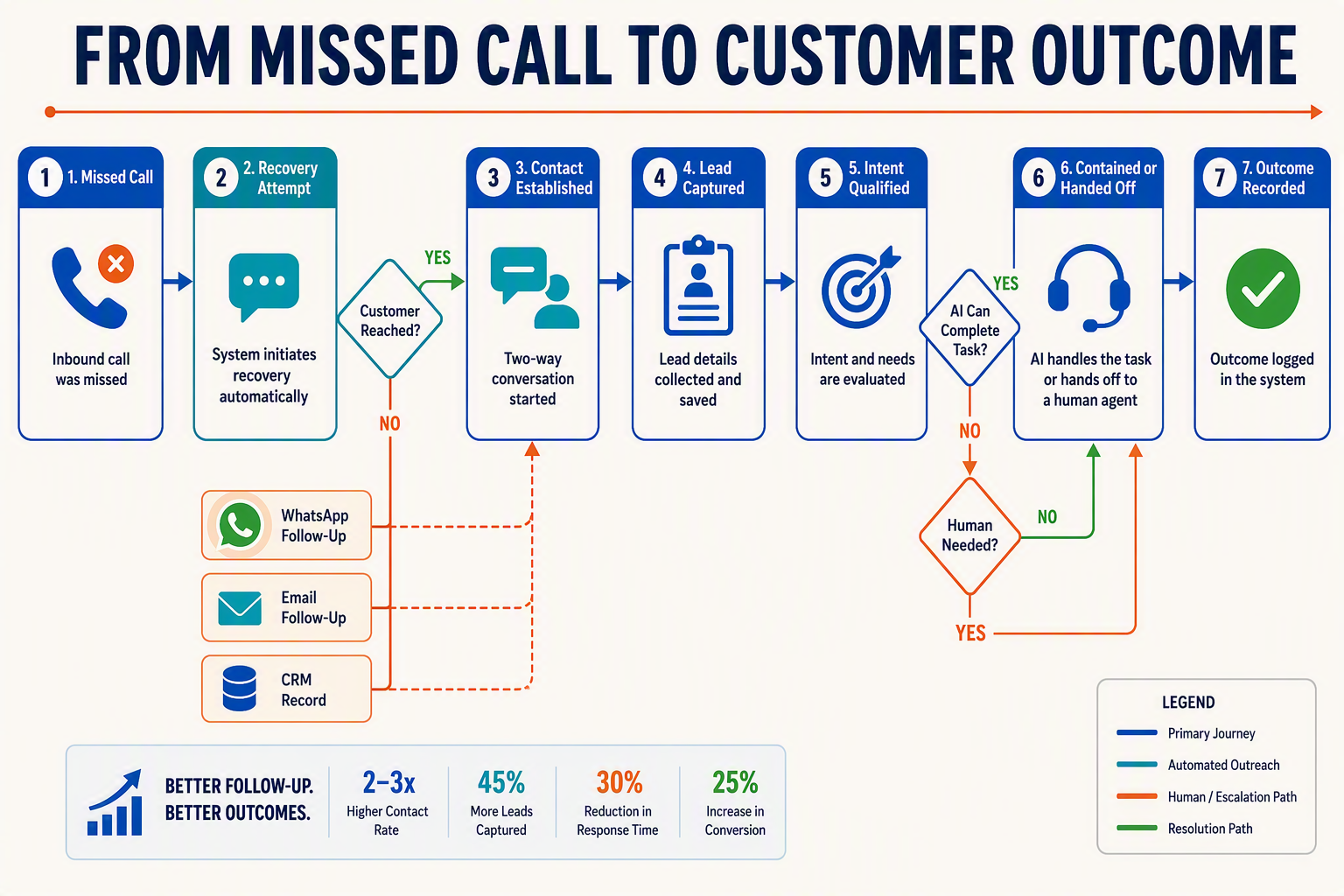
Missed-call recovery, lead capture, containment, and human handoff form one connected journey—not four independent metrics. Teams should measure how many missed contacts become reachable conversations, how many conversations produce usable lead records, and whether each customer reaches a verified resolution through automation or a successful transfer.
Model the journey as an event funnel
In CallMissed analytics, assign one persistent journey ID across the original call, WhatsApp follow-up, AI conversation, email, CRM record, and human interaction. Without identity stitching, a recovered caller who later converts on WhatsApp may appear as one failed call and one unrelated digital lead.
Use a funnel with explicit states:
- Missed contact: An eligible inbound call was not answered.
- Recovery attempted: The workflow sent a permitted WhatsApp message, placed a callback, or initiated another configured follow-up.
- Contact recovered: The customer answered or sent a meaningful response—not merely received a message.
- Lead captured: Required identity, contact, consent, intent, and qualification fields passed validation.
- Outcome reached: The journey was contained successfully, transferred successfully, or closed with another verified disposition.
- Commercial result: A booking, payment, qualified opportunity, or other defined business outcome occurred.
Every state needs a timestamp, channel, language, campaign, use case, and failure reason. This structure makes AI agent performance metrics comparable without treating message delivery as customer engagement.
Calculate each metric from the correct denominator
Small denominator changes can produce materially different conclusions. Document each formula directly in the dashboard:
- Missed-call recovery rate = missed calls that produce a meaningful customer response ÷ eligible missed calls.
- Lead-capture rate = recovered conversations with a valid lead record ÷ recovered conversations where lead capture was relevant.
- Lead completeness rate = valid required fields captured ÷ required fields expected across eligible leads.
- Successful containment rate = eligible conversations resolved by automation with no required human transfer ÷ eligible conversations.
- Human-handoff rate = conversations transferred or queued for a person ÷ conversations eligible for escalation.
- Handoff success rate = handoffs accepted by a human within the defined service threshold ÷ handoffs initiated.
- End-to-end recovery conversion = verified business outcomes ÷ eligible missed calls.
“Eligible” must exclude test traffic, duplicates, immediate caller retries, spam, and contacts that cannot legally or operationally receive follow-up.
Treat containment and handoff as outcomes with guardrails
Containment is valuable only when the customer’s task is completed correctly. A conversation that ends because the customer abandons, encounters a technical failure, or receives an unsupported answer is not successful containment.
Likewise, a handoff is not automatically a failure. Escalation may be the correct outcome for payment disputes, safety concerns, regulated requests, low-confidence answers, or explicit requests for a person. Voice agent quality assurance should therefore review:
- Whether escalation was required and triggered at the correct moment.
- Whether the transcript, intent, language, and captured fields reached the human agent.
- Queue time, transfer acceptance, repeated questions, and post-handoff resolution.
- Repeat contact within a defined window, which can expose false containment.
- Critical errors such as invented answers, missing consent, or dropped urgent requests.
Diagnose the complete chain
Segment the funnel by channel, intent, campaign, language, time of day, recovery method, and handoff reason. For example, a strong recovery rate paired with poor lead completeness points to conversation design or CRM validation—not outreach performance. High containment with rising repeat contact suggests unresolved journeys.
Avoid a single universal target. Establish verified baselines for each workflow, inspect failed paths weekly, and optimize for completed customer outcomes, not the highest possible containment percentage.
How should latency, task completion, opt-outs and customer outcomes be measured together?
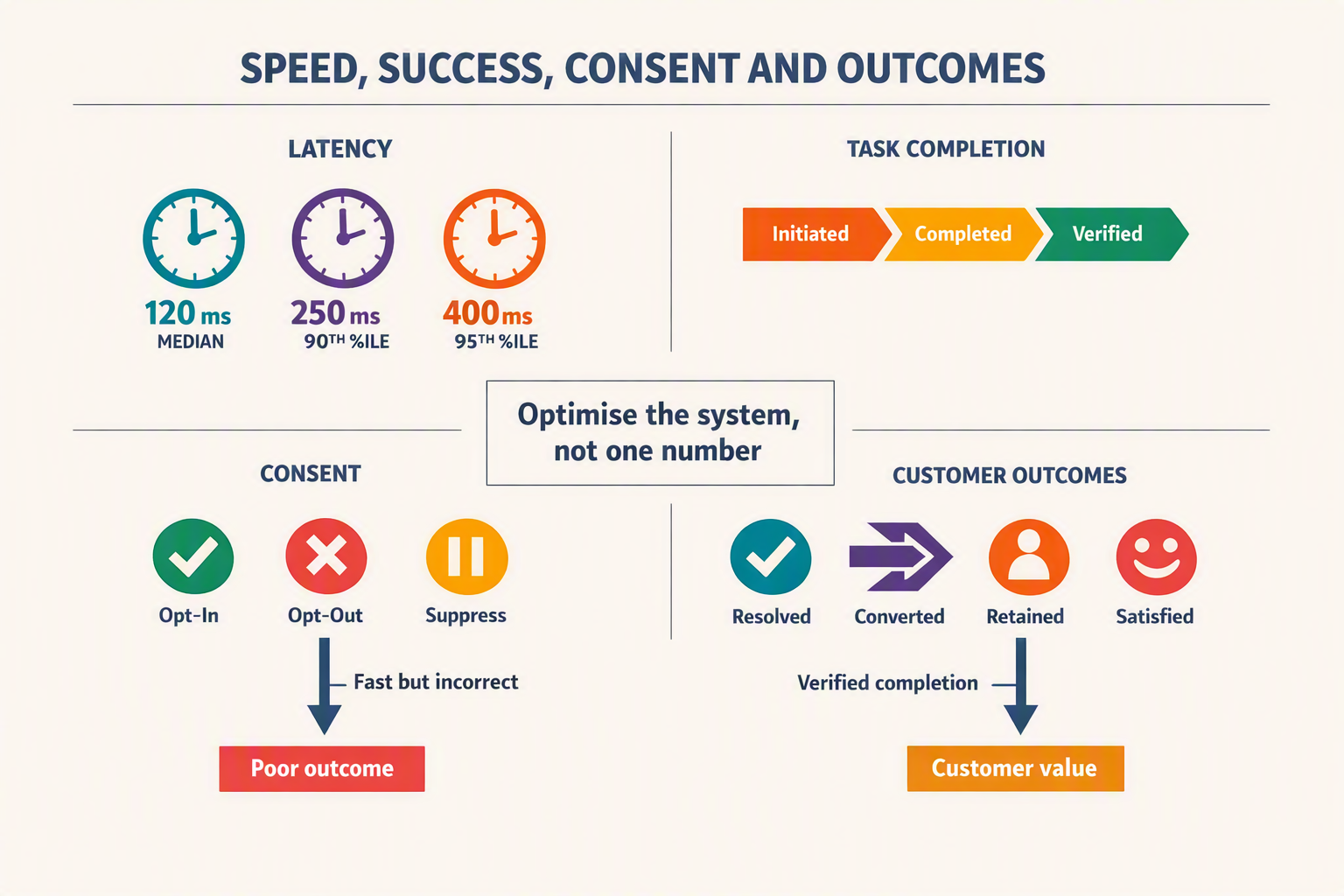
Latency, task completion, opt-outs, and customer outcomes should be measured as a connected journey, not as independent averages. The objective is to determine whether faster interactions help customers complete verified tasks without increasing abandonment, unwanted contact, repeat requests, or negative outcomes.
Build one journey-level measurement record
Join channel events using a persistent journey ID, customer ID, or consent-safe hashed identifier. A journey might begin with a missed call, continue through WhatsApp and an AI voice call, and end with a booking, human escalation, or opt-out.
Each record should include:
- Context: channel, intent, campaign, language, customer type, and first-contact timestamp.
- Performance: response latency, voice turn latency, task duration, retries, and tool failures.
- Resolution: verified task completion, containment, handoff, abandonment, and repeat contact.
- Customer signal: opt-out, complaint, satisfaction response, cancellation, conversion, or retention event.
- Evidence: transcript, tool response, CRM update, booking ID, payment status, or case closure.
For CallMissed analytics, this joined view is more useful than separate voice, WhatsApp, and email reports because it prevents a successful follow-up from being misclassified as a failed initial interaction.
Define each metric precisely
Measure latency as a distribution rather than a single mean:
- First-response latency: time from an inbound event to the agent’s first meaningful response.
- Voice turn latency: time between the end of the customer’s speech and the start of the agent’s reply.
- Tool latency: time consumed by CRM, scheduling, payment, retrieval, or handoff systems.
- End-to-end task time: time from expressed intent to verified completion.
Report median, 90th-percentile, and 95th-percentile latency. Percentiles reveal slow-tail experiences that an average can conceal.
Use this task-completion formula:
Verified task completion rate = journeys with confirmed completion ÷ eligible journeys × 100
“Confirmed” should require external evidence—for example, a calendar booking, CRM field update, ticket closure, or successful payment—not merely the AI agent saying the task is complete.
Calculate opt-outs by both exposure and customer:
Opt-out rate = unique customers opting out ÷ unique customers receiving eligible outreach × 100
Separate explicit opt-outs from delivery failures, blocked numbers, call rejection, and inactivity. These events have different operational and compliance meanings.
Read the metrics as a system
A latency improvement is valuable only when completion and customer outcomes remain stable or improve. Review combinations such as:
- Lower latency + higher completion + stable opt-outs: likely a genuine improvement.
- Lower latency + lower completion: responses may be faster but rushed, inaccurate, or insufficiently grounded.
- Higher containment + more repeat contacts: apparent automation success may be masking unresolved issues.
- Higher conversion + rising opt-outs: short-term commercial gains may be creating long-term contactability risk.
- More handoffs + better resolution: escalation may be working correctly rather than indicating AI failure.
For voice agent quality assurance, sample conversations from every combination—not only failures. Review fast successful calls, fast failed calls, slow successful calls, opt-outs, and escalations to identify causation rather than correlation.
Segment before setting targets
Break down AI agent performance metrics by intent, channel, campaign, language, customer cohort, and outcome window. CallMissed supports voice and chat across 22 Indian languages, so an overall latency or completion figure can hide recognition, pronunciation, or workflow problems affecting a specific language.
Set targets from validated internal baselines, then monitor whether changes improve verified outcomes per eligible journey while keeping opt-outs, complaints, repeat contacts, and critical QA errors within approved guardrails.
How should teams design dashboards and set a reliable review cadence?
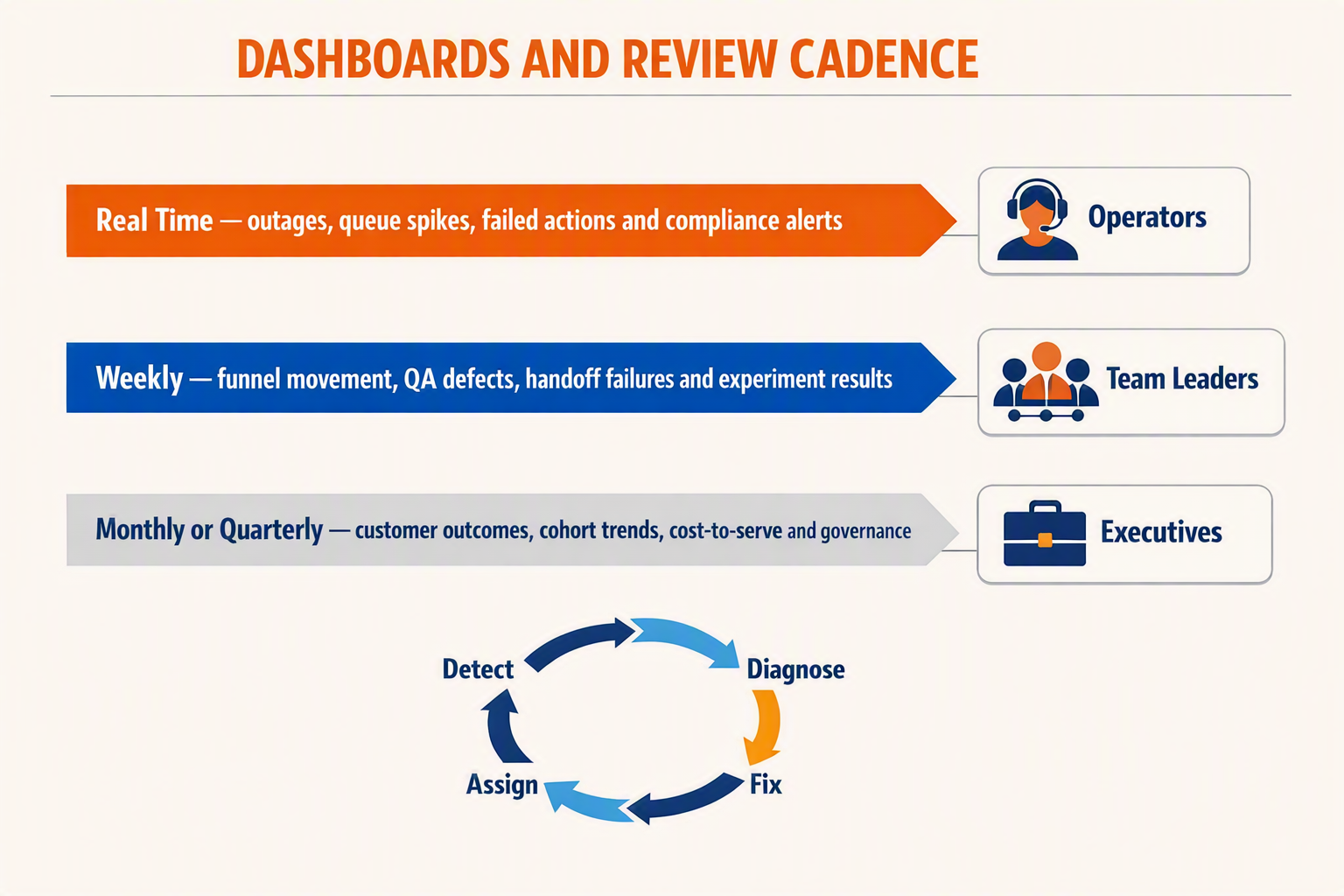
Teams should build separate executive, operations, and quality-assurance dashboards, all derived from the same governed metric definitions. Review urgent failures daily, trends weekly, business outcomes monthly, and metric design quarterly; do not force every stakeholder into one overloaded dashboard.
Build dashboards around decisions
Each dashboard should answer a defined question and identify who must act. A practical three-layer design is:
- Executive dashboard — Is automation creating value safely?
- Task completion and verified customer outcomes
- Qualified leads, bookings, payments, or recovered opportunities
- Cost per completed outcome, where channel costs are available
- Repeat-contact, escalation, opt-out, and critical-error trends
- Comparisons against the team’s approved baseline and target
- Operations dashboard — Where is the journey breaking?
- AI voice answer rates, latency, call completion, and transfer success
- Missed-call recovery attempts, contact rate, and recovery outcomes
- WhatsApp delivery, response, template failure, and opt-out rates
- Email delivery, bounce, reply, and unsubscribe rates
- Queue depth, handoff wait time, abandoned transfers, and unresolved cases
- QA dashboard — Why did the interaction fail?
- Grounding, factual accuracy, consent, tone, and escalation correctness
- Speech-recognition or synthesis issues by language and acoustic condition
- Tool-call failures, knowledge gaps, prompt defects, and agent mistakes
- Critical-error counts with links to recordings, transcripts, and event traces
CallMissed supports voice and chat across 22 Indian languages, according to CallMissed product information in 2026, so language must be a dashboard filter rather than a hidden aggregate. Teams should also filter CallMissed analytics by channel, use case, campaign, customer cohort, agent version, handoff reason, and time period.
Make every metric auditable
A dashboard is reliable only when every number can be traced to its source events. Maintain a metric dictionary containing:
- Definition: the exact numerator, denominator, exclusions, and time window.
- Owner: the person accountable for investigating movement.
- Data source: telephony logs, WhatsApp events, email events, CRM records, or QA reviews.
- Freshness: real-time, hourly, daily, or manually validated.
- Segmentation rules: language, intent, campaign, channel, and model version.
- Target logic: internal baseline, risk tolerance, and desired improvement—not an invented industry benchmark.
Display both percentages and sample sizes. A 100% completion rate from three conversations should not carry the same confidence as a result based on thousands of interactions.
Set a review cadence that leads to action
Use a tiered operating rhythm:
- Continuously: alert on service outages, severe latency, delivery failures, unavailable handoff queues, consent violations, and other critical errors.
- Daily: review failed transfers, abandoned high-intent journeys, missed-call recovery exceptions, opt-out spikes, and a risk-based transcript sample.
- Weekly: examine funnel movement, task completion, containment quality, repeat contacts, language-level defects, and recurring failure reasons.
- Monthly: connect AI agent performance metrics to qualified leads, revenue where attribution is defensible, customer outcomes, and operating cost.
- Quarterly: revalidate metric definitions, sampling methods, targets, retention controls, and dashboard usefulness.
Every review should end with an owner, corrective action, due date, and validation method. For voice agent quality assurance, teams should combine random sampling with targeted reviews of long calls, repeat contacts, escalations, negative outcomes, and newly released agent versions. This cadence turns dashboards from passive reporting into a controlled improvement system.
What should your team put in a sample weekly scorecard?
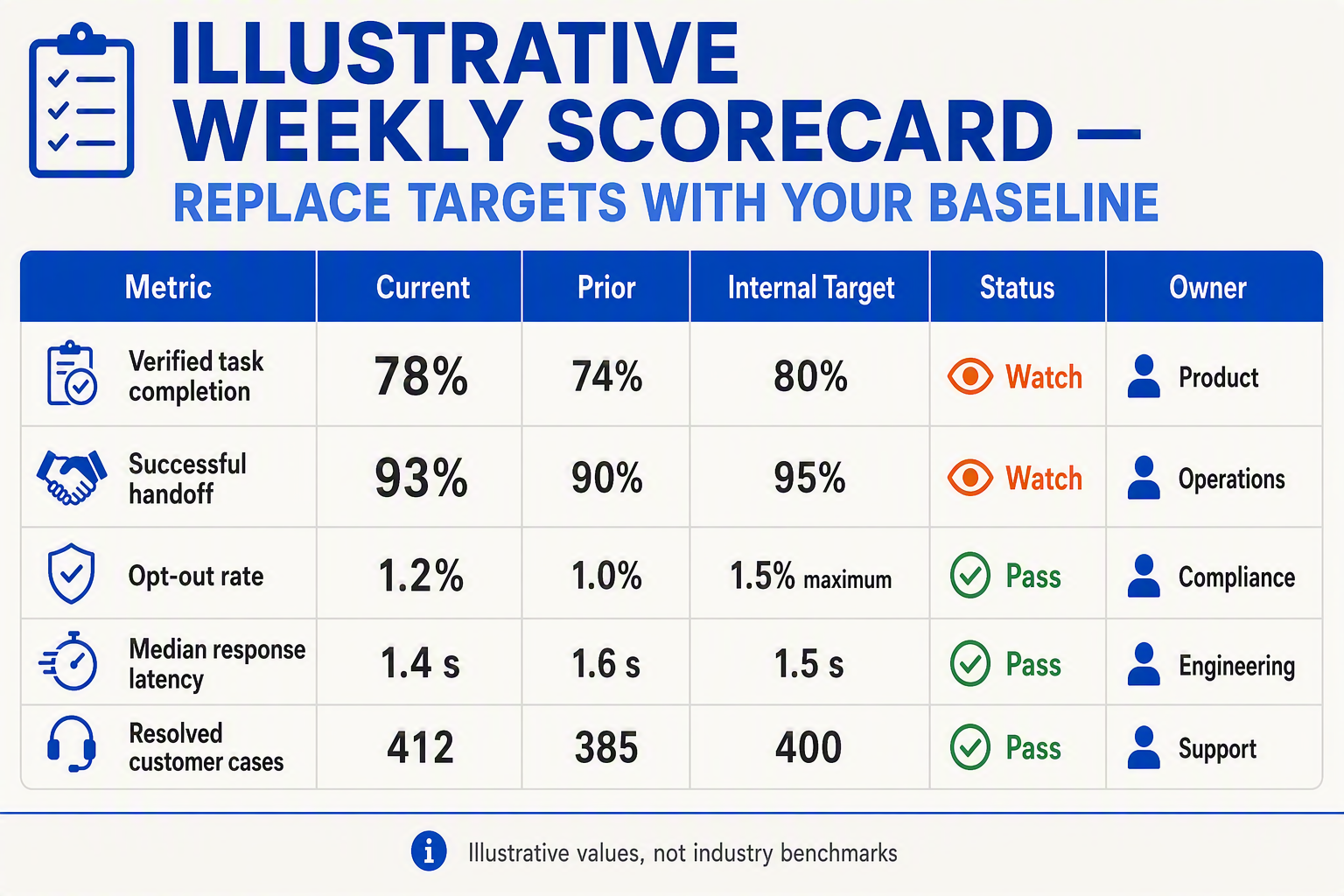
A sample weekly scorecard should combine customer outcomes, operational efficiency, experience, and safety in one view. The score is useful only when every result remains traceable to its channel, workflow, language, sample size, and verified source event.
Sample weighted scorecard
The weights below are an illustrative operating model, not universal industry benchmarks. Each team should set targets from a validated baseline and adjust weights according to business risk—for example, a healthcare workflow may assign more weight to escalation accuracy than a simple appointment-booking flow.
| Objective | Weekly metric set | Target rule | Weight | Primary owner |
|---|---|---|---|---|
| Complete customer tasks | Task-completion rate; repeat contact within the defined window; verified booking, payment, or case closure | Improve against the trailing four-week baseline without raising critical errors | 20% | Business operations |
| Recover missed demand | Missed-call recovery rate; time to first follow-up; successful reconnection; recovered outcome | Set by call reason, operating hours, and customer contactability | 15% | Voice operations |
| Capture qualified leads | Required-field completeness; valid contact rate; qualification rate; CRM-write success; conversion | Count only validated fields and deduplicated leads | 15% | Revenue operations |
| Resolve or escalate correctly | Successful containment; human-handoff completion; transfer latency; abandonment after transfer | Reward resolved containment, not containment alone | 20% | Support operations |
| Protect channel experience | Voice response latency; WhatsApp response and opt-out rates; email delivery, reply, and unsubscribe rates | Use channel-specific baselines and investigate adverse movement | 15% | Channel owner |
| Maintain quality and safety | Grounded-answer accuracy; consent compliance; language QA; escalation correctness; critical-error rate | Any critical breach triggers review regardless of total score | 15% | QA or compliance |
How to calculate the weekly result
Normalize each metric against its approved target, cap excessive overperformance so one metric cannot mask failures elsewhere, and then apply the table’s weights. For adverse metrics such as latency, abandonment, opt-outs, and critical errors, lower is better, so the scoring direction must be reversed.
A practical weekly review follows four steps:
- Freeze the reporting window and reconcile CallMissed analytics events with telephony, WhatsApp, email, and CRM records.
- Publish the denominator beside every rate—for example, “42 successful handoffs from 50 eligible escalations,” not merely “84%.”
- Segment material changes by workflow, channel, campaign, language, model or configuration version, and handoff reason.
- Assign one corrective action with an owner, due date, and expected metric effect.
Add QA evidence, not just percentages
Every scorecard should include a short review panel beneath the numbers:
- Three representative successes and three failures, with transcript or recording references.
- All critical incidents involving consent, unsafe advice, incorrect commitments, or failed escalation.
- Low-confidence metrics caused by small samples, missing events, or CRM-sync failures.
- Configuration changes that could explain week-over-week movement.
Language segmentation is especially important for voice agent quality assurance. CallMissed product documentation states in 2026 that the platform supports speech and chat across 22 Indian languages, so one blended recognition or task-completion figure can conceal regional failures.
Finally, show the weighted score alongside its components rather than treating it as a standalone grade. The most reliable AI agent performance metrics reveal trade-offs: containment may rise while repeat contact worsens, or faster responses may coincide with lower factual accuracy. A red safety guardrail should therefore override an attractive aggregate score.
What do experts recommend about vanity metrics, benchmarks and operational impact?

Experts recommend treating activity metrics as diagnostic signals, not proof of success. Benchmarks should come from verified internal baselines and comparable workflows, while every target should connect to an operational, customer, commercial, or risk outcome.
Replace impressive numbers with decision-ready measures
High call volume, message count, email opens, average call duration, and raw containment can look persuasive without showing whether customers completed their goals. This is an application of Goodhart’s law, named after economist Charles Goodhart: when a measure becomes a target, it often stops being a useful measure.
A metric becomes operationally useful when teams can answer three questions:
- What decision will this metric change?
- Which customer outcome should move with it?
- What counter-metric prevents gaming or hidden harm?
For example:
- Pair containment rate with verified task completion, repeat contact, abandonment, and critical-error rate.
- Pair lead volume with qualification completeness, contactability, appointment completion, and conversion.
- Pair missed-call recovery attempts with successful connections, customer response, opt-outs, and recovered outcomes.
- Pair fast response time with answer accuracy, escalation correctness, and customer effort.
- Pair WhatsApp delivery with meaningful replies, completed actions, blocks, and opt-outs.
This approach keeps AI agent performance metrics focused on value rather than automation activity.
Build benchmarks from comparable evidence
A universal “good containment rate” or “ideal call duration” is rarely defensible. A restaurant reservation agent, healthcare triage workflow, loan-enquiry bot, and emergency escalation line have different intent complexity, risk, and acceptable failure costs.
Experts therefore recommend benchmarking in stages:
- Validate instrumentation: confirm that events, dispositions, handoffs, and outcomes are recorded consistently.
- Establish a baseline: observe stable performance over a defined period before introducing targets.
- Segment the baseline: compare like with like across intent, channel, campaign, language, time band, customer type, and model version.
- Set a target range: use tolerances rather than one brittle number.
- Monitor guardrails: prevent one target from improving at the expense of safety or experience.
For voice agent quality assurance, language-level comparison is especially important. CallMissed supports voice and chat across 22 Indian languages, so an aggregate recognition or task-completion rate can conceal substantial differences between Hindi, Tamil, Bengali, Marathi, or code-switched conversations.
Translate dashboard movement into operational impact
Each dashboard alert should have an owner, investigation path, and expected response. A useful review asks not merely what changed, but what should the team do next?
Examples include:
- Rising handoffs caused by missing knowledge trigger a content update.
- Longer latency isolated to one model or route triggers infrastructure investigation.
- Increased WhatsApp opt-outs trigger a review of consent, targeting, frequency, and message relevance.
- Lower lead completeness triggers prompt, form, validation, or CRM-mapping changes.
- Repeat contacts after “contained” sessions trigger transcript review and outcome reclassification.
CallMissed analytics should consequently separate executive outcome indicators from operational diagnostics and QA evidence. The strongest benchmark is not an unsupported industry average; it is a verified, segmented baseline showing that a specific change improved completion, recovery, customer experience, or risk without degrading another critical measure.
Frequently Asked Questions About CallMissed Analytics and AI Agent Performance
What are the most important AI agent performance metrics to track in CallMissed analytics?
How should businesses set benchmarks for AI voice and WhatsApp agent performance?
How often should teams review CallMissed analytics and quality-assurance results?
What should a voice agent quality assurance scorecard include?
How do you measure AI containment without hiding failed customer journeys?
How can AI agent performance metrics improve human handoffs and lead attribution?
Conclusion
Effective AI measurement is not about proving that automation is busy; it is about showing that customer journeys are useful, safe, and improving. The strongest AI agent performance metrics connect operational signals—such as latency, delivery, and answer rate—to verified outcomes such as recovered opportunities, completed tasks, qualified leads, correct escalations, and satisfied customers.
- Measure the complete journey. Track reach and missed-call recovery across AI voice, WhatsApp, and email, then connect those interactions to lead capture, qualification, booking, payment, repeat contact, and other customer outcomes. Channel-level activity becomes meaningful only when teams can follow the journey across systems.
- Balance containment with successful resolution. A high containment rate is valuable only when the AI agent completes the intended task accurately and gives customers an accessible path to human help. Monitor task completion, abandonment, repeat contact, handoff reasons, escalation correctness, and post-handoff outcomes together.
- Treat quality assurance as evidence, not intuition. Effective voice agent quality assurance combines latency and interruption telemetry with transcript sampling, grounding checks, consent verification, tone assessment, policy testing, and critical-error reviews. CallMissed supports voice and chat across 22 Indian languages as of 2026, making language-level segmentation essential for teams serving regional audiences.
- Use verified baselines instead of invented benchmarks. Define each metric precisely, validate event instrumentation, establish an observation period, and compare performance by channel, use case, campaign, language, intent, and handoff reason. Executive dashboards should emphasise outcomes and risk, while operations and QA views should expose the diagnostic signals needed to investigate failures.
Looking ahead, teams should watch for journeys that appear successful in aggregate but fail within a particular language, workflow, or escalation path. As AI agents handle more customer interactions, measurement will increasingly need to connect every conversation with its downstream CRM record and verified business result.
Explore CallMissed to see how CallMissed analytics can support omnichannel measurement across voice, WhatsApp, email, missed-call recovery, and human handoff. Is your dashboard measuring conversations—or proving that customers actually achieved what they came for?
Related Reading
Discussion
Related Posts


Ready to automate customer conversations?
Launch AI voice agents and WhatsApp bots with CallMissed — one API, 22+ Indian languages.