
CallMissed Email Agent Guide: Continuity Across Voice, WhatsApp, and Email



Learn how a CallMissed email agent can use relevant voice and WhatsApp context for coherent follow-ups, qualification, and support.
CallMissed Email Agent Guide: Continuity Across Voice, WhatsApp, and Email
What if a customer explained a service problem on WhatsApp, clarified it by voice, and then received an email that acted as though none of that history existed? That broken handoff is exactly what this CallMissed Email Agent Guide addresses: how relevant shared context from earlier CallMissed voice and WhatsApp conversations can make a later email feel like the next step, rather than a restart. CallMissed, an AI-native customer-engagement and communication-infrastructure platform, brings voice, WhatsApp, email, and web engagement into one business platform for cross-channel customer journeys. That makes continuity a practical product-design question now.
Customers already judge brands by whether interactions connect. In Zendesk’s CX Trends 2023 report, 70% of consumers said they expect anyone they interact with to have the full context of their situation. Salesforce’s State of the Connected Customer, Sixth Edition, published in 2023, found that 79% of customers expect consistent interactions across departments. Those expectations matter more as AI handles more touchpoints: speed without continuity merely automates repetition, while careless memory can automate a privacy, identity, or accuracy failure. Email therefore needs enough verified context to help, but never an indiscriminate transcript dump.
This guide follows concrete journeys rather than offering a generic catalogue of AI email features. You will learn how to:
- Continue a voice-to-email follow-up using confirmed needs, constraints, and next steps, without inventing commitments or treating tentative comments as decisions.
- Carry a WhatsApp support exchange into email with the known issue, troubleshooting already attempted, and current status, so customers are not asked to retell the case.
- Qualify a lead by preserving facts already supplied and asking only for missing information, without assuming particular scores, fields, routing rules, or CRM actions.
- Decide when channel history should be ignored, corrected, or sent to a human for review.
At the center is omnichannel customer memory: the disciplined use of relevant, recent, permission-appropriate context tied to the right person and purpose. This guide separates that idea from copying entire transcripts into every prompt. It explains the controls buyers and administrators should verify: identity resolution across channels, retention, inspection, editing and deletion, sensitive-data handling, and rules for disregarding stale or irrelevant history. You will also see why wrong identity matches, contradictory facts, excessive personalization, incomplete histories, and tentative statements presented as confirmed facts require caution. The principle is simple: use context to advance the customer’s goal, but escalate ambiguity, sensitive matters, conflicts, and consequential promises for review.
What is a CallMissed email agent, and how can it maintain conversation continuity?
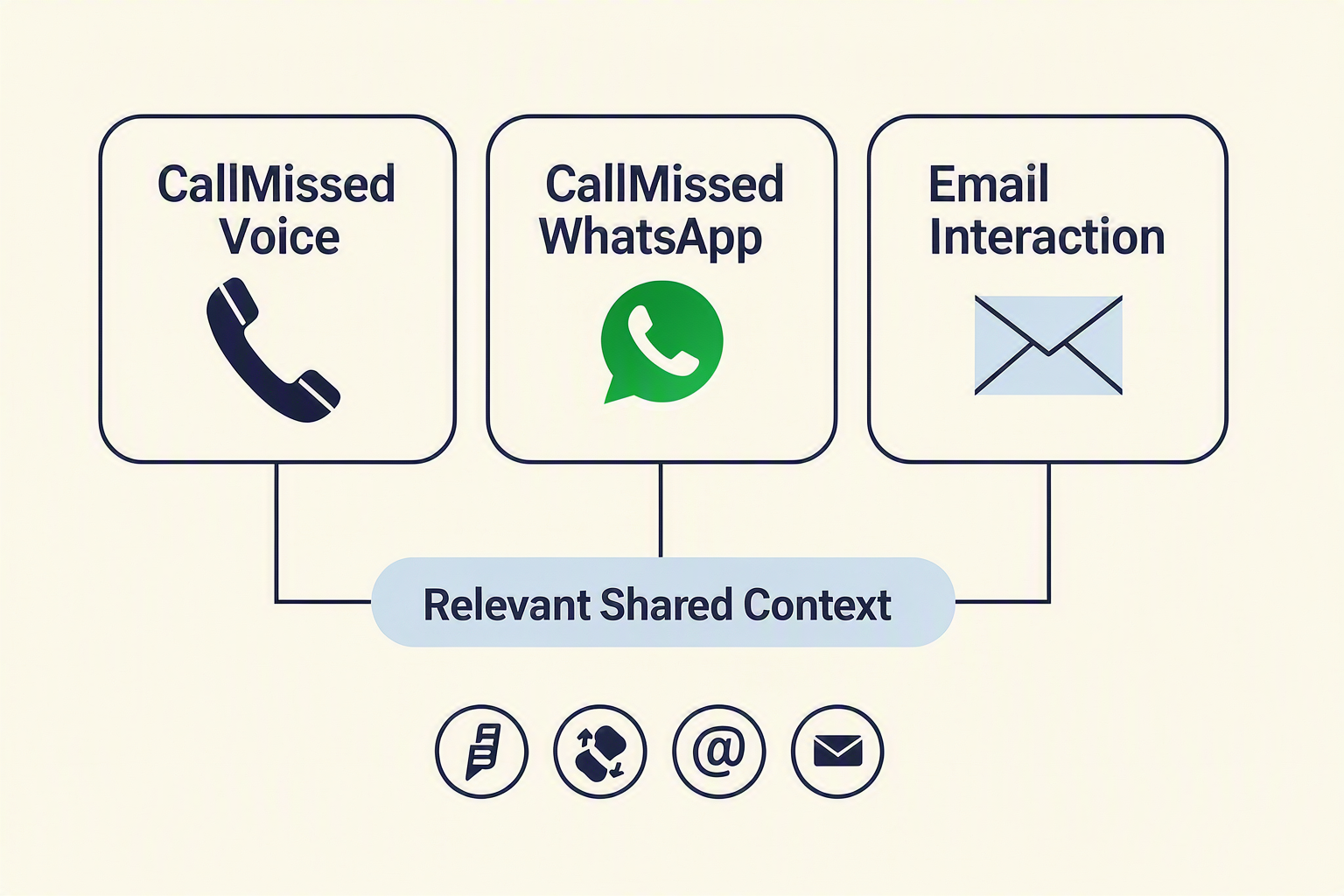
A CallMissed email agent is an AI-based email capability within CallMissed’s customer-engagement platform that uses relevant customer context to support coherent email interactions. When appropriate shared context exists from an earlier CallMissed voice or WhatsApp conversation, the email should continue the customer’s goal instead of treating the message as an isolated first contact.
From message automation to conversation continuity
A generic AI email agent can interpret messages and generate responses. A continuity-focused CallMissed email agent has a narrower, more useful objective: determine which verified details from earlier interactions are relevant to the current email and use them without overstating what the customer said.
That distinction matters because Zendesk’s CX Trends 2023 report found that 70% of consumers expect anyone they interact with to have the full context of their situation. Meeting that expectation does not require placing every historical message into an email. It requires preserving the parts that help move the current request forward.
For example, after a voice inquiry about a service, useful context might include:
- The customer’s confirmed requirement
- Constraints such as an agreed budget range or deadline
- Questions that were answered during the call
- An explicitly requested email follow-up
- The next step that both parties actually confirmed
A passing comment, unverified preference, or tentative statement such as “I may decide next week” should not become “You confirmed that you will purchase next week.”
What omnichannel customer memory should mean
Omnichannel customer memory is the controlled use of relevant information across channels, not an unrestricted transcript archive. In a CallMissed journey, the practical unit of continuity is the customer’s objective—resolving an issue, evaluating a service, supplying missing information, or receiving promised material—not merely the wording used on WhatsApp or voice.
Before earlier context informs an email, the workflow should evaluate five questions:
- Identity: Is the email sender reliably matched to the person who used the phone or WhatsApp number?
- Relevance: Does the earlier information help answer this specific email?
- Recency: Is the information still current enough to use?
- Permission: Is reusing the information appropriate for the present purpose?
- Confidence: Was the detail confirmed, inferred, disputed, or merely tentative?
These checks help prevent a smooth-sounding email from becoming an inaccurate or intrusive one.
A simple continuity example
Suppose a customer reports a failed payment on WhatsApp, attempts two troubleshooting steps, and later emails for an update. A continuity-aware response could acknowledge the known issue and those completed steps before requesting only the missing information.
The agent should not assume that the payment has since succeeded, expose unnecessary WhatsApp history, or promise a refund that no authorized person approved. If identity matching is uncertain, records conflict, or the case involves sensitive information or a consequential commitment, the safer action is human review.
Continuity therefore depends on selective, accountable memory. The goal is not to prove that the system remembers everything; it is to ensure that the customer does not have to repeat relevant facts while preserving accuracy, privacy, and appropriate oversight.
How does an AI email agent use omnichannel customer memory?
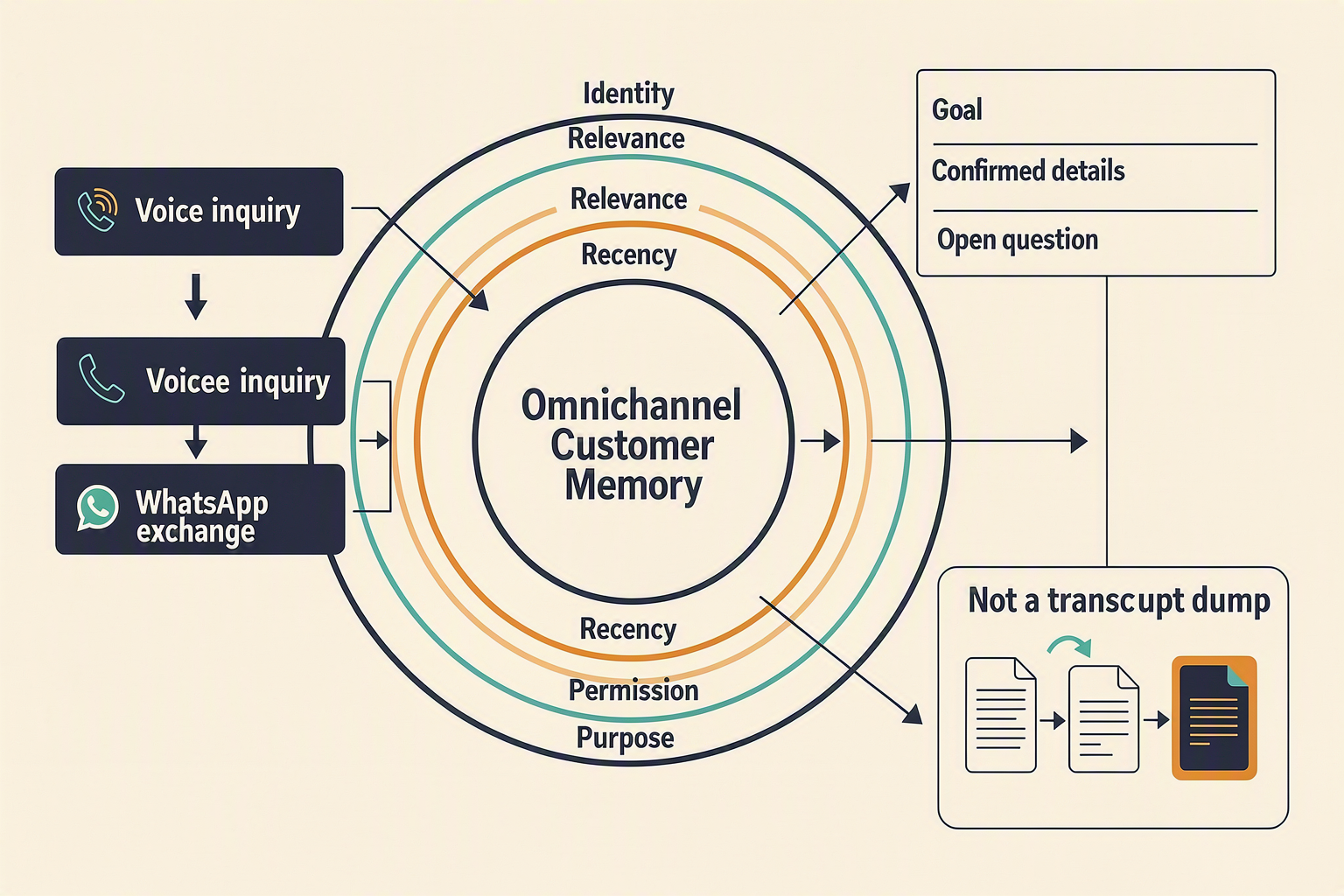
An AI email agent uses omnichannel customer memory by retrieving only the verified context relevant to the current customer, request, and purpose. In a CallMissed journey, that can mean using facts from an earlier voice or WhatsApp interaction to compose a coherent email without copying the full conversation or making the customer start again.
From conversation history to usable context
Shared memory should operate as a controlled context layer, not as an unlimited transcript archive. Before prior information influences an email, the system should answer five questions:
- Identity: Does the email address reliably belong to the same person who used the phone number or WhatsApp account?
- Relevance: Does the earlier interaction concern the same case, purchase, or goal?
- Recency: Is the information current enough to remain useful?
- Permission: Is using this information appropriate for the email’s audience and purpose?
- Reliability: Was the detail confirmed, or was it merely suggested, inferred, or discussed tentatively?
These checks are essential because customer expectations are high. Zendesk’s CX Trends 2023 report found that 70% of consumers expect anyone they interact with to have the full context of their situation. However, “full context” should mean sufficient operational understanding—not exposing every utterance from every channel.
What the email agent should remember
Useful cross-channel memory consists of structured, attributable facts with enough provenance to interpret them correctly. Depending on the journey, relevant context could include:
- The customer’s stated goal or question
- A confirmed product, service, order, or case reference
- Constraints explicitly provided by the customer
- Troubleshooting steps already attempted
- The latest known status and unresolved issue
- A requested follow-up channel or time
- The next action that a representative actually confirmed
For example, after a WhatsApp support exchange, an email might say: “You reported that the reset completed but access was not restored.” That preserves the issue and attempted step. It should not say, “Your account will be restored today,” unless that outcome was explicitly authorized and recorded.
How memory becomes an email response
A well-governed workflow can follow four stages:
- Retrieve: Find recent voice or WhatsApp context associated with the verified customer and active case.
- Filter: Exclude unrelated conversations, stale preferences, sensitive details, and unsupported inferences.
- Compose: Use the remaining facts to acknowledge prior progress, answer the current request, and ask only for missing information.
- Validate: Check names, identifiers, commitments, dates, and contradictions before sending or escalating for human review.
This approach preserves the customer’s goal, rather than simply reusing message text. A voice enquiry about service availability may lead to an email summarising confirmed requirements and requesting one missing detail. A WhatsApp troubleshooting conversation may continue by email with the known symptoms, completed steps, and present status.
Memory needs boundaries
CallMissed brings voice, WhatsApp, email, and web engagement into one business platform, creating the foundation for connected journeys. Buyers should still verify exactly how a deployment handles identity resolution, retention, inspection, correction, deletion, permissions, and sensitive information.
The email agent should ignore or escalate remembered context when:
- Identity matching is uncertain
- New information contradicts older history
- The history is incomplete or stale
- A tentative preference is being treated as a decision
- The email involves sensitive data or consequential promises
The objective is not maximum memory. It is minimum sufficient, verified context that helps the customer move forward safely.
Which cross-channel journeys benefit from shared context? (TABLE)
Cross-channel journeys benefit from shared context when the customer’s identity, goal, and prior actions are sufficiently verified and the next channel serves the same purpose. The strongest use cases are follow-ups, support continuations, lead qualification, document delivery, and carefully managed escalations—not every interaction involving the same email address or phone number.
Journey-by-journey context map
| Cross-channel journey | Context worth carrying forward | Do not assume | Review or escalation trigger |
|---|---|---|---|
| Voice inquiry → email follow-up | Confirmed requirement, questions asked, stated constraints, and agreed next step | A tentative preference is a final decision; the agent made an unrecorded promise | Unclear call history, consequential pricing or contractual language, or disputed commitments |
| WhatsApp support → email continuation | Verified issue, affected product or service, troubleshooting attempted, current status, and requested outcome | The issue is resolved because one troubleshooting step succeeded temporarily | Contradictory symptoms, sensitive account data, repeated failure, or an incomplete history |
| Voice or WhatsApp lead → qualification email | Needs, timeline, location, use case, constraints, and other facts explicitly supplied by the prospect | A lead score, budget, authority, CRM stage, or routing outcome not present in verified context | Ambiguous buying intent, conflicting requirements, or missing identity confirmation |
| WhatsApp request → email document delivery | The specific document requested, relevant reference details, and preferred delivery purpose | The recipient is authorised to receive confidential documents | Financial, medical, identity, legal, or account-sensitive material requires verification |
| Email response → voice or WhatsApp escalation | Email summary, unresolved question, urgency, previous answer, and customer’s requested channel | A phone or WhatsApp number belongs to the email sender without identity checks | Possible identity mismatch, complaint escalation, cancellation, refund, or legal threat |
| Multi-channel relationship follow-up | Recent, relevant preferences and open actions that clearly belong to the same customer and purpose | Old context remains accurate indefinitely or applies to a new enquiry | Stale preferences, multiple users sharing contact details, or a materially different purpose |
Why these journeys produce value
The table prioritises continuity where remembered information can prevent repetition or preserve progress. Zendesk’s CX Trends 2023 report found that 70% of consumers expected anyone they interacted with to have the full context of their situation. Salesforce’s 2023 State of the Connected Customer, Sixth Edition, reported that 79% of customers expected consistent interactions across departments.
CallMissed brings voice, WhatsApp, email, and web engagement into one business platform, making these handoffs practical to design. For example, a CallMissed email agent could use relevant context from a prior voice or WhatsApp exchange to frame the next message around the customer’s existing goal. That does not mean copying the full transcript into an email or treating every historical statement as current truth.
Apply a continuity test before using history
For each journey, evaluate five questions:
- Identity: Is there adequate reason to believe the voice, WhatsApp, and email interactions belong to the same person or authorised representative?
- Relevance: Does the earlier information directly help complete the present task?
- Recency: Could the customer’s status, preference, or circumstances have changed?
- Permission and sensitivity: Is the context appropriate to reuse through email, where messages may be forwarded or viewed by others?
- Confidence: Was the information explicitly confirmed, or was it merely tentative, inferred, or generated in a summary?
If any answer is uncertain, the email should ask for confirmation, omit the questionable detail, or route the case for human review. Shared context works best as a controlled handoff layer: enough memory to continue the journey, but clear boundaries against wrong identity matches, stale facts, excessive personalisation, and invented commitments.
How should voice or WhatsApp context shape follow-ups and lead qualification?
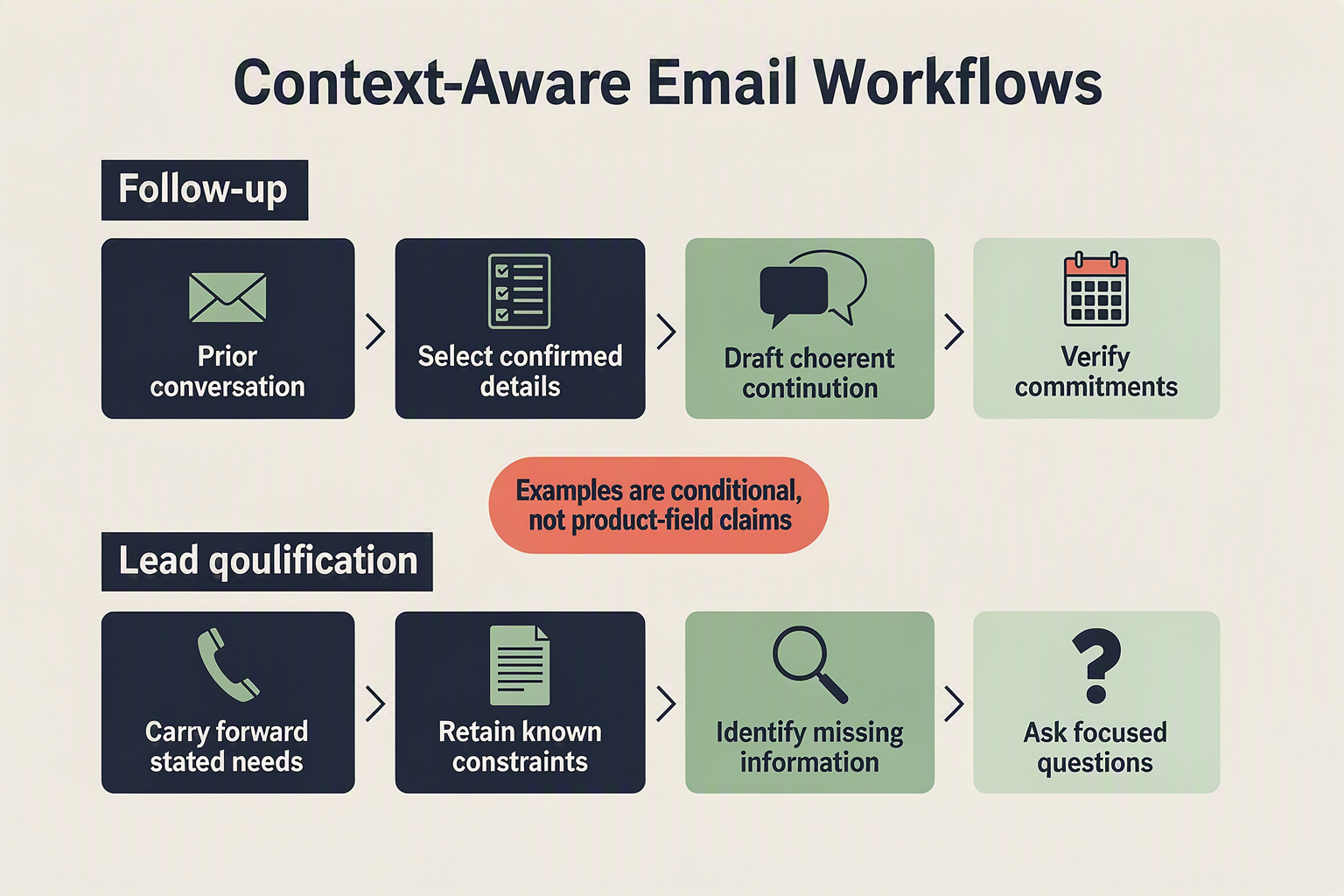
Voice or WhatsApp context should make an email more relevant, not more presumptive. A follow-up should carry forward verified needs, constraints, actions and unresolved questions, while lead qualification should preserve information already supplied and ask only for material gaps.
Convert conversation history into a usable handoff
The email agent should not receive an unfiltered transcript merely because one exists. Instead, relevant shared context from a prior CallMissed voice or WhatsApp interaction should be organized into a concise handoff containing:
- Customer goal: What outcome was the person seeking?
- Confirmed facts: Which requirements, dates, locations or constraints did the customer explicitly state?
- Actions completed: What troubleshooting, consultation or information exchange has already occurred?
- Current status: Is the customer waiting for a document, answer, quotation or human decision?
- Open questions: What information is still needed to move forward?
- Confidence and source: Did a detail come from the customer directly, an agent’s interpretation or an incomplete summary?
This distinction matters because “I may need 50 licences” is not equivalent to “I have approved a purchase of 50 licences.” Tentative statements should remain tentative in the email.
Shape a voice-to-email follow-up around the agreed next step
Suppose a prospect calls about deploying AI-assisted customer service across several Indian regions. The prospect confirms a need for Hindi and Marathi support, mentions an approximate launch window, and asks for written information.
A coherent follow-up could acknowledge those confirmed requirements and provide the requested material. It should not invent a budget, purchasing authority or implementation deadline. A practical workflow is:
- Match the identity carefully using verified contact information rather than a similar name alone.
- Extract explicit requirements and separate them from inferred interests.
- Restate the next step agreed during the call.
- Ask for confirmation when a material detail remains uncertain.
- Escalate for review before communicating pricing commitments, contractual terms or consequential promises.
CallMissed supports engagement across voice, WhatsApp and email, so the design objective is continuity of the customer’s goal—not simply copying spoken words into an email.
Qualify leads without making them repeat themselves
Lead qualification should begin with what the customer has already provided. Salesforce’s State of the Connected Customer, Sixth Edition, published in 2023, found that 79% of customers expect consistent interactions across departments; repeatedly requesting known information works against that expectation.
If a WhatsApp conversation has already established the use case, preferred language and approximate team size, the email should ask only for genuinely missing information. Depending on the business’s qualification process, that might include:
- The intended timeline, if it was never confirmed
- The operational problem the customer wants to solve
- Relevant scale or volume requirements
- Who else needs to participate in evaluation
- Whether the stated constraint is firm or provisional
These are examples, not claims about predefined CallMissed fields, scores or routing rules.
Know when prior context should not shape the email
Context should be ignored or reviewed when the identity match is uncertain, the history is stale, two channels contain contradictory facts, or the earlier conversation includes sensitive information unrelated to the email’s purpose. Human review is also appropriate when the available history is incomplete or when personalization would expose information the recipient did not expect to appear in email. The safest rule is to carry forward confirmed relevance, preserve uncertainty and never turn inference into fact.
How can customer support continue when a conversation switches to email?

Customer support can continue over email when the agent receives verified, relevant case context from the preceding voice or WhatsApp exchange. The email should preserve the customer’s goal, known issue, troubleshooting attempts, and current status—without copying the entire conversation or assuming that unconfirmed details are true.
Build a compact support-state record
A useful handoff is not a transcript dump. It is a structured snapshot containing only what the next interaction needs:
- Customer goal: the outcome the customer is trying to achieve.
- Confirmed issue: the product, service, order, or process affected.
- Steps already attempted: actions completed by the customer or support team.
- Observed results: error messages, symptoms, or other factual outcomes.
- Current status: resolved, unresolved, waiting for information, or pending review.
- Agreed next step: only a commitment explicitly confirmed during the earlier interaction.
- Open questions: information still required to move the case forward.
This approach directly addresses customer expectations. Zendesk’s CX Trends 2023 report found that 70% of consumers expect anyone they interact with to have the full context of their situation. Full context should mean sufficient operational understanding—not unrestricted access to every previous message.
Follow the WhatsApp-to-email support workflow
Consider a customer who reports an installation failure through WhatsApp, confirms that restarting the device did not work, and requests detailed instructions by email. Where that history is available through CallMissed’s shared customer context, the email agent could:
- Verify the identity match between the WhatsApp participant and email recipient.
- Restate the known problem in one sentence.
- Acknowledge the troubleshooting already completed.
- Provide the promised instructions or ask only for genuinely missing details.
- State the next step and who is expected to take it.
- Avoid introducing unrelated history from other conversations.
A continuity-aware opening might read:
“You contacted us on WhatsApp about the installation error, and you confirmed that restarting the device did not resolve it. Below are the next diagnostic steps; if the error remains, please reply with the displayed error code.”
The email advances the case immediately. It does not ask the customer to describe the installation problem again.
Separate confirmed facts from uncertain statements
Support conversations frequently contain ambiguity. “I think the order number ends in 42” is not equivalent to a verified order identifier, and “someone said I might receive a refund” is not an approved refund.
The agent should label context by confidence:
- Confirmed: explicitly supplied or verified facts.
- Tentative: estimates, recollections, preferences, or possible outcomes.
- Conflicting: details that differ across voice, WhatsApp, and email.
- Missing: information required before action can be taken.
Tentative or contradictory context should generate a clarifying question, not a confident assertion.
Escalate when continuity could create risk
A human should review the email when identity is uncertain, histories conflict, sensitive information could be exposed, or the response contains a consequential promise. Escalation is also appropriate when the available conversation history is incomplete.
Administrators should verify how CallMissed resolves identities, limits retained context, handles corrections, and prevents sensitive information from appearing in outbound email. Continuity is successful only when the carried-forward context is accurate, necessary, and appropriate for the recipient.
Which memory controls should buyers and administrators verify?
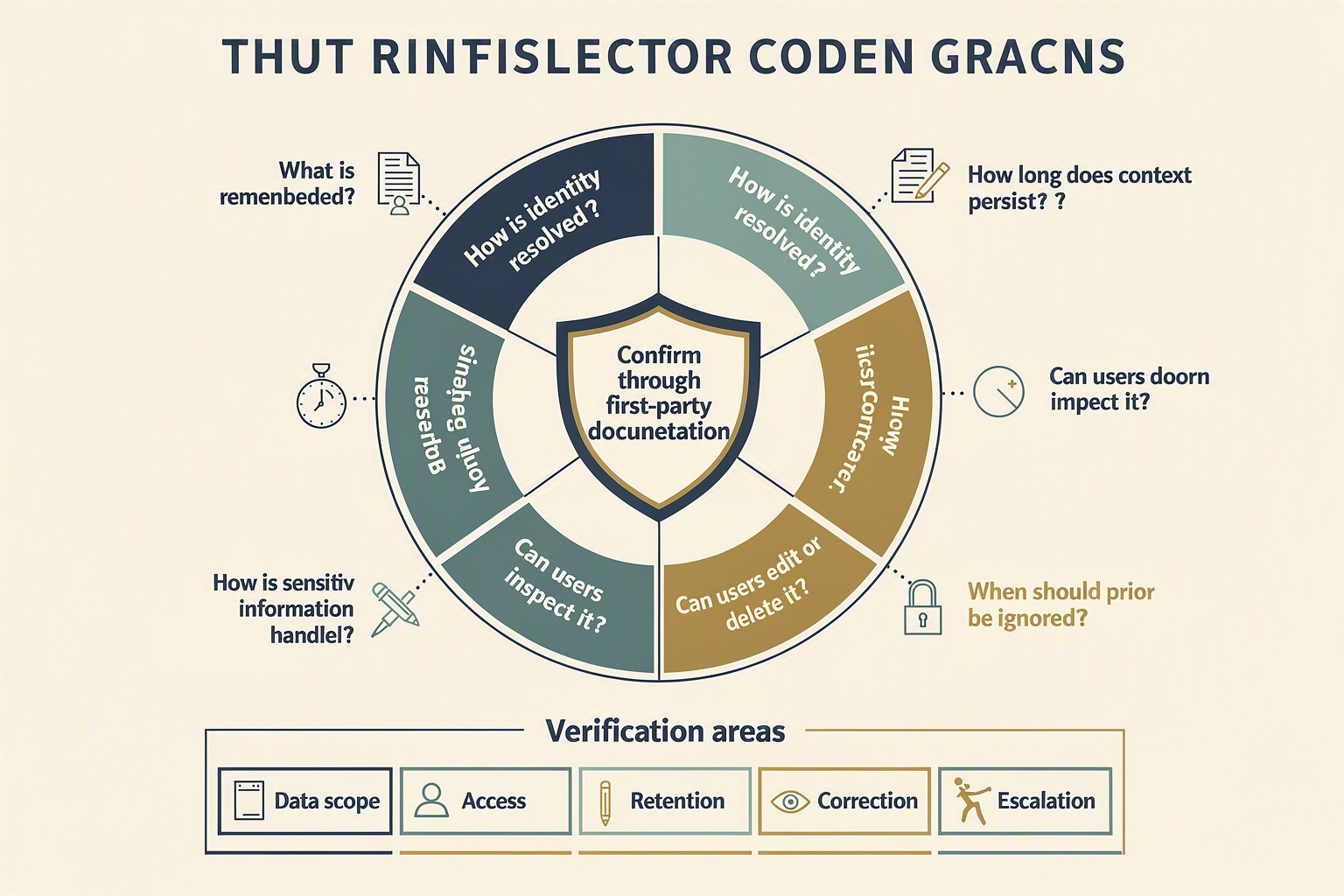
Buyers and administrators should verify that cross-channel memory is identity-safe, relevant, inspectable, correctable, deletable, purpose-limited, and governed by clear retention rules. These controls must be validated during procurement and testing rather than assumed to be built into a CallMissed email-agent deployment.
1. Define exactly what the agent remembers
Request a field-level description of the context available to the email agent. Useful memory may include a customer’s confirmed objective, the issue reported, troubleshooting already completed, stated constraints, and an agreed next step; it does not necessarily require complete voice or WhatsApp transcripts.
Administrators should establish:
- Whether the system retains raw messages, call transcripts, summaries, structured facts, or combinations of these.
- Which channels and workspaces can contribute context.
- Whether tentative statements are marked differently from confirmed facts.
- Whether the email agent can distinguish customer statements from an agent’s suggestions.
- What happens when only part of a conversation was captured.
This distinction matters because shared context is not synonymous with unlimited transcript reuse.
2. Test identity resolution across channels
Before an email uses voice or WhatsApp history, administrators should understand how CallMissed associates the email address with the earlier participant. Verify which identifiers are used, how confidently they are matched, and whether ambiguous links require human approval.
Test at least four difficult cases:
- A shared family or company telephone number.
- One customer using multiple email addresses.
- A reassigned phone number.
- Two contacts with similar names but separate cases.
A false match can expose another person’s information or cause the agent to pursue the wrong objective. When identity confidence is insufficient, the safer response is to ask for verification or continue without prior context.
3. Verify retention, inspection, correction, and deletion
Buyers should obtain clear answers to the following questions rather than assuming a particular CallMissed implementation:
- Retention: How long does each type of conversational context persist?
- Inspection: Can an authorised user see the source behind a remembered fact?
- Correction: Can incorrect, outdated, or disputed information be amended?
- Deletion: Can context be removed at the customer, conversation, or individual-record level?
- Propagation: If information is corrected, will future email interactions stop using the earlier version?
- Auditability: Can administrators determine who changed or deleted memory and when?
These controls support customer expectations without turning continuity into permanent profiling. Zendesk’s CX Trends 2023 report found that 70% of consumers expect an interacting representative to have the full context of their situation, but “full context” should mean the relevant case history—not every available personal detail.
4. Set boundaries for sensitive and stale information
Administrators should define categories that the agent must not reuse automatically. Examples include payment details, authentication secrets, health information, legal disputes, personal identifiers, and information supplied for an unrelated purpose.
Memory should also have recency and conflict rules. The email agent should ignore or seek review for context when:
- A newer statement supersedes an older preference.
- Voice and WhatsApp records contradict each other.
- The source or speaker cannot be verified.
- A casual possibility is being interpreted as a commitment.
- Reusing the detail would feel unexpectedly personal or irrelevant.
5. Require human review for consequential actions
Human review should be mandatory when an email contains a refund promise, contractual term, deadline commitment, sensitive disclosure, or conclusion based on incomplete history. During acceptance testing, administrators should deliberately inject wrong matches, stale facts, contradictions, and tentative statements, then confirm that the agent pauses, qualifies its wording, or escalates instead of confidently improvising.
What can go wrong, and when should a human review the conversation?
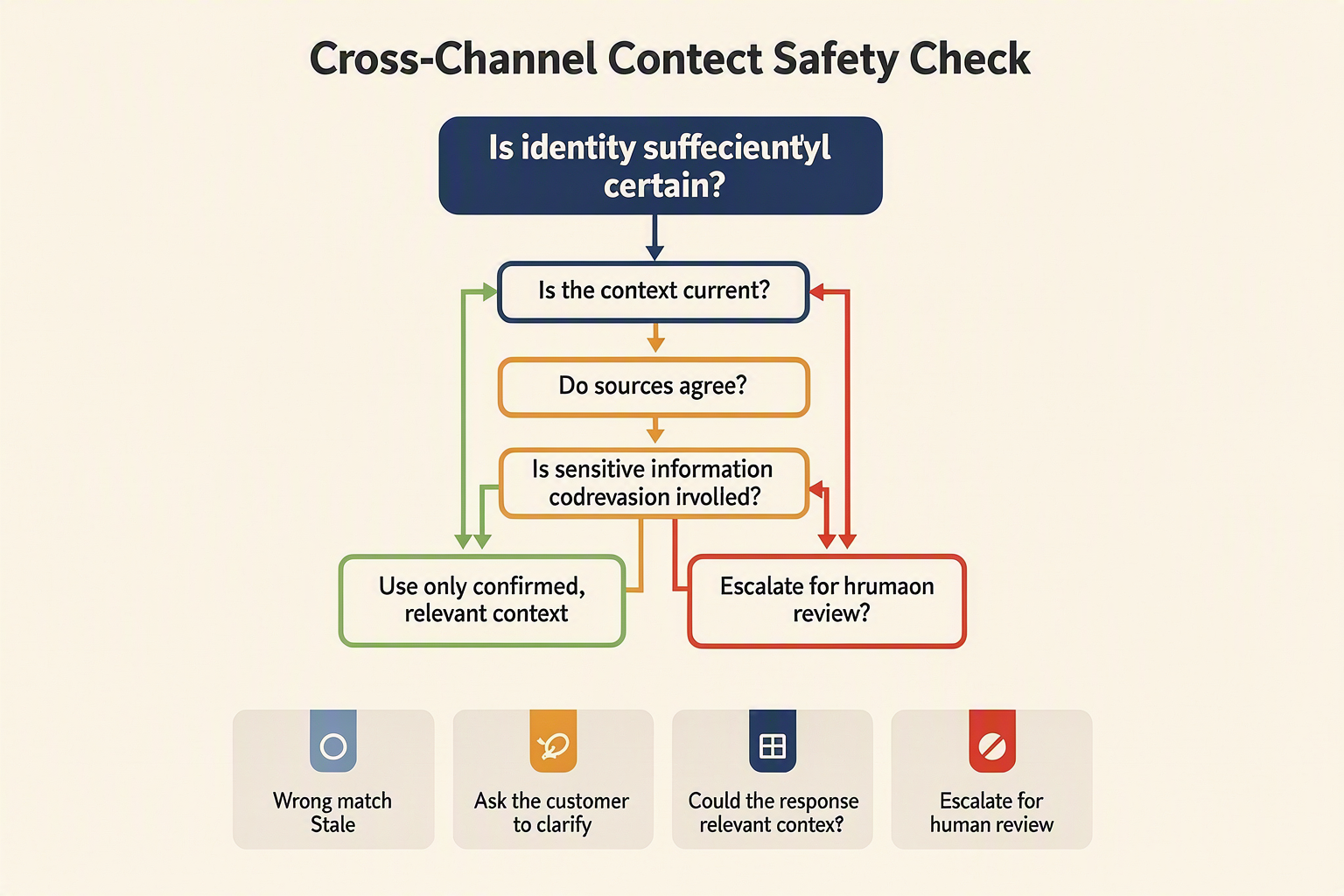
An email should receive human review whenever identity, context, intent, authority, or safety is uncertain. Automation can prepare routine continuations, but ambiguous histories, sensitive information, conflicting facts, and consequential commitments should not be handled as if the record were complete and verified.
The main continuity failure modes
Cross-channel memory can reduce repetition, but it also increases the impact of an incorrect assumption. Watch for these failure modes:
- Wrong identity match: A shared phone, family email address, recycled number, or mistyped contact detail can attach one person’s WhatsApp or voice history to another person. The agent should avoid referencing prior context until identity is sufficiently verified.
- Stale context: A customer’s budget, delivery address, preferred plan, availability, or support status may have changed. Time-sensitive details should be reconfirmed rather than presented as current.
- Contradictory information: A voice conversation might mention one requirement while a newer WhatsApp message states another. The email should surface the discrepancy neutrally and ask which information is correct.
- Tentative language converted into fact: “I may upgrade next month” is not the same as “I approved the upgrade.” Models can mistakenly turn possibilities, estimates, or exploratory questions into decisions.
- Incomplete history: A missing call segment, unrecorded offline interaction, or unavailable message can make an apparently coherent timeline misleading.
- Excessive personalization: Repeating unnecessary personal details can feel intrusive even when those details appeared previously. Continuity should serve the current task, not demonstrate how much the system remembers.
- Sensitive-data leakage: Financial, health, authentication, legal, or other confidential information should not be copied into a new channel merely because it exists in earlier context.
These risks matter because customers expect continuity without sacrificing control. Zendesk’s CX Trends 2023 report found that 70% of consumers expect anyone they interact with to have the full context of their situation. “Full context” should mean the relevant and verified case history—not unrestricted reuse of every prior statement.
When a human should review the draft
A CallMissed email-agent workflow should route or hold a conversation for review when it involves:
- Ambiguous identity, including uncertain matches between an email address and a voice or WhatsApp participant.
- Conflicting facts that materially affect the answer, recommendation, eligibility, price, timeline, or next step.
- Sensitive matters, such as payment disputes, account access, legal threats, health information, fraud allegations, or vulnerable customers.
- Consequential promises, including refunds, contractual terms, guaranteed delivery dates, policy exceptions, or commitments that require organizational authority.
- Unclear customer intent, particularly when an earlier statement could be a question, preference, complaint, or approval.
- Incomplete or low-confidence history, where the available context cannot support a reliable continuation.
- Requests to correct or delete remembered information, which should be handled according to the organization’s verified data-control process.
What the reviewer should check
Human review should be a focused verification step, not a complete rewrite. The reviewer should confirm:
- Right person: Does the cross-channel history belong to this customer?
- Right facts: Are the cited details explicit, current, and internally consistent?
- Right purpose: Is each remembered detail necessary to resolve the present request?
- Right authority: Can the business actually make every commitment in the draft?
- Right disclosure: Would sending this information by email expose sensitive data?
When uncertainty remains, the safest email is transparent: briefly state what is understood, identify what needs confirmation, and ask one precise question. That preserves continuity without allowing remembered context to become an invented record.
What are the practical impacts of stronger conversation continuity?
Stronger conversation continuity allows the CallMissed email agent to use relevant context from voice and WhatsApp when preparing the next email. This can reduce repeated explanations, improve follow-ups, and help teams move customer journeys forward. The benefit comes from carrying forward verified facts and unfinished actions, not from giving every email unrestricted access to every previous conversation.
Lower customer effort without false familiarity
The clearest practical impact is that customers spend less time reconstructing their history. Zendesk’s CX Trends 2023 report found that 70% of consumers expect anyone they interact with to have the full context of their situation.
After a WhatsApp troubleshooting exchange, for example, the CallMissed email agent could acknowledge:
- The specific issue already reported
- The troubleshooting steps already completed
- The latest confirmed status
- The next action that remains outstanding
The customer can respond with what has changed instead of repeating the entire case. However, the email should not mention unrelated messages, expose sensitive details unnecessarily, or treat an uncertain identity match as confirmed.
The same principle applies to voice conversations. If a caller confirms a service location and requests written information, the follow-up can use those facts. It should not add assumptions about budget, authority, preferences, or purchasing intent that the caller did not express.
More coherent follow-ups and channel switching
Continuity turns email into the next stage of the same customer goal. A voice inquiry about service availability might lead to an email that summarizes the confirmed requirement and requests one missing detail. A WhatsApp exchange that becomes too complex for short messages might continue through a structured email with the relevant evidence and next steps.
This consistency also matters across internal functions. Salesforce’s State of the Connected Customer, Sixth Edition, published in 2023, found that 79% of customers expect consistent interactions across departments.
With CallMissed, voice, WhatsApp, and email can participate in a connected engagement journey. The role of the CallMissed email agent is not to copy wording from one channel into another. It is to preserve intent, confirmed constraints, progress, and ownership while adapting the response to email.
| Outcome | Voice context | WhatsApp context | Email action | Human-review trigger |
|---|---|---|---|---|
| Less repetition | Confirmed issue, identity details, or requested service | Answers, screenshots, or completed troubleshooting steps | Summarize only the relevant confirmed facts and continue from the open step | Voice and WhatsApp records appear to refer to different people or cases |
| Clearer qualification | Stated use case, location, or operational constraint | Follow-up answers and explicit preferences | Ask only for information still needed to progress the inquiry | Budget, authority, consent, or timeline would need to be inferred |
| Faster support progression | Problem description and promised follow-up | Latest status and steps already attempted | Provide the next appropriate instruction or request missing evidence | Symptoms conflict, the issue is safety-sensitive, or prior advice may be incorrect |
| Better channel switching | Request for written confirmation or detailed documentation | A conversation has become too complex for short messages | Organize the relevant information into a clear email with next steps | Sensitive attachments, personal data, or uncertain recipients are involved |
| More reliable ownership | Named team, scheduled callback, or agreed next action | Updates showing whether that action occurred | State the current owner and outstanding action when supported by the record | Ownership is disputed, overdue, or unclear |
| Fewer stale follow-ups | Earlier requirement and date discussed | More recent correction or cancellation | Prefer the latest confirmed information and avoid reviving superseded requests | Records contain contradictory dates, requirements, or commitments |
Faster qualification and support progression
Remembered context can prevent the CallMissed email agent from asking questions the customer has already answered. In lead qualification, this may mean carrying forward a confirmed use case or constraint and asking only for genuinely missing information. It does not mean inventing a budget, decision timeline, preference, score, or routing outcome.
In customer support, selective continuity can contribute to:
- Fewer duplicate questions when previous answers remain relevant.
- Cleaner handoffs because the current state and open action are explicit.
- More focused emails that address the unresolved issue.
- Better human review when reviewers can identify which facts informed a draft.
Businesses should measure these effects rather than assume them. Useful indicators include repeat-question frequency, customer corrections, time to the next meaningful action, escalation rate, and the percentage of drafts requiring factual edits. These measures can help teams determine whether the CallMissed email agent is applying context accurately instead of merely producing more personalized language.
Better continuity also creates higher stakes
The more personalized an email appears, the more damaging incorrect memory can become. A wrong identity match could disclose another person’s issue. Stale context could revive an expired requirement, while a tentative statement such as “we may proceed next month” could be converted into a false commitment.
For that reason, the CallMissed email agent should operate with clear continuity rules:
- Prefer recent, relevant, and confirmed facts.
- Exclude unrelated or purpose-inappropriate history.
- Distinguish customer statements from verified business records.
- Surface contradictions rather than silently choosing one version.
- Request confirmation before consequential actions or promises.
- Escalate sensitive, ambiguous, or incomplete cases to a human.
- Keep the source of important facts inspectable where review is required.
Human review is especially important when context affects account access, payments, contractual commitments, complaints, regulated information, or disclosure of personal data. It is also appropriate when different channels contain conflicting instructions or the intended recipient cannot be verified confidently.
The practical result is not merely faster email. Used selectively, the CallMissed email agent can support a more coherent cross-channel experience in which customers repeat less and teams have a clearer view of what remains to be done. That continuity remains dependable only when its inputs are relevant, inspectable, and correctable.
What should product, privacy, support, and operations experts verify before publication or deployment?

Publication and deployment should proceed only after product behavior, privacy boundaries, support escalation, and operational recovery have been tested with realistic cross-channel cases. Documentation must describe verified CallMissed behavior—not intended behavior—and deployment approval should require evidence that incorrect, stale, sensitive, or ambiguous context cannot silently become an authoritative email.
Product verification: prove continuity without overclaiming
Product owners should create acceptance tests for complete and incomplete journeys across CallMissed voice, WhatsApp, and email. At minimum, verify that the configured experience:
- Preserves confirmed needs, constraints, troubleshooting steps, and next actions when appropriate.
- Distinguishes statements such as “I may upgrade” from confirmed instructions such as “Please upgrade my plan.”
- Avoids inventing prices, deadlines, approvals, refunds, preferences, or promises.
- Handles contradictory facts by requesting clarification or escalating instead of choosing whichever record appears first.
- Produces a sensible email when no usable prior context exists.
Before publication, compare every statement in help content, screenshots, onboarding copy, and sales material with the deployed product. Do not imply support for particular inbox providers, CRM synchronization, autonomous sending, retention periods, or administrative controls unless those capabilities have been verified against current first-party documentation.
Privacy verification: inspect the memory boundary
Privacy reviewers should document the purpose, source, sensitivity, retention, and permitted recipients of every category of remembered context. The European Union’s General Data Protection Regulation, applicable since 25 May 2018, establishes principles including data minimisation, accuracy, purpose limitation, and storage limitation in Article 5. India’s Digital Personal Data Protection Act, 2023 received presidential assent on 11 August 2023 and requires organizations to assess applicable notice, lawful processing, correction, erasure, and security obligations as provisions take effect.
Reviewers should verify:
- How phone numbers, WhatsApp identities, and email addresses are matched.
- What happens when an identifier is shared, recycled, or incorrectly entered.
- Whether authorized users can inspect, correct, or remove remembered information.
- Whether sensitive details are excluded, redacted, or restricted appropriately.
- Whether deletion and retention behavior matches published policy and applicable law.
A successful test should prove not merely that memory works, but that it can be limited and disregarded.
Support verification: test the difficult cases
Support leaders should prepare playbooks for wrong-person matches, customer corrections, partial histories, conflicting statements, and sensitive requests. Each playbook needs a visible escalation threshold, an accountable queue, and approved language that acknowledges uncertainty without exposing internal notes.
Human review should be mandatory where configured context could trigger a consequential commitment, disclose sensitive information, or misrepresent an unresolved complaint. Agents should also know how to record a correction without preserving the disputed claim as though it remained valid.
Operations verification: make failures observable and reversible
Operations teams should test permissions, monitoring, incident response, rollback, and change control before live traffic. The NIST AI Risk Management Framework 1.0, released in January 2023, organizes AI risk work around Govern, Map, Measure, and Manage—a useful structure for assigning owners and recording evidence.
The final release gate should require:
- Named owners across product, privacy, support, and operations.
- Test records covering normal, adversarial, and no-context scenarios.
- A rollback or disablement procedure.
- Approval of customer-facing wording and escalation paths.
- Revalidation whenever prompts, models, memory rules, or channel workflows change.
Continuity should be treated as a controlled capability, not a default permission to reuse everything known about a customer.
Frequently asked questions about CallMissed email agents and shared context
Core concepts and channel continuity
What is a CallMissed email agent, and how does it use shared context?
What is an AI email agent compared with a standard email automation tool?
Can CallMissed email agents continue a voice or WhatsApp conversation by email?
Memory boundaries, corrections, and conflicts
What does omnichannel customer memory mean for email, voice, and WhatsApp?
What customer context should CallMissed email agents carry between channels?
How should remembered context be corrected, removed, or handled when information conflicts?
Conclusion
Conversation continuity connects email to voice and WhatsApp. A CallMissed email agent can make the next message a continuation, not a restart. The CallMissed email agent reduces repetition without treating every prior statement as verified. A CallMissed email agent works best with accurate, bounded, reviewable context.
Key takeaways
- Continue the goal. A CallMissed email agent carries the confirmed objective into follow-up. The CallMissed email agent should advance the inquiry, not merely recap it.
- Bridge voice to email. A CallMissed email agent can preserve needs, constraints, status, and the next action. The CallMissed email agent should ask only for missing information.
- Bridge WhatsApp to email. A CallMissed email agent can acknowledge the known issue and troubleshooting already attempted. The CallMissed email agent should avoid making the customer repeat established details.
- Verify before relying. The CallMissed email agent must distinguish confirmed facts from tentative comments, outdated preferences, contradictions, or unverified promises. A CallMissed email agent should not present uncertainty as settled fact.
- Keep context bounded. The CallMissed email agent should exclude sensitive, stale, irrelevant, or mismatched information. A CallMissed email agent needs identity matching and context that can be inspected, corrected, or deleted.
- Require human review. A CallMissed email agent should escalate ambiguity, identity mismatches, sensitive matters, and consequential commitments. The CallMissed email agent supports, rather than replaces, human responsibility.
Related Reading
Discussion
Related Posts


Ready to automate customer conversations?
Launch AI voice agents and WhatsApp bots with CallMissed — one API, 22+ Indian languages.