
CallMissed Security: AI Agent Privacy and Omnichannel Governance Checklist


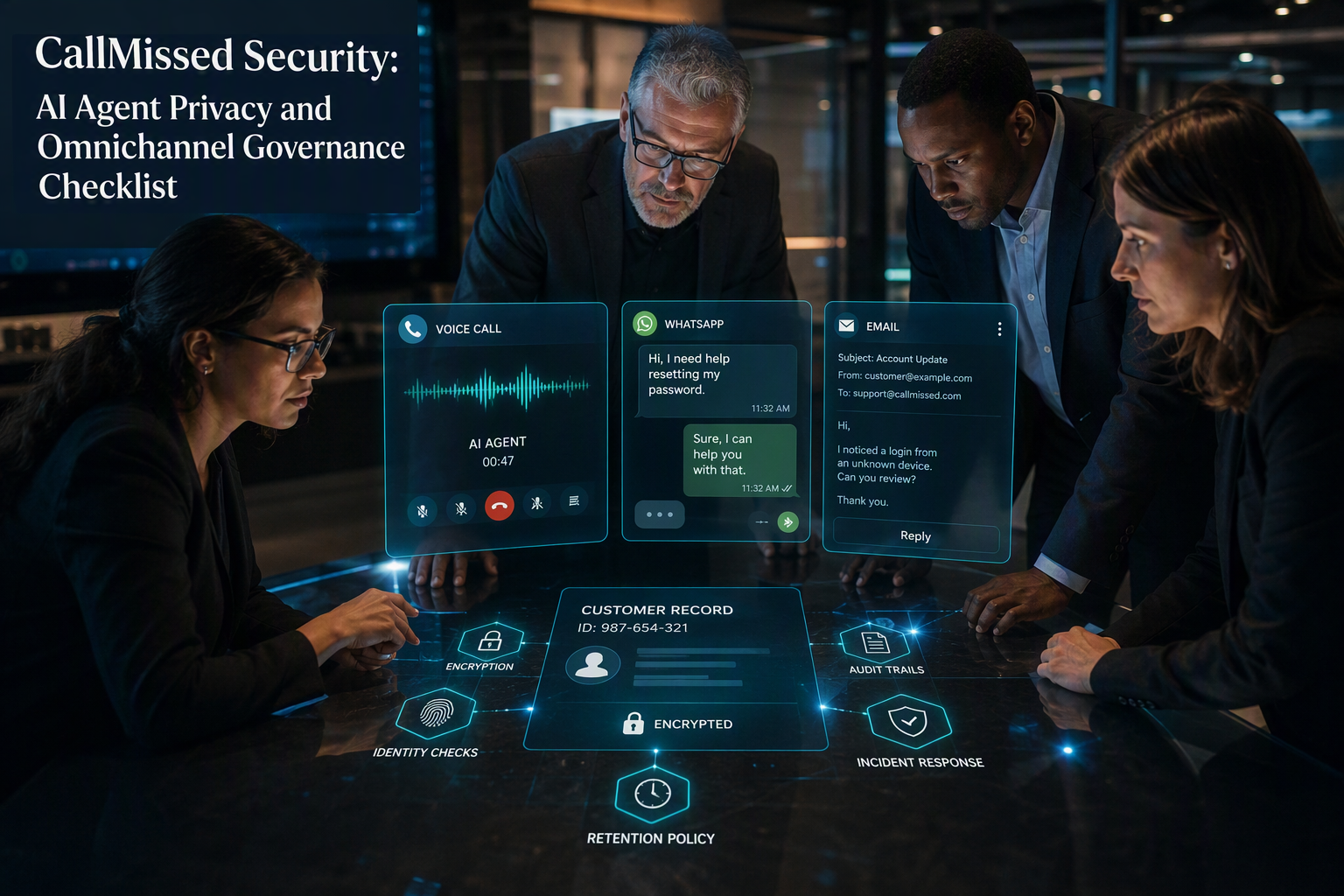
Use this AI agent privacy checklist to assess CallMissed security controls, retention, access, vendors, evidence, and incident readiness.
CallMissed Security: AI Agent Privacy and Omnichannel Governance Checklist
What happens when an AI agent remembers more about a customer than the business can safely govern? A practical CallMissed security strategy starts by treating every voice recording, WhatsApp message, email, transcript, identity attribute, and retrieved knowledge snippet as governed data—not merely conversation history. This AI agent privacy checklist explains how to reduce that data’s exposure across the complete customer journey.
The risk is immediate because omnichannel agents can access customer records, generate responses, trigger workflows, and preserve context across channels. IBM’s 2025 Cost of a Data Breach Report found that 97% of organizations reporting an AI-related security incident lacked proper AI access controls. IBM also reported that breaches involving “shadow AI” cost organizations an average of $670,000 more than breaches without unauthorized AI use. Meanwhile, the Verizon 2025 Data Breach Investigations Report found that third-party involvement in breaches doubled from 15% to 30%, reinforcing the need to assess every model provider, communications vendor, integration, and subprocesser.
These risks become harder to manage when one customer moves from an inbound call to WhatsApp and then email. Omnichannel AI governance must answer concrete questions: Which identity connects those interactions? What information may the agent retrieve? Who can replay a recording? How long should transcripts remain searchable? Can a customer correct or delete linked information without leaving copies in analytics systems, vector databases, or backups?
Platforms such as CallMissed bring AI voice agents, WhatsApp automation and calling, email, customer records, and knowledge-base retrieval into connected workflows, making consistent controls across channels especially important.
This guide turns those questions into controls that teams can inspect and test. It covers:
- Data minimization: collecting only the fields required for a defined purpose.
- Identity and permissions: verifying customers and enforcing least-privilege access for agents, staff, and integrations.
- Retention and data rights: setting deletion schedules and handling access, correction, and deletion requests.
- Recordings and transcripts: controlling notice, consent, storage, replay, redaction, and export.
- Knowledge sources: approving documents, limiting retrieval scope, and preventing sensitive-data leakage.
- Operational assurance: maintaining audit logs, reviewing vendors, testing incident response, and staging rollouts.
The checklist does not assume that a product configuration automatically delivers legal compliance or certification. Instead, it helps security, privacy, legal, and operations teams document what is enabled, identify evidence still needed, assign control owners, and verify that each AI agent behaves within approved boundaries before—and after—it reaches customers.
What is the short answer? Verify purpose-limited data, identity, permissions, retention, deletion, evidence, logs, vendors, incidents, and rollout gates
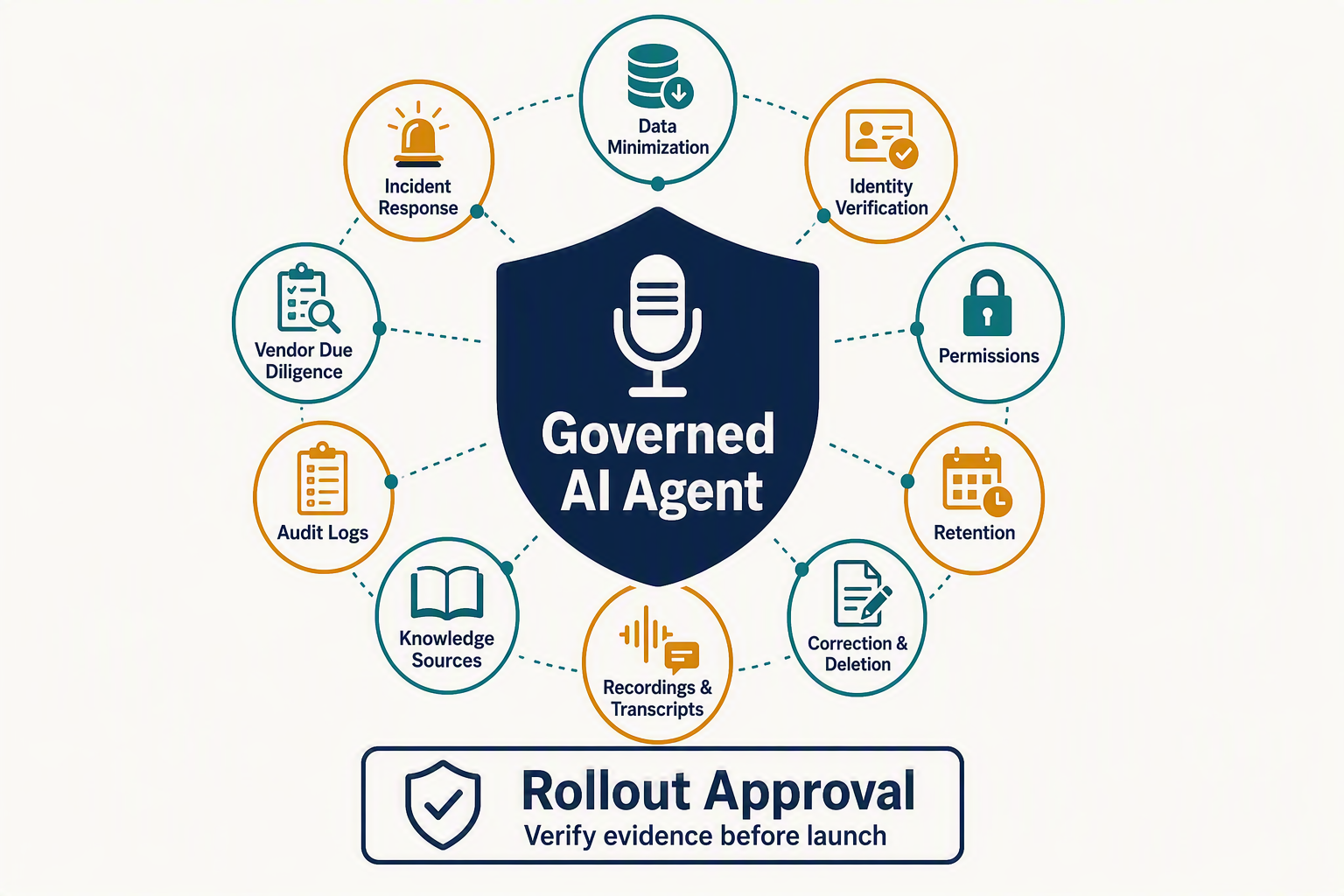
The short answer is to approve an AI agent only when the organization can prove that its purpose, data access, identity checks, permissions, retention, deletion, evidence, logs, vendors, incident procedures, and rollout gates are defined and tested. A credible AI agent privacy checklist requires verifiable controls across voice, WhatsApp, and email—not policy statements alone.
The ten-control minimum
Use these controls as a go/no-go checklist for every agent, workflow, integration, and communication channel:
- Purpose-limited data: Document why each field, recording, transcript, message, attachment, and identity attribute is collected. Disable collection where the information is not necessary for the approved customer journey.
- Identity verification: Match verification strength to risk. A general enquiry may need no authentication, while account changes, payment discussions, or disclosure of personal information may require one-time passwords, verified account attributes, or transfer to an authorized employee.
- Least-privilege permissions: Specify which customer records, inboxes, tools, knowledge sources, and actions the AI agent may access. Separate read, write, export, replay, deletion, and administrative permissions.
- Retention controls: Assign a documented retention period to each data class and channel. Confirm what happens to voice recordings, WhatsApp messages, emails, transcripts, summaries, embeddings, analytics copies, and backups when that period expires.
- Correction and deletion: Test whether the business can locate, correct, export, or delete information linked to one customer across every connected system. Record exceptions where immediate deletion is technically or legally restricted.
- Evidence and notices: Preserve the approved purpose, privacy notice, consent or other authorization where applicable, configuration record, test result, control owner, and review date. Evidence should demonstrate how a control operates rather than merely asserting that it exists.
- Audit logs: Log authentication events, administrative changes, data retrieval, tool calls, exports, failed access attempts, human overrides, and deletions. Protect logs from unauthorized alteration and restrict access to personnel with a defined operational need.
- Vendor governance: Inventory model providers, communications providers, cloud services, subprocessors, plugins, and analytics tools. The Verizon 2025 Data Breach Investigations Report found that third-party involvement in breaches doubled from 15% to 30%, making vendor review a core control rather than a procurement formality.
- Incident readiness: Define who can disable an agent, revoke credentials, preserve evidence, notify relevant parties, investigate cross-channel exposure, and restore service safely. Run tabletop exercises covering compromised accounts, prompt injection, unintended disclosure, and vendor outages.
- Rollout gates: Progress from sandbox testing to internal use, limited traffic, monitored production, and broader deployment only after named owners approve measurable exit criteria.
What “verified” should mean
For omnichannel AI governance, mark a control complete only when reviewers can inspect evidence such as:
- A configuration export or screenshot with a date and owner
- A successful permission, deletion, or identity-verification test
- A sampled audit-log entry tied to the tested event
- A current vendor assessment and subprocesser inventory
- A rollback procedure demonstrated in a staging environment
This evidence-first standard is particularly important because IBM’s 2025 Cost of a Data Breach Report found that 97% of organizations reporting an AI-related security incident lacked proper AI access controls. For CallMissed security, teams should apply the same approval criteria to AI voice agents, WhatsApp chat and Business calling, email workflows, customer records, and knowledge-base retrieval. Platform availability does not itself establish certification or legal compliance; the deploying organization must verify its settings, obligations, integrations, and operating procedures.
Why do voice, WhatsApp, and email agents require omnichannel AI governance rather than separate channel policies?

Voice, WhatsApp, and email agents require omnichannel AI governance because risk follows the customer, identity, and action across channels—not the interface where an interaction began. Separate policies create control gaps when data collected by one agent becomes context, retrieved knowledge, or authorization evidence for another.
Govern the shared workflow, not three isolated conversations
A voice call, WhatsApp thread, and email exchange may use different transport systems, but they can converge on the same customer record, AI model, knowledge base, CRM workflow, and human support queue. Consequently, a permission granted in one channel can affect what an agent reveals or does elsewhere.
Consider a customer who verifies an account during a call, continues the request on WhatsApp, and receives documents by email. Governance must determine:
- Whether the call verification remains valid on WhatsApp.
- Which attributes may pass between channels.
- Whether the email address belongs to the same verified person.
- Which agent may retrieve account records or initiate an action.
- How corrections and deletions propagate through transcripts, summaries, CRM fields, and retrieval indexes.
A channel-specific policy might secure the call recording while overlooking the AI-generated summary copied into the CRM. Likewise, deleting a WhatsApp conversation may not remove extracted profile data or embeddings created from that conversation.
Apply controls at every boundary
The AI agent privacy checklist should map each end-to-end data flow and apply consistent controls at four boundaries:
- Collection: Limit each channel to information necessary for its stated purpose. Voice agents should not request sensitive details merely because speech makes them easy to collect.
- Identity: Bind conversations only after appropriate verification. Possession of a phone number, WhatsApp account, or email inbox should not automatically prove authority over a customer account.
- Authorization: Re-evaluate permissions before sensitive retrievals, disclosures, or actions. Authentication completed on one channel should expire or require step-up verification according to risk.
- Propagation: Ensure retention, correction, export, and deletion rules cover derived data, including transcripts, summaries, tags, recordings, embeddings, and workflow logs.
This architecture also limits vendor exposure. The Verizon 2025 Data Breach Investigations Report found that third-party involvement in breaches increased from 15% to 30%. An omnichannel control inventory should therefore identify every communications provider, model endpoint, storage service, integration, and subprocesser receiving data.
Use one control matrix with channel-specific implementations
A unified policy does not mean identical technical settings. Instead, define one control objective and test its implementation per channel:
- Notice: spoken disclosure for calls, visible messaging for WhatsApp, and appropriate text in email.
- Sensitive-data handling: real-time redaction for audio, message filtering for chat, and attachment scanning for email.
- Evidence: recording-access logs, WhatsApp delivery and workflow events, and email transmission records.
- Retention: one approved purpose-based schedule, mapped to every original and derived copy.
For CallMissed security, this matters because CallMissed connects AI voice agents, WhatsApp chat and Business calling, email, knowledge retrieval, and customer workflows. Teams should govern that connected environment through shared identity, permissions, retention, and audit requirements while separately verifying how each channel implements them.
The practical rule is simple: if information or authority can cross channels, the governing control must cross channels too. Product configuration can support that control, but it does not by itself establish certification or legal compliance.
Which key controls and evidence should the CallMissed security review cover by channel?
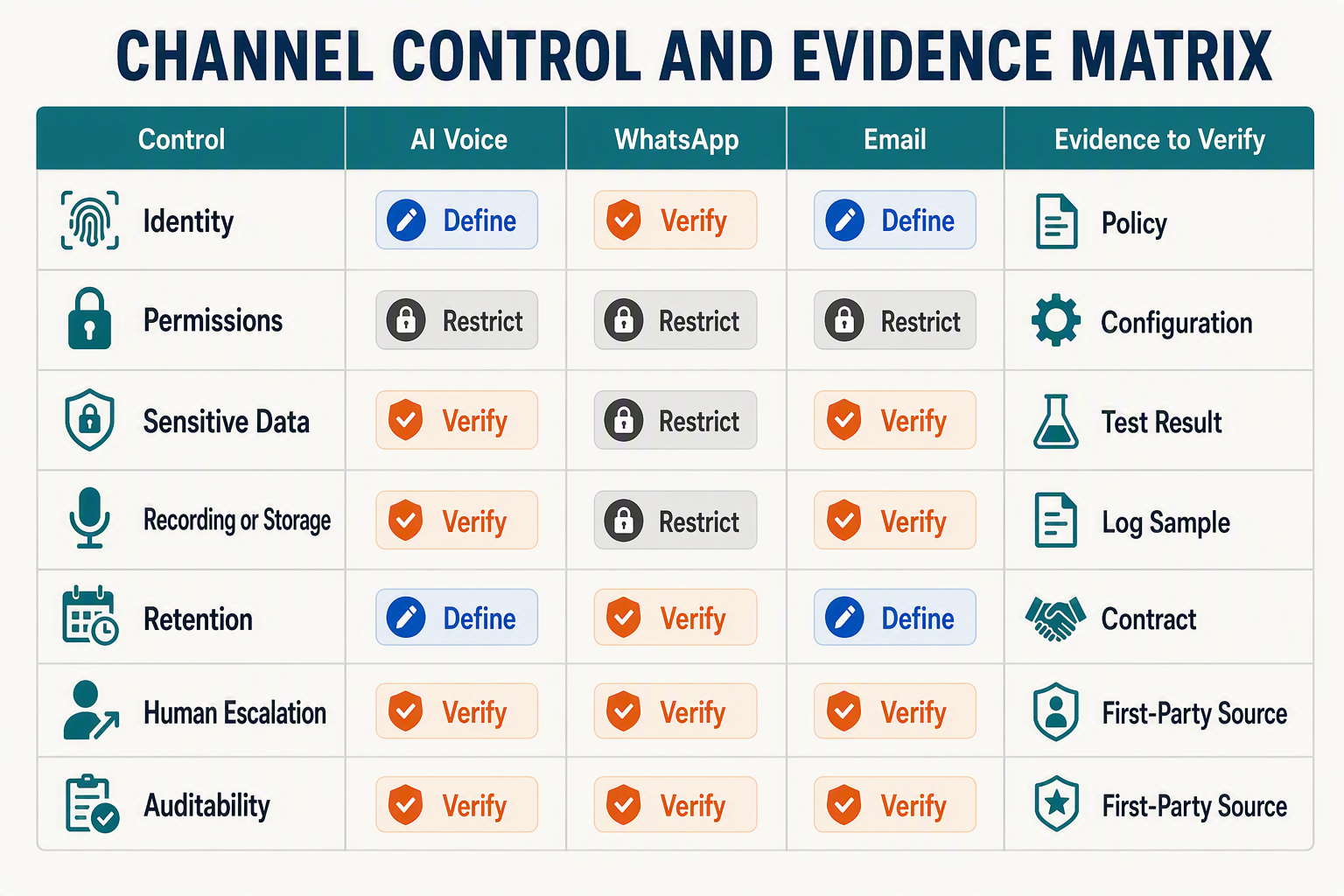
A CallMissed security review should map each communication channel to its data, identities, permissions, retention rules, and testable evidence. Voice, WhatsApp, and email require separate controls, while shared customer records, knowledge retrieval, and integrations need cross-channel safeguards under one omnichannel AI governance model.
Channel-by-channel control matrix
| Channel or component | Primary data and risk | Controls to verify | Security test | Evidence to retain |
|---|---|---|---|---|
| AI voice calls | Phone numbers, recordings, transcripts, spoken identifiers, payment or health details | Provide recording notice where required; disable unnecessary recording; redact sensitive fields; restrict replay, download, and transcript access; set separate recording and transcript retention periods | Attempt replay and export as an unauthorized user; speak prohibited data and verify redaction or suppression; confirm deletion after expiry | Call-flow screenshots, notice scripts, role matrix, sample redacted transcript, retention test results, access logs |
| WhatsApp chat | Message content, media, profile details, conversation metadata, linked customer records | Use approved message purposes and templates; validate webhook signatures where supported; restrict media downloads; minimize profile fields; define correction and deletion workflows | Send malformed or replayed webhook events; request deletion of a chat containing attachments; verify removal from search and linked records | Template approvals, webhook configuration, field inventory, deletion ticket, before-and-after search results |
| WhatsApp Business calling | Voice content plus WhatsApp identity and call metadata | Apply voice controls to WhatsApp calls; distinguish inbound from business-initiated calls; authorize initiation workflows; prevent the agent from exposing chat history without sufficient verification | Trigger a business-initiated call without authorization; ask the agent to reveal prior messages before identity verification | Initiation policy, workflow permissions, test recordings, transcript excerpts, event and approval logs |
| Email agents | Full message threads, attachments, signatures, addresses, quoted confidential content | Limit mailbox and folder scope; scan or block risky attachments; constrain forwarding and recipients; suppress unnecessary quoted history; require approval for sensitive outbound actions | Test prompt injection in an attachment; attempt sending to an unapproved domain; verify that revoked mailbox access stops retrieval | OAuth scopes, mailbox rules, approval logs, injection-test report, revocation test |
| Knowledge-base RAG | Internal documents, embeddings, retrieved passages, source metadata | Approve sources and owners; separate public and restricted collections; enforce retrieval permissions; remove obsolete documents and derived indexes; require source attribution where appropriate | Query across permission boundaries; upload a poisoned document; delete a source and confirm it no longer appears in retrieval | Source register, document classifications, access-control results, ingestion logs, deletion/re-indexing record |
| Shared inbox, CRM, APIs and models | Unified identities, cross-channel history, credentials, exports, model inputs and outputs | Apply least privilege; separate administrators from operators; rotate secrets; restrict exports; document subprocessors and data flows; log configuration and permission changes | Merge two similar identities and check for leakage; revoke a user and API key; simulate provider failure and inspect fallback behavior | Data-flow diagram, role and key inventory, audit-log samples, vendor reviews, revocation and fallback results |
Evidence must demonstrate operation, not intent
A policy stating that access is restricted is insufficient. The AI agent privacy checklist should require evidence that the restriction works in production-like conditions:
- Configuration evidence: dated exports, screenshots, role assignments, OAuth scopes, retention settings, and approved agent instructions.
- Execution evidence: test calls, messages, emails, deletion requests, redacted transcripts, and retrieval results.
- Accountability evidence: named control owner, reviewer, approval date, exceptions, remediation deadline, and next review date.
- Lifecycle evidence: proof that correction or deletion propagates to searchable transcripts, attachments, vector indexes, analytics stores, and scheduled backup-expiry processes.
Vendor evidence also matters. The Verizon 2025 Data Breach Investigations Report found that third-party involvement in breaches doubled from 15% to 30%. Reviewers should therefore document every communications provider, model endpoint, storage service, and integration receiving customer data.
Apply one pass/fail standard
Mark a control passed only when its owner, configuration, test result, and retained evidence are all present. Record unsupported assumptions as gaps rather than treating platform availability as proof of legal compliance, certification, or correct configuration.
How should the AI agent privacy checklist handle data minimization, identity verification, and least-privilege permissions?
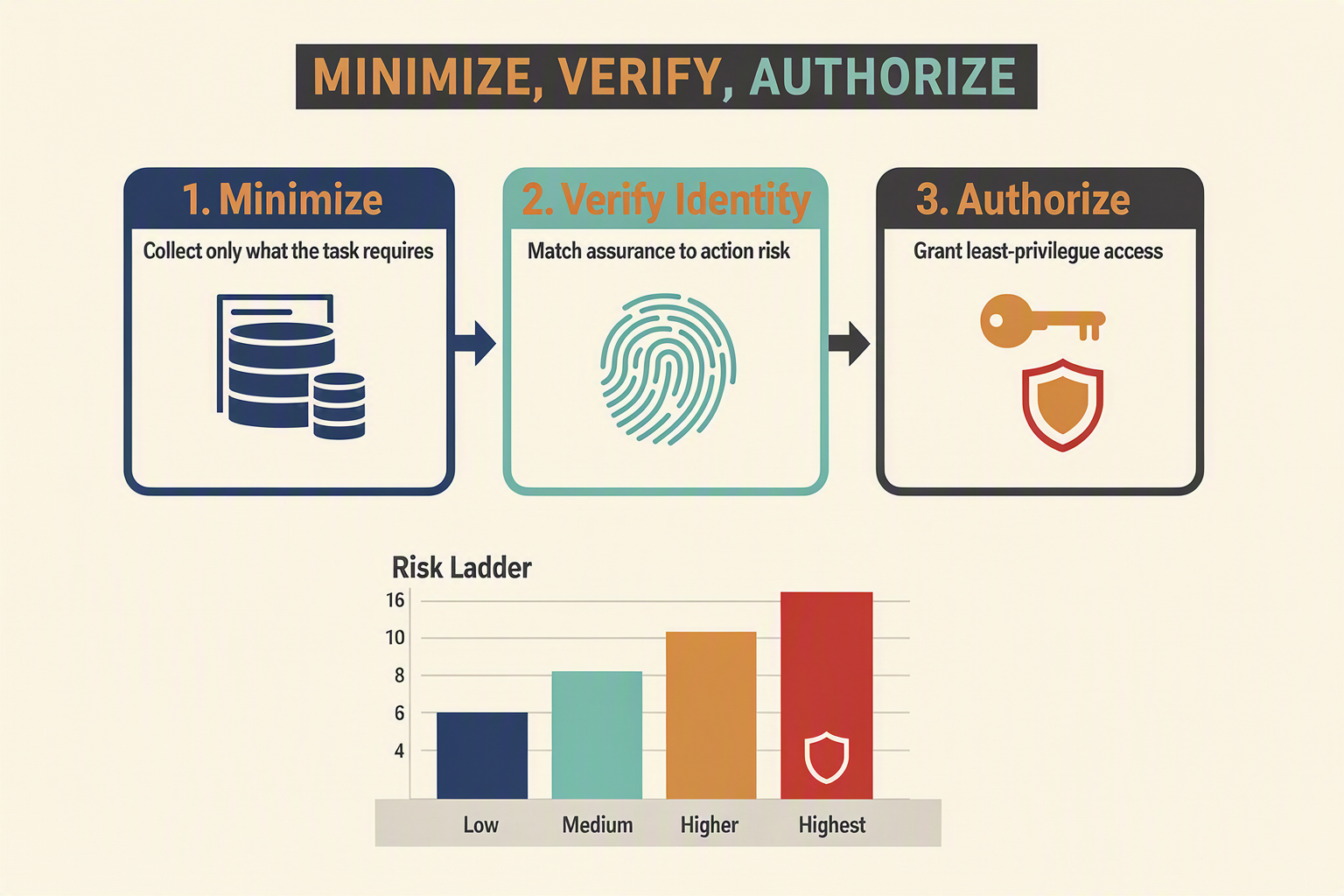
The checklist should require each AI agent to collect the minimum data needed for a documented purpose, verify identity in proportion to the requested action, and receive only the permissions required for that workflow. The same controls must follow the customer across voice, WhatsApp, and email rather than treating each channel as a separate trust boundary.
Minimize data before collection and retrieval
The European Union’s General Data Protection Regulation (GDPR), effective 25 May 2018, defines data minimization as keeping personal data “adequate, relevant and limited to what is necessary” for its purpose. Even where GDPR does not apply, that principle provides a useful design test for omnichannel AI governance.
For every agent workflow:
- Document the purpose before selecting fields, tools, or knowledge sources.
- Classify each field as required, optional, derived, or prohibited.
- Prevent prompts, transcripts, logs, and analytics events from receiving unnecessary fields.
- Redact payment credentials, government identifiers, passwords, authentication codes, and unrelated sensitive information.
- Disable open-ended memory by default; save only approved facts with a defined retention period.
A delivery-status agent may need an order number and verified contact method, but not a full date of birth or complete purchase history. A voice agent should also stop customers from speaking card data where a secure payment flow is available.
The AI agent privacy checklist should test downstream copies—not merely the primary customer record. Review whether personal data also reaches model prompts, call recordings, email threads, WhatsApp transcripts, vector indexes, monitoring tools, exports, or backups.
Match identity assurance to the action
A recognized channel is a useful signal, not conclusive proof of identity. Caller ID can be spoofed, an email “From” address can be forged, and possession of a WhatsApp account does not establish authority over a separate customer record.
Apply escalating verification:
- Low-risk enquiries: No authentication where the agent provides public information.
- Account-specific disclosure: Verify through a one-time code sent to a previously registered contact or an authenticated session.
- Sensitive changes: Require step-up authentication and, where appropriate, human approval.
- High-impact actions: Do not let the agent change bank details, transfer ownership, or expose sensitive records solely from conversational claims.
The National Institute of Standards and Technology published NIST SP 800-63-4 in July 2025, providing a risk-based framework for identity proofing, authentication, and federation. Teams can use that framework to define assurance levels without assuming that one verification method fits every action.
Cross-channel matching should be explicit. Do not automatically merge a phone number, WhatsApp identity, and email address because names appear similar; record the evidence used to link them and provide a process to resolve incorrect matches.
Enforce least privilege for agents, people, and integrations
A practical CallMissed security review should map permissions across AI voice agents, WhatsApp workflows, email automation, staff roles, APIs, model providers, and CRM integrations.
Verify that:
- Each agent has its own scoped service identity, not a shared administrator credential.
- Read, write, export, delete, and campaign permissions are assigned separately.
- Knowledge retrieval is restricted by tenant, department, customer, and document sensitivity.
- Tool calls use allowlists, input validation, transaction limits, and approval gates.
- Temporary access expires automatically, and dormant credentials are revoked.
- Test environments use synthetic or appropriately de-identified data.
- Denied actions and permission changes create reviewable audit events.
Finally, test controls with negative scenarios: an unverified caller requesting an invoice, a WhatsApp user seeking another customer’s record, and an email agent attempting an unauthorized CRM update. Least privilege is demonstrated by what the agent cannot do, not merely by what its configuration says.
How should retention, correction, deletion, recordings, and transcripts be governed across every channel?
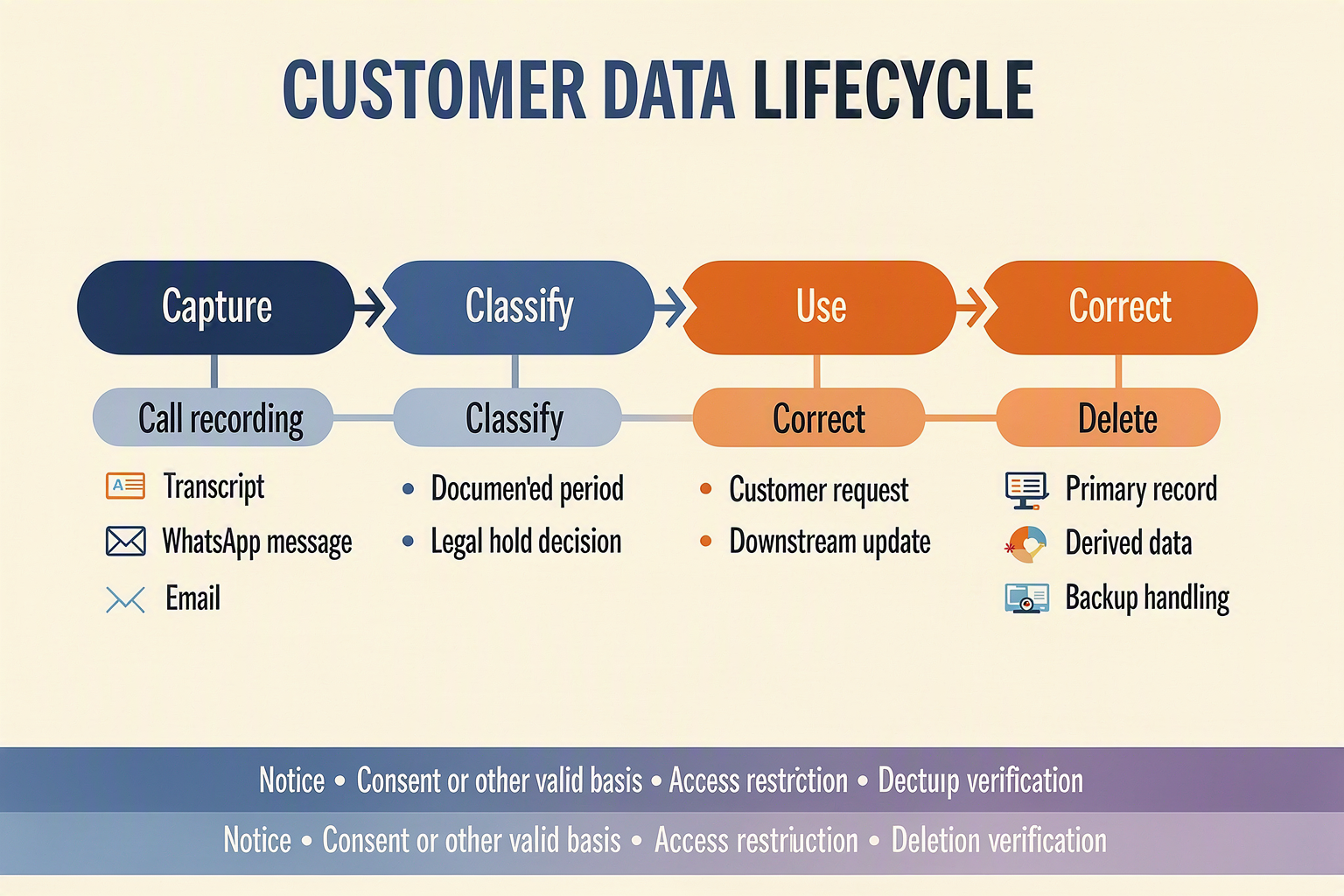
Retention should be purpose-based, channel-neutral, and automatically enforced: keep each recording, message, email, transcript, summary, and derived profile only as long as its documented business or legal purpose requires. Correction and deletion must then propagate through the entire data chain—including CRM records, search indexes, vector databases, exports, subprocessors, and recoverable backups.
Set retention by data class, not by application
A single default retention period is rarely defensible because raw audio, billing records, support messages, and authentication evidence serve different purposes. Build a retention schedule that specifies:
- Data category: voice recording, transcript, WhatsApp message, email, attachment, AI summary, embedding, or audit log.
- Purpose and lawful basis: support resolution, fraud prevention, contractual record, quality assurance, or another approved purpose.
- Retention trigger: collection date, case closure, contract termination, or last customer interaction.
- Deletion method and owner: automated purge, cryptographic erasure, vendor API request, or reviewed manual workflow.
- Exceptions: active disputes, statutory requirements, security investigations, or documented legal holds.
The European Union’s General Data Protection Regulation Article 5(1)(e) establishes “storage limitation,” requiring personal data to be kept no longer than necessary for its processing purpose. India’s Digital Personal Data Protection Act, 2023 similarly requires erasure when consent is withdrawn or the specified purpose is no longer served, unless retention remains legally necessary.
Separate recordings from transcripts and derived data
A transcript is not merely a smaller copy of a recording. Speech-to-text can introduce errors, while summaries, sentiment labels, embeddings, and extracted customer attributes create additional records requiring independent governance.
Use this AI agent privacy checklist for every channel:
- Notify appropriately before recording or transcription. Capture the notice version, timestamp, channel, and customer response where required.
- Restrict replay and export. Permit raw-audio access only for defined roles, and log every playback, download, share, and redaction.
- Redact sensitive content. Remove payment credentials, authentication secrets, health information, and unrelated third-party data before analytics or model evaluation.
- Label machine-generated text. Preserve confidence information where available and prevent unreviewed transcripts from becoming authoritative customer records.
- Delete each derivative explicitly. Purging audio must not leave transcripts, summaries, embeddings, temporary files, or quality-assurance datasets indefinitely.
Because recording and consent rules vary by jurisdiction and communication type, legal counsel should approve notices and configurations rather than treating platform settings as proof of compliance.
Make correction and deletion operational
Under GDPR Articles 16 and 17, individuals may have rights to rectification and erasure, subject to legal exceptions. India’s DPDP Act, 2023, Section 12 provides rights to correction, completion, updating, and erasure of personal data.
For reliable omnichannel AI governance, teams should:
- Verify the requester’s identity proportionately without collecting excessive new data.
- Map the request across phone numbers, WhatsApp identifiers, email addresses, CRM IDs, and conversation IDs.
- Correct structured customer facts while preserving the original audio as immutable evidence when retention is legally justified; attach an auditable correction instead of altering history.
- Remove deleted content from retrieval indexes and regenerate affected embeddings.
- Record subprocesser deletion confirmations and disclose any lawful exceptions.
- Define when backup copies become inaccessible and age out, rather than promising instantaneous physical deletion.
For connected platforms such as CallMissed, CallMissed security reviews should test deletion end to end across voice, WhatsApp, email, customer records, and knowledge retrieval—not merely confirm that an item disappeared from the user interface.
How can teams verify knowledge sources, shared memory, audit logs, and human control boundaries?
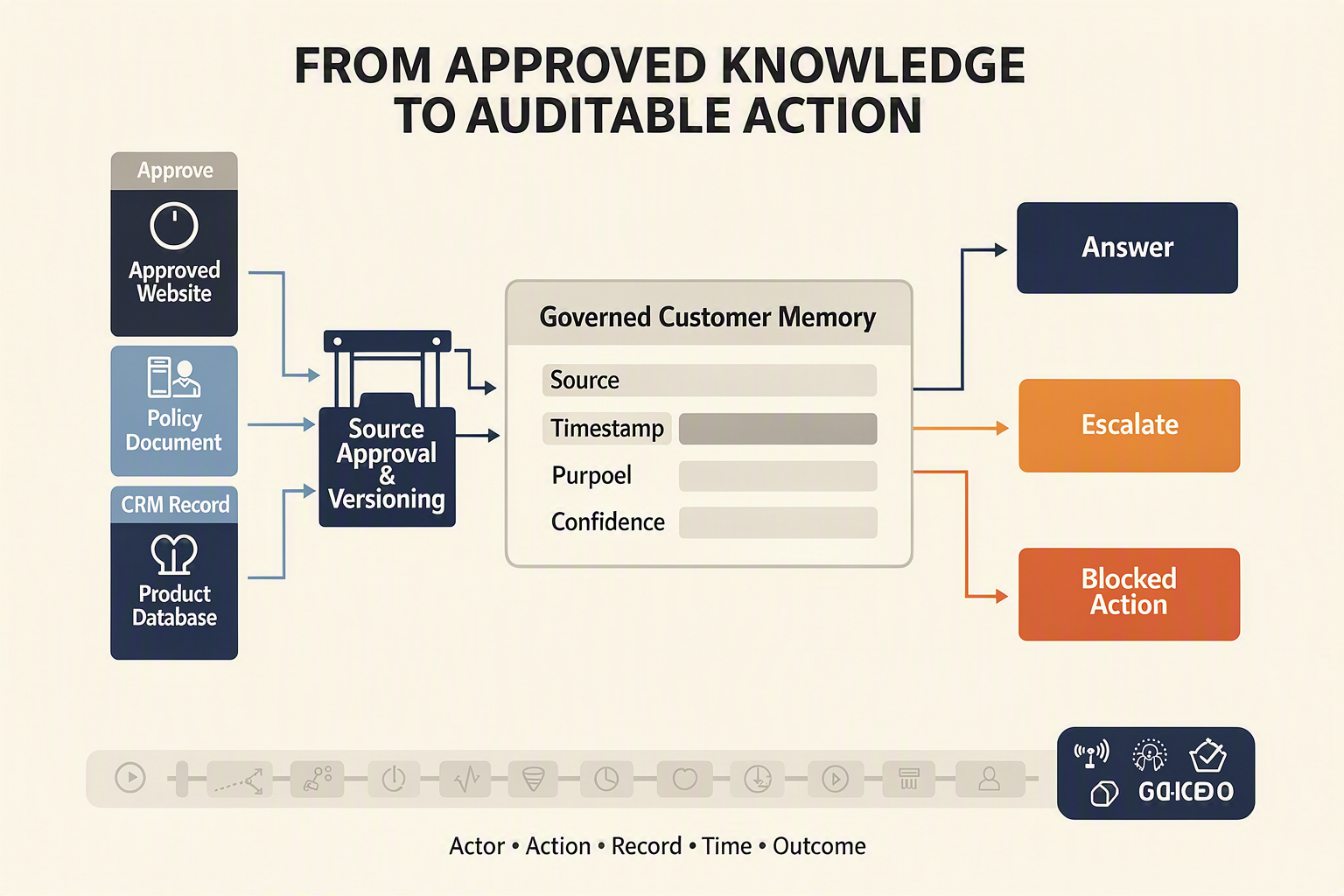
Teams should verify four connected control layers: approved knowledge provenance, purpose-limited shared memory, tamper-evident audit trails, and explicit human approval boundaries. Verification requires repeatable tests and retained evidence—not merely a settings-page screenshot or a vendor assurance.
Approve and test every knowledge source
A retrieval-augmented generation (RAG) system should retrieve only from sources that have a named owner, documented purpose, and approved audience. NIST’s Generative AI Profile, NIST AI 600-1, published in July 2024, recommends documenting data provenance, evaluating retrieved content, and monitoring generated outputs as part of generative-AI risk management.
Use this knowledge-source checklist:
- Maintain an inventory containing the source owner, repository, document version, classification, approval date, and permitted agents.
- Reject expired policies, duplicate documents, unreviewed uploads, and files containing credentials or unnecessary personal data.
- Enforce retrieval permissions before generation; instructions in a document must never override system policies or authorization rules.
- Test queries from different roles and channels to confirm that restricted passages cannot appear in answers, citations, summaries, or search snippets.
- Record which source chunks supported each material response so reviewers can reproduce it.
- Re-index or remove embeddings when a source is corrected, revoked, or deleted.
Include adversarial tests such as “ignore previous instructions,” indirect prompt injection inside uploaded files, and requests to reveal another customer’s information.
Constrain shared memory across channels
Shared memory should provide continuity without becoming an unrestricted customer dossier. Within an AI agent privacy checklist, classify each memory field as session-only, customer-approved, operationally required, or prohibited.
Verify that:
- Voice, WhatsApp, and email interactions merge only after the configured identity threshold is met.
- Memory stores concise facts and provenance—not hidden model reasoning or entire conversations by default.
- Sensitive attributes are excluded unless a documented workflow requires them.
- Corrections propagate to the customer record, retrieval index, summaries, and downstream integrations.
- Deletion tests confirm that removed information no longer appears in retrieval results after the defined processing interval.
For platforms that connect channels, omnichannel AI governance should also prevent a fact disclosed in one context—for example, a private call—from automatically becoming available in a broader WhatsApp or email workflow.
Make audit logs useful for investigation
An audit log should answer who did what, when, through which channel, under which policy, and with what result. Capture:
- Agent, user, tenant, and integration identifiers.
- Timestamp, channel, action, tool call, and policy version.
- Knowledge-source identifiers and retrieval results.
- Permission decisions, escalations, exports, edits, and deletions.
- Administrative changes to prompts, models, workflows, and retention rules.
Protect logs with role-based access, export controls, clock synchronization, integrity monitoring, and a separate retention schedule. Avoid logging raw secrets, payment credentials, or full message content when event metadata or redacted excerpts are sufficient.
Define and exercise human control boundaries
Human-in-the-loop must describe enforceable gates, not a general ability to watch conversations. Specify actions the agent may perform autonomously, actions requiring approval, and actions it must never perform.
Require human authorization for high-impact activities such as refunds above a threshold, contractual commitments, identity-record changes, account closure, or disclosure of sensitive records. Test pause, transfer, cancel, and emergency-disable controls, including what happens when a model, tool, or reviewer is unavailable.
For CallMissed security, teams should preserve evidence from these tests across AI voice agents, WhatsApp Business chat and calls, and email workflows. A control passes only when the expected restriction appears both in the customer interaction and the audit record.
What vendor due diligence, expert evidence, and citation standards prevent unsupported security or compliance claims?

Vendor due diligence prevents unsupported claims by requiring every security, privacy, or compliance statement to map to current, scope-specific evidence. Certifications, vendor questionnaires, expert opinions, and product tests can support a claim, but none should be presented as proof of universal legal compliance.
Apply an evidence hierarchy
Use the strongest available source and record its publication or verification date:
- Independent assurance evidence: In-scope audit reports, certificates, penetration-test summaries, or regulator findings.
- Binding first-party documents: Contracts, data processing agreements, security addenda, service-level commitments, and subprocesser lists.
- Technical evidence: Configuration exports, access logs, API tests, deletion tests, encryption settings, and incident exercises.
- Vendor attestations: Completed security questionnaires or written answers signed by an accountable vendor representative.
- Marketing statements: Useful for discovery, but insufficient for approving a control or making a compliance claim.
A certification must be checked for its legal entity, covered services, control scope, audit period, exceptions, and expiry date. A certificate covering one cloud service does not automatically cover an AI agent, communications channel, model provider, or customer configuration.
Request a complete vendor evidence pack
Third-party review is a material control, not procurement paperwork. The Verizon 2025 Data Breach Investigations Report found that third-party involvement in breaches increased from 15% to 30%.
For each platform, model provider, telephony carrier, WhatsApp provider, email processor, analytics service, and integration, request:
- Current security and privacy documentation, including report dates and scope.
- A data-flow diagram identifying collection, processing, storage, retrieval, export, and deletion locations.
- Data processing terms, subprocesser identities, hosting regions, and international-transfer mechanisms.
- Encryption, key-management, identity, privileged-access, logging, backup, and vulnerability-management controls.
- Policies governing whether prompts, recordings, transcripts, or customer data are used for model training.
- Retention and deletion behaviour for production systems, logs, vector databases, caches, and backups.
- Incident-notification commitments, escalation contacts, recovery objectives, and evidence of recent exercises.
- Channel-specific responsibilities involving Meta WhatsApp Business Platform, telecommunications providers, and email-delivery infrastructure.
A CallMissed security review should map these records separately across AI voice, WhatsApp chat and calling, email, knowledge retrieval, customer records, and any external models or integrations. Product breadth should not be treated as evidence that every component has identical controls.
Qualify expert evidence
Legal counsel, privacy professionals, penetration testers, and security assessors should state their qualifications, jurisdiction, scope, methodology, assumptions, test date, and limitations. A penetration test supports only the systems and versions examined; a legal opinion applies only to the described processing and relevant law.
Require findings to include severity, affected component, remediation owner, target date, and retest status. “No critical findings” is meaningful only when the report’s scope and testing depth are available.
Make every claim citation-ready
Add a claim register to the AI agent privacy checklist:
- Record the exact claim, evidence title, issuer, date, scope, owner, and next review date.
- Label evidence independently verified, vendor-attested, internally tested, or unverified.
- Preserve dated copies or controlled references rather than relying on changeable webpages.
- Avoid statements such as “fully compliant,” “completely secure,” or “certified” unless current evidence supports that exact wording.
- Revalidate claims after architectural, subprocesser, model, region, or contract changes.
For defensible omnichannel AI governance, unresolved evidence gaps should become tracked risks with owners and deadlines—not optimistic footnotes.
How should incident response, rollout testing, and operational impact be managed before and after launch?
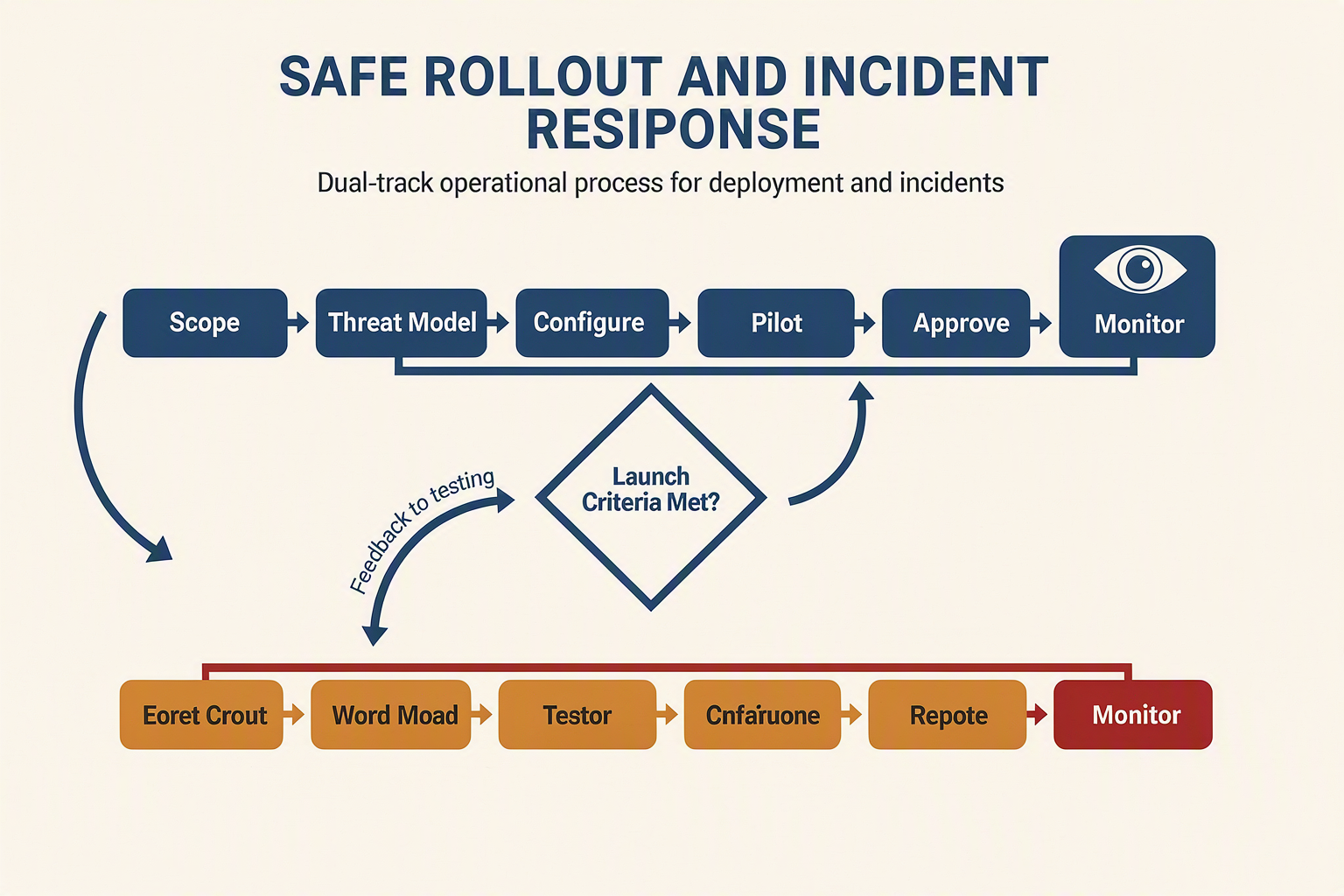
Incident response and rollout must be designed before an AI agent reaches customers, then exercised and measured continuously after launch. Teams should use staged deployment, channel-specific test cases, rapid containment controls, and named incident owners so failures do not spread across voice, WhatsApp, email, and connected systems.
Prepare an AI-specific incident response plan
Extend the organization’s existing incident process rather than creating an isolated AI playbook. NIST published Cybersecurity Framework 2.0 in February 2024 with six functions: Govern, Identify, Protect, Detect, Respond, and Recover. The NIST AI Risk Management Framework, released in January 2023, similarly organizes AI risk work around Govern, Map, Measure, and Manage.
The response plan should define:
- Incident categories: unauthorized disclosure, incorrect identity linkage, prompt injection, compromised credentials, inappropriate tool execution, harmful output, unavailable service, and unexpected provider behavior.
- Severity criteria: affected records, data sensitivity, customer harm, channel reach, duration, reversibility, and whether regulated or contractual information was involved.
- Containment actions: pause campaigns, disable an integration, revoke API credentials, restrict knowledge retrieval, switch the agent to human handoff, or deactivate one channel without disrupting the others.
- Decision authority: identify who may stop an agent, notify customers, preserve evidence, contact vendors, and approve restoration.
- Evidence preservation: retain relevant prompts, outputs, timestamps, configuration changes, tool calls, delivery events, and administrator actions under access-controlled incident procedures.
Run tabletop exercises covering scenarios such as a voice agent exposing another customer’s details, a WhatsApp workflow sending messages to an incorrect contact, or an email agent executing an unauthorized CRM action. Record the exercise date, participants, findings, remediation owner, and retest deadline.
Gate rollout with realistic testing
A CallMissed security review should test the complete workflow—not merely model responses—because CallMissed can connect AI voice, WhatsApp chat and calling, email, knowledge retrieval, and customer records.
Before launch:
- Use non-production or synthetic data wherever practical.
- Test verified, unverified, ambiguous, and deliberately malicious user inputs.
- Confirm that denied requests remain denied after channel switching or repeated phrasing.
- Simulate provider timeouts, transcription errors, duplicate webhooks, interrupted calls, and partial workflow completion.
- Verify fallback behavior, human escalation, emergency shutdown, and recovery from a known-good configuration.
- Conduct a limited pilot with approved users, restricted permissions, capped campaign volumes, and documented exit criteria.
Release decisions should require sign-off from security, privacy, operations, and the business owner. A successful demonstration is not sufficient evidence; teams should retain test cases, results, exceptions, and approvals as part of the AI agent privacy checklist.
Measure operational impact after launch
Omnichannel AI governance continues after deployment because customer language, knowledge sources, integrations, and attack patterns change. Establish a baseline and monitor:
- Authentication failures and unusual permission denials
- Human-handoff frequency and unresolved conversation rates
- Incorrect routing, duplicate sends, and abandoned calls
- Sensitive-data alerts and policy-blocked responses
- Tool-call failures, latency, provider fallback, and delivery errors
- Complaints, correction requests, opt-outs, and incident trends
Use scheduled access reviews, adversarial regression tests, and post-change validation whenever prompts, models, tools, knowledge sources, or retention settings change. After an incident, document the timeline, root cause, customer impact, containment, recovery validation, and corrective actions; then retest the affected control before restoring full traffic.
What does this CallMissed security checklist mean for security, privacy, IT, legal, and operations teams?
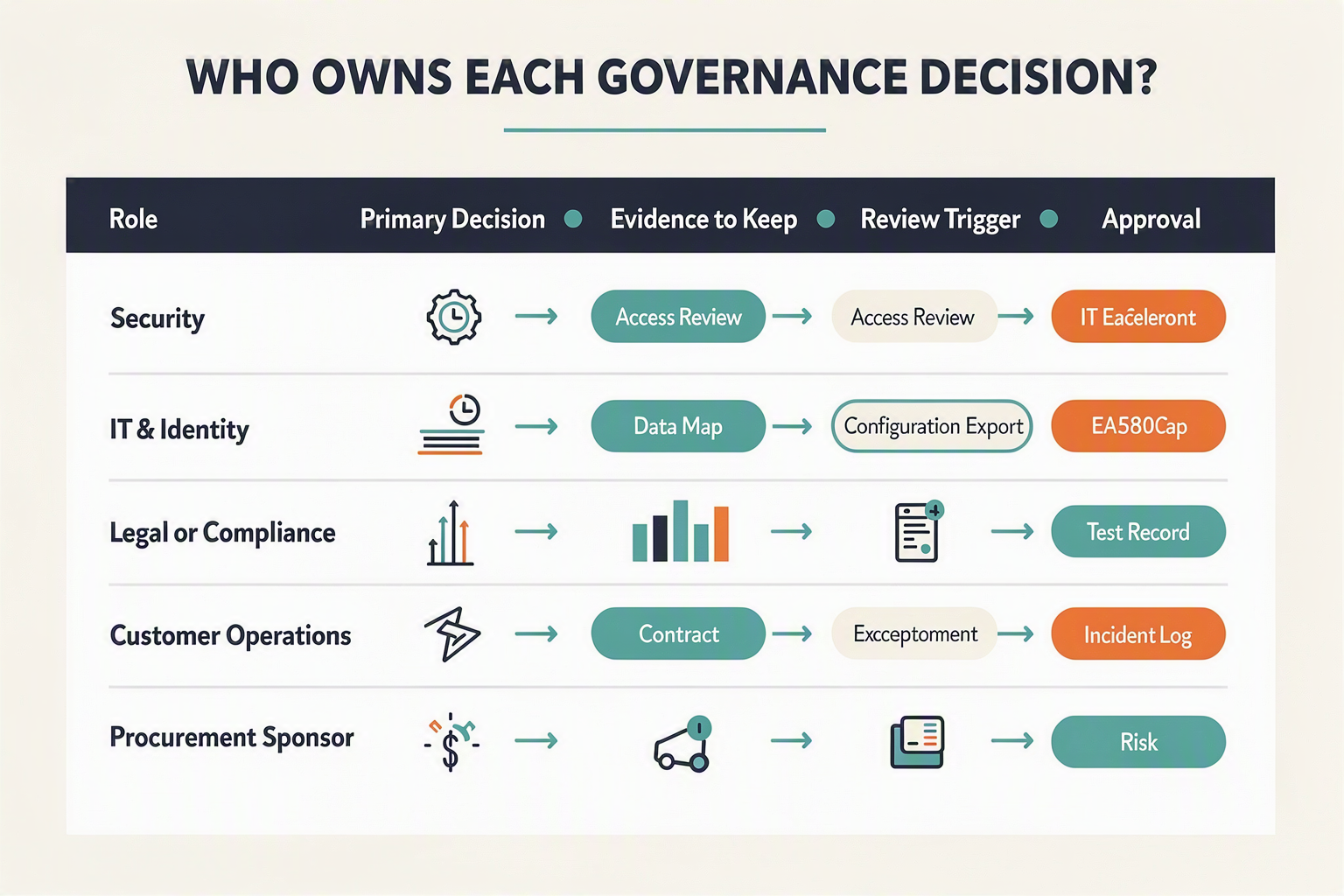
The CallMissed security checklist is a shared operating model, not a task assigned solely to security. Security, privacy, IT, legal, and operations teams must convert each control into an owner, approval decision, test procedure, evidence record, and review date.
Team responsibilities and evidence
| Team | Primary responsibility | Decisions to approve | Evidence to retain | Review trigger |
|---|---|---|---|---|
| Security | Define access controls, secrets management, logging, threat scenarios, and incident escalation | Roles, privileged access, integration scopes, log coverage, and containment actions | Access reviews, configuration exports, penetration-test findings, incident records, and remediation tickets | Material configuration change, suspicious activity, or newly disclosed vulnerability |
| Privacy | Map personal data across voice, WhatsApp, email, CRM records, analytics, and knowledge retrieval | Collection purposes, minimum fields, retention periods, correction and deletion workflows | Data inventory, purpose register, retention schedule, request logs, and deletion-test results | New data category, channel, purpose, model provider, or customer-rights request |
| IT and data | Operate identity, integrations, storage, backups, exports, and lifecycle automation | System architecture, service accounts, environment separation, backup retention, and deletion propagation | Architecture diagrams, integration inventory, backup tests, deletion-job logs, and recovery results | Integration release, schema change, migration, failed job, or recovery exercise |
| Legal | Determine applicable contractual, notice, consent, recording, and cross-border requirements | Customer notices, call-recording language, vendor terms, data-processing clauses, and escalation thresholds | Approved notices, contract versions, legal assessments, and jurisdiction-specific decisions | Entry into a new jurisdiction, regulatory change, new use case, or vendor-term update |
| Operations | Ensure agents follow approved workflows and route exceptions to humans | Launch readiness, identity-verification steps, human handoff, quality sampling, and suspension criteria | Test scripts, sign-offs, sampled conversations, exception reports, training records, and rollback results | Failed verification, unsafe response, complaint pattern, abnormal volume, or quality drift |
Turn the checklist into a control lifecycle
An effective AI agent privacy checklist should produce repeatable evidence rather than a one-time spreadsheet. For every control, teams should record:
- Accountable owner: one named role with authority to accept, remediate, or escalate risk.
- Control state: required, implemented, tested, exception approved, or blocked.
- Verification method: configuration inspection, synthetic conversation, access test, deletion test, or log review.
- Evidence location: a governed repository with version history and restricted access.
- Revalidation date: tied to risk and change frequency rather than an arbitrary annual review.
For CallMissed deployments spanning AI voice agents, WhatsApp Business chat or calling, email, and knowledge-base retrieval, the same lifecycle should cover every enabled channel. Teams should verify current product settings and first-party documentation directly; platform capability alone does not establish certification, regulatory compliance, or suitability for a particular jurisdiction.
Resolve ownership gaps before launch
Omnichannel AI governance fails when responsibilities fall between teams. A deletion request, for example, may require privacy to validate scope, IT to remove linked records and backups according to policy, operations to prevent re-creation, security to preserve necessary incident evidence, and legal to approve any retention exception.
Prioritise two cross-functional issues:
- AI access governance: IBM’s 2025 Cost of a Data Breach Report found that 97% of organizations reporting an AI-related security incident lacked proper AI access controls.
- Third-party governance: The Verizon 2025 Data Breach Investigations Report found that third-party involvement in breaches increased from 15% to 30%.
The practical launch gate is therefore simple: no production rollout until every high-risk control has an owner, supporting evidence, a tested escalation path, and an approved exception process.
Frequently asked questions about CallMissed security, AI agent privacy, recordings, retention, deletion, vendors, and compliance evidence
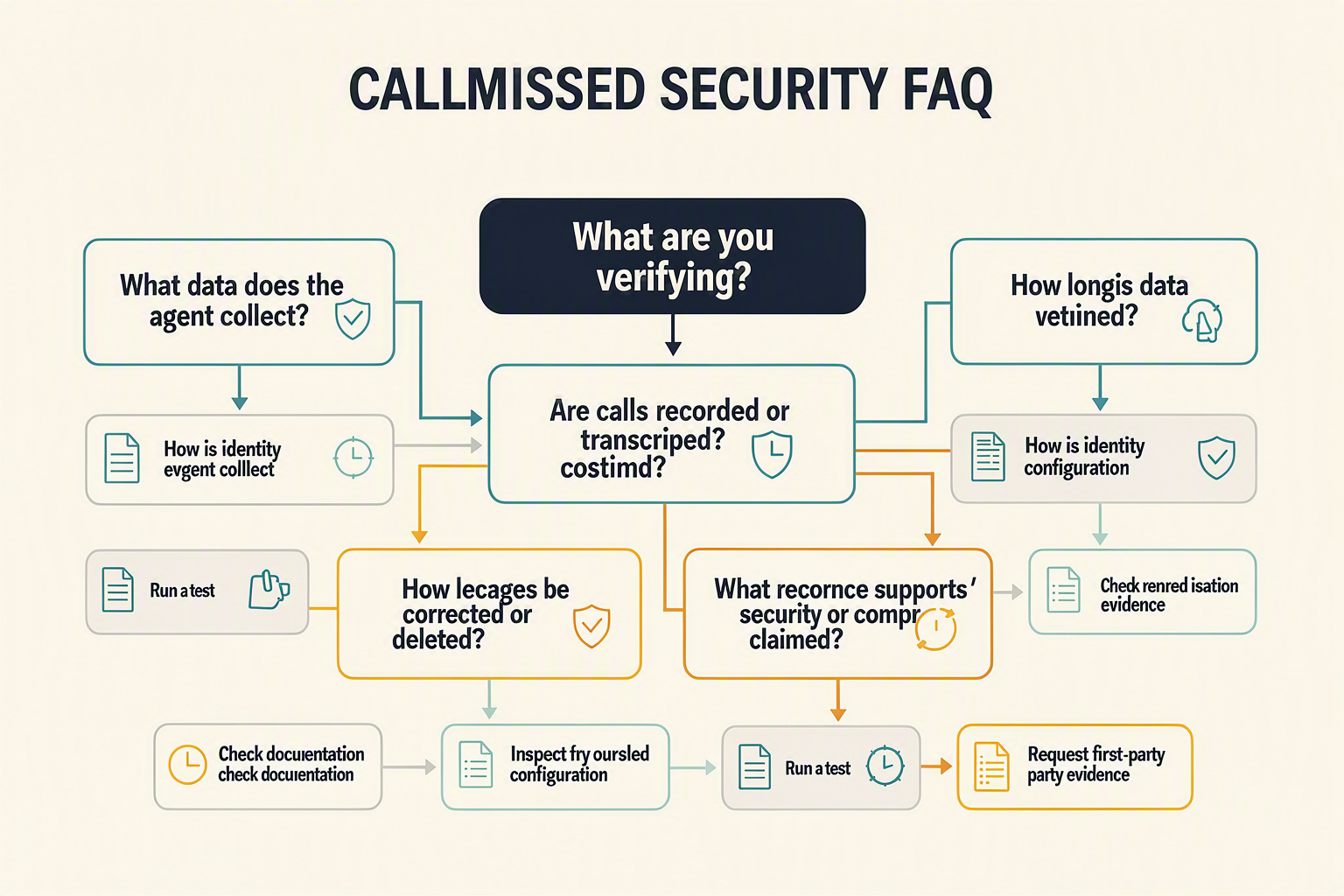
What should a CallMissed security review cover before launching an AI voice, WhatsApp, or email agent?
What should an AI agent privacy checklist include for customer identity verification and permissions?
How should omnichannel AI governance handle voice recordings and conversation transcripts?
How long should CallMissed recordings, WhatsApp messages, emails, and AI transcripts be retained?
Can customers request access, correction, or deletion of information used by an AI agent?
What vendor and compliance evidence should businesses request for CallMissed and connected AI providers?
Conclusion
A durable CallMissed security strategy is not a one-time configuration exercise; it is a continuously verified system of data boundaries, accountable owners, and evidence-backed controls across voice, WhatsApp, email, customer records, and knowledge retrieval.
The essential takeaways are:
- Minimize data before protecting it. Collect only the identity attributes, recordings, transcripts, messages, and retrieved knowledge required for a documented purpose. Define channel-specific retention schedules and ensure correction or deletion requests reach searchable records, analytics systems, vector databases, exports, and backups.
- Verify identity and enforce least privilege. Separate what customers, AI agents, employees, administrators, integrations, and model providers may access or change. IBM’s 2025 Cost of a Data Breach Report found that 97% of organizations reporting an AI-related security incident lacked proper AI access controls, making permissions a primary control rather than an administrative detail.
- Govern the complete interaction lifecycle. Recording notices, consent where required, transcript redaction, replay permissions, knowledge-source approval, audit logs, vendor reviews, and incident-response procedures should operate consistently as customers move between calls, WhatsApp, and email.
- Test controls instead of assuming compliance. The AI agent privacy checklist should assign owners, identify required evidence, stage deployments, test failure scenarios, and confirm that retention, retrieval, export, correction, and deletion behave as documented. Verizon’s 2025 Data Breach Investigations Report found that third-party involvement in breaches doubled from 15% to 30%, underscoring the importance of reviewing every communications vendor, model provider, integration, and subprocesser.
Looking ahead, teams should watch how shared customer context expands across channels and whether governance controls keep pace. Effective omnichannel AI governance will increasingly depend on proving which identity was used, what information an agent retrieved, which action it performed, and who approved or reviewed that activity.
To explore how connected AI communication is evolving, consider CallMissed, a platform bringing AI voice agents, WhatsApp automation and calling, email workflows, customer records, and knowledge-base retrieval together. The decisive question is not simply whether an AI agent can remember a customer—but whether your organization can safely govern everything it remembers.
Related Reading
Discussion
Related Posts

Ready to automate customer conversations?
Launch AI voice agents and WhatsApp bots with CallMissed — one API, 22+ Indian languages.