
CallMissed Omnichannel AI Agents: How Shared Customer Memory Connects Every Channel


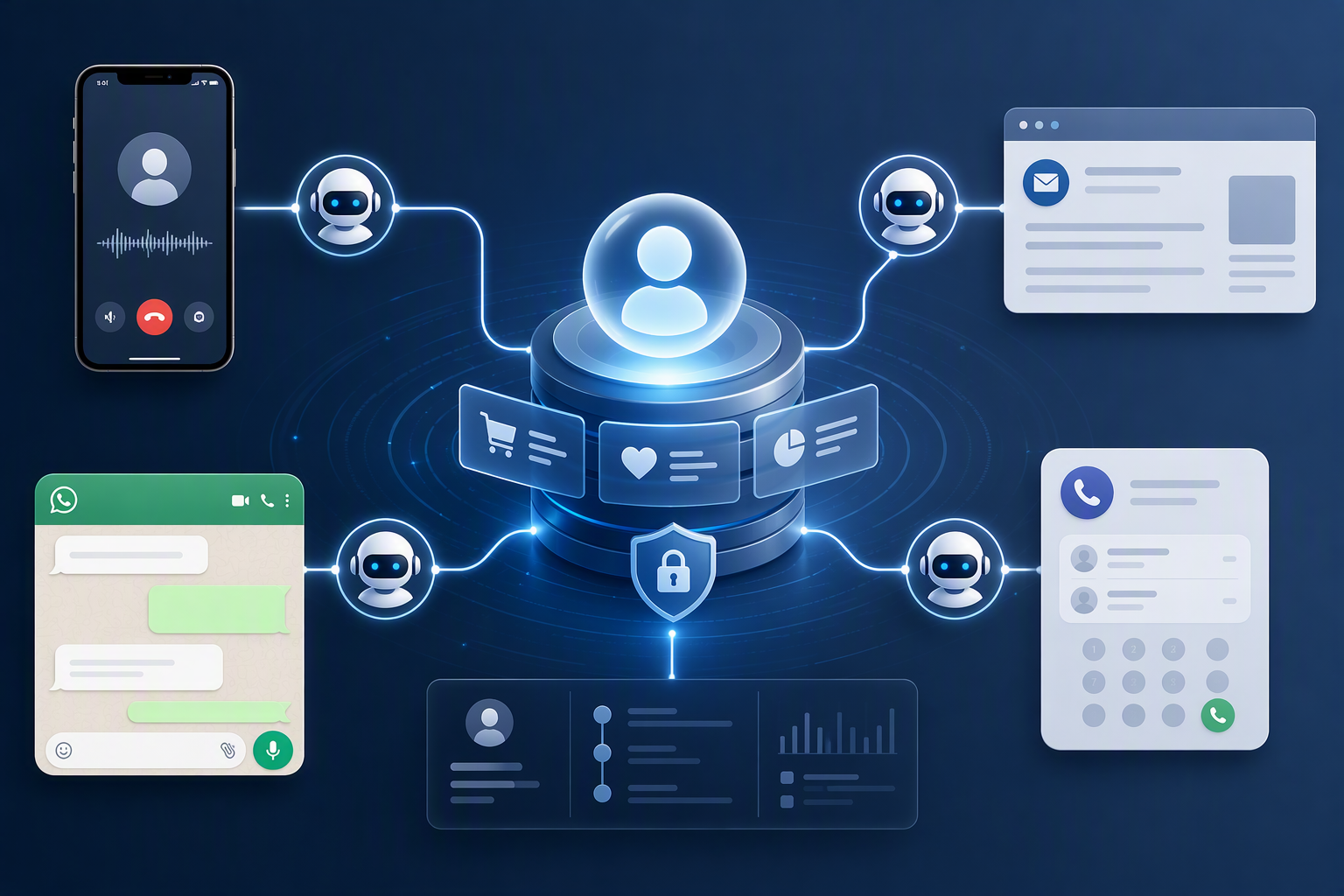
Learn how CallMissed omnichannel AI agents unite email, WhatsApp, voice, and business numbers through shared customer memory.
CallMissed Omnichannel AI Agents: How Shared Customer Memory Connects Every Channel
What happens when a customer starts on WhatsApp, continues by email, and calls your business—only to repeat the same problem three times? CallMissed omnichannel AI agents use shared customer memory to preserve relevant customer context across those interactions, helping email, WhatsApp, voice, and business-phone workflows operate as parts of one connected engagement platform.
The need for that continuity is growing quickly. Meta reported in April 2025 that WhatsApp had surpassed 3 billion monthly active users worldwide. Meanwhile, Salesforce’s State of the Connected Customer reported in 2023 that 79% of customers expect consistent interactions across departments, while 88% consider the experience a company provides as important as its products or services. For businesses, the implication is clear: adding more communication channels is not enough if every channel behaves like a separate island.
CallMissed addresses this fragmentation by bringing multiple customer touchpoints into one AI-native platform:
- AI email agents can interpret enquiries, use available customer context, and support follow-up workflows.
- WhatsApp chat agents can handle conversations through the channel customers already use for everyday communication.
- AI voice agents can answer or initiate calls and maintain relevant continuity with earlier interactions.
- Business phone numbers give voice conversations a consistent operational entry point instead of leaving calls disconnected from digital engagement.
- An omnichannel inbox and CRM help teams view and manage conversations spanning WhatsApp, voice, email, and web.
The important concept is not merely “one dashboard.” It is shared customer memory: structured context associated with a customer that can follow that customer when the conversation moves between supported channels. For example, someone might request pricing through WhatsApp, clarify requirements during a phone call, and receive a follow-up email without each interaction beginning from zero.
That does not mean every AI agent must have an identical memory or unrestricted access to every piece of information. Separate CallMissed agents may retain their own configured instructions, knowledge sources, roles, and agent-specific memories while using permitted cross-channel customer context. This distinction supports more controlled automation: a sales agent and a support agent can remain purpose-built even when both recognize the same customer journey.
This product guide explains how CallMissed connects email agents, WhatsApp chat agents, voice agents, and business phone numbers; how customer context can move between channels; and how businesses can design memory boundaries that balance continuity, relevance, and operational control. The result is a practical model for engagement in which customers can change channels without forcing the conversation to restart.
How does CallMissed unify email, WhatsApp, voice agents, and business phone numbers?
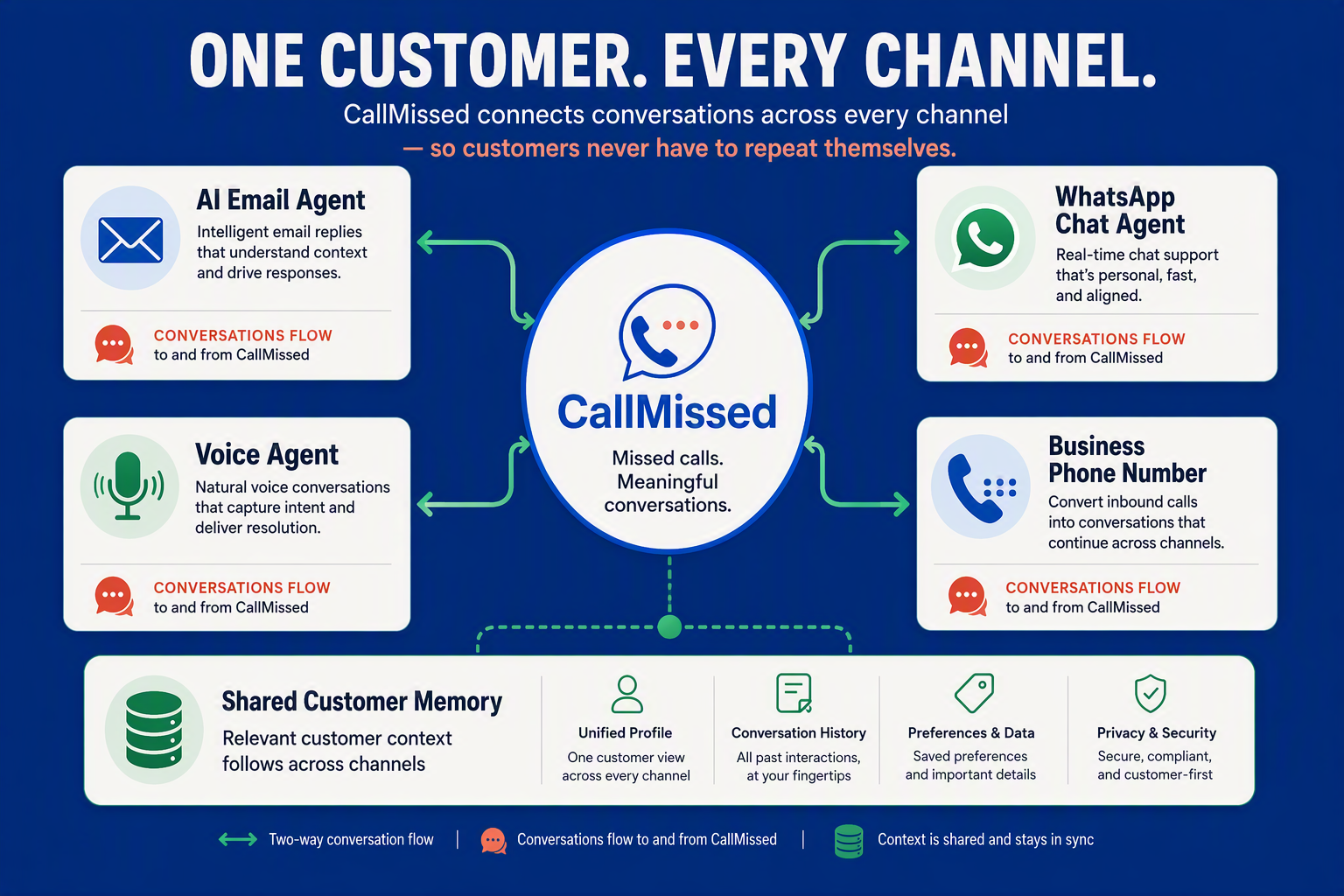
CallMissed unifies email, WhatsApp, voice, and business phone interactions by connecting supported conversations to customer records and permitted context. CallMissed omnichannel AI agents can use shared cross-channel memory for continuity while retaining distinct instructions, knowledge, and channel-specific memories.
One customer journey across channels
A customer might begin with a WhatsApp message, continue through a phone call, and receive an email follow-up. When the customer can be identified, relevant authorized context can follow that journey, so each interaction does not have to start from zero.
CallMissed omnichannel AI agents support:
- Email agents for interpreting incoming messages and assisting with replies, summaries, and follow-ups
- WhatsApp chat agents for automated conversations based on configured business knowledge
- Voice agents for spoken enquiry, qualification, support, and appointment workflows
- Directly purchased phone numbers that provide business entry points for inbound and outbound calls
- WhatsApp Business calling that can connect voice interactions with an AI voice agent
- An omnichannel inbox and CRM where teams can review conversations and continue workflows
Shared context with distinct agent memories
Shared cross-channel memory does not mean every agent accesses the same information or behaves like one general-purpose bot. Businesses can configure separate roles, knowledge bases, instructions, memories, and handoff points for different agents.
This means CallMissed omnichannel AI agents can preserve relevant customer context across email, WhatsApp, and voice while keeping each channel agent purpose-built and within its configured boundaries.
Why do disconnected communication channels create customer-context gaps?

Disconnected channels create customer-context gaps because each tool records only one fragment of the relationship. A WhatsApp chatbot may know the original request, an email agent may see the quotation, and a voice agent may hear the objection—without any one channel understanding the complete journey.
Where customer context breaks
Channel fragmentation is usually a data and workflow problem, not simply an agent-performance problem. Even capable AI agents produce incomplete responses when the relevant conversation history remains inside separate inboxes, telephony systems, or automation tools.
A typical gap develops in four steps:
- A customer asks a product question through WhatsApp.
- A separate email system sends pricing without carrying over the WhatsApp discussion.
- The customer calls a business phone number to clarify a requirement.
- The voice agent or employee receives the call without the earlier chat and email context.
The customer must then restate the requirement, while the business risks inconsistent answers, duplicated follow-ups, and incorrect routing. Salesforce’s State of the Connected Customer reported in 2023 that 79% of customers expect consistent interactions across departments, illustrating why internal system boundaries should not become visible to customers.
Common context gaps include:
- Identity gaps: The same person appears as a phone number in one system and an email address in another.
- Conversation gaps: Previous questions, answers, and unresolved issues remain channel-specific.
- Intent gaps: A sales enquiry becomes a support call, but the new agent cannot see why the customer switched channels.
- Preference gaps: Language, contact-channel, or scheduling preferences are repeatedly requested.
- Action gaps: A promised callback or quotation is not visible to the next agent handling the customer.
How CallMissed reduces channel fragmentation
CallMissed brings AI email agents, WhatsApp chat agents, voice agents, business phone numbers, and an omnichannel inbox/CRM into one engagement environment. Its omnichannel AI agents can use shared customer memory so that permitted, relevant context remains associated with the customer rather than being trapped inside a single interaction.
For example, CallMissed can support a journey in which:
- A WhatsApp agent records that a prospect is evaluating a particular service.
- A voice agent uses that context when the prospect subsequently calls the business number.
- An email agent prepares an appropriate follow-up based on the resulting conversation.
- A team member reviews the connected interactions through the omnichannel workspace.
This continuity is especially relevant for multilingual engagement. CallMissed supports Speech-to-Text and Text-to-Speech across 22 Indian languages, allowing regional-language voice interactions to participate in broader customer workflows rather than operating as isolated call records.
Shared context does not mean unrestricted memory
A connected platform should not expose every detail to every agent. In CallMissed, separate agents can retain distinct instructions, knowledge sources, responsibilities, and configured memories while drawing on permitted cross-channel customer context.
A practical design might allow:
- A sales agent to access product interest and quotation status.
- A support agent to access the reported issue and troubleshooting history.
- A voice agent to access language and callback preferences.
- An email agent to access the approved outcome needed for follow-up.
The objective is relevant continuity with controlled boundaries. CallMissed connects the customer journey while allowing each AI agent to remain specialized for its assigned role.
Which communication capabilities does CallMissed bring together?
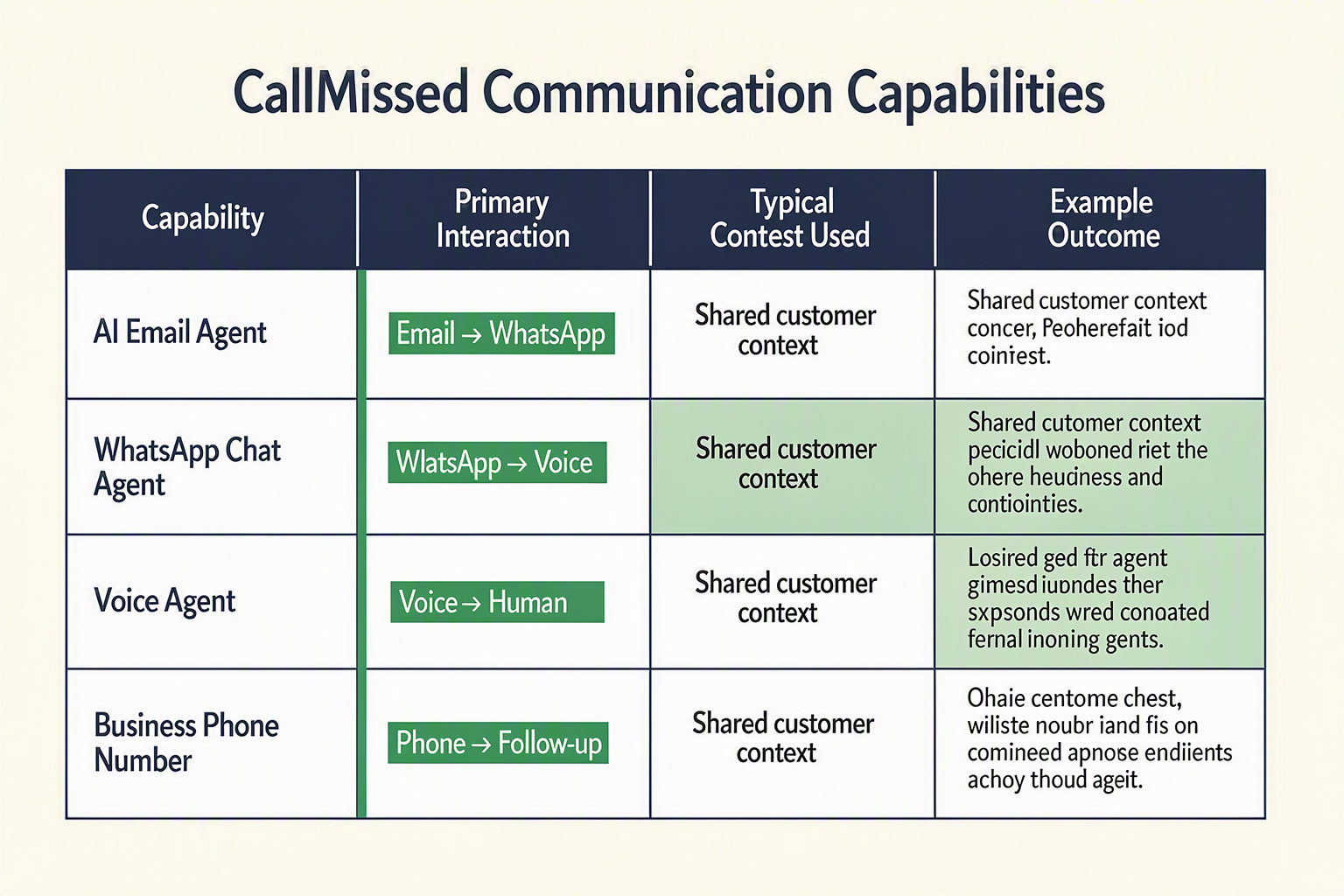
CallMissed brings email, WhatsApp chat, WhatsApp Business calling, AI voice agents, business phone numbers, and team-managed conversations into one customer-engagement platform. Its omnichannel AI agents can use permitted shared customer memory, while each agent retains its own role, instructions, knowledge sources, and configured memory.
CallMissed communication capability map
| Capability | What CallMissed provides | Context available | Typical workflow |
|---|---|---|---|
| AI email agents | Automated interpretation, response, follow-up, and campaign or email tooling | Customer details, relevant conversation history, CRM data, and approved knowledge | Send a quotation after a voice call or continue a support case by email |
| WhatsApp chat agents | Automated messaging through WhatsApp Business, with knowledge-base retrieval and workflow support | Prior WhatsApp messages plus permitted context from email, voice, or web interactions | Answer product questions, qualify leads, share updates, or schedule appointments |
| WhatsApp Business calling | Inbound and business-initiated WhatsApp voice calls connected to an AI agent | Relevant chat history, customer records, and authorised cross-channel context | Move from text to a voice conversation without treating the caller as a new customer |
| AI voice agents | Automated inbound and outbound conversations using speech recognition and speech synthesis | Call history, CRM fields, approved knowledge, and earlier channel activity | Handle enquiries, qualify leads, confirm bookings, or conduct follow-ups |
| Business phone numbers | A consistent telephone entry point for routing customer calls into configured voice workflows | Caller identity, previous call records, and permitted customer context | Answer routine calls automatically or route exceptions to a human team |
| Omnichannel inbox and CRM | A shared operational workspace for WhatsApp, voice, email, and web conversations | Consolidated customer identity, conversation records, status, and ownership | Let staff review the journey, intervene when necessary, and continue the interaction |
How the capabilities work as one system
The table describes separate communication functions, but the practical value comes from coordinating them. In CallMissed, a workflow can connect channel events rather than requiring teams to assemble isolated tools and reconcile records manually.
A typical sequence could be:
- A WhatsApp chat agent collects a prospect’s requirements.
- The prospect requests a call, which is handled through WhatsApp Business calling or a configured business number.
- The voice agent receives the relevant requirements as permitted context instead of asking every introductory question again.
- An email agent sends a summary or next step using information captured during the conversation.
- A staff member reviews the combined journey through the omnichannel inbox and CRM.
CallMissed’s WhatsApp capability therefore extends beyond text automation: businesses can bridge actual WhatsApp Business calls to an AI voice agent. For regional voice deployments, CallMissed also supports Speech-to-Text and Text-to-Speech across 22 Indian languages, using Indic-focused model options for businesses serving multilingual audiences.
Shared context without identical agents
Shared customer memory does not mean every agent becomes interchangeable or receives unrestricted access. A support voice agent can use technical knowledge and recent case details, while an email sales agent can use pricing information and lead-stage data. Both may recognise the same customer, but their accessible memories and permitted actions can differ.
This separation enables businesses to configure:
- Channel-specific instructions, such as concise WhatsApp replies or structured email responses.
- Role-specific knowledge, such as separate sales, support, and appointment data.
- Access boundaries determining which customer context each agent may use.
- Human handoff rules for sensitive, ambiguous, or high-value conversations.
The result is one coordinated communication layer with purpose-built agents—not one unrestricted pool of data shared indiscriminately.
How does shared customer memory work across CallMissed channels?
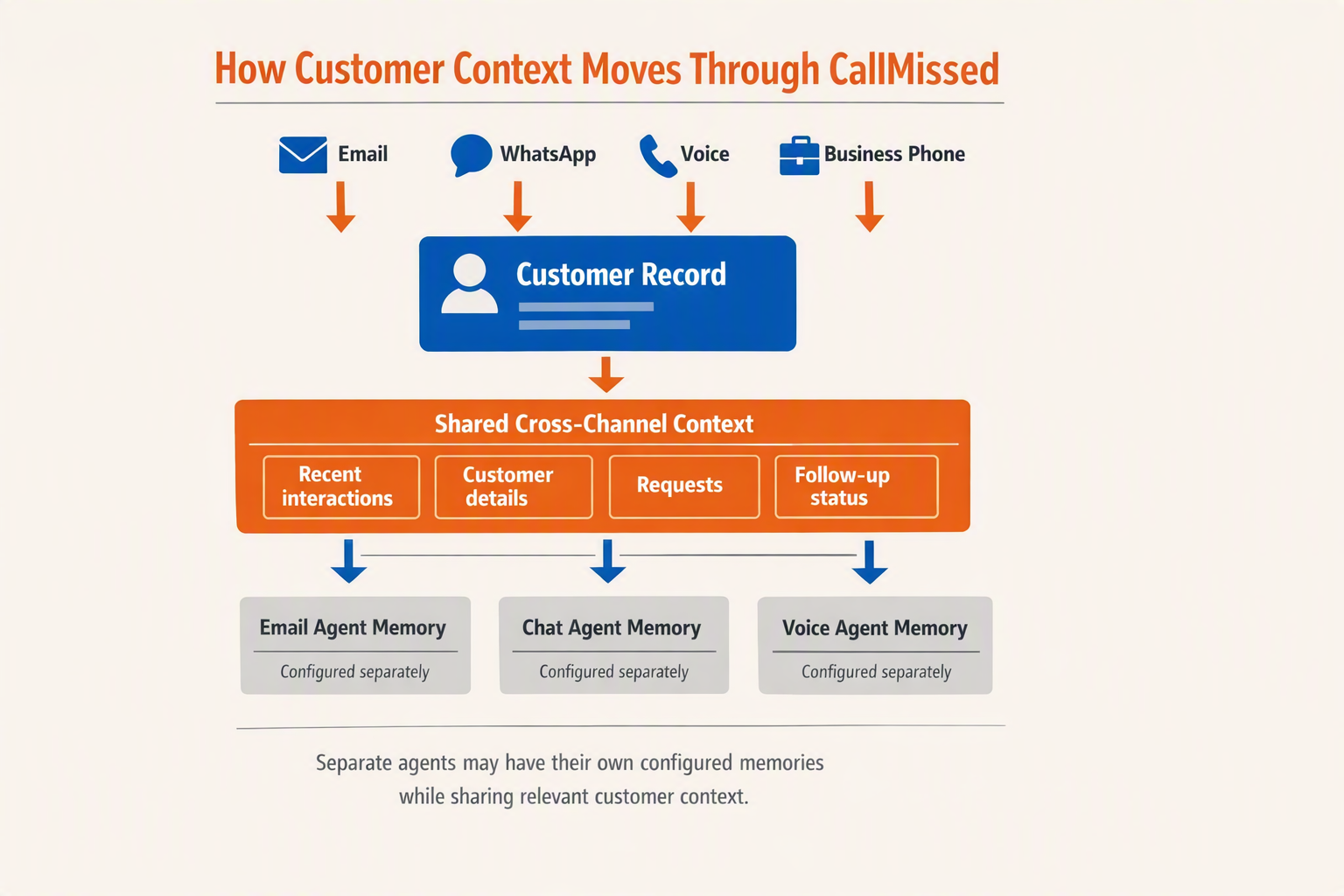
Shared customer memory in CallMissed works by associating permitted conversation context with a customer, then making that context available when the customer moves between email, WhatsApp, voice, or a business phone number. CallMissed agents can therefore continue the journey without treating every channel switch as a completely new enquiry.
From channel events to reusable customer context
A message, email, or call may contain information that another agent needs later. Within CallMissed, the practical memory flow can be understood in four stages:
- Identify the customer: CallMissed uses available identifiers—such as a phone number, WhatsApp identity, email address, or linked CRM record—to associate an interaction with the appropriate customer.
- Capture relevant context: The interaction produces useful details such as the customer’s request, stated preferences, qualification information, appointment requirements, or unresolved issue.
- Make context available across channels: When the same customer contacts the business through another connected channel, the receiving workflow can use permitted customer-level context.
- Continue or escalate the journey: An AI agent can respond with continuity, while a human team member can review the conversation through the omnichannel inbox and CRM when intervention is required.
For example, a prospect could tell a WhatsApp chat agent that they need a product demonstration for a 20-person team. If the prospect subsequently calls the connected business number, the voice agent can use that available context to continue qualification rather than asking the prospect to restate the original requirement. An AI email agent can then support a follow-up containing the relevant next steps.
Shared memory does not mean identical agents
CallMissed separates cross-channel customer context from each agent’s configured role and memory. This distinction prevents omnichannel automation from becoming one undifferentiated assistant.
A business might configure:
- A WhatsApp agent to answer initial questions and collect lead details.
- A voice agent to qualify requirements or schedule an appointment.
- An email agent to manage structured follow-ups.
- A support agent to consult an approved knowledge base through retrieval-augmented generation, or RAG.
These agents may recognize the same customer and use relevant shared facts, but they can still have different instructions, knowledge sources, permissions, and agent-specific memories. Shared customer memory provides continuity; agent configuration determines what each agent should do with that continuity.
What should enter shared customer memory?
Businesses should prioritize information that improves the next interaction without exposing unnecessary data. Useful memory can include:
- The customer’s current intent or reason for contacting the business
- Products, services, languages, or appointment times discussed
- Completed workflow steps and pending actions
- Previous summaries and outcomes
- Consent, communication preferences, and escalation status
Sensitive or irrelevant material should not automatically become universal context. Teams should define retention, access, consent, and deletion policies according to their operating requirements and applicable privacy obligations. Reliable identity matching also matters: if an email address and phone number have not been linked to the same customer, the system should not assume they belong together.
The result is a controlled memory model for CallMissed omnichannel AI agents: customer-level context can follow the journey, while separate agents retain purpose-specific boundaries. That balance allows CallMissed to connect conversations without requiring every agent—or every employee—to see everything.
What operational impact can connected CallMissed conversations have?

Connected CallMissed conversations can reduce repeated discovery, shorten handoffs, and make follow-up more consistent because permitted context travels with the customer across email, WhatsApp, voice, and business phone interactions. The operational value comes from shared customer memory, not simply from placing multiple channels in one interface.
Fewer restarts and cleaner handoffs
When channels operate separately, each switch creates another opportunity to lose intent, history, or ownership. CallMissed omnichannel AI agents can instead use relevant customer context to continue the workflow.
A connected journey might proceed as follows:
- A customer asks a CallMissed WhatsApp chat agent about an appointment.
- The chat agent records the customer’s preferred date and unresolved question as structured context.
- The customer calls the business number for clarification, and the voice agent receives the permitted context rather than repeating the entire discovery process.
- An email agent sends the appropriate confirmation or follow-up using the updated conversation state.
- A human operator can review the interactions through the omnichannel inbox and CRM when intervention is required.
This continuity matters at scale: Salesforce reported in its 2023 State of the Connected Customer that 79% of customers expect consistent interactions across departments. Connected context gives businesses a practical way to work toward that expectation without forcing every channel to run an identical agent.
More useful automation across the customer lifecycle
CallMissed can support operational workflows in which one interaction becomes the input for the next. Depending on the business’s configuration, connected conversations can help teams:
- Qualify enquiries progressively: WhatsApp can collect initial requirements, voice can resolve ambiguity, and email can deliver a detailed proposal.
- Improve follow-up discipline: A completed or missed call can trigger an email, WhatsApp message, task, or campaign step using the available conversation outcome.
- Centralise service visibility: Agents and human team members can inspect a customer’s supported-channel history instead of searching through disconnected tools.
- Preserve language and channel preferences: Businesses can use known preferences when routing later engagement, including voice and chat workflows across CallMissed’s support for 22 Indian languages.
- Escalate with context: Human operators can receive the issue summary, prior actions, and outstanding request rather than asking the customer to start again.
These are potential workflow improvements, not guaranteed performance results. Actual impact depends on agent instructions, CRM data quality, integrations, escalation design, and which information the business allows each agent to access.
Metrics that reveal the operational effect
Teams should measure connected conversations against a baseline rather than assuming that adding AI automatically improves service. Useful indicators include:
- Repeat-information rate: How often customers must restate details after switching channels.
- First-contact resolution rate: The share of enquiries resolved without another interaction.
- Average handling time: Human and AI processing time for comparable request types.
- Handoff completion rate: The percentage of cross-channel transfers that reach the intended next step.
- Follow-up latency: Time between a call or chat outcome and the promised email or message.
- Escalation quality: Whether a human receives enough context to act immediately.
CallMissed should be configured so these gains do not come at the expense of control. A support agent, sales agent, and collections agent may each retain separate instructions, knowledge sources, and agent-specific memories while accessing only approved cross-channel customer context. Connected memory should mean relevant continuity—not unrestricted data sharing.
What should experts and implementation teams evaluate before configuring CallMissed?
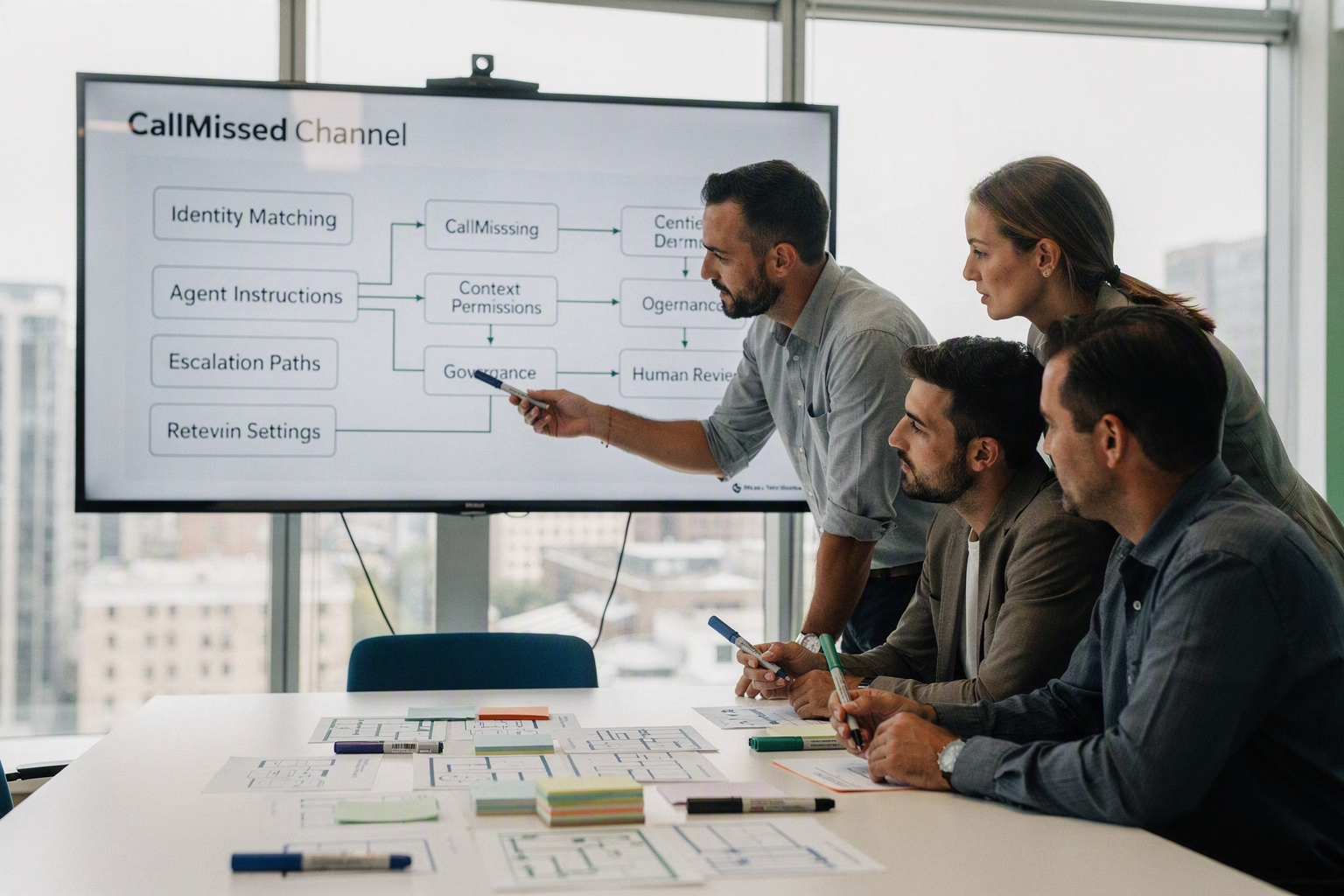
Implementation teams should define identity resolution, memory boundaries, channel permissions, escalation rules, and success metrics before activating CallMissed. The objective is not to expose every conversation to every agent; it is to give each agent the minimum relevant context needed for a consistent, controlled customer journey.
1. Map customers to a reliable identity
CallMissed omnichannel AI agents need a dependable way to recognize that an email sender, WhatsApp user, and caller represent the same customer. Teams should decide which identifiers are authoritative and how conflicts will be resolved.
Evaluate:
- Whether the phone number, WhatsApp number, email address, CRM ID, or account ID is the primary identifier.
- How duplicate contacts and shared family or company numbers will be handled.
- Whether an agent should request verification before revealing order, payment, or account information.
- How corrected contact details propagate across the omnichannel inbox and CRM.
Do not merge records merely because names appear similar. A mistaken identity match can expose one customer’s context to another.
2. Define shared and agent-specific memory
Shared customer memory should contain durable, cross-channel facts—not unrestricted transcripts by default. Useful shared fields might include a customer’s preferred language, active support case, product interest, appointment status, or consent preferences.
Separate agents can still have their own configured instructions and memory:
- A WhatsApp chat agent may remember the current conversational flow.
- A voice agent may use pronunciation guidance and the purpose of a scheduled call.
- An email agent may retain thread-specific context and follow-up status.
- A sales agent should not automatically receive sensitive support or billing details unless the workflow requires them.
Experts should document which fields are shared, channel-local, agent-local, temporary, or prohibited. They should also establish retention and deletion policies with legal review, including applicability of India’s Digital Personal Data Protection framework and relevant sector rules.
3. Configure each channel’s operating rules
Every CallMissed channel has different interaction constraints. Before launch, implementation teams should configure:
- WhatsApp permissions: approved messaging workflows, customer consent, business-initiated communication, and the transition between chat and WhatsApp Business calling.
- Voice behaviour: inbound and outbound call purposes, supported business phone numbers, language selection, interruption handling, voicemail, and call transfer conditions.
- Email controls: approved sender identities, response timing, thread handling, attachments, signatures, and escalation for ambiguous or high-risk messages.
- Human handoff: queue ownership, business hours, priority rules, and the context summary delivered to an employee.
CallMissed supports speech workflows across 22 Indian languages, so teams serving regional audiences should test language detection, code-switching, names, addresses, and industry vocabulary rather than relying only on English test cases.
4. Validate knowledge, safety, and outcomes
Connect only reviewed knowledge sources to retrieval workflows, assign content owners, and specify what the AI must do when information is missing or contradictory. High-impact actions—such as refunds, cancellations, account changes, or regulated advice—may require deterministic checks or human approval.
Before production, run end-to-end scenarios that switch channels: WhatsApp to voice, missed call to email, and email to business phone. Measure:
- Identity-match and duplicate-record errors.
- Resolution and human-handoff rates.
- Incorrect or unsupported answers.
- Context successfully carried between channels.
- Opt-outs, failed deliveries, dropped calls, and latency.
A phased rollout lets teams inspect real conversations, refine memory boundaries, and expand automation only after CallMissed behaves predictably across every configured channel.
What does CallMissed mean for your team and customer workflows?
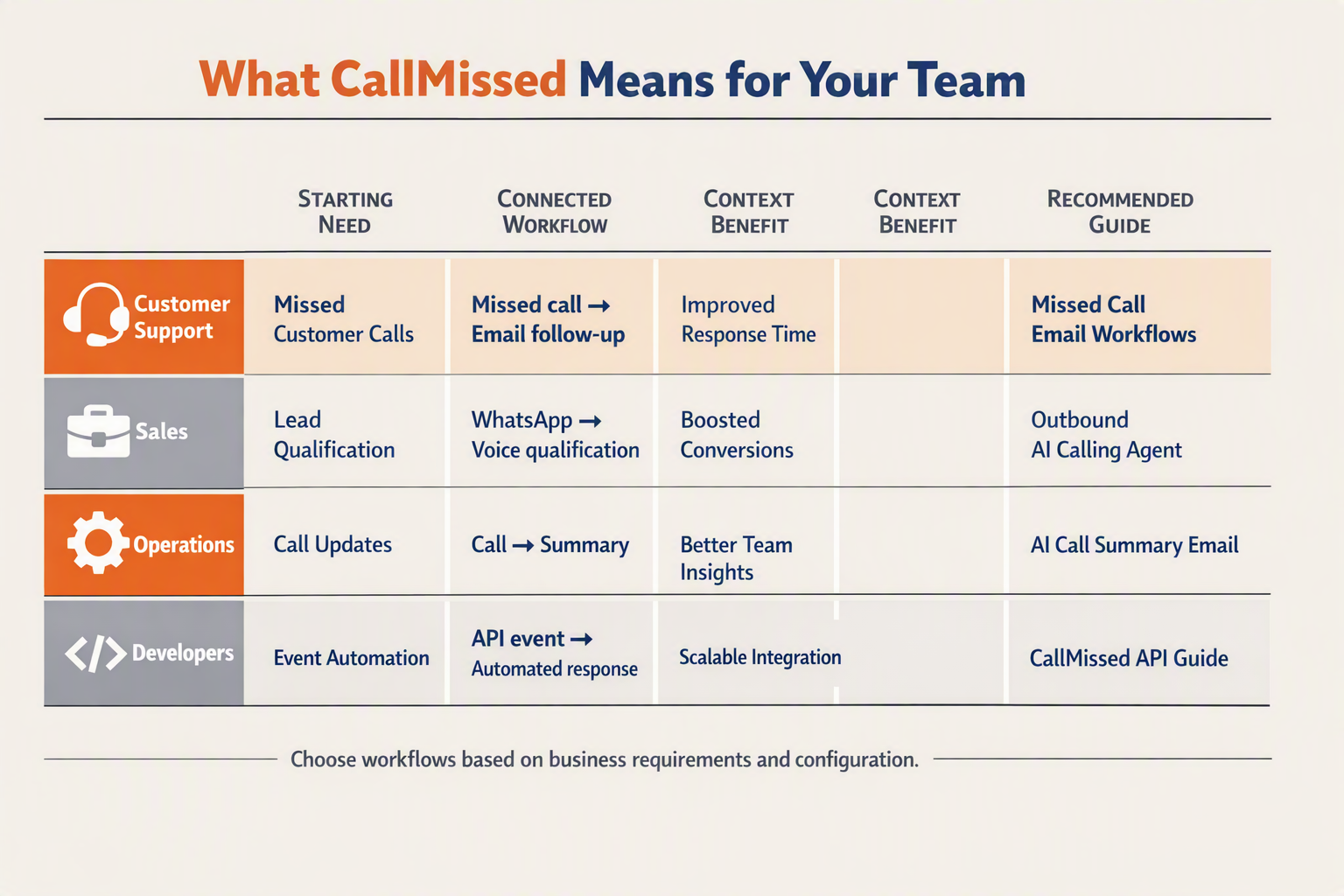
CallMissed turns separate channel tasks into coordinated customer workflows: AI handles routine interactions, relevant context follows the customer, and employees can intervene through the omnichannel inbox and CRM. Teams gain continuity without requiring every agent to use the same instructions, knowledge sources, or unrestricted memory.
How workflows change with CallMissed
| Workflow | Before unification | CallMissed workflow | Team impact |
|---|---|---|---|
| Lead qualification | WhatsApp enquiries, calls, and emails create separate records | Omnichannel AI agents capture requirements and associate permitted context with the customer | Sales representatives review a more complete journey before following up |
| Customer support | Customers repeat account details after changing channels | A WhatsApp chat agent, email agent, or voice agent can use relevant shared customer memory | Support teams spend less time reconstructing previous conversations |
| Missed-call recovery | An unanswered call becomes a manual callback task | The business can trigger an approved WhatsApp or email follow-up workflow | Fewer disconnected tasks and a clearer recovery process |
| Appointment management | Booking, confirmation, and rescheduling happen in different tools | AI agents can coordinate booking conversations across WhatsApp, voice, and email | Operations teams manage exceptions instead of every routine exchange |
| WhatsApp calling | Chat and phone support operate as separate systems | CallMissed can bridge inbound or business-initiated WhatsApp Business calls to an AI voice agent | Customers can move from messaging to a call within the WhatsApp environment |
| Regional-language engagement | Language coverage depends on agent availability | CallMissed supports Speech-to-Text and Text-to-Speech across 22 Indian languages | Indian teams can design voice experiences for regional audiences |
This coordination addresses a measurable customer expectation. Salesforce reported in its 2023 State of the Connected Customer that 79% of customers expect consistent interactions across departments. For a team, consistency means the next authorised agent can understand what has already happened—not that every employee or AI automatically sees every customer detail.
What shared memory should contain
A practical CallMissed deployment can make selected information available across channels, including:
- Customer identity and preferences, subject to verification and consent.
- Conversation outcomes, such as “requested a product demonstration” or “appointment rescheduled.”
- Open tasks and commitments, including promised callbacks or documents.
- Relevant summaries, rather than complete transcripts when full history is unnecessary.
- Escalation status, ownership, and the reason human attention is required.
Agent boundaries still matter. A sales email agent may use pricing knowledge and lead history, while a support voice agent uses troubleshooting material and ticket context. Both can recognise the same customer journey, but each retains its configured role, instructions, knowledge base, and agent-specific memory.
A practical operating model
Teams can introduce CallMissed without automating every interaction at once:
- Map one cross-channel journey, such as WhatsApp enquiry → voice qualification → email confirmation.
- Define the shared fields that should follow the customer and exclude unnecessary sensitive data.
- Configure agent-specific permissions, knowledge sources, escalation rules, and retention policies.
- Assign human ownership for exceptions inside the omnichannel inbox and CRM.
- Review outcomes regularly, checking summaries, handoffs, unresolved conversations, and customer corrections.
The operational result is not simply fewer applications. CallMissed creates one governed engagement layer for AI email agents, WhatsApp chat agents, voice agents, and business phone numbers, while allowing each specialist agent to remain purpose-built.
Frequently asked questions about CallMissed omnichannel AI agents
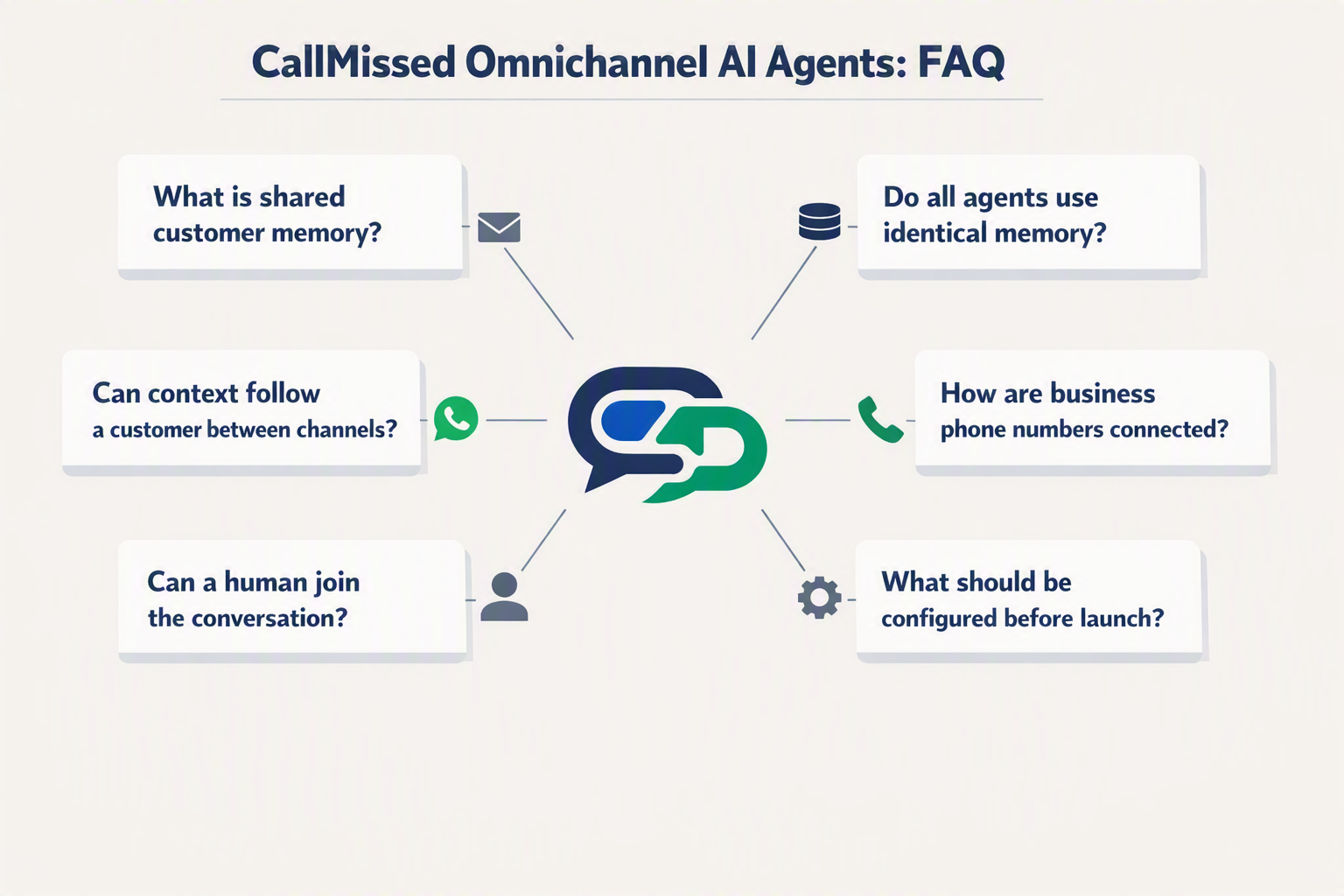
What are CallMissed omnichannel AI agents?
How does shared customer memory work across CallMissed channels?
Do CallMissed omnichannel AI agents support WhatsApp chat and calling?
Can CallMissed connect AI voice agents to business phone numbers?
Can separate CallMissed AI agents have different memories and instructions?
Why should a business use shared customer memory for email, WhatsApp, and voice?
Conclusion
CallMissed omnichannel AI agents turn separate customer touchpoints into one connected journey. CallMissed omnichannel AI agents help relevant context follow customers across email, WhatsApp, voice, and business phone numbers, reducing the need to restart a conversation.
Key takeaways include:
- Email: CallMissed omnichannel AI agents use email agents to manage customer conversations with relevant context.
- WhatsApp: CallMissed omnichannel AI agents include WhatsApp chat agents for messaging-based engagement.
- Voice: CallMissed omnichannel AI agents support AI voice agents for phone interactions.
- Phone numbers: CallMissed omnichannel AI agents work with business phone numbers purchased directly through the platform, connecting calls with the wider customer journey.
- Controlled memory: CallMissed omnichannel AI agents can maintain channel-specific memories, instructions, roles, and knowledge sources. CallMissed omnichannel AI agents can also access permitted shared cross-channel memory when continuity is useful.
- Verification: CallMissed omnichannel AI agents can follow configured verification steps before using protected customer context.
- Human support: CallMissed omnichannel AI agents can escalate conversations to a human when needed, preserving available context for a smoother handoff.
Ultimately, CallMissed omnichannel AI agents focus on providing the right context at the right moment—not unlimited data sharing. CallMissed omnichannel AI agents connect specialized channels while keeping memory boundaries configurable. Explore CallMissed to see how CallMissed omnichannel AI agents can support a more continuous customer journey.
Related Reading
Discussion
Related Posts
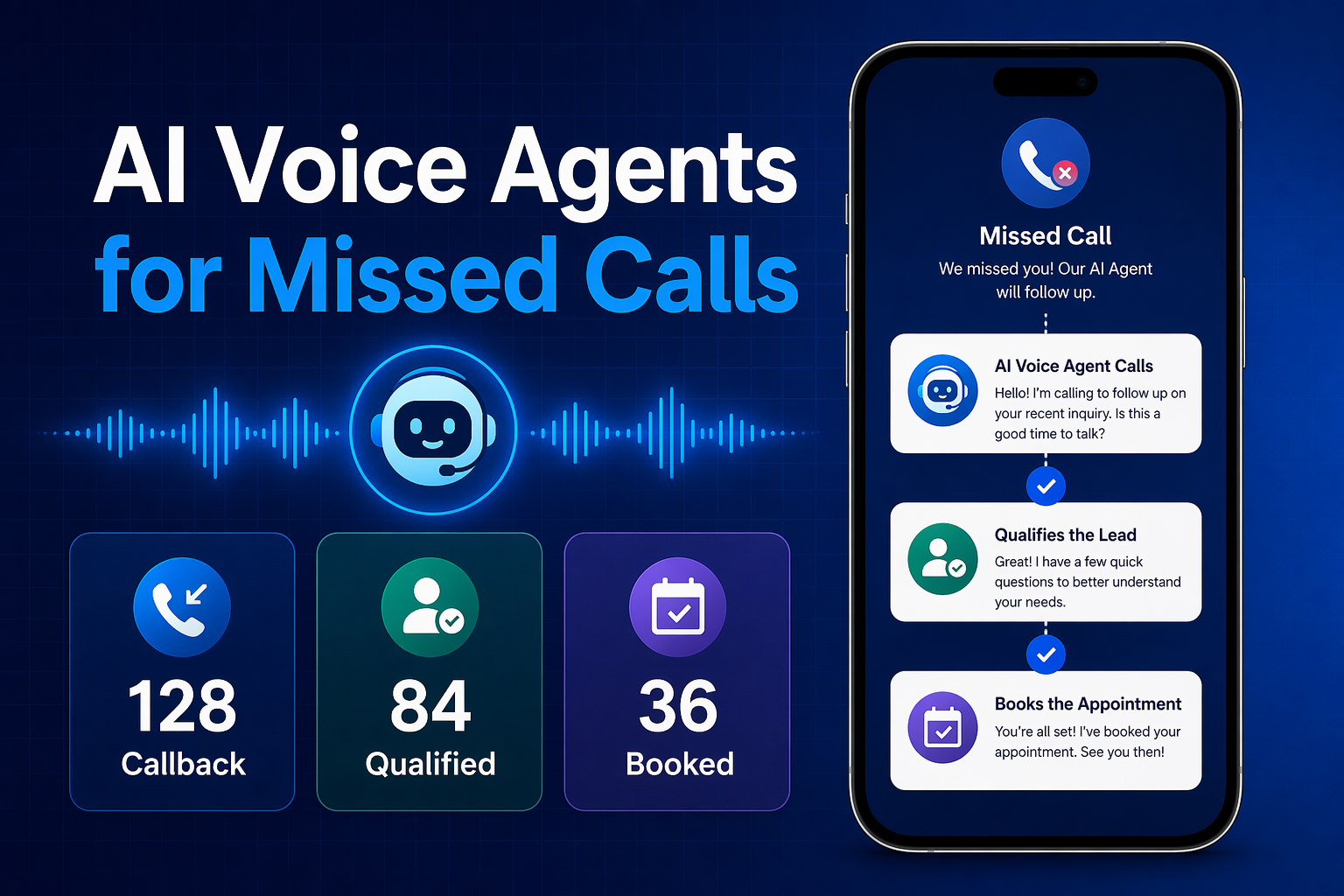
Ready to automate customer conversations?
Launch AI voice agents and WhatsApp bots with CallMissed — one API, 22+ Indian languages.