
CallMissed Customer Memory: How Cross-Channel AI Agents Reduce Repeated Explanations



Learn how CallMissed customer memory carries permitted context across phone, WhatsApp, and email while protecting accuracy and privacy.
CallMissed Customer Memory: How Cross-Channel AI Agents Reduce Repeated Explanations
What if the most frustrating part of customer service is not waiting, but having to explain the same problem three times? CallMissed Customer Memory addresses that familiar break in continuity: a customer describes an issue on a phone call, follows up on WhatsApp, and later sends an email, yet each channel can behave like a new case when context remains trapped in separate threads.
This matters because customers increasingly judge service as one relationship, not a collection of inboxes. The Zendesk Customer Experience Trends Report 2023 found that 70% of consumers expect anyone they interact with to have the full context of their situation. The Salesforce State of the Connected Customer report, published in 2023, likewise found that 79% of customers expect consistent interactions across departments. Those expectations make continuity an operational requirement, but not a licence to retain everything.
A governed continuity layer
Customer memory should be a deliberately governed continuity layer, not an unlimited transcript archive or a promise of flawless recall. In the intended CallMissed workflow, the system captures only relevant interaction context, associates it with the appropriate customer or case, creates a concise continuity summary, and makes permitted information available as the conversation moves among phone, WhatsApp, and email.
In a fragmented workflow, a phone agent may record one version of the issue; WhatsApp begins without it; email opens another disconnected thread. The customer repeats identity, intent, prior troubleshooting, and the desired next step, while agents manually reconcile records. Afterward, shared memory can preserve verified identity status, the current goal, attempted fixes, unresolved questions, commitments, consent preferences, and next actions. Channel-specific memory remains local: call-turn or pronunciation notes for voice, template and delivery state for WhatsApp, and subject, thread, or attachment context for email.
What this article will show
Through a phone-to-WhatsApp-to-email journey, this article explains:
- how shared and local memory complement each other without promoting every raw detail;
- why agents should confirm critical facts at each transition;
- how identity confidence, purpose limitation, data minimisation, access controls, retention periods, consent, correction, and deletion protect customers; and
- why remembered context is not automatically true: it may be incomplete, stale, ambiguous, or superseded.
CallMissed can reduce unnecessary repetition while still asking customers to verify information when accuracy, identity, consent, safety, or privacy requires it. The goal is not perfect recall; it is a coherent experience in which useful context follows the customer, sensitive details stay controlled, and corrections remain possible, rather than forcing another complete retelling from the beginning.
How does CallMissed customer memory reduce repeated explanations?
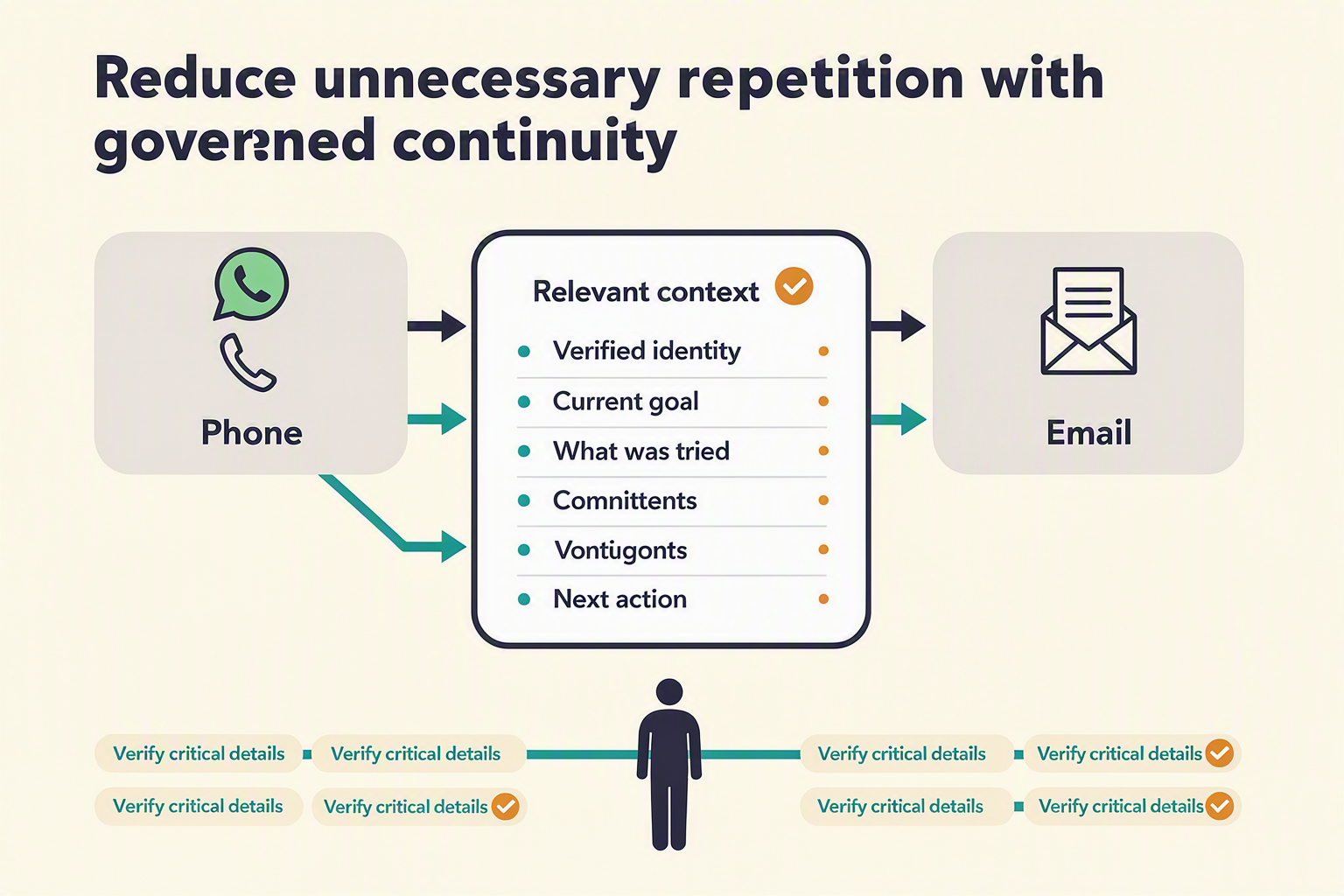
CallMissed customer memory reduces repeated explanations by carrying a concise, permitted case summary across voice, WhatsApp, and email. When a customer changes channels, the next AI agent receives relevant context instead of treating the interaction as a new enquiry.
This continuity does not mean sharing every detail. Channel-specific memories remain separate, and agents still confirm identity or information when confidence is limited.
From three disconnected conversations to one continuing case
Consider a customer whose payment succeeded but whose order remains unconfirmed.
Without cross-channel memory, the customer may call and explain the payment, order details, and troubleshooting already attempted. They may then move to WhatsApp to provide a transaction reference, only to receive a generic greeting.
If the customer later emails a receipt, they may need to reconstruct the issue once more. A support employee might then have to compare call notes, WhatsApp messages, and the email thread manually.
The central problem is that each agent lacks a reliable account of what has happened, what remains unresolved, and what should happen next.
With CallMissed customer memory, the initial interaction can produce a focused continuity summary associated with the appropriate customer or case record. Permitted parts of that summary then become available to the next agent when the customer changes channels.
For example, the WhatsApp agent might say: “I understand that your payment was completed but the order is still unconfirmed. Please verify the final four characters of the transaction reference before uploading the receipt.”
This prompt saves the customer from retelling the entire story. It also avoids assuming that stored context is unquestionably correct.
What follows the customer—and what stays local
CallMissed customer memory distinguishes between shared memory and channel-specific agent memory.
Shared memory contains durable case information that another authorised agent may need, including:
- verified identity status and the method or time of verification;
- the customer’s current objective;
- troubleshooting steps already completed;
- unresolved questions and promised follow-ups;
- communication or consent preferences; and
- the agreed next action and responsible team.
This relevant context can follow the customer across voice, WhatsApp, and email. It helps each agent continue the case without requiring a complete explanation from the beginning.
Channel-specific memory serves a different purpose. It helps an agent operate effectively within a particular medium.
A voice agent may retain pronunciation guidance or call-turn context. A WhatsApp agent may need message-template and delivery state. An email agent may need the subject line, thread structure, and attachment status.
These operational details do not automatically become part of CallMissed customer memory or the shared cross-channel narrative.
The governing principle is selective promotion: information should be preserved because it supports continuity, not simply because it appeared in a conversation.
Continuity still requires verification
CallMissed customer memory is useful only when the system has adequate confidence that a new interaction belongs to the same customer or case.
A matching phone number, email address, or WhatsApp identity may provide a signal. However, sensitive context should not be exposed solely because one field appears to match.
At each channel transition, the receiving agent should:
- verify identity when the risk or sensitivity warrants it;
- provide a short recap of its understanding;
- confirm critical facts, commitments, and requested actions;
- prefer newer, verified information over older notes; and
- allow the customer to correct an inaccurate summary.
These safeguards keep verification distinct from continuity. The goal is not to eliminate every repeated question, because some confirmation remains necessary for accuracy, identity, consent, safety, and privacy.
Instead, CallMissed customer memory reduces unnecessary repetition while helping each conversation begin closer to where the previous one ended. The result is controlled continuity rather than perfect recall.
Why do customers repeat themselves when conversations cross channels?

Customers repeat themselves because channel history, customer identity, and case status are often stored as separate records rather than assembled into a usable continuity layer. A phone call may contain the diagnosis, WhatsApp may hold the follow-up, and email may contain the requested document—yet the next agent sees only the channel in front of them.
The problem is fragmented state, not missing data
Most businesses already possess pieces of the conversation. The failure occurs when those pieces cannot be safely matched, summarised, and presented at the next interaction.
Four common breaks create repetition:
- Channel silos: Telephony logs, WhatsApp messages, CRM notes, and email threads sit in different systems or queues.
- Inconsistent identifiers: A caller ID, WhatsApp number, and email address do not automatically prove that three interactions belong to the same person or case.
- Unstructured histories: A full transcript may exist, but the agent still has to locate the current objective, attempted fixes, and promised next action.
- Incomplete handoffs: One agent closes an interaction without recording what the next agent needs to continue it.
This creates an important distinction: access to history is not the same as operational memory. Ten pages of messages can be less useful than a short, timestamped summary stating what the customer wants, what has been verified, what has already failed, and who must act next.
The expectation gap is substantial. The Zendesk Customer Experience Trends Report 2023 found that 70% of consumers expect anyone they interact with to have the full context of their situation. Customers experience one relationship with a business, even when the business operates several disconnected tools behind the scenes.
Every channel represents context differently
Cross-channel continuity is difficult because each medium produces different signals:
- Phone captures spoken explanations, interruptions, pronunciation, sentiment, and verbal commitments.
- WhatsApp adds asynchronous replies, message delivery state, approved templates, media, and conversational timestamps.
- Email introduces subject lines, quoted histories, attachments, recipients, and formal documentation.
Simply copying all content from one channel into another is neither efficient nor privacy-conscious. A pronunciation note that helps a voice agent may add no value to an email workflow. An email attachment may require restricted access rather than automatic exposure inside WhatsApp.
The challenge is therefore to identify which facts are durable and cross-channel, which remain useful only within one medium, and which should not be retained at all.
Identity uncertainty forces customers to start again
Repetition can also be a legitimate safeguard. If a person calls from one number, messages from another, and emails through a shared account, joining those interactions without verification could disclose another customer’s information.
A responsible agent should pause when:
- identifiers conflict or identity confidence is low;
- remembered information is old, ambiguous, or contradicted;
- consent does not cover the proposed channel;
- the conversation includes sensitive personal or financial details.
This is why customer memory cannot mean automatic recall of everything. In a CallMissed-centred workflow, the intended role of Customer Memory is to make permitted, relevant context available across phone, WhatsApp, and email while preserving channel-specific context separately. When confidence is insufficient, the agent should verify the customer or case instead of presenting potentially unrelated history.
The practical objective is not zero repetition. It is to remove avoidable retelling caused by fragmented systems while retaining necessary confirmation for accuracy, privacy, consent, and safety.
What changes before and after CallMissed?
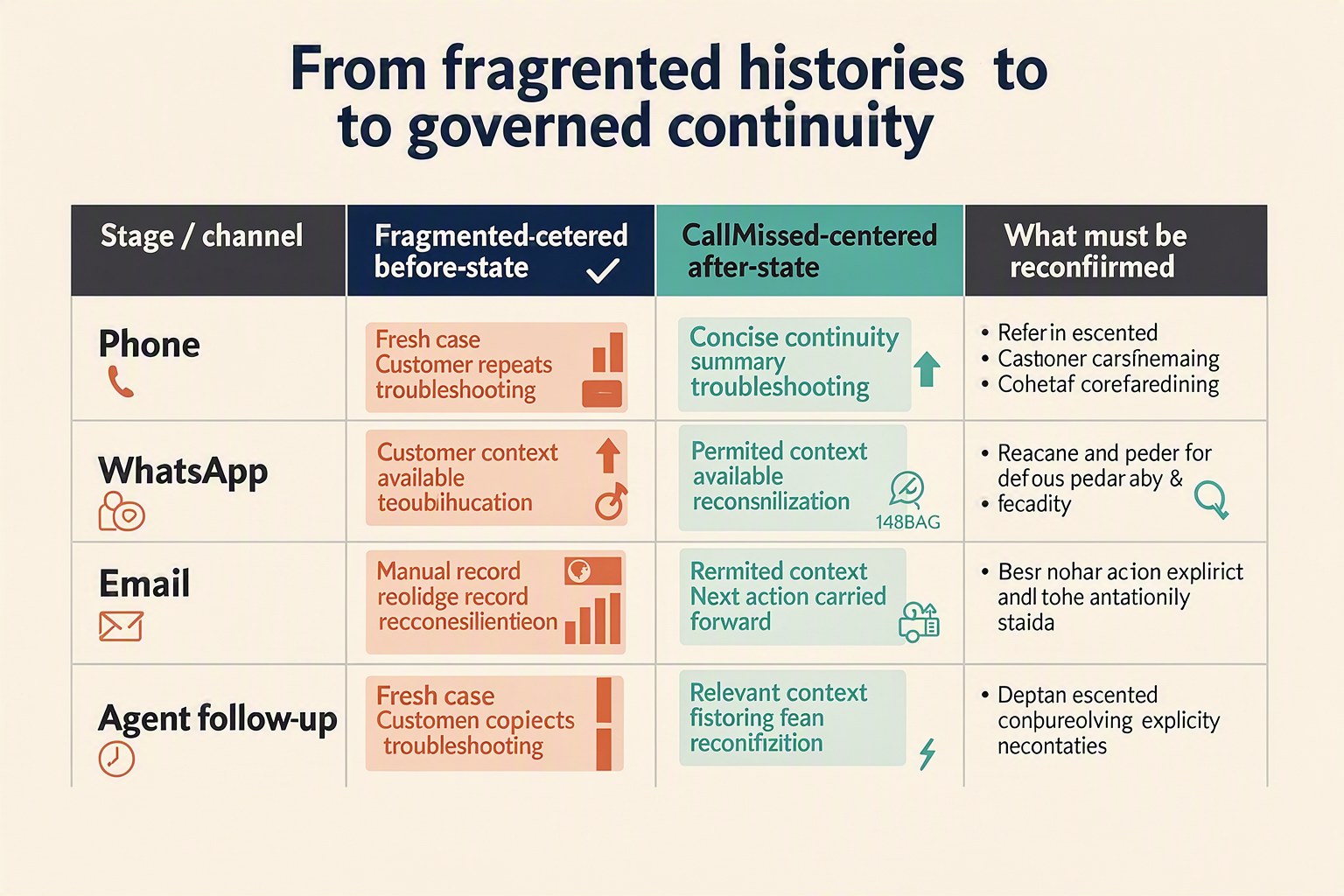
CallMissed changes the service model from channel-by-channel reconstruction to controlled cross-channel continuity. The customer may still need to verify sensitive or uncertain details, but agents can begin with an approved summary instead of asking for the entire story again.
Before-and-after workflow
| Journey stage | Before CallMissed | After CallMissed | Required safeguard |
|---|---|---|---|
| Initial phone call | The agent captures the problem in call-specific notes, often isolated from later messages. | Relevant facts—such as the customer’s goal, completed troubleshooting and next action—are associated with the appropriate customer or case record. | Record only necessary context and distinguish customer statements from verified facts. |
| Move to WhatsApp | The WhatsApp conversation starts without the call context, so identity, intent and prior steps are requested again. | The WhatsApp agent receives a concise, permitted continuity summary and can resume from the agreed next step. | Confirm identity before revealing case details; retain WhatsApp delivery and template state locally. |
| WhatsApp follow-up | New information remains inside the message thread and may not reach another agent. | Durable updates, corrections and commitments can be added to shared memory while channel-operational details remain local. | Promote only relevant facts, not every message or raw conversational detail. |
| Move to email | Email creates another thread, requiring the customer or agent to reconstruct the timeline manually. | Email can provide a formal recap, document request or resolution based on the current approved case summary. | Keep attachment, subject and thread context channel-specific unless broader access is justified. |
| Agent preparation | Staff search separate systems, compare notes and decide which version is current. | Permitted context is available through CallMissed’s omnichannel customer-engagement workflow, reducing manual reconciliation. | Use timestamps and provenance where practical; prefer recent, verified information. |
| Correction or closure | Incorrect notes may persist independently across channels. | A correction can update the continuity record, while closure can trigger an appropriate retention or deletion process. | Provide correction, deletion and retention controls according to purpose, consent and policy. |
The operational difference
The principal change is where the case narrative lives. Before shared memory, each medium effectively owns a partial account. Afterward, the cross-channel layer can preserve a compact state: who has been verified, what the customer wants, what has already been attempted, what remains unresolved, what was promised and which contact preferences apply.
Channel-specific agents still need their own working context. A voice agent may require pronunciation or call-turn information; a WhatsApp agent may need message-delivery status; an email agent may need attachment and thread state. Keeping those details local prevents the shared record from becoming an indiscriminate transcript archive.
This distinction supports the expectation identified in the Zendesk Customer Experience Trends Report 2023, which found that 70% of consumers expect anyone they interact with to have the full context of their situation. Full context should mean sufficient, authorised context—not unrestricted access to every historical utterance.
What does not change
Customer memory does not eliminate verification or human judgement. The agent should pause and confirm when:
- identity matching is uncertain;
- remembered information conflicts with a newer statement;
- consent or communication preferences may have changed;
- financial, health or other sensitive information is involved; or
- the requested action carries privacy, safety or legal consequences.
The practical outcome is fewer unnecessary retellings, not a promise that customers will never repeat a detail. CallMissed Customer Memory should help each channel continue the same case while preserving the right to verify, correct, restrict or forget what the system retains.
How should shared memory and channel-specific agent memory work together?
Shared memory should contain the minimum durable case state needed for continuity, while channel-specific memory should contain the operational details needed to communicate effectively in one medium. The two layers should exchange selected, permissioned summaries—not automatically copy complete call transcripts, WhatsApp histories, or email threads into a universal customer profile.
One case narrative, multiple working contexts
In the intended CallMissed Customer Memory workflow, shared memory acts as the cross-channel source of continuity. It may include:
- the customer’s current objective and verified identity status;
- products, orders, or cases relevant to the request;
- troubleshooting steps already completed;
- unresolved questions and the agreed next action;
- commitments made by the business;
- consent, language, and communication preferences; and
- timestamps or provenance indicating when and where a fact originated.
Channel-specific memory serves a narrower purpose. A voice agent may need pronunciation guidance, call-turn state, or whether the line disconnected mid-sentence. A WhatsApp agent may need message-template approval state and delivery status. An email agent may need the subject line, quoted-thread structure, and attachment context.
These details can help an agent perform well without necessarily belonging in the permanent cross-channel narrative.
Promote summaries, not every interaction detail
Information should move from local memory into shared memory only when it passes a deliberate relevance test. A practical promotion policy can ask:
- Is the information necessary for the current case or a committed follow-up?
- Has the customer provided it directly, or has an agent verified it?
- Is sharing it across channels consistent with consent and purpose limitation?
- Does it supersede an older fact, and can that change be timestamped?
- Would retaining the detail create disproportionate privacy or security risk?
For example, “customer completed a router reset at 14:20 and connectivity remains unavailable” is useful shared state. Voice cadence, background noise, or an agent’s speculative interpretation generally should remain local—or not be retained at all.
Read shared state, write back carefully
Each channel agent should begin by reading the permitted continuity summary, then use its local context to conduct the interaction. Afterward, it should write back only meaningful changes: a newly verified fact, a completed action, a corrected preference, or a revised next step.
Consider a phone agent that records an unresolved billing question and obtains permission to continue on WhatsApp. The WhatsApp agent can receive the approved summary and ask, “I understand the disputed charge is from July; is that still correct?” If the customer later emails a receipt, the email agent can see the case objective while keeping attachment-processing details within the email context.
This pattern reduces repetition without treating memory as truth. Critical details should be confirmed at channel transitions, particularly when they affect identity, payment, consent, safety, or account access.
Resolve conflicts before expanding memory
Shared and local records will sometimes disagree. A customer may correct an address by email after giving an older one by phone, or two conversations may have been linked with insufficient identity confidence. The system should then:
- prefer recent, verified information over older assumptions;
- preserve useful provenance rather than silently overwriting conflicts;
- ask the customer to verify ambiguous details;
- restrict context when identity matching is uncertain; and
- support correction, deletion, access controls, and retention limits.
The result is a layered memory model: shared memory preserves the case narrative, while channel-specific memory helps each agent operate appropriately. CallMissed can thereby reduce unnecessary explanations without exposing unrelated details or promising perfect recall.
How can a phone-to-WhatsApp-to-email journey continue without assuming perfect recall?
A cross-channel journey can continue reliably by carrying forward a small, permissioned handoff summary while revalidating facts that affect identity, consent, money, safety, or the requested outcome. The agent uses memory as a starting point—not as proof that every stored detail remains complete or correct.
Use a handoff packet, not the entire conversation
The Zendesk Customer Experience Trends Report 2023 found that 70% of consumers expect service representatives to have the full context of their situation. Meeting that expectation does not require copying every call transcript into every subsequent channel.
Instead, each transition should expose an approved continuity packet containing:
- the customer or case identifier, with an identity-confidence status;
- the customer’s current objective;
- troubleshooting steps already completed;
- unresolved questions and promised actions;
- relevant consent and contact preferences;
- the source channel and time of the latest verified update; and
- the next action, owner, or expected response date.
Detailed call turns, WhatsApp delivery events, email headers, and unrelated personal remarks can remain in channel-specific memory unless they become necessary to resolve the case.
A three-stage journey with confirmation points
Consider a customer reporting an incorrect invoice:
- Phone establishes the problem.
The voice agent identifies the invoice in question, records that the customer disputes a duplicate charge, and notes which checks have already been completed. Before ending the call, the agent confirms the amount, invoice reference, preferred follow-up channel, and permission to continue on WhatsApp.
- WhatsApp advances the next action.
CallMissed can make an approved summary available to the WhatsApp agent, allowing it to begin with: “You contacted us about a possible duplicate charge on invoice 4821. Is that still the issue?” The agent does not claim certainty; it asks the customer to confirm the issue before displaying account-specific details or requesting a document.
- Email completes the formal exchange.
If the customer needs to send supporting records, the email agent receives the verified case summary and expected attachment type. The email can recap the dispute and next step without forcing another full explanation, while the attachment itself remains governed by email-specific access and retention controls.
This workflow reduces repetition because each channel inherits case state, but confirmation checkpoints prevent inherited context from silently becoming accepted truth.
Design for gaps, conflicts, and uncertain identity
A continuity layer should explicitly represent uncertainty. Practical states might include verified, customer-reported, inferred, superseded, and needs confirmation. Timestamps and source attribution help agents distinguish a fact confirmed during today’s call from a preference recorded months earlier.
When information conflicts, agents should:
- prefer the most recent verified update rather than merging both versions;
- ask the customer to resolve material ambiguity;
- preserve a correction trail where operationally required;
- avoid revealing remembered details until identity confidence is sufficient; and
- create a separate case when two interactions cannot safely be joined.
If a WhatsApp number, caller ID, and email address do not confidently map to the same customer or authorised case participant, the system should pause continuity and request verification.
Measure continuity by useful progress
The goal is not “zero repeated questions.” A better standard is whether each question has a legitimate purpose. Reconfirmation is appropriate when it protects accuracy or privacy; asking again because systems failed to share an already verified next step is avoidable friction.
A well-governed journey therefore remembers enough to continue the work, forgets or restricts what is unnecessary, and gives the customer a clear opportunity to correct what the AI believes it knows.
How should CallMissed retain context without turning memory into an unlimited transcript archive?
CallMissed should retain a compact, purpose-bound case state rather than make every historical message available to every AI agent. Raw calls, WhatsApp messages, and emails may follow separate retention requirements, but the active memory layer should contain only the verified facts, commitments, preferences, and next steps necessary to continue the interaction.
Store state, not the entire conversation
A useful memory record should answer: What does the next authorised agent need to know to move this case forward? It can be organised into three layers:
- Shared continuity state: the customer’s current objective, completed troubleshooting, unresolved questions, agreed commitments, consent preferences, and next action.
- Channel-local context: voice pronunciation notes, WhatsApp delivery state, or email attachment references that remain useful within their original medium.
- Source evidence: restricted pointers to the relevant call, message, or email so an authorised person can verify how a remembered fact was established.
This structure avoids repeatedly injecting complete transcripts into an AI model. It also reduces the risk that an incidental comment, outdated address, or sensitive disclosure becomes a permanent part of the customer profile.
Each promoted memory item should ideally carry provenance, a timestamp, verification status, and an expiry or review rule. For example, “customer wants a replacement” is more useful when accompanied by “confirmed by customer on WhatsApp on 1 August 2026” than when presented as an timeless fact.
Apply a retention policy by data class
CallMissed should support a policy-driven lifecycle rather than one universal deletion date. Businesses can define shorter or longer periods according to the interaction’s purpose, legal obligations, and operational risk.
- Temporary working context can expire when a session or handoff is complete.
- Case summaries can remain available while the issue is active and for a justified follow-up period.
- Consent and preference records may need to remain as evidence of the customer’s latest instructions.
- Sensitive information should face stricter access, promotion, and deletion controls.
- Records subject to legal or contractual retention can be archived separately without remaining in the AI agent’s everyday memory.
A business might configure a short window such as 30 days for temporary troubleshooting details and a longer period for an unresolved service commitment, but those periods should be documented choices—not arbitrary defaults.
This approach aligns with the storage-limitation principle in Article 5 of the European Union’s General Data Protection Regulation, which says personal data should not be kept in identifiable form longer than necessary. India’s Digital Personal Data Protection Act, 2023, published in the Gazette of India on 11 August 2023, similarly requires erasure when consent is withdrawn or the specified purpose is no longer served, unless retention is legally necessary.
Make forgetting an operational capability
Retention controls only work if deletion and correction propagate through the memory system. A governed workflow should:
- remove deleted facts from active summaries and retrieval indexes;
- prevent expired context from resurfacing through cached prompts;
- preserve only narrowly required audit evidence;
- record corrections without continuing to present superseded claims as current; and
- restrict access according to role, channel, case, and purpose.
CallMissed Customer Memory should therefore behave less like a recording vault and more like a maintained case brief. It can reduce unnecessary repetition while deliberately forgetting context that is expired, irrelevant, unverified, or too sensitive to reuse.
Why must customer memory remain separate from truth?
Customer memory must remain separate from truth because remembered context is evidence about a previous interaction—not proof that every detail is current, complete, or correct. CallMissed Customer Memory should therefore support continuity while agents continue to verify consequential facts.
Memory records what was understood
A continuity summary may accurately report that a customer previously said, “The replacement should go to my Pune office.” It does not establish that Pune remains the correct destination, that the speaker was authorised to change the address, or that the agent interpreted the request correctly.
Memory can diverge from reality when:
- the customer’s circumstances change after the interaction;
- speech recognition, transcription, or summarisation introduces an error;
- an ambiguous statement is recorded as a definite fact;
- two people or cases are incorrectly associated;
- an agent’s inference is stored as though the customer confirmed it;
- newer information supersedes an earlier instruction; or
- privacy rules intentionally exclude details needed to interpret the summary.
The distinction is especially important across phone, WhatsApp, and email, where each medium supplies different evidence. A phone call may capture urgency but not a supporting document. WhatsApp may contain the latest instruction but lack formal approval. Email may provide an invoice or written confirmation that changes the case state.
Give memory provenance, status, and time
Useful memory should answer more than “What do we know?” It should also help an agent ask “Who said this, when, through which channel, and was it verified?” Where practical, continuity records should preserve provenance without exposing unnecessary raw content.
A robust summary can distinguish among:
- Customer-stated: “Customer reported duplicate billing during the 30 July phone call.”
- Agent-observed: “Agent could not reproduce the error.”
- System-derived: “Possible match to order CM-4821; confirmation required.”
- Verified: “Email address confirmed by one-time password on 31 July.”
- Superseded: “Previous callback preference replaced by email-only contact on 1 August.”
- Unresolved: “Refund eligibility awaits review.”
These labels prevent a model-generated inference from silently becoming an operational fact. Timestamps and source channels also help the next agent prefer recent, verified information when records conflict.
Confirm facts according to their consequences
Not every remembered detail requires the same scrutiny. An agent might safely reuse a customer’s general product interest, but should reconfirm information that affects identity, money, consent, safety, privacy, or legal commitments.
A practical confirmation hierarchy is:
- Low consequence: Use relevant context while allowing easy correction.
- Operational consequence: Confirm delivery dates, product variants, and next actions.
- High consequence: Reverify identity, payment instructions, account changes, consent, and sensitive personal data.
For example, a WhatsApp agent could say: “The call summary says you already restarted the device and the issue remains unresolved—is that still correct?” That sentence preserves continuity without presenting the summary as unquestionable truth.
Correction is part of memory, not an exception
Customers need a straightforward way to correct inaccurate or outdated context. Corrections should update the shared case narrative, identify superseded information, and avoid leaving conflicting facts equally prominent. Where retention or deletion requests apply, the continuity layer should respect them rather than reconstructing removed information from another channel.
In a CallMissed-centred workflow, memory can reduce unnecessary retelling by carrying an approved summary from voice to WhatsApp and email. However, the agent should still ask for confirmation whenever confidence is insufficient. The trustworthy promise is not perfect recall; it is traceable, correctable, and appropriately sceptical continuity.
What do customer-experience, privacy, and AI-governance experts prioritize in agent memory?
Customer-experience experts prioritize continuity, privacy specialists prioritize purpose-bound retention, and AI-governance experts prioritize accountability and verifiability. Together, these disciplines point toward selective, auditable memory that improves service without becoming an uncontrolled customer dossier.
Customer-experience priority: preserve progress, not every word
CX leaders judge memory by whether it helps the customer advance. The useful question is not “How much can the agent recall?” but “What does the next interaction need?”
High-value continuity typically includes:
- the customer’s confirmed objective and current case status;
- troubleshooting steps already completed;
- commitments, deadlines, and the responsible team;
- preferred contact channel and approved next action; and
- critical facts that remain unresolved or require reconfirmation.
This approach reflects established customer expectations. The Zendesk Customer Experience Trends Report 2023 found that 70% of consumers expect anyone they interact with to have the full context of their situation. However, a good experience may still require repetition when a detail affects payment, eligibility, safety, or account access. Experts therefore optimize for less avoidable repetition, not zero verification.
Privacy priority: collect less and retain it deliberately
Privacy specialists prioritize purpose limitation, data minimisation, retention controls, and customer rights. Article 5 of the European Union’s General Data Protection Regulation, applicable since May 25, 2018, establishes principles including purpose limitation, data minimisation, accuracy, storage limitation, integrity, and confidentiality.
India’s Digital Personal Data Protection Act, 2023 similarly creates obligations around lawful processing, security safeguards, correction, erasure, and grievance redressal. For an India-first platform such as CallMissed, those principles make privacy-conscious design relevant across phone calls, WhatsApp messages, and email threads.
A defensible memory policy should answer four questions:
- Why is this information being remembered?
- Who can retrieve or change it?
- When will it expire or be deleted?
- How can the customer inspect, correct, or withdraw relevant information?
Sensitive information should receive stricter handling than ordinary service context. A compact statement such as “identity verified during the call” may be sufficient; copying identification numbers or an entire transcript into cross-channel memory may be unnecessary.
AI-governance priority: make memory contestable
AI-governance experts treat stored context as an input that can influence future outputs—not as established truth. The NIST AI Risk Management Framework 1.0, released in January 2023, organizes AI risk work around four functions: Govern, Map, Measure, and Manage. Applied to agent memory, that means defining ownership, understanding failure scenarios, testing retrieval quality, and responding when memory is wrong.
Practical controls include:
- provenance, showing whether a fact came from the customer, an employee, or an AI-generated summary;
- timestamps and confidence indicators for details that may become stale;
- approval requirements before promoting sensitive local context into shared memory;
- audit logs covering access, changes, and deletion; and
- human escalation when records conflict or identity matching is uncertain.
ISO/IEC 42001:2023, published in December 2023, also formalized requirements for an AI management system, reinforcing that governance must cover processes and accountability rather than model performance alone.
The combined expert standard is clear: customer memory should be useful enough to preserve progress, minimal enough to respect privacy, and traceable enough to challenge. That balance—not maximum recall—is the foundation of trustworthy cross-channel continuity.
What should teams implement when designing cross-channel AI agents?
Teams should implement cross-channel AI agents as a governed state-management system, with explicit rules for identity, memory promotion, verification, retention, and failure handling. The safest design assumes that remembered context may be incomplete or outdated and requires confirmation before consequential actions.
Cross-channel implementation blueprint
| Control | Implementation requirement | Transition test | Safe failure behaviour |
|---|---|---|---|
| Identity resolution | Link channels using verified identifiers and a team-defined confidence threshold | Can the phone, WhatsApp, and email interactions be attributed to the same person or case? | Request verification; do not reveal stored context |
| Memory classification | Separate shared case facts from voice-, WhatsApp-, and email-specific state | Is the information necessary outside its original channel? | Keep uncertain or channel-local details out of shared memory |
| Structured summaries | Store the goal, verified facts, attempted steps, commitments, preferences, and next action | Does the summary distinguish customer statements from confirmed facts? | Present context as unverified and ask the customer to confirm |
| Provenance and freshness | Attach source channel, update time, verification state, and case identifier | Is newer or more authoritative information available? | Prefer recent verified data and flag conflicts |
| Privacy controls | Apply purpose limitation, access rules, retention schedules, and correction or deletion workflows | Is each retained field required for the declared service purpose? | Exclude, redact, restrict, or delete unnecessary data |
| Human escalation | Define triggers for identity conflicts, sensitive data, repeated failures, and disputed records | Can the AI proceed without increasing privacy or operational risk? | Pause automation and transfer the summary to an authorised person |
These controls reflect established privacy principles rather than treating memory as an unrestricted archive. Article 5 of the European Union’s General Data Protection Regulation requires purpose limitation, data minimisation, and storage limitation, while Articles 16 and 17 provide rights concerning rectification and erasure. For Indian deployments, teams should also map workflows to the Digital Personal Data Protection Act, 2023, including notice, consent where applicable, security safeguards, correction, and erasure obligations.
Build transitions as verification checkpoints
Every channel handoff should execute a short, predictable sequence:
- Resolve identity or case association using authorised identifiers.
- Retrieve only permitted shared context, not every available transcript.
- Check timestamps and provenance for facts affecting the next action.
- Summarise the current state in language the customer can correct.
- Confirm consequential details, such as identity, payment status, consent, delivery address, or promised resolution date.
- Write back the outcome while preserving prior versions for authorised audit needs.
For example, a WhatsApp agent might say: “I have a note from your call that the replacement failed to arrive and that email confirmation was requested. Is that still correct?” This reduces retelling without presenting memory as unquestionable truth.
Measure continuity without rewarding over-retention
Teams should define operational metrics before launch, including:
- the percentage of handoffs that contain an approved summary;
- identity-verification failures and incorrect-link incidents;
- customer corrections per transferred conversation;
- stale-memory conflicts by channel and age;
- retention-policy exceptions and deletion completion time; and
- escalation rates after ambiguous or contradictory context.
Thresholds should be risk-based and team-defined, not copied universally across industries.
CallMissed can support this model across voice, WhatsApp, and email, including Indian-language interactions across 22 Indian languages. The implementation objective should remain precise: reduce unnecessary repetition while retaining verification, customer correction, and human escalation whenever memory is uncertain.
Frequently Asked Questions: What does CallMissed remember, verify, retain, and let customers correct?
What information does CallMissed Customer Memory remember across phone, WhatsApp, and email?
How does CallMissed Customer Memory verify that conversations belong to the same customer?
How long does CallMissed retain customer conversation memory?
Does CallMissed store complete phone recordings, WhatsApp messages, and emails as shared memory?
Can customers correct or delete information in CallMissed Customer Memory?
Does cross-channel customer memory mean customers will never have to repeat themselves?
Conclusion
CallMissed customer memory treats phone, WhatsApp, and email as one governed customer relationship rather than disconnected conversations. With CallMissed customer memory, relevant and permitted context can follow a case so customers repeat less. Used carefully, CallMissed customer memory supports continuity without turning every channel detail into a permanent shared record.
Key takeaways include:
- CallMissed customer memory can preserve verified identity status, customer goals, attempted fixes, commitments, consent preferences, and next actions.
- CallMissed customer memory should keep channel-specific details separate. Voice notes, WhatsApp delivery states, and email attachment context may remain local.
- CallMissed customer memory is not truth. Before relying on important details, CallMissed customer memory should prompt verification when context may be stale, incomplete, ambiguous, or superseded.
- CallMissed customer memory should support customer correction when remembered information is inaccurate.
- Privacy defines responsible use. CallMissed customer memory should follow purpose limitation, data minimisation, access controls, consent, retention, and deletion requirements.
- CallMissed customer memory should respect identity confidence before exposing or applying sensitive context.
- CallMissed customer memory should enable human escalation when automated handling is unsuitable.
- During escalation, CallMissed customer memory should provide relevant context without transferring unnecessary information.
Ultimately, CallMissed customer memory should be judged by selective, transparent, and safe use. Success means CallMissed customer memory knows when to remember, verify, correct, forget, ask again, or involve a person.
Explore this approach at CallMissed.
Related Reading
Discussion
Related Posts


Ready to automate customer conversations?
Launch AI voice agents and WhatsApp bots with CallMissed — one API, 22+ Indian languages.