
CallMissed WhatsApp Agent: A Practical Guide to Shared Conversation Memory


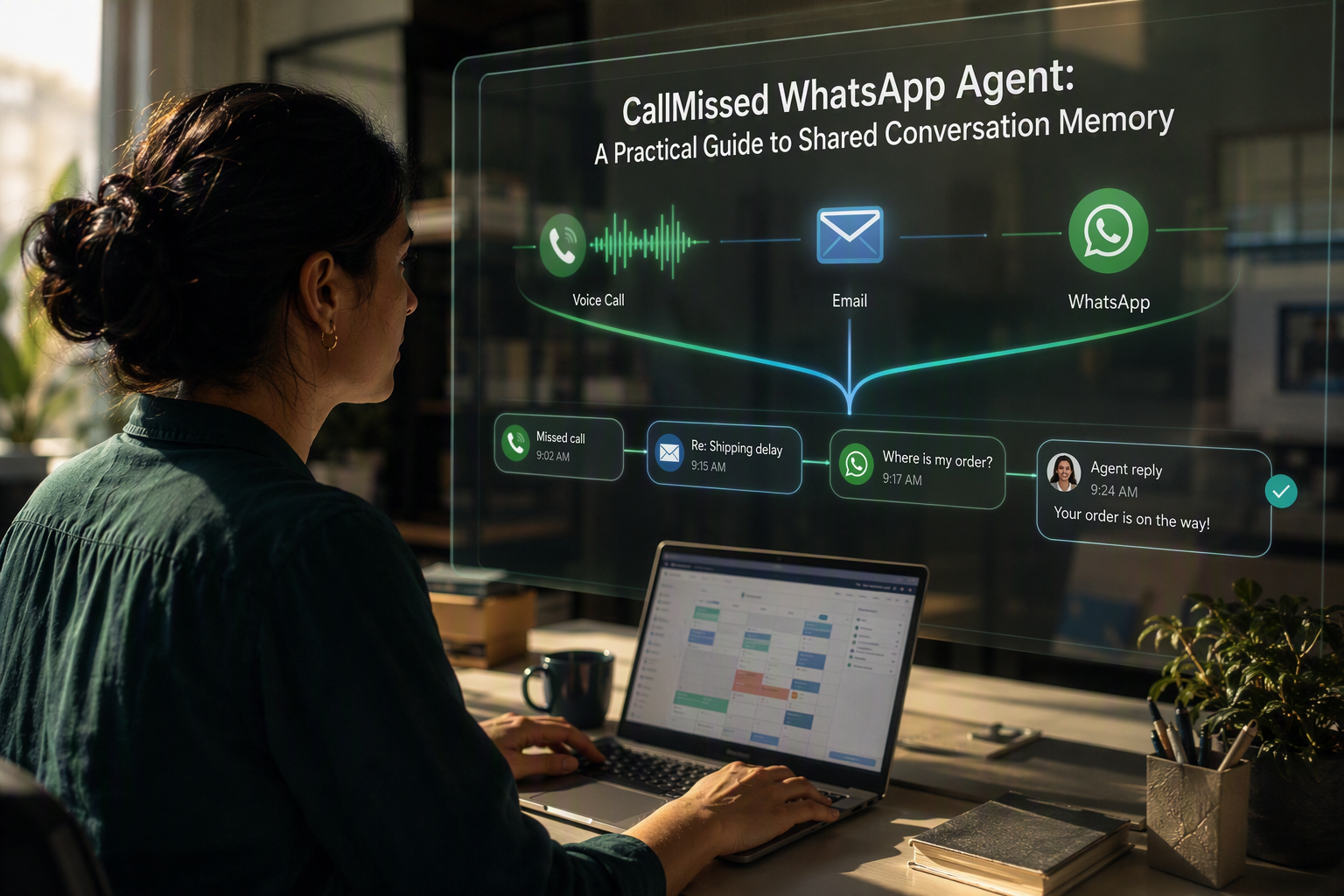
Learn how a CallMissed WhatsApp agent can carry useful context from voice or email into safer lead, support, and follow-up chats.
CallMissed WhatsApp Agent: A Practical Guide to Shared Conversation Memory
What happens when a customer explains a problem by phone, follows up by email, and then opens WhatsApp—only to be treated like a stranger each time? The scale of that frustration is significant: WhatsApp exceeded 3 billion monthly active users, according to Meta’s April 2025 earnings call, making conversation continuity increasingly important for businesses using messaging as a service channel.
A CallMissed WhatsApp agent can address this challenge through shared conversation memory: relevant customer context made available across interactions so the agent can continue a conversation instead of automatically restarting it. In practical terms, a WhatsApp AI agent might recognize that a lead previously described a requirement during a voice call, or that a support customer already explained an issue by email. It can then confirm the current situation, ask only for missing information, and guide the customer toward an appropriate next step.
The emphasis is on useful continuity, not unlimited recall. Memory may be incomplete, outdated, ambiguous, or associated with the wrong person. Identity-sensitive information, payment details, consequential requests, and assumptions about a customer’s current circumstances should therefore be verified rather than accepted as infallible facts.
This distinction matters as businesses adopt more autonomous AI systems. Gartner predicted in October 2024 that agentic AI would be included in 33% of enterprise software applications by 2028, up from less than 1% in 2024. Gartner also forecast in June 2025 that more than 40% of agentic AI projects would be cancelled by the end of 2027 because of rising costs, unclear business value, or inadequate risk controls. Effective memory must consequently deliver a clear customer benefit while remaining bounded, reviewable, and responsible.
CallMissed sits within this shift by combining WhatsApp chat, WhatsApp Business calling, AI voice agents, email, and an omnichannel inbox for businesses serving customers across channels, including regional audiences in 22 Indian languages.
What this practical guide covers
You will learn how a context-aware journey could work when:
- A lead calls first and later continues the discussion through WhatsApp.
- A support issue begins by email before moving to a WhatsApp agent.
- A customer returns with an unresolved question or earlier promise that should inform the next response.
- Stored context appears stale, sensitive, or uncertain and requires confirmation.
- A conversation needs human escalation rather than further automation.
The guide also separates the product premise from implementation details that have not been independently established. It does not assume a particular database, retention period, third-party integration, or proactive-messaging capability. Instead, it explains the desired behavior of WhatsApp AI agent shared conversation memory and the safeguards teams should evaluate: purpose limitation, data minimization, transparent disclosure, appropriate retention, correction and deletion paths, role-based access, auditability, and human oversight.
The goal is not memory for its own sake. It is a more coherent customer journey—one that preserves relevant context while knowing when to verify, forget, or hand the conversation to a person.
What Is a CallMissed WhatsApp Agent, and How Does Shared Conversation Memory Create Continuity?

A CallMissed WhatsApp agent is an AI-powered conversational agent that handles customer interactions on WhatsApp as part of CallMissed’s broader customer-engagement platform. Shared conversation memory means making relevant context from earlier voice, email, or WhatsApp interactions available so the agent can resume the customer’s journey from an informed point rather than begin with a blank slate.
What the WhatsApp agent does
A WhatsApp agent interprets a customer’s message, uses available business knowledge and conversation context, and selects an appropriate response or next step. Depending on the use case, this could involve:
- Answering a product or service question.
- Qualifying a lead based on requirements already discussed.
- Continuing troubleshooting from an earlier support interaction.
- Identifying missing information without asking for every detail again.
- Escalating the conversation when human judgment or authorization is needed.
CallMissed combines WhatsApp chat with WhatsApp Business calling, AI voice agents, email, and an omnichannel inbox. This channel breadth creates the practical foundation for continuity: a customer’s conversation can be treated as one evolving journey rather than several unrelated channel sessions.
This matters at substantial scale. Meta reported in its April 2025 earnings call that WhatsApp had surpassed 3 billion monthly active users, reinforcing WhatsApp’s role as a mainstream customer-communication channel rather than a secondary messaging option.
What shared conversation memory should contain
Shared memory is best understood as selected, useful context, not a complete permanent transcript of everything a customer has ever said. Depending on what information is available and appropriate to use, context might include:
- Established needs: “The lead is looking for support in Hindi and Marathi.”
- Conversation state: “Pricing was discussed, but the plan was not selected.”
- Previous actions: “The customer already tried resetting the device.”
- Unresolved questions: “The customer is waiting for clarification about eligibility.”
- Communication preferences: “The customer requested that the discussion continue on WhatsApp.”
- Source and timing: “This requirement was stated during yesterday’s voice conversation.”
These examples describe desired agent behavior; they do not establish a specific CallMissed database design, retention period, identity-matching method, or external integration.
How continuity works in practice
A context-aware journey can be viewed as four steps:
- Recognize the returning customer or conversation, subject to appropriate identity checks.
- Retrieve only context relevant to the current request.
- Confirm details that may be stale, ambiguous, sensitive, or consequential.
- Continue toward a clear resolution, next question, or human handoff.
For example, if a lead discussed a three-location deployment during a voice call and later writes on WhatsApp, the agent could say: “I understand you were evaluating service for three locations. Is that still correct?” The response preserves continuity while verifying that the remembered detail remains current.
Continuity is not certainty
WhatsApp AI agent shared conversation memory should inform responses, not dictate them. A phone number may be shared, circumstances may have changed, and an earlier summary may omit an important qualification. A responsible agent therefore distinguishes between:
- Context it can safely use, such as a previously stated product interest.
- Context it should confirm, such as identity, current requirements, or account status.
- Information it should not rely on without verification, such as payment instructions, legal consent, or high-impact service changes.
The goal is not maximum recall. It is relevant continuity with visible limits and opportunities for correction.
Why Does CallMissed Focus on Continuity Across Voice, Email, and WhatsApp?

CallMissed focuses on cross-channel continuity because customers experience one relationship with a business, not separate voice, email, and WhatsApp journeys. A CallMissed WhatsApp agent should therefore use relevant prior context to move the customer forward while verifying anything uncertain, sensitive, or consequential.
Each channel plays a different role
Customers often change channels because their needs change during the same journey. A voice call may be convenient for describing a complex requirement, email may suit detailed documentation, and WhatsApp may be preferable for quick clarification.
The importance of connecting these interactions grows with messaging adoption: WhatsApp surpassed 3 billion monthly active users, Meta reported in its April 2025 earnings call. For businesses, this means WhatsApp is increasingly likely to become the next step in a conversation rather than its starting point.
A connected journey might work as follows:
- A prospect explains a requirement during a voice call.
- The prospect later opens WhatsApp to ask about the next step.
- The WhatsApp AI agent identifies relevant earlier context.
- The agent confirms that the requirement is still current.
- It asks only for missing details and directs the prospect toward a clear action.
The goal is not to reproduce an entire transcript. It is to preserve the details that help answer, “What is this customer trying to accomplish now?”
Continuity reduces avoidable conversational friction
When channels operate independently, customers may need to repeat their issue, requirements, contact preferences, or troubleshooting steps. That repetition creates friction and can also produce inconsistent information when different agents reconstruct the situation differently.
Shared conversation memory gives the CallMissed WhatsApp agent a basis for a more relevant response. Useful context could include:
- The customer’s previously stated objective.
- An unresolved question or support issue.
- Troubleshooting steps already attempted.
- A commitment made during an earlier interaction.
- A communication preference relevant to the current exchange.
These examples describe the desired conversational behavior. They do not establish a particular database, retention period, identity-matching method, or integration architecture.
CallMissed treats voice, email, and WhatsApp as parts of one journey
CallMissed combines WhatsApp chat, WhatsApp Business calling, AI voice agents, email, and an omnichannel inbox within its customer-engagement platform. That product scope makes continuity especially relevant: the benefit of supporting several channels is limited if every transition forces the conversation back to the beginning.
This approach also matters in multilingual markets. CallMissed supports voice and chat across 22 Indian languages, allowing regional-language interactions to form part of the same customer journey rather than being treated as peripheral use cases. However, multilingual context still requires care because names, intent, and account details can be mistranscribed or interpreted ambiguously.
Continuity must remain conditional
A remembered detail should guide the conversation, not automatically authorize action. A well-designed WhatsApp agent should:
- Confirm identity before revealing account-specific information.
- Recheck stale context, such as an old delivery address or product requirement.
- Verify payment and high-impact requests rather than relying on memory.
- Acknowledge uncertainty when customer records may refer to different people.
- Escalate to a person when context conflicts or the customer disputes it.
For CallMissed, the practical focus is therefore bounded continuity: carry forward enough verified context to make the interaction coherent, while preserving opportunities for correction, confirmation, and human judgment.
How Can a CallMissed WhatsApp Agent Use Shared Conversation Memory Without Treating It as Infallible?
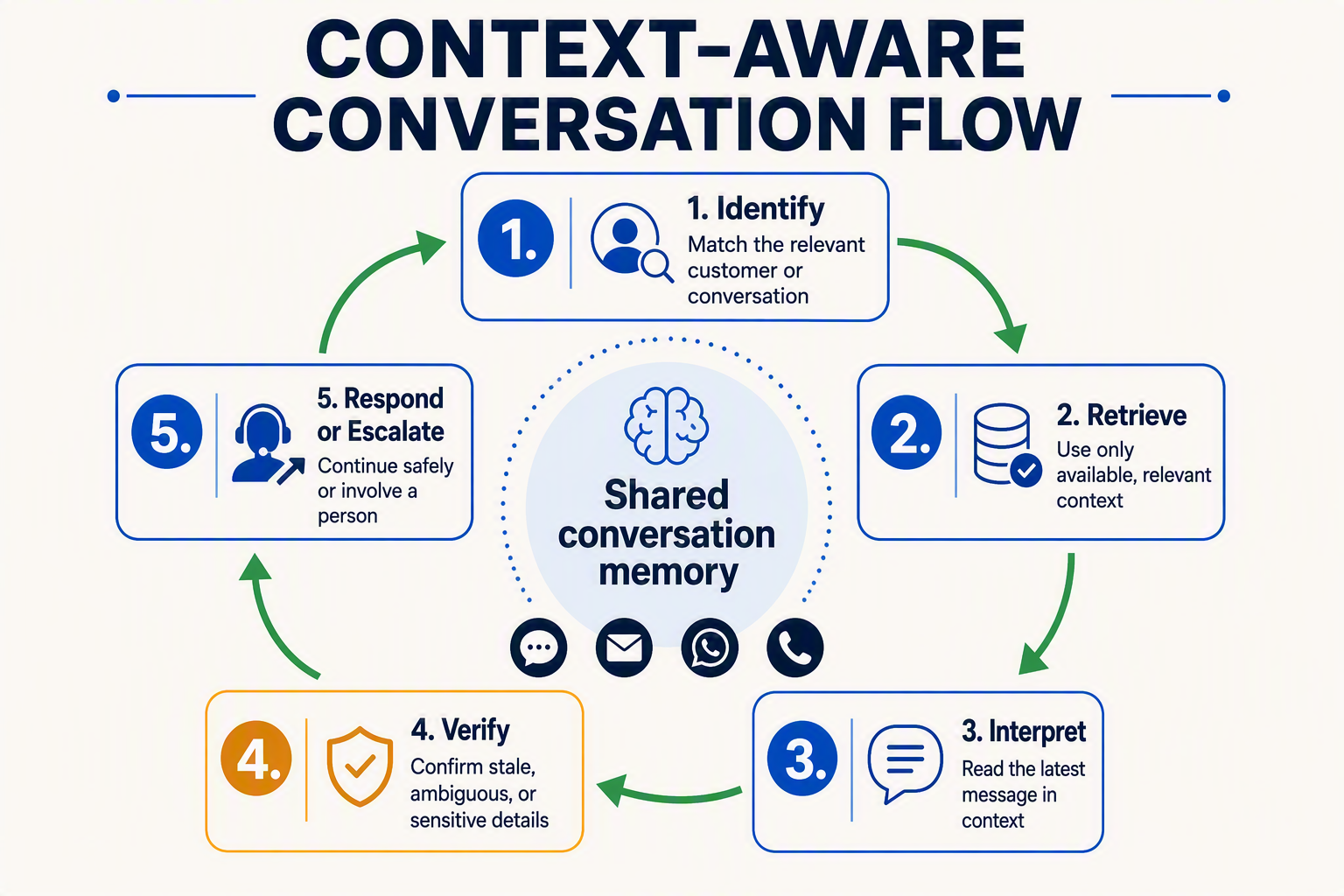
A CallMissed WhatsApp agent should treat shared conversation memory as a working hypothesis, not a source of unquestionable truth. The safest rule is simple: memory can guide the next question, but the customer—or an authorised human or system—must confirm sensitive, uncertain, or consequential details.
Apply a “use, confirm, act” pattern
A practical WhatsApp AI agent can process remembered context in three stages:
- Use context to avoid unnecessary repetition.
If an earlier voice conversation indicates that a lead wants a three-user plan, the agent can begin with that requirement instead of asking the customer to explain everything again.
- Confirm what may have changed.
The agent could say: “I understand you were considering access for three users. Is that still correct?” This preserves continuity without presenting the earlier statement as permanent fact.
- Verify before consequential action.
Identity, account ownership, payment instructions, cancellations, refunds, addresses, consent, and contractual commitments require stronger verification than ordinary conversational details.
This approach is especially important because Gartner forecast in June 2025 that more than 40% of agentic AI projects would be cancelled by the end of 2027 because of rising costs, unclear business value, or inadequate risk controls. Reliable continuity therefore depends as much on controls as on recall.
Classify memory by risk and confidence
Teams should define how the CallMissed WhatsApp agent handles different kinds of context:
- Low-risk context: A preferred language, general product interest, or previously asked question can shape the response, although the customer should be able to correct it.
- Potentially stale context: Budget, delivery location, availability, account status, and business requirements should be reconfirmed when they affect the next step.
- Ambiguous context: Notes such as “call next week” or “customer approved” should not be acted upon without establishing who made the statement and what it meant.
- Identity-sensitive context: Personal records or account-specific information should not be disclosed merely because a phone number appears familiar.
- High-impact context: Payment, legal, financial, healthcare, security, or account-control decisions should trigger verification or human review.
The agent should also distinguish between what the customer said, what an employee promised, and what the AI inferred. An inference such as “the customer appears ready to buy” is not equivalent to an explicit purchase decision.
Make uncertainty visible in the conversation
Useful confirmation language includes:
- “From your earlier conversation, I understand that… Is that still accurate?”
- “I may have incomplete context. Could you confirm…?”
- “You previously mentioned this issue continued after restarting the device. Has anything changed since then?”
- “Before proceeding, I need to verify a few details.”
These phrases let the agent use context without concealing uncertainty.
Evaluate responsible-memory safeguards
Businesses should assess or configure purpose limitation, data minimisation, transparent disclosure, appropriate retention, correction and deletion paths, role-based access, auditability, and human escalation. These are recommended safeguards, not claims about a particular CallMissed storage model or built-in configuration.
A customer should be able to correct inaccurate context, while staff should be able to inspect why a response relied on it. When records conflict, identity remains uncertain, or an action carries material consequences, the CallMissed WhatsApp agent should pause and transfer the conversation to a person rather than improvise.
Which Key Workflow Developments Distinguish Restart-Based Chat From CallMissed Conversation Continuity? (TABLE)
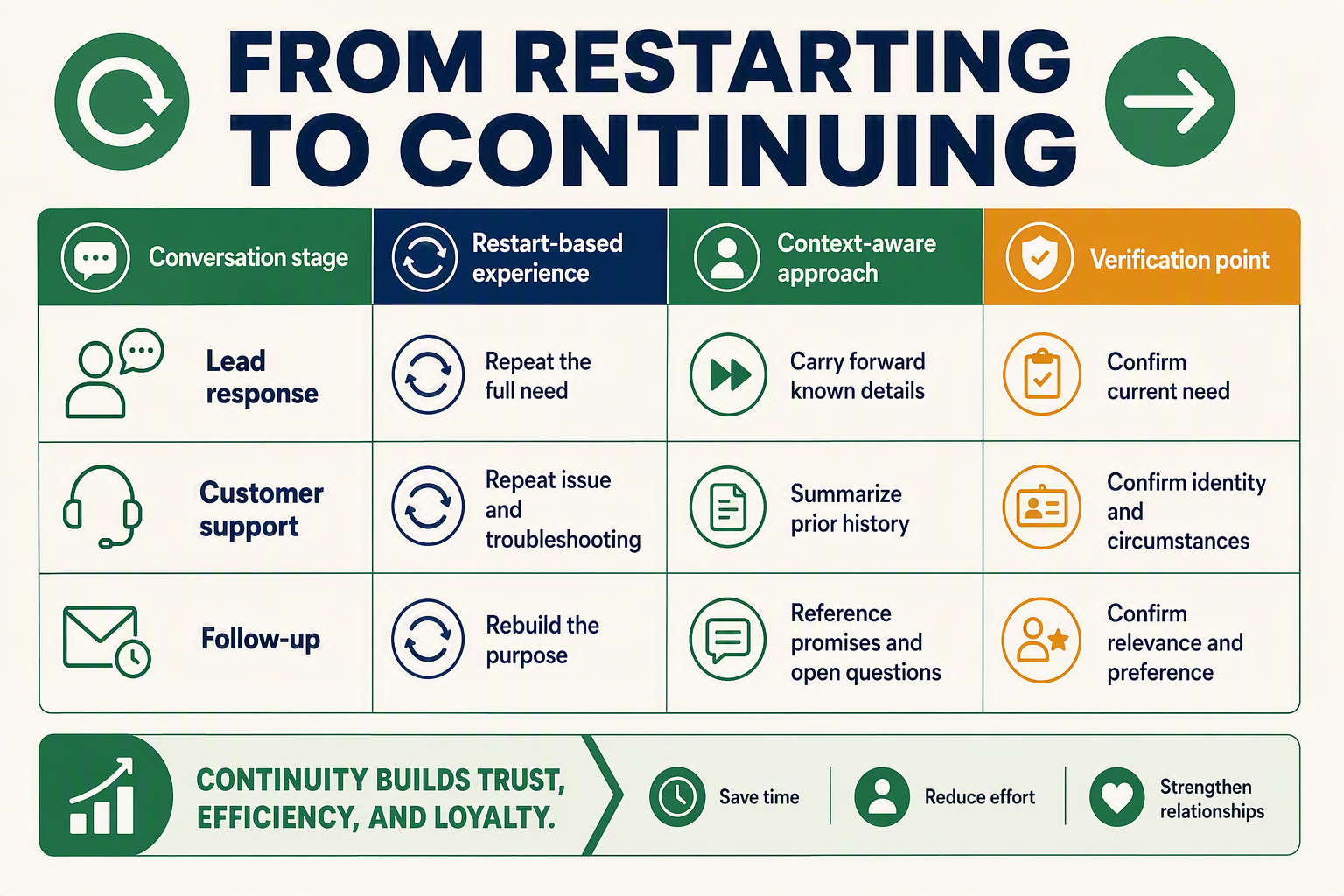
The key development is a shift from channel-specific resets to a workflow that retrieves relevant context, confirms uncertain details, asks only for missing information, and advances the customer toward a clear next step. A CallMissed WhatsApp agent should use memory as decision support—not as unquestionable truth.
Restart-based chat versus CallMissed conversation continuity
The table describes expected workflow behaviour rather than a verified storage architecture, retention period, or external integration. Each continuity step is conditional on relevant context being available and appropriately associated with the customer.
| Workflow stage | Restart-based chat | CallMissed conversation continuity | Required control |
|---|---|---|---|
| Conversation opening | Begins with a generic greeting and asks the customer to explain the request again. | Acknowledges the apparent earlier voice, email, or WhatsApp interaction and asks whether the customer wants to continue it. | Confirm identity and intent before exposing prior details. |
| Context gathering | Collects every requirement from the beginning, even when the customer previously supplied it. | Carries forward relevant facts, such as the stated need, issue summary, or preferred language, and asks only for missing information. | Separate confirmed facts from inferred, ambiguous, or stale context. |
| Lead qualification | Repeats questions about requirements, location, use case, or preferences. | Uses previously stated requirements to narrow the remaining questions and identify an appropriate next step. | Reconfirm details that may have changed; do not infer purchasing authority or current intent. |
| Support troubleshooting | Restarts the diagnostic script without considering steps already attempted by email or voice. | Summarises the reported problem and earlier troubleshooting, then checks whether the issue still occurs before continuing. | Verify the current device, account, symptoms, and customer identity before consequential action. |
| Follow-up handling | Treats an unresolved question or earlier promise as a new request. | Surfaces the relevant open item and asks whether it remains outstanding, helping the conversation resume from that point. | Do not imply that outreach was scheduled or sent unless that capability and action are documented. |
| Resolution or escalation | Produces another generic answer or transfers the customer without useful background. | Passes a concise summary of the request, confirmed context, attempted steps, and unresolved question to the next stage or a person. | Minimise sensitive data and provide appropriate access controls, auditability, and human review. |
How the continuity workflow should operate
A practical WhatsApp AI agent shared conversation memory workflow can be evaluated through four actions:
- Recognise: Find potentially relevant context from an earlier interaction without assuming that every record belongs to the current customer.
- Summarise: Present only the information needed for the present task—for example, “You previously contacted us about an installation issue.”
- Verify: Ask the customer to confirm stale, sensitive, payment-related, identity-dependent, or high-impact details.
- Advance: Request the missing information, provide the next safe step, or escalate with a concise handoff summary.
This controlled progression matters as agentic systems become more autonomous. Gartner forecast in June 2025 that more than 40% of agentic AI projects would be cancelled by the end of 2027 because of escalating costs, unclear business value, or inadequate risk controls. Conversation continuity therefore needs measurable utility and explicit safeguards, not memory accumulation for its own sake.
A simple quality test
Teams reviewing a CallMissed WhatsApp agent journey should ask:
- Did the agent reduce avoidable repetition?
- Did it clearly distinguish remembered context from confirmed facts?
- Did it move the customer toward resolution without exposing unnecessary information?
- Did it escalate when identity, risk, ambiguity, or customer preference required human judgment?
A continuity workflow succeeds when prior context makes the next interaction more relevant while preserving the customer’s ability to correct, update, or withhold information.
How Can a CallMissed WhatsApp Agent Continue a Lead Conversation That Began by Voice?
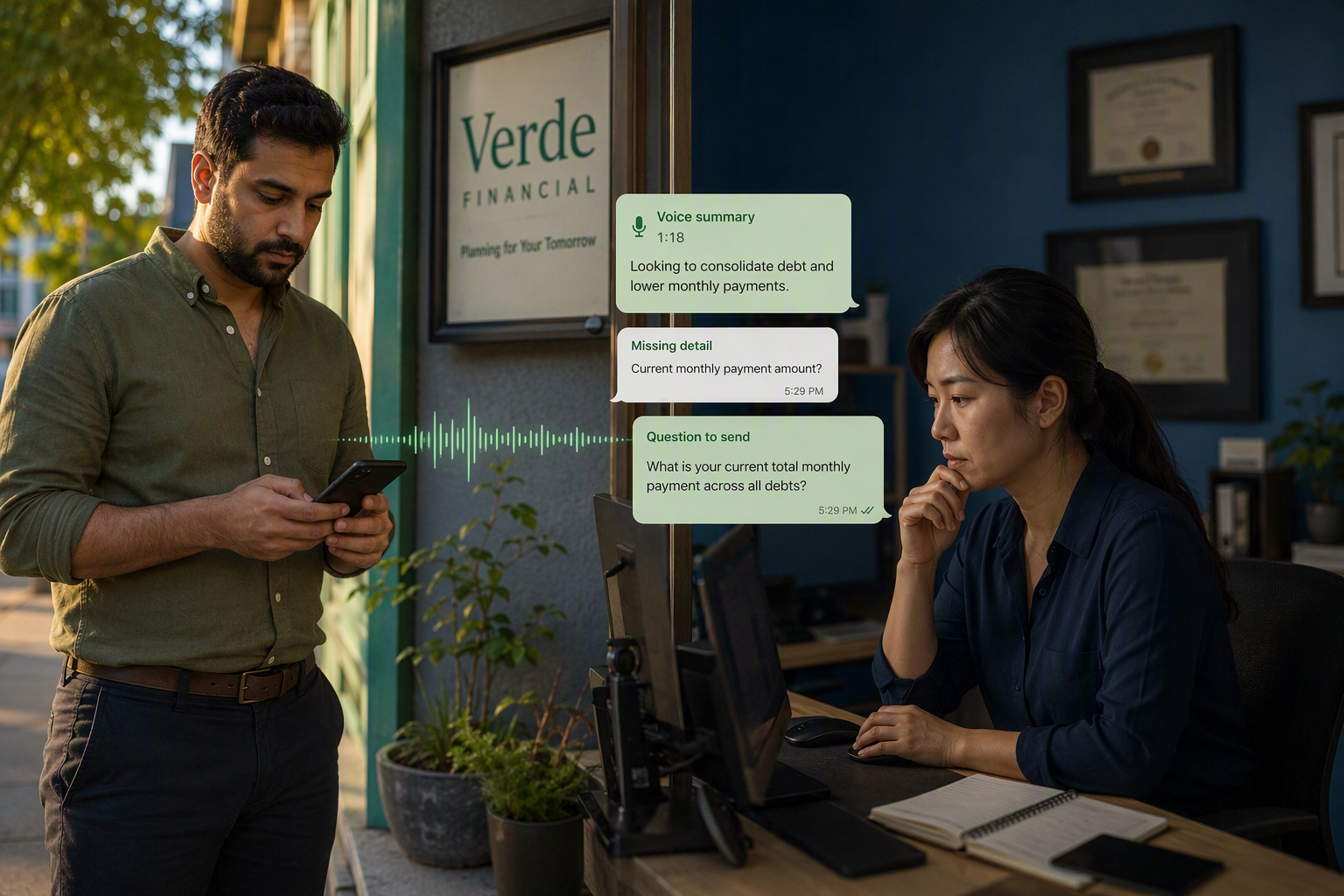
A CallMissed WhatsApp agent can continue a voice-originated lead conversation by receiving relevant context from the earlier call, confirming that context with the lead, and asking only for information still needed. The objective is not perfect recall; it is a shorter, coherent path from initial enquiry to a clear next step.
A practical voice-to-WhatsApp journey
Consider a lead who calls about an accounting solution for a 30-person company. During the voice conversation, the lead explains that the business needs GST invoicing, prefers a Hindi demonstration, and wants to decide before the next financial quarter.
If the same lead subsequently starts a WhatsApp conversation, an effective continuity flow would be:
- Identify a probable earlier interaction. The system may associate the WhatsApp user with the previous caller using available customer context. Because identifiers can be shared, mistyped, or reassigned, a probable match should not automatically be treated as confirmed identity.
- Retrieve only relevant context. The WhatsApp AI agent needs the stated requirement, company size, language preference, unresolved questions, and agreed next step—not an indiscriminate transcript of everything discussed.
- Confirm before proceeding. The agent could say: “I understand you previously discussed GST invoicing for a 30-person business and preferred a Hindi demo. Is that still correct?”
- Ask for missing information. Once the lead confirms the summary, the agent can request only what remains unknown, such as the preferred demo date or number of users.
- Conclude with an explicit next step. The conversation should end with a clear outcome, such as documenting the requested demonstration or transferring the lead to a person who can complete the arrangement.
What the WhatsApp agent should carry forward
Useful shared conversation memory is selective and purpose-driven. For lead response, it may include:
- The product or service the lead asked about.
- Previously stated requirements and constraints.
- Preferred language or communication channel.
- Questions that remain unanswered.
- A follow-up that a representative said would occur.
- The current stage of the enquiry, if that status is available and reliable.
CallMissed supports AI voice and WhatsApp interactions, including WhatsApp Business calls connected to an AI voice agent. However, the precise storage method, matching logic, retention period, and internal transfer mechanism should not be assumed without product-specific documentation or configuration details.
Where confirmation becomes essential
A remembered detail should become a confirmation prompt, not an unquestioned instruction, when it is stale, ambiguous, or consequential. The agent should verify:
- Whether the person on WhatsApp is the same person who called.
- Whether requirements, budgets, deadlines, or contact preferences have changed.
- Whether a quoted price or promised action remains valid.
- Any payment, account-access, contractual, or identity-sensitive information.
For example, “You previously mentioned a ₹50,000 budget—is that still your working range?” is safer than presenting the amount as permanently correct.
When a person should take over
Human escalation is appropriate when the identity match is uncertain, the lead disputes the remembered context, an earlier promise cannot be verified, or the request involves negotiation or other high-impact decisions. In those cases, WhatsApp AI agent shared conversation memory should help the human understand what happened—not encourage the automation to guess.
How Can CallMissed Support Continue From Email to WhatsApp Without Unsafe Assumptions?

A CallMissed WhatsApp agent should continue an email-originated support case by presenting a short, neutral summary and asking the customer to confirm it. The agent should not assume that a matching name, phone number, or remembered issue proves identity—or that the situation remains unchanged.
A safe email-to-WhatsApp journey
This continuity matters at scale: WhatsApp exceeded 3 billion monthly active users, according to Meta’s April 2025 earnings call. A practical support journey should therefore preserve useful context without exposing information to the wrong WhatsApp user.
A well-designed flow could work as follows:
- Retrieve only relevant context. If permitted context is available, the WhatsApp AI agent identifies the email subject, broad issue category, current case state, and troubleshooting already attempted.
- Acknowledge the possible connection. The agent says it may have context from an earlier email rather than presenting the match as certain.
- Request confirmation. The customer confirms a non-sensitive detail, such as the issue category or case reference.
- Check the present situation. Even when the earlier context is correct, the agent asks whether anything has changed since the email.
- Continue from the last confirmed point. The agent avoids repeating completed troubleshooting and asks only for information needed for the next step.
- Escalate when necessary. Identity disputes, account changes, refunds, payments, security incidents, or ambiguous records should move to an authorized person or controlled verification process.
What the conversation could sound like
A cautious CallMissed WhatsApp agent might respond:
“It looks like this conversation may relate to an email about an order arriving damaged. Before we continue, can you confirm the case reference shown in your email? Please do not send card details or passwords here.”
After confirmation, it could say:
“Thank you. The earlier notes indicate that you had already shared photographs of the packaging. Is that still accurate, and has the condition of the item changed since your email?”
This wording uses shared conversation memory to reduce repetition while clearly separating stored history from newly confirmed facts. It also avoids disclosing the full email, address, order value, or other details before identity and relevance have been established.
Context to use, verify, or withhold
Teams should classify remembered information before allowing an agent to act:
- Use cautiously: issue category, previously attempted troubleshooting, preferred language, and unresolved questions.
- Verify first: identity, order or case reference, present issue status, delivery address, and any earlier promise or deadline.
- Do not expose or rely on: passwords, one-time passcodes, complete payment credentials, authentication answers, or unrelated email content.
- Escalate: refunds, account ownership changes, legal complaints, suspected fraud, and conflicting customer records.
Configuration questions for support teams
Before enabling email-to-WhatsApp continuity, evaluate:
- What evidence is sufficient to associate the WhatsApp user with the email case?
- Which fields can the agent summarize before verification?
- How can customers correct or request deletion of remembered information?
- Which roles may inspect or amend conversation history?
- What events require audit logging or human review?
These are recommended safeguards, not claims about a particular CallMissed storage architecture, retention period, or email-matching mechanism. The safe objective is straightforward: continue from confirmed context, not from convenient assumptions.
How Should a CallMissed WhatsApp Agent Handle Promised Follow-Ups, Open Questions, and Communication Preferences?
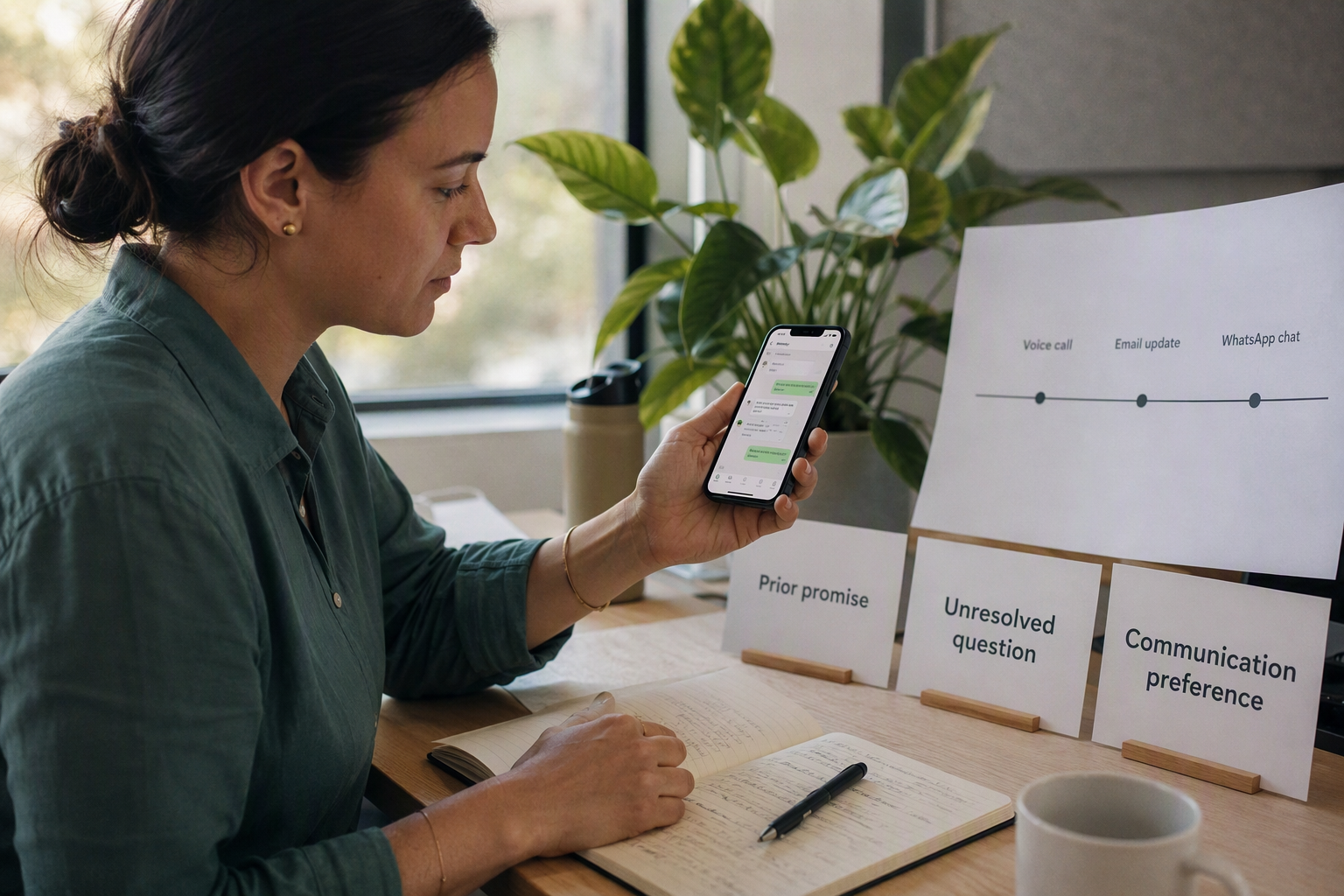
A CallMissed WhatsApp agent should treat promises, unanswered questions, and communication preferences as working context—not unquestionable instructions. It should acknowledge the relevant history, verify that it still applies, and move the conversation toward a specific next step without implying that outreach, scheduling, or external-system updates occurred automatically.
Turn previous promises into accountable next steps
A remembered promise needs enough context to be useful. “We will get back to you” is vague; “The sales team will confirm whether the requested plan supports five locations” identifies the owner, subject, and expected outcome.
When a customer returns on WhatsApp, the agent should:
- Summarise the commitment: State what was promised and through which earlier interaction, if known.
- Check whether it remains unresolved: Ask whether the customer has already received an answer elsewhere.
- Provide only verified progress: Do not invent a status or claim that a colleague completed an action.
- Define the next step: Answer from available knowledge, collect missing details, or route the matter to a person.
For example: “During your earlier call, you asked whether the service could cover five branches, and a follow-up was promised. Have you received that confirmation, or would you like me to continue from that question?”
This wording demonstrates continuity without assuming the remembered record is complete.
Keep open questions explicit
Shared conversation memory should distinguish a resolved topic from an open question. Otherwise, a WhatsApp AI agent may repeat an old answer, overlook an outstanding request, or mistakenly reopen a completed issue.
A practical open-question record should capture, where available:
- The customer’s actual question, preferably as a concise summary.
- Known facts and missing information, kept separate.
- What has already been attempted or explained.
- Whether the customer confirmed resolution.
- Whether human judgement or authorisation is required.
If an email support exchange ended while waiting for an order reference, the agent could say: “Your earlier email described an installation problem, but the order reference was still missing. Is that still the issue you want help with?” The agent should then request only the information necessary to continue.
Apply communication preferences carefully
Preferences can improve relevance, particularly for customers who choose WhatsApp over calls or communicate in a regional language. CallMissed supports voice and chat experiences across 22 Indian languages, making language preference especially useful for businesses serving multilingual audiences.
However, a preference is not permanent consent. The agent should separate:
- Language preference: “Would you like to continue in Hindi?”
- Channel preference: “Would you prefer the answer here or from a human by phone?”
- Timing preference: “Is there a convenient time for a representative to contact you?”
- Marketing consent: This must not be inferred merely because the customer used WhatsApp for support.
The agent should confirm preferences when they may be stale, unclear, shared across household members, or consequential.
Separate remembered intent from completed action
Memory can inform a response, but it does not prove that an operational action happened. Unless supported by verified product configuration, businesses should not assume that the CallMissed WhatsApp agent can proactively send a follow-up, schedule outreach, or update a third-party system.
A safe response pattern is: “I can see the earlier request, but I cannot confirm that the action was completed. I can help collect the remaining details or pass this to the appropriate person.” This keeps conversation continuity useful, transparent, and reviewable.
Which Responsible-Memory Safeguards Should CallMissed Teams Evaluate or Configure?
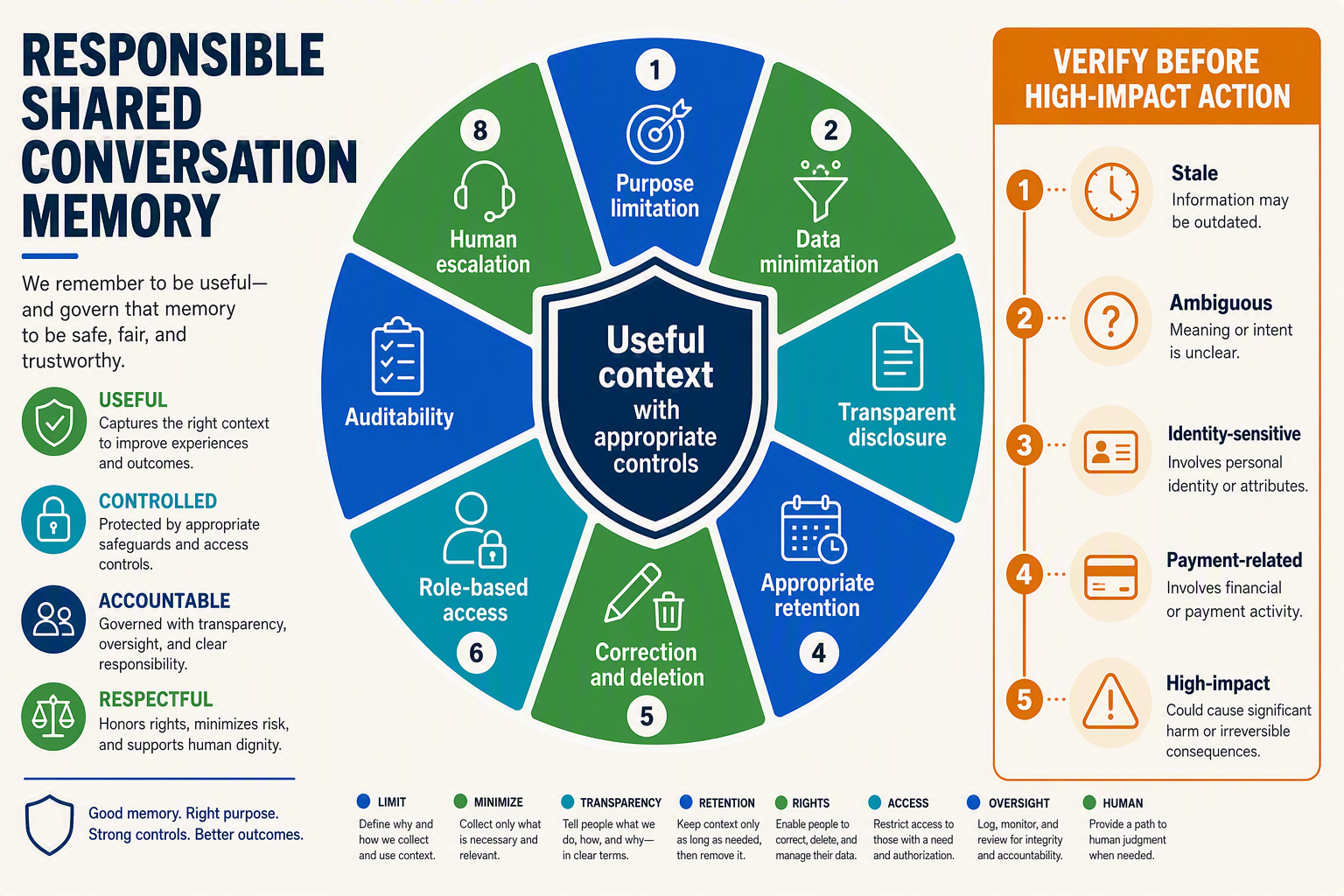
Responsible shared memory should preserve only the context needed to continue a customer journey, while giving customers and authorised staff meaningful control over its use. CallMissed teams should evaluate the safeguards below as configuration and governance requirements—not assume that every control is a verified, preconfigured product feature.
Define what the agent may remember
Start with purpose limitation: every remembered field should support a clear customer-service, support, or lead-response purpose. “Customer requested a product demonstration” is useful context; an unrelated personal detail usually is not.
Apply data minimisation by classifying information into three groups:
- Useful context: stated requirements, unresolved questions, troubleshooting already attempted, communication preferences, and promised next steps.
- Context requiring confirmation: identity details, addresses, current account status, old quotations, eligibility information, and circumstances that may have changed.
- Restricted context: passwords, one-time passcodes, complete payment-card data, authentication secrets, or unnecessary sensitive personal information.
A CallMissed WhatsApp agent should not convert guesses into permanent customer facts. Inferences such as sentiment, intent, family relationships, or financial circumstances should be labelled as uncertain—or excluded—unless the customer confirms them.
Make memory visible and correctable
Customers should receive a concise disclosure explaining that relevant information from earlier voice, email, or WhatsApp interactions may be used to continue the conversation. The disclosure should also indicate how they can request correction or deletion, subject to applicable legal and operational requirements.
Teams should test whether the workflow supports these outcomes:
- A customer can ask, “What information are you using from my earlier conversation?”
- The agent can distinguish recorded facts from generated summaries.
- Incorrect context can be corrected without forcing the customer to restart.
- Deletion or restriction requests reach an authorised person for review.
- A disputed memory is not repeatedly presented as established fact.
Set retention, access, and audit boundaries
Memory should have an appropriate retention period based on purpose, rather than being kept indefinitely by default. A short-lived sales enquiry, an active support case, and a legally required business record may justify different treatment.
Access should follow role-based controls. For example, a sales representative may need the customer’s stated requirements but not detailed support notes or sensitive identity documentation. Audit records should make it possible to determine:
- Which prior context influenced a response.
- When that context was created or updated.
- Whether the source was voice, email, WhatsApp, or a human-entered note.
- Who viewed, corrected, exported, or deleted it.
- When an automated interaction was escalated.
These controls matter because Gartner forecast in June 2025 that more than 40% of agentic AI projects would be cancelled by the end of 2027 because of rising costs, unclear value, or inadequate risk controls.
Require verification and human escalation
Before payment-related, identity-sensitive, contractual, or otherwise high-impact action, the WhatsApp AI agent should verify the customer and reconfirm relevant details through an approved process. Memory can guide the conversation, but it should not serve as authentication.
Escalate to a person when context conflicts, the customer challenges the record, identity cannot be confirmed, deletion is requested, or the agent lacks authority. The responsible standard for WhatsApp AI agent shared conversation memory is therefore not maximum recall; it is relevant continuity with transparent, reviewable limits.
What Does CallMissed Shared Conversation Memory Mean for Leads, Support Teams, Customers, and Governance Owners? (TABLE)
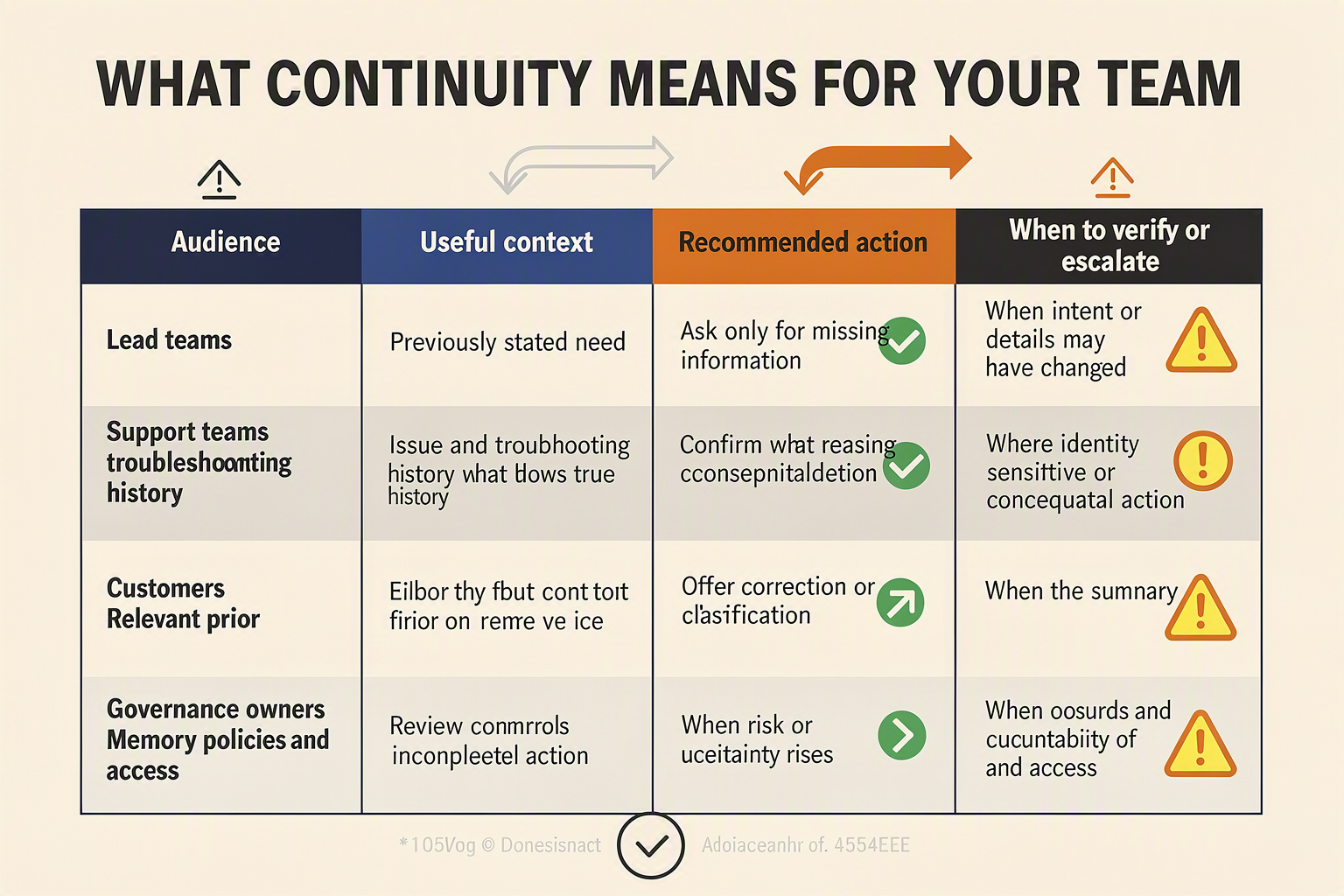
Shared conversation memory means different things to each stakeholder: leads gain continuity, support teams gain usable context, customers repeat less information, and governance owners gain a new responsibility to control how memory is used. For a CallMissed WhatsApp agent, success is not maximum recall; it is relevant continuity with verification, boundaries, and human oversight.
Stakeholder impact at a glance
| Stakeholder | Practical value | Example behavior | Control or success check |
|---|---|---|---|
| Leads | Faster progression from interest to next step | Carries a previously stated requirement from a voice call into WhatsApp and asks only for missing details | Confirm that the requirement is still current before recommending an action |
| Sales teams | More coherent qualification and handoffs | Summarizes known needs, open questions, and the last agreed next step | Separate customer statements from AI-generated interpretations |
| Support teams | Less duplicate troubleshooting | Uses an earlier email issue description to avoid restarting diagnosis | Recheck identity, current symptoms, and steps already completed |
| Customers | A more consistent cross-channel experience | Acknowledges relevant context when a conversation moves from email or voice to WhatsApp | Provide a clear way to correct inaccurate or outdated context |
| Supervisors | Better-informed human escalation | Transfers the issue with a concise history, unresolved question, and uncertainty markers | Review whether the handoff includes only necessary information |
| Governance owners | Controlled, reviewable use of customer context | Defines which information may inform responses and which details require reverification | Evaluate purpose limitation, retention, access, auditability, correction, and deletion |
What teams should expect in practice
For lead response, shared memory should help the CallMissed WhatsApp agent move the conversation forward without treating remembered information as permanent truth. A useful pattern is:
- Acknowledge the prior interaction: “You previously discussed support for Hindi and Marathi callers.”
- Confirm current relevance: “Is that still the requirement?”
- Request only the gap: Ask for the missing deployment scope or preferred next step.
- Avoid unsupported conclusions: Do not infer budget, authority, consent, or urgency merely from earlier messages.
For customer support, the WhatsApp AI agent could reference an issue first described by email and the troubleshooting already attempted. However, account ownership, payment instructions, refunds, service cancellation, and other consequential actions should require fresh checks rather than relying solely on remembered context.
For customers, continuity should feel transparent rather than intrusive. The agent should explain why it knows something when that knowledge may be unexpected—for example, by stating that it is using context from an earlier support interaction. This is especially important at WhatsApp’s scale: WhatsApp exceeded 3 billion monthly active users, according to Meta’s April 2025 earnings call.
Governance questions before relying on memory
Governance owners should treat the following as controls to evaluate or configure, not as independently verified CallMissed product features:
- Is each remembered detail necessary for a defined service purpose?
- Can customers correct or request deletion of inaccurate context?
- Are sensitive details excluded, minimized, or subject to stronger access rules?
- Can reviewers distinguish original customer statements from summaries and AI inferences?
- Is uncertain or stale context visibly labelled?
- Is there a clear route to human review?
These controls matter as autonomy expands. Gartner predicted in October 2024 that agentic AI would appear in 33% of enterprise software applications by 2028, compared with less than 1% in 2024. Gartner also forecast in June 2025 that more than 40% of agentic AI projects would be cancelled by the end of 2027 because of rising costs, unclear business value, or inadequate risk controls.
The practical standard for WhatsApp AI agent shared conversation memory is therefore simple: preserve enough context to help, but verify enough context to remain trustworthy.
CallMissed WhatsApp Agent FAQ: What Is It, What Should It Remember, and When Should a Person Take Over?
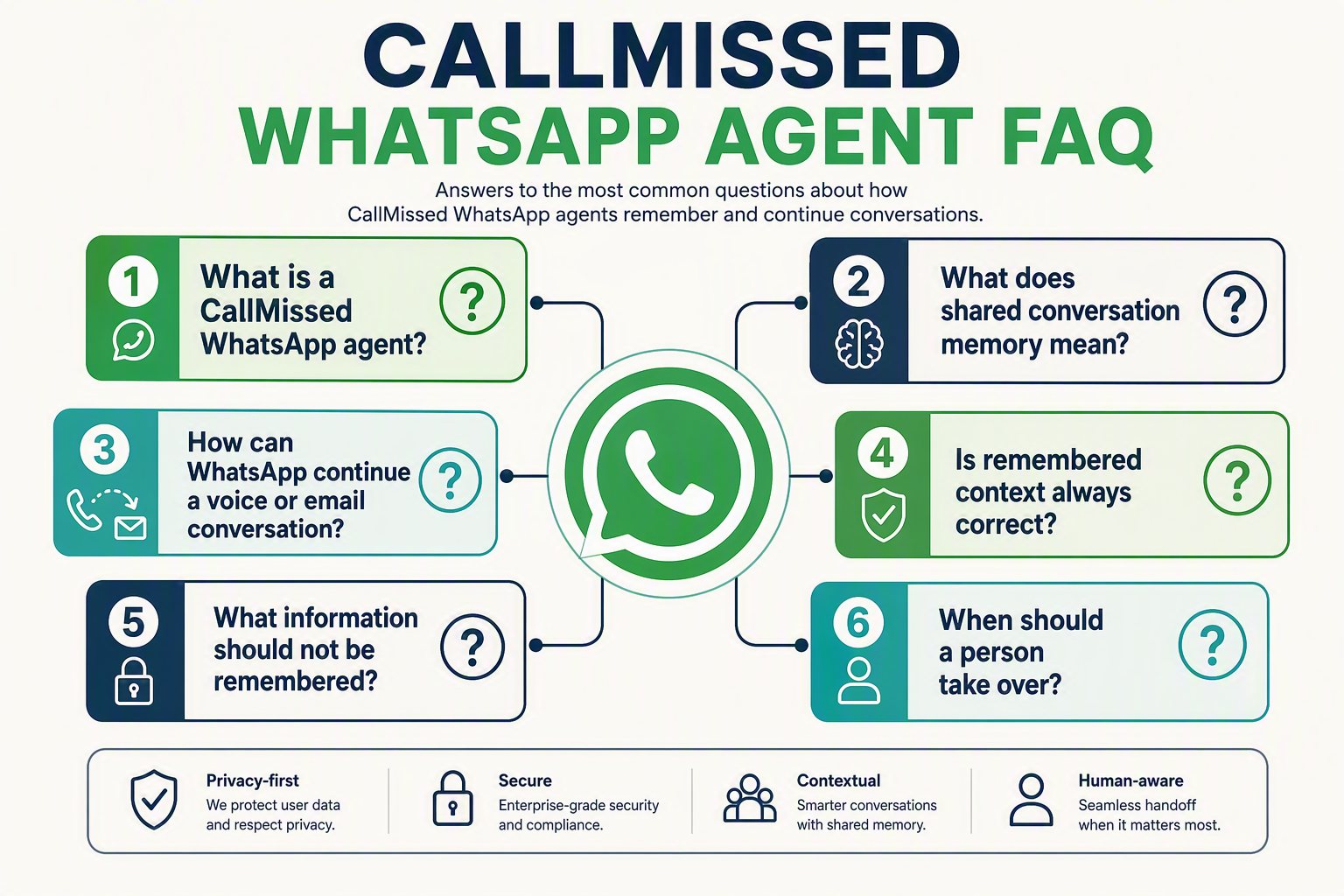
Understanding the Agent and Its Memory
What is a CallMissed WhatsApp agent?
What does shared conversation memory mean for a CallMissed WhatsApp agent?
Continuing Conversations Across Channels
How can a CallMissed WhatsApp agent continue a conversation that started by voice or email?
Is WhatsApp AI agent shared conversation memory always accurate?
Safety and Human Escalation
What information should a WhatsApp AI agent not remember?
When should a person take over from a CallMissed WhatsApp agent?
Conclusion: Why the CallMissed WhatsApp Agent Is Valuable for Continuity, Not Memory for Its Own Sake

The CallMissed WhatsApp agent is valuable when shared context helps a customer make progress—not when information is retained simply because it can be. The practical goal is continuity across voice, email, and WhatsApp, supported by verification, proportionate data use, and timely human intervention.
Measure continuity by the customer outcome
A useful WhatsApp AI agent should turn prior context into a better next interaction. Depending on the customer journey, that may mean:
- Recognizing a requirement previously described during a voice call.
- Carrying an email support issue into WhatsApp without requesting the entire history again.
- Recalling an unresolved question or promised next step.
- Asking only for information that is missing or no longer reliable.
- Moving the conversation toward an appropriate resolution, appointment, qualification step, or human handoff.
This continuity matters at global scale. WhatsApp exceeded 3 billion monthly active users, according to Meta’s April 2025 earnings call. For businesses, messaging is therefore not merely an isolated channel; it can be one stage in a longer relationship that also includes calls and email.
CallMissed brings WhatsApp chat, WhatsApp Business calling, AI voice agents, email, and an omnichannel inbox into the same customer-engagement proposition. Its support for 22 Indian languages is particularly relevant when continuity must extend to regional-language conversations rather than forcing every customer into English.
Treat remembered context as evidence, not truth
The operating principle should be simple: use context to reduce friction, but verify it before it drives consequential action. A remembered detail can become stale, be misunderstood, or belong to another person sharing the same phone number or account.
Before deployment, teams should define clear rules for:
- Relevance: Retain or expose only context needed for a legitimate customer-engagement purpose.
- Verification: Reconfirm identity-sensitive, payment-related, ambiguous, or high-impact details.
- Transparency: Tell customers when earlier interactions may inform the current response.
- Control: Provide suitable correction, deletion, retention, access, and audit processes.
- Escalation: Transfer to a person when confidence is low, the customer requests help, or the decision carries material consequences.
These are safeguards businesses should evaluate and configure; they should not be interpreted as claims about an undocumented storage architecture, fixed retention period, or third-party integration.
Build for dependable progress
The broader agentic-AI market reinforces the need to connect capability with measurable value. Gartner forecast in June 2025 that more than 40% of agentic AI projects would be cancelled by the end of 2027 because of escalating costs, unclear business value, or inadequate risk controls. Shared conversation memory should consequently be judged by practical questions: Did it prevent avoidable repetition? Did it preserve the correct thread? Did it help the customer reach a safe, clear next step?
The strongest implementation is not the one that remembers the most. It is the one that:
- Retrieves relevant and sufficiently reliable context.
- Signals uncertainty instead of inventing certainty.
- Confirms details when circumstances may have changed.
- Keeps people accountable for sensitive decisions.
- Allows context to be corrected or removed.
That is the central promise of a CallMissed WhatsApp agent: conversations can continue with appropriate context across channels, while responsible controls keep memory subordinate to customer trust.
Conclusion
The value of a CallMissed WhatsApp agent is not memory for its own sake; it is continuity with appropriate controls. Shared conversation memory should help customers resume a journey across voice, email, and WhatsApp while ensuring uncertain, sensitive, or outdated details are confirmed before the agent acts.
Key takeaways include:
- Continue rather than restart. When a lead moves from a voice call to WhatsApp, the WhatsApp AI agent can use relevant prior context, carry forward known requirements, and ask only for missing information.
- Reduce unnecessary repetition in support. If an issue began by email, earlier descriptions and troubleshooting history can inform the next response, subject to identity and current-status verification.
- Make follow-up relevant. Previous promises, unresolved questions, and stated communication preferences can guide the conversation without implying unverified scheduling, proactive messaging, or third-party integrations.
- Treat memory as fallible. Purpose limitation, data minimization, transparent disclosure, appropriate retention, correction and deletion paths, role-based access, auditability, and human escalation are safeguards businesses should evaluate and configure.
The scale makes these practices increasingly important: WhatsApp exceeded 3 billion monthly active users, according to Meta’s April 2025 earnings call. Meanwhile, Gartner forecast in June 2025 that more than 40% of agentic AI projects would be cancelled by the end of 2027 because of rising costs, unclear business value, or inadequate risk controls.
Looking ahead, watch whether conversation-memory systems become more transparent, reviewable, and selective—not merely more expansive. Successful implementations will preserve useful context while making uncertainty visible and handing consequential cases to people.
To explore this direction, visit CallMissed, an AI communication infrastructure platform combining WhatsApp chat, WhatsApp Business calling, AI voice agents, email, an omnichannel inbox, and support for 22 Indian languages. What would change in your customer journey if every channel could continue the right conversation—without making unsafe assumptions?
Related Reading
Discussion
Related Posts
Ready to automate customer conversations?
Launch AI voice agents and WhatsApp bots with CallMissed — one API, 22+ Indian languages.