
Automotive AI Receptionist: CallMissed Guide for Dealers and Service Centers


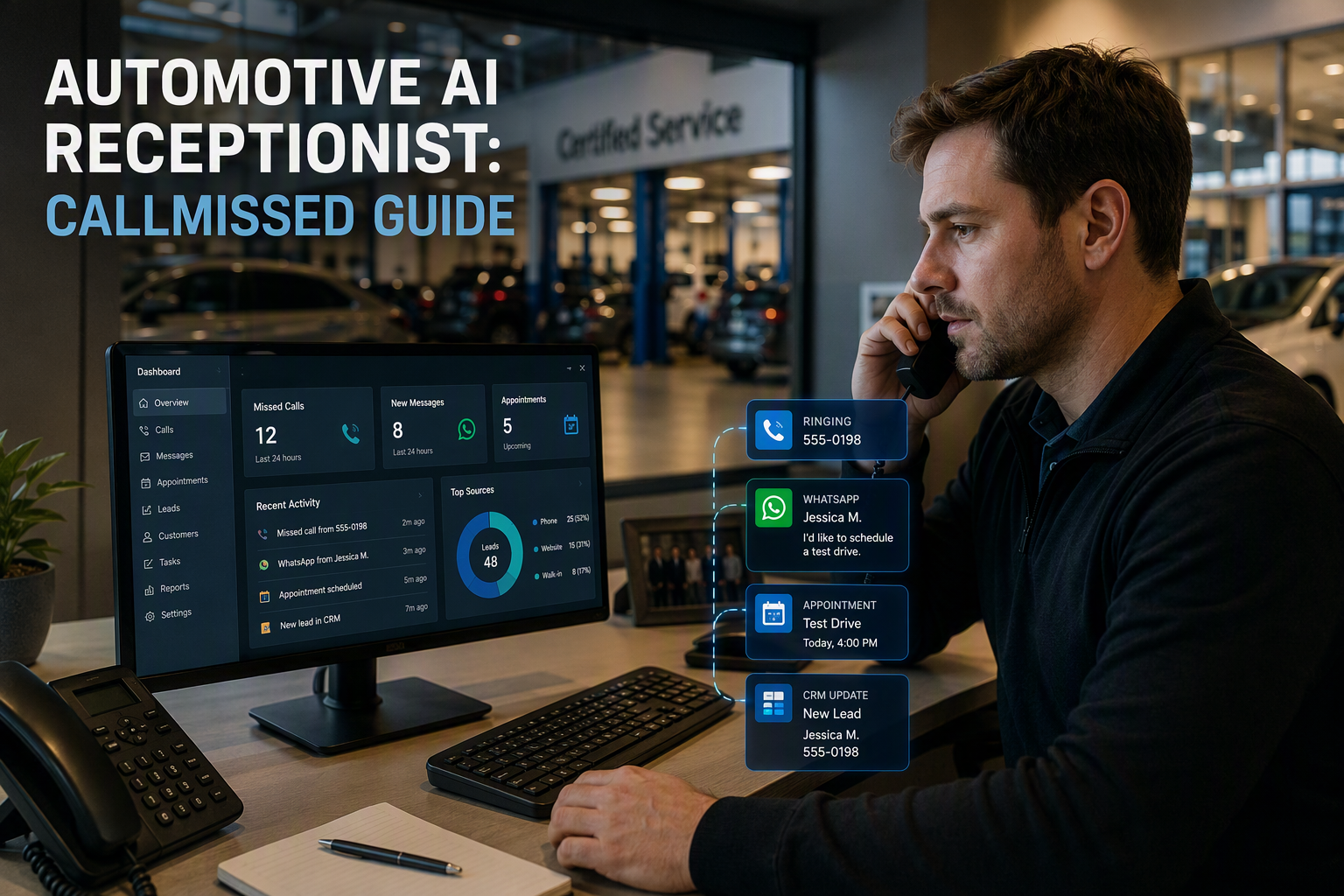
Assess whether an automotive AI receptionist can capture enquiries, recover missed calls, route leads, and support bookings safely.
Automotive AI Receptionist: CallMissed Guide for Dealers and Service Centers
What if the next unanswered phone call at your dealership is from a buyer ready to book a test drive—or from a frustrated owner waiting for a service update? An automotive AI receptionist can answer routine calls, capture intent and route urgent conversations without forcing every customer to wait for a front-desk executive. This guide explains how to deploy CallMissed for automotive workflows while keeping humans, consent and reliable customer records at the center.
The timing matters. India recorded 4.30 million domestic passenger-vehicle sales in FY2024–25, according to the Society of Indian Automobile Manufacturers in April 2025. Every vehicle sold creates recurring communication around enquiries, finance, delivery, maintenance, repairs, insurance and resale. Dealership teams must handle that volume while responding across phone calls, WhatsApp, email and web channels—often during lunch breaks, peak service hours or after the showroom has closed.
From unanswered calls to structured workflows
Traditional car dealership call automation can stop at an interactive voice response menu. A modern AI receptionist can go further by identifying whether a caller wants a vehicle quotation, test drive, service appointment, roadside escalation or repair-status update. The system can then collect essential details, confirm the next step and transfer the conversation when human judgment is required.
CallMissed supports this model through AI voice agents, WhatsApp chatbots and WhatsApp Business calling, an omnichannel inbox/CRM, knowledge-base retrieval and follow-up tooling, with voice support across 22 Indian languages for dealerships serving regional audiences.
The objective is not to remove dealership staff from customer relationships. It is to prevent avoidable lead leakage and let employees concentrate on negotiations, technical diagnosis and sensitive complaints. A well-designed workflow should:
- Recover missed calls with an appropriately timed callback or WhatsApp message.
- Route sales, service, finance and emergency requests to the correct team.
- Book test drives and service slots only against verified availability.
- Answer service-status questions from approved CRM or workshop data.
- Escalate uncertain, emotional or high-value conversations to a person.
- Record consent, contact preferences and conversation outcomes consistently.
What this guide will help you build
The following sections will map the complete journey from the first ring to a measurable outcome. You will learn how to design enquiry scripts, connect CRM fields, configure multilingual knowledge, govern WhatsApp follow-up and test failure scenarios such as unavailable inventory, duplicate leads or incorrect registration numbers.
The guide will also define practical performance metrics—including answer rate, missed-call recovery rate, qualified-lead rate, appointment completion, transfer success, response latency and opt-out rate—so dealerships can evaluate automation by business results rather than call volume alone. The goal is a receptionist workflow that responds quickly, communicates clearly and knows precisely when to bring in a human.
How can CallMissed for automotive help? When documented and correctly configured, it can support enquiry capture, appointment requests, missed-call recovery, routing, follow-up, and human escalation
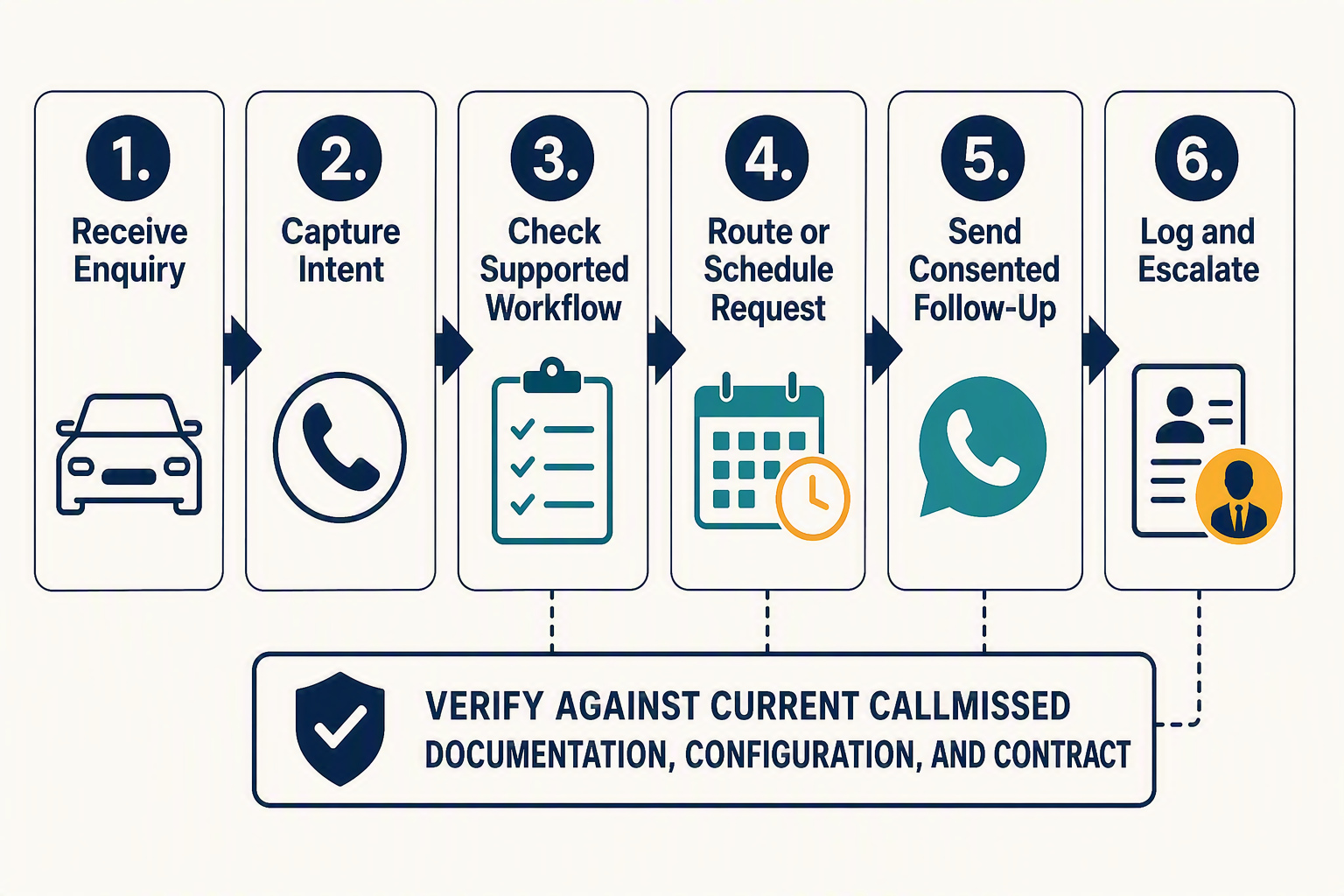
CallMissed can help dealerships and service centers capture enquiries, record appointment requests, recover missed calls, route conversations, support follow-up and escalate customers to employees. An automotive AI receptionist is most reliable when dealership policies, integrations and escalation rules are clearly documented. It should not promise vehicle availability, pricing, appointment slots, repair status or completion dates unless the information comes from an approved, current source.
Where the automotive AI receptionist fits
An automotive AI receptionist can act as the first coordination layer between customers, dealership teams and connected systems. CallMissed combines AI voice agents, WhatsApp chatbots, WhatsApp Business calling, an omnichannel inbox/CRM and knowledge-base retrieval. Authorised teams can use these tools to manage conversations across voice, WhatsApp, email and the web.
Dealership and service-center workflows can include:
- Vehicle enquiries: Capture the model, variant, fuel type, preferred showroom, budget range and purchase timeline.
- Test-drive requests: Collect the customer’s location and preferred time. Check an integrated calendar or send the request to an employee for confirmation.
- Service appointment requests: Record the registration number, vehicle model, required service, reported symptoms and preferred workshop slot. Treat the appointment as a request until an authorised system or employee confirms it.
- Missed-call recovery: Create a follow-up task. A policy-compliant WhatsApp message may also be sent when the required consent and channel permissions exist.
- Service-status questions: Retrieve status from an approved workshop system. If current data is unavailable, route the customer to a service adviser.
- Routing and follow-up: Assign the conversation to the correct branch, sales team, workshop or employee queue.
- Human escalation: Transfer finance discussions, complaints, emergencies and uncertain requests to an appropriate employee.
These workflows matter at scale. India recorded 4.30 million domestic passenger-vehicle sales in FY2024–25, according to the Society of Indian Automobile Manufacturers in April 2025. Each sale can lead to years of service, repair, insurance and ownership-related conversations.
Documentation determines whether automation is reliable
Effective car dealership call automation starts with dealership-approved operating rules, not a generic conversational prompt. Before deploying an automotive AI receptionist, teams should document:
- Intent definitions: Define a new lead, existing opportunity, service request, complaint and emergency.
- Required fields: List the information needed for each next step. This may include a phone number, preferred vehicle, branch, registration number and contact preference.
- Sources of truth: Identify the CRM, dealer-management system, calendar or workshop platform that controls each answer.
- Routing logic: Map branches, departments, business hours, employee queues and fallback contacts.
- Communication permissions: Record consent, approved WhatsApp templates, opt-out handling and restrictions on business-initiated messages.
- Escalation thresholds: Require employee involvement when confidence is low, a customer disputes a record, or a conversation concerns safety, legal threats or sensitive financial information.
CallMissed supports voice interactions across 22 Indian languages, which can help automotive businesses serve regional customers. Each deployed language still needs testing. Tests should cover local model names, place names, number formats, accents and code-switching patterns.
A practical request-to-resolution flow
A correctly configured automotive AI receptionist can follow a controlled sequence:
- Identify the customer and classify the request.
- Search the CRM for an existing lead or vehicle record.
- Capture only the missing information needed for the next action.
- Check an authorised system before sharing availability, pricing or service status.
- Create a task, appointment request or routed conversation.
- Confirm what was requested. Do not describe an unverified request as a completed booking.
- Continue on WhatsApp only when channel rules and customer permissions allow it.
- Escalate to a named team with the transcript, captured fields and reason for transfer.
The key distinction is between capturing a request and confirming an outcome. The automotive AI receptionist can collect details and coordinate the next step. Dealership employees and connected operational systems should remain responsible for verified commitments to customers.
Why do dealerships and service centers need a different call-automation model from other businesses?
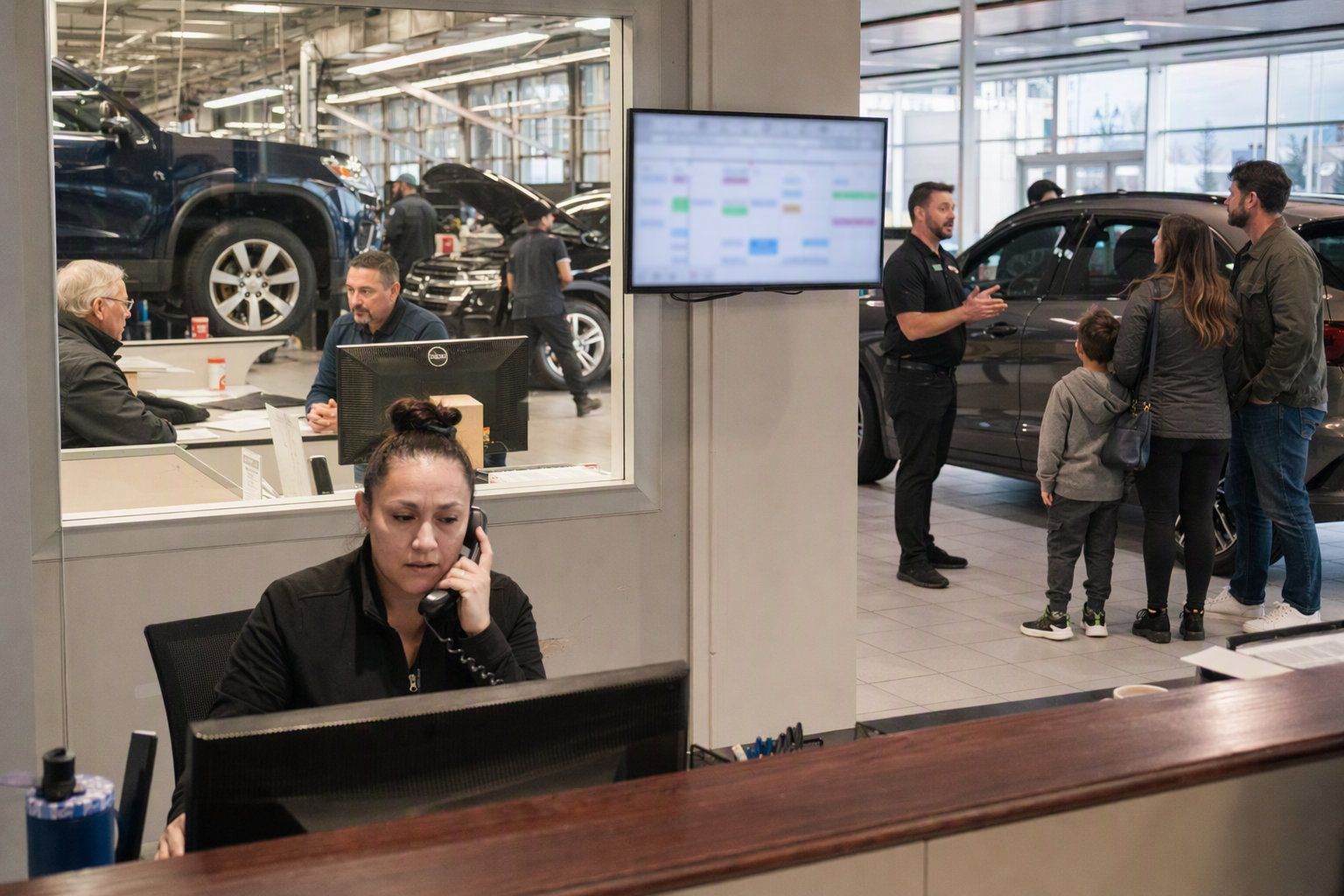
Dealerships and service centers need automation designed around two connected but operationally different journeys: vehicle sales and after-sales service. Unlike a generic receptionist, an automotive system must understand vehicles, locations, workshop capacity, ownership records and urgency before deciding whether to answer, book, follow up or transfer.
One phone number can represent many customer intents
A dealership may receive calls about a new model, used-car exchange, finance eligibility, test drives, delivery dates, routine maintenance, accident repairs or roadside problems. Treating these conversations as identical creates incorrect routing and poor CRM data.
India recorded 4.30 million domestic passenger-vehicle sales in FY2024–25, according to the Society of Indian Automobile Manufacturers in April 2025. That scale matters because each sale can generate years of subsequent interactions involving service, insurance, accessories and resale.
An automotive AI receptionist should classify intent before collecting workflow-specific information:
- Vehicle enquiry: model, variant, fuel or powertrain, budget, preferred dealership and purchase timeline.
- Test-drive request: vehicle, location, date, time, driving-licence requirements and confirmation status.
- Service appointment: registration number, model, mileage, reported issue, preferred workshop and slot.
- Repair-status question: job-card or registration identifier, verified customer details and approved workshop update.
- Urgent request: breakdown, safety issue, accident or repeated unresolved complaint requiring human escalation.
Sales availability and workshop capacity are not interchangeable
Generic appointment automation often assumes that every open calendar slot represents the same resource. Automotive operations are more constrained. A test drive depends on the correct demonstrator vehicle and branch, while a service booking may depend on workshop bays, technicians, parts availability and the type of repair.
For this reason, car dealership call automation should not promise availability from static scripts. It should either check an authoritative scheduling or inventory system or capture the request as pending and clearly explain that an employee will confirm it. The same rule applies to prices, delivery estimates and repair completion times: the AI should distinguish verified data from estimates.
Customer identity and context change the routing decision
A phone number alone may be insufficient. One household can own multiple vehicles, and one customer may contact different branches for sales and service. Before disclosing a repair update, the workflow may need a registration number, job-card reference or another approved verification step.
Routing should account for:
- Intent: sales, service, finance, insurance, accessories or escalation.
- Location: showroom, workshop, city or assigned territory.
- Vehicle context: model, registration number, booking ID or job card.
- Urgency: routine request versus breakdown, safety concern or complaint.
- Ownership: new lead, existing customer or duplicate CRM record.
Follow-up must preserve continuity across channels
Automotive conversations frequently move from a call to WhatsApp for brochures, location details, appointment confirmations or document requests. That transition requires consent, a clear business identity and a shared interaction record—not an isolated message from another team.
CallMissed for automotive can support this operating model through AI voice agents, WhatsApp chatbots and WhatsApp Business calling, plus an omnichannel inbox/CRM and knowledge-base retrieval. Its support for 22 Indian languages is particularly relevant when customers describe vehicle symptoms or service needs more naturally in a regional language.
The defining requirement is therefore not simply answering more calls. It is maintaining accurate context, branch-aware routing, controlled commitments and timely human intervention across the complete ownership lifecycle.
Which automotive AI receptionist capabilities matter in 2026, and what evidence should verify each one?
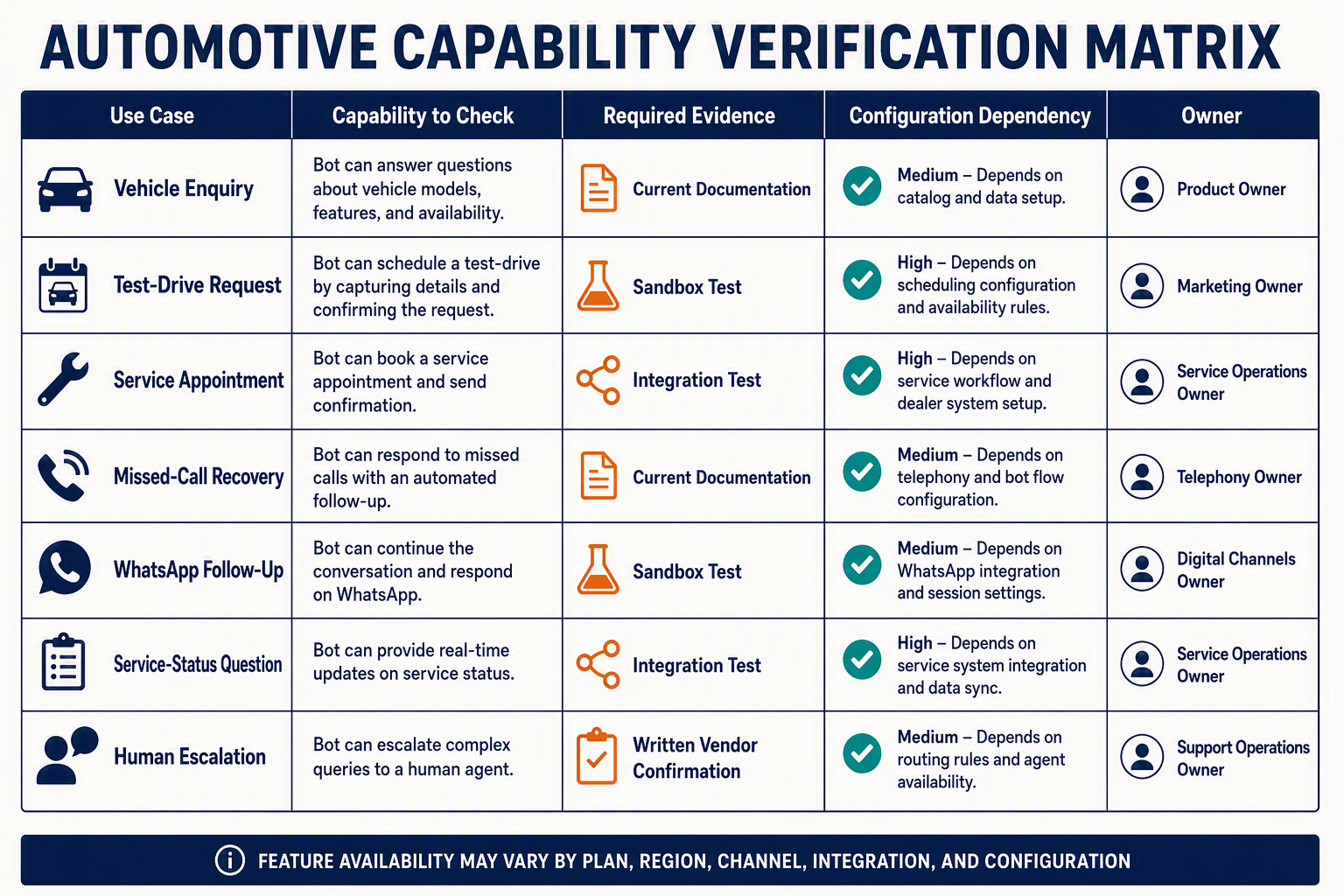
The most important 2026 capabilities are reliable intent capture, live-system appointment checks, missed-call recovery, multilingual handling, policy-compliant WhatsApp follow-up and traceable human escalation. Dealerships should verify every claim with call recordings, integration logs and completed workflow tests—not a polished demonstration alone.
Capability-and-evidence checklist
| Capability | Automotive use case | Evidence to request | Acceptance test |
|---|---|---|---|
| Intent recognition and data capture | Distinguish vehicle enquiry, test drive, finance, service booking, repair status and roadside urgency; capture model, location and registration number where relevant. | Transcripts, structured CRM payloads and confidence or fallback records from representative calls. | Run at least 50 scripted and unscripted calls, including interruptions, background noise and ambiguous model names; confirm mandatory fields reach the correct CRM records. |
| Calendar and workshop integration | Offer test-drive times or service bays using actual staff, demonstrator and workshop availability. | API documentation, availability queries, booking-write logs, duplicate-prevention rules and cancellation handling. | Attempt concurrent bookings, unavailable slots, rescheduling and API downtime; the agent must never invent availability or confirm a failed write. |
| Missed-call recovery and lead routing | Return unanswered calls, classify sales versus service intent and assign the lead by branch, postcode, vehicle or urgency. | Telephony event timestamps, routing rules, callback outcomes and assignment audit trails. | Simulate busy, rejected, after-hours and disconnected calls; verify that each eligible event creates only one correctly owned follow-up task. |
| Multilingual voice performance | Serve customers who switch between English, Hindi and regional Indian languages or use local pronunciations for models and locations. | Language coverage documentation, native-speaker recordings, word-error analysis and escalation rates by language. | Test dealership vocabulary, number plates, dates and code-switching with local speakers. CallMissed documents Speech-to-Text and Text-to-Speech coverage across 22 Indian languages, but each dealership should validate its own accents and terminology. |
| WhatsApp follow-up and consent controls | Send quotations, location pins, booking confirmations and approved reminders after a call or missed-call event. | WhatsApp Business configuration, template status, consent timestamps, opt-out records and delivery logs. | Test valid consent, absent consent, expired conversation windows, STOP requests and failed delivery. Confirm that promotional and service communications follow separately configured rules. |
| Human escalation and service-status retrieval | Transfer urgent complaints or high-value buyers while answering routine repair-status questions from approved systems. | Warm-transfer recordings, queue outcomes, source timestamps, retrieval citations and role-based access logs. | Test unavailable staff, stale workshop data, conflicting records and low-confidence answers; the agent should disclose uncertainty and create a human task rather than guess. |
What counts as credible verification?
For car dealership call automation, evidence should cover three layers:
- Platform evidence: documentation showing that the function exists.
- Integration evidence: logs proving that telephony, WhatsApp, calendars, CRM and dealer-management systems exchange the intended fields.
- Operational evidence: recordings and reports showing that real customer journeys finish correctly.
A vendor statement such as “supports CRM integration” is therefore insufficient. Ask which objects are read or written, how duplicate contacts are resolved, what happens during an API timeout and whether every automated action carries a timestamp and conversation identifier.
Applying the checklist to CallMissed
CallMissed for automotive combines AI voice agents, WhatsApp chatbots, WhatsApp Business calling, an omnichannel inbox/CRM and knowledge-base retrieval. Its differentiated WhatsApp capability can bridge a WhatsApp Business voice call to an AI agent, while the multilingual stack covers 22 Indian languages.
Those capabilities make CallMissed a practical candidate for an automotive AI receptionist, but configuration still determines reliability. Before launch, dealerships should retain test transcripts, CRM screenshots, consent records, routing logs and booking confirmations as the deployment evidence pack. India’s Digital Personal Data Protection Act, 2023 also makes purpose, notice and controlled handling of personal data central governance considerations—not optional QA details.
How should car dealership call automation move a vehicle enquiry from first contact to test drive, lead routing, WhatsApp follow-up, and CRM ownership?
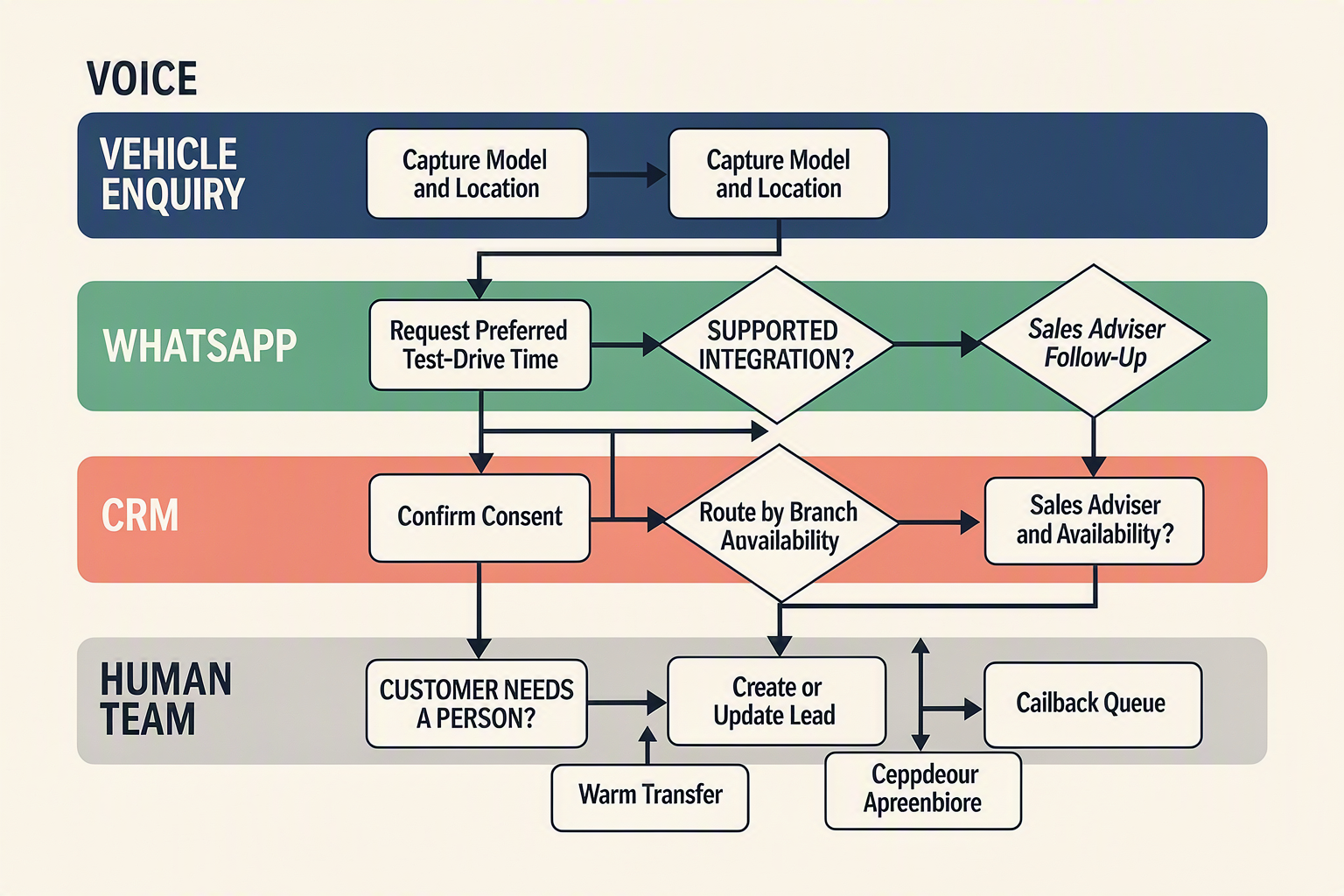
A vehicle enquiry should become one traceable CRM journey: identify the buyer’s intent, qualify the request, offer a verified test-drive slot, assign an accountable owner and continue on WhatsApp only with appropriate consent. Effective car dealership call automation should never create parallel leads or promise inventory, pricing or appointments that dealership systems have not confirmed.
1. Capture the first contact as structured data
The automotive AI receptionist should begin with a short disclosure and determine whether the customer wants a new vehicle, used vehicle, test drive, quotation, exchange valuation or finance discussion. Instead of collecting an exhaustive profile, capture only the information needed for the next action:
- Customer name and validated mobile number
- Preferred model, variant, fuel type and transmission
- Location or preferred dealership branch
- Purchase timeframe and test-drive interest
- Language and contact-channel preference
- Consent status for WhatsApp or future promotional communication
The workflow should search the CRM using the normalized phone number before creating a record. If a matching contact or open opportunity exists, append the interaction to that record rather than generating a duplicate lead.
2. Qualify without making unsupported promises
Qualification should help the sales team prioritize—not allow the AI agent to invent availability or discounts. Connect the agent to approved inventory, pricing and campaign data where those integrations are available.
A safe response is: “I can record your preference and ask the dealership team to confirm availability.” The agent should use this fallback when model allocation, delivery dates, exchange values or final on-road pricing cannot be verified.
Apply explicit escalation rules for:
- Immediate-purchase or fleet enquiries
- Discount negotiation and trade-in valuation
- Loan rejection, insurance or documentation disputes
- Repeated callers and dissatisfied customers
- Requests involving unavailable or unverified inventory
3. Book the test drive against real capacity
A test-drive appointment should be offered only after checking the relevant branch calendar, demonstrator vehicle and sales-adviser availability. The automation can collect the preferred date, time, pickup location and driving-licence confirmation, but dealership policy should determine whether a licence image is necessary before arrival.
Use a two-stage appointment state:
- Requested: the customer has selected a preferred slot.
- Confirmed: the dealership calendar or assigned employee has accepted it.
This distinction prevents an AI-generated conversational confirmation from being mistaken for an operational booking. Send the confirmed branch, model, time, contact person and rescheduling instructions through the customer’s permitted channel.
4. Route the lead and establish CRM ownership
Routing should use deterministic rules before round-robin allocation. Relevant fields include PIN code, branch, vehicle model, language, lead source, purchase timeframe and existing relationship.
Every accepted lead needs:
- One primary CRM owner
- A response deadline or service-level target
- A visible status such as new, contacted, qualified, appointment requested, test drive completed or closed
- A reassignment rule when the owner is absent or misses the deadline
- A complete call summary and next action
CallMissed for automotive can support this flow through AI voice agents, an omnichannel inbox/CRM and WhatsApp follow-up. Actual assignment, calendar and inventory behaviour depends on the dealership’s configured integrations and permissions.
5. Continue on WhatsApp with consent and context
WhatsApp follow-up should reference the enquiry rather than restart it: “You asked about a test drive for the [model] at [branch].” Record when and how the customer agreed to receive the message, distinguish transactional updates from marketing, and honour opt-outs across connected workflows.
For missed calls, send a neutral recovery message or initiate an approved callback workflow. Do not assume that a missed call itself grants permission for recurring campaigns. The final CRM record should preserve the original source, transcript or summary, consent state, appointment outcome and human owner so reporting reflects the complete journey rather than disconnected channel activity.
How can a service center handle booking requests, rescheduling, service-status questions, urgent issues, and adviser handoff?
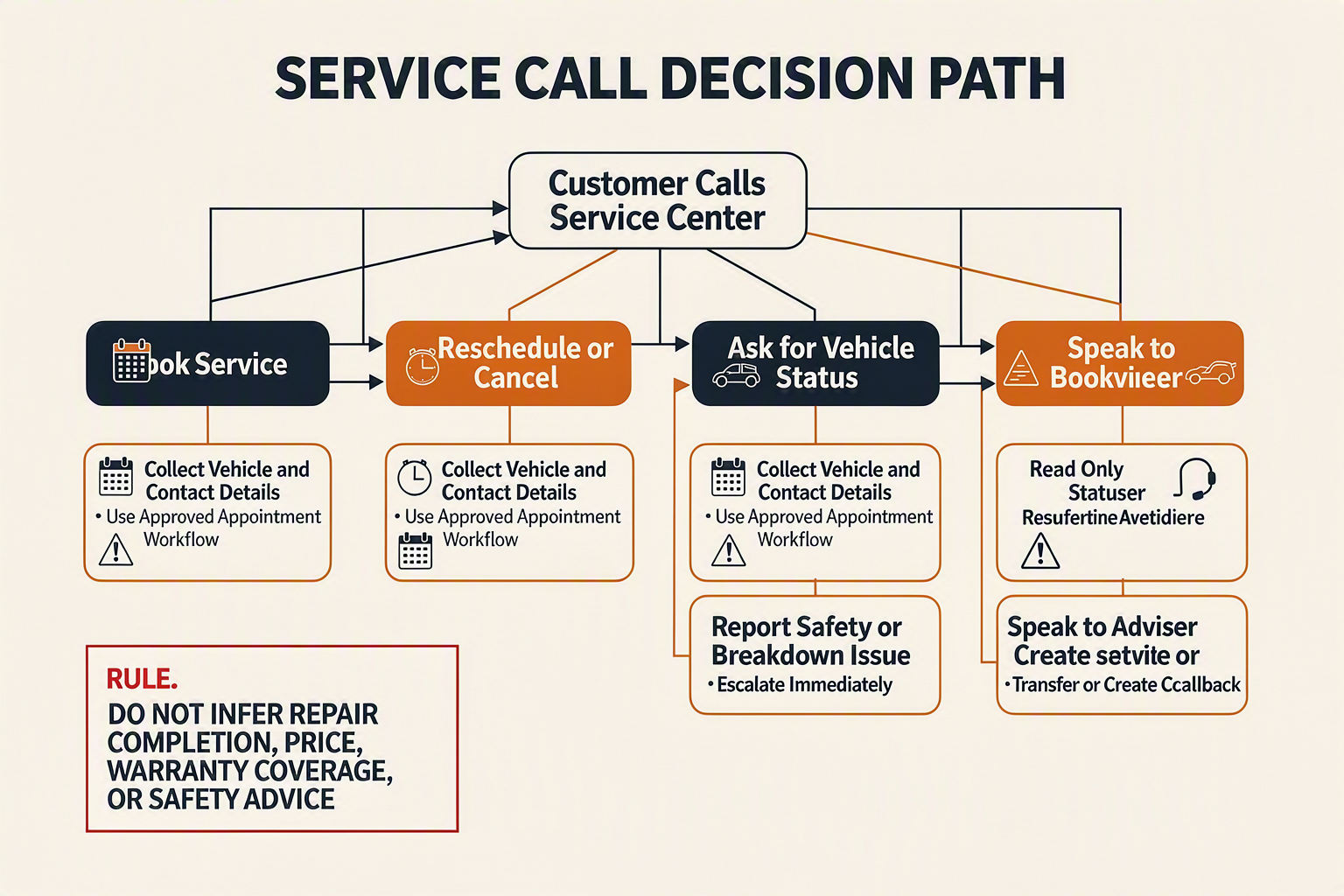
A service center should use an automotive AI receptionist to classify each request, verify the customer and vehicle, read only approved workshop data, and either complete a low-risk action or transfer the conversation to an adviser. Booking and rescheduling can be automated when live slot data is available; diagnosis, safety concerns, disputes and uncertain status records require human handling.
Separate the five service intents
Configure CallMissed for automotive to identify the customer’s objective before collecting unnecessary information:
- New booking: Capture the registration number, vehicle model, requested service, preferred location, date and time.
- Rescheduling or cancellation: Locate the existing appointment using a booking reference or verified mobile number, then offer valid alternatives.
- Service-status enquiry: Retrieve an approved status from the dealer management system, CRM or workshop application.
- Urgent issue: Detect safety-related language and prioritize a live transfer or approved roadside-assistance path.
- Adviser request: Route the customer to the assigned adviser or create a callback task with context.
The agent should distinguish an urgent situation from a routine repair request. Phrases such as “brake failure,” “smoke from the engine,” “vehicle stranded,” “accident” or “child locked inside” should bypass ordinary queues. The AI must not diagnose the vehicle, promise that it is safe to drive or substitute for emergency services.
Book and reschedule against verified availability
Reliable car dealership call automation must not invent appointment slots. Connect the workflow to the service center’s calendar, CRM or dealer management system where an integration is available; otherwise, capture a preferred window and label it “awaiting confirmation.”
Before confirming a booking, validate:
- Customer name and callback number
- Vehicle registration or VIN fragment
- Vehicle model and service category
- Workshop location and adviser preference
- Available date, arrival window and pickup requirement
- Explicit confirmation of the final slot
For rescheduling, preserve the original appointment until the replacement slot is successfully recorded. The workflow should write the change back to the system of record and send a confirmation through the customer’s permitted channel, such as WhatsApp or email. Avoid treating an AI-generated message as proof that the workshop calendar was updated.
Answer status questions without overpromising
Status responses should come from structured, timestamped workshop fields—not a general knowledge base. Useful states include vehicle received, inspection underway, estimate awaiting approval, parts pending, repair in progress, quality check, washing and ready for delivery.
A safe response names the update time: “The workshop record showed ‘quality check’ at 3:20 p.m.; your adviser has not yet confirmed a delivery time.” If the record is missing, contradictory or stale, the assistant should create an adviser callback rather than infer progress.
Make adviser handoff context-rich
CallMissed supports AI voice agents, WhatsApp interactions and an omnichannel inbox, enabling service conversations to continue across channels. Actual CRM lookup, appointment updates and adviser routing depend on the dealership’s configured integrations and permissions.
Each handoff should include:
- Verified customer and vehicle identifiers
- Intent and urgency classification
- Appointment or repair-order reference
- A concise conversation summary
- Promises already made and requested callback time
- Transfer result: connected, declined, failed or callback queued
If a live transfer fails, the customer should hear the next action and expected response window. This closes the loop without falsely claiming that an adviser has received or accepted the case.
What consent, CRM, privacy, WhatsApp, and human-escalation controls should be approved before launch?
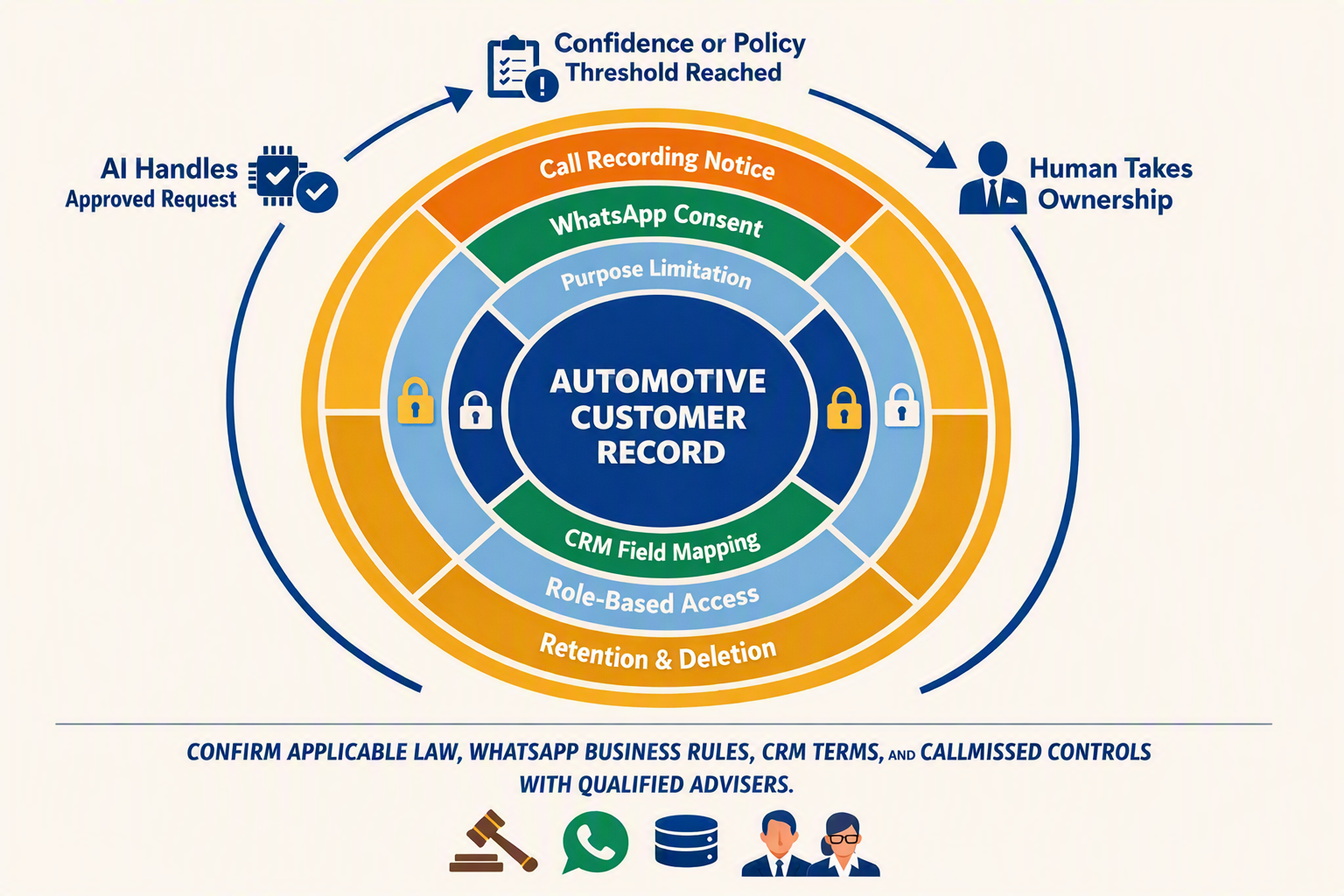
Before launch, the dealership should approve a written control matrix covering consent, data access, CRM ownership, WhatsApp permissions, retention and mandatory human handoffs. No automotive AI receptionist should contact customers or expose vehicle records until business, legal, IT and operational owners have signed off on these rules.
Establish consent and privacy boundaries
India’s Digital Personal Data Protection Act received presidential assent on 11 August 2023, according to the Ministry of Electronics and Information Technology. Dealerships should obtain legal advice on the Act, applicable rules and sector-specific requirements rather than treating platform configuration as legal compliance.
Approve controls for:
- Purpose-specific collection: Capture only information needed for the enquiry, appointment or follow-up—such as name, phone number, preferred model, registration number and service location.
- Clear disclosure: Tell callers when they are interacting with AI and whether the conversation is recorded or transcribed.
- Channel-level consent: Do not assume that permission to receive a service callback also authorises promotional WhatsApp, email or voice campaigns.
- Withdrawal and suppression: Store opt-outs centrally and prevent subsequent campaigns from re-importing suppressed contacts.
- Retention: Define separate periods for recordings, transcripts, CRM notes, consent evidence and unsuccessful leads.
- Sensitive data: Prevent agents from requesting payment credentials, one-time passwords or unnecessary identity documents.
TRAI’s Telecom Commercial Communications Customer Preference Regulations, 2018 govern commercial communications in India, so promotional calling and messaging workflows should be reviewed against current registration, preference and consent requirements.
Make the CRM the controlled source of truth
For car dealership call automation, every interaction needs a deterministic record owner. Approve which system controls inventory, appointment availability, repair status and customer preferences before connecting it to CallMissed for automotive.
The CRM specification should define:
- Required fields: customer identity, vehicle or model, intent, branch, language, consent source, timestamp and outcome.
- Matching rules: decide whether phone number, lead ID, vehicle identification number or registration number prevents duplicates.
- Write permissions: allow the agent to update only approved fields; protect finance, warranty and workshop notes with role-based access.
- Conflict handling: route ambiguous customer or vehicle matches to staff instead of guessing.
- Auditability: retain the source, timestamp and actor for material changes.
The dealership’s privacy review should also cover CallMissed’s configurable CRM and knowledge integrations, including what data is sent to connected services and which employees can retrieve transcripts.
Approve WhatsApp messaging and calling rules
Meta’s WhatsApp Business Platform generally requires an approved message template for business-initiated messages outside the 24-hour customer-service window, according to Meta’s platform documentation. Because Meta’s policies can change, teams should verify the current rules immediately before launch.
Document:
- The opt-in language and where consent evidence is stored.
- Which templates support test drives, service reminders and missed-call recovery.
- Frequency limits and quiet hours.
- Opt-out keywords and immediate suppression behaviour.
- Permission requirements for business-initiated WhatsApp calls.
- Prohibited use of service updates as disguised marketing.
Define non-negotiable human escalation
Human transfer should be mandatory for accidents or roadside emergencies, safety complaints, payment disputes, legal threats, repeated recognition failures, emotional callers and uncertain repair-status data. Approve the destination team, operating hours, maximum wait time and fallback when nobody answers.
The handoff must include a concise transcript summary, verified customer details and the reason for escalation. Before production, test that the AI never promises inventory, pricing, credit approval, repair completion or emergency assistance unless an authorised system has confirmed it.
Which experts should validate the deployment, and which QA scenarios should they test before customers encounter it?
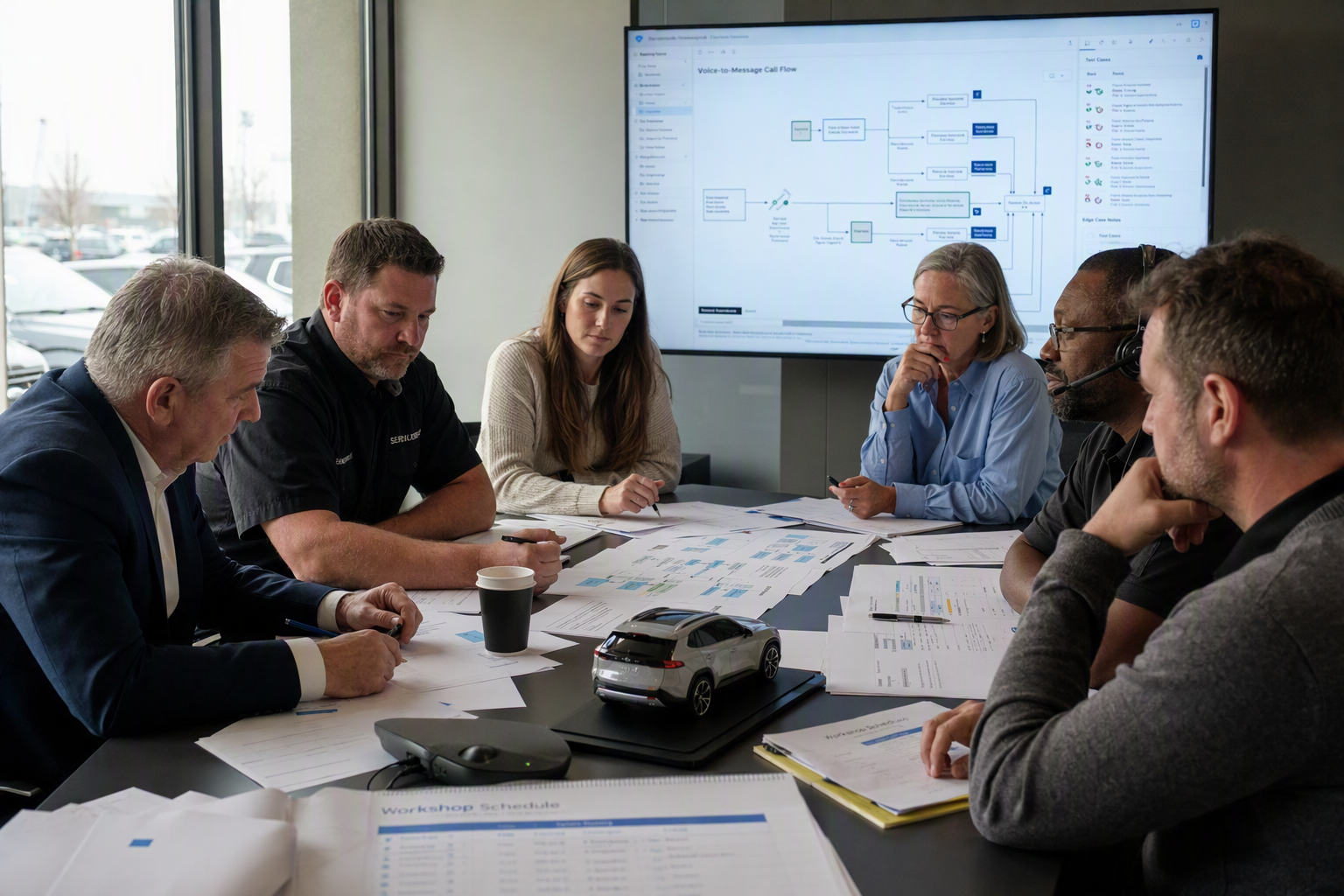
A cross-functional team—not the automation vendor alone—should approve an automotive AI receptionist before launch. Dealership operations, sales, service, CRM, privacy, language and frontline experts must validate both successful journeys and controlled failures using anonymised or synthetic customer data.
Experts who should sign off
Assign named owners rather than relying on a general “business approval”:
- Dealer principal or operations lead: Confirms opening hours, branch boundaries, escalation policy and acceptable customer experience.
- Sales manager: Validates model, variant, fuel type, transmission, colour, pricing-disclaimer and test-drive workflows.
- Service manager or workshop controller: Checks appointment capacity, repair-status terminology, pickup promises and urgent vehicle-safety escalation.
- CRM or dealer-management-system administrator: Verifies field mapping, deduplication, lead ownership, timestamps and source attribution.
- Front-desk and call-centre representatives: Identify phrases, interruptions and edge cases that process designers may overlook.
- Privacy and compliance reviewer: Approves consent language, recording notices, retention periods, role-based access and WhatsApp follow-up rules.
- Regional-language reviewers: Test pronunciation, code-switching and intent recognition with speakers from the dealership’s actual market—not merely translated scripts.
- Integration or QA engineer: Exercises telephony, calendars, CRM APIs, WhatsApp delivery, retries, monitoring and rollback controls.
CallMissed supports voice workflows across 22 Indian languages, but each dealership must validate its own vehicle names, local accents, branch vocabulary and knowledge sources. Platform language availability does not remove the need for market-specific testing.
Minimum pre-launch QA scenarios
Test complete journeys across phone, WhatsApp and CRM rather than checking isolated responses:
- Vehicle enquiry: Ask about a current model, discontinued model, unavailable colour and ambiguous variant. The agent should avoid inventing inventory or an on-road price and should create a correctly attributed lead.
- Test-drive request: Try valid, fully booked, after-hours and duplicate bookings. Confirm that the system reads availability from the configured source and never treats an unverified request as confirmed.
- Service appointment: Test routine maintenance, breakdowns, warning lights, accident damage and recall questions. Safety-sensitive cases should reach an authorised person without attempting diagnosis.
- Missed-call recovery: Simulate repeated calls from one number, an unknown caller, an opted-out contact and a callback failure. Verify frequency limits and suppression rules.
- Lead routing: Submit sales, service, finance, insurance and complaint intents for multiple branches. Check owner assignment, fallback queues and what happens when nobody accepts a transfer.
- Service-status question: Use correct, incorrect and partially spoken registration numbers. The agent must authenticate appropriately and avoid exposing another customer’s repair details.
- WhatsApp follow-up: Test consent present, consent absent, delivery failure, customer opt-out and a reply that changes intent.
- Human escalation: Interrupt the agent, express frustration, request a manager or use an unsupported language. Preserve the transcript and context so the customer does not need to repeat everything.
- System failure: Disconnect the CRM, calendar or knowledge base; introduce latency; and terminate a call mid-transaction. The workflow should disclose uncertainty, capture a callback request and avoid false confirmation.
Release gates and evidence
For car dealership call automation, define measurable gates before exposing traffic: 100% pass rates for consent, identity protection, emergency escalation and false-confirmation tests are sensible internal requirements, not industry benchmarks. Record test case, language, channel, expected result, actual result, owner and remediation date.
Deploy CallMissed for automotive in stages—internal users, one branch or queue, limited operating hours, then broader traffic. Re-test after every script, model, CRM-field, routing or knowledge-base change, and maintain a human fallback and rollback plan throughout.
What should your dealership measure during the pilot, and how should each metric drive action?
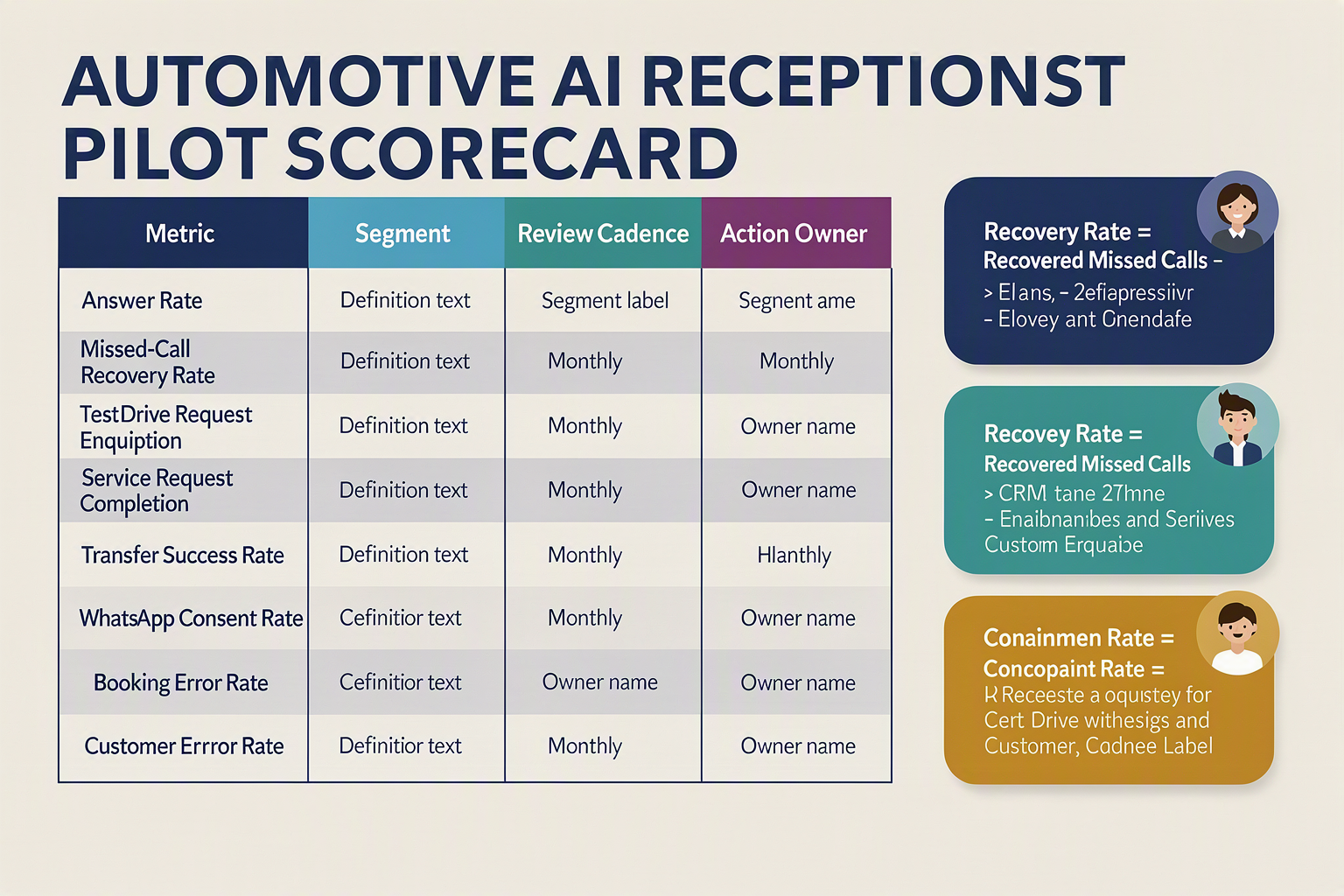
Measure whether the pilot captures demand, routes it correctly and produces completed customer outcomes without increasing risk. Each metric should trigger a predefined operational response; avoid treating call volume or conversations handled as proof that the automotive AI receptionist is working.
Pilot scorecard and action rules
| Metric | How to calculate it | Break down by | Action when performance weak |
|---|---|---|---|
| Answer rate | Calls answered ÷ total eligible inbound calls × 100 | Hour, branch, sales/service queue, language | Check number routing, agent availability, concurrency limits and after-hours rules. Separate customer hang-ups from genuine platform failures. |
| Missed-call recovery rate | Missed callers who reconnect, reply on WhatsApp or receive a completed callback ÷ missed callers contacted × 100 | Callback delay, channel, intent, time of day | Test shorter callback windows, revise the WhatsApp message and confirm that consent and contact-preference rules permit follow-up. Suppress duplicate outreach after a customer responds. |
| Qualified-lead rate | Enquiries containing the dealership’s required fields ÷ sales enquiries handled × 100 | Vehicle model, source, branch, language, new/used vehicle | Review prompts for model, location, purchase timeline, finance interest and exchange requirements. If completion falls at one question, simplify or defer that field to a salesperson. |
| Appointment completion rate | Test drives or service visits completed ÷ appointments booked × 100 | Appointment type, branch, booking channel, reminder status | Audit slot accuracy and reminder timing. A high booking rate with low attendance may indicate unsuitable slots, unclear locations or bookings created without explicit confirmation. |
| Transfer success rate | Human transfers connected to the correct team ÷ attempted transfers × 100 | Department, urgency, operating hours, transfer reason | Correct routing tables, staff schedules and fallback queues. If no employee answers, create a CRM task and tell the customer when to expect contact rather than leaving the call unresolved. |
| Response latency and opt-out rate | Track median and 95th-percentile response time; calculate opt-outs ÷ follow-up recipients × 100 | Voice/WhatsApp, campaign, template, language | Investigate long-tail delays even when the average looks healthy. Pause or revise follow-ups if opt-outs rise after a particular template, frequency or customer-intent category. |
These are measurement definitions, not universal industry benchmarks. Establish each branch’s pre-pilot baseline, then set an improvement threshold and a safety limit before enabling automation. For example, a dealership might require a measurable reduction in unrecovered missed calls while imposing zero tolerance for bookings against unavailable workshop capacity.
Read metrics as a connected funnel
Evaluate car dealership call automation as a funnel rather than six isolated percentages:
- Demand reached: answer rate and missed-call recovery.
- Intent understood: qualified-lead rate and routing accuracy.
- Commitment created: confirmed test-drive or service booking.
- Outcome delivered: appointment completed or human follow-up closed.
- Trust protected: opt-outs, complaints, incorrect answers and consent exceptions.
A higher answer rate is not a win if transfer failures increase. Likewise, more appointments can conceal poor performance if customers do not attend or workshop advisers must manually correct inaccurate records.
Run a controlled review cadence
For a CallMissed for automotive pilot, review operational failures daily and funnel trends weekly. Segment results by branch, intent, operating hours and language; the CallMissed product specification covers 22 Indian languages, so aggregate reporting can otherwise hide a weak regional-language flow.
Maintain a QA sample containing successful and failed conversations. Review transcripts or recordings under the dealership’s access and retention policy, then classify failures as knowledge, speech recognition, workflow, integration, staffing or customer-choice issues. Expand the pilot only when gains persist across multiple review periods and guardrails—especially consent, booking accuracy and human escalation—remain within the thresholds approved before launch.
Frequently asked questions about CallMissed, automotive AI receptionists, dealership integrations, consent, languages, pricing, and fallback handling
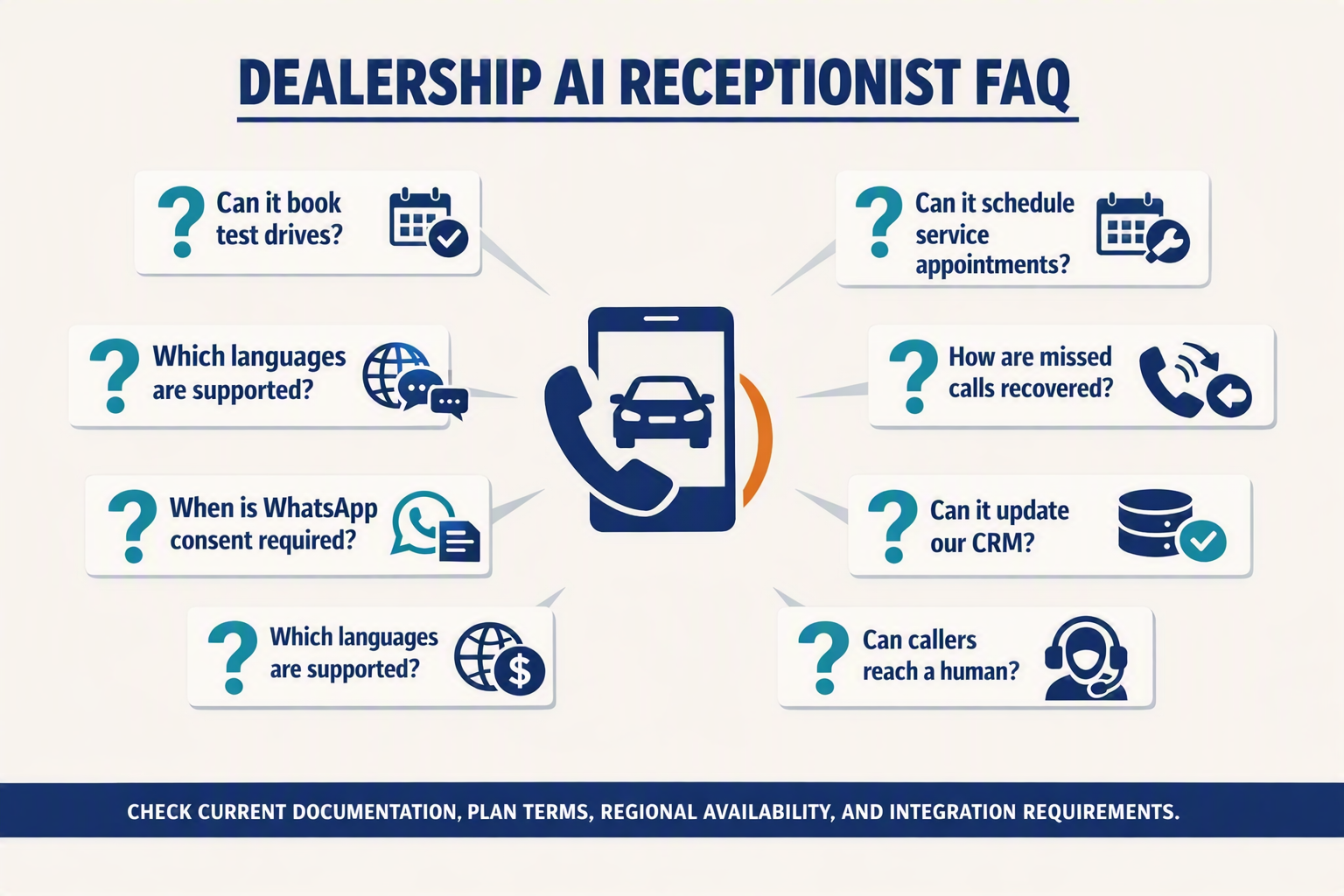
Deployment and dealership integrations
How does CallMissed for automotive handle vehicle enquiries and appointment requests?
Can an automotive AI receptionist integrate with dealership CRM and workshop systems?
How should car dealership call automation route sales, service and emergency calls?
Consent, languages and operational resilience
Does CallMissed support Indian languages for dealership voice calls?
What consent is required for WhatsApp follow-up after a missed dealership call?
How much does CallMissed cost, and what happens if the AI or integration fails?
Conclusion
An automotive AI receptionist should turn every customer interaction into a clear, traceable next step—not simply answer more calls. For dealerships and service centers, the practical goal is to capture intent, recover missed opportunities, coordinate follow-up and involve employees whenever negotiation, diagnosis or empathy is required.
Key takeaways
- Design workflows around customer intent. Vehicle enquiries, quotation requests, test-drive bookings, service appointments, roadside escalations and repair-status questions each require different data, routing rules and escalation paths. Appointment confirmations should always rely on verified inventory, calendars or workshop capacity.
- Connect every channel to a reliable customer record. Effective car dealership call automation should write consent, contact preferences, vehicle details, lead source, appointment status and conversation outcomes into the CRM. A shared record across voice, WhatsApp, email and web interactions reduces duplicate leads and prevents customers from repeatedly explaining the same issue.
- Treat missed-call recovery and WhatsApp follow-up as governed workflows. Teams should define when callbacks or messages are appropriate, identify the business clearly and respect opt-outs. CallMissed supports AI voice agents, WhatsApp chatbots, WhatsApp Business calling and an omnichannel inbox, helping dealerships coordinate follow-up without separating each conversation into a different system.
- Measure outcomes, not activity alone. Answer rate and response latency matter, but qualified-lead rate, missed-call recovery, transfer success, appointment completion and opt-out rate reveal whether automation is producing useful customer outcomes. Quality assurance should also test unavailable vehicles, full service calendars, duplicate records, incorrect registration numbers and uncertain service-status data.
India recorded 4.30 million domestic passenger-vehicle sales in FY2024–25, according to the Society of Indian Automobile Manufacturers in April 2025. As those vehicles generate years of sales and after-sales communication, multilingual accessibility will become increasingly important. CallMissed for automotive workflows can support regional engagement through voice capabilities across 22 Indian languages while preserving human handoff for sensitive or high-value conversations.
Looking ahead, watch for tighter CRM synchronization, more reliable availability checks and stronger consent governance across voice and WhatsApp. To explore how this model is evolving, visit CallMissed—and ask: how many valuable customer journeys currently end with an unanswered ring?
Related Reading
Discussion
Related Posts

Ready to automate customer conversations?
Launch AI voice agents and WhatsApp bots with CallMissed — one API, 22+ Indian languages.