
CallMissed for Healthcare: Safe AI Receptionist Guide for Clinics


Learn how an AI receptionist for clinics can handle enquiries and follow-up, with privacy boundaries, human escalation, and a deployment checklist.
CallMissed for Healthcare: Safe AI Receptionist Guide for Clinics
What happens when a patient’s call about an appointment goes unanswered—but the clinic cannot safely assume whether the message is routine or urgent? CallMissed for healthcare can help clinics capture enquiries, collect appointment requests, recover missed calls, and maintain continuity across voice, WhatsApp, email, and web, while keeping clinical judgement and urgent care firmly with qualified humans.
Why clinics need safer communication automation
Administrative pressure is rising alongside workforce constraints. The World Health Organization’s 2022 workforce projections estimated a global shortage of 10 million health workers by 2030, concentrated mainly in low- and lower-middle-income countries. Every repetitive scheduling call or unanswered enquiry therefore represents time that could be managed more efficiently—provided automation operates within clearly defined boundaries.
India’s privacy environment also makes careful design essential. India enacted the Digital Personal Data Protection Act on August 11, 2023, establishing requirements around lawful processing, notice, consent, security safeguards, and individuals’ rights. A clinic should not interpret software availability as proof of legal, medical, or regulatory compliance; consent wording, retention periods, call recording, data access, vendor agreements, and cross-border processing require legal and account-level confirmation.
A well-configured AI receptionist for clinics should behave like an administrative front desk, not a clinician. Appropriate tasks can include:
- Recording a patient’s name, preferred contact channel, and general reason for contacting the clinic
- Accepting an appointment request without promising availability until the scheduling system or staff confirms it
- Following up after a missed call through an approved voice, WhatsApp, or email workflow
- Answering verified operational questions such as opening hours, location, consultation process, and accepted payment methods
- Escalating sensitive, ambiguous, distressed, or urgent messages to trained personnel
The safe boundary is equally important: an AI agent should not diagnose symptoms, recommend treatment, interpret test results, determine emergency severity, or imply that a clinician has reviewed a message.
What this guide will help you build
CallMissed combines AI voice agents, WhatsApp chatbots, WhatsApp Business calling, an omnichannel inbox, knowledge-base retrieval, and email tooling. Its support for speech and voice across 22 Indian languages is particularly relevant for clinics serving regional-language patients, but each language, accent, script, and escalation path still needs real-world testing.
This guide explains how to design healthcare communication automation for enquiry intake, appointment requests, missed-call recovery, cross-channel continuity, and human handoff. It also separates verified CallMissed capabilities from workflows that depend on live-product configuration, external scheduling integrations, clinic policy, legal advice, or account approval. The final deployment checklist will cover consent, privacy, minimum-data collection, urgent-message disclaimers, knowledge-base controls, staff ownership, fallback behaviour, testing, and ongoing review—because a useful healthcare receptionist must know not only how to respond, but when to stop and bring in a human.
What is CallMissed for healthcare, and what should clinics use it for?
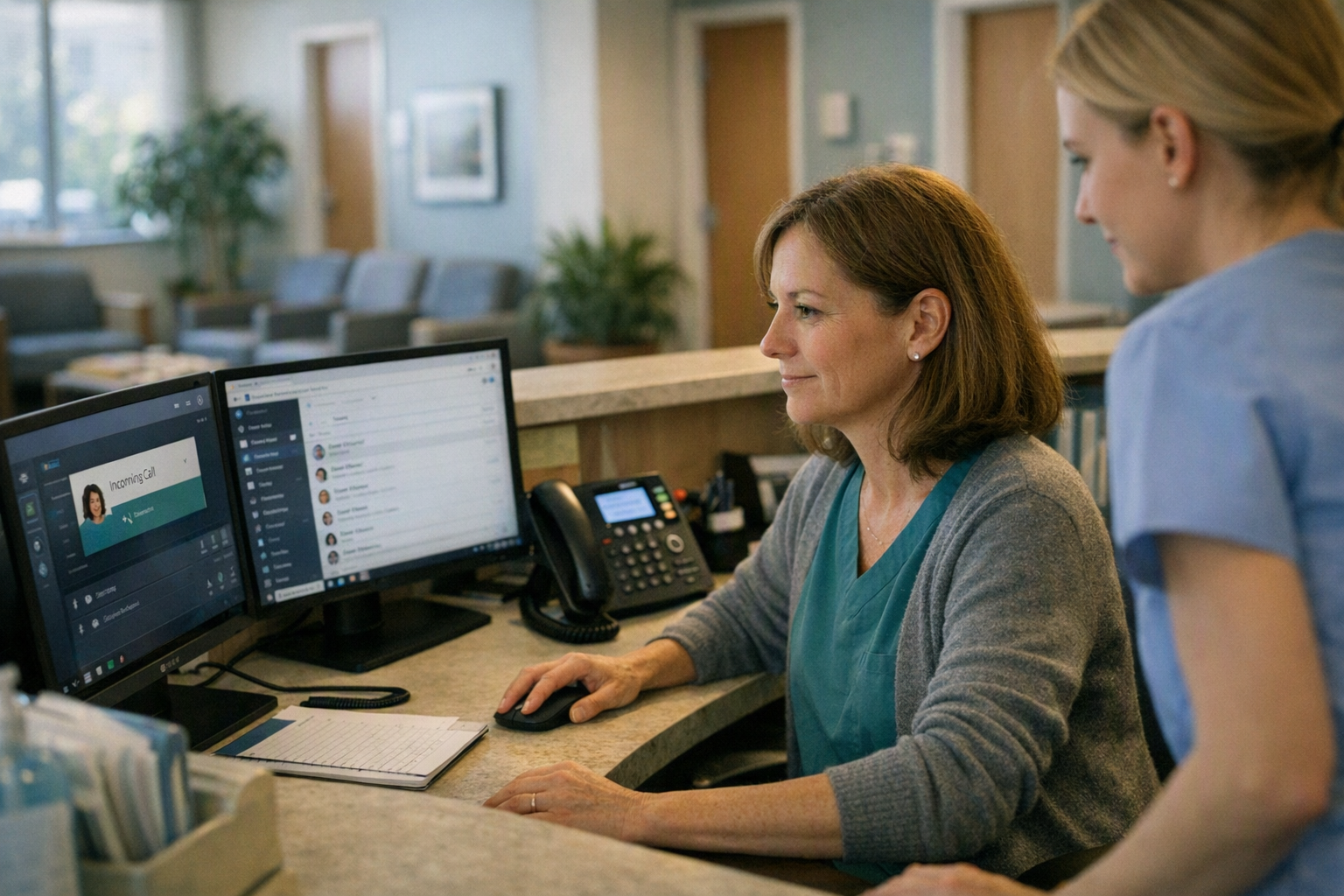
CallMissed for healthcare is a configurable communication platform for non-clinical patient interactions. It supports voice, WhatsApp, email, and web channels.
Clinics can use it to:
- Capture patient enquiries
- Coordinate appointment requests
- Follow up on missed calls
- Answer approved administrative questions
- Route conversations to authorised staff
It should not diagnose, triage, prescribe, provide medical advice, or replace clinical judgement.
Where CallMissed fits in a clinic’s workflow
CallMissed combines AI voice agents, WhatsApp chatbots, WhatsApp Business calling, an omnichannel inbox, knowledge-base retrieval, and campaign and email tools. Each clinic must configure and test these capabilities for its own workflows.
A carefully configured AI receptionist for clinics can support:
- Patient enquiry intake: Collect a caller’s name, contact details, preferred language, and general reason for contacting the clinic.
- Appointment requests: Record the requested doctor, department, location, visit type, date, and preferred time.
- Missed-call follow-up: Start an approved callback or messaging workflow after an unanswered call.
- Administrative FAQs: Provide clinic-approved information about opening hours, directions, consultation procedures, required documents, and payment options.
- Human escalation: Route sensitive, unclear, distressed, urgent-sounding, or out-of-scope conversations to qualified staff.
CallMissed supports speech and voice across 22 Indian languages. This can improve access for multilingual communities. Clinics should still test every enabled language with local accents, mixed-language speech, medical names, background noise, and real phone connections.
Use CallMissed for continuity, not autonomous care
The main benefit of CallMissed for healthcare is continuity across communication channels.
For example, a patient may call after hours and leave a general appointment request with an AI voice agent. The system may then send an approved WhatsApp acknowledgement. A receptionist can later review the request and confirm the appointment through the same workflow.
A safe process separates three tasks:
- Capture: Record what the patient says without making a clinical interpretation.
- Coordinate: Add the request and channel history to the correct staff inbox or queue.
- Escalate: Transfer control when a message is urgent-sounding, sensitive, ambiguous, distressed, or outside the approved knowledge base.
The AI should use clear wording, such as:
“Your appointment request has been received but is not yet confirmed.”
It must not imply that an appointment is confirmed or that a clinician has reviewed the request unless the system can verify that event.
Urgent or potentially clinical cases require clear redirection and review by qualified humans. The clinic—not the AI—must define emergency instructions, escalation owners, and response expectations.
What clinics must verify before launch
Using CallMissed for healthcare does not by itself establish medical, privacy, security, or regulatory compliance. Requirements depend on the clinic’s location, configuration, vendors, contracts, and intended use.
Before relying on a workflow, confirm:
- Whether the appointment or electronic health record system has a supported integration
- How WhatsApp consent, message templates, business-initiated calls, and opt-outs apply
- Whether calls are recorded or transcribed and what notice or consent may be required
- Where data is processed and how long it is retained
- Which staff members and service providers can access patient information
- How notifications, after-hours queues, retries, and failed escalations work
- Which contractual, privacy, and security terms apply to health-related information
Clinics should verify these points in the live product and their account settings. They should also consult relevant service providers and qualified legal or compliance advisers.
The appropriate role of CallMissed for healthcare is administrative communication with human oversight. Clinical decisions, medical advice, urgent-message handling, and emergency response must remain with properly trained and authorised people.
Why are clinics adopting healthcare communication automation?
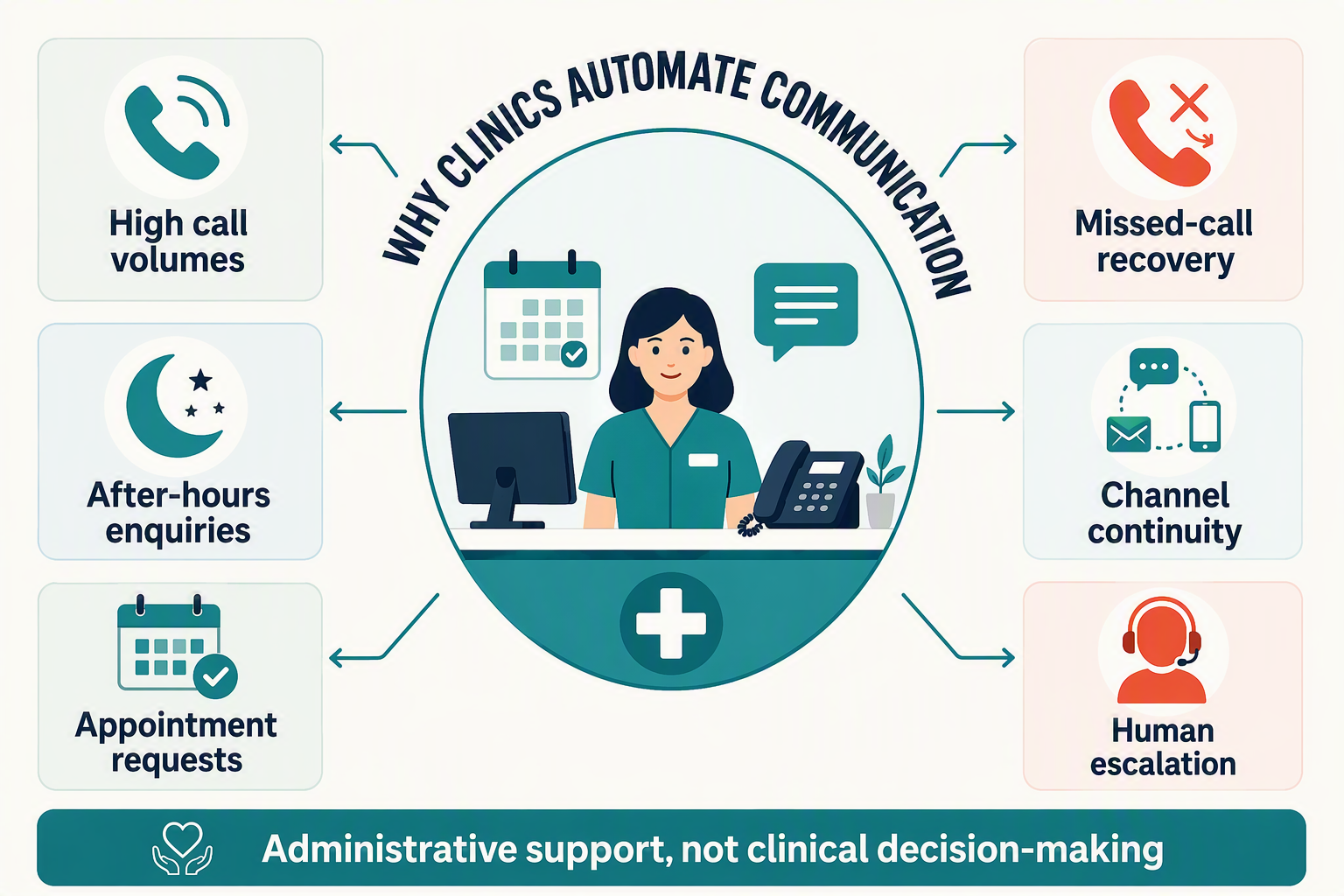
Clinics are adopting healthcare communication automation to reduce administrative bottlenecks, respond consistently outside reception hours, and prevent routine enquiries from disappearing between channels. The objective is not to automate medical judgement; it is to give staff a structured, reviewable queue of patient requests that would otherwise remain in voicemails, inboxes, or call logs.
Administrative demand rarely follows reception hours
Patients may contact a clinic while staff are assisting someone at the desk, supporting a consultation, or handling billing and records. A healthcare AI receptionist can capture the request immediately without treating it as a confirmed booking or clinical case.
Common adoption drivers include:
- Uneven call volumes: Several patients may call simultaneously, although a receptionist can handle only one conversation at a time.
- After-hours enquiries: Patients often want to submit appointment requests when the front desk is closed.
- Repeated operational questions: Opening hours, directions, consultation procedures, and payment options consume staff time despite having standard answers.
- Missed-call leakage: A telephone number alone does not reveal the caller’s intent, preferred language, or appropriate next step.
- Fragmented conversations: A patient may call first, reply on WhatsApp later, and send supporting administrative information by email.
The World Health Organization’s 2022 workforce projections estimated a global shortage of 10 million health workers by 2030, making the responsible reduction of repetitive administrative work increasingly relevant.
Automation turns interruptions into structured work
A carefully scoped AI receptionist for clinics changes the front desk from a sequence of interruptions into a prioritised workflow:
- Capture: Record essential contact details and the patient’s non-clinical request.
- Classify: Separate appointment, location, payment, records, callback, and other administrative enquiries.
- Continue: Send an approved acknowledgement or move the conversation to the patient’s permitted channel.
- Escalate: Route uncertain, sensitive, distressed, or potentially urgent messages to trained staff.
This structure can improve operational consistency without implying that every request should receive an automated resolution. A patient asking for clinic hours may receive a verified answer; a patient describing symptoms should encounter an urgent-care notice and human escalation policy rather than automated interpretation.
Omnichannel continuity is a practical reason to adopt
CallMissed for healthcare provides verified building blocks including AI voice agents, WhatsApp chatbots, WhatsApp Business calling, an omnichannel inbox, knowledge-base retrieval, and email tooling. CallMissed also supports speech and voice across 22 Indian languages, which can help clinics design more accessible intake for regional-language communities.
These capabilities do not automatically establish a complete healthcare workflow. Clinics must confirm in the live product and relevant account configuration whether channel identity matching, appointment-system integration, recording controls, retention settings, access permissions, delivery templates, and escalation notifications work as required.
Adoption also creates accountability requirements
Automation can make communication more traceable by placing interactions into shared queues rather than personal phones or disconnected inboxes. However, clinics remain responsible for defining:
- Which information the agent may collect
- When consent or notice must be presented
- Who can access conversation records
- How quickly escalated messages must be reviewed
- What happens if WhatsApp, voice, email, or an integration fails
- Which language-specific scripts have been clinically and legally reviewed
The strongest adoption case is therefore administrative reliability with explicit human ownership. Automation receives and organises the request; authorised clinic staff decide what it means and what should happen next.
Which CallMissed capabilities are verified, and which require confirmation?
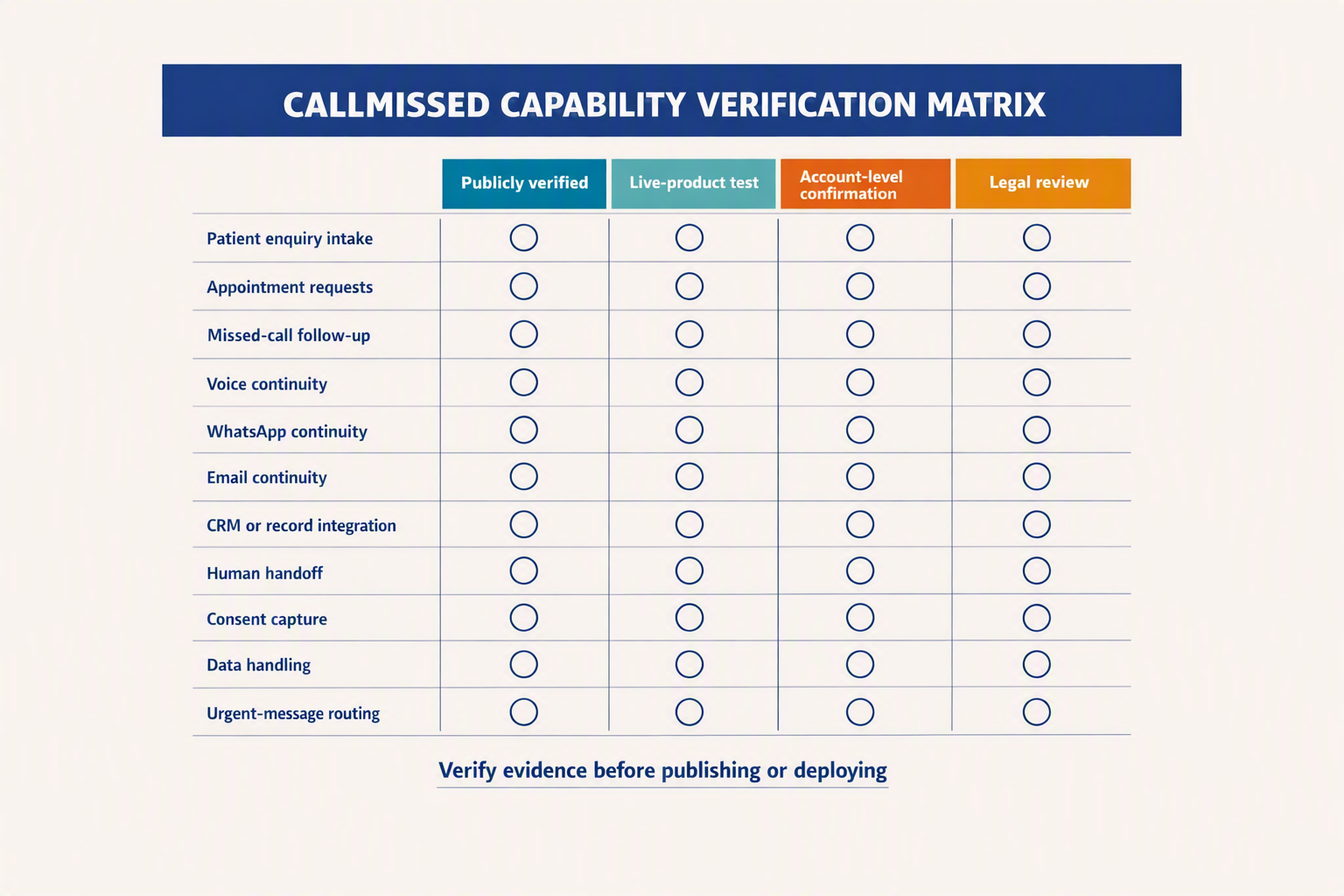
CallMissed’s communication building blocks are verified, but a clinic-specific deployment is not automatically verified as medically or legally compliant. Clinics should separate documented product capabilities from configurations that require live-product testing, account review, legal advice, and approval by clinical leadership.
Capability and confirmation matrix
| Area | Verified CallMissed capability | Suitable clinic use | What requires confirmation |
|---|---|---|---|
| AI voice agents | CallMissed supports AI voice agents for automated conversations. | Capture names, contact details, general enquiries, and appointment requests. | Phone-number availability, recording settings, consent prompts, retention, transfer behaviour, and performance under real call conditions. |
| Indian-language speech | CallMissed supports Speech-to-Text and Text-to-Speech across 22 Indian languages, according to CallMissed’s published product scope. | Offer regional-language intake for patients who may not prefer English. | Accuracy for each accent, dialect, medical name, mixed-language sentence, noisy environment, and clinic vocabulary. |
| WhatsApp communication | CallMissed provides WhatsApp chatbots and inbound and business-initiated WhatsApp Business calling. | Continue an enquiry on WhatsApp, send approved follow-ups, or bridge a WhatsApp call to an AI agent. | Meta template approval, patient consent, calling eligibility, business-initiated contact rules, account permissions, and country-specific availability. |
| Omnichannel operations | CallMissed includes an omnichannel inbox/CRM plus voice, WhatsApp, email, and web communication tooling. | Give authorised staff a shared place to review conversations and continue follow-up. | Identity matching, duplicate-contact handling, role-based access, audit requirements, message synchronisation, and integration with the clinic’s existing systems. |
| Knowledge-base retrieval | CallMissed supports knowledge-base retrieval-augmented generation, or RAG, for grounded responses. | Answer approved administrative questions about hours, location, services, and appointment procedures. | Source-document accuracy, update ownership, citation behaviour, refusal rules, and safeguards preventing clinical advice or result interpretation. |
| Campaign and follow-up tooling | CallMissed provides campaign and email capabilities that can support structured communication. | Send permitted reminders or recover a missed enquiry through an approved channel. | Trigger logic, message frequency, opt-out handling, consent evidence, deliverability, emergency exclusions, and whether automated health-related messaging is lawful. |
What “verified” does—and does not—mean
For CallMissed for healthcare, “verified” means the underlying platform capability is part of the stated product scope. It does not establish that a particular workflow is safe for patient data, connected correctly to a practice-management system, or approved for a clinic’s jurisdiction.
An AI receptionist for clinics should therefore pass four separate checks before launch:
- Live-product verification: Test the actual account, phone number, WhatsApp Business configuration, language models, fallback routes, and human-transfer flow.
- Operational approval: Have clinic leaders define which requests automation may complete, merely record, or immediately escalate.
- Privacy and legal review: Confirm notice, consent, access controls, recording, retention, deletion, processor terms, and cross-border data handling. India enacted the Digital Personal Data Protection Act on August 11, 2023, creating a statutory baseline that clinics must evaluate with qualified counsel.
- Safety validation: Use scripted tests for urgent phrases, distress, ambiguity, silence, failed transcription, disconnected transfers, and out-of-hours contact.
The safest interpretation of healthcare communication automation is administrative assistance with mandatory human escape routes. Clinics should not label a workflow “compliant,” “clinically safe,” or “emergency-ready” solely because its voice, WhatsApp, email, or RAG components are technically available.
How should an AI receptionist for clinics handle enquiries and appointment requests?
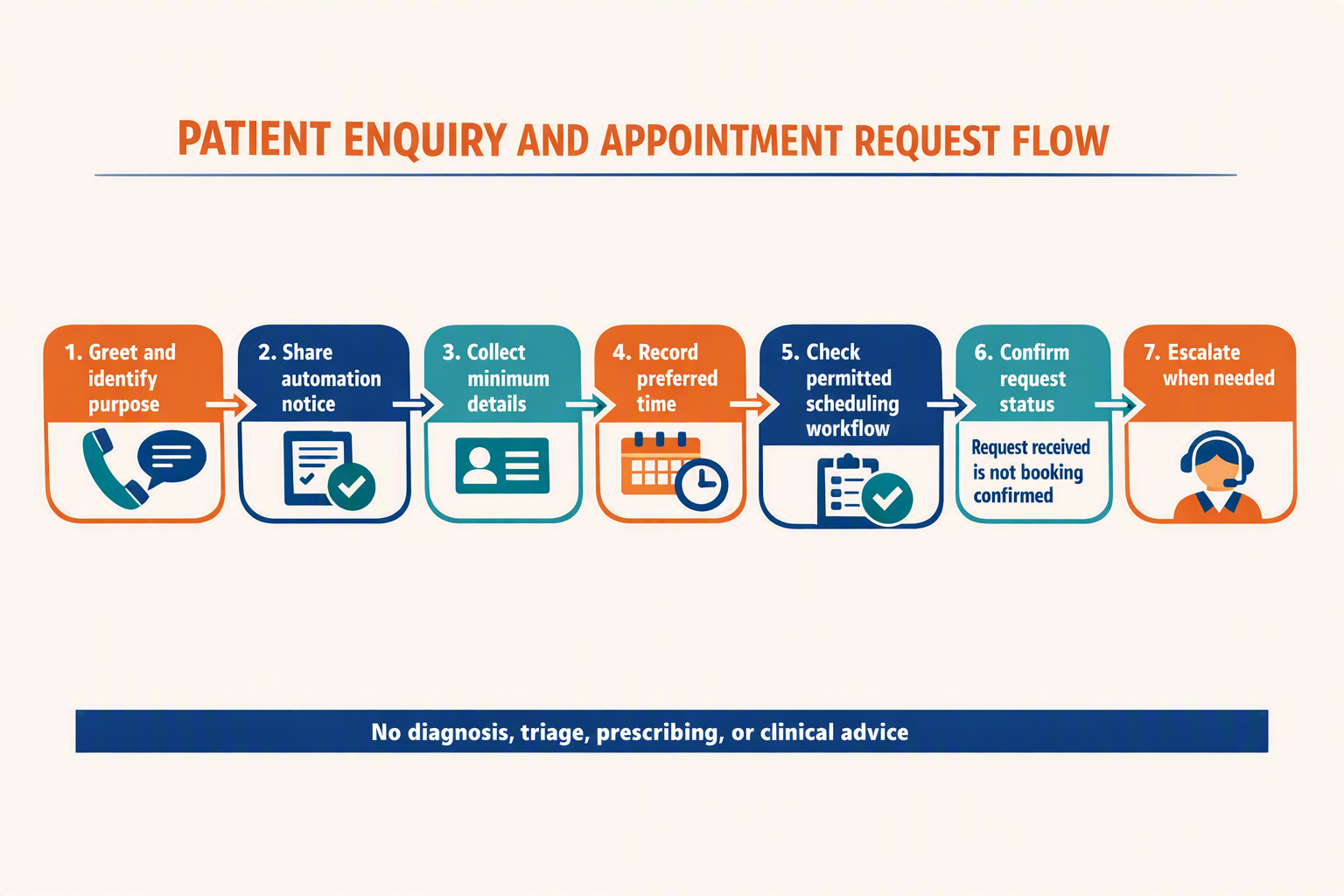
An AI receptionist for clinics should collect only the information needed to route an enquiry, treat every appointment as a request until availability is verified, and transfer urgent, sensitive, or uncertain conversations to a human. It should provide administrative continuity without diagnosing conditions or suggesting that a clinician has reviewed the patient’s message.
Use a structured enquiry-intake flow
The receptionist should follow a short, predictable sequence rather than conducting an open-ended clinical interview:
- Identify the caller: Ask for the patient’s name and, when necessary, a clinic-approved identifier.
- Capture contact preferences: Confirm whether the patient prefers voice, WhatsApp, or email and obtain the appropriate contact detail.
- Classify the administrative purpose: Use categories such as new appointment, rescheduling, cancellation, billing, directions, report collection, or clinician callback.
- Record the patient’s own words: Preserve the original message instead of converting it into an AI-generated clinical conclusion.
- Confirm the next step: State who will respond, through which channel, and within what clinic-approved service window.
The agent should request the minimum necessary information. Detailed medical history, identification documents, insurance records, or test reports should not be collected through a general-purpose workflow unless the clinic has approved the purpose, access controls, retention policy, and secure handling process.
Treat scheduling as a controlled transaction
A safe appointment workflow distinguishes clearly between requested, pending confirmation, confirmed, rescheduled, and cancelled statuses. An AI response such as “Your request for Tuesday at 3:00 p.m. has been recorded” is safer than “Your appointment is booked” when no live scheduling integration has returned a successful confirmation.
The workflow should:
- Ask for the preferred doctor, department, date range, and time window
- Offer alternatives only from verified scheduling data
- Repeat the selected date, time, location, and consultation mode
- Send confirmation only after the booking system or authorised employee approves it
- Route duplicate records, integration failures, and conflicting availability to staff
- Require human review for special accommodations or requests outside standard rules
Any calendar, hospital information system, electronic medical record, payment, or identity-verification integration requires live-product and account-level confirmation. Healthcare communication automation should never infer availability from an old knowledge-base article or an unverified conversation.
Escalate urgency without practising medicine
The agent should display a clinic-approved urgent-care notice when a patient mentions severe distress, immediate danger, self-harm, rapidly worsening symptoms, or another configured trigger. It should then offer the clinic’s designated human or emergency route—not rank severity, diagnose the problem, or advise treatment.
If no trained person is available, the message must not disappear into a routine queue. The workflow should create a high-priority record, preserve the transcript, attempt approved escalation paths, and communicate that the AI cannot provide emergency assistance.
Preserve context across channels
CallMissed for healthcare can use CallMissed’s verified voice-agent, WhatsApp, email, knowledge-base, and omnichannel-inbox capabilities to keep administrative context together. CallMissed also supports speech and voice across 22 Indian languages, although every deployed language and accent should be tested with representative patients.
A caller might begin by voice, receive an approved WhatsApp summary, and obtain confirmation by email. Before deployment, the clinic must verify consent language, WhatsApp template approval, recording settings, identity matching, access permissions, delivery failures, and human ownership of escalations. These are configured workflows—not automatic proof of medical, privacy, or regulatory compliance.
How can missed-call follow-up continue across voice, WhatsApp, and email?
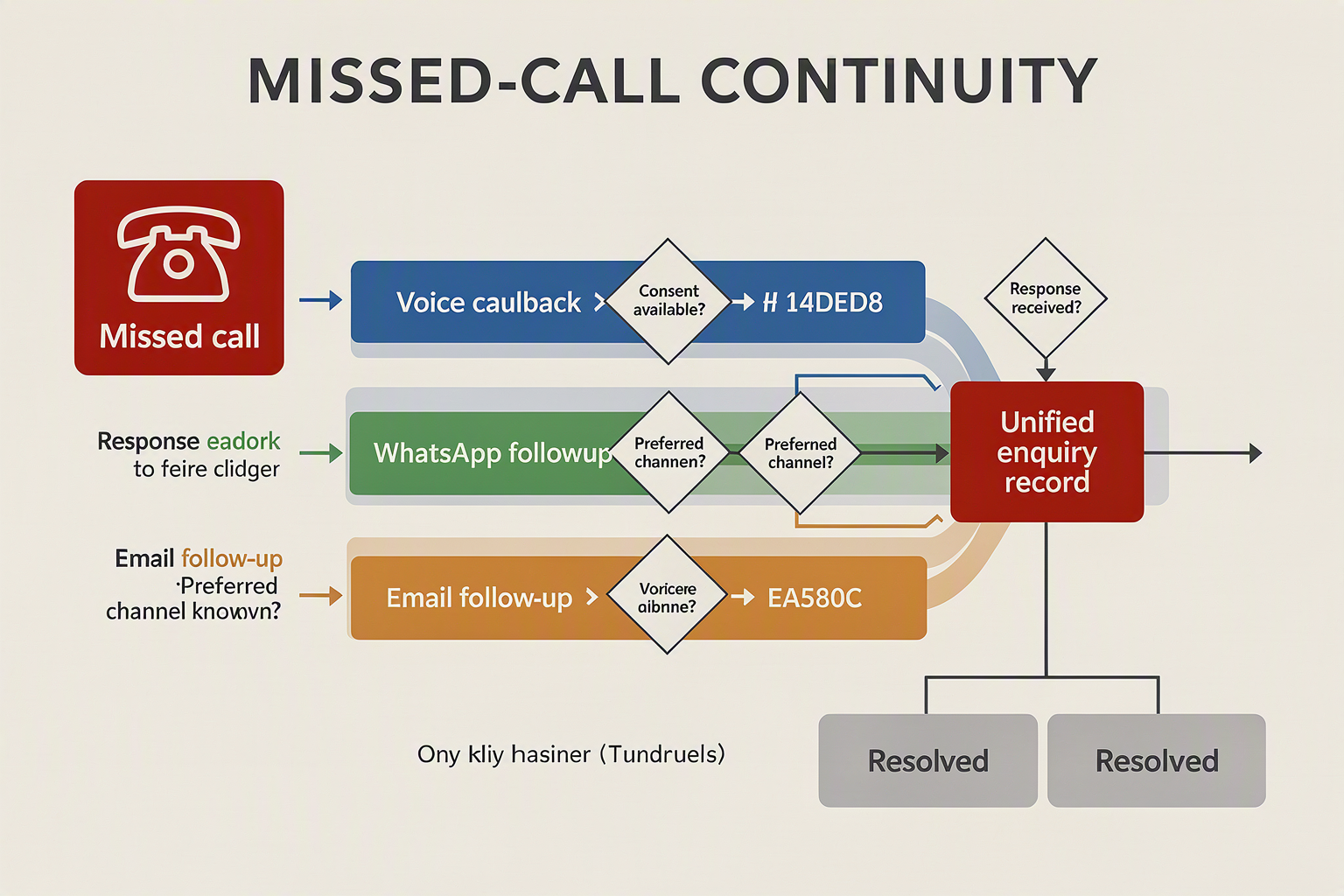
A missed call should create one persistent enquiry record, not three disconnected conversations. The safest workflow resumes the same administrative thread by voice, WhatsApp, or email while preserving consent, minimising repeated questions, and routing urgent or ambiguous messages to a qualified human.
Build one follow-up journey around the patient’s preference
A practical healthcare communication automation sequence can work as follows:
- Register the missed call. Record the calling number, timestamp, clinic line, and callback status. Avoid inferring why the patient called.
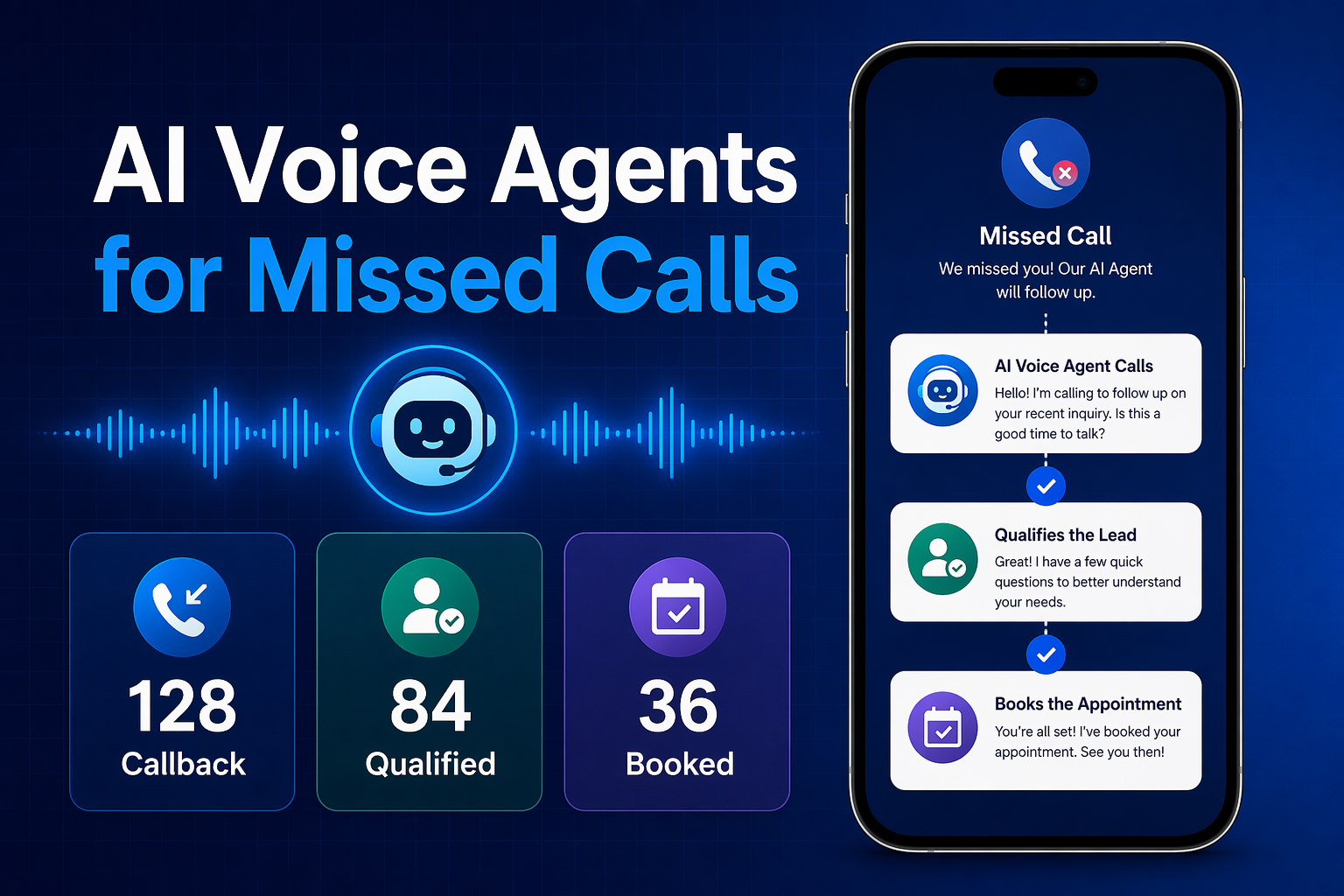
- Attempt an approved callback. An AI voice agent can identify the clinic, explain that it is responding to a missed call, and ask whether the patient wants administrative help or a staff callback.
- Offer a channel choice. With appropriate permission, ask whether the patient prefers to continue by WhatsApp, voice, or email.
- Carry forward only necessary context. Transfer the enquiry category, appointment preference, language, consent status, and escalation state—not an unrestricted transcript by default.
- Close the loop. Mark the request as awaiting staff, awaiting patient, booked, resolved, or escalated so another channel does not trigger duplicate follow-ups.
For example, a caller might say, “I need to change tomorrow’s appointment.” The voice agent can confirm a preferred time and send a WhatsApp summary, but the message should state “appointment request received”, not “appointment confirmed,” until clinic staff or an authorised scheduling system validates availability.
Keep context consistent without exposing unnecessary data
CallMissed for healthcare can use the platform’s AI voice agents, WhatsApp chatbots, WhatsApp Business calling, omnichannel inbox, and email tooling to support cross-channel continuity. A clinic could associate each interaction with a common enquiry ID and display the sequence to authorised staff in one inbox.
The following workflow details still require live-product, account-level, and legal confirmation:
- Whether a specific scheduling or electronic health-record system can exchange data with the account
- Which WhatsApp templates, opt-ins, and business-initiated messaging or calling permissions apply
- Whether calls are recorded, where recordings and transcripts are stored, and how long they are retained
- Whether email contains sensitive information and what authentication or encryption controls are required
- Which roles may view, export, correct, or delete patient communication records
India’s Digital Personal Data Protection Act, enacted on August 11, 2023, makes notice, lawful processing, consent, security safeguards, and data-subject rights material design considerations. Platform capability alone does not establish medical, privacy, or regulatory compliance.
Escalate by meaning, not merely by channel
An AI receptionist for clinics should transfer the case to a person whenever the message includes possible urgency, distress, clinical questions, uncertain intent, repeated failed contact, or a request to discuss reports or treatment. It should not classify medical severity.
Safe responses include:
- “I cannot assess symptoms or determine whether this is an emergency.”
- “Please contact local emergency services or seek immediate in-person medical help if you believe urgent care is needed.”
- “I can notify clinic staff that you requested a callback, but I cannot guarantee when a clinician will respond.”
CallMissed’s support for voice and speech across 22 Indian languages can help regional-language conversations continue across channels. Clinics should nevertheless test dialects, code-switching, names, medical terminology, consent prompts, and human handoff before deployment.
When must an automated clinic conversation escalate to a human or urgent service?
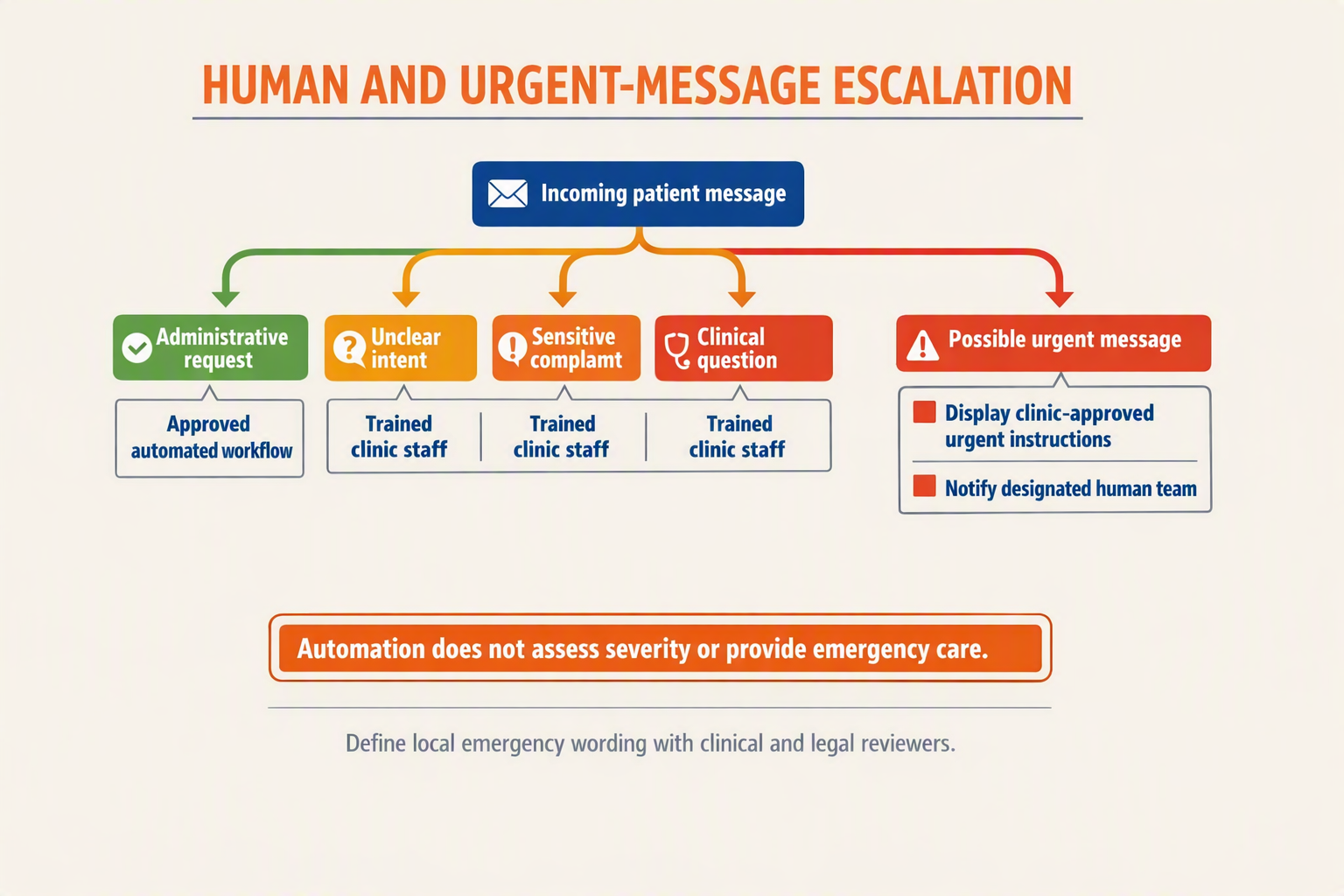
An automated clinic conversation must escalate when a patient may need urgent assistance, requests clinical judgement, shows distress, or cannot be handled safely and confidently by the approved administrative workflow. Automation should never delay access to a human or emergency service while attempting to complete intake.
Define non-negotiable escalation triggers
An AI receptionist for clinics should transfer or alert trained staff when it detects clinic-approved triggers such as:
- References to an emergency, immediate danger, self-harm, violence, severe distress, or a rapidly worsening condition
- Questions requiring diagnosis, treatment advice, medicine instructions, test-result interpretation, or assessment of symptom severity
- Requests involving safeguarding, abuse, pregnancy complications, paediatric concerns, or another category the clinic designates as sensitive
- A patient who repeatedly asks for a person, disputes the automated response, or cannot understand the next step
- Low speech-recognition confidence, conflicting answers, repeated silence, or language that the configured workflow cannot reliably process
- Complaints, billing disputes, privacy requests, legal threats, or requests to change or disclose sensitive records
These triggers are routing rules, not automated triage. A clinic’s qualified clinical and legal teams must approve the vocabulary, thresholds, destinations, operating hours, and emergency instructions.
Use a safe escalation sequence
A robust escalation workflow should follow a predetermined order:
- Stop the routine script. Do not continue asking scheduling or marketing questions after an urgent trigger.
- State the limitation clearly. Explain that the automated service cannot provide medical advice or determine the seriousness of symptoms.
- Give clinic-approved urgent instructions. Direct the patient to the appropriate local emergency service or urgent-care pathway without requiring more data first.
- Attempt human transfer where configured. Route the voice or WhatsApp Business call to the approved clinic team, subject to live-product and account-level confirmation.
- Create a high-priority alert. Include the channel, timestamp, callback details, patient’s own words, language, and transfer outcome.
- Confirm only what happened. Say “your message has been sent” rather than promising that a clinician has reviewed it or will respond within an unverified timeframe.
The system must not claim that emergency services were contacted unless that action was actually completed and auditable. If no human is available, the conversation should provide the approved urgent-service instruction rather than placing the patient silently into a routine queue.
Preserve context without oversharing
CallMissed for healthcare can support continuity through AI voice agents, WhatsApp chatbots, WhatsApp Business calling, email tooling, and an omnichannel inbox. A useful handoff record can prevent patients from repeating the same explanation, but clinics should transmit only the minimum information needed by the receiving team.
India enacted the Digital Personal Data Protection Act on August 11, 2023, making notice, lawful processing, security safeguards, and patient rights relevant to escalation records. Clinics must obtain legal guidance on recording, transcript retention, access controls, messaging consent, and cross-border processing.
CallMissed supports speech and voice across 22 Indian languages, which can make regional-language escalation more accessible. However, healthcare communication automation must test urgent phrases, code-switching, accents, background noise, and mistranscriptions in every deployed language.
Test failure paths, not just successful transfers
Before launch, run simulations covering:
- Staff unavailable, transfer rejected, or call disconnected
- Patient switching from voice to WhatsApp or email
- Multiple urgent messages from the same person
- Incorrect trigger activation and missed trigger detection
- Human acknowledgement, ownership, and closure logging
The clinic—not the automation—must remain accountable for escalation policy, clinical review, and urgent-response procedures.
How should clinics manage consent, privacy, access, and communication records?
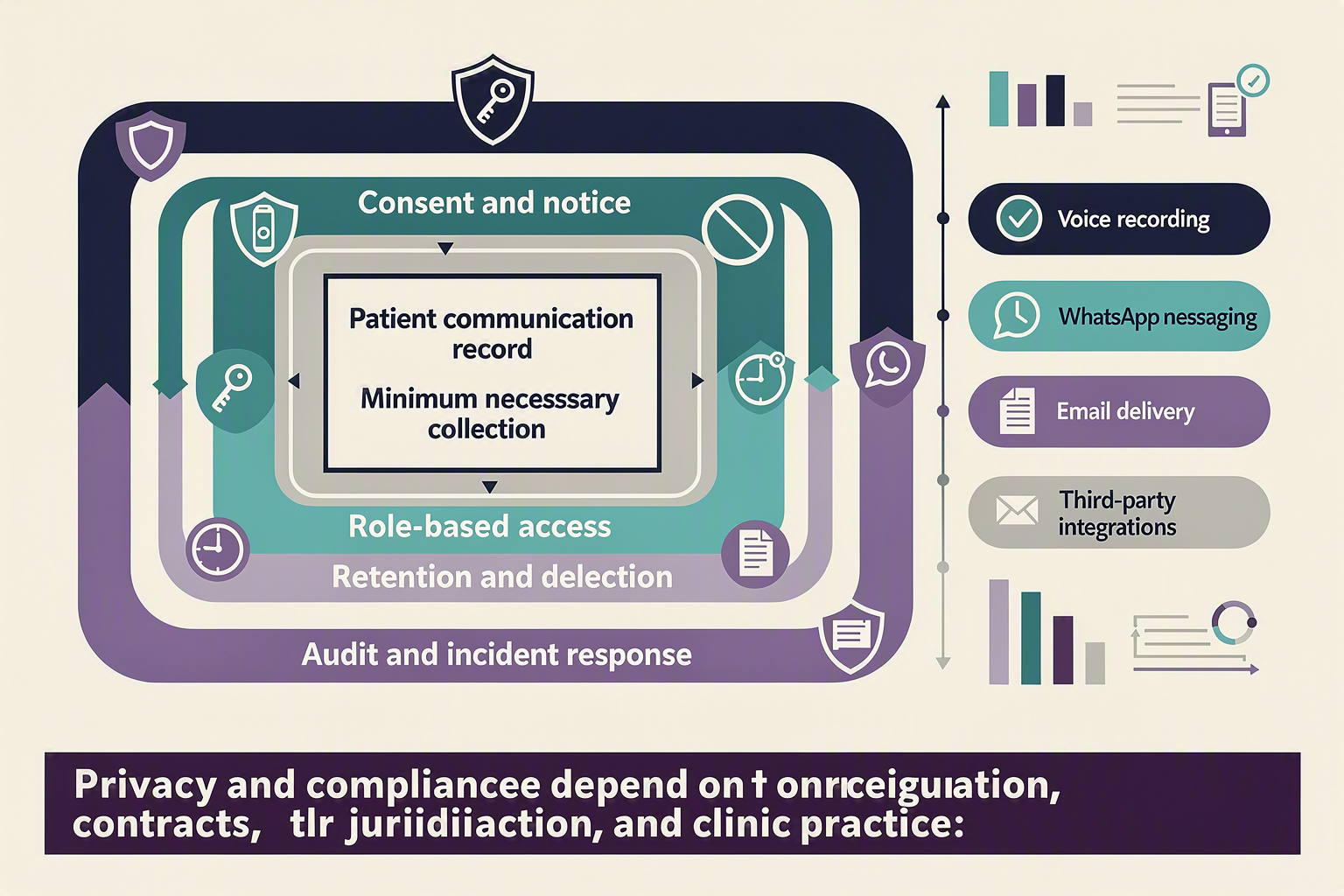
Clinics should manage communication data through clear notice, purpose-specific consent, minimum necessary collection, role-based access, defined retention, and auditable human handoffs. An AI receptionist for clinics should capture administrative enquiries without turning a voice, WhatsApp, or email conversation into an uncontrolled clinical record.
Establish consent before collecting information
India enacted the Digital Personal Data Protection Act on August 11, 2023, creating obligations around notice, consent, lawful processing, security safeguards, and individuals’ rights. Clinics should obtain legal guidance on how these requirements apply to their organisation, patients, vendors, and communication channels.
A practical consent flow should:
- Identify the clinic and explain that automation is being used.
- State why information is being collected—for example, to process an appointment request or return a missed call.
- Explain which channels may be used for follow-up.
- Offer a clear route to a human or another contact method.
- Record the notice version, timestamp, channel, and consent status where technically supported.
Consent to receive an appointment update should not automatically be treated as consent for promotional campaigns. Call recording, transcription, WhatsApp messaging, business-initiated calling, and email marketing may require different notices or permissions, depending on applicable law and platform policy.
Minimise what the AI receives
Safe healthcare communication automation starts with data minimisation. The agent should request only what staff need to route or complete the administrative task.
Appropriate fields may include:
- Patient name and callback details
- Preferred language and communication channel
- Requested clinician, department, or appointment window
- A brief, patient-provided reason for contact
- Consent and escalation status
Avoid soliciting diagnoses, full medical histories, identity documents, payment credentials, or detailed test information unless the clinic has established a lawful, necessary, and secured workflow. Free-text messages should also carry a warning not to submit emergency or highly sensitive information.
Restrict access and preserve accountability
Apply least-privilege access so receptionists, clinicians, administrators, and technical vendors see only the information required for their roles. Clinics should confirm whether their selected plan and connected systems support:
- Role-based permissions and administrator approval
- Multi-factor authentication or single sign-on
- Audit logs for viewing, editing, exporting, and deleting records
- Encryption, backups, incident response, and vendor access controls
- Data-location, subprocessors, and cross-border transfer requirements
These controls must be verified through live-product documentation, contracts, and account settings; platform availability alone does not demonstrate legal or medical compliance.
Maintain one traceable communication history
CallMissed for healthcare can use CallMissed’s omnichannel inbox to bring voice, WhatsApp, email, and web interactions into a more continuous operational view. However, clinics must confirm account-level details such as retention controls, export formats, deletion workflows, auditability, and integration behaviour before deployment.
Each communication record should show the channel, timestamp, patient identifier, consent state, automation actions, staff owner, escalation reason, and resolution status. Corrections should preserve accountability rather than silently rewriting history.
Finally, define a retention schedule for recordings, transcripts, appointment requests, and failed-contact logs. Communication histories should not automatically become the authoritative clinical record; clinically relevant information must be reviewed and entered into the clinic’s approved health-record system by authorised personnel.
What should operations, privacy, legal, and clinical experts review before launch?

A clinic should launch only after operations, privacy, legal, and clinical reviewers have approved the workflow, data handling, patient language, and human-escalation plan. Product capability alone does not establish medical, privacy, telecommunications, or healthcare compliance.
1. Operations: verify ownership and service levels
Operations leaders should map every automated path to a named team, queue, and response target. For each appointment request, missed call, WhatsApp message, email, and failed handoff, confirm:
- Who monitors the queue during and outside clinic hours
- How duplicate contacts across channels are reconciled
- When an appointment is considered requested, confirmed, rescheduled, or cancelled
- How quickly routine, sensitive, and potentially urgent messages receive human review
- What happens during staff shortages, connectivity failures, or platform downtime
- Which languages are supported by staff after escalation
CallMissed supports AI voice agents, WhatsApp chatbots, WhatsApp Business calling, email tooling, and an omnichannel inbox. However, number availability, calling permissions, message templates, integrations, delivery behaviour, and account-specific routing must be confirmed in the live product before using CallMissed for healthcare.
2. Privacy: document the complete data lifecycle
Privacy experts should review what information the AI receptionist for clinics collects, why it is required, where it is stored, who can access it, and when it is deleted.
The Government of India enacted the Digital Personal Data Protection Act on August 11, 2023, introducing obligations involving notice, consent or other permitted processing grounds, security safeguards, and data-principal rights. Legal counsel should determine how those requirements apply to the clinic’s specific data flows.
The privacy review should cover:
- Data minimisation for names, phone numbers, symptoms, recordings, transcripts, and appointment details
- Clear notices for AI interaction and call recording where applicable
- Consent capture, withdrawal, correction, deletion, and grievance workflows
- Role-based access for receptionists, clinicians, administrators, and vendors
- Retention periods for recordings, transcripts, inbox messages, and backups
- Subprocessors, hosting locations, cross-border transfers, incident response, and audit logs
Do not collect detailed medical histories merely because an open-text field or recording makes that possible.
3. Legal: confirm every channel and vendor arrangement
Legal counsel should review the clinic’s privacy notice, patient-facing scripts, vendor contracts, data-processing terms, recording rules, outbound-contact permissions, and applicable WhatsApp Business policies. Counsel should also determine whether separate consent or disclosures are needed for voice calls, promotional campaigns, transactional reminders, and email.
No deployment should describe the platform as “medically compliant” unless qualified counsel has assessed the precise configuration, contracts, jurisdiction, and use case. Healthcare communication automation is a workflow design, not a compliance certification.
4. Clinical safety: define prohibited responses and escalation triggers
A clinical lead should approve the knowledge base and establish phrases that require immediate human handling. The system must not diagnose, recommend treatment, interpret results, or claim that a clinician has reviewed a message.
Required safeguards include:
- A prominent instruction to contact local emergency services when immediate danger is reported.
- Rapid escalation for chest pain, breathing difficulty, severe bleeding, self-harm language, pregnancy emergencies, or other clinic-defined warning terms.
- Conservative handling of ambiguous messages rather than automated reassurance.
- Regular review of false negatives, false positives, mistranslations, and failed handoffs.
CallMissed supports speech and voice across 22 Indian languages, but each deployed language, accent, code-switched conversation, and emergency phrase needs testing with native speakers.
5. Final go/no-go evidence
Before launch, obtain signed approval for scripts, retention, escalation coverage, outage procedures, and test results. Run end-to-end scenarios across voice, WhatsApp, and email—including urgent messages, unavailable staff, consent withdrawal, transcription errors, and channel failure—and launch only when every scenario has a safe, traceable human fallback.
What does this mean for your clinic, and what belongs on the deployment checklist?
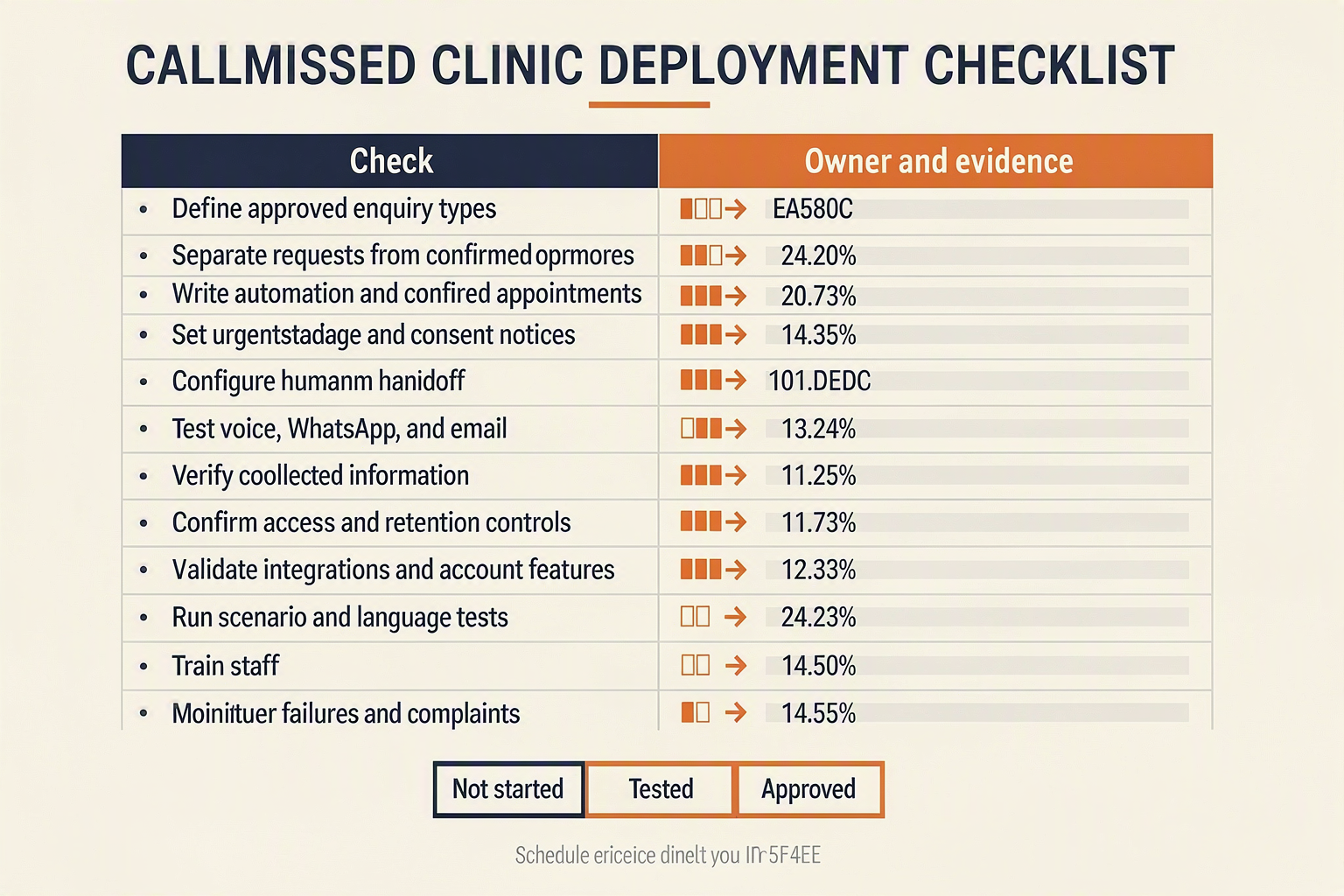
A clinic should deploy healthcare communication automation as a controlled administrative workflow, not as an autonomous clinical service. Go live only when consent, data handling, urgent-message boundaries, channel continuity, and human ownership have been tested with evidence.
Deployment checklist and launch gates
The checklist below separates verified CallMissed capabilities from configurations that require confirmation in the live product, the clinic’s account, connected systems, or legal review.
| Deployment area | Required clinic decision | Test evidence | Launch gate |
|---|---|---|---|
| Scope and boundaries | Limit the agent to enquiries, appointment requests, operational FAQs, and message capture; prohibit diagnosis, triage, treatment advice, and result interpretation | Test prompts include symptoms, emergencies, medicines, reports, and distressed callers | Unsafe requests receive a fixed boundary message and immediate human or emergency-direction path |
| Consent and privacy | Approve notices for data collection, WhatsApp contact, email, callbacks, and recording where applicable | Legal review records the approved wording, lawful basis, retention period, and withdrawal process | Do not launch until India’s Digital Personal Data Protection Act, enacted on August 11, 2023, and other applicable rules have been assessed |
| Channel continuity | Define how identity and conversation context move between voice, WhatsApp, email, and the omnichannel inbox | One end-to-end test starts with a missed call and continues through an approved follow-up channel | Staff can see the source, timestamps, consent status, summary, and next action without relying on patient repetition |
| Human escalation | Assign queues, opening hours, response targets, backup owners, and after-hours instructions | Simulate urgency language, ambiguity, repeated contact, anger, vulnerability, and failed automation | Every escalation has a named owner; urgent wording is never left only in an unattended queue |
| Language quality | Select supported languages and validate names, dates, addresses, medical terminology, and mixed-language speech | Native speakers test representative accents, code-switching, noise, and pronunciation | Enable only validated languages, despite CallMissed supporting speech and voice across 22 Indian languages |
| Systems and operations | Confirm calendar, CRM, inbox, number, WhatsApp Business, email, permissions, exports, and audit requirements | Staging tests cover duplicate records, unavailable slots, delivery failures, outages, and manual takeover | Appointment requests remain unconfirmed until staff or an authorised scheduling system validates availability |
What to confirm before configuration
CallMissed for healthcare can provide AI voice agents, WhatsApp chatbots, inbound and business-initiated WhatsApp Business calling, an omnichannel inbox, knowledge-base retrieval, and email tooling. However, availability does not establish that every proposed workflow is enabled for a particular account or suitable for protected patient information.
Before configuration, the clinic should confirm:
- Approved WhatsApp message templates, calling permissions, telephone numbers, and regional availability
- Integration behaviour for calendars, electronic records, CRM systems, and identity matching
- Data locations, subprocessors, access controls, deletion procedures, exports, recordings, and audit logs
- Whether sensitive fields should be excluded from prompts, transcripts, summaries, notifications, or analytics
- Downtime procedures when an AI service, messaging channel, or staff queue is unavailable
Run a measured pilot
Start the AI receptionist for clinics with one location, a narrow enquiry category, and limited operating hours. For at least one full scheduling cycle:
- Review a sample of transcripts and escalations daily.
- Track handoff success, abandoned enquiries, duplicate records, incorrect appointment assumptions, channel-delivery failures, and time to human response.
- Pause any workflow that gives clinical guidance, loses consent context, misroutes urgent wording, or exposes information to the wrong recipient.
- Record configuration changes and retest affected paths before expansion.
The practical go-live standard is simple: automation may capture and route the request, but a qualified human remains accountable whenever meaning, urgency, privacy, or clinical judgement is uncertain.
Frequently asked questions about CallMissed for healthcare
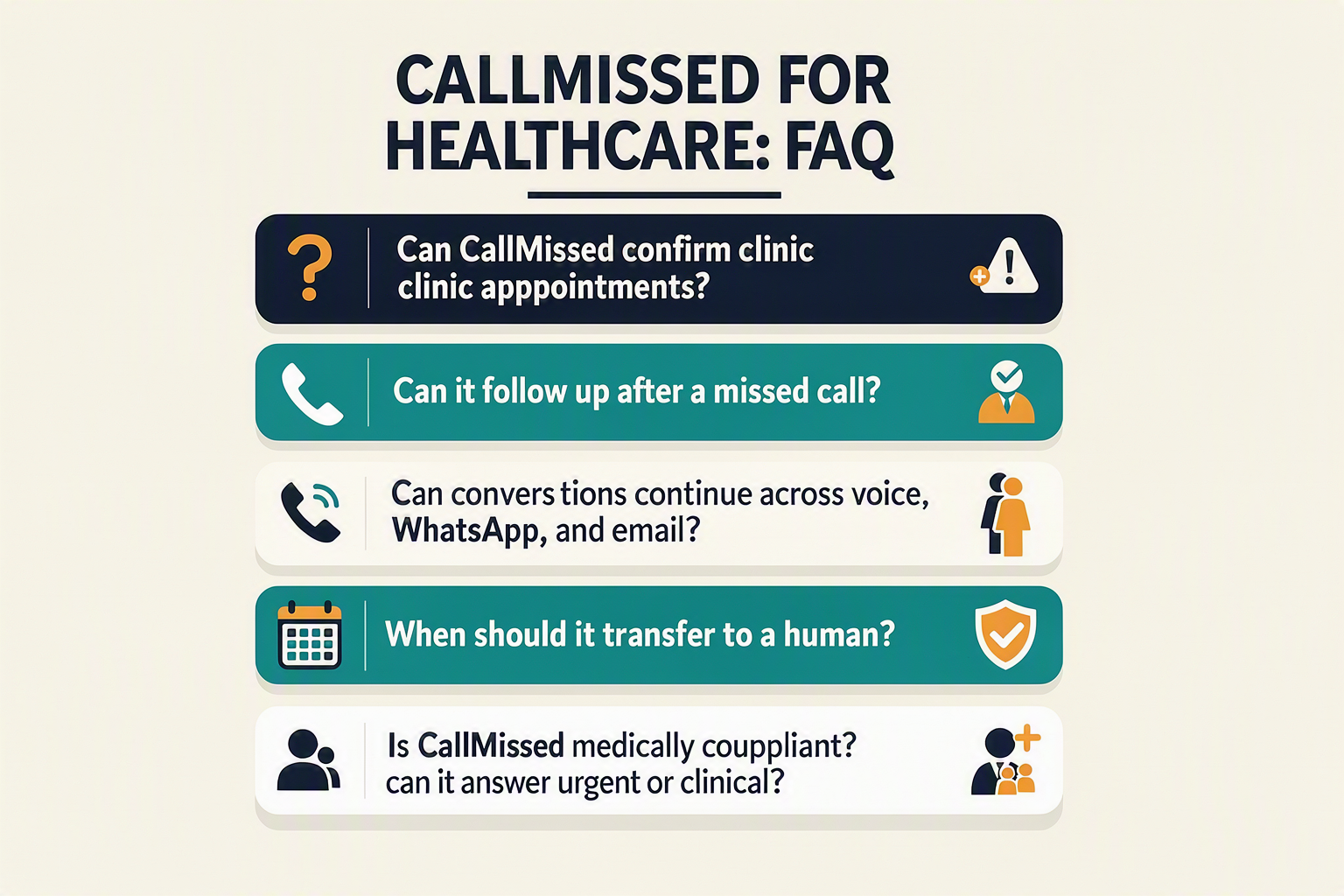
What can CallMissed for healthcare automate at a clinic?
Can an AI receptionist for clinics schedule appointments automatically?
How does CallMissed handle missed patient calls and follow-up messages?
Does CallMissed support multilingual healthcare communication automation in India?
Is CallMissed medically compliant, and can it diagnose patients or assess emergencies?
When should a CallMissed healthcare AI receptionist transfer a patient to a human?
Conclusion
CallMissed for healthcare can strengthen a clinic’s administrative front door, but safe deployment depends on strict boundaries: automate routine communication, preserve patient choice, and route clinical, urgent, sensitive, or ambiguous matters to qualified humans. A healthcare AI receptionist should support staff—not diagnose, triage, recommend treatment, interpret results, or suggest that a clinician has reviewed a message.
Key takeaways for clinics include:
- Keep automation administrative. An AI receptionist for clinics can capture basic enquiries, record preferred contact channels, answer verified operational questions, and accept appointment requests without promising availability before staff or the scheduling system confirms it.
- Design missed-call recovery around escalation. Follow-up through voice, WhatsApp, or email can reduce lost enquiries, but urgent language, distress, uncertainty, and sensitive requests must trigger clear human handoff procedures.
- Maintain cross-channel continuity. CallMissed brings together AI voice agents, WhatsApp chatbots, WhatsApp Business calling, email tooling, knowledge retrieval, and an omnichannel inbox, helping clinics preserve context as conversations move between channels.
- Treat privacy and consent as deployment requirements. India enacted the Digital Personal Data Protection Act on August 11, 2023. Clinics still need legal and account-level confirmation for notices, consent, recording, retention, access controls, vendor terms, and cross-border processing; platform availability does not establish medical or regulatory compliance.
The case for responsible healthcare communication automation will grow as staffing pressure intensifies. The World Health Organization’s 2022 projections estimated a worldwide shortage of 10 million health workers by 2030, mainly in low- and lower-middle-income countries. Clinics should watch how multilingual testing, escalation reliability, and channel-specific consent practices evolve—especially when serving patients across India’s regional languages.
To stay ahead, clinics can explore CallMissed and ask: Which repetitive communication tasks can we automate without ever shifting clinical judgement away from trained people?
Related Reading
Discussion
Related Posts
Ready to automate customer conversations?
Launch AI voice agents and WhatsApp bots with CallMissed — one API, 22+ Indian languages.