
CallMissed for Home Services: Safe AI Call Answering for Contractors


Learn how CallMissed for home services can capture after-hours calls, qualify jobs, support safe triage, handoffs, CRM records, and ROI tracking.
CallMissed for Home Services: Safe AI Call Answering for Contractors
What happens when a leaking pipe, failed air conditioner, or sparking switch triggers a customer call at 2 a.m.—and nobody answers? CallMissed for home services helps plumbers, electricians, HVAC providers, and repair teams capture these enquiries after hours, gather structured details, and route them appropriately without pretending that an AI agent can diagnose hazards or guarantee emergency attendance.
The timing matters because demand for skilled trades continues to grow while contractors still spend much of the day away from a desk. The U.S. Bureau of Labor Statistics projected in 2025 that electrician employment would grow 9% from 2024 to 2034, with about 81,000 openings each year. The U.S. Bureau of Labor Statistics also projected in 2025 that HVAC technician employment would grow 8% over the same decade, with approximately 40,100 annual openings. More jobs, more enquiries, and limited office coverage make reliable call capture an operational priority—not merely a customer-service upgrade.
A home services AI receptionist can ask what service is needed, confirm the property location, check whether the postcode or locality falls inside the contractor’s service area, record preferred appointment times, and request permission for WhatsApp follow-up. Platforms such as CallMissed combine AI voice agents, WhatsApp messaging and calling, an omnichannel inbox, knowledge-base retrieval, and human handoff, with support for 22 Indian languages for businesses serving multilingual regional markets.
Safety, however, must shape every workflow. AI call answering for contractors should classify urgency from the caller’s own description, not issue technical diagnoses or make promises about arrival times, pricing, or safety. If a caller reports gas odour, smoke, exposed wiring, severe flooding, or another potentially life-threatening condition, the approved script should direct the caller toward relevant emergency services, the utility provider, or a qualified human dispatcher according to the business’s documented policy.
What this guide will help you build
You will learn how to configure a practical intake workflow covering:
- After-hours capture and consent-aware call handling
- Urgency triage with conservative, pre-approved safety language
- Job qualification, service-area checks, and scheduling requests
- WhatsApp follow-up and technician escalation
- CRM records that preserve call summaries and customer details
- Testing for noisy calls, regional accents, edge cases, and failures
- ROI measurement using qualified leads, bookings, handoff rates, and recovered revenue
The objective is not to replace skilled judgement. It is to ensure that every caller receives a consistent first response—and that contractors begin the next conversation with the right context.
How can CallMissed for home services capture and route calls safely?
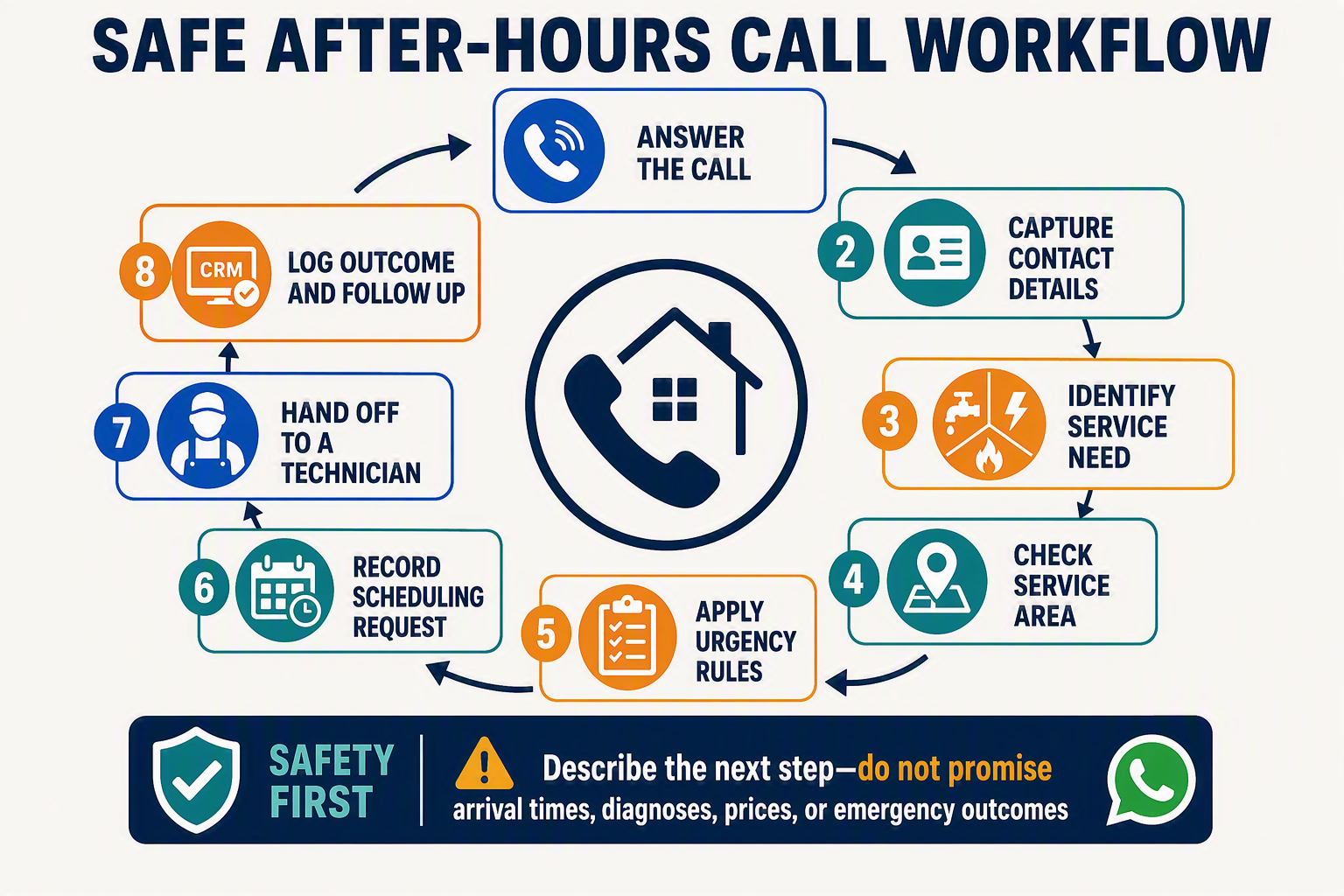
CallMissed for home services can capture after-hours enquiries through an AI voice agent, assign rule-based urgency labels, and route each record to the right technician or dispatcher. Safe routing relies on the caller’s own observations and approved escalation scripts. The agent should not diagnose faults, give safety assurances, commit to prices, or guarantee arrival times.
Build a structured capture-to-routing flow
A home services AI receptionist should follow a clear sequence instead of offering open-ended technical advice:
- Identify the service: Ask whether the caller needs plumbing, electrical, HVAC, appliance repair, or another supported service.
- Confirm contact details: Record the caller’s name, callback number, property address, and preferred communication channel.
- Collect observable facts: Use neutral questions such as, “What can you see, hear, or smell?” and “When did the problem begin?”
- Check service coverage: Compare the postcode, PIN code, suburb, or locality with the contractor’s approved service-area list.
- Apply an urgency label: Use documented business rules based only on what the caller reports.
- Create the service record: Add the details to the CRM or shared inbox, including the transcript or recording where permitted.
- Notify the correct route: Alert the on-call technician, dispatcher, branch inbox, or next-business-day queue.
- Confirm the next step: Tell the caller what action was taken without promising attendance or resolution.
CallMissed for home services combines AI voice agents, knowledge-base retrieval, an omnichannel inbox, and human handoff. Support for 22 Indian languages can help contractors configure regional-language intake. Every deployed language and accent should still be tested with the business’s real-world caller base before launch.
Separate urgency classification from diagnosis
AI call answering for contractors should classify urgency without deciding what caused the problem. For example, “water is spreading across the floor” is a caller-reported observation. “The supply pipe has burst” is a technical conclusion for a qualified professional.
CallMissed for home services can use a conservative three-level routing policy:
- Potential safety emergency: Reports of smoke, fire, gas odour, electric shock, exposed live wiring, sparking equipment, or immediate danger. Play the approved emergency instruction. Alert the designated human contact when configured.
- Urgent property risk: Active flooding, sewage overflow, complete loss of essential cooling in extreme conditions, or power loss affecting critical equipment. Escalate to the on-call queue without promising attendance.
- Routine service request: Dripping taps, maintenance visits, intermittent faults, quotation requests, and non-urgent repairs. Capture scheduling preferences for office review.
The agent can say, “I’ll mark this as urgent and notify the on-call team.” It should not say, “A technician will arrive within 30 minutes.” CallMissed for home services can send a notification, but attendance depends on staff availability, travel conditions, service coverage, and contractor policy.
Use explicit routing rules and safe fallbacks
Configure every route with four clear elements:
- Recipient: On-call technician, dispatcher, branch inbox, or next-business-day queue
- Channels: Call transfer, WhatsApp message, CRM task, email, or multiple alerts
- Escalation endpoint: Stop after acknowledgment or after a defined retry sequence
- Failure procedure: Preserve the transcript or recording where permitted, flag the record, and send a fallback notification
Test each route before launch. Include scenarios for unavailable technicians, failed transfers, unanswered alerts, out-of-area callers, and incomplete addresses.
If speech confidence is low, details conflict, or an address cannot be confirmed, the system should escalate rather than guess. CallMissed for home services can also request consent for WhatsApp follow-up. The caller may then share a location pin, photo, or additional description for human review. These materials can support qualification, but they should never replace an onsite inspection by a qualified tradesperson.
Why do contractors need an after-hours home services AI receptionist?
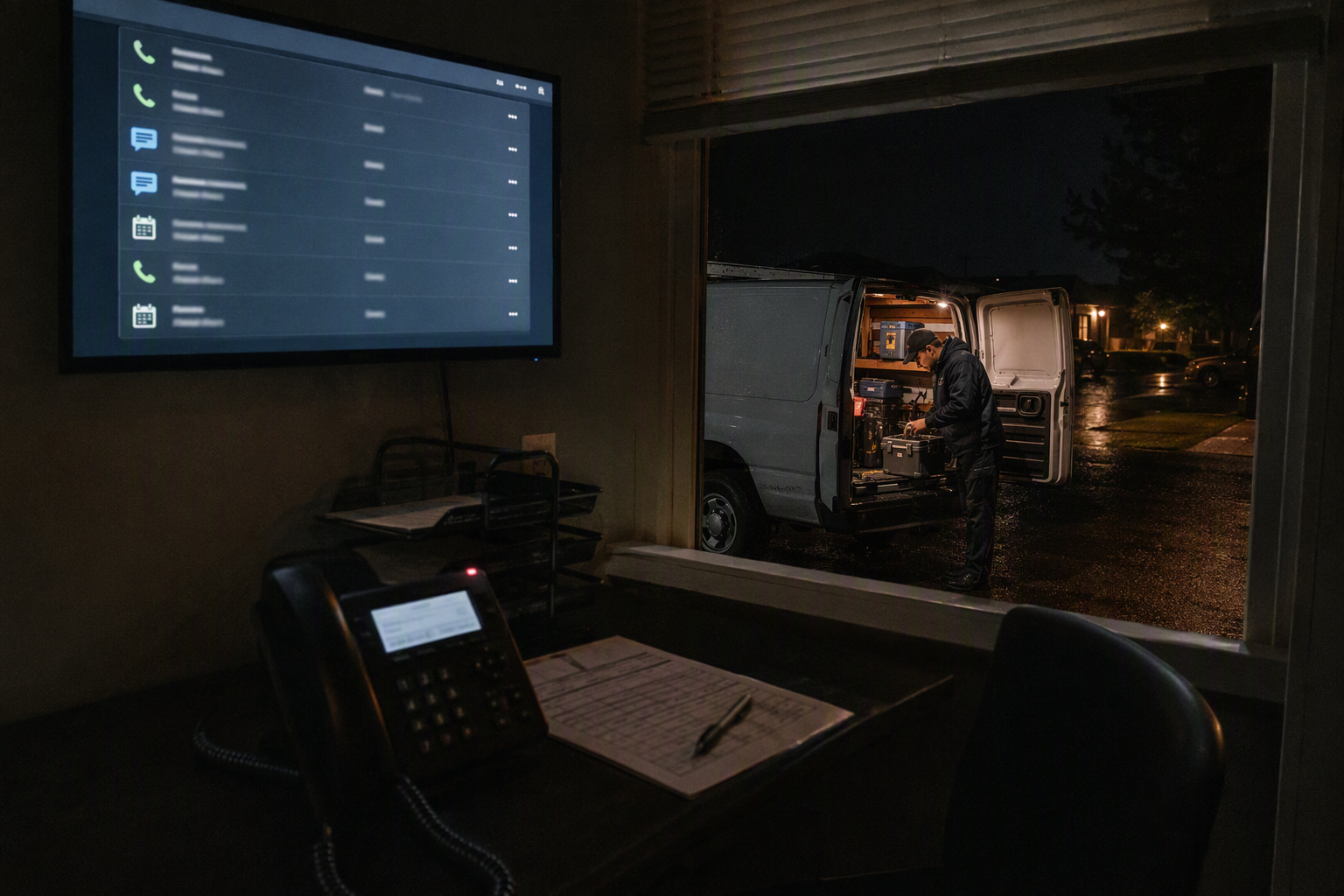
Contractors need an after-hours home services AI receptionist because urgent enquiries rarely follow office hours, while plumbers, electricians, HVAC technicians, and repair teams cannot safely answer every call from a job site. The receptionist provides immediate, structured intake so the business can distinguish a viable booking from an out-of-area request or a case requiring prompt human escalation.
After-hours callers are often high-intent customers
A homeowner calling about a failed boiler, blocked drain, or loss of power usually wants a clear next step—not voicemail. Delayed responses create several operational risks: the customer may contact another provider, important details may be lost, or an on-call technician may receive an unstructured message with insufficient context.
AI call answering for contractors can improve this first interaction by collecting decision-ready information:
- Caller name and callback number
- Property address, postcode, or locality
- Trade and service category required
- Customer-described symptoms and when they began
- Residential, commercial, landlord, or tenant status
- Access limitations and preferred appointment window
- Consent for WhatsApp messages or a return call
This does not automatically make every enquiry a qualified job. It gives the contractor enough structured information to decide what should happen next.
AI reception protects productive field time
Home-service teams face a practical coverage problem: technicians generate revenue by completing skilled work, but answering calls interrupts inspections, driving, tool use, and customer conversations. Hiring continuous reception coverage may also be difficult for smaller operators with variable call volumes.
An AI receptionist can act as a first-line intake layer, leaving people responsible for decisions that require trade expertise. A sensible division of responsibility is:
- AI captures: identity, location, service type, availability, and the caller’s description.
- Business rules filter: service area, operating hours, accepted job categories, and escalation criteria.
- Humans decide: technical advice, dispatch priority, quotations, attendance commitments, and exceptions.
This model is increasingly relevant as trade demand grows. The U.S. Bureau of Labor Statistics projected in 2025 that electrician employment would increase 9% between 2024 and 2034. Rising demand makes it more valuable to protect technicians’ time while maintaining dependable enquiry coverage.
Fast triage must remain conservative
“Urgent” has different meanings to customers and contractors. An AI agent should record observable statements such as “water is reaching the hallway” or “the socket is smoking,” rather than conclude that a specific component has failed.
The workflow should also avoid unsafe assurances. It must not say that a property is safe, promise that a technician will arrive within a particular time, or instruct an unqualified caller to perform hazardous repairs. Instead, approved scripts can direct potentially life-threatening reports to the appropriate emergency service, utility provider, or human dispatcher under the contractor’s policy.
CallMissed connects intake with the next channel
CallMissed for home services can carry the conversation beyond the initial call through voice, WhatsApp follow-up, human handoff, and shared CRM records. Its support for 22 Indian languages is particularly relevant to contractors serving multilingual customers across Indian cities and regional markets.
The core benefit is not merely answering more calls. It is creating an auditable intake process in which service-area fit, urgency indicators, contact consent, and scheduling requests reach the right person without asking an AI system to replace qualified judgement.
Which workflow developments make AI call answering for contractors more useful?
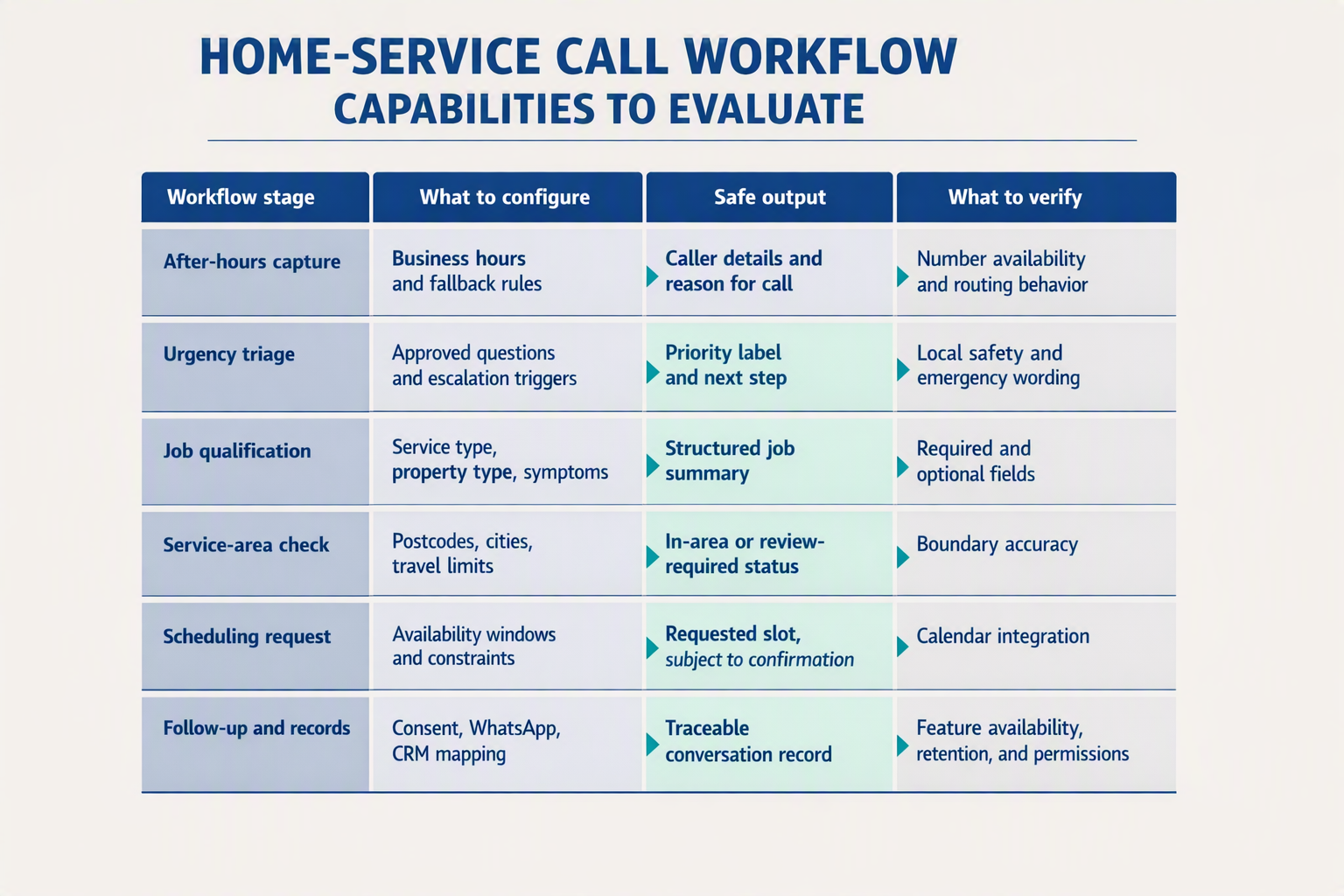
The most useful workflow developments connect structured intake, policy-based triage, real-time availability, multilingual follow-up, and human escalation in one traceable process. For contractors, the advance is not simply more natural speech; it is an AI agent that can move an enquiry to the correct next step while staying within approved operational and safety boundaries.
From generic answering to controlled job intake
Modern AI call answering for contractors can turn a conversation into structured fields rather than leaving staff with only a recording or transcript. The workflow can collect the caller’s name, callback number, property location, service category, issue description, access constraints, and requested time window.
| Workflow development | What it adds | Contractor use case | Required control |
|---|---|---|---|
| Structured data extraction | Converts speech into CRM-ready fields | Separate “no cooling” from installation enquiries | Read back critical details such as phone number and address |
| Policy-based urgency triage | Matches caller statements to approved rules | Flag reported smoke, gas odour, flooding, or exposed wiring | Do not diagnose, declare a site safe, or promise emergency attendance |
| Service-area validation | Checks postcode, PIN code, suburb, or locality | Avoid dispatch requests outside the operating area | Route uncertain or boundary locations for human review |
| Availability-aware requests | Reads permitted slots or records preferences | Capture a preferred HVAC or plumbing appointment window | Describe it as a request until the booking system confirms it |
| Omnichannel continuation | Moves the conversation to WhatsApp or another approved channel | Send a summary, request photos, or confirm next steps | Obtain appropriate consent and avoid collecting unnecessary sensitive data |
| Confidence-based handoff | Escalates ambiguous, high-risk, or low-confidence calls | Transfer a complex electrical fault to the duty technician | Define fallback contacts and what happens if nobody answers |
Why connected workflows matter
A home services AI receptionist becomes more practical when each step uses the output of the previous one. For example, the service-area result should determine whether scheduling is offered, while urgency classification should determine whether the call enters the normal booking queue or an approved escalation path.
A robust workflow can follow this sequence:
- Capture the caller’s contact and property details.
- Classify the service request using the caller’s own words.
- Check the business’s location, operating-hours, and job-type rules.
- Escalate safety-sensitive or unclear descriptions without giving technical instructions.
- Request an appointment window rather than guaranteeing a technician’s arrival.
- Record the transcript, summary, consent status, and routing outcome.
- Continue by WhatsApp only where the business has an appropriate basis and the customer has agreed to follow-up.
Multilingual and WhatsApp-native continuity
For Indian contractors, language coverage is an operational workflow feature rather than a cosmetic localisation choice. CallMissed supports Speech-to-Text and Text-to-Speech across 22 Indian languages, allowing intake designs to accommodate regional customers while preserving structured records for dispatch teams.
CallMissed for home services can also connect AI voice handling with WhatsApp chat, WhatsApp Business calling, a knowledge-base retrieval layer, and an omnichannel inbox. A plumbing team could therefore receive an after-hours voice summary, review the customer’s consented WhatsApp photos, and hand the case to a technician without forcing the customer to repeat the entire issue.
These developments should still be deployed conservatively. Knowledge-base retrieval can explain published service policies, but it should not improvise repair advice. Automation should accelerate capture and coordination, while licensed professionals and emergency authorities retain responsibility for diagnosis, safety decisions, and on-site work.
How should you design triage, qualification, scheduling, WhatsApp follow-up, and technician handoff?
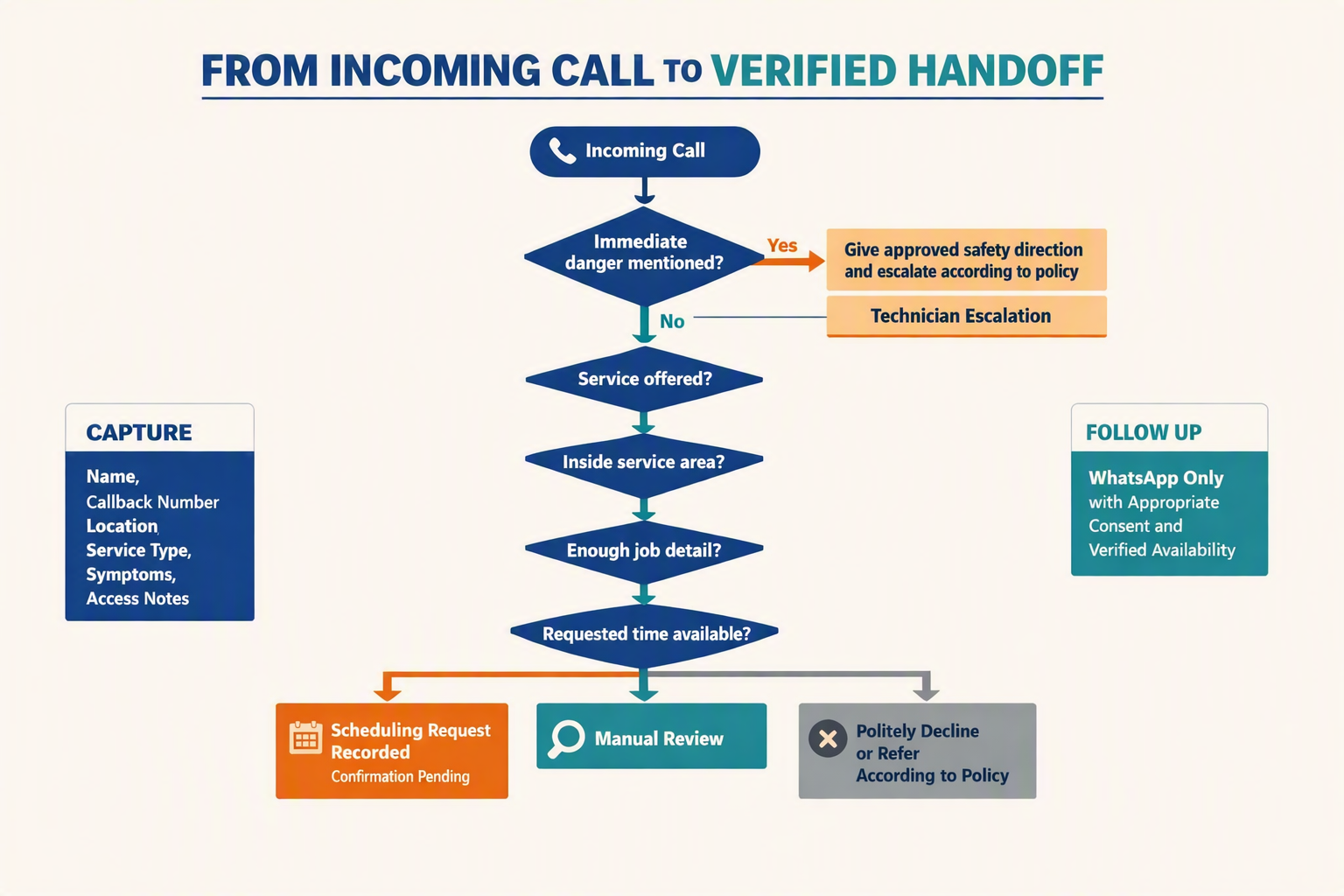
Design the workflow as a sequence of controlled gates: triage first, qualification second, scheduling request third, WhatsApp confirmation fourth, and human handoff whenever risk or uncertainty exceeds policy limits. A home services AI receptionist should collect and route information—not diagnose faults, declare a property safe, or guarantee a technician’s arrival.
1. Triage with approved safety boundaries
Begin by asking the caller to describe the problem in their own words. Configure CallMissed for home services to match high-risk phrases against rules approved by the contractor, insurer, and relevant local authorities.
A conservative triage flow should:
- Detect reports such as gas odour, smoke, fire, sparking, exposed wiring, severe flooding, or suspected carbon-monoxide exposure.
- Avoid diagnostic statements such as “the circuit is safe” or “this is only a minor leak.”
- Play a pre-approved instruction directing the caller to the appropriate emergency service, utility provider, building manager, or human dispatcher.
- Mark the case urgent review required, rather than promising emergency attendance.
- Escalate low-confidence transcripts, unclear answers, and distressed callers to a person.
Use wording such as: “I cannot assess whether the situation is safe. Based on what you described, please follow the company’s emergency guidance while I notify the on-call team.”
2. Qualify the job systematically
For non-emergency enquiries, collect only the details needed to determine whether the contractor can help:
- Service category: plumbing, electrical, HVAC, appliance repair, or another supported trade.
- Problem description: what happened, when it began, and whether service has stopped completely.
- Property information: residential or commercial, locality or postcode, and access constraints.
- Customer details: name, callback number, and preferred contact channel.
- Job context: existing customer, warranty status, relevant equipment type, and previous visit reference where applicable.
The agent should compare the location and service category with an approved knowledge base. If coverage is uncertain, it should say “The team will confirm whether this address is serviceable” instead of rejecting or accepting the job automatically.
3. Treat scheduling as a request, not a promise
AI call answering for contractors should distinguish between capturing availability and confirming an appointment. Unless the agent has live, authoritative access to technician calendars, travel zones, skills, leave, and job duration, it should offer a requested window only.
Record:
- The customer’s preferred date and time range
- Whether someone must be present
- Property-access instructions
- Technician or language preferences
- Any stated deadline, without promising it can be met
A safe confirmation reads: “I have recorded Tuesday morning as your preference. The dispatch team will confirm the appointment.”
4. Continue on WhatsApp with consent
Ask explicitly whether the customer agrees to receive WhatsApp messages. After consent, send a concise summary containing the issue, address, requested slot, reference number, and correction instructions. Do not include sensitive access codes or unnecessary personal information.
CallMissed can connect voice intake, WhatsApp follow-up, and the omnichannel inbox, allowing office staff to continue the same conversation rather than recreate it from notes.
5. Give technicians an actionable handoff
The handoff should contain:
- Caller-provided symptoms and urgency label
- Safety script already delivered
- Address and service-area result
- Requested appointment window
- Photos or documents supplied through WhatsApp
- Transcript confidence and unanswered questions
- Consent status and complete interaction history
This structure turns a home services AI receptionist into an intake layer while leaving diagnosis, pricing, dispatch priority, and safety decisions with qualified people.
What impact can better call capture have, and how should ROI be measured?
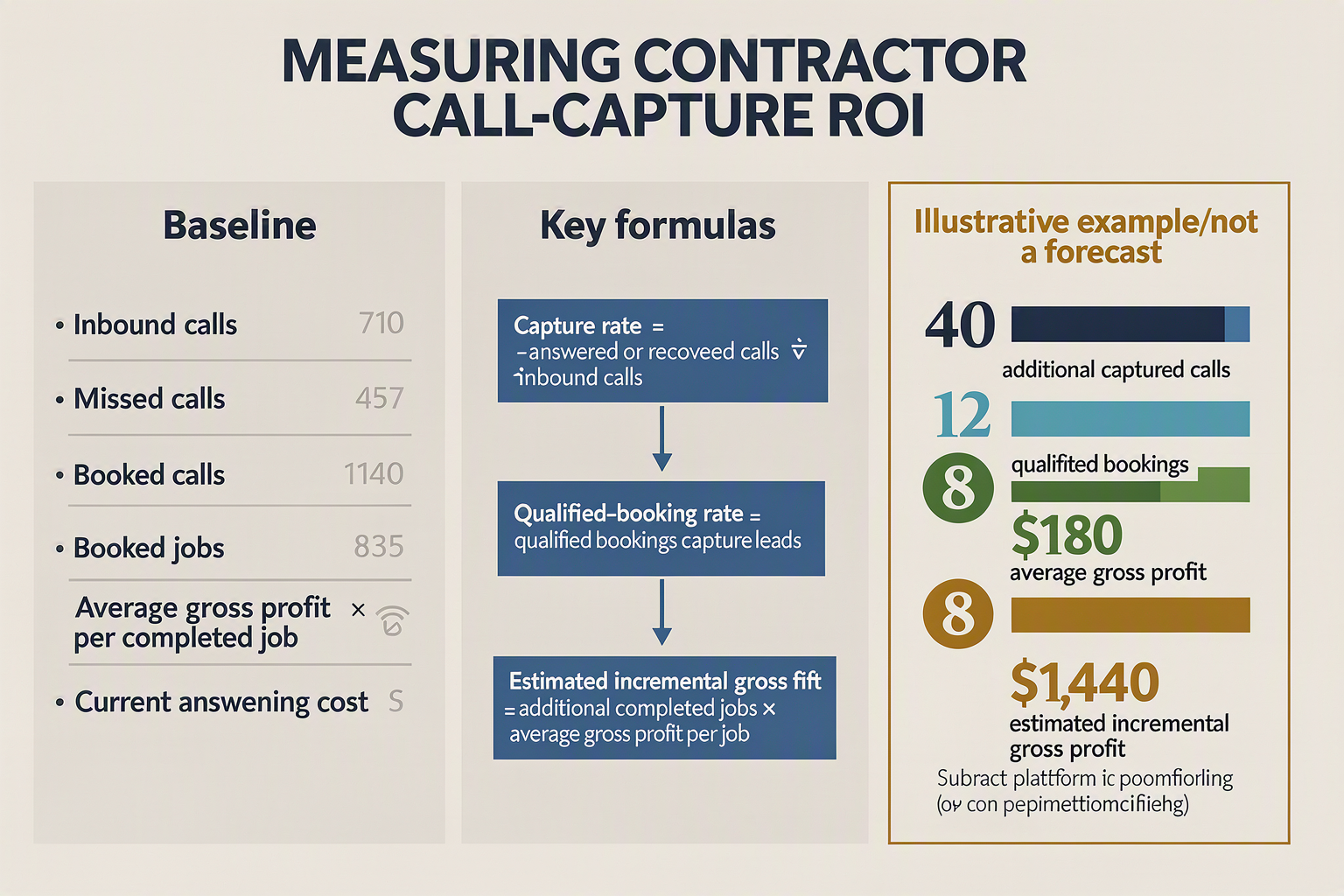
Better call capture can convert previously unanswered enquiries into qualified jobs, but its impact should be measured as incremental gross profit—not call volume alone. For CallMissed for home services, the clearest ROI test compares a documented baseline with bookings, revenue, operating costs, and safety outcomes after deployment.
Measure the complete call-to-job funnel
A home services AI receptionist creates value only when captured calls progress to commercially meaningful outcomes. Track each stage separately:
- Eligible inbound calls: Exclude spam, wrong numbers, existing-job updates, and enquiries outside the service area.
- Successfully answered calls: Measure how many eligible calls receive a usable response from the AI agent or a human.
- Qualified leads: Count callers whose service need, location, contact details, and requested timing meet the business’s criteria.
- Scheduling requests: Record requests rather than treating every preferred time as a confirmed appointment.
- Confirmed bookings: Count only jobs accepted by the dispatcher or scheduling system.
- Completed jobs: Remove cancellations, no-shows, duplicates, and appointments the business could not fulfil.
- Collected revenue and gross profit: Use invoiced and paid amounts, minus direct labour, materials, subcontractor costs, and other job-level expenses.
Key conversion formulas include:
- Capture rate = successfully answered eligible calls ÷ eligible inbound calls
- Qualification rate = qualified leads ÷ successfully answered eligible calls
- Booking rate = confirmed bookings ÷ qualified leads
- Completion rate = completed jobs ÷ confirmed bookings
- Revenue per qualified lead = collected revenue ÷ qualified leads
Segment these metrics by after-hours versus business-hours traffic, trade, service area, language, campaign source, and new versus existing customer. A blended booking rate can conceal whether the system is genuinely recovering overnight opportunities.
Calculate incremental ROI, not headline revenue
Use a pre-deployment baseline of at least several representative weeks, adjusting for weather, seasonality, holidays, advertising changes, and technician capacity. HVAC demand during a heatwave, for example, should not be attributed entirely to improved call answering.
A practical calculation is:
Net incremental benefit = incremental gross profit − total system and operating costs
ROI = net incremental benefit ÷ total system and operating costs × 100
Include all relevant costs:
- AI voice, telephony, WhatsApp, and message usage
- Integration, configuration, and testing time
- Human review and dispatcher labour
- CRM or scheduling-system expenses
- Training, script maintenance, and compliance work
- Refunds, rework, or acquisition costs associated with recovered jobs
CallMissed product pricing uses a transparent credit model in which 1 credit equals ₹1, alongside a free tier and pay-as-you-go access, according to CallMissed. Businesses should nevertheless calculate actual per-call and per-booking costs from their own call duration, channel usage, workflow, and model selection rather than assuming a fixed universal cost.
Treat quality and safety as ROI guardrails
The business case for AI call answering for contractors weakens if higher capture produces poor records, unsafe wording, or unserviceable bookings. Monitor:
- Human-handoff success rate and time to acknowledgement
- Service-area accuracy and duplicate-record rate
- Transcription or contact-detail correction rate
- Cancellation, no-show, and rework rates
- Urgent-call escalation compliance based on approved scripts
- Unsupported diagnosis, price, safety, or arrival-time promises, with a target of zero
Review call samples and CRM outcomes together. A captured call is not automatically a recovered job, and an urgency label is not a technical diagnosis. The strongest ROI evidence connects the original enquiry, consented WhatsApp follow-up, dispatcher decision, completed work, and collected payment while preserving conservative safety boundaries.
What do dispatch, safety, privacy, and CRM experts recommend verifying?
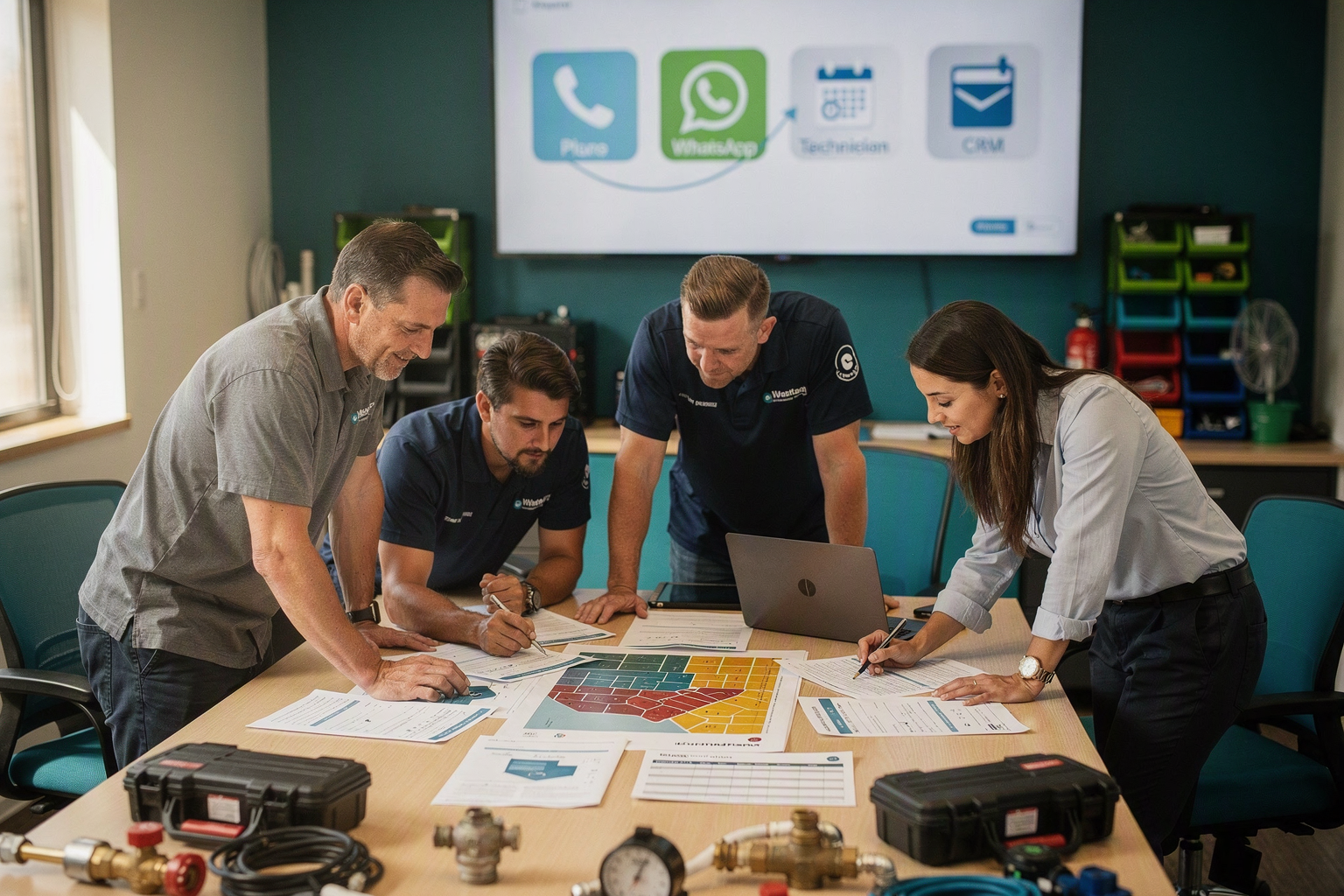
Experts recommend verifying four things before launch: dispatch rules are operationally realistic, safety scripts are approved, personal data is handled lawfully, and CRM records remain accurate through every handoff. A home services AI receptionist should be treated as a controlled intake system—not an autonomous technician, emergency service, or source of legal consent.
1. Dispatch and safety controls
Ask the owner, dispatcher, and a qualified trade professional to approve a written escalation matrix. For each service type, verify:
- Which descriptions trigger immediate human escalation, routine follow-up, or rejection as out of scope.
- Whether the on-call technician has accepted the shift and can actually receive calls or WhatsApp messages.
- What happens when nobody acknowledges an escalation within the defined interval.
- Which postcodes, localities, property types, and working hours are supported.
- Which statements the agent must never make, including “the property is safe,” “this is definitely a gas leak,” or “a technician will arrive in 20 minutes.”
The agent should repeat the customer’s reported symptoms without converting them into a diagnosis. For example: “You reported smoke near the electrical panel” is safer than “Your panel is on fire.” Emergency wording must be tailored to local authorities, utility providers, and company policy.
NIST’s AI Risk Management Framework 1.0, published in January 2023, organises AI oversight around four functions: Govern, Map, Measure, and Manage. That model is useful for documenting who owns scripts, tests classifications, approves changes, and reviews incidents involving AI call answering for contractors.
2. Privacy and payment boundaries
Privacy reviewers should map every piece of information collected—from the recording and transcript to the address, access instructions, and WhatsApp number. Verify the lawful basis or consent mechanism with qualified counsel in each operating jurisdiction.
The European Union General Data Protection Regulation Article 5 requires personal data to be adequate, relevant, and limited to what is necessary. India’s Digital Personal Data Protection Act, 2023 likewise makes purpose, notice, consent where applicable, security safeguards, and deletion practices central governance considerations.
Check that the workflow:
- Announces recording or transcription where legally required.
- Separates essential job intake from optional marketing consent.
- Defines retention periods for audio, transcripts, summaries, and attachments.
- Restricts access by role and preserves an audit trail.
- Provides a process for correction, deletion, and customer requests.
- Prevents callers from speaking card details into recorded conversations.
If payments are accepted, specialists should review the workflow against PCI DSS 4.0.1, published by the PCI Security Standards Council in June 2024. The safer design is generally to send customers to an approved payment channel rather than store payment credentials in call notes.
3. CRM integrity and handoff testing
CRM experts recommend verifying the complete record lifecycle, not merely whether a new lead appears. Test these numbered controls:
- Identity matching: Does a repeat caller update the correct customer without merging unrelated households?
- Source preservation: Does the record identify voice, WhatsApp, web, or campaign origin?
- Structured fields: Are urgency, trade, location, service-area status, preferred time, consent, and escalation outcome stored separately?
- Failure recovery: Are duplicate records prevented when an integration retries?
- Human traceability: Can staff see what the caller said, what the agent inferred, and what action followed?
For CallMissed for home services, these checks should cover the AI voice agent, WhatsApp follow-up, technician handoff, and omnichannel CRM record as one auditable workflow. Review CallMissed configuration alongside the broader CRM integration guide and security governance checklist before production deployment.
What should your team configure, test, and verify before going live?
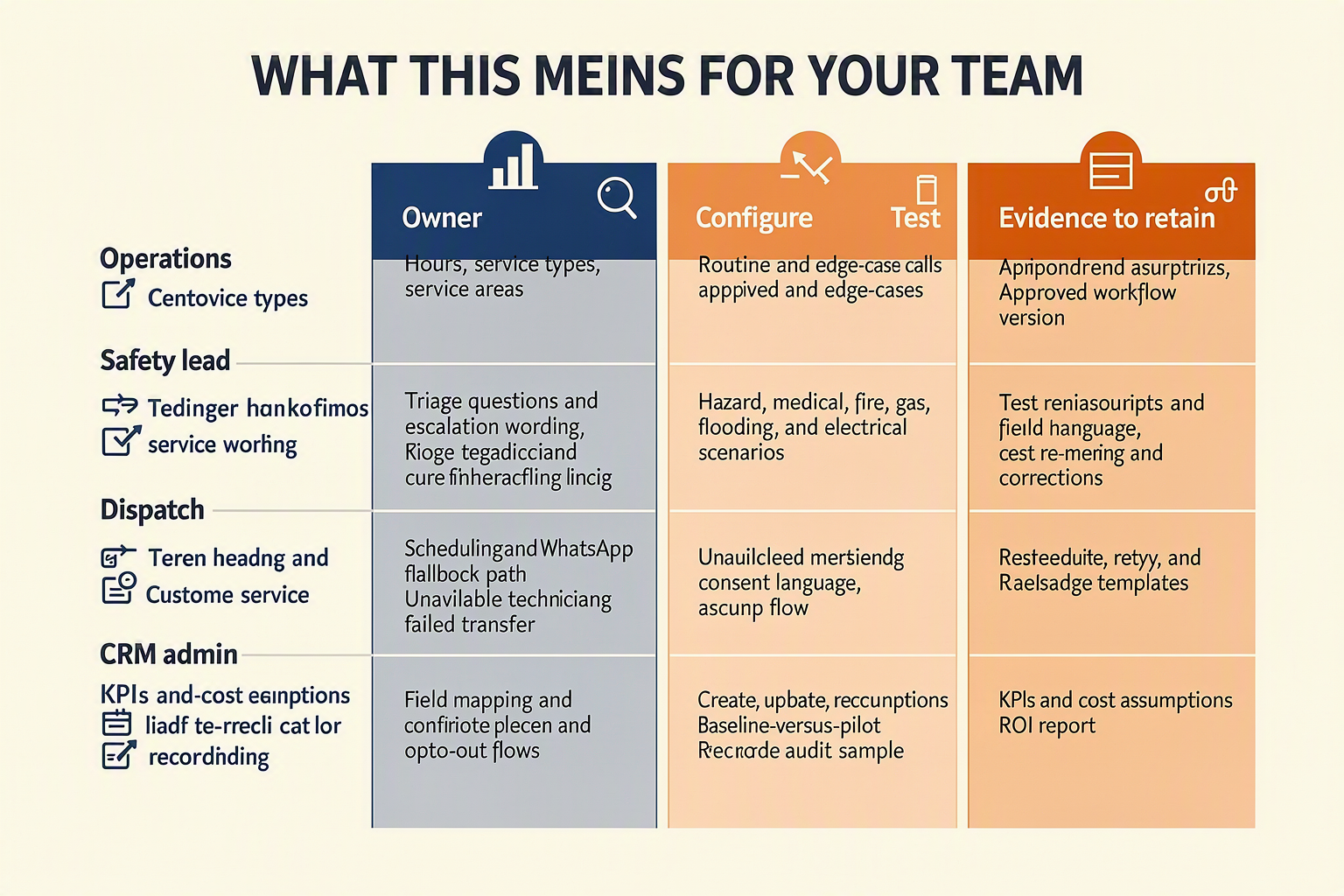
Before launch, configure the CallMissed for home services workflow around documented operating policies, then test realistic calls and verify that every record, alert, and handoff reaches the correct destination. Do not publish the number until safety language, service-area rules, consent capture, scheduling boundaries, and fallback routes have passed controlled tests.
Pre-launch configuration and verification matrix
| Area | Configure | Test | Go-live verification |
|---|---|---|---|
| Opening and disclosure | Business name, AI-agent disclosure where required, supported services, opening hours, and after-hours wording | New customer, returning customer, silence, interruption, and “Are you a human?” scenarios | Agent identifies the correct business and never implies that a technician is already dispatched |
| Urgency and safety | Approved trigger phrases for gas odour, smoke, sparking, exposed wiring, flooding, entrapment, or immediate danger | Paraphrases, ambiguous descriptions, multiple hazards, and distressed callers | Agent repeats the caller’s facts, gives only approved escalation instructions, and makes no diagnosis or safety guarantee |
| Qualification and coverage | Service categories, excluded work, locality or postcode rules, property type, access constraints, and essential job questions | In-area, boundary-area, out-of-area, unknown postcode, and unsupported-job calls | CRM record shows the supplied address and coverage result without claiming availability |
| Scheduling requests | Business hours, appointment windows, blackout dates, technician calendars, and rules for requests versus confirmed bookings | Fully booked days, duplicate requests, rescheduling, weekends, and calendar/API failure | Agent clearly distinguishes requested, pending confirmation, and confirmed appointments |
| WhatsApp and human handoff | Customer consent wording, approved templates, technician or dispatcher queues, escalation hours, and timeout rules | Consent granted, declined, or unclear; unanswered handoff; invalid WhatsApp number; inbound WhatsApp Business call | Message or call routes correctly, consent status is stored, and failed transfers create a visible follow-up task |
| Records, language, and resilience | Required CRM fields, summaries, recordings or transcripts according to policy, retention controls, supported languages, and fallback contacts | Noisy audio, weak network, mixed-language speech, regional accents, duplicate callers, and provider interruption | Searchable record contains source, timestamp, caller details, summary, urgency label, consent, owner, and next action |
Apply explicit launch gates
A home services AI receptionist should launch only when the team can answer “yes” to all of these checks:
- Safety scripts are approved by management and, where appropriate, legal or compliance advisers. The agent directs immediate-danger reports according to the company’s documented policy rather than improvising technical advice.
- At least one human fallback works after hours. Test the primary dispatcher, backup contact, timeout, voicemail alternative, and next-business-day queue.
- The knowledge base is controlled. Remove outdated prices, unavailable services, unsupported claims, and language suggesting guaranteed arrival or repair outcomes.
- Permissions and retention are verified. Confirm who can access call audio, transcripts, summaries, addresses, and WhatsApp conversations.
- Every language offered has been tested. CallMissed supports voice and chat across 22 Indian languages, but each business should still test its own trade terminology, local place names, accents, and code-switching before advertising multilingual service.
Run a final acceptance test
For AI call answering for contractors, use scripted test cases with an expected outcome and record the actual result. Include ordinary enquiries, urgent descriptions, out-of-area jobs, unsupported repairs, abusive calls, silence, background machinery, failed integrations, and callers who refuse WhatsApp consent.
Do not treat a fluent conversation as proof of readiness. The launch decision should depend on accurate routing, conservative safety handling, complete records, functioning fallbacks, and clear ownership of every unresolved enquiry. After approval, begin with limited hours or call volume, review transcripts daily, and correct recurring errors before expanding coverage.
Frequently asked questions about CallMissed and call answering for contractors
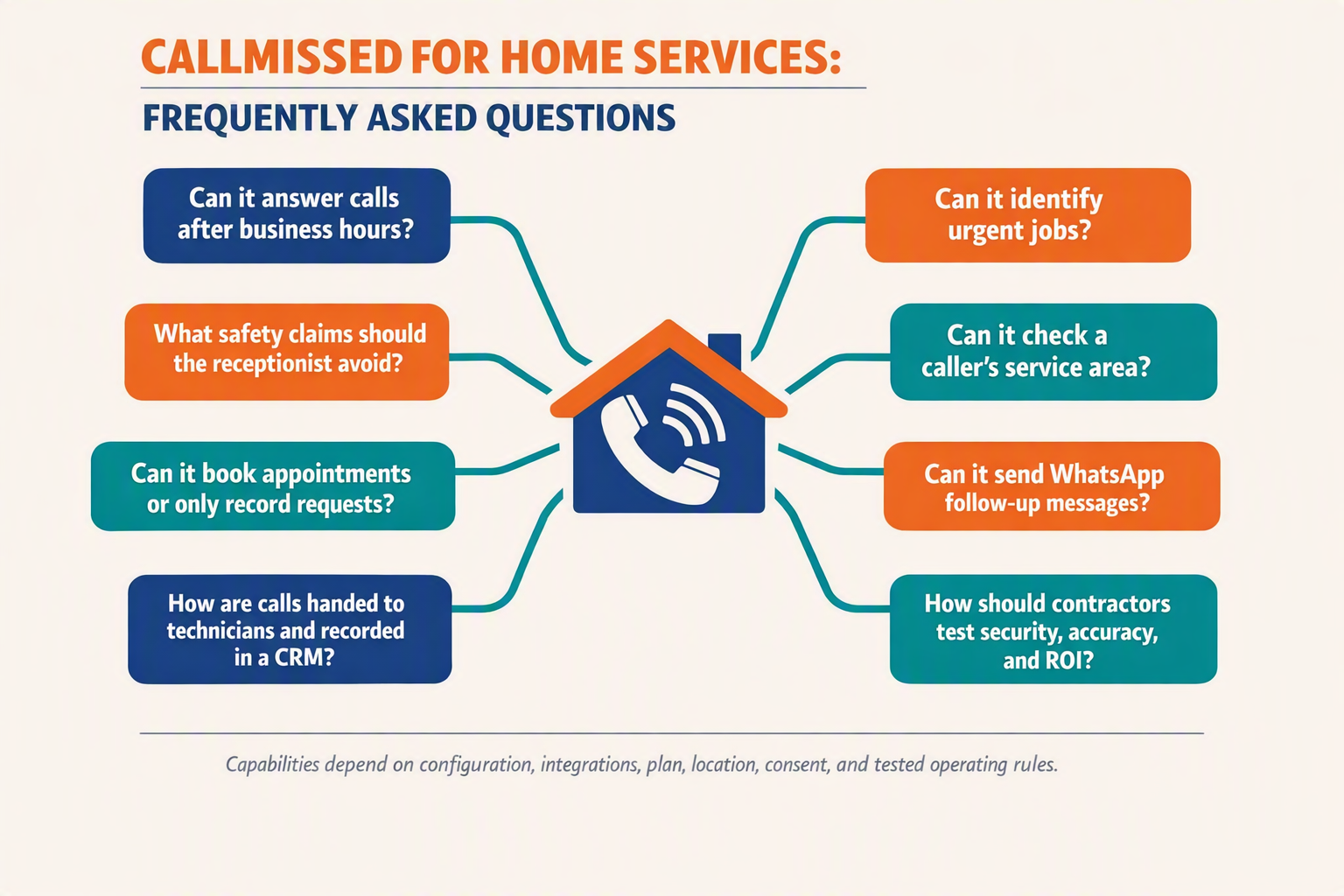
How does CallMissed for home services handle after-hours calls?
Can a home services AI receptionist safely identify emergency jobs?
Can AI call answering for contractors qualify jobs and check service areas?
Can CallMissed book appointments and send WhatsApp follow-ups?
Does CallMissed support multilingual callers and WhatsApp Business calls?
How should contractors measure the ROI of an AI receptionist?
Conclusion
Safe automation for contractors is not about replacing skilled judgement; it is about capturing every enquiry, collecting useful context, and escalating risk without making unsupported promises. CallMissed for home services can help plumbing, electrical, HVAC, and repair businesses provide a consistent first response while keeping diagnosis, pricing, safety decisions, and attendance commitments with qualified people.
Key takeaways
- Capture calls beyond office hours. A home services AI receptionist can record the customer’s contact details, property location, service requirement, preferred appointment window, and consent for WhatsApp follow-up. This gives the team structured information instead of an unanswered call or incomplete voicemail.
- Treat urgency triage as routing, not diagnosis. AI call answering for contractors should reflect the caller’s own description and use conservative, business-approved scripts. Reports involving gas odour, smoke, exposed wiring, severe flooding, or possible danger should trigger instructions to contact the appropriate emergency service, utility provider, or human dispatcher—not assurances that the property is safe or that a technician will arrive within a guaranteed time.
- Connect qualification with human action. Service-area checks, scheduling requests, WhatsApp messages, technician handoffs, and CRM summaries should form one traceable workflow. The objective is to ensure that contractors receive the necessary context before speaking with the customer while preserving a clear path to human intervention.
- Measure outcomes and test continuously. Teams should monitor qualified leads, booking rates, escalation frequency, handoff success, and recovered revenue. Testing must include noisy environments, interrupted calls, regional accents, multilingual conversations, ambiguous hazards, and system failures. CallMissed’s support for 22 Indian languages is particularly relevant for contractors serving multilingual Indian markets.
The need for dependable intake will likely increase: the U.S. Bureau of Labor Statistics projected in 2025 that electrician employment would grow 9% and HVAC technician employment 8% from 2024 to 2034. Watch for safer escalation controls, better multilingual speech recognition, and tighter connections between voice, WhatsApp, and CRM records.
To explore this shift, check out CallMissed—and ask: how many valuable or urgent customer calls could your business handle better with a carefully tested AI-first workflow?
Related Reading
Discussion
Related Posts

Ready to automate customer conversations?
Launch AI voice agents and WhatsApp bots with CallMissed — one API, 22+ Indian languages.