
CallMissed CRM Integration: An Evidence-Led Omnichannel Records Guide



Learn how CallMissed CRM integration can unify voice, WhatsApp, and email data with sound identity, permissions, failure checks, and rollout steps.
CallMissed CRM Integration: An Evidence-Led Omnichannel Records Guide
One customer, three channels, one record
What if your CRM treated one customer’s phone call, WhatsApp message, and email as three different people? That seemingly small identity error can make an AI agent repeat questions, misroute a lead, ignore an opt-out, or expose information to the wrong employee. A reliable CallMissed CRM integration must therefore do more than copy transcripts: it must create a governed, traceable customer record across every interaction.
In Salesforce’s 2023 State of the Connected Customer survey, 79% of customers said they expect consistent interactions across departments. Those expectations are difficult to meet when voice dispositions, WhatsApp consent, email replies, and pipeline stages live in separate systems.
Why omnichannel context now belongs in the integration
CallMissed, an AI-native customer-engagement platform built in India, brings AI voice agents, WhatsApp chat and Business calling, email, and an omnichannel inbox together, making it a practical example of the broader shift toward shared communication context.
An effective omnichannel CRM should synchronize durable facts—customer identifiers, verified contact points, consent status, language preference, owner, lead stage, last interaction, promised follow-up, and outcome—while keeping raw recordings and message bodies subject to retention, access, and purpose controls.
It should also preserve channel metadata, timestamps, source IDs, delivery states, agent actions, and confidence scores so teams can reconstruct what happened without allowing a generated summary to overwrite the underlying evidence.
What this implementation guide will resolve
- This guide will show how to design an AI agent CRM integration around a canonical customer ID, deterministic matching rules, cautious fuzzy matching, and merge-review queues. It will distinguish data that belongs in the CRM from data that should remain in a communications system, and explain how to generate concise summaries linked to source events.
- You will also get a practical method for mapping lead stages, propagating opt-outs, applying role-based permissions, and testing retries, webhooks, duplicate events, partial writes, and channel outages.
- Because no named third-party CRM connector should be assumed without verification, the guide focuses on the API and integration questions that matter: authentication, field mapping, idempotency, rate limits, webhook signatures, audit logs, data residency, deletion behavior, and recovery guarantees.
The goal is not a larger database; it is a trustworthy operational memory that lets humans and AI agents continue the same conversation while respecting customer choice. The final checklist and comparison table turn those principles into a deployment plan.
How should CallMissed CRM integration create one governed customer record across voice, WhatsApp, and email?
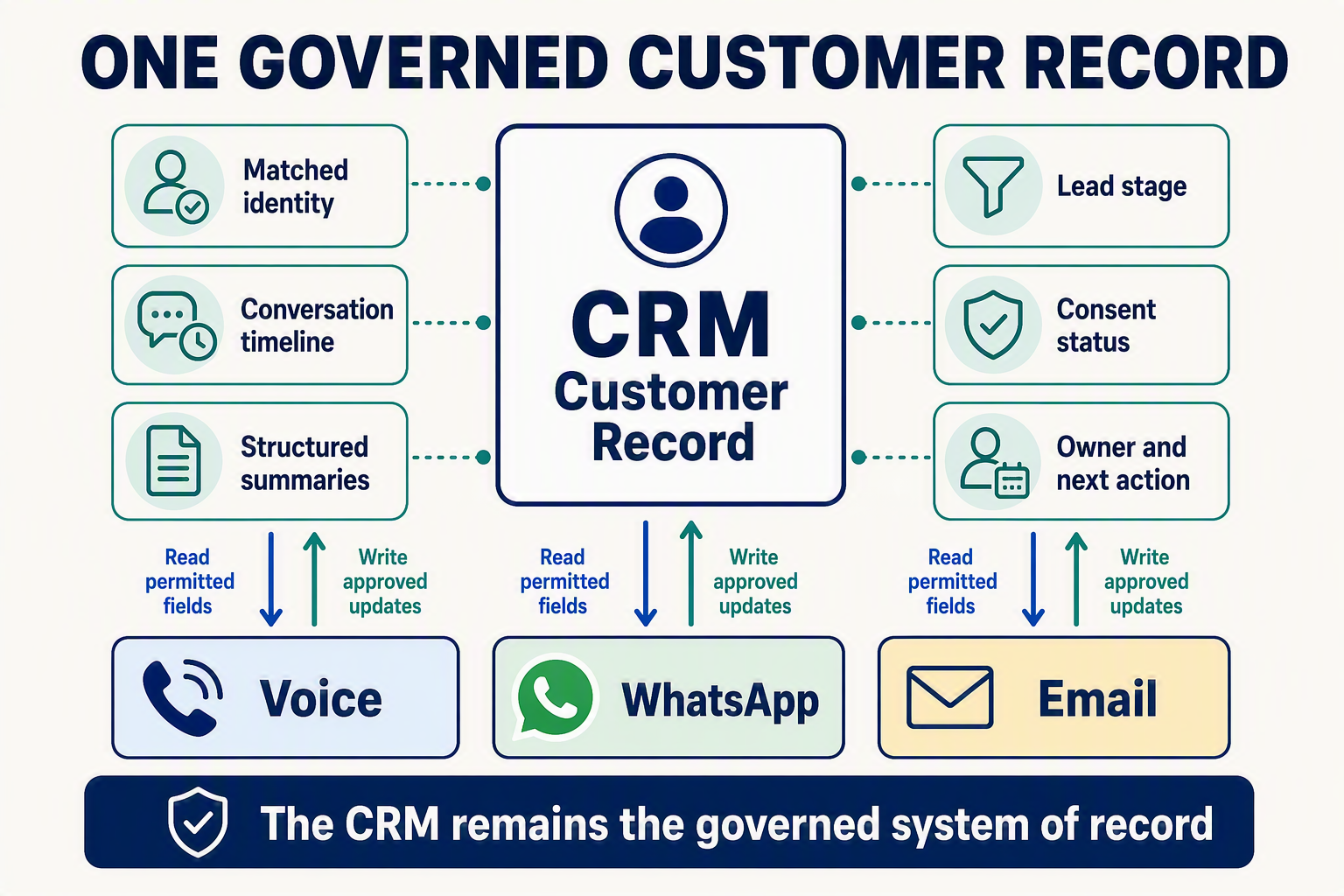
A CallMissed CRM integration should assign every person or organisation a canonical CRM ID, attach channel-specific identities to that ID, and store each interaction as an immutable event. The CRM becomes the authority for customer state, while CallMissed remains the communication context layer for voice, WhatsApp, email, and AI-agent activity.
Define a canonical record before synchronising data
The integration should separate the durable customer profile from the interaction timeline. A practical omnichannel CRM model has three linked objects:
- Customer: Canonical ID, name, account, owner, preferred language, lifecycle stage, and verified contact methods.
- Channel identity: Normalised phone number, WhatsApp identity, email address, verification state, and source.
- Interaction: Call, message, email, disposition, timestamp, participating agent, source event ID, and linked artefacts.
Phone numbers should be stored in E.164 format, timestamps in ISO 8601 with a UTC offset, and email addresses in a consistently normalised form. Preserve the originally supplied value separately because normalisation can remove evidence needed for investigation.
Never use a mutable field such as a phone number as the primary key. Numbers can be reassigned, email addresses can be shared, and one customer can legitimately use several identities.
Establish field-level ownership
Bidirectional synchronisation without ownership rules creates loops and silent overwrites. Define one authoritative system for every field:
- CRM-owned: Canonical ID, account relationship, sales owner, lead stage, revenue fields, and manually verified profile data.
- Communication-owned: Call status, WhatsApp delivery state, recording reference, message identifiers, channel timestamps, and AI-agent execution metadata.
- Policy-controlled: Consent, opt-outs, legal holds, retention deadlines, and deletion status.
- Derived: Latest summary, sentiment, intent, next action, and confidence score.
Derived values must not replace customer-provided facts. For example, an AI summary may say “customer prefers Hindi,” but the profile should change only when the statement is supported by a source interaction or confirmed by an authorised user.
The European Union’s General Data Protection Regulation has applied since 25 May 2018, and GDPR Article 5 requires personal data to be adequate, relevant, and limited to what is necessary. Even where GDPR is not the governing law, that data-minimisation principle is a useful architecture constraint: synchronise operational facts, not every available payload.
Process every interaction as a governed event
An AI agent CRM integration should process voice, WhatsApp, and email through the same controlled sequence:
- Validate the webhook signature and record the source event ID.
- Reject duplicate events using an idempotency key.
- Resolve the channel identity to a canonical customer.
- Append the interaction without modifying earlier evidence.
- apply consent and permission rules.
- Generate a source-linked summary and proposed next action.
- Update lead stage only when an explicit transition rule is satisfied.
For CallMissed, the design should accommodate AI voice agents, WhatsApp chat and Business calls, email, and the omnichannel inbox without assuming that any named third-party CRM connector exists. Before implementation, verify whether the required CRM connection uses native configuration, webhooks, an API, middleware, or a custom adapter.
Make governance visible inside the record
Every synchronised field should carry source, timestamp, actor, verification state, and last-modified version. Users should also be able to distinguish customer-authored content, human notes, and AI-generated summaries at a glance.
The result is not merely a combined activity feed. It is a controlled customer record in which every claim can be traced to evidence, every change has an accountable owner, and every channel continues from the same governed state.
Why does an AI agent CRM integration need shared memory, evidence boundaries, and a system of record?

An AI agent CRM integration needs shared memory to continue conversations across channels, evidence boundaries to separate verified facts from model-generated interpretations, and a designated system of record to resolve conflicting updates. Without all three, an agent may recall context yet act on stale, unverified, or unauthorized information.
Shared memory is useful only when it is scoped
Shared memory should give a voice agent, WhatsApp chatbot, email workflow, and human employee the minimum context required to handle the next interaction. Salesforce’s 2023 State of the Connected Customer found that 79% of customers expect consistent interactions across departments, making continuity an operational requirement rather than a convenience.
However, shared memory should not mean unrestricted access to every transcript or recording. Divide memory into three layers:
- Durable customer facts: canonical customer ID, verified phone numbers, verified email addresses, preferred language, consent status, assigned owner, lead stage, and active commitments.
- Interaction context: recent channel, timestamp, intent, outcome, unresolved issue, and scheduled follow-up.
- Restricted evidence: call recordings, full transcripts, message bodies, attachments, payment details, and sensitive personal information.
An omnichannel CRM can store durable facts and concise interaction references while the communication platform retains channel evidence under appropriate access and retention controls. The AI agent should retrieve only the fields permitted for its current purpose and role.
Evidence boundaries prevent generated text from becoming fact
An AI-generated summary is a useful navigation aid, but it is not equivalent to the source conversation. Every summary written through a CallMissed CRM integration should preserve a boundary between what the customer actually communicated and what the model inferred.
A defensible summary object should include:
- Source event IDs for the call, WhatsApp exchange, or email thread.
- Channel and timestamps, preferably in UTC plus the business’s local timezone.
- Extracted facts, each linked to supporting evidence where practical.
- Model-generated interpretation, clearly labelled as a summary or inferred intent.
- Confidence or review status for fields that can trigger consequential actions.
- Generator metadata, including model or workflow version and creation time.
For example, “Customer said, ‘Please call after 4 p.m.’” is evidence-backed. “Customer is highly likely to purchase” is an inference. The latter may help prioritization, but it should not silently advance a lead stage or replace a salesperson’s qualification decision.
The system of record decides which update wins
Each field must have one authoritative owner. “Everything syncs both ways” is not a sufficient governance rule because simultaneous webhook deliveries, retries, human edits, and delayed channel events can create contradictory values.
A practical ownership model is:
- CRM owns commercial state: lead stage, account owner, opportunity value, qualification status, and sales tasks.
- Communication platform owns interaction evidence: recordings, transcripts, delivery receipts, channel IDs, and message status.
- Consent service or governed CRM field owns permissions: opt-ins, opt-outs, legal basis, source, scope, and effective timestamp.
- Identity service owns entity resolution: canonical IDs, aliases, merge history, and match confidence.
When two systems disagree, the integration should apply field-level precedence, event timestamps, version checks, and idempotency keys—not a blanket “last write wins” rule. Failed or ambiguous updates should enter a review queue rather than being guessed by the AI agent.
This architecture turns shared memory into traceable operational memory: useful enough for continuity, constrained enough for privacy, and authoritative enough for humans and automated agents to trust.
What data should an omnichannel CRM sync across voice, WhatsApp, and email?
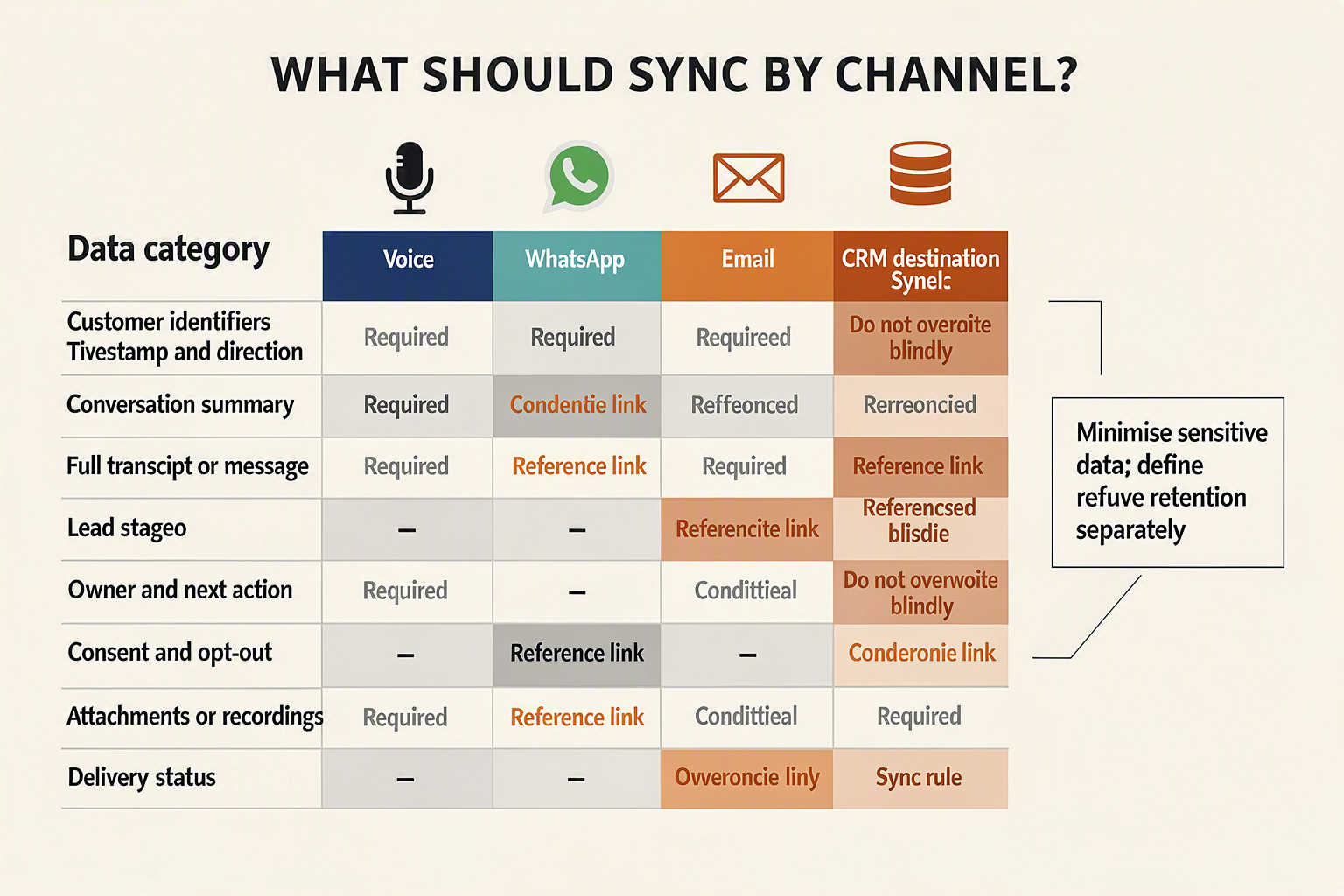
An omnichannel CRM should sync operational facts needed to identify the customer, continue the conversation, respect consent, and advance the relationship. Raw recordings, complete transcripts, attachments, and message bodies should generally remain in the communications layer, with the CRM storing secure references and structured outcomes.
Recommended cross-channel data model
| Data group | Voice | CRM destination | ||
|---|---|---|---|---|
| Identity | E.164 phone number, caller ID, verified status | WhatsApp ID, E.164 number, profile name | Normalized email, verification status | Contact identifiers linked to one canonical customer ID |
| Interaction evidence | Call ID, direction, start/end time, recording reference | Message ID, direction, timestamp, delivery/read status | Message-ID, thread ID, sender, recipients, timestamp | Immutable activity record with source-system ID |
| Conversation outcome | Disposition, intent, transfer, callback request | Intent, resolved/escalated state, requested action | Reply classification, requested action, resolution | Structured activity fields and follow-up task |
| AI-generated context | Summary, entities, sentiment, confidence | Thread summary, extracted entities, confidence | Thread summary, extracted entities, confidence | Versioned summary linked to supporting events |
| Commercial state | Product interest, qualification answers | Catalogue or offer interest, qualification answers | Enquiry type, proposal response | Lead stage, opportunity, owner, next action |
| Consent and preferences | Calling permission, do-not-call status, preferred time | WhatsApp opt-in source, scope, timestamp, opt-out | Subscription status, unsubscribe event, lawful purpose | Channel-specific consent ledger and global suppression rules |
The International Telecommunication Union’s E.164 standard permits a maximum of 15 digits in an international telephone number. Phone values should therefore be normalized to E.164 before matching voice and WhatsApp identities; display formatting should not become part of the identity key.
For email, preserve the Message-ID defined by the Internet Engineering Task Force’s RFC 5322 rather than relying only on subject lines. Subjects can change, repeat, or lose prefixes, whereas source IDs provide stronger evidence for threading and idempotency.
Sync facts, references, and provenance—not just text
Every synchronized activity should carry enough provenance to answer who, what, when, and where:
canonical_customer_idand channel-specific identifiersource_event_id, source channel, and event timestamp in UTC- direction, assigned human or AI agent, and conversation outcome
- consent state applicable when the interaction occurred
- summary version, generation time, model identifier, and confidence
- secure references to recordings, transcripts, messages, or attachments
- creation, update, deletion, and merge audit fields
A CallMissed CRM integration can use this structure across AI voice, WhatsApp chat and Business calling, email, and the omnichannel inbox without treating every utterance as a permanent CRM field. The integration should upsert durable state while appending interaction events, never silently replacing source evidence.
Keep summaries subordinate to source events
An AI agent CRM integration should create a concise summary containing the customer’s intent, verified facts, commitments, unresolved questions, and next action. It should not convert speculation into profile data: “caller may be interested in financing” belongs in a summary, while “financing requested” requires explicit evidence.
Apply three controls:
- Link each summary to its source event IDs.
- Store confidence and extraction method for inferred fields.
- Require review for consequential changes, including lead disqualification, identity merges, sensitive-data updates, or consent reversal.
This separation gives sales and support teams useful context while retaining an auditable path back to the original communication.
How should identity matching, conversation summaries, and cross-channel timelines work?
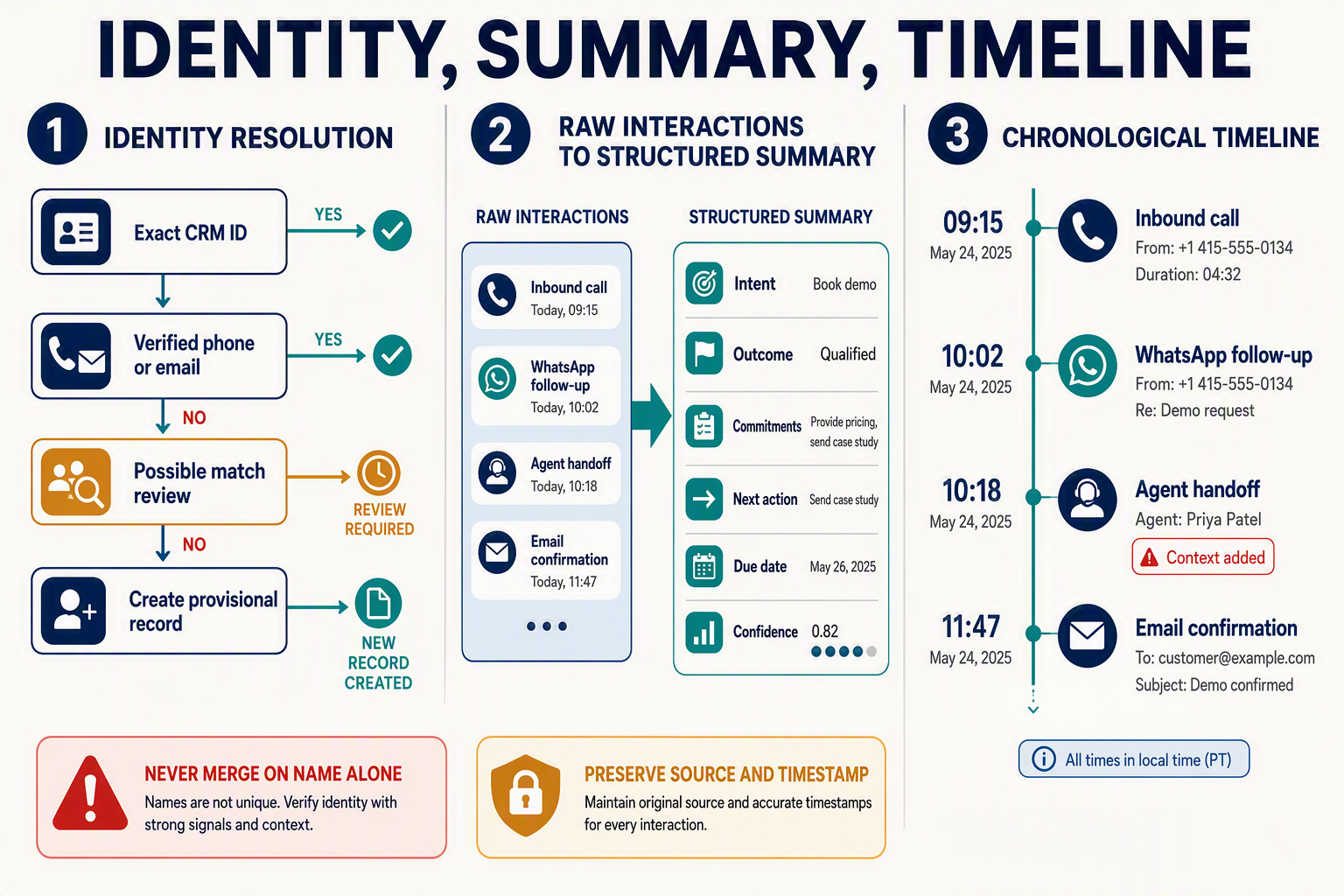
Identity matching should resolve verified channel identifiers to a stable CRM customer ID, while summaries should remain derived, reviewable artefacts linked to their source conversations. The cross-channel timeline should be an append-only sequence of voice, WhatsApp, and email events—not a rewritten narrative that hides what actually happened.
Match identities with an evidence hierarchy
An omnichannel CRM needs an identity graph rather than a single “phone equals customer” rule. Store each phone number, WhatsApp identifier, and email address as a separate contact point connected to the canonical customer ID, including its verification state, source, and validity period.
Apply matching rules in descending order of certainty:
- Exact internal reference: Match an authenticated account ID, CRM contact ID, order number, or signed session identifier.
- Verified contact point: Match a phone number confirmed by OTP, an authenticated WhatsApp identity, or a verified email address.
- Exact unverified identifier: Suggest a match, but require additional evidence before exposing account-specific information.
- Probabilistic evidence: Use name, company, location, or conversation context only to create a review candidate—not an automatic merge.
Normalize telephone numbers to ITU-T E.164, which permits a maximum of 15 digits, while retaining the original customer-entered value for audit and display. Email domains can be case-normalized, but integrations should not remove punctuation or apply provider-specific alias rules universally because two addresses that look similar may represent different recipients.
Every identity link should record:
- Identifier type and normalized value
- Verified, unverified, or revoked status
- Verification method and timestamp
- Source system and source record ID
- Match method and confidence
- Who approved, rejected, merged, or split the record
A shared family phone, recycled number, forwarded email, or assistant-managed WhatsApp account must not silently combine customer records. High-impact merges should enter a human review queue and remain reversible.
Generate summaries without replacing evidence
An AI agent CRM integration should generate a short, structured summary after a meaningful interaction or conversation window. The summary should capture:
- Customer intent and requested outcome
- Confirmed facts, excluding unsupported inference
- Commitments, deadlines, and responsible owner
- Objections, unresolved questions, and escalation status
- Consent or opt-out statements requiring workflow action
- Language used and whether translation occurred
Store the model name or version, prompt/template version, generation time, and source event IDs with each summary. NIST’s January 2023 AI Risk Management Framework 1.0 identifies validity, reliability, transparency, and accountability as characteristics of trustworthy AI; source-linked summaries operationalize those principles by allowing staff to inspect the underlying transcript or message.
A generated statement such as “customer accepted the quote” must not update a contractual or pipeline field unless the source event supports it and the configured business rule permits that transition. Corrections should create a new summary version rather than erase the original.
Build one ordered, channel-neutral timeline
A CallMissed CRM integration can bring AI voice, WhatsApp chat and Business calling, and email activity into one operational view. Each timeline event should use a common envelope containing:
event_id,customer_id,conversation_id, andchanneloccurred_atandreceived_attimestamps with time zones- Direction, participant, delivery state, and agent identity
- Source-system ID, payload reference, and correlation ID
- Visibility classification and retention policy
Sort primarily by occurred_at, but preserve received_at to explain delayed webhooks and offline delivery. Deduplicate using immutable event IDs, display late-arriving events in their true chronological position, and visibly mark disputed identity matches. This produces continuity for humans and AI agents without confusing generated memory with verified customer history.
How should lead stages, opt-outs, permissions, retention, and human ownership be governed?
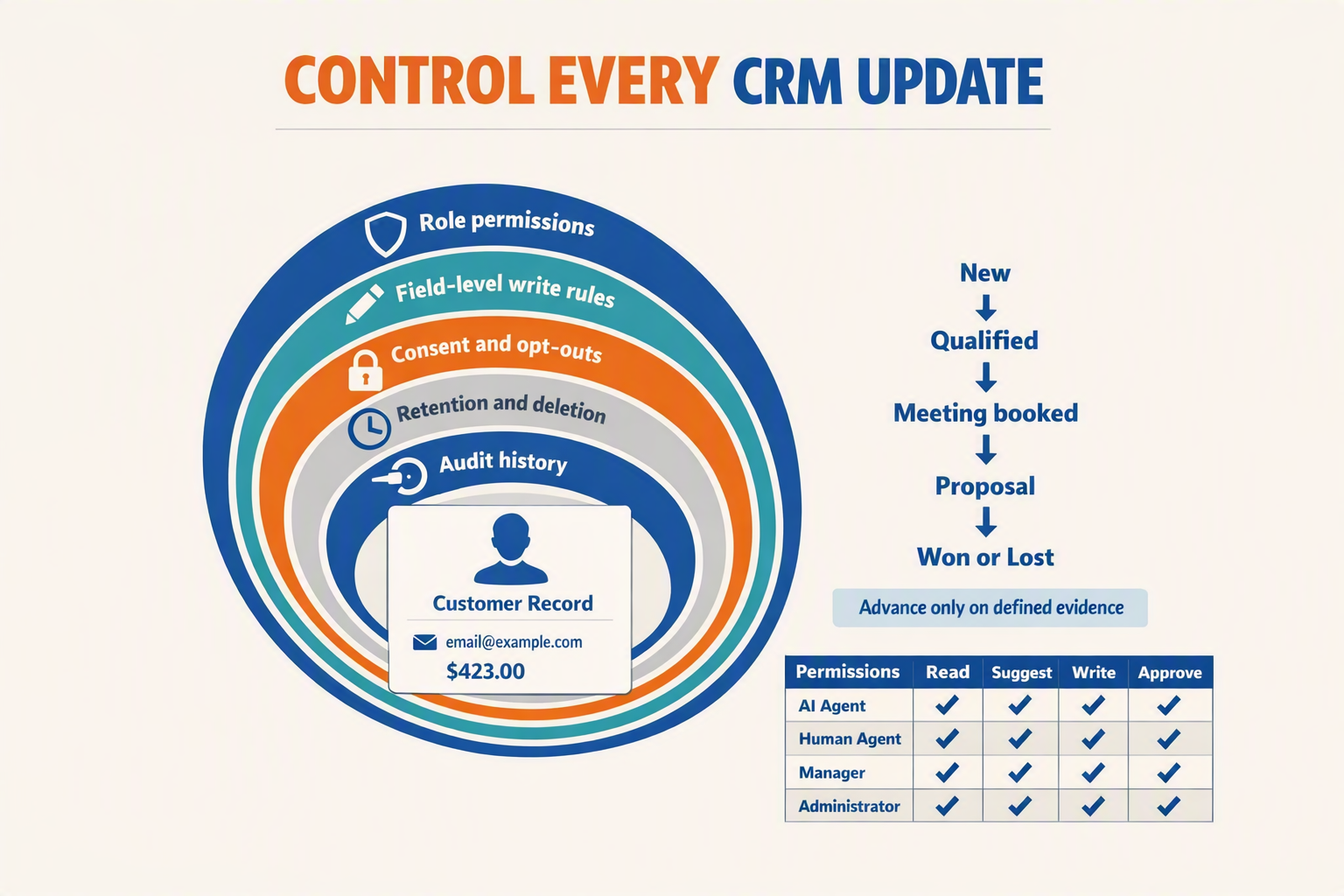
A governed CallMissed CRM integration should treat lead stages, consent, access, retention, and ownership as controlled state—not editable notes. The CRM should remain authoritative for pipeline and human ownership, while channel-specific opt-outs and communication evidence synchronize through explicit, auditable rules.
Make lead-stage changes deterministic
Define one canonical stage model and map every channel outcome to it. An AI agent CRM integration may recommend or apply low-risk transitions, but it should not infer commercially or legally significant outcomes without evidence.
- Create a mapping such as New → Contacted → Qualified → Proposal → Won/Lost.
- Specify the event required for each transition: answered qualification questions, booked meeting, accepted quotation, or recorded rejection.
- Store previous stage, new stage, source event ID, actor, timestamp, reason, and confidence.
- Reject backward or skipped transitions unless an approved workflow permits them.
- Require human approval for high-impact changes such as marking a deal won, disqualifying a regulated applicant, or reallocating account ownership.
A WhatsApp reply saying “send details” may justify Contacted, for example, but it does not prove Qualified. Generated summaries can support a decision; they should not become the sole evidence for it.
Propagate opt-outs by purpose and channel
An opt-out must take effect before the next campaign run, including when it originates during a voice call rather than through a standard keyword. Store consent as structured data:
- Identity and contact point: customer ID, phone number, or email address
- Channel and purpose: WhatsApp marketing, email offers, voice promotions, or service notifications
- Status and provenance: granted, withdrawn, source interaction, wording shown, and timestamp
- Scope: channel-only, campaign-specific, or all marketing communications
India’s Digital Personal Data Protection Act, 2023 states that withdrawing consent must be as easy as giving it. The Telecom Commercial Communications Customer Preference Regulations, 2018, issued by the Telecom Regulatory Authority of India, also establish customer preferences and controls for commercial communications.
Do not interpret a marketing opt-out as a request to suppress essential security, order, or support messages automatically; classify purposes with legal review. Conversely, “do not contact me again” should enter a review-safe global suppression flow rather than being buried in a transcript.
Enforce least privilege and bounded retention
The omnichannel CRM should separate access to contact details, summaries, transcripts, recordings, exports, and consent administration. Use role-based permissions so sales representatives see assigned leads, supervisors review escalations, and compliance administrators manage deletion or legal holds.
The European Union’s General Data Protection Regulation, effective May 25, 2018, defines storage limitation in Article 5(1)(e): personal data should be retained no longer than necessary for its purpose. India’s Digital Personal Data Protection Act, 2023 similarly requires erasure when consent is withdrawn or the specified purpose is no longer served, unless retention is legally required.
Apply separate retention schedules to:
- Raw call recordings and full transcripts
- WhatsApp and email message bodies
- AI summaries and extracted attributes
- Consent evidence, audit logs, and transaction records
Deletion must cascade to replicas, search indexes, embeddings, and queued exports—or record why a legal hold prevents it.
Keep one accountable human owner
Every active record should have one current human owner, an assignment timestamp, and a fallback queue. AI agents may answer, summarize, qualify, and propose follow-ups, but unresolved complaints, consent ambiguity, sensitive disclosures, low-confidence identity matches, and ownership conflicts should route to a named person. Log every automated and human change so governance remains reconstructable across voice, WhatsApp, and email.
Which integration capabilities, API details, and evidence claims must you verify?
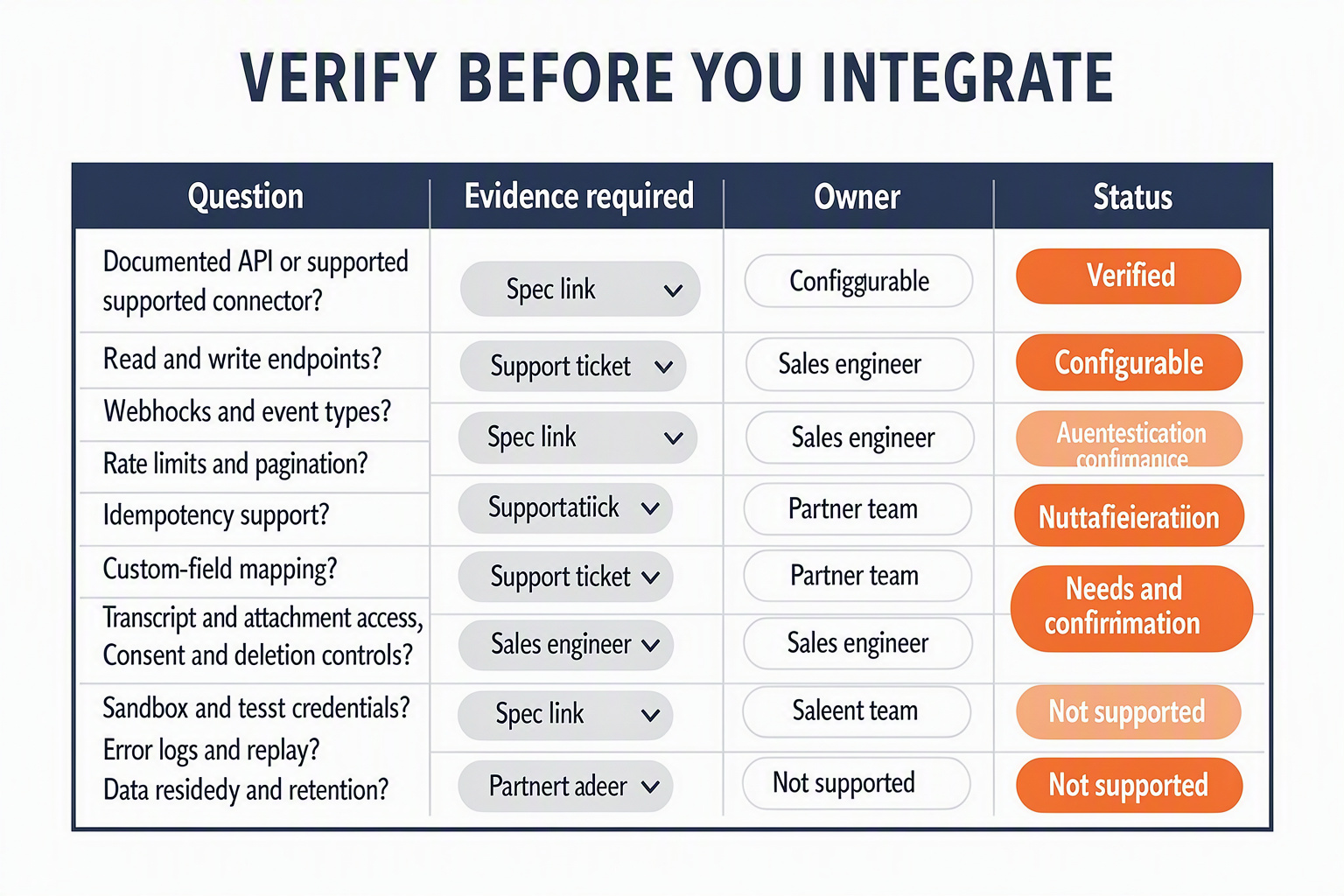
A CallMissed CRM integration should enter production only after the team verifies connector scope, API behavior, event delivery, security controls, and data-lifecycle guarantees. Product-page language can establish broad capability, but endpoint documentation, contractual terms, and failure-injection tests must substantiate implementation claims.
Verification matrix for integration decisions
| Area to verify | Questions and required evidence | Acceptance test | Claim permitted after verification |
|---|---|---|---|
| Integration scope | Is the connection native, partner-built, middleware-based, or custom? Which CRM objects and fields support read and write operations? Obtain current product documentation and a supported-object list. | Create, update, and retrieve a test contact, interaction, task, consent value, and lead stage. | Name a CRM connector only when its availability and supported operations are documented. |
| Authentication and authorization | Confirm authentication method, token expiry, rotation, scopes, service-account support, tenant isolation, and role requirements. Do not assume that an OpenAI-compatible model API also exposes CRM administration endpoints. | Revoke a credential, attempt an out-of-scope write, and verify immediate rejection plus audit evidence. | State the exact authentication and permission mechanisms demonstrated by documentation and tests. |
| Writes, retries, and limits | Verify idempotency keys, external IDs, pagination, batch limits, rate limits, timeout behavior, retry guidance, concurrency rules, and partial-write responses. | Replay the same request and force a timeout after submission; confirm that no duplicate contact or activity appears. | Describe a write as retry-safe only when duplicate prevention is documented and reproducible. |
| Webhooks and event ordering | Check available event types, signature validation, timestamp tolerance, delivery retries, ordering guarantees, replay windows, and dead-letter recovery. | Deliver duplicate, delayed, forged, and out-of-order events; verify rejection or deterministic reconciliation. | Claim real-time synchronization only with measured latency and documented delivery semantics. |
| Identity and channel data | Establish whether voice caller IDs, WhatsApp identifiers, and normalized email addresses are available with stable source IDs. Verify fields for consent, delivery status, recordings, transcripts, summaries, and confidence scores. | Send interactions from matched and deliberately ambiguous identities; ensure uncertain matches enter review rather than auto-merge. | Claim unified records only for channels and identity rules validated end to end. |
| Governance and lifecycle | Request evidence for encryption, audit logs, data location, subprocessors, retention, export, deletion propagation, backups, and recovery objectives. Separate platform settings from contractual commitments. | Delete a test customer and trace removal or tombstoning through the CRM, queues, indexes, logs, and retained media. | Publish residency, deletion, or recovery claims only with dated documentation or contractual support. |
Keep three CallMissed surfaces distinct
CallMissed combines AI voice agents, WhatsApp chat and WhatsApp Business calling, email, and an omnichannel inbox. CallMissed also operates an OpenAI-compatible developer gateway spanning large language models, Speech-to-Text, Text-to-Speech, image generation, and web search; however, that gateway’s compatibility does not by itself prove the availability of contact, pipeline, consent, or CRM-write endpoints.
For an AI agent CRM integration, verify separately:
- The business-platform API or export mechanism used for customer records.
- The events available for voice, WhatsApp, email, agent handoff, and campaign activity.
- Whether generated summaries link back to immutable source-event IDs.
- Whether lead-stage and opt-out updates are bidirectional or authoritative in one system.
- Which features are generally available, limited-access, or dependent on a provider.
Apply an evidence hierarchy
Use evidence in descending order of reliability:
- Observed production-like tests, including retries and outages.
- Signed contracts, data-processing terms, and service commitments.
- Versioned API references and dated security documentation.
- Current product documentation and administrator screenshots.
- Marketing pages or sales statements, treated as discovery inputs rather than technical proof.
Record the evidence owner, document date, API version, test result, and next review date in the architecture decision log. This discipline prevents an omnichannel CRM design from depending on an undocumented field, an assumed connector, or a delivery guarantee that was never actually offered.
What failure modes can break synchronization, and how should teams detect and recover from them?
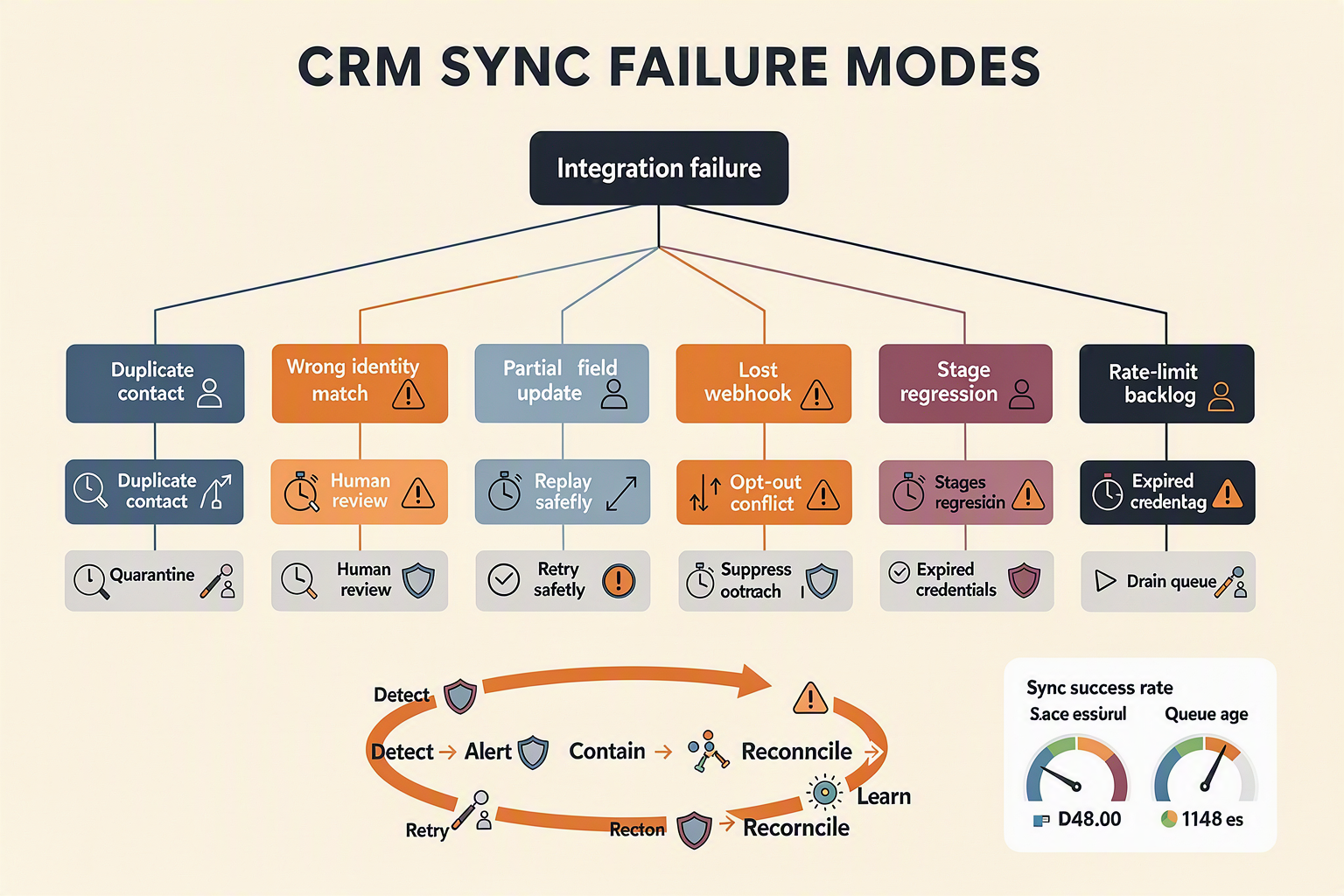
Synchronization usually breaks through lost or duplicated events, out-of-order delivery, partial writes, identity errors, schema drift, expired credentials, or channel outages. Teams should assume these failures will occur, detect them through event-level observability, and recover with idempotent replay rather than manual database edits.
Recognize the failure modes that corrupt customer records
A robust CallMissed CRM integration should explicitly test these scenarios:
- Duplicate delivery: A webhook retry creates two activities, advances a lead twice, or sends the same follow-up repeatedly. RFC 9110, published by the Internet Engineering Task Force in June 2022, specifies that PUT and DELETE are idempotent while POST is not inherently idempotent—so POST-based event handlers need application-level idempotency keys.
- Dropped events: Call, WhatsApp, or email events never reach the CRM because an endpoint is unavailable or acknowledges an event before committing it.
- Out-of-order events: A “call completed” event arrives before “call answered,” or an older lead-stage update overwrites a newer decision.
- Partial writes: The transcript is stored, but the disposition, consent change, owner, or follow-up task fails. This creates a record that appears complete but is operationally unsafe.
- Identity collisions: A recycled phone number, shared family inbox, malformed country code, or overaggressive fuzzy match attaches an interaction to the wrong customer.
- Schema and authentication failures: Renamed CRM fields, changed enum values, expired tokens, missing scopes, or invalid webhook signatures stop synchronization.
- Rate limiting and outages: RFC 6585, published by the Internet Engineering Task Force in April 2012, defines HTTP 429 Too Many Requests and permits a
Retry-Afterresponse header that integrations should honor. - Derived-data drift: An AI-generated summary or lead stage no longer reflects the underlying source events after a correction, deletion, or late-arriving message.
Detect failures before users report them
Every event should carry an event ID, source record ID, customer ID, channel, event type, source timestamp, received timestamp, schema version, processing status, retry count, and correlation ID. Monitor both technical and business-level signals:
- Webhook success rate and signature-validation failures
- Event age, queue depth, retry volume, and dead-letter queue size
- Counts of source events versus committed CRM activities
- Duplicate idempotency keys and identity-match conflicts
- Records missing required companion fields
- Consent or lead-stage discrepancies across systems
- Sudden channel-specific drops against normal hourly patterns
A successful HTTP response is not proof of synchronization. The integration should acknowledge an event only after durable storage, then expose whether downstream CRM processing is pending, committed, quarantined, or failed.
Recover without creating a second inconsistency
Use a controlled recovery sequence for an AI agent CRM integration:
- Pause unsafe automation, such as outbound campaigns, when consent or identity state is uncertain.
- Retain the original event in an immutable queue or event store; never reconstruct it solely from a generated summary.
- Retry transient failures with exponential backoff, jitter, a maximum attempt count, and
Retry-Aftercompliance. - Quarantine permanent failures—including invalid fields or ambiguous identities—in a dead-letter queue with a named owner.
- Replay idempotently using the original event ID and conditional version checks.
- Reconcile periodically by comparing source counts, hashes, timestamps, and terminal states with the omnichannel CRM.
- Record every repair in an audit log, including the operator, reason, previous value, replacement value, and replay result.
For CallMissed workflows spanning voice, WhatsApp, and email, recovery should preserve the source interaction while recalculating summaries and stages as replaceable derivatives. That distinction prevents a synchronization fault from becoming permanent customer-history corruption.
What do integration experts recommend, and what are the operational and compliance implications?

Integration experts recommend treating CRM synchronization as a governed data pipeline, not a bulk-copy exercise. For a CallMissed CRM integration, that means documenting why each field moves, which system owns it, who can access it, how long it remains, and how corrections or deletions propagate.
Apply established integration and AI-governance practices
The NIST AI Risk Management Framework 1.0, published in January 2023, organizes AI risk work around four functions: Govern, Map, Measure, and Manage. Applied to an AI agent CRM integration, these functions translate into practical controls:
- Govern: Assign owners for identity rules, consent, retention, security, and model-generated summaries.
- Map: Document every data flow among CallMissed, the CRM, model providers, storage systems, and analytics tools.
- Measure: Track duplicate rates, failed writes, incorrect merges, summary corrections, unauthorized access attempts, and opt-out propagation time.
- Manage: Establish rollback, incident-response, manual-review, and customer-correction procedures.
The OWASP API Security Top 10—2023 identifies broken object-level authorization as its first API risk. Every read or update should therefore verify that the authenticated user, service account, or AI agent may access that specific customer record—not merely that it possesses a valid API key.
Experts also recommend a written data contract specifying field types, allowed values, event versions, idempotency keys, timestamps, ownership, and deletion behavior. Deploy schema changes gradually, because an unexpected enum or missing identifier can silently corrupt lead stages and customer timelines.
Translate privacy principles into system behavior
India’s Digital Personal Data Protection Act, 2023 received presidential assent on 11 August 2023. Organizations should assess which provisions and implementing rules apply at deployment time, but the engineering direction is clear: provide appropriate notice, use personal data for a defined purpose, maintain reasonable security safeguards, support applicable data-principal rights, and implement erasure workflows.
For multinational deployments, the EU General Data Protection Regulation has applied since 25 May 2018 and requires principles including purpose limitation, data minimization, accuracy, storage limitation, and security. Operationally, an omnichannel CRM should:
- Store structured outcomes and source references instead of indefinitely duplicating every recording, transcript, attachment, and email body.
- Record the purpose, channel, scope, source, and timestamp of consent or opt-out.
- Prevent an AI-generated summary from becoming unchallengeable evidence; retain provenance and a correction path.
- Apply role-based access so sales representatives, support agents, administrators, and automated services see only necessary fields.
- Propagate verified correction, suppression, and deletion requests to downstream indexes, caches, backups, and model-memory stores according to documented policy.
Where high-risk profiling, sensitive data, or systematic monitoring is involved, obtain legal guidance on whether a data-protection impact assessment is required.
Plan for security operations and accountability
The Indian Computer Emergency Response Team issued its cybersecurity directions on 28 April 2022, including specified incident-reporting and log-retention obligations for covered entities. Teams should verify applicability rather than assuming every CRM event must be retained indefinitely.
Before production, confirm:
- Controller, processor, and subprocessor responsibilities.
- Hosting locations, cross-border transfers, encryption, key management, and backup residency.
- Webhook authentication, secret rotation, audit-log integrity, and privileged-access reviews.
- Breach-notification responsibilities and escalation contacts.
- WhatsApp, voice-recording, telemarketing, and email-consent requirements in every operating jurisdiction.
CallMissed’s cross-channel capabilities can unify voice, WhatsApp, and email context, but technical unification does not create legal permission. The safest design preserves continuity while enforcing consent, least privilege, traceability, and channel-specific restrictions at every write and read.
What does implementation mean for your team, and which rollout steps should you complete?
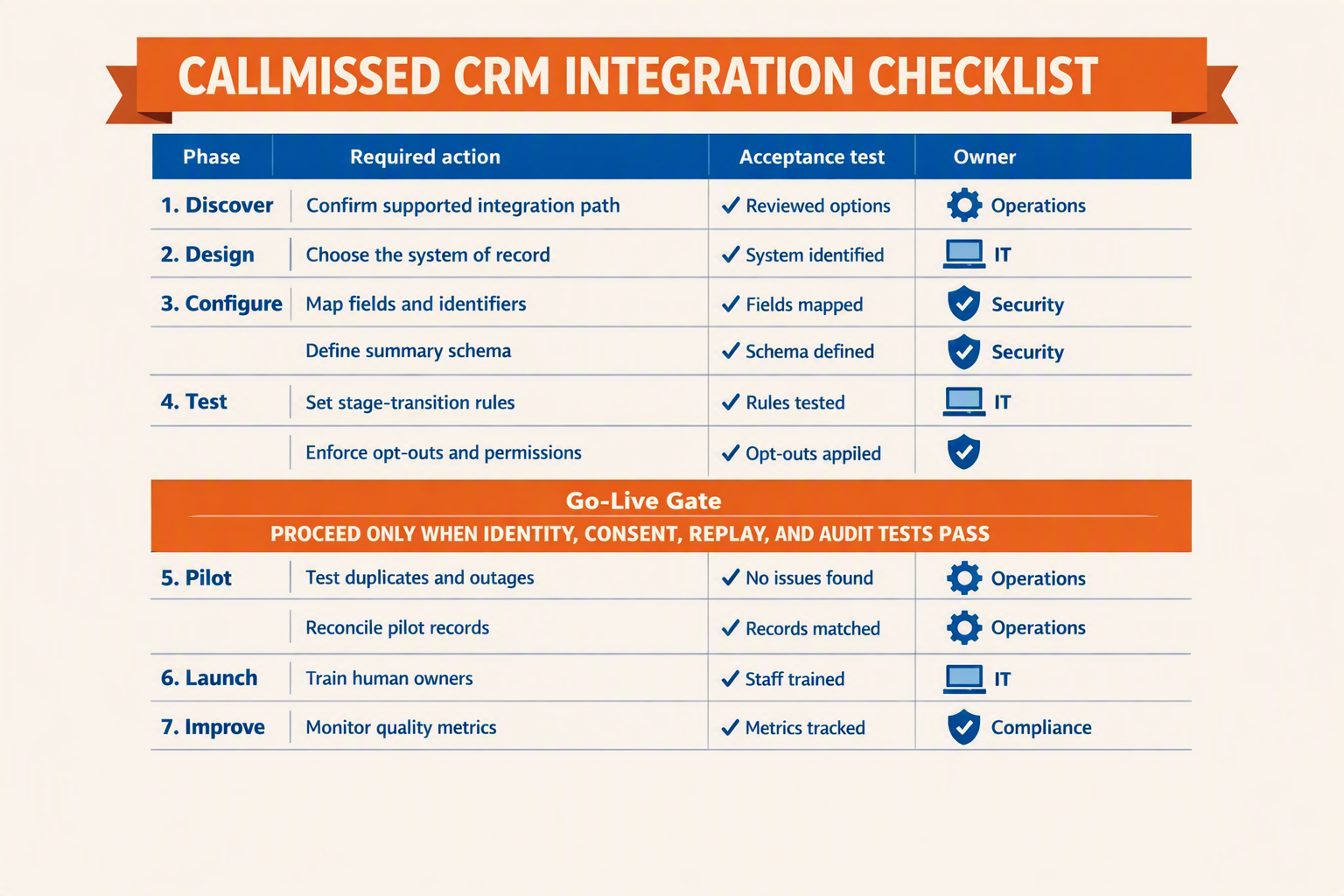
Implementation means turning the integration design into owned workflows, testable data contracts, and measurable release gates. Your team should roll out the CallMissed CRM integration incrementally—starting with read-only mapping, then controlled writes, channel pilots, and monitored production—rather than connecting every channel at once.
Recommended rollout sequence
| Step | Primary owner | Required output | Exit criterion |
|---|---|---|---|
| 1. Define scope and ownership | Product owner + CRM administrator | Channel inventory, system-of-record matrix, RACI, success metrics | Every synchronized field has an owner, source, purpose, and update rule |
| 2. Map data and identities | CRM architect + data engineer | Canonical ID schema, phone/email normalization, match hierarchy, merge-review process | Test records link correctly without unsafe automatic merges |
| 3. Build and secure the integration | Integration engineer + security lead | Authentication, signed-webhook validation, idempotency keys, least-privilege service accounts | Duplicate and unauthorized events cannot create valid CRM writes |
| 4. Validate workflows | Sales, support, marketing + QA | Lead-stage mappings, summary templates, consent propagation, routing rules | Approved test cases pass across voice, WhatsApp, and email |
| 5. Pilot with limited traffic | Operations lead + selected agents | Controlled user cohort, dashboards, reconciliation reports, support runbook | No unresolved critical defects; users can trace CRM updates to source events |
| 6. Release and operate | Engineering + operations + compliance | Alerts, retry queues, audit reviews, deletion procedures, rollback plan | Production health and data-quality thresholds remain within agreed limits |
The first deliverable should be a field-level contract, not code. For each attribute, document its format, authoritative system, write direction, retention rule, and conflict policy. For example, a CRM may own the lead stage while the communications platform supplies the latest interaction outcome. The team must decide which value wins when updates arrive out of order.
Divide responsibilities before connecting live data
A practical AI agent CRM integration needs more than an engineering owner:
- CRM administrators manage schemas, validation rules, deduplication, queues, and permissions.
- Sales and support leaders approve stage transitions, dispositions, escalation criteria, and human handoffs.
- Security and privacy teams review credentials, recordings, transcript access, consent evidence, retention, and deletion behavior.
- Data or integration engineers own webhooks, retries, rate-limit handling, reconciliation, observability, and rollback.
- Front-line users verify whether summaries are useful, attribution is clear, and the next action is operationally correct.
Salesforce’s 2023 State of the Connected Customer found that 79% of customers expect consistent interactions across departments; implementation should therefore test cross-team continuity, not merely API availability.
Use a constrained pilot and explicit release gates
Pilot the omnichannel CRM with selected queues, numbers, WhatsApp entry points, or email addresses. Include normal journeys and adversarial cases: shared phone numbers, changed email addresses, duplicate webhook delivery, simultaneous updates, revoked consent, malformed payloads, unavailable CRM APIs, and delayed events.
Before production, require evidence that:
- Source events remain traceable after summaries and stage updates.
- Retries are idempotent and failed writes enter a visible recovery queue.
- Opt-outs suppress the appropriate channel without erasing historical evidence.
- Role-based access restricts sensitive recordings and transcripts.
- Reconciliation can identify missing, duplicated, or conflicting records.
CallMissed combines AI voice, WhatsApp chat and Business calling, email, and an omnichannel inbox, so the rollout should validate each enabled channel independently before testing shared customer continuity. After launch, review match accuracy, merge reversals, failed writes, consent conflicts, manual corrections, and queue age on a fixed operating cadence.
Frequently asked questions about CallMissed CRM integration and omnichannel customer records
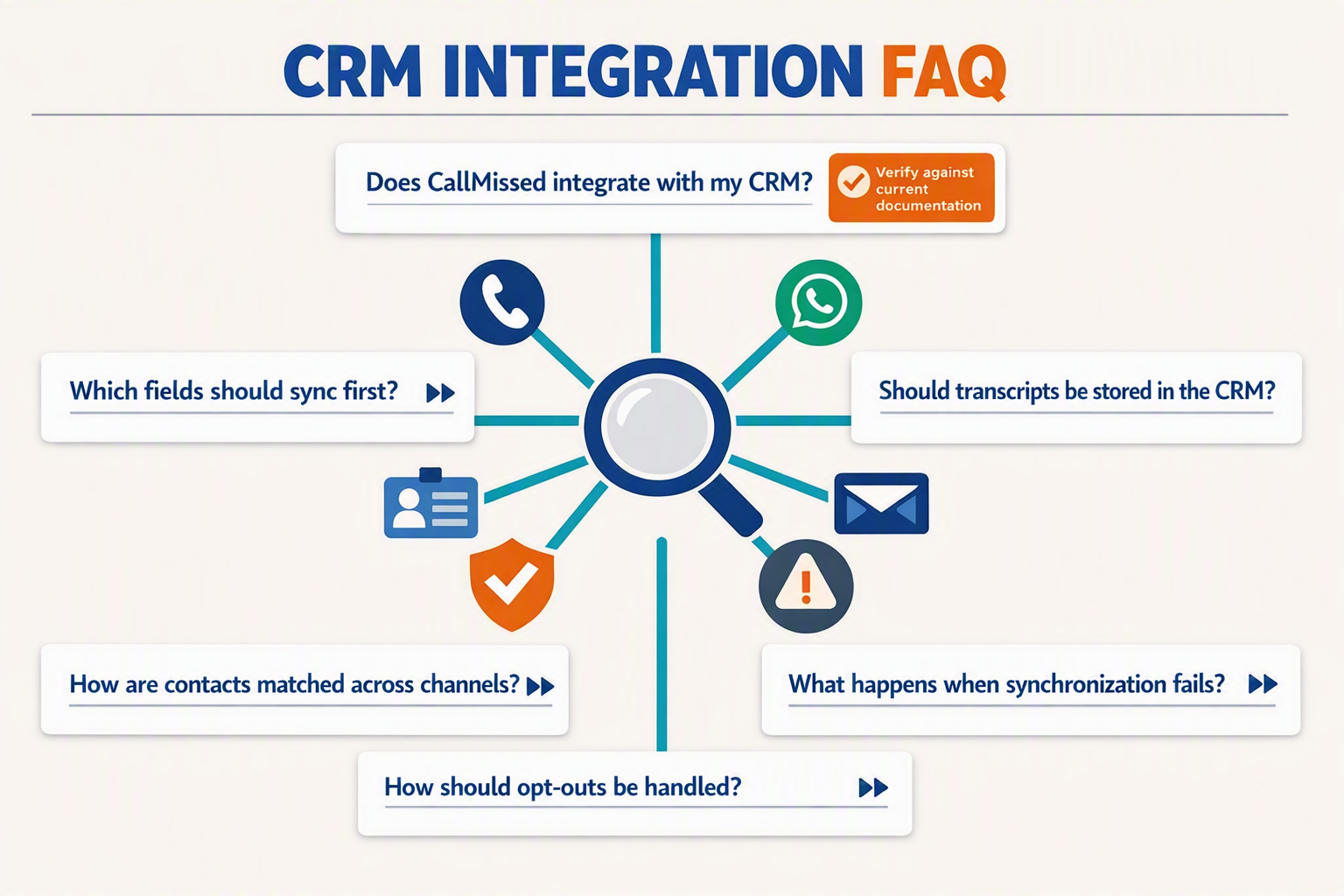
What data should a CallMissed CRM integration synchronize across voice, WhatsApp, and email?
How should CallMissed CRM integration match customer identities without creating duplicate records?
How should an AI agent CRM integration create and store conversation summaries?
How should an omnichannel CRM handle lead stages and ownership changes?
How should consent and opt-outs work across WhatsApp, voice calls, and email?
What should businesses verify before deploying CallMissed with an existing CRM?
Conclusion
A reliable CallMissed CRM integration should create one governed customer record—not simply move transcripts between systems. The result is an omnichannel CRM where human teams and AI agents can continue conversations across voice, WhatsApp, and email without losing context or customer choice.
- Synchronize durable facts: canonical customer IDs, verified contact points, consent status, language preference, owner, lead stage, outcomes, and promised follow-ups.
- Preserve evidence: retain source IDs, timestamps, delivery states, confidence scores, and links to underlying events so AI-generated summaries never replace the original record.
- Match identities cautiously: prioritize deterministic identifiers, use fuzzy matching only with safeguards, and route uncertain duplicates to a human merge-review queue.
- Design for governance and failure: propagate opt-outs, enforce role-based permissions, and test webhook signatures, idempotency, retries, partial writes, outages, deletion behaviour, and auditability.
The business case is clear: 79% of customers expected consistent interactions across departments, according to Salesforce’s 2023 State of the Connected Customer survey. A well-designed AI agent CRM integration turns that expectation into an operational capability.
Looking ahead, watch whether integrations can maintain accurate identity, consent, and lead-stage state as interaction volumes and AI autonomy increase. To explore this evolution, visit CallMissed, a platform unifying AI voice, WhatsApp, email, and customer engagement. Is your CRM ready to become a trustworthy operational memory rather than another disconnected database?
Related Reading
Discussion
Related Posts

Ready to automate customer conversations?
Launch AI voice agents and WhatsApp bots with CallMissed — one API, 22+ Indian languages.