
AI Voice Agent for Home Services: 2026 Plumbing, HVAC & Electrical Guide


Learn how an AI voice agent for home services captures after-hours calls, triages urgency, books jobs and hands off dispatch safely.
AI Voice Agent for Home Services: 2026 Plumbing, HVAC & Electrical Guide
What happens when a homeowner with a burst pipe calls at 2:00 a.m.—and nobody answers? An AI voice agent for home services can respond immediately, identify the problem, verify the address and service area, assess urgency, and either book a visit or escalate the caller to an on-call technician. For plumbing, HVAC, and electrical companies, that capability can turn an expensive missed call into a structured, dispatch-ready job.
The timing matters. The U.S. Bureau of Labor Statistics projected in 2024 that employment would grow by 6% for plumbers, 9% for HVAC technicians, and 11% for electricians from 2023 to 2033—all faster than the average for every occupation. As demand rises, many contractors still depend on technicians, office staff, or outsourced operators to answer unpredictable call volumes. Traditional coverage can become especially difficult during nights, weekends, weather events, and seasonal HVAC surges.
Modern voice AI goes beyond taking a name and phone number. A properly configured plumber answering service can ask whether water is actively flowing, provide approved shut-off instructions, distinguish a blocked sink from a major leak, and alert the correct technician. HVAC call automation can determine whether the customer has no heating or cooling, collect equipment details, check warranty or membership status, and avoid promising an appointment outside the company’s coverage area.
What this 2026 guide will cover
You will learn how to design an AI call workflow that can:
- Capture after-hours opportunities without pretending every request is an emergency.
- Validate service areas using postcodes, pin codes, cities, or configurable travel zones.
- Triage urgency safely, including electrical hazards, gas smells, flooding, and vulnerable occupants.
- Separate estimates from confirmed bookings, so callers understand what has—and has not—been promised.
- Hand off to dispatchers or technicians with a concise transcript, customer details, and escalation reason.
- Send WhatsApp or email follow-ups containing appointment information, preparation steps, and rescheduling options.
- Measure performance through answer rate, booking rate, escalation accuracy, abandonment, latency, and cost per booked job.
Platforms such as CallMissed reflect this shift by combining AI voice agents with WhatsApp Business calling, automated follow-up, and multilingual speech support across 22 Indian languages.
This guide also provides practical scripts, implementation safeguards, and KPI frameworks. The goal is not to remove human judgment; it is to ensure every call receives a fast, consistent response while technicians and dispatch teams retain control over safety-critical decisions.
What should an AI voice agent for home services do in 2026? Capture, qualify, book and hand off every call
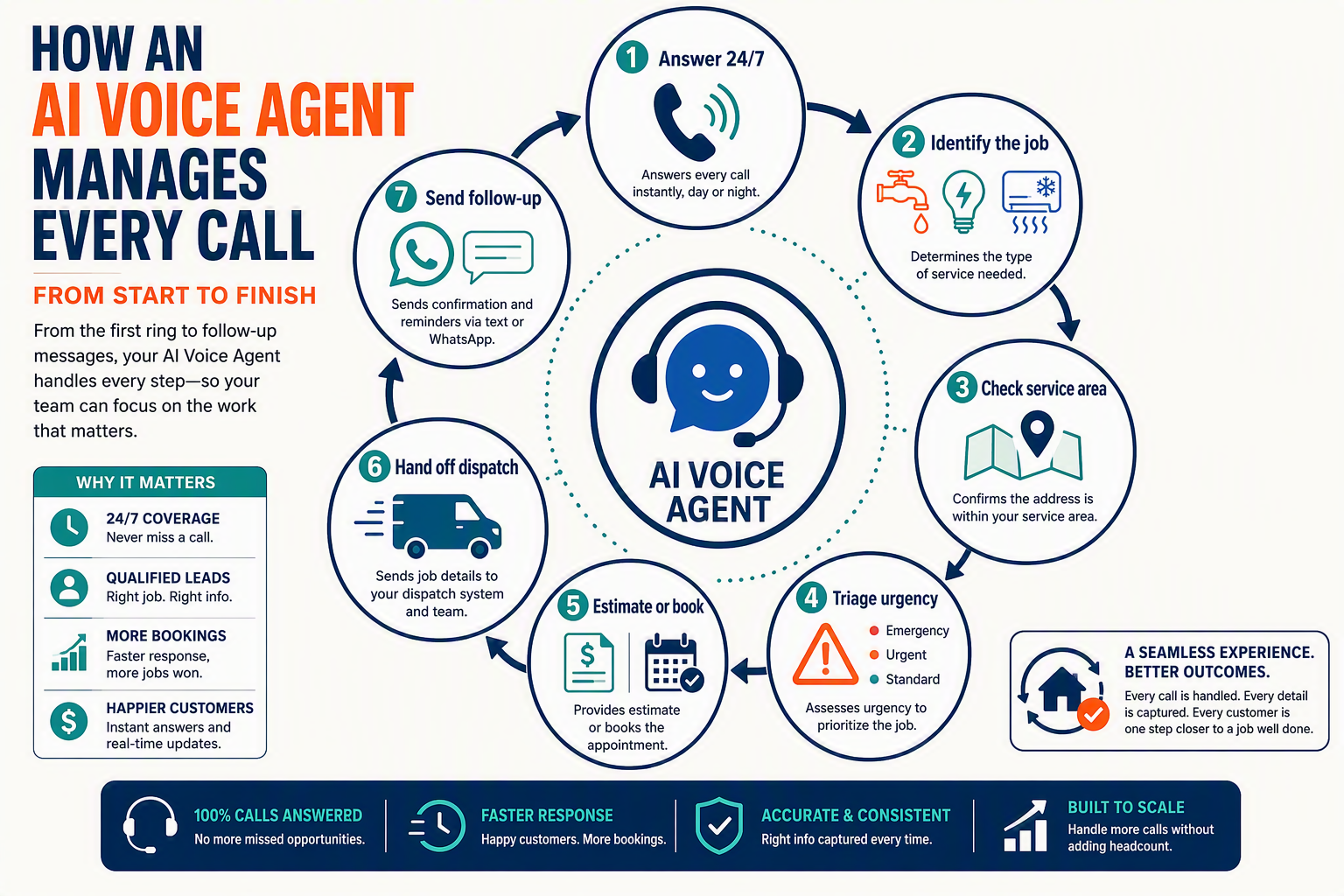
An AI voice agent for home services should convert an unstructured phone conversation into a safe, dispatch-ready record. In 2026, that means answering immediately, collecting the right details, applying service and urgency rules, scheduling only when authorized, and transferring exceptions with full context.
1. Capture the complete request
Whether operating as a plumber answering service or supporting electrical and HVAC calls, the agent should identify the caller’s intent before starting a rigid questionnaire. It must capture:
- Customer name, callback number, and preferred contact channel
- Service address, postcode or pin code, and property type
- Problem description, affected equipment, and when the issue began
- Whether the caller is an existing customer, member, tenant, landlord, or property manager
- Access constraints, pets, parking instructions, and availability
- Recording consent and any disclosures required by applicable law
If a call disconnects, the system should retain collected fields and trigger an approved callback, WhatsApp message, or email rather than forcing the customer to restart.
2. Qualify serviceability and urgency
Qualification should happen against business rules, not the language model’s intuition. The agent should check the address against configured cities, postcodes, radius zones, technician territories, service types, opening hours, and equipment restrictions.
Urgency triage requires a separate safety path. Phrases such as “smell of gas,” “sparking panel,” “water near electricity,” “carbon-monoxide alarm,” or “uncontrolled flooding” should trigger approved emergency instructions and immediate escalation. The agent must never improvise repair guidance or represent itself as an emergency service.
Recommended outcomes include:
- Emergency handoff: Transfer to the on-call technician or instruct the caller to contact the relevant emergency authority.
- Priority dispatch: Place the request in an urgent queue with a defined response target.
- Routine appointment: Offer eligible calendar slots.
- Unsupported request: Explain the limitation and follow the company’s referral policy.
3. Distinguish estimates from confirmed bookings
A frequent automation failure is presenting an indicative price or appointment request as a guarantee. HVAC call automation should clearly label each outcome:
- An estimate is a non-binding range based on the information provided and may change after diagnosis.
- A diagnostic-fee quote states the approved call-out charge and applicable conditions.
- A booking request awaits dispatcher or technician confirmation.
- A confirmed booking exists only after the scheduling system reserves an eligible slot and returns a confirmation identifier.
The agent should repeat the date, arrival window, address, fee terms, and cancellation policy before the caller accepts. Prices must come from an approved rate table or business system—not from model-generated calculations.
4. Hand off without making the customer repeat everything
Human escalation should include a structured summary, not merely a transcript. Send the dispatcher:
- Customer and location details
- Service-area result
- Issue summary and urgency classification
- Safety signals and escalation reason
- Promises already communicated
- Requested or confirmed appointment window
Against the skilled-trade demand growth documented by the U.S. Bureau of Labor Statistics in 2024, this workflow helps scarce technicians focus on diagnosis and fieldwork. The correct 2026 design principle is simple: automate routine coordination, but preserve human authority over safety, exceptions, pricing discretion, and dispatch decisions.
Why are plumbers, electricians and HVAC teams moving beyond a traditional plumber answering service?
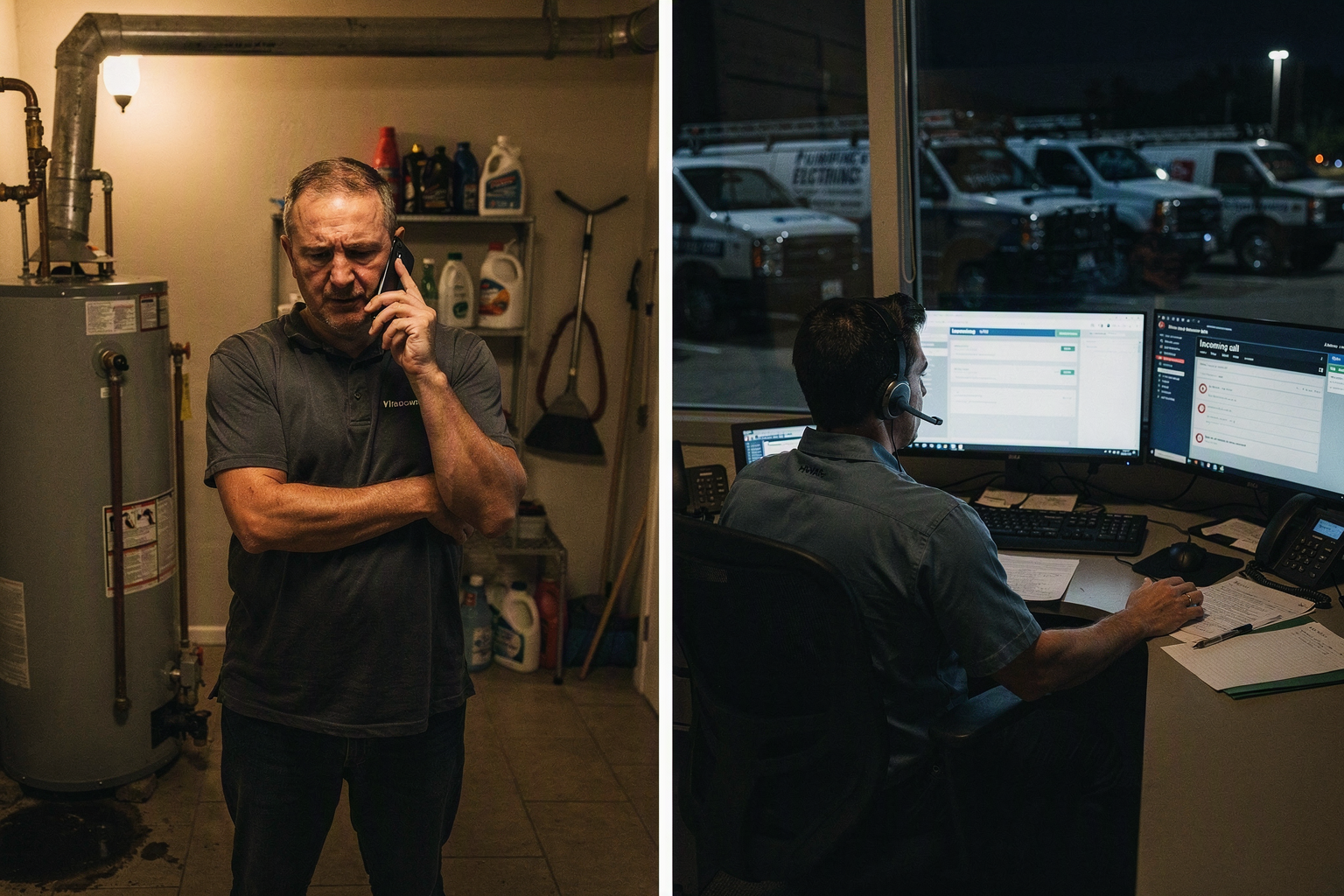
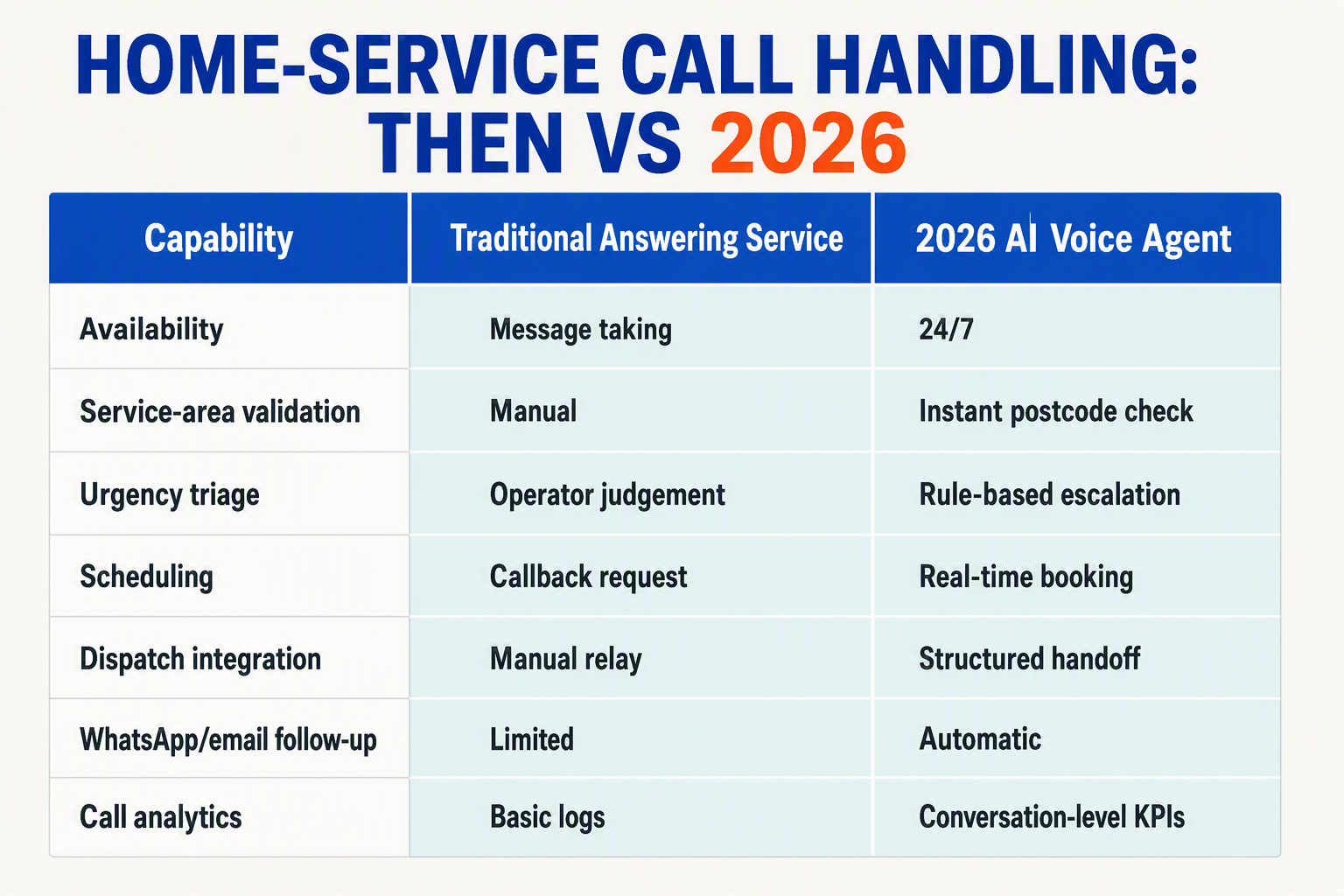
Plumbers, electricians and HVAC teams are moving beyond traditional answering services because they need more than message-taking: they need real-time qualification, policy-aware scheduling and structured dispatch data. Human operators remain valuable for complex or sensitive cases, but an AI voice agent for home services can handle routine calls consistently and escalate exceptions to the right person.
Traditional coverage often stops at taking a message
A conventional plumber answering service typically records the caller’s contact details, summarizes the issue and forwards a message. That provides basic availability, but the office or on-call technician may still need to call back to determine:
- Whether the address is inside the company’s service area.
- Whether the situation is urgent, routine or unsafe.
- Which trade, skill level or equipment the job requires.
- Whether the caller wants an estimate or an actual appointment.
- Whether a technician, dispatcher or emergency service should respond.
Every extra callback creates another opportunity for delay, voicemail or duplicated data entry. By contrast, voice AI can apply the company’s approved decision tree during the first conversation and send a structured record directly to dispatch or customer relationship management software.
Demand growth makes consistency more important
Home-service demand is growing while qualified field labour remains constrained. The U.S. Bureau of Labor Statistics projected in 2024 that employment from 2023 to 2033 would increase by 6% for plumbers, 9% for HVAC technicians and 11% for electricians.
That growth creates an operational challenge: technicians generate revenue in the field, but incoming calls interrupt installations, repairs and travel. Hiring enough office staff to cover ordinary demand plus nights, weekends and weather-driven spikes can also be difficult.
HVAC call automation helps absorb variable call volume without requiring every call to interrupt a technician. Multiple conversations can be processed using the same service-area, scheduling and escalation rules, while human staff focus on exceptions.
AI turns conversations into operational workflows
The key difference is not simply that software answers the phone. It is what happens before the call ends. A production-ready agent can:
- Identify intent: repair, maintenance, installation, estimate, warranty query or appointment change.
- Collect job context: property type, equipment details, symptoms and access constraints.
- Apply business rules: operating hours, postcode coverage, membership priority and technician availability.
- Set accurate expectations: distinguish a provisional estimate request from a confirmed booking.
- Trigger the next action: book, create a callback task, alert dispatch or transfer the caller.
The resulting handoff can contain the caller’s name, verified address, issue category, urgency level, preferred time and conversation transcript. Dispatchers receive usable information rather than an unstructured note such as “customer needs urgent help.”
The strongest model is hybrid, not fully autonomous
Voice AI should not make unrestricted safety or pricing decisions. Gas odours, sparking electrical panels, severe flooding and medically vulnerable occupants require explicit escalation rules and approved language.
A practical hybrid model assigns work according to risk:
- AI handles: common questions, intake, service-area validation and permitted bookings.
- Humans handle: ambiguous hazards, unusual pricing, complaints and high-value exceptions.
- Emergency services handle: situations that company policy identifies as immediate threats to life or property.
Moving beyond a traditional answering service therefore means giving every call a defined operational outcome—not removing human judgment from the process.
Which 2026 developments are changing plumber answering services and HVAC call automation?
The biggest 2026 change is the move from scripted call answering to tool-connected, multilingual agents that can validate, triage, schedule and follow up during one conversation. A modern AI voice agent for home services should make bounded operational decisions while escalating safety risks and uncertain cases to humans.
Six developments reshaping call handling
| 2026 development | What the voice agent can do | Home-service example | Required safeguard |
|---|---|---|---|
| Real-time system integration | Read approved availability and create structured records in CRM, scheduling or dispatch software | Offer an HVAC diagnostic slot based on the live calendar | Confirm the date, time, address and booking status aloud |
| Geospatial service-area checks | Validate postcode, pin code, city or distance-based coverage before scheduling | Reject or route a plumbing request outside the normal travel zone | Allow manual exceptions for high-value or emergency jobs |
| Structured urgency triage | Convert caller descriptions into predefined severity levels | Distinguish a dripping tap from uncontrolled flooding | Escalate gas smells, electrical arcing and immediate danger |
| Context-aware conversations | Retain equipment, symptom and customer details across the call | Ask an HVAC caller about system type, error code and vulnerable occupants | Avoid diagnosing faults or guaranteeing repair outcomes |
| Omnichannel continuity | Continue the interaction through WhatsApp or email | Send appointment details, preparation steps and a rescheduling option | Obtain consent and protect sensitive customer information |
| Quality and confidence controls | Track latency, tool failures, transcripts and low-confidence responses | Transfer when an address cannot be verified or speech is unclear | Preserve transcripts, escalation reasons and human override |
Why integration matters more than a natural-sounding voice
Earlier automation frequently stopped after collecting contact information. In 2026, useful HVAC call automation depends on whether the agent can safely interact with business systems—not simply whether its speech sounds human.
For example, an integrated workflow can:
- Verify the caller’s postcode against configured service zones.
- Check whether the account has a maintenance membership or warranty note.
- Identify a no-heat request involving an elderly occupant as potentially urgent.
- inspect approved appointment availability.
- Create the job and send a written confirmation.
The distinction between an estimate and a booking is particularly important. An agent may provide an approved call-out fee or a conditional price range, but it should not present that information as a final repair quote. Likewise, collecting a preferred time does not constitute a confirmed appointment unless the scheduling system successfully reserves it.
Multilingual and WhatsApp-native service becomes practical
Regional-language support is becoming an operational requirement rather than an optional interface feature. The U.S. Bureau of Labor Statistics projected in 2024 that employment would rise by 6% for plumbers, 9% for HVAC technicians and 11% for electricians between 2023 and 2033, increasing the need for scalable customer intake as service demand and workforce pressure grow.
For Indian businesses, platforms such as CallMissed combine AI voice agents with WhatsApp Business calls and speech support across 22 Indian languages. That architecture allows a plumber answering service to handle a call, transfer urgent cases, and continue non-urgent coordination through WhatsApp without forcing the customer to restart the conversation.
The practical 2026 benchmark is therefore not “Can the bot answer?” It is: Can the system complete an auditable workflow, communicate exactly what was promised, and bring in a human before uncertainty becomes risk?
How should after-hours capture, service-area checks, urgency triage and dispatch handoff work?
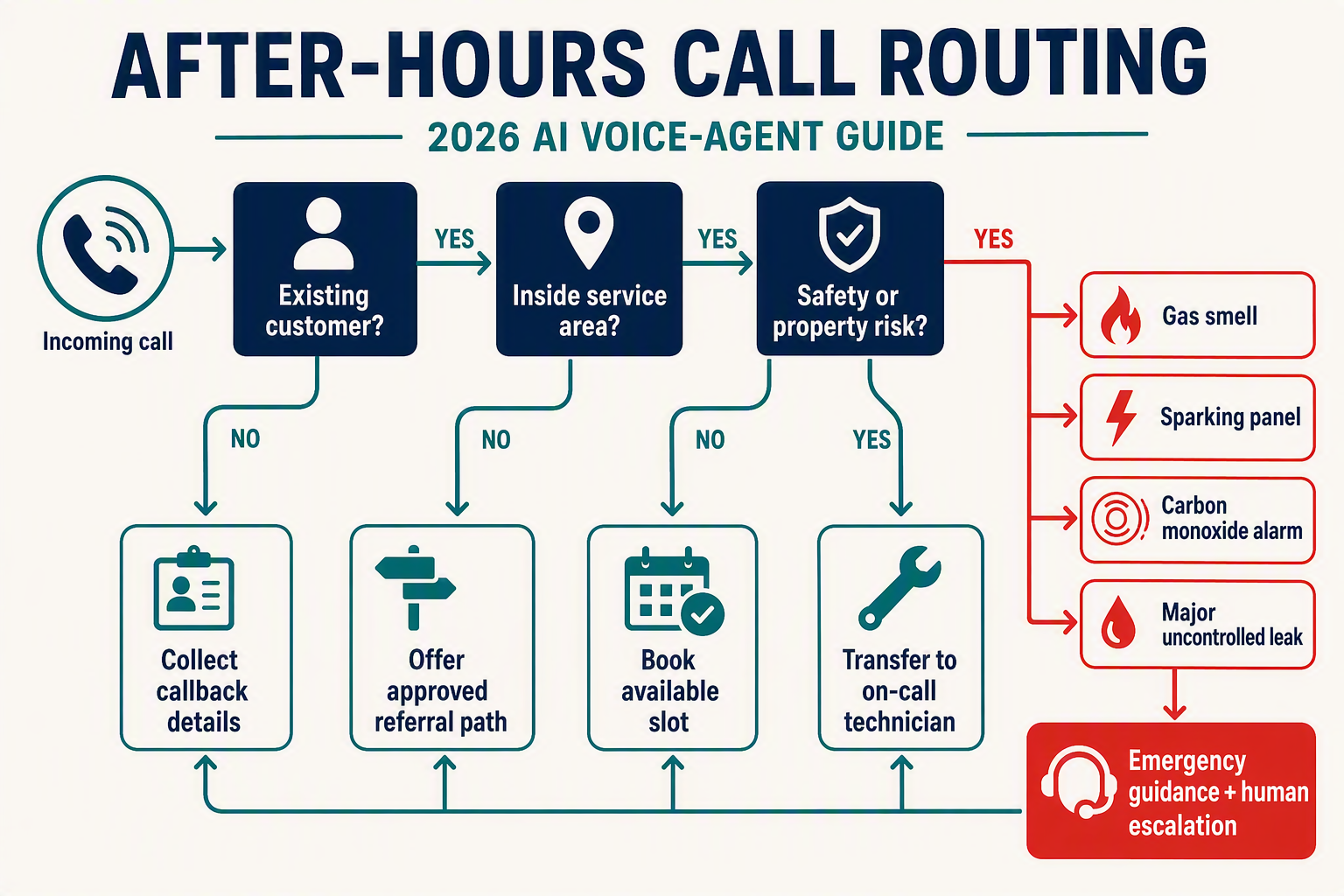
An AI voice agent for home services should follow a deterministic sequence: capture the caller, validate where the job is located, identify safety risks, determine whether booking is permitted, and send dispatch a structured handoff. It should never imply that leaving a message, receiving an estimate, and securing a confirmed appointment are the same outcome.
1. Capture the after-hours call
The agent should first disclose that it is an automated assistant and determine whether the caller is an existing customer, a new customer, or a third party such as a tenant. A reliable plumber answering service or electrical agent should collect:
- Customer name, callback number, and service address
- A plain-language description of the problem
- Whether the issue is happening now or can wait
- Property type, access constraints, and preferred appointment window
- Membership, warranty, landlord, or property-management details
- Consent to receive confirmation by SMS, WhatsApp, or email
The workflow must use the business’s timezone and actual on-call schedule. “After hours” at 8:00 p.m. on Friday may trigger emergency dispatch, while the same issue at 6:30 a.m. on Monday may qualify for the first standard slot.
2. Check the service area before offering availability
Location validation should happen before pricing or appointment promises. The agent can normalize the address and compare the postcode, ZIP code, pin code, city, or coordinates against configurable zones.
The result should produce one of three outcomes:
- In area: Continue to triage and booking.
- Conditional area: Explain possible travel charges or request dispatcher approval.
- Out of area: Decline politely without creating an appointment, then offer an approved referral path if available.
This prevents HVAC call automation from booking a technician into an unsupported territory simply because the calendar contains an open slot.
3. Triage urgency with explicit safety rules
Triage should classify the call rather than diagnose the equipment. Example levels include:
- Immediate safety escalation: Suspected gas leak, smoke, sparking equipment, electric shock, or carbon-monoxide alarm.
- Emergency dispatch review: Active flooding, sewage backup, total heat loss in dangerous weather, or an outage affecting medically necessary equipment.
- Priority service: No cooling, repeated breaker trips, a failed water heater, or a contained leak.
- Routine booking: Preventive maintenance, minor dripping, inspections, and replacement estimates.
For immediate hazards, the agent should use company-approved language directing the caller to leave the area or contact emergency services where appropriate—not improvise repair instructions. The U.S. Bureau of Labor Statistics projected in 2024 that electrician employment would grow 11% from 2023 to 2033, reinforcing the need to reserve scarce technician capacity for correctly classified work.
4. Separate estimates from confirmed bookings
The agent must label each outcome precisely:
- Estimate request: A request for pricing that still requires review or an on-site diagnosis.
- Provisional window: A preferred time awaiting dispatcher approval.
- Confirmed booking: A slot successfully written to the scheduling system with a reference number.
- Emergency escalation: A request sent to the on-call technician, not a guaranteed arrival time.
5. Give dispatch a decision-ready handoff
The handoff should contain the caller’s contact details, validated address, issue summary, urgency level, safety flags, equipment information, transcript, promised next step, and recording or consent status. For urgent calls, the system should attempt the on-call technician, retry according to policy, and escalate to a backup person if unanswered—while telling the customer exactly what will happen next.
When should the agent give an estimate, book a job or request a human callback?
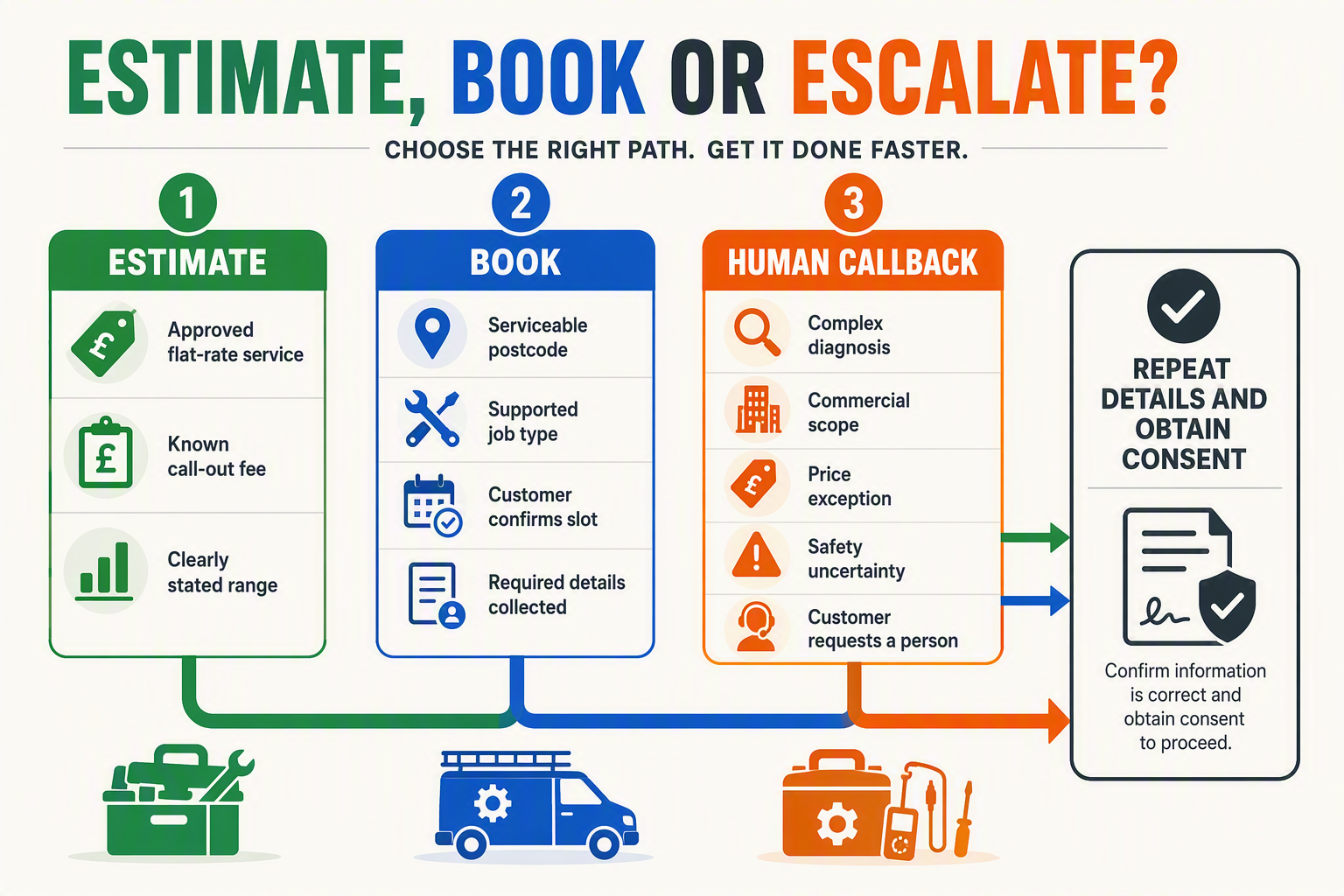
An AI voice agent for home services should give an estimate only from approved pricing rules, confirm a booking only when availability and eligibility are verified, and request a human callback whenever safety, diagnosis, scope, or price remains uncertain. The agent must never present a preliminary range as a guaranteed quote.
Use a three-path decision policy
Every qualified call should end in one of three clearly labelled outcomes:
- Estimate: Provide a non-binding price range when the job matches a standard service category and the company has approved pricing data.
- Booked job: Reserve a real appointment when the customer, location, job type, and live calendar satisfy all booking rules.
- Human callback: Route the case to a dispatcher, estimator, or technician when responsible automation requires more information or judgment.
This discipline becomes more important as call volumes grow. The U.S. Bureau of Labor Statistics projected in 2024 that employment would increase from 2023 to 2033 by 6% for plumbers, 9% for HVAC technicians, and 11% for electricians, indicating sustained demand across these trades.
When the agent can provide an estimate
A plumber answering service or HVAC agent can state a range when the business has configured:
- An approved price book for a recognizable service, such as drain cleaning or an HVAC tune-up.
- Defined call-out, diagnostic, after-hours, and travel fees.
- Variables the agent can reliably collect, including equipment type, postcode, access conditions, and service timing.
- Required disclaimers explaining that inspection may change the final price.
For example: “Based on the information provided, the approved estimate is ₹2,000–₹3,000, excluding replacement parts. The technician will confirm the final price after inspection.”
The agent should not estimate rewiring, concealed pipe damage, major equipment replacement, code-compliance work, or other jobs whose scope cannot be established by phone.
When the agent should book immediately
HVAC call automation can create a confirmed appointment when all operational checks pass:
- The address is inside the supported service area.
- The requested work is an accepted job category.
- The customer agrees to disclosed diagnostic or call-out fees.
- A suitable technician and genuine calendar slot are available.
- No unresolved hazard requires emergency escalation.
- The scheduling system returns a booking ID or other confirmation.
The agent should then repeat the date, arrival window, address, fee terms, and cancellation policy. A booking is not confirmed merely because the caller requested a time; the calendar or dispatch platform must successfully reserve it.
When human judgment is required
The agent should request or initiate a human callback for:
- Safety-critical ambiguity, such as burning smells, sparking panels, suspected gas leaks, or uncontrolled flooding.
- Custom or high-value work, including full HVAC replacement, repiping, panel upgrades, and renovation estimates.
- Diagnosis uncertainty after the approved question sequence.
- Pricing exceptions, warranty disputes, financing requests, or demands for a fixed quote.
- Scheduling conflicts, inaccessible calendars, specialist requirements, or no eligible slot.
- Upset or vulnerable callers who need reassurance or discretionary support.
The handoff should include the transcript, contact details, service address, urgency level, symptoms, estimate status, and promised callback window. The closing language must remain precise: “I have requested a technician callback within 20 minutes” is accurate; “A technician is on the way” is not unless dispatch has confirmed it.
Which call scripts produce clear bookings and useful WhatsApp or email follow-up?
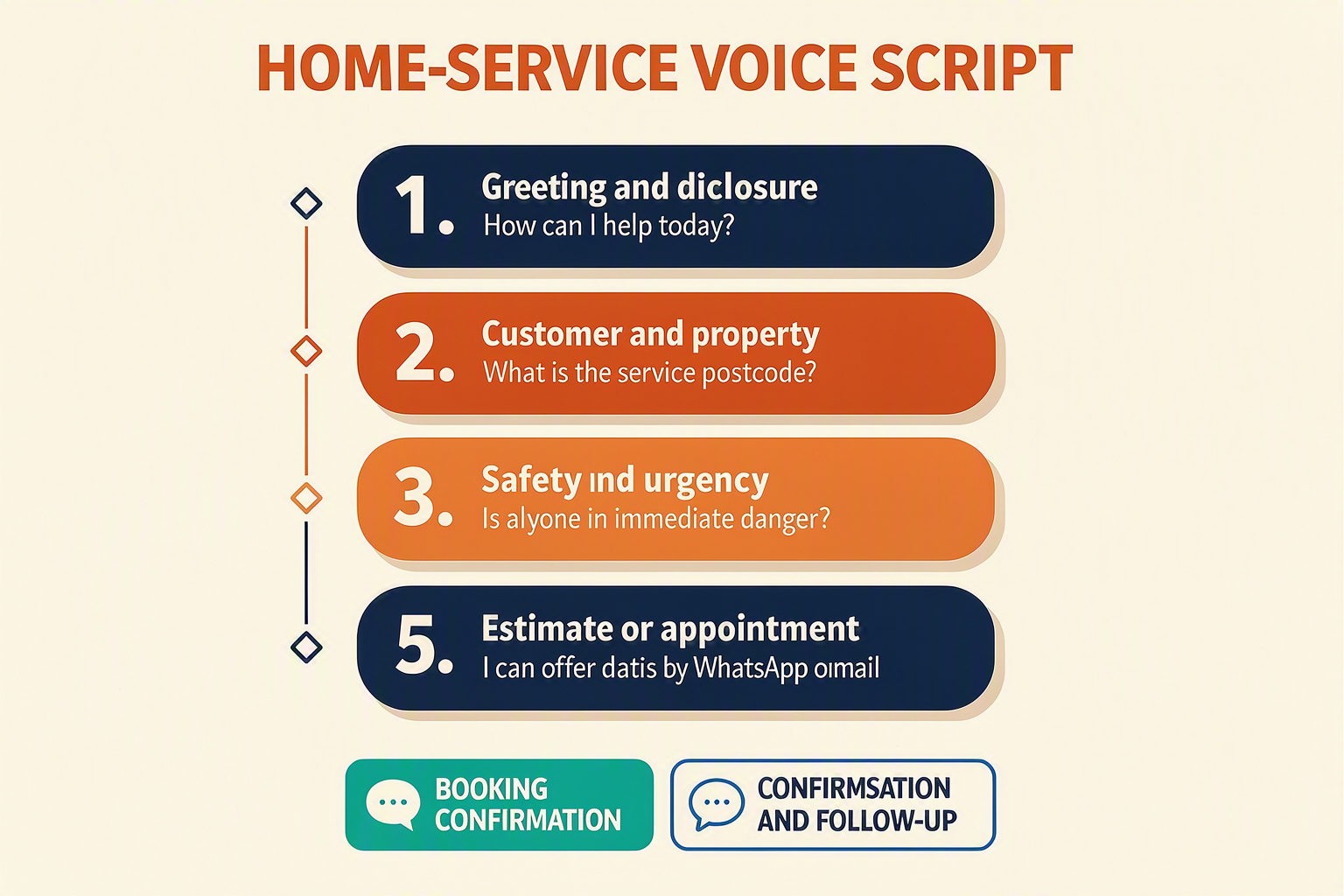
The clearest call scripts use one question at a time, confirm critical details aloud, and explicitly distinguish a confirmed booking from an estimate request or callback. Every follow-up should then summarize the outcome, address, time window, charges disclosed, and next action without introducing promises that were not made on the call.
Use a structured booking script
An AI voice agent for home services should sound conversational while following a fixed data sequence:
- Identify the request: “Tell me briefly what is happening.”
- Check immediate risk: “Do you smell gas, see sparks, or have water near electrical equipment?”
- Capture the location: “What is the full service address and postcode?”
- Collect job details: Ask about the affected system, when the issue began, and relevant equipment or property information.
- Confirm contact details: Repeat the caller’s name, mobile number, and email address.
- Offer only available slots: “I can offer Tuesday between 10:00 a.m. and noon.”
- State the outcome: “Your appointment is confirmed,” or, “Your request has been sent for review; this is not yet a confirmed appointment.”
A plumber answering service might ask: “Is water actively flowing now, and can you safely access the main shut-off valve?” An HVAC call automation workflow could ask: “Is the system completely off, running without heating or cooling, or making an unusual sound?” These constrained choices generate more useful dispatch data than a vague prompt such as “How can we help?”
Separate estimates, diagnostic visits, and bookings
Pricing language must prevent an indicative figure from becoming an unintended promise. Use explicit labels:
- Confirmed booking: “Your diagnostic visit is booked for Friday, 1:00–3:00 p.m.”
- Estimate request: “A technician will review the information and contact you with the next step. No visit is booked yet.”
- Callout fee: “The visit has a ₹___/$___ callout fee. Repairs and parts are quoted separately.”
- Price range: “The preliminary range is ___ to ___, subject to inspection; it is not a final quote.”
- Escalation: “I cannot safely diagnose this by phone, so I am connecting you to the on-call team.”
The agent should request a verbal confirmation—“Would you like me to book that slot?”—before writing to the calendar. It should then read back the date, arrival window, address, fee policy, and cancellation terms.
Make WhatsApp and email follow-up operational
Ask permission and channel preference directly: “May I send the appointment details and service updates by WhatsApp or email?” Platforms such as CallMissed can connect voice workflows with WhatsApp follow-up, including businesses using WhatsApp Business calling and multilingual conversations.
A useful confirmation message should contain:
- Customer name and job reference
- Service address and reported problem
- Booking status: confirmed, pending review, or estimate requested
- Date and arrival window, including the time zone
- Disclosed callout or diagnostic fee
- Safe preparation instructions approved by the business
- Reschedule, cancel, or contact options
For example: “Booking CM-1842 is confirmed for 3 August, 2:00–4:00 p.m., at 18 Lake Road. Reported issue: AC running but not cooling. Diagnostic fee: ₹___, excluding repairs. Reply RESCHEDULE if the time no longer works.”
Never place passwords, payment-card data, alarm codes, or unnecessary sensitive details in the message. The follow-up should mirror the call record exactly, giving customers a clear receipt and dispatchers a reliable operational summary.
Which KPIs reveal the business impact of home-service call automation?
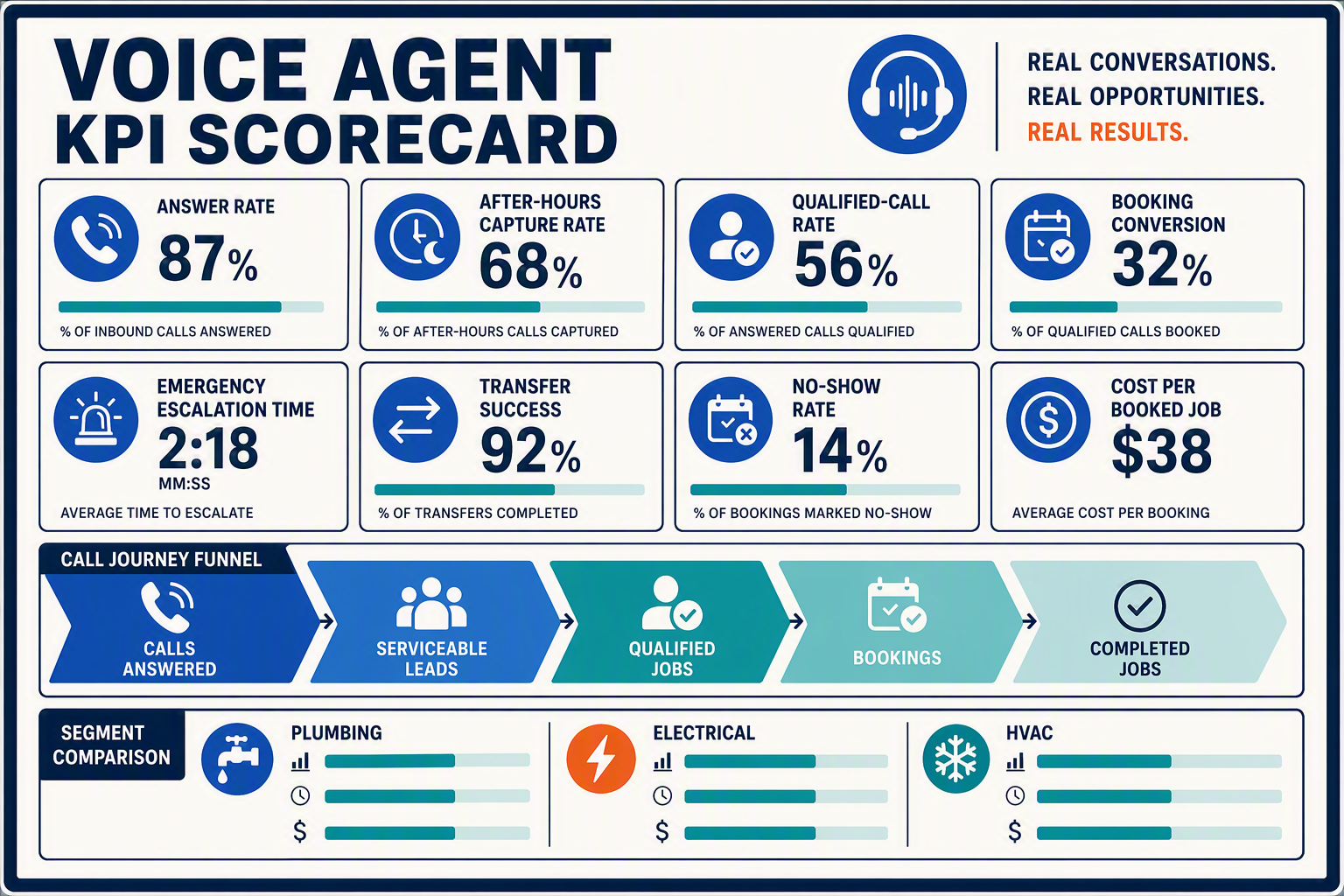
The most revealing KPIs connect call handling to booked, completed and profitable jobs—not merely calls answered. Measure conversion, operational quality, customer experience and safety separately, then compare results by channel, trade, service area and business-hours window.
Start with the revenue funnel
An AI voice agent for home services should be evaluated as a measurable funnel from inbound demand to collected revenue:
- Answer rate: Answered calls ÷ eligible inbound calls. Separate agent failures from callers who disconnect almost immediately.
- Qualification completion rate: Calls completing required fields ÷ answered service enquiries. Required fields may include contact details, location, issue type and urgency.
- Booking rate: Confirmed appointments ÷ qualified, serviceable calls. Do not count estimate requests, messages or promised callbacks as bookings.
- Job completion rate: Completed jobs ÷ AI-booked appointments. This exposes poor qualification, duplicate bookings and no-shows.
- Revenue per qualified call: Collected revenue attributed to calls ÷ qualified calls.
- Cost per booked job: Total voice-AI, telephony and support costs ÷ confirmed bookings.
For example, suppose HVAC call automation handles 1,000 eligible calls, answers 940, identifies 700 serviceable opportunities and books 420 appointments. The answer rate is 94%, while the booking rate among qualified calls is 60%. Reporting only “420 bookings” hides where the remaining demand was lost.
Isolate after-hours impact
After-hours performance should not be blended into the daytime average. Track nights, weekends and holidays as distinct cohorts using:
- After-hours capture rate: Qualified after-hours enquiries ÷ eligible after-hours calls.
- Incremental bookings: AI-booked jobs that would otherwise have entered voicemail or gone unanswered.
- Next-day recovery rate: Unbooked callers successfully contacted the following business day.
- Emergency dispatch rate: Valid emergency escalations ÷ qualified after-hours calls.
- Revenue from after-hours jobs: Completed-job revenue originating outside staffed hours.
Compare these figures with a four-to-eight-week pre-automation baseline where possible. Attribution should remain conservative: a captured call is not incremental revenue until it produces a completed, paid job.
Measure accuracy, safety and customer experience
A plumber answering service that books frequently but mishandles flooding or sends technicians outside the coverage area is not performing well. Operational KPIs should include:
- Service-area validation accuracy: Correct in-area and out-of-area decisions verified against dispatch records.
- Urgency-triage precision: Calls marked urgent that dispatchers confirm were urgent.
- Urgency-triage recall: Confirmed urgent cases that the agent successfully escalated.
- False-negative escalation rate: Safety-critical calls incorrectly treated as routine.
- Handoff acceptance rate: Escalations accepted by the intended dispatcher or technician.
- Booking correction rate: Appointments later changed because of incorrect duration, trade, location or availability.
- Abandonment rate: Callers disconnecting before resolution.
- Median and 95th-percentile response latency: Both figures matter because averages can conceal disruptive delays.
Review transcripts for electrical hazards, gas smells, active flooding and vulnerable occupants. False-negative safety events require case-level investigation, even when the overall percentage appears small.
Build a decision-ready dashboard
A useful weekly dashboard segments results by plumbing, HVAC and electrical work; business hours versus after-hours; new versus existing customers; language; campaign; and postcode or pin code. Platforms such as CallMissed can combine voice-agent records with WhatsApp or email follow-up, but CRM and dispatch outcomes must still be reconciled to prevent duplicate or inflated attribution.
Avoid a single “automation success rate.” Pair commercial outcomes with quality guardrails, and require sustained improvement across several weeks before changing staffing, scripts or escalation policies.
What safeguards do experts recommend for safe, reliable voice-agent deployment?
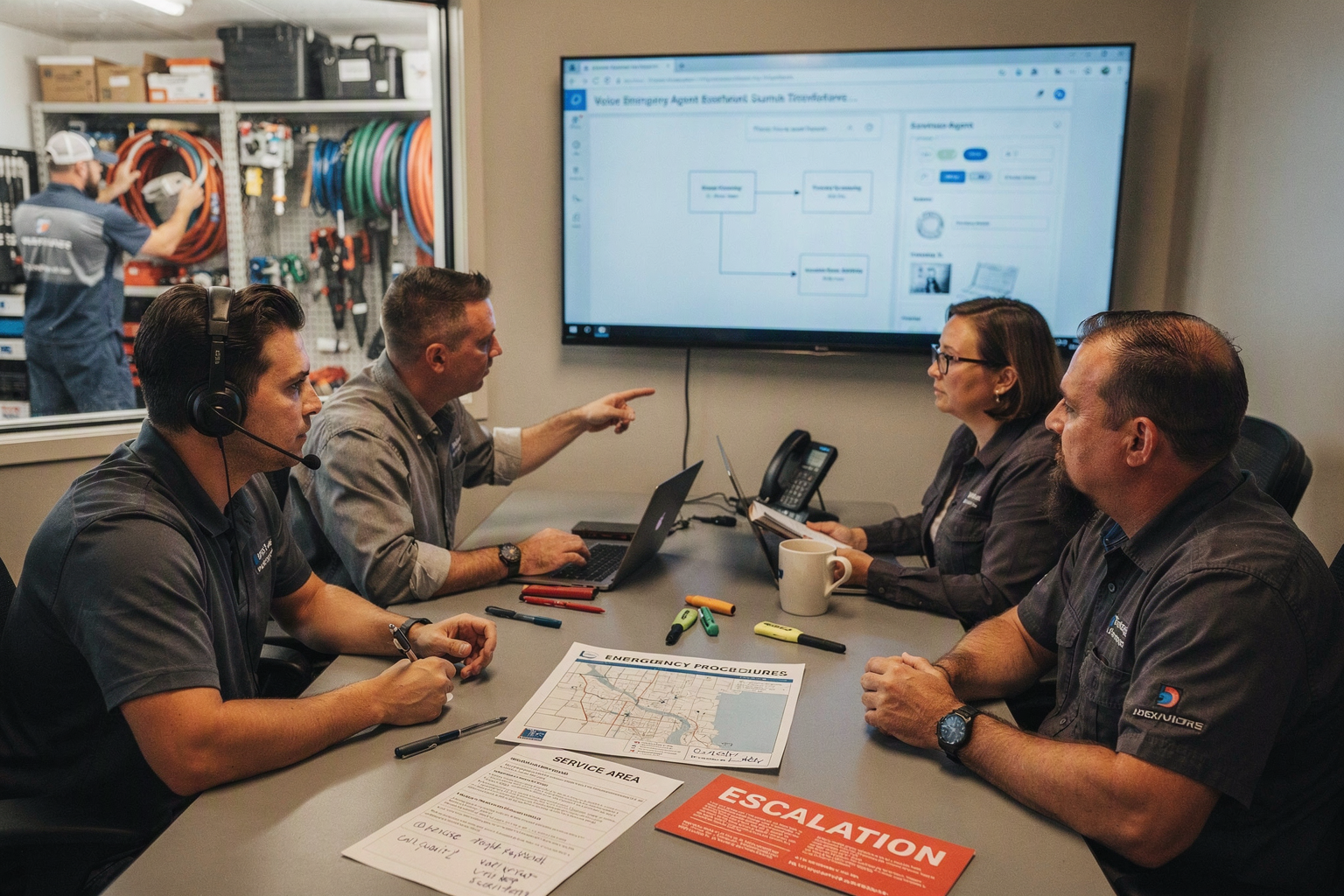
Experts recommend treating an AI voice agent for home services as a controlled intake and routing system—not as an autonomous technician. Safe deployment requires deterministic emergency rules, transparent caller disclosure, restricted permissions, protected data, human handoffs, and continuous testing.
Put safety rules outside the language model
A voice agent may interpret natural language, but high-risk actions should follow fixed business logic. The NIST AI Risk Management Framework 1.0, published in January 2023, organizes AI risk controls around four functions: Govern, Map, Measure, and Manage. NIST’s Generative AI Profile, released in July 2024, further emphasizes human oversight, pre-deployment testing, incident disclosure, and monitoring.
For plumbing, electrical, and HVAC calls, configure non-negotiable escalation triggers:
- Gas smell, smoke, fire, sparking, or suspected carbon monoxide: tell the caller to leave the affected area and contact the appropriate emergency service or utility.
- Water near electrical equipment: prohibit troubleshooting instructions and escalate immediately.
- Flooding or uncontrolled leaks: provide only company-approved isolation guidance, such as locating a shut-off valve.
- Medical danger or trapped occupants: direct the caller to emergency services rather than continuing qualification.
- Uncertain classification: default to a human dispatcher instead of guessing.
The agent must never claim to diagnose equipment conclusively, guarantee safety, or instruct callers to open electrical panels, handle refrigerants, or repair gas appliances.
Disclose automation and control consent
Tell callers early that they are speaking with an automated assistant and explain when recording or transcription occurs. Consent requirements vary by jurisdiction, so businesses should have counsel review the locations they serve.
For outbound reminders and campaigns, consent is especially important. The U.S. Federal Communications Commission ruled on February 8, 2024, that AI-generated voices count as “artificial or prerecorded voices” under the Telephone Consumer Protection Act, making applicable consent and identification requirements relevant to AI calls. Maintain suppression lists, respect opt-outs immediately, and separate service-related notifications from marketing campaigns.
Minimize access to customer and payment data
A plumber answering service or HVAC call automation workflow should collect only information needed to qualify and dispatch the job. Recommended controls include:
- Role-based access for transcripts, recordings, schedules, and customer records.
- Encryption in transit and at rest.
- Configurable retention periods rather than indefinite call storage.
- Redaction of payment details and other sensitive information.
- Audit logs covering bookings, edits, transfers, and outbound messages.
PCI Security Standards Council published PCI DSS version 4.0.1 in June 2024; businesses accepting card data must ensure that their voice, transcription, storage, and payment flows remain within an appropriately secured PCI scope. A safer design is to send callers to a compliant payment link or secure payment system instead of capturing card numbers in conversation.
Test failures, not just successful bookings
Before launch, run adversarial and operational tests covering background noise, accents, interruptions, vague addresses, duplicate bookings, unavailable calendars, API outages, and prompt-injection attempts. Platforms such as CallMissed can support multilingual voice workflows and human handoffs, but each business remains responsible for configuring its own safety policies and escalation contacts.
Monitor false emergency downgrades, incorrect service-area approvals, failed transfers, booking errors, latency, abandoned calls, and opt-out failures. Review incident transcripts regularly, version every script, and maintain a kill switch that routes all calls to staff or voicemail when reliability falls below an approved threshold.
What does implementation mean for your team, and where can CallMissed fit?
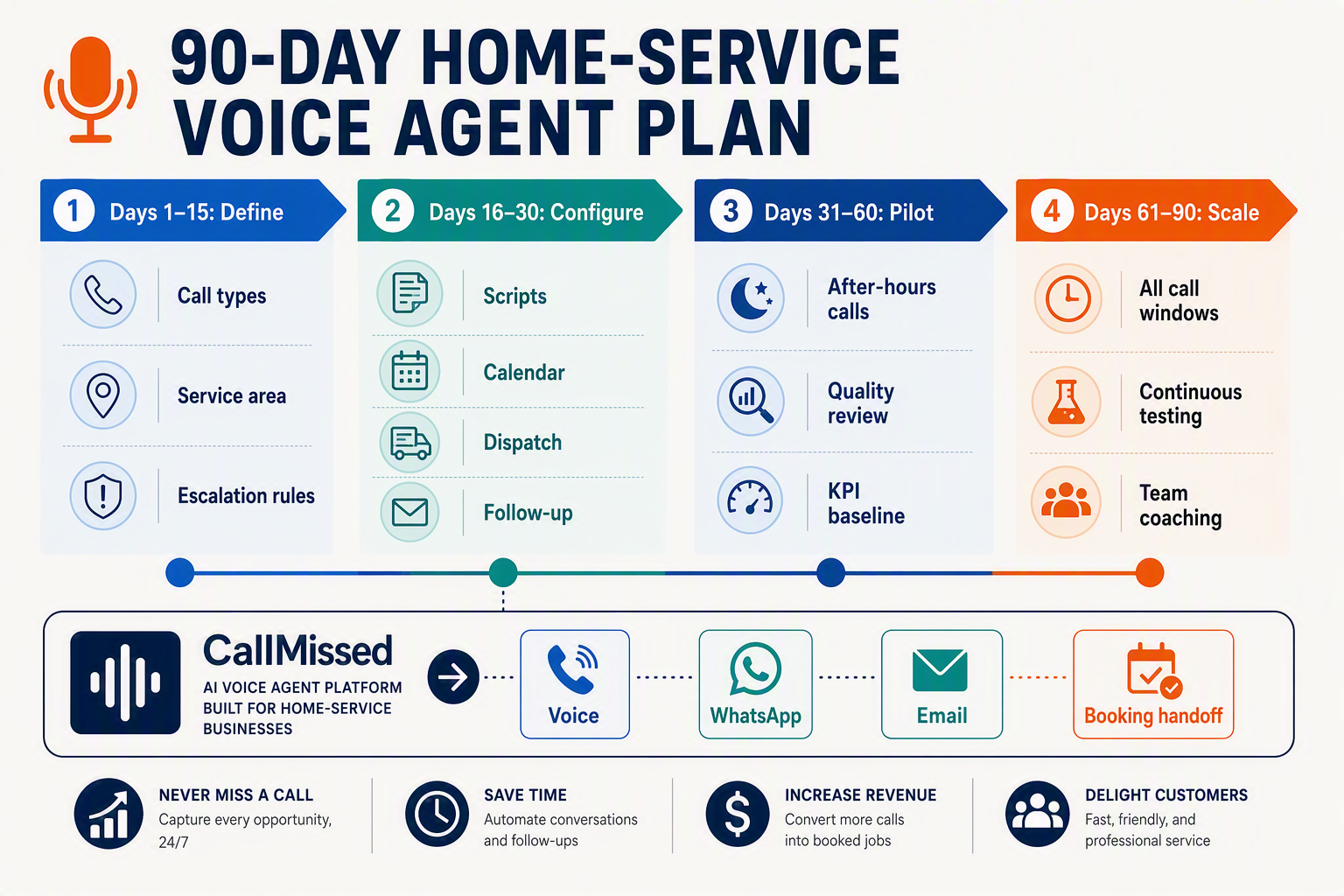
Implementation means converting call-handling policies into controlled workflows with clear ownership, integration tests, escalation rules and measurable acceptance criteria. CallMissed should be considered for a home-service voice agent when a plumbing, HVAC or electrical business needs after-hours answering, service-area qualification, appointment booking, WhatsApp or email follow-up, structured dispatch handoff, multilingual call handling or escalation to staff.
It is best suited to defined workflows rather than unrestricted autonomous dispatch. Teams should retain human control over emergencies, hazardous situations, unusual jobs, estimates and any request the system cannot confidently handle.
Recommended automation boundaries
| Use case | Automation boundary | Validation requirement |
|---|---|---|
| After-hours answering | Collect caller details, summarize the issue and create a callback or approved booking; do not promise an unsupported response time | Test routine, urgent, abandoned and after-hours calls; confirm notifications reach the on-call team |
| Service-area qualification | Check the address or postcode against an approved coverage list | Verify boundary locations, duplicate place names and out-of-area requests |
| Appointment booking | Offer only approved job types, territories, durations and available time slots | Test calendar conflicts, travel buffers, cancellations, rescheduling and duplicate records |
| WhatsApp or email follow-up | Send approved confirmations, preparation instructions, callback links and rescheduling options | Confirm customer consent, message delivery, template accuracy and opt-out handling |
| Structured dispatch handoff | Pass contact details, address, issue category, urgency, transcript or summary and requested time to the designated system or employee | Ensure required fields map correctly and failed handoffs generate visible alerts |
| Multilingual calls | Use supported speech recognition and voice output for approved languages while preserving the same service and safety rules | Review calls with fluent speakers and test addresses, equipment terms, accents and code-switching |
| Human escalation | Transfer or notify staff when the caller requests a person, confidence is low or policy thresholds are met | Test transfers during and outside business hours, including unanswered and failed-transfer paths |
| Emergency or hazardous situations | Follow approved safety scripts and direct the caller to the appropriate human or emergency channel; do not diagnose hazards or improvise technical instructions | Test scenarios involving gas smells, smoke, fire, electrical arcing, flooding, carbon-monoxide concerns and immediate danger |
Where CallMissed can fit
CallMissed can serve as the customer-engagement layer connecting AI voice interactions with WhatsApp, email, web, booking and internal handoff workflows. For home-service companies, it is a practical option when the goal is to:
- Answer and classify inbound calls outside office hours.
- Qualify callers by location, job type and approved service rules.
- Book permitted appointment categories against controlled calendar availability.
- Send WhatsApp or email confirmations and follow-up instructions.
- Create structured handoffs for dispatchers, technicians or on-call staff.
- Support multilingual conversations where the required language and speech quality have been validated.
- Escalate uncertain, sensitive or urgent calls to a human.
CallMissed should not be treated as a substitute for dispatch policy, technical judgment or emergency services. Plumbing, HVAC and electrical calls can involve gas leaks, fire, flooding, exposed wiring, carbon monoxide and other hazards. Those situations require company-approved scripts, immediate escalation rules and clear directions to contact the relevant emergency service when appropriate.
Implementation and team ownership
A safer deployment starts with a representative call audit and a written policy covering service areas, business hours, supported jobs, booking authority and escalation thresholds. The office or service team should approve customer-facing language, while an operations owner should approve workflow changes.
- Shadow mode: Classify and summarize calls without taking customer-facing actions; compare results with dispatcher decisions.
- Assisted mode: Capture information and recommend actions while staff approve bookings, estimates and dispatch.
- Limited autonomy: Enable approved, low-risk appointment types within fixed service areas and calendar rules.
- Expanded production: Add workflows only after reviewing transcripts, booking accuracy, handoff failures and escalation outcomes.
Before production, verify telephony routing, calendar and CRM updates, WhatsApp or email delivery, duplicate prevention, recording and consent requirements, and human fallback availability. Review failed, abandoned and escalated conversations regularly, and maintain versioned scripts and workflow changes. This positions CallMissed as a controlled extension of the service desk rather than an autonomous replacement for experienced dispatchers and technicians.
Frequently asked questions about cost, disclosure, emergencies, integrations and HVAC call automation
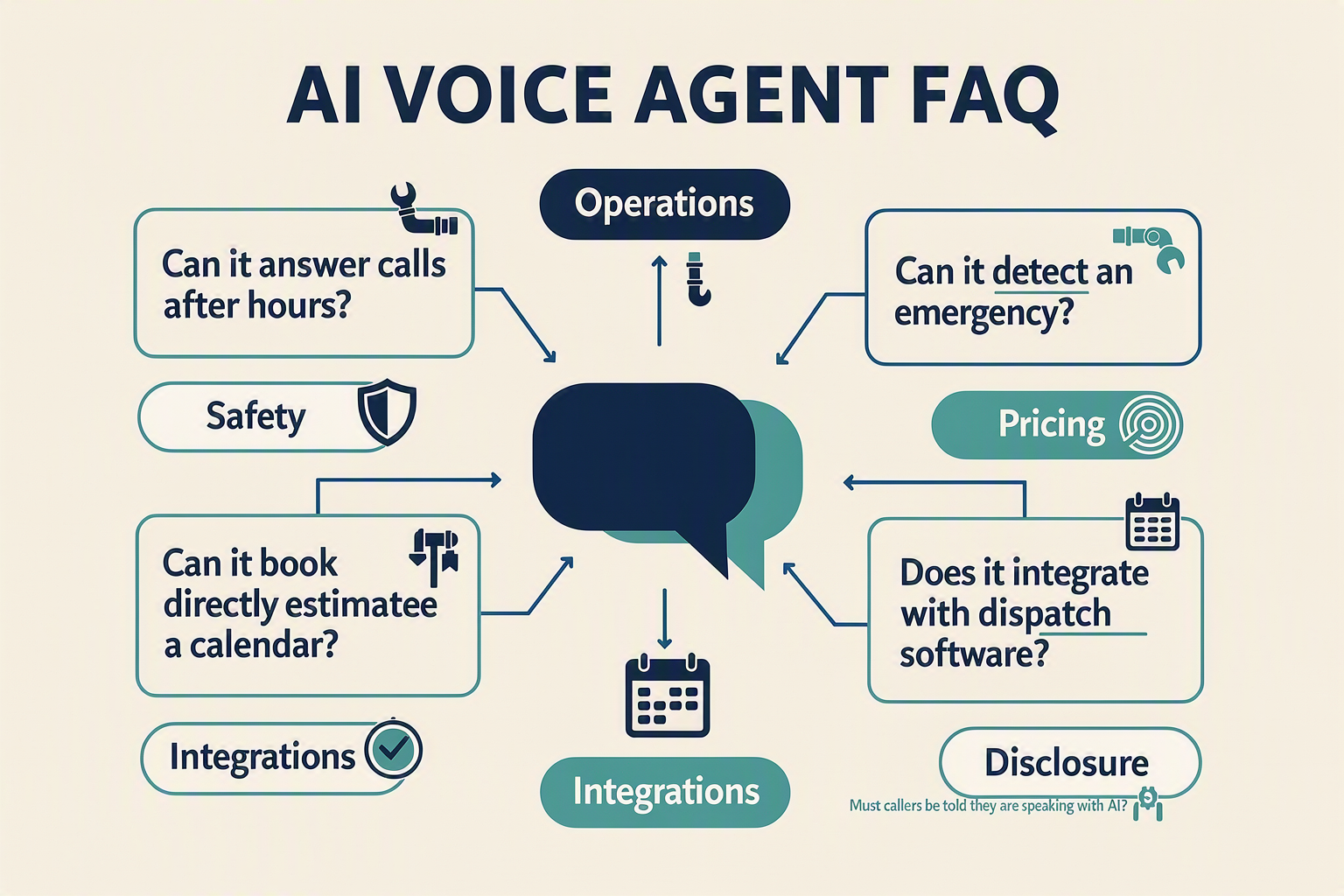
How much does an AI voice agent for home services cost in 2026?
Must an AI voice agent tell callers that they are speaking with AI?
Can a plumber answering service safely handle emergency calls?
Which CRM, calendar and dispatch integrations should an AI voice agent for home services support?
How does HVAC call automation qualify and schedule heating or cooling jobs?
Should an AI agent give a home-service estimate or confirm a booking?
Conclusion
An AI voice agent for home services should give every caller an immediate, structured response while preserving human control over safety, pricing, and dispatch. In 2026, successful plumbing, HVAC, and electrical teams will treat voice AI not as a basic answering service, but as an operational layer connecting qualification, booking, escalation, and follow-up.
- Capture and qualify every call: An effective plumber answering service can identify active flooding, gather contact and property details, offer approved shut-off guidance, and alert an on-call technician. This becomes particularly valuable overnight, on weekends, and during demand spikes.
- Check coverage before making commitments: The agent should verify postcodes, pin codes, cities, or travel zones before offering availability. If an address falls outside the service area, the workflow should explain the limitation clearly rather than creating an appointment that dispatch cannot fulfil.
- Triage risk without replacing expert judgment: Calls involving gas smells, exposed wiring, electrical burning, severe leaks, loss of essential heating, or vulnerable occupants need predefined escalation paths. The agent should communicate approved safety instructions, record the escalation reason, and transfer the caller instead of diagnosing complex hazards.
- Distinguish estimates from bookings: Reliable HVAC call automation must state whether the customer is receiving a preliminary price range, an assessment appointment, or a confirmed service slot. Dispatchers and technicians should receive concise transcripts, equipment details, urgency indicators, and customer expectations, followed by consistent WhatsApp or email confirmations.
Implementation quality will matter as much as conversational fluency. Businesses should monitor answer rate, booking rate, escalation accuracy, abandonment, latency, and cost per booked job, while regularly reviewing transcripts and testing edge cases. The U.S. Bureau of Labor Statistics projected in 2024 that employment from 2023 to 2033 would grow by 6% for plumbers, 9% for HVAC technicians, and 11% for electricians, reinforcing the need for scalable call handling as service demand expands.
What should businesses watch next? More tightly connected voice, dispatch, CRM, WhatsApp, and email workflows—combined with stronger multilingual speech and clearer guardrails. To explore this direction, visit CallMissed, an AI communication infrastructure platform supporting voice agents, WhatsApp Business calling, automated follow-up, and speech across 22 Indian languages.
The practical question is no longer whether AI can answer a service call—it is whether your workflow can turn that conversation into a safe, accurate, dispatch-ready outcome.
Related Reading
Discussion
Related Posts
Ready to automate customer conversations?
Launch AI voice agents and WhatsApp bots with CallMissed — one API, 22+ Indian languages.